Article

Optical Evaluation of Microviscosity in 4-Cyano-4′-n-Octyloxybiphenyl Liquid Crystals Using a Viscosity-Responsive Aggregation-Induced Emission Luminogen


Department of Chemical Science and Engineering, Institute of Science Tokyo, Tokyo 152-8552, Japan
*
Author to whom correspondence should be addressed.
Liquids 2026, 6(2), 14; https://doi.org/10.3390/liquids6020014
Submission received: 30 January 2026 / Revised: 12 March 2026 / Accepted: 19 March 2026 / Published: 24 March 2026
(This article belongs to the Section Chemical Physics of Liquids)

Abstract

We report an optical method to estimate local microviscosity in thermotropic liquid crystals using viscosity-responsive aggregation-induced emission luminogens. Pendant-type luminogens were designed by covalently attaching 4-cyano-4′-n-octyloxybiphenyl mesogens (n = 8, 10) to a bis(N,N-dialkylamino)anthracene emissive core. When introduced at 1.0 wt% into 8OCB and 10OCB, thermal and optical analyses showed that the intrinsic liquid crystal properties were essentially unchanged, indicating good structural compatibility. Temperature-dependent fluorescence and polarization measurements revealed that emission changes are governed mainly by microviscosity rather than macroscopic phase disruption. Effective microviscosity was evaluated from absolute fluorescence quantum yields using the Förster–Hoffmann relation. On this basis, the microviscosity in the nematic phase is 21 mPa·s for 8OCB upon cooling, which correlates with the enhancement in fluorescence. In the smectic phase, although the director distribution parameter remains nearly constant, the effective microviscosity is ca. 21 mPa·s for 10OCB and ca. 54 mPa·s for 8OCB, and the fluorescence varies smoothly with temperature, reflecting changes in local segmental mobility within the layered structure. These values are broadly consistent with reported viscosity ranges/trends for cyanobiphenyl-type liquid crystals.

Graphical Abstract

1. Introduction

Liquid crystal (LC) materials are widely used in display technologies [1,2,3,4], optical elements [5,6,7], and sensing devices [8,9,10], and their functional properties strongly depend on molecular orientation and dynamic behavior. In particular, the viscosity of LC molecules is a crucial physical parameter that governs response speed and operational stability under external stimuli such as electric fields and temperature changes [11,12,13,14,15]. Because the viscosity inside LCs varies significantly with mesophase type (e.g., nematic, smectic), intermolecular interactions, temperature, and alignment conditions, its accurate evaluation is essential for both material design and device applications [16,17,18,19,20].
Conventionally, LC viscosities have been evaluated using rotational viscometers [21,22], rheometers [23], NMR [24], dynamic light scattering [25] and elastic constant measurements [26,27]. While these techniques are well suited for determining macroscopic, averaged viscosities of bulk LCs, they have inherent limitations in probing molecular-level motion or local “microviscosity.” In particular, because LCs are intrinsically anisotropic and heterogeneous media, the macroscopic viscosity does not necessarily coincide with the local viscosity experienced on the molecular scale, which poses a fundamental challenge for understanding microscopic dynamics.
Against this background, fluorescence-based viscosity sensing has attracted increasing attention in recent years. Saito et al. demonstrated that a viscosity-responsive flexible and aromatic photofunctional system (FLAP) [28] dye can be used to optically detect the isotropic–nematic phase transition of a representative LC, 5CB, thereby opening a new avenue for optical evaluation of LC viscosity [29,30].
Meanwhile, molecular rotors and aggregation-induced emission (AIE) luminogens (AIEgens) are well established as fluorescent viscosity sensors. Among them, AIEgens exhibit particularly high sensitivity in the low-viscosity regime [31,32,33,34,35,36,37,38], enabling the detection of subtle viscosity changes that are often inaccessible to conventional molecular rotors [39,40,41]. AIE refers to a photophysical phenomenon in which dyes are non-emissive in dilute solution but become highly emissive in the aggregated or solid state, owing to the suppression of intramolecular motions that otherwise promote nonradiative decay pathways [42,43,44,45,46]. As a result, many AIEgens display pronounced responsiveness to environmental viscosity [47]. In recent years, AIEgens have been extensively studied as viscosity probes, allowing for fluorescence-based visualization of local microviscosity in solvents [48], polymers [49,50], and even intracellular environments [51,52]. However, despite these advances, the evaluation of viscosity in LC phases using AIE-based probes remains scarcely explored.
We have previously developed a series of AIEgens, bis(N,N-dialkylamino)anthracenes (BDAAs), and demonstrated that their viscosity responsiveness is comparable to or even superior to that of conventional viscosity-sensitive dyes. Unlike typical molecular rotors such as thioflavin T [53,54,55], whose fluorescence response becomes prominent mainly in relatively high-viscosity regimes, BDAA derivatives exhibit pronounced emission changes even in low- to moderate-viscosity environments [31,32]. Because their fluorescence intensity and absolute quantum yield change markedly depending on environmental viscosity and intramolecular rotational freedom, BDAAs are particularly sensitive to subtle variations in local microviscosity. This characteristic is especially advantageous for LC systems, where viscosity changes associated with molecular orientation, segmental mobility, and phase structure are often modest and anisotropic. These considerations suggest that BDAA derivatives are well suited as fluorescent probes for optically evaluating microviscosity variations in LC mesophases.
Despite these advances, several challenges remain in the optical evaluation of microviscosity in liquid crystal systems. Most previously reported fluorescent probes, including molecular rotors and flapping fluorophores, rely on physically doped dyes that may suffer from limited compatibility with host mesogens or potential phase segregation. In addition, many studies focus primarily on qualitative fluorescence responses or phase transition sensing rather than quantitative estimation of viscosity across different mesophases. Furthermore, optical investigations of viscosity in smectic phases remain relatively scarce compared with nematic systems. To address these limitations, a molecular design that integrates LC compatibility with quantitative photophysical readout is highly desirable. In particular, the development of probes that can provide quantitative microviscosity information while maintaining structural compatibility with LC matrices would represent a significant advance.
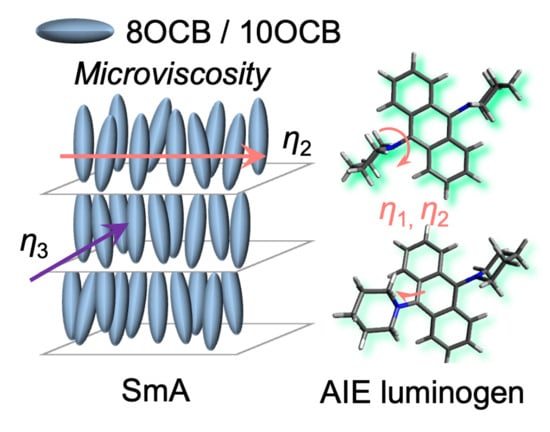
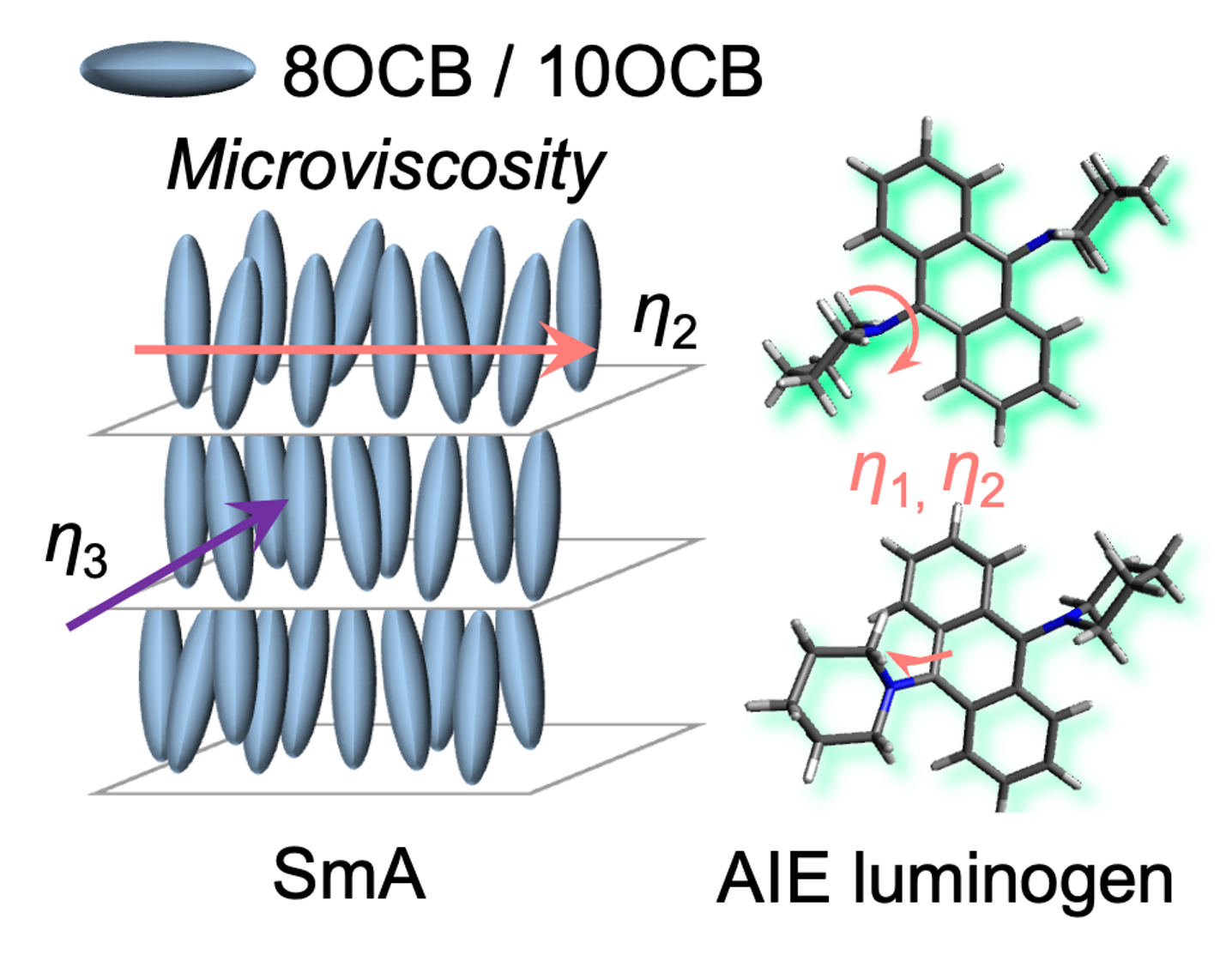
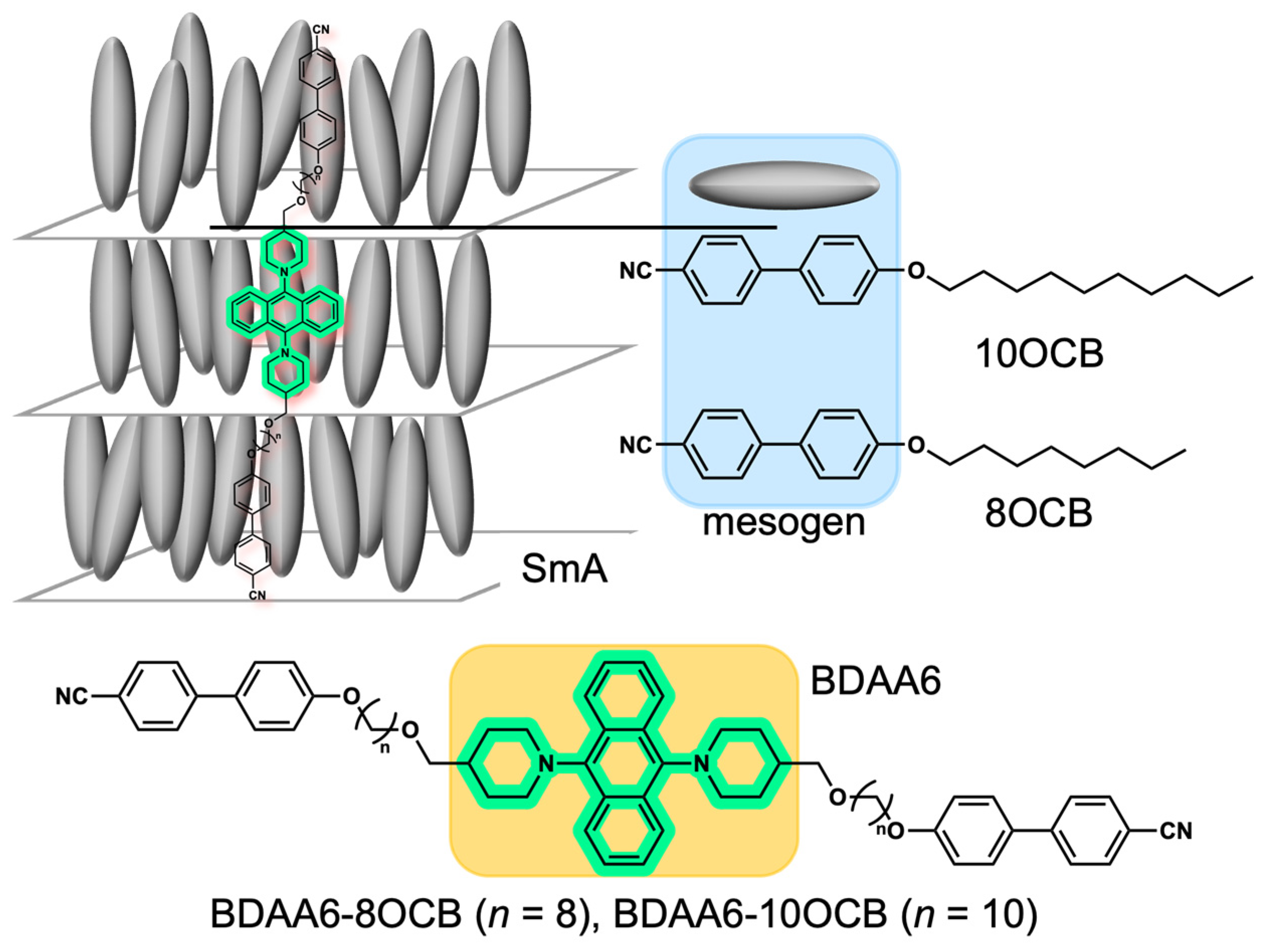
In this study, we designed and synthesized new pendant-type luminogens by using 9,10-bis(piperidyl)anthracene (BDAA6) as the emissive core and covalently attaching typical LC mesogens, 4-cyano-4′-n-alkoxybiphenyl (n = 8 and 10, hereafter nOCB), at both molecular termini. (Figure 1) To minimize disturbance of the LC phase by dye addition, these AIE-active molecules were introduced into 8OCB and 10OCB at a low concentration of 1.0 wt% [56,57,58]. By analyzing the fluorescence behavior of the BDAA6 moiety in these LC matrices (Figure 1), we aim to evaluate the local microviscosity of the LC phases of 8OCB and 10OCB using AIEgens as optical probes and to clarify its relationship with phase structure and molecular dynamics.

2. Materials and Methods

2.1. Materials

Unless otherwise noted, all solvents and chemicals were commercially available and used without further purification. Column chromatography was performed on silica gel (SilicaGel 60N, 63–210 μm, Kanto chemical Co., Inc., Tokyo Japan). Pd-PEPPSI-IPr, tetrabutylammonium fluoride, 4-cyano-4′-hydroxybiphenyl, 1-bromooctane, 1,10-dibromooctane, sodium hydride, and 1,10-dibromodecane were purchased from TCI (Tokyo, Japan). 1-bromodecane was purchased from Wako Pure Chem (Tokyo, Japan).

2.2. Methods

2.2.1. Characterization

1H NMR and 13C NMR spectra were recorded on a 500 MHz (125 MHz for 13C NMR) BRUKER spectrometer or 100 MHz JEOL 400 spectrometers for CDCl3 solutions using tetramethyl silane (TMS) as the internal standard. The data for 1H-NMR were reported as follows: chemical shift (δ ppm), multiplicity (s = singlet, d = doublet, t = triplet, q = quartet, quin = quintet, sex = sextet m = multiplet), integration, and coupling constant (Hz). 13C NMR spectra were reported as chemical shifts in ppm and multiplicity where appropriate. Column chromatography was carried out with Kanto Chemical silica gel 60N (40–50 mesh). TLC was carried out with a Merck Silica Gel 60 F254 (0.2 mm) plate.

2.2.2. Optical Spectroscopy

Ultraviolet–visible (UV–Vis) absorption spectra were recorded on a JASCO V-670 spectrophotometer (Tokyo Japan). Steady-state fluorescence spectra were measured using a JASCO FP-6500 spectrofluorometer or an Edinburgh Instruments FS5 spectrofluorometer (Edinburgh, UK). Absolute photoluminescence quantum yields were determined using a Hamamatsu Photonics Quantaurus-QY system for solid-state samples and by integrating the sphere module (SC-30) equipped with the FS5 spectrofluorometer for solution samples. All solution-phase photophysical measurements were performed using optically dilute samples (optical density ≈ 0.10 at the excitation or absorption maximum) in 1 cm quartz cuvettes at room temperature (298 K).

2.2.3. UV-Polarized Optical Microscopy (UV-POM)

Temperature-dependent fluorescence spectra were recorded on BX-51 equipped with a BX-URA universal reflected light illuminator (Olympus, Tokyo, Japan) and a super-high-pressure mercury lump (HBO103W/2, OSRAM GmbH, Munich, Germany) as the UV light source (350 nm). The UV light, which was passed through a 50% ND filter (U-25ND50) and an excitation filter (BP330-385, Olympus, Tokyo, Japan) and reflected by a dichroic mirror (FF376-Di01-25 × 36, Semrock, Tokyo, Japan), was irradiated on the sample in the hot stage. The fluorescent light then passed through the dichroic mirror and an absorption filter (FF01-380/LP-25, Tokyo Japan). The filters and dichroic mirror were installed in a fluorescence filter cube. The filtrated fluorescence light was guided through an optical fiber to a PMA-11 multichannel spectrometer (Hamamatsu Photonics, Shizuoka, Japan). In the measurements of the temperature-dependent fluorescence anisotropy, a UV linear polarizer (colorPol® UV375 BC5, Codixx, Bedford, CT, USA) was inserted before the excitation filter and a normal analyzer for the visible region was inserted after the absorption filter. The excitation polarization was set by rotating the polarizer by 90°, and the detection polarization was similarly controlled by rotating the analyzer by 90°. As a result, four polarization configurations were obtained (the geometric arrangement is shown in Figure S12). Fluorescence intensities measured under these configurations (IY(90°), IY(0°), Ix(90°), and Ix(0°)) were used to calculate the director distribution parameter, SD, according to Equations (1) and (2). In the present study, SD is introduced as an optical parameter that reflects the distribution of local director orientations sampled within the observation area from the polarized fluorescence of the probe. It should therefore be distinguished from the conventional liquid crystal orientational order parameter defined for an individual aligned domain. The derivation of Equations (1) and (2) is provided in Section S5 of the Supplementary Materials. Here, < > represents the ensemble average. The LC samples were sandwiched between glass substrates with a spacer thickness of 2 mm. Temperature-dependent measurements were performed using the same heating/cooling rate as in the DSC experiments (10 °C min−1). For fluorescence quantum yield measurements, the sample was equilibrated at each target temperature for 10 min prior to data acquisition to ensure thermal stabilization. In addition, all measurements were carried out after at least three heating–cooling cycles to eliminate thermal history effects and to confirm reproducibility.
S = 3 c o s 2 Θ 1 2
c o s 2 Θ = 2 I X 90 ° + I X 0 ° 8 3 I Y 90 ° + 4 I X 90 ° + I X 0 °
Because the excitation light is reflected by a half mirror before reaching the sample through the objective lens, the reflectance differs for s- and p-polarized components. To correct for this instrumental polarization bias, fluorescence intensities for s- and p-polarized excitation were measured in the isotropic phase, where molecular orientation is random. The ratio of these intensities was used as a polarization correction factor for subsequent measurements.
In the present optical configuration, the polarization direction of the incident UV light was set either parallel or perpendicular to the optical axis of the observed domain. Under these conditions, the influence of birefringence on fluorescence intensity detection is expected to be small and was therefore assumed to be negligible.
We emphasize that the parameter obtained here from polarized fluorescence is not the conventional liquid crystal orientational order parameter defined for an individual uniformly aligned domain. Instead, the present SD mainly reflects the orientation of the fluorescent dye moiety and, more importantly, the distribution of director orientations within the polydomain texture sampled in the measurement area. Consequently, its absolute value is strongly affected by spatial averaging over domains with different director orientations and may be substantially lower than the orientational order parameter values reported for aligned monodomain samples by birefringence, NMR, or other conventional methods. In this sense, SD should be regarded as a director distribution parameter rather than a strict thermodynamic orientational order parameter. In the present work, its role is to monitor relative temperature-dependent changes in the polarization response and to help distinguish orientational effects from microviscosity effects.

2.2.4. Theoretical Calculations

Density functional theory (DFT) calculations were performed using ORCA5.0 [57]. Geometry optimizations and frequency analyses were carried out for all stationary points to confirm that the optimized structures exhibited no imaginary frequencies. Excited state calculations were conducted using time-dependent DFT (TD-DFT). To construct the potential energy surface (PES) diagram, spin–flip (SF) TD-DFT calculations were performed.

2.2.5. Differential Scanning Calorimeter (DSC)

Differential scanning calorimetry (DSC) was performed using PerkinElmer DSC 8500 equipment (Tokyo, Japan) at a scanning rate of 10 °C min−1 under a flow of dry nitrogen.

2.2.6. Polarized Optical Microscopy (POM)

Polarized optical microscopy (POM) was performed using an OLYMPUS DP21 microscope (OLYMPUS, Tokyo, Japan) with a Mettler FP90 hot stage (Greifensee, Switzerland).

3. Results and Discussion

3.1. Molecular Design and Synthesis

Using our previously developed viscosity-responsive AIEgen (BDAA6) as the central fluorescent core, we designed new LC luminogens by covalently introducing versatile LC units, 8OCB and 10OCB, at both molecular termini. Unlike the conventional strategy of physically doping a small amount of fluorescent dye into an LC host—where the probe merely senses the environment created by surrounding LC molecules—our molecular design integrates the emissive unit directly into the LC framework. This allows viscosity responsiveness to be encoded at the molecular level, as the luminogen-integrated LC molecules themselves function as fluorescent reporters of the local environment. In addition, this covalent integration is expected to suppress phase segregation and local concentration inhomogeneity that often arise in doped systems, thereby enabling more reliable and uniform reporting of the LC environment (Figure 1).
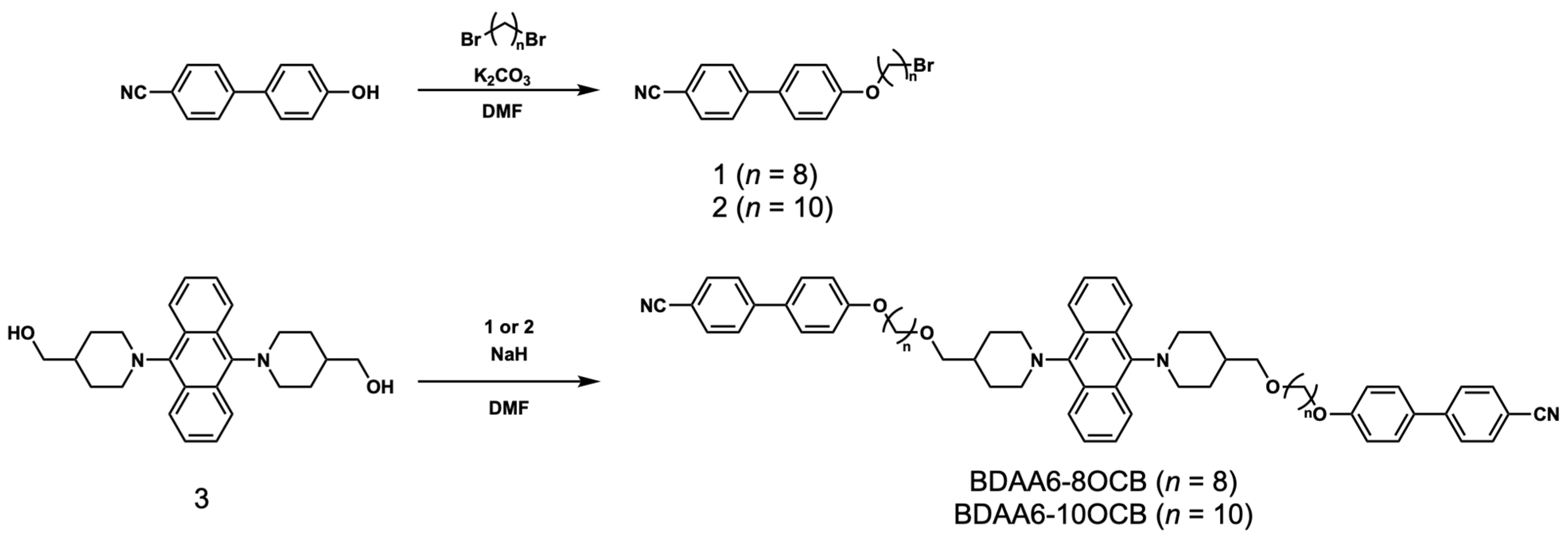
BDAA6-8OCB and BDAA6-10OCB were synthesized according to Scheme 1. First, 4-cyano-4′-hydroxybiphenyl was reacted with 1,8-dibromooctane or 1,10-dibromodecane in the presence of potassium carbonate via a Williamson ether synthesis to afford intermediates 1 and 2, respectively. Subsequently, intermediates 1 and 2 were coupled with compound 3, which was prepared according to a previously reported procedure [59], using sodium hydride as the base in another Williamson ether synthesis to yield BDAA6-8OCB (n = 8) and BDAA6-10OCB (n = 10). The detailed synthetic procedures are described in the Supplementary Materials (SI, Section S1). Both compounds were fully characterized by 1H NMR, and 13C NMR, and the corresponding spectra and analytical data are provided in Figures S1–S14.

3.2. Photophysical Properties

We first examined the photophysical properties of BDAA6-8OCB and BDAA6-10OCB in dichloromethane (DCM) and in the solid state. In addition, samples containing 1.0 wt% of BDAA6-8OCB in 8OCB and 1.0 wt% of BDAA6-10OCB in 10OCB were also evaluated under the same conditions. The maximum absorption wavelength (λabs), maximum fluorescence wavelength (λfl), and fluorescence quantum yield (Φfl) in DCM and in the solid state are summarized in Table 1. All samples showed similar spectral features, with λabs ≈ 400 nm, λfl ≈ 530 nm, a Stokes shift of about 130 nm (6132 cm−1), and Φfl of ~0.03 in DCM and ~0.40 in the solid state. These values are essentially identical to those of the parent BDAA6 system. These results indicate that incorporation of the 8OCB and 10OCB units into the BDAA framework does not significantly alter the intrinsic photophysical characteristics. Importantly, BDAA-based luminogens are known to exhibit environment-sensitive emission, especially in response to changes in molecular mobility [44]. This behavior originates from restricted access to the conical intersection (RACI) [42] in the condensed phase, and therefore, their fluorescence is expected to be sensitive to external factors such as temperature and viscosity.

3.3. Liquid Crystal Phase Characterization

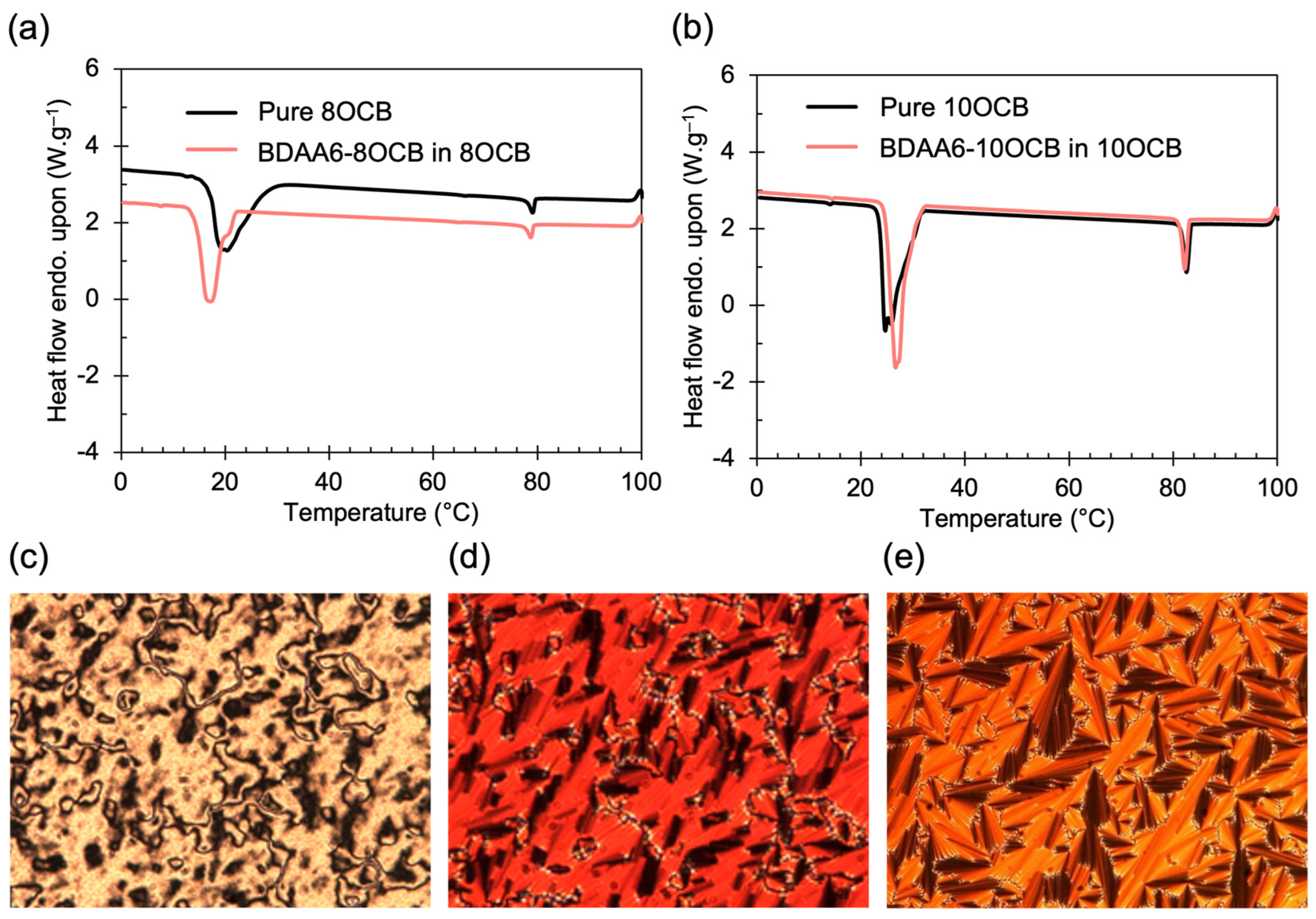
The phase transition behaviors of the four samples listed in Table 2 were investigated by polarized optical microscopy (POM) and differential scanning calorimetry (DSC). Measurements were carried out upon cooling for the third time from 100 to 0 °C at a scan rate of 10 °C min−1. The corresponding DSC thermograms and representative POM textures are shown in Figure 2. For 1.0 wt% BDAA6-8OCB in 8OCB and neat 8OCB, three distinct phase transitions were observed, corresponding to isotropic–nematic–smectic A–crystalline (Iso–N–SmA–Cr) transitions (Figure 2a). In the case of 1.0 wt% BDAA6-8OCB in 8OCB, the Iso–N transition temperature (TIN) was 78.7 °C, the N–SmA transition temperature (TNA) was 65.0 °C, and the SmA–Cry transition temperature (TACr) was 17.2 °C. These values are essentially identical to those of pristine 8OCB [60], with only negligible shifts (ΔT < 1 °C), indicating that the incorporation of 1.0 wt% BDAA6-8OCB does not significantly perturb the mesophase behavior of the host LC. The POM image of 1.0 wt% BDAA6-8OCB in 8OCB in the N phase (Figure 2c) exhibits a typical schlieren texture with four dark brushes emerging from defect centers, reflecting the non-uniform molecular orientation characteristic of nematic ordering [60,61,62]. Upon further cooling, the SmA phase appears, showing fan-shaped textures characteristic of lamellar packing (Figure 2d) [63,64]. These textures are fully consistent with those reported for 8OCB in previous studies [65,66], confirming that the mesophase structure is preserved upon doping.
In contrast, 1.0 wt% BDAA6-10OCB in 10OCB and neat 10OCB exhibited two phase transitions corresponding to Iso–SmA–Cr behavior (Figure 2b). For 1.0 wt% BDAA6-10OCB in 10OCB, the Iso–SmA transition temperature (TIA) was 82.2 °C and the SmA–Cry transition temperature (TACr) was 26.7 °C. Again, these values are very close to those of pure 10OCBT < 1 °C), demonstrating that the AIE-active dopant does not disrupt the intrinsic phase sequence of the host LC. The DSC thermograms show well-defined exothermic peaks corresponding to these transitions, indicating that the first-order nature of the phase transition is retained after doping. Thus, both thermal and optical analyses consistently show that the mesophase organization of the host LCs is essentially unaffected by the presence of 1.0 wt% AIEgens. Furthermore, POM observations revealed no signs of phase separation for any of the compounds or mesophases examined, indicating that the luminogens are well miscible with the liquid crystal matrix. Overall, these results demonstrate that the incorporation of a small amount of AIE-active LC luminogen maintains the original phase behavior of 8OCB and 10OCB owing to their high structural compatibility. This preservation of LC order is crucial, as it ensures that the fluorescence changes discussed in the following section arise from local microviscosity variations within the LC matrix rather than from macroscopic disruption of the LC phases.

3.4. Mesophase Characterization by Photophysical Properties

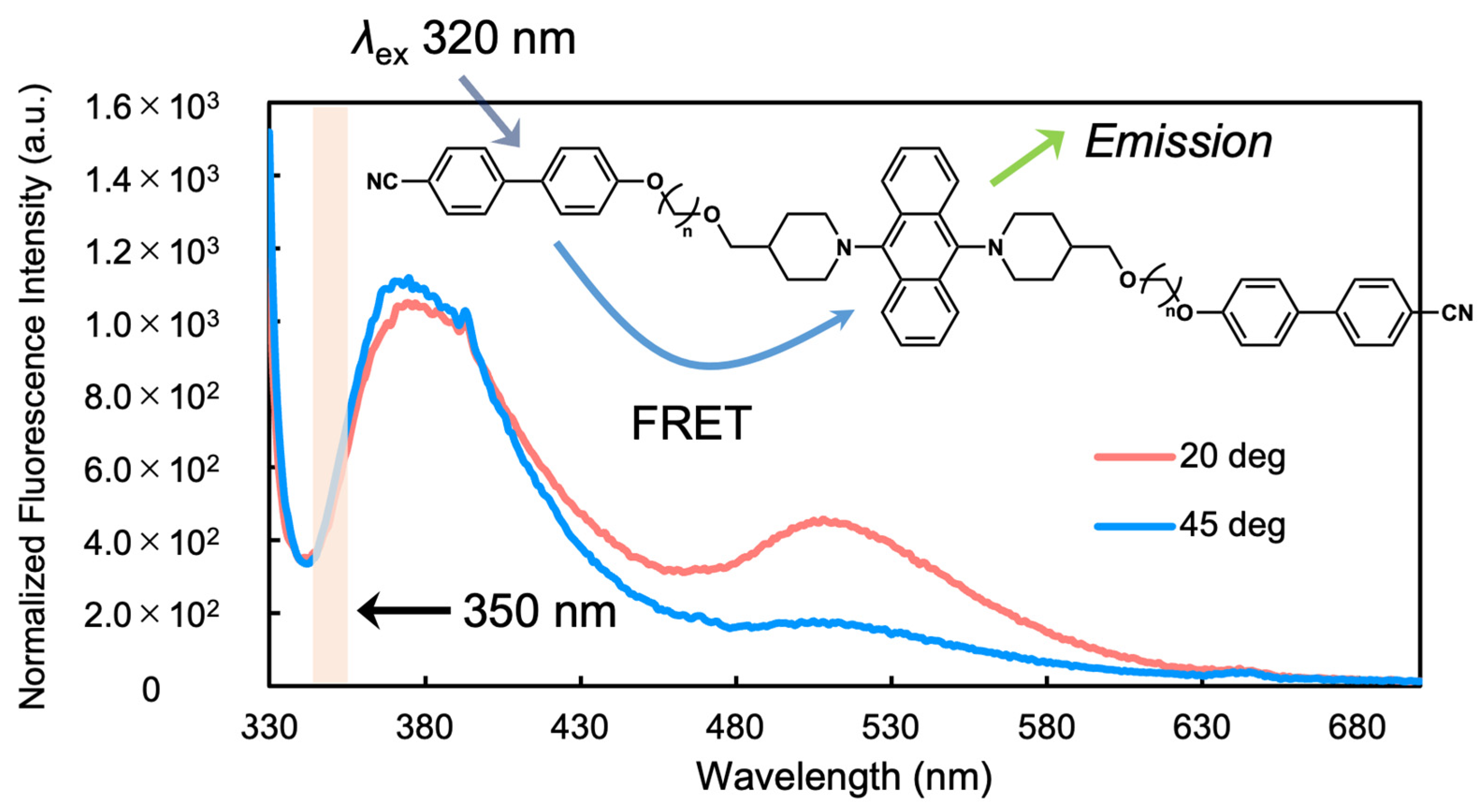
To evaluate the microviscosity of the LC phases of 8OCB and 10OCB, temperature-dependent fluorescence measurements were performed using UV-excited polarized optical microscopy (UV-POM) for 1.0 wt% BDAA6-8OCB in 8OCB and 1.0 wt% BDAA6-10OCB in 10OCB. Changes in the director distribution parameter SD, derived from polarization-dependent fluorescence measurements, were also investigated as an indicator of the temperature-dependent orientational distribution in the LC textures. When excited at 320 nm, the nOCB host molecules absorb light and emit fluorescence around 380 nm (Figure 3). This emission is subsequently absorbed by BDAA6-nOCB, leading to energy transfer (FRET) [67,68,69,70,71] and emission around 500 nm. In the UV-POM measurements, an excitation wavelength of 350 nm was used, at which nOCB absorbs only weakly, so that mainly BDAA6-nOCB was selectively excited. This is important to ensure that the observed fluorescence originates predominantly from the AIEgens.
During the measurements, the sample was cooled while polarizers were inserted in both the excitation and detection paths, and the fluorescence intensity was recorded under different polarization configurations. Specifically, excitation polarization was set by rotating the polarizer by 90°, and detection polarization was similarly controlled by rotating the analyzer by 90°. As a result, four polarization configurations were obtained (the geometric arrangement is shown in Figure S12). The fluorescence intensities obtained for these four configurations were used to quantify the polarization dependence and to calculate the director distribution parameter SD. It should be noted that the fluorescence intensities obtained in this method are relative values. With changes in temperature, not only the molecular orientation of the LC but also the refractive index and birefringence change, which can affect the absorption efficiency of the excitation light and the collection efficiency of the emitted light. Therefore, direct comparison of absolute fluorescence intensities at different temperatures is not appropriate. Instead, the director distribution parameter SD, derived from the polarization-dependent data, is used as a practical indicator for discussing temperature-dependent behavior. Here, SD does not represent the conventional director distribution parameter of a single aligned LC domain. Rather, it is an apparent optical parameter that reflects the combined effects of probe orientation, the assumption of approximately parallel absorption and emission dipoles (μA||μF), possible deviations from ideal cylindrical symmetry, and, importantly, spatial averaging over multiple domains with different director orientations. As a result, the absolute SD values are expected to be smaller than literature order parameters obtained for aligned monodomain samples, whereas their temperature-dependent trends remain meaningful for the present purpose.
The validity of the assumption that the absorption and emission transition dipoles are approximately parallel (µA||μF) was also examined. Quantum chemical calculations indicate that the transition dipole moment of BDAA6 is oriented along the long molecular axis, which is consistent with the alignment direction of the host liquid crystal molecules (Figure S16). Experimentally, fluorescence intensities measured under crossed configurations, IY(0°) and IX(90°), which are expected to be equivalent when the absorption and emission dipoles are parallel, showed good agreement, as summarized in Tables S1 and S2. Furthermore, the configuration with parallel excitation and detection polarizations, IX(0°), consistently produced the highest intensity, supporting that the dye molecules are preferentially aligned along the liquid crystal director. These results collectively support the assumption of approximately parallel absorption and emission dipoles used in the analysis.
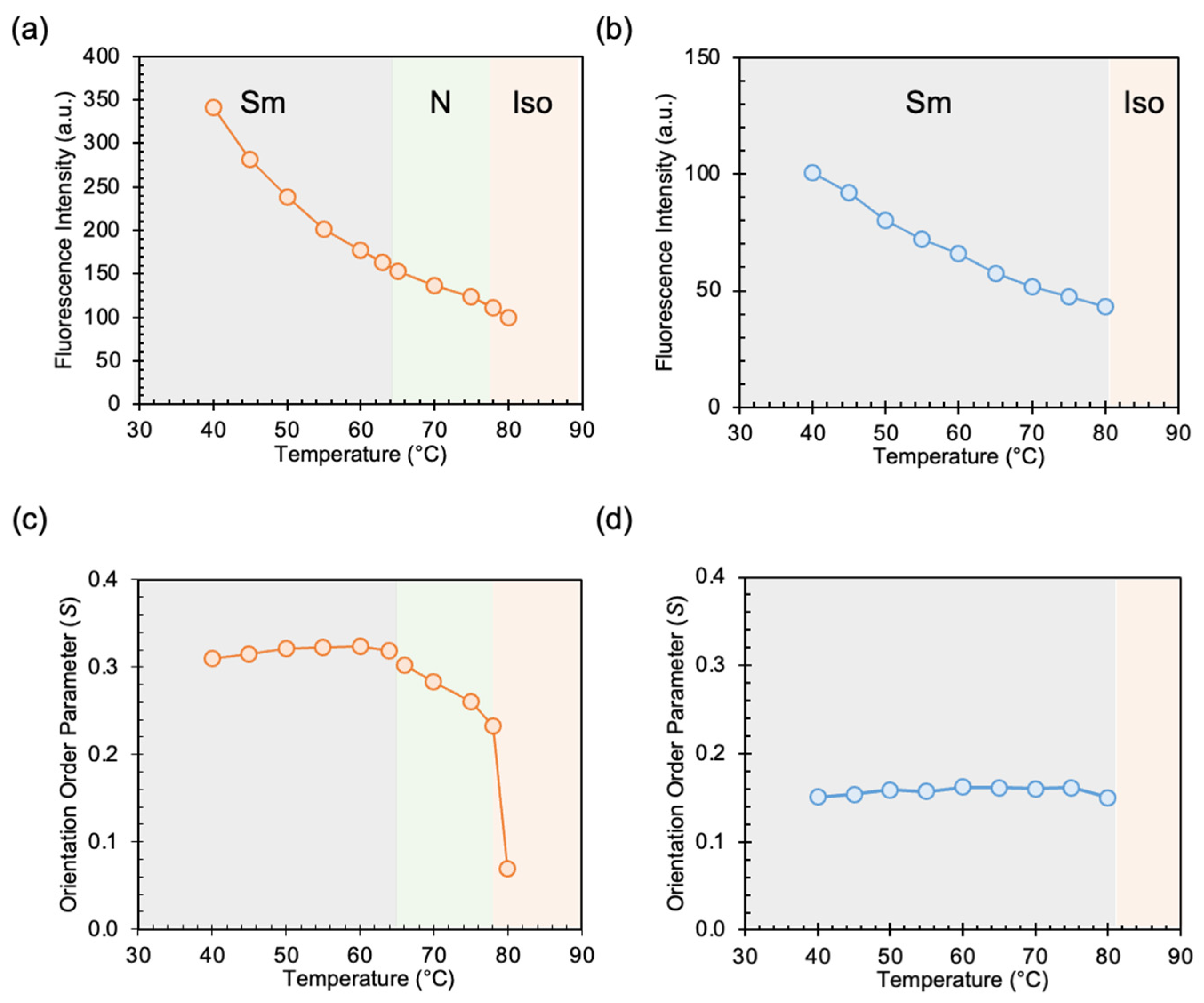
The temperature-dependent polarized fluorescence intensities of 1.0 wt% BDAA6-8OCB in 8OCB and 1.0 wt% BDAA6-10OCB in 10OCB are shown in Figure 4a,b, respectively. The corresponding temperature dependences of the director distribution parameter SD calculated from these data are presented in Figure 4c,d. As shown in Figure 4a,b, the polarized fluorescence intensity increases during cooling from 80 °C to 40 °C for both systems. The corresponding phase textures are summarized in Figures S13 and S14. To rationalize the temperature-dependent fluorescence behavior, two possible origins were considered. One is the change in fluorescence intensity arising from the reorientation of LC molecules relative to the polarization direction of the excitation and detection light. The other is the intrinsic response of the AIEgen to changes in microviscosity in the LC phase. These two contributions can be distinguished by analyzing the molecular director distribution parameter SD (Figure 4c,d). For both 8OCB and 10OCB systems, the SD values remain nearly constant in the SmA phase, whereas in 8OCB a marked change in S is observed across the Iso–N transition: S decreases from ca. 0.07 in the Iso phase to ca. 0.2 near the Iso–N transition and then increases again to around 0.3 below TNA. It should be emphasized that the absolute SD values estimated from polarized fluorescence measurements are not directly comparable to the director distribution parameters commonly reported for nematic or smectic liquid crystals in the literature. The latter are typically defined for individual aligned domains and quantify orientational fluctuations of molecular axes around a well-defined director [72,73,74]. By contrast, the present SD is an optical parameter obtained from a polydomain sample without macroscopic alignment and is therefore strongly influenced by domain averaging within the observation area. Accordingly, SD is used here only as a measure of the temperature-dependent director distribution sampled by the probe, not as a strict director distribution parameter in the conventional liquid crystal sense. Within this definition, the nearly constant SD values observed in the SmA phase indicate that the overall distribution of director orientations sampled in the experiment changes only weakly with temperature, whereas the continuous fluorescence change is attributed mainly to variation in microviscosity. Temperature-dependent evolution of orientational order in nematic liquid crystals has been widely reported and is commonly described by mean field models such as the Maier–Saupe theory [75,76,77,78]. Such temperature-dependent changes in SD are accompanied by an increase in microviscosity in the N phase, as previously reported for related cyanobiphenyl systems. In contrast, the SD values for both 1.0 wt% BDAA6-8OCB in 8OCB and 1.0 wt% BDAA6-10OCB in 10OCB become nearly constant in the SmA phase. Because the SmA phase is expected to exhibit spatially anisotropic viscosity due to its layered structure, the polarized fluorescence intensity of BDAA6-8OCB and BDAA6-10OCB in this phase is likely governed mainly by microviscosity rather than by further changes in molecular orientation.

3.5. Estimation of Microviscosity from Absolute Fluorescence Quantum Yields
In Section 3.4, we demonstrated that the temperature-dependent change in fluorescence intensity of BDAA6-nOCB in nOCB within the SmA phase is governed primarily by changes in the local viscosity of the system. To quantify this microviscosity, we employed the Förster–Hoffmann equation [79,80,81], which relates viscosity to fluorescence intensity, fluorescence lifetime (τ), or Φfl. Among these, Φfl and τ are absolute, measurement-condition-independent quantities, making them suitable for constructing a universal calibration curve. Therefore, in this study, we adopted the Förster–Hoffmann equation based on Φfl, as shown in Equation (3).
log Φ f l = χ log η + c o n s t .
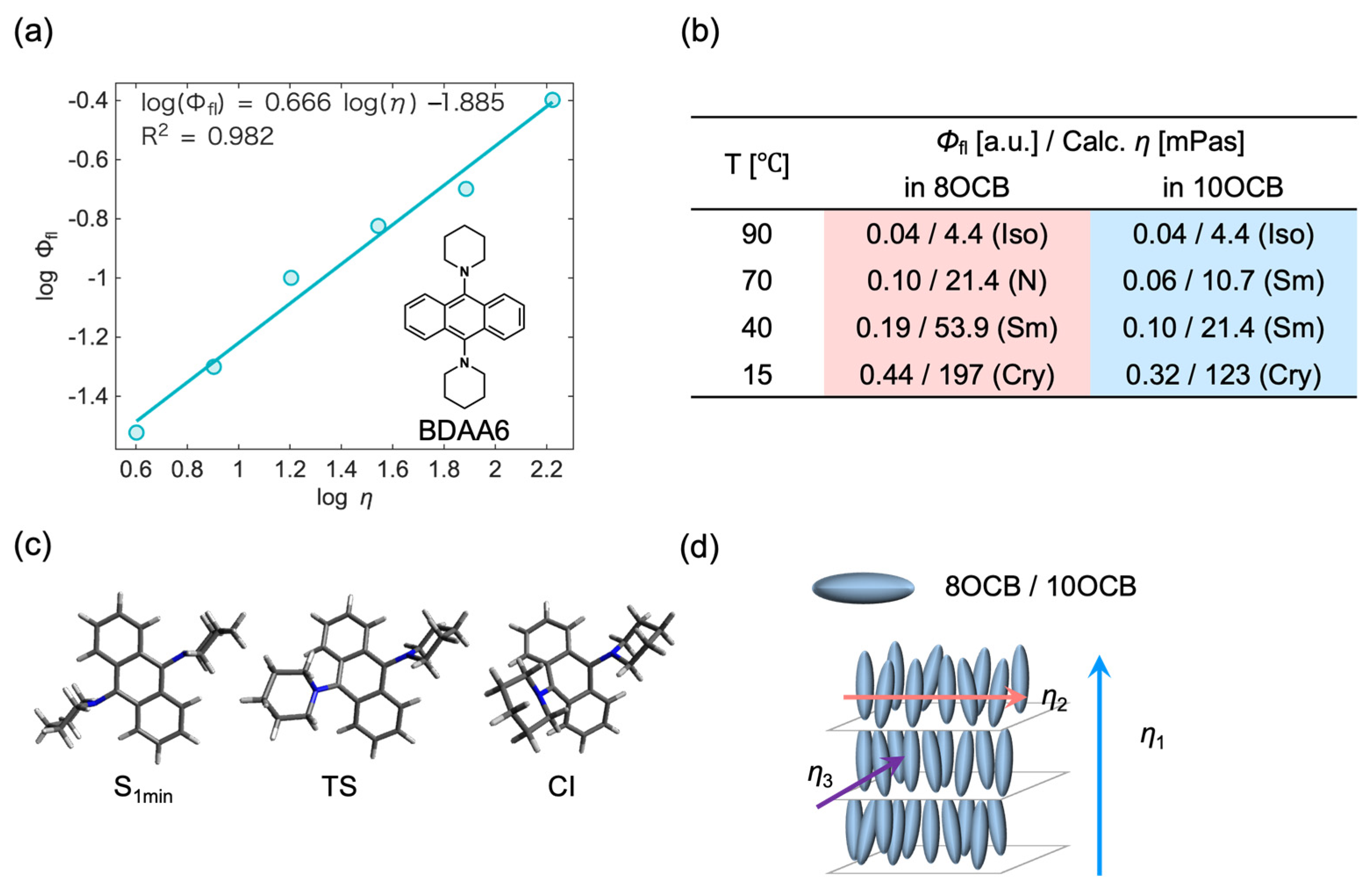
As a reference system, we first measured the viscosity dependence of Φfl for BDAA6, a model compound of BDAA6-nOCB, and constructed a Förster–Hoffmann plot (Figure 5a). From this plot, the viscosity sensitivity parameter χ was determined to be 0.666, with an intercept of −1.885. These values are in good agreement with those previously reported for a water-soluble BDAA6 derivative (χ = 0.620, intercept = −1.751), despite the different solvent environments [31]. This consistency indicates that the Förster–Hoffmann relationship obtained here can be regarded as an intrinsic calibration for BDAA6-type AIEgens. Using this calibration, the Φfls measured at different temperatures (Figure 5b) were converted into microviscosities for the N and SmA phases of 8OCB and 10OCB. The resulting values are summarized as follows: for 8OCB, η ≈ 21.4 mPa·s in the N phase and 53.9 mPa·s in the Sm phase; for 10OCB, η ≈ 10.7 mPa·s in the Sm phase at 70 °C and 21.4 mPa·s at 40 °C. Thus, 8OCB exhibits systematically higher microviscosity than 10OCB in both mesophases, reflecting the influence of alkyl chain length and packing efficiency on local molecular mobility [82]. It is known from macroscopic rheological studies that, on the low-temperature side of the N phase, viscosity often shows a sharp increase near the N–SmA transition due to presmectic effects [83,84,85]. However, in our fluorescence measurements (Figure 4a), the intensity changes across the N–Sm transition are relatively smooth, with only a slight change in slope. This suggests that, in the absence of external alignment fields (e.g., magnetic fields) or imposed macroscopic shear, the presmectic enhancement in viscosity is not manifested as a sharp divergence but rather as a gradual change in the local environment experienced by the probe.
At this point, it is important to clarify what type of “viscosity” is sensed by the AIEgen. In our method, viscosity is not measured under an externally applied macroscopic shear flow. Instead, it is probed through the photophysical response of a viscosity-sensitive luminogen embedded in the LC matrix. The relevant time scale of this method is determined by the excited state lifetime of the luminogen, typically in the picosecond–nanosecond range. Therefore, the probe does not sense macroscopic flow resistance, but rather the local friction experienced during ultrafast intramolecular structural relaxation. In particular, as illustrated in Figure 5c, the dominant nonradiative decay pathway involves torsional motion leading from the excited state local minimum (S1min) toward a conical intersection; the resistance to this motion reflects local, microscopic friction. The viscosity obtained in this way should thus be regarded as effective microscopic viscosity associated with intramolecular motion in a heterogeneous anisotropic medium. Because no external field is applied to fix the director and no macroscopic shear is imposed, the present fluorescence method cannot isolate the individual Miesowicz viscosities (η1, η2, η3) [86,87] shown in Figure 5d. Instead, the observed response corresponds to an orientationally averaged effective viscosity, weighted by the local distribution of molecular orientations and by the relative orientation between the dye’s internal motion and the surrounding mesogens [88]. The torsional motion responsible for nonradiative decay is mainly hindered by local segmental mobility of the mesogens rather than by long-range hydrodynamic flow. Consequently, the fluorescence method is primarily sensitive to local molecular friction associated with transverse rearrangements of surrounding mesogens, although without strict geometrical selectivity. Accordingly, the present readout cannot be assigned to a specific Miesowicz viscosity (η1η3), but may only be qualitatively related to viscosity components often discussed in connection with η2 in aligned nematic systems. While the Miesowicz viscosities are rigorously defined for nematic phases under controlled alignment and macroscopic shear, their direct application to smectic phases is not strictly valid because of the presence of layered structures. Therefore, in the present work, the “viscosity” in the smectic phase should be understood as effective microviscosity reflecting resistance to local molecular and segmental motion within smectic layers, rather than true macroscopic shear viscosity.
Finally, it is useful to compare our values with literature data. Macroscopic Miesowicz viscosities of cyanobiphenyl-type LCs such as 5CB, 8CB, and related OCB derivatives are typically reported to be on the order of 10–30 mPa·s in the N phase and to increase strongly near the N–Sm transition due to presmectic effects. Our value for the N phase of 8OCB (21 mPa·s) lies within the same order of magnitude as previously reported macroscopic viscosities, suggesting qualitative consistency with known trends. However, direct numerical comparison is not appropriate because the present values represent local, time-scale-dependent microviscosities rather than macroscopic shear viscosities. Similarly, the Sm phase values obtained here (54 mPa·s for 8OCB and 21 mPa·s for 10OCB) should not be directly compared with macroscopic shear viscosities, as they reflect effective local viscosities sensed by the AIEgen. Thus, the present fluorescence method provides complementary information to conventional rheology: it probes microscopic friction relevant to excited state molecular motion, offering a simple and sensitive way to visualize local viscosity in LC phases without the need for external alignment fields or macroscopic shear.
Figure 5. (a) A Förster–Hoffmann plot of BDAA6 constructed from the viscosity dependence of its absolute fluorescence quantum yield. (b) Temperature-dependent fluorescence quantum yields Φfl of BDAA6-nOCB in nOCB (n = 8, 10) and the corresponding effective viscosities (η) calculated using the Förster–Hoffmann relation. (c) Excited state structural changes of BDAA6 relevant to its viscosity-responsive behavior, obtained from quantum chemical calculations (spin–flip TDDFT, BHHLYP/6-31G (d), gas phase, ORCA 5.0 [89]). (d) A schematic illustration of the different viscosity components in the SmA phase that can be discussed in terms of Miesowicz-type shear viscosities.
Liquids 06 00014 g005

4. Conclusions

We investigated BDAA-based AIEgens (BDAA6-8OCB and BDAA6-10OCB) as fluorescent probes of microviscosity in thermotropic LCs 8OCB and 10OCB. Doping 1.0 wt% of these AIEgens did not disturb the intrinsic phase transitions of the host mesogens, confirming good structural compatibility. Fluorescence and polarized measurements showed that emission is governed mainly by microviscosity rather than by phase disruption. In the N phase, increasing molecular order is accompanied by higher microviscosity, which enhances fluorescence by suppressing nonradiative decay. In the SmA phase, although the director distribution parameter remains nearly constant, fluorescence still changes smoothly with temperature, reflecting variations in local segmental mobility. Using the Förster–Hoffmann equation, we estimated the effective microviscosity in both phases. This approach differs from most previously reported LC viscosity probes, which are typically based on physically doped molecular rotors or flapping fluorophores and often provide mainly qualitative responses. In contrast, the present pendant-type molecular design ensures good compatibility with the LC matrix while enabling quantitative estimation of microviscosity across multiple mesophases, including the smectic phase. These values are consistent with known trends, but represent microscopic, time-scale-dependent friction rather than macroscopic shear viscosity. This work demonstrates that AIEgens provide a simple and powerful optical method to visualize local viscosity in LCs and potentially in other structured soft materials. In this way, not only AIEgens [36,90] and FLAP [91,92,93] dyes but also other functional fluorophores—such as solvatochromic [94,95,96], temperature-responsive [97,98], and twisted intramolecular charge transfer (TICT) [98,99] dyes—have the potential to visualize various physical properties of LCs beyond viscosity, and their use in LC characterization is expected to expand in the future.

Supplementary Materials

The following supporting information can be downloaded at: https://www.mdpi.com/article/10.3390/liquids6020014/s1, Figure S1. 1H-NMR spectrum of 4′-((8-bromooctyl)oxy)-[1,1′-biphenyl]-4-carbonitrile (1). Figure S2. 1H-NMR spectrum of 4′-((10-bromodecyl)oxy)-[1,1′-biphenyl]-4-carbonitrile (2). Figure S3. 1H-NMR spectrum of (anthracene-9,10-diylbis(piperidine-1,4-diyl))dimethanol (3). Figure S4. 1H-NMR spectrum of 4′,4‴-(((((anthracene-9,10-diylbis(piperidine-1,4-diyl))bis(methylene))bis(oxy))bis(octane-8,1-diyl))bis(oxy))bis(([1,1′-biphenyl]-4-carbonitrile)) (BDAA6-8OCB). Figure S5. 1H-NMR spectrum of 4′,4‴-(((((anthracene-9,10-diylbis(piperidine-1,4-diyl))bis(methylene))bis(oxy))bis(decane-10,1-diyl))bis(oxy))bis(([1,1′-biphenyl]-4-carbonitrile)) (BDAA6-10OCB). Figure S6. 13C-NMR spectrum of (anthracene-9,10-diylbis(piperidine-1,4-diyl))dimethanol (3). Figure S7. 13C-NMR spectrum of 4′,4‴-(((((anthracene-9,10-diylbis(piperidine-1,4-diyl))bis(methylene))bis(oxy))bis(octane-8,1-diyl))bis(oxy))bis(([1,1′-biphenyl]-4-carbonitrile)) (BDAA6-8OCB). Figure S8. 13C-NMR spectrum of 4′,4‴-(((((anthracene-9,10-diylbis(piperidine-1,4-diyl))bis(methylene))bis(oxy))bis(decane-10,1-diyl))bis(oxy))bis(([1,1′-biphenyl]-4-carbonitrile)) (BDAA6-10OCB). Figure S9. Normalized absorption and emission spectra of 3 at a concentration of 10 µmol L−1 in DCM solvent under argon purging for 20 min. *abs is absorption, and em is emission. Figure S10. Normalized absorption and emission spectra of BDAA6-8OCB at a concentration of 10 µmol L−1 in DCM solvent under argon purging for 20 min. *abs is absorption, and em is emission. Figure S11. Normalized absorption and emission spectra of BDAA6-10OCB at a concentration of 10 µmol L−1 in DCM solvent under argon purging for 20 min. *abs is absorption, and em is emission. Figure S12. The geometric arrangement of IY(90°) (a), IY(0°) (b), IX(90°) (c), and IX(0°) (d). Table S1. Fluorescence intensity of 1 wt% of BDAA6-8OCB in 8OCB at various temperatures from 80 °C to 40 °C. Figure S13. UV-polarized light microscopy of 1 wt% of BDAA6-8OCB in 8OCB in the temperature range of 40 °C to 80 °C. Table S2. Fluorescence intensity of 1 wt% of BDAA6-10OCB in 10OCB at various temperatures from 80 °C to 40 °C. Figure S14. UV-polarized light microscopy of 1 wt% of BDAA6-10OCB in 10OCB in the temperature range of 40 °C to 80 °C. Figure S15. The cartesian coordinate system. Figure S16. Calculated transition dipole moment of BDAA6 at ωB97X-D/def2-SVP level of theory. Figure S17. MS spectrum of BDAA6-8OCB. Figure S18. MS spectrum of BDAA6-10OCB, References [100,101] are cited in the supplementary materials.

Author Contributions

Conceptualization, C.S., T.T. and G.-i.K.; methodology, R.I.; C.S., T.T., Y.S. (Yoshimichi Shimomura), Y.S. (Yuki Sawatari), Y.I. and R.I.; writing—original draft preparation, C.S., T.T. and G.-i.K.; writing—review and editing, C.S., T.T., Y.S. (Yoshimichi Shimomura), Y.S. (Yuki Sawatari), Y.I. and G.-i.K. All authors have read and agreed to the published version of the manuscript.

Funding

This project was supported in part by MEXT/JSPS KAKENHI grants 23H02036 (G.K.), 25K22304 (G.K.) and The Sasakawa Scientific Research Grant (T.T.).

Data Availability Statement

The original contributions presented in the study are included in the article/Supplementary Materials; further inquiries can be directed to the corresponding author.

Acknowledgments

We thank Masato Koizumi (Materials Analysis Division, Tokyo Institute of Technology) for the HR-MS measurements. This division is independent of our laboratory to ensure fairness.

Conflicts of Interest

The authors declare no conflicts of interest.

References

  1. Zhang, L.; Cui, Y.; Wang, Q.; Zhou, H.; Wang, H.; Li, Y.; Yang, Z.; Cao, H.; Wang, D.; He, W. Spatial Patterning of Fluorescent Liquid Crystal Ink Based on Inkjet Printing. Molecules 2022, 27, 5536. [Google Scholar] [CrossRef] [PubMed]
  2. Dierking, I. Liquid Crystal Research and Novel Applications in the 21st Century. Crystals 2025, 15, 321. [Google Scholar] [CrossRef]
  3. Agarwal, S.; Srivastava, S.; Joshi, S.; Tripathi, S.; Singh, B.P.; Pandey, K.K.; Manohar, R. A Comprehensive Review on Polymer-Dispersed Liquid Crystals: Mechanisms, Materials, and Applications. ACS Mater. Au 2025, 5, 88–114. [Google Scholar]
  4. Schadt, M. Liquid Crystal Materials and Liquid Crystal Displays. Annu. Rev. Mater. Res. 1997, 27, 305–379. [Google Scholar]
  5. Zhou, Y.; Li, G. Recent Progress in Liquid Crystal-Based Smart Windows with Low Driving Voltage and High Contrast. Photonics 2025, 12, 819. [Google Scholar] [CrossRef]
  6. Ryabchun, A.; Bobrovsky, A. Cholesteric Liquid Crystal Materials for Tunable Diffractive Optics. Adv. Opt. Mater. 2018, 6, 1800335. [Google Scholar] [CrossRef]
  7. Chu, F.; Zhang, H.; Zhou, X.; Fu, Y.; Dong, H.; Wang, S.; Chao, J.; Wang, X. Liquid Crystal/Carbon Nanotube/Polyaniline Composites and Their Coating Orientation Patterning Applications. Coatings 2024, 14, 1568. [Google Scholar]
  8. Iwai, R.; Yoshida, H.; Arakawa, Y.; Sasaki, S.; Iida, Y.; Igawa, K.; Sakurai, T.; Suzuki, S.; Tokita, M.; Watanabe, J.; et al. Near-room-temperature π-conjugated nematic liquid crystals in molecules with a flexible seven-membered ring structure. Aggregate 2025, 6, e660. [Google Scholar]
  9. Ohm, C.; Brehmer, M.; Zentel, R. Liquid Crystalline Elastomers as Actuators and Sensors. Adv. Mater. 2010, 22, 3366–3387. [Google Scholar] [CrossRef]
  10. Ouyang, L.; Chen, H.; Xu, R.; Shaik, R.; Zhang, G.; Zhe, J. Rapid Surface Charge Mapping Based on a Liquid Crystal Microchip. Biosensors 2024, 14, 199. [Google Scholar] [CrossRef]
  11. Yoshioka, J.; Nobori, H.; Fukao, K.; Araoka, F. Propagation of periodic director and flow patterns in a cholesteric liquid crystal under electroconvection. Sci. Rep. 2024, 14, 23201. [Google Scholar] [CrossRef]
  12. Ayeb, H.; Derbali, M.; Mouhli, A.; Soltani, T.; Jomni, F.; Fresnais, J.; Lacaze, E. Viscoelastic and dielectric properties of 5CB nematic liquid crystal doped by magnetic and nonmagnetic nanoparticles. Phys. Rev. E 2020, 102, 052703. [Google Scholar] [CrossRef]
  13. Yu, J.; Chen, L.; Li, G.Y.; Li, Y.; Huang, Y.; Bake, M.; Zhao, T. Rotational viscosity of nematic lyotropic chromonic liquid crystals. J. Mol. Liq. 2021, 344, 117756. [Google Scholar] [CrossRef]
  14. Das, K.A.; Kumar, M.P.; Čopar, S.; Dhara, S. Effect of rotational shear on the dielectric dispersion of a nematic liquid crystal above the Freedericksz threshold field. Soft Matter 2024, 20, 6965–6970. [Google Scholar] [CrossRef] [PubMed]
  15. Liu, L.; Wang, M.; Guo, L.-X.; Sun, Y.; Zhang, X.-Q.; Lin, B.-P.; Yang, H. Aggregation-Induced Emission Luminogen-Functionalized Liquid Crystal Elastomer Soft Actuators. Macromolecules 2018, 51, 4516–4524. [Google Scholar]
  16. Jung, J.; Park, H.; Jung, H.; Jung, S.E.; Kim, S.G.; Kim, T.; Lim, Y.J.; Ku, B.-C.; Kim, M.S.; Lee, S.H. Recent Progress in Liquid Crystal Devices and Materials of TFT-LCDs. J. Inf. Disp. 2024, 25, 121–142. [Google Scholar]
  17. Guardià, J.; Reina, J.A.; Giamberini, M.; Montané, X. An Up-to-Date Overview of Liquid Crystals and Liquid Crystal Polymers for Different Applications: A Review. Polymers 2024, 16, 2293. [Google Scholar] [CrossRef] [PubMed]
  18. Kudreyko, A.; Chigrinov, V.; Neyts, K.; Chausov, D.; Perestoronina, A. Photonic Devices with Multi-Domain Liquid Crystal Structures. Crystals 2024, 14, 512. [Google Scholar] [CrossRef]
  19. Yamaguchi, M.; Matsukizono, H.; Okumura, Y.; Kikuchi, H. Nanostructured Polymer-Dispersed Liquid Crystals Using a Ferroelectric Smectic A Liquid Crystal. Molecules 2024, 29, 4837. [Google Scholar] [CrossRef]
  20. Inui, S.; Eguchi, Y.; Morita, M.; Yasui, M.; Konno, T.; Yamada, S. Multi-State Photoluminescence of Donor–π–Acceptor Tetrafluorinated Tolane Mesogenic Dimers in Solution, Crystal, and Liquid-Crystalline Phases. Crystals 2025, 15, 1050. [Google Scholar] [CrossRef]
  21. Orr, R.; Pethrick, R.A. Viscosity coefficients of nematic liquid crystals: I. Oscillating plate viscometer measurements and rotational viscosity measurements: K15. Liq. Cryst. 2011, 38, 1169–1181. [Google Scholar]
  22. Paul, A.; Paul, M.; Badu, M.; Ghimire, A.; Dhakal, N.P.; Sprunt, S.; Jákli, A.; Gleeson, J.T. Comprehensive characterization of a reference ferroelectric nematic liquid crystal material. Materials 2025, 18, 5496. [Google Scholar] [CrossRef]
  23. Chandrasekar, V.; Lu, J.R.; Dierking, I. Micro-scale viscosity measurements of different thermotropic and lyotropic classes of liquid crystals by using ferrofluid inclusions. J. Mol. Liq. 2023, 383, 122178. [Google Scholar] [CrossRef]
  24. Gradišek, A.; Cifelli, M.; Wojcik, M.; Apih, T.; Dvinskikh, S.V.; Gorecka, E.; Domenici, V. Study of Liquid Crystals Showing Two Isotropic Phases by 1H NMR Diffusometry and 1H NMR Relaxometry. Crystals 2019, 9, 178. [Google Scholar] [CrossRef]
  25. Risi, C.L.S.; Figueiredo Neto, A.M.; Akpinar, E.; Lacerda Santos, M.B. Dynamic Light Scattering and Viscosity Measurements in a Ternary and Quaternary Discotic Lyotropic Nematic Liquid Crystal: Tuning the Backflow with Salt. Phys. Rev. E 2013, 88, 022506. [Google Scholar] [CrossRef]
  26. Huang, Y.; Selvaraj, P.; Senguttuvan, G.; Hsu, C.-J. Electro-optical and dielectric properties of TiO2 nanoparticles in nematic liquid crystals with high dielectric anisotropy. Curr. Appl. Phys. 2009, 10, 561–568. [Google Scholar] [CrossRef]
  27. Dietrich, C.F.; Collings, P.J.; Sottmann, T.; Rudquist, P.; Giesselmann, F. Extremely small twist elastic constants in lyotropic nematic liquid crystals. Proc. Natl. Acad. Sci. USA 2020, 117, 27238–27244. [Google Scholar] [PubMed]
  28. Kimura, R.; Kitakado, H.; Yamakado, T.; Yoshida, H.; Saito, S. Probing a microviscosity change at the nematic–isotropic liquid crystal phase transition by a ratiometric flapping fluorophore. Chem. Commun. 2022, 58, 2128–2131. [Google Scholar] [CrossRef]
  29. Chen, H.; Hu, M.; Peng, F.; Li, J.; An, Z.; Wu, S.-T. Ultra-low viscosity liquid crystal materials. Opt. Mater. Express 2015, 5, 655–660. [Google Scholar] [CrossRef]
  30. Salamończyk, M.; Vaupotič, N.; Pociecha, D.; Walker, R.; Storey, J.M.D.; Imrie, C.T.; Wang, C.; Zhu, C.; Gorecka, E. Multi-level chirality in liquid crystals formed by achiral molecules. Nat. Commun. 2019, 10, 1922. [Google Scholar] [CrossRef] [PubMed]
  31. Tanaka, T.; Noda, R.; Sawatari, Y.; Iwai, R.; Tang, B.Z.; Konishi, G. Viscosity responsiveness of excited-state dynamics in aggregation-induced emission luminogens. Chin. Chem. Lett. 2025, 36, 111495. [Google Scholar] [CrossRef]
  32. Tanaka, T.; Koyanagi, H.; Ehara, T.; Ryu, T.; Miyata, K.; Suzuki, S.; Igawa, K.; Onda, K.; Konishi, G. Push–Pull Bridged Stilbenes as Small Solvatochromic Aggregation-Induced Emission Luminogen: Design and Excited-state Deactivation Dynamics. Aggregate 2026, 7, e70295. [Google Scholar] [CrossRef]
  33. Iida, Y.; Gon, M.; Yoshida, H.; Tanaka, K.; Konishi, G. Development of a Cholesteric Liquid Crystal Comprising a Mesogenic Fluorophore for Circularly Polarized Luminescence with a High Dissymmetry Factor. Aggregate 2026, 7, e70304. [Google Scholar] [CrossRef]
  34. Guo, H.; Huang, Y.; Lin, L.; Chen, S.; Yang, F. High circularly polarized luminescence based on hydrogen-bonding columnar mesophase of an AIE-active mesogen with stronger D–A structure. J. Mol. Liq. 2025, 426, 127323. [Google Scholar] [CrossRef]
  35. Guo, H.; Yu, Q.; Xiong, Y.; Yang, F. Room-temperature AIE ionic liquid crystals based on diphenylacrylonitrile–imidazole salts. Soft Matter 2020, 16, 10368–10376. [Google Scholar] [CrossRef]
  36. Tong, Y.; Wang, B.; Zhao, D.; Li, M.; Tang, B.Z. Aggregation Induced Emissive Liquid Crystals–Polymer Composite Membrane for Dual-Channel Analysis of Parathyroid Hormone. Aggregate 2025, 6, e70000. [Google Scholar] [CrossRef]
  37. Tsutsui, Y.; Zhang, W.; Ghosh, S.; Sakurai, T.; Yoshida, H.; Ozaki, M.; Akutagawa, T.; Seki, S. Electrically Switchable Amplified Spontaneous Emission from Liquid Crystalline Phase of an AIEE-Active ESIPT Molecule. Adv. Opt. Mater. 2020, 8, 1902158. [Google Scholar] [CrossRef]
  38. He, Y.; Zhang, J.; Ma, C.; Liu, J.; Guo, J.; Han, T.; Hu, R.; Li, B.S.; Tang, B.Z. Multifaceted regulation of chiroptical properties and self-assembly behaviors of chiral fluorescent polymers. Aggregate 2024, 5, e642. [Google Scholar] [CrossRef]
  39. Amdursky, N.; Erez, Y.; Huppert, D. Molecular rotors: What lies behind the high sensitivity of the thioflavin-T fluorescent marker. Acc. Chem. Res. 2012, 45, 1548–1557. [Google Scholar] [CrossRef]
  40. Wang, B.; Yang, D.; Zhong, X.; Liu, Y.; Huang, Y. A Red-Emission Fluorescent Probe with Large Stokes Shift for Detection of Viscosity in Living Cells and Tumor-Bearing Mice. Molecules 2024, 29, 1993. [Google Scholar] [CrossRef]
  41. Shen, B.; Jung, K.H.; Ye, S.; Hoelzel, C.A.; Wolstenholme, C.H.; Huang, H.; Liu, Y.; Zhang, X. A dual-functional BODIPY-based molecular rotor probe reveals different viscosity of protein aggregates in live cells. Aggregate 2023, 4, e301. [Google Scholar] [CrossRef]
  42. Suzuki, S.; Sasaki, S.; Sairi, A.S.; Iwai, R.; Tang, B.Z.; Konishi, G. Principles of Aggregation-Induced Emission: Design of Deactivation Pathways for Advanced AIEgens and Applications. Angew. Chem. Int. Ed. 2020, 59, 9856–9867. [Google Scholar] [CrossRef]
  43. Sasaki, S.; Igawa, K.; Konishi, G. The effect of regioisomerism on the solid-state fluorescence of bis(piperidyl)anthracenes. J. Mater. Chem. C 2015, 3, 5940–5950. [Google Scholar] [CrossRef]
  44. Sasaki, S.; Suzuki, S.; Igawa, K.; Morokuma, K.; Konishi, G. The K-Region in Pyrenes as a Key Position to Activate Aggregation-Induced Emission: Effects of Introducing Highly Twisted N,N-Dimethylamines. J. Org. Chem. 2017, 82, 6865–6873. [Google Scholar] [CrossRef]
  45. Iwai, R.; Suzuki, S.; Sasaki, S.; Sairi, A.S.; Igawa, K.; Suenobu, T.; Morokuma, K.; Konishi, G. Bridged stilbenes: Synthesis and properties of AIE-active fluorophores. Angew. Chem. Int. Ed. 2020, 59, 10566–10573. [Google Scholar] [CrossRef]
  46. Sasaki, S.; Suzuki, S.; Sameera, W.C.; Igawa, K.; Morokuma, K.; Konishi, G. Highly Twisted N,N-Dialkylamines as a Design Strategy to Tune Simple Aromatic Hydrocarbons as Steric Environment-Sensitive Fluorophores. J. Am. Chem. Soc. 2016, 138, 8194–8206. [Google Scholar] [CrossRef] [PubMed]
  47. Zhang, W.; Song, Q.; He, J.; Jia, H.; Shang, Z.; Zhang, Z.; Meng, Q. A quinoline-malononitrile-based fluorescent probe with aggregation-induced emission effect for the in vivo monitoring of viscosity. Anal. Methods 2025, 17, 1877–1883. [Google Scholar] [CrossRef]
  48. Wu, K.; Zhang, P.; Li, F.; Guo, C.; Wu, Z. Viscosity Characteristics of Cationic Polyacrylamide Solutions in Aqueous Media. Polymers 2026, 18, 331. [Google Scholar]
  49. Sun, C.-C.; Pal, R.; Merchiers, J.; Reddy, N.K.; Sharma, V. Extensibility-enriched spinnability and enhanced sorption and strength of centrifugally spun polystyrene fiber mats. Fluids 2025, 10, 253. [Google Scholar]
  50. Li, Y.; Yonemoto, Y.; Yamahata, Y.; Kawahara, A. Rheological property changes in polyacrylamide aqueous solution flowed through microchannel under low Reynolds number and high shear rate conditions. Micromachines 2025, 16, 545. [Google Scholar] [CrossRef]
  51. Chen, S.; Hong, Y.; Zeng, Y.; Sun, Q.; Liu, Y.; Zhao, E.; Bai, G.; Qu, J.; Hao, J.; Tang, B.Z. Mapping Live Cell Viscosity with an Aggregation-Induced Emission Fluorogen by Means of Two-Photon Fluorescence Lifetime Imaging. Chem. Eur. J. 2015, 21, 4315–4320. [Google Scholar] [CrossRef]
  52. Zhou, P.; Han, K. ESIPT-based AIE luminogens: Design strategies, applications, and mechanisms. Aggregate 2022, 3, e160. [Google Scholar] [CrossRef]
  53. Stsiapura, V.I.; Maskevich, A.A.; Kuzmitsky, V.A.; Uversky, V.N.; Kuznetsova, I.M.; Turoverov, K.K. Thioflavin T as a molecular rotor: Fluorescent properties of Thioflavin T in solvents with different viscosity. J. Phys. Chem. B 2008, 112, 15893–15902. [Google Scholar] [CrossRef] [PubMed]
  54. Mukherjee, P.; Das, A.; Sen, P. Ultrafast excited state deactivation channel of Thioflavin T adsorbed on SDS micelle: A combined femtosecond fluorescence and transient absorption study. J. Photochem. Photobiol. A 2017, 348, 287–294. [Google Scholar] [CrossRef]
  55. Mukherjee, P.; Ganai, S. Thioflavin-T: A quantum yield-based molecular viscometer for glycerol–monohydroxy alcohol mixtures. ACS Omega 2023, 8, 36604–36613. [Google Scholar] [CrossRef]
  56. Wang, X.; Zhao, B.; Deng, J. Liquid Crystals Doped with Chiral Fluorescent Polymer: Multi-Color Circularly Polarized Fluorescence and Room-Temperature Phosphorescence with High Dissymmetry Factor and Anti-Counterfeiting Application. Adv. Mater. 2023, 35, 2304405. [Google Scholar] [CrossRef]
  57. Zhao, Y.; Li, C.; Lang, T.; Sun, Y.; Li, Q.; Shi, X.; Yao, R.; Zhang, H.; Zhao, Y. Fluorescent Dye-Doped Brightening Polymer-Stabilized Bistable Cholesteric Liquid Crystal Films. Molecules 2023, 28, 3509. [Google Scholar] [CrossRef]
  58. Sakurai, T.; Kobayashi, M.; Yoshida, H.; Shimizu, M. Remarkable Increase of Fluorescence Quantum Efficiency by Cyano Substitution on an ESIPT Molecule 2-(2-Hydroxyphenyl)benzothiazole: A Highly Photoluminescent Liquid Crystal Dopant. Crystals 2021, 11, 1105. [Google Scholar] [CrossRef]
  59. Sairi, A.S.; Kuwahara, K.; Sasaki, S.; Suzuki, S.; Igawa, K.; Tokita, M.; Ando, S.; Morokuma, K.; Suenobu, T.; Konishi, G.I. Synthesis of fluorescent polycarbonates with highly twisted N,N-bis(dialkylamino)anthracene AIE luminogens in the main chain. RSC Adv. 2019, 9, 21733–21740. [Google Scholar] [CrossRef]
  60. Oweimreen, G.A.; Morsy, M.A. DSC studies on p-(n-alkyl)-p′-cyanobiphenyl (RCB’s) and p-(n-alkoxy)-p′-cyanobiphenyl (ROCB’s) liquid crystals. Thermochim. Acta 2000, 346, 37–47. [Google Scholar] [CrossRef]
  61. Nehring, J.; Saupe, A. On the schlieren texture in nematic and smectic liquid crystals. J. Chem. Soc. Faraday Trans. 2 Mol. Chem. Phys. 1972, 68, 1–15. [Google Scholar]
  62. Shimomura, Y.; Iida, Y.; Tsurumaki, E.; Konishi, G. Innovative molecular design of bridged biphenyls for calamitic nematic liquid crystals with extensive π-conjugated mesogens. Mater. Chem. Front. 2025, 9, 1127–1138. [Google Scholar] [CrossRef]
  63. Browne, C.A.; Morimitsu, Y.; Kim, N.K.; Gopinadhan, M.; Sirota, E.B.; Altintas, O.; Edmond, K.V.; Heiney, P.A.; Osuji, C.O. Structural complexity driven by liquid–liquid crystal phase separation of smectics. Soft Matter 2025, 21, 6751–6761. [Google Scholar] [CrossRef] [PubMed]
  64. Osiecka-Drewniak, N.; Galewski, Z.; Juszyńska-Gałązka, E. Distinguishing the focal-conic fan texture of Smectic A from the focal-conic fan texture of Smectic B. Crystals 2023, 13, 1187. [Google Scholar] [CrossRef]
  65. Als-Nielsen, J.; Christensen, F.; Pershan, P.S. Smectic-A Order at the Surface of a Nematic Liquid Crystal: Synchrotron X-Ray Diffraction. Phys. Rev. Lett. 1982, 48, 1107–1110. [Google Scholar]
  66. Sied, M.B.; López, D.O.; Tamarit, J.L.; Barrio, M. Liquid crystal binary mixtures of 8CB + 8OCB: Critical behaviour at the smectic A–nematic transition. Liquid Cryst. 2002, 29, 57–66. [Google Scholar] [CrossRef]
  67. Kaur, A.; Kaur, P.; Ahuja, S. Förster resonance energy transfer (FRET) and applications thereof. Anal. Methods 2020, 12, 5532–5550. [Google Scholar] [CrossRef]
  68. Zhu, M.; Chen, Y.; Zhang, X.; Chen, M.; Guo, H.; Yang, F. Perylene bisimide with diphenylacrylonitrile on side-chain: Strongly fluorescent liquid crystal with large pseudo Stokes shift based on AIE and FRET effect. Soft Matter 2018, 14, 6737–6744. [Google Scholar] [CrossRef]
  69. Wu, Y.; Yan, C.; Li, X.-S.; You, L.H.; Yu, Z.-Q.; Wu, X.; Zheng, Z.; Liu, G.; Guo, Z.; Tian, H.; et al. Circularly Polarized Fluorescence Resonance Energy Transfer (C-FRET) for Efficient Chirality Transmission within an Intermolecular System. Angew. Chem. Int. Ed. 2021, 60, 24549–24557. [Google Scholar]
  70. De Luca, C.; Galleposo, E.C.; Ferreira, R.R.; Puccinelli, C.; Peterlik, H.; Mondal, P.K.; van Dam, L.; Dietschreit, J.C.B.; Shimomura, Y.; Konishi, G.; et al. Benzoyl-Xanthenoxanthenes: Versatile Chromophores for Light-Engaging Applications. Angew. Chem. Int. Ed. 2026, 63, e23349. [Google Scholar]
  71. Lin, L.; Liu, Z.; Yu, Q.; Guo, H.; Yang, F. Near-infrared circularly polarized luminescence based on AIE-FRET and chiral-transfer effect of porphyrin-diphenylacrylonitrile-cholesterol trimer. J. Mol. Liq. 2024, 409, 125544. [Google Scholar] [CrossRef]
  72. Wu, S.-T. Infrared markers for determining the order parameters of uniaxial liquid crystals. Appl. Opt. 1987, 26, 3434–3440. [Google Scholar] [CrossRef]
  73. Kocot, A.; Czarnecka, M.; Arakawa, Y.; Merkel, K. Dielectric study of liquid crystal dimers: Probing the orientational order and molecular interactions in nematic and twist-bend nematic phases. J. Phys. Chem. B 2023, 127, 7082–7090. [Google Scholar] [CrossRef]
  74. Sawatari, Y.; Shimomura, Y.; Takeuchi, M.; Iwai, R.; Tanaka, T.; Tsurumaki, E.; Tokita, M.; Watanabe, J.; Konishi, G. Supramolecular liquid crystals from the dimer of L-shaped molecules with tertiary amide end groups. Aggregate 2024, 5, e507. [Google Scholar] [CrossRef]
  75. Maier, W.; Saupe, A. Eine einfache molekulare Theorie des nematischen kristallinflüssigen Zustandes. II. Z. Für Naturforschung A 1959, 13, 882–900. [Google Scholar]
  76. Luckhurst, G.R.; Zannoni, C. Why is the Maier–Saupe theory of nematic liquid crystals so successful? Nature 1977, 267, 412–414. [Google Scholar] [CrossRef]
  77. Humphries, R.L.; James, P.G.; Luckhurst, G.R. Molecular field treatment of nematic liquid crystals. J. Chem. Soc. Faraday Trans. 2 Mol. Chem. Phys. 1972, 68, 1031–1044. [Google Scholar] [CrossRef]
  78. Zheng, X.; Palffy-Muhoray, P. Maier-Saupe theory in four dimensions. Phys. Rev. E 2011, 83, 041702. [Google Scholar] [CrossRef] [PubMed]
  79. Förster, T.; Hoffmann, G. Die Viskositätsabhängigkeit der Fluoreszenzquantenausbeuten einiger Farbstoffsysteme. Z. Physik. Chem. 1971, 75, 63–76. [Google Scholar] [CrossRef]
  80. Raut, S.; Kimball, J.; Fudala, R.; Doan, H.; Maliwal, B.; Sabnis, N.; Lacko, A.; Gryczynski, I.; Dzyuba, S.V. A homodimeric BODIPY rotor as a fluorescent viscosity sensor for membrane-mimicking and cellular environments. Phys. Chem. Chem. Phys. 2014, 16, 27037–27042. [Google Scholar] [CrossRef]
  81. Suhling, K.; Levitt, J.A.; Chung, P.-H.; Kuimova, M.K.; Yahioglu, G. Fluorescence lifetime imaging of molecular rotors in living cells. J. Vis. Exp. 2012, 69, e2925. [Google Scholar]
  82. Orr, R.; Pethrick, R.A. Viscosity coefficients of nematic liquid crystals: II. Measurements of some nematic liquid crystals. Liquid Crystals 2011, 38, 1183–1191. [Google Scholar] [CrossRef]
  83. Nanthaiah, J.; Rajeswari, M.; Sastry, V.S.S.; Dabrowski, R.; Dhara, S. Rheological properties of a reentrant nematic liquid crystal. Phys. Rev. E 2012, 86, 011710. [Google Scholar] [CrossRef]
  84. Madsen, A.; Als-Nielsen, J.; Grübel, G. Viscosity of a Liquid Crystal near the Nematic–Smectic A Phase Transition. Phys. Rev. Lett. 2003, 90, 085701. [Google Scholar] [CrossRef] [PubMed]
  85. Bennett, L.; Hess, S. Nonequilibrium-molecular-dynamics investigation of the presmectic behavior of the viscosities of a Gay–Berne nematic liquid crystal. Phys. Rev. E 1999, 60, 5561. [Google Scholar] [CrossRef]
  86. Mięsowicz, M. The Three Coefficients of Viscosity of Anisotropic Liquids. Nature 1946, 158, 27–29. [Google Scholar] [CrossRef]
  87. Simões, M.; Yamaguti, K.; Palangana, A.J. Rotational dissipation and the Miesowicz coefficients. Phys. Rev. E 2009, 80, 061701. [Google Scholar] [CrossRef]
  88. Paez-Perez, M.; Kuimova, M.K. Molecular rotors: Fluorescent sensors for microviscosity and conformation of biomolecules. Angew. Chem. Int. Ed. 2023, 63, e202311233. [Google Scholar] [CrossRef] [PubMed]
  89. Neese, F. Software update: The ORCA program system, version 5.0. Wiley Interdiscip. Rev. Comput. Mol. Sci. 2022, 12, e1606. [Google Scholar] [CrossRef]
  90. Konishi, G.; Sawatari, Y.; Iwai, R.; Tanaka, T.; Shimomura, Y.; Tokita, M. Synthesis of Side-Chain Liquid Crystalline Polyacrylates with Bridged Stilbene Mesogens. Molecules 2024, 29, 5220. [Google Scholar] [CrossRef] [PubMed]
  91. Kotani, R.; Sotome, H.; Okajima, H.; Yokoyama, S.; Nakaike, Y.; Kashiwagi, A.; Mori, C.; Nakada, Y.; Yamaguchi, S.; Osuka, A.; et al. Flapping viscosity probe that shows polarity-independent ratiometric fluorescence. J. Mater. Chem. C 2017, 5, 5248–5256. [Google Scholar] [CrossRef]
  92. Suga, K.; Ochiai, K.; Yoneda, Y.; Kuramochi, H.; Saito, S. An Energy-Tunable Dual Emission Mechanism of the Hybridized Local and Charge Transfer (HLCT) and the Excited State Conjugation Enhancement (ESCE). Chem. Eur. J. 2025, 31, e202404376. [Google Scholar] [CrossRef] [PubMed]
  93. Yoneda, Y.; Konishi, T.; Suga, K.; Saito, S.; Kuramochi, H. Excited-State Aromatization Drives Nonequilibrium Planarization Dynamics. J. Am. Chem. Soc. 2025, 147, 12051–12060. [Google Scholar] [CrossRef]
  94. Tanaka, T.; Matsumoto, A.; Klymchenko, A.S.; Tsurumaki, E.; Ikenouchi, J.; Konishi, G. Fluorescent Solvatochromic Probes for Long-Term Imaging of Lipid Order in Living Cells. Adv. Sci. 2024, 11, 2309721. [Google Scholar]
  95. Iida, Y.; Shimomura, Y.; Tokita, M.; Konishi, G. Push-pull biphenyl and tolane derivatives as novel luminescent liquid crystals: Synthesis and properties. Liquid Cryst. 2024, 51, 2032–2045. [Google Scholar]
  96. Hori, A.; Matsumoto, A.; Ikenouchi, J.; Konishi, G. D−π–A Fluorophores with Strong Solvatochromism for Single-Molecule Ratiometric Thermometers. J. Am. Chem. Soc. 2025, 147, 9953–9961. [Google Scholar]
  97. Kitamura, S.; Sakai, M.; Yamaguchi, S. Temperature-Responsive Near-Infrared Emission Enabled by Reversible π-Umpolung with an Alkenyl-Strapped Diarylboryl Unit. Angew. Chem. Int. Ed. 2024, 63, e23338. [Google Scholar]
  98. Sasaki, S.; Drummen, G.P.C.; Konishi, G. Recent advances in twisted intramolecular charge transfer (TICT) fluorescence and related phenomena in materials chemistry. J. Mater. Chem. C 2016, 4, 2731–2743. [Google Scholar] [CrossRef]
  99. Wang, C.; Chi, W.; Qiao, Q.; Tan, D.; Xu, Z.; Liu, X. Twisted intramolecular charge transfer (TICT) and twists beyond TICT: From mechanisms to rational designs of bright and sensitive fluorophores. Chem. Soc. Rev. 2021, 50, 12656–12678. [Google Scholar] [CrossRef]
  100. Ha, T.; Laurence, T.A.; Chemia, D.S.; Weiss, S. Polarization Spectroscopy of Single Fluorescent Molecules. J. Phys. Chem. B 1999, 103, 6839–6850. [Google Scholar] [CrossRef]
  101. Zannoni, C. A theory of time dependent fluorescence depolarization in liquid crystals. Mol. Phys. 1979, 38, 1813–1827. [Google Scholar] [CrossRef]
Figure 1. A schematic illustration of the incorporation of the pendant-type luminogens into a smectic A (SmA) LC matrix. The 9,10-bis(piperidyl)anthracene (BDAA6) core functions as a fluorescent microviscosity probe embedded within the layered mesophase.
Liquids 06 00014 g001
Scheme 1. Synthesis of BDAA6-8OCB (n = 8) and BDAA6-10OCB (n = 10). Synthetic details for Compound 3 are provided in the Supplementary Materials [60].
Liquids 06 00014 sch001
Figure 2. DSC thermograms of (a) 1.0 wt% BDAA6-8OCB in 8OCB and neat 8OCB, and (b) 1.0 wt% BDAA6-10OCB in 10OCB and neat 10OCB, recorded during the cooling process. POM images of (c) the N phase of 1.0 wt% BDAA6-8OCB in 8OCB, (d) the SmA phase of 1.0 wt% BDAA6-8OCB in 8OCB, and (e) the SmA phase of 1.0 wt% BDAA6-10OCB in 10OCB, also obtained upon cooling.
Liquids 06 00014 g002
Figure 3. Fluorescence spectra of 1.0 wt% BDAA6-10OCB in 10OCB at 20 °C and 45 °C. The excitation wavelength was set to 320 nm to selectively excite the 10OCB host.
Liquids 06 00014 g003
Figure 4. The relationship between polarization fluorescence intensity and temperature (a) for 1.0 wt% of BDAA6-8OCB in 8OCB and (b) for 1.0 wt% of BDAA6-10OCB in 10OCB. The relationship between the director distribution parameter (SD) and temperature for (c) 1.0 wt% of BDAA6-8OCB in 8OCB and (d) 1.0 wt% of BDAA6-10OCB in 10OCB. S was calculated using SD = <3cos2θ − 1>/2. All samples are melted at 85 °C to ensure the Iso phase is assessable, then carefully cooled by the temperature controller.
Liquids 06 00014 g004
Table 1. Spectroscopic properties of BDAA6-8OCB, BDAA6-10OCB, 1.0 wt% of BDAA6-8OCB in 8OCB, 1.0 wt% of BDAA6-10OCB in 10OCB, and the monomer (as a reference) in dichloromethane and in the solid state.
Entryλabs,DCM
(nm)
λfl,DCM
(nm)
λfl,solid
(nm)
Φfl, DCMΦfl, solid
BDAA6-8OCB4025345350.04 a0.43 a
BDAA6-10OCB4015365370.04 a0.44 a
BDAA64005315200.03 a0.53 a
1.0 wt% BDAA6-8OCB
in 8OCB
--5140.04 a0.35 a
1.0 wt% BDAA6-10OCB
in 10OCB
--5150.04 a0.45 a
a Excitation wavelength: 400 nm.
Table 2. Phase transition temperatures of 8OCB, 1.0 wt% BDAA6-8OCB in 8OCB, 10OCB, and 1.0 wt% BDAA6-10OCB in 10OCB determined from DSC thermograms recorded during cooling at a rate of 10 °C min−1.
EntryT (°C) [ΔH (kJ/mol)]
Iso N SmA Cr
1.0 wt% BDAA6-8OCB in 8OCB 78.7 [2.23]·65.0 [0.10]·17.2
[61.19]
·
8OCB 79.1
[2.30]
·66.1
[0.10]
·20.4
[76.78]
·
1.0 wt% BDAA6-10OCB in 10OCB n.d.82.2
[8.86]
·26.7
[84.94]
·
10OCB n.d.82.6
[8.71]
·24.7
[83.27]
·
Disclaimer/Publisher’s Note: The statements, opinions and data contained in all publications are solely those of the individual author(s) and contributor(s) and not of MDPI and/or the editor(s). MDPI and/or the editor(s) disclaim responsibility for any injury to people or property resulting from any ideas, methods, instructions or products referred to in the content.