


Abstract
Fruit rot disease is a major obstacle for starapple production in Vietnam. Therefore, the aims of the current study were (i) to identify the causing agents for fruit rot in starapple, (ii) to select isolates of Trichoderma spp. as antagonists, and (iii) to determine efficient approaches to control the disease. The pathogens were isolated from symptomatic starapple fruits collected in Can Tho City, Vietnam. The antagonists were isolated from the soils of healthy starapple farms. The three pathogenic isolates with the fastest growth (20.5–45.0 mm) and the largest infection spot (14.5–16.5 mm) were Calonectria candelabra C-SA01, C. candelabra C-SA06, and C. sulawesiensis C-SA07. Four Trichoderma isolates, T-SA01, T-SA06, T-SA10, and T-SA14, were selected because they consistently showed high antagonistic efficiency against C-SA01, C-SA06, and C-SA07 in dual-culture assays at 56.7–69.5%, 50.4–70.8%, and 62.6–69.2%, respectively. ITS-based results tentatively assigned T-SA01 to T. harzianum and T-SA06, T-SA10, and T-SA14 to T. asperellum. Under in vivo conditions, each Trichoderma sp. isolate was combined with different spraying methods. The result revealed that the four antagonists showed identical outcomes in reducing fruit rot disease. Spraying Trichoderma spp. both one day before and after inoculation resulted in the best biocontrol, with the highest disease-reducing rate at 44.2% at day 5. These newly found antagonists should be further tested in actual starapple farms to reveal their true potency.
1. Introduction
Starapple (Chrysophyllum cainito L.) is popularly grown in the Mekong Delta, including the provinces of Tien Giang, Ben Tre, Soc Trang, and Can Tho [1]. It is well-known for its sweet and refreshing taste and is one of the 12 key fruits of the Mekong Delta. Vietnam produces starapple for export, whereas other countries, such as Cambodia, the Philippines, India, Thailand, and Australia, mainly use starapple for domestic consumption [2]. According to the General Statistics Office [3], the area for starapple in the Mekong Delta is 5000 ha, which is mainly distributed in Tien Giang province (3100 ha) and Can Tho city (1428 ha). The Lo Ren Vinh Kim starapple is not only a variety for exportation, but also a specialty of Tien Giang province. The fruit yield in Phong Dien district is recorded to be roughly 18–22 t/ha, and the total production is not lower than 60 thousand t annually. The efficiency of exporting fruits helps many localities accelerate the formation of large-scale intensive production regions. However, because exported fruits depend strongly on external appearance and postharvest quality, fruit rot directly reduces the marketable value of this crop and is therefore an important constraint for regional starapple production.
Calonectria spp. are fungal pathogens of crops and are widely found in subtropical and tropical regions. These species have a broad range of hosts, including more than 335 plant species [4], and can be isolated from soil, leaf, stem, root, and fruit [5,6,7,8,9]. Roughly 169 species have been described as Calonectria spp. by using DNA sequencing and morphology comparison [5,7,9]. Many Calonectria spp. are the causing agents for severe diseases in plants in agriculture, ornamental, and forestry. In particular, C. pseudonaviculata and C. henricotia are the causing agents for the box blight disease in Buxus spp. in Germany, Holland, Slovenia, Britain, and the United States [10,11,12]. Many species, such as C. pentaseptata in China and Vietnam [5,13], C. pteridis in Brazil [12], C. reteaudii in Australia, India, and Vietnam [14], and C. spathulata in Colombia [15], are responsible for leaf blight in Eucalyptus farms, leading to remarkable damage [16]. On fruits, Calonectria infection can appear as expanding brown necrotic lesions and soft rot, which reduce fruit quality and postharvest value [17]. Calonectria infection is expected to begin through wounds, natural openings, or weakened tissues on the fruit surface [18]. After infection, the pathogen colonizes the fruit tissue and causes expanding brown necrotic lesions, tissue softening, and fruit rot, which reduce both fruit quality and marketable value [19]. However, information on the disease cycle, infection process, and specific control strategies for Calonectria-associated fruit rot in starapple remains limited.
At present, specific management strategies for Calonectria-associated fruit rot in starapple remain poorly documented. In fruit crops more broadly, fruit rot and postharvest disease management commonly rely on integrated practices, including sanitation, removal of diseased or infected plant material to reduce inoculum sources, careful handling to limit wounds, and fungicide application when disease risk is high [20]. However, improper use of chemical fungicides may not only harm the environment and the health of consumers but also cause drug-resistant fungal isolates. Therefore, several fungal genera, including Alternaria, Penicillium, Pichia, Aspergillus, and Trichoderma, have been widely employed as effective biocontrol agents against fungal plant pathogens [21,22]. Among them, Trichoderma is the most widely used in field applications [23]. This is because Trichoderma spp. can grow fast and live well in various substrates and can tolerate toxins, including some fungicides (azoxystrobin, 3,4-dichloroaniline and trifloxystrobin), herbicides, and other organic contaminants [24,25,26]. Moreover, Trichoderma spp. are known as popular biocontrol agents that have been popularly used to antagonize pests on plants [24], such as Phytophthora spp. [27], Fusarium spp. [28], and Colletotrichum spp. [29]. Apart from diseases caused by fungi, Trichoderma spp. can also protect plants from nematode diseases [30]. The Trichoderma spp. can control pathogens via different pathways, such as competition [31], antibiosis [32], antagonism [33], mycoparasitism [34], promoting plant growth [35], and inducing plant systemic resistance [36]. Trichoderma spp. are widely found in agricultural soils. Trichoderma asperellum can produce chitinase and glucanase to degrade the cell walls of pathogenic fungi [37]. Other Trichoderma spp. are also found to be beneficial, such as T. hamatum [38], T. reesei [39], T. virens [40], etc. Moreover, Trichoderma spp. can secrete secondary metabolites, such as terpenoids, polyketides, peptides, alkaloids, and steroids, possessing antimicrobial, cytotoxic, and antifungal activities [41]. Although Trichoderma spp. have been tested against several fungal pathogens, information on their use against Calonectria spp. causing fruit rot in starapple is still scarce. The present study focused on indigenous Trichoderma isolates from apparently healthy starapple farms because local isolates may be better adapted to the starapple rhizosphere and the environmental conditions of the Mekong Delta than non-native commercial isolates. Trichoderma spp. are greatly potent in suppressing the development of Calonectria spp. causing starapple fruit rot. Thus, the current study proposed to select Trichoderma spp. that can control the Calonectria spp. causing starapple fruit rot, as well as determining the practices to reduce the damage caused by the disease. This design allowed the study to move from pathogen identification to antagonist selection and then to preliminary evaluation of practical applications for biological disease control.
2. Materials and Methods
2.1. Materials
The experiment of the current study took place from March 2022 to April 2023 in the Medicinal and Edible Mushroom Laboratory, Faculty of Crop Science, College of Agriculture, Can Tho University.
Symptomatic starapple fruits were collected directly from starapple farms in Phong Dien district, Can Tho City. Apparently healthy farms were defined as farms in which the sampled trees did not show visible fruit rot symptoms at the time of sampling.
Trichoderma spp. were isolated from rhizosphere soils collected from apparently healthy starapple farms and were used as indigenous biocontrol candidates (Preliminary data).
Culture medium: The components of Trichoderma Specific Medium (TSM) in a liter of solution were prepared as follows: 1.0 g NH4NO3, 0.9 g K2HPO4, 0.15 g KCl, 0.2 g MgSO4.7H2O, 0.25 g Chloramphenicol and 20 g agar. The Potato Dextrose Agar (PDA) in a liter of solution consisted of 20 g dextrose, 0.25 g chloramphenicol, 250 g potato extract, and 20 g agar. The Potato Dextrose Broth (PDB) included 200 g potato extract and 20 g D-glucose in a liter of distilled water and was adjusted to pH = 5.6.
2.2. Isolation, Selection, and Pathogenicity Assessment of Fungi Causing Starapple Fruit Rot
2.2.1. Isolation of Pathogenic Fungi
Sample collection and processing: Eight symptomatic fruits were collected from each of eight starapple farms in Phong Dien district, Can Tho City (64 fruits in total). Fruits were transferred to the laboratory in clean polyethylene bags and processed within the day of collection. Tissue pieces were taken from the margin between healthy and diseased tissues to increase the probability of recovering the causal fungi.
Isolation of pathogenic fungi: Diseased samples were chopped into small pieces (equilateral triangle with sides roughly 1 cm), surface sterilized with 70% ethanol for 1 min, and then rinsed again with distilled water. The samples were then placed on water agar medium, i.e., a medium consisting of 12 g L−1 of agar in 1 L of distilled water [42]. After 2 days, when the fungi grew, isolation and purification occurred.
Purification: Fungal cultures were purified by repeated hyphal-tip transfer on PDA until a single colony morphology was obtained. Colony morphology, hyphal characteristics, and spore features were observed for each isolate. Characteristics of hyphae and spores were observed at 40× (Olympus, Evident Corporation, Tokyo, Japan). The fungal source was stored at 4 °C in potato dextrose broth (PDB) until the next investigation.
Morphology Description: The shape, size, and color of mycelia and spores were investigated by microscopy. In detail, monospores, which were spores of pure culture of a single fungal isolate, were inoculated on PDA under laboratory room conditions in a 15 m2 room maintained at approximately 25 °C and illuminated by one 1.2 m-long, 40 W fluorescent tube. Fungal material from the colony margin was mounted on a microscopic slide in sterile distilled water, covered with a cover slip, and observed under a light microscope. Fungal isolates were preserved in PDB at 4 °C and in glycerol 20% at −80 °C.
2.2.2. Assessment of the Pathogenicity and Growth Rate of Fungi Causing Starapple Fruit Rot
Experiment 1: Pathogenicity test by spore inoculation according to Koch’s postulates
The experiment was arranged in a completely randomized design with nine treatments, including eight fungal isolates and one negative control. Each treatment included 4 fruits and 4 replications. The fungi, after isolation, were cultured on PDA in Petri dishes (12 h in light and 12 h in dark) at room temperature (25 ± 2 °C) for 10 days for the fungi to form spores. The spore suspensions were obtained by adding 5 mL of sterilized distilled water to the culture surface and collecting the mycelia with a microscopic cover. The collected spore suspensions were diluted to a density of 106 spores/mL. Starapple fruits were applied with surface sterilization by Ca(OCl)2 1% for 3 min, rinsed again with 70% ethanol for 30 s, rinsed with sterilized distilled water four times, and dried by sterile blotting paper. Starapple fruits were wounded at four standardized positions per fruit using the same sterile needle bundle. Each wound was made to a depth of approximately 5 mm and a width of approximately 5 mm, and the same wounding procedure was applied to all fruits to ensure uniform inoculation conditions (Figure S1). A micropipette was used to transfer 20 µL of the spore suspension into the wounds. The negative control used sterilized distilled water instead. The fruit samples after inoculation were stored in nylon bags equipped with cotton balls filled with sterilized distilled water, and incubated at 25 °C [43]. Lesion development was evaluated on days 5, 7, and 9 after inoculation by recording brown necrosis, soft rot, visible mycelial growth, and lesion diameter. The pathogens in the infected fruits were re-isolated and compared with the initial fungi. The pathogens were determined according to the classification of Barnet and Hunter [44].
Experiment 2: Pathogenicity test by hyphae inoculation
Pathogen preparation: Pathogenic fungal isolates were cultured in PDB for 12 days at 25 ± 2 °C under static dark conditions. Then, hyphae were collected and cut into a 25 mm2 square sample by a sterilized blade to collect a hyphae mixture.
Starapple preparation: Healthy and intact starapple fruits with a weight of roughly 290–300 g were collected directly from starapple farms in Phong Dien district, Can Tho City. The starapple fruits’ surface was sterilized by 70% alcohol, dried by sterilized blotting paper, and moisturized by cotton balls filled with distilled water. Wounds at 4 different spots at the top, middle, and bottom of the fruit were made by needle bundles (5 mm depth and 7 mm width) (Figure S1).
Experimental design: The experiment followed a completely randomized design with 9 treatments and 4 replications corresponding to 4 inoculation spots on each fruit. The treatments consisted of: (i) the negative control injected with only PDB, (ii) C-SA01, (iii) C-SA02, (iv) C-SA03, (v) C-SA04, (vi) C-SA05, (vii) C-SA06, (viii) C-SA07, and (ix) C-SA08. The hyphae suspension was adjusted to a density of 106 CFU/µL. From the adjusted suspension, 20 µL was dropped into the wounds. The infected starapple fruits were kept in sterilized bags containing cotton balls with 5 mL of sterilized distilled water to moisturize the fruits. The negative control fruits were proposed similarly, but only PDB was used. Starapple fruits were incubated in the dark at 25 °C. Parameters, including the time when the disease appeared, symptoms, and the diameter of diseased spots, were collected on days 5, 7, and 9 after inoculation. The fungal isolates that caused the most severe symptoms were chosen for the next experiment.
2.3. Selection for Trichoderma spp. Can Antagonize the Pathogens of the Starapple Fruit Rot In Vitro
2.3.1. Assessment of the Growth of Trichoderma spp. Isolates
Trichoderma spp. were isolated from soil in healthy starapple farms in a previous study (Preliminary data). In the preliminary screening, potential biocontrol-related traits, including the ability to produce cell-wall-degrading enzymes such as chitinase, cellulase, endo-β-1,3-glucanase, and exo-β-1,3-glucanase, were also considered. Trichoderma spp. fungi were cultured at 28 ± 2 °C on PDA. The mycelia diameter was measured at 24, 48, 72, and 96 h after inoculation. The experiment was completely randomized with three replications.
2.3.2. In Vitro Investigation of the Antagonism of Trichoderma spp. Isolates Against the Pathogens of the Starapple Fruit Rot
The experiment was completely randomized, and each treatment was a fungal isolate with four replications. Isolates of Trichoderma spp. and pathogenic fungi were raised in the PDA for 7 days. A Trichoderma spp. isolate and a pathogenic fungal isolate were cultured in the same Petri dish (ф = 9.5 mm), with the distance between the centers of the two mycelia (ф = 5 mm) of 3 cm. Because Calonectria isolates grew more slowly than Trichoderma, the pathogen plug was placed 12 h before the Trichoderma plug. Plates containing only the pathogen served as the negative control for calculating pathogen growth inhibition, whereas plates containing only Trichoderma served as positive growth controls. All plates were incubated at 25 °C under the same laboratory room conditions.
The antagonism of the Trichoderma spp. was investigated according to the mycelia diameter of the pathogenic fungi. The antagonistic efficiency (AE) was classified as follows: great antagonism when AE ≥ 60%; moderate antagonism when 40% ≤ AE ≤ 59%; poor antagonism when 20% ≤ AE ≤ 39%; and non-antagonism when AE ≤ 19% at hours 24, 48, 72 and 96 after inoculation [45]. The AE was determined as follows:
In which C is the radius of the pathogen in the negative control, and T is the radius of the fungi when treated with Trichoderma spp. isolates. Radius of Trichoderma spp. isolates were recorded to evaluate the case of the treated pathogen.
2.4. Biocontrol Efficiency of Trichoderma spp. Against the Pathogens of the Starapple Fruit Rot Under In Vivo Conditions
Experimental design: An experiment with two factors was designated to be completely randomized with four replications. In particular, factor A was 4 for the four Trichoderma spp. isolates selected from the above experiment. Factor B was the 3 methods of spraying, including 1DBI: spraying Trichoderma spp. one day before inoculation, 1DAI: spraying Trichoderma spp. after inoculation, and 1DBI + 1DAI: spraying Trichoderma spp. before and after inoculation. Inoculated fruits sprayed with sterile distilled water served as the negative control.
Experiment preparation: The selected Calonectria isolates and Trichoderma isolates were cultured on PDA for 10 days at room temperature (25 ± 2 °C) to obtain spores. Spores were harvested by adding sterile distilled water to the Petri dishes and gently scraping the mycelial surface. Suspensions were filtered through sterile gauze and adjusted to 1 × 10⁶ spores mL−1 with a Neubauer hemocytometer. For treatments involving more than one Calonectria isolate, spore suspensions were prepared separately and mixed at equal volumes immediately before inoculation to ensure that fruits received the same total spore concentration.
Artificial inoculation was conducted following Section 2.2.2. For the Trichoderma application, 5 mL of a Trichoderma spore suspension (1 × 10⁶ spores mL−1) was sprayed uniformly onto each fruit. The same volume of sterile distilled water was sprayed on control fruits. Fruits were kept in sterile bags with moist cotton balls and incubated at 25 °C.
Criteria of evaluation: The growth diameters of the infected spots were measured on days 3, 5, 7, and 9 after inoculation. The disease-reducing rate (DRR) followed the formula: DRR (%) = ((DLcontrol − DLtreatment)/DLcontrol) × 100. Therein: DRR: disease-reducing rate; DLcontrol: diseased spot length in the negative control (mm) and DLtreatment: the diseased spot length when being sprayed with the antagonists (mm).
2.5. Identification of the Pathogenic Fungi and the Trichoderma spp.
DNA extraction and ITS sequencing: The selected Trichoderma spp. and pathogens had their DNA extracted from their hyphae. In particular, the spores of fungi were cultured for 7–10 days on PDA. Their hyphae were added to Eppendorf tubes, shaken, and incubated at room temperature (25 ± 2 °C) for 10 min. The centrifugation was applied at 13,000 rpm (r = 97 mm, RCF: 18,327.4) for 5 min by Universal 320/320 R (Hettich, Kirchlengern, Germany). The supernatant was collected and transferred into a new tube. The precipitate was rinsed with 500 µL ethanol 70%, centrifuged at 13,000 rpm (r = 97 mm, RCF: 18,327.4) for 5 min, and vacuum dried. Subsequently, the extracted DNA was diluted in 100 µL TE 0.1X. The PCR was conducted with the following primer pair: ITS 1: 5′-TCCGTAGGTGAACCTGCGG-3′; and ITS 4: 5′-TCCTCCGCTTATTGATATGC-3′) [46]. The PCR was conducted in a 50 µL total volume and went through the following stages of reactions: Denaturation at 95 °C for 5 min, 30 cycles (95°C for 90 s, 52 °C for 60 s, and 72 °C for 95 s), and termination at room temperature (25 ± 2 °C). The amplicons were purified and sequenced by an automatic sequencing machine by the sequencing service of Macrogen, Seoul, Republic of Korea.
Sequence analysis and species determination of the pathogens and the Trichoderma spp.: Based on the sequencing results, the determination was based on the database of Genbank by BLAST version 2.17.0 of NCBI (the National Center for Biotechnology Information). The sequences of the fungi were applied to construct a phylogenetic tree using the MEGA 6 software.
2.6. Statistical Analysis
The data were handled by the SPSS 13.0 software. The analysis of variance (ANOVA) was used to compare the differences between treatments according to the Duncan test at 5% significance. Duncan’s test was applied because the comparison among isolates did not require strict classification and involved a single observation stage. Duncan’s test was also selected because the study involved screening many fungal isolates and required a clear grouping of treatment means for practical selection. Observation time was not treated as a covariate; instead, each time point was analyzed separately because disease progression was not assumed to be linear across the assessment period.
3. Results
3.1. Isolation, Selection, and Assessment of Fungal Pathogens of Starapple Fruit Rot
3.1.1. Isolation of Pathogens of Starapple Fruit Rot
There were 8 fungal isolates from 8 starapple fruits in starapple farms in Phong Dien district, Can Tho City, Vietnam (Table S1). The isolates showed broadly similar colony morphology on PDA but differed in colony pigmentation. Most isolates, including C-SA01, C-SA02, C-SA04, C-SA06, C-SA07, and C-SA08, produced colonies that were initially milky white and later became light orange. C-SA03 changed from brown to light yellow, whereas C-SA05 developed colonies ranging from white to black. The hyphae of all isolates were white, dense, and interwoven, and the spores observed under microscopic examination were colorless. On inoculated fruits, the isolates produced brown necrotic lesions and fruit rot symptoms around the inoculation sites. Colony and symptom characteristics of all eight isolates after 14 days on PDA are shown in Figure S2.
3.1.2. In Vitro Growth Rate of Mycelia of Fungi Causing Starapple Fruit Rot
Table 1 exhibited different growth rates among fungal isolates at 5% significance after 24, 48, 72, and 96 h of culture. After 72 h of culture, the three isolates C-SA01, C-SA06, and C-SA07 showed the largest mycelia diameter (44.3–45.0) (Figure S3), while those of the other isolates were only 20.5–37.0 mm.
Table 1.
Growth of Calonectria spp. at hours 24, 48, 72 and 96 after inoculation.
3.1.3. In Vivo Pathogenicity of the Isolated Pathogenic Fungi
All of the fungal isolates were virulent and led to rotten starapple fruits (Figure S4). In the control, the inoculation spots indicated by red circles did not show any signs of fruit rot. On the other hand, the fruits inoculated with pathogens showed rotten spots with a brown color. The three isolates C-SA01, C-SA06, and C-SA07 caused larger spots than the others at days 5, 7, and 9 after inoculation, with the diseased spot length of 14.5–16.5 mm compared with 11.5–14.5 mm of the others at day 9 after inoculation (Table 2).
Table 2.
Diseased spot length (mm) of rotten starapple fruits caused by pathogenic fungi.
3.1.4. Identification of the Pathogens of the Starapple Fruit Rot
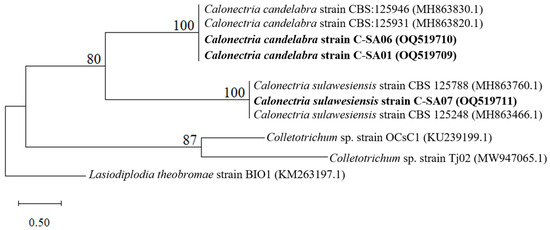
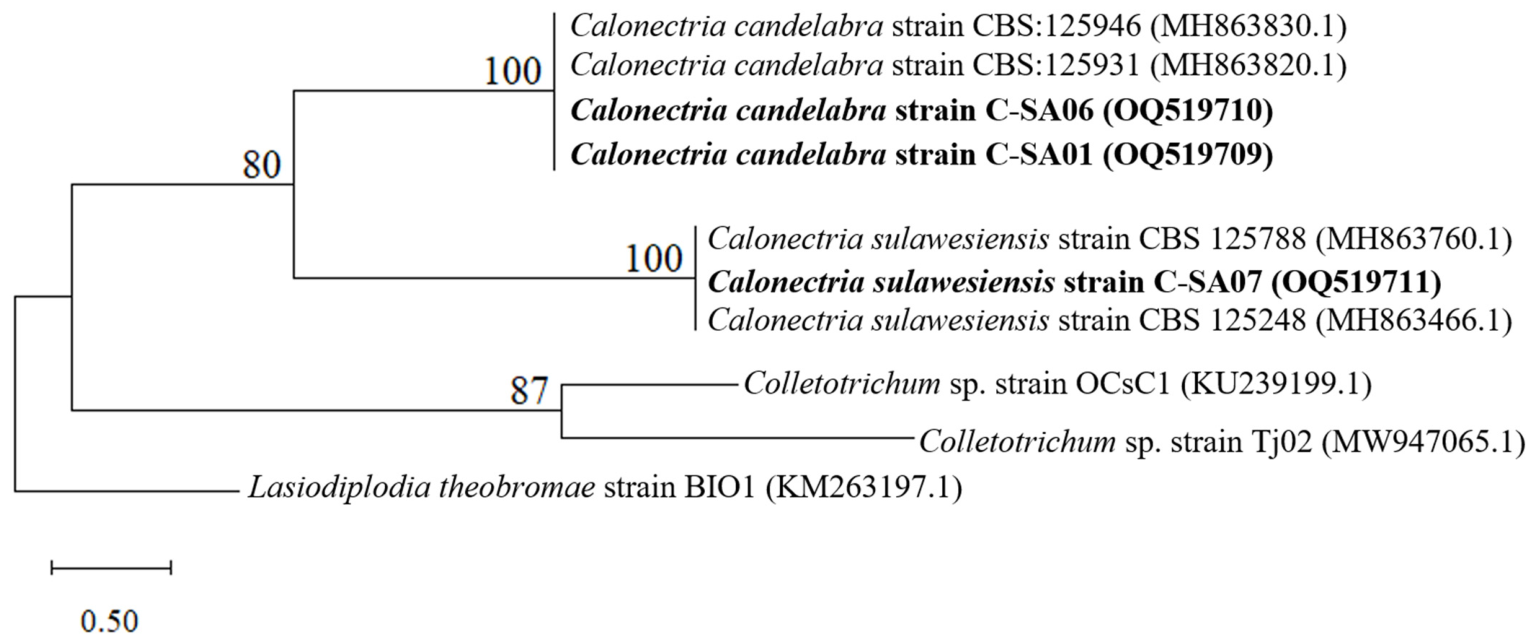
Based on ITS sequence analysis, the three selected pathogenic isolates were placed within the Calonectria clade (Figure 1). Isolates C-SA01 and C-SA06 clustered with reference sequences of C. candelabra, whereas C-SA07 clustered with C. sulawesiensis. Their GenBank accession numbers were OQ519709, OQ519710, and OQ519711, respectively. Therefore, C-SA01 and C-SA06 were putatively identified as C. candelabra, while C-SA07 was putatively identified as C. sulawesiensis.
Figure 1.
ITS-based phylogenetic tree of the selected Calonectria isolates from starapple fruits and related reference sequences from GenBank. The selected isolates are shown in bold. Bootstrap values are indicated at the nodes, and the scale bar represents 0.5 substitutions per site. Lasiodiplodia theobromae strain BIO1 was used as the outgroup. Bootstrap values are indicated at the nodes (1000 replicates). GenBank accession numbers are given in parentheses. The scale bar represents the number of substitutions per site.
3.2. Antagonizing Capacity of the Trichoderma spp. Against the Calonectria spp.
The selected Calonectria isolates in the control grew progressively on PDA from 24 to 96 h after inoculation (Table S2). Colony diameters increased from 8.3 to 8.8 mm at 24 h to 40.3–42.3 mm at 96 h, confirming the rapid growth of C-SA01, C-SA06, and C-SA07 under in vitro conditions.
The growth diameter of the three pathogenic Calonectria isolates differed among treatments when co-cultured with different Trichoderma isolates (Table S3). In general, pathogen growth increased from 24 to 96 h after inoculation, but the rate of expansion varied depending on the antagonist isolate.
3.2.1. Trichoderma spp. Versus C. candelabra C-SA01
All 25 Trichoderma spp. isolates suppressed the hyphae growth of C. candelabra, C-SA01. The AE of the Trichoderma spp. against the Calonectria sp. C-SA01 varied significantly at 48 and 72 h after inoculation. After 48 h of culture, the average AE was 16%, in which the isolates with the greatest AE were T-SA01, T-SA06, T-SA10, and T-SA14 (53.3–58.1%). After 72 h of culture, the greatest AE belonged to the isolate T-SA10 (69.9%) (Table 3).
Table 3.
Antagonistic efficiency of Trichoderma spp. isolates against the Calonectria candelabra C-SA01 at hours 48 and 72 after inoculation.
3.2.2. Trichoderma spp. Versus C. candelabra C-SA06
Table 4 indicates that great AE values after 48 h of culture were found in isolates T-SA01 (62.5%), T-SA06 (61.1%), T-SA10 (64.6%), and T-SA14 (62.5%). After 72 h of culture, the isolates having the greatest AE were T-SA10 (70.8%) and T-SA01 (62.4%), which were different at 5% significance from the other isolates. Therein, isolates with low AE were T-SA15 and T-SA26, roughly 27.3% and 30.3%, respectively (Figures S5–S7).
Table 4.
Antagonistic efficiency of Trichoderma spp. isolates against the Calonectria candelabra C-SA06 at hours 48 and 72 after inoculation.
3.2.3. Trichoderma spp. Versus C. sulawesiensis C-SA07
After 48 h of culture, Trichoderma spp. isolates T-SA01, T-SA06, T-SA10, and T-SA14 resulted in AE values of 56.9–61.0%, which were significantly greater than those of the other isolates. After 72 h of culture, these four isolates had AE greater than 60% (Table 5).
Table 5.
Antagonistic efficiency of Trichoderma spp. isolates against the Calonectria candelabra C-SA07 at hours 48 and 72 after inoculation.
Overall, T-SA01, T-SA06, T-SA10, and T-SA14 were the most effective antagonists because they consistently suppressed the three selected Calonectria isolates, C. candelabra C-SA01, C. candelabra C-SA06, and C. sulawesiensis C-SA07.
3.2.4. Identification of Trichoderma spp. That Can Control the Calonectria spp.
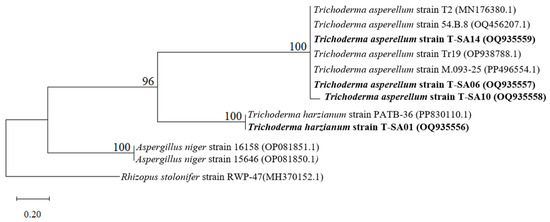
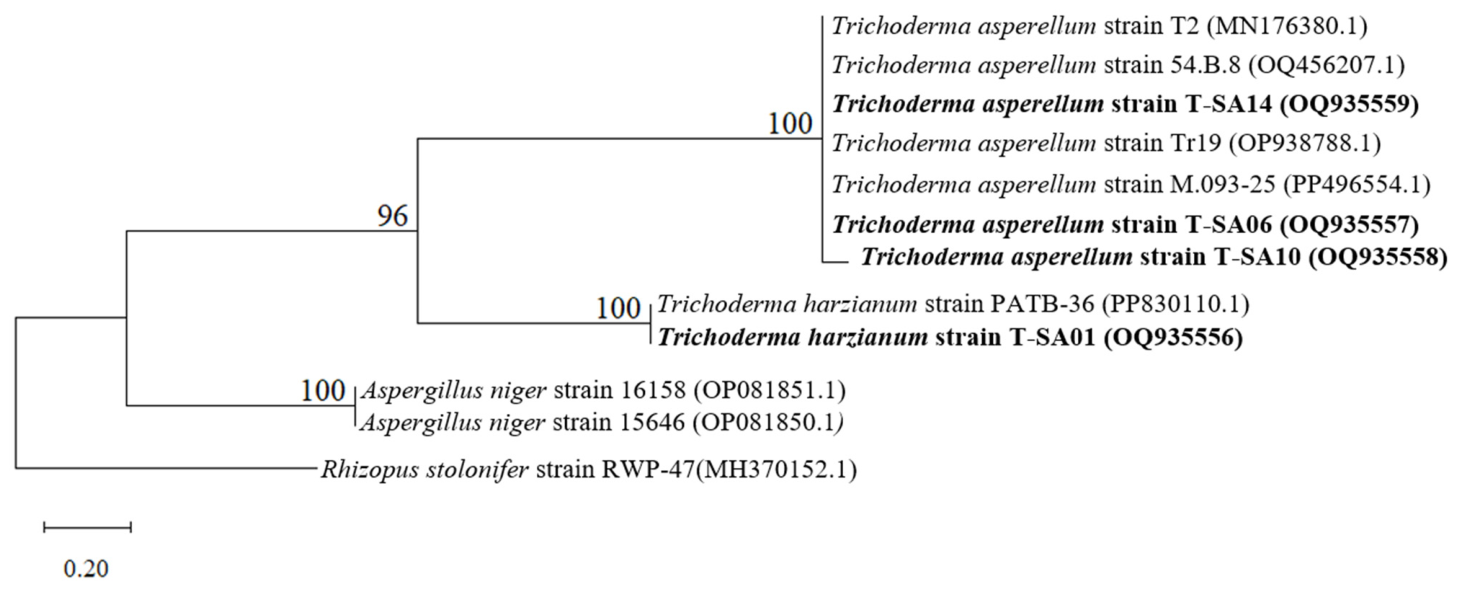
Based on ITS sequence analysis, the selected antagonistic isolates were placed within the Trichoderma clade (Figure 2). Isolates T-SA06, T-SA10, and T-SA14 clustered with reference sequences of T. asperellum, while T-SA01 was positioned separately and was putatively identified as T. harzianum. These four isolates had GenBank accession numbers OQ935557, OQ935558, OQ935559, and OQ935556, respectively.
Figure 2.
Neighbor-joining phylogenetic trees of the Trichoderma spp. isolates based on the internal transcribed spacer region sequences of three selected fungi isolates compared to the closely related isolates in the GenBank database. The percentage levels of bootstrap analysis of 1000 replicates are indicated at each node. The bar represents 0.2 substitutions per nucleotide position. The Rhizopus stolonifer strain RWP-47 was used as the outgroup isolate. Accession numbers of GenBank sequences are implied in brackets.
3.3. In Vivo Antagonism of Trichoderma spp. Against Calonectria spp.
3.3.1. Diseased Spot Length
Spraying T. harzianum T-SA01 and T. asperellum T-SA06, T-SA10, and T-SA14 reduced lesion length compared with the untreated inoculated control at all assessment times (Table 6). The four Trichoderma isolates produced similar lesion lengths, ranging from 7.67 to 8.00 mm on day 5, 9.42 to 10.1 mm on day 7, and 10.6 to 11.2 mm on day 9 after pathogen inoculation. The spraying schedule also affected lesion development. The 1DBI + 1DAI treatment resulted in the shortest lesions on day 5 (7.23 mm), whereas 1DBI and 1DBI + 1DAI were statistically similar and both produced shorter lesions than 1DAI on day 9.
Table 6.
Diseased spot length (mm) on days 5, 7 and 9 after inoculation.
3.3.2. The Suppression Efficiency Against the Calonectria spp.
The four selected Trichoderma isolates showed similar disease-reducing rates, and no significant interaction between Trichoderma isolate and spraying schedule was detected at days 5, 7, or 9 after pathogen inoculation (Table 7; Figure S8). The spraying schedule was the main factor affecting disease reduction. On day 9, 1DBI and 1DBI + 1DAI reduced disease by 36.4% and 39.1%, respectively, whereas spraying only after pathogen inoculation (1DAI) reduced disease by 15.9%. The highest DRR was observed for 1DBI + 1DAI on day 5 (44.2%).
Table 7.
Disease-reducing rate (%) on days 5, 7 and 9 after inoculation.
4. Discussion
The present study confirmed that Calonectria spp. were associated with fruit rot of starapple and that pathogenicity differed among isolates. All eight isolates caused brown necrotic lesions and tissue softening on inoculated fruits, but C-SA01, C-SA06, and C-SA07 produced the largest lesions and were therefore selected for antagonism assays. The mycelial growth rates ranged from 20.0 to 45.0 mm after four days at room temperature (25 ± 2 °C) on PDA (Table 1). According to Dann et al. [47], when Calonectria sp. mycelia cover a dish surface, the color is rust (both sides of a dish), the hyphae are thick, and spots appear on the medium surface due to a large number of darker spores within the medium. However, as per Yi et al. [48], the Calonectria sp. isolated from plants suffering from root rot has filaments on mycelia, milk-white hyphae, a light brown surface, a white border, and a brown center. Moreover, Sanchez-Gonzalez et al. [49] revealed that the growth rate of Calonectria sp. is optimized best at 23.8 °C. Calonectria spp. fungi cause diseases on different crops, such as strawberry fruit rot in Brazil [6] and Eucalyptus leaf blight in Brazil [49]. Furthermore, Calonectria sp. is a pathogen of severe root rot, which reduces the root biomass and plant height of avocados [47]. In addition, Calonectria ilicicola is seriously harmful to plants with symptoms such as dehydration, yellow leaves, rotten roots, and in some cases, plants wither and die [48]. Moreover, C. hawksworthii was first reported to cause stem-end rot in pomegranates in India [50]. In the current study, Calonectria spp. has been reported to cause fruit rot at the ripening stage, and this is one of the first reports determining Calonectria spp. as the cause of starapple fruit rot in the world. As can be seen, these findings support the pathogenic role of Calonectria spp. in starapple fruit rot and broaden the known host range of this genus, which has been reported to cause fruit rot in different types of crops.
The selected isolates of Trichoderma spp. have been successfully identified by the ITS region. This is consistent with the study by Wu et al. [37], in which the ITS region was also used to identify T. asperellum. Nevertheless, the ITS region is supposed to identify fungi at the genus level, not the species level [51]. Thus, other regions such as tef 1 should be used to identify fungal species in several studies [52,53,54]. This is because within a big sample size, ITS shows ambiguous identification [55]. However, luckily, our study was conducted in a much smaller sample size. Therefore, the selected isolates were putatively identified based on ITS sequence analysis. Nevertheless, the lack of using more recent gene regions is an unfortunate gap in our study, which should be further explored in our next studies. Therefore, the ITS-based species assignments of Trichoderma should be considered tentative until confirmed using tef1-alpha and beta-tubulin markers.
Trichoderma spp. have been isolated to control the stem-end rot in starapple caused by Lasiodiplodia spp. [56]. Trichoderma spp. has been used to control other crop diseases, such as anthracnose in pepper caused by Colletotrichum [57]. The four selected Trichoderma isolates consistently suppressed pathogen growth in dual culture, indicating their potential as indigenous biocontrol candidates. Using isolates from apparently healthy starapple farms was justified because such isolates may already be adapted to local soil, crop, and climatic conditions. Moreover, the objective was not to wait until the fungus fully covered the plate, but to evaluate early antagonistic interaction before Trichoderma overgrew the pathogen colony. Because Trichoderma grows rapidly, later assessment could obscure the pathogen colony and make accurate measurement difficult. The rapid inhibition observed at 48 and 72 h suggests early competition for space and nutrients and possible direct antagonism before the pathogen fully colonized the plate. Trichoderma spp. can produce cell-wall-degrading enzymes, antibiotic synthesis, space and nutrient competition, and direct parasitism [58,59]. Moreover, glucanase enzymes that can degrade the cell walls of pathogens are exo-β-glucanase and endo-β-glucanase [60]. Apart from chitinase and glucanase, the important role of parasitism is conducted by protein-lysing enzymes, which facilitate hydrolysis of peptide linkages in proteins [61,62]. Protease Prb1, synthesized by T. harzianum, has been proven to play a role in biocontrol [63]. In other words, isolates of T. harzianum T-SA01, T. asperellum T-SA06, T-SA10, and T-SA14 may have fungal antagonism due to the production of chitinase, exo-β-glucanase and endo-β-glucanase. However, these mechanisms were not directly quantified in the present experiment. Therefore, the antagonistic mechanisms of T-SA01, T-SA06, T-SA10, and T-SA14 should be verified by enzyme assays, volatile and non-volatile metabolite tests, and microscopy of the interaction zone.
Preventive application was more effective than curative application. Spraying Trichoderma one day before pathogen inoculation, either alone or followed by another spray one day after inoculation, resulted in smaller lesions and greater disease-reducing rates than spraying only after pathogen inoculation (Figure S8). This showed that the selected Trichoderma spp. can minimize the fruit rot disease in starapple, which is caused by Calonectria spp., and Trichoderma needs time to establish on the fruit surface and wound sites before pathogen arrival. Moreover, this was one of the first studies investigating a biocontrol agent, Trichoderma spp., to antagonize the starapple fruit rot disease induced by Calonectria spp. Similar preventive advantages have been reported for Trichoderma-based control of Calonectria pauciramosa in the study by Vitale et al. [64]. In particular, the biocontrol agent T. harzianum has been used to inhibit the root rot diseases caused by C. pauciramosa. When T. harzianum got into the plants, the symptoms caused by Calonectria spp. on red clover plants were lessened, i.e., the seedling mortality when supplying the T. harzianum T22 isolate was the lowest under the inoculation of the C. pauciramosa G42 isolates (92.3%), while T. harzianum T22 can reduce the death rate to 52.7% and 66.4% on seedlings infected with C. pauciramosa G2 and G121. During re-isolation from plants infected with C. pauciramosa on PDA, the presence was roughly 86.4–95.9%, while the re-isolation rate of C. pauciramosa was low when plants were treated with T. harzianum T22. Indeed, although the selected antagonists show similar inhibition on the pathogen, there are different mechanisms of antagonism by Trichoderma spp., such as competition, antibiosis, and mycoparasitism [65]. Although the current results are promising, they were obtained under controlled in vivo conditions and were not compared directly with commercial Trichoderma products, chemical fungicides, or other biocontrol agents. Field trials are therefore required to test persistence, performance under rainfall and variable humidity, compatibility with orchard management practices, optimal formulation, spray frequency, and possible integration with reduced fungicide programs.
5. Conclusions
Calonectria spp. were isolated from starapple fruits showing fruit rot symptoms, and C-SA01, C-SA06, and C-SA07 were the most aggressive isolates under the experimental conditions. ITS-based analysis putatively assigned C-SA01 and C-SA06 to C. candelabra and C-SA07 to C. sulawesiensis. The selection resulted in four isolates of T. harzianum T-SA01, T. asperellum T-SA06, T-SA10, and T-SA14 that showed the greatest AE against the three isolates of C. candelabra C-SA01 (56.0–65.5%) and C-SA06 (58.4–70.8), and C. sulawesiensis C-SA07 (62.6–69.2). Under in vivo conditions, preventive spraying one day before pathogen inoculation, especially when combined with one additional spray one day after inoculation, reduced lesion expansion more effectively than post-inoculation spraying alone. The main limitations of the study are that taxonomic identification relied on ITS sequences, antagonistic mechanisms were not directly quantified in this experiment, and field efficacy was not evaluated. Future studies should confirm fungal identities using multilocus markers, compare these isolates with commercial biocontrol agents and standard fungicides, investigate enzymatic and metabolite-mediated mechanisms, and validate long-term disease suppression under starapple orchard conditions.
Supplementary Materials
The following supporting information can be downloaded at: https://www.mdpi.com/article/10.3390/applmicrobiol6070072/s1. Table S1: features, mycelial color, and spores of pathogenic fungi causing starapple fruit rot in Phong Dien district; Table S2: growth diameter (mm) of selected Calonectria isolates on PDA at 24, 48, 72, and 96 h after inoculation; Table S3: mean colony diameter (mm) of pathogenic Calonectria isolates in dual culture with different Trichoderma isolates at 24, 48, 72, and 96 h after inoculation.; Figure S1: wounding positions on a fruit; Figure S2: symptoms on fruits and morphology of mycelia of Calonectria spp. after 14 days on PDA; Figure S3: representative growth of Calonectria spp. causing starapple fruit rot on PDA at 24, 48, 72, and 96 h after inoculation; Figure S4: representative fruit rot symptoms caused by Calonectria spp. on starapple fruits at day 9 after inoculation; Figure S5: dual-culture antagonism of selected Trichoderma isolates against C. candelabra C-SA01 on PDA at 48 and 72 h after dual inoculation. In each dual-culture plate, the Calonectria plug was positioned opposite the Trichoderma plug. Pathogen-only plates were used as negative controls for inhibition calculations, whereas Trichoderma-only plates confirmed antagonist growth: Figure S6: dual-culture antagonism of selected Trichoderma isolates against C. candelabra C-SA06 on PDA at 48 and 72 h after dual inoculation. In each dual-culture plate, the Calonectria plug was positioned opposite the Trichoderma plug. Pathogen-only plates were used as negative controls for inhibition calculations, whereas Trichoderma-only plates confirmed antagonist growth; Figure S7: dual-culture antagonism of selected Trichoderma isolates against C. sulawesiensis C-SA07 on PDA at 48 and 72 h after dual inoculation. In each dual-culture plate, the Calonectria plug was positioned opposite the Trichoderma plug. Pathogen-only plates were used as negative controls for inhibition calculations, whereas Trichoderma-only plates confirmed antagonist growth; Figure S8: effects of Trichoderma isolate and spraying schedule on lesion length and disease-reducing rate after 9 days of inoculation under in vivo conditions: (a) T-SA01, (b) T-SA06, (c) T-SA10, and (d) T-SA14. 1DBI: Trichoderma sprayed one day before pathogen inoculation; 1DAI: Trichoderma sprayed one day after pathogen inoculation. The control is the fruit inoculated with sterile distilled water only. Lesions were assessed after pathogen inoculation. Red arrows indicate visible lesion development and mycelial growth on the fruit surface.
Author Contributions
Conceptualization, N.Q.K. and C.L.P.; methodology, N.Q.K.; validation, C.L.P.; formal analysis, N.D.T., C.L.P., T.N.H.V. and L.T.M.T.; investigation, N.D.T., C.L.P., T.N.H.V., and L.T.M.T.; data curation, L.T.M.T.; writing—original draft preparation, N.Q.K. and C.L.P.; writing—review and editing, L.T.Q. and D.T.X. All authors have read and agreed to the published version of the manuscript.
Funding
This research received no external funding.
Institutional Review Board Statement
Not applicable.
Informed Consent Statement
Not applicable.
Data Availability Statement
The original contributions presented in the study are included in the article/Supplementary Material; further inquiries can be directed to the corresponding author.
Acknowledgments
The authors sincerely appreciate the Purple Nonsulfur Bacteria Laboratory (Faculty of Crop Science, College of Agriculture, Can Tho University), which provided equipment, chemicals, and materials for this study to be completed.
Conflicts of Interest
The authors declare no conflicts of interest.
Abbreviations
The following abbreviations are used in this manuscript:
| AE | Antagonistic efficiency |
| DAI | Days after inoculation |
| DBI | Days before inoculation |
| PDA | Potato Dextrose Agar |
| PDB | Potato Dextrose Broth |
| TSM | Trichoderma Specific Medium |
References
- Khang, D.T.; Hon, H.N.; Huy, T.G.; Thi, N.P.A.; Men, T.T.; Van Ay, N.; Dung, T.N. Morphological Characteristics and Genetic Relations of the Star Apple Varieties (Chrysophyllum cainito L.). Asian J. Plant Sci. 2021, 20, 380–388. [Google Scholar] [CrossRef] [Scilit]
- Gajera, H.P.; Bambharolia, R.P.; Domadiya, R.K.; Patel, S.V.; Golakiya, B.A. Molecular Characterization and Genetic Variability Studies Associated with Fruit Quality of Indigenous Mango (Mangifera indica L.) Cultivars. Plant Syst. Evol. 2013, 300, 1011–1020. [Google Scholar] [CrossRef] [Scilit]
- General Statistics Office. Investigating Results of Rural, Agriculture and Aquaculture in 2016. Available online: https://tdtntnnts2016.gso.gov.vn/ (accessed on 21 December 2021).
- Crous, P.W. Taxonomy and Pathology of Cylindrocladium (Calonectria) and Allied Genera; American Phytopathological Society (APS Press): St. Paul, MN, USA, 2002. [Google Scholar]
- Li, J.; Wingfield, M.J.; Liu, Q.; Barnes, I.; Roux, J.; Lombard, L.; Crous, P.W.; Chen, S. Calonectria Species Isolated from Eucalyptus Plantations and Nurseries in South China. IMA Fungus 2017, 8, 259–286. [Google Scholar] [CrossRef] [Scilit] [PubMed]
- Lopes, U.P.; Alfenas, R.F.; Zambolim, L.; Crous, P.W.; Costa, H.; Pereira, O.L. A New Species of Calonectria Causing Rot on Ripe Strawberry Fruit in Brazil. Aust. Plant Pathol. 2017, 47, 1–11. [Google Scholar] [CrossRef] [Scilit]
- Marin-Felix, Y.; Groenewald, J.Z.; Cai, L.; Chen, Q.; Marincowitz, S.; Barnes, I.; Bensch, K.; Braun, U.; Camporesi, E.; Damm, U.; et al. Genera of Phytopathogenic Fungi: GOPHY 1. Stud. Mycol. 2017, 86, 99–216. [Google Scholar] [CrossRef] [Scilit] [PubMed]
- Jiang, G.Z.; Gao, F.; Yue, H.; Tao, L.; He, X.Y. First Report of Fruit Spot of Macadamia sp. Caused by Calonectria pentaseptata in China. Plant Dis. 2020, 104, 575. [Google Scholar] [CrossRef] [Scilit]
- Pham, N.Q.; Barnes, I.; Chen, S.; Liu, F.; Dang, Q.N.; Pham, T.Q.; Lombard, L.; Crous, P.W.; Wingfield, M.J. Ten New Species of Calonectria from Indonesia and Vietnam. Mycologia 2019, 111, 78–102. [Google Scholar] [CrossRef] [Scilit] [PubMed]
- Henricot, B.; Culham, A. Cylindrocladium buxicola, a New Species affecting Buxus spp., and Its Phylogenetic Status. Mycologia 2002, 94, 980–997. [Google Scholar] [CrossRef] [Scilit]
- Gehesquière, B.; Crouch, J.A.; Marra, R.E.; Van Poucke, K.; Rys, F.; Maes, M.; Gobin, B.; Höfte, M.; Heungens, K. Characterization and Taxonomic Reassessment of the Box Blight Pathogen Calonectria pseudonaviculata, Introducing Calonectria henricotiae sp. nov. Plant Pathol. 2015, 65, 37–52. [Google Scholar] [CrossRef] [Scilit]
- Freitas, R.G.; Alfenas, R.F.; Guimarães, L.M.S.; Badel, J.L.; Alfenas, A.C. Genetic Diversity and Aggressiveness of Calonectria pteridis in Eucalyptus spp. Plant Pathol. 2019, 68, 869–877. [Google Scholar] [CrossRef] [Scilit]
- Crous, P.W.; Shivas, R.G.; Wingfield, M.J.; Summerell, B.A.; Rossman, A.Y.; Alves, J.L.; Adams, G.C.; Barreto, R.W.; Bell, A.; Coutinho, M.L.; et al. Fungal Planet Description Sheets: 128–153. Persoonia 2012, 29, 146–201. [Google Scholar] [CrossRef] [Scilit] [PubMed]
- Old, K.M.; Wingfield, M.J.; Yuan, Z.Q. A manual of Diseases of Eucalyptus in South-East Asia; Center for International Forestry Research: Jakarta, Indonesia, 2003. [Google Scholar]
- Rodas, C.A.; Lombard, L.; Gryzenhout, M.; Slippers, B.; Wingfield, M.J. Cylindrocladium blight of Eucalyptus grandis in Colombia. Aust. Plant Pathol. 2005, 34, 143. [Google Scholar] [CrossRef] [Scilit]
- Gai, Y.; Deng, Q.; Chen, X.; Guan, M.; Xiao, X.; Xu, D.; Deng, M.; Pan, R. Phylogenetic Diversity of Calonectria ilicicola Causing Cylindrocladium Black Rot of Peanut and Red Crown Rot of Soybean in Southern China. J. Gen. Plant Pathol. 2017, 83, 273–282. [Google Scholar] [CrossRef] [Scilit]
- Sharma, S.; Chauhan, O. Postharvest Pathology. In Fruits and Vegetables Technologies; Chauhan, O., Ed.; Springer: Singapore, 2025. [Google Scholar] [CrossRef] [Scilit]
- Capote, N.; Del Río, M.Á.; Herencia, J.F.; Arroyo, F.T. Molecular and pathogenic characterization of Cylindrocarpon-like anamorphs causing root and basal rot of almonds. Plants 2022, 11, 984. [Google Scholar] [CrossRef] [Scilit] [PubMed]
- Wang, Q.; Han, Y.; Yu, Z.; Tian, S.; Sun, P.; Shi, Y.; Peng, C.; Gu, T.; Li, Z. Fungi in horticultural crops: Promotion, pathogenicity and monitoring. Agronomy 2025, 15, 1699. [Google Scholar] [CrossRef] [Scilit]
- Cardenas, D.E.; Aguilar, C.; Bhatta, U.; Bugingo, C.; Cochran-Murray, S.; Gazis, R.; Miles, T.; Jurick, W.M., II; Naegele, R.; Quesada-Ocampo, L.M.; et al. Rotten to the core: Challenges with postharvest disease management of fruit crops. Plant Dis. 2025, 109, 2009–2028. [Google Scholar] [CrossRef] [Scilit] [PubMed]
- Thambugala, K.M.; Daranagama, D.A.; Phillips, A.J.L.; Kannangara, S.D.; Promputtha, I. Fungi vs. Fungi in Biocontrol: An Overview of Fungal Antagonists Applied Against Fungal Plant Pathogens. Front. Cell. Infect. Microbiol. 2020, 10, 604923. [Google Scholar] [CrossRef] [Scilit] [PubMed]
- Waqas, M.; Khana, A.L.; Hamayuna, M.; Shahzad, R.; Kang, S.M.; Kim, J.G.; Lee, I.J. Endophytic Fungi Promote Plant Growth and Mitigate the Adverse Effects of Stem Rot: An Example of Penicillium citrinum and Aspergillus terreus. J. Plant Interact. 2015, 10, 280–287. [Google Scholar]
- Guzmán-Guzmán, P.; Kumar, A.; de los Santos-Villalobos, S.; Parra-Cota, F.I.; Orozco-Mosqueda, M.d.C.; Fadiji, A.E.; Hyder, S.; Babalola, O.O.; Santoyo, G. Trichoderma Species: Our Best Fungal Allies in the Biocontrol of Plant Diseases—A Review. Plants 2023, 12, 432. [Google Scholar] [CrossRef] [Scilit] [PubMed]
- Wells, H.D. Trichoderma as a biocontrol agent. In Biocontrol of Plant Diseases; Mukerji, K.G., Garg, K.L., Eds.; CRC Press: Boca Raton, FL, USA, 2023; pp. 71–82. [Google Scholar] [CrossRef] [Scilit]
- Zin, N.A.; Badaluddin, N.A. Biological Functions of Trichoderma spp. for Agriculture Applications. Ann. Agric. Sci. 2020, 65, 168–178. [Google Scholar] [CrossRef] [Scilit]
- Escudero-Leyva, E.; Alfaro-Vargas, P.; Muñoz-Arrieta, R.; Charpentier-Alfaro, C.; Del Milagro Granados-Montero, M.; Valverde-Madrigal, K.S.; Pérez-Villanueva, M.; Méndez-Rivera, M.; Rodríguez-Rodríguez, C.E.; Chaverri, P.; et al. Tolerance and Biological Removal of Fungicides by Trichoderma Species Isolated from the Endosphere of Wild Rubiaceae Plants. Front. Agron. 2022, 3, 772170. [Google Scholar] [CrossRef] [Scilit]
- Bae, S.-J.; Mohanta, T.K.; Chung, J.Y.; Ryu, M.; Park, G.; Shim, S.; Hong, S.-B.; Seo, H.; Bae, D.-W.; Bae, I.; et al. Trichoderma Metabolites as Biological Control Agents against Phytophthora Pathogens. Biol. Control 2016, 92, 128–138. [Google Scholar] [CrossRef] [Scilit]
- Jambhulkar, P.P.; Raja, M.; Singh, B.; Katoch, S.; Kumar, S.; Sharma, P. Potential Native Trichoderma Isolates against Fusarium verticillioides Causing Post Flowering Stalk Rot in Winter Maize. Crop Prot. 2022, 152, 105838. [Google Scholar] [CrossRef] [Scilit]
- Molebila, D.Y.; Rosmana, A.; Tresnaputra, U.S. Trichoderma of Coffee Roots from Alor: Morphological Characteristic and in Vitro Efficacy to Inhibit Colletotrichum, Causing Anthracnose. J. Fitopatol. Indones. 2020, 16, 61–68. [Google Scholar] [CrossRef] [Scilit]
- Yao, X.; Guo, H.; Zhang, K.; Zhao, M.; Ruan, J.; Chen, J. Trichoderma and its role in biological control of plant fungal and nematode disease. Front. Microbiol. 2023, 14, 1160551. [Google Scholar] [CrossRef] [Scilit] [PubMed]
- Wang, R.; Yu, X.; Yin, Y.; Norvienyeku, J.; Khan, R.A.A.; Zhang, M.; Ren, S.; Chen, J.; Liu, T. Biocontrol of cucumber Fusarium wilt by Trichoderma asperellum FJ035 dependent on antagonism and spatiotemporal competition with Fusarium oxysporum. Biol. Control 2023, 186, 105334. [Google Scholar] [CrossRef] [Scilit]
- Keswani, C.; Mishra, S.; Sarma, B.K.; Singh, S.P.; Singh, H.B. Unraveling the efficient applications of secondary metabolites of various Trichoderma spp. Appl. Microbiol. Biotechnol. 2013, 98, 533–544. [Google Scholar] [CrossRef] [Scilit] [PubMed]
- Tian, L.; Zhu, X.; Guo, Y.; Zhou, Q.; Wang, L.; Li, W. Antagonism of rhizosphere Trichoderma brevicompactum DTN19 against the pathogenic fungi causing corm rot in saffron (Crocus sativus L.) in vitro. Front. Microbiol. 2024, 15, 1454670. [Google Scholar] [CrossRef] [Scilit] [PubMed]
- Kappel, L.; Yu, L.; Escobar, C.; Marcianò, D.; Srivastava, V.; Bulone, V.; Gruber, S. A Comparative cell wall analysis of Trichoderma spp. confirms a conserved polysaccharide scaffold and suggests an important role for chitosan in mycoparasitism. Microbiol. Spectr. 2024, 12, e034523. [Google Scholar] [CrossRef] [Scilit] [PubMed]
- Contreras-Cornejo, H.A.; Schmoll, M.; Esquivel-Ayala, B.A.; González-Esquivel, C.E.; Rocha-Ramírez, V.; Larsen, J. Mechanisms for plant growth promotion activated by Trichoderma in natural and managed terrestrial ecosystem. Microbiol. Res. 2024, 281, 127621. [Google Scholar] [CrossRef] [Scilit] [PubMed]
- Behiry, S.; Soliman, S.A.; Massoud, M.A.; Abdelbary, M.; Kordy, A.M.; Abdelkhalek, A.; Heflish, A. Trichoderma pubescens elicit induced systemic resistance in tomato challenged by Rhizoctonia solani. J. Fungi 2023, 9, 167. [Google Scholar] [CrossRef] [Scilit] [PubMed]
- Wu, Q.; Sun, R.; Ni, M.; Yu, J.; Li, Y.; Yu, C.; Dou, K.; Ren, J.; Chen, J. Identification of a Novel Fungus, Trichoderma asperellum GDFS1009, and Comprehensive Evaluation of Its Biocontrol Efficacy. PLoS ONE 2017, 12, e0179957. [Google Scholar] [CrossRef] [Scilit] [PubMed]
- Lodi, R.S.; Peng, C.; Dong, X.; Deng, P.; Peng, L. Trichoderma hamatum and its benefits. J. Fungi 2023, 9, 994. [Google Scholar] [CrossRef] [Scilit] [PubMed]
- Zhao, S.; Zhang, T.; Hasunuma, T.; Kondo, A.; Zhao, X.-Q.; Feng, J.-X. Every Road Leads to Rome: Diverse biosynthetic regulation of plant cell wall-degrading enzymes in filamentous fungi Penicillium oxalicum and Trichoderma reesei. Crit. Rev. Biotechnol. 2023, 44, 1241–1261. [Google Scholar] [CrossRef] [Scilit] [PubMed]
- Pachauri, S.; Zaid, R.; Sherkhane, P.D.; Easa, J.; Viterbo, A.; Chet, I.; Horwitz, B.A.; Mukherjee, P.K. Comparative phenotypic, genomic, and transcriptomic analyses of two contrasting strains of the plant beneficial fungus Trichoderma virens. Microbiol. Spectr. 2023, 11, e03024-22. [Google Scholar] [CrossRef] [Scilit] [PubMed]
- Guo, Q.; Shi, L.; Wang, X.; Li, D.; Yin, Z.; Zhang, J.; Ding, G.; Chen, L. Structures and biological activities of secondary metabolites from the Trichoderma genus (covering 2018–2022). J. Agric. Food Chem. 2023, 71, 13612–13632. [Google Scholar] [CrossRef] [Scilit] [PubMed]
- Furukawa, T.; Kishi, K. Production of perithecia of various ascomycotina on water agar medium emended with leaf pieces. J. Phytopathol. 2002, 150, 625–628. [Google Scholar] [CrossRef] [Scilit]
- Awa, O.C.; Samuel, O.; Oworu, O.O.; Sosanya, O. First Report of Fruit Anthracnose in Mango Caused by Colletotrichum gloeosporioides in Southwestern Nigeria. Int. J. Sci. Technol. Res. 2012, 1, 30–34. [Google Scholar]
- Barnett, H.L.; Hunter, B.B. Illustrated Genera of Imperfect Fungi, 4th ed.; APS Press: St. Paul, MN, USA, 1998. [Google Scholar]
- Kakraliya, S.S.; Choskit, D.; Pandit, D.; Abrol, S. Effect of Bio-Agents, Neem Leaf Extract and Fungicides Against Alternaria Leaf Blight of Wheat (Triticum aestivum L.). Nat. Prod. Chem. Res. 2017, 5, 1000295. [Google Scholar] [CrossRef]
- White, T.J.; Bruns, T.; Lee, S.; Taylor, J. Amplification and direct sequencing of fungal ribosomal RNA genes for phylogenetics. In PCR Protocols: A Guide to Methods and Applications; Innis, M.A., Ed.; Academic Press: New York, NY, USA, 1990; pp. 315–322. [Google Scholar]
- Dann, E.K.; Cooke, A.W.; Forsberg, L.I.; Pegg, K.G.; Tan, Y.P.; Shivas, R.G. Pathogenicity Studies in Avocado with Three Nectriaceous Fungi, Calonectria ilicicola, Gliocladiopsis sp. and Ilyonectria liriodendri. Plant Pathol. 2012, 61, 896–902. [Google Scholar] [CrossRef] [Scilit]
- Yi, R.H.; Su, J.J.; Li, H.J.; Li, D.; Long, G.G. First Report of Root Rot on Manglietia decidua Caused by Calonectria ilicicola in China. Plant Dis. 2022, 106, 1522. [Google Scholar] [CrossRef] [Scilit] [PubMed]
- Sanchez-Gonzalez, E.I.; De Paula Farias Soares, T.; Zarpelon, T.G.; Zauza, E.A.V.; Mafia, R.G.; Ferreira, M.A. Two New Species of Calonectria (Hypocreales, Nectriaceae) Causing Eucalyptus Leaf Blight in Brazil. MycoKeys 2022, 91, 169–197. [Google Scholar] [CrossRef] [Scilit] [PubMed]
- Manjunatha, N.; Pokhare, S.S.; Sharma, J.; Patil, P.G.; Agarrwal, R.; Chakranarayan, M.G.; Sirsat, J.D.; Patil, J.; Marathe, R.A. Collar Rot Caused by Calonectria hawksworthii, a New Record for Pomegranate (Punica granatum). J. Plant Pathol. 2023, 105, 887–894. [Google Scholar] [CrossRef] [Scilit]
- Cai, F.; Druzhinina, I.S. In honor of John Bissett: Authoritative guidelines on molecular identification of Trichoderma. Fungal Divers. 2021, 107, 1–69. [Google Scholar] [CrossRef] [Scilit]
- Hussein, L.F.; Saadullah, A.A.M. DNA marker identification of Trichoderma and Fusarium level species. IOP Conf. Ser. Earth Environ. Sci. 2023, 1252, 012175. [Google Scholar] [CrossRef] [Scilit]
- Oliveira, L.G.; Kettner, M.G.; Lima, M.L.S.; Leão, M.P.C.; Da S Santos, A.C.; Costa, A.F. Trichoderma species from soil of Pernambuco State, Brazil. Curr. Microbiol. 2023, 80, 289. [Google Scholar] [CrossRef] [Scilit] [PubMed]
- Weaver, D.; Novak-Frazer, L.; Palmer, M.; Richardson, M.; Bromley, M.; Bowyer, P. Development of a novel mycobiome diagnostic for fungal infection. BMC Microbiol. 2024, 24, 63. [Google Scholar] [CrossRef] [Scilit] [PubMed]
- Błaszczyk, L.; Popiel, D.; Chełkowski, J.; Koczyk, G.; Samuels, G.J.; Sobieralski, K.; Siwulski, M. Species Diversity of Trichoderma in Poland. J. Appl. Genet. 2011, 52, 233–243. [Google Scholar] [CrossRef] [Scilit] [PubMed]
- Khuong, N.Q.; Nhien, D.B.; Thu, L.T.M.; Trong, N.D.; Hiep, P.C.; Thuan, V.M.; Quang, L.T.; Thuc, L.V.; Xuan, D.T. Using Trichoderma asperellum to Antagonize Lasiodiplodia theobromae Causing Stem-End Rot Disease on Pomelo (Citrus maxima). J. Fungi 2023, 9, 981. [Google Scholar] [CrossRef] [Scilit] [PubMed]
- Yadav, M.; Dubey, M.K.; Upadhyay, R.S. Systemic Resistance in Chilli Pepper against Anthracnose (Caused by Colletotrichum truncatum) Induced by Trichoderma harzianum, Trichoderma asperellum and Paenibacillus dendritiformis. J. Fungi 2021, 7, 307. [Google Scholar] [CrossRef] [Scilit] [PubMed]
- Benítez, T.; Rincón, A.M.; Limón, M.C.; Codon, A.C. Biocontrol Mechanisms of Trichoderma Strains. Int. Microbiol. 2004, 7, 249–260. [Google Scholar] [PubMed]
- Tyśkiewicz, R.; Nowak, A.; Ozimek, E.; Jaroszuk-Ściseł, J. Trichoderma: The Current Status of Its Application in Agriculture for the Biocontrol of Fungal Phytopathogens and Stimulation of Plant Growth. Int. J. Mol. Sci. 2022, 23, 2329. [Google Scholar] [CrossRef] [Scilit] [PubMed]
- Sood, M.; Kapoor, D.; Kumar, V.; Sheteiwy, M.S.; Ramakrishnan, M.; Landi, M.; Araniti, F.; Sharma, A. Trichoderma: The “Secrets” of a Multitalented Biocontrol Agent. Plants 2020, 9, 762. [Google Scholar] [CrossRef] [Scilit] [PubMed]
- Mukherjee, M.; Mukherjee, P.K.; Horwitz, B.A.; Zachow, C.; Berg, G.; Zeilinger, S. Trichoderma–Plant–Pathogen Interactions: Advances in Genetics of Biological Control. Indian J. Microbiol. 2012, 52, 522–529. [Google Scholar] [CrossRef] [Scilit] [PubMed]
- Souza, P.M.; De Assis Bittencourt, M.L.; Caprara, C.C.; De Freitas, M.; De Almeida, R.P.C.; Silveira, D.; Fonseca, Y.M.; Filho, E.X.F.; Pessoa, A., Jr.; Magalhães, P.O. A Biotechnology Perspective of Fungal Proteases. Braz. J. Microbiol. 2015, 46, 337–346. [Google Scholar] [CrossRef] [Scilit] [PubMed]
- De Marco, J.L.; Felix, C. Characterization of a Protease Produced by a Trichoderma harzianum Isolate Which Controls Cocoa Plant Witches’ Broom Disease. BMC Biochem. 2002, 3, 3. [Google Scholar] [CrossRef] [Scilit] [PubMed]
- Vitale, A.; Cirvilleri, G.; Castello, I.; Aiello, D.; Polizzi, G. Evaluation of Trichoderma harzianum Isolate T22 as Biological Control Agent of Calonectria pauciramosa. BioControl 2011, 57, 687–696. [Google Scholar] [CrossRef] [Scilit]
- Mukhopadhyay, R.; Kumar, D. Trichoderma: A beneficial antifungal agent and insights into its mechanism of biocontrol potential. Egypt. J. Biol. Pest Control 2020, 30, 133. [Google Scholar] [CrossRef] [Scilit]

Disclaimer/Publisher’s Note: The statements, opinions and data contained in all publications are solely those of the individual author(s) and contributor(s) and not of MDPI and/or the editor(s). MDPI and/or the editor(s) disclaim responsibility for any injury to people or property resulting from any ideas, methods, instructions or products referred to in the content. |
© 2026 by the authors. Licensee MDPI, Basel, Switzerland. This article is an open access article distributed under the terms and conditions of the Creative Commons Attribution (CC BY) license.