Article

Divergent Primary Growth Kinetics of Aerobic mesophilic and Staphylococcus aureus in Guinea Pig Meat Burgers Under Controlled Temperature


by
Frank Fernandez-Rosillo
1,
Carlos Culqui-Arce
2,
Eliana Milagros Cabrejos-Barrios
1,
Katia Karlita Rodríguez Frias
1,
Jhuly Vanessa Pérez Gonzáles
1,
Nestor A. Sánchez-Goycochea
3,
Nilthon Arce Fernández
1,
Ralph Rivera Botanares
1,
Fredy Velayarce-Vallejos
4,
Diner Mori-Mestanza
2,* and
César R. Balcázar-Zumaeta
2,*
1
Grupo de Modelamiento y Simulación de Procesos en la Industria Alimentaria (MOSIPRIA), Instituto de Investigación de Ciencia de Datos (INSCID), Universidad Nacional de Jaén (UNJ), Carretera Jaén—San Ignacio KM 24, Cajamarca 06801, Peru
2
Instituto de Investigación, Innovación y Desarrollo para el Sector Agrario y Agroindustrial (IIDAA), Facultad de Ingeniería y Ciencias Agrarias, Universidad Nacional Toribio Rodríguez de Mendoza de Amazonas, Chachapoyas 01001, Peru
3
Centro de Apoyo Logístico para Investigadores, Universidad Tecnológica del Perú, Lima 15842, Peru
4
Facultad de Ingeniería Zootecnista, Biotecnología, Agronegocios y Ciencia de Datos, Universidad Nacional Toribio Rodríguez de Mendoza de Amazonas, Chachapoyas 01001, Peru
*
Authors to whom correspondence should be addressed.
Appl. Microbiol. 2026, 6(5), 62; https://doi.org/10.3390/applmicrobiol6050062 (registering DOI)
Submission received: 24 March 2026 / Revised: 30 April 2026 / Accepted: 4 May 2026 / Published: 11 May 2026

Abstract

Temperature abuse during storage represents a critical factor influencing microbial behavior in meat products, particularly in non-conventional matrices such as guinea pig meat. This study aimed to characterize and compare the primary growth kinetics of Aerobic mesophilic bacteria and Staphylococcus aureus (S. aureus) in guinea pig meat burgers under controlled temperature abuse conditions (30, 35, and 40 °C). Microbial growth was monitored over 96 h and described using the modified Gompertz model to estimate key kinetic parameters, including maximum specific growth rate (µmax) and lag phase duration (λ). Aerobic mesophilic bacteria exhibited increasing µmax values with temperature, indicating enhanced metabolic activity under elevated thermal conditions. In contrast, S. aureus showed reduced µmax and prolonged λ at 40 °C, suggesting stress-induced modulation of growth dynamics. These findings demonstrate that temperature increases do not uniformly accelerate microbial proliferation across different populations within the same food matrix. The contrasting kinetic responses indicate that Aerobic mesophilic bacteria and S. aureus respond differently to temperature abuse conditions, highlighting that total aerobic counts alone may not reliably predict pathogen behavior in guinea pig meat burgers.

1. Introduction

Guinea pig (Cavia porcellus) meat is an alternative animal protein source that is gaining cultural and economic importance in Andean countries. It is characterized by high protein content and low fat levels, which influence its physicochemical environment and potentially its microbial ecology [1,2]. Despite its increasing consumption, there is still limited information regarding the microbiological behavior and growth kinetics of key indicator microorganisms and pathogens in processed products derived from guinea pig meat, particularly under temperature abuse conditions that may occur during processing, storage, or distribution [3].
Mathematical growth models such as the modified Gompertz and Baranyi models have been widely applied to describe sigmoidal bacterial growth curves under isothermal conditions and to estimate biologically meaningful kinetic parameters, including the maximum specific growth rate (µmax) and lag phase duration (λ) [4,5,6,7,8,9]. The application of predictive models in food safety has historically focused on conventional meat matrices such as pork, beef, and poultry, in which the influence of intrinsic and extrinsic factors on microbial kinetics has been extensively documented [10,11,12,13]. For instance, Gompertz-based models have successfully characterized the growth kinetics of spoilage organisms and pathogens in cooked and raw pork products stored at different temperatures, demonstrating high goodness-of-fit and predictive reliability [10,11,14]. However, predictive models developed for these matrices have limited transferability to non-conventional animal products, as variations in meat composition and physicochemical properties (e.g., buffering capacity, fat content, and water activity) can substantially affect microbial responses to environmental stressors [15].
Predictive microbiology is a quantitative discipline within food microbiology that uses mathematical models to describe and forecast microbial behavior under specific environmental conditions, including temperature, pH, and water activity, in order to support food safety and quality assessment [7,9,16]. These models enable the prediction of microbial growth, survival, and inactivation, allowing scientists and industry stakeholders to make informed decisions regarding risk management and shelf-life estimation in food systems [9,17].
Among the intrinsic factors influencing microbial growth, temperature plays a critical role. In meat systems, the growth rate of both spoilage and pathogenic bacteria generally increases with rising temperatures within the permissive growth range, while lag phases tend to shorten as a result of accelerated metabolic adaptation [10,18]. However, these temperature responses are not uniform across microbial groups; different species and strains may exhibit contrasting kinetic patterns under identical temperature conditions, underscoring the importance of microorganism-specific modeling in predictive microbiology [13,19,20].
Microbiological assessment of food products commonly employs indicator organisms (e.g., Aerobic mesophilic bacteria and total viable counts) as proxies for overall microbiological quality and hygienic status. Traditionally, indicator microorganisms have been used to infer the possible presence of pathogens or inadequate processing conditions because of their ease of enumeration and their correlation with general contamination level [7,21]. However, the relationship between indicator counts and the presence or behavior of specific pathogens is not always linear or reliable, as indicator organisms may not experience the same ecological constraints, stress responses, or competitive interactions as pathogens within the same food matrix [22]. Staphylococcus aureus (S. aureus) represents a significant foodborne pathogen associated with various meat products. It is capable of growth across a broad temperature range and can produce heat-stable enterotoxins that pose serious public health risks when present at high levels [23]. Predictive modeling of S. aureus growth in meat has been applied to raw pork, ham, and other meat systems across different temperature conditions, demonstrating the usefulness of kinetic models for anticipating pathogen behavior under storage and temperature abuse scenarios [11,24]. Comparative modeling of indicator microorganisms and S. aureus within the same food system can therefore provide important insights into differential responses to thermal stress, improving the interpretation of predictive assessments and supporting food safety interventions.
Temperature abuse, defined as exposure to temperatures outside recommended storage limits, can differentially affect microbial populations. Elevated temperatures may accelerate the growth of spoilage microorganisms while simultaneously inducing physiological stress or growth inhibition in certain pathogens [12]. These contrasting kinetic responses highlight that microbial populations within the same food matrix do not necessarily respond uniformly to temperature changes. Understanding such differential behavior is particularly important in non-conventional meat products, where information on microbial growth dynamics remains limited. Characterizing these responses contributes to a better interpretation of microbial behavior under temperature abuse conditions and supports the development of more informed food safety management strategies [25].
The selected temperatures (30, 35, and 40 °C) were chosen to represent realistic temperature abuse scenarios that may occur during transportation, informal retail display, or temporary refrigeration failure in tropical distribution environments, where meat products can be exposed to elevated ambient conditions for extended periods. Under such circumstances, contamination with S. aureus may become relevant from a risk assessment perspective despite not being expected under properly controlled handling conditions.
Based on the known temperature dependence of microbial growth and the ecological differences between spoilage microbiota and pathogenic species, it was hypothesized that Aerobic mesophilic bacteria and S. aureus would exhibit distinct temperature-dependent growth kinetics under abuse conditions, and that total aerobic counts would not necessarily reflect pathogen behavior within the same food matrix.
The present study aimed to characterize and compare the primary growth kinetics of Aerobic mesophilic bacteria and S. aureus in guinea pig meat burgers under controlled temperature abuse conditions (30, 35, and 40 °C), estimate key growth parameters (µmax and λ) using the modified Gompertz model, and evaluate whether temperature abuse differentially modulates the growth behavior of spoilage microbiota and a pathogenic species within the same food matrix.

2. Materials and Methods

2.1. Raw Material and Hamburger Preparation

Guinea pig (Cavia porcellus) meat burgers were prepared from a standardized formulation consisting of guinea pig meat (3375 g), beef (1350 g), pork fat (1350 g), curing salts (sodium nitrate), and spices (cumin, white pepper, paprika, garlic, onion, sodium chloride, and monosodium glutamate). The ingredients were homogenized and manually formed into patties of approximately 150 g each. A total of 45 hamburger units were produced and individually packaged in polypropylene zip-lock bags under aerobic conditions. Samples were stored under controlled isothermal conditions at 30, 35, and 40 °C for 96 h. Independent biological replicates were analyzed at each sampling time (0, 24, 48, 72, and 96 h), and plate counts were performed in duplicate for each dilution level.

2.2. Storage Conditions and Experimental Design

The study used a factorial design with temperature as the independent variable at three levels (30, 35, and 40 °C) and time (0, 24, 48, 72, and 96 h). The storage period of 96 h at 40 °C was selected to allow complete characterization of the primary growth curves, including lag, exponential, and stationary phases, required for reliable estimation of Gompertz model parameters. Although such conditions exceed typical organoleptic acceptability limits for fresh meat products, they represent controlled temperature abuse scenarios commonly applied in predictive microbiology studies to evaluate microbial kinetic responses under extreme but informative conditions. These conditions were not intended to simulate normal storage practices but to investigate microbial behavior under severe temperature abuse conditions that may occur during prolonged refrigeration failure or inadequate handling in tropical environments.
The dependent variables were CFU g−1 of S. aureus and Mesophilic aerobes, pH, titratable acidity, and kinetic parameters. The experiment was conducted using a completely randomized design. Hamburger samples were stored in three drying ovens (GX-45BE, Faithful Instrument Co., Ltd., Huanghua, China) under controlled isothermal conditions at 30, 35, and 40 °C to simulate moderate to severe temperature abuse scenarios that may occur during transportation, retail handling, or refrigeration failure under tropical environmental conditions. Microbiological analyses were performed at predetermined time intervals over the storage period. All treatments were carried out in triplicate, and independent samples were analyzed at each sampling point.
Microbiological analyses were performed using naturally occurring microbiota without experimental inoculation. Independent biological replicates were analyzed at each sampling time (0, 24, 48, 72, and 96 h), and plate counts were performed in duplicate for each dilution level.
This design allows characterization of microbial growth kinetics under realistic background contamination conditions rather than controlled challenge-test scenarios.

2.3. Reagents and Culture Media

All reagents and culture media used in this study were of analytical grade. Plate Count Agar (PCA) used for the enumeration of Aerobic mesophilic bacteria and Baird–Parker agar supplemented with egg yolk tellurite emulsion used for the selective enumeration of S. aureus were obtained from Merck (Darmstadt, Germany). Sterile peptone water employed for sample homogenization and serial dilutions was also supplied by Merck (Darmstadt, Germany). Sodium hydroxide used for titratable acidity determination was of analytical grade and purchased from Sigma-Aldrich (St. Louis, MO, USA). All solutions were prepared following standard analytical procedures.

2.4. Microbiological Analysis

Microbiological analyses focused on the enumeration of Aerobic mesophilic bacteria as indicator microorganisms and S. aureus as a representative foodborne pathogen [26]. The microbial populations analyzed corresponded to the natural microbiota present in the hamburger samples and were not experimentally inoculated, allowing characterization of microbial growth kinetics under realistic background contamination conditions rather than controlled challenge-test scenarios.
Prior to analysis, samples (10 g) were aseptically homogenized in sterile diluent, and appropriate serial dilutions were prepared for microbial enumeration [27,28].
Aerobic mesophilic bacteria were enumerated according to ISO 4833-1:2013 [29]. Aliquots of appropriate dilutions were plated on Plate Count Agar (PCA) and incubated at 30 °C for 72 h. Results were expressed as colony-forming units per gram of sample (CFU g−1) and subsequently transformed to logarithmic values (log CFU g−1) for modeling and statistical analysis.
S. aureus was enumerated following ISO 6888-1:1999/AMD 2:2018 [30], using Baird–Parker agar supplemented with egg yolk tellurite emulsion and incubated at 37 °C for 24–48 h. Presumptive colonies were further confirmed by catalase and coagulase tests prior to enumeration.
Independent biological replicates were analyzed at each sampling time (0, 24, 48, 72, and 96 h), and plate counts were performed in duplicate for each dilution level.

2.5. Physicochemical Analyses

The pH of hamburger samples was measured using a calibrated digital pH meter equipped with a penetrating electrode (HI5522-02, Hanna Instruments, Woonsocket, RI, USA), following standard procedures [31]. Titratable acidity was determined by titration with standardized sodium hydroxide solution and expressed as percentage of lactic acid (Method 942.15) [32]. Physicochemical analyses were performed at the same sampling times as microbiological evaluations, given the well-established influence of pH and acidity on microbial growth kinetics in meat systems, according to [33].

2.6. Mathematical Modeling of Microbial Growth

The modified Gompertz model was selected due to its widespread application in predictive microbiology for describing sigmoidal bacterial growth under isothermal conditions and for estimating biologically interpretable parameters such as maximum specific growth rate (µmax) and lag phase duration (λ) [33,34]. Because the objective of this study was to characterize primary growth kinetics rather than to compare alternative primary models (e.g., Baranyi model), a single-model approach was considered appropriate and consistent with previous studies in meat-based matrices. Model fitting was performed using nonlinear regression analysis, and the quality of fit was assessed by determination coefficients and visual inspection of residuals. The kinetic parameters of the model were calculated using Equation (1) [34]:
N = N 0 + C × e e B t M
Log   ( N ) = l o g   ( N 0 ) + C × e e B t M
Log   ( N N 0 ) = C × e e B t M
where N is the number of microorganisms at time t expressed in log (CFU g−1), N 0 > 0 is the number of microorganisms at the initial moment, expressed in log (CFU g−1), C is the common logarithm of the difference between the initial and final population in the stationary phase, B represents the slope of the curve and describes the growth rate, and M is time at which the growth rate is of greater magnitude.
The growth curves for 30, 35, and 40 °C were represented by constructing nonlinear regression graphs with the tabulated data from the colony count (CFU g−1), where the y a x i s   =   l o g ( N / N 0 ) and the x a x i s   =   t (time in h) in which the samples were evaluated. Likewise, the growth parameters were calculated from the model parameters, the maximum specific growth rate ( μ m a x ), the duration of the lag phase (λ), and the generation time ( G ) using Equations (2), (3), and (4), respectively [6,34].
μ m a x = B × C e
λ = M 1 B
G = 24 × l o g 10 2 e B × C
The model was fitted using Statistica 12.0 (StatSoft Inc., Tulsa, OK, USA) in the nonlinear least squares curve fitting toolbox with the trust-region algorithm. Model fitting was performed using nonlinear regression analysis. Model performance was evaluated using the coefficient of determination (R2), replicate-based variability of parameter estimates, and visual inspection of residual distributions to confirm the adequacy of model fitting.

2.7. Statistical Analysis

The results were evaluated in triplicate and expressed as means ± standard deviations. For the microbiological evaluation results, the differences were confirmed by two-way ANOVA with significant interaction (p < 0.001) and Tukey’s test with homogeneity of variances (Levene, p = 0.05) and normality (Shapiro–Wilk, p > 0.05). For the physical-chemical variables (pH and acidity), the parametric assumptions were evaluated using normality (Shapiro–Wilk) and homoscedasticity (Breusch–Pagan) tests. pH did not meet the normality assumption, so a nonparametric Kruskal–Wallis test was used to compare and analyze significant differences between temperatures. For acidity, which met both assumptions, a two-factor ANOVA was applied to evaluate the effect of time and temperature. For the kinetic parameters of the Gompertz model in the growth of Mesophilic aerobes prior to analysis of variance (ANOVA), the assumptions of normality (Shapiro–Wilk) and homoscedasticity (Levene) were verified. For parameters that did not meet these assumptions, the nonparametric Kruskal–Wallis test followed by Dunn’s test was applied, and for S. aureus, ANOVA tests (after meeting the assumptions) or Kruskal–Wallis with Dunn’s post hoc test were included when necessary. The data obtained was processed using Statistica 12.0 (StatSoft Inc., Tulsa, OK, USA).
Kinetic parameters derived from the modified Gompertz model (µmax, λ, and generation time) were estimated from three independent biological replicates and expressed as mean ± standard deviation. Differences among temperature treatments were evaluated using ANOVA or Kruskal–Wallis tests depending on compliance with normality and homoscedasticity assumptions. This approach allowed for the assessment of parameter uncertainty beyond goodness-of-fit indicators such as R2.

3. Results and Discussion

3.1. Microbial Growth Behavior Under Different Temperature Conditions

The growth behavior of Aerobic mesophilic bacteria and S. aureus in guinea pig meat hamburgers stored at 30, 35, and 40 °C is presented in Table 1 and Table 2. Table 1 shows that the growth of Mesophilic aerobes in hamburgers showed a pattern dependent on temperature and storage time. At 24 h, the treatment at 30 °C showed significantly higher growth compared to 35 and 40 °C. However, at 48 h, a notable increase was observed at 40 °C, surpassing the other temperatures. At later times (72 and 96 h), there were no significant differences between treatments, although all reached high levels. It can be inferred that 30 and 35 °C favor accelerated growth in the initial stages (24–48 h), while 40 °C promotes a late but significant increase.
Table 2 shows that the growth of S. aureus in hamburgers was significantly inhibited at 40 °C compared to 30 °C and 35 °C. After 24 h, treatment at 40 °C showed significantly lower bacterial counts than the other groups, maintaining this trend until 96 h. No significant differences were observed between 30 and 35 °C at any time, although both showed continuous exponential growth.
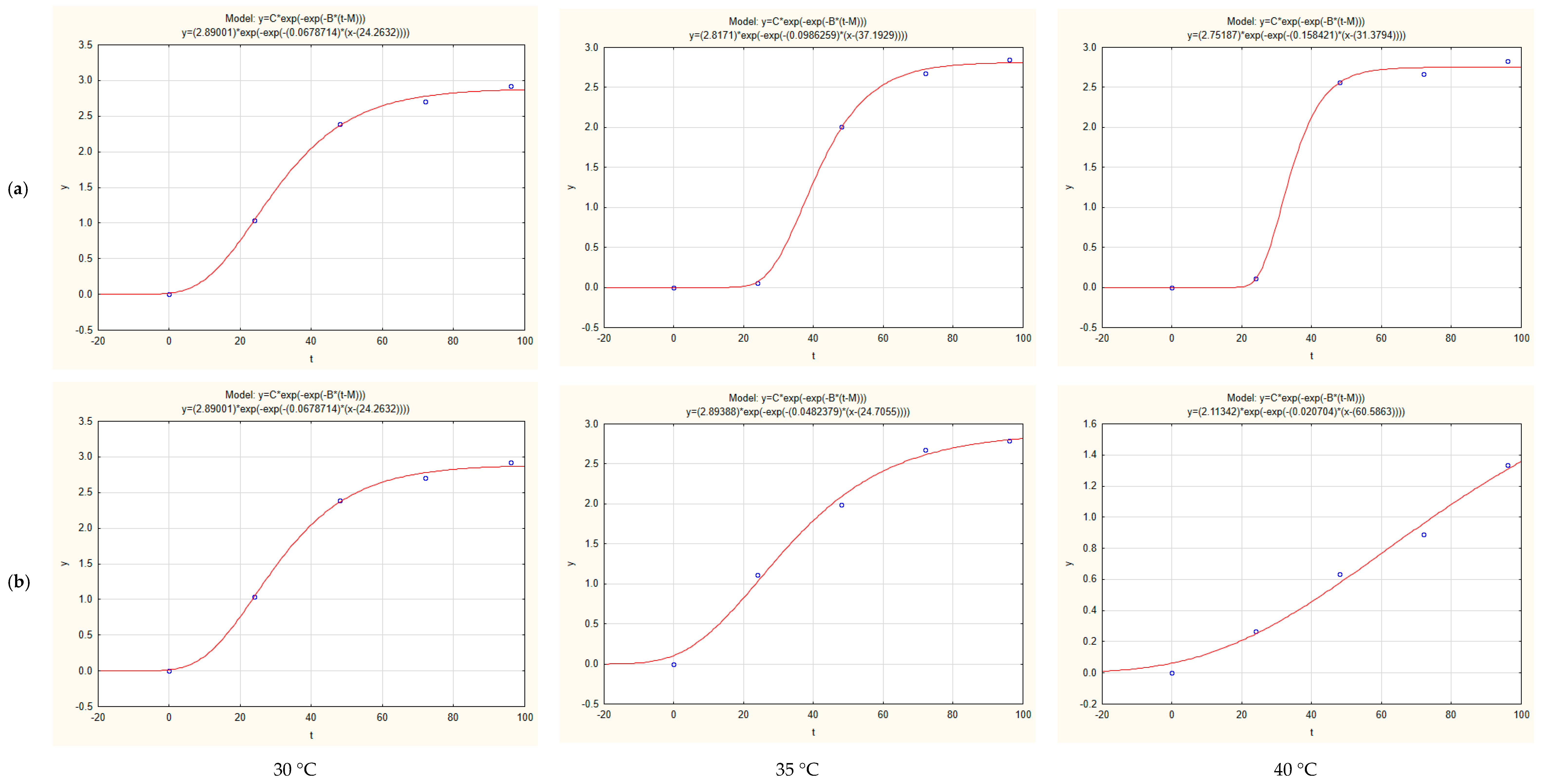
Guinea pig meat is increasingly recognized as a nutritionally valuable protein source in South America, but its high perishability demands robust evidence to support safe processing and storage strategies, particularly in value-added products such as burgers [2,35]. In the present study, Aerobic mesophilic bacteria and S. aureus exhibited typical sigmoidal growth patterns (Figure 1), and the modified Gompertz model provided an excellent description of the experimental data (Table 3 and Table 4), consistent with the long-established suitability of sigmoidal primary models for microbial growth in foods [33,36].
For Aerobic mesophilic bacteria (Figure 1a), increasing storage temperature resulted in a marked acceleration of microbial growth, with steeper exponential phases observed at 35 and 40 °C compared to 30 °C. This pattern supports the interpretation that temperature abuse strongly accelerates spoilage microbiota, but the growth trajectory (early vs. late acceleration) can vary across temperatures, likely reflecting shifts in community structure and adaptation kinetics rather than a simple monotonic response.
Comparable Aerobic mesophilic loads have been reported in beef burgers and related minced-meat matrices under non-ideal temperature regimes, highlighting how quickly total viable counts can approach spoilage levels in ground products [37,38]. This behavior is consistent with the temperature dependence of enzymatic activity and metabolic rates in mesophilic spoilage microbiota, which typically exhibit optimal growth at temperatures between 30 and 40 °C [10,33]. The observed growth patterns indicate that temperature abuse conditions strongly favor the proliferation of the overall aerobic microflora in guinea pig meat hamburgers. In contrast, S. aureus exhibited a distinct growth response to temperature (Figure 1b). Although growth was observed at all tested temperatures, the curves at 40 °C showed a visibly extended lag phase and a less pronounced exponential growth compared to those at 30 and 35 °C [39]. This non-parallel behavior between indicator microorganisms and a pathogenic species suggests that temperature increases do not uniformly enhance the growth of all microbial populations within the same food matrix, highlighting the importance of microorganism-specific kinetic evaluation [40,41].
Table 3 shows the results of the Gompertz model constants and growth parameters calculated for Mesophilic aerobes. For parameter C, the highest growth potential was observed at 30 °C, with slightly lower values at higher temperatures. The maximum growth rate parameter (B) increased with temperature and reached its highest value at 40 °C. The parameter M, representing the time at which the maximum growth rate occurs, was significantly higher at 35 °C compared with 30 and 40 °C. Similarly, the maximum specific growth rate (µmax) increased with temperature, reaching its highest value at 40 °C. The coefficient of determination (R2 > 0.999) confirmed that the model adequately described the experimental data at all tested temperatures. The lag phase duration (λ) was longer at 35 °C and 40 °C compared with 30 °C, although differences between the two higher temperatures were not statistically significant. In contrast, the generation time (G) decreased as temperature increased, with the highest value observed at 30 °C.
Table 4 shows the values of the Gompertz model parameters and constants for S. aureus. Parameter C, which represents the maximum increase in microbial population relative to the initial population, showed the highest value at 35 °C compared with 30 and 40 °C. The growth rate parameter (B) decreased as temperature increased, with significantly lower values observed at 40 °C. The parameter M, representing the time at which the maximum growth rate occurs, increased markedly with temperature and reached its highest value at 40 °C, indicating delayed adaptation to growth conditions. Similarly, the maximum specific growth rate (µmax) decreased with increasing temperature and was significantly lower at 40 °C than at 30 and 35 °C. The high values of the coefficient of determination (R2 > 0.99) confirmed a good fit of the model at all evaluated temperatures. The lag phase duration (λ) increased at 40 °C compared with 30 and 35 °C, indicating a longer adaptation period before exponential growth. Likewise, the generation time (G) increased substantially at 40 °C, reflecting slower microbial multiplication under this temperature condition.

3.2. Effect of Temperature on Maximum Specific Growth Rate (µmax)

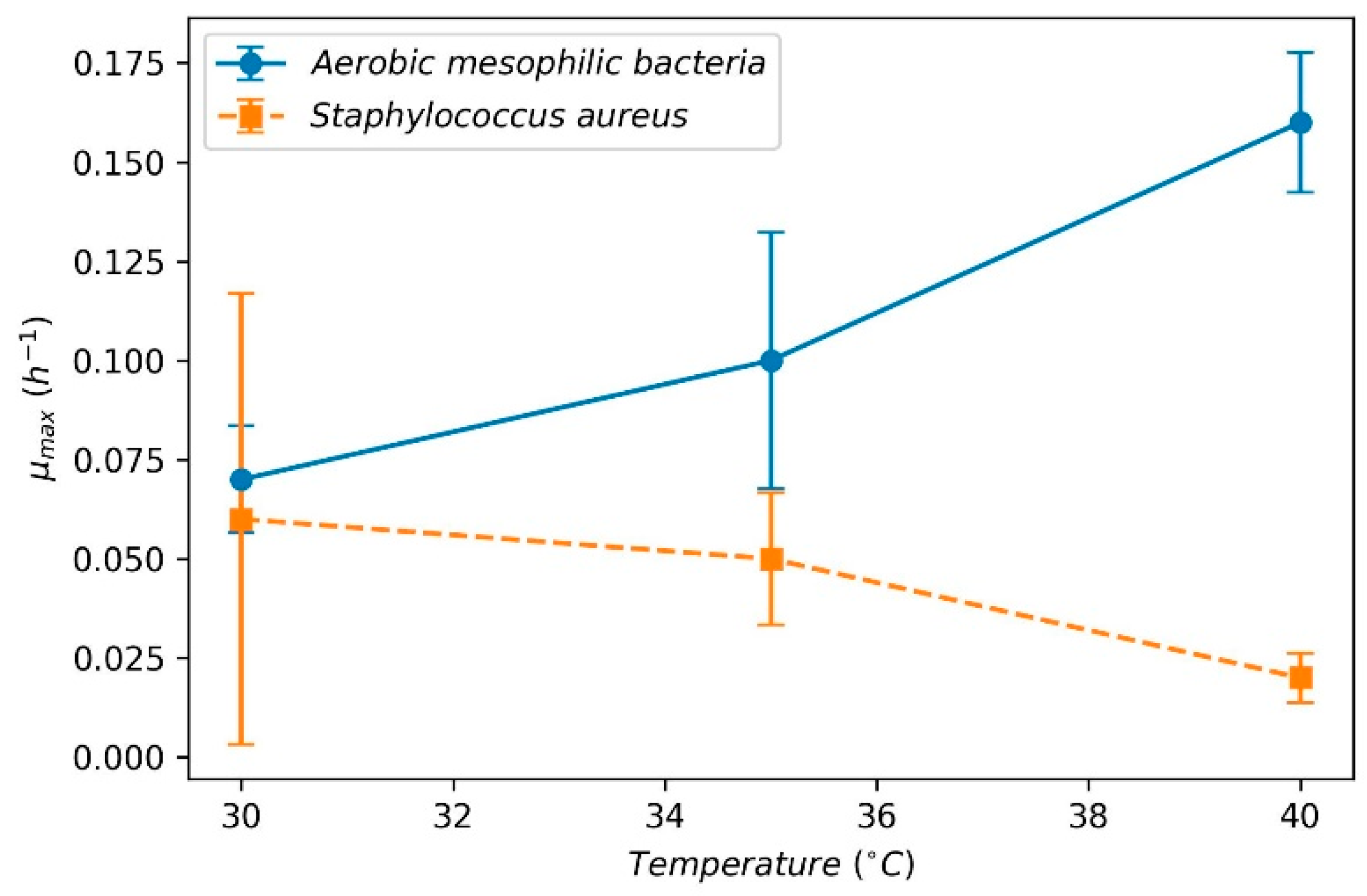
The effect of temperature on the maximum specific growth rate (µmax) estimated using the modified Gompertz model is shown in Figure 2. Aerobic mesophilic bacteria displayed a clear positive relationship between temperature and µmax, with significantly higher growth rates at 35 and 40 °C compared to 30 °C [33,42]. This trend reflects the enhanced metabolic efficiency of heterogeneous spoilage microbiota under elevated temperatures and has been widely reported for Aerobic mesophilic populations in meat products [10,33].
Conversely, S. aureus exhibited a different kinetic response. While µmax remained statistically similar between 30 and 35 °C, a marked reduction was observed at 40 °C. This behavior may be attributed to thermal stress effects that impair cellular functions, including membrane integrity and protein stability, despite S. aureus being classified as a mesophilic organism [41,43]. These findings indicate that temperatures approaching the upper limit of the permissive growth range can induce sublethal stress responses that constrain pathogen growth rather than accelerate it [40,44]. Importantly, the contrasting µmax trends between Aerobic mesophilic bacteria and S. aureus demonstrate that the use of total viable counts or aerobic mesophiles as sole indicators of microbiological risk may lead to an overestimation or misinterpretation of pathogen behavior under temperature abuse scenarios.

3.3. Temperature-Dependent Variation in Lag Phase Duration (λ)

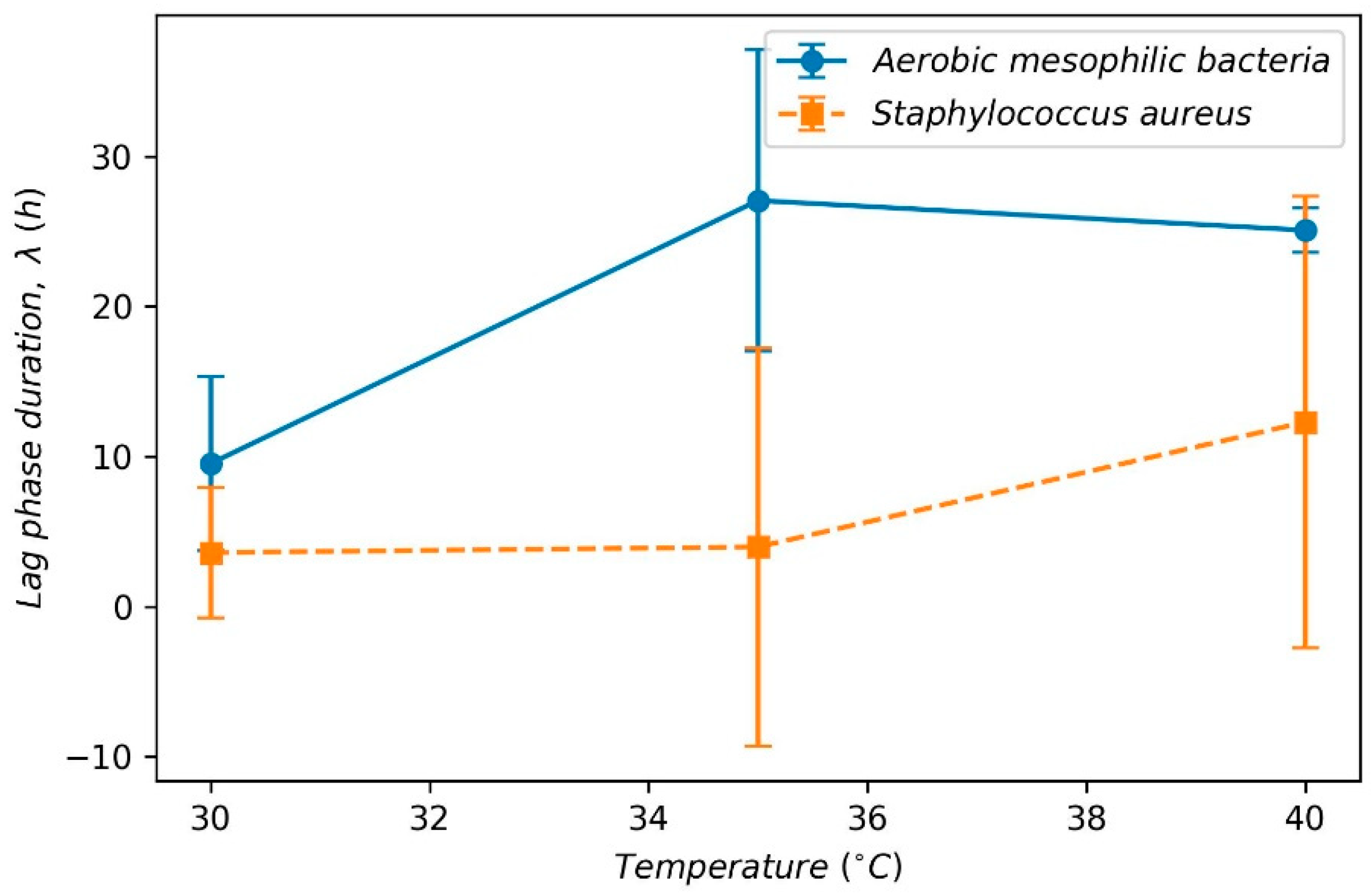
Lag phase duration (λ) provides insight into the physiological adaptation of microorganisms to new environmental conditions [45]. As shown in Figure 3, Aerobic mesophilic bacteria exhibited longer lag phase durations at 35 and 40 °C compared to 30 °C, suggesting delayed physiological adaptation under higher temperature conditions. Similar temperature-dependent responses have been reported for heterogeneous spoilage microbiota in meat systems, where community-level interactions and environmental stress can modulate adaptation dynamics [33,42].
In contrast, S. aureus showed an increase in lag phase duration at 40 °C, suggesting a delayed adaptation to the thermal environment. This prolonged lag phase is indicative of stress-induced cellular repair mechanisms, such as the synthesis of heat shock proteins and membrane remodeling, which temporarily divert resources from growth [43]. The extended lag phase observed at higher temperature further supports the hypothesis that S. aureus experiences thermal stress under conditions that are otherwise favorable for aerobic spoilage microbiota. The divergent behavior of λ reinforces the need to evaluate kinetic parameters individually for each microbial group, particularly when predictive models are applied to assess food safety risks in non-conventional meat products.

3.4. Influence of pH and Titratable Acidity on Microbial Growth

The evolution of pH and titratable acidity during storage is presented in Table 5. Across all temperature treatments, pH values remained within a relatively narrow range, with only a slight decrease observed over time. Titratable acidity increased modestly but did not reach levels typically associated with microbial inhibition. These results suggest that the observed differences in microbial growth kinetics were primarily driven by temperature rather than by significant changes in the physicochemical environment of the meat matrix. Similar observations have been reported in meat products where temperature was identified as the dominant extrinsic factor influencing microbial growth when pH remained near neutrality [32,40,41]. The stability of pH and moderate increase in acidity further support the validity of comparing temperature-dependent kinetic parameters across microbial groups without confounding effects from major intrinsic factor variations.

3.5. Microbial Interactions in a Natural Co-Culture Context

Although the present study did not experimentally manipulate defined microbial co-cultures, the simultaneous presence of Aerobic mesophilic microbiota and S. aureus within the same food matrix represents a natural background microbial community in which potential ecological interactions may occur. In such systems, microbial growth dynamics can be influenced not only by environmental factors such as temperature but also by indirect ecological processes including competition for nutrients, space, and metabolic by-products [46,47].
One conceptual framework frequently used to interpret microbial behavior in mixed populations is the Jameson effect, which proposes that the growth of a secondary population may be limited once the dominant microbiota approaches its stationary phase, regardless of whether nutrients remain available [48,49,50]. This phenomenon has been reported in meat systems and has been proposed as a possible mechanism influencing pathogen dynamics in the presence of background spoilage microbiota [51].
In the present study, the divergent growth responses observed between Aerobic mesophilic bacteria and S. aureus, particularly at 40 °C, are compatible with ecological interaction scenarios described in co-culture literature [52,53]. However, because microbial interactions were not experimentally quantified, these observations should be interpreted cautiously and cannot be attributed directly to competitive exclusion or Jameson-type effects. Alternative explanations such as temperature-dependent physiological stress responses may also contribute to the observed kinetic differences [46,54].
Future studies involving controlled co-culture experiments or interaction modeling approaches would be necessary to determine the extent to which microbial competition influences the growth behavior observed in this matrix. Nevertheless, considering the ecological context of naturally contaminated food systems provides a useful framework for interpreting population-specific responses to temperature abuse conditions and supports the need for cautious interpretation of indicator microorganism data when assessing pathogen behavior.

3.6. Implications for Food Safety Under Temperature Abuse Conditions

The differential growth responses observed between Aerobic mesophilic bacteria and S. aureus under controlled temperature abuse conditions provide relevant insights for interpreting microbial dynamics in guinea pig meat burgers. While increasing temperature enhanced the growth rate of the overall aerobic microbiota, S. aureus exhibited constrained kinetics at 40 °C, characterized by reduced µmax and prolonged lag phase. This contrasting behavior indicates that temperature elevation does not uniformly stimulate all microbial populations within the same food matrix. From a food safety perspective, these findings highlight an important interpretative consideration: total aerobic counts may not necessarily reflect pathogen behavior under defined thermal stress conditions. Although Aerobic mesophilic bacteria are commonly used as indicators of spoilage and general microbial load, their kinetic response may differ from that of specific pathogens when temperatures approach the upper limits of mesophilic growth. Therefore, caution should be exercised when inferring pathogen dynamics solely from indicator microorganisms in abuse scenarios.
From a regulatory perspective, microbiological guideline values for meat products indicate that Aerobic mesophilic counts above 106–107 CFU g−1 are generally associated with reduced microbiological quality and product spoilage, whereas S. aureus populations exceeding approximately 103–104 CFU g−1 may represent a potential risk of enterotoxin production under favorable conditions [55]. Although the present study did not evaluate toxin formation, the observed population dynamics highlight the importance of considering both indicator microorganisms and specific pathogens when interpreting microbial responses under temperature abuse scenarios.
Importantly, the present study did not evaluate enterotoxin production by S. aureus, which represents a critical determinant of food safety risk in contaminated meat products. Therefore, the reduced growth rate observed at 40 °C should not be interpreted as evidence of decreased hazard under temperature abuse conditions. Further studies integrating toxin quantification and secondary predictive modeling would be required to support risk-based storage recommendations.
The observed extension of lag phase and reduction in growth rate in S. aureus at 40 °C suggest the activation of adaptive physiological responses consistent with stress modulation rather than growth optimization. Such responses may delay proliferation under certain conditions, yet they do not eliminate the potential for subsequent growth if environmental parameters become more favorable. Consequently, temperature abuse remains a significant risk factor, even when pathogen growth appears partially constrained. Rather than proposing generalized predictive extrapolations, the present study provides comparative primary kinetic data that improves understanding of temperature-dependent microbial behavior in this alternative meat matrix. These results contribute to a more nuanced interpretation of microbial responses under defined isothermal conditions and support evidence-based decision-making regarding storage practices in environments where temperature control may be inconsistent.
In this context, the observed increases in microbial counts during storage at elevated temperatures approached levels relevant for microbiological quality deterioration, reinforcing the importance of temperature control during handling and distribution.

4. Conclusions

This study demonstrates that temperature exerts microorganism-specific effects on growth kinetics in guinea pig meat burgers, revealing distinct responses between Aerobic mesophilic bacteria and S. aureus under defined temperature abuse conditions. While increasing temperature enhanced the growth rate of the overall aerobic microbiota, S. aureus displayed constrained kinetic behavior at 40 °C, characterized by reduced maximum specific growth rate and prolonged lag phase.
By providing comparative primary growth parameters derived from controlled isothermal conditions, this work contributes to a more precise understanding of temperature-dependent microbial dynamics in a non-conventional meat product. However, because enterotoxin production by S. aureus was not evaluated and no secondary predictive modeling was performed, the observed reduction in growth rate at 40 °C should not be interpreted as evidence of reduced food safety risk under temperature abuse conditions. Instead, the results highlight the importance of microorganism-specific kinetic assessment when interpreting microbial behavior in complex food matrices.

Author Contributions

Conceptualization, F.F.-R., E.M.C.-B., K.K.R.F., J.V.P.G., C.C.-A. and C.R.B.-Z.; methodology, K.K.R.F., J.V.P.G., N.A.F., R.R.B., D.M.-M. and N.A.S.-G.; software, F.F.-R., N.A.F., N.A.S.-G. and F.V.-V.; validation, F.F.-R., E.M.C.-B., C.C.-A., C.R.B.-Z. and N.A.S.-G.; formal analysis, K.K.R.F., J.V.P.G., N.A.F., R.R.B., D.M.-M. and N.A.S.-G.; investigation, F.F.-R., E.M.C.-B., K.K.R.F., J.V.P.G., N.A.F. and C.R.B.-Z.; resources, F.F.-R., E.M.C.-B., D.M.-M., C.R.B.-Z. and N.A.S.-G.; data curation, E.M.C.-B., K.K.R.F., J.V.P.G., N.A.F., R.R.B. and C.C.-A.; writing—original draft preparation, F.F.-R., E.M.C.-B., R.R.B., C.R.B.-Z., N.A.S.-G. and F.V.-V.; writing—review and editing, F.F.-R., E.M.C.-B., D.M.-M. and C.R.B.-Z.; visualization, F.F.-R., E.M.C.-B., N.A.S.-G. and F.V.-V.; supervision, F.F.-R., E.M.C.-B. and C.R.B.-Z.; project administration, F.F.-R., D.M.-M. and C.R.B.-Z.; funding acquisition, F.F.-R., D.M.-M. and C.R.B.-Z. All authors have read and agreed to the published version of the manuscript.

Funding

This research was funded by Laboratorio de Investigación en Ingeniería de los Alimentos y Poscosecha, Project N° 2343049. The APC was funded by Vicerrectorado de Investigación Universidad Nacional Toribio Rodríguez de Mendoza de Amazonas, Peru.

Institutional Review Board Statement

Not applicable.

Informed Consent Statement

Not applicable.

Data Availability Statement

Dataset available on request from the authors.

Acknowledgments

The authors thank Project CUI N° 2343049—Creación de los Servicios de Investigación en Ingeniería de Alimentos y Poscosecha of the Universidad Nacional Toribio Rodríguez de Mendoza de Amazonas.

Conflicts of Interest

The authors declare no conflicts of interest.

References

  1. Flores-Mancheno, C.I.; Duarte, C.; Salgado-Tello, I.P. Caracterización de La Carne de Cuy (Cavia porcellus) Para Utilizarla En La Elaboración de Un Embutido Fermentado. Cienc. Agric. 2017, 14, 39–45. [Google Scholar] [CrossRef]
  2. Donoso, G.; Galecio, J.S.; Fuentes-Quisaguano, O.G.; Pairis-Garcia, M. Guinea Pig Meat Production in South America: Reviewing Existing Practices, Welfare Challenges, and Opportunities. Anim. Welf. 2025, 34, e29. [Google Scholar] [CrossRef]
  3. Miranda-Yuquilema, J.E.; Taboada-Pico, J.; Luna-Velasco, D.; Cuenca-Condoy, M.; Briñez, W. Impact of Agroindustrial Waste Fermented with Bacteria and Yeasts and Their Effect on Productive, Hematological, and Microbiota Indicators in Guinea Pigs (Cavia porcellus). Fermentation 2025, 11, 10. [Google Scholar] [CrossRef]
  4. Baranyi, J.; Ross, T.; McMeekin, T.A.; Roberts, T.A. Effects of Parameterization on the Performance of Empirical Models Used in ‘predictive Microbiology’. Food Microbiol. 1996, 13, 83–91. [Google Scholar] [CrossRef]
  5. Ding, T.; Shim, Y.-H.; Choi, N.-J.; Ha, S.-D.; Chung, M.-S.; Hwang, I.-G.; Oh, D.-H. Mathematical Modeling on the Growth of Staphylococcus Aureus in Sandwich. Food Sci. Biotechnol. 2010, 19, 763–768. [Google Scholar] [CrossRef]
  6. Juneja, V.K.; Golden, C.E.; Mishra, A.; Harrison, M.A.; Mohr, T.; Silverman, M. Predictive Model for Growth of Bacillus Cereus during Cooling of Cooked Rice. Int. J. Food Microbiol. 2019, 290, 49–58. [Google Scholar] [CrossRef]
  7. Yu, H.H.; Song, Y.J.; Kim, Y.J.; Lee, H.Y.; Choi, Y.-S.; Lee, N.-K.; Paik, H.-D. Predictive Model of Growth Kinetics for Staphylococcus aureus in Raw Beef under Various Packaging Systems. Meat Sci. 2020, 165, 108108. [Google Scholar] [CrossRef] [PubMed]
  8. Serment-Moreno, V. Microbial Modeling Needs for the Nonthermal Processing of Foods. Food Eng. Rev. 2021, 13, 465–489. [Google Scholar] [CrossRef]
  9. Tarlak, F. The Use of Predictive Microbiology for the Prediction of the Shelf Life of Food Products. Foods 2023, 12, 4461. [Google Scholar] [CrossRef] [PubMed]
  10. Dalcanton, F.; Pérez-Rodríguez, F.; Posada-Izquierdo, G.D.; De Aragão, G.M.F.; García-Gimeno, R.M. Modelling Growth of L Actobacillus plantarum and Shelf Life of Vacuum-packaged Cooked Chopped Pork at Different Temperatures. Int. J. Food Sci. Tech. 2013, 48, 2580–2587. [Google Scholar] [CrossRef]
  11. Lee, Y.J.; Jung, B.S.; Kim, K.-T.; Paik, H.-D. Predictive Model for the Growth Kinetics of Staphylococcus aureus in Raw Pork Developed Using Integrated Pathogen Modeling Program (IPMP) 2013. Meat Sci. 2015, 107, 20–25. [Google Scholar] [CrossRef]
  12. Yücel, Ö.; Tarlak, F. An Intelligent Based Prediction of Microbial Behaviour in Beef. Food Control 2023, 148, 109665. [Google Scholar] [CrossRef]
  13. Peruzzolo, M.; Danielli, A.J.; Fischer, B.; Junges, A.; Colet, R.; Steffens, C.; De Souza, M.A.S.F.; Cansian, R.L.; Backes, G.T. Growth Effects as a Function of pH and Temperature of Salmonella Enterica Serovar Choleraesuis in In Vitro Tests and Chicken Meat: Prediction and Modeling. Indian J. Microbiol. 2024, 64, 1542–1550. [Google Scholar] [CrossRef]
  14. Wang, J.; Guo, X. The Gompertz Model and Its Applications in Microbial Growth and Bioproduction Kinetics: Past, Present and Future. Biotechnol. Adv. 2024, 72, 108335. [Google Scholar] [CrossRef]
  15. Majumdar, A.; Pradhan, N.; Sadasivan, J.; Acharya, A.; Ojha, N.; Babu, S.; Bose, S. Food Degradation and Foodborne Diseases: A Microbial Approach. In Microbial Contamination and Food Degradation; Elsevier: Amsterdam, The Netherlands, 2018; pp. 109–148. ISBN 978-0-12-811515-2. [Google Scholar]
  16. McMeekin, T.A. Predictive Microbiology: Quantitative Science Delivering Quantifiable Benefits to the Meat Industry and Other Food Industries. Meat Sci. 2007, 77, 17–27. [Google Scholar] [CrossRef]
  17. Kumar, V.; Ahire, J.J.; Taneja, N.K. Advancing Microbial Food Safety and Hazard Analysis through Predictive Mathematical Modeling. Microbe 2024, 2, 100049. [Google Scholar] [CrossRef]
  18. Koutsoumanis, K.; Stamatiou, A.; Skandamis, P.; Nychas, G.-J.E. Development of a Microbial Model for the Combined Effect of Temperature and pH on Spoilage of Ground Meat, and Validation of the Model under Dynamic Temperature Conditions. Appl. Environ. Microbiol. 2006, 72, 124–134. [Google Scholar] [CrossRef] [PubMed]
  19. Garcia, D.; Ramos, A.J.; Sanchis, V.; Marín, S. Modelling the Effect of Temperature and Water Activity in the Growth Boundaries of Aspergillus Ochraceus and Aspergillus Parasiticus. Food Microbiol. 2011, 28, 406–417. [Google Scholar] [CrossRef]
  20. Goh, L.-Y.; Kao, T.-P.; Pan, Y.-C.; Chang, C.-W.; Lu, K.-H. Growth Modeling of Uropathogenic Escherichia coli in Raw and Cooked Beef as a Function of Storage Temperature for Shelf Life Predictions. Int. J. Food Microbiol. 2025, 442, 111359. [Google Scholar] [CrossRef] [PubMed]
  21. National Research Council (US). Subcommittee on Microbiological Criteria Selection of Indicator Organisms and Agents as Components of Microbiological Criteria. In An Evaluation of the Role of Microbiological Criteria for Foods and Food Ingredients; National Academies Press: Washington, DC, USA, 1985. [Google Scholar]
  22. Ndoye, B.; Dicko, M.H.; Gill, C. Exploring the Spoilage Microbiota of Raw and Processed Meats under Different Storage Environments and Its Related Profiling Methods: A Review. Cogent Food Agric. 2025, 11, 2562177. [Google Scholar] [CrossRef]
  23. Juneja, V.K.; Osoria, M.; Kapoor, H.K.; Gupta, P.; Salazar, J.K.; Shrestha, S.; Bag, S.K.; Mishra, A. A Predictive Growth Model of Staphylococcus Aureus during Temperature Abuse Conditions. Food Res. Int. 2025, 206, 116032. [Google Scholar] [CrossRef] [PubMed]
  24. Mansur, A.R.; Park, J.-H.; Oh, D.-H. Predictive Model for Growth of Staphylococcus Aureus on Raw Pork, Ham, and Sausage. J. Food Prot. 2016, 79, 132–137. [Google Scholar] [CrossRef]
  25. Kapoor, H.K.; Gao, J.; Mishra, A. Environmental and Physiological Determinants of Microbial Lag Phase: Implications for Predictive Microbiology. Annu. Rev. Food Sci. Technol. 2026, 17, 349–377. [Google Scholar] [CrossRef]
  26. Jaja, I.F.; Green, E.; Muchenje, V. Aerobic Mesophilic, Coliform, Escherichia coli, and Staphylococcus aureus Counts of Raw Meat from the Formal and Informal Meat Sectors in South Africa. Int. J. Environ. Res. Public. Health 2018, 15, 819. [Google Scholar] [CrossRef]
  27. Foght, J.; Aislabie, J. Enumeration of Soil Microorganisms. In Monitoring and Assessing Soil Bioremediation; Margesin, R., Schinner, F., Eds.; Springer: Berlin/Heidelberg, Germany, 2005; pp. 261–280. ISBN 978-3-540-28904-3. [Google Scholar]
  28. Thomas, P.; Sekhar, A.C.; Upreti, R.; Mujawar, M.M.; Pasha, S.S. Optimization of Single Plate-Serial Dilution Spotting (SP-SDS) with Sample Anchoring as an Assured Method for Bacterial and Yeast Cfu Enumeration and Single Colony Isolation from Diverse Samples. Biotechnol. Rep. 2015, 8, 45–55. [Google Scholar] [CrossRef] [PubMed]
  29. ISO 4833-1:2013; International Organization for Standardization Microbiology of the Food Chain: Horizontal Method for the Enumeration of Microorganisms—Part 1: Colony Count at 30° C by the Pour Plate Technique. Turkish Standards Institution: Ankara, Turkey, 2013.
  30. ISO 6887-1:1999; International Organization for Standardization Microbiology of the Food Chain—Preparation of Test Samples, Initial Suspension and Decimal Dilutions for Microbiological Examination—Part 1: General Rules for the Preparation of the Initial Suspension and Decimal Dilutions. Turkish Standards Institution: Ankara, Turkey, 2017.
  31. Andersen, J.R.; Borggaard, C.; Rasmussen, A.J.; Houmøller, L.P. Optical Measurements of pH in Meat. Meat Sci. 1999, 53, 135–141. [Google Scholar] [CrossRef]
  32. Capita, R.; Llorente-Marigómez, S.; Prieto, M.; Alonso-Calleja, C. Microbiological Profiles, pH, and Titratable Acidity of Chorizo and Salchichón (Two Spanish Dry Fermented Sausages) Manufactured with Ostrich, Deer, or Pork Meat. J. Food Prot. 2006, 69, 1183–1189. [Google Scholar] [CrossRef]
  33. Zwietering, M.H.; Jongenburger, I.; Rombouts, F.M.; Van ’T Riet, K. Modeling of the Bacterial Growth Curve. Appl. Environ. Microbiol. 1990, 56, 1875–1881. [Google Scholar] [CrossRef]
  34. Gibson, A.M.; Bratchell, N.; Roberts, T.A. The Effect of Sodium Chloride and Temperature on the Rate and Extent of Growth of Clostridium Botulinum Type A in Pasteurized Pork Slurry. J. Appl. Bacteriol. 1987, 62, 479–490. [Google Scholar] [CrossRef]
  35. Moreno, Y.; Arteaga-Miñano, H.L. Natural Conservation of Guinea Pig (Cavia porcellus) Meat Vacuum Packed: Oregano Essential Oil Effect on the Physicochemical, Microbiological and Sensory Characteristics. Sci. Agropecu. 2018, 9, 467–476. [Google Scholar] [CrossRef]
  36. Barbosa, A.D.; Alexandre, B.; Tondo, E.C.; Malheiros, P.D.S. Microbial Survival in Gourmet Hamburger Thermally Processed by Different Degrees of Doneness. Int. J. Gastron. Food Sci. 2022, 28, 100501. [Google Scholar] [CrossRef]
  37. Fernández, A.; Izquierdo, P.; Valero, K.; Allara, M.; Piñero, M.; García Urdaneta, A. Effect of Time and Storage Temperature on Microbiological Quality of Hamburger Meat. Rev. Científica 2006, 16, 315–324. [Google Scholar]
  38. Grispoldi, L.; Karama, M.; Sechi, P.; Iulieto, M.F.; Cenci-Goga, B.T. Effect of the Addition of Starter Cultures to Ground Meat for Hamburger Preparation. Microbiol. Res. 2020, 11, 8623. [Google Scholar] [CrossRef]
  39. Schmitt, M.; Schuler-Schmid, U.; Schmidt-Lorenz, W. Temperature Limits of Growth, TNase and Enterotoxin Production of Staphylococcus Aureus Strains Isolated from Foods. Int. J. Food Microbiol. 1990, 11, 1–19. [Google Scholar] [CrossRef] [PubMed]
  40. Valero, A.; Pérez-Rodríguez, F.; Carrasco, E.; Fuentes-Alventosa, J.M.; García-Gimeno, R.M.; Zurera, G. Modelling the Growth Boundaries of Staphylococcus Aureus: Effect of Temperature, pH and Water Activity. Int. J. Food Microbiol. 2009, 133, 186–194. [Google Scholar] [CrossRef] [PubMed]
  41. Yuk, H.-G.; Geveke, D.J. Nonthermal Inactivation and Sublethal Injury of Lactobacillus Plantarum in Apple Cider by a Pilot Plant Scale Continuous Supercritical Carbon Dioxide System. Food Microbiol. 2011, 28, 377–383. [Google Scholar] [CrossRef]
  42. Robinson, T.P.; Ocio, M.J.; Kaloti, A.; Mackey, B.M. The Effect of the Growth Environment on the Lag Phase of Listeria monocytogenes. Int. J. Food Microbiol. 1998, 44, 83–92. [Google Scholar] [CrossRef]
  43. Fito, P.; Toldrá, F. International Conference on Food Innovation (FoodInnova 2010). Trends Food Sci. Technol. 2011, 22, 465–466. [Google Scholar] [CrossRef]
  44. Ortega, E.; Abriouel, H.; Lucas, R.; Gálvez, A. Multiple Roles of Staphylococcus Aureus Enterotoxins: Pathogenicity, Superantigenic Activity, and Correlation to Antibiotic Resistance. Toxins 2010, 2, 2117–2131. [Google Scholar] [CrossRef]
  45. Bertrand, R.L. Lag Phase Is a Dynamic, Organized, Adaptive, and Evolvable Period That Prepares Bacteria for Cell Division. J. Bacteriol. 2019, 201, 10–1128. [Google Scholar] [CrossRef]
  46. Ross, T.; McMeekin, T.A. Predictive Microbiology. Int. J. Food Microbiol. 1994, 23, 241–264. [Google Scholar] [CrossRef]
  47. Sharma, D.; Astapati, A.D.; Dey, S.; Bhattacharjee, D.; Singha, D.M.; Nath, S. Microbial Interactions in Soil Ecosystems: Facilitating Plant Growth, Nutrient Cycling, and Environmental Dynamics. In Microbial Allies: Understanding Plant-Microbe Interactions in Sustainable Agriculture; Babalola, O.O., Ayangbenro, A.S., Eds.; Springer Nature: Cham, Switzerland, 2025; pp. 21–48. ISBN 978-3-031-90530-8. [Google Scholar]
  48. Giuffrida, A.; Valenti, D.; Ziino, G.; Spagnolo, B.; Panebianco, A. A Stochastic Interspecific Competition Model to Predict the Behaviour of Listeria Monocytogenes in the Fermentation Process of a Traditional Sicilian Salami. Eur. Food Res. Technol. 2009, 228, 767–775. [Google Scholar] [CrossRef]
  49. Cauchie, E.; Delhalle, L.; Baré, G.; Tahiri, A.; Taminiau, B.; Korsak, N.; Burteau, S.; Fall, P.A.; Farnir, F.; Daube, G. Modeling the Growth and Interaction Between Brochothrix Thermosphacta, Pseudomonas Spp., and Leuconostoc Gelidum in Minced Pork Samples. Front. Microbiol. 2020, 11, 639. [Google Scholar] [CrossRef] [PubMed]
  50. Sommer, U. Populations. In Freshwater and Marine Ecology; Sommer, U., Ed.; Springer International Publishing: Cham, Switzerland, 2023; pp. 169–199. ISBN 978-3-031-42459-5. [Google Scholar]
  51. Cayré, M.E.; Vignolo, G.; Garro, O. Modeling Lactic Acid Bacteria Growth in Vacuum-Packaged Cooked Meat Emulsions Stored at Three Temperatures. Food Microbiol. 2003, 20, 561–566. [Google Scholar] [CrossRef]
  52. Thippareddi, H.; Subbiah, J.; Korasapati, N.R.; Sanchez-Plata, M.X. Predictive Modeling of Pathogen Growth in Cooked Meats. In Safety of Meat and Processed Meat; Toldrá, F., Ed.; Springer: New York, NY, USA, 2009; pp. 559–590. ISBN 978-0-387-89026-5. [Google Scholar]
  53. Juneja, V.K.; Yadav, A.S.; Hwang, C.-A.; Sheen, S.; Mukhopadhyay, S.; Friedman, M. Kinetics of Thermal Destruction of Salmonella in Ground Chicken Containing Trans-Cinnamaldehyde and Carvacrol†. J. Food Prot. 2012, 75, 289–296. [Google Scholar] [CrossRef]
  54. Mellefont, L.A.; Ross, T. The Effect of Abrupt Shifts in Temperature on the Lag Phase Duration of Escherichia Coli and Klebsiella Oxytoca. Int. J. Food Microbiol. 2003, 83, 295–305. [Google Scholar] [CrossRef]
  55. International Commission on Microbiological Specifications for Foods. Microorganisms in Foods 8: Use of Data for Assessing Process Control and Product Acceptance; Springer Science & Business Media: Berlin/Heidelberg, Germany, 2011; ISBN 978-1-4419-9374-8. [Google Scholar]
Figure 1. Growth curves of (a) Aerobic mesophilic bacteria and (b) S. aureus in guinea pig meat hamburgers stored at 30, 35, and 40 °C. Note: Symbols represent experimental data, and solid lines correspond to the fitted modified Gompertz model. Data are expressed as mean log CFU g−1.
Applmicrobiol 06 00062 g001
Figure 2. Effect of temperature on the maximum specific growth rate (µmax) of Aerobic mesophilic bacteria and S. aureus in guinea pig meat hamburgers. Note: estimated using the modified Gompertz model. Values represent mean ± standard deviation.
Applmicrobiol 06 00062 g002
Figure 3. Temperature-dependent variation in lag phase duration (λ) for Aerobic mesophilic bacteria and Staphylococcus aureus in guinea pig meat hamburgers. Note: Parameters were obtained from the modified Gompertz model fitted with experimental growth data.
Applmicrobiol 06 00062 g003
Table 1. Count of Mesophilic aerobic CFU g−1 during storage.
Time (h)Temperature
30 °C35 °C40 °C
02.33 × 10⁶ ± 7.64 × 10⁵ a2.33 × 106 ± 7.64 × 10⁵ a2.33 × 106 ± 7.64 × 10⁵ a
242.57 × 10⁷ ± 1.70 × 10⁷ a8.67 × 106 ± 9.83 × 10⁶ b1.20 × 107 ± 7.21 × 10⁶ b
485.73 × 10⁸ ± 9.99 × 10⁷ b2.37 × 108 ± 1.27 × 10⁸ b8.56 × 108 ± 3.71 × 10⁸ a
721.19 × 10⁹ ± 5.06 × 10⁸ b1.11 × 109 ± 5.17 × 10⁸ b1.09 × 109 ± 3.38 × 10⁸ b
961.94 × 10⁹ ± 4.19 × 10⁸ a1.64 × 109 ± 4.02 × 10⁸ a1.56 × 109 ± 9.23 × 10⁸ a
Note: Mean ± standard deviation. Different superscript letters represent significant differences between treatments according to Tukey’s test (p < 0.05).
Table 2. Count of Staphylococcus aureus CFU g−1 during storage.
Time (h)Temperature
30 °C35 °C40 °C
08.11 × 10⁴ ± 3.85 × 10³ a8.11 × 104 ± 3.85 × 10³ a8.11 × 104 ± 3.85 × 10³ a
241.79 × 10⁶ ± 1.76 × 10⁶ a1.05 × 106 ± 1.56 × 10⁶ a1.50 × 105 ± 8.67 × 10⁴ b
481.25 × 10⁷ ± 6.97 × 10⁵ a7.95 × 106 ± 1.29 × 10⁶ a3.48 × 105 ± 5.86 × 10⁴ b
722.42 × 10⁷ ± 2.73 × 10⁶ a3.82 × 107 ± 1.07 × 10⁷ a6.28 × 105 ± 8.75 × 10⁴ b
963.63 × 10⁷ ± 1.65 × 10⁶ a5.05 × 107 ± 1.45 × 10⁶ a1.75 × 106 ± 5.77 × 10⁵ b
Note: Mean ± standard deviation. Different superscript letters represent significant differences between treatments according to Tukey’s test (p < 0.05).
Table 3. Determination of the constants of the Gompertz equation and growth parameters for Mesophilic aerobes in storage.
ConstantTemperature
30 °C35 °C40 °C
C2.89 ± 0.1633 a2.82 ± 0.2275 a2.75 ± 0.2345 a
B0.07 ± 0.0154 b0.10 ± 0.0337 b0.16 ± 0.0076 a
M24.26 ± 4.3783 b37.19 ± 1.6825 a31.38 ± 1.4591 b
R20.99928 ± 0.00196 a0.99974 ± 0.00847 a0.99931 ± 0.00223 a
N06.37 ± 0.1560 a6.37 ± 0.1560 a6.37 ± 0.1560 a
µmax0.07 ± 0.0135 b0.10 ± 0.0323 b0.16 ± 0.0176 a
λ9.53 ± 5.8034 b27.05 ± 10.0446 ab25.07 ± 1.4958 a
G100.12 ± 16.9211 a70.68 ± 50.6279 ab45.05 ± 8.8063 b
Note: Mean ± standard deviation. C: Asymptote (maximum microbial growth in log CFU g−1); B: Maximum growth rate in h−1; M: Latency time in h; R2: Coefficient of determination of the goodness of fit of the model; N0: number of microorganisms at the initial moment in log CFU g−1; µmax: maximum specific growth rate in h−1; λ: latency time in h; G: generation time in h. Different superscript letters represent significant differences between treatments according to Tukey’s test (p < 0.05).
Table 4. Determination of the constants of the Gompertz equation and growth parameters for S. aureus in storage.
ConstantTemperature
30 °C35 °C40 °C
C2.59 ± 0.2628 b2.89 ± 0.0417 a2.11 ± 1.2833 b
B0.07 ± 0.7459 a0.05 ± 0.0157 a0.02 ± 0.0218 b
M18.55 ± 10.8240 b24.71 ± 10.2560 b60.59 ± 27.5971 a
R20.99779 ± 0.1023 a0.99703 ± 0.0074 a0.9939 ± 0.0099 a
N04.91 ± 0.02090 a4.91 ± 0.0209 a4.91 ± 0.02090 a
µmax0.06 ± 0.05680 a0.05 ± 0.0166 a0.02 ± 0.0062 b
λ3.59 ± 4.3567 b3.97 ± 13.2761 b12.29 ± 15.0731 a
G113.46 ± 54.7324 b140.68 ± 21.9254 b448.82 ± 139.6668 a
Note: Mean ± standard deviation. C: Asymptote (maximum microbial growth in log CFU g−1); B: Maximum growth rate in h−1; M: Latency time in h; R2: Coefficient of determination of the goodness of fit of the model; N0: number of microorganisms at the initial moment in log CFU g−1; µmax: maximum specific growth rate in h−1; λ: latency time in h; G: generation time in h. Different superscript letters represent significant differences between treatments according to Tukey’s test (p < 0.05).
Table 5. Changes in pH and titratable acidity of guinea pig meat hamburgers during storage at 30, 35, and 40 °C.
Time (h)pHTitratable Acidity
30 °C35 °C40 °C30 °C35 °C40 °C
06.44 ± 0.013 a6.33 ± 0.045 b6.31 ± 0.080 b0.72 ± 0.049 a0.57 ± 0.010 b0.52 ± 0.014 c
246.43 ± 0.082 a6.34 ± 0.118 b6.32 ± 0.018 b0.74 ± 0.043 a0.61 ± 0.008 b0.63 ± 0.024 b
486.34 ± 0.035 a6.45 ± 0.074 b6.14 ± 0.052 c0.79 ± 0.034 a0.74 ± 0.038 a0.62 ± 0.020 b
726.07 ± 0.068 a6.07 ± 0.063 a5.93 ± 0.051 b1.08 ± 0.051 a0.95 ± 0.040 b0.75 ± 0.000 c
965.95 ± 0.048 a5.59 ± 0.122 b5.59 ± 0.122 b1.17 ± 0.026 a1.29 ± 0.154 b1.12 ± 0.042 a
Note: Mean ± standard deviation. Different superscript letters represent significant differences between treatments according to Tukey’s test (p < 0.05).
Disclaimer/Publisher’s Note: The statements, opinions and data contained in all publications are solely those of the individual author(s) and contributor(s) and not of MDPI and/or the editor(s). MDPI and/or the editor(s) disclaim responsibility for any injury to people or property resulting from any ideas, methods, instructions or products referred to in the content.