
Lactic Acid Bacteria from Traditional Fermented Milk: Antimicrobial Potential Against Foodborne Pathogens

 , ,
, ,  ,
,
Abstract
1. Introduction
2. Materials and Methods
2.1. Isolation of LAB from Milk
2.2. Indicator Pathogens and Antimicrobial Spectrum
2.3. Bacterial Strains Used in This Study
2.4. Antimicrobial Screening of LAB
2.5. Stability of Bacteriocin-like Activity After Exposure to Proteolytic Enzymes
2.6. Identification of Antagonistic LAB
2.6.1. Phenotypic and Biochemical Identification
2.6.2. Molecular Identification (16S rRNA)
2.7. Technological Assessment of LAB Strains
2.7.1. Proteolytic and Lipolytic Activities
2.7.2. Aggregation Abilities
2.8. Evaluation of Safety-Related Traits
2.8.1. Hemolytic Activity
2.8.2. Antibiotic Susceptibility
2.8.3. Gelatinase Activity and Biogenic Amine Production
2.9. Statistical Analysis
3. Results
3.1. Characterization of Lactic Acid Bacteria with Antimicrobial Potential
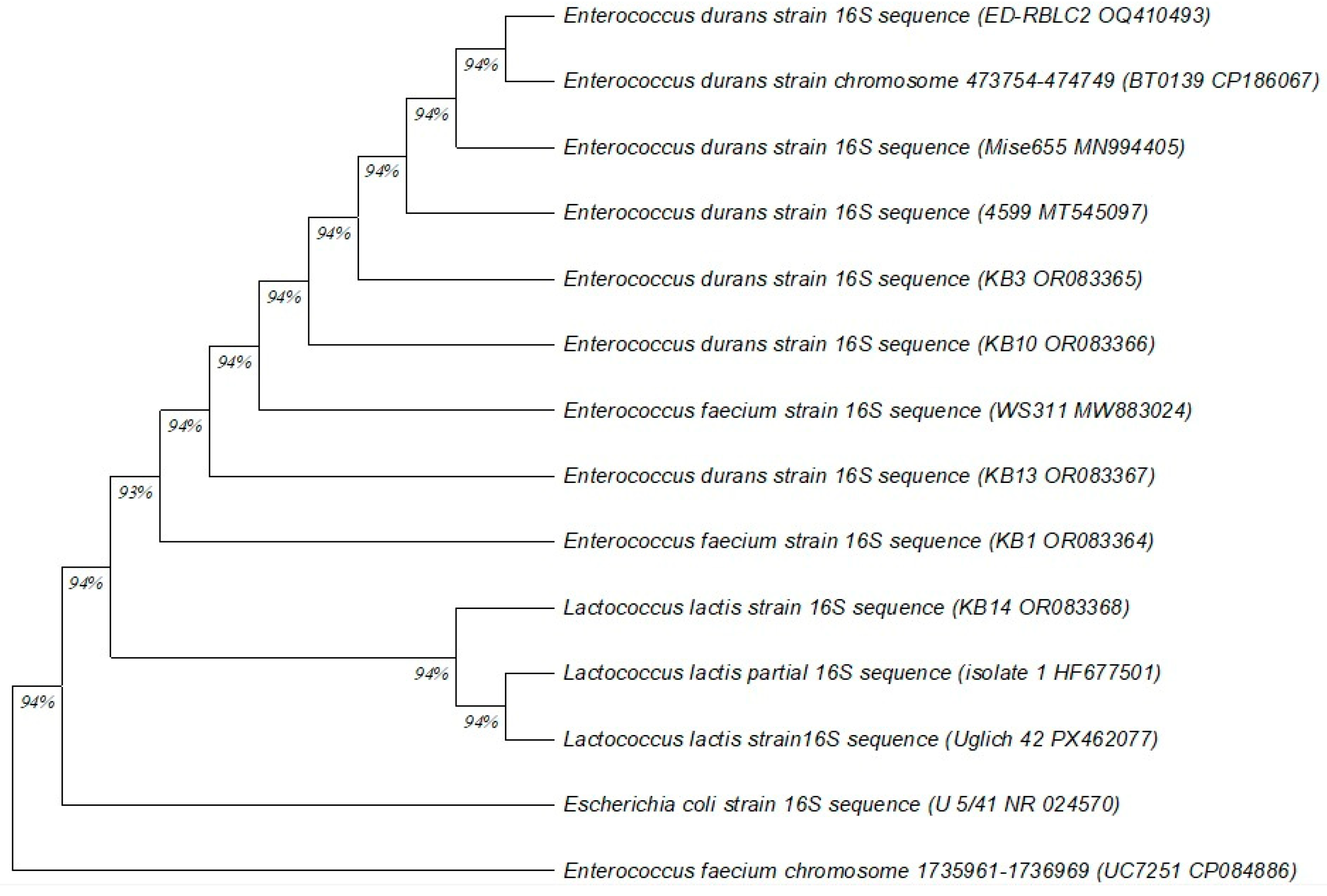
- The Enterococcus KB10, KB13 and KB3 isolates cluster into two well-supported clades (bootstrap values ≥ 97%) with reference strains of E. durans (ED-RBLC2, chromosome BT0139, Mise655, 4599) and E. faecium (strain WS311). This grouping confirms the affiliation of our isolates with the species E. durans and E. faecium and highlights their evolutionary proximity to these reference lineages.
- Isolate KB14 clusters with reference strains of L. lactis (HF677501, Uglich 42) in a distinct clade, separate from Enterococcus, confirming its membership in the genus Lactococcus.
- Escherichia coli U5/41 is used as an outgroup to root the tree and illustrate the divergence between the genera studied.
3.2. Antimicrobial Activity
3.3. Safety and Functional Characteristics
3.4. Aggregation Capacity of LAB Isolates
4. Discussion
4.1. Antimicrobial Potential and Safety Assessment of LAB Strains
4.2. Proteolytic and Lipolytic Activities
4.3. Auto-Aggregation and Co-Aggregation Capabilities of LAB Strains
4.4. Protein-Based Features of Antimicrobial Substances from LAB
5. Conclusions
Author Contributions
Funding
Institutional Review Board Statement
Informed Consent Statement
Data Availability Statement
Acknowledgments
Conflicts of Interest
Abbreviations
| LAB | Lactic Acid Bacteria |
| BLAST | Basic Local Alignment Search Tool |
| MRS | De Man, Rogosa and Sharpe |
| BEA | Bile Esculin Agar |
| BHI | Brain Heart Infusion |
| MHA | Mueller Hinton Agar |
| TSA | Tryptic Soy Agar |
| CFS | Cell-free supernatants |
Appendix A

| Strains | KB1 | KB2 | KB3 | KB4 | KB5 | KB6 | KB7 | KB8 | KB9 | KB10 | KB11 | KB12 | KB13 | KB14 | KB15 | KB16 | KB17 | KB18 |
|---|---|---|---|---|---|---|---|---|---|---|---|---|---|---|---|---|---|---|
| L. monocytogenes CECT 7467 | 30 | 24 | 22 | 22 | 21 | 21 | 23 | 10 | 10 | 10 | 10 | 9 | 9 | 17 | 21 | 20 | 17 | 17 |
| L. monocytogenes CECT 4032 | 14 | 20 | 19 | 19 | 20 | 19 | 20 | 11 | 11 | 11 | 9 | 10 | 10 | 19 | 19 | 18 | 18 | 19 |
| L. monocytogenes CECT 5725 | 22 | 22 | 22 | 21 | 22 | 22 | 21 | 11 | 10 | 11 | 10 | 10 | 9 | 24 | 23 | 25 | 24 | 22 |
| L. monocytogenes CECT 935 | 14 | 20 | 19 | 18 | 19 | 19 | 20 | 9 | 10 | 9 | 10 | 9 | 9 | 15 | 15 | 16 | 15 | 15 |
| S. aureus CECT 976 | 28 | 18 | 20 | 20 | 19 | 20 | 19 | 13 | 13 | 13 | 13 | 13 | 13 | 17 | 18 | 19 | 18 | 16 |
| E. coli CECT 4076 | 14 | 14 | 15 | 14 | 9 | 13 | 11 | 13 | 13 | 16 | 14 | 14 | 13 | 17 | 13 | 15 | 15 | 13 |
| E. coli ATCC 25922 | 13 | 12 | 12 | 12 | 13 | 17 | 17 | * | * | * | * | * | * | 16 | 18 | 18 | 17 | 17 |
| B. subtilis DSMZ 6633 | 16 | 13 | 14 | 13 | 12 | 12 | 12 | * | * | * | * | * | * | 20 | 22 | 22 | 22 | 22 |
| S. enterica CECT 704 | 17 | 17 | 18 | 15 | 18 | 15 | 15 | * | * | * | * | * | * | 17 | 20 | 18 | 17 | 16 |
| P. aeruginosa CECT 118 | 25 | 13 | 15 | 15 | 9 | 16 | 16 | * | * | * | * | * | * | 20 | 19 | 18 | 18 | 17 |
| Strains | KB1 | KB2 | KB3 | KB4 | KB5 | KB6 | KB7 | KB8 | KB9 | KB10 | KB11 | KB12 | KB13 | KB14 | KB15 | KB16 | KB17 | KB18 |
|---|---|---|---|---|---|---|---|---|---|---|---|---|---|---|---|---|---|---|
| L. monocytogenes CECT 7467 | 18.5 | 14 | 14.5 | 14 | 14 | 14 | 14 | 15 | 15 | 13 | 13 | 14 | 14 | 16 | 17 | 16 | 16 | 16 |
| L. monocytogenes CECT 4032 | 19 | 17 | 17 | 17 | 15 | 15 | 15 | 16.5 | 15 | 14.5 | 14 | 14.5 | 14.5 | 14 | 15 | 15 | 15 | 14 |
| L. monocytogenes CECT 5725 | 18 | 16 | 16 | 16 | 17 | 17 | 17 | 15.5 | 15.5 | 14 | 14 | 14 | 14 | 16 | 16 | 17 | 14 | 14 |
| L. monocytogenes CECT 935 | 19 | 17 | 17 | 16.5 | 17 | 17 | 17 | 16 | 16.5 | 14 | 13.5 | 14 | 14 | 14 | 14 | 14 | 13 | 14 |
| S. aureus CECT 976 | - | - | - | - | - | - | - | - | - | - | - | - | - | 12 | 13 | 13 | 12 | 13 |
| E. coli CECT 4076 | - | - | - | - | - | - | - | - | - | - | - | - | - | 9 | - | - | - | - |
| E. coli ATCC 25922 | - | 2 | 2 | 2 | 2 | 2 | 2 | - | - | - | - | - | - | - | - | - | - | - |
| B. subtilis DSMZ 6633 | - | - | - | - | - | 2 | 2 | - | - | - | 2 | - | 2 | - | - | - | - | - |
| S. enterica CECT 704 | - | - | - | - | - | - | - | - | - | - | - | - | - | - | - | - | - | - |
| P. aeruginosa CECT 118 | 18 | - | - | - | - | - | - | - | - | - | - | - | - | - | - | - | - | - |
References
- Maky, M.A.; Ishibashi, N.; Gong, X.; Sonomoto, K.; Zendo, T. Distribution of Bacteriocin-like Substance-Producing Lactic Acid Bacteria in Egyptian Sources. Appl. Microbiol. 2025, 5, 20. [Google Scholar] [CrossRef]
- Alvarez-Sieiro, P.; Montalbán-López, M.; Mu, D.; Kuipers, O.P. Bacteriocins of lactic acid bacteria: Extending the family. Appl. Microbiol. Biotechnol. 2016, 100, 2939–2951. [Google Scholar] [CrossRef]
- Karapetyan, K.; Huseynova, N.; Arutjunyan, R.; Tkhruni, F.; Haertle, T. Perspective of using new strains of lactic acid bacteria for biopreservation. Biotechnol. Biotechnol. Equip. 2010, 24, 460–464. [Google Scholar] [CrossRef]
- Zanzan, M.; Achemchem, F.; Hamadi, F.; Latrache, H.; Elmoslih, A.; Mimouni, R. Anti-adherence activity of monomicrobial and polymicrobial food-derived Enterococcus spp. biofilms against pathogenic bacteria. Curr. Microbiol. 2023, 80, 216. [Google Scholar] [CrossRef] [PubMed]
- De Martinis, E.C.P.; Freitas, F.Z. Screening of lactic acid bacteria from Brazilian meats for bacteriocin formation. Food Control 2003, 14, 197–200. [Google Scholar] [CrossRef]
- Gálvez, A.; Abriouel, H.; López, R.L.; Omar, N.B. Bacteriocin-based strategies for food biopreservation. Int. J. Food Microbiol. 2007, 120, 51–70. [Google Scholar] [CrossRef]
- Perez, R.H.; Zendo, T.; Sonomoto, K. Novel bacteriocins from lactic acid bacteria (LAB): Various structures and applications. Microb. Cell Fact. 2014, 13, S3. [Google Scholar] [CrossRef] [PubMed]
- Bintsis, T. Yeasts in different types of cheese. AIMS Microbiol. 2021, 7, 447–470. [Google Scholar] [CrossRef]
- Giraffa, G. Lactic Acid Bacteria: Enterococcus in Milk and Dairy Products. In Encyclopedia of Dairy Sciences, 3rd ed.; McSweeney, P.L.H., McNamara, J.P., Eds.; Academic Press: Oxford, UK, 2022; pp. 151–159. [Google Scholar] [CrossRef]
- Sadiq, S.; Imran, M.; Hassan, M.N.; Iqbal, M.; Zafar, Y.; Hafeez, F.Y. Potential of bacteriocinogenic Lactococcus lactis subsp. lactis inhabiting low pH vegetables to produce nisin variants. LWT Food Sci. Technol. 2014, 59, 204–210. [Google Scholar] [CrossRef]
- Kondrotiene, K.; Kasnauskyte, N.; Serniene, L.; Gölz, G.; Alter, T.; Kaskoniene, V.; Maruska, A.S.; Malakauskas, M. Characterization and application of newly isolated nisin producing Lactococcus lactis strains for control of Listeria monocytogenes growth in fresh cheese. LWT 2018, 87, 507–514. [Google Scholar] [CrossRef]
- Foulquié Moreno, M.R.; Sarantinopoulos, P.; Tsakalidou, E.; De Vuyst, L. The role and application of enterococci in food and health. Int. J. Food Microbiol. 2006, 106, 1–24. [Google Scholar] [CrossRef] [PubMed]
- Mancini, L.; Carbone, S.; Calabrese, F.M.; Celano, G.; De Angelis, M. Isolation and characterization from raw milk of Enterocin B-producing Enterococcus faecium: A potential dairy bio-preservative agent. Appl. Food Res. 2025, 5, 100857. [Google Scholar] [CrossRef]
- Achemchem, F.; Martínez-Bueno, M.; Abrini, J.; Valdivia, E.; Maqueda, M. Enterococcus faecium F58, a bacteriocinogenic strain naturally occurring in Jben, a soft, farmhouse goat’s cheese made in Morocco. J. Appl. Microbiol. 2005, 99, 141–150. [Google Scholar] [CrossRef]
- Ghrairi, T.; Manai, M.; Berjeaud, J.M.; Frère, J. Antilisterial activity of lactic acid bacteria isolated from rigouta, a traditional Tunisian cheese. J. Appl. Microbiol. 2004, 97, 621–628. [Google Scholar] [CrossRef] [PubMed]
- Perin, L.M.; Nero, L.A. Antagonistic lactic acid bacteria isolated from goat milk and identification of a novel nisin variant Lactococcus lactis. BMC Microbiol. 2014, 14, 36. [Google Scholar] [CrossRef]
- Elotmani, F.; Revol-Junelles, A.-M.; Assobhei, O.; Millière, J.-B. Characterization of anti-Listeria monocytogenes bacteriocins from Enterococcus faecalis, Enterococcus faecium, and Lactococcus lactis strains isolated from Raïb, a moroccan traditional fermented milk. Curr. Microbiol. 2002, 44, 10–17. [Google Scholar] [CrossRef]
- Achemchem, F.; Cebrián, R.; Abrini, J.; Martínez-Bueno, M.; Valdivia, E.; Maqueda, M. Antimicrobial characterization and safety aspects of the bacteriocinogenic Enterococcus hirae F420 isolated from Moroccan raw goat milk. Can. J. Microbiol. 2012, 58, 596–604. [Google Scholar] [CrossRef]
- Elmoslih, A.; Zanzan, M.; Aissa, R.; Hamadi, F.; Baddi, G.A.; Aoumar, A.A.B.; Achemchem, F. Isolation and Characterization of Bacteriocinogenic Enterococcal and Lactococcal Strains from South of Morocco Dairy Product. Biotechnol. J. Int. 2017, 18, 1–16. [Google Scholar] [CrossRef][Green Version]
- Elidrissi, A.; Ezzaky, Y.; Boussif, K.; Achemchem, F. Isolation and characterization of bioprotective lactic acid bacteria from Moroccan fish and seafood. Braz. J. Microbiol. 2023, 54, 2117–2127. [Google Scholar] [CrossRef]
- Albayrak, Ç.B.; Duran, M. Isolation and characterization of aroma producing lactic acid bacteria from artisanal white cheese for multifunctional properties. LWT 2021, 150, 112053. [Google Scholar] [CrossRef]
- Zanzan, M.; Ezzaky, Y.; Achemchem, F.; Hamadi, F.; Amzil, K.; Latrache, H. Bacterial biofilm formation on stainless steel: Exploring the capacity of Enterococcus spp. isolated from dairy products on AISI 316 L and AISI 304 L surfaces. Biologia 2024, 79, 1539–1551. [Google Scholar] [CrossRef]
- Angmo, K.; Kumari, A.; Savitri Bhalla, T.C. Probiotic characterization of lactic acid bacteria isolated from fermented foods and beverage of Ladakh. LWT Food Sci. Technol. 2016, 66, 428–435. [Google Scholar] [CrossRef]
- Doménech-Sánchez, A.; Laso, E.; Pérez, M.J.; Berrocal, C.I. Microbiological levels of randomly selected food contact surfaces in hotels located in Spain during 2007–2009. Foodborne Pathog. Dis. 2011, 8, 1025–1029. [Google Scholar] [CrossRef]
- CLSI. Performance Standards for Antimicrobial Susceptibility Testing. In CLSI Supplement M100, 30th ed.; Clinical and Laboratory Standards Institute: Wayne, PA, USA, 2020. [Google Scholar]
- Mazlumi, A.; Panahi, B.; Hejazi, M.A.; Nami, Y. Probiotic potential characterization and clustering using unsupervised algorithms of lactic acid bacteria from saltwater fish samples. Sci. Rep. 2022, 12, 11952. [Google Scholar] [CrossRef]
- Amidi-Fazli, N.; Hanifian, S. Biodiversity, antibiotic resistance and virulence traits of Enterococcus species in artisanal dairy products. Int. Dairy J. 2022, 129, 105287. [Google Scholar] [CrossRef]
- Simova, E.D.; Beshkova, D.B.; Dimitrov, Z.P. Characterization and antimicrobial spectrum of bacteriocins produced by lactic acid bacteria isolated from traditional Bulgarian dairy products. J. Appl. Microbiol. 2009, 106, 692–701. [Google Scholar] [CrossRef]
- Cavicchioli, V.; Dornellas, W.; Perin, L.; Pieri, F.; Franco, B.; Todorov, S.; Nero, L. Genetic diversity and some aspects of antimicrobial activity of lactic acid bacteria isolated from goat milk. Appl. Biochem. Biotechnol. 2015, 175, 2806–2822. [Google Scholar] [CrossRef] [PubMed]
- Schittler, L.; Perin, L.M.; de Lima Marques, J.; Lando, V.; Todorov, S.D.; Nero, L.A.; da Silva, W.P. Isolation of Enterococcus faecium, characterization of its antimicrobial metabolites and viability in probiotic Minas Frescal cheese. J. Food Sci. Technol. 2019, 56, 5128–5137. [Google Scholar] [CrossRef]
- Kouhi, F.; Mirzaei, H.; Nami, Y.; Khandaghi, J.; Javadi, A. Potential probiotic and safety characterisation of Enterococcus bacteria isolated from indigenous fermented motal cheese. Int. Dairy J. 2022, 126, 105247. [Google Scholar] [CrossRef]
- González, L.; Sandoval, H.; Sacristán, N.; Castro, J.M.; Fresno, J.M.; Tornadijo, M.E. Identification of lactic acid bacteria isolated from Genestoso cheese throughout ripening and study of their antimicrobial activity. Food Control 2007, 18, 716–722. [Google Scholar] [CrossRef]
- Chahad, O.B.; El Bour, M.; Calo-Mata, P.; Boudabous, A.; Barros-Velàzquez, J. Discovery of novel biopreservation agents with inhibitory effects on growth of food-borne pathogens and their application to seafood products. Res. Microbiol. 2012, 163, 44–54. [Google Scholar] [CrossRef] [PubMed]
- Akabanda, F.; Owusu-Kwarteng, J.; Tano-Debrah, K.; Parkouda, C.; Jespersen, L. The use of lactic acid bacteria starter culture in the production of Nunu, a spontaneously fermented milk product in Ghana. Int. J. Food Sci. 2014, 2014, 721067. [Google Scholar] [CrossRef]
- de Sousa, M.A.; Muller, M.P.; Berghahn, E.; de Souza, C.F.V.; Granada, C.E. New enterococci isolated from cheese whey derived from different animal sources: High biotechnological potential as starter cultures. LWT 2020, 131, 109808. [Google Scholar] [CrossRef]
- Fugaban, J.I.I.; Holzapfel, W.H.; Todorov, S.D. Probiotic potential and safety assessment of bacteriocinogenic Enterococcus faecium strains with antibacterial activity against Listeria and vancomycin-resistant enterococci. Curr. Res. Microb. Sci. 2021, 2, 100070. [Google Scholar] [CrossRef] [PubMed]
- Slyvka, I.; Tsisaryk, O.; Musii, L.; Kushnir, I.; Koziorowski, M.; Koziorowska, A. Identification and Investigation of properties of strains Enterococcus spp. Isolated from artisanal Carpathian cheese. Biocatal. Agric. Biotechnol. 2022, 39, 102259. [Google Scholar] [CrossRef]
- Sonei, A.; Edalatian Dovom, M.R.; Yavarmanesh, M. Evaluation of probiotic, safety, and technological properties of bacteriocinogenic Enterococcus faecium and Enterococcus faecalis strains isolated from lighvan and koozeh cheeses. Int. Dairy J. 2024, 148, 105807. [Google Scholar] [CrossRef]
- Kazancıgil, E.; Demirci, T.; Öztürk-Negiş, H.İ.; Akın, N. Isolation, technological characterization and in vitro probiotic evaluation of Lactococcus strains from traditional Turkish skin bag Tulum cheeses. Ann. Microbiol. 2019, 69, 1275–1287. [Google Scholar] [CrossRef]
- Mercha, I.; Lakram, N.; Kabbour, M.; Bouksaim, M.; Zkhiri, F.; El Maadoudi, E.H. Probiotic and technological features of Enterococcus and Weissella isolates from camel milk characterised by an Argane feeding regimen. Arch. Microbiol. 2020, 202, 2207–2219. [Google Scholar] [CrossRef] [PubMed]
- Islam, M.Z.; Uddin, M.E.; Rahman, M.T.; Islam, M.A.; Harun-ur-Rashid, M. Isolation and characterization of dominant lactic acid bacteria from raw goat milk: Assessment of probiotic potential and technological properties. Small Rumin. Res. 2021, 205, 106532. [Google Scholar] [CrossRef]
- Cheng, T.; Wang, L.; Guo, Z.; Li, B. Technological characterization and antibacterial activity of Lactococcus lactis subsp. cremoris strains for potential use as starter culture for cheddar cheese manufacture. Food Sci. Technol. 2022, 42, e13022. [Google Scholar] [CrossRef]
- Allam, M.G.M.; Darwish, A.M.G.; Ayad, E.H.E.; Shokery, E.S.; Darwish, S.M. Lactococcus species for conventional Karish cheese conservation. LWT Food Sci. Technol. 2017, 79, 625–631. [Google Scholar] [CrossRef]
- Liu, M.; Bayjanov, J.R.; Renckens, B.; Nauta, A.; Siezen, R.J. The proteolytic system of lactic acid bacteria revisited: A genomic comparison. BMC Genom. 2010, 11, 36. [Google Scholar] [CrossRef]
- Kieliszek, M.; Pobiega, K.; Piwowarek, K.; Kot, A.M. Characteristics of the Proteolytic Enzymes Produced by Lactic Acid Bacteria. Molecules 2021, 26, 1858. [Google Scholar] [CrossRef]
- García-Cano, I.; Rocha-Mendoza, D.; Ortega-Anaya, J.; Wang, K.; Kosmerl, E.; Jiménez-Flores, R. Lactic acid bacteria isolated from dairy products as potential producers of lipolytic, proteolytic and antibacterial proteins. Appl. Microbiol. Biotechnol. 2019, 103, 5243–5257. [Google Scholar] [CrossRef] [PubMed]
- Thomas, B. Lactic acid bacteria as starter cultures: An update in their metabolism and genetics. AIMS Microbiol. 2018, 4, 665–684. [Google Scholar] [CrossRef] [PubMed]
- Sørensen, H.M.; Rochfort, K.D.; Maye, S.; MacLeod, G.; Loscher, C.; Brabazon, D.; Freeland, B. Bioactive Ingredients from Dairy-Based Lactic Acid Bacterial Fermentations for Functional Food Production and Their Health Effects. Nutrients 2023, 15, 4754. [Google Scholar] [CrossRef] [PubMed]
- Zawistowska-Rojek, A.; Kośmider, A.; Stępień, K.; Tyski, S. Adhesion and aggregation properties of Lactobacillaceae strains as protection ways against enteropathogenic bacteria. Arch. Microbiol. 2022, 204, 285. [Google Scholar] [CrossRef]
- Rosales, E.B.; Ametaj, B.N. Reproductive Tract Infections in Dairy Cows: Can Probiotics Curb Down the Incidence Rate? Dairy 2021, 2, 40–64. [Google Scholar] [CrossRef]
- Azat, R.; Liu, Y.; Li, W.; Kayir, A.; Lin, D.; Zhou, W.-W.; Zheng, X. Probiotic properties of lactic acid bacteria isolated from traditionally fermented Xinjiang cheese. J. Zhejiang Univ. Sci. B 2016, 17, 597–609. [Google Scholar] [CrossRef]
- Ayyash, M.; Abushelaibi, A.; Al-Mahadin, S.; Enan, M.; El-Tarabily, K.; Shah, N. In-vitro investigation into probiotic characterisation of Streptococcus and Enterococcus isolated from camel milk. LWT 2018, 87, 478–487. [Google Scholar] [CrossRef]
- Ben Braïek, O.; Morandi, S.; Cremonesi, P.; Smaoui, S.; Hani, K.; Ghrairi, T. Safety, potential biotechnological and probiotic properties of bacteriocinogenic Enterococcus lactis strains isolated from raw shrimps. Microb. Pathog. 2018, 117, 109–117. [Google Scholar] [CrossRef] [PubMed]
- Nascimento, L.C.S.; Casarotti, S.N.; Todorov, S.D.; Penna, A.L.B. Probiotic potential and safety of enterococci strains. Ann. Microbiol. 2019, 69, 241–252. [Google Scholar] [CrossRef]
- Krausova, G.; Hyrslova, I.; Hynstova, I. In vitro evaluation of adhesion capacity, hydrophobicity, and auto-aggregation of newly isolated potential probiotic strains. Fermentation 2019, 5, 100. [Google Scholar] [CrossRef]


| Strain Code | Species | Origin * |
|---|---|---|
| CECT 7467 | L. monocytogenes | CECT Collection |
| CECT 4032 | L. monocytogenes | CECT Collection |
| CECT 5725 | L. monocytogenes | CECT Collection |
| CECT 935 | L. monocytogenes | CECT Collection |
| CECT 976 | S. aureus | CECT Collection |
| CECT 4076 | E. coli | CECT Collection |
| ATCC 25922 | E. coli | ATCC Collection |
| DSMZ 6633 | B. subtilis | DSMZ Collection |
| CECT 704 | S. enterica | CECT Collection |
| CECT 118 | P. aeruginosa | CECT Collection |
| F 58 | E. faecium | Our Collection |
| AE 99 | L. lactis | Our Collection |
| Strains | Gram Staining | Catalase Activity | Growth Ability at 10 °C | Growth Ability at 45 °C | Growth Ability in 4% NaCl | Growth Ability in 6.5%NaCl | Growth in Bile-Esculin-Azide Agar |
|---|---|---|---|---|---|---|---|
| KB1 | + | - | + | + | + | + | + |
| KB2 | + | - | + | + | + | + | + |
| KB3 | + | - | + | + | + | + | + |
| KB4 | + | - | - | + | + | + | + |
| KB5 | + | - | + | + | + | + | + |
| KB6 | + | - | + | + | + | + | + |
| KB7 | + | - | + | + | + | + | + |
| KB8 | + | - | + | + | + | + | + |
| KB9 | + | - | + | + | + | + | + |
| KB10 | + | - | + | + | + | + | + |
| KB11 | + | - | + | + | + | + | + |
| KB12 | + | - | + | + | + | + | + |
| KB13 | + | - | + | + | + | + | + |
| KB14 | + | - | + | + | + | + | + |
| KB15 | + | - | + | + | + | + | + |
| KB16 | + | - | + | + | + | + | + |
| KB17 | + | - | + | + | + | + | + |
| KB18 | + | - | + | + | + | + | + |
| Selected Strains | Origin of Isolate | Identification | Number of Accessions | Homology Scores (%) |
|---|---|---|---|---|
| KB1 | Goat’s milk | E. faecium | OR083364 | 99.41 |
| KB3 | E. durans | OR083365 | 99.93 | |
| KB10 | E. durans | OR083366 | 99.10 | |
| KB13 | E. durans | OR083367 | 99.20 | |
| KB14 | L. lactis | OR083368 | 99.03 |
| Antibiotic | KB1 | KB3 | KB10 | KB13 | KB14 |
|---|---|---|---|---|---|
| Vancomycin | I | S | S | I | S |
| Fosfomycin | S | S | S | S | S |
| Penicillin G | R | S | S | S | S |
| Ampicillin | I | S | S | S | S |
| Ciprofloxacin | I | S | I | I | I |
| Fusidic Acid | I | S | S | S | I |
| Streptomycin | R | R | I | I | I |
| Gentamicin | R | S | I | I | I |
| Chloramphenicol | S | S | S | R | S |
| Netilmicin | R | S | I | I | I |
| Erythromycin | R | S | S | S | S |
| Tetracycline | S | S | S | S | S |
| Kanamycin | R | S | I | I | I |
Disclaimer/Publisher’s Note: The statements, opinions and data contained in all publications are solely those of the individual author(s) and contributor(s) and not of MDPI and/or the editor(s). MDPI and/or the editor(s) disclaim responsibility for any injury to people or property resulting from any ideas, methods, instructions or products referred to in the content. |
© 2026 by the authors. Licensee MDPI, Basel, Switzerland. This article is an open access article distributed under the terms and conditions of the Creative Commons Attribution (CC BY) license.
Share and Cite
Boussif, K.; Elidrissi, A.; Elmoslih, A.; Ezzaky, Y.; Zanzan, M.; Achemchem, F. Lactic Acid Bacteria from Traditional Fermented Milk: Antimicrobial Potential Against Foodborne Pathogens. Appl. Microbiol. 2026, 6, 14. https://doi.org/10.3390/applmicrobiol6010014
Boussif K, Elidrissi A, Elmoslih A, Ezzaky Y, Zanzan M, Achemchem F. Lactic Acid Bacteria from Traditional Fermented Milk: Antimicrobial Potential Against Foodborne Pathogens. Applied Microbiology. 2026; 6(1):14. https://doi.org/10.3390/applmicrobiol6010014
Chicago/Turabian StyleBoussif, Kaoutar, Ahmed Elidrissi, Abdelkhaleq Elmoslih, Youssef Ezzaky, Mariem Zanzan, and Fouad Achemchem. 2026. "Lactic Acid Bacteria from Traditional Fermented Milk: Antimicrobial Potential Against Foodborne Pathogens" Applied Microbiology 6, no. 1: 14. https://doi.org/10.3390/applmicrobiol6010014
APA StyleBoussif, K., Elidrissi, A., Elmoslih, A., Ezzaky, Y., Zanzan, M., & Achemchem, F. (2026). Lactic Acid Bacteria from Traditional Fermented Milk: Antimicrobial Potential Against Foodborne Pathogens. Applied Microbiology, 6(1), 14. https://doi.org/10.3390/applmicrobiol6010014