
Article

Using Phytoplankton as Bioindicators of Tourism Impact and Seasonal Eutrophication in the Andaman Sea (Koh Yaa, Thailand)

by
Tassnapa Wongsnansilp
1,*,
Manoch Khamcharoen
1,
Jaran Boonrong
2 and
Wipawee Dejtisakdi
3
1
Faculty of Science and Fisheries Technology, Rajamangala University of Technology Srivijaya, Trang Campus, Trang 92150, Thailand
2
Natural Resources and Environment Institute, Rajamangala University of Technology Srivijaya, Trang Campus, Trang 92150, Thailand
3
Department of Biology, School of Science, King Mongkut’s Institute of Technology Ladkrabang, Bangkok 10250, Thailand
*
Author to whom correspondence should be addressed.
Appl. Microbiol. 2026, 6(1), 15; https://doi.org/10.3390/applmicrobiol6010015
Submission received: 22 November 2025 / Revised: 9 January 2026 / Accepted: 9 January 2026 / Published: 13 January 2026
(This article belongs to the Topic Environmental Bioengineering and Geomicrobiology)

Abstract

This study focuses on the diversity of phytoplankton in the Koh Yaa region of Thailand and their relationship with environmental variables, aiming to assess whether human activities (primarily tourism) pose potential threats to the marine ecosystem and provide scientific support for eco-sustainable tourism management decisions in the region. In April, August, and December 2024, corresponding to peak season, off-season, and shoulder season, a total of 156 discrete samples were collected from four coastal sites to analyze water quality parameters such as temperature, pH, total nitrogen (TN), and total phosphorus (TP), along with plankton diversity and abundance. Statistical analyses including two-way ANOVA with Duncan’s Multiple Range Test (DMRT), Pearson correlation analysis, and principal component analysis (PCA) were applied. The results showed a declining trend in plankton abundance over time, peaking at 1009 × 106 cells/m3 in April and dropping to 281 × 106 cells/m3 by December. A total of 15 types of phytoplankton were identified across four phyla: Bacillariophyta, Cyanobacteria, Dinoflagellata, and Chlorophyta. Notably, Chaetoceros from Bacillariophyta accounted for 47% of phytoplankton, while Oscillatoria from Cyanobacteria made up 29.6%. The diversity index and evenness index improved from 1.34 and 0.46 in April to 1.88 and 0.64 in December, respectively. Environmental factors like pH, temperature, and TP significantly affected phytoplankton abundance (p < 0.01), with TP levels ranging from 0.27 to 0.69 mg/L. These results indicate possible pollution in this region, and changes in phytoplankton abundance were linked to seasonal climate variations—especially during peak tourist seasons—which may exacerbate eutrophication affecting community structures.

1. Introduction

Marine plankton, as a fundamental component of marine ecosystems, exhibit notable characteristics such as widespread distribution, species richness, and functional diversity [1]. They serve not only as the core link in marine food webs but also regulate global climate and biogeochemical processes through carbon sequestration effects, nutrient cycling, and energy transfer [2]. Based on their nutritional modes and ecological functions, marine plankton can be classified into two main categories: phytoplankton (autotrophic) and zooplankton (heterotrophic). Among these, phytoplankton contributes approximately 50% of global primary productivity; its photosynthetic activity directly drives changes in carbon fluxes and influences cloud reflectivity and climate regulation by releasing volatile compounds such as dimethyl sulfide (DMS) [3]. Research indicates that phytoplankton communities are highly sensitive to environmental changes; variations in their composition can reflect water nutrient status, pollution loads, and temperature fluctuations [4]. For instance, the succession of diatoms and dinoflagellates is often utilized as a biological indicator for red tide warnings [5].
In recent years, the impact of changes in marine environmental factors on plankton communities has garnered significant attention. Rising temperatures can induce community structure reorganization by altering metabolic rates and species competition relationships [6]. Nutrient enrichment leading to an imbalance in nitrogen-to-phosphorus ratios may trigger harmful algal blooms [7]. Additionally, ocean acidification (decreased pH) could inhibit the growth of calcifying plankton, such as coccolithophores [8]. Furthermore, declining dissolved oxygen levels—exemplified by the expansion of hypoxic zones—pose a direct threat to zooplankton survival [9]. These changes not only disrupt marine ecological balance but also jeopardize industries reliant on marine resources, particularly tourism; for instance, coral bleaching has resulted in significant economic losses for tropical diving destinations [10]. Therefore, elucidating the coupling relationship between plankton and environmental factors is crucial for maintaining the health of marine waters and ensuring sustainable development.
The Koh Yaa region in Thailand is renowned as a prominent diving tourism destination in Southeast Asia, characterized by typical features of tropical marine ecosystems. The water temperature in this area consistently ranges from 26 to 30 °C throughout the year, with visibility reaching up to 20 m and an abundance of coral reefs and fish resources [11]. However, the rapid development of tourism has led to increased wastewater discharge, sunscreen pollution, and disturbances from diving activities, which may exacerbate eutrophication and coral degradation [11]. Nevertheless, systematic research on the dynamics of phytoplankton populations in relation to environmental factors within the Koh Yaa region remains limited. In particular, the combined effects of tourism activities and seasonal variations have yet to be clearly defined.
To address this knowledge gap, this study tests the following research hypotheses: (1) Phytoplankton abundance and community structure in the Koh Yaa region will exhibit distinct seasonal patterns corresponding to local climatic cycles (hot, rainy, and cool seasons), with environmental factors such as temperature, rainfall, and nutrient inputs driving these temporal variations; (2) These seasonal patterns will be further modulated by tourist activity intensity, with peak tourist seasons (e.g., April) associated with elevated nutrient levels (e.g., total phosphorus) from anthropogenic inputs and a consequent decrease in phytoplankton diversity index due to the dominance of fast-growing, pollution-tolerant taxa; (3) Key environmental factors (temperature, pH, and nutrients) will show significant correlations with phytoplankton abundance and community composition, with temperature and pH acting as primary abiotic drivers shaping the phytoplankton assemblage.
This study addresses the overarching question of whether intensive tourism alters coastal phytoplankton communities in the Koh Yaa region. We quantified plankton diversity and abundance during three contrasting tourist-pressure periods (April peak, August low, December secondary peak) and related observed shifts to simultaneous changes in temperature, nutrients and dissolved oxygen. This research seeks to reveal the potential impacts of tourism activities on marine health. The findings may provide a scientific basis for developing ecologically sustainable tourism management strategies in the Koh Yaa region [11,12]. Furthermore, exploring the feasibility of using plankton as biological indicators holds promise for facilitating a transition from traditional sightseeing tourism to an eco-friendly tourism model in this area.

2. Materials and Methods

2.1. Sampling Site

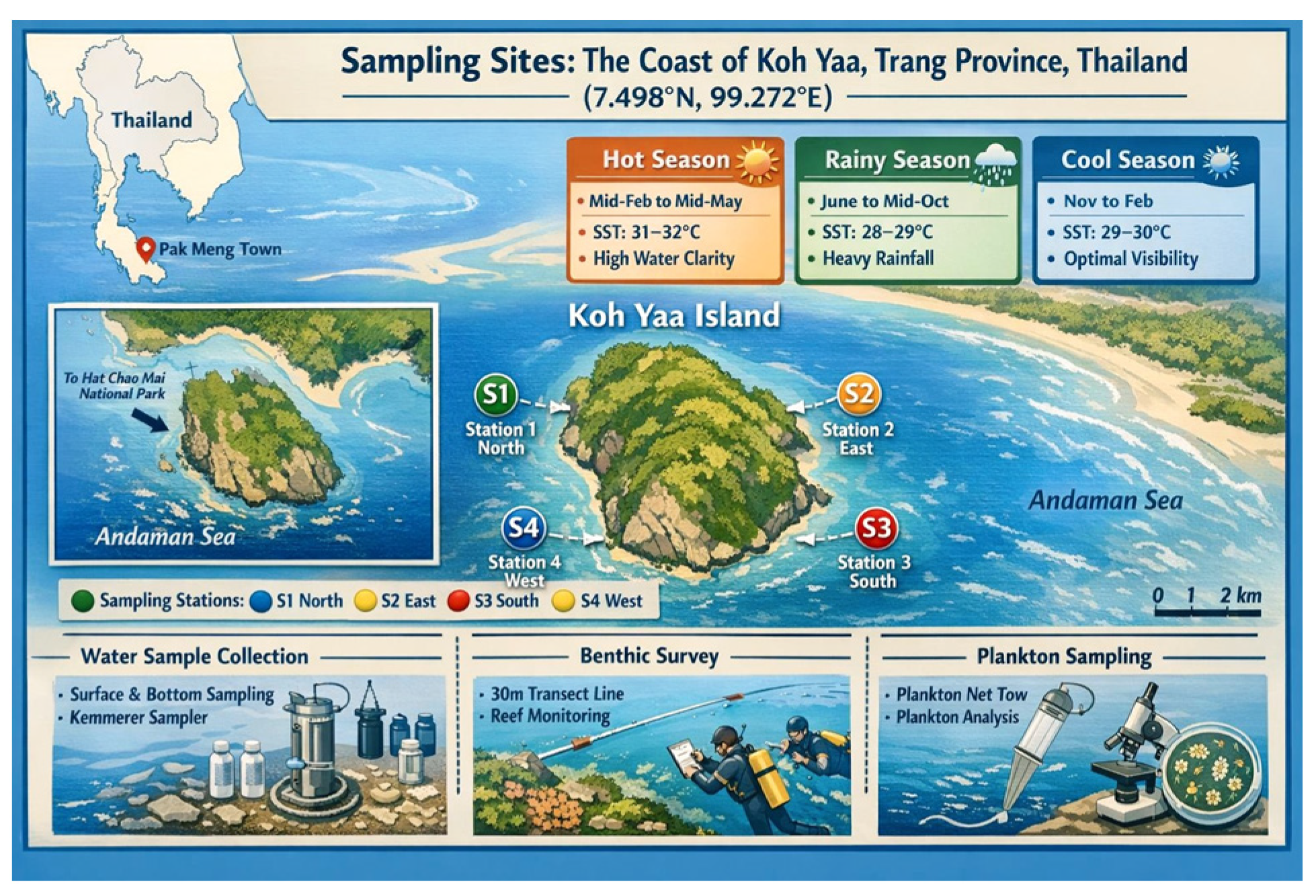
The coast of Koh Yaa (7°498′ N, 99°272′ E) is located in Pak Meng town under Sikao District, Trang Province, Thailand, adjacent to Hat Chao Mai National Park and a popular destination for diving tourists. As a core diving tourism area of the Andaman Sea, Koh Yaa exhibits typical tropical monsoon climate and oceanic coupling characteristics: Hot Season (mid-February to mid-May): Sea surface temperature (SST) reaches 31–32 °C with high water clarity; Rainy Season (June to mid-October): Rainfall accounts for 85% of annual total precipitation (over 1550 mm), SST drops to 28–29 °C, and increased nutrient input leads to reduced clarity; Cool Season (November to February): Lowest rainfall occurs, SST stabilizes at 29–30 °C with optimal visibility.

2.2. Sample Collection and Treatment

Surveys were conducted in mid-April, August and December 2024, covering three seasons along the west coast of Koh Yaa (7°498′ N, 99°272′ E) to Hat Chao Mai National Park. Four stations (North, East, South and West) were established every 3 km around Koh Yaa. At each station a 30-m fibreglass tape was laid parallel to the reef crest; two snorkelers swam along the tape to confirm the homogeneity of the habitat and to mark the exact mid-water position where subsequent water-quality and plankton samples would be taken. Sampling map were seen in Figure 1.
At each station, seawater was collected from four depths (0.5 m, 5 m, 10 m and 1 m above sea bottom) with a 2.2-L Kemmerer sampler (Wildco 1520-C20, Yulee, FL, USA). Three repeated samplings were conducted, and then an additional sample was taken from the surface in the middle of the belt. Thus, 13 water samples were collected at each station for one season, and a total of 156 samples were collected throughout the year. For water quality and plankton analysis, 13 water samples were pooled into an acid-rinsed 30-L carboy, gently inverted, and a single 1-L sub-sample was withdrawn and stored in refrigeration at 4 °C for subsequently physicochemical parameters analyses (<6 h) in laboratory, including temperature, pH, total dissolved solids (TDS), dissolved oxygen (DO), biochemical oxygen demand (BOD), total nitrogen (TN), total phosphorus (TP) and total alkalinity (TA).
For plankton analysis, samples were collected with a standard 22-µm mesh, 25-cm mouth-diameter plankton net fitted with a mechanical flowmeter (General Oceanics 2030R, Miami, FL, USA). Three replicate horizontal surface tows (0.5 m depth) were performed at each station. Tow duration was 2 min at a vessel speed of 0.5 m/s. The volume of water filtered (V) was read directly from the flowmeter and cross-checked with tow distance × net mouth area. The collected samples include phytoplankton and zooplankton. To prevent cell deformation and decay from affecting the identification process, the combined cod-end contents were immediately transferred into 300-mL amber glass bottles, preserved with 2% Lugol’s iodine plus 5% buffered formalin, and stored at 4 °C in the dark. In the laboratory, each sample was settled for 24 h, concentrated to 50 mL, and 1-mL Sedgwick–Rafter chambers were examined under an inverted microscope for the calculation of plankton abundance.

2.3. Determination Methods

Plankton samples and abundance (cells/m3) were checked under a microscope (Carl Zeiss Microscopy GmbH, Primo Star Axiocam, Jena, Germany). The primary identification keys and algal flora monographs used for morphological determination followed Identifying Marine Phytoplankton by Tomas [13]. Nomenclature and higher classification were standardized against AlgaeBase (www.algaebase.org) (accessed on 8 January 2026) [14]. Zooplankton was assigned using the pictorial keys by Conway et al. [15], and boxed into nauplii, copepodites, adult copepods, bivalve veligers and gastropod veligers; names and higher taxonomy were verified against the World Register of Marine Species (www.marinespecies.org) (accessed on 8 January 2026). Abundance was reported as cells or individuals m−3. A single cell containing cytoplasm was counted as one individual; filamentous colonies (e.g., Trichodesmium) were recorded as one unit. At least 400 cells or 100 fields were counted per replicate. Plankton abundance (cells/m3) was calculated as:
Abundance = (N × Vf)/(V × t × v), where N is number of cells counted, Vf is final volume of concentrate (mL), V is filtered seawater volume (m3), t is number of chambers counted, and v is volume of one chamber (mL). The mean of the three replications was used for statistical analyses. Because the 22-µm mesh selectively retains micro-phytoplankton (>20 µm), pico- and nano-phytoplankton are under-represented; therefore, the term “total phytoplankton” used herein refers to the net-retained fraction only.
For water quality parameters, seawater samples were filtered through 0.22-µm Whatman GF/F (Shanghai Jinpan Biotech Co., Ltd., Shanghai, China,) filter paper under dark conditions, and then a multi-parameter rapid water quality analyzer (TR6900DZ, Shenzhen Tongao Technology Co., Ltd., Guangdong, China) was used to determine temperature, pH, TDS, DO, BOD, TN, TP, and TA following the manufacturer’s protocols and related methods cited below:
pH, temperature, dissolved oxygen (DO), and total dissolved solids (TDS) were measured directly using electrodes calibrated with pH buffer, saturated KCl solution, zero-DO solution, and a 1413 µS/cm conductivity standard, respectively. Samples were analyzed immediately after collection, with the electrodes rinsed three times between replicates.
BOD: 250-mL aliquots were incubated at 20 °C in BOD bottles for 5 d; initial and final DO were recorded with the same meter and BOD calculated as the difference after subtracting bottle blanks.
TN: alkaline persulfate digestion was performed in 25-mL borosilicate tubes with 0.15 g K2S2O8 and 0.4 g NaOH at 121 °C for 30 min; digests were neutralised with 1 mol/L HCl and TN determined by UV spectrophotometry at 220 nm.
TP: samples were digested with 0.05 g K2S2O8 and 0.5 mL 30% H2SO4 at 121 °C for 30 min; TP was measured by the ascorbic acid method at 700 nm.
Alkalinity (TA): 100-mL sample was titrated with 0.02 N HCl to pH 4.5; TA was calculated as mg/L CaCO3.

2.4. Data Analysis

Descriptive statistics (mean, range, and standard error) were calculated for all data using SPSS 16.0 (SPSS Inc., Chicago, IL, USA). A two-way ANOVA was conducted to assess significant differences across study sites, and mean separation was analyzed using Duncan’s Multiple Range Test (DMRT) at the p ≤ 0.05 level. The Pearson coefficient was used to analyze the correlation between environmental factors (physical and chemical parameters and dissolved nutrients) and phytoplankton (abundance and communities). All the figures were output by Origin 8.0 software (OriginLab Corporation, Northampton, MA, USA).
Plankton diversity was assessed using the Shannon–Weaver diversity index (H’), as the equation described: H’ = −Σ(ni/N) ln(ni/N), where N is the total number of individuals across all genera, and ni is the total number of individuals for genera i. The diversity index (H’) ranged from 0 to 4. Very low (<1.0), medium (1.0 to 2.5) and high (>2.5) [14,16].
Plankton evenness was assessed using Pielou’s evenness index (J’), as the equation described: J’ = H’/ln(S), where H’ is the diversity index and S is the total genera. The Evenness index (J’) ranged from 0 to 1. Very poor (<0.5), moderate (0.5 to 0.8), and good (0.8 to 1) [14,17].

3. Results

3.1. The Composition and Variation in Plankton Communities

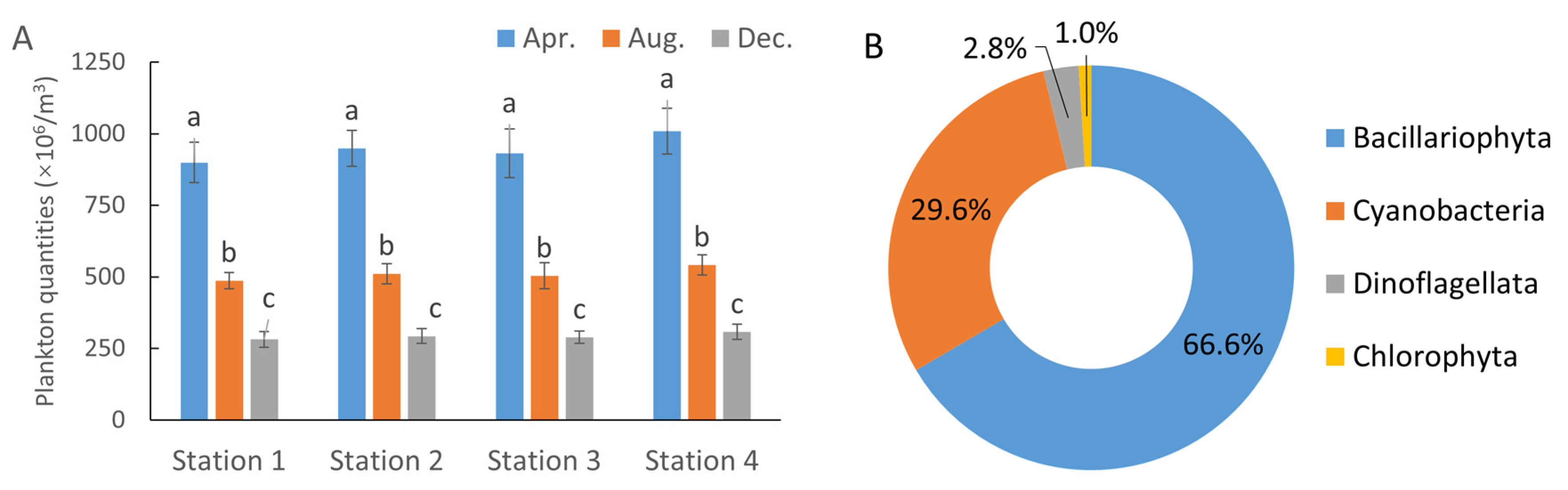
The investigation of plankton abundance in the waters of the Koh Yaa tourism area revealed a decreasing trend over time. Notably, April exhibited the highest biological abundance, reaching 1009 × 106 cells/m3, while December recorded the lowest at 281 × 106 cells/m3 (Figure 2A). Within each season, there were no significant differences in biological abundance among the four observation stations, indicating that the environmental conditions in this region are relatively stable.
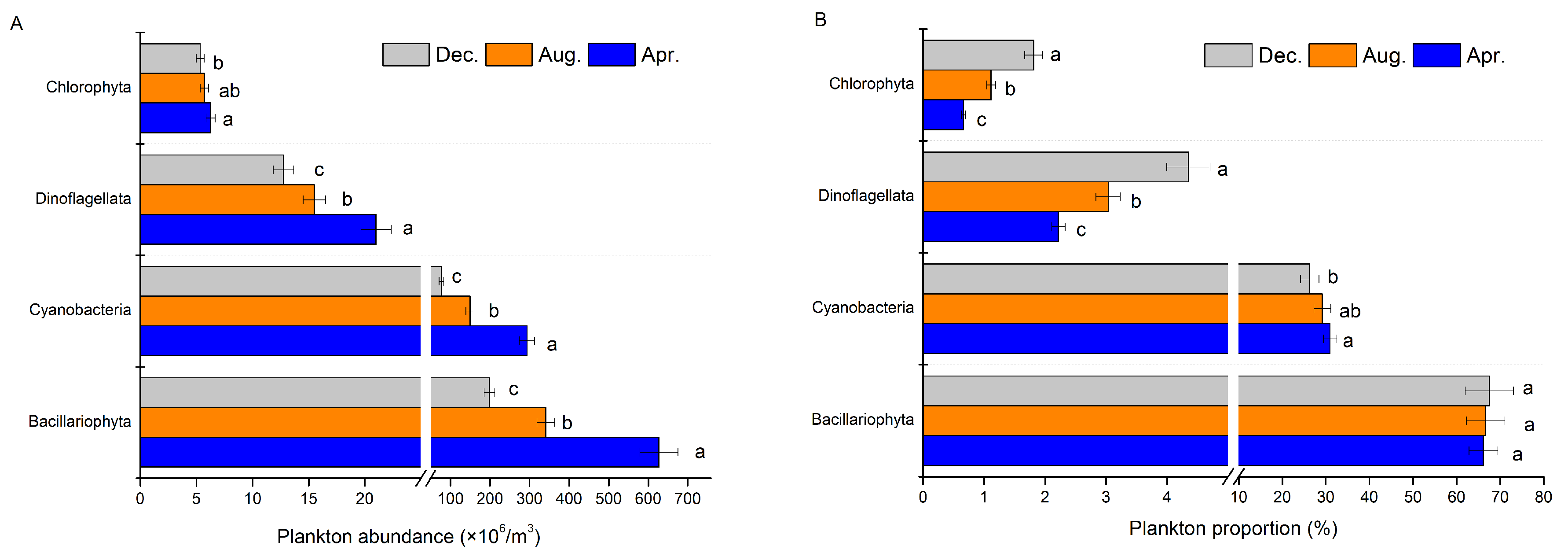
Further identification of these plankton revealed a total of 15 categories of phytoplankton classified into four phyla: Bacillariophyta, Cyanobacteria, Dinoflagellata, and Chlorophyta. This classification encompassed six classes, eleven orders, thirteen families, and fifteen genera (Supplementary Table S1). Among them, Bacillariophyta was predominant with eleven genera identified—accounting for 66.6% of all categories—with an annual average abundance of 388 × 106 cells/m3. Following this was Cyanobacteria with an annual average abundance of 173 × 106 cells/m3; conversely, Chlorophyta constituted only 1.0% of total plankton (Figure 2B). For seasonal variations, it is noteworthy that over time, the abundance of all phytoplankton groups had decreased, while the proportion of phytoplankton from all phyla except Cyanobacteria had increased, indicating a certain degree of biodiversity enhancement in this region (Figure 3).

3.2. Dominant Organisms Analysis

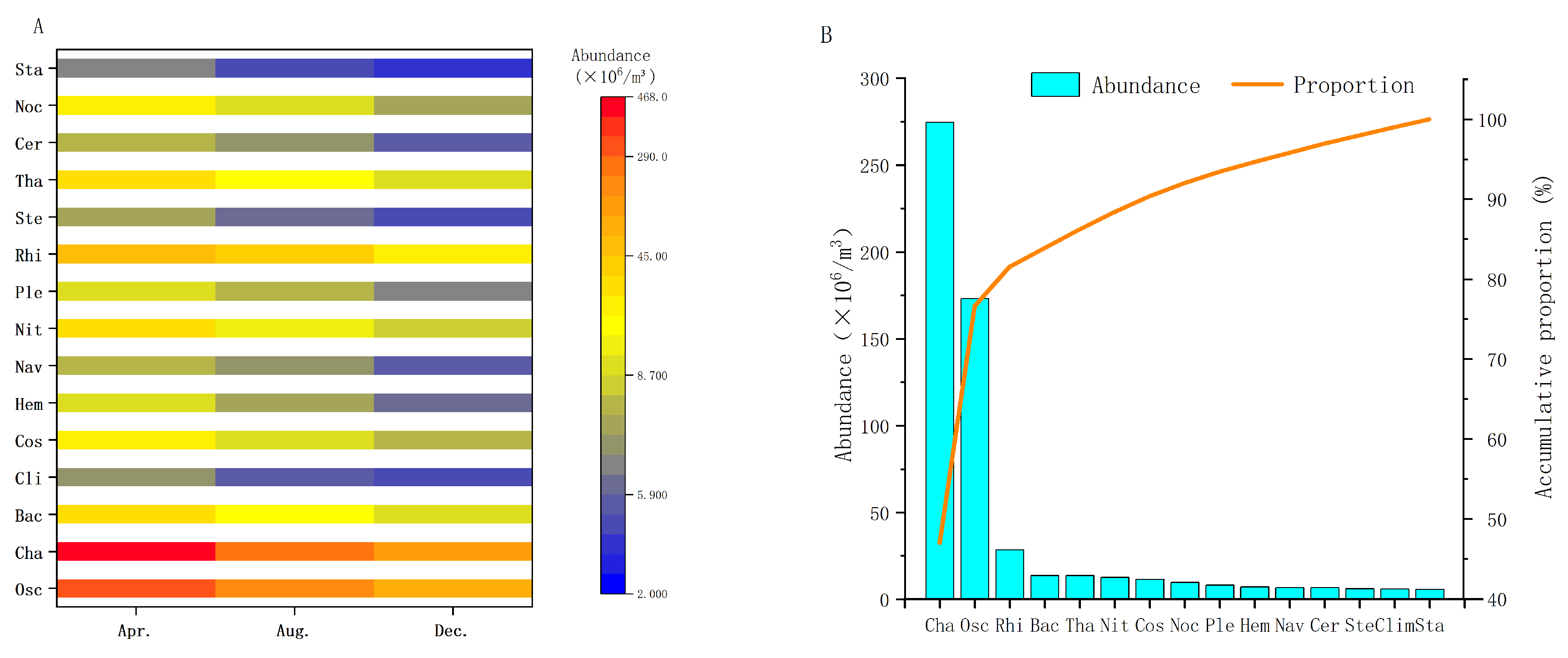
The annual average abundance of marine plankton in the Koh Yaa region was further analyzed, revealing that the highest abundances were found in the diatom genus Chaetoceros (2.75 × 10⁶ cells/m3) and the cyanobacterium genus Oscillatoria (1.73 × 10⁶ cells/m3) (Figure 4A and Supplementary Table S2). Together, these two genera accounted for a total of 4.48 × 10⁶ cells/m3, representing 76.6% of all planktonic cells (Figure 4B). Although their abundance displayed a significant downward trend with seasonal variation, the proportion of two genera remained relatively stable at approximately 1.58:1. Within the dinoflagellate group, two genera—Noctiluca and Ceratium—were identified with comparatively lower abundances; meanwhile, Staurastrum from Chlorophyta group showed the lowest abundance (Figure 4A). Additionally, with seasonal changes, the proportion of diatom genus Chaetoceros and the cyanobacterium genus Oscillatoria decreased, while that of other genera increased, leading to greater uniformity in phytoplankton within the region (Figure 4A).

3.3. Diversity Index and Evenness of Plankton Communities

The variation in diversity and evenness indices among different observation points within each season is relatively small, which aligns with the previously mentioned fluctuations in plankton abundance (Figure 2 and Table 1). In April, the diversity index was at its lowest, ranging from 1.34 to 1.58, indicating a moderately low level of diversity. In August, however, the diversity index increased to between 1.51 and 1.70, reflecting a moderate level; by December, despite rising further to between 1.72 and 1.88, biodiversity levels remained moderate. The seasonal trend of the evenness index aligns with that of the diversity index, rising from a minimum of 0.46 in April to a maximum of 0.64 in December, moving from poor to moderate levels throughout the year (Table 1). Overall, the diversity and evenness indices improved but remained at a moderately low level throughout the year, indicating potential pollution in this marine area.

3.4. Physicochemical Factor Analysis

Overall, pH, dissolved oxygen (DO), and total nitrogen (TN) showed a significant increasing trend with seasonal changes, while seawater temperature and biochemical oxygen demand (BOD) exhibited a clear decreasing trend (Table 2). Total dissolved solids (TDS) and alkalinity (TA) reached their lowest values in August, whereas total phosphorus (TP) peaked during the same month. The seawater pH generally remained within the neutral range (7.14–7.76), suitable for most planktonic organisms [18]; seawater temperature ranged from 28 °C to 32 °C. During the rainy season in August, both seawater temperature and TDS dropped to their minimums, reflecting Thailand’s seasonal climate characteristics—high temperatures with little rain in April and maximum rainfall in August [19]. Additionally, DO and BOD displayed an inverse relationship; for instance, DO levels were highest while BOD levels were lowest in December. Overall, DO content was at a normal level but BOD ranged from 0.27 to 0.69 mg/L, exceeding normal limits (<0.1 mg/L) for clean water, indicating potential pollution of seawater [20]. TN and TP are crucial nutrients affecting algal growth; results indicated TN levels at 0.19–0.32 mg/L were normal, while TP at 0.27–0.69 mg/L exceeded acceptable ranges, possibly due to coastal discharge activities [20]. The findings suggest that variations in physicochemical indicators of seawater are coupled with seasonal fluctuations and may also be influenced by human activities since April is peak tourist season while August is off-peak.

3.5. Correlation and PCA of Plankton Abundance and Environmental Factors

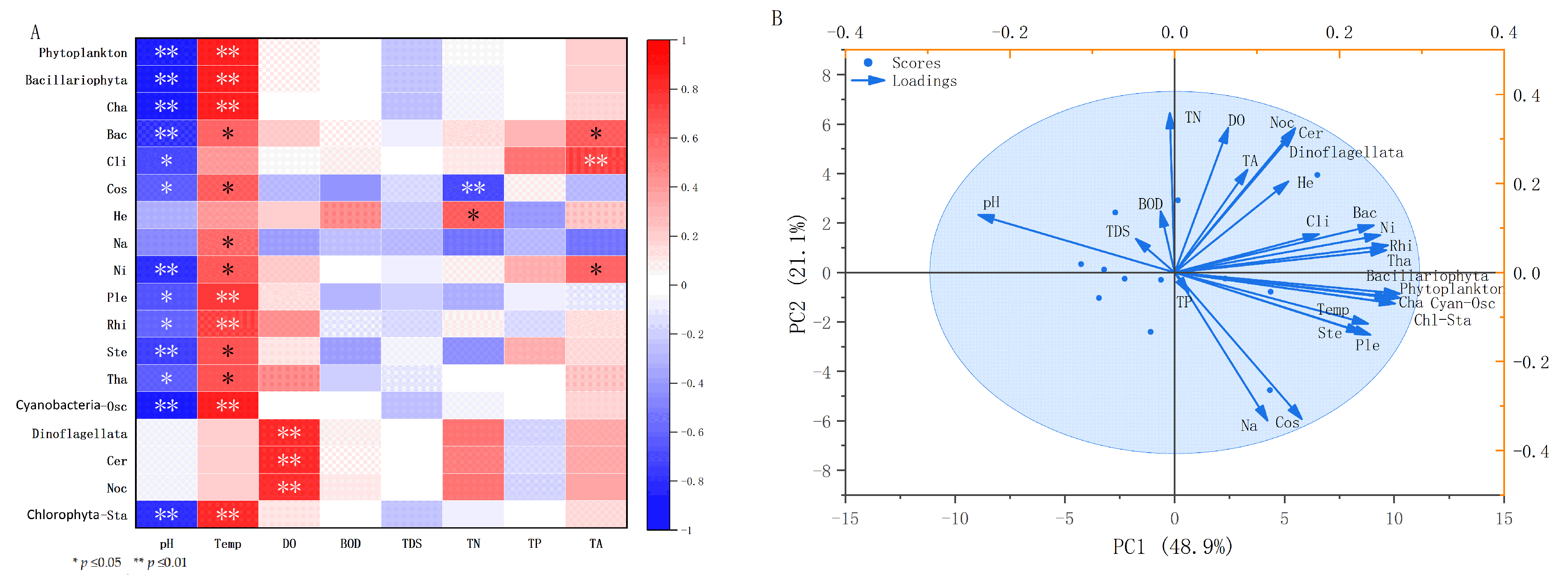
The total phytoplankton exhibited the highest negative correlation with pH (r = −0.875, p < 0.01) and a high positive correlation with temperature (r = 0.865, p < 0.01), indicating that acidification and seasonal warming are the primary environmental drivers of overall biomass (Figure 5A). Bacillariophyta closely tracked this community-level signal (r = −0.882 for pH; r = 0.868 for temperature), reflecting its quantitative dominance. Cyanobacteria (Oscillatoria) and Chlorophyta (Staurastrum) showed nearly identical correlation patterns (r ≈ −0.89 with pH and ≈ +0.87 with temperature), confirming their shared thermal-pH niche. In contrast, dinoflagellates (Ceratium and Noctiluca) showed weak links to temperature or pH but had a high positive association with dissolved oxygen (r = 0.82–0.83, p < 0.01). In terms of nutrients, Coscinodiscus and Hemiaulus have significant correlations with TN—one negative (r = −0.711) and one positive (r = 0.636), but neither correlates significantly with phosphorus. In addition, the high correlation between Chaetoceros and Oscillatoria implies that future warming coupled with acidification may promote synergistic blooms of these fast-growing taxa, shifting the plankton assemblage toward a diatom–cyanobacteria co-dominance (Supplementary Table S2). Overall, the matrix reveals temperature and pH as key abiotic variables that differentiate diatom/cyanobacterial dominance from dinoflagellate proliferation along the Koh Yaa coast.
To further analyze the inter-relation between plankton and environmental factors, PCA was conducted (Figure 5B and Supplementary Table S3). PCA ordination retained two axes that together explain 64.5% of the variance. PC1 (48.9%) was anchored by temperature (+0.235) and pH (−0.238). All dominant diatoms (Chaetoceros 0.267, Bacillariophyta 0.273, Oscillatoria 0.267) and total phytoplankton (0.273) loaded strongly positive on this axis, whereas Dinoflagellates (Ceratium 0.145, Noctiluca 0.146) and DO (0.065) occupied the negative side, confirming that heated, acidified conditions favoured the diatom–cyanobacterial consortium while cooler, oxygen-rich water promoted dinoflagellates. PC2 (15.6%) was driven by a nutrient–alkalinity suite: TN (0.358), TA (0.231) and DO (0.325) opposed TP (−0.045) and TDS (0.076). Staurastrum (0.262) and several benthic diatoms (Navicula −0.333, Coscinodiscus −0.329) therefore spread along the positive PC2 quadrants, signalling their affinity for mineral-rich, monsoon-influenced sites, while high-TP stations shifted downward. Together, the PCA corroborated the temperature–pH and DO gradients revealed in Figure 5A and established TN and DO as the primary axes structuring phytoplankton assemblages along the Koh Yaa coast.

4. Discussion

4.1. The Relationship Between Biodiversity and Pollution Levels

In this study, the Shannon–Wiener diversity index (H’) of phytoplankton in the Koh Yaa region increased from 1.34 in April to 1.88 in December, indicating a rise in biodiversity over the observation period. In comparison, other tropical marine areas also exhibited similar seasonal variations in their diversity indices, although specific values differed. For instance, Hasan et al. (2022) reported that the diversity index of phytoplankton ranged from 1.45 to 2.96 in intertidal mangrove streams at the Pasur River estuary in Bangladesh [14]. While caution is warranted when comparing diversity indices across different marine environments due to their susceptibility to various environmental factors, it can be inferred that the diversity index for Koh Yaa is at a moderate or middle-low level, suggesting that its planktonic community is relatively rich but still has room for improvement. An increase in the diversity index is generally regarded as a positive indicator of ecosystem health enhancement [14]. In this study, alongside the rise in the diversity index, evenness index (J’) for plankton increased from 0.46 in April to 0.64 by December, signifying a more uniform distribution of plankton within the community. However, this increase may be associated with seasonal changes rather than being directly attributed to reductions in seawater pollution levels (Table 2). Notably during the research period, biochemical oxygen demand (BOD) and total phosphorus (TP) concentrations exceeded normal ranges indicative of clean water conditions [20]; this likely reflects pollution pressures stemming from human activities. Therefore, while there has been an improvement noted through increases in both indices of biodiversity and evenness within this study area—the highest at J’ = 0.64—it remains approximately 15%–20% lower than those observed in other sea areas in Thailand, indicating a potential pollution in this marine area [21]; such findings suggest potential occurrences of dominant genera overgrowth warranting further attention regarding long-term impacts on plankton communities due to seawater pollution, e.g., algal blooms.

4.2. Plankton Composition and Potential Risks

In this study, the dominant phytoplankton were Chaetoceros diatoms and Oscillatoria cyanobacteria, followed by Rhizosolenia diatoms. Compared to other studies, Chaetoceros frequently appears as a dominant genus. Chaetoceros’ strong adaptability to light and nutrients enables it to dominate in spring and summer, demonstrating its proliferation capacity across diverse aquatic environments [22,23]. Oscillatoria is also noted as a dominant Cyanobacterium in tropical and subtropical waters, likely due to its temperature adaptability [14].
In addition, we investigated the quantity of zooplankton to further assess potential pollution in the area through the ratio of phytoplankton to zooplankton. We found that the local zooplankton population averaged approximately 64 × 106 individuals/m3, resulting in a phytoplankton-to-zooplankton (P:Z) ratio of about 9.2:1 (Supplementary Table S1). In normal tropical seas, this ratio typically ranges from 2:1 to 3:1; however, oligotrophic regions of the western Pacific may see higher ratios (over 4:1) due to dominance by microphytoplankton [24,25]. A ratio exceeding 4:1 may indicate significant ecological imbalance with multifaceted implications for the marine ecosystem that extend beyond basic trophic structure:
(1) Reduced food web efficiency and energy transfer limitation: Insufficient zooplankton abundance creates a “grazing gap” where the majority of phytoplankton biomass cannot be effectively consumed. Normally, zooplankton act as a critical intermediate link, transferring energy from primary producers (phytoplankton) to higher trophic levels (e.g., small fish, crustaceans, and apex predators) [25,26]. In this study, the 9.2:1 ratio suggests that only a small fraction of phytoplankton production is channeled upward, leading to energy retention at the base of the food web. This inefficiency weakens the stability of higher trophic levels, potentially reducing the productivity of commercial and ecologically important species dependent on zooplankton prey.
(2) Impaired carbon export and biogeochemical cycling: Phytoplankton play a pivotal role in marine carbon sequestration through the “biological pump”—the process by which organic carbon is exported from the surface ocean to deep waters via sinking detritus or zooplankton fecal pellets [3]. A balanced P:Z ratio facilitates efficient carbon export, as zooplankton grazing converts phytoplankton biomass into dense, fast-sinking particles. However, the elevated P:Z ratio in the Koh Yaa region implies that most phytoplankton biomass either accumulates in surface waters or decomposes aerobically near the euphotic zone. This decomposition consumes dissolved oxygen (DO) and releases carbon dioxide back into the atmosphere, reducing the region’s capacity to act as a carbon sink and potentially exacerbating local hypoxia risks [9].
(3) Increased risk of phytoplankton biomass buildup and intensified eutrophication: Even in the absence of harmful species, excessive phytoplankton biomass accumulation can degrade water quality by reducing light penetration, which inhibits the growth of benthic primary producers (e.g., coral reefs and seagrasses) critical to the Koh Yaa ecosystem [10]. The high P:Z ratio indicates that nutrient inputs (e.g., elevated TP levels observed in this study) are not effectively regulated by zooplankton grazing, creating a positive feedback loop for eutrophication. As nutrients persist in surface waters, phytoplankton growth is further stimulated, increasing the likelihood of nuisance blooms that alter water clarity and disrupt benthic-pelagic coupling [7].
(4) Latent risk of harmful algal blooms (HABs) and toxin production: The presence of cyanobacteria (Oscillatoria) and dinoflagellates (Noctiluca, Ceratium) in the plankton community adds a critical dimension to the ecological risk assessment. While no HABs were observed during the study period, the trophic imbalance created by the 9.2:1 P:Z ratio increases the potential for opportunistic, toxin-producing species to proliferate. Phytoplankton from Oscillatoria genus are known to produce cyanotoxins such as microcystins and anatoxins, which can accumulate in the food web and pose risks to aquatic organisms and human health (e.g., via seafood consumption or direct contact during diving activities) [27]. Similarly, certain dinoflagellate genera (e.g., Noctiluca) can form blooms that release biotoxins or cause hypoxia, while others (e.g., Ceratium) may act as indicators of deteriorating water quality preceding HAB events [5,28]. The current dominance of non-toxic Chaetoceros does not preclude future shifts in community composition; as nutrient loading and trophic imbalance persist, competitive advantages may shift toward toxin-producing taxa that are less palatable to zooplankton, further destabilizing the ecosystem.
Overall, the distribution of dominant planktonic communities in the study area exhibits both similarities and differences when compared to other research findings. The absence of algal blooms associated with eutrophic algae in this region may be linked to the seasonal impacts of tourism activities and the influence of Indian ocean currents [28]. Additionally, the imbalance in the P:Z ratio (9.2:1) poses more direct and far-reaching threats to regional ecological integrity than diversity indices alone, as it reflects functional impairment of the food web, reduced biogeochemical efficiency, and latent HAB risks. This underscores the need for targeted management strategies to mitigate nutrient pollution and restore trophic balance in the Koh Yaa coastal ecosystem. It should be noted that the 22-µm mesh plankton net used in this study selectively samples micro-phytoplankton (22–200 µm), excluding pico-phytoplankton (<2 µm) and nano-phytoplankton (2–22 µm). Thus, the “phytoplankton” data reported herein do not represent the total phytoplankton community, and the abundance and diversity of smaller phytoplankton fractions (e.g., Prochlorococcus, Synechococcus) may be underestimated. This limitation should be considered when extrapolating the study results to the entire phytoplankton assemblage in the Koh Yaa region.

4.3. Impact of Human Activities on Plankton

This study confirmed that seawater temperature and pH are the key abiotic factors jointly regulating phytoplankton abundance and community structure (Figure 5), consistent with previous tropical marine plankton research [14,23]. A critical challenge lies in disentangling tourism impacts from natural seasonality, as April’s peak tourist season coincides with the hot, dry season and strong light—conditions that inherently promote phytoplankton growth. Temperature showed a strong positive correlation with total phytoplankton abundance (r = 0.865, p < 0.01) and dominance of Chaetoceros and Oscillatoria (r = 0.868 and 0.870, respectively, p < 0.01), reflecting seasonal baseline effects. However, April also exhibited the lowest pH (7.25) and highest tourist density, with tourism-related inputs (untreated wastewater, sunscreen residues, organic waste) driving pH reduction via enhanced microbial respiration (CO2 release) and acidifying compounds [24,27]. This acidification favored acid-tolerant Chaetoceros and Oscillatoria (r = −0.882 and −0.890 for pH), amplifying their dominance beyond temperature-driven effects [8,14].
April’s plankton pattern—high abundance (1009 × 106 cells/m3) but lowest diversity (H’ = 1.34–1.58)—supports the hypothesis that tourism-derived nutrients favor r-strategists like Chaetoceros (47% of total phytoplankton), which have high nutrient uptake rates and short generation times [20,22]. April’s TP (0.42 mg/L) exceeded natural background levels (0.02–0.1 mg/L) [29], likely from sewage and coastal runoff [11,27]. In contrast, off-season (August) and shoulder season (December) showed lower tourist pressure, higher pH (7.59 and 7.68), and higher diversity (H’ = 1.51–1.70 and 1.72–1.88), despite elevated TP (0.44 mg/L), indicating that nutrient enrichment alone is insufficient—tourism-induced pH reduction and nutrient input together create a niche favoring fast-growing taxa. Three aspects of evidence distinguish tourism from seasonality: (1) pH correlates with tourist density (non-climatic pattern); (2) imbalanced TN:TP (≈0.6:1) reflects phosphorus-rich anthropogenic inputs [29,30]; (3) disturbance-tolerant taxa dominate in peak tourism, while sensitive dinoflagellates (Ceratium, Noctiluca) increase in low-pressure seasons. Management should target nutrient loading and pH reduction (e.g., visitor limits, eco-friendly sunscreens, wastewater treatment and long-term monitoring mechanisms) [31]. Future research should further explore how these impacts vary over time and space to provide scientific support for more effective conservation strategies.

5. Conclusions

The present study mainly investigated the diversity of phytoplankton in the Koh Yaa region of Thailand at the genus level, as well as their relationships with environmental variables, to assess the impact of tourism activities on marine health in this area. The conclusions are as follows:
  • A total of 15 categories of phytoplankton were identified, belonging to four phyla: Bacillariophyta, Cyanobacteria, Dinoflagellata, and Chlorophyta. Among these, Chaetoceros (Bacillariophyta) and Oscillatoria (Cyanobacteria) are the dominant genera, accounting for 47% and 29.6% of total phytoplankton quantities, respectively, with a relatively stable ratio throughout seasonal variations.
  • The absence of harmful algal blooms associated with eutrophic algae in this area may be linked to seasonal tourism impacts and Indian Ocean currents. However, the ratio between phytoplankton and zooplankton stands at 9.2—higher than typical values in Southeast Asian waters—indicating an imbalance that warrants caution regarding potential risks.
  • Although both the diversity index and evenness index improved from 1.34 and 0.46 in April to 1.88 and 0.64 in December, respectively, they still remained at moderate or middle-low levels; combined with seasonal changes in nutrient content (e.g., TP), this suggests some degree of pollution exists in this area.
  • Variations in phytoplankton abundance, diversity indices and evenness indices, as well as physicochemical parameters, correlate with seasonal climate variations and tourist season fluctuations; it is recommended that strategies such as controlling visitor numbers during high season or enhancing wastewater management practices—including promoting environmentally friendly sunscreen products—be implemented to mitigate negative impacts on marine ecosystems.

Supplementary Materials

The following supporting information can be downloaded at: https://www.mdpi.com/article/10.3390/applmicrobiol6010015/s1, Table S1: Plankton abundance among different stations and seasonal variation; Table S2: Pearson correlation coefficient among all factors; Table S3: PCA result.

Author Contributions

Conceptualization, T.W.; Formal analysis, J.B.; Investigation, M.K. and J.B.; Methodology, T.W., M.K., J.B. and W.D.; Validation, M.K.; Writing—original draft, T.W.; Writing—review & editing, T.W. and W.D. All authors have read and agreed to the published version of the manuscript.

Funding

This research received no external funding.

Institutional Review Board Statement

Not applicable.

Informed Consent Statement

Not applicable.

Data Availability Statement

The original contributions presented in this study are included in the article/Supplementary Materials. Further inquiries can be directed to the corresponding author.

Acknowledgments

This study was supported by Thailand Science Research and Innovation, Thailand. The authors also acknowledge the Faculty of Science and Fisheries Technology, Rajamangala University of Technology Srivijaya, Trang Campus, Thailand, for providing laboratory facilities. We are also grateful for the experimental support from the Faculty of Science, Kasetsart University, Thailand.

Conflicts of Interest

The authors declare no conflicts of interest.

References

  1. Bresnan, E.; Cook, K.B.; Hughes, S.L.; Hay, S.J.; Smith, K.; Walsham, P.; Webster, L. Seasonality of the plankton community at an east and west coast monitoring site in Scottish waters. J. Sea Res. 2015, 105, 16–29. [Google Scholar] [CrossRef]
  2. Raven, J.A.; Beardall, J. Influence of global environmental change on plankton. J. Plankton Res. 2021, 43, 779–800. [Google Scholar] [CrossRef]
  3. Wang, S.; Maltrud, M.; Elliott, S.; Cameron-Smith, P.; Jonko, A. Influence of dimethyl sulfide on the carbon cycle and biological production. Biogeochemistry 2018, 138, 49–68. [Google Scholar] [CrossRef]
  4. Yang, J.; Wang, F.; Lv, J.; Liu, Q.; Nan, F.; Liu, X.; Xu, L.; Xie, S.; Feng, J. Interactive effects of temperature and nutrients on the phytoplankton community in an urban river in China. Environ. Monit. Assess. 2019, 191, 688. [Google Scholar] [CrossRef]
  5. Zohdi, E.; Abbaspour, M. Harmful algal blooms (red tide): A review of causes, impacts and approaches to monitoring and prediction. Int. J. Environ. Sci. Technol. 2019, 16, 1789–1806. [Google Scholar] [CrossRef]
  6. Kordas, R.L.; Harley, C.D.; O’Connor, M.I. Community ecology in a warming world: The influence of temperature on interspecific interactions in marine systems. J. Exp. Mar. Biol. Ecol. 2011, 400, 218–226. [Google Scholar] [CrossRef]
  7. Lan, J.; Liu, P.; Hu, X.; Zhu, S. Harmful algal blooms in eutrophic marine environments: Causes, monitoring, and treatment. Water 2024, 16, 2525. [Google Scholar] [CrossRef]
  8. Irie, T.; Bessho, K.; Findlay, H.S.; Calosi, P. Increasing costs due to ocean acidification drives phytoplankton to be more heavily calcified: Optimal growth strategy of coccolithophores. PLoS ONE 2010, 5, e13436. [Google Scholar] [CrossRef] [PubMed]
  9. Ekau, W.; Auel, H.; Pörtner, H.-O.; Gilbert, D. Impacts of hypoxia on the structure and processes in pelagic communities (zooplankton, macro-invertebrates and fish). Biogeosciences 2010, 7, 1669–1699. [Google Scholar] [CrossRef]
  10. Najeeb, S.; Khan, R.A.A.; Deng, X.; Wu, C. Drivers and consequences of degradation in tropical reef island ecosystems: Strategies for restoration and conservation. Front. Mar. Sci. 2025, 12, 1518701. [Google Scholar] [CrossRef]
  11. Noonsang, P.; Tina, F.W.; Jaroensutasinee, M.; Jaroensutasinee, K.; Chumkiew, S.; Kuhapong, U. Diversity of coral reef fishes at Racha Yai Island, Thailand. J. Fish. Environ. 2016, 40, 19–34. [Google Scholar]
  12. Cheewajaroenkul, J.; Tuntipisitkul, P.; Phakdee-Auksorn, P. Factors affecting tourist’s intention to purchase environmentally friendly sunscreen products: A case study of Phuket, Thailand. Kasetsart J. Soc. Sci. 2022, 43, 1015–1024. [Google Scholar] [CrossRef]
  13. Tomas, C.R. Identifying Marine Phytoplankton; Academic Press: San Diego, CA, USA, 1997. [Google Scholar]
  14. Hasan, J.; Shaha, D.C.; Kundu, S.R.; Yusoff, F.M.; Cho, Y.-K.; Haque, F.; Salam, M.A.; Ahmed, S.; Wahab, M.A.; Ahmed, M.; et al. Phytoplankton community in relation to environmental variables in the tidal mangrove creeks of the Pasur River estuary, Bangladesh. Conservation 2022, 2, 587–612. [Google Scholar] [CrossRef]
  15. Conway, D.V.P.; White, R.G.; Hugues-Dit-Ciles, J.; Gallienne, C.P.; Robins, D.B. Guide to the Coastal and Surface Zooplankton of the South-Western Indian Ocean; Occasional Publication of the Marine Biological Association No. 15; Marine Biological Association: Plymouth, UK, 2003. [Google Scholar] [CrossRef]
  16. Shannon, C.E. A Mathematical Theory of Communication. Bell Syst. Tech. J. 1948, 27, 623–656. [Google Scholar]
  17. Pielou, E.C. Species-diversity and pattern-diversity in the study of ecological succession. J. Theor. Biol. 1966, 10, 370–383. [Google Scholar]
  18. Hinga, K.R. Effects of pH on coastal marine phytoplankton. Mar. Ecol. Prog. Ser. 2002, 238, 281–300. [Google Scholar] [CrossRef]
  19. Limsakul, A.; Singhruck, P. Long-term trends and variability of total and extreme precipitation in Thailand. Atmos. Res. 2016, 169, 301–317. [Google Scholar] [CrossRef]
  20. Shanmugam, P.; Neelamani, S.; Ahn, Y.-H.; Philip, L.; Hong, G.-H. Assessment of the levels of coastal marine pollution of Chennai city, Southern India. Water Resour. Manag. 2007, 21, 1187–1206. [Google Scholar] [CrossRef]
  21. Phonmat, P.; Chaichana, R.; Rakasachat, C.; Klongvessa, P.; Chanthorn, W.; Moukomla, S. Phytoplankton and Zooplankton Assemblages Driven by Environmental Factors Along Trophic Gradients in Thai Lentic Ecosystems. Diversity 2025, 17, 372. [Google Scholar] [CrossRef]
  22. Minggat, E.; Roseli, W.; Tanaka, Y. Nutrient absorption and biomass production by the marine diatom Chaetoceros muelleri: Effects of temperature, salinity, photoperiod, and light intensity. J. Ecol. Eng. 2021, 22, 231–240. [Google Scholar] [CrossRef]
  23. Somsap, N.; Gajaseni, N.; Piumsomboon, A. Physico-chemical factors influencing blooms of Chaetoceros spp. and Ceratium furca in the Inner Gulf of Thailand. Agric. Nat. Resour. 2015, 49, 200–210. [Google Scholar]
  24. Li, X.; Xu, Z.; Zhang, S.; Gao, W.; Dong, Q.; Guo, F.; Zhu, Z.; Yang, W.; Yang, Z. Eutrophication-Driven Changes in Plankton Trophic Interactions: Insights from Trade-Offs in Functional Traits. Environ. Sci. Technol. 2025, 59, 744–755. [Google Scholar] [CrossRef]
  25. Wei, Y.; Ding, D.; Gu, T.; Jiang, T.; Qu, K.; Sun, J.; Cui, Z. Different responses of phytoplankton and zooplankton communities to current changing coastal environments. Environ. Res. 2022, 215, 114426. [Google Scholar] [CrossRef] [PubMed]
  26. Griffin, S.L.; Rippingale, R.J. Zooplankton grazing dynamics: Top-down control of phytoplankton and its relationship to an estuarine habitat. Hydrol. Process. 2001, 15, 2453–2464. [Google Scholar] [CrossRef]
  27. Shreenidhi, K.; Geetha, B.V.; Sandhya, S.S.S.; Murugan, S.J.; Sarada, G. Influence of Cosmetic and Pharmaceutical Wastes on Community of Plankton. In Emergent Pollutants in Freshwater Plankton Communities; CRC Press: Boca Raton, FL, USA, 2024; pp. 67–79. [Google Scholar]
  28. Tang, D.L.; Kawamura, H.; Shi, P.; Takahashi, W.; Guan, L.; Shimada, T.; Sakaida, F.; Isoguchi, O. Seasonal phytoplankton blooms associated with monsoonal influences and coastal environments in the sea areas either side of the Indochina Peninsula. J. Geophys. Res. Biogeosci. 2006, 111, G01010. [Google Scholar] [CrossRef]
  29. Thongra-ar, W.; Musika, C.; Mokkongpai, P.; Wongsudawan, W.; Munhapol, A. Various Forms of Phosphorus in Sediments of the Eastern Coast of Thailand. Scienceasia 2004, 30, 211–222. [Google Scholar] [CrossRef]
  30. Rosales, D.; Ellett, A.; Jacobs, J.; Ozbay, G.; Parveen, S.; Pitula, J. Investigating the Relationship between nitrate, total dissolved nitrogen, and phosphate with abundance of pathogenic Vibrios and harmful algal blooms in Rehoboth Bay, Delaware. Appl. Environ. Microbiol. 2022, 88, e00356-22. [Google Scholar] [CrossRef]
  31. Tanpichai, K.; Jamieson, I.A. Enhancing Customer Experiences in Ecotourism Scuba Diving on Koh Tao. Master’s Thesis, Thammasat University, Bangkok, Thailand, 2024. [Google Scholar]
Figure 1. Sampling map.
Applmicrobiol 06 00015 g001
Figure 2. Total quantities of plankton (A) and the proportion of plankton communities (B). Different small letters in the same group indicate significant differences at the p = 0.05 level based on Duncan’s Multiple Range Test. Error bars denote the mean ± standard deviation of three replications.
Applmicrobiol 06 00015 g002
Figure 3. Seasonal variations in the abundance (A) and proportions of plankton communities (B). Different small letters in the same group indicate significant differences at the p = 0.05 level based on Duncan’s Multiple Range Test. Error bars denote the mean ± standard deviation, n = 12. Plankton proportion (%).
Applmicrobiol 06 00015 g003
Figure 4. Spatial distribution and seasonal variations in plankton organisms. (A) is the heat-map for plankton communities vs. month, (B) is the Pareto chart for annual abundance and cumulative proportions. Abbreviations are represented by the first two or three letters of each name, standing for Oscillatoria, Staurastrum, Chaetoceros, Bacteriastrum, Climacosphenia, Coscinodiscus, Hemiaulus, Navicula, Nitzschia, Pleurosigma, Rhizosolenia, Stephanopyxis, Thalassionema, Ceratium, and Noctiluca, respectively.
Applmicrobiol 06 00015 g004
Figure 5. Pearson correlation coefficient (A) and principal component analysis (B) for plankton organisms and environment. Abbreviations are represented by the first two or three letters of each name, standing for Oscillatoria, Staurastrum, Chaetoceros, Bacteriastrum, Climacosphenia, Coscinodiscus, Hemiaulus, Navicula, Nitzschia, Pleurosigma, Rhizosolenia, Stephanopyxis, Thalassionema, Ceratium, and Noctiluca, respectively. In (B), the left vertical axis and the bottom horizontal axis represent scores, while the top horizontal axis and the right vertical axis represent loadings. Arrows indicate the loading directions of factors, pointing toward increasing values, with length representing their contribution to PC1 and PC2.
Applmicrobiol 06 00015 g005
Table 1. Seasonal variations in biodiversity and evenness of plankton in the Koh Yaa Sea.
H’J’H’J’H’J’
AprilAugustDecember
Station 11.340.461.510.511.720.59
Station 21.420.481.570.531.770.60
Station 31.410.481.560.531.770.60
Station 41.580.541.700.581.880.64
Note: H’ is the Shannon–Weaver diversity index, and J’ represents Pielou’s evenness index.
Table 2. Variations in environmental factors.
MonthSitepHTemp.
(°C)
DO
(mg/L)
BOD
(mg/L)
TDS
(g/L)
TN
(mg/L)
TP
(mg/L)
TA
(mg/L)
AprilStation 17.29 ± 0.1131.9 ± 0.274.1 ± 0.811.2 ± 0.0436.3 ± 0.460.3 ± 0.060.27 ± 0.09102 ± 4.5
Station 27.21 ± 0.1032.3 ± 0.284.32 ± 0.780.2 ± 0.0536.5 ± 0.450.19 ± 0.030.4 ± 0.0597 ± 3.8
Station 37.14 ± 0.1331.2 ± 0.234.3 ± 0.930.6 ± 0.0337.3 ± 0.430.24 ± 0.020.64 ± 0.06107 ± 4.1
Station 47.37 ± 0.1231.7 ± 0.226.02 ± 0.950.6 ± 0.0837.1 ± 0.380.32 ± 0.050.38 ± 0.04104 ± 4.0
Average7.25 ± 0.1031.78 ± 0.464.69 ± 0.900.65 ± 0.0436.80 ± 0.480.26 ± 0.060.42 ± 0.16102.50 ± 4.2
AugustStation 17.67 ± 0.1028.95 ± 0.334.1 ± 0.790.6 ± 0.0534.6 ± 0.250.3 ± 0.050.3 ± 0.1595 ± 4.8
Station 27.59 ± 0.1129.25 ± 0.254.3 ± 0.810.4 ± 0.0435.1 ± 0.300.2 ± 0.040.4 ± 0.0797 ± 4.2
Station 37.44 ± 0.1229.92 ± 0.344.28 ± 0.920.6 ± 0.0435.4 ± 0.330.26 ± 0.040.67 ± 0.10104 ± 4.5
Station 47.64 ± 0.1029.15 ± 0.266.04 ± 1.231.0 ± 0.0335.3 ± 0.280.31 ± 0.050.38 ± 0.06103 ± 4.2
Average7.59 ± 0.1029.32 ± 0.424.68 ± 0.910.65 ± 0.0535.10 ± 0.360.27 ± 0.050.44 ± 0.1699.75 ± 4.4
DecemberStation 17.74 ± 0.1229.17 ± 0.304.12 ± 0.660.4 ± 0.0337.2 ± 0.630.3 ± 0.020.27 ± 0.12100 ± 4.5
Station 27.76 ± 0.1130.09 ± 0.314.32 ± 0.821.0 ± 0.0438.4 ± 0.720.2 ± 0.010.4 ± 0.1197 ± 3.3
Station 37.52 ± 0.1229.65 ± 0.284.3 ± 0.720.8 ± 0.0338.7 ± 0.820.24 ± 0.010.69 ± 0.05104 ± 3.6
Station 47.7 ± 0.1029.13 ± 0.326.06 ± 0.780.4 ± 0.0338.8 ± 0.680.34 ± 0.020.38 ± 0.09104 ± 4.6
Average7.68 ± 0.1129.51 ± 0.454.70 ± 0.910.65 ± 0.3038.28 ± 0.740.27 ± 0.060.44 ± 0.18101.25 ± 3.4
Note: data are shown at mean ± standard deviation. Temperature, Temp.; total dissolved solids, TDS; dissolved oxygen, DO; biochemical oxygen demand, BOD; total nitrogen, TN; total phosphorus, TP; alkalinity, TA.
Disclaimer/Publisher’s Note: The statements, opinions and data contained in all publications are solely those of the individual author(s) and contributor(s) and not of MDPI and/or the editor(s). MDPI and/or the editor(s) disclaim responsibility for any injury to people or property resulting from any ideas, methods, instructions or products referred to in the content.