1. Introduction
Red raspberry (R. idaeus L.) is an important fruit crop cultivated in temperate regions worldwide, valued for its flavour, nutritional properties, and economic significance in the fresh and processed fruit industries.
One of the major problems affecting this crop is the occurrence of crumbly fruit disorder (CFD, henceforth referred to only as crumbly), which is a major concern for breeders and producers because it compromises fruit quality and reduces both yield and market value. Crumbly is characterized by fruits composed of a reduced number of enlarged drupelets, which prevents cohesion and causes the fruit to disintegrate upon harvesting suggesting partial failure in the physiological processes of fruit development [
1]. Several factors, individually or in combination, have been associated with the presence of crumbly, including pollination failure, flower damage, adverse environmental conditions during critical flower and fruit development stages, extensive tissue culture propagation, genetic predisposition, insufficient chilling, infection by phytoplasma and excessive nectar production [
2]. Additionally, viral infections caused by Raspberry Bushy Dwarf Virus, Raspberry Leaf Mottle Virus, and Raspberry Latent Virus have been linked to severe crumbly symptoms, particularly when infections occur in combination [
3].
The severity of crumbly varies among raspberry cultivars. Some cultivars appear more susceptible to the disorder than others; however, environmental variations across seasons may trigger crumbly symptoms even in cultivars previously considered resistant [
4]. While crumbly is a broad term for describing malformed fruit, two categories of the disorder have been established based on severity: Malformed Fruit Disorder (MFD), where symptoms are intermittent, varying in severity within and between growing seasons; and Crumbly Fruit Condition (CFC), where all fruits of a plant exhibit symptoms consistently across seasons. Whereas MFD is influenced by environmental conditions affecting symptom expression, making it a major concern for growers due to its unpredictability, CFC is genetically determined [
1].
Current strategies for the early detection and management of CFD rely on the use of virus-free certified plant material, screening plants for viral infections, and evaluating fruit development in parent plants; however, no strategy appears to fully mitigate the occurrence of this disorder [
3,
4].
Previous research on crumbly fruit development began with studies on fruit maturation in a full-sibling population derived from a cross between European red raspberry (Glen Moy) and North American red raspberry (Latham), where Quantitative Trait Loci (QTLs) associated with fruit maturation were identified [
5]. Subsequent work evaluated crumbly fruit phenotypes in this same mapping population under different environmental conditions (open field and polytunnel) over seven growing seasons [
4]. The studies identified seasonal, environmental, and genetic factors influencing crumbly fruit development, and associated the crumbly phenotype with two QTLs, cr_JHI_1–15 and cr_JHI_3–15 on linkage groups 1 (LG1) and 3 (LG3). A key finding was that prolonged fruit development increased the likelihood of crumbly expression, highlighting a close relationship between fruit developmental dynamics and the disorder.
More recently, Hackett et al. [
6] used Genotyping-by-Sequencing (GBS) to generate a high-density genetic linkage map for a Glen Moy × Latham raspberry population. This enhanced map was integrated with previously collected phenotypic data on fruit developmental and ripening traits to refine existing QTL analyses. The higher marker density confirmed previously reported QTLs associated with fruit development and ripening and enabled the detection of additional QTLs that were not resolved in earlier, lower-resolution maps, resulting in the identification of 34 significant QTLs related to fruit development and ripening traits. Using this new map, Scolari et al. [
1] reanalysed the segregation of the crumbly fruit phenotype in the Glen Moy × Latham raspberry population, confirming the positions of two previously identified crumbly QTLs on LG1 and LG3 [
4], and identifying a novel third locus (cr_JHI_3–20) on LG3. In the same study, concurrent transcriptomic analysis of the same population identified differentially expressed candidate genes underlying these loci, suggesting that crumbly fruit disorder is linked to deficiencies in pollen formation, pollen tube elongation, and ovule interaction [
2]. These findings opened new possibilities for practical control measures and potential eradication of the disorder through marker-assisted selection.
However, the genetic architecture of this disorder remains incompletely resolved. Reported QTLs appear to be of limited effect and sensitive to environmental conditions, and their stability across years, environments, and genetic backgrounds has not yet been clearly demonstrated. In the QTL mapping study by Scolari et al. [
1], loci cr_JHI_1–15, cr_JHI_3–15, and cr_JHI_3–20 were detected as significant QTLs under the statistical criteria applied in that study, but only in specific seasons or experimental conditions. Each locus explained a moderate proportion of the phenotypic variance (generally below 15%), indicating modest effect sizes consistent with the polygenic and environmentally influenced nature of the trait. While these loci showed positional consistency and were associated with candidate genes involved in hormone-related pathways, their overall explanatory power is limited, and they should therefore be regarded as candidate rather than fully validated markers. Consequently, the robustness and practical utility of the proposed markers remain uncertain.
Nevertheless, the detection of these QTLs in multiple independent analyses of the Glen Moy × Latham population, including across different seasons and using progressively higher-density linkage maps, identifies these regions as the most biologically informed candidate loci currently available for exploratory evaluation of marker behaviour.
To identify potential genetic markers associated with crumbly fruit, a set of single nucleotide polymorphisms (SNPs) and simple sequence repeats (SSRs) located within crumbly associated QTLs and adjacent genomic regions were previously selected for screening in a panel of 63 raspberry genotypes with well-characterized crumbly phenotypes [
2]. However, analysis of the SNPs did not reveal significant associations between SNP segregation and crumbly expression. Validation of the identified SSR markers was not performed [
2].
On this basis, the present work applies an exploratory approach to evaluate literature-derived SNP and SSR markers in a diverse panel of R. idaeus plants from cultivars different from those in which they were originally developed, with the aim of assessing marker behaviour outside the original mapping population and contributing data to support future efforts to identify robust, environmentally stable loci associated with the crumbly fruit trait.
2. Materials and Methods
2.1. Plant Material
A total of 34
R. idaeus cultivars from the germplasm collection of the INIAV Breeding Program (Polo de Inovação da Fataca, Odemira, Portugal, 37°3456 N; 8°4428 W) were selected for the study of SNP and SSR molecular markers associated with the crumbly fruit phenotype (
Supplementary Table S1). The list of accessions included both commercial and non-commercial cultivars, as well as primocane and floricane fruiting types.
The 34 cultivars were grown under uniform field conditions, under high tunnels, planted in rows at a density of six plants per linear meter (three seven-liter pots per meter, with two plants per pot). Field management and fertigation were performed according to standard commercial practices [
7], and all cultivars were subjected to the same agronomic regime throughout the experiment.
One plant per cultivar was analysed; therefore, results reflect individual plant responses and not replicated cultivar-level effects.
2.2. DNA Extraction
Three fully expanded leaves samples were collected, surface-disinfected with 70% ethanol and used for genomic DNA extraction. The plant material was ground to a fine powder in a mortar with liquid N2. Approximately 100 mg of the resulting powder was used for DNA extraction using column-based purification with the DNeasy Plant Mini Kit (ID: 69104, Qiagen, Hilden, Germany), following the manufacturer’s instructions. The suitability of the extracted DNA for PCR amplification was assessed using a NanoDrop 2000 spectrophotometer (ThermoFisher Scientific, Waltham, MA, USA).
2.3. Phenotyping
Phenotyping was conducted at two levels.
First, fruit production data were collected over three consecutive growing seasons. For each season, the presence or absence of crumbly fruit was systematically recorded at harvest. To ensure phenotypic consistency across years, genotypes were classified as crumbly only when the disorder was observed in all three production seasons and across the majority of plants evaluated per genotype. A fruit was classified as crumbly when normal fruit development was observed up to the harvest stage, but the fruit disintegrated or crumbled upon picking or handling.
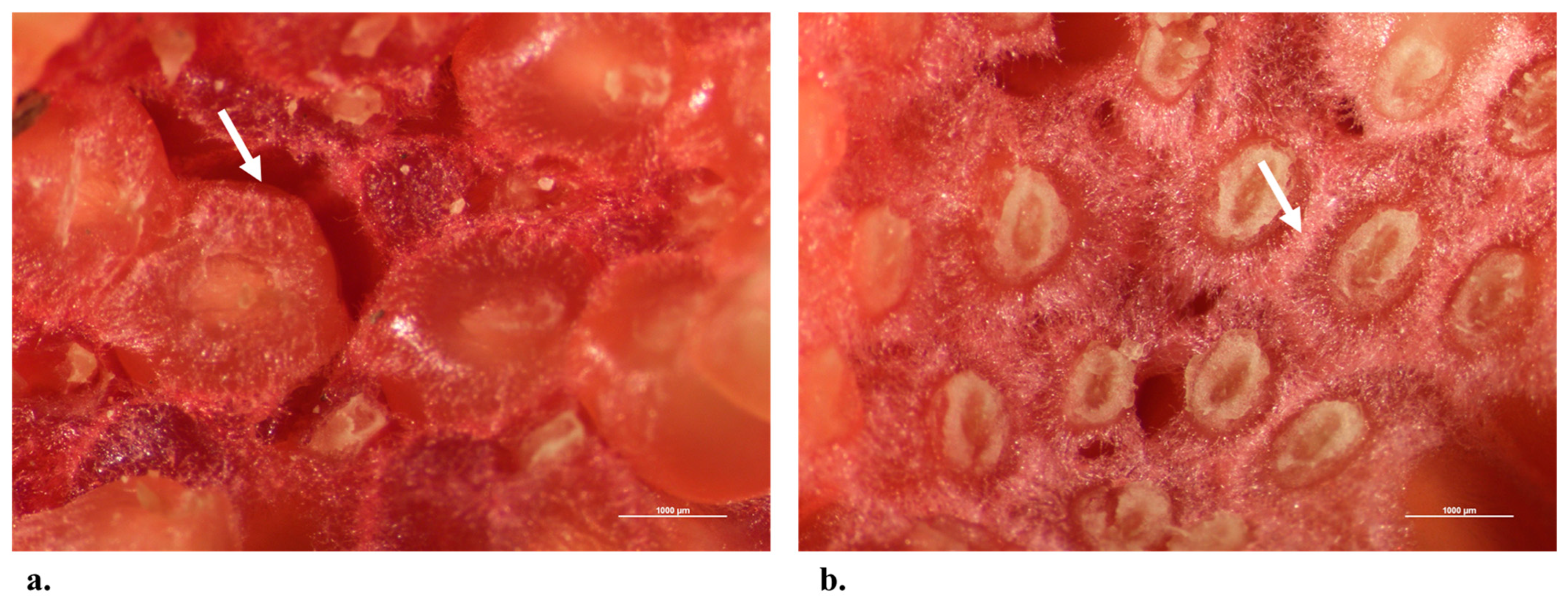
For the fruit morphological analysis, the internal cavity was observed using a Leica MZ8 stereomicroscope (Leica Microsystems, Wetzlar, Germany). Samples were photographed to document the homogeneity and cohesion of the drupelets as well as the presence of trichomes between them, since trichomes in the internal cavity are described as contributing to drupelet cohesion and fruit integrity [
8]. Combining data from production and morphological analyses, genotypes were classified as either ‘crumbly’, ‘crumbly free’ or ‘crumbly phenotype un-known’.
2.4. SSR Screening
The SSR and SNP markers analysed in this study were selected from genomic regions previously reported as associated with the crumbly fruit phenotype in the Glen Moy × Latham mapping population. These regions correspond to QTLs that were initially identified through multi-year phenotypic evaluation, subsequently refined using high-density Genotyping-by-Sequencing linkage maps, and further supported by the co-localization of differentially expressed genes. Although these QTLs have not been demonstrated to be stable across environments or genetic backgrounds, they represent the most comprehensively characterized crumbly associated genomic regions currently available. Accordingly, the selected markers were treated as provisional candidates and used for exploratory evaluation rather than as validated predictors of the crumbly phenotype.
Three SSR genomic regions previously described in the literature as linked to the crumbly phenotype in
R. idaeus [
2,
9,
10] were analysed by PCR–capillary electrophoresis. For this, the flanking primers described in these studies (
Table 1) were purchased from STABVida (Caparica, Portugal).
For SSR screening, each region was amplified by PCR in all plants, using 25 μL reactions using the Qiagen Multiplex Kit (Ref. 206143, Qiagen, Hilden, Germany), 5 μM bovine serum albumin (BSA, Invitrogen, REF. 2614G1, Waltham, MA, USA), 0.2 μM of each primer, and approximately 100 ng of template DNA. PCR cycling conditions consisted of initial denaturation and enzyme activation at 95 °C for 15 min, followed by 30 cycles of denaturation at 94 °C for 45 s, annealing at 59 °C for 90 s, and extension at 72 °C for 1 min. A final extension was performed at 72 °C for 5 min. Successful PCR amplification was confirmed by agarose gel electrophoresis (0.5× TBE, 2%, 150 V, 30 min).
SSR detection was performed by capillary electrophoresis as described in [
11]. The PCR products from SSR markers were prepared for the simultaneous analysis of the amplified alleles in a 1:1:1 mixture. For each sequencing run, 1.0 μL of the PCR mixture was added to 24 μL formamide. An internal standard (0.5 μL) labeled with WellRED dye D1 (DNA size standard kit, 400, Beckman Coulter, Brea, CA, USA) was added to each sample to allow the determination of the size of the amplified products.
The amplification products were separated in a CEQ 8000 Genetic Analysis System (Beckman Coulter, Inc., Brea, CA, USA). Data analysis was performed using the CEQ 8000 Fragment Analysis software (v 9.0) according to the manufacturer’s recommendations (Beckman Coulter Inc., Brea, CA, USA). Allele size was scored using the CEQ 8000 Genetic Analysis System (Beckman Coulter Inc., Brea, CA, USA).
2.5. SNP Screening
To analyse genomic regions associated with SNP molecular markers correlated with the crumbly phenotype in
R. idaeus, flanking primers described in [
2] (
Table 2) were purchased from STABVida (Caparica, Portugal).
With the aim of identifying new SNPs, additional primers were designed to amplify regions adjacent to those originally described (
Table 3). For this purpose, publicly available genomic data from
R. idaeus cultivars Anitra, Autumn Bliss, Maling Jewel, JoanJ (herein referred to as JoanJw for disambiguation) and Glen Moy were retrieved from
https://www.rosaceae.org/species/rubus/all (accessed on 27 May 2024). Sequences of approximately 2000 bp covering the regions analysed by [
2] were retrieved, and primers were designed to amplify fragments that did not overlap with the original ones using Primer-BLAST (
https://www.ncbi.nlm.nih.gov/tools/primer-blast, accessed on 13 July 2024). Regions containing Open Reading Frames (ORFs), previously identified with ORFfinder (
https://www.ncbi.nlm.nih.gov/orffinder (accessed on 13 July 2024)) under default parameters, were prioritized.
All primers were tested in Primer-BLAST and compared with published R. idaeus genomes to verify amplification specificity.
Each sample was amplified in 25 μL PCR reactions using 5 μM Readymix (LS29, FastGene, NIPPON Genetics Europe), 0.5 μM of each primer, and approximately 100 ng of DNA. Thermal cycling included an initial denaturation and activation step at 95 °C for 3 min, followed by 35 cycles of denaturation at 95 °C for 30 s, annealing at the primer-specific temperature for 45 s, and extension at 72 °C for 1 min. A final extension was performed at 72 °C for 5 min.
PCR success was confirmed by gel electrophoresis as described above. PCR products were purified with Illustra™ ExoProStar™ 1-Step (GE Healthcare Life Sciences, Amersham, UK) before being sent for bidirectional Sanger sequencing at STABVida (Caparica, Portugal).
2.6. Data Analysis
For each SSR allele and SNP, the presence/absence of the marker was tested against the binary crumbly/non-crumbly phenotype using Fishers exact test. Fishers exact test was performed in R (v.4.4.1) using RStudio (RStudio 2026.01.0 Build 392), and p-values were adjusted for multiple testing using the Benjamini–Hochberg procedure.
PCoAs were conducted in GenAlEx 6.503 [
12] and were performed separately for each genomic region and subsequently across all regions using a multilocus approach. These analyses served as an exploratory tool to visualize clustering patterns among accessions.
3. Results
3.1. Phenotypic Evaluation of Genotypes for Crumbly Fruit Disorder
The fruit of the 34 genotypes was examined for symptoms of crumbly, specifically the disaggregation of drupelets resulting from the absence of trichomes between them.
A total of 7 genotypes consistently produced fruits showing an absence of trichomes between drupelets in most plants and across all three production cycles; and were therefore classified as crumbly (RUB2, RUB8, RUB9, RUB10, RUB11, RUB14, and RUB19) (
Figure 1).
One genotype, Autumn Treasure (AT), was classified as non-crumbly, as trichomes between drupelets were clearly visible, consistent with its known classification [
2].
The remaining genotypes exhibited variable expression of the crumbly trait across seasons and production cycles, with some fruits showing partial trichome loss and drupelet separation in certain years or parts of the aggregate fruit. These plants were therefore considered to have inconsistent symptom expression and were classified as “crumbly phenotype unknown,” pending additional multi-year evaluations to confirm their phenotypic status.
3.2. Transferability of SSR Markers
The evaluation of SSR transferability was based on two criteria: the success of amplification of the locus under analysis; and the presence of the previously reported alleles.
Using the primers described previously [
2], amplification was achieved for all plants included in the study. The only allele found in common with those reported previously was 180 (reported in Glen Moy and here found in Glen Dee and Glen Prosen). This was considered acceptable since the cultivars screened in the present study are distinct from those of the original study.
Capillary electrophoresis generated electropherograms for each marker and plant under analysis, from which the allele sizes (x-axis values) present at each locus were extracted (
Table 4). All signals appearing in at least 10% of the samples were considered significant. Fluorescence peaks such as stutters, pull-ups, or dinosaur tails were excluded [
11]. In cases of doubt regarding the authenticity of a signal due to the pull-up phenomenon, the PCR product was run individually in capillary electrophoresis to confirm its presence.
For the D11AOC marker, the same allele (366 bp) was found in all samples. The absence of variation at this locus among the plants analysed makes it non-informative; therefore, it was excluded from subsequent analyses.
The SSR marker Rub2a amplified a total of six alleles at 140, 145, 158, 166, 180, and 185 bp. The 158 bp allele was present in all accessions except Autumn Treasure, while the 180 bp allele appeared exclusively in plants from cultivars Glen Prosen and Glen Dee. The 166 bp allele appeared in all plants from all cultivars and was therefore non-informative for distinguishing among them; it was excluded from further analyses.
The SSR marker Rub256e amplified a total of eight alleles, with sizes of 130, 145, 155, 166, 175, 185, 244, and 288 bp. All alleles were present in plants from at least four different cultivars.
3.3. Transferability of SNP Markers
The assessment of SNP transferability was carried out based on the amplification of the genomic regions and the occurrence of SNPs at the positions described in the literature [
2]. Similarly to what was observed for the SSRs, amplification of
R. idaeus genomic fragments was obtained for all samples using the primers published previously [
2]. However, the only SNPs common to those reported for a Latham × Glen Moy cross population was the SNP at position 129 of the
s182 region.
After Sanger sequencing, most sequences obtained sufficient quality for SNP analysis. The low-quality sequences excluded showed, for the most part, overlapping signals, indicating probable non-specific amplification. It was possible to obtain 100% high-quality sequences for regions MOY35 and s353. For regions MOY34 and s182, 88% and 94% high-quality sequences were obtained, respectively. MOY36 showed the lowest percentage of high-quality sequences, with only 29% of the total. Due to insufficient data, this region was excluded from later stages of the study.
For the regions newly amplified in this study, it was possible to obtain 97% and 94% high-quality sequences for NewMOY34 and NewMOY35, respectively. However, for the fragment amplified by primers NewMOY36, no high-quality sequences were obtained, and for the fragments amplified by primers NewS182 and NewS353, only 50% and 74% high-quality sequences were obtained, respectively—insufficient for further analysis. Regions with at least 80% high-quality sequences were considered suitable to proceed with subsequent analyses.
After amplification and sequencing of all target regions and subsequent assessment of sequence quality, the regions considered for SNP analysis were: MOY35, s353, MOY34, s182, NewMOY34, and NewMOY35. SNPs were identified in the sequences using TASSEL (v5.2.93) with default parameters. The position and nucleotide of each SNP were annotated. The addition of published and annotated R. idaeus sequences from the cultivars Anitra, Autumn Bliss, Maling Jewel, GlenMoy, and JoanJ were added to the analysis to provide reference alleles and facilitate comparative assessment of sequence variation across genotypes.
3.4. Exploring Genetic Marker Trends Related to the Crumbly Phenotype
Fishers exact test was applied to evaluate the association between individual SSR and SNP and the crumbly versus non-crumbly phenotype. No significant associations were detected, likely due to the limited number of control accessions included in the analysis (0.860 ≤ p ≤ 1.00).
Consequently, to identify the alleles most relevant for distinguishing between crumbly and non-crumbly accessions (hereafter referred to as “locus influence”), we focused only on alleles that differed between the crumbly genotypes RUB2, RUB8, RUB9, RUB10, RUB11, RUB14, and RUB19 and the non-crumbly genotype AT as contributing to the discrimination of the contrasting phenotypes. Locus influence was calculated as:
In this study, locus influence is used as an exploratory, descriptive metric to summarize allelic differentiation in an unbalanced dataset (7 crumbly × 1 non-crumbly genotypes). As such, it is intended to highlight patterns that may be consistent with the crumbly phenotype, while recognizing that more balanced phenotypic data will be required to formally test marker–phenotype associations.
Alleles with a locus influence score exceeding 50% were selected for further analysis (
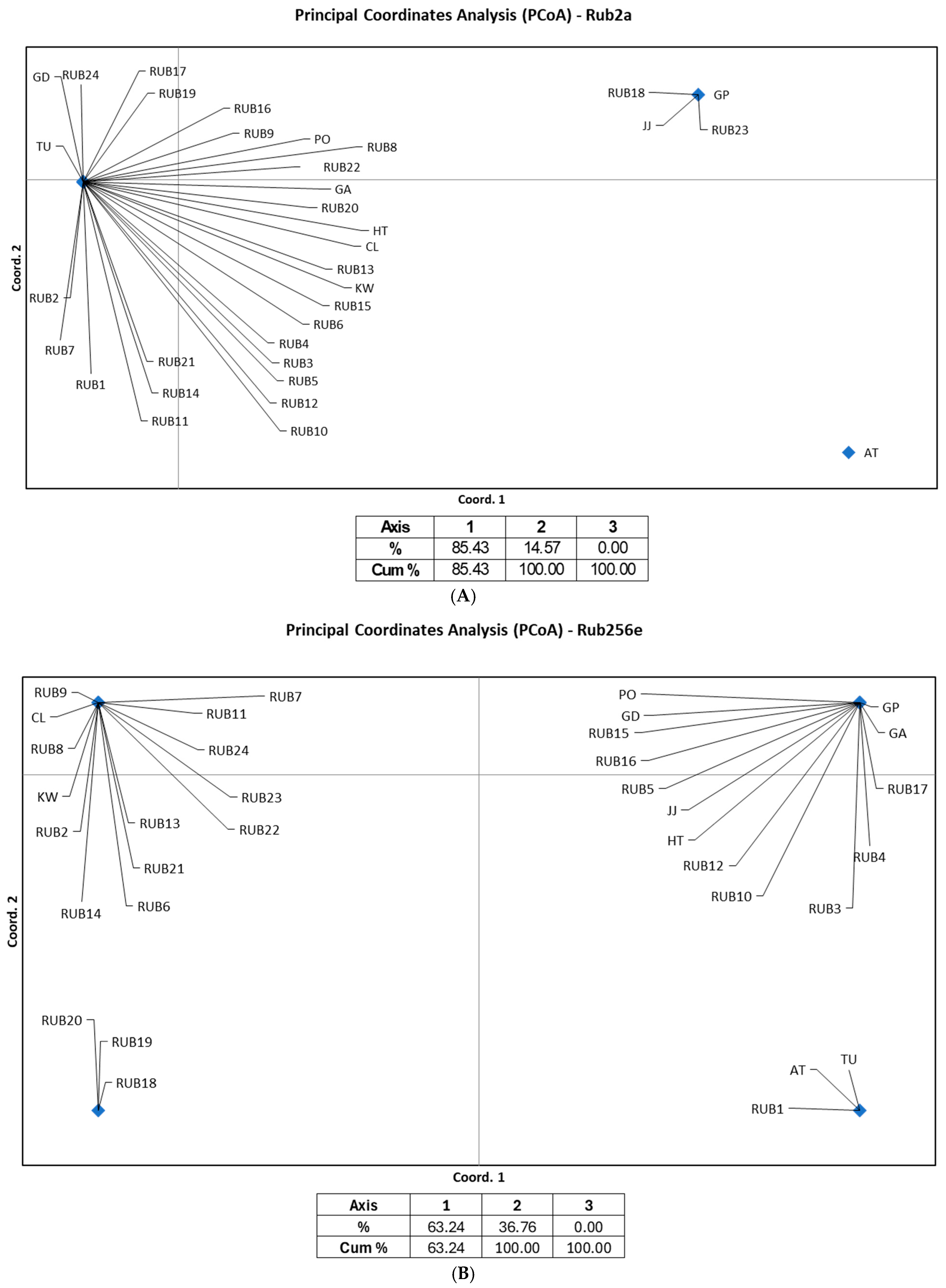
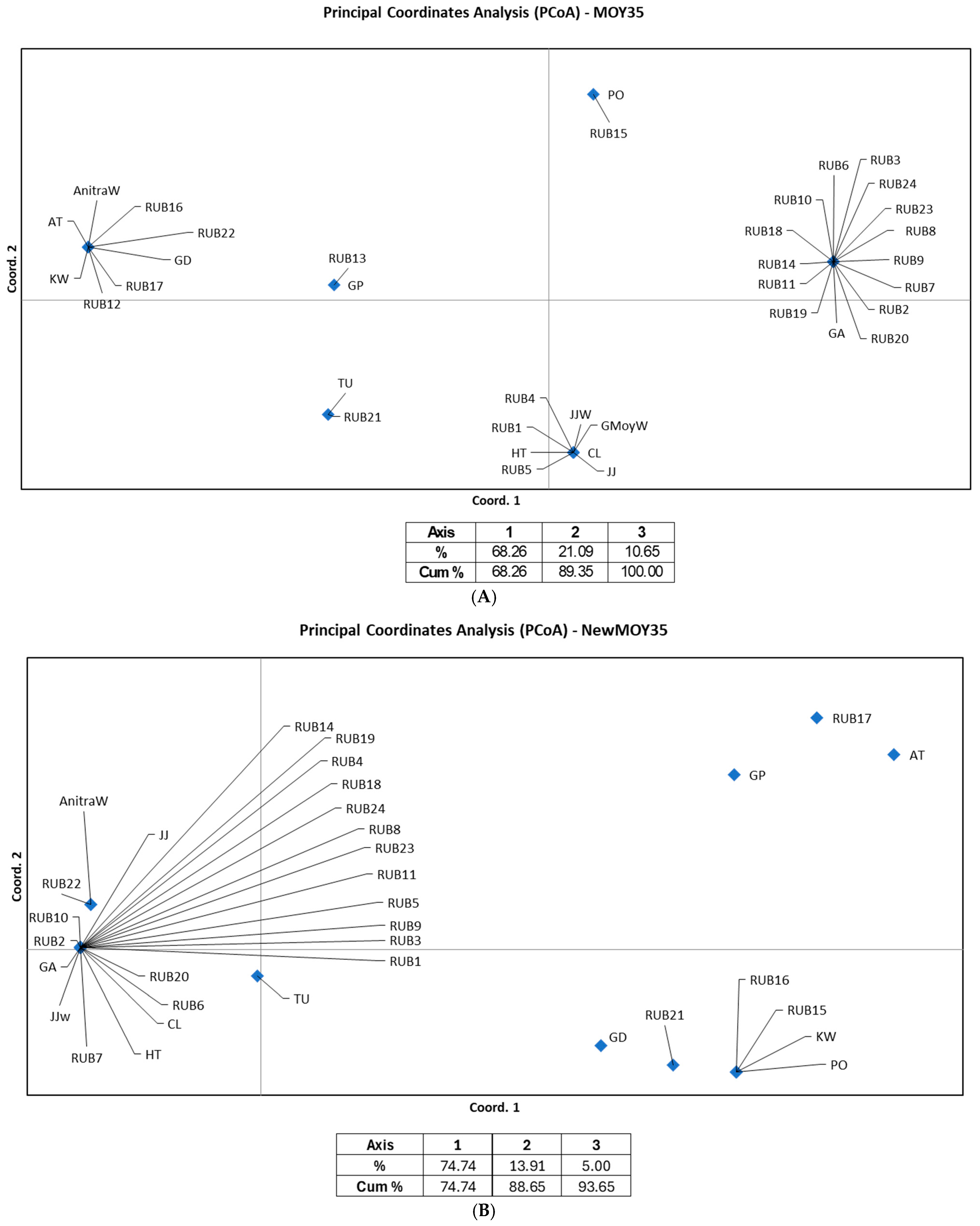
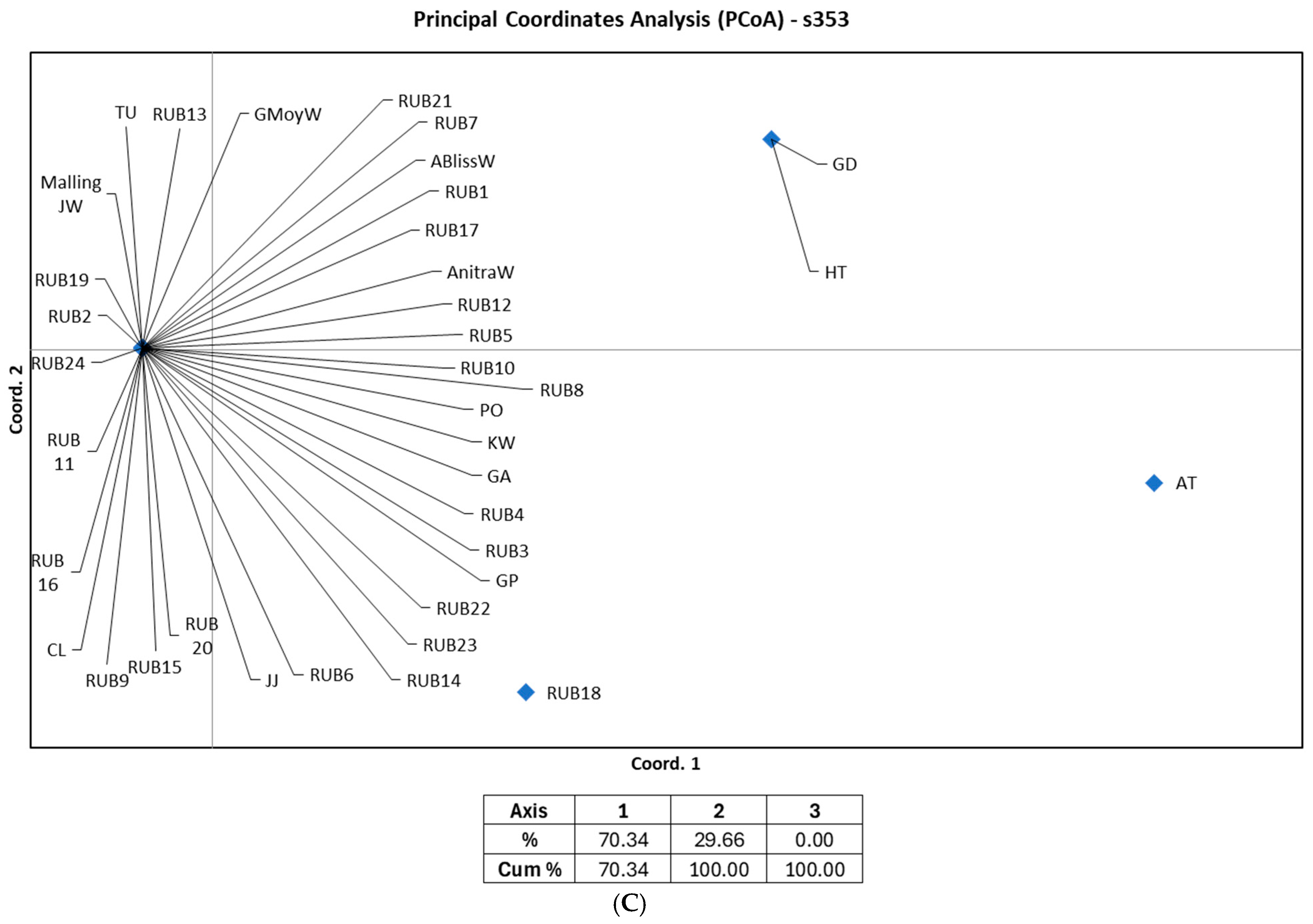
Supplementary Material, Tables S1 and S2). The usefulness of SSR and SNP markers in analysing the relationships between plants from distinct cultivars and the crumbly phenotype was assessed through individual PCoAs (
Figure 2 and
Figure 3) with these selected alleles.
The PCoA obtained for the SSR region Rub2A distributed the samples along axis1 and axis2 (accounting for 85.43% and 14.57% of the total variation, respectively). The use of this marker showed the plants from cultivars Clarita, Glen Ample, Glen Dee, HimboTop, Kweli, Polka, Tulameen, RUB1, RUB3, RUB4, RUB5, RUB6, RUB7, RUB10, RUB11, RUB12, RUB13, RUB15, RUB16, RUB17, RUB20, RUB21, and RUB22 grouped with the crumbly genotypes, while the plants from cultivars Glen Prosen, JoanJ, RUB18, and RUB23 clustered closer to the position of the non-crumbly control Autumn Treasure (
Figure 2A).
For the SSR region Rub256e, the separation between crumbly and non-crumbly accessions was observed along axis 1 and associated with 63.24% of the variation. On the non-crumbly side, only Tulameen and RUB1 clustered with the non-crumbly Autumn Treasure (
Figure 2B).
To analyse the distribution of samples based on genetic variation associated with the presence of SNPs, a PCoA was performed for each locus individually (
Figure 3). For the regions
MOY34 and
s182, only one relevant SNP was identified for each (positions 178 and 4, respectively), preventing the construction of a new PCoA for these markers.
The PCoAs distributed the samples along axis associated with 70.34%, 68.26%, and 74.74% of variation for regions s353, MOY35, and NewMOY35, respectively.
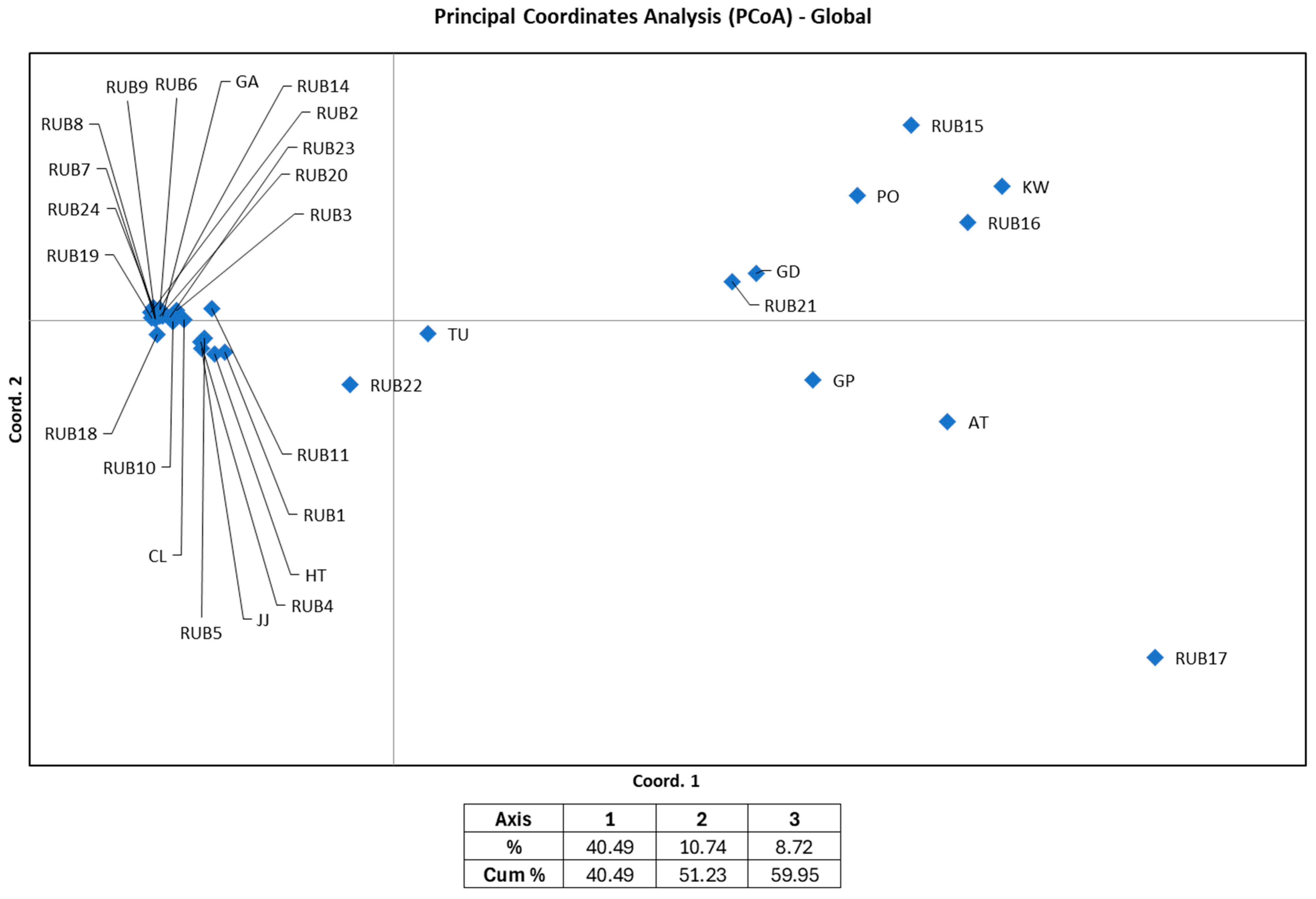
A multilocus PCoA was performed using the combined dataset of all informative SSR and SNP markers from the MOY35, NewMOY35, s353, Rub2A and Rub256e regions to investigate the overall genetic relationships among the 34 cultivars (
Figure 4). These SNP regions were selected based on quality criteria, namely the presence of at least 80% high-quality sequences with polymorphisms. Only the genotypes RUB1, RUB10, RUB11, RUB14, RUB15, RUB16, RUB17, RUB18, RUB19, RUB2, RUB20, RUB21, RUB22, RUB23, RUB24, RUB3, RUB4, RUB5, RUB6, RUB7, RUB8, RUB9, KW, PO, TU, AT, CL, GA, GD, GP, HT and JJ were included in the analyses, as they were the only ones with available data across all regions under evaluation.
The first two axes of the multilocus PCoA accounted for 51.23 of the total molecular variation observed between samples (40.49% axis 1 and 10.74% axis 2), respectively. The multilocus PCoA revealed only a partial yet still discernible separation between crumbly and crumbly free genotypes, indicating that these genomic regions may harbor some of the genetic variation associated with the crumbly phenotype.
The PCoAs were performed as an exploratory visualization of multilocus patterns among genotypes; because the markers included were selected based on their ability to distinguish the crumbly and non-crumbly genotype, the analysis is presented strictly for descriptive purposes and not as evidence of marker–trait association. The high proportion of variation explained by the first two axes reflects the limited dimensionality of the dataset, which results from the small number of informative markers and the low number of contrasting phenotypic classes included in the analysis.
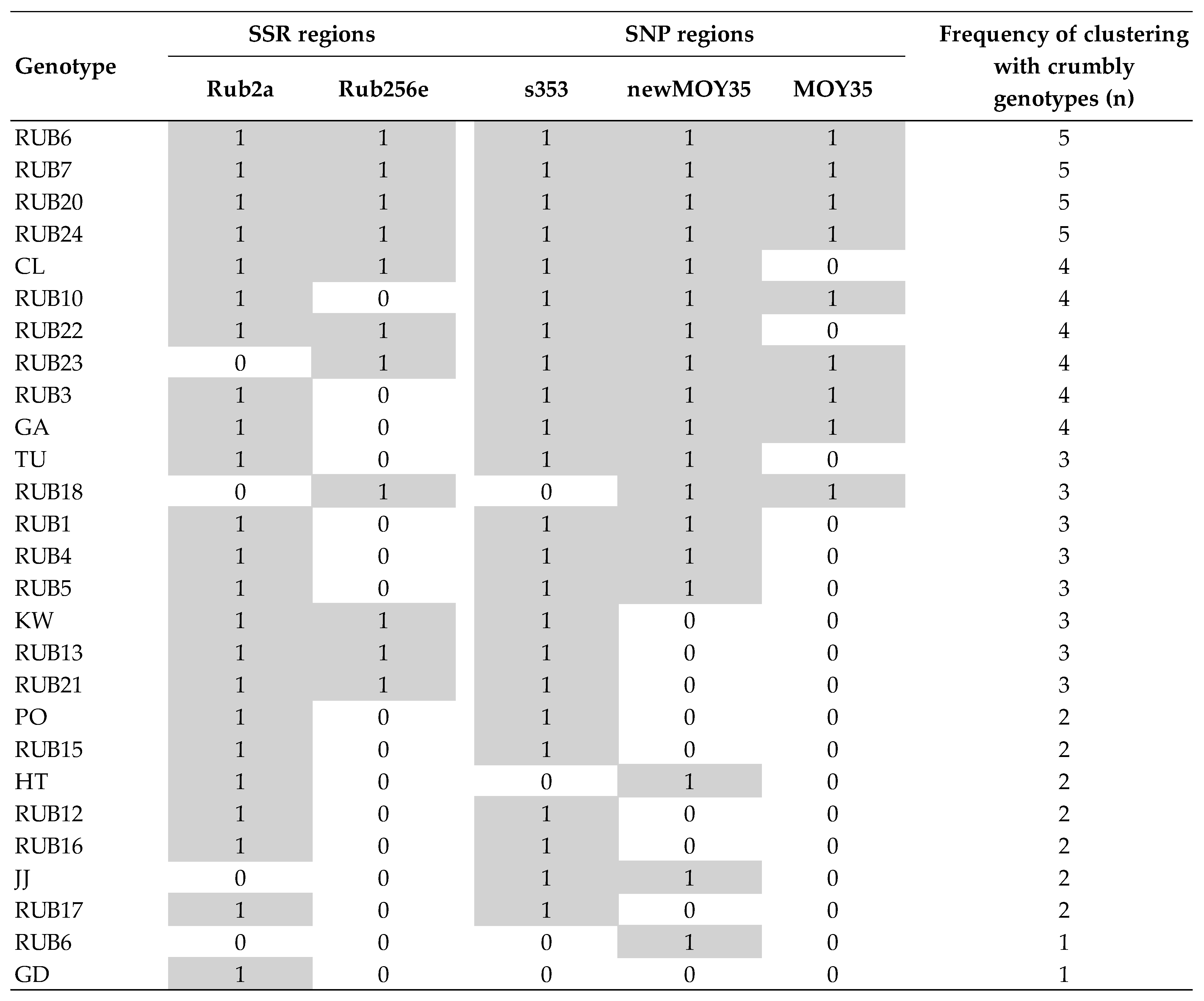
Across the analysed genomic regions, the same genotypes showed a consistent tendency to cluster with crumbly genotypes in the corresponding PCoA analyses. To better visualize the overall behavior of genotypes across the most important genomic regions analysed and identify potential trends, the distribution of each genotype in the respective PCoA plots was examined. For each locus, genotypes were classified according to whether they clustered with crumbly genotypes. The combined results of this assessment are summarized in the heatmap shown in
Figure 5.
The heatmap highlights concordant patterns across loci, which suggests that, although individual markers are not predictive, the combined marker behaviour reflects shared genetic trends associated with the crumbly phenotype.
4. Discussion
This study aimed to explore the genetic basis of the crumbly fruit disorder in raspberry by integrating phenotypic characterization with the analysis of previously reported and newly explored genomic regions. By comparing results obtained from SSR and SNP markers with earlier studies, this work evaluates the transferability and limitations of candidate genetic markers associated with the crumbly phenotype.
Phenotypic characterization was therefore a critical first step in this study, as the reliability of any genotype–phenotype association depends directly on the consistency and biological relevance of the phenotype definition. The qualitative and quantitative definition of the phenotype crumbly proved challenging, since the range of descriptors associated with crumbly in the literature is broad and somewhat subjective. In this study, we adopted a simplified definition of the disorder, based on the absence (crumbly phenotype) or presence (non-crumbly phenotype) of hairs on the drupelet-drupelet interface.
Drupelet cohesion in raspberry is a critical determinant of fruit structural integrity, directly influencing firmness, harvestability, and postharvest quality. Epidermal hairs and their density have been proposed to add mechanical interlocking that supplements biochemical adhesion at the drupelet-drupelet interface [
8,
13]. For future studies, a standardized and clearly defined crumbly phenotype is essential to enable meaningful comparisons and to disentangle genetic effects from environmental influences. Without a consistent phenotypic framework, the identification, validation, and transferability of genetic markers associated with crumbly fruit remain highly constrained.
To investigate the genetic components underlying the crumbly phenotype, both SSR and SNP markers located within or adjacent to previously identified crumbly associated QTL regions were analysed.
For the SSR-based analysis, the primers obtained from the literature [
2,
4] allowed amplification in all accessions in this study, indicating that this methodology has potential for universal application in
R. idaeus.
A strong correlation was observed between allele variation and the presence of crumbly for the regions Rub2a and Rub256e, where crumbly and non-crumbly samples were grouped at opposite ends of axes explaining 85.43% and 63.24% of the total variation, respectively. The clear separation between crumbly and non-crumbly plants suggests that the variation represented by these axes is associated with this phenotype.
For the loci Rub256e, this result is consistent with those of Graham et al. (2015) [
4], who mapped Rub256e within a crumbly associated QTL region in the Glen Moy × Latham population. The original study primarily established the genomic location of crumbly QTLs, and the present analysis provides additional evidence that Rub256e is related to phenotypical variation in an independent panel of genotypes.
The result observed for the loci Rub2a is also supported by the findings of Scolari et al. (2021) [
1], who identified this as the most representative marker within the crumbly QTL cr_JHI_3–20 on linkage group 3 in the Glen Moy × Latham mapping population. In that work, allelic variation at Rub2a was associated with differences in the incidence of crumbly fruit among progeny classes, suggesting that genetic variation at Rub2a, or a linked locus, contributes to phenotypic variation in crumbly fruit.
The loci D11AOC was monomorphic across all genotypes analysed, with a single allele (366 bp) detected, and therefore was not informative for discriminating between crumbly and crumbly free plants. Consequently, this marker did not segregate with the crumbly phenotype in the analysed panel of genotypes. These results are consistent with previous findings reported by Graham et al. (2015) [
4], in which D11AOC was identified within a crumbly associated QTL in the Glen Moy × Latham mapping population, but was not shown to be a robust or universally predictive diagnostic marker. The authors report that although D11AOC exhibited significant associations with crumbly scores in specific environments and years within that population, there was uncertainty regarding its independent contribution to the phenotype, particularly in relation to ripening time effects. Taken together, these findings support the conclusion that while D11AOC maps to a genomic region associated with crumbly fruit, its utility as a transferable marker across diverse genetic backgrounds is limited. The utility of D11AOC as a diagnostic marker for crumbly fruit therefore requires further elucidation, ideally through validation across diverse genetic backgrounds and environments.
SNP-based analyses were conducted in genomic regions previously associated with crumbly fruit, as reported by Scolari (2020) [
2], and in newly designed adjacent regions. Specifically, the regions MOY34, MOY35, MOY36, s182 and s353 were initially targeted using published primers. In addition, primers were designed for adjacent regions to expand the genomic coverage around these loci.
Although amplification using the published primers was successful across all samples, overlap in SNP identity between the two studies was minimal, with only a single shared polymorphism detected at position 129 of the s182 region. This limited concordance supports the conclusion of Scolari (2020) [
2] that many SNPs identified in the mapping population may be population-specific. In the present study, plants without any connection to such cultivars were introduced, making the detection of new alleles expected.
By extending the analysis to adjacent genomic regions through newly designed primers, this study revealed additional SNP variation that was informative beyond the original loci. Specifically, while Scolari (2020) [
2] did not report strong SNP-based discrimination of crumbly and non-crumbly phenotypes for regions such as s353 and MOY35, principal coordinates analyses in the present work showed clear separation of samples for these loci, with the main axes explaining 70.34% and 68.26% of the total genetic variation, respectively. Moreover, inclusion of the newly amplified region NewMOY35, which was not investigated by Scolari (2020) [
2], resulted in an even stronger separation (74.74% of variation explained), highlighting the added value of expanding the study of markers beyond previously defined QTL boundaries.
Conversely, regions MOY34 and s182 yielded only a single informative SNP each in the present dataset, preventing multivariate analysis and aligning with Scolari’s observation that not all crumbly associated QTL regions contain SNPs suitable for marker development. This highlights the importance of locus-specific validation and marker refinement when translating QTL-based discoveries into applied genetic markers for complex traits such as crumbly fruit.
Regarding the presence of SNPs it is also relevant to say that variation found in these regions often implied changes in coding sequences (ORFs), suggesting that the observed alterations in the analysed loci may have physiological implications in the plant. Mutations have the potential to alter all subsequent stages of gene expression. If present in regulatory elements of transcription, they may affect mRNA expression. When occurring within genes, SNPs may affect mRNA splicing, nucleocytoplasmic export, stability, and translation. If located within a coding sequence and resulting in an amino acid substitution, they may modify the conformation and activity of the final protein. If the mutation is silent (i.e., does not alter the amino acid), translation rates or mRNA half-life may still be affected. If the mutation leads to a premature STOP codon, it may result in a truncated protein or a near-null phenotype due to nonsense-mediated decay [
14]. However, a more detailed annotation of
R. idaeus genomes is essential to elucidate the role of these SNPs in the alteration of protein functions associated with susceptibility to the crumbly phenotype.
The inclusion of plants from commercial cultivars that were also present in Scolari’s work (2020) [
2], such as Autumn Treasure (AT) and Glen Prosen (GP), aimed to validate the authors findings and assess the transferability of the methods to the present study. However, no direct correspondence was obtained between the alleles described by the author and those identified here. A possible explanation for this discrepancy is the occurrence of multiple amplicons for the same primer pair due to the high number of copies and gene duplications, leading to peak overlap and inconsistencies in readings.
For both SSR and SNP analyses, the consistency and reproducibility of the results were supported by the coherence observed for accessions RUB8 and RUB9, which are genetically identical clones. In addition, for SNPs, the use of published and annotated cultivar sequences (Anitra, Autumn Bliss, Malling Jewel and JoanJ) helped validate the results.
A critical limitation of the present study is the near absence of biological replication at the cultivar level, as genotypic assessment was based on a single representative plant per cultivar. Given the strong influence of environmental conditions on crumbly fruit expression, this design does not allow separation of genetic effects from plant- or environment-specific variation, nor does it support quantitative inference at the cultivar level. Although phenotyping was conducted using consistent criteria across three seasons under uniform field management conditions (as detailed in 2. Methods), the lack of within-cultivar replication substantially constrains the robustness of the genotypic clustering. Accordingly, the genetic patterns observed here should be interpreted as exploratory signals rather than evidence of stable or predictive marker–trait relationships.
Overall, the analysis based on allelic variation in the selected genomic regions indicates that raspberry accessions can be grouped according to genetic similarity at loci previously implicated in crumbly fruit development. While none of the markers analysed here can be considered predictive or diagnostic of the crumbly phenotype, the recurrence of similar genetic patterns across multiple independent loci suggests that these regions capture biologically relevant variation. Collectively, these findings support the view that crumbly fruit is influenced by multiple genomic regions of small effect and highlight the potential value of integrating consistent marker signals, rather than relying on single markers, in future efforts to understand and characterize this complex trait.
Despite the consistency observed across markers, it is important to acknowledge that the association analysis was based on a markedly unbalanced phenotypic dataset, with only one well-defined non-crumbly cultivar (Autumn Treasure) used as a control. Given the exploratory nature of the study and the lack of biological replication, these associations should be interpreted as preliminary trends rather than as evidence supporting phenotype prediction in uncharacterized cultivars. Future work should prioritize expanding the set of reliably classified non-crumbly accessions, evaluated over multiple years and environments, to support a more robust and reproducible association framework.
Regardless of the marker used, the results also underscore the importance of precise phenotypic assessment. Future studies should include a more rigorous and standardized phenotypic evaluation of the crumbly trait. The new phenotypic definition proposed here may serve as an additional indicator for accurate identification of the crumbly phenotype.
5. Conclusions
The crumbly fruit phenotype is a raspberry plant condition that results from the compromised cohesion of drupelets, leading to fruit disintegration at harvest which consequently makes the fruit unsuitable for commercialization. This study aimed to test the transferability of molecular markers of the SSR (D11AOC, Rub256e and Rub2a) and SNP types (MOY34, MOY35, MOY36, s182, s353) previously associated with the crumbly phenotype in plants of different cultivars of R. idaeus L. Additionally, regions adjacent to the original markers were analysed for the presence of SNP markers (NewMOY34, NewMOY35, NewMOY36, NewS182 and NewS353). The expectation was to assess the universality of these markers as indicators of this genetic trait, enabling their use in marker-assisted breeding programs.
Throughout the experimental work, plants from 34 raspberry accessions were analysed, including 7 that had already expressed the crumbly phenotype (RUB2, RUB8, RUB9, RUB10, RUB 11, RUB14 and RUB19) and one that had never shown this trait (Autumn Treasure). Phenotypic classification was based on a single representative plant per accession, reflecting material availability but limiting the strength of phenotype-based inference. Fragment and sequence analysis enabled the identification of distinct alleles in crumbly and non-crumbly genotypes. PCoA of the variation observed among genotypes revealed a tendency for separation between plants expressing and not expressing the crumbly phenotype, with a high proportion of the variance explained by the first axes. However, given the limited replication of phenotypic assessment, this pattern should be interpreted as descriptive rather than confirmatory. The loci previously associated with the crumbly condition were therefore explored in this study in a comparative, hypothesis-generating context rather than formally validated.
The identification of ORFs whose predicted translation is altered by selected SNPs can be explored in future studies regarding possible molecular mechanisms underlying crumbly fruit development.
Taken together, the results presented here demonstrate the limited transferability of previously reported crumbly associated markers beyond their original mapping population, as evidenced by marker monomorphism, reduced overlap of informative SNPs, and weak predictive power across diverse germplasm. This outcome represents an important cautionary finding for raspberry breeding, emphasizing the challenges of directly extrapolating marker–trait associations across genetic backgrounds.
Future studies incorporating replicated phenotyping, controlled environmental conditions, and multi-year evaluation will be necessary to determine whether stable, transferable marker combinations can ultimately be identified for use in breeding programs.





 ,
,