Article

Establishment and Shoot Development Responses of Hylocereus undatus Under Plant Growth Regulator Treatments

by
Cristina Pech-Jiménez
1,
Paloma A. Salgado-Mercado
2,
Alejandra Hernandez
2 and
Liliana S. Muñoz-Ramírez
2,*
1
Independent Researcher, Guadalajara 44810, Jalisco, Mexico
2
Departamento de Ciencias Médicas y de la Vida, Centro Universitario de la Ciénega, Universidad de Guadalajara, Avenida Universidad, No 1115, Col. Lindavista, Ocotlán 47810, Jalisco, Mexico
*
Author to whom correspondence should be addressed.
Crops 2026, 6(1), 21; https://doi.org/10.3390/crops6010021
Submission received: 16 December 2025 / Revised: 25 January 2026 / Accepted: 6 February 2026 / Published: 14 February 2026

Abstract

Background/Objectives: Hylocereus undatus is a high-value crop whose conventional propagation is inefficient for commercial scaling. This study aimed to develop an optimized protocol for in vitro establishment and to define optimal plant growth regulator (PGR) formulations for shoot multiplication. Methods: methods involved testing six surface sterilization protocols using combinations of a surfactant, a systemic fungicide, ethanol, and sodium hypochlorite. Subsequently, nodal explants were cultured on Murashige and Skoog (MS) medium supplemented with ten different concentrations of benzylaminopurine (BAP) and indole-3-butyric acid (IBA), with morphogenic responses evaluated over 60 days. Results: We identified a sterilization treatment that achieved contamination-free cultures with high explant survival percentages. Shoot multiplication was strictly dependent on cytokinin supplementation, with the highest BAP concentration inducing maximal shoot proliferation, while lower concentrations favored shoot elongation. The inclusion of IBA demonstrated a synergistic effect; a balanced BAP–IBA combination optimized shoot proliferation and vigor, whereas a high auxin-to-cytokinin ratio severely repressed organogenesis. Conclusion: this research establishes a reproducible, two-phase protocol that integrates rigorous aseptic establishment with tailored PGR application, effectively balancing high multiplication with superior shoot morphology for the commercial micropropagation of pitahaya.

1. Introduction

Hylocereus undatus (commonly known as dragon fruit or pitaya), a member of the Cactaceae family, has emerged as a high-value fruit crop with considerable commercial relevance. Its increasing popularity is largely attributed to its favorable nutritional profile and the rapid expansion of its cultivation across tropical and subtropical regions [1]. However, conventional vegetative propagation of this species presents significant limitations for large-scale production, including low multiplication rates and the risk of systemic pathogen transmission. In this context, in vitro micropropagation represents a viable alternative to overcome these constraints, enabling the rapid and efficient production of genetically uniform and pathogen-free plantlets [2,3].
As a cornerstone of plant biotechnology, micropropagation allows for the clonal multiplication of elite genotypes under strictly controlled conditions and has been successfully applied to a wide range of horticultural species. Nevertheless, despite extensive research on in vitro propagation protocols for H. undatus, their effectiveness remains strongly influenced by the type and physiological origin of the explant, leading to considerable variability in growth performance and multiplication efficiency [4,5,6]. While seed-derived cultures are valuable for germplasm conservation, their genetic heterogeneity limits their suitability for true-to-type clonal propagation [6]. In contrast, the use of meristematic tissues—such as shoot apices and nodal segments—has consistently supported direct organogenesis, providing a reliable foundation for large-scale clonal micropropagation systems [7,8]. In Cactaceae, the areole, a specialized axillary meristematic structure, has been identified as a particularly responsive explant for shoot induction and multiplication in Hylocereus, further reinforcing its suitability for in vitro propagation strategies [4,9,10,11].
Micropropagation of pitaya generally involves a sequence of stages, including aseptic culture establishment from shoot apices or lateral nodes, shoot elongation, mass multiplication, and rooting. However, the process is considered moderately challenging due to the release of polysaccharides and the succulent nature of pitaya tissues, which favor fungal and bacterial contamination and may induce explant necrosis [12,13,14,15,16]. Despite these challenges, H. undatus can be regenerated in vitro through both direct and indirect pathways, facilitating the safe exchange of germplasm between laboratories without quarantine or phytosanitary restrictions.
The success of any micropropagation system is critically dependent on the precise application of plant growth regulators (PGRs). Auxins and cytokinins play a central role in directing morphogenic responses, regulating processes ranging from explant establishment to shoot induction, proliferation, and elongation. Their synergistic and antagonistic interactions govern cell division and organogenic fate, with cytokinins primarily promoting shoot formation, while auxins influence rooting and broader morphogenetic patterning. In H. undatus, exogenous cytokinin application has been strongly associated with enhanced shoot initiation and multiplication, whereas auxin supplementation can modulate growth patterns and in vitro physiological traits [17,18,19,20].
Despite advances in the development of micropropagation protocols for H. undatus, there remains a need for standardized methodologies that effectively integrate reliable aseptic establishment with optimized PGR formulations. A comprehensive understanding of how specific PGR treatments influence key developmental parameters—including explant disinfection efficiency, shoot induction frequency, proliferation rate, shoot elongation, and overall morphological quality—is essential for establishing reproducible, efficient, and scalable propagation systems [3,21].
Consequently, this study was designed to systematically evaluate the in vitro establishment of H. undatus explants. Specifically, the objectives were to assess the effectiveness of different disinfection treatments, including varying exposure times and disinfectant agents, and to examine the effects of PGRs on key stages of in vitro culture, namely shoot induction, proliferation dynamics, shoot elongation, and the resulting morphological characteristics of regenerated plantlets.

2. Materials and Methods

2.1. Plant Material

Stem segments approximately 50 cm in length were collected from mature pitahaya (H. undatus) plants cultivated under field conditions with a drip irrigation system in the municipality of Poncitlán (20.364157° N, 102.900837° W). The collected segments were rooted and grown in 4 kg black polyethylene bags. A 3:1 (v/v) mixture of potting soil and coconut fiber was used as the substrate. Plants were maintained under greenhouse conditions at the Centro Universitario de la Ciénega, University of Guadalajara, located in La Barca, Jalisco, Mexico (20.2763° N, 102.6038° W). Greenhouse-grown plants received weekly foliar applications of the commercial fungicide Captan® (Adama, Nezahualcoyotl, Mexico, RSCO-FUNG-0306-008-002-050) at a concentration of 2 g/L and were irrigated twice weekly with well water. This management regime was maintained until the emergence of new shoots suitable for in vitro establishment.

2.2. Explant Disinfection Protocol

Young shoots (20–30 cm in length) were collected from established greenhouse-grown plants. For explant disinfection, the shoots were cut into 7–10 cm segments and placed in plastic beakers. The explants were washed under running tap water with detergent soap and gently brushed to remove superficial contaminants from both the plant tissue and spines. Following this preliminary cleaning step, the explants were transferred to separate beakers for the application of the different disinfection treatments. These treatments varied in disinfectant type, concentration, and exposure time, as detailed in Table 1.
The experiment was established under a completely randomized design (CRD) with six disinfection treatments. Each treatment consisted of seven culture vessels, each containing two explants, and the culture vessel was considered the experimental unit. The response variables evaluated were contamination (fungal or bacterial), phenolic oxidation, and survival. For each variable, the number of affected or surviving explants per vessel was recorded.

2.3. Establishment and Induction of In Vitro Cultures

For the in vitro establishment and induction of dragon fruit explants, the basal Murashige and Skoog (MS) medium [22] was used. The medium was supplemented with 1 mg/L BAP (6-Benzylaminopurine) (Sigma-Aldrich, Saint Louis, MO, USA #B3408), 30 g/L sucrose (Sigma-Aldrich, Saint Louis, MO, USA #S5390), and 7 g/L agar (Sigma-Aldrich, Saint Louis, MO, USA #A7921). The pH was adjusted to 5.7 before autoclaving at 121 °C and 15 psi for 20 min. A volume of 20 mL of the culture medium was dispensed into each glass vessel.
Disinfected shoots (7–10 cm in length) were aseptically prepared on a sterile glass plate. A V-shaped cut of approximately 2–3 cm was made to excise the bud (areole), thereby removing any tissue potentially damaged during the disinfection process. The resulting explants had a final length of approximately 2 cm in length. Two areoles were inoculated into each culture vessel. The vessels were sealed with plastipack to maintain aseptic conditions and properly labeled for traceability.
All cultures were maintained in a growth chamber at 25 ± 1 °C under a 16 h photoperiod. Explants were evaluated at 15-day intervals over a total period of 45 days for contamination, phenolic oxidation, and survival. Survival was defined as the proportion of explants that remained viable, free of visible microbial contamination, and without severe tissue necrosis at the end of the establishment period.

2.4. Shoot Multiplication Protocol

Following a 45-day establishment phase, shoots exceeding 3 cm in length were selected for the multiplication experiment. This study aimed to evaluate the effects of different concentrations of the cytokinin BAP and the auxin indole-3-butyric acid (IBA) (Sigma-Aldrich, Saint Louis, MO, USA #57310) on shoot multiplication in H. undatus. Cladode segments approximately 1 cm in length were excised from the selected shoots, yielding two explants per donor shoot. The explants were cultured in Magenta™ vessels (Merck KGaA, Darmstadt, Germany, #V8505), with four segments placed equidistantly in each vessel to minimize competition for space and nutrients. Each vessel contained the culture medium corresponding to its assigned PGR treatment (Table 2).
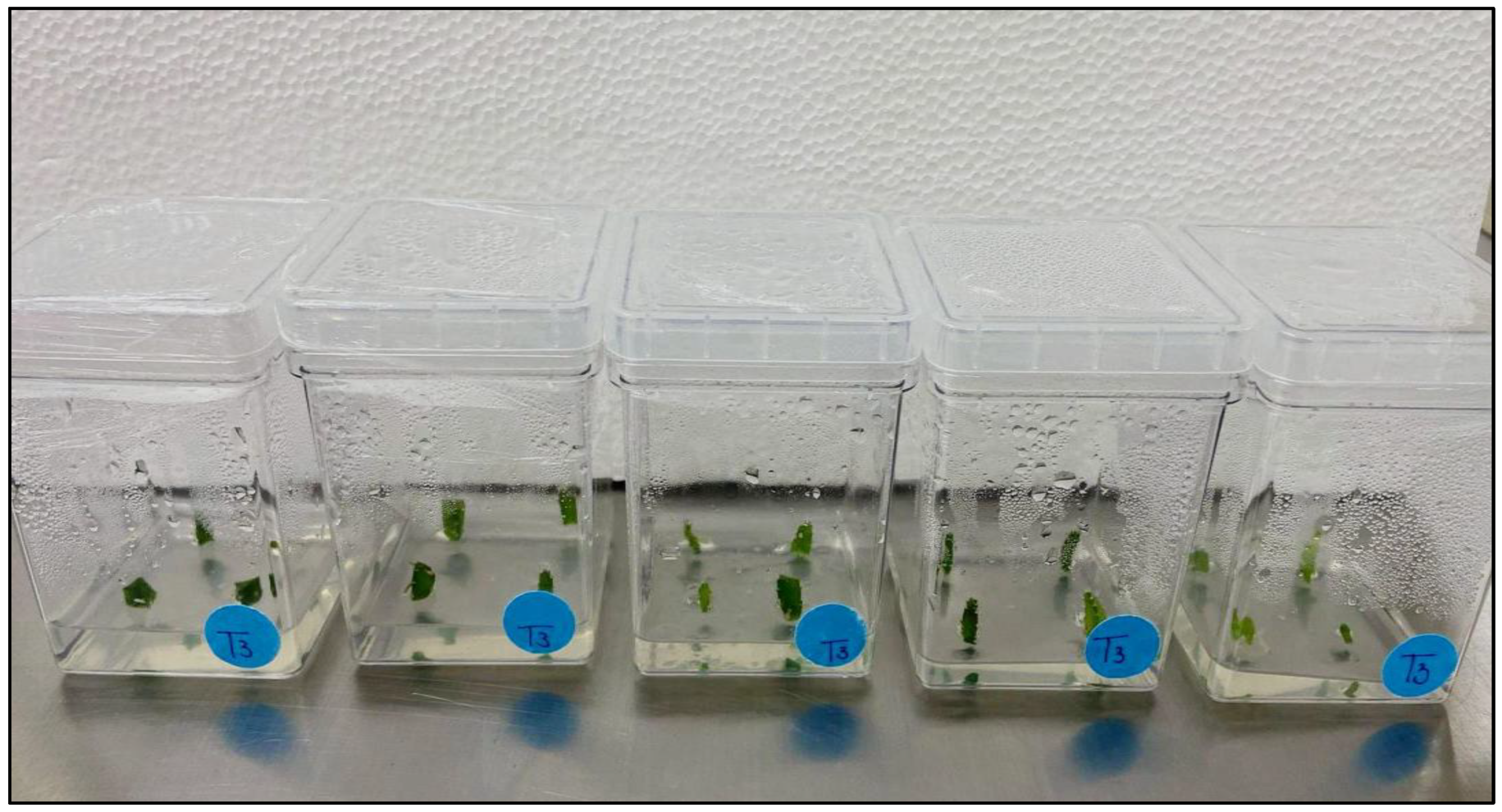
The vessels were sealed to prevent contamination by pathogens (e.g., fungi, bacteria), labeled with the date and treatment number for identification, and transferred to a growth chamber. The incubation conditions were maintained at a temperature of 24 ± 2 °C under a 16 h photoperiod (Figure 1).
During the multiplication phase, the proportion of explants exhibiting organogenic shoot formation was recorded as “shoot response” at 30-day intervals. The multiplication capacity was further assessed by recording the mean number of shoots per explant for each treatment. Data collection for these parameters was conducted at 15-day intervals throughout the entire culture period. Additionally, the average shoot length was measured after 60 days of culture using a millimeter-scale ruler, determining the distance from the base of the shoot at the point of emergence to its apical meristem to assess longitudinal growth. Shoot length was recorded as absolute shoot length and measured only for elongated, viable shoots. Shoots that emerged late during the culture period and subsequently underwent phenolic oxidation were recorded as induced shoots but were not measurable in length and therefore assigned a value of 0.00 cm. Complementary morphological assessments were performed to evaluate the quality of the regenerated shoots. These included visual scoring of shoot vigor, the incidence and nature of callus formation at the explant base, and the presence of physiological abnormalities such as hyperhydricity, necrosis, or chlorosis. These qualitative observations provided a comprehensive evaluation of the developmental performance under each hormonal treatment.
For the in vitro multiplication phase, the experimental unit consisted of a Magenta™ vessel containing 40 mL of MS medium supplemented according to the assigned treatment. Four dragon fruit (H. undatus) explants were aseptically established per vessel. The experiment included ten distinct treatments; each replicated five times, resulting in a total of 50 experimental units. For statistical analysis, the culture vessel was considered the experimental unit. For binary response variables, the number of responsive explants per vessel was used as the response, whereas for quantitative variables, measurements were averaged per vessel before analysis.

2.5. Data Analysis

The collected data were statistically analyzed using SPSS software, version 22 (IBM Corp., Armonk, NY, USA). Variables related to contamination, phenolic oxidation, survival, and shoot response were analyzed using generalized linear models (GLM) with a binomial distribution and logit link function, considering treatment as a fixed factor. For each variable, the number of affected or surviving explants per culture vessel was used as the response, with the culture vessel considered the experimental unit. Estimated marginal means were obtained from the models and expressed as percentages. Pairwise comparisons among treatments were performed using Bonferroni-adjusted tests, and differences were considered statistically significant at p ≤ 0.05.
For quantitative data, a one-way analysis of variance (ANOVA) was applied to assess significant differences among treatments. When significant differences were detected, Tukey’s honest significant difference (HSD) test was used for mean separation at a significance level of p = 0.05. Quantitative results are presented as mean ± standard deviation (SD). All figures were generated using GraphPad Prism software, version 8.1 (GraphPad Software, San Diego, CA, USA).

3. Results

3.1. Explant Aseptic Establishment

During the in vitro aseptic establishment of pitahaya explants, significant differences were observed among the evaluated disinfection treatments for contamination and survival variables (Table 3). In contrast, no statistically significant differences were detected among treatments for phenolic oxidation (p > 0.05).
Treatment 0 (control), based exclusively on the application of Tween 20, 70% ethanol, and 30% NaClO, exhibited the highest level of fungal contamination (71.43%) and a complete absence of explant survival (0%). These results indicate that a basic disinfection protocol is insufficient for achieving the aseptic establishment of pitahaya explants. In contrast, the inclusion of a fungicide in the disinfection protocols significantly reduced fungal contamination. Treatments 1 and 2, both employing 20% NaClO, showed contamination levels of only 14.29% and differed statistically from the control. Similarly, Treatment 5 was distinguished by achieving 0% fungal contamination.
Regarding survival, significant differences were observed among treatments. Treatment 5 exhibited the highest survival percentage (85.71%), placing it within the highest statistical group, followed by Treatments 1 and 2, with survival of 71.43% and 57.14%, respectively. These results demonstrate that successful aseptic establishment of pitahaya explants depends on an appropriate combination of fungicide, sodium hypochlorite concentration, and exposure time. Among the evaluated protocols, Treatment 5 proved to be the most effective, achieving an optimal balance between contamination control and explant survival.

3.2. In Vitro Shoot Multiplication Efficiency

The shoot multiplication response of pitahaya explants showed significant differences among the PGR treatments evaluated (Table 4). Response percentages varied markedly among treatments, ranging from low to high values (20–100%) depending on the PGR combination applied. The control treatment (T0), without PGRs, exhibited the lowest response percentage (20%). In contrast, most treatments supplemented with BAP, either alone or in combination with IBA, significantly enhanced shoot induction, with response percentages ranging from 75% to 100%.
Among the cytokinin-only treatments, T2 (2.0 mg/L BAP) achieved a 100% response and was classified within the highest statistical group, while lower BAP concentrations (0.5–1.0 mg/L) also resulted in high response percentages (85–90%), suggesting that moderate BAP levels are sufficient to promote shoot induction in H. undatus. The addition of IBA did not consistently improve the shoot multiplication response; although some combined treatments (T5, T7, and T9) maintained high response percentages (90–95%), others, such as T6 and T8, showed significantly lower responses (60% and 35%, respectively).
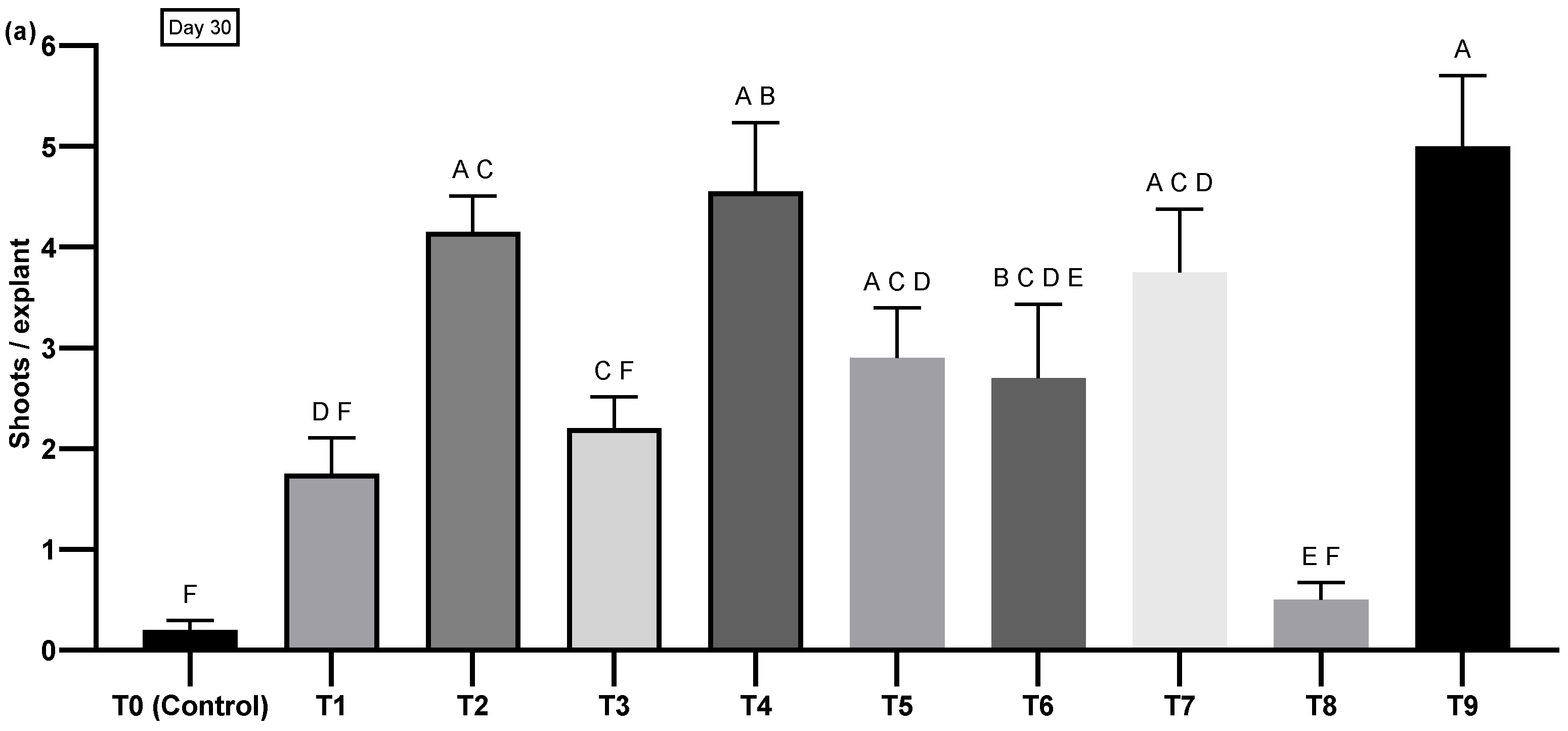
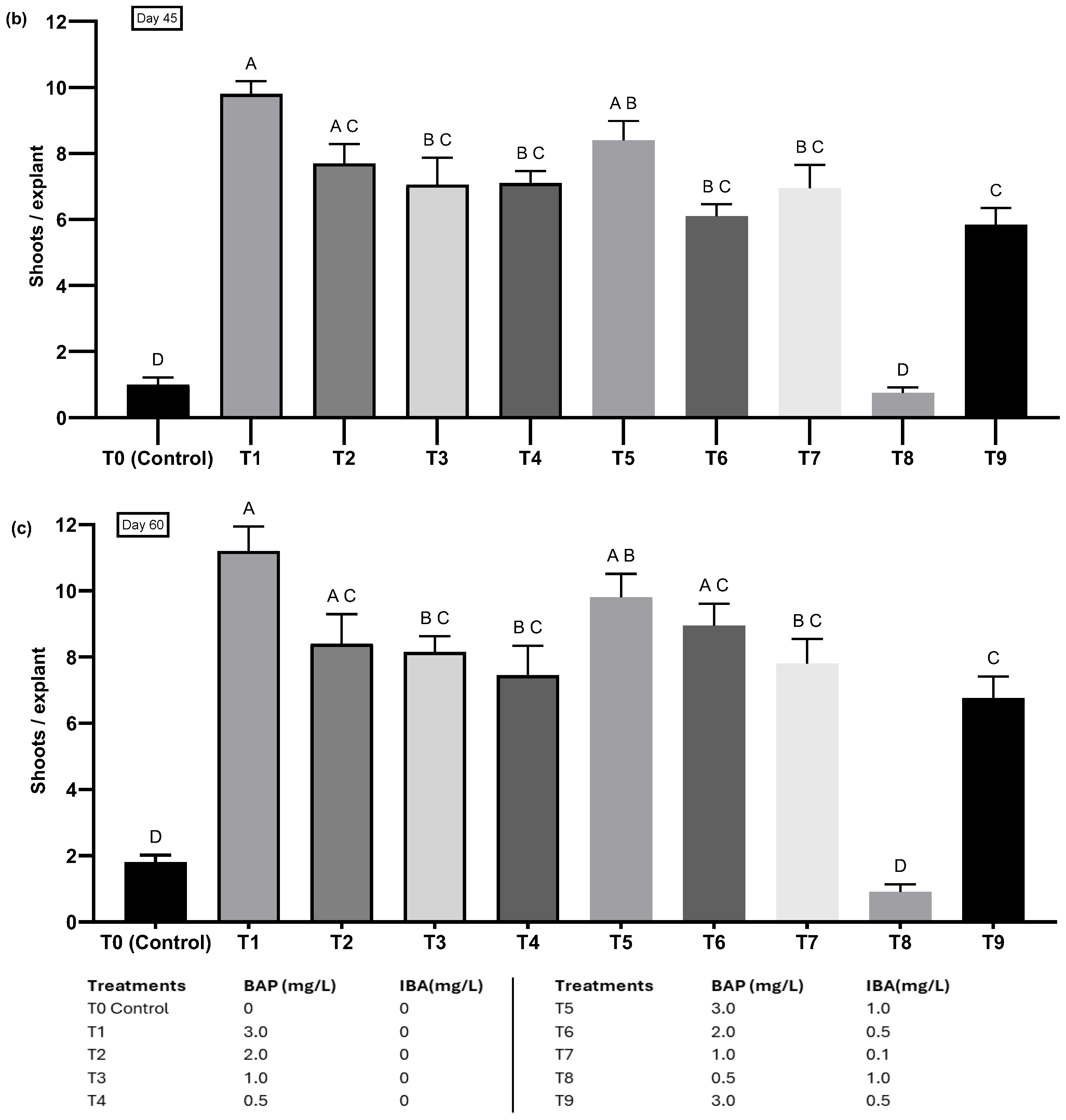
The data presented in Table 5 and Figure 2 demonstrate a clear dependence of shoot proliferation in pitahaya explants on the presence of PGRs in the culture medium at 30, 45, and 60 days of in vitro culture. In the control treatment (T0), which lacked PGRs, the number of shoots per explant remained consistently low throughout the evaluation period.
At 30 days (Figure 2a), the highest values of shoots per explant were recorded in treatment T9 (3.0 mg/L BAP + 0.5 mg/L IBA), with 5.0 ± 0.70, followed by T4 (0.5 mg/L BAP) and T2 (2.0 mg/L BAP); these treatments did not differ significantly from each other, as indicated by shared letters. In contrast, the control (T0) and treatment T8 (0.5 mg/L BAP + 1.0 mg/L IBA) exhibited the lowest values, indicating a limited response in the absence of PGRs or under conditions of high auxin concentration combined with low cytokinin levels.
At 45 days (Figure 2b), a marked increase in shoot number was observed in all treatments containing BAP. Treatment T1 (3.0 mg/L BAP) showed a significantly superior response, reaching 9.80 ± 0.39 shoots per explant, and outperforming all other treatments. Similarly, T5 (3.0 mg/L BAP + 1.0 mg/L IBA) and T2 (2.0 mg/L BAP) exhibited high values, although these were statistically lower than those recorded for T1. The control and T8 continued to present the lowest values, confirming a reduced capacity for shoot induction under these conditions.
At 60 days (Figure 2c), the highest number of shoots was again observed in T1, reaching 11.20 ± 0.74 shoots per explant, with no significant differences compared to T5 and T2, which also promoted high levels of shoot proliferation. Treatments containing intermediate BAP concentrations (T3, T4, and T7) showed moderate values, whereas T9, despite its high early response, exhibited a lower rate of increase over time. Once again, control and T8 recorded the lowest values, with no significant differences between them.
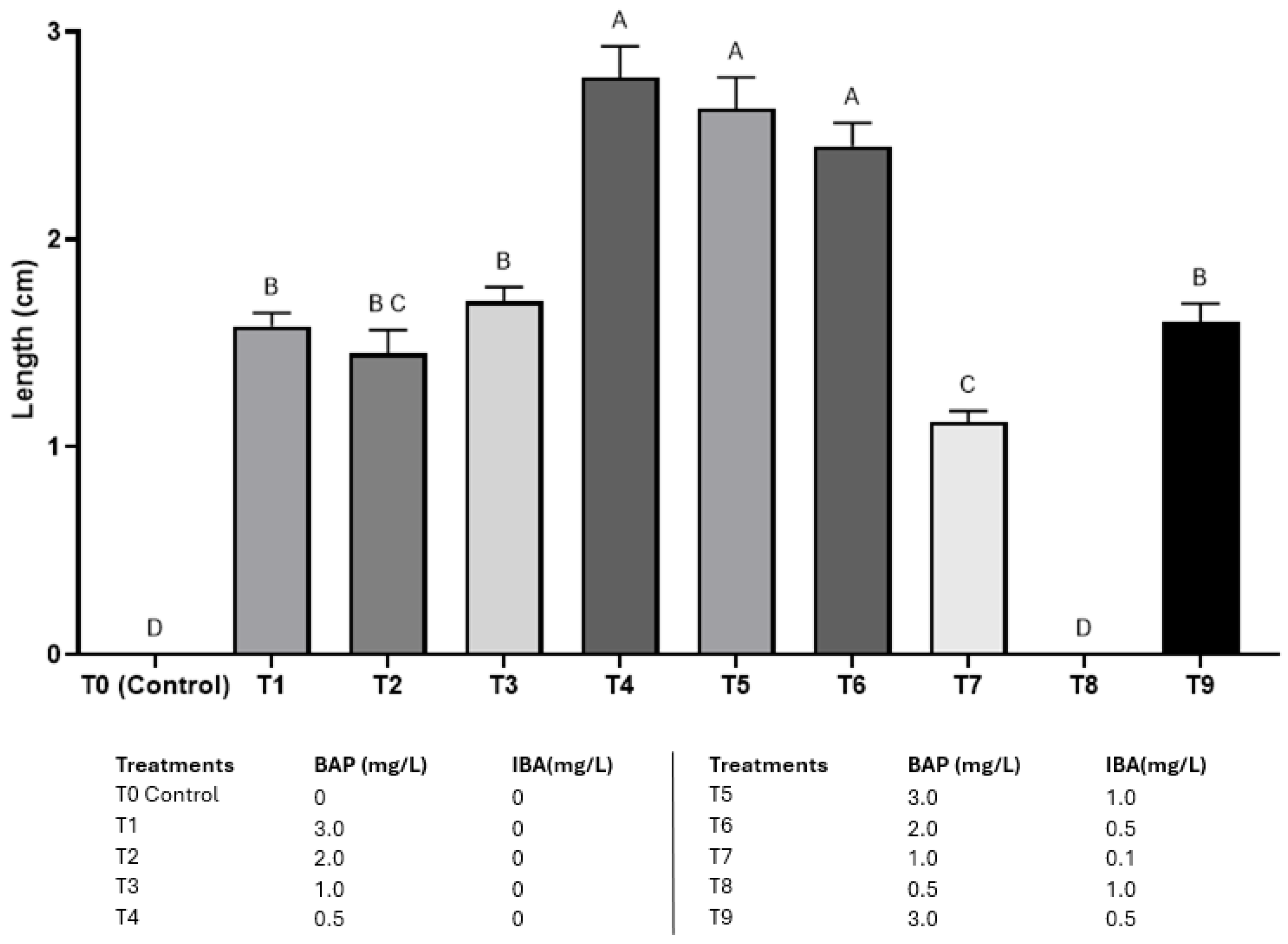
Regarding shoot growth of H. undatus after 60 days of in vitro culture (Table 5, Figure 3), the control treatment (T0), which lacked plant growth regulators, showed limited and delayed shoot induction. Although some shoots were formed, they failed to elongate and exhibited phenolic oxidation, preventing measurable shoot length. Among the treatments supplemented exclusively with BAP, shoot length showed a concentration-dependent response. Treatment T4 (0.5 mg/L BAP) produced the longest shoots (2.78 ± 0.15 cm), which were significantly greater than those of all other single-hormone treatments. Treatments combining BAP and IBA (T5 and T6) also promoted substantial shoot elongation, reaching mean lengths of 2.63 ± 0.15 cm and 2.45 ± 0.11 cm, respectively. These values did not differ significantly from T4 and ranked among the highest observed in the study. In contrast, treatment T8 (0.5 mg/L BAP + 1.0 mg/L IBA) resulted in the shortest shoots among the hormone-supplemented treatments, with values comparable to those of the control.

3.3. Morphological Characteristics of Regenerated Shoots

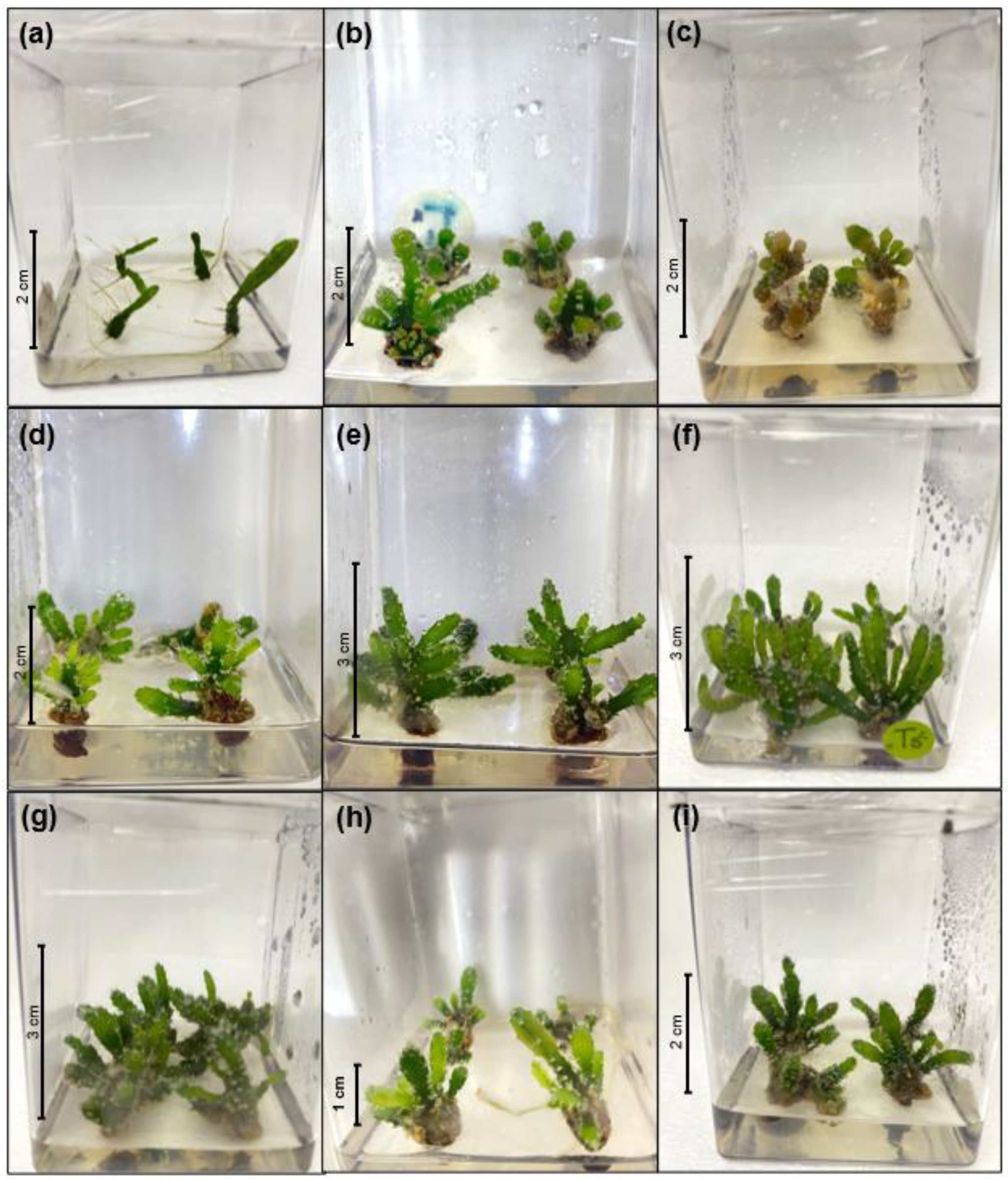
The in vitro development of H. undatus explants revealed distinct morphological responses among treatments, reflecting the influence of BAP and IBA concentrations on shoot induction, multiplication, and viability. In the control treatment (T0), shoot induction was limited and occurred at late stages of the culture period; however, the induced shoots failed to elongate and exhibited phenolic oxidation, which prevented shoot length measurement. In Figure 4a, only explants showing apical meristem growth are observed, without evidence of elongated or viable shoots.
Among the treatments supplemented exclusively with BAP, shoot morphology varied according to cytokinin concentration. Treatment T1 (Figure 4b) produced small, compact shoots with limited elongation, indicating that high BAP levels may promote the formation of numerous but short shoots. Treatment T2 (Figure 4c) yielded the smallest shoots, characterized by light green to yellowish coloration and callus formation at the explant base, suggesting mild chlorotic symptoms associated with cytokinin excess. Treatment T3 (Figure 4d) generated green, turgid shoots with a more vigorous appearance, reflecting a balanced morphogenic response at this BAP concentration. Notably, T4 (Figure 4e) produced the longest shoots with intense green coloration and a well-defined cylindrical shape, indicating that moderate BAP levels favor shoot elongation and morphological stability.
With respect to treatments combining cytokinin and auxin, marked effects on shoot elongation patterns and vigor were observed. T5 (Figure 4f) produced a high number of elongated, green shoots. Treatment T6 (Figure 4g) exhibited compact, uniform shoots with regular morphological characteristics and intense green coloration, indicating that this hormonal ratio favored stable organogenic development.
In treatment T7 (Figure 4h), the shoots were small, chlorotic, and showed less differentiation, which is associated with an insufficient auxin concentration to counteract the cytokinin effect and stimulate subsequent growth. In contrast, treatment T8 showed an absence of budding structures, characteristic of a negative response to the applied treatment. Finally, treatment T9 (Figure 4i) produced shoots with intense green coloration but reduced size and heterogeneous development, accompanied by callus formation at the explant base.
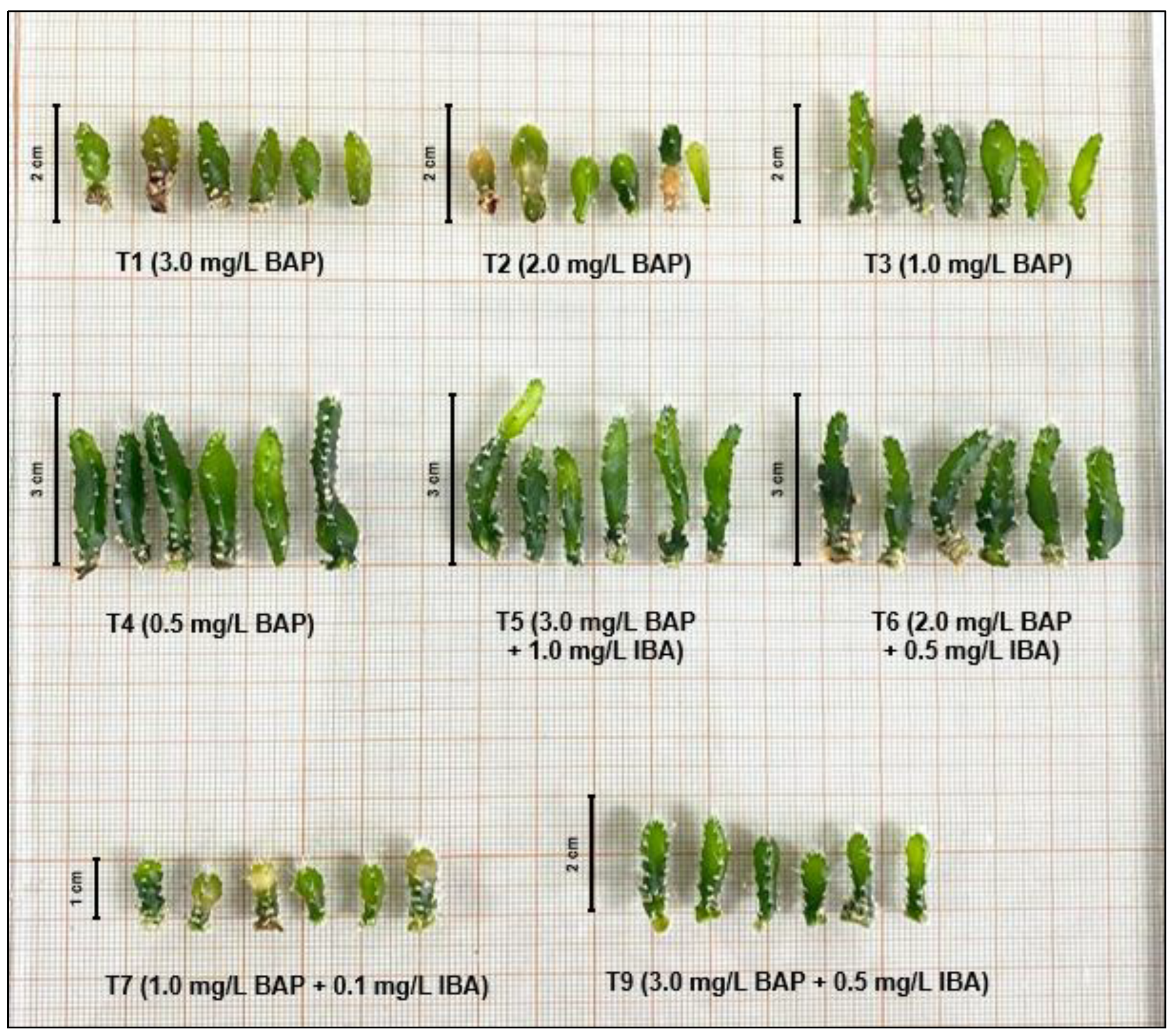
Overall, morphological evaluation allowed for the identification of positive and negative responses. Positive responses were characterized by a high number of shoots per explant, increased length, and an intense, homogeneous green coloration. In contrast, negative responses included pale green coloration, necrosis, oxidation, and an absence of regenerative structures. These observations were instrumental in determining the optimal hormonal conditions for the proliferation and healthy development of pitahaya explants in vitro. Figure 5 illustrates the differences in shape, color, and size of the pitahaya shoots obtained from the various treatments. Notably, no shoots were observed in the control treatment or in T8.

4. Discussion

Successful aseptic establishment of pitahaya requires the inclusion of fungicides in disinfection protocols, along with an appropriate combination of sodium hypochlorite concentration and exposure time to minimize microbial contamination and maximize explant survival. This finding appears to be consistent with reports by Cassells [23], who highlighted that basic disinfection protocols are often insufficient to eliminate endophytic microorganisms associated with explants from plants grown under non-controlled conditions. Incorporating fungicide such as Sultron into the disinfection protocol significantly reduced fungal contamination and improved explant survival. These results align with previous studies in cacti and other perennial species, where the use of fungicides during initial disinfection facilitated aseptic establishment by controlling persistent internal contaminants [10].
The protocol combining Tween 20, Sultron at 8 mL/L, 70% ethanol, and 30% NaClO, with moderate exposure times, showed the highest survival percentage and complete absence of fungal contamination. This suggests an optimal balance between antimicrobial efficacy and the explant’s physiological tolerance. Such a balance has been described as a determining factor in optimizing micropropagation protocols, as prolonged exposures or high concentrations of oxidizing agents can cause tissue damage, oxidative stress, and reduced viability, even when contamination is controlled [24].
The results for in vitro shoot multiplication efficiency show that adding BAP to the culture medium has a significant positive effect on the budding response of pitahaya explants. In contrast, the control treatment without PGRs showed only a 20% response. The treatment containing 2.0 mg/L BAP achieved a 100% response, indicating that this cytokinin concentration may be particularly effective for inducing bud formation in this system. Intermediate BAP concentrations, such as 1.0 mg/L and 0.5 mg/L, also produced high responses (85% and 90%, respectively), suggesting that relatively low cytokinin levels are sufficient to promote shoot multiplication. These concentrations fall within the range considered optimal for bud induction in pitahaya, typically between 1 and 3 mg/L of BAP [3].
In treatments where BAP was combined with IBA, the results indicate that auxin at low concentrations can exert a synergistic effect with cytokinin [25]. Specifically, treatments containing 1.0 mg/L BAP + 0.1 mg/L IBA and 3.0 mg/L BAP + 0.5 mg/L IBA showed high budding percentages, suggesting that a high cytokinin-to-auxin ratio can improve tissue stability and favor cellular polarity during shoot formation. However, when auxin predominates relative to cytokinin, as in the treatment containing 0.5 mg/L BAP + 1.0 mg/L IBA, shoot proliferation decreased notably.
The results obtained are generally consistent with those reported by Seran and Thiresh [26], who achieved up to a 62% budding response in H. undatus using MS culture medium supplemented with 3 mg/L Thidiazuron (TDZ) and 0.5 mg/L 1-Naphthaleneacetic acid (NAA), and a 48% response using 3 mg/L BAP and 0.5 mg/L NAA. Comparable regeneration responses have also been reported by Canales-Carrera et al. [9], who observed up to an 85% response at 28 days in explants of H. guatemalensis.
The control treatment, without added PGRs, exhibited low shoot numbers per explant throughout the evaluations. These values align with previous studies, where pitahaya shows minimal proliferation without PGRs [27]. The multiplication capacity observed at 30 days suggests that moderate cytokinin concentrations break apical dominance and promote the activation of axillary buds, consistent with reports in pitahaya cultures [8]. By day 45, shoot proliferation increased in all BAP treatments, indicating that higher cytokinin doses can maintain a high rate of cell division once the tissue has entered the proliferative phase. Other studies on Hylocereus have likewise found that BAP combinations in the range of ~1–4 mg/L (depending on cultivar and explant) considerably increase shoot number compared to cytokinin-free controls [27].
By the end of the experiments, continued shoot multiplication at elevated cytokinin concentrations may suggest that plant tissue adapts to the cytokinin regimen and maintains an active budding cycle. Similar responses have been reported in previous studies using other cytokinins, such as kinetin and TDZ [28]. The low yield of the control throughout the experiment confirms that pitahaya explants require an exogenous supply of cytokinins for efficient in vitro multiplication.
Collectively, the results indicate that supplementing the culture medium with 3.0 mg/L of BAP is suitable for maximizing shoot proliferation in prolonged culture, while lower concentrations optimize shoot initiation. This information is valuable for developing efficient pitahaya micropropagation protocols, as it allows for a balance between rapid initiation and sustained multiplication.
The results demonstrate that the different BAP and IBA combinations evaluated significantly influence the morphogenic response, highlighting that hormonal balance is a key element for shoot induction and proliferation in H. undatus. The results suggest a clear functional synergistic effect between cytokinin and auxin, where the former promotes cell divisions in meristematic tissues and the latter favors differentiation and establishment of new shoots. This response is consistent with the physiological models proposed by George et al. [29], indicating that cytokinins in the presence of moderate amounts of auxin favor caulinar structure formation, provided the hormonal balance does not shift toward root induction. Similar behavior has been reported in H. undatus and H. polyrhizus, where BAP combinations with IBA significantly increased proliferation [30].
The treatment containing 1.0 mg/L BAP combined with 0.1 mg/L IBA produced intermediate but relatively consistent values for shoot proliferation and elongation, suggesting that low to moderate auxin levels combined with moderate cytokinin levels can be effective for protocols prioritizing shoot quality over quantity. Previous studies on red pitahaya ‘Da Hong’ demonstrated that high BAP concentrations can induce compact and deformed shoots, whereas moderate levels (0.5–1.0 mg/L) promote more vigorous structures, albeit in lower numbers [27].
Conversely, the treatment containing 0.5 mg/L BAP + 1.0 mg/L IBA showed the lowest values, with only 0.90 ± 0.21 shoots per explant at 60 days. This supports the idea that low cytokinin levels are insufficient to induce shoot proliferation in pitahaya explants, even when auxin is present at relatively high concentrations. Excess auxin generally favors cell elongation, callus formation, or even root induction but not shoot formation, as indicated by some studies on cacti species [29,31].
The results are comparable to the average values reported by Mállap-Detquizán et al. [25], who obtained 2.48 shoots per explant in yellow pitahaya (H. megalanthus) using full-strength MS culture medium supplemented with 0.1 mg/L BAP and 3 mg/L NAA. Similarly, the shoot numbers observed in the present study are comparable to or slightly higher than those reported by Hua et al. [19], who obtained a maximum average of 7.1 shoots in explants of different varieties of H. undatus, H. polyrhizus, and their hybrids, using MS basal medium supplemented with 3 mg/L Zeatin and 0.5 mg/L IBA. Differences among studies may be influenced by variations in species, explant type, and culture conditions. Overall, the present study indicates that the combination of 3 mg/L BAP + 1 mg/L IBA may be suitable for optimizing shoot proliferation in H. undatus, whereas high auxin doses accompanied by low cytokinin significantly reduce the in vitro organogenesis response.
Shoot length was measured at 60 days of culture. The control treatment showed no elongation, consistent with reports by Lee et al. [27], who describe that pitahaya explants rarely develop elongated shoots in the absence of cytokinins due to limited cell division. Our results indicate that low BAP concentrations favor elongation, likely by preventing tissue hyperproliferation often associated with higher cytokinin doses. Similar results have also been observed in cacti and other succulents, where moderate doses (0.25–1.0 mg/L) of BAP stimulate elongation without causing fasciation or excessive thickening [32].
Treatments combining cytokinin and auxin (BAP + IBA) exhibited even more pronounced elongation. However, the treatment containing 0.5 mg/L BAP + 1.0 mg/L IBA produced the shortest shoots among the hormonal treatments, suggesting that high IBA concentrations may inhibit elongation, likely due to callus formation and poorly differentiated structures. The values obtained in this study surpass those of Martínez-Arroyo et al. [4], suggesting that the presence of IBA at moderate levels may be decisive for improving the shoot’s morphological quality, as auxin favors cell expansion. These results agree with the findings of Juárez and Passera [33] in Opuntia spp., who demonstrated that the presence of auxins at moderate concentrations improves the elongation and vigor of regenerated shoots, while high levels inhibit the formation of defined shoots.
Combinations with IBA favored the development of longer shoots when auxin concentrations did not exceed those of cytokinin, evidencing the importance of the balance of PGRs supplemented to the culture medium. Although maximum proliferation was achieved with high cytokinin levels, these treatments did not necessarily produce the greatest shoot length. This correlates with studies on other succulents [32], where excessive cell division induced by BAP results in compact shoots with poor elongation. Thus, these results support the notion that higher proliferation does not necessarily imply greater vigor, which is critical for commercial micropropagation.
The control treatment’s response indicates that pitahaya maintains its intrinsic growth pattern in the absence of exogenous cytokinins, reaffirming the role of cytokinins in breaking apical dominance and promoting lateral bud activation in cacti [10]. Regarding the interaction of auxin and cytokinin, Viñas et al. [34] emphasize that axillary bud development in cacti requires low auxin and high cytokinin levels. In line with these observations, our results suggest that cytokinins alone can induce shoot proliferation, while the addition of auxin contributes to improved shoot structuring and morphology.
Overall, pitahaya shoot proliferation and morphogenesis appear to be closely dependent on the balance between BAP and IBA. Cytokinins appear to stimulate cell division and shoot induction, whereas low concentrations of IBA may contribute to cellular polarity, elongation, and differentiation [12]. Previous studies in cacti have generally supported this hormonal regulation model, where the combination of BAP with IBA has been shown to increase regeneration frequency and improve the formation of functional shoots [7].
Despite achieving high proliferation, some explants exhibited excessive callus formation, faint green coloration, initial signs of phenolic oxidation, and hyperhydricity, indicating that physiological status can be compromised under certain hormonal imbalances. Another limitation of this study is that the subsequent phases of micropropagation, namely root induction and in vitro acclimatization, were not addressed. Future studies should evaluate rooting efficiency and the successful transfer of regenerated shoots to ex vitro conditions to ensure the production of fully functional plants suitable for large-scale propagation. Addressing these stages is essential to complement the establishment and multiplication phases and to develop a complete and commercially applicable micropropagation protocol for H. undatus.

5. Conclusions

The present study demonstrates that the efficiency of Hylocereus undatus micropropagation is strongly determined by the successful optimization of its early in vitro phases, which represent critical bottlenecks in pitahaya propagation systems. In particular, stringent aseptic establishment and a finely tuned hormonal regime during shoot induction and multiplication were identified as decisive factors influencing explant survival, morphogenic competence, and overall culture performance.
The integration of a fungicide (Sultron, 8 mL/L), followed by a sequential surface sterilization protocol using 70% ethanol (1 min) and 30% sodium hypochlorite (5 min) under laminar flow conditions, proved fundamental for minimizing microbial contamination while preserving maximal explant viability. This protocol resulted in the highest rates of explant survival and aseptic culture initiation, establishing a robust foundation for subsequent in vitro development.
With respect to shoot multiplication, the results clearly highlight the indispensable role of cytokinins in triggering organogenesis. Supplementation of the culture medium with BAP significantly enhanced shoot induction and proliferation compared to the hormone-free control, with 3.0 mg/L BAP yielding the highest proliferation efficiency. Conversely, lower BAP concentrations favored shoot elongation and improved morphological stability. The incorporation of low concentrations of IBA acted synergistically with BAP, enhancing shoot vigor, elongation, and overall structural quality, provided that a favorable auxin-to-cytokinin ratio was maintained. In contrast, elevated auxin proportions relative to cytokinin negatively affected morphogenesis, reducing both shoot proliferation and elongation and inducing aberrant morphological development.
Importantly, this work focuses specifically on the establishment and shoot multiplication stages, which directly determine the physiological quality of propagules and strongly influence the success of subsequent rooting and acclimatization phases. By generating morphologically stable and physiologically competent shoots, the protocol described here provides a necessary and reproducible foundation for the completion of a full micropropagation system. While rooting and acclimatization were beyond the scope of the present study, the results reported address essential early-stage limitations and offer practical guidance for the development of complete and scalable propagation protocols.
Overall, the findings contribute valuable and reproducible knowledge for the initial stages of H. undatus micropropagation and support future research aimed at integrating rooting, acclimatization, and large-scale production under commercial conditions.


Author Contributions

Conceptualization, L.S.M.-R., C.P.-J., P.A.S.-M. and A.H.; methodology, P.A.S.-M. and A.H.; investigation, C.P.-J., P.A.S.-M. and A.H.; writing—original draft preparation, L.S.M.-R. and C.P.-J.; writing—review and editing, L.S.M.-R. and C.P.-J.; visualization, P.A.S.-M. and A.H.; supervision, L.S.M.-R. and C.P.-J.; funding acquisition, L.S.M.-R. All authors have read and agreed to the published version of the manuscript.

Funding

This research was funded by the Universidad de Guadalajara through “PROSNI 2024–2025” to Liliana S. Muñoz-Ramírez.

Institutional Review Board Statement

Not applicable.

Data Availability Statement

The original contributions of this study are included in the article. Further information is available from the corresponding author upon reasonable request.

Acknowledgments

The authors thank Isabel Margarita Marrón-Chávez and Araceli Ortega Martínez for their expert technical assistance in the laboratory.

Conflicts of Interest

The authors declare no conflicts of interest.

Abbreviations

The following abbreviations are used in this manuscript:
ANOVAAnalysis of Variance
BAP6-Benzylaminopurine
CRDCompletely Randomized Design
HSDHonest Significant Difference
IBAIndole-3-Butyric Acid
MSMurashige and Skoog medium
NAA1-Naphthaleneacetic Acid
NaClOSodium Hypochlorite
PGR(s)Plant Growth Regulator(s)
SDStandard Deviation
TDZThidiazuron
TISTemporary Immersion System

References

  1. Verona-Ruiz, A.; Urcia-Cerna, J.; Paucar-Menacho, L. Pitahaya (Hylocereus spp.): Culture, physicochemical characteristics, nutritional composition, and bioactive compounds. Sci. Agropecu. 2020, 11, 439–453. [Google Scholar] [CrossRef]
  2. Bello-Bello, J.J.; Schettino-Salomón, S.; Ortega-Espinoza, J.; Spinoso-Castillo, J.L. A Temporary Immersion System for Mass Micropropagation of Pitahaya (Hylocereus undatus). 3 Biotech 2021, 11, 437. [Google Scholar] [CrossRef] [PubMed]
  3. Bouzroud, S.; El Maaiden, E.; Sobeh, M.; Devkota, K.P.; Boukcim, H.; Kouisni, L.; El Kharrassi, Y. Micropropagation of Opuntia and Other Cacti Species Through Axillary Shoot Proliferation: A Comprehensive Review. Front. Plant Sci. 2022, 13, 926653. [Google Scholar] [CrossRef]
  4. Cristina, M.-A.M.; Eucario, M.; Luis, S.-C.J.; Jabín, B.-B.J. Evaluation of the Effect of Different Culture Systems on Photomixotrophic Capacity during in vitro Multiplication of Pitahaya (Hylocereus undatus). S. Afr. J. Bot. 2023, 159, 396–404. [Google Scholar] [CrossRef]
  5. Gómez, E.J.S.; Hidalgo, M.C.L.; Ruiz, M.L.P.; Miceli, F.A.G.; Gómez, J.A.S. Germinación de semillas y propagación in vitro de pitahaya (Hylocereus undatus). Biotecnia 2025, 27, e2366. [Google Scholar] [CrossRef]
  6. Kasim, D.P.; Kishore, N.S.; Suneetha, P.; Rao, K.B.; Kumar, M.N.; Krishna, M.S.R. Multiple Shoot Regeneration in Seed-Derived Immature Leaflet Explants of Red Dragon Fruit (Hylocereus costaricensis). Res. J. Pharm. Technol. 2019, 12, 1491. [Google Scholar] [CrossRef]
  7. Carmona-Martín, E.; Conde, F.; Petri, C. Progress towards in vitro Shoot Regeneration and Genetic Transformation in Pitaya (Hylocereus undatus) Cladode Sections. Plant Cell Tissue Organ Cult. 2025, 162, 37. [Google Scholar] [CrossRef]
  8. Oo, K.T.; Lynn, Z.M.; Oo, K.Z.; Htwe, M.Y.; Htet, W.T. In vitro Propagation of Three Pitaya Varieties (Hylocereus undatus, Hylocereus polyrhizus and Hylocereus megalanthus) with the Use of Different BAP Concentrations. J. Sci. Innov. Res. 2023, 12, 33–39. [Google Scholar]
  9. Canales-Carrera, E.E.; Navarro-Sandoval, B.G.; Melgarejo, M.L.; Príncipe Jara, R.E.; Campos Julca, Á.P.; Goñy Ameri, L.A. Explantes de Pitahaya (Hylocereus guatemalensis) a Partir de Areolas: Protocolo Para La Regeneración in vitro y Una Exitosa Aclimatación. Sci. Agropecu. 2025, 16, 427–438. [Google Scholar] [CrossRef]
  10. Pérez-Molphe-Balch, E.; Santos-Díaz, M.d.S.; Ramírez-Malagón, R.; Ochoa-Alejo, N. Tissue Culture of Ornamental Cacti. Sci. Agric. 2015, 72, 540–561. [Google Scholar] [CrossRef]
  11. Cortés-Olmos, C.; Guerra-Sandoval, V.M.; Blanca-Giménez, V.; Rodríguez-Burruezo, A. Micropropagation and Acclimatization of Gymnocalycium Cv. Fancy (Cactaceae): Developmental Responses to Different Explant Types and Hormone Conditions. Plants 2023, 12, 3932. [Google Scholar] [CrossRef] [PubMed]
  12. Bozkurt, T.; İnan, S.; Dündar, İ. Micropropagation of Different Pitaya Varieties. Int. J. Agric. Nat. Sci. 2020, 13, 39–46. [Google Scholar]
  13. Infante, R. In vitro Axillary Shoot Proliferation and Somatic Embryogenesis of Yellow Pitaya Mediocactus coccineus (Salm-Dyck). Plant Cell Tissue Organ Cult. 1992, 31, 155–159. [Google Scholar] [CrossRef]
  14. Trivellini, A.; Lucchesini, M.; Ferrante, A.; Massa, D.; Orlando, M.; Incrocci, L.; Mensuali-Sodi, A. Pitaya, an Attractive Alternative Crop for Mediterranean Region. Agronomy 2020, 10, 1065. [Google Scholar] [CrossRef]
  15. Jakobina, M.; Łyczko, J.; Zydorowicz, K.; Galek, R.; Szumny, A. The Potential Use of Plant Growth Regulators for Modification of the Industrially Valuable Volatile Compounds Synthesis in Hylocereus undatus Stems. Molecules 2023, 28, 3843. [Google Scholar] [CrossRef]
  16. Attar, Ş.H.; Gündeşli, M.A.; Urün, I.; Kafkas, S.; Kafkas, N.E.; Ercisli, S.; Ge, C.; Mlcek, J.; Adamkova, A. Nutritional Analysis of Red-Purple and White-Fleshed Pitaya (Hylocereus) Species. Molecules 2022, 27, 808. [Google Scholar] [CrossRef]
  17. Dar, S.A.; Nawchoo, I.A.; Tyub, S.; Kamili, A.N. Effect of Plant Growth Regulators on in vitro Induction and Maintenance of Callus from Leaf and Root Explants of Atropa acuminata Royal Ex Lindl. Biotechnol. Rep. 2021, 32, e00688. [Google Scholar] [CrossRef]
  18. Grzegorczyk-Karolak, I.; Hnatuszko-Konka, K.; Krzemińska, M.; Olszewska, M.A.; Owczarek, A. Cytokinin-Based Tissue Cultures for Stable Medicinal Plant Production: Regeneration and Phytochemical Profiling of Salvia bulleyana Shoots. Biomolecules 2021, 11, 1513. [Google Scholar] [CrossRef]
  19. Hua, Q.; Chen, P.; Liu, W.; Ma, Y.; Liang, R.; Wang, L.; Wang, Z.; Hu, G.; Qin, Y. A Protocol for Rapid in vitro Propagation of Genetically Diverse Pitaya. Plant Cell Tissue Organ Cult. 2015, 120, 741–745. [Google Scholar] [CrossRef]
  20. Motte, H.; Vereecke, D.; Geelen, D.; Werbrouck, S. The Molecular Path to in vitro Shoot Regeneration. Biotechnol. Adv. 2014, 32, 107–121. [Google Scholar] [CrossRef]
  21. Hill, K.; Schaller, G.E. Enhancing Plant Regeneration in Tissue Culture. Plant Signal. Behav. 2013, 8, e25709. [Google Scholar] [CrossRef] [PubMed]
  22. Murashige, T.; Skoog, F. A Revised Medium for Rapid Growth and Bio Assays with Tobacco Tissue Cultures. Physiol. Plant. 1962, 15, 473–497. [Google Scholar] [CrossRef]
  23. Cassells, A.C. Contamination and Its Impact in Tissue Culture. Acta Hortic. 2001, 560, 353–359. [Google Scholar] [CrossRef]
  24. Permadi, N.; Prismantoro, D.; Navisya Vasall, P.R.; Sheelmarevaa, F.A.; Nurjanah, S.; Nurzaman, M.; Alhasnawi, A.N.; Doni, F.; Julaeha, E. Modern and Traditional Strategies for Controlling Microbial Contamination in Plant Micropropagation: Current Insights and Future Perspectives. Curr. Res. Biotechnol. 2025, 10, 100337. [Google Scholar] [CrossRef]
  25. Mállap-Detquizán, G.; Vilca-Valqui, N.C.; Meléndez-Mori, J.B.; Huaman-Huaman, E.; Oliva, M. Multiplicación in vitro de pitahaya amarilla (Hylocereus megalanthus) a partir de plántulas obtenidas in vitro. Agron. Mesoam. 2022, 33, 45472. [Google Scholar] [CrossRef]
  26. Seran, T.; Thiresh, A. Root and Shoot Growth of Dragon Fruit (Hylocereus undatus) Stem Cutting as Influenced by Indole Butytic Acid. Agric. Biol. Sci. J. 2015, 1, 27–30. [Google Scholar]
  27. Lee, Y.-C.; Chang, J.-C. Development of an Improved Micropropagation Protocol for Red-Fleshed Pitaya ‘Da Hong’ with and without Activated Charcoal and Plant Growth Regulator Combinations. Horticulturae 2022, 8, 104. [Google Scholar] [CrossRef]
  28. Fan, Q.-J.; Yan, F.-X.; Qiao, G.; Zhang, B.-X.; Wen, X.-P. Identification of Differentially-Expressed Genes Potentially Implicated in Drought Response in Pitaya (Hylocereus undatus) by Suppression Subtractive Hybridization and cDNA Microarray Analysis. Gene 2014, 533, 322–331. [Google Scholar] [CrossRef]
  29. George, E.F.; Hall, M.A.; Klerk, G.-J.D. Plant Growth Regulators II: Cytokinins, Their Analogues and Antagonists. In Plant Propagation by Tissue Culture: Volume 1. The Background; George, E.F., Hall, M.A., Klerk, G.-J.D., Eds.; Springer Netherlands: Dordrecht, The Netherlands, 2008; pp. 205–226. [Google Scholar]
  30. Comlekcioglu, S. In vitro Propagation and Rooting Strategies for Hylocereus undatus and Hylocereus polyrhizus. Plant Biotechnol. Rep. 2024, 18, 829–838. [Google Scholar] [CrossRef]
  31. Lema-Rumińska, J.; Kulus, D. Micropropagation of Cacti—A Review. Haseltonia 2014, 19, 46–63. [Google Scholar] [CrossRef]
  32. Tellez-Román, J.; López-Peralta, M.C.; Hernández-Meneses, E.; Livera-Muñoz, L.; Estrada-Luna, A.; Zavaleta-Mancera, H. In vitro Regeneration of Echinopsis chamaecereus H. Friedrich Glaetzle Cv. ‘Aurea.’. Agrociencia 2020, 54, 163–175. [Google Scholar]
  33. Juarez, M.C.; Passera, C.B. In vitro Propagation of Opuntia ellisiana Griff. and Acclimatization to Field Conditions. Biocell 2002, 26, 319–324. [Google Scholar] [CrossRef]
  34. Viñas, M.; Fernández-Brenes, M.; Azofeifa, A.; Jiménez, V.M. In vitro Propagation of Purple Pitahaya (Hylocereus costaricensis [F.A.C. Weber] Britton & Rose) Cv. Cebra. Vitr. Cell. Dev. Biol.-Plant 2012, 48, 469–477. [Google Scholar] [CrossRef]
Figure 1. Dragon fruit (H. undatus) explants established in Magenta™ vessels during the in vitro multiplication phase.
Crops 06 00021 g001
Figure 2. Number of shoots per explant in H. undatus grown under different PGR treatments. (a) Shoot proliferation at 30 days; (b) shoot proliferation at 45 days; and (c) shoot proliferation at 60 days. Bars represent the mean ± standard deviation (SD). Different letters indicate significant differences among treatments according to one-way ANOVA followed by Tukey’s HSD test (p = 0.05).
Crops 06 00021 g002aCrops 06 00021 g002b
Figure 3. Shoot length (cm) of H. undatus measured after 60 days of in vitro culture under different PGR treatments. Bars represent the mean ± standard deviation (SD). Different letters indicate significant differences among treatments according to one-way ANOVA followed by Tukey’s HSD test (p = 0.05).
Crops 06 00021 g003
Figure 4. Effect of different BAP and BAP–IBA combination treatments on shoot multiplication of H. undatus after 60 days of culture. (a) T0: control (basal medium without PGRs); (b) T1: 3.0 mg L−1 BAP; (c) T2: 2.0 mg L−1 BAP; (d) T3: 1.0 mg L−1 BAP; (e) T4: 0.5 mg L−1 BAP; (f) T5: 3.0 mg L−1 BAP + 1.0 mg L−1 IBA; (g) T6: 2.0 mg L−1 BAP + 0.5 mg L−1 IBA; (h) T7: 1.0 mg L−1 BAP + 0.1 mg L−1 IBA; (i) T9: 3.0 mg L−1 BAP + 0.5 mg L−1 IBA.
Crops 06 00021 g004
Figure 5. Morphological comparison of H. undatus shoots obtained under different concentrations of BAP and BAP–IBA combinations after 60 days of the in vitro multiplication period.
Crops 06 00021 g005
Table 1. Surface disinfection treatments applied to H. undatus explants during the aseptic establishment phase.
Disinfection TreatmentDescriptionTime
Treatment 0 (Control)In a laminar flow hood:
70% ethanol 1 min
30% Sodium hypochlorite 10 min
Treatment 1In the laboratory:
Sultron fungicide (8 mL/L)30 min
In a laminar flow hood:
70% ethanol1 min
20% Sodium hypochlorite 10 min
Treatment 2In the laboratory:
Sultron fungicide (6 mL/L)30 min
In a laminar flow hood:
70% ethanol1 min
20% Sodium hypochlorite 10 min
Treatment 3In the laboratory:
Sultron fungicide (8 mL/L)45 min
In a laminar flow hood:
70% ethanol1 min
30% Sodium hypochlorite 10 min
Treatment 4In the laboratory:
Sultron fungicide (6 mL/L)45 min
In a laminar flow hood:
70% ethanol1 min
30% Sodium hypochlorite10 min
Treatment 5In the laboratory:
Sultron fungicide (8 mL/L)20 min
In a laminar flow hood:
70% ethanol1 min
30% Sodium hypochlorite5 min
Note: All treatments included a pre-treatment with Tween® 20 (Merck KGaA, Darmstadt, Germany, #P2287) (5 mL/L) for 15 min.
Table 2. Composition of culture media MS supplemented with the 6-Benzylaminopurine (BAP) and Indole-3-butyric acid (IBA).
TreatmentsBAP (mg/L)IBA (mg/L)
T0 Control00
T13.00
T22.00
T31.00
T40.50
T53.01.0
T62.00.5
T71.00.1
T80.51.0
T93.00.5
Note: Four explants were cultured per Magenta™ vessel. Each treatment consisted of 20 explants in total.
Table 3. Effect of disinfection treatments on fungal contamination, phenolic oxidation, and survival during in vitro aseptic establishment of H. undatus explants.
TreatmentsContamination (%)Phenolic Oxidation (%)Survival (%)
Treatment 0 (Control)71.43 ± 12.10 a28.57 ± 12.10 a0 ± 0.00 c
Treatment 114.29 ± 9.40 b14.29 ± 9.40 a71.43 ± 12.10 ab
Treatment 214.29 ± 9.40 b28.57 ± 12.10 a57.14 ± 13.20 ab
Treatment 328.57 ± 12.10 ab28.57 ± 12.10 a42.86 ± 13.20 bc
Treatment 428.57 ± 12.10 ab42.86 ± 13.20 a28.57 ± 12.10 c
Treatment 50 ± 0.00 b14.29 ± 9.40 a85.71 ± 9.40 a
Note: Values represent estimated marginal means ± standard error obtained from a generalized linear model (binomial distribution, logit link), expressed as percentages. The culture vessel was considered the experimental unit. Within each column, different letters indicate significant differences among treatments according to Bonferroni-adjusted pairwise comparisons (p ≤ 0.05).
Table 4. Response percentage of H. undatus explants to shoot multiplication.
TreatmentsBAP (mg/L)IBA(mg/L)Response Percentage (%)
T0 Control0020 ± 8.90 b
T13.0075 ± 9.70 a
T22.00100 ± 0.00 a
T31.0085 ± 8.00 a
T40.5090 ± 6.70 a
T53.01.090 ± 6.70 a
T62.00.560 ± 11.00 b
T71.00.190 ± 6.70 a
T80.51.035 ± 10.70 b
T93.00.595 ± 4.90 a
Note: Values represent estimated marginal means ± standard error obtained from a generalized linear model (binomial distribution, logit link), expressed as percentages. The culture vessel was considered the experimental unit. Different letters indicate significant differences among treatments according to Bonferroni-adjusted pairwise comparisons (p ≤ 0.05).
Table 5. Effect of BAP and IBA on in vitro shoot multiplication of H. undatus.
TreatmentsBAP
(mg/L)
IBA (mg/L)Shoots/ExplantShoot Length (cm)
30 Days45 Days60 Days
T0 Control000.20 ± 0.09 f1.0 ± 0.22 d1.80 ± 0.21 d0.00 ± 0.00 d
T13.001.75 ± 0.35 df9.80 ± 0.39 a11.20 ± 0.74 a1.58 ± 0.07 b
T22.004.15 ± 0.36 ac7.70 ± 0.59 ac8.40 ± 0.89 ac1.45 ± 0.11 bc
T31.002.2 ± 0.31 cf7.05 ± 0.82 bc8.15 ± 0.47 bc1.70 ± 0.07 b
T40.504.55 ± 0.69 ab7.10 ± 0.37 bc7.45 ± 0.89 bc2.78 ± 0.15 a
T53.01.02.90 ± 0.50 acd8.40 ± 0.58 ab9.80 ± 0.71 ab2.63 ± 0.15 a
T62.00.52.70 ± 0.74 bcde6.10 ± 0.36 bc8.95 ± 0.66 ac2.45 ± 0.11 a
T71.00.13.75 ± 0.63 acd6.95 ± 0.71 bc7.80 ± 0.74 bc1.12 ± 0.05 c
T80.51.00.50 ± 0.17 ef0.75 ± 0.16 d0.90 ± 0.23 d0.00 ± 0.00 d
T93.00.55.0 ± 0.70 a5.85 ± 0.50 c6.75 ± 0.66 c1.60 ± 0.09 b
Note: Values are presented as mean ± standard deviation (SD). Different letters within each column indicate significant differences among treatments according to one-way ANOVA followed by Tukey’s HSD test (p = 0.05). Shoot length values of 0.00 cm indicate shoots that were induced but failed to elongate due to late emergence and subsequent phenolic oxidation.
Disclaimer/Publisher’s Note: The statements, opinions and data contained in all publications are solely those of the individual author(s) and contributor(s) and not of MDPI and/or the editor(s). MDPI and/or the editor(s) disclaim responsibility for any injury to people or property resulting from any ideas, methods, instructions or products referred to in the content.