Communication

Evaluation of the Pathogenicity of Metarhizium taii and Trichoderma afroharzianum on Immature Stages of Bemisia tabaci in Tomato Plants


by
Ricardo A. Varela-Pardo
1,*,
Gustavo Curaqueo
1,
Alejandra Fuentes-Quiroz
2,
Paola Díaz-Navarrete
3,
Claudia López-Lastra
4,
Cecilia Mónaco
5 and
Eduardo Wright
6
1
Departamento de Ciencias Agropecuarias y Acuícolas, Facultad de Recursos Naturales, Universidad Católica de Temuco, Temuco P.O. Box 15-D, Chile
2
Laboratorio de Silvicultura, Departamento de Ciencias Forestales, Facultad de Ciencias Agropecuarias y Medioambiente, Universidad de La Frontera, Casilla 54-D, Francisco Salazar, Temuco 01145, Chile
3
Departamento de Ciencias Veterinarias y Salud Pública, Facultad de Recursos Naturales, Universidad Católica de Temuco, Temuco P.O. Box 15-D, Chile
4
Centro de Estudios Parasitológicos y de Vectores (CEPAVE) CONICET-UNLP, Blvd. 120, Buenos Aires 1900, Argentina
5
Facultad de Ciencias Agrarias y Forestales, Universidad Nacional de La Plata, Calle 60 y 119, La Plata 1900, Argentina
6
Facultad de Agronomía, Universidad de Buenos Aires, Av. San Martín 4453, Ciudad Autónoma de Buenos Aires C1417DSE, Argentina
*
Author to whom correspondence should be addressed.
Crops 2025, 5(5), 66; https://doi.org/10.3390/crops5050066
Submission received: 11 June 2025 / Revised: 15 July 2025 / Accepted: 24 July 2025 / Published: 26 September 2025

Abstract

The whitefly (Bemisia tabaci) (Hemiptera: Aleyrodidae) is a small phytophagous invertebrate of herbaceous plants, shrubs, trees, wild plants, and crops of economic importance. It generates substantial economic losses due to direct damage caused by sap sucking and virus transmission. This work presents referential images of the morphology of B. tabaci and one of its main biological controllers in southern South America, thus serving as a reference for other researchers. In addition, results are presented of studies carried out to evaluate the pathogenicity of two fungal isolates (previously selected in vitro against Sclerotinia sclerotiorum and Botrytis cinerea and plant growth promoters) identified as Metarhizium taii CEP-722 and Trichoderma afroharzianum CEP-754 in immature stages of B. tabaci in tomato plants (Solanum lycopersicum). The trials were conducted under controlled conditions in controlled chambers, ensuring optimal growth conditions for B. tabaci, after morphological prospection, collection, identification, and mass rearing of adults in entomological cages. The results indicate that M. taii CEP-722 caused approximately 30% mortality in the immature stages of B. tabaci, while T. afroharzianum CEP-754 did not increase mortality under the experimental conditions. This study provides new knowledge on the potential of M. taii as a biological control agent against B. tabaci, offering a promising alternative in integrated pest management strategies. The results with T. afroharzianum suggest that further methodologies or combinations should be explored to improve its efficacy.

1. Introduction

Aleyrodidae is estimated to harbor more than 1200 described species. Whiteflies (Hemiptera: Aleyrodidae) are small phytophagous insects that inhabit herbaceous plants, shrubs, trees, wild plants, and crops of economic importance. Sometimes, they become a serious problem due to direct damage caused by sap sucking and the transmission of viruses. Two economically important whitefly species are very similar, although they belong to different genera: Bemisia tabaci (Gennadius, 1889) and Trialeurodes vaporariorum (Westwood, 1856) [1]. B. tabaci, but not T. vaporariorum, transmits tobacco leaf curl virus (TLCV). These species are easily distinguishable [2]. Some scientific references suggest that B. tabaci could be native to tropical Africa, from where it spread to Europe and Asia, and was subsequently introduced into the Neotropics, mainly through the transport of plant material [3,4,5].
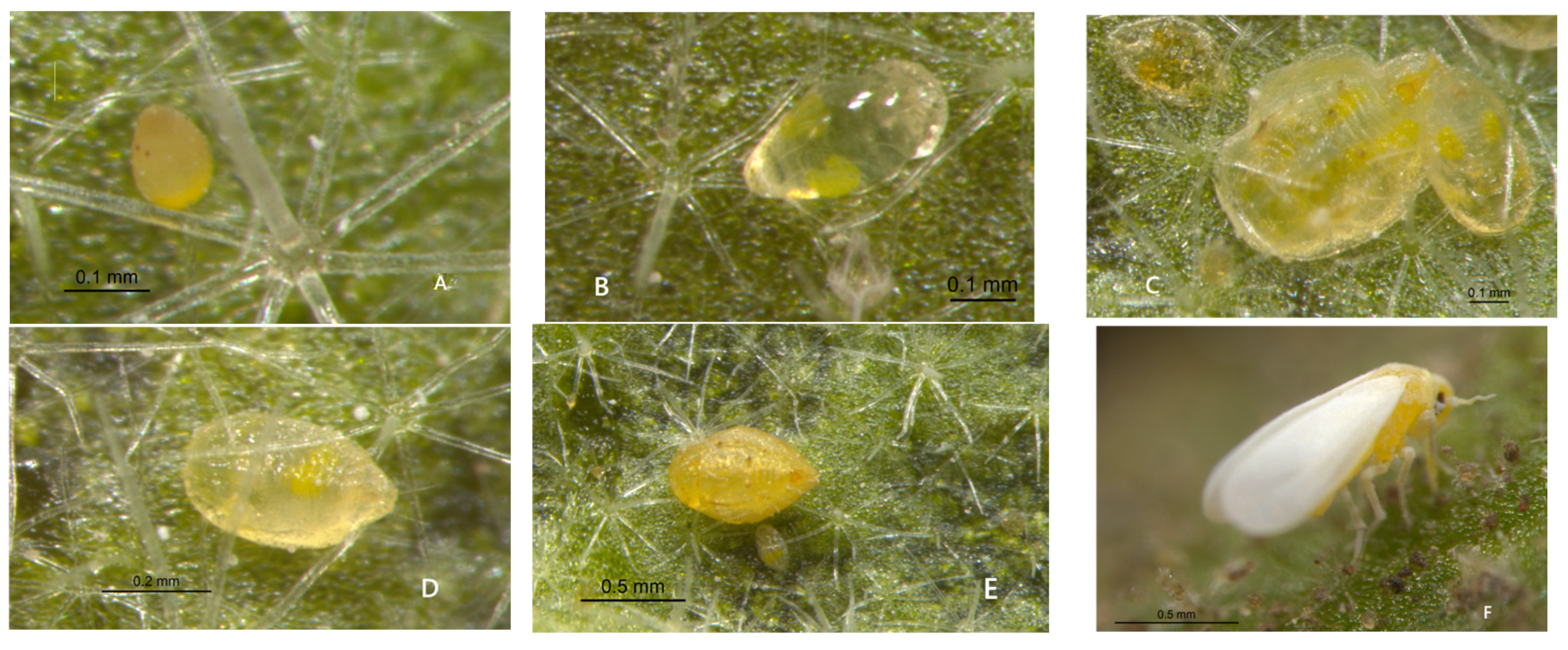
However, other studies suggest that this species could be native to India or Pakistan, where the greatest diversity of natural enemies has been found [6]. Adult female B. tabaci lay eggs on the host plant [7]. The immature stages of the B. tabaci species are egg, nymph 1, nymph 2, nymph 3, and nymph 4, or also commonly called pseudopupa. The eggs then hatch after 6–7 days, and the first instar nymphs (motile nymphs) crawl along the leaves and feed. These nymphs then molt after 2–3 days and undergo two further molts. The pupal or “red-eyed nymph” stage is part of the fourth instar and lasts 5–6 days, and then winged adults emerge from the T-shaped opening in the fourth-instar exoskeleton (Figure 1) [8].
Whiteflies (B. tabaci and T. vaporariorum) are considered one of the major pests associated with horticultural crops [9,10,11]. Damage caused by B. tabaci ranges from minor to severe, with global annual losses reaching billions of US dollars for many crops [12]. Its economic importance is related to its wide geographical distribution, the large number of affected crop species, and its potential to cause damage (in the case of T. vaporariorum), either as a virus vector or through indirect damage by promoting the development of sooty mold caused by the fungus Capnodium spp. [13,14,15,16,17,18]. Latin America is the region that has been most affected by the whitefly (B. tabaci), due to the number of crops affected, the losses in yield, and the agricultural areas devastated by this pathogen. Additionally, millions of hectares of land suitable for agriculture in 20 countries are attacked by more than thirty begomoviruses spread by whiteflies [19]. Another reason that these two species of whitefly are classified as the most important is their ability to develop resistance, in a relatively short time, to the insecticides used for their control, as well as the emergence of the B biotype of B. tabaci, registered by some taxonomists as a new species Bemisia argentifolii [20,21,22], which has been shown to have a greater biotic potential that tends to displace the A biotype from areas where it had previously been identified as the predominant species [23]. Morphologically, the two biotypes of B. tabaci cannot be distinguished; however, the B biotype has biological characteristics that distinguish it from the A biotype, such as a wider host spectrum, higher population densities, greater capacity to acquire resistance to insecticides, and the induction of physiological disorders such as irregular ripening of tomato fruits and silvering of leaves in cucurbits [24]. Authors have proposed that the MEAM1 biotype prefers S. melongena crops over other crops under greenhouse conditions, ultimately displacing other biotypes that are less reproductively efficient and have longer life cycles. Therefore, the presence of the MEAM1 biotype is highly likely in S. melongena crops with a long history of whitefly attack [25,26].
In agricultural settings, B. tabaci and T. vaporariorum are controlled primarily by conventional insecticides [24,27]. Nevertheless, chemical control has favored the development of resistant populations of these insects, and the negative impact on the environment generated by this type of technology has triggered the generation of alternative management strategies, where control by microorganisms could play an important role [28,29,30]. Furthermore, the entomopathogenic fungus Metarhizium anisopliae (Sorokin, 1883) is also an effective alternative for the control of whitefly (B. tabaci) [31,32,33,34,35]. Other members of this genus are also frequently cited for the control and management of agricultural pests, such as M. brunneum, M. robertsii, M. rileyi, and M. flavoviride [36]. Other fungal species such as Paecilomyces fumosoroseus (Bainier, 1907) and Lecanicilium lecanii (synonym Akanthomyces lecanii (Zimm., 1898)) have also been reported as biological control agents for whiteflies [37], and formulations based on the entomopathogenic fungus P. fumosoroseus have been marketed since the 1990s for the management of whiteflies (B. tabaci and T. vaporariorum) [28,33]. As observed for other entomopathogenic fungi, Trichoderma spp. can actively parasitize the bodies of insects, using them as a nutrient source for the formation of reproductive structures [38]. Trichoderma longibrachiatum (Rifai, 1969) infects Leucinodes orbonalis (Guenee, 1854), B. tabaci, and the bed bug (Cimex hemipterus L. (1753)) [39], and different species of Trichoderma cause mortality close to 100% in adults of the palm rhinoceros beetle (Oryctes rhinoceros L. (1753)) [40]. Trichoderma afroharzianum is one of the best-characterized Trichoderma species, and strains have been utilized as plant disease suppressive inoculants [41]. Phylogenomic analysis has shown that the genus Trichoderma (Ascomycota, teleomorph: Hypocrea) shared a last common ancestor with entomoparasitic hypocrealean fungi (e.g., Cordyceps, Beauveria) and evolved from a predecessor with limited cellulolytic capability that fed on either fungi or arthropods [38]. Therefore, given the aforementioned evidence, it is suggested that the management of invertebrates, especially those that are vectors of viral diseases, through the use of native entomopathogenic fungi, is especially important due to the multiple interactions that a specific microorganism can generate in an agroecosystem [42,43]. The use of strains of microorganisms exogenous to agroecosystems can cause a series of trophic reactions that could lead to a displacement of species in a given place. The objective of this work was to advance the development and use of native fungal strains with multiple functionalities, evaluating the pathogenic capacity of two species—M. taii CEP-722 and T. afroharzianum CEP-754—with high potential for biological control over immature stages of B. tabaci.

2. Materials and Methods

2.1. Collection of B. tabaci

A uniform population of different stages (eggs, nymphs, and adults) of whitefly (B. tabaci) was captured from eggplants (Solanum melongena L.) in an experimental field of the Faculty of Agricultural and Forestry Sciences of the National University of La Plata, located in Los Hornos, Province of Buenos Aires, Argentina (−34.985191, −57.993469). Subsequently, mass rearing of B. tabaci was carried out by introducing adults into 40 × 70 × 30 cm entomological cages, containing tomato (S. lycopersicum) plants with 10 true leaves and full vegetative growth. After 72 h, the plants were removed and placed in entomological cages free of insects. The presence of eggs was verified on the upper and lower surfaces of the leaves. These cages were kept in a vivarium at an average temperature of 28 °C, a relative humidity of 85%, and a photoperiod of 18 h light:6 h dark. A consistent population of B. tabaci was maintained for 60 days, ensuring the production of two generations of egg-laying adults. In this study, the circular arrangement of eggs, suggesting normal behavior in the animal’s biology [44]. Work was carried out on immature stages of B. tabaci due to the importance of the adult in pest dispersal. Focusing control on immature stages would reduce pest dispersal by preventing the development of winged adults, which drastically influences pest dispersal within the system.

2.2. Preparation of the Spore Suspension

Isolates of the genera Metarhizium and Trichoderma were selected previously using in vitro assays against Sclerotinia sclerotiorum (de Bary, 1884) and Botrytis cinerea (Whetzel, 1945) based on their growth-promoting effect on tomato plant (S. lycopersicum), and they were identified by molecular methods [45]. M. taii CEP-722 (OP792040) and T. afroharzianum CEP-754 (OP792042) isolates were cultured in a 25 °C incubator in 90 mm diameter Petri dishes containing SDYA medium (MERCK, Darmstadt, Germany) and APG medium (MERCK, Germany). Ten days after sowing and after detecting the presence of sporulation in the isolates, conidia were removed with a sterile metal spatula, suspended in 150 mL of sterile distilled water, and stored in a 250 mL Erlenmeyer flask (HDA, Lake Forest, CA, USA). The mixture was vortexed for 30 min, and a suspension of 1 × 10⁷ conidia/mL was measured and standardized for both genera.

2.3. Pathogenicity Tests of the Metarhizium taii CEP-722 and Trichoderma afroharzianum CEP-754 Isolates on Immobile Stages of Bemisia tabaci

Tomato plants were introduced into entomological cages together with plants infested with adult B. tabaci and maintained for 20 days. Subsequently, they were transferred to a chamber at an average temperature of 28 °C, a relative humidity of 85%, and a photoperiod of 18 h light:6 h dark. The conidia suspension of the fungi Metarhizium taii CEP-722 or Trichoderma afroharzianum CEP-754, both at a concentration of 1 × 10⁷ conidia/mL, was sprayed onto the immature stages of B. tabaci, which were immobile on the surface of tomato plant (S. lycopersicum) leaves. Sterile distilled water was applied as a control treatment. Treatments were applied once over the entire surface of the plants, using a polyethylene sprayer (100 mL, generic, China) up to the dripping point (approximately 0.5 mL per leaf). Inoculated plants were maintained in chambers under the conditions described above for 14 days. After this period, 7 leaves were randomly collected from each treated plant (5 plants per treatment). The leaves were placed in humid chambers inside 90 mm diameter Petri dishes for 24 h and, on a 10 × 10 mm surface of the central lobe and the underside of the leaves, the percentage of B. tabaci nymph mortality was determined for each treatment by a simple count of nymphs with signs of death due to fungal infection or with visible sporulation. The treated plants were placed in 3 different chambers to avoid cross-contamination.

2.4. Experimental Design and Statistical Analysis

A completely randomized design was implemented, using three treatments with 5 replicates and 7 measurements per experimental unit (n = 105). The response variable was the count of dead B. tabaci individuals per unit area, by calculating the mortality percentage. Subsequently, the mortality percentage was corrected using the Sun–Shepard formula [46]. The Shapiro–Wilk and Levene tests were employed to analyze all data for normality and homoscedasticity. Differences between fungal species were calculated using the nonparametric Kruskal–Wallis test, followed by the Steel–Dwass–Critchlow–Fligner test for multiple comparisons. The effect size and power analysis were performed using the PAMLj module. All analyses were carried out in Jamovi software version 2.3.28 [47].

3. Results

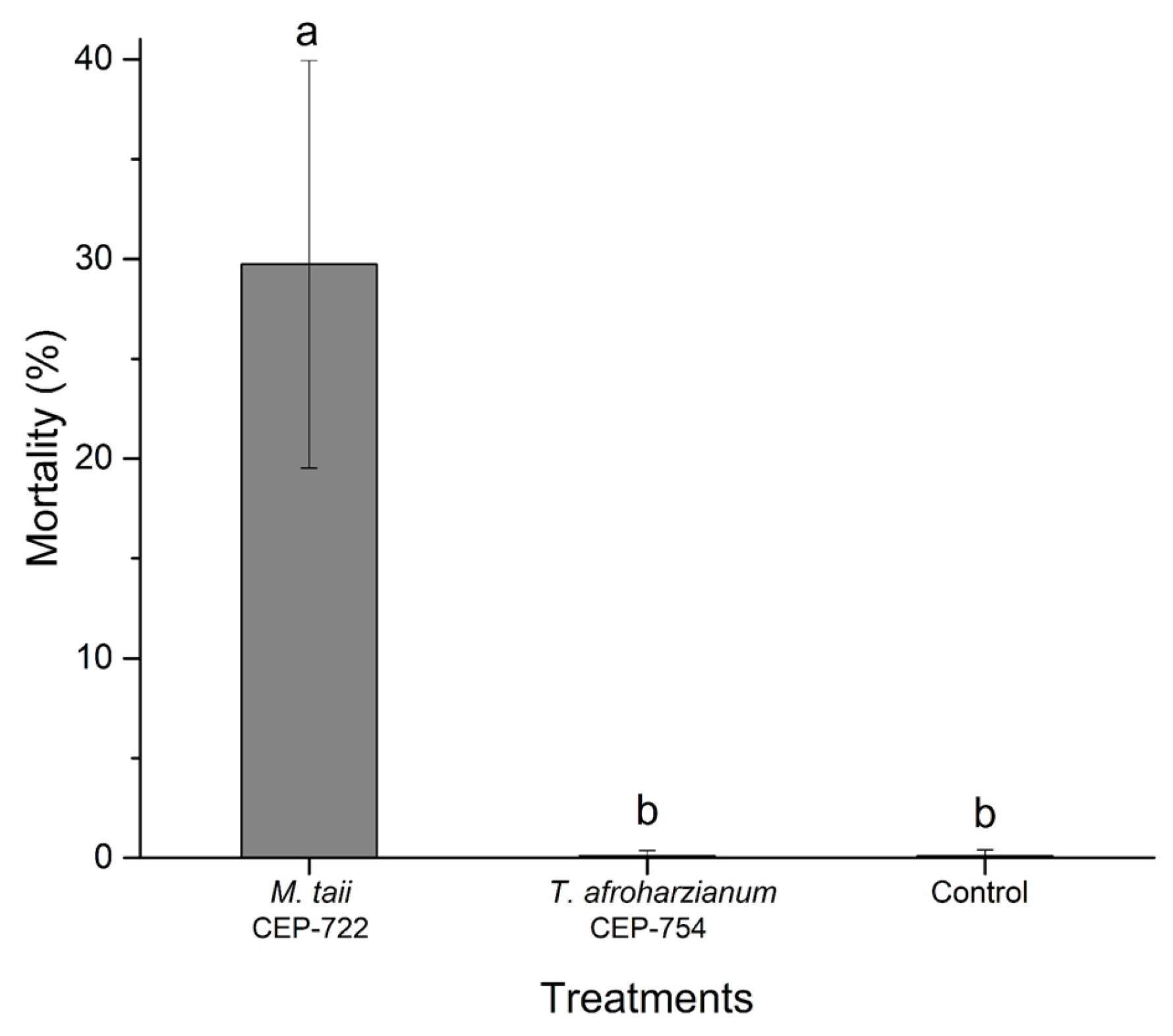
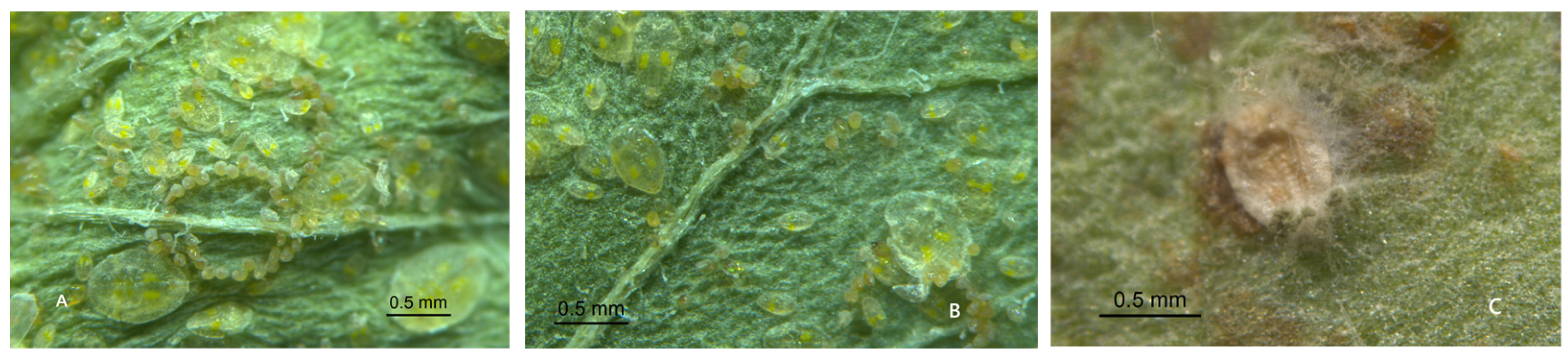
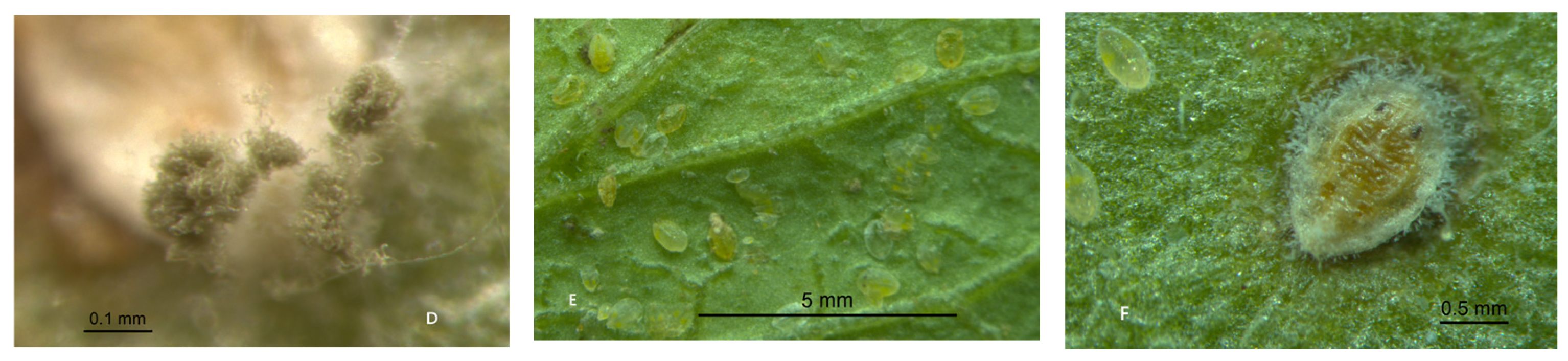
M. taii CEP-722 caused an average mortality rate of 29.73% on B. tabaci nymphs, significantly higher (p < 0.01) than the 0.1% for T. afroharzianum CEP-754 and 0.09% for the control (Figure 2), which is associated with an effect size of 0.915 and statistical power of 0.973. This suggests that M. taii has great potential as a biological control agent for B. tabaci. In the treatment with a conidial suspension of the M. taii CEP-722 isolate, deaths were observed in all immature stages of B. tabaci, except for eggs. In this treatment, fully growing and sporulating mycelium with colors characteristic of the Metarhizium genus were observed. In contrast, nymph development was not affected in colonies treated with conidial suspensions of T. afroharzianum CEP-754. Similarly, in the control treatment, no eggs or dead nymphs of B. tabaci were observed. The natural behavior of B. tabaci colonies during mass rearing of individuals was not affected, corroborated by observing the circular arrangement of the eggs (Figure 3).

4. Discussion

Although some isolates of the genus Trichoderma have demonstrated pathogenic capacity in insects in previous studies [39,40,42], not all species of this genus possess this characteristic. Indeed, the T. afroharzianum CEP-754 strain did not show pathogenicity in immature stages of B. tabaci in this study. Among the secondary metabolites produced by Trichoderma spp. described in the literature, chitinase, protease, and cellulase can be mentioned as secondary metabolites that have a direct effect on the biocontrol capacity of microorganisms [48,49,50]. In this work, no pathogenic effect of immature stages of B. tabaci exerted by T. afroharzianum CEP-754 was observed, possibly because the regulation of secondary metabolites is given by specific elicitors that depend on the type of symbiosis, that is, the species of plant or invertebrate and the species of Trichoderma [51,52,53]. In addition, Trichoderma sp. can exert another form of biocontrol by releasing volatile organic compounds (VOCs), such as 1-octen-3-ol and 6-pentyl-2H-pyran-2-one (6-PP), that can attract parasitoids and predators of insect pests [38]. However, further studies with this strain are needed, employing other application methodologies and targeting other insect species. In a study of promising fungal isolates as entomopathogens, a mortality of 37.8 ± 3.9% of adult and 33.3 ± 3.1% of nymph Frankliniella occidentalis (Pergande, 1895) was reported ten days after the application of conidial suspensions of T. afroharzianum [54]. Although T. afroharzianum is a known pathogen of corn plants (Zea mays L.), its growth-promoting capacity has been demonstrated in other crops such as tomato (S. lycopersicum) and its effect on the management of insect pests. In this context, it is interesting to evaluate the indirect control effect that T. afroharzianum CEP-754 may have on B. tabaci populations at field level, given that it has been reported that inoculation with strains belonging to the T. afroharzianum species are more attractive to predatory and parasitoid insect species of B. tabaci and other invertebrates, which would allow for the implementation of sustainable strategies in the management of agricultural pests [55]. Similarly, in the study conducted by [56] on B. tabaci biotype B, induced resistance in tomato plants was evaluated through treatments with salicylic acid (SA), β-aminobutyric acid (BABA), and particularly Trichoderma, applied individually or in combination. Treatments involving Trichoderma, especially when applied to the roots in combination with SA or BABA, were the most effective in delaying the development of B. tabaci and reducing adult settling and oviposition. Moreover, these treatments enhanced the activity of key defense-related enzymes: polyphenol oxidase (PPO), which catalyzes the oxidation of phenolic compounds; peroxidase (POD), involved in cell wall reinforcement; and phenylalanine ammonia lyase (PAL), essential for the biosynthesis of phenolic metabolites. An increase in leaf phenolic content was also observed. These findings highlight the critical role of Trichoderma as an effective inducer of defense mechanisms in tomato (S. lycopersicum) plants against B. tabaci. In conventional agricultural systems, where chemically synthesized insecticides are constantly applied, implementing predatory and/or parasitoid insects as control agents is challenging, since their efficiency can be affected by the presence of residues from previous insecticide applications. Therefore, the use of entomopathogenic fungi may be favorable in this scenario, since they are more resistant to insecticide residues [57]. As an alternative to chemicals, the use of mycoinsecticides is considered an ecological method for the control of arthropod pests; indeed, an increasing number of fungal strains and isolates are on their way to becoming commercial products available for the market, and their use in sustainable pest control is expanding. Different species of entomopathogenic fungi have been reported as pathogens of B. tabaci [58]. In this sense, the isolate M. taii CEP-722, which presented promising results in both in vitro dual culture tests against the phytopathogens Botrytis cinerea and Sclerotinia sclerotiorum, and in growth promotion tests on tomato plants, could be used within a management plan for B. tabaci in the conventional production of this crop by carrying out laboratory and field studies using formulations containing this microorganism [45]. Indeed, a 30% mortality rate of immature B. tabaci stages caused by the application of a suspension with a spore concentration of 1 × 10⁷ is insufficient to achieve adequate commercial pest control [11]. However, this may be determined by the way the treatments are applied and the environmental conditions under which the study is conducted. M. taii CEP-722 may possibly generate greater mortality in B. tabaci if the applied spore concentration is increased or the environmental conditions under which the study is conducted are regulated. The pathogenic capacity of the isolate M. taii CEP-722 on immature stages of B. tabaci is probably due to the characteristics of some species of the genus Metarhizium as facultative saprophytes. Previous scientific work indicates that this ability allows them to attack arthropods and grow as parasites on their bodies, and in the absence of a suitable host, members of this genus, due to their labile metabolism, can live freely in the rhizosphere, on plants, or survive on inorganic particles in the soil [59,60]. The mode of action of M. taii has been described as interfering with insect development, as it can inhibit the normal growth and maturation of B. tabaci nymphs. This is similar to the effect of spiromesifen, which disrupts lipid metabolism in whiteflies, leading to abnormal development and reduced survival rates [61]. In a scientific paper published in 2024, studies were conducted to promote the growth of tomato plants inoculated with spore suspensions of M. taii CEP-722 and T. afroharzianum CEP-754, with encouraging results [45]. This is important to consider in agricultural pest management strategies, since crop nutrition using microorganisms could influence the capacity of plants to respond to invertebrate attacks. On the other hand, native microorganisms could be a promising alternative to external inocula, potentially reducing production costs and the risk of introducing foreign microorganisms into the environment [62,63,64].

5. Conclusions

The results of pathogenicity tests indicate that Metarhizium taii CEP-722 is pathogenic for all nymphal stages of Bemisia tabaci. In contrast, Trichoderma afroharzianum CEP-754 did not exhibit pathogenicity under the conditions employed in this study. This finding highlights the potential of M. taii CEP-722 as a promising candidate for the biological control of B. tabaci. However, further complementary studies to optimize the inoculum concentrations and application methods in the field are essential. We emphasize that these results are specific to B. tabaci but do not rule out the possibility that these isolates may have differential effects on other invertebrate species. Future studies with higher conidia concentrations than those analyzed here could provide further insight into the pathogenic potential of both M. taii CEP-722 and T. afroharzianum CEP-754, which could significantly affect their efficacy in inducing mortality of this species of whitefly.

Author Contributions

Conceptualization, R.A.V.-P., C.M., E.W. and C.L.-L.; methodology, R.A.V.-P. and C.L.-L.; validation, R.A.V.-P., C.M., E.W. and C.L.-L.; formal analysis, R.A.V.-P. and G.C.; investigation, R.A.V.-P.; writing—original draft preparation, R.A.V.-P., G.C. and P.D.-N.; writing—review and editing, R.A.V.-P., G.C. and P.D.-N.; visualization, A.F.-Q., P.D.-N. and G.C.; supervision, E.W., C.M. and R.A.V.-P.; funding acquisition, R.A.V.-P. All authors have read and agreed to the published version of the manuscript.

Funding

This work was supported by CONICET (doctoral scholarship), Universidad de Buenos Aires, Argentina (UBACYT 20020160100066BA), and the UCT 2025 Environment Connection project “Manejo Fitosanitario Sustentable. Producción Agroecológica de cultivos Frutihortícolas de la región de La Araucanía. Difusión y Capacitación”.

Data Availability Statement

No new data were created or analyzed in this study. Data sharing is not applicable to this article.

Conflicts of Interest

The authors declare no conflicts of interest.

References

  1. Kepngop, L.R.; Wosula, E.N.; Amour, M.; Ghomsi, P.G.; Wakam, L.N.; Kansci, G.; Legg, J.P. Genetic diversity of whiteflies colonizing crops and their associated endosymbionts in three agroecological zones of Cameroon. Insects 2024, 15, 657. [Google Scholar] [CrossRef] [PubMed]
  2. Giorgini, M.; Formisano, G.; García-García, R.; Bernat-Ponce, S.; Beitia, F. The Susceptibility of Bemisia tabaci Mediterranean (MED) Species to Attack by a Parasitoid Wasp Changes between Two Whitefly Strains with Different Facultative Endosymbiotic Bacteria. Insects 2023, 14, 808. [Google Scholar] [CrossRef] [PubMed]
  3. Li, Z.X. Molecular phylogenetic analysis reveals at least five genetic races of Bemisia tabaci in China. Phytoparasitica 2006, 34, 431–440. [Google Scholar] [CrossRef]
  4. Kanakala, S.; Ghanim, M. Global genetic diversity and geographical distribution of Bemisia tabaci and its bacterial endosymbionts. PLoS ONE 2019, 14, e0213946. [Google Scholar] [CrossRef]
  5. Morales, F.J.; Anderson, P.K. The emergence and dissemination of whitefly-transmitted geminiviruses in Latin America. Arch. Virol. 2001, 146, 415–441. [Google Scholar] [CrossRef]
  6. Naranjo, S.E. Conservation and evaluation of natural enemies in IPM systems for Bemisia tabaci. Crop Prot. 2001, 20, 835–852. [Google Scholar] [CrossRef]
  7. Zhang, Y.B.; Castañé, C.; Gabarra, R.; Albajes, R.; Wan, F.H. Host selection by the autoparasitoid Encarsia pergandiella on primary (Bemisia tabaci) and secondary (Eretmocerus mundus) hosts. Insect Sci. 2015, 22, 793–802. [Google Scholar] [CrossRef]
  8. Gelman, D.B.; Hu, J.S. Critical feeding periods for last instar nymphal and pharate adults of the whiteflies, Trialeurodes vaporariorum and Bemisia tabaci. Insect Sci. 2007, 7, 33. [Google Scholar]
  9. Gebremariam, A.; Chekol, Y.; Assefa, F. Extracellular enzyme activity of entomopathogenic fungi, Beauveria bassiana and Metarhizium anisopliae and their pathogenicity potential as a bio-control agent against whitefly pests, Bemisia tabaci and Trialeurodes vaporariorum (Hemiptera: Aleyrodidae). BMC Res. Notes 2022, 15, 117. [Google Scholar] [CrossRef]
  10. Rehman, H.; Bukero, A.; Ghani Lanjar, A.; Bashir, L. Investigation of Varietal Characteristics of Tomato Plants for Determining the Diverse Preferences of Bemisia Tabaci (Aleyrodidea: Hemiptera). Gesunde Pflanz. 2020, 72, 163–170. [Google Scholar] [CrossRef]
  11. Sani, I.; Ismail, S.I.; Abdullah, S.; Jalinas, J.; Jamian, S.; Saad, N. A review of the biology and control of whitefly, Bemisia tabaci (Hemiptera: Aleyrodidae), with special reference to biological control using entomopathogenic fungi. Insects 2020, 11, 619. [Google Scholar] [CrossRef] [PubMed]
  12. Mascarin, G.M.; Kobori, N.N.; Quintela, E.D.; Delalibera Jr, I. The virulence of entomopathogenic fungi against Bemisia tabaci biotype B (Hemiptera: Aleyrodidae) and their conidial production using solid substrate fermentation. Biocontrol 2013, 66, 209–218. [Google Scholar] [CrossRef]
  13. Abubakar, M.; Koul, B.; Chandrashekar, K.; Raut, A.; Yadav, D. Whitefly (Bemisia tabaci) management (WFM) strategies for sustainable agriculture: A review. Agriculture 2022, 12, 1317. [Google Scholar] [CrossRef]
  14. Osborne, L.S.; Landa, Z. Biological control of whiteflies with entomopathogenic fungi. Fla. Entomol. 1992, 75, 456–471. [Google Scholar] [CrossRef]
  15. Katarina, K.O.S.; Tomanović, Ž.; Rojht, H.; Vidrih, M.; Trdan, S. First massive occurrence of greenhouse whitefly parasitoid, Encarsia formosa Gahan (Hymenoptera: Aphelinidae) on greenhouse whitefly, Trialeurodes vaporariorum [Westwood] (Homoptera: Aleyrodidae) in Slovenia. Acta Agric. Slov. 2009, 93, 285–291. [Google Scholar]
  16. Varma, A.; Malathi, V.G. Emerging geminivirus problems: A serious threat to crop production. Ann. Appl. Biol. 2003, 142, 145–164. [Google Scholar] [CrossRef]
  17. Mugiira, R.B.; Liu, S.S.; Zhou, X. Tomato yellow leaf curl virus and Tomato leaf curl Taiwan virus Invade South-east Coast of China. J. Phytopathol. 2008, 156, 217–221. [Google Scholar] [CrossRef]
  18. Ahmed, M.Z.; Ren, S.X.; Mandour, N.S.; Maruthi, M.N.; Naveed, M.; Qiu, B.L. Phylogenetic analysis of Bemisia tabaci (Hemiptera: Aleyrodidae) populations from cotton plants in Pakistan, China, and Egypt. J. Pest Sci. 2010, 83, 135–141. [Google Scholar] [CrossRef]
  19. Li, Y.; Mbata, G.N.; Punnuri, S.; Simmons, A.M.; Shapiro-Ilan, D.I. Bemisia tabaci on vegetables in the Southern United States: Incidence, impact, and management. Insects 2021, 12, 198. [Google Scholar] [CrossRef]
  20. Hidayat, P.; Kurniawan, H.A.; Afifah, L.; Triwidodo, H. Siklus hidup dan statistik demografi kutukebul Bemisia tabaci (Gennadius) (Hemiptera: Aleyrodidae) biotipe B dan non-B pada tanaman cabai (Capsicum annuum L.). J. Entomol. Indones. 2017, 14, 143. [Google Scholar] [CrossRef]
  21. Bellows, T.S., Jr.; Perring, T.M.; Gill, R.J.; Headrick, D.H. Description of a species of Bemisia (Homoptera: Aleyrodidae). Ann. Entomol. Soc. Am. 1994, 87, 195–206. [Google Scholar] [CrossRef]
  22. Perring, T.M. The Bemisia tabaci species complex. Crop Prot. 2001, 20, 725–737. [Google Scholar] [CrossRef]
  23. De Barro, P.D.; Hart, P.J. Mating interactions between two biotypes of the whitefly, Bemisia tabaci (Hemiptera: Aleyrodidae) in Australia. Bull. Entomol. Res. 2000, 90, 103–112. [Google Scholar] [CrossRef] [PubMed]
  24. Samih, M.A.; Zarabi, M.; Yazdani, M.; Rouhani, M. Biological traits and life table parameters A and B biotype of Bemisia tabaci (Genn.) on cotton and rapeseed. Braz. Arch. Biol. Technol. 2014, 57, 309–316. [Google Scholar] [CrossRef]
  25. Alemandri, V.; Martino, J.A.; Di Feo, L.; Truol, G. Indigenous and introduced species of the Bemisia tabaci complex in sweet potato crops from Argentina. Agriscientia 2014, 31, 103–107. [Google Scholar] [CrossRef]
  26. Hilje, L.; Stansly, P.A. Host preference by two Bemisia tabaci biotypes in Costa Rica and Florida. Agron. Mesoam. 2018, 29, 585–595. [Google Scholar] [CrossRef]
  27. Perić, P.; Marčić, D.; Stamenković, S. Natural enemies of whitefly (Trialeurodes vaporariorum Westwood) in Serbia. In Proceedings of the IV Balkan Symposium on Vegetables and Potatoes, Plovdiv, Bulgaria, 9–12 September 2008; Volume 830, pp. 539–544. [Google Scholar]
  28. Faria, M.; Wraight, S.P. Biological control of Bemisia tabaci with fungi. Crop Prot. 2001, 20, 767–778. [Google Scholar] [CrossRef]
  29. Huang, Z.; Ali, S.; Ren, S.X.; Wu, J.H. Effect of Isaria fumosoroseus on mortality and fecundity of Bemisia tabaci and Plutella xylostella. Insect Sci. 2010, 17, 140–148. [Google Scholar] [CrossRef]
  30. Cuthbertson, A.G.; Blackburn, L.F.; Eyre, D.P.; Cannon, R.J.; Miller, J.; Northing, P. Bemisia tabaci: The current situation in the UK and the prospect of developing strategies for eradication using entomopathogens. Insect Sci. 2011, 18, 1–10. [Google Scholar] [CrossRef]
  31. Islam, M.T.; Omar, D.; Shabanimofrad, M. Molecular identification and virulence of six isolates of Metarhizium anisopliae (Deuteromycotina: Hyphomycetes) to Bemisia tabaci Q biotype. J. Asia-Pac. Entomol. 2014, 17, 237–241. [Google Scholar] [CrossRef]
  32. Islam, M.T.; Omar, D.; Shah, A.A.; Hasan, M.F. Virulence of entomopathogenic fungus, Metarhizium anisopliae to Sweetpotato whitefly, Bemisia tabaci (Hemiptera: Aleyrodidae) under osmotic stress. Proc. Natl. Acad. Sci. India B Biol. Sci. 2016, 86, 617–622. [Google Scholar] [CrossRef]
  33. Oreste, M.; Bubici, G.; Poliseno, M.; Tarasco, E. Effect of Beauveria bassiana and Metarhizium anisopliae on the Trialeurodes vaporariorum-Encarsia formosa system. J. Pest Sci. 2016, 89, 153–160. [Google Scholar] [CrossRef]
  34. Musso, A.; Marcondes Almeida, J.E.; Padín, S.B.; Ordoqui, E.; López Lastra, C.C. Eficiencia de hongos entomopatógenos contra Rhyzopertha dominica (Fabricius) (Coleoptera: Bostrichidae) bajo condiciones de laboratorio. Rev. Fac. Cienc. Agrar. Univ. Nac. Cuyo 2020, 52, 317–324. [Google Scholar]
  35. Jeyaram, K.; Singh, W.M.; Capece, A.; Romano, P. Molecular identification of yeast species associated with ‘Hamei’—A traditional starter used for rice wine production in Manipur, India. Int. J. Food Microbiol. 2008, 124, 115–125. [Google Scholar] [CrossRef]
  36. Litwin, A.; Nowak, M.; Różalska, S. Entomopathogenic fungi: Unconventional applications. Rev. Environ. Sci. Biotechnol. 2020, 19, 23–42. [Google Scholar] [CrossRef]
  37. Quesada-Moraga, E.E.A.A.; Maranhao, E.A.A.; Valverde-García, P.; Santiago-Álvarez, C. Selection of Beauveria bassiana isolates for control of the whiteflies Bemisia tabaci and Trialeurodes vaporariorum on the basis of their virulence, thermal requirements, and toxicogenic activity. Biolcontrol 2006, 36, 274–287. [Google Scholar] [CrossRef]
  38. Monte, E. The sophisticated evolution of Trichoderma to control insect pests. Proc. Natl. Acad. Sci. USA 2023, 120, e2301971120. [Google Scholar] [CrossRef]
  39. Anwar, W.; Subhani, M.N.; Haider, M.S.; Shahid, A.A.; Mushatq, H.; Rehman, M.Z.; Hameed, U.; Javed, S. First record of Trichoderma longibrachiatum as entomopathogenic fungi against Bemisia tabaci in Pakistan. Pak. J. Phytopathol. 2016, 28, 287–294. [Google Scholar]
  40. Nasution, L.; Corah, R.; Nuraida, N.; Siregar, A.Z. Effectiveness Trichoderma and Beauveria bassiana on larvae of Oryctes rhinoceros on palm oil plant (Elaeis guineensis Jacq.) in vitro. Int. J. Environ. Agric. Biotechnol. 2018, 3, 239050. [Google Scholar] [CrossRef]
  41. Zhang, X.; Harvey, P.R.; Stummer, B.E.; Warren, R.A.; Zhang, G.; Guo, K.; Li, J.; Yang, H. Antibiosis functions during interactions of Trichoderma afroharzianum and Trichoderma gamsii with plant pathogenic Rhizoctonia and Pythium. Funct. Integr. Genom. 2015, 15, 599–610. [Google Scholar] [CrossRef]
  42. Shakeri, J.; Foster, H.A. Proteolytic activity and antibiotic production by Trichoderma harzianum in relation to pathogenicity to insects. Enzym. Microb. Technol. 2007, 40, 961–968. [Google Scholar] [CrossRef]
  43. Coppola, M.; Cascone, P.; Lelio, I.D.; Woo, S.L.; Lorito, M.; Rao, R.; Pennacchio, F.; Guerrieri, E.; Digilio, M.C. Trichoderma atroviride P1 colonization of tomato plants enhances both direct and indirect defense barriers against insects. Front. Physiol. 2019, 10, 813. [Google Scholar] [CrossRef]
  44. Prota, N. Study of Drimane Sesquiterpenoids from the Persicaria genus and Zigiberene from Callitropsis noorkatensis and Their Effect on the Feeding Behaviour of Myzus persicae and Bemisia tabaci. Ph.D. Thesis, Wageningen University and Research, Wageningen, The Netherlands, 2015. [Google Scholar]
  45. Varela-Pardo, R.A.; López-Lastra, C.C.; Manfrino, R.G.; Balcazar, D.; Mónaco, C.; Wright, E.R. Selection of fungal isolates from Buenos Aires, Argentina, as biological control agents of Botrytis cinerea and Sclerotinia sclerotiorum. Rev. Fac. Cienc. Agrar. Univ. Nac. Cuyo 2024, 56, 72–86. [Google Scholar] [CrossRef]
  46. Abdel-Rahman, A.A.; Kesba, H.H.; Mohamed, H.G.; Kamel, D.F.; Ahmed, F.S. Sublethal concentrations of conventional nematicides alter the physiological activities of Meloidogyne incognita and suppress parasitism. Sci. Rep. 2023, 13, 229. [Google Scholar] [CrossRef] [PubMed]
  47. Sain, S.K.; Kranthi, S.; Kranthi, K.R.; Monga, D.; Paul, D.; Prasad, Y.G. Diversity study of Beauveria bassiana species for finding the most virulent strain to manage Bemisia tabaci in cotton. Appl. Microbiol. Biotechnol. 2024, 108, 364. [Google Scholar] [CrossRef]
  48. Morel, M.; García, S.; Castillo, Y.; Conce, M.; Franco, J.D.D.M.; Reynoso, T.; Núñez, P.; Alonzo, K. Caracterización bioquímica de cepas nativas de Trichoderma spp., endófitas en tomate con potencial de biocontrol de Meloidogyne spp. APF 2021, 10, 57–68. [Google Scholar]
  49. Iglesias-Velasco, S.J.; Chan-Cupul, W.; Osuna-Castro, J.A.; Hernández-Ortega, H.A.; Centeno-Leija, S. Antagonismo in vitro, actividad ligninolítica y de hidrolasas de pared celular en la interacción de especies de Trichoderma spp. con Curvularia eragrostidis aislado de piña. Sci. Fung 2022, 53, e1430. [Google Scholar] [CrossRef]
  50. Andrade-Hoyos, P.; Rivera-Jiménez, M.N.; Landero-Valenzuela, N.; Silva-Rojas, H.V.; Martínez-Salgado, S.J.; Romero-Arenas, O. Beneficios ecológicos y biológicos del hongo cosmopolita Trichoderma spp. en la agricultura: Una perspectiva en el campo mexicano. Rev. Argent. Microbiol. 2023, 55, 366–377. [Google Scholar] [CrossRef]
  51. Andrade-Bustamante, G.; Suarez-Hernandez, A.M.; Aispuro-Hernández, E.; Martínez-Ruiz, F.E. Trichoderma harzianum y espinosina en el control de gorgojo del trigo Sitophilus granarius (L. 1758). Biotecnia 2023, 25, 94–99. [Google Scholar] [CrossRef]
  52. Gomez-Hurtado, K.D. Evaluación de la Susceptibilidad de Diaphorina citri Kuwayama Insecto Vector del HLB Frente a Cepas Fúngicas con Potencial Entomopatógeno en Condiciones In Vitro. 2022. 84p. Available online: https://repositorio.udes.edu.co/entities/publication/b5fde37e-3e46-4c51-a0f2-821d73d448cd (accessed on 12 April 2025).
  53. Landa-Cadena, M.G.; Trigos, Á.; Hernández-Rosas, F.; Salinas-Castro, A. Identificación de hongos entomopatógenos para el control biológcio de Diaphorina citri en árboles de cítricos. Trop. Subtrop. Agroecosyst. 2025, 28, 1–11. [Google Scholar] [CrossRef]
  54. Barasa, M.W.; Gathu, R.K.; Mwangi, M.; Wanjohi, J.W. In Vitro Efficacy of Native Entomopathogenic Fungi Against Western Flower Thrips Frankliniella Occidentalis (Pergande) of Tomato in Kenya. J. Nat. Sci. Res. 2019, 9, 10–7176. [Google Scholar] [CrossRef]
  55. Battaglia, D.; Mang, S.M.; Caccavo, V.; Fanti, P.; Forlano, P. The Belowground–Aboveground Interactions of Zucchini: The Effects of Trichoderma afroharzianum Strain T22 on the Population and Behavior of the Aphid Aphis gossypii Glover and Its Endoparasitoid Aphidius colemani Viereck. Insects 2024, 15, 690. [Google Scholar] [CrossRef]
  56. Jafarbeigi, F.; Samih, M.A.; Alaei, H.; Shirani, H. Induced tomato resistance against Bemisia tabaci triggered by salicylic acid, β-aminobutyric acid, and Trichoderma. Neotrop. Entomol. 2020, 49, 456–467. [Google Scholar] [CrossRef]
  57. Chaudhary, R.; Nawaz, A.; Khattak, Z.; Butt, M.A.; Fouillaud, M.; Dufossé, L.; Munir, M.; ul Haq, I.; Mukhtar, H. Microbial bio-control agents: A comprehensive analysis on sustainable pest management in agriculture. J. Agric. Food Res. 2024, 18, 101421. [Google Scholar] [CrossRef]
  58. Steenberg, T.; Humber, R.A. Entomopathogenic Potential of Verticillium and Acremonium Species (Deuteromycotina: Hyphomycetes). J. Invertebr. Pathol. 1999, 73, 309–314. [Google Scholar] [CrossRef]
  59. Kepler, R.M.; Humber, R.A.; Bischoff, J.F.; Rehner, S.A. Clarification of generic and species boundaries for Metarhizium and related fungi through multigene phylogenetics. Mycologia 2014, 106, 811–829. [Google Scholar] [CrossRef]
  60. Skinner, M.; Parker, B.L.; Kim, J.S. Role of entomopathogenic fungi in integrated pest management. In Integrated Pest Management; Academic Press: Cambridge, MA, USA, 2014; pp. 169–191. ISBN 9780124017092. [Google Scholar]
  61. Kontsedalov, S.; Gottlieb, Y.; Ishaaya, I.; Nauen, R.; Horowitz, R.; Ghanim, M. Toxicity of spiromesifen to the developmental stages of Bemisia tabaci biotype B. Pest Manag. Sci. 2009, 65, 5–13. [Google Scholar] [CrossRef]
  62. Vermelho, A.B.; Moreira, J.V.; Akamine, I.T.; Cardoso, V.S.; Mansoldo, F.R. Agricultural Pest Management: The Role of Microorganisms in Biopesticides and Soil Bioremediation. Plants 2024, 13, 2762. [Google Scholar] [CrossRef]
  63. Delgado-Vergara, C.; Marileo, L.; Tighe-Neira, R.; Medina, L.; Barra, P.J.; Díaz-Navarrete, P.; LeBlanc, J.G.; Inostroza-Blancheteau, C.; Viscardi, S. Native Lactic Acid Bacteria Enterococcus sp. and Lactobacillus sp. Improve Physiological, Biochemical and Fruit Yield of Solanum lycopersicum L. Plants Under Water Deficit. J. Soil Sci. Plant. Nutr. 2025, 25, 4897–4912. [Google Scholar] [CrossRef]
  64. Díaz, P.E.; Aranda, C.; Martínez, O.; Godoy, R.; Gonzales, A.; Valenzuela, E. Characterization of yeast in hapludands soil with biotechnological potential. J. Soil Sci. Plant. Nutr. 2017, 17, 948–965. [Google Scholar] [CrossRef]
Figure 1. (A) Bemisia tabaci eggs, (B) first instar B. tabaci nymph, (C) second instar B. tabaci nymph, (D) third instar B. tabaci nymph, (E) fourth and final instar B. tabaci nymph, (F) adult B. tabaci nymph.
Crops 05 00066 g001
Figure 2. Average percentage of Bemisia tabaci nymphs affected by fungal infection with Metarhizium taii CEP-722 or Trichoderma afroharzianum CEP-754, and/or with visible sporulation for each treatment. Different letters indicate significant differences according to the Kruskal–Wallis test (p ≤ 0.05). Values represent the mean ± SD (n = 105).
Crops 05 00066 g002
Figure 3. (A) Bemisia tabaci eggs in a circular arrangement in the control treatment, (B) colony with all immature stages of B. tabaci after treatment with a conidial suspension of Trichoderma afroharzianum CEP-754, (C) B. tabaci nymph corpse with Metarhizium taii CEP-722 sporulation, (D) detail of M. taii CEP-722 sporulation, (E) B. tabaci colony with M. taii CEP-722 infestation, (F) healthy and infected B. tabaci nymphs.
Crops 05 00066 g003aCrops 05 00066 g003b
Disclaimer/Publisher’s Note: The statements, opinions and data contained in all publications are solely those of the individual author(s) and contributor(s) and not of MDPI and/or the editor(s). MDPI and/or the editor(s) disclaim responsibility for any injury to people or property resulting from any ideas, methods, instructions or products referred to in the content.