


Abstract
Hawaii is known for its diverse micro-climates, making the evaluation of varieties at different locations an important strategy to determine the best varieties for each climate zone. Demand for dry beans in Hawaii has been rising due to the increase in production of value-added goods made from legumes. Initial field trials in 2017 were conducted to determine the best sowing date for dry beans in Hawaii since there were no previous such determinations. Field trials were conducted between 2018 and 2021 to evaluate 24 varieties of chickpea (Cicer arietinum), 21 varieties of common bean (Phaseolus vulgaris), and 10 varieties of cowpea (Vigna unguiculata) for their suitability and yield variability under Hawaii’s micro-climates. Preliminary sowing date trials were conducted in 2017, and a variety of trials were conducted between 2018 and 2021; seven field trials were conducted, including two in each of Oahu, Maui, and Hawaii County, and one in Kauai County. The trials were conducted in a randomized complete block design (RCBD) with three replicates. For all the study sites, 20-20-20 NPK fertilizer was applied at 30, 13, and 25 kg/ha N-P-K, respectively. A drip irrigation system was used in all locations as supplemental irrigation. Irrigation was used when needed and turned off 2 weeks prior to harvest. The results showed highly significant (p < 0.01) differences in yield between the varieties of each legume crop. Highly significant (p < 0.01) differences in yield were also found between the study locations. There was a significant (p < 0.05) decline in yield by 28% and 45% in chickpea and by 32% and 43% in common bean when planted 1 and 2 months, respectively, after the optimal mid-February planting on Oahu and Maui County. A decline of 21% and 50% in chickpea and 30 and 48% in common bean was recorded when planted 1 and 2 months, respectively, after the optimal mid-March planting in Hawaii County. The study results lead to developing site-specific recommendations for varieties and planting dates from each of the legume crops for each county. However, more studies are needed to develop site-specific recommendations for the micro-climates within each county.
1. Introduction
The UN Special Report on “The Right to Food” [1] highlights the role of agro-ecological practices (e.g., on-farm fertility and integrated pest management) in providing food security for the 21st century and beyond. Food security is a critical issue in small states like Hawaii, and reducing imports of agricultural inputs has been a priority of local stakeholders (grower surveys in 2008, 2009, and 2013). Although soil and weather are suitable for year-round production, 80–90% of Hawaii’s food is currently imported, including as much as 100% for dry grains such as legumes. This high rate of importation is due to challenges such as (a) Hawaii’s climate rendering crops more prone to pests and diseases, (b) increasing costs of imported fertilizers and other inputs, (c) urban development pressures occupying prime agricultural land, and (d) community concerns about pesticide use in agriculture near residential areas. In addition, water scarcity and drought cycles are now a growing concern in the Pacific Region [2].
The 68th UN General Assembly identified legumes as critical to ensuring global food security as they require limited water and fertilizer, have high nutritional value, and have the ability to address food security issues worldwide [3,4]. The UN Year of Pulses declaration aims to increase collaboration among organizations and stakeholders, better connections throughout the food chain, expand utilization of plant-based proteins, enhance legume production globally, and promote sustainable agriculture through pulses’ low input requirement and adaptability for different production practices.
Including legumes in crop rotation is a widely used practice worldwide [5]. Cover crops, including legumes, are known to reduce sediment and nutrient losses, improve soil fertility, physical, chemical, and water holding capacity properties, suppress weeds, and reduce production input costs or become an additional source of income [6]. Additionally, leguminous crops play a key environmental role in crop rotation, mainly due to their ability to fix nitrogen levels in the soil, their rooting system, and to suppress and break the life cycle of different pests [7,8].
Two United Nations (UN) international research centers, The International Crops Research Institute for the Semi-Arid Tropics (ICRISAT) and the International Center for Agricultural Research in the Dry Areas (ICARDA), are known for developing genotypes of legume crops for yield, quality, disease resistance, drought tolerance, and different environmental conditions. Another source of genotype diversity for researchers and breeders in the US is the National Plant Germplasm System (NPGS), which offers small seed lots (15–30) for trial. Conducting trials to evaluate Genotype X Environment (G X E) influences is the best strategy to determine suitability of different crops and crop varieties under multiple environments and to develop recommendations for growers [9].
The US is the sixth largest producer of edible dry beans, accounting for about 6% of the total produced worldwide. The US exports 20% of the US-produced edible dry beans, while it imports 14% of the edible dry beans for consumption [10]. Most of the legume crops are known to grow well in warm and dry environments [11,12]. In the late 1960s and early 1970s, the State of Hawaii had ~1,000,000 acres of Class C and D lands suitable to grow legume crops, though at the time it was used primarily for sugarcane and pineapple. The closure of the last sugar plantation and continuous reduction in pineapple production has led to thousands of acres left fallow and available for other crops, with legume crops being a strong contender to bring much of this acreage back into production to increase local food security. Grain legumes are a major source of plant-based proteins, carbohydrates, dietary fibers, and are rich with vitamins and minerals [13], serving as a “meat” substitute in developing countries, low-income families, and vegan diets [14].
Many studies have been conducted around the world to examine the impacts of environmental factors on the production of various legumes including studies on genotype and environment effects on chickpea (Cicer arietinum) and common bean (Phaseolus vulgaris) in Pakistan, Southwestern Ethiopia, and Uganda; and in intercropping systems in Malawi. For details, Qureshi et al. [15] screened 22 genotypes of chickpea for G X E interaction; at four locations with varying climatic conditions in Pakistan, they found a significant effect of the genotypes and locations on chickpea yield. Also, ref. [16] evaluated chickpea breeding lines under various seasons and locations and compared their yield performance to phenomic data collected using aerial imaging techniques. The authors of ref. [17] conducted field trials to determine the best, out of three (Nasir, Goberesha, and Local Asendabo), common bean (Phaseolus vulgaris) variety and their optimum row spacing under the study environmental condition in Southwestern Ethiopia. In Mexico, ref. [18] evaluated 30 common beans (Phaseolus vulgaris), collected from 3 states, for their genetic variability as a source for drought-tolerance genes. In Malawi, ref. [19] evaluated the growth and yield of common bean varieties comparing sole planting and intercropping with maize, finding that there were significant differences between the performance of common bean varieties when intercropped with maize. In Uganda, ref. [20] compared 15 genotypes of common bean on 9 on-farm sites in Uganda, and they found highly significant variability between the genotypes and the trial locations, concluding that the study site had a major effect on the genotypes’ performance. This study was conducted based on the need from the local growers to increase local food production and increase the food and nutritional-security in Hawaii. The overarching goals were to (1) evaluate the suitability of three legume crops to Hawaii’s micro-climates and (2) develop statewide, site-specific recommendations for varieties, from each of the three legumes.
2. Materials and Methods
2.1. Study Crops
Chickpea, common bean, and cowpea are drought tolerant and consequently may have an increasingly important role to play as climate change progresses and water becomes more limited in many places. Legume crops can be stored for a longtime without a decline in their nutritional value, which makes them a major component in food and nutritional-security. Also, there is an increased interest in legumes as the number of businesses producing value-added products using legumes as the main ingredient have been expanding rapidly in Hawaii.
2.1.1. Chickpea (Cicer arietinum)
Chickpea is a highly nutritious grain legume crop. It is the second most important leguminous crop worldwide, producing 12.4 million tons annually (FOA). It contains none of the anti-nutritional or toxic compounds often present in other legumes. It can be eaten raw, roasted, boiled, or processed into hummus, falafel, flour, or other value-added products. Mature chickpea grains contain 60–65% carbohydrates, 6% fat, and between 20 and 30% protein. Chickpea is also a good source of vitamins and minerals, including choline, folate, magnesium, potassium, and iron, and chickpeas are also high in vitamin A, E, and C [21,22]. The chickpea varieties/genotypes used in this study (Kabuli type: Sierra, Dylan, Alma, Orion, Frontier, Sawyer, Turkish, Kabuli1, Kabuli2, Royal, Nash, Ghab3, Rafidain, and Harrer. Desi type: Myles, Green, BGD103, Rajestan, JG11, Jaki, PI583753, PI360279, Noki85th, and Noki1) were obtained from the following sources: the beans program at Montana State University, USA-ARS researchers pulse program, the National Plant Germplasm System (NPGS), and Research Centers in India and the Middle East. The chickpea varieties were obtained/selected from different geographical locations (USA, India, and Middle East) in order to achieve a higher genotype variability to ensure a better selection of most suitable varieties/genotypes for Hawaii.
2.1.2. Common Bean (Phaseolus vulgaris)
Common Bean is one of the most economically and nutritionally important crops worldwide. It contains thiamin, riboflavin, niacin, vitamin B6,folic acid, and is rich with potassium, calcium, magnesium, zinc, copper, and iron, with an economic value over $14 billion annually [23]. It is the most important grain legume for direct human consumption, with almost 30.2 million metric tons produced in 2019—more than twice that of the next most important legume, chickpea [3,4]. Beans are an environmentally diverse crop, grown in temperate and sub-tropical environments from sea level to more than 3000 m above sea level and consumed as fresh pods or as dry beans, making them an important protein source worldwide. The varieties of common bean used in this study (Mayocoba, Gancho, Black Coco, Dragon Tongue, Black Turtle, Appaloosa, Black Bean, Vermont Appaloosa, Cranberry, Rockwell, Kenearly Yellow Eye, Tiger’s Eye, Jumbo Roman, Tongue of Fire, Anasazi, HidastaRed, Anasazi Heirloom, Cannellani, Dominican Red Speckled, Kebarika, and Pink Bean) were obtained from various seed companies, including Siskiyou Seeds, Elegant Beans and Beyond, Harris Seeds, Johnny’s Selected Seeds, Amazon, eBay, Etsy, and others. Similar to the chickpea varieties, the common bean varieties were selected from different geographical locations within the USA in order to obtain higher genotype variability in the common bean.
2.1.3. Cowpea (Vigna unguiculata)
Cowpea is a widely grown and used crop in many developing countries. It contains about 30% protein and is rich with vitamins and minerals including vitamins A, B1, B2, B3, B5, B6, C, and folic acid as well as iron, calcium, magnesium, selenium, zinc, copper, and phosphorus [24]. The world produces 2.9 million tons of cowpea annually, which is consumed as food in different ways, and it is also used as green manure and animal feed [24,25]. Worldwide protein intake from cowpea seeds is considered comparable to that from the common bean, and cowpea is often called “vegetable meat” [26]. The varieties of cowpea used in this study (Big Boy, Kiawah, Colosus, QP Pinkeye, Coronet, TP Pinkeye, Dixie Lee, Zipper Cream, Hercules, and TP Brown) were obtained from various seed companies, including Siskiyou Seeds, Harris Seeds, Amazon, eBay, Etsy, and others. Similar to chickpea varieties and common bean varieties, the cowpea varieties were selected from different geographical locations within the USA in order to obtain higher genotype variability in cowpea.
2.2. Study Site
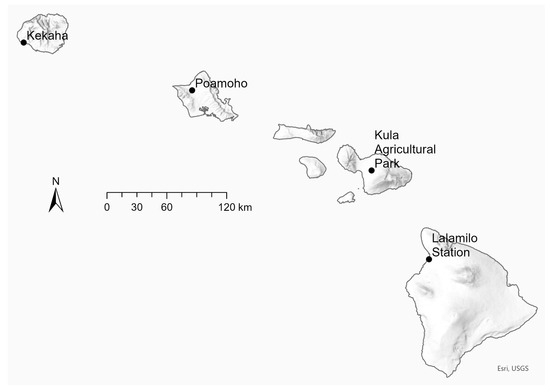
Four locations (Figure 1 and Table 1) were selected to conduct the field trials. The study sites selection was based on a wider preliminary study in 2017, which included research stations with higher rainfall. The preliminary study was conducted to determine the best sowing date and was conducted at 7 locations; 3 locations were eliminated due to high disease infection rate in beans which lead to failure of crops. The preliminary study was conducted using 5 varieties of chickpea and common bean. Based on the previous results, unsuitable locations (mainly those with high rainfall conditions) were eliminated. The 4 study locations are different in soil type, annual rainfall, maximum and minimum temperature, and elevation (Table 1). Thisstudy wasconducted at (1) Poamoho Research Station on Oahu County with 889 mm annual rainfall, 19 °C minimum temperature, 28 °C maximum temperature, and Wahiawa series (Very-fine, kaolinitic, isohyperthermic Rhodic Haplustox), (2) Lalamilo Research Station on Hawaii County with 1270 mm annual rainfall, 15 °C minimum temperature, 23 °C maximum temperature, and Waimea series (Medial, amorphic, isothermic Humic Haplustands), (3) Kula Agricultural Park on Maui County with 635 mm annual rainfall, 16 °C minimum temperature, 27 °C maximum temperature, and Keahua series (Fine, kaolinitic, isohyperthermic Torroxic Haplustoll), and (4) Beck’s Superior Hybrids Seed Company on Kauai County with 584 mm annual rainfall, 19 °C minimum temperature, 29 °C maximum temperature, and Kekaha series (Very-fine, parasesquic, isohyperthermic Typic Haplocambids).
Figure 1.
Study site locations on each county in Hawaii.
Table 1.
Study site locations, annual rainfall, average minimum and maximum temperatures and soil type.
2.3. Planting–Harvesting Dates and Experimental Design
A preliminary study was conducted in 2017 to determine the best sowing date for chickpea, common bush bean, and cowpea in Hawaii. The preliminary sowing dates were conducted since there was no record of the best sowing date for dry beans in Hawaii. The preliminary study included sowing dates once a month from January to May 2017. The results showed the best sowing dates for Oahu and Maui County were between mid-February and late-March, while it was between mid-March and mid-April for Hawaii County. For all locations, the best harvesting dates were between early-June and mid-July.
Rotation of Poaceae/Leguminaceae crops was followed in this study. Three or four months prior to each planting time, sudex (hybrid of Sorghum and Sudangrass (Sorghum bicolor [L.] Moench × S. sudanense [P.] Staph.)) was planted at all the University of Hawaii’s research stations on Oahu, Maui, and in Hawaii County, while corn (Zea mays) was planted prior to the legumes at the study site in Kauai County. The sudex was mowed and tilled a month prior to planting the bean seeds. Corn, in Kauai County, was harvested and crop residue was tilled prior to planting the legumes.
The variety trials were conducted between 2018 and 2021 in a randomized complete block design (RCBD) with three replicates for all trials (except Kauai). Due to COVID-19 pandemic lockdowns and travel restrictions in 2020, only one replicate of chickpea and common bean varieties/genotypes was planted in Kauai County. Unfortunately, the seed company in Kekaha was closed in 2021 and it was not possible to repeat the trial. So, the data presented in this study from Kauai County are considered observational only. Each variety was direct seeded in 3 m long rows in each replicate, with seeds planted at the rate of 3–4 seed/30 cm. Drip irrigation lines were used at each location. Irrigation was provided as a supplement to ensure a successful growing season. In the first month after planting, irrigation was provided when needed only for 60 min up to 3 times a week. The irrigation was reduced to 30 min up to 3 times a week in the 2nd month when needed and reduced to 15 min up to 2 times a week in the 3rd month; then, irrigation was turned off 2 weeks prior to harvest. Seeds were treated with Captan fungicide at the recommended rate to improve the seeds’ germination rate and protect the young seedlings. Due to expected interference between the fungicide and rhizobium inoculant, a mix of rhizobium inoculant (N-Dure Legume inoculant) was applied after seeds germinated. The inoculant was obtained from the following sources: Johnny’s Selected Seeds, Harris Seeds, Amazon, and eBay.
Prior to each field trial, soil samples’ nutrient content was tested at the University of Hawaii Agricultural Diagnostic Services Center (ADSC). Nitrogen (N) was applied at 30 kg/ha application rate using 20-20-20 N-P-K fertilizer. Since phosphorus (P) and potassium (K) soil content were within the sufficient [27] level (45–70 and 140–170 parts per million (ppm) for P and K, respectively), the amount of P and K provided (13 and 25 kg/ha, respectively) from the same amount of fertilizer was not adjusted. The low application rate of nitrogen was meant to encourage nodulation and natural fixation of nitrogen. During each growing season and at harvest, successful nodulation was determined visually on the roots of each legume/variety tested in this study. Weeding and other agronomic activities were conducted based on the need of each location.
2.4. Statistical Analysis
An Analysis of Variance (ANOVA), Statistix v.10. (https://www.statistix.com, accessed on 20 October 2022, Analytical Software, Tallahassee, FL, USA), was conducted to determine variability level (not-significant, significant, or highly significant) between the varieties of each legume crop at each location. In a separate analysis as split-plot design (location set as the main-plot and varieties as the sub-plots), data were used to determine the effect of location on the 3 legume crops. The Tukey Honestly Significant Difference (HSD) test (alpha = 0.05) was used to identify the differences among treatment varieties of each crop at each replicated location. Note that Kauai County data was excluded from all analyses due to the lack of replication.
3. Results and Discussion
The analysis of yield data for all three species at each replicated location showedhighly significant treatment effects (p < 0.01) from variety, study location, and their interaction (G X E) (Table 2). Since the results obtained from two growing seasons were very similar in pattern and did not show a significant difference between the years, an average of the two seasons was used to run the data analysis.
Table 2.
ANOVA results, including location as split-plot, showing source of variation (S.O.V), degree of freedom (D.F.), and significance level for the three legume crops tested in this study.
The results showed that some varieties of each crop performed differently under each of the study conditions and some varieties showed similar yield across locations (Table 3, Table 4 and Table 5), which lead to developing site-specific recommendations for each county.
Table 3.
Dry seed yield of 24 chickpea varieties/genotypes (g of dry seeds/3m plot) tested in this study across 4 locations.
Table 4.
Dry seed yield of 21 common bean varieties/genotypes (g of dry seeds/3m plot) tested in this study across 4 locations.
Table 5.
Dry seed yield of 10 cowpea varieties/genotypes (g of dry seeds/3m plot) tested in this study across 3 locations.
3.1. Effect of Sowing (Planting) Date and Crop Rotation on Legume Yield
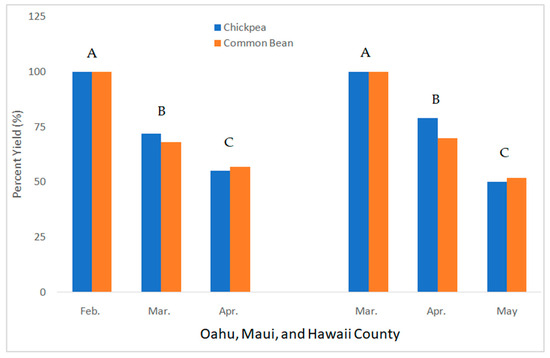
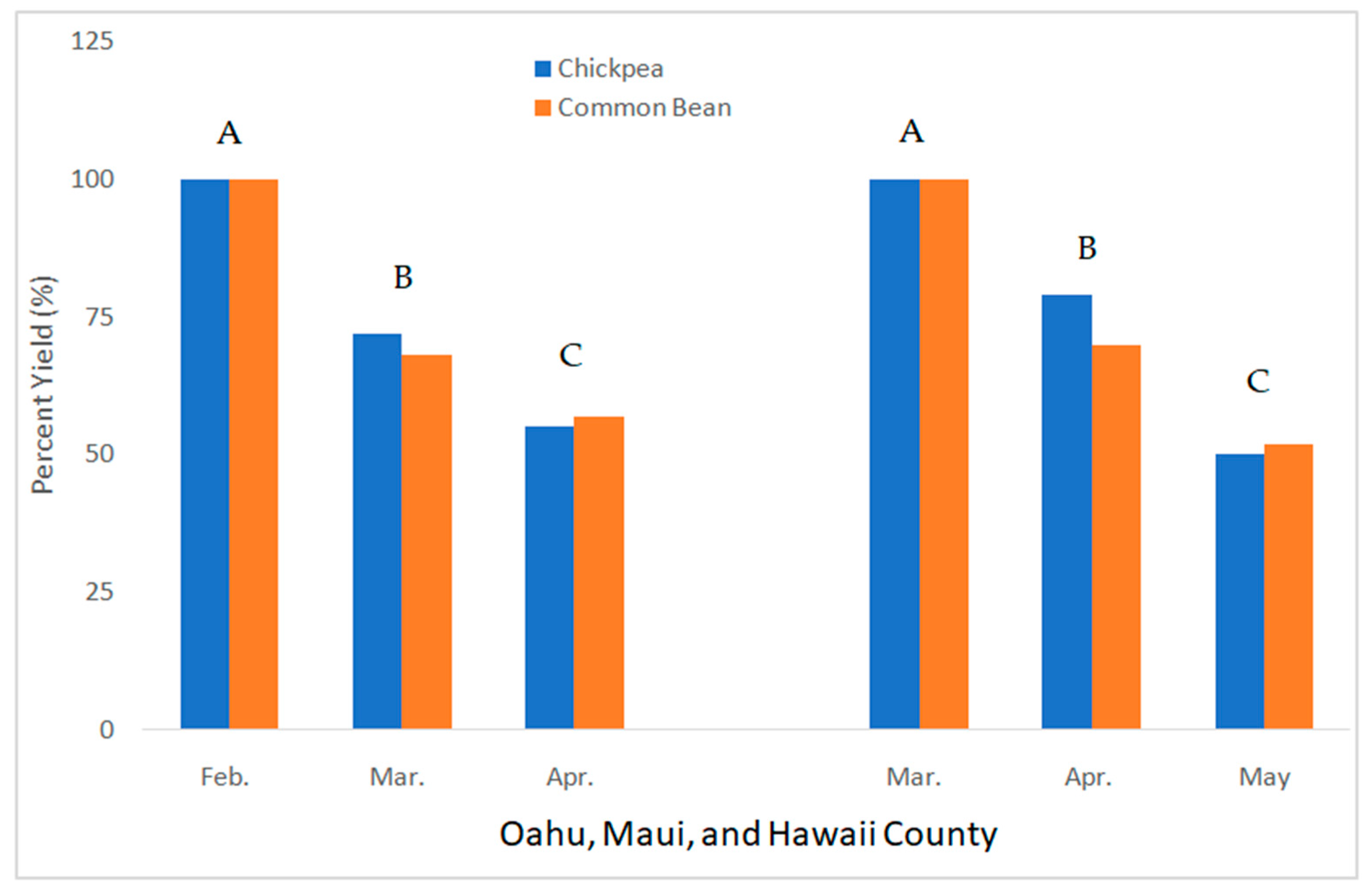
The initial sowing date trial results showed that the best sowing date for Oahu and Maui County was the month of February, while the month of March was the best for Hawaii County (Figure 2). A delay of 1 and 2 months in the sowing date (March and April for Oahu and Maui County) caused a significant (p < 0.05) decline in the yield, 72% and 55% in chickpea and 68% and 57% in common bean, respectively, compared to the optimum sowing date which was considered 100% yield.
Figure 2.
Decline in chickpea and common bean yield (%) due to delay from the optimum sowing date by delaying plaiting 1 and 2 months, respectively. Yield percentage (bars) followed by different letters are significantly different at 0.05 probability based on Tukey’s mean separation test. A, B, and C are Tukey’s mean separation letters. The results were the same under chickpea and common bean. So, one letter was used.
The delay of 1 and 2 months in the sowing date (April and May for Hawaii County) caused a decline in the yield, 79% and 50% in chickpea and 70% and 52% in common bean, respectively, compared to the optimum sowing date. However, there was no significant effect of sowing date on cowpea yield (unpublished data). These results presented in Figure 2 were similar to what [28,29] found in common bean and corn yield decline after delaying the sowing date beyond the recommended dates. Although there was no testing of sowing date on Kauai County, the average maximum and minimum temperature and rainfall on Kauai were similar to the Oahu and Maui County study locations (Table 1). Additionally, the crop rotation with a cover crop (sudex) led to fewer pest issues (mealy bug, root-knot nematode, and cut worms) in the study locations (data not presented) compared to the preliminary trials prior to the implementation of the crop rotation.
3.2. Effect of Genotype X Environment on Chickpea Yield
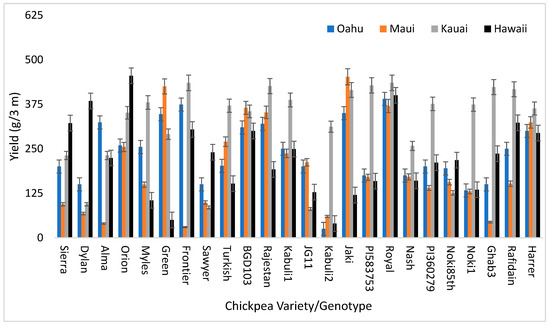
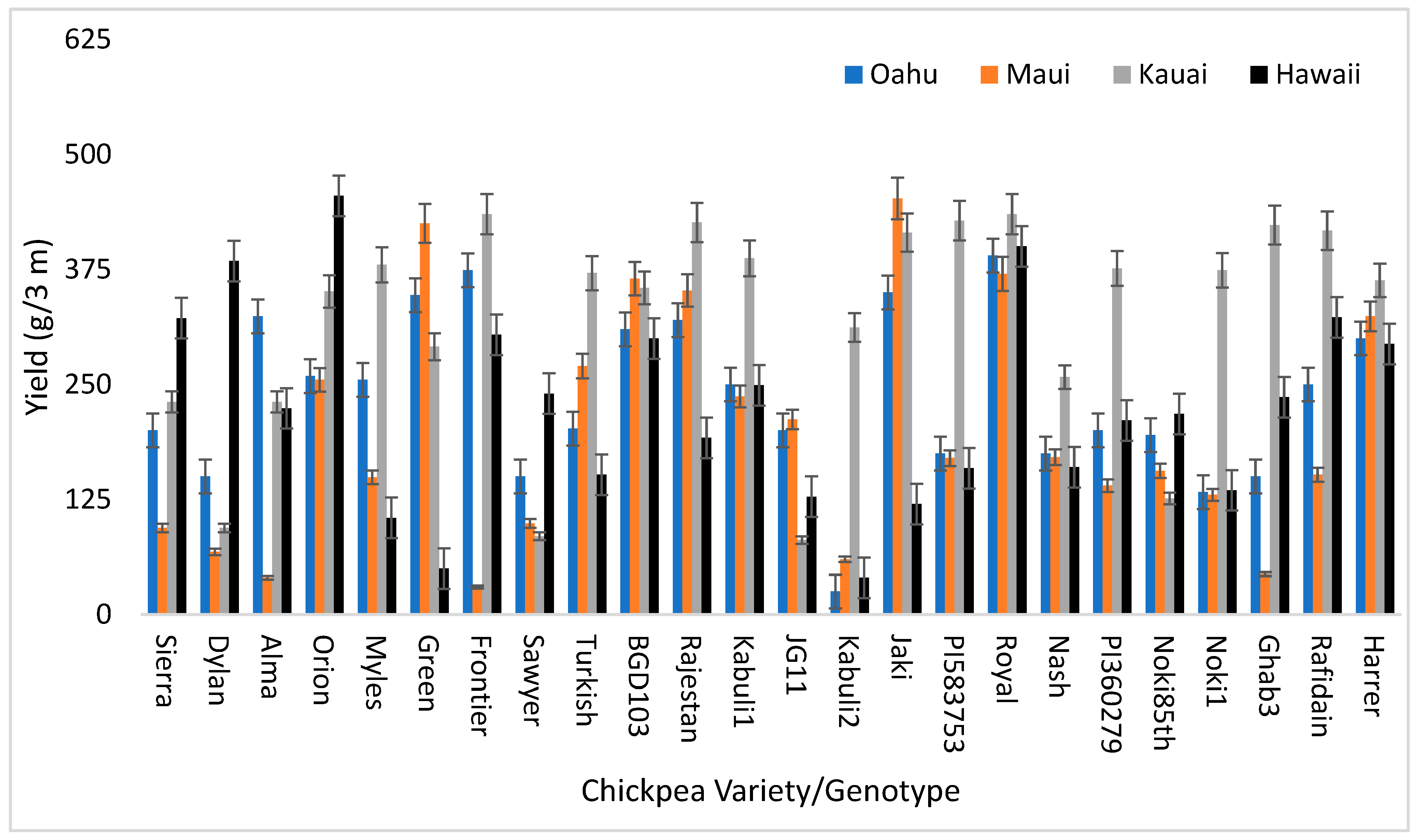
The results showed a highly significant (p < 0.01) difference among the chickpea varieties and genotypes (Table 3). Also, Hawaii’s micro-climates had a highly significant effect (p < 0.01) on the chickpea varieties and genotypes yield. The lowest yield was 30 g of chickpea seeds from Frontier varieties in Maui County, while the highest was 455 g of chickpea seeds from the Orion variety in Hawaii County. In general, chickpea varieties Rajestan, JG11, BGD103, Harrer, and Royal performed similarly across the study locations (Figure 3). However, the best performing varieties and genotypes were different for each location. Royal was among the highest yielding statewide, with 390, 370, 435, and 400 g for Oahu Maui Kauai, and Hawaii County, respectively.
Figure 3.
Effect of Genotype X Environment on the 24 varieties/genotypes of chickpea tested in this study under 4 locations.
On Oahu County, Royal, Frontier, and Jaki were the best yielding varieties. On Maui County, Jaki, Green, and Royal were the best yielding varieties. On Hawaii County, Orion, Royal, and Dylan were the best yielding varieties. On Kauai County, Frontier, Royal, and Rajestan were the best yielding varieties (Figure 3). However, Kauai County results need to be repeated to confirm the first-year results. The study findings of significant variability among the chickpea varieties and significant difference between the growing locations agree with what [15,16,21,22] found in evaluating different chickpea varieties and genotypes at different locations, i.e., a significant difference between the genotypes and location effect on chickpea yield. Genetic variability in the varieties/genotypes and climate condition are believed to cause the significant effect on chickpea yield [15,21]. The study results have led to site-specific recommendations of varieties/genotypes of chickpea for each of the study locations in Hawaii.
3.3. Effect of Genotype X Environment on Common Bean Yield
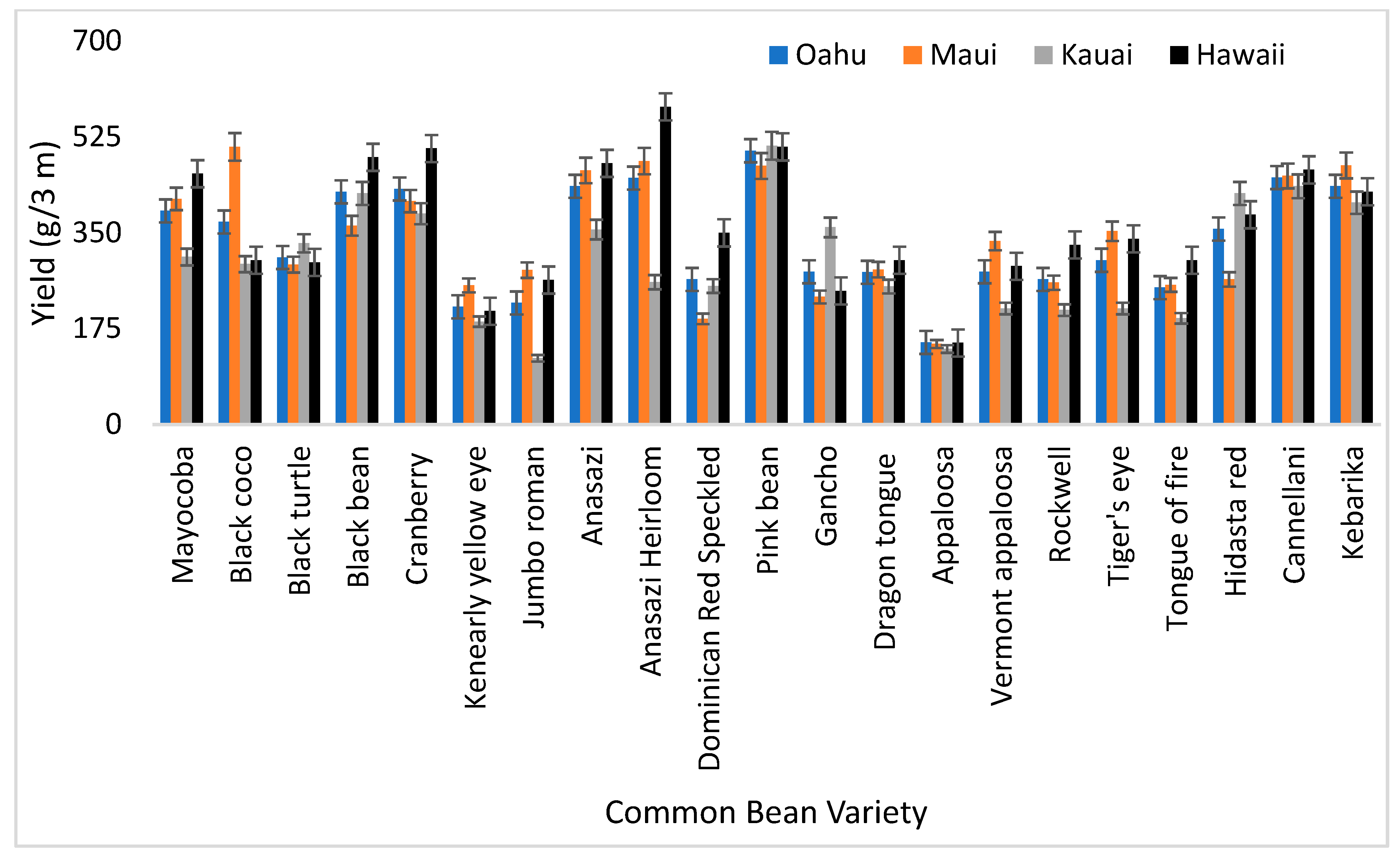
The results showed, similarly to the chickpea data, that there were highly significant (p < 0.01) differences between the common bean varieties. Also, the results showed that the study location, similarly to the chickpea results, had a highly significant (p < 0.01) effect on the varieties’ performance. The lowest yield was from Jumbo Roman (121 g) on Kauai County and the highest was from Anasazi Heirloom (580 g) on Hawaii County. The Appaloosa variety was among the lowest yielding across locations (150, 147, 138, and 149 g for Oahu Maui Kauai, and Hawaii County, respectively). While Pink Bean varieties’ yield was among the highest across locations (500, 472, 509, and 507 g for Oahu Maui Kauai, and Hawaii County, respectively) (Figure 4 and Table 4).
Figure 4.
Effect of Genotype X Environment on the 21 varieties of common bean tested in this study under 4 locations.
On Oahu County, Pink Bean, Cannellani, and Anasazi Heirloom were the best yielding varieties. On Maui County, Black Coco, Anasazi Heirloom, and Pink Bean were the best yielding varieties. On Hawaii County, Anasazi Heirloom, Cranberry, and Pink Bean were the best yielding varieties. On Kauai County, Pink Bean, Cannellani, and Black Bean were the best yielding varieties (Figure 4 and Table 4). However, Kauai County results need to be repeated to confirm the first-year results. The study results are in agreement with what [19,20,29] found in their study of G X E effect on common bean yield, where they found a significant effect of G X E on the growth and yield of various common bean varieties under the studies conditions. The differences among these study sites in temperature, rainfall, elevation, and soil type (Table 1) are believed to have influenced the significant results between the varieties and locations [20].
3.4. Effect of Genotype X Environment on Cowpea Yield
The results, similar to what was found in the chickpea and common bean data, showed a highly significant (p < 0.01) differences between the cowpea varieties and the study location effect on the cowpea variety yield. The lowest yield was from TP Brown with 120 g on Maui County and the highest was from Coronet with 825 g on Hawaii County (Figure 5 and Table 5). On Oahu County, Coronet, Kiawah, and Zipper Cream varieties were the best yielding. On Maui County, Kiawah, Dixie Lee, and Coronet were the best yielding varieties. On Hawaii County, Coronet, TP Pinkeye, and Zipper Cream were the best yielding varieties (Figure 5 and Table 5). The cowpea varieties Big Boy and QP Pinkeye were among the lowest yielding varieties statewide. However, there was no highest performing variety statewide.
Figure 5.
Effect of Genotype X Environment on the 10 varieties of cowpea tested in this study under 3 locations.
The results presented here in Figure 5, which showed a clear response and variability in yield between the varieties at the three study locations, are similar to the findings of [26,30,31]. Additionally, ref. [32] found that the percentage of cowpea genotype yield was influenced by 63.98%, 2.66%, and 16.30% based on the growing environment, genotype variability, and genotype by environment, respectively, using the additive main effect and multiplicative interaction (AMMI) model. This study’s results have showed a clear significant effect of the genotype and growth environment on the yield of cowpea under the study conditions.
4. Conclusions
Genetic variability and the environmental effect are highly relevant for the selection of legume crops in order to achieve optimum yield. Site-specific recommendations are needed to ensure a successful growing season in Hawaii. Generally, in this study, it was clear that Desi type chickpea varieties and genotypes performed better in the higher rainfall locations and Kabuli type chickpea varieties and genotypes performed better in the lesser rainfall locations. However, common bean and cowpea varieties did not show a similar response as the chickpea. This might be related to the wider geographical genotype source in chickpea (USA, India, Middle East) varieties/genotypes obtained, while common bean and cowpea were obtained from the US. The study results were helpful in developing two types of recommendations: (1) site-specific recommendations for best performing varieties/genotypes for each of the study locations, and (2) statewide recommendations for varieties/genotypes which performed similarly across locations. With suitable varieties and proper sowing times, valuable legume crops can be grown across the Hawaiian Islands.
Author Contributions
Conceptualization, A.A.A., T.J.K.R., K.-H.W., H.V.N. and S.W.; methodology, A.A.A., T.J.K.R., K.-H.W., J.U., E.K. and K.T.; software, A.A.A. and K.-H.W.; validation, A.A.A., K.-H.W., H.V.N., T.J.K.R. and M.K.; formal analysis, A.A.A., K.-H.W., T.J.K.R. and M.K.; investigation, A.A.A., T.J.K.R., K.-H.W., S.W., K.T., E.K. and J.U.; resources, everyone (all authors were the extramural fund members); data curation, A.A.A., K.T., S.W., J.U., K.-H.W., T.J.K.R., E.K. and H.V.N.; writing—original draft preparation, A.A.A., T.J.K.R., H.V.N., E.K. and M.K.; writing—review and editing, all authors contributed to reviewing/editing; visualization, everyone (all authors contributed); supervision, A.A.A. and T.J.K.R.; project administration, everyone (all authors since all were extramural fund members); funding acquisition, all authors were part of the proposal preparation and acquiring the fund. All authors have read and agreed to the published version of the manuscript.
Funding
This research was funded by the Specialty Crop Block Grant Program (SCBGP) of Hawaii Department of Agriculture, grant number 64183.
Data Availability Statement
The data for this research are available via request only due to the size of data and privacy of the secured storage location.
Acknowledgments
The authors would like to thank the National Plant Germplasm System (NPGS) for providing seeds of some varieties/lines of chickpea and bush bean tested in this project. The authors would also like to thank the managers and farm crew at each of the study locations for all the help they provided in field preparations, crop maintenance, and harvest tasks.
Conflicts of Interest
The authors declare no conflicts of interest.
References
- DeSchutter, O. Special Rapporteur on the Right to Food. 2012. Available online: https://www.ohchr.org/en/special-procedures/sr-food (accessed on 16 March 2020).
- Annamalai, H.; Keener, V.; Widlansky, M.J.; Hanfer, J. El Nino Strengthen in the Pacific: Preparing for the Impact of Drought; Asia Pacific Issues, East-West Center: Honolulu, Hawaii, 2015; N. 122; Available online: https://reliefweb.int/sites/reliefweb.int/files/resources/api122.pdf (accessed on 16 March 2020).
- FAO. The International Year of Pulses Final Report. 2019. Available online: https://www.fao.org/3/CA2853EN/ca2853en.pdf (accessed on 16 March 2020).
- FAO. The State of Food Insecurity in the World. Addressing Food Insecurity in Protracted Crises. 2010. Available online: https://www.fao.org/3/i1683e/i1683e.pdf (accessed on 16 March 2020).
- Yadav, S.; Kanwar, R.S. Effect of Crop Rotation with Legumes and Some Other Crops on Soil Health and Population of Heteroderaavenae. Indian J. Nematol. 2019, 49, 44–52. [Google Scholar]
- Fageria, N.K.; Baligae, V.C.; Bailey, B.A. Role of Cover Crops in Improving Soil and Row Crop Productivity. Commun. Soil Sci. Plant Anal. 2005, 36, 2733–2757. [Google Scholar] [CrossRef] [Scilit]
- Tylka, G.L.; Gebhart, G.D.; Marett, C.C.; Mullaney, M.P. Evaluation of Soybean Varieties Resistant to Soybean Cyst Nematode in Iowa. Iowa State University. 2021. Available online: https://store.extension.iastate.edu/product/Evaluation-of-Soybean-Varieties-Resistant-to-Soybean-Cyst-Nematode-in-Iowa-2021 (accessed on 20 December 2022).
- Crop Life International. Integrated Pest Management. Crop Life International, Belgium. 2014. Available online: https://croplife.org/wp-content/uploads/pdf_files/Integrated-pest-management.pdf (accessed on 16 March 2020).
- Shrestha, S.; Asch, F.; Dusserre, J.; Ramanantsoanirina, A.; Brueck, H. Climate effects on yield components as affected by genotypic responses to variable environmental conditions in upland rice systems at different altitudes. Field Crops Res. 2012, 134, 216–228. [Google Scholar] [CrossRef] [Scilit]
- Minor, T.; Bond, J.K. Vegetables and Pulses Outlook. USDA-Economic Research Service. 2017. Available online: https://www.ers.usda.gov/webdocs/outlooks/83350/vgs-358.pdf?v=20.2 (accessed on 16 March 2020).
- Gezahegn, A.M.; Tafes, B.; Eshetu, S. Boosting Chickpea Production by Optimizing Inter-Row and Intra-row Spacing at Central Highlands of Ethiopia. Int. J. Agron. 2022, 2022, 4139645. [Google Scholar] [CrossRef] [Scilit]
- Fageriaa, N.K.; Baligarb, V.C.; Moreirac, A.; Portesd, T.A. Dry Bean Genotypes Evaluation for Growth, Yield Components and Phosphorus Use Efficiency. J. Plant Nutr. 2010, 33, 2167–2181. Available online: http://www.informaworld.com/smpp/title~content=t713597277 (accessed on 16 March 2020). [CrossRef] [Scilit]
- Langyan, S.; Yadava, P.; Nazish Khan, F.; Dar, Z.A.; Singh, R.; Kumar, A. Sustaining Protein Nutrition Through Plant-Based Foods. Front. Nutrition 2022, 18, 772573. [Google Scholar] [CrossRef] [Scilit]
- Pietrysiak, E.; Smith, D.M.; Smith, B.M.; Ganjyal, G.M. Enhanced functionality of pea-rice protein isolate blends through direct steam injection processing. Food Chem. 2018, 243, 338–344. [Google Scholar] [CrossRef] [Scilit] [PubMed]
- Qureshi, S.T.; Yasmeen, A.; Abassi, A.R.; Qureshi, A.S.; Gafoor, A.; Memon, M.; Soomro, N. Evaluation of Chickpea Genotypes Under Different Environments for Stability of Quantitative Traits. Sindh Univ. Res. J. 2015, 47, 559–562. [Google Scholar]
- Zhang, C.; McGee, R.J.; Vandemark, G.J.; Sankaran, S. Crop Performance Evaluation of Chickpea and Dry Pea Breeding Lines Across Seasons and Locations Using Phenomics Data. Front. Plant Sci. 2021, 12, 640259. [Google Scholar] [CrossRef] [Scilit]
- Merga, J.T. Evaluation of common bean varieties (Phaseolus vulgaris L.) to different row-spacing in Jimma, South Western Ethiopia. Heliyon 2020, 6, e04822. [Google Scholar] [CrossRef] [Scilit] [PubMed]
- Peña-Ortega, M.G.; Serrano-Covarrubias, L.M.; Martínez-Solís, L. Exploration of Genetic Variability of Bean (Phaseolus vulgaris L.) Landraces through ISSR Markers. Athens J. Sci. 2014, 1, 165–174. [Google Scholar] [CrossRef] [Scilit]
- Nkhata, W.; Shimelis, H.; Chirwa, R. Productivity of Newly Released Common Bean (Phaseolus vulgaris L.) Varieties Under Sole Cropping and Intercropping with Maize (Zea mays L.). Front. Plant Sci. 2021, 5, 741177. [Google Scholar] [CrossRef] [Scilit]
- Katuuramu, D.N.; Luyima, G.B.; Nkalubo, S.T.; Wiesinger, J.A.; Kelly, J.D.; Cichy, K.A. On-farm multi-location evaluation of genotype by environment interactions for seed yield and cooking time in common bean. Sci. Rep. 2020, 10, 3628. Available online: https://www.nature.com/articles/s41598-020-60087-2 (accessed on 27 December 2021). [CrossRef] [Scilit]
- Yegrem, L.; Mengestu, D.; Legesse, O.; Abebe, W.; Girma, N. Nutritional compositions and functional properties of New Ethiopian chickpea varieties: Effects of variety, grown environment and season. Int. J. Food Prop. 2022, 25, 1485–1497. [Google Scholar] [CrossRef] [Scilit]
- Namvar, A.; Sharifi, R.S.; Khandan, T. Growth analysis and yield of chickpea (Cicer arietinum L.) in relation to organic and inorganic nitrogen fertilization. Ekologija 2011, 57, 97–108. [Google Scholar] [CrossRef] [Scilit]
- Garden-Robinson, J.; McNeal, K. All About Beans. North Dakota State University. 2019. Available online: https://www.ndsu.edu/agriculture/sites/default/files/2022-06/fn1643.pdf (accessed on 16 March 2020).
- Singh, B.B. Cowpea: The Food Legume of the 21st Century. ASA, CSSA, and SSSA Books; Wiley: Madison, WI, USA, 2014; 192p. [Google Scholar]
- Srinivas, J.; Kale, V.S.; Nagre, P.K. Evaluation of Different Cowpea Varieties and Genotypes. Int. J. Pure Appl. Biosci. 2017, 5, 329–334. [Google Scholar] [CrossRef] [Scilit]
- Agbogidi, O.M.; Egho, E.O. Evaluation of eight varieties of cowpea (Vigna unguiculata (L.) Walp) in Asaba agro-ecological environment, Delta State, Nigeria. Eur. J. Sustain. Dev. 2012, 1, 303–314. [Google Scholar] [CrossRef] [Scilit]
- Deenik, J.; McClellan, A.T. Soils of Hawaii. College of Tropical Agriculture and Human Resources, University of Hawaii at Manoa. 2007. Available online: https://www.ctahr.hawaii.edu/oc/freepubs/pdf/scm-20.pdf (accessed on 16 March 2020).
- Kavut, Y.T.; Geren, H.; Avcioglu, R.; Soya, H. Effects of previous legume crop levels of nitrogen and sowing date on yield components and some morphological characteristics of corn. Legume Res. 2015, 38, 341–347. [Google Scholar] [CrossRef] [Scilit]
- Mutari, B.; Sibiya, J.; Gasura, E.; Matova, P.M.; Simango, K.; Kondwakwenda, A. Genetic analysis of grain yield and yield-attributing traits in navy bean (Phaseolus vulgaris L.) under drought stress. Euphytica 2022, 218, 51. [Google Scholar] [CrossRef] [Scilit]
- Olaleke, A.M.; Olorunfemi, O.; Akintayo, E. Compositional evaluation of cowpea (Vigna unguiculata) and scarlet runner bean (Phaseolus coccineus) varieties grown in Nigeria. J. Food Agric. Environ. 2006, 4, 39–43. [Google Scholar]
- Mekonnen, T.W.; Mekbib, F.; Amsalu, B.; Gedil, M.; Labuschagne, M. Genotype by environment interaction and grain yield stability of drought tolerant cowpea landraces in Ethiopia. Euphytica 2022, 5, 57. [Google Scholar] [CrossRef] [Scilit]
- Bhatia, A.; Mina, U.; Kumar, V.; Tomer, R.; Kumar, A.; Chakrabarti, B.; Singh, R.N.; Singh, B. Effect of elevated ozone and carbon dioxide interaction on growth, yield, nutrient content and wilt disease severity in chickpea grown in Northern India. Heliyon 2021, 7, e06049. [Google Scholar] [CrossRef] [Scilit] [PubMed]




Disclaimer/Publisher’s Note: The statements, opinions and data contained in all publications are solely those of the individual author(s) and contributor(s) and not of MDPI and/or the editor(s). MDPI and/or the editor(s) disclaim responsibility for any injury to people or property resulting from any ideas, methods, instructions or products referred to in the content. |
© 2024 by the authors. Licensee MDPI, Basel, Switzerland. This article is an open access article distributed under the terms and conditions of the Creative Commons Attribution (CC BY) license (https://creativecommons.org/licenses/by/4.0/).