Brief Report

Implementation of Recent WHO Classification in Publications on Glioblastoma Research Using Multi-Omics Databases


1
Department Neuropathology, Institute of Pathology, Technical University Munich, 81675 München, Germany
2
Institute of Pathology and Molecular Diagnostics, University Hospital, University of Augsburg, 86156 Augsburg, Germany
*
Author to whom correspondence should be addressed.
Submission received: 25 June 2026 / Revised: 13 August 2026 / Accepted: 17 August 2026 / Published: 19 August 2026

Simple Summary

Many actual studies in cancer research are based on multi-omics databases. Modifications to tumor classifications could change the foundations of the datasets. A concrete illustration of this issue is the recent WHO classification of tumors of the central nervous system, published in 2021. According to the WHO 2021 classification, glioblastoma (GBM), the most malignant brain tumor in adults, does not harbor a mutation of the IDH gene. However, some multi-omics databases retain the classification from the time the samples for the datasets were collected, prior to the WHO 2021 classification, including IDH mutant GBMs. We reviewed publications in the biomedical literature from 2022 to 2025 that utilized the two most widely used databases in the glioma research field to assess the correct application of the classification of GBM. We found that only a minority of papers correctly followed the WHO 2021 guidelines.

Abstract

(1) Background: Modifications to tumor classifications could fundamentally alter the foundation of research approaches. A concrete illustration of this issue is the actual WHO classification of tumors of the central nervous system, published in 2021. According to the WHO classification, GBM is an IDH wild-type tumor. However, some multi-omics databases retain the classification from the time the samples for the datasets were collected, prior to the WHO 2021 classification, including IDH mutant GBMs. We were interested in assessing the number of papers published in the biomedical literature from 2022 to 2025 that are based on these databases, to ensure the correct implementation of the WHO 2021 classification of GBM. (2) Methods: We systematically reviewed publications in the biomedical literature from 2022 to 2025 that utilized the two most widely used multi-omics databases in the glioma research field, the CGGA and TCGA databases, to assess the correct application of the classification of GBM. (3) Results: We identified 269 publications, but only 45 (14%) correctly included only IDH wild-type GBM; 83 (33%) also contained IDH mutant tumors; and 141 (53%) provided no information about the IDH status of their research material. (4) Conclusions: Using a systematic search strategy, we found that 1/3 of published papers used IDH mutant tumors, and 1/2 of the studies did not report the IDH status of the tumors.

1. Introduction

The complex molecular biological data collected by modern high-throughput methods are available to the scientific community in multi-omics databases for research projects. The potential of current system biology techniques and modern digital technologies, such as artificial intelligence, has opened new paths for understanding the pathophysiological complexity of diseases and discovering novel therapeutic targets. Therefore, they are one of the most crucial instruments in contemporary translational medicine [1]. The technical aspects of creating and managing biomedical big data collections are governed by complex, internationally standardized quality assurance regulations. However, biomedical research is a field that is constantly evolving. This is especially true for the discovery of novel genetic or pathophysiological insights that yield new diagnostic information, ultimately modifying classification paradigms [2].
A concrete illustration of this scenario is the new WHO classification of tumors of the central nervous system, published in 2021 [3]. With the Haarlem Consensus Criteria, the WHO Commission had already paved the way from a histological tumor classification to an integrated diagnostic approach that combines histopathological and molecular features, which was implemented in the fourth edition of the classification [4]. Subsequently, the cIMPACT-NOW (Consortium to Inform Molecular and Practical Approaches to CNS Tumor Taxonomy—Not Official WHO) consortium established the foundation for a key tool to further develop diagnostic criteria based on new discoveries in tumor biology and technological advancements [5].
Our understanding of the pathogenesis of gliomas has been significantly altered by the identification of IDH mutations in human gliomas [6]. The presence or absence of an IDH mutation now clearly distinguishes at least two biological entities: astrocytomas/oligodendrogliomas, IDH mutant, and glioblastomas, IDH wild-type. Previously, glioblastomas were thought to be the malignant endpoint of the progression of astrocytomas, progressing from lower grades of astrocytoma to high-grade tumors with increased aggressiveness in glioblastomas. But this pathogenetic concept is no longer viable. We now know that IDH mutant and IDH wild-type gliomas represent two distinct tumor types [7]. Despite the fact that IDH mutations were well known, even the 2016 WHO classification combined GBMs with both wild-type and mutant IDH [8]. The most recent WHO classification (2021) represents the first consequential revision to the biological basis of the glioma classification. Therefore, GBM must not contain an IDH mutation since tumors harboring an IDH mutation are astrocytomas or oligodendrogliomas, not GBM [9].
It is well documented that some multi-omics databases include GBM datasets that retained their original classification from the time of data collection [10]. We checked the most commonly used databases for the inclusion of IDH mutant GBMs and found that the TCGA included 4.2% and the CGGA included 21.6% IDH mutant tumors in their GBM groups. To assess whether investigators using these databases are aware of this, we reviewed the biomedical literature from 2022 to 2025 regarding the correct implementation of the WHO 2021 classification of GBM in glioma research.

2. Materials and Methods

Search protocol: We conducted our systematic literature review in accordance with the PRISMA 2020 guidelines [11]. We decided to include only the two most widely used databases in glioma research, CGGA and TCGA, in our search.
Our search was performed on 31 March 2026, in the PubMed database (https://pubmed.ncbi.nlm.nih.gov). Search keywords were “TCGA” or “CGGA” and “glioblastoma”, and years = “2022”, “2023”, “2024”, and “2025”.
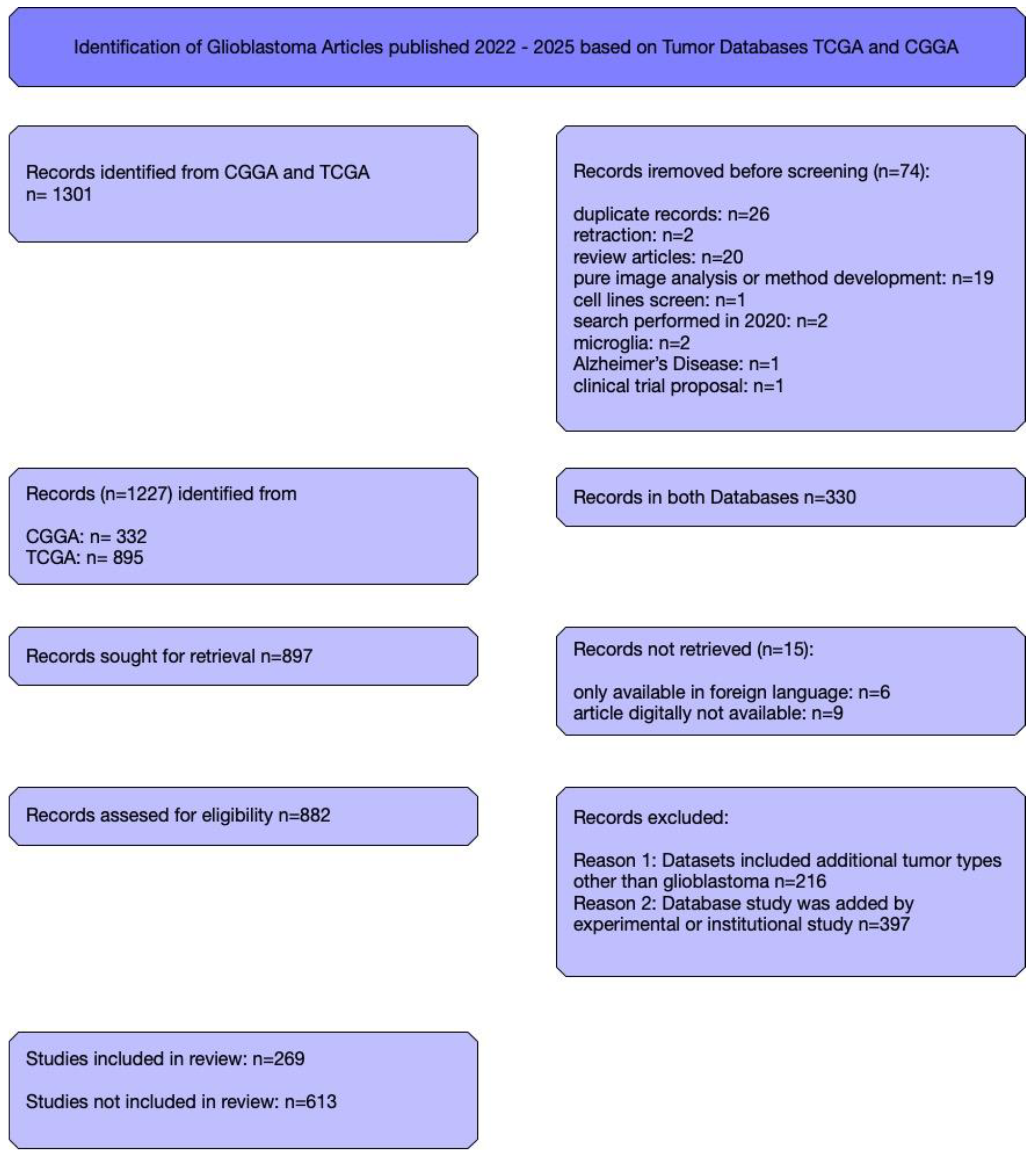
The aim was to include original articles published in peer-reviewed journals with full-text descriptions of glioblastoma research based on the TCGA and CGGA databases. We excluded review articles; pure method development papers including image analysis; and articles presenting cell line screens, microglia research, glioblastoma in the context of Alzheimer’s disease, and clinical trial proposals. Furthermore, articles with full text in a language other than English and articles that were not digitally available were excluded (Figure 1).
We included all articles that investigated glioblastoma as the central research topic and excluded those that studied glioblastoma in the context of other tumor types (gliomas, carcinomas, etc.). Moreover, articles that included additional approaches, such as experimental research or institutional clinical studies, were also excluded from our search (Figure 1).
We checked all remaining articles based on two categories:
1. IDH status
-
Does the article contain information about the IDH status of glioblastomas investigated in the study?
-
Does the study only include glioblastoma, IDH wild-type, WHO CNS grade 4?
-
Does the study include IDH mutant tumors?
2. WHO classification
-
Does the article mention the WHO classification that was used for the study?
-
Was the study correctly performed according to the WHO classification of 2021?
-
Was the study performed according to an outdated WHO CNS5 classification, or did the study incorrectly use the WHO CNS5 of 2021?
We conducted an additional bibliometric analysis of the articles we found [12]. To do this, we categorized the journals in which the articles were published according to the Web of Science Core Collection Subject Categories along with each journal’s 2025 impact factor. We also determined how frequently the articles had been cited (as of 20 July 2026).
Articles were evaluated according to PRISMA recommendations [10] by 2 of the authors independently (N.A. and J.S.). In case of disagreement, the third author (M.A.) was consulted to reach a decision.

3. Results

Our systematic literature research was performed in March 2026 on the PubMed database using the search terms “CGGA” or “TCGA” and “glioblastoma”. It covered the years 2022 to 2025, following the publication of the fifth edition of the WHO classification of the tumors of the central nervous system in 2021. We identified 1301 records (CGGA n = 353, TCGA n = 948). After removing duplicates, retractions, review articles, pure method development, image analysis, cell line screens, Alzheimer’s disease, microglia research, and clinical trial proposals, 1227 records remained, of which 330 used both databases. For retrieval, we finally excluded 15 records that were either written in a foreign language or unavailable digitally.
The number of records assessed for eligibility was n = 882. Datasets that included additional non-glioma tumor types or only WHO mutant gliomas (n = 216) or datasets that included additional experimental or institutional clinical studies (n = 397) were excluded from the review.
We included 269 records in our study (Figure 1) and assessed two categories of information:
  • The IDH status of the glioblastomas used in the studies.
  • The WHO classification used as the basis for the studies.
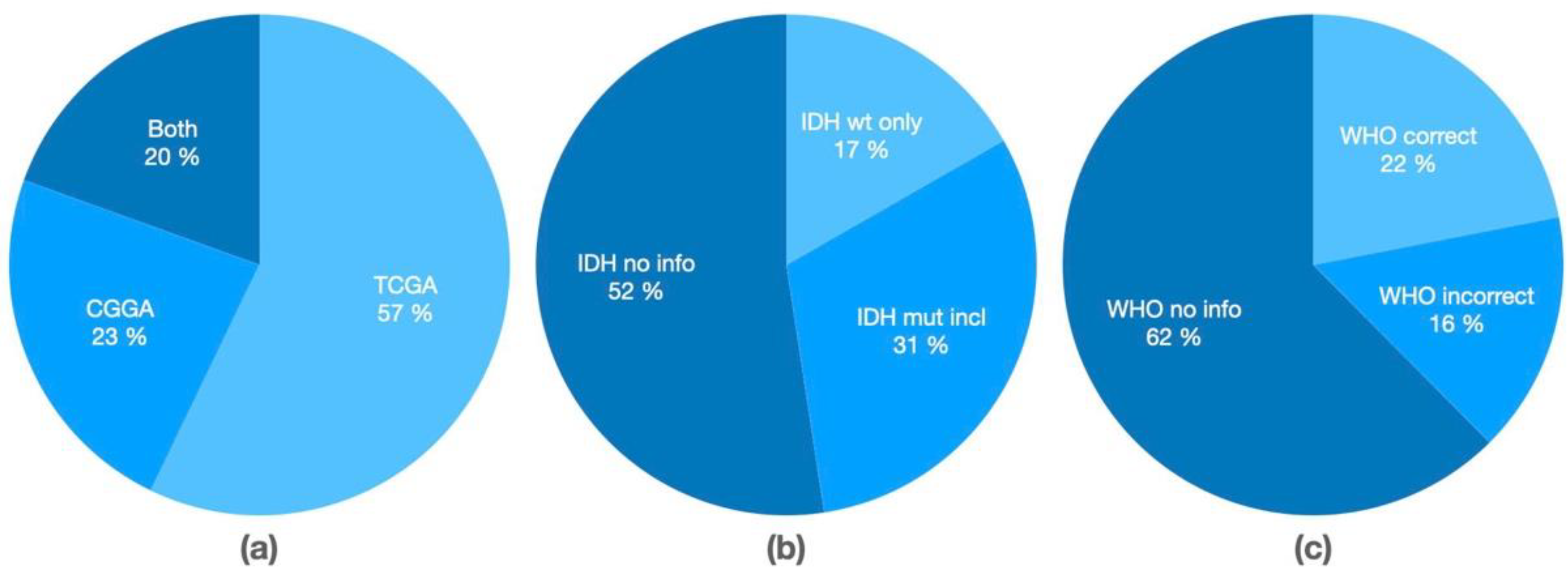
In the first category, we would expect that only IDH wild-type glioblastomas would be included in the studies. The inclusion of IDH mutant glioblastomas would be incorrect, as these tumors are not glioblastomas but astrocytomas or oligodendrogliomas. We found 45 studies (17%) that correctly included only IDH wild-type glioblastomas (Table S1) but 83 studies (31%) that also included IDH mutant tumors, which are definitely not glioblastomas. The remaining 141 studies (52%) did not report the IDH status of the GBM they investigated (Figure 2). Without knowledge of the IDH status, their conclusions may be influenced by incomplete molecular annotation. Therefore, their findings should be interpreted with caution. One would expect that the implementation of the WHO guidelines would have led to fewer studies including IDH mutant GBM; however, this is not the case, as the numbers remain stable over the years (Table 1).
In the second category, we would expect that the classification of the tumors in the studies would have been performed according to the fifth edition of the WHO classification of the tumors of the nervous system from 2021 [3]. Outdated WHO classifications or incorrect interpretations of the WHO 2021 guidelines would lead to erroneous assumptions. Of the 269 records, 42 (16%) explicitly used an outdated WHO classification or misinterpreted the WHO 2021 guidelines. In cases of misinterpretation, the incorrect implementation occurred because, despite knowledge that GBM must always be IDH wild-type, IDH mutated tumors were nevertheless included. The WHO 2021 classification was correctly implemented in 59 records (22%), including the 45 articles that used only IDH wild-type GBM, and 168 (62%) records did not mention the WHO classification they used (Figure 2).
The bibliometric data revealed some differences. In the group of correctly classified GBMs, journals were predominantly found in the Oncology category. In contrast, journals in the categories Pharmacology, Computer Sciences, and Genetics were underrepresented (Table 2). The average impact factors of the journals were slightly but significantly higher for the correctly classified publications than for the other two groups (p < 0.01, t-test). Likewise, these papers were cited slightly more frequently during the observation period (Table 2).

4. Discussion

Many actual studies in cancer research are based on multi-omics databases [2]. Modifications to tumor classifications would fundamentally alter the foundation of the research approaches in these studies [10]. A concrete illustration of this issue is the new WHO classification of tumors of the central nervous system, published in 2021 [3]. It represents the first consequential revision to the biological basis of the glioma classification [8]. According to the WHO classification, glioblastoma (GBM) does not harbor an IDH mutation, as tumors with an IDH mutation are astrocytomas or oligodendrogliomas not GBM.
GBM, IDH wild-type, and astrocytomas/oligodendrogliomas, IDH mutant, differ not only because of the IDH mutation but also represent at least two distinct evolutionary pathways of glial tumorigenesis with distinct tumor biology [13]. Epigenetic programming in cells is highly stable. Thus, the methylation profile of tumor cells resembles that of their progenitor cells. GBM, IDH wild-type, and astrocytomas/oligodendrogliomas, IDH mutant, exhibit fundamentally different methylation patterns, suggesting distinct tumor development and, most likely, different progenitor cells [14]. These methylation differences are now also being used very successfully for the precise diagnosis of brain tumors [15]. The distinct tumor biology is also reflected in various other mutation profiles, as well as fundamentally different metabolisms [16], and it also affects the tumor microenvironment. Consequently, the tumors exhibit distinct clinical behavior, with corresponding prognostic implications [17]. It is therefore essential to recognize that IDH mutations do not represent a single prognostic factor but rather define at least two distinct tumor types with different tumor biology and distinct clinical behavior [18].
In addition to the central role of the IDH mutation, numerous other molecular markers have been identified that contribute to GBM tumorigenesis. Beyond their significance in tumor biology, these biomarkers also have a considerable impact on diagnosis and often allow for a prognostic assessment. For example, TERT promoter mutations, EGFR amplification, and the addition of chromosome 7 and loss of chromosome 10 (+7/−10) signatures have been included as criteria for the molecular diagnosis of GBM in the absence of confirmed histological parameters [19]. The methylation status of the MGMT promoter remains an important predictive parameter for evaluating adjuvant TMZ therapy [20,21].
However, biomedical databases do not automatically adapt to changes in classifications. The most commonly used multi-omics databases in glioma research, the Chinese Glioma Genome Atlas (CGGA) and The Cancer Genome Atlas (TCGA), include, respectively, 21.6% (CGGA) and 4.2% (TCGA, data for 2025) IDH mutant GBMs, which are not GBMs. Although they follow the highest quality standards, the number of tumors is actually falsely classified in the glioma group, namely astrocytomas and glioblastomas, and underscores the need to re-check tumor diagnoses, even if they were correctly classified in an earlier version of the WHO classification [9]. Two excellent papers addressed the re-classification of the TCGA database according to the 2021 WHO classification [22,23]. All researchers should be encouraged to use this work as a basis for selecting their own data from the TCGA database.
Here, we were interested in learning how many articles were written using these databases and correctly implemented the WHO 2021 classification. We therefore conducted a systematic search of the PubMed literature database from 2022 to 2025 to identify publications that utilized the TCGA and CGGA databases. Our aim was not to identify individual articles with potential errors but to provide an overview of how to deal with the new classification in practice. We focused only on PubMed records and the two leading genomics databases used for GBM research, TCGA and CGGA. In addition, we were interested in an overview. Therefore, we decided to include only studies that investigated GBM and no other tumor types. Using this approach, we achieved a very clear diagnostic classification based on a single molecular marker. Including additional tumor types would have made the molecular differentiation considerably more complex. On the other hand, we had expected that articles focusing specifically on GBM would be most likely to adhere to diagnostic standards. And we looked only for database studies that did not include additional approaches, such as experimental or clinical studies.
We identified 269 records published between 2022 and 2025 that used the TCGA and/or CGGA exclusively for GBM research topics. Only 45 articles (17%) correctly implemented the 2021 WHO classification and used only IDH wild-type GBMs, excluding IDH mutant GBMs (Table S1). IDH mutant tumors, most likely representing astrocytomas or oligodendrogliomas, were included in 83 studies (31%). It is no surprise that nearly all studies that included IDH mutant tumors found differences in gene expression patterns, of which 17 could attribute the differences directly to the IDH status (wild-type vs. mutant), and 12 found a significant prognostic impact directly linked to the IDH status. The remaining 141 records did not mention the IDH status of the GBM they investigated in their studies. Without knowledge of the IDH status, it cannot be ruled out that these studies also include falsely classified tumors. Therefore, their value is questionable.
We also reviewed the WHO classification used in the studies and found that 168 records (62%) did not specify the guidelines they followed for their work. Again, this would be an additional argument that these studies could contain an incomplete molecular annotation. Of 269 records, 42 explicitly used an outdated WHO classification or misinterpreted the WHO 2021 guidelines. In cases of misinterpretation, the incorrect implementation occurred because, despite knowledge that GBM must always be IDH wild-type, IDH mutated tumors were nevertheless included. The WHO 2021 was correctly implemented by 59 records.
The overview of the published data using two of the most important cancer databases, following the modifications in the fifth edition of the 2021 WHO classification of tumors of the central nervous system, shows that for the majority of articles, it cannot be excluded that their conclusions may be influenced by incomplete molecular annotations. This definitely weakens the research results, and their findings should be interpreted with caution. The most important point is that the modifications to the 2021 WHO classification do not merely reflect terminological changes but adjust the classification to the biology of the tumors [24]. It is now clear that GBM on the one side and astrocytoma/oligodendroglioma on the other side are two different tumor types with a different tumor biology [25]. Therefore, all articles demonstrating differences in gene expression profiles or the prognosis of IDH mutant versus wild-type tumors reveal only the distinct biology of these tumors.
Interestingly, a similar situation also appears in clinical studies. In the year following the WHO’s 2021 guidelines, a very insightful review by Baglay and co-workers [26] demonstrated that for the majority of registered GBM studies IDH mutated “GBM” cases were still being included, and only a minority accepted a purely molecular diagnosis of GBM. The situation has changed somewhat since then, but in principle, “general” GBM diagnoses without specific molecular parameters are still eligible for inclusion into some clinical studies.
Authors of scientific studies must always be aware of the basis of their research, particularly regarding data sources [27]. They should keep in mind that molecular classification is continuously evolving and that database harmonization will remain necessary for future WHO revisions. Our results show that many researchers appear unaware of this fact. Moreover, researchers should clearly identify the research resources used in their work so that the work is transparent for the scientific community. This certainly includes a clear diagnostic classification and the underlying classification system. Again, this was not the case in some of the papers we checked. Therefore, many of the results should be interpreted with caution. This is particularly true for those papers that demonstrated a correlation between IDH mutations and the expression of their genetic profile of interest in GBM. Our bibliometric results show that the papers were predominantly published in prestigious peer-reviewed journals. The journals publishing articles using databases with correctly classified IDH wild-type GBM had a slight but significantly higher average impact factor (IF). However, in this group the share and the average IF of journals of the category “Oncology” and “Neuroscience” was higher than average. Furthermore, the papers of all groups have already been cited in other works, on average more than seven times over the past 4 years, and thus have an impact on the work of other researchers. No significant differences were found among the individual groups.
This could not only lead to wrong expectations but could also be dangerous in times when artificial intelligence (AI) approaches span a broad field [28,29]. In biomarker development, AI relies on published articles, as peer-reviewed scientific literature is considered trustworthy. Another example is molecular tumor boards, which have now become an integral part of clinical precision oncology. They must evaluate highly complex multimodal data to make personalized treatment recommendations, and, thus, there is an increasing interest in using AI to support tumor board workflows [30]. The AI models used are continuously adapted to changes in classifications and clinical recommendations. However, if the literature on which these AI models are trained is already based on principles that are no longer valid, errors may be introduced into the system as early as the data entry stage.

5. Conclusions

The aim of our study was to review the implementation of the current WHO classification in GBM research using multi-omics databases, as it is well known that they may contain datasets based on an outdated WHO classification. Using a systematic search strategy, we found that 1/3 of published papers used IDH mutant tumors, and 1/2 of the studies did not report the IDH status of the tumors. Our results show that, despite the use of excellent modern scientific methods, many publications are inaccurate in their treatment of the fundamentals of the research material and thus undermine their own findings.

Supplementary Materials

The following supporting information can be downloaded at https://www.mdpi.com/article/10.3390/onco6030042/s1: Table S1: Articles that exclusively use IDH-wt GBM. Refs. [22,23,31,32,33,34,35,36,37,38,39,40,41,42,43,44,45,46,47,48,49,50,51,52,53,54,55,56,57,58,59,60,61,62,63,64,65,66,67,68,69,70,71,72,73] is cited in the Supplementary Materials.

Author Contributions

Conceptualization, J.S. and N.A.; Methodology, N.A. and J.S.; Validation, N.A., M.A. and J.S.; Formal Analysis, N.A., M.A. and J.S.; Investigation, N.A. and J.S.; Resources, J.S.; Data Curation, N.A. and J.S.; Writing—Original Draft Preparation, N.A. and J.S.; Writing—Review and Editing, N.A., M.A. and J.S.; Visualization, J.S.; Supervision, J.S.; Project Administration, J.S. All authors have read and agreed to the published version of the manuscript.

Funding

This research received no external funding.

Institutional Review Board Statement

Not applicable.

Informed Consent Statement

Not applicable.

Data Availability Statement

The bibliometric data can be requested from the authors.

Conflicts of Interest

The authors declare no conflicts of interest.

References

  1. Danchin, A.; Ouzounis, C.; Tokuyasu, T.; Zucker, J.D. No wisdom in the crowd: Genome annotation in the era of big data—Current status and future prospects. Microb. Biotechnol. 2018, 11, 588–605. [Google Scholar] [CrossRef] [Scilit] [PubMed]
  2. Kakde, G.S.; Dakal, T.C.; Maurya, P.K. Emerging multi-omics biomarkers in glioblastoma: Integrative insights from genomics to metabolomics. Biochim. Biophys. Acta Rev. Cancer 2026, 1881, 189540. [Google Scholar] [CrossRef] [Scilit] [PubMed]
  3. Editorial Board WHO Classification of Tumours. World Health Organization Classification of Tumours of the Central Nervous System, 5th ed.; International Agency for Research on Cancer: Lyon, France, 2021. [Google Scholar]
  4. Louis, D.N.; Perry, A.; Burger, P.; Ellison, D.W.; Reifenberger, G.; von Deimling, A.; Aldape, K.; Brat, D.; Collins, V.P.; Eberhart, C.; et al. International Society of Neuropathology--Haarlem consensus guidelines for nervous system tumor classification and grading. Brain Pathol. 2014, 24, 429–435. [Google Scholar] [CrossRef] [Scilit] [PubMed]
  5. Louis, D.N.; Aldape, K.; Brat, D.J.; Capper, D.; Ellison, D.W.; Hawkins, C.; Paulus, W.; Perry, A.; Reifenberger, G.; Figarella-Branger, D.; et al. Announcing cIMPACT-NOW: The Consortium to Inform Molecular and Practical Approaches to CNS Tumor Taxonomy. Acta Neuropathol. 2017, 133, 1–3. [Google Scholar] [CrossRef] [Scilit] [PubMed]
  6. Balss, J.; Meyer, J.; Mueller, W.; Korshunov, A.; Hartmann, C.; von Deimling, A. Analysis of the IDH1 codon 132 mutation in brain tumors. Acta Neuropathol. 2008, 116, 597–602. [Google Scholar] [CrossRef] [Scilit] [PubMed]
  7. Horbinski, C.; Berger, T.; Packer, R.J.; Wen, P.Y. Clinical implications of the 2021 edition of the WHO classification of central nervous system tumours. Nat. Rev. Neurol. 2022, 18, 515–529. [Google Scholar] [CrossRef] [Scilit] [PubMed]
  8. Louis, D.N.; Ohgaki, H.; Wiestler, O.D.; Cavenee, W.K. WHO Classification of Tumours of the Central Nervous System, 4th ed.; International Agency for Research on Cancer: Lyon, France, 2016. [Google Scholar]
  9. Louis, D.N.; Perry, A.; Wesseling, P.; Brat, D.J.; Cree, I.A.; Figarella-Branger, D.; Hawkins, C.; Ng, H.K.; Pfister, S.M.; Reifenberger, G.; et al. The 2021 WHO Classification of Tumors of the Central Nervous System: A summary. Neuro Oncol. 2021, 23, 1231–1251. [Google Scholar] [CrossRef] [Scilit] [PubMed]
  10. Satgunaseelan, L.; Xian, E.; Madani, D.; Gamage, K.K.; Hallal, S.M.; Gorolay, V.; Sim, H.W.; Mason, S.; Buckland, M.E.; Shivalingam, B.; et al. Impact of an evolving classification system on diffuse glioma repositories: Experience from the Sydney brain tumour bank. J. Neurooncol. 2026, 177, 6–18. [Google Scholar] [CrossRef] [Scilit] [PubMed]
  11. Page, M.J.; McKenzie, J.E.; Bossuyt, P.M.; Boutron, I.; Hoffmann, T.C.; Mulrow, C.D.; Shamseer, L.; Tetzlaff, J.M.; Akl, E.A.; Brennan, S.E.; et al. The PRISMA 2020 statement: An updated guideline for reporting systematic reviews. BMJ 2021, 372, n71. [Google Scholar] [CrossRef] [Scilit] [PubMed]
  12. Szomszor, M.; Adams, J.; Fry, R.; Gebert, C.; Pendlebury, D.A.; Potter, R.W.K.; Rogers, G. Interpreting Bibliometric Data. Front. Res. Metr. Anal. 2020, 5, 628703. [Google Scholar] [CrossRef] [Scilit] [PubMed]
  13. von Deimling, A.; Ono, T.; Shirahata, M.; Louis, D.N. Grading of Diffuse Astrocytic Gliomas: A Review of Studies Before and After the Advent of IDH Testing. Semin. Neurol. 2018, 38, 19–23. [Google Scholar] [CrossRef] [Scilit] [PubMed]
  14. Capper, D.; Jones, D.T.W.; Sill, M.; Hovestadt, V.; Schrimpf, D.; Sturm, D.; Koelsche, C.; Sahm, F.; Chavez, L.; Reuss, D.E.; et al. DNA methylation-based classification of central nervous system tumours. Nature 2018, 555, 469–474. [Google Scholar] [CrossRef] [Scilit] [PubMed]
  15. Aldape, K.; Capper, D.; von Deimling, A.; Giannini, C.; Gilbert, M.R.; Hawkins, C.; Hench, J.; Jacques, T.S.; Jones, D.; Louis, D.N.; et al. cIMPACT-NOW update 9: Recommendations on utilization of genome-wide DNA methylation profiling for central nervous system tumor diagnostics. Neurooncol. Adv. 2025, 7, vdae228. [Google Scholar] [CrossRef] [Scilit] [PubMed]
  16. Venneti, S.; Thompson, C.B. Metabolic Reprogramming in Brain Tumors. Annu. Rev. Pathol. 2017, 12, 515–545. [Google Scholar] [CrossRef] [Scilit] [PubMed]
  17. Krolikowska, K.; Blaszczak, K.; Lawicki, S.; Zajkowska, M.; Gudowska-Sawczuk, M. Glioblastoma-A Contemporary Overview of Epidemiology, Classification, Pathogenesis, Diagnosis, and Treatment: A Review Article. Int. J. Mol. Sci. 2025, 26, 12162. [Google Scholar] [CrossRef] [Scilit] [PubMed]
  18. Pinarbasi, E.; Pratt, D. The Evolving Molecular Landscape of High-Grade Gliomas. Cancer J. 2021, 27, 337–343. [Google Scholar] [CrossRef] [Scilit] [PubMed]
  19. Brat, D.J.; Aldape, K.; Colman, H.; Holland, E.C.; Louis, D.N.; Jenkins, R.B.; Kleinschmidt-DeMasters, B.K.; Perry, A.; Reifenberger, G.; Stupp, R.; et al. cIMPACT-NOW update 3: Recommended diagnostic criteria for “Diffuse astrocytic glioma, IDH-wildtype, with molecular features of glioblastoma, WHO grade IV. Acta Neuropathol. 2018, 136, 805–810. [Google Scholar] [CrossRef] [Scilit] [PubMed]
  20. Hegi, M.E.; Liu, L.; Herman, J.G.; Stupp, R.; Wick, W.; Weller, M.; Mehta, M.P.; Gilbert, M.R. Correlation of O6-methylguanine methyltransferase (MGMT) promoter methylation with clinical outcomes in glioblastoma and clinical strategies to modulate MGMT activity. J. Clin. Oncol. 2008, 26, 4189–4199. [Google Scholar] [CrossRef] [Scilit] [PubMed]
  21. Ludwig, K.; Kornblum, H.I. Molecular markers in glioma. J. Neurooncol. 2017, 134, 505–512. [Google Scholar] [CrossRef] [Scilit] [PubMed]
  22. Zakharova, G.; Efimov, V.; Raevskiy, M.; Rumiantsev, P.; Gudkov, A.; Belogurova-Ovchinnikova, O.; Sorokin, M.; Buzdin, A. Reclassification of TCGA Diffuse Glioma Profiles Linked to Transcriptomic, Epigenetic, Genomic and Clinical Data, According to the 2021 WHO CNS Tumor Classification. Int. J. Mol. Sci. 2022, 24, 157. [Google Scholar] [CrossRef] [Scilit] [PubMed]
  23. de Mendonca, M.L.; Coletti, R.; Goncalves, C.S.; Martins, E.P.; Costa, B.M.; Vinga, S.; Lopes, M.B. Updating TCGA glioma classification through integration of molecular data following the latest WHO guidelines. Sci. Data 2025, 12, 935. [Google Scholar] [CrossRef] [Scilit] [PubMed]
  24. Louis, D.N.; Ellison, D.W.; Brat, D.J.; Aldape, K.; Capper, D.; Hawkins, C.; Paulus, W.; Perry, A.; Reifenberger, G.; Figarella-Branger, D.; et al. cIMPACT-NOW: A practical summary of diagnostic points from Round 1 updates. Brain Pathol. 2019, 4, 469–472. [Google Scholar] [CrossRef] [Scilit] [PubMed]
  25. Wesseling, P.; Capper, D.; Reifenberger, G.; Sarkar, C.; Hawkins, C.; Perry, A.; Kleinschmidt-DeMasters, B.; Komori, T.; Paulus, W.; Santosh, V.; et al. cIMPACT-NOW update 11: Proposal on adaptation of diagnostic criteria for IDH- and H3-wildtype diffuse high-grade gliomas and for posterior fossa ependymal tumors. Brain Pathol. 2026, 36, e70035. [Google Scholar] [CrossRef] [Scilit] [PubMed]
  26. Bagley, S.J.; Kothari, S.; Rahman, R.; Lee, E.Q.; Dunn, G.P.; Galanis, E.; Chang, S.M.; Nabors, L.B.; Ahluwalia, M.S.; Stupp, R.; et al. Glioblastoma Clinical Trials: Current Landscape and Opportunities for Improvement. Clin. Cancer Res. 2022, 28, 594–602. [Google Scholar] [CrossRef] [Scilit] [PubMed]
  27. Prinz, F.; Schlange, T.; Asadullah, K. Believe it or not: How much can we rely on published data on potential drug targets? Nat. Rev. Drug Discov. 2011, 10, 712. [Google Scholar] [CrossRef] [Scilit] [PubMed]
  28. Bryant, A. AI Chatbots: Threat or Opportunity? Informatics 2023, 10, 49. [Google Scholar] [CrossRef] [Scilit]
  29. Manoharan, J.; Sehgal, Y. AI-Enabled Text Mining: A Paradigm Shift in Disease Prediction, Drug Discovery, and Clinical Research. J. Med. Inform. 2026, 2, 23–35. [Google Scholar] [CrossRef] [Scilit]
  30. Bando, H.; Naito, Y.; Yamada, T.; Fujisawa, T.; Imai, M.; Sakamoto, Y.; Saigusa, Y.; Yamamoto, K.; Tomioka, Y.; Takeshita, N.; et al. A prospective study comparing highly qualified Molecular Tumor Boards with AI-powered software as a medical device. Int. J. Clin. Oncol. 2025, 30, 172–179. [Google Scholar] [CrossRef] [Scilit] [PubMed]
  31. Alom, Z.; Tran, Q.T.; Bag, A.K.; Lucas, J.T.; A Orr, B. Predicting methylation class from diffusely infiltrating adult gliomas using multimodality MRI data. Neuro-Oncol. Adv. 2023, 5, vdad045. [Google Scholar] [CrossRef] [Scilit] [PubMed]
  32. Baheti, B.; Innani, S.; Nasrallah, M.; Bakas, S. Prognostic stratification of glioblastoma patients by unsupervised clustering of morphology patterns on whole slide images furthering our disease understanding. Front. Neurosci. 2024, 18, 1304191. [Google Scholar] [CrossRef] [Scilit] [PubMed]
  33. Chakrabarty, S.; LaMontagne, P.; Shimony, J.; Marcus, D.S.; Sotiras, A. MRI-based classification of IDH mutation and 1p/19q codeletion status of gliomas using a 2.5D hybrid multi-task convolutional neural network. Neuro-Oncol. Adv. 2023, 5, vdad023. [Google Scholar] [CrossRef] [Scilit] [PubMed]
  34. Chen, C.-R.; Chang, R.-S.; Chen, C.-S. Identification of Prognostic Genes in Gliomas Based on Increased Microenvironment Stiffness. Cancers 2022, 14, 3659. [Google Scholar] [CrossRef] [Scilit] [PubMed]
  35. Chen, J.; Wu, Q.; Berglund, A.E.; Macaulay, R.J.; Mulé, J.J.; Etame, A.B. RNF135 Expression Marks Chemokine (C-C Motif) Ligand-Enriched Macrophage–Tumor Interactions in the Glioblastoma Microenvironment. Cancers 2025, 17, 3271. [Google Scholar] [CrossRef] [Scilit] [PubMed]
  36. Cheng, C.; Zhao, C.; Liang, B.; Sun, Y.; Zhao, D.; Ma, P.; Wang, C.; Wang, D.; Pan, C.; Zhai, Y.; et al. Strategy and clinical benefit of first re-resection for recurrent adult-type diffuse glioma: A retrospective cohort analysis. Med 2025, 6, 100891. [Google Scholar] [CrossRef] [Scilit] [PubMed]
  37. Chunduru, P.; Phillips, J.J.; Molinaro, A.M. Prognostic risk stratification of gliomas using deep learning in digital pathology images. Neuro-Oncol. Adv. 2022, 4, vdac111. [Google Scholar] [CrossRef] [Scilit] [PubMed]
  38. Dang, H.-H.; Ta, H.D.K.; Nguyen, T.T.T.; Wang, C.-Y.; Lee, K.-H.; Le, N.Q.K. Identification of a Novel Eight-Gene Risk Model for Predicting Survival in Glioblastoma: A Comprehensive Bioinformatic Analysis. Cancers 2023, 15, 3899. [Google Scholar] [CrossRef] [Scilit] [PubMed]
  39. Ding, Y.; Xu, Z.; Hu, W.; Deng, P.; Ma, M.; Wu, J. Comprehensive multi-omics and machine learning framework for glioma subtyping and precision therapeutics. Sci. Rep. 2025, 15, 24874. [Google Scholar] [CrossRef] [Scilit] [PubMed]
  40. Ghanem, P.; Fatteh, M.; Kamson, D.O.; Balan, A.; Chang, M.; Tao, J.; Blakeley, J.; The Johns Hopkins Molecular Tumor Board Investigators; Canzoniero, J.; Grossman, S.A.; et al. Druggable genomic landscapes of high-grade gliomas. Front. Med. 2023, 10, 1254955. [Google Scholar] [CrossRef] [Scilit] [PubMed]
  41. Ghosh, H.S.; Patel, R.V.; Woodward, E.; Greenwald, N.F.; Bhave, V.M.; A Maury, E.; Cello, G.; E Hoffman, S.; Li, Y.; Gupta, H.; et al. Contemporary prognostic signatures and refined risk stratification of gliomas: An analysis of 4400 tumors. Neuro-Oncology 2024, 27, 195–208. [Google Scholar] [CrossRef] [Scilit] [PubMed]
  42. Hou, Z.; Liu, D.; Hou, Z.; Zhang, H.; Wang, H. Histopathological grading affects survival in patients with isocitrate dehydrogenase-wildtype gliomas. Front. Oncol. 2025, 15, 1570941. [Google Scholar] [CrossRef] [Scilit] [PubMed]
  43. Hsu, W.-W.; Song, W.-S.; Chang, P.-C.; Hueng, D.-Y.; Li, Y.-F. COL22A1 expression identifies aggressive glioma and independently predicts survival through integrated multiomics and clinical validation. Discov. Oncol. 2025, 16, 1945. [Google Scholar] [CrossRef] [Scilit] [PubMed]
  44. Ji, H.; Wang, F.; Liu, Z.; Li, Y.; Sun, H.; Xiao, A.; Zhang, H.; You, C.; Hu, S.; Liu, Y. COVPRIG robustly predicts the overall survival of IDH wild-type glioblastoma and highlights METTL1+ neural-progenitor-like tumor cell in driving unfavorable outcome. J. Transl. Med. 2023, 21, 533. [Google Scholar] [CrossRef] [Scilit] [PubMed]
  45. Ji, Q.; Zheng, Y.; Zhou, L.; Chen, F.; Li, W. Unveiling divergent treatment prognoses in IDHwt-GBM subtypes through multiomics clustering: A swift dual MRI-mRNA model for precise subtype prediction. J. Transl. Med. 2024, 22, 578. [Google Scholar] [CrossRef] [Scilit] [PubMed]
  46. Jue, T.R.; Descallar, J.; Pham, V.V.H.; Bell, J.L.; Shai-Hee, T.; Cazzolli, R.; Nagabushan, S.; Koh, E.-S.; Vittorio, O. Cuproplasia-related gene signature: Prognostic insights for glioma therapy. Neuro-Oncol. Adv. 2024, 7, vdae233. [Google Scholar] [CrossRef] [Scilit] [PubMed]
  47. Kiesel, B.; Borkovec, M.; Furtner, J.; Roetzer-Pejrimovsky, T.; Nenning, K.-H.; Greutter, L.; Miller-Michlits, Y.; Widhalm, G.; Woehrer, A. Sex-specific differences in DNA methylation defining prognostically relevant subgroups in glioblastoma. J. Neurosurg. 2025, 143, 204–213. [Google Scholar] [CrossRef] [Scilit] [PubMed]
  48. Le, M.-K.; Tran, N.Q.V.; Nguyen, P.-T.; Nguyen, T.-A.; Nakao, A.; Kondo, T. Comprehensive analysis of distinct circadian clock subtypes of adult diffuse glioma and their associations with clinicopathological, genetic, and epigenetic profiles. J. Neuropathol. Exp. Neurol. 2024, 83, 736–744. [Google Scholar] [CrossRef] [Scilit] [PubMed]
  49. Le, M.-K.; Vuong, H.G.; Dunn, I.F.; Kondo, T. Molecular and clinicopathological implications of PRAME expression in adult glioma. PLoS ONE 2023, 18, e0290542. [Google Scholar] [CrossRef] [Scilit] [PubMed]
  50. Leitão, B.N.; Veríssimo, A.; Carvalho, A.M.; Vinga, S. Enhancing Prognostic Signatures in Glioblastoma with Feature Selection and Regularised Cox Regression. Genes 2025, 16, 473. [Google Scholar] [CrossRef] [Scilit] [PubMed]
  51. Lin, S.-H.; Chen, S.C.-C. RNA Editing in Glioma as a Sexually Dimorphic Prognostic Factor That Affects mRNA Abundance in Fatty Acid Metabolism and Inflammation Pathways. Cells 2022, 11, 1231. [Google Scholar] [CrossRef] [Scilit] [PubMed]
  52. Liu, E.M.; Shi, Z.; Li, K.K.; Malta, T.M.; Chung, N.Y.; Chen, H.; Chan, J.Y.; Poon, M.F.; Kwan, J.S.; Chan, D.T.; et al. Molecular landscape of IDH-wild type, pTERT-wild type adult glioblastomas. Brain Pathol. 2022, 32, e13107. [Google Scholar] [CrossRef] [Scilit] [PubMed]
  53. Mallik, M.K.; Majumdar, K.; Mujtaba, S. Non-Association of Driver Alterations in PTEN with Differential Gene Expression and Gene Methylation in IDH1 Wildtype Glioblastomas. Brain Sci. 2023, 13, 186. [Google Scholar] [CrossRef] [Scilit] [PubMed]
  54. Mao, X.-G.; Xue, X.-Y.; Wang, L.; Lin, W.; Zhang, X. Deep learning identified glioblastoma subtypes based on internal genomic expression ranks. BMC Cancer 2022, 22, 86. [Google Scholar] [CrossRef] [Scilit] [PubMed]
  55. McInerney, C.E.; Lynn, J.A.; Gilmore, A.R.; Flannery, T.; Prise, K.M. Using AI-Based Evolutionary Algorithms to Elucidate Adult Brain Tumor (Glioma) Etiology Associated with IDH1 for Therapeutic Target Identification. Curr. Issues Mol. Biol. 2022, 44, 2982–3000. [Google Scholar] [CrossRef] [Scilit] [PubMed]
  56. Mischkulnig, M.; Kiesel, B.; Rötzer-Pejrimovsky, T.; Borkovec, M.; Lang, A.; Millesi, M.; Wadiura, L.I.; Hervey-Jumper, S.; Penninger, J.M.; Berger, M.S.; et al. The impact of heme biosynthesis regulation on glioma aggressiveness: Correlations with diagnostic molecular markers. Front. Mol. Neurosci. 2022, 15, 928355. [Google Scholar] [CrossRef] [Scilit] [PubMed]
  57. Mo, H.; Magaki, S.; Deisch, J.K.; Raghavan, R. Isocitrate Dehydrogenase Mutations Are Associated with Different Expression and DNA Methylation Patterns of OLIG2 in Adult Gliomas. J. Neuropathol. Exp. Neurol. 2022, 81, 707–716. [Google Scholar] [CrossRef] [Scilit] [PubMed]
  58. Mo, Y.; Fan, D.; Wang, W.; Wang, S.; Yan, Y.; Zhao, Z. Identification of inflammation-related genes signature to establish a prognostic model in MGMT unmethylated glioblastoma patients. Discov. Oncol. 2025, 16, 154. [Google Scholar] [CrossRef] [Scilit] [PubMed]
  59. Modestov, A.; Zolotovskaia, M.; Suntsova, M.; Zakharova, G.; Seryakov, A.; Jovcevska, I.; Mlakar, J.; Poddubskaya, E.; Moisseev, A.; Vykhodtsev, G.; et al. Bioinformatic and clinical experimental assay uncovers resistance and susceptibility mechanisms of human glioblastomas to temozolomide and identifies new combined and individual survival biomarkers outperforming MGMT promoter methylation. Ther. Adv. Med. Oncol. 2024, 16, 1–21. [Google Scholar] [CrossRef] [Scilit] [PubMed]
  60. Musib, L.; Coletti, R.; Lopes, M.B.; Mouriño, H.; Carrasquinha, E. Priority-Elastic net for binary disease outcome prediction based on multi-omics data. BioData Min. 2024, 17, 45. [Google Scholar] [CrossRef] [Scilit] [PubMed]
  61. Qazi, S.; Potts, M.; Myers, S.; Richardson, S.; Trieu, V. Positive Prognostic Overall Survival Impacts of Methylated TGFB2 and MGMT in Adult Glioblastoma Patients. Cancers 2025, 17, 1122. [Google Scholar] [CrossRef] [Scilit] [PubMed]
  62. Shah, A.H.; Suter, R.; Gudoor, P.; Doucet-O’hAre, T.T.; Stathias, V.; Cajigas, I.; de la Fuente, M.; Govindarajan, V.; A Morell, A.; Eichberg, D.G.; et al. A multiparametric pharmacogenomic strategy for drug repositioning predicts therapeutic efficacy for glioblastoma cell lines. Neuro-Oncol. Adv. 2021, 4, vdab192. [Google Scholar] [CrossRef] [Scilit] [PubMed]
  63. Shi, J. Early 2-Factor Transcription Factors Associated with Progression and Recurrence in Bevacizumab-Responsive Subtypes of Glioblastoma. Cancers 2024, 16, 2536. [Google Scholar] [CrossRef] [Scilit] [PubMed]
  64. Son, S.M.; Lee, H.S.; Kim, J.; Kwon, R.J. Expression and prognostic significance of microsomal triglyceride transfer protein in brain tumors: A retrospective cohort study. Transl. Cancer Res. 2024, 13, 2282–2294. [Google Scholar] [CrossRef] [Scilit] [PubMed]
  65. Spoor, J.K.H.; Braber, M.D.; Dirven, C.M.F.; Pennycuick, A.; Bartkova, J.; Bartek, J.; van Dis, V.; Bosch, T.P.P.v.D.; Leenstra, S.; Venkatesan, S. Investigating chromosomal instability in long-term survivors with glioblastoma and grade 4 astrocytoma. Front. Oncol. 2024, 13, 1218297. [Google Scholar] [CrossRef] [Scilit] [PubMed]
  66. Vieira, F.G.; Bispo, R.; Lopes, M.B. Integration of Multi-Omics Data for the Classification of Glioma Types and Identification of Novel Biomarkers. Bioinform. Biol. Insights 2024, 18, 1–14. [Google Scholar] [CrossRef] [Scilit] [PubMed]
  67. Wang, X.; Li, X.; Wu, Y.; Hong, J.; Zhang, M. The prognostic significance of tumor-associated neutrophils and circulating neutrophils in glioblastoma (WHO CNS5 classification). BMC Cancer 2023, 23, 20. [Google Scholar] [CrossRef] [Scilit] [PubMed]
  68. Wroblewski, T.H.; Karabacak, M.; Seah, C.; Yong, R.L.; Margetis, K. Radiomic Consensus Clustering in Glioblastoma and Association with Gene Expression Profiles. Cancers 2024, 16, 4256. [Google Scholar] [CrossRef] [Scilit] [PubMed]
  69. Wu, C.; Qin, C.; Long, W.; Wang, X.; Xiao, K.; Liu, Q. Tumor antigens and immune subtypes of glioblastoma: The fundamentals of mRNA vaccine and individualized immunotherapy development. J. Big Data 2022, 9, 92. [Google Scholar] [CrossRef] [Scilit] [PubMed]
  70. Yang, X.-L.; Zeng, Z.; Wang, C.; Sheng, Y.-L.; Wang, G.-Y.; Zhang, F.-Q.; Lian, X. Predictive Model to Identify the Long Time Survivor in Patients with Glioblastoma: A Cohort Study Integrating Machine Learning Algorithms. J. Mol. Neurosci. 2024, 74, 48. [Google Scholar] [CrossRef] [Scilit] [PubMed]
  71. Yuan, M.; Hu, X.; Yang, Z.; Cheng, J.; Leng, H.; Zhou, Z. Identification of Recurrence-associated Gene Signatures and Machine Learning-based Prediction in IDH-Wildtype Histological Glioblastoma. J. Mol. Neurosci. 2025, 75, 48. [Google Scholar] [CrossRef] [Scilit] [PubMed]
  72. Zhang, G.; Xu, X.; Zhu, L.; Li, S.; Chen, R.; Lv, N.; Li, Z.; Wang, J.; Li, Q.; Zhou, W.; et al. A Novel Molecular Classification Method for Glioblastoma Based on Tumor Cell Differentiation Trajectories. Stem Cells Int. 2023, 2023, 2826815. [Google Scholar] [CrossRef] [Scilit] [PubMed]
  73. Zheng, X.; Pan, Z.; Chen, L.; Wang, C.; Li, W. The pyroptosis-related gene signature predicts prognosis and reveals immune microenvironment infiltration in reclassified glioblastoma based on 2021 WHO classification. Front. Immunol. 2025, 16, 1617036. [Google Scholar] [CrossRef] [Scilit] [PubMed]
Figure 1. Search strategy for systematic review following the recommendations of PRISMA 2020 [6].
Onco 06 00042 g001
Figure 2. Visual summary of results (percentages of n = 269 publications): (a) publications based on CGGA and/or TCGA GBM datasets, (b) the correct implementation of IDH wild-type GBM/incorrect implementation of IDH mutant tumors and publications without information about IDH status, and (c) the correct implementation of WHO 2021/incorrect implementation of WHO 2021 and publications without information about WHO classification.
Onco 06 00042 g002
Table 1. Number of articles and year of publications using IDH wild-type GBM and IDH mutant GBM and those that do not mention IDH status.
2022202320242025Total
IDH wt only1110101445
IDH mut included2816251483
No IDH status47273334141
269
Table 2. Bibliometric data.
IDH wt OnlyIDH Mut Incl.No IDH InfoTotal
Oncology17 (38%)28 (34%)29 (21%)74 (28%)
Neurosciences11 (24%)7 (8%)22 (16%)40 (15%)
Genetics1 (2%)6 (7%)18 (13%)25 (9%)
Biology5 (11%)16 (19%)19 (13%)40 (15%)
Medicine5 (11%)16 (19%)22 (16%)43 (16%)
Multidisciplinary Sciences2 (4%)7 (8%)20 (14%)29 (11%)
Pharmacology 2 (2%)4 (3%)6 (2%)
Computer Sciences4 (11%)1 (1%)7 (5%)12 (4%)
Impact Factor5.0 *3.93.94.0
Citations 2022–20259.98.66.47.4
n45 (14%)83 (33%) 95 (53%)269
* p < 0.01, t-test. Journals’ subject categories according to Clarivate’s Web of Science Categories, average impact factor 2025, and total number of citations 2022–2025. (Article groups: publications including only IDH wild-type tumors, publications also including IDH mutant tumors, and publications without information on the IDH status; number of articles, % = percentage of articles in the article groups, n = total numbers and percentages of all articles).
Disclaimer/Publisher’s Note: The statements, opinions and data contained in all publications are solely those of the individual author(s) and contributor(s) and not of MDPI and/or the editor(s). MDPI and/or the editor(s) disclaim responsibility for any injury to people or property resulting from any ideas, methods, instructions or products referred to in the content.