


Highlights
What are the main findings?
- A systematic ablation design revealed that integrating Sentinel-1 SAR and topography with optical data increased the Macro-F1 score by 5.5 percentage points in complex terrains.
- Annual SAR composites demonstrated superior cartographic consistency compared to seasonal aggregations, which introduced geometric artifacts despite achieving high statistical metrics.
What are the implications of the main findings?
- The inclusion of structural and topographic variables effectively resolves spectral ambiguities in transitional zones, such as urban rural interfaces and wetlands on steep slopes.
- The proposed open-source workflow provides a scalable solution for overcoming persistent cloud cover in high-latitude regions, enabling operational ecosystem monitoring in data-scarce environments.
Abstract
Accurate Land Use and Land Cover (LULC) mapping in high-latitude mountain regions faces critical challenges from persistent cloud cover and complex topography, which limit the utility of passive optical sensors. To address the absence of evidence-based guidelines for these data-scarce environments, this study employs a systematic ablation design to quantify the marginal and synergistic contributions of optical data (Sentinel-2), Synthetic Aperture Radar (Sentinel-1 SAR), topography, and intra-seasonal phenological metrics within the Aysén River basin, Chilean Patagonia, developing a geospatial workflow with high transferability potential. Using a Random Forest classifier, five progressive configurations were compared: a seasonal optical baseline (A), and configurations incorporating intra-seasonal percentiles (A + P), topography (A + T), SAR (A + R), and their full integration (A + P + T + R). The baseline model achieved an Overall Accuracy (OA) of 89.2% and a Macro-F1 of 80.5%; the fully integrated model reached OA = 92.5% and Macro-F1 = 86.0%. Macro-F1 was adopted as the primary metric because it assigns equal weight to all 11 classes regardless of spatial prevalence, capturing gains in minority but ecologically critical classes that OA would mask. SAR and topographic variables were the largest contributors, generating non-redundant improvements in structurally complex and relief-conditioned classes, respectively. Furthermore, annual SAR composites demonstrated superior cartographic spatial consistency over seasonal aggregations, which introduced purely cartographic geometric artifacts at class ecotones despite achieving marginally higher point-based statistical metrics, a divergence explained by the spatial blindness of confusion-matrix validation to boundary-zone classification errors.
1. Introduction
Accurate monitoring of Land Use and Land Cover (LULC) dynamics underpins a broad spectrum of scientific and applied disciplines. Changes in LULC alter fundamental ecosystem processes, including hydrological regulation, carbon sequestration, soil erosion dynamics, and biodiversity habitat structure, and directly affect the provision of ecosystem services such as water purification, flood attenuation, and landscape connectivity [1,2,3]. These biophysical consequences make LULC mapping an essential input for territorial planning, natural hazard assessment, environmental vulnerability analysis, and sustainable resource management at local and regional scales [2]. At the international level, LULC information also supports progress toward the Sustainable Development Goals (SDGs) and informs climate mitigation strategies advanced by the Intergovernmental Panel on Climate Change (IPCC) [2]. Over the past decade, the convergence of open-data policies and cloud-based processing has fundamentally transformed Earth observation capabilities in four specific dimensions: (i) free and open access to decades of archival satellite imagery (Landsat from 1972, Copernicus Sentinel from 2014–2015); (ii) increased spatial resolution, with Sentinel-2 providing 10 m multispectral data and Sentinel-1 providing 10 m SAR data; (iii) higher revisit frequency, with the dual satellite constellations Sentinel-1A/1B and Sentinel-2A/2B achieving 5–6-day repeat cycles; and (iv) scalable cloud-based geospatial processing through platforms such as Google Earth Engine (GEE), which enables petabyte-scale multi-temporal analyses without the computational and storage barriers of local data processing [3].
Despite these advances, the production of systematic LULC maps in mountainous ecosystems remains severely constrained, even when machine-learning classifiers are employed [4,5]. Persistent cloud cover creates substantial data gaps in optical time series, while complex topography introduces radiometric distortions that degrade model performance [6]. Such distortions arise as terrain shadows reduce spectral signal quality in slopes shielded from direct solar illumination; differential illumination caused by slope aspect produces divergent spectral responses for identical land-cover classes. Furthermore, sensor viewing geometry over abrupt relief generates geometric displacements that compromise spatial correspondence between image pixels and surface features.
This observational deficit has produced a critical geographic and thematic bias within the national literature. A recent systematic review [7] shows that LULC research in Chile is disproportionately concentrated in the central region, whereas areas such as Aysén and Magallanes account for less than 2% of published studies. This gap is particularly concerning given that the Chilean Patagonia represents a globally significant natural laboratory, characterized by a pronounced west–east ecological gradient encompassing temperate forests, shrublands, steppes, and wetlands [8,9]. Moreover, the limited monitoring efforts conducted to date have primarily focused on forest dynamics, leaving substantial gaps in the characterization of transitional land-cover classes. These classes are frequently misclassified in official static inventories and global products [10,11].
This scarcity of studies is not compensated for by the available global or national cartographic products. While initiatives such as ESA World Cover and the CONAF land registry provide a first-rate thematic reference, their operational utility in the Aysén Basin is structurally limited by specific technical reasons. The CONAF land registry, while constituting the most detailed national reference, was not conceived as a systematic monitoring tool: its updates lack standardized periodicity at the national level, and its methodology has undergone changes over time that undermine its comparability across editions. For its part, global products such as ESA World Cover have documented thematic limitations in characterizing transitional classes in ecosystems of high structural complexity [11,12]. Furthermore, none of these products were designed to provide reproducible operational guidelines on what combination of data sources is needed to classify land cover in mountain environments with persistent cloud cover, nor how much each source contributes individually. This absence of an evidence-based methodological framework for sensor selection in cloud-prone mountain environments represents a critical operational gap that motivates the present study.
To overcome these limitations, it is necessary to move beyond traditional optical-only approaches. The combined use of robust statistics derived from the temporal distribution (e.g., medians and percentiles such as and ) has become an effective strategy for mitigating atmospheric noise and capturing phenological variability in optical time series, even under limited observation availability [13]. Nevertheless, exclusive reliance on optical data remains a vulnerability at austral latitudes [14]. Consequently, the integration of Synthetic Aperture Radar (SAR), particularly Sentinel-1, emerges as a critical complementary solution by providing information on physical structure and surface roughness that is independent of atmospheric conditions [15]. In environments characterized by abrupt relief, however, effective SAR use requires the explicit incorporation of topographic variables, not only to contextualize the radar signal as a function of terrain geometry but also to represent ecologically relevant altitudinal gradients [16].
The present study makes three specific methodological contributions that distinguish it from the standard Sentinel-1/Sentinel-2 fusion workflows prevalent in the LULC literature [5,17,18]. The dominant paradigm in multi-sensor LULC mapping concatenates optical bands, SAR backscatter channels, and DEM-derived variables into a single feature stack and trains a classifier on the combined system. This approach improves overall accuracy relative to single-sensor baselines but cannot quantify how much each data source contributes to the observed gain. While ablation-style sensor comparisons have been applied in isolated contexts, such as tropical monsoon environments [19] and selectively logged tropical forests [16], no prior study has structured a full progressive modular ablation framework in a cloud-prone subpolar Andean basin.
This study departs from the stacking paradigm in three ways. First, the systematic progressive ablation design (A → A + P → A + T → A + R → A + P + T + R) isolates the marginal and synergistic discriminatory capacity of each thematic block under fixed experimental conditions, enabling source-attributable performance reasoning that is directly informative for data acquisition decisions. Second, by explicitly comparing annual versus seasonal SAR temporal aggregation strategies within this framework, the study documents and physically explains a counterintuitive divergence between point-based statistical accuracy and cartographic spatial coherence, a finding not previously reported for multi-sensor LULC mapping in cloud-prone Andean Mountain environments. Third, the study derives an explicit operational recommendation: annual SAR compositing as a temporal low-pass filter that suppresses dielectric transients while preserving structural land-cover signatures. This recommendation is absent from existing Sentinel-1/2 fusion guidelines for high-latitude, data-scarce environments and is directly implementable in Google Earth Engine using freely available Copernicus data.
Within this context, the present study implements a systematic ablation experimental design in the Aysén River Basin to quantify the relative and complementary contributions of the optical, topographic, and radar domains to LULC classification. Three working hypotheses are formulated, linking sensor physical properties to landscape structure:
- Phenological Hypothesis (H1): Distribution-based percentile metrics are expected to capture the amplitude of phenological signals more effectively than measures of central tendency, enabling the discrimination of spectrally similar land covers with contrasting intra-annual dynamics (e.g., deciduous versus evergreen vegetation). This hypothesis is considered supported if the A + P configuration shows an improvement in Macro-F1 relative to the optical baseline model (A), together with consistent class-level gains in spectrally dynamic vegetation classes.
- Structural Hypothesis (H2): The inclusion of SAR backscatter from Sentinel-1 is hypothesized to provide information orthogonal to optical reflectance, facilitating land-cover discrimination based on surface roughness and volumetric structure, particularly for classes with contrasting architectures (e.g., urban areas versus bare soil). This hypothesis is considered supported if the A + R configuration shows an improvement in Macro-F1 relative to the optical baseline model (A), particularly for structurally complex classes, as reflected in class-level performance gains.
- Topo-Ecological Hypothesis (H3): Topographic variables are anticipated to act as environmental proxies of the altitudinal gradient, constraining the spatial probability of class occurrence and reducing thematic confusion in Andean transition zones (e.g., vegetation, snow, and wetland distributions). This hypothesis is considered supported if the A + T configuration shows an improvement in Macro-F1 relative to the optical baseline model (A), particularly for classes constrained by topographic gradients, as reflected in class-level performance gains.
Against this background, the present study pursues three specific objectives: (1) to quantify the marginal and synergistic contributions of optical, SAR, topographic, and phenological data to LULC classification accuracy in a cloud-prone Andean mountain basin through a controlled ablation design; (2) to evaluate the trade-off between statistical accuracy metrics and cartographic spatial coherence under different SAR temporal aggregation strategies; and (3) to derive explicit, reproducible operational guidelines for multi-sensor data integration in data-scarce, high-cloud environments.
By addressing the absence of source-attributable, evidence-based guidelines for sensor selection in cloud-prone mountain environments, a gap not previously filled by existing Sentinel-1/2 fusion studies in subpolar Andean basins, this study provides land management agencies and geospatial practitioners with a reproducible, open-source framework directly applicable to analogous environments in the Southern Hemisphere. The following sections describe the study area, data, and experimental design in detail.
2. Materials and Methods
2.1. Study Area
The Aysén River basin is located in the Aysén del General Carlos Ibáñez del Campo Region of southern Chilean Patagonia, situated approximately between 45°00′–46°16′ S and 71°20′–73°00′ W (Figure 1). According to the official delimitation by the General Water Directorate’s (DGA) National Inventory of Hydrographic Basins, the basin covers a total area of 1,142,537 ha.
Figure 1.
Location of the study area in southern Chile. (A) Regional context showing the Aysén Region of Chile highlighted in red along the Pacific coast. (B) Administrative and geographic context of the study basin within the Aysén Region. (C) Topographic overview of the study basin, including elevation, the main subantarctic river network, and urban areas. CRS: Panels (A,B): WGS 84 (EPSG:4326); Panel (C): WGS 84/UTM zone 18S (EPSG:32718).
The territory is characterized by rugged topography, extending from sea level at the Aysén Fjord to the Andean summits. The basin’s relief rises progressively from the eastern valleys to the Andes Mountains in the west, where the highest altitudes and steepest slopes occur. Elevations in this sector reach 2227 m, with a mean slope of 32% [20].
Climatically, the basin exhibits a marked west-to-east gradient. In the western sector, annual precipitation exceeds 3000–4000 mm, accompanied by persistent cloud cover, which fosters the development of temperate evergreen forests and Lenga (Nothofagus pumilio) stands [20,21]. Eastward, precipitation drops to 621 mm annually in Balmaceda, where Patagonian steppes predominate under a cold, dry climate [8]. This environmental contrast drives an ecologically major biogeographical transition from coastal rainforests to inland semi-arid environments.
Furthermore, the current landscape configuration of the Aysén River basin is the direct result of massive and singular anthropogenic disturbance. Historically, during the agro-livestock colonization period (late 19th to mid-20th century), the basin underwent massive and systematic burning of native forest to clear land for pasture [22]. It is estimated that nearly 60% of the original forest was destroyed, causing severe fragmentation and loss of landscape connectivity [8,20]. The western sector was the most severely affected; here, the loss of vegetation cover promotes soil erosion and prompted reforestation programs using exotic species, primarily Pinus spp. These plantations altered the landscape structure and evolved into a relevant productive component for the region [20]. This legacy of degradation has generated vast transition zones or anthropogenic ecotones, composed of dense secondary shrublands (Nothofagus antarctica), degraded grasslands, and matrices of standing deadwood.
As a result of the interaction between these natural and anthropogenic factors, the Aysén River basin currently exhibits a highly heterogeneous environmental mosaic. Temperate rainforests, peatlands, shrublands, agricultural grasslands, rocky areas, snow, and glaciers coexist within the territory alongside productive zones and dispersed settlements. This topographical, climatic, and historical diversity reflects the environmental and socio-ecological transformations of the 20th century, rendering the basin a representative landscape of Chilean Patagonia where processes of conservation, productive use, and ecological regeneration converge [8,22].
2.2. Data Acquisition
The satellite and topographic data employed in this study consist of public products from the Sentinel-2, Sentinel-1, and SRTMs, accessed and processed via the Google Earth Engine platform [12].
To ensure consistency across datasets with different native Ground Sampling Distances (GSDs), all datasets were harmonized to a common working spatial resolution of 10 m, corresponding to the native grid of Sentinel-2 optical data. In Google Earth Engine, the spatial resolution of analysis is defined by the output scale; therefore, all variables were processed within a unified spatial framework by specifying a 10 m output scale during sampling and export operations. Datasets with coarser native resolutions (e.g., Sentinel-2 SWIR bands at 20 m and SRTM-derived variables at 30 m) were integrated through implicit reprojection during processing. Unless otherwise specified, Earth Engine applies nearest-neighbor resampling during reprojection, ensuring consistency across variables while preserving spatial boundaries. A comprehensive summary of all input variables, including their thematic block, data source, description, native spatial resolution, and final working resolution, is provided in Appendix A.
2.2.1. Sentinel-2 (Optical)
We employed images from the Multispectral Instrument (MSI) onboard the Sentinel-2A and Sentinel-2B satellites, part of the European Space Agency’s (ESA) Copernicus program. The products used correspond to Level-2A (Surface Reflectance), obtained via Sen2Cor atmospheric correction from Level-1C data [23]. This processing level provides surface reflectance suitable for land use and land cover analysis [18]. Each image consists of 13 spectral bands with spatial resolutions of 10, 20, and 60 m. In this study, we employed the 10 m bands (B2–B4, B8) and the 20 m SWIR bands (B11, B12), the latter resampled to 10 m to maintain spatial consistency. The SWIR bands are particularly useful for discriminating between snow and clouds due to the strong absorption of snow in the shortwave infrared region, in contrast to the high reflectance of clouds in this spectral range [24], a key aspect in the context of the high cloud cover typical of Patagonia.
2.2.2. Sentinel 1 (SAR)
C-band (5.405 GHz) Synthetic Aperture Radar data were obtained from the Sentinel-1A/B constellation, which operates as an active dual-polarization sensor providing observations in VV (vertical transmit/vertical receive) and VH (vertical transmit/horizontal receive) polarizations [25]. Sentinel-1 allows for systematic image acquisition every six days, independent of weather conditions or time of day. SAR data were used to complement optical information, given their sensitivity to physical surface properties such as structure, roughness, and moisture content, which are especially relevant in mountainous and environmentally complex landscapes [25,26].
Ground Range Detected (GRD) products were accessed via the COPERNICUS/S1_GRD collection in Google Earth Engine (GEE). The preprocessing applied before ingestion follows the standard Sentinel-1 Instrument Processing Facility (IPF) chain, including thermal noise removal, radiometric calibration to the normalized backscatter coefficient (σ0), terrain correction using the SRTM 30 m DEM, and geocoding [27].
No orbit-direction filter was applied; therefore, both ascending and descending acquisitions were included in the annual stack to maximize spatial coverage in the topographically complex study area, where side-looking radar geometry may lead to shadowing and foreshortening effects [28]. The VV and VH backscatter bands were composited as annual pixel-wise medians in their native decibel (dB) scale. For the computation of the derived polarimetric indices (DOP, RVI, CR, PRVI, NPRVI), backscatter values were converted from dB to linear power scale for the computation of derived polarimetric indices, where linear units are required for physically consistent ratio-based formulations. No additional spatial speckle filter was applied to the VV and VH bands, as temporal aggregation of the annual image stack provides effective speckle reduction through temporal multi-looking [27,29]. A 3 × 3 pixel mean filter was applied exclusively to the derived indices to mitigate residual pixel-scale noise.
Layover and shadow effects were not explicitly masked and are therefore considered a limitation in steep terrain; their influence is partially mitigated by the inclusion of the local incidence angle and the use of multi-temporal compositing. The local incidence angle was included as an additional predictor to account for terrain–sensor interaction effects inherent to SAR acquisition in mountainous environments [28].
2.2.3. Digital Elevation Model
The Digital Elevation Model (DEM) from the Shuttle Radar Topography Mission (SRTM) was used as the source of topographic information, with a spatial resolution of 30 m. This model was generated from C-band radar interferometry data and has a reported vertical accuracy of ±16 m [30]. Although SRTM may exhibit higher uncertainties in areas of rugged relief due to radar shadow or decorrelation over snow-covered and glacial surfaces, Version 3 (used in this study) incorporates a void-filling process based on auxiliary data, providing nearly global, gap-free coverage [30,31]. Within the GEE pipeline, the SRTM v3 product (USGS/SRTMGL1_003, [32]) was loaded directly without additional preprocessing: no spatial smoothing filter was applied to the elevation layer, no supplementary void-filling was performed, given that residual voids in the study area are already resolved in the v3 product [25], and no hydrological conditioning was applied. Topographic variables were derived from the raw SRTM v3 surface using the ee.Algorithms.Terrain() function, which implements the Horn finite-difference algorithm over a 3×3-pixel neighborhood [33]. Slope is expressed in degrees from horizontal; aspect was decomposed into northness (cosine of aspect in radians) and eastness (sine of aspect in radians) to allow their incorporation as continuous predictors without circular discontinuities at the 0°/360° boundary. The DEM was subsequently resampled from its native 30 m posting to the 10 m classification grid, as described in Section 2.4.3.
2.2.4. Auxiliary Data
- (a)
- PlanetScope High-Resolution Imagery
Very-high-resolution satellite imagery can serve as valuable support for visual interpretation in land-cover studies [34]. In this study, PlanetScope imagery, corresponding to the SuperDove (PSB.SD) multispectral product acquired by the Dove satellite constellation (Planet Labs), was used as a high-resolution spatial reference (3 m spatial resolution) to support visual interpretation and the delineation of homogeneous polygons in ArcGIS Pro 3.2 (Esri, Redlands, CA, USA). These data correspond to Level 3B PlanetScope Ortho Scene Surface Reflectance products and include eight spectral bands (Coastal Blue, Blue, Green I, Green, Yellow, Red, Red Edge, and Near-Infrared) [35]. PlanetScope provides near-daily revisit capability, and imagery from 2021 was selected based on visual quality and cloud-free conditions over the study area.
Its role was to support the identification and verification of land-cover classes, ensuring the consistency of reference labels, particularly in areas where Sentinel-2 spatial detail is limited. These data were used exclusively as a visual aid for reference sample generation and validation support and were not included in the classifier. The visual interpretation was conducted by trained personnel with expertise in remote sensing and land cover analysis, following standardized criteria aligned with the biophysical class definitions to ensure consistency and minimize subjectivity.
- (b)
- CONAF Land Use Cadastre
The “Vegetational Resources and Land Use Cadastre” by CONAF constitutes official cartography at a 1:50,000 scale, generated through multi-temporal satellite image analysis, GIS-assisted photointerpretation, and field verification. In this study, the 2020–2022 update was used as auxiliary information to support the thematic validation and spatial consistency of coinciding LULC classes, particularly in forest ecosystems and areas of anthropogenic transition [36]. However, due to its vector-based and multi-temporal nature, this dataset does not provide ground-truth observations with direct pixel-level spatial and temporal correspondence.
- (c)
- Copernicus Land Cover products
Land cover products from the ESA World Cover 10 m (v200; [11]) provide a harmonized first-order classification at a global scale based on multi-temporal analysis of optical satellite imagery. In this study, this product was used as auxiliary information to establish a first-order thematic reference framework. It includes major land cover classes such as tree cover, shrubland, grassland, cropland, built-up areas, bare or sparse vegetation, snow and ice, water bodies, and wetlands.
WorldCover was used to support the delineation of training polygons and to assist in the identification of homogeneous areas for selected classes, particularly those with direct correspondence between both classification schemes (e.g., snow, water, urban, and wetlands), contributing to thematic consistency during labeling.
The final 11-class LULC scheme was defined through manual delineation and expert interpretation, integrating multiple sources of information, and therefore does not represent a direct refinement of the WorldCover classification. The correspondence between both schemes is presented in Table A2, Appendix B.
2.3. Pre-Processing and Composite Generation
2.3.1. Temporal Filtering and Masking
All Sentinel-2 SR scenes from 2021 intersecting the study basin were retrieved. Cloud filtering was implemented as a two-stage procedure. In the first stage, a scene-level inclusion threshold of 70% cloud cover (CLOUDY_PIXEL_PERCENTAGE ≤ 70) was applied to ensure sufficient temporal sampling for seasonal compositing. In this region, where cloud cover frequently exceeds 80%, more restrictive thresholds (e.g., 20–30%) would substantially reduce the number of usable scenes and lead to undersampling, particularly in the western sector of the basin.
In the second stage, clouds, cirrus, and shadows were masked at the pixel level using the Cloud Score+ (CS+) algorithm. This algorithm, developed by the Google Earth Engine team as an extension of the method by [37], estimates atmospheric visibility via weakly supervised deep learning and has demonstrated robust performance in recent LULC classification applications [38]. Only pixels with CS+ ≥ 0.60 were retained for composite construction. Under this two-stage approach, the final composite quality is primarily controlled at the pixel level, while the scene-level threshold ensures sufficient temporal coverage.
2.3.2. Image Compositing
Following masking, multi-temporal mosaics were constructed at different aggregation scales to represent both the mean surface state and its temporal dynamics. The hierarchical compositing strategy is detailed below:
- (a)
- Seasonal Composites
Valid Sentinel-2 scenes were grouped by austral quarter, corresponding to summer (DJF), autumn (MAM), winter (JJA), and spring (SON). For each period, the median reflectance per pixel was calculated. The use of the median reduces the influence of outliers and avoids biases associated with extreme phenological peaks, providing stable and comparable seasonal representations [39,40]. Each composite is integrated between 5 and 15 observations per pixel, depending on temporal availability and cloud persistence. Key spectral indices (NDVI, EVI2, NDWI, NDSI, and NBR) were calculated from the reflectance composites, generating a multi-band set of seasonal composites.
- (b)
- Percentile Composites
To characterize intra-seasonal variability, the 25th (P25) and 75th (P75) percentiles were calculated for the spectral indices NDVI, EVI2, NDWI, NDSI, and NBR, which constitute the subset of indices selected for percentile-based feature extraction. This complementary approach has been shown to improve the separability of dynamic classes in heterogeneous environments [41]. The discriminatory value of these metrics is described in Section 2.4.2.
- (c)
- Annual Composite and Gap-filling
An annual composite for 2021 was generated using the median of all valid post-masking observations from the year. This product was used exclusively to fill data gaps in the seasonal mosaics caused by persistent cloud cover or shadows. This hierarchical compositing scheme, which prioritizes the seasonal level over the annual level, ensures spatial continuity without sacrificing the dominant phenological signal. This strategy is consistent with “best-available-pixel” algorithms described by [42] and aligns methodologically with global products such as ESA World Cover [11].
- (d)
- Annual SAR Composites
Since Synthetic Aperture Radar (SAR) is unaffected by cloud cover, gap-filling strategies were unnecessary, unlike in the optical case. In this study, Sentinel-1 data were integrated via an annual composite, calculated as the temporal median of the VV and VH backscatter coefficients, as well as the derived SAR indices.
2.4. Predictor Variable Extraction
Based on the generated composites, a multitemporal data cube was constructed at a 10 m spatial resolution. This resolution corresponds to the standardized working grid defined during data harmonization (Section 2.2). To evaluate the complementarity of the different information sources, variables were organized into four thematic blocks (A, P, T, R); their detailed mathematical formulations are presented in Table 1.
To ensure traceability between the predictor variables and their temporal origin, all variables are labeled using a systematic two-component notation throughout this manuscript: the variable name or band identifier (prefix) followed by a three-letter seasonal suffix (_djf = austral summer; _mam = autumn; _jja = winter; _son = spring). For intra-seasonal percentile variables, the percentile level is embedded between the index name and the seasonal suffix (e.g., ndsi_p75_jja = P75 percentile of NDSI for the winter quarter).
2.4.1. Block A—Multispectral Optical (Baseline)
This block represents the mean phenological state and spectral composition of the surface. It integrates Sentinel-2 bands (B2, B3, B4, B8, B11, B12) and a set of spectral indices calculated for each season. The selection of these indices was guided by their sensitivity to key biophysical properties relevant to the study area, including vegetation condition (NDVI, EVI2), surface moisture (NDWI), snow cover (NDSI), and soil or built-up characteristics (SAVI, BSI, NDBI), allowing the characterization of heterogeneous Andean landscapes. In addition to standard vegetation (NDVI, EVI2), water (NDWI), and snow (NDSI) indices, specific indices for arid and anthropized zones were incorporated: SAVI to minimize soil background noise in sparse steppes, BSI to characterize bare soils, and NDBI for built-up areas. Although some indices may exhibit intercorrelation, they were retained to capture complementary responses under varying environmental conditions. Furthermore, the Random Forest classifier is robust to multicollinearity, minimizing the impact of correlated predictors on model performance [43] (Total: 56 layers).
2.4.2. Block P—Percentile (Temporal Dynamics)
Designed to capture the intra-seasonal variability that the median tends to smooth out [6], this block consists of the 25th (P25) and 75th (P75) percentiles calculated for five spectral indices (NDVI, EVI2, NDWI, NDSI, and NBR), computed across the four austral seasons (DJF, MAM, JJA, SON). These indices were selected for their sensitivity to vegetation phenology (NDVI, EVI2), surface water dynamics (NDWI), snow persistence (NDSI), and vegetation disturbance (NBR), representing the most temporally dynamic signals in the study area. (Total: 5 indices × 2 percentiles × 4 seasons = 40 layers).
2.4.3. Block T—Topographic (Geomorphological Context)
Four static variables were derived from the elevation model (SRTM, resampled): elevation, slope, and the aspect components’ northness and eastness. These variables act as proxies for the thermal and insolation gradients that condition vegetation distribution in Andean environments. It is important to note that the SRTM-derived variables have an original spatial resolution of 30 m; therefore, their integration into the 10 m working grid does not increase their intrinsic spatial detail. These variables are thus interpreted as representing broad geomorphological gradients rather than fine-scale terrain features. (Total: 4 layers).
2.4.4. Block R—Polarimetric Radar (Structure and Roughness)
Derived from annual Sentinel-1 composites, this block provides information on target geometry, independent of solar illumination. It includes backscatter intensities (VV, VH), local incidence angle, and a set of advanced polarimetric indices sensitive to canopy structure: the Cross-Polarization Ratio (CR), Degree of Polarization (DOP), dual-pol Radar Vegetation Index (RVI), and Normalized Polarimetric RVI (NPRVI). These variables allow for the characterization of biomass and structural complexity under any atmospheric condition. (Total: 8 layers).
Table 1.
Mathematical definitions and references for the predictor variables.
2.5. Experimental Design: Modular Contribution Assessment
To quantify the specific contribution of the different information sources, we implemented a modular contribution assessment experimental design. The objective was to measure the performance gain provided by each thematic block (modules P, T, R described in Section 2.4) when integrated into a backbone configuration.
The experiment was structured by defining a Baseline (Model A), composed exclusively of standard phenological information. Additional information modules were added to this base in a controlled manner. This approach allows for isolating the discriminative capacity of temporal dynamics, topography, and radar, unlike simple stacking strategies, where the individual contribution of each source tends to be diluted or masked. The five experimental configurations are summarized in Table 2.
Table 2.
Experimental configurations for the modular contribution assessment.
- Reference: The optical baseline (A).
- Marginal Contribution: Augmented models (A + P, A + T, A + R) to evaluate the specific complementarity of each module.
- Total Synergy: Full integration (Full) to evaluate the maximum multi-sensor scenario.
To ensure statistical comparability, a controlled experimental setup was used in which the classification algorithm (Random Forest), its hyperparameters (ntree = 200, mtry = √p), and the spatial partitions for training (70%) and validation (30%) were kept fixed across all runs. Consequently, variations in accuracy metrics (OA, F1-score) are attributable solely to the information contributed by the evaluated sensor modules.
2.6. Sampling and Class Definition
Reference data were generated through a three-step workflow designed to maintain thematic independence between the labelling process and the satellite predictor variables used for classification. In the first step, homogeneous reference polygons were delineated through systematic visual interpretation of PlanetScope imagery (3 m), which constitutes the primary reference source; the CONAF Vegetational Resources and Land Use Cadastre (2020–2022 update) and the ESA WorldCover served solely as spatial context guides to identify approximate boundaries of major land-cover units and first-order thematic orientations, without directly determining polygon labels. In the second step, the thematic label of each polygon was assigned exclusively by the interpreting analyst based on PlanetScope visual evidence, following the biophysical class definitions in Table 3, ensuring that reference labels derive from a sensor physically and operationally independent from the classifier predictor variables (Sentinel-2, Sentinel-1, SRTM). In the third step, stratified random sampling was applied to the labelled polygons, selecting 1500 points per class for a total of 16,500 samples, under a 70/30 polygon-level hold-out partition that prevents any polygon from contributing points to both training and validation subsets simultaneously.
Table 3.
Definition of land use and land cover classes.
To reduce potential spatial dependence, a polygon-level hold-out partition strategy was implemented. Before point extraction, each delineated homogeneous polygon was randomly assigned to one of two mutually exclusive subsets: 70% for model training and 30% for external validation. Under this design, all sample points derived from a given polygon belong to a single partition, preventing direct pixel-level leakage between training and validation data. However, this approach does not fully eliminate spatial autocorrelation between neighboring polygons, a characteristic inherent to geographically structured datasets.
The resulting classification scheme comprises 11 Land Use and Land Cover (LULC) classes; their biophysical definitions are detailed in Table 3.
2.7. Classifier Configuration
Supervised classification was performed using the Random Forest (RF) algorithm [43], an ensemble learning method based on the aggregation of multiple decision trees. RF was selected for its ability to model nonlinear relationships and its robustness to noise in high-dimensional feature spaces [58].
Systematic reviews have shown that RF consistently outperforms traditional parametric classifiers (e.g., Maximum Likelihood) and achieves accuracy that is comparable to or higher than more complex machine-learning methods such as Support Vector Machines (SVMs). These advantages are coupled with reduced requirements for parameter tuning and lower computational cost [17,18].
Model implementation relied on the following hyperparameter settings to stabilize generalization error:
- Number of trees (ntree): A total of 200 decision trees was grown per model configuration. This value was selected based on expected out-of-bag (OOB) error convergence behavior and is supported by previous studies demonstrating that Random Forest performance in remote sensing applications is relatively insensitive to increases in the number of trees beyond moderate ensemble sizes [12,59]. Under these conditions, the selected value provides a conservative and computationally efficient configuration. While a more exhaustive sensitivity analysis across hyperparameters could be explored in future implementations, the selected configuration ensures algorithmic stability across all ablation stages.
- Variables per split (mtry): The number of predictor variables evaluated at each node split was set to the square root of the total number of predictors .
- Splitting criterion: The Gini impurity criterion was used to optimize node partitioning, consistent with the default and only available splitting function in the GEE implementation ee.Classifier.smileRandomForest(). The Gini impurity at a node t is defined as G(t) = 1 − Σₖ pₖ2, where pₖ is the proportion of class k samples at that node.
Under this configuration, five independent models were trained, corresponding to the experimental blocks defined in Section 2.5 (A, A + P, A + T, A + R, A + P + T + R), using a fixed random seed to ensure full reproducibility of the experiments. This hyperparameter configuration was kept constant across all models to ensure direct comparability and to isolate the relative contribution of each feature module within the ablation framework.
2.8. Accuracy Assessment and Performance Metrics
Model reliability was assessed using an independent validation dataset (30%). For each experimental configuration, a confusion matrix was computed, from which accuracy metrics were derived following standard validation protocols [34].
The following metrics were calculated:
- Overall Accuracy (OA): The proportion of correctly classified samples relative to the total number of validation samples.
- Kappa Coefficient (κ): A chance-corrected measure of agreement, reported for historical comparability and interpreted in a complementary manner, given the recent debate regarding its suitability for thematic map evaluation [60].
- Producer’s Accuracy (PA) and User’s Accuracy (UA): Class-specific metrics used to quantify omission and commission errors, respectively.
In addition, given the class imbalance inherent to the study area, robust metrics recently recommended to reduce evaluation bias were also computed [61].
- 4.
- Balanced Accuracy (BA): The arithmetic mean of class-wise sensitivity (recall), a critical metric to ensure that dominant classes do not mask errors associated with minority classes.
- 5.
- Macro F1-score: The harmonic mean of precision and recall averaged with equal weight across all 11 classes, irrespective of their spatial prevalence. Macro-F1 is adopted as the primary evaluation metric for the ablation comparisons because OA is structurally biased toward spatially dominant classes under class-area imbalance and is insensitive to the minority classes where the topographic and SAR blocks provide their greatest discriminatory benefit, as demonstrated by the A + T configuration.
Finally, a comparative analysis was conducted by quantifying the absolute differences in these metrics between the multisensor models (A + P, A + T, A + R, and Full) and the optical baseline model (A).
To estimate the uncertainty associated with the reported accuracy metrics, 95% confidence intervals were derived through a non-parametric bootstrap resampling procedure (B = 1000 iterations) using the percentile method, while the statistical significance of performance differences between configurations was assessed based on the non-overlapping of these intervals, a criterion corresponding approximately to p < 0.01 [62]. Full methodological details are provided in Appendix C.
The integration of the methodological components described in Section 2.2, Section 2.3, Section 2.4, Section 2.5, Section 2.6, Section 2.7 and Section 2.8, structuring the complete workflow from data acquisition to model validation, is illustrated in Figure 2.
Figure 2.
Workflow for LULC classification using Random Forest and block-wise variable evaluation (optical A, percentiles P, topography T, and radar R) in the Aysén River Basin. The 10 m spatial resolution grid represents the finest common resolution across all sensor inputs: Sentinel-1 GRD IW and primary Sentinel-2 bands (B2, B3, B4, B8) are natively at 10 m; coarser layers (Sentinel-2 SWIR bands at 20 m; SRTM DEM at 30 m) were resampled to this reference grid within GEE.
3. Results
3.1. Global Performance of the Ablation Models
Overall LULC classification performance improved progressively as additional variable blocks were incorporated into the seasonal optical baseline model (A). Table 4 summarizes the global accuracy metrics obtained for each experimental configuration.
Table 4.
Summary of global performance metrics (Overall Accuracy, Kappa coefficient, Balanced Accuracy, and Macro-F1) obtained for the five evaluated classification model configurations (A, A + P, A + T, A + R, and Full).
The optical baseline model (A), based exclusively on seasonal spectral information, achieved an Overall Accuracy (OA) of 89.2%, with a κ coefficient of 0.871, a Balanced Accuracy (BA) of 86.1%, and a Macro-F1 of 80.5%. Although these values indicate strong overall performance, the 8.7 pp gap between OA (89.2%) and Macro-F1 (80.5%) in the baseline model is a direct consequence of class-area imbalance: dominant classes such as Water, Snow, and Native Forest are well-separated optically, inflating OA while masking the substantially lower performance of minority classes such as Natural Grasslands/Shrublands (F1 = 48.4%) and Bare Soil/Alluvial Beaches (F1 = 53.4%). This structural bias makes Macro-F1 the more informative primary metric for evaluating the ablation configurations, as it captures gains in the minority classes where each additional data block provides its most significant discriminatory benefit, gains that OA would systematically underreport.
The subsequent inclusion of multi-temporal percentiles (A + P) yielded modest but consistent improvements relative to the baseline, with gains of +0.4% in OA and +1.2% in Macro-F1. This result indicates that intra-annual information contributes to stabilizing spectral responses across land covers, although its isolated impact on overall performance remains limited. In contrast, adding topographic variables (A + T) produced more pronounced improvements, particularly in metrics sensitive to class-level performance, such as BA (+1.3%) and Macro-F1 (+3.8%). This pattern suggests enhanced discrimination of land covers conditioned by topographic gradients.
The largest single contribution, however, was observed with the incorporation of radar information (A + R). Relative to the baseline model, A + R improved OA by 2.5%, κ by 0.028, and Macro-F1 by 3.8%, highlighting the substantial role of SAR data in separating spectrally similar and structurally complex land covers.
Finally, the Full model (A + P + T + R) integrated all data sources and achieved the best overall performance across all evaluated metrics, with an OA of 92.5%, a BA of 89.0%, and a Macro-F1 of 86.0%. The cumulative gain of +5.5 percentage points in Macro-F1 relative to the optical baseline demonstrates that multisensor integration is both highly effective and synergistic. The contributions of topography and radar are not redundant but complementary, correcting misclassification in different underrepresented classes.
To visualize the marginal impact of each variable domain, Figure 3 presents the relative gains with respect to the baseline model.
Figure 3.
Performance gains relative to the optical baseline model (A) for the different experimental configurations. Bars represent improvements in Overall Accuracy (OA), Balanced Accuracy (BA), and Macro-F1 score.
Taken together, Figure 3 highlights the progressive and incremental nature of the observed performance gains, underscoring the dominant contribution of topographic information and, in particular, radar data, as well as the cumulative effect achieved by the Full model. These results establish the quantitative basis for the detailed class-wise analysis presented in the following subsection.
3.2. Class-Wise Metrics and Confusion Patterns
The class-wise analysis reveals that the impact of the different variable blocks varies markedly across land-cover categories, as summarized in Figure 4.
Figure 4.
Heatmap of accuracy metrics (Producer’s Accuracy—PA, User’s Accuracy—UA, and F1 score) by land-cover class and evaluated model (A, A + P, A + T, A + R, and Full).
The persistent classification challenges observed in several land-cover classes have distinct physical explanations rooted in spectral mixing, structural similarity, and phenological overlap. Natural Grasslands/Shrublands, the most challenging class across all configurations (F1 = 48.4% in model A; F1 = 70.4% in the Full model), is subject to three simultaneous sources of confusion: (i) spectral overlap with Forage Grassland in the NIR–Red reflectance space, as both classes exhibit similar canopy greenness signals during the growing season; (ii) structural similarity with sparse Steppe vegetation along the west–east aridity gradient; and (iii) high intra-class heterogeneity. This transitional class encompasses a continuum from pioneer shrub patches to dense Nothofagus antarctica thickets, producing a wide and internally overlapping spectral distribution.
Bare Soil/Alluvial Beaches (F1 = 53.4% in model A; 76.0% in the Full model) is confused primarily with Rocky Terrain, due to shared high reflectance and minimal vegetation cover, and secondarily with Urban surfaces, whose mineral substrates produce similar high-reflectance signatures in the SWIR bands. Forage Grassland (F1 ≈ 81.0% in the Full model) experiences phenological confusion with Natural Grasslands during the austral winter (JJA), when managed pastures enter dormancy and become spectrally indistinguishable from surrounding natural herbaceous vegetation. Finally, Wetlands (F1 ≈ 83.0% in the Full model) are confused with Water bodies in permanently inundated sectors, and with Natural Grasslands in seasonally saturated mallines (wet meadows and Sphagnum bogs), where the ecological transition is gradual rather than spatially discrete, generating mixed pixels at the spatial resolutions of the sensors used.
Classes with well-defined spectral signatures, such as Water, Snow/Ice, and forest covers, exhibit high F1 values (≥90%). In contrast, classes characterized by greater spectral and structural heterogeneity show substantially lower performance, most notably Natural Grasslands/Shrublands (48.4% F1) and Bare Soil/Alluvial Beaches (53.4% F1), followed by Forage Grassland (72.9% F1) and Wetlands (75.2% F1). For Natural Grasslands/Shrublands, the combination of high PA and very low UA indicates a predominance of commission errors, consistent with over-assignment of this class.
The inclusion of multi-temporal percentiles (A + P) results in limited and class-specific improvements, with a clear increase for Forage Grassland (+6.6 percentage points in F1) and a moderate improvement for the Urban class (+2.9 percentage points in F1). For the remaining categories, changes are minor and do not substantially alter the confusion patterns observed in the optical baseline model.
In contrast, the topographic block (A + T) produces more consistent gains for relief-conditioned classes, particularly Bare Soil/Alluvial Beaches (+15.6 percentage points in F1), Natural Grasslands/Shrublands (+13.7), and Rocky Terrain (+7.4), as well as moderate improvements for Wetlands (+6.3). Classes that were already well classified remain relatively stable.
Similarly, the addition of radar information (A + R) contributes to reducing persistent confusion among structurally complex classes. Under this configuration, Natural Grasslands/Shrublands show the largest relative gain in F1 (≈+16 percentage points), while the Urban class (≈+6 percentage points) and Forage Grassland (+4 percentage points) exhibit moderate improvements. Bare Soil/Alluvial Beaches show a smaller gain (≈+3 percentage points), whereas Wetlands display an intermediate increase (≈+4 percentage points). In contrast, Water and Snow/Ice remain virtually unchanged, consistent with their high separability already achieved using optical information.
Finally, the Full model (A + P + T + R) consolidates the observed improvements, achieving high F1 values for most classes and substantially reducing the performance gaps of the baseline model. Nevertheless, Natural Grasslands/Shrublands remains the lowest-performing class (F1 ≈ 70%), followed by Bare Soil/Alluvial Beaches (F1 ≈ 76%) and Forage Grassland (F1 ≈ 81%).
3.3. Variable Importance
Variable importance analysis using the Random Forest classifier allowed for the identification of the most influential predictors in each model configuration and an evaluation of how their hierarchy shifts across the incremental scheme. To facilitate comparison between configurations, Figure 5 presents the 15 variables with the highest relative importance for each case, estimated using the Mean Decrease in Gini Index.
Figure 5.
Top 15 most influential variables for each classification model configuration (A, A + P, A + T, A + R, and Full), estimated using Mean Decrease in Gini (MDG) within the Random Forest classifier. Variable names follow a consistent nomenclature: the prefix denotes the spectral band, index, or sensor-derived metric, and the suffix indicates either the austral season of the composite (djf: summer; mam: autumn; jja: winter; son: spring) or the percentile statistic (p25, p75). Topographic and SAR-derived variables are described in Table 1.
In the seasonal optical baseline model (A), the importance hierarchy is dominated by short-wave infrared (SWIR) bands, specifically B11_son and B12_jja. These are accompanied by spectral indices associated with snow, moisture, and the contrast between vegetated and non-vegetated surfaces (NDSI, NBR, NDWI, NDBI and BSI). This pattern indicates that the classification relies primarily on spectral contrasts related to surface moisture conditions, seasonal snow presence, and the differentiation of land cover states.
The incorporation of multi-temporal percentiles (A + P) maintains the SWIR bands as pillars but introduces statistical metrics of intra-annual extremes. In particular, the high percentiles of indices related to snow and surface/vegetation cover state (such as NDSI_p75 and NBR_p75) gain greater relevance. This suggests that the persistence or maximum intensity of certain events throughout the year provides critical information that complements the data contained in seasonal medians.
In the model with topography (A + T), a marked shift in the importance hierarchy is observed, with elevation and slope occupying the top-ranking positions and significantly outperforming individual spectral predictors. Although seasonal optical variables remain in the list, their relative weight decreases. This pattern confirms the foundational role of relief and the altitudinal gradient in the spatial distribution of land covers within the study area.
Analysis of the radar-integrated model (A + R) shows that the importance hierarchy is headed by the acquisition geometry variable (angle), followed by VV and VH backscatter intensities, and derived SAR indices sensitive to structure and scattering, such as PRVI and NPRVI. These variables exceed the importance of the optical bands, which remain in intermediate ranking positions. This pattern suggests that, in this configuration, the primary contribution of SAR is linked to capturing the geometric and structural information of the terrain.
Finally, in the Full model (A + P + T + R), the set of most influential variables is dominated by physical landscape descriptors, with elevation and slope among the highest-weighted predictors, alongside the acquisition geometry variable (angle). In this context, there is a prominent presence of SAR variables within the top 10, including PRVI, NPRVI, VV, VH, CR, and RVI. Optical variables appear starting from the seventh position in the ranking (e.g., B12_djf and B11_son). Taken together, this pattern highlights the integrated contribution of topographic gradients, observation geometry, and SAR descriptors in achieving the highest global performance. For further details, the complete list of the top 20 variables for each model configuration is provided in Appendix D.
3.4. Spatial Consistency of the Mapping
The spatial distribution of land use and land cover produced by the best-performing configuration (Full model, A + P + T + R) for the entire study area is shown in Figure 6. At the basin scale, the map adequately reproduces the main ecological and land-use gradients characteristic of the region, capturing the transition from steppe and shrubland in the eastern sector, through an intermediate agricultural–forestry mosaic, to evergreen forests in the western sector, as well as the location of the main urban centers.
Figure 6.
Spatial distribution of land use and land cover (LULC, 2021) in the Aysén River Basin derived from the best-performing configuration (Full model, A + P + T + R). CRS: WGS 84/UTM zone 18S (EPSG:32718).
- (a)
- Case 1: Lacustrine–steppe transition in the Lago Misterioso sector (Figure 7).Figure 7. Spatial comparison between the reference image (RGB composite acquired on 08 April 2021) and the classification maps corresponding to configurations A, A + P, A + T, A + R, and Full (A + P + T + R) in the Lago Misterioso sector, characterized by a highly heterogeneous lacustrine–terrestrial mosaic (wetlands, steppe, native forest, and forest plantations). CRS: WGS 84/UTM zone 18S (EPSG:32718).
In the reference image, Figure 7, the interface between native forest and forest plantations is clearly distinguishable, associated with the reddish tones of native forest during its autumn phenological phase and the more homogeneous texture and regular geometry of evergreen plantations. This pattern is consistently reproduced in the classification maps.
In the optical baseline model (A) and the A + P configuration, persistent commission errors are observed for the Urban class, reflected in low User’s Accuracy values (UA = 72.0% and 75.4%, respectively), together with an over-assignment of the Wetlands class at higher elevations, consistent with UA = 73.4% in both configurations. These confusions are visually expressed as spurious Urban and Wetlands assignments in areas where such covers are not expected according to ground reference information.
The incorporation of topographic variables (A + T) leads to a clear reduction in wetlands at higher elevations, with an increase in UA to 81.6% and in F1 to 81.5%, consistent with the visual removal of spurious wetlands on slopes and steep terrain. In this configuration, greater spatial stability is also observed for classes such as Steppe and Bare Soil; however, this improvement does not translate into a reduction in commission errors for the Urban class, whose UA decreases to 68.8%.
The inclusion of radar information (A + R) produces a clear reduction in Urban commission errors, with UA increasing to 77.6% and F1 to 86.8%, consistent with a more accurate delineation of lacustrine–terrestrial transitions. For Wetlands, improvements are more moderate (UA = 80.4%; F1 = 79.5%).
Finally, the Full model (A + P + T + R) consolidates the observed reductions, achieving UA = 88.9% and F1 = 93.0% for the Urban class, and UA = 83.8% and F1 = 83.1% for Wetlands, while classes that were already well characterized (e.g., Water, Native Forest, and Forest Plantations) remain stable (F1 ≥ 93%). Overall, these results are reflected in enhanced spatial stability of lacustrine–terrestrial interfaces within the analyzed area.
- (b)
- Case 2: Urban–fluvial environment of the city of Puerto Aysén (Figure 8).Figure 8. Spatial comparison between the reference image (RGB composite acquired on 8 April 2021) and the classification maps corresponding to configurations A, A + P, A + T, A + R, and Full (A + P + T + R) in the urban–fluvial environment of the city of Puerto Aysén, characterized by the coexistence of compact urban areas, active alluvial plains, riparian wetlands, and bare-soil surfaces associated with fluvial bars. CRS: WGS 84/UTM zone 18S (EPSG:32718).
This case examines the spatial consistency of the mapping in a complex urban–fluvial setting characterized by compact urban areas, active alluvial plains, riparian wetlands, and bare-soil surfaces linked to fluvial bars, see Figure 8 for spatial comparison across all model configurations.
In configurations A and A + P, persistent commission errors are observed for the Urban class, manifested as spurious expansion into riparian sectors and non-built surfaces, consistent with the low UA values reported (72.0% and 75.4%, respectively). These confusions are mainly concentrated along urban–fluvial interfaces and in transitions with Bare Soil/Sands and Wetlands. The incorporation of topography (A + T) contributes to greater spatial coherence of the fluvial corridor and adjacent alluvial surfaces but does not reduce Urban commission errors (UA = 68.8%), indicating that topographic information stabilizes the geomorphological context without directly discriminating urban cover.
In contrast, the A + R configuration shows a clear reduction in Urban commission errors, with UA increasing to 77.6% and F1 to 86.8%, reflected in a more precise delineation of the urban footprint. For Wetlands, improvements are moderate (UA = 80.4%; F1 = 79.5%), associated with a progressive stabilization of their spatial distribution. The Full model (A + P + T + R) consolidates these improvements, achieving the highest accuracy values for the Urban class (UA = 88.9%; F1 = 93.0%) and enhanced spatial stability along urban–riparian interfaces.
3.5. Sensitivity to the Temporal Aggregation of SAR Variables
As a complementary analysis, the sensitivity of the integrated model (A + P + T + R) to the temporal aggregation scheme of SAR variables was evaluated by comparing the annual aggregation used in the main experimental design with an alternative seasonal aggregation.
From a quantitative perspective, the SAR seasonal-aggregation variant yielded additional gains in global metrics relative to the Full model with annual aggregation (OA = 92.5%; Macro-F1 = 86.0%), reaching an OA of 92.9% and a Macro-F1 of 89.5%. These values correspond to increases of +0.4 and +3.5 percentage points, respectively.
However, qualitative inspection of spatial consistency reveals contrasting behavior. Figure 9 illustrates this effect in the urban–periurban environment of Coyhaique, comparing the optical reference (Figure 9A) with the Full model using annual SAR aggregation (Figure 9B) and its seasonal-aggregation variant (Figure 9C). While annual aggregation preserves a compact urban delineation that is consistent with the reference, seasonal aggregation induces spurious expansion of the Urban class into rural and periurban areas.
Figure 9.
Sensitivity of the Full model to SAR temporal aggregation at the urban–periurban interface of Coyhaique. (A) Optical reference image from PlanetScope (RGB composite acquired on 8 April 2021). (B) Full model with annual SAR aggregation, showing a compact and spatially coherent urban delineation. (C) Full model variant with seasonal SAR aggregation, characterized by spurious urban expansion and increased spatial fragmentation. CRS: WGS 84/UTM zone 18S (EPSG:32718).
A similar, though less pronounced, pattern is observed for Forage Grasslands, which exhibit increased spatial fragmentation under seasonal aggregation.
4. Discussion
The results demonstrate that the synergy between multi-seasonal optical data, multi-temporal SAR observations, and topographic variables significantly enhances LULC classification in complex Andean ecosystems. The performance of the Full model (OA: 92.5%; Macro-F1: 86.0%) confirms that multisensor integration is not merely additive but genuinely complementary, particularly in mitigating the effects of class imbalance (Table 4). Beyond achieving high statistical accuracy, the contribution of this study lies in the empirical quantification of the marginal gains provided by different data domains through a systematic ablation design, and in the evaluation of annual SAR median composites as a robust alternative to seasonal aggregations for maintaining cartographic coherence in cloud-prone mountain environments.
4.1. Multisensor Synergy and Model Performance
The integration of optical, radar, and topographic data proved decisive for accurate LULC mapping within the complex orography of the Aysén basin. Overall Accuracy increased progressively from 89.2% in the optical baseline model to 92.5% in the Full model. This performance gain is especially relevant when contrasted with national-scale mapping efforts in Chile, where a systematic decline in accuracy toward austral latitudes has been reported due to persistent cloud cover and complex terrain [14]. Rather than focusing solely on surpassing previously reported regional performance levels, these results demonstrate how the integration of multiple data domains resolves classification ambiguities that are otherwise difficult to address using single-sensor approaches. Moreover, the observed gain of +5.5 percentage points in Macro-F1 is consistent with previous studies conducted in heterogeneous landscapes, which have shown that the fusion of optical and radar information systematically improves the discrimination of complex land-cover classes compared to single-source approaches [19,63]. Taken together, these results highlight that the ablation-based design provides a systematic framework to disentangle the individual and combined contributions of optical, SAR, and topographic variables in complex mountainous environments.
Regarding the optical domain, the extreme cloud persistence characteristic of high-latitude or humid mountain environments poses a significant challenge for maintaining seasonal spectral integrity. To ensure spatial continuity, we implemented a hierarchical compositing strategy in which an annual median was used as a pixel-level fallback to fill residual gaps. While temporal interpolation is often applied to reconstruct phenology [64], its use in data-scarce environments is constrained by the limited availability of temporally consistent observations required for reliable reconstruction [65]. Under such conditions, interpolation may introduce phenological trajectories not directly supported by observations when large temporal gaps are present, highlighting the challenges of reconstructing temporally consistent signals in cloud-prone environments [66].
By prioritizing observed reflectance values (i.e., the annual median) over interpolated estimates, this approach maintains the physical consistency of the input data. This strategy is consistent with compositing approaches widely used in Google Earth Engine and large-scale land-cover mapping, where median-based composites are commonly employed to reduce cloud-related noise and ensure spatial continuity in heterogeneous landscapes [67,68].
A minor limitation of this approach is that the frequency of gap filling from the annual composite was not explicitly quantified. However, as the same compositing strategy was applied consistently across all experimental configurations, relative comparisons between models remain unaffected. Taken together, these elements support the consistency of the optical domain under conditions of persistent cloud cover.
Although optical data (Sentinel-2) effectively captured phenological variability, as reflected by the dominance of SWIR bands (B11, B12) and snow- and vegetation-related indices in the baseline model, this information alone was insufficient to differentiate classes with similar spectral responses but distinct geometric or structural configurations. In this context, the incorporation of Sentinel-1 SAR backscatter (A + R configuration) yielded the largest marginal performance gain (+2.5% in OA).
This improvement is attributed to the ability of radar data to introduce descriptors sensitive to surface roughness and three-dimensional canopy organization, thereby facilitating the separation of structurally complex classes such as urban areas, bare soil, and shrublands [19].
The robust contribution of these different data domains is further supported by the variable-importance ranking (Figure 5). The inclusion of multiple spectral indices introduces a degree of redundancy, as some predictors are derived from similar spectral bands and capture related surface properties. However, the Random Forest algorithm mitigates the impact of multicollinearity through its random feature selection at each node [43,69], which reduces the dominance of correlated predictors within the ensemble.
In this study, importance values reflect the relative contribution of feature groups within a controlled ablation framework rather than strictly independent physical drivers. The consistent prominence of non-collinear features, such as elevation, slope, and SAR-derived metrics, indicates their strong contribution, as they remain highly influential despite the high dimensionality of the optical block.
4.2. The Role of Topography and SAR in Structural Discrimination
Our findings highlight topography as a key structuring factor of the landscape. The dominance of elevation and slope in the variable-importance ranking (Figure 5) is consistent with the environmental gradients of the Aysén River Basin, where altitude governs wetland distribution and the upper treeline. However, it must be acknowledged that the model’s topographic influence is fundamentally constrained by the 30 m native resolution of the SRTM product. Although these data were resampled to 10 m for multisensor integration, this procedure does not enhance the inherent geomorphological detail. Consequently, the topographic variables in this study represent broad environmental gradients rather than fine-scale terrain features, a factor that should be considered when interpreting results in areas of extreme topographic fragmentation.
In this context, the inclusion of topographic variables (A + T) effectively corrected commission errors associated with wetlands on steep slopes (Figure 7), a recurrent issue in classifications based exclusively on optical information, where topographic shadows or surfaces with high soil moisture can mimic wetland spectral signatures [70].
However, the results also indicate that topography, while a robust predictor for natural land covers, is insufficient for urban discrimination in the complex environments of Patagonia. Under the A + T configuration, relief variables introduced a systematic bias, reducing the User’s Accuracy (UA) of the Urban class from 72.0% to 68.8% (Figure 4). This limitation is consistent with findings from national-scale mapping efforts in Chile, where austral topographic complexity hampers land-cover separation even when digital elevation models and multi-temporal optical data are integrated [14]. This behavior can be explained by geographic covariance, whereby a low slope acts as a positional predictor of settlements. In the Aysén River Basin, urban centers such as Puerto Aysén and Coyhaique are located on fluvial terraces and alluvial plains, sharing this geomorphological niche with forage grasslands and sand bars. This limitation can be more rigorously interpreted within the framework of decision tree learning. In Random Forest classifiers, predictor variables contribute to classification performance according to their ability to reduce class impurity during node splitting, typically quantified through the Gini gain [43].
When different land-cover classes occupy overlapping regions of the feature space, such as urban areas and forage grasslands within similar elevation and slope ranges, splits based on topographic variables produce child nodes with comparable class compositions, resulting in limited impurity reduction. Consequently, these variables exhibit limited discriminative capacity within homogeneous geomorphological domains.
In contrast, topographic variables remain highly informative across altitudinal gradients where classes are naturally stratified (e.g., snow, forest, and steppe). This behavior is consistent with the variable-importance ranking (Figure 5), where elevation and slope dominate under stratified conditions, but their relative importance decreases when structurally informative variables (e.g., SAR metrics) are introduced to resolve class ambiguities in low-relief areas. Within this framework, SAR and topographic variables address different sources of classification error: SAR enhances discrimination of structurally similar classes, whereas topography resolves terrain-induced spectral ambiguities.
Resolution of this bias is achieved through the incorporation of Sentinel-1 SAR signals (A + R). Radar sensitivity to surface roughness and double-bounce scattering mechanisms enables effective separation of built infrastructure from natural substrates, as documented in previous SAR–optical fusion studies for urban mapping [59,71]. Furthermore, the high importance of the local incidence angle variable in the Full model reflects its role as a terrain compensating predictor: by exposing the combined effect of sensor look geometry and local slope to the classifier, the model implicitly accounts for terrain-induced radiometric variations without requiring an explicit prior normalization step. Because the annual median composite aggregates both ascending and descending acquisitions, the angle value at each pixel converges toward a terrain-driven central tendency rather than a pass-specific acquisition geometry, mitigating potential artifacts associated with systematic orbital effects [28].
4.3. Spatial Consistency Versus Statistical Metrics
The sensitivity analysis of SAR temporal aggregation revealed a critical discrepancy between statistical performance metrics and cartographic quality. Although the seasonal-SAR variant of the Full model numerically outperformed annual aggregation (Macro-F1: 89.5% vs. 86.0%; OA: 92.9% vs. 92.5%), visual inspection demonstrated that this metric gain masked a substantial degradation in spatial coherence, manifested as spurious urban expansion and increased class fragmentation at landscape ecotones (Figure 9). This paradox arises from two concurrent causes: a physical one, whereby seasonal composites aggregate insufficient acquisitions to suppress transient dielectric anomalies induced by precipitation and snowmelt events characteristic of the western Patagonian hydrological cycle [72], generating radiometric confusion concentrated at class boundary zones; and a methodological one, whereby the point-based validation protocol samples pixels exclusively from homogeneous polygon interiors, remaining spatially blind to the geometric fragmentation occurring at ecotones. The annual median composite, by aggregating a full hydrological cycle of approximately 40–60 acquisitions per pixel, suppresses stochastic moisture-driven backscatter variance while preserving the structural signature of each class [66], prioritizing cartographic coherence over marginal gains in point-based statistical metrics. Such radiometric ambiguity between built-up surfaces and natural substrates with high surface roughness or rocky components is a well-documented challenge in Sentinel-1-based mapping, particularly in heterogeneous and topographically complex environments where distinct land covers may produce similar signal response [28]. These findings support a methodological recommendation: the use of temporally aggregated SAR features, particularly annual composites, as a robust strategy to improve spatial consistency under persistent cloud cover conditions.
This effect can be interpreted in light of the physical sensitivity of C-band SAR backscatter to short-term variations in surface moisture, dielectric properties, roughness, and vegetation structure [55,72]. In dynamic environments, transient increases in surface moisture following precipitation or snowmelt can modify the effective dielectric properties of natural surfaces and alter the backscatter response, occasionally producing signals comparable to those of structurally complex or built environments.
In this context, the use of seasonal aggregations increases the likelihood that the classifier incorporates transient radiometric variability linked to short-term environmental conditions rather than to the permanent structure of land covers. Methodological studies on SAR preprocessing have emphasized that decisions regarding temporal aggregation and radiometric stabilization directly affect the robustness of derived products and the suppression of spurious artifacts [27]. By contrast, the annual median composite acted as a robust temporal filter, smoothing transient noise and prioritizing the geographic consistency of permanent structures over marginal gains in global statistical metrics.
4.4. Persistent Challenges in Natural Grasslands
The Natural Grasslands/Shrublands class represented the primary challenge within the classification scheme, exhibiting the lowest performance in the Full model (F1 = 70.4%). In the seasonal optical baseline model, this class showed systematic overestimation, associated with its high spectral and phenological similarity to forage grasslands, which limits discrimination based solely on optical reflectance [69].
The incorporation of topographic and radar information reduced commission errors, increasing User’s Accuracy (UA = 67.3%). However, this improvement was accompanied by reduced sensitivity, reflecting a characteristic trade-off for transitional land covers with high internal heterogeneity. From a biophysical perspective, this limitation can be explained by phenological overlap in the optical domain [73] and by the limited ability of C-band SAR to resolve fine-scale structural differences. At the pixel scale, the volumetric scattering response of sparse shrublands is comparable to that generated by dense, managed grasslands [70].
This suggests that pixel-level spectral and structural information may be insufficient to fully resolve these highly heterogeneous transitional zones. In this context, approaches that incorporate explicit spatial context, such as GEOBIA or deep learning architectures, may help capture textural and neighborhood patterns that are not represented in pixel-based features. These methods have demonstrated potential for addressing persistent confusion among land-cover classes with similar physical signatures [70,74].
While these limitations highlight the challenges associated with class-specific discrimination, it is also important to consider the implications of the experimental design. The use of a balanced sampling scheme (1500 samples per class) represents a methodological trade-off that helps ensure adequate representation of all land-cover categories during model training. In heterogeneous landscapes such as the Aysén basin, where minority but relevant classes (e.g., urban areas or wetlands) occupy a small fraction of the territory, proportional-to-area sampling could lead to dominance of majority classes, reducing the model’s ability to learn discriminative spectral–structural characteristics of underrepresented categories [58,75,76].
From a validation perspective, while the polygon-level partition strategy prevents direct pixel-level leakage, it does not fully eliminate inherent spatial autocorrelation between neighboring units. However, since all model configurations in this ablation study were consistently trained and evaluated under the same sampling and validation framework, the relative performance gains quantified remain robust and comparable. This integrated design supports the interpretation that the observed synergistic contributions are primarily associated with the information content of the multi-sensor data rather than differences in class prevalence or spatial artifacts, particularly in contexts where overall accuracy (OA) may be insufficient to represent classification performance under imbalanced conditions [77].
5. Conclusions
The implemented ablation design demonstrated that multisensor fusion is strongly recommended for overcoming the limitations of optical remote sensing in complex Andean landscapes, a finding that, while derived from a single basin and a single year of observation, is consistent with the physical constraints imposed by persistent cloud cover and rugged terrain that are characteristic of high-latitude mountain environments more broadly. Beyond improving global performance, this approach allowed for the decoupling and quantification of contributions from complementary information domains. While the central tendency baseline proved insufficient for capturing compositional heterogeneity (Macro-F1 = 80.5%), the inclusion of phenological metrics (P) refined vegetation discrimination, and the subsequent integration of topographic (T) and radar (R) variables generated critical, non-redundant gains (+3.8 points each), acting as geomorphological filters and structural descriptors. The integrated model (A + P + T + R) maximized global performance (OA = 92.5%; Macro-F1 = 86.0%), validating the hypotheses regarding the necessary complementarity between phenological dynamics (H1), physical structure (H2), and topographic landscape context (H3).
Methodologically, this study cautions against optimizing statistical metrics at the expense of the spatial plausibility of cartographic products. It was shown that although seasonal SAR data aggregation improved numerical metrics, it introduced noise and geometric artifacts; in contrast, annual composites operated as robust temporal regularizers, prioritizing cartographic coherence over marginal metric gains. Nonetheless, challenges persist in transitional classes such as Grasslands/Shrublands (F1 ≈ 70%), suggesting that incorporating explicit spatial context may help improve class separability, for example, through approaches such as GEOBIA or deep learning techniques, which can better capture spatial patterns in heterogeneous landscapes. From the perspective of potential operational implementation, the developed workflow, based entirely on open data from the Copernicus program and cloud-based GEE processing, constitutes a cost-effective and scalable framework for the systematic production of LULC maps in vast and inaccessible regions. Its reliance on freely available and globally consistent data sources enhances its reproducibility. However, confirming its robustness under operational conditions will require multi-year validation to assess the temporal stability of classification accuracy under varying hydrological and phenological conditions. This approach demonstrates strong potential for transfer to land management agencies operating in analogous mountain environments characterized by persistent cloud cover, where it could facilitate frequent updates of land cover data for watershed management, fire monitoring, and climate change adaptation planning. However, further evaluation in comparable environmental contexts or in other basins is required to confirm its performance under different conditions.
It is important to acknowledge that the findings presented here are based on a single case study conducted in the Aysén River Basin using 2021 imagery. While the results demonstrate robust performance and consistent behavior across multiple feature configurations, the broader applicability of the proposed framework should be further evaluated in additional geographic and environmental contexts. Future research should therefore assess its reproducibility and classification performance in other cloud-prone mountain basins of Chilean Patagonia and comparable high-latitude environments.
Author Contributions
Conceptualization, K.E. and J.V.-C.; methodology, K.E. and J.V.-C.; software, K.E. and V.A.S.O.; validation, K.E. and V.A.S.O.; formal analysis, K.E. and G.O.-T.; investigation, K.E., J.V.-C. and G.O.-T.; resources, K.E. and V.A.S.O.; data curation, K.E. and V.A.S.O.; writing—original draft preparation, K.E., J.V.-C., G.O.-T. and V.A.S.O.; writing—review and editing, K.E., J.V.-C., G.O.-T. and V.A.S.O.; visualization, K.E. and V.A.S.O.; supervision, J.V.-C. and G.O.-T.; project administration, J.V.-C. and G.O.-T.; funding acquisition, J.V.-C. and G.O.-T. All authors have read and agreed to the published version of the manuscript.
Funding
Funded by the European Union under grant agreement No. 101131859. Views and opinions expressed are however those of the author(s) only and do not necessarily reflect those of the European Union or EUSPA. Neither the European Union nor the granting authority can be held responsible for them.
Data Availability Statement
Data is contained within the article.
Acknowledgments
The authors would like to thank Planet Labs for providing PlanetScope data via the E&R Program to KE.
Conflicts of Interest
The authors declare no conflicts of interest.
Appendix A
Table A1.
Configuration of the input variable set for systematic ablation design: description of bands, indices, and resolution parameters.
Appendix B
Table A2.
Correspondence between ESA WorldCover (10 m v200) classes and the LULC classification scheme used in this study.
Appendix C
To quantify the uncertainty associated with the reported accuracy metrics and assess the statistical significance of performance differences between model configurations, a non-parametric bootstrap resampling procedure was applied. Bootstrap is a general statistical method that estimates the sampling distribution of a statistic of interest from the observed data, without assuming any underlying theoretical distribution [78]. Its appeal lies in its wide applicability to complex data structures in both parametric and nonparametric problems [79], making it particularly appropriate for accuracy metrics derived from confusion matrices, such as OA, Kappa, BA, and Macro-F1. In the context of LULC classification, the use of confidence intervals has been promoted as a more general basis for classifier accuracy comparison, as they provide a richer basis for interpretation and allow stronger conclusions to be drawn about the null hypothesis than standard hypothesis testing approaches, which only indicate whether the null hypothesis is rejected or not, without informing on the magnitude of the observed differences [80].
The bootstrap procedure was implemented directly on the confusion matrix of each model configuration, treating each cell count as a discrete frequency of pixel-level predictions. In each iteration, pixels were resampled with replacement using a multinomial resampling scheme, which is mathematically equivalent to sampling individual pixels with replacement while preserving the total pixel count [78]. A total of B = 1000 bootstrap iterations were performed per model configuration, a value established as the minimum necessary to obtain stable confidence intervals, since bootstrap confidence intervals require more bootstrap replications than standard error estimates, on the order of B = 1000 rather than B = 50 or 100 [78]. The 95% confidence intervals were estimated from the 2.5th and 97.5th percentiles of the resulting bootstrap distributions, following the percentile method described by [79]. Two model configurations were considered statistically different when their 95% confidence intervals did not overlap, a conservative criterion that, following [62], corresponds approximately to p < 0.01, thus constituting a sufficient condition for establishing statistically significant differences between models.
Table A3.
Global accuracy metrics with 95% bootstrap confidence intervals for each ablation model configuration.
Ablation analysis reveals that the progressive incorporation of complementary data sources to the Sentinel-2 seasonal spectral medians (A: OA = 88.32% [95% CI: 87.56–89.05%]; Kappa = 0.86 [0.85–0.87]) produces distinct improvements in classification accuracy. The addition of topographic variables derived from SRTM (A + T: OA = 90.42% [89.77–91.06%]) and Sentinel-1 SAR data (A + R: OA = 91.30% [90.66–91.95%]) generated statistically significant improvements over the baseline model in all evaluated metrics, confirmed by the absence of overlap between their 95% CIs. The SAR block made the largest single contribution, surpassing topography by 0.88 percentage points of OA, reflecting the ability of synthetic aperture radar to capture canopy structural information and soil moisture orthogonal to the optical signal, especially relevant in a basin with high cloud cover like Aisén. In contrast, the incorporation of seasonal spectral percentiles (A + P: OA = 89.32% [88.63–90.03%]) did not produce a statistically significant improvement over the baseline model in any of the four metrics evaluated, demonstrating informational redundancy between the p25/p75 percentiles and the seasonal medians already included in the baseline block. The complete Full model (A + P + T + R) achieved the best overall performance with OA = 92.53% [95% CI: 91.93–93.12%], Kappa = 0.91 [0.90–0.92], Macro F1 = 88.99% [87.63–90.25%], and Balanced Accuracy = 91.51% [90.26–92.70%], whose CIs do not overlap with models A, A + P, and A + T in any of the evaluated metrics. Regarding the A + R model, the Full model shows statistically significant differences in Balanced Accuracy and Macro F1, while the overlap in OA and Kappa is marginal, suggesting that the incremental contribution of combining all blocks on the SAR model is more pronounced in performance-sensitive metrics by class than in overall accuracy.
The global accuracy values reported in Table 4 (main text) represent point estimates computed directly from the fixed validation subset under a single model run. The values reported in Table A3 of Appendix C represent the mean of the bootstrap distribution across B = 1000 resampling iterations of the same validation set. Minor numerical differences between the two tables (on the order of 0.5–1.0 percentage points) are expected and reflect the inherent sampling variability of the validation subset rather than any inconsistency in the underlying classification results. The bootstrap mean is not designed to reproduce the point estimate exactly; rather, it characterizes the central tendency of the empirical sampling distribution, from which the confidence intervals are derived. Both sets of values are consistent and jointly support the conclusions of the ablation analysis.
Appendix D
Figure A1.
Ranking of the 20 most influential variables for each classification model configuration (A, A + P, A + T, A + R, and Full), based on the Mean Decrease in Gini Index.
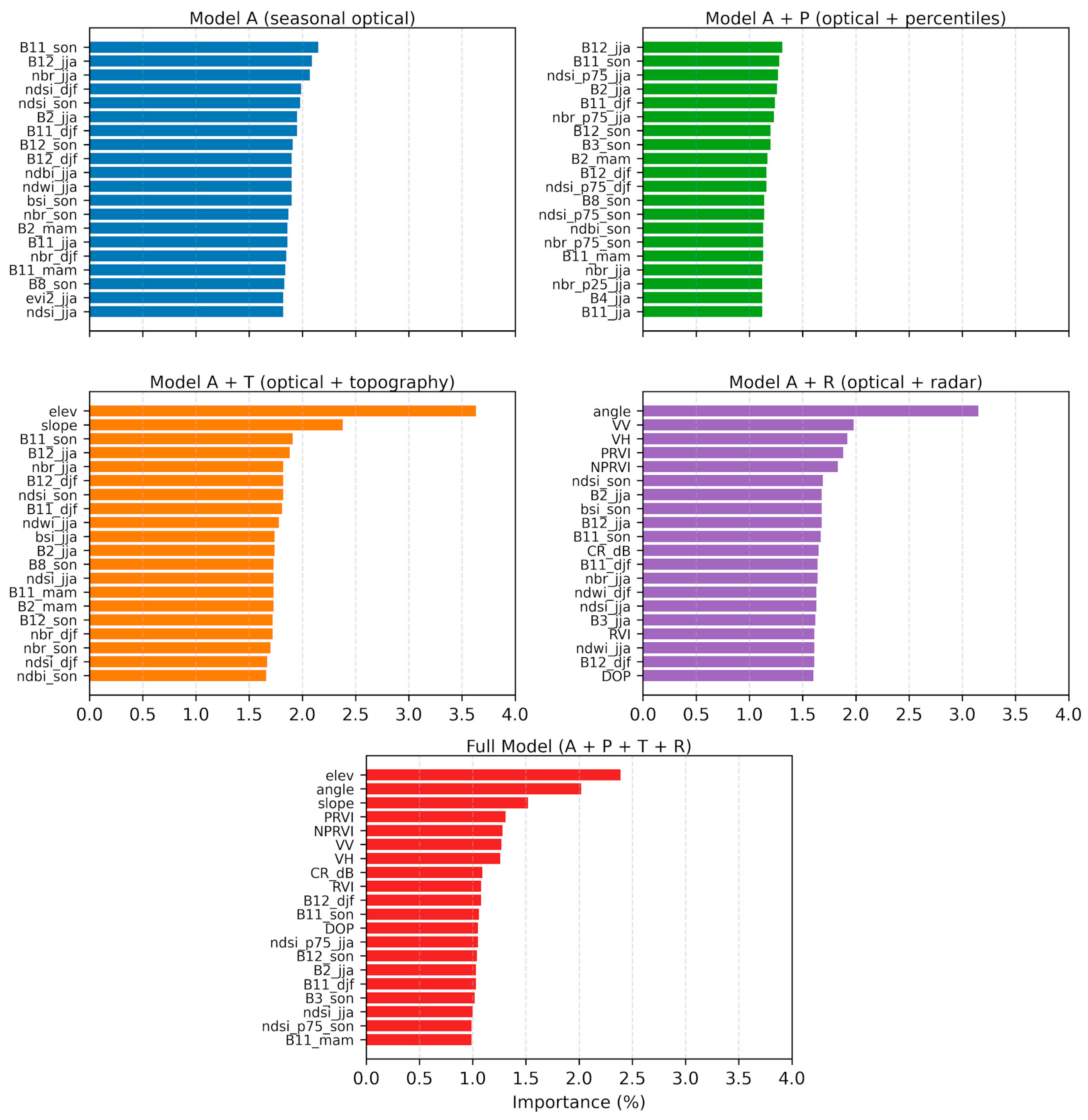
References
- Aberle, R.; Enderlin, E.; O’Neel, S.; Florentine, C.; Sass, L.; Dickson, A.; Marshall, H.-P.; Flores, A. Automated snow cover detection on mountain glaciers using spaceborne imagery and machine learning. Cryosphere 2025, 19, 1675–1693. [Google Scholar] [CrossRef] [Scilit]
- Shukla, P.R.; Skeg, J.; Buendia, E.C.; Masson-Delmotte, V.; Pörtner, H.-O.; Roberts, D.; Zhai, P.; Slade, R.; Connors, S.; Van Diemen, S. Climate Change and Land: An IPCC Special Report on Climate Change, Desertification, Land Degradation, Sustainable Land Management, Food Security, and Greenhouse Gas Fluxes in Terrestrial Ecosystems. 2019. Available online: https://philpapers.org/rec/SHUCCA-2 (accessed on 20 December 2025).
- Velastegui-Montoya, A.; Montalván-Burbano, N.; Carrión-Mero, P.; Rivera-Torres, H.; Sadeck, L.; Adami, M. Google Earth Engine: A global analysis and future trends. Remote Sens. 2023, 15, 3675. [Google Scholar]
- Amin, G.; Imtiaz, I.; Haroon, E.; Saqib, N.U.; Shahzad, M.I.; Nazeer, M. Assessment of machine learning algorithms for land cover classification in a complex mountainous landscape. J. Geovis. Spat. Anal. 2024, 8, 34. [Google Scholar] [CrossRef] [Scilit]
- Talukdar, S.; Singha, P.; Mahato, S.; Pal, S.; Liou, Y.-A.; Rahman, A. Land-use land-cover classification by machine learning classifiers for satellite observations—A review. Remote Sens. 2020, 12, 1135. [Google Scholar] [CrossRef] [Scilit]
- Belcore, E.; Piras, M.; Wozniak, E. Specific alpine environment land cover classification methodology: Google earth engine processing for sentinel-2 data. Int. Arch. Photogramm. Remote Sens. Spat. Inf. Sci. 2020, 43, 663–670. [Google Scholar] [CrossRef] [Scilit]
- Argandoña-Castro, F.; Peña-Cortés, F. A Systematic Review of Developments in Farmland Cover in Chile: Dynamics and Implications for a Sustainable Future in Land Use. Sustainability 2025, 17, 3905. [Google Scholar] [CrossRef] [Scilit]
- Bizama, G.; Torrejón, F.; Aguayo, M.; Muñoz, M.D.; Echeverría, C.; Urrutia, R. Pérdida y fragmentación del bosque nativo en la cuenca del río Aysén (Patagonia-Chile) durante el siglo XX. Rev. Geogr. Norte Gd. 2011, 49, 125–138. [Google Scholar]
- Castilla, J.C.; Armesto, J.J.; Martínez-Harms, M.J. Conservación en la Patagonia Chilena: Evaluación del Conocimiento, Oportunidades y Desafíos; Ediciones UC: Santiago, Chile, 2021. [Google Scholar]
- Buchhorn, M.; Lesiv, M.; Tsendbazar, N.-E.; Herold, M.; Bertels, L.; Smets, B. Copernicus global land cover layers—Collection 2. Remote Sens. 2020, 12, 1044. [Google Scholar] [CrossRef] [Scilit]
- Zanaga, D.; Van De Kerchove, R.; Daems, D.; De Keersmaecker, W.; Brockmann, C.; Kirches, G.; Wevers, J.; Cartus, O.; Santoro, M.; Fritz, S. ESA WorldCover 10 m 2021 v200. 2022. Available online: https://pure.iiasa.ac.at/id/eprint/18478/ (accessed on 20 December 2025).
- Gorelick, N.; Hancher, M.; Dixon, M.; Ilyushchenko, S.; Thau, D.; Moore, R. Google Earth Engine: Planetary-scale geospatial analysis for everyone. Remote Sens. Environ. 2017, 202, 18–27. [Google Scholar]
- Azzari, G.; Lobell, D. Landsat-based classification in the cloud: An opportunity for a paradigm shift in land cover monitoring. Remote Sens. Environ. 2017, 202, 64–74. [Google Scholar]
- Zhao, Y.; Feng, D.; Yu, L.; Wang, X.; Chen, Y.; Bai, Y.; Hernández, H.J.; Galleguillos, M.; Estades, C.; Biging, G.S. Detailed dynamic land cover mapping of Chile: Accuracy improvement by integrating multi-temporal data. Remote Sens. Environ. 2016, 183, 170–185. [Google Scholar] [CrossRef] [Scilit]
- Clerici, N.; Valbuena Calderón, C.A.; Posada, J.M. Fusion of Sentinel-1A and Sentinel-2A data for land cover mapping: A case study in the lower Magdalena region, Colombia. J. Maps 2017, 13, 718–726. [Google Scholar] [CrossRef] [Scilit]
- Hethcoat, M.G.; Edwards, D.P.; Carreiras, J.M.; Bryant, R.G.; Franca, F.M.; Quegan, S. A machine learning approach to map tropical selective logging. Remote Sens. Environ. 2019, 221, 569–582. [Google Scholar] [CrossRef] [Scilit]
- Belgiu, M.; Drăguţ, L. Random forest in remote sensing: A review of applications and future directions. ISPRS J. Photogramm. Remote Sens. 2016, 114, 24–31. [Google Scholar] [CrossRef] [Scilit]
- Phiri, D.; Simwanda, M.; Salekin, S.; Nyirenda, V.R.; Murayama, Y.; Ranagalage, M. Sentinel-2 data for land cover/use mapping: A review. Remote Sens. 2020, 12, 2291. [Google Scholar] [CrossRef] [Scilit]
- Steinhausen, M.J.; Wagner, P.D.; Narasimhan, B.; Waske, B. Combining Sentinel-1 and Sentinel-2 data for improved land use and land cover mapping of monsoon regions. Int. J. Appl. Earth Obs. Geoinf. 2018, 73, 595–604. [Google Scholar] [CrossRef] [Scilit]
- Torres-Gómez, M.; Delgado, L.E.; Marín, V.H.; Bustamante, R.O. Estructura del paisaje a lo largo de gradientes urbano-rurales en la cuenca del río Aisén (Región de Aisén, Chile). Rev. Chil. Hist. Nat. 2009, 82, 73–82. [Google Scholar] [CrossRef] [Scilit]
- Pérez, T.; Mattar, C.; Fuster, R. Decrease in snow cover over the Aysén river catchment in Patagonia, Chile. Water 2018, 10, 619. [Google Scholar] [CrossRef] [Scilit]
- Sade, K.; Pérez, L. El impacto humano sobre el paisaje arqueológico en la Cuenca del Río Aysén. In Proceedings of the Ctas del VIII Congreso de Historia Social y Política de la Patagonia Argentino Chilena, Rawson 2009, Trevelin, Argentina, 8–10 October 2009; pp. 266–274. [Google Scholar]
- Louis, J.; Pflug, B.; Main-Knorn, M.; Debaecker, V.; Mueller-Wilm, U.; Iannone, R.Q.; Cadau, E.G.; Boccia, V.; Gascon, F. Sentinel-2 global surface reflectance level-2A product generated with Sen2Cor. In Proceedings of the IGARSS 2019–2019 IEEE International Geoscience and Remote Sensing Symposium; IEEE: Piscataway, NJ, USA, 2019; pp. 8522–8525. [Google Scholar]
- Hall, D.K.; Riggs, G.A. Normalized-difference snow index (NDSI). In Encyclopedia of Snow, Ice and Glaciers; Springer: Berlin/Heidelberg, Germany, 2010. [Google Scholar]
- Marzi, D.; Sorriso, A.; Gamba, P. Automatic wide area land cover mapping using Sentinel-1 multitemporal data. Front. Remote Sens. 2023, 4, 1148328. [Google Scholar] [CrossRef] [Scilit]
- Schulz, D.; Yin, H.; Tischbein, B.; Verleysdonk, S.; Adamou, R.; Kumar, N. Land use mapping using Sentinel-1 and Sentinel-2 time series in a heterogeneous landscape in Niger, Sahel. ISPRS J. Photogramm. Remote Sens. 2021, 178, 97–111. [Google Scholar] [CrossRef] [Scilit]
- Mullissa, A.; Vollrath, A.; Odongo-Braun, C.; Slagter, B.; Balling, J.; Gou, Y.; Gorelick, N.; Reiche, J. Sentinel-1 sar backscatter analysis ready data preparation in google earth engine. Remote Sens. 2021, 13, 1954. [Google Scholar] [CrossRef] [Scilit]
- Small, D. Flattening gamma: Radiometric terrain correction for SAR imagery. IEEE Trans. Geosci. Remote Sens. 2011, 49, 3081–3093. [Google Scholar] [CrossRef] [Scilit]
- Reiche, J.; Mullissa, A.; Slagter, B.; Gou, Y.; Tsendbazar, N.-E.; Odongo-Braun, C.; Vollrath, A.; Weisse, M.J.; Stolle, F.; Pickens, A. Forest disturbance alerts for the Congo Basin using Sentinel-1. Environ. Res. Lett. 2021, 16, 024005. [Google Scholar] [CrossRef] [Scilit]
- Farr, T.G.; Rosen, P.A.; Caro, E.; Crippen, R.; Duren, R.; Hensley, S.; Kobrick, M.; Paller, M.; Rodriguez, E.; Roth, L. The shuttle radar topography mission. Rev. Geophys. 2007, 45, RG2004. [Google Scholar] [CrossRef] [Scilit]
- Uuemaa, E.; Ahi, S.; Montibeller, B.; Muru, M.; Kmoch, A. Vertical accuracy of freely available global digital elevation models (ASTER, AW3D30, MERIT, TanDEM-X, SRTM, and NASADEM). Remote Sens. 2020, 12, 3482. [Google Scholar] [CrossRef] [Scilit]
- Jpl, N. NASA Shuttle Radar Topography Mission Global 3 arc second number NetCDF. In NASA EOSDIS Land Processes Distributed Active Archive Center (DAAC) Data Set; SRTMGL3_NUMNC. 003; U.S. Geological Survey: Reston, VA, USA, 2013. [Google Scholar]
- Horn, B.K. Hill shading and the reflectance map. Proc. IEEE 2005, 69, 14–47. [Google Scholar]
- Olofsson, P.; Foody, G.M.; Stehman, S.V.; Woodcock, C.E. Making better use of accuracy data in land change studies: Estimating accuracy and area and quantifying uncertainty using stratified estimation. Remote Sens. Environ. 2013, 129, 122–131. [Google Scholar] [CrossRef] [Scilit]
- Planet Labs PBC. PlanetScope Product Specification. Available online: https://assets.planet.com/docs/Planet_PSScene_Imagery_Product_Spec_June_2021.pdf (accessed on 20 December 2025).
- Albornoz, A.; Alegría, D.; Cortés, F.; Moya, J. Protocolo Metodológico Para la Elaboración de Cartografías de Usos y Cambios de Usos de la Tierra. 2021. Available online: https://www.sidalc.net/search/Record/dig-fao-it-20.500.14283-cb0845es/Description (accessed on 20 December 2025).
- Hollstein, A.; Segl, K.; Guanter, L.; Brell, M.; Enesco, M. Ready-to-use methods for the detection of clouds, cirrus, snow, shadow, water and clear sky pixels in Sentinel-2 MSI images. Remote Sens. 2016, 8, 666. [Google Scholar] [CrossRef] [Scilit]
- Rifai, M. Integration of Cloud Score+ with Sentinel-2 Harmonized for land use and land cover classification using machine learning algorithms. In Proceedings of the IOP Conference Series: Earth and Environmental Science; IOP Publishing Ltd.: Bristol, UK, 2024; p. 012039. [Google Scholar]
- Flood, N. Seasonal composite Landsat TM/ETM+ images using the medoid (a multi-dimensional median). Remote Sens. 2013, 5, 6481–6500. [Google Scholar] [CrossRef] [Scilit]
- Griffiths, P.; Hostert, P.; Gruebner, O.; van der Linden, S. Mapping megacity growth with multi-sensor data. Remote Sens. Environ. 2010, 114, 426–439. [Google Scholar] [CrossRef] [Scilit]
- Phan, T.N.; Kuch, V.; Lehnert, L.W. Land cover classification using Google Earth Engine and random forest classifier—The role of image composition. Remote Sens. 2020, 12, 2411. [Google Scholar] [CrossRef] [Scilit]
- Griffiths, P.; van der Linden, S.; Kuemmerle, T.; Hostert, P. A pixel-based Landsat compositing algorithm for large area land cover mapping. IEEE J. Sel. Top. Appl. Earth Obs. Remote Sens. 2013, 6, 2088–2101. [Google Scholar] [CrossRef] [Scilit]
- Breiman, L. Random forests. Mach. Learn. 2001, 45, 5–32. [Google Scholar] [CrossRef] [Scilit]
- Rouse, J.W., Jr.; Haas, R.H.; Schell, J.; Deering, D. Monitoring the Vernal Advancement and Retrogradation (Green Wave Effect) of Natural Vegetation; Texas A&M University: College Station, TX, USA, 1973. [Google Scholar]
- Jiang, Z.; Huete, A.R.; Didan, K.; Miura, T. Development of a two-band enhanced vegetation index without a blue band. Remote Sens. Environ. 2008, 112, 3833–3845. [Google Scholar] [CrossRef] [Scilit]
- Huete, A.R. A soil-adjusted vegetation index (SAVI). Remote Sens. Environ. 1988, 25, 295–309. [Google Scholar] [CrossRef] [Scilit]
- McFeeters, S.K. The use of the Normalized Difference Water Index (NDWI) in the delineation of open water features. Int. J. Remote Sens. 1996, 17, 1425–1432. [Google Scholar] [CrossRef] [Scilit]
- Hall, D.K.; Riggs, G.A.; Salomonson, V.V. Development of methods for mapping global snow cover using moderate resolution imaging spectroradiometer data. Remote Sens. Environ. 1995, 54, 127–140. [Google Scholar] [CrossRef] [Scilit]
- Key, C.H.; Benson, N.C. Landscape assessment (LA). In FIREMON: Fire Effects Monitoring and Inventory System; Lutes, D.C., Keane, R.E., Caratti, J.F., Key, C.H., Benson, N.C., Sutherland, S., Gangi, L.J., Eds.; Gen. Tech. Rep. RMRS-GTR-164-CD; US Department of Agriculture, Forest Service, Rocky Mountain Research Station: Fort Collins, CO, USA, 2006; Volume 164, p. LA-1-55. [Google Scholar]
- Zha, Y.; Gao, J.; Ni, S. Use of normalized difference built-up index in automatically mapping urban areas from TM imagery. Int. J. Remote Sens. 2003, 24, 583–594. [Google Scholar] [CrossRef] [Scilit]
- Rikimaru, A.; Roy, P.S.; Miyatake, S. Tropical forest cover density mapping. Trop. Ecol. 2002, 43, 39–47. [Google Scholar]
- Burrough, P.A. Principles of geographical. In Information Systems for Land Resource Assessment; Clarendon Press: Oxford, UK, 1986. [Google Scholar]
- Beers, T.W.; Dress, P.E.; Wensel, L.C. Notes and observations: Aspect transformation in site productivity research. J. For. 1966, 64, 691–692. [Google Scholar] [CrossRef] [Scilit]
- Torres, R.; Snoeij, P.; Geudtner, D.; Bibby, D.; Davidson, M.; Attema, E.; Potin, P.; Rommen, B.; Floury, N.; Brown, M. GMES Sentinel-1 mission. Remote Sens. Environ. 2012, 120, 9–24. [Google Scholar] [CrossRef] [Scilit]
- Lee, J.-S.; Pottier, E. Polarimetric Radar Imaging: From Basics to Applications; CRC press: Boca Raton, FL, USA, 2017. [Google Scholar]
- Chang, J.G.; Kraatz, S.; Anderson, M.; Gao, F. Enhanced polarimetric radar vegetation index and integration with optical index for biomass estimation in grazing lands across the contiguous United States. Remote Sens. 2024, 16, 4476. [Google Scholar] [CrossRef] [Scilit]
- Mandal, D.; Kumar, V.; Ratha, D.; Dey, S.; Bhattacharya, A.; Lopez-Sanchez, J.M.; McNairn, H.; Rao, Y.S. Dual polarimetric radar vegetation index for crop growth monitoring using sentinel-1 SAR data. Remote Sens. Environ. 2020, 247, 111954. [Google Scholar] [CrossRef] [Scilit]
- Maxwell, A.E.; Warner, T.A.; Fang, F. Implementation of machine-learning classification in remote sensing: An applied review. Int. J. Remote Sens. 2018, 39, 2784–2817. [Google Scholar] [CrossRef] [Scilit]
- Vizzari, M. PlanetScope, Sentinel-2, and Sentinel-1 data integration for object-based land cover classification in Google Earth Engine. Remote Sens. 2022, 14, 2628. [Google Scholar] [CrossRef] [Scilit]
- Foody, G.M. Explaining the unsuitability of the kappa coefficient in the assessment and comparison of the accuracy of thematic maps obtained by image classification. Remote Sens. Environ. 2020, 239, 111630. [Google Scholar] [CrossRef] [Scilit]
- Farhadpour, S.; Warner, T.A.; Maxwell, A.E. Selecting and interpreting multiclass loss and accuracy assessment metrics for classifications with class imbalance: Guidance and best practices. Remote Sens. 2024, 16, 533. [Google Scholar] [CrossRef] [Scilit]
- Cumming, G.; Finch, S. Inference by eye: Confidence intervals and how to read pictures of data. Am. Psychol. 2005, 60, 170. [Google Scholar] [CrossRef] [Scilit] [PubMed]
- Joshi, N.; Baumann, M.; Ehammer, A.; Fensholt, R.; Grogan, K.; Hostert, P.; Jepsen, M.R.; Kuemmerle, T.; Meyfroidt, P.; Mitchard, E.T. A review of the application of optical and radar remote sensing data fusion to land use mapping and monitoring. Remote Sens. 2016, 8, 70. [Google Scholar] [CrossRef] [Scilit]
- Jönsson, P.; Eklundh, L. TIMESAT—A program for analyzing time-series of satellite sensor data. Comput. Geosci. 2004, 30, 833–845. [Google Scholar] [CrossRef] [Scilit]
- Zhu, Z.; Woodcock, C.E. Continuous change detection and classification of land cover using all available Landsat data. Remote Sens. Environ. 2014, 144, 152–171. [Google Scholar] [CrossRef] [Scilit]
- Gómez, C.; White, J.C.; Wulder, M.A.; Alejandro, P. Historical forest biomass dynamics modelled with Landsat spectral trajectories. ISPRS J. Photogramm. Remote Sens. 2014, 93, 14–28. [Google Scholar] [CrossRef] [Scilit]
- Zhang, X.; Liu, L.; Zhao, T.; Zhang, W.; Guan, L.; Bai, M.; Chen, X. GLC_FCS10: A global 10 m land-cover dataset with a fine classification system from Sentinel-1 and Sentinel-2 time-series data in Google Earth Engine. Earth Syst. Sci. Data 2025, 17, 4039–4062. [Google Scholar] [CrossRef] [Scilit]
- Zhang, Z.; Wei, M.; Pu, D.; He, G.; Wang, G.; Long, T. Assessment of annual composite images obtained by google earth engine for urban areas mapping using random forest. Remote Sens. 2021, 13, 748. [Google Scholar] [CrossRef] [Scilit]
- Fassnacht, F.E.; Latifi, H.; Stereńczak, K.; Modzelewska, A.; Lefsky, M.; Waser, L.T.; Straub, C.; Ghosh, A. Review of studies on tree species classification from remotely sensed data. Remote Sens. Environ. 2016, 186, 64–87. [Google Scholar] [CrossRef] [Scilit]
- Tassi, A.; Vizzari, M. Object-oriented lulc classification in google earth engine combining snic, glcm, and machine learning algorithms. Remote Sens. 2020, 12, 3776. [Google Scholar] [CrossRef] [Scilit]
- Carrasco, L.; O’Neil, A.W.; Morton, R.D.; Rowland, C.S. Evaluating combinations of temporally aggregated Sentinel-1, Sentinel-2 and Landsat 8 for land cover mapping with Google Earth Engine. Remote Sens. 2019, 11, 288. [Google Scholar] [CrossRef] [Scilit]
- Ulaby, F.; Long, D. Microwave Radar and Radiometric Remote Sensing; University of Michigan Press: Ann Arbor, MI, USA, 2014. [Google Scholar]
- Griffiths, P.; Müller, D.; Kuemmerle, T.; Hostert, P. Agricultural land change in the Carpathian ecoregion after the breakdown of socialism and expansion of the European Union. Environ. Res. Lett. 2013, 8, 045024. [Google Scholar] [CrossRef] [Scilit]
- Ma, L.; Liu, Y.; Zhang, X.; Ye, Y.; Yin, G.; Johnson, B.A. Deep learning in remote sensing applications: A meta-analysis and review. ISPRS J. Photogramm. Remote Sens. 2019, 152, 166–177. [Google Scholar] [CrossRef] [Scilit]
- Colditz, R.R. An evaluation of different training sample allocation schemes for discrete and continuous land cover classification using decision tree-based algorithms. Remote Sens. 2015, 7, 9655–9681. [Google Scholar] [CrossRef] [Scilit]
- Millard, K.; Richardson, M. On the importance of training data sample selection in random forest image classification: A case study in peatland ecosystem mapping. Remote Sens. 2015, 7, 8489–8515. [Google Scholar] [CrossRef] [Scilit]
- Thanh Noi, P.; Kappas, M. Comparison of random forest, k-nearest neighbor, and support vector machine classifiers for land cover classification using Sentinel-2 imagery. Sensors 2017, 18, 18. [Google Scholar] [CrossRef] [Scilit]
- Efron, B. Bootstrap methods: Another look at the jackknife. In Breakthroughs in Statistics: Methodology and Distribution; Springer: Berlin/Heidelberg, Germany, 1992; pp. 569–593. [Google Scholar]
- Diciccio, T.J.; Romano, J.P. A review of bootstrap confidence intervals. J. R. Stat. Soc. Ser. B Stat. Methodol. 1988, 50, 338–354. [Google Scholar] [CrossRef] [Scilit]
- Foody, G.M. Classification accuracy comparison: Hypothesis tests and the use of confidence intervals in evaluations of difference, equivalence and non-inferiority. Remote Sens. Environ. 2009, 113, 1658–1663. [Google Scholar] [CrossRef] [Scilit]
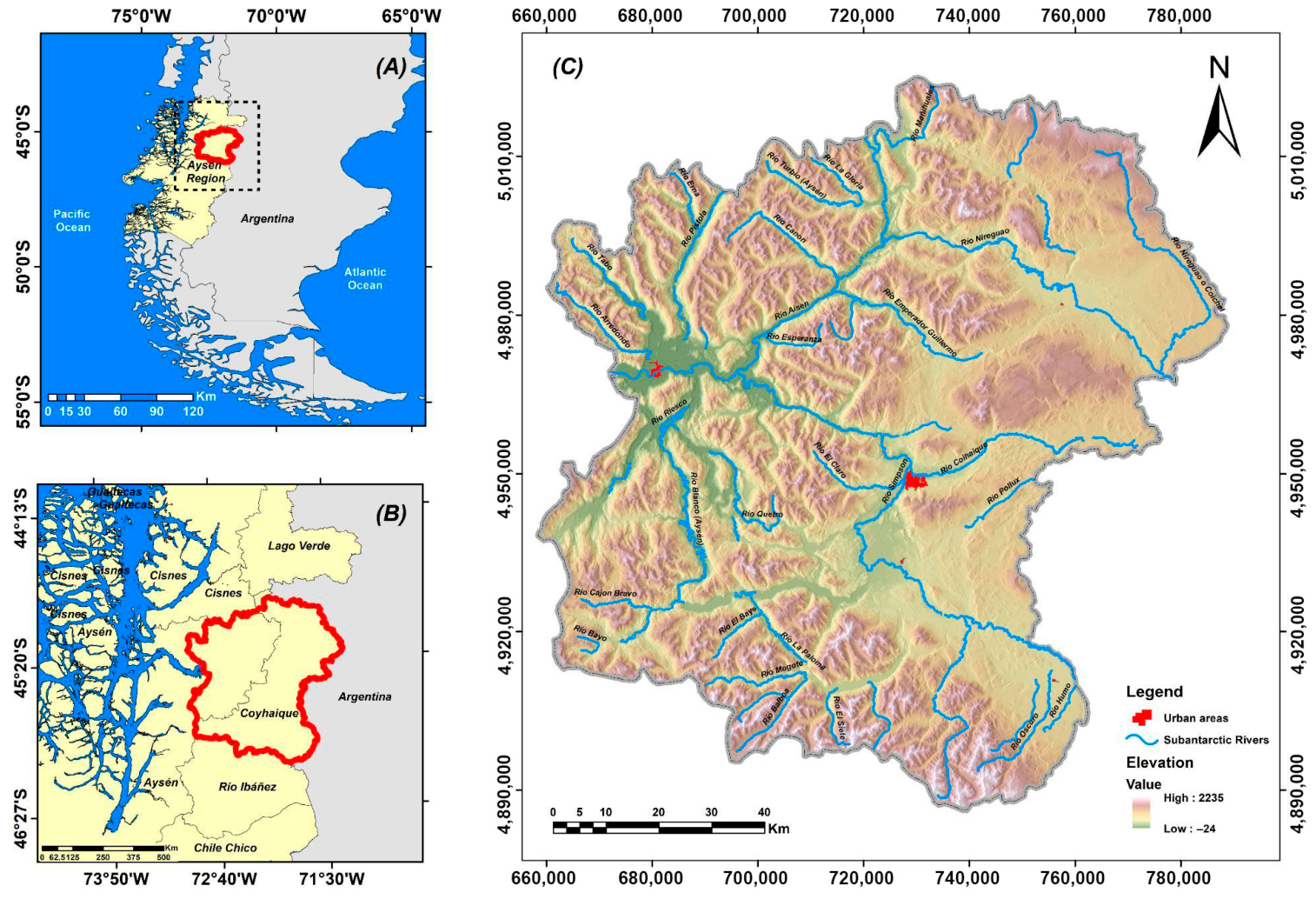
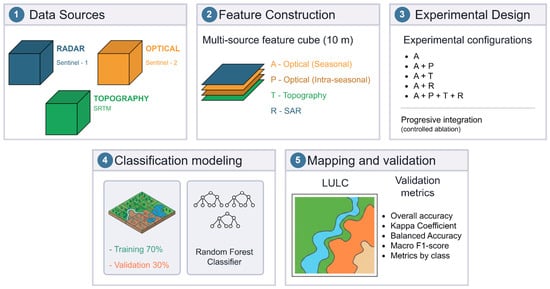
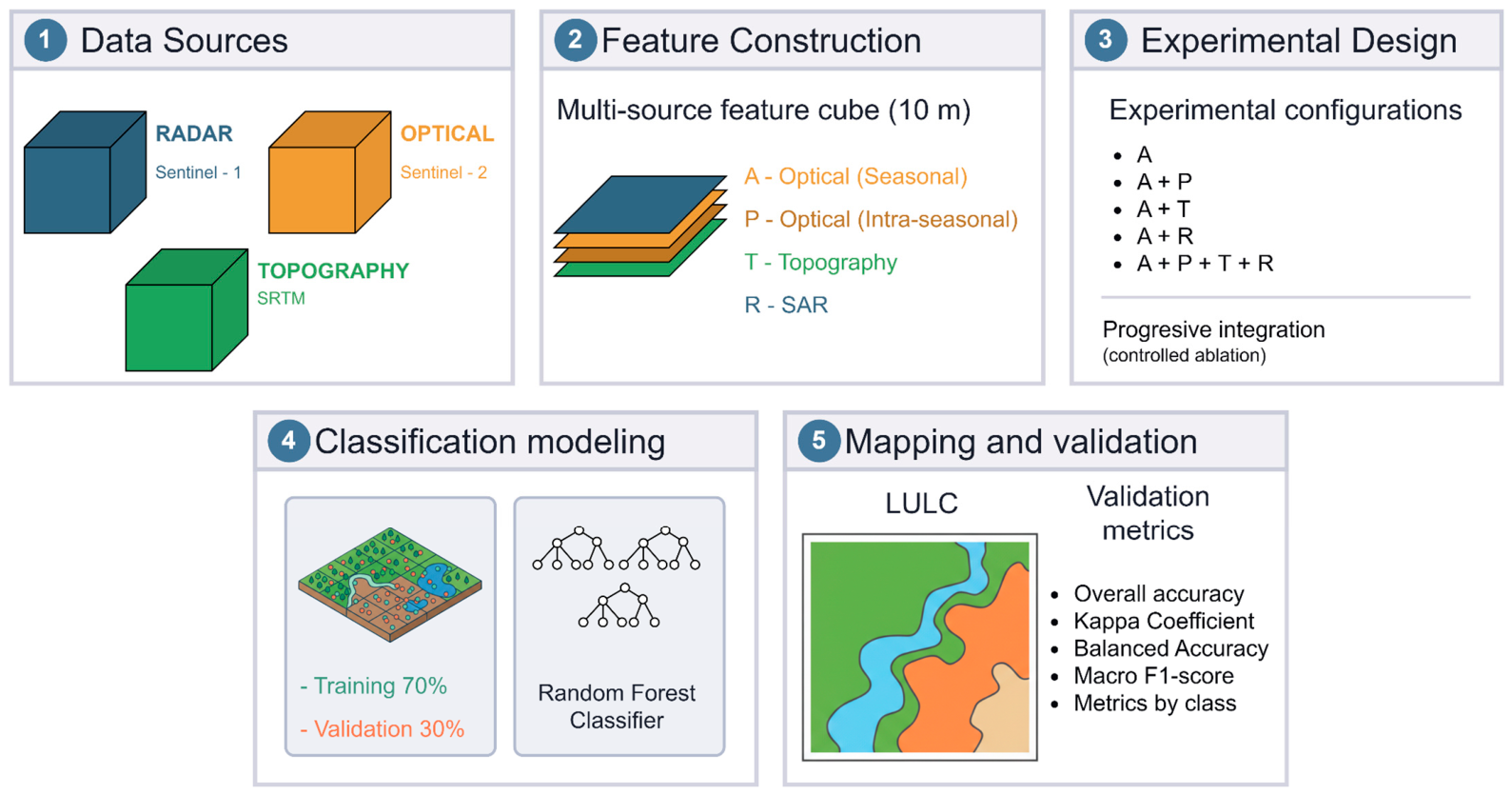
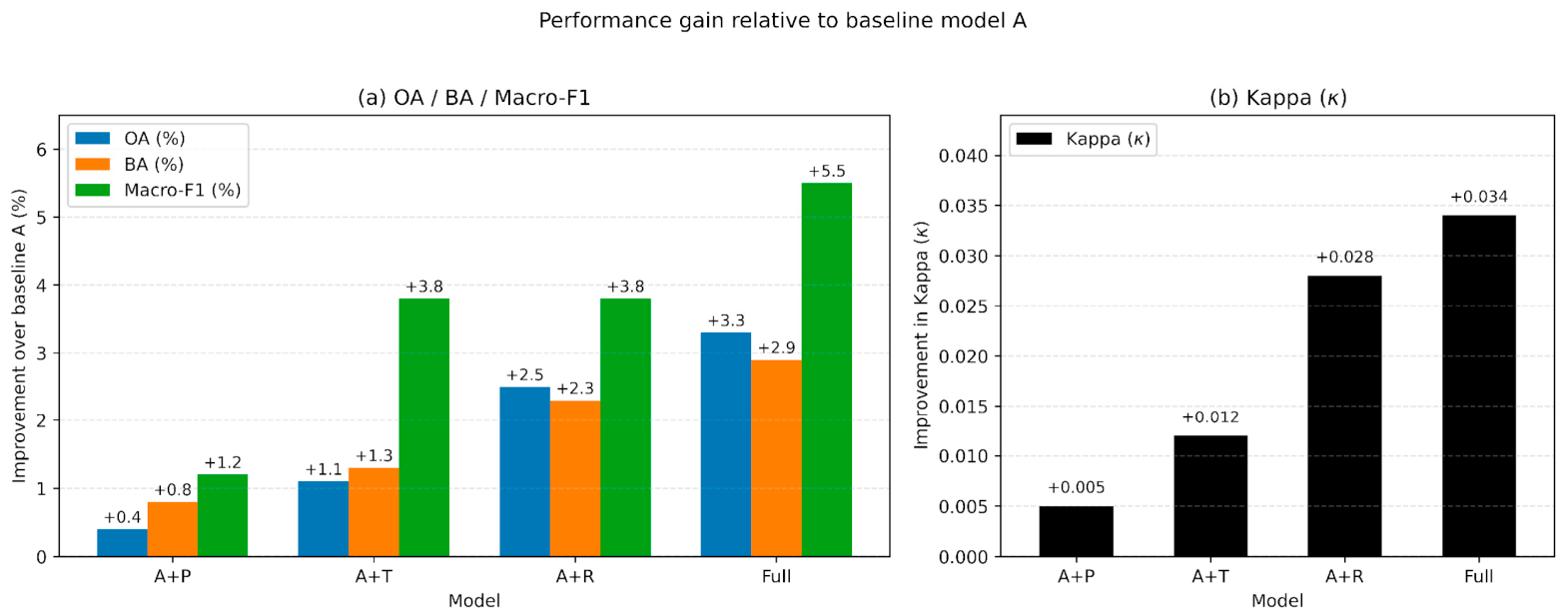
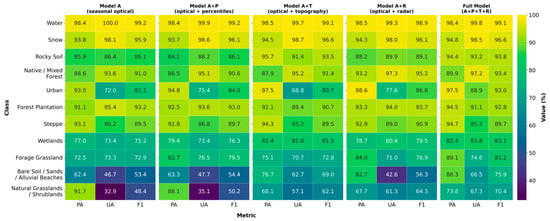
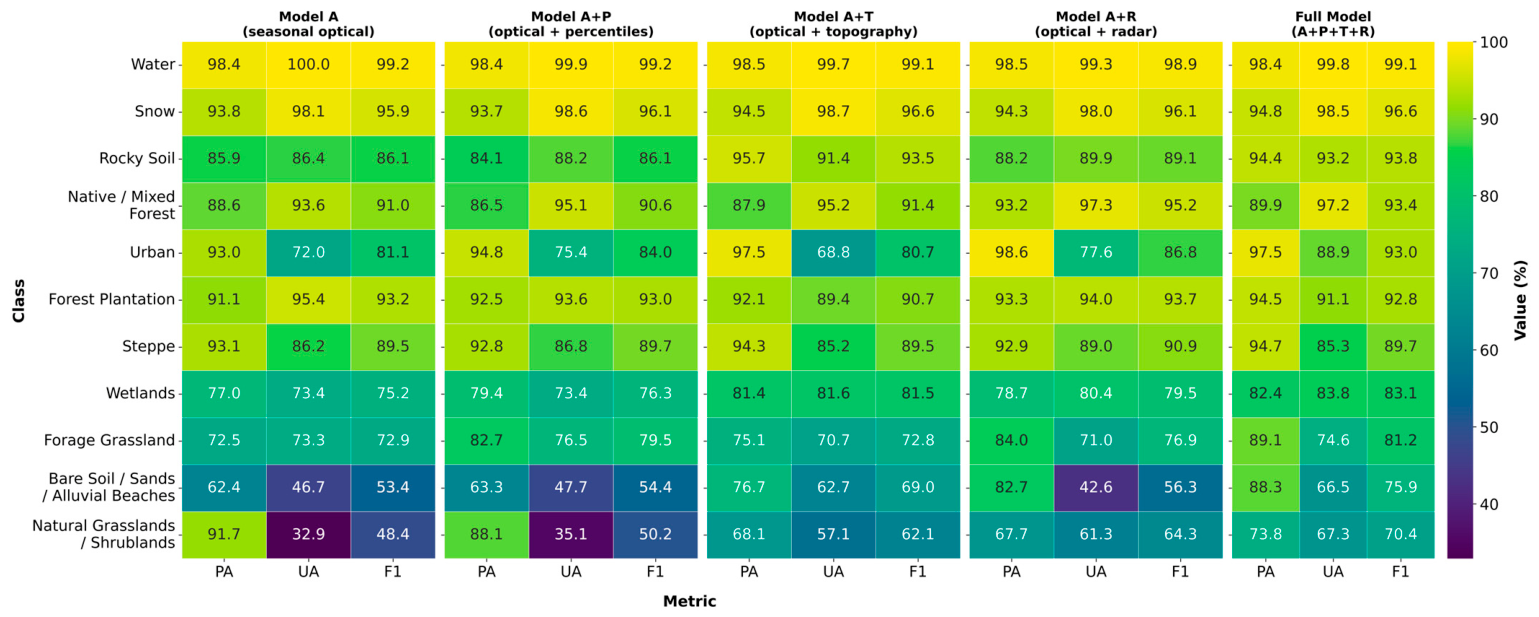
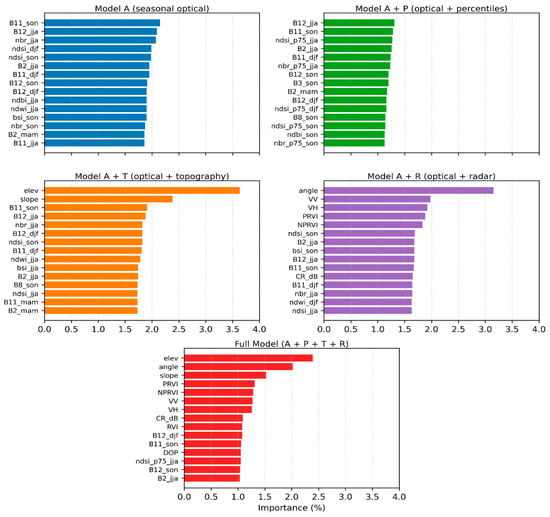
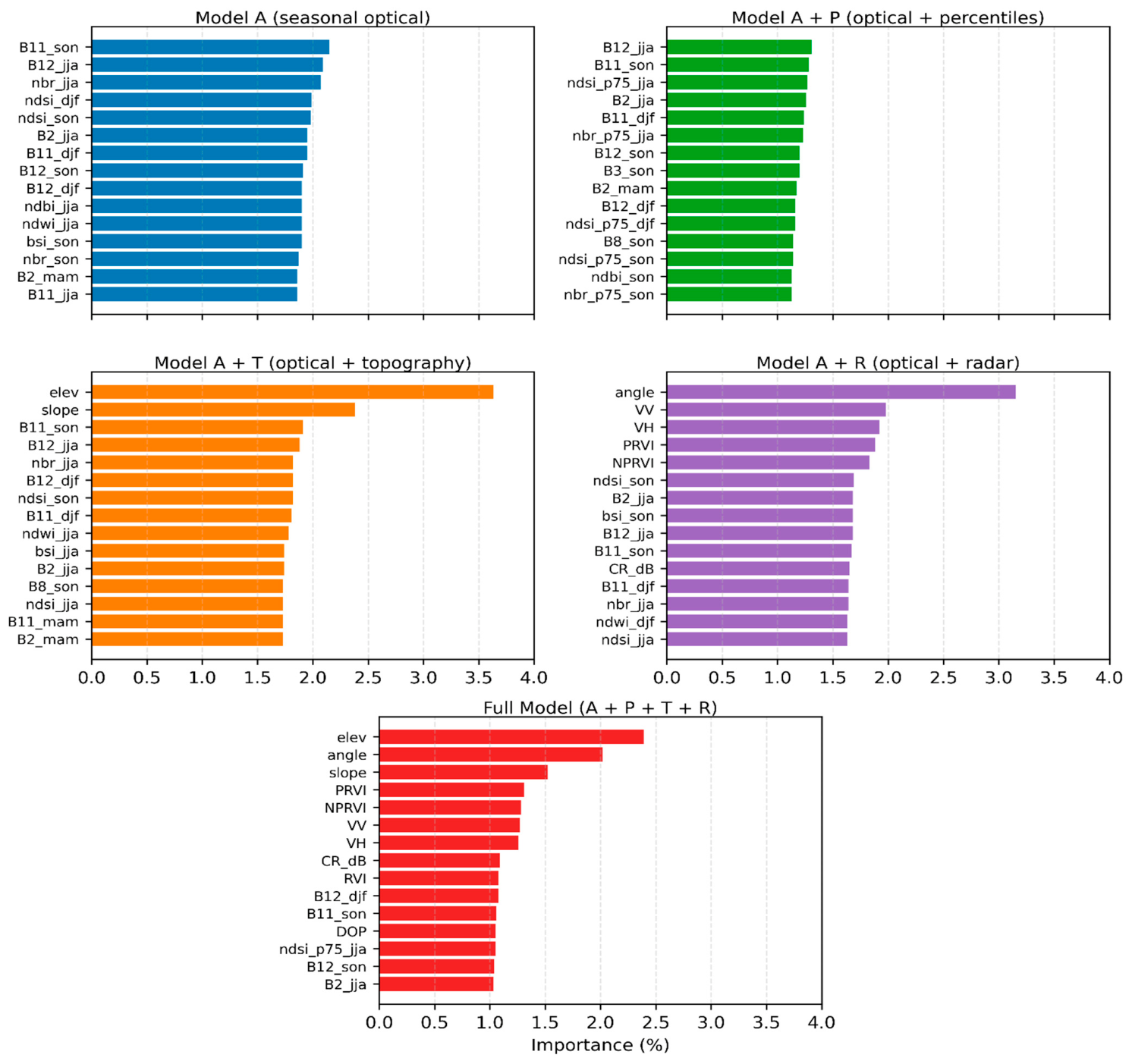
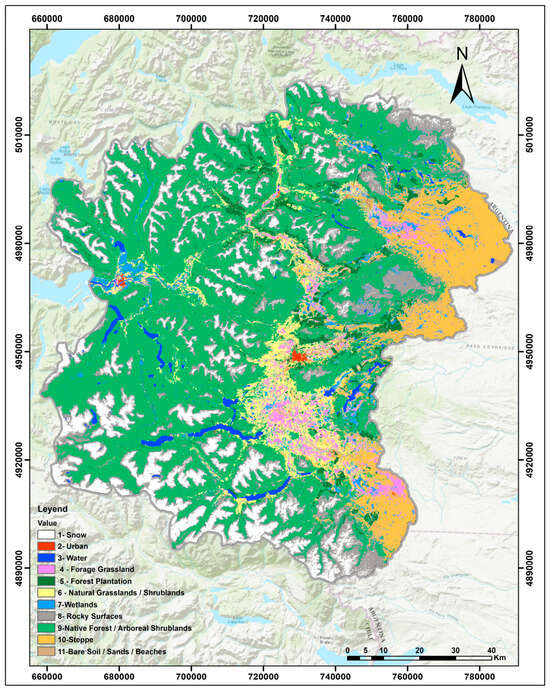
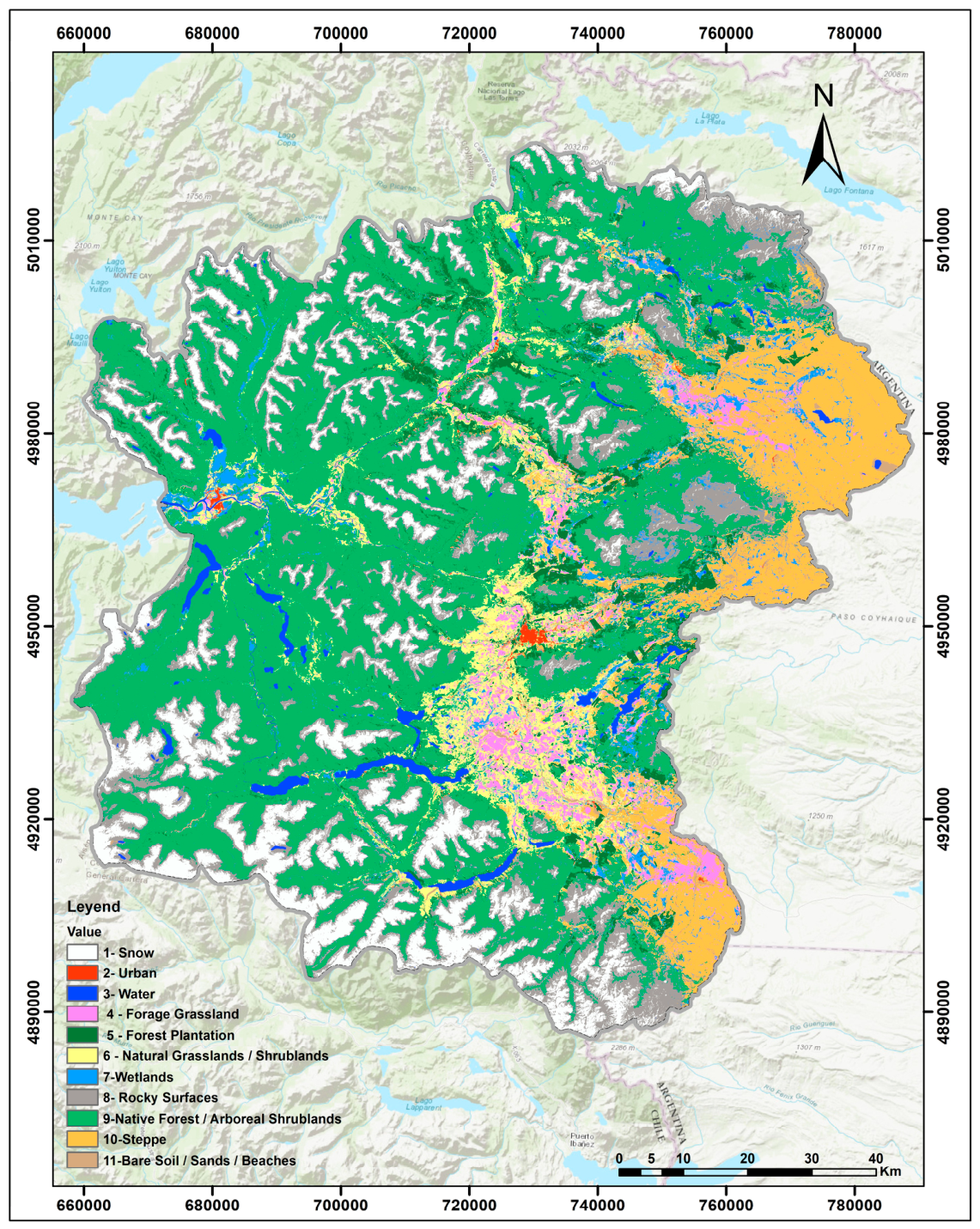
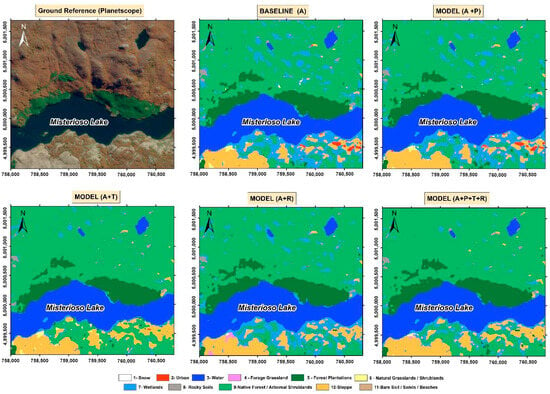
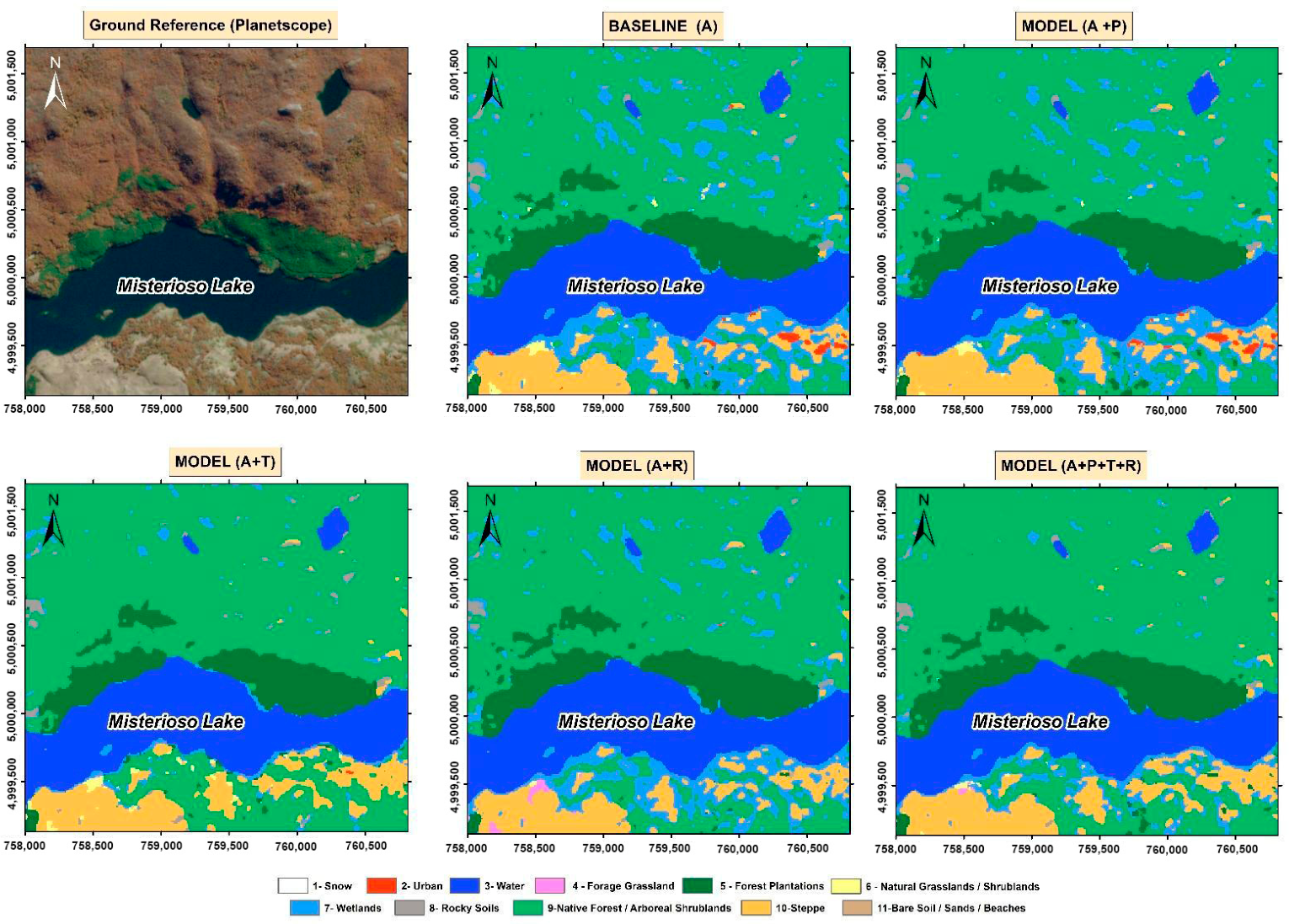
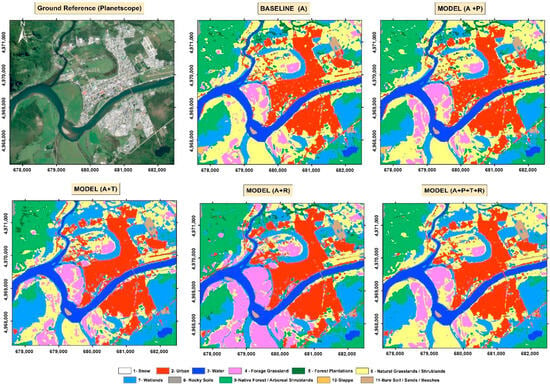
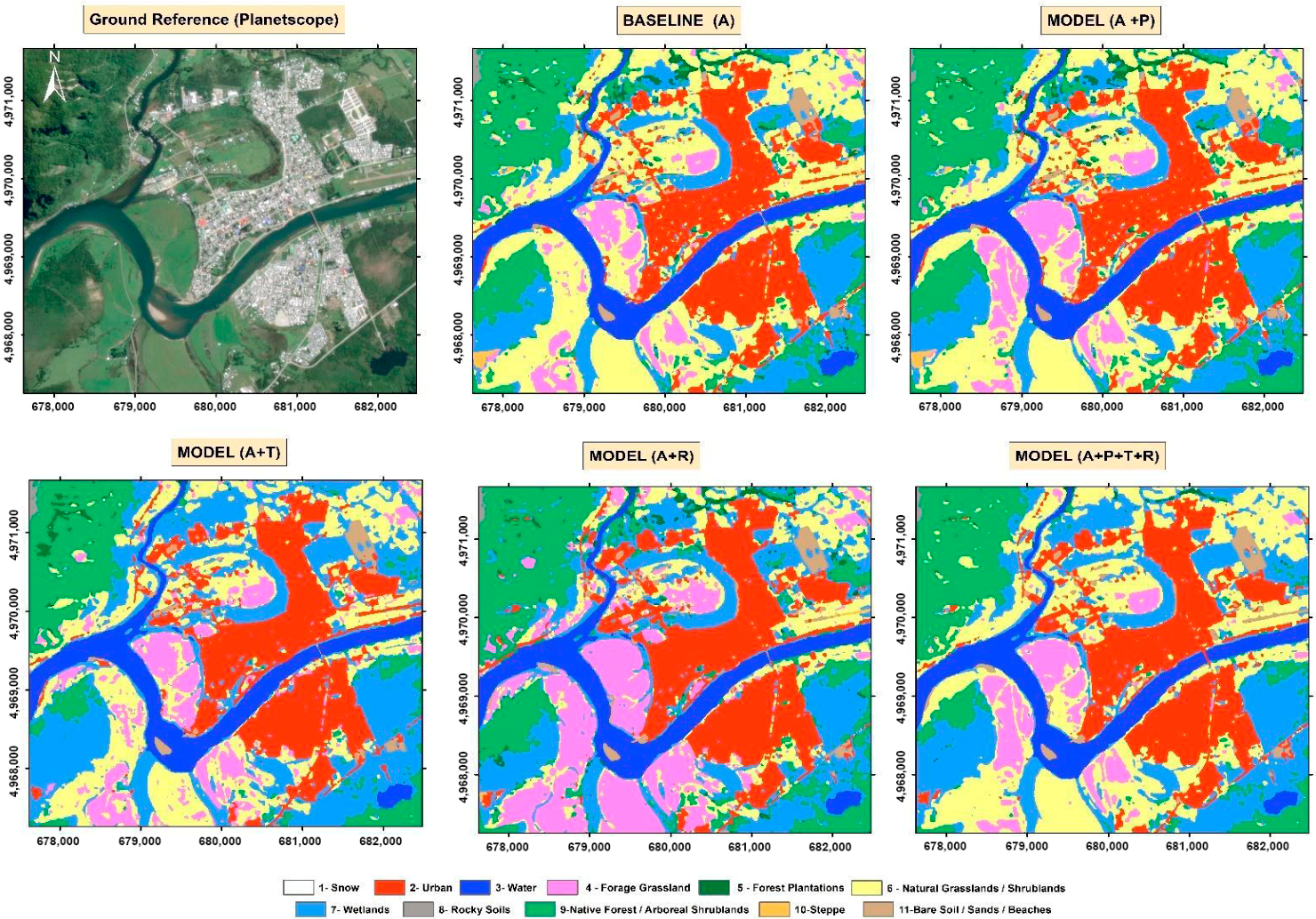
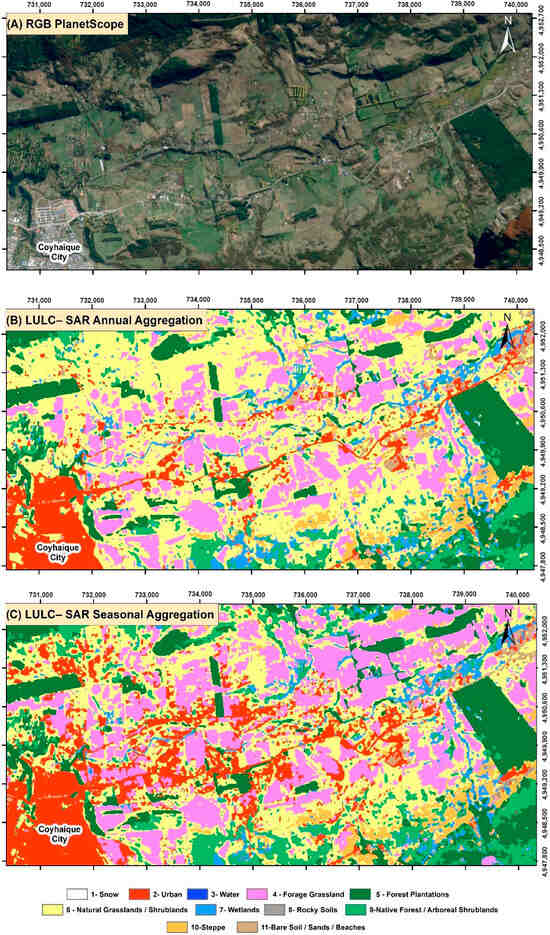
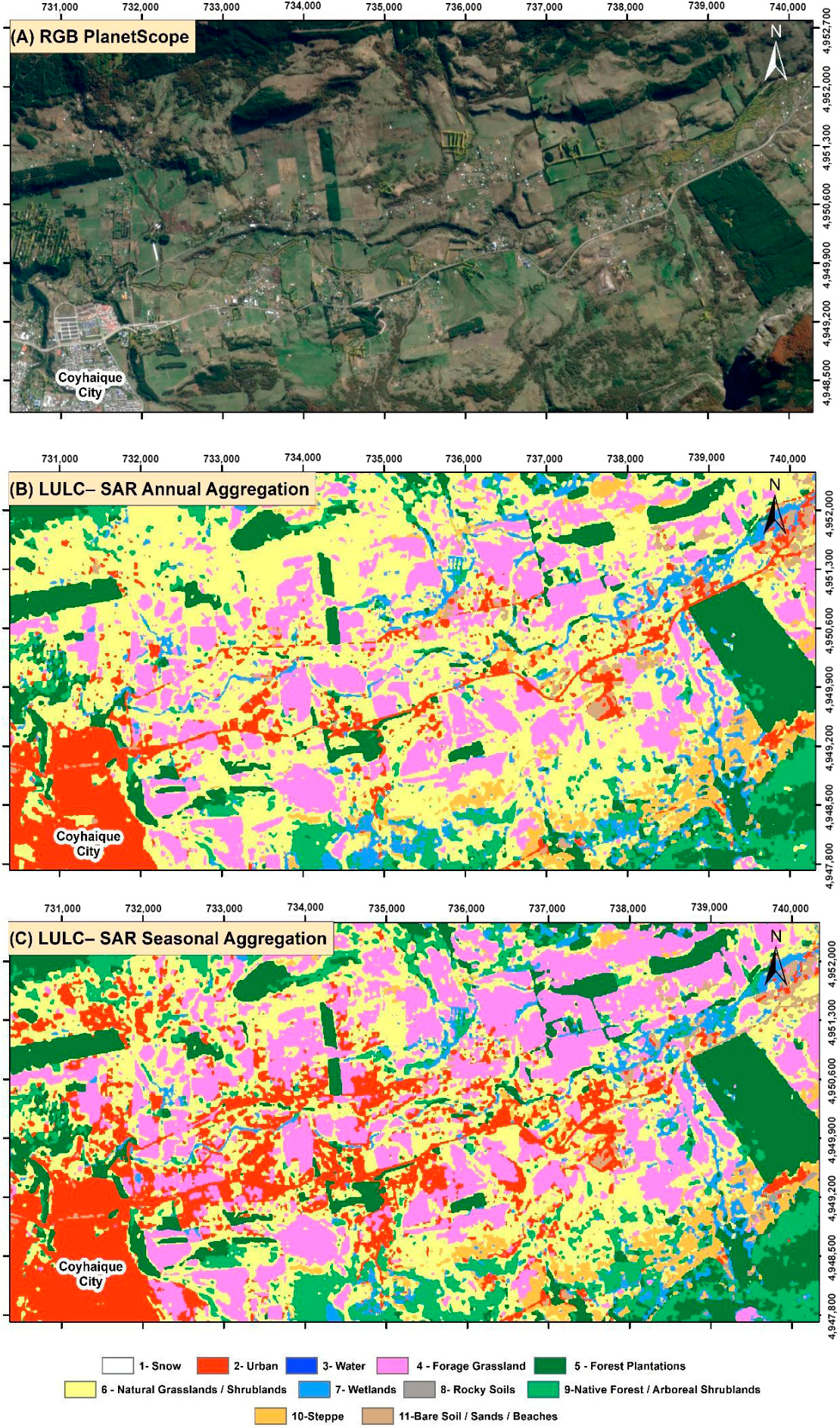

Disclaimer/Publisher’s Note: The statements, opinions and data contained in all publications are solely those of the individual author(s) and contributor(s) and not of MDPI and/or the editor(s). MDPI and/or the editor(s) disclaim responsibility for any injury to people or property resulting from any ideas, methods, instructions or products referred to in the content. |
© 2026 by the authors. Licensee MDPI, Basel, Switzerland. This article is an open access article distributed under the terms and conditions of the Creative Commons Attribution (CC BY) license.