


Abstract
Orthometric heights are practically determined from levelling and gravity measurements by applying orthometric corrections to levelled height differences. Currently, Helmert’s definition of orthometric heights is mostly used, with the mean gravity computed only approximately from observed surface gravity by applying the Poincaré–Prey gravity reduction. In this study, we apply the state-of-the-art method for the orthometric height determination and demonstrate its practical applicability. The method utilizes advanced numerical procedures to account for the topographic relief and mass density variations, while adopting the Earth’s spherical approximation. The non-topographic contribution of masses inside the geoid is evaluated by solving geodetic boundary-values problems. We apply this method for the first time to practically determine the orthometric heights of levelling benchmarks from levelling and gravity measurements and digital terrain and rock density models. The results obtained after the readjustment of newly determined orthometric heights at the levelling network covering Hong Kong territories are compared with Helmert’s orthometric heights. This comparison revealed that errors in Helmert’s orthometric heights vary between −3.13 and 0.95 cm. Such errors are very significant when compared to accurate values of the cumulative orthometric correction between −1.88 and 0.84 cm. Moreover, large errors (up to 1 cm) already occur at levelling benchmarks at very low elevations (<100 m). These findings demonstrate that the accurate determination of orthometric heights is crucial, even for regions with moderately elevated topography.
1. Introduction
The mean value of gravity along a plumbline within topography, i.e., between the topographic surface and the geoid, is required for the accurate determination of orthometric heights. This value is also needed for conversion between orthometric and normal heights or, alternatively, between geoid and quasigeoid heights, both realized by applying the geoid-to-quasigeoid separation. Since actual gravity inside topography cannot be measured, various methods have been proposed and used to estimate it from the observed surface gravity by adopting certain assumptions that (more or less) realistically approximate the actual gravity gradient inside topography. Helmert [1,2] computed the mean gravity value from the observed surface gravity by applying the Poincaré–Prey gravity gradient reduction. To further improve the accuracy of the Poincaré–Prey gravity gradient reduction, Niethammer [3,4], Mader [5], Wirth [6], and Flury and Rummel [7] applied the correction to the mean gravity value for terrain geometry. Tenzer and Vaníček [8] and Allister and Featherstone [9] applied the correction for anomalous topographic density to Helmert’s orthometric heights.
Realizing that the actual gravity inside topography depends not only on terrain geometry and topographic mass density variations, but also eventually on mass density distribution inside the geoid (that significantly affects the geometry of all equipotential surfaces including the geoid), Tenzer [10] and Tenzer et al. [11] developed an accurate method for determination of the mean gravity and orthometric heights. The method takes into consideration all three attributes mentioned above, while also assuming the Earth’s spherical approximation. Alternative methods have also been proposed and tested numerically for conversion between normal and orthometric heights (or equivalently between geoid and quasigeoid heights). Among these methods, we should mention the advanced numerical procedures developed by Sjöberg [12,13,14] and Tenzer et al. [15,16] to compute the geoid-to-quasigeoid separation; note that a more comprehensive summary of the studies on this topic is given later in this section.
Despite several theoretical attempts (briefly summarized above) to improve the accuracy of orthometric heights, Helmert’s definition of the mean gravity value within topography (by means of applying the Poincaré–Prey gravity gradient reduction) has been mostly used until now to determine the orthometric heights from levelled height differences and surface gravity data. This approximation is also used for conversion between Helmert’s orthometric and Molodensky’s [17,18] normal heights (see also [19]), as well as between the geoid and quasigeoid heights. Its principal justification is based on a very simple computation and expected sufficient accuracy for most regions where vertical geodetic controls are physically established by levelling benchmarks. As explained above, according to this approximation the mean gravity value along a plumbline within topography is determined from the observed surface gravity by applying the Poincaré–Prey gravity gradient reduction while disregarding gravity gradient changes caused by terrain geometry, anomalous topographic mass density variations, and mass density heterogeneities inside the geoid. In this study, we demonstrate that such assumptions are inadequate, showing that errors due to applying these approximations could reach a few centimetres in the region with an already moderately elevated topography.
A practical determination of orthometric heights at levelling benchmarks is realized by applying the orthometric correction to measured height differences along levelling lines. Alternatively, the orthometric heights at the levelling benchmarks can be computed from the normal heights by applying the geoid-to-quasigeoid separation. The geoid-to-quasigeoid separation is defined as a difference between the geoid height and the quasigeoid height (height anomaly), both described in terms of Bruns’s [20] formula. Equivalently, the definition of the geoid-to-quasigeoid separation can be given in terms of the difference between the normal and orthometric heights. A relationship between them is then derived as the difference between the mean gravity (along the plumbline within topography) and the mean normal gravity (along the ellipsoidal normal between the telluroid and the reference ellipsoid). Helmert’s approximation of the mean gravity in this definition yields the expression that functionally describes the geoid-to-quasigeoid separation in terms of the simple (incomplete) planar Bouguer gravity anomaly ([21], Equations (8)–(103)). The geoid-to-quasigeoid separation is thus computed from the Bouguer gravity data, while orthometric heights are determined from the mean gravity values. We note that orthometric heights can be obtained either by scaling the geopotential number (i.e., product of the levelled height differences and respective gravity measurements) by a reciprocal value of the mean gravity (e.g., [21], Equations (4)–(21)), or by applying the orthometric correction to the levelled height differences. Since the same approximations are adopted in both definitions, the geoid-to-quasigeoid separation is equivalent with the difference between Helmert’s orthometric and Molodensky’s normal heights. Consequently, differences between the normal and (Helmert’s) orthometric corrections to levelled height differences agree with the geoid-to-quasigeoid separation differences [22] if both differences are computed for the same levelling segments.
Contrary to the expected sufficient accuracy of Helmert’s orthometric heights for most of levelling networks, Santos et al. [23] and Odera and Fukuda [24] demonstrated that these heights can be quite inaccurate, particularly in mountainous regions. Similarly, Sjöberg and Bagherbandi [25], Bagherbandi and Tenzer [26], Tenzer et al. [27], and Foroughi and Tenzer [28] confirmed that Helmert’s approximation applied in definition of the geoid-to-quasigeoid separation yielded results significantly different from accurate values obtained by applying the methods developed by Sjöberg [13] or Tenzer et al. [15]. In the largest mountainous regions, these errors could reach several metres [28]. Tenzer and Foroughi [29] demonstrated that relatively large errors could occur already in regions with moderately elevated topography or even in lowlands, particularly in the vicinity of large mountains.
As stated above, the Poincaré–Prey gravity gradient reduction was adopted in Helmert’s theory of orthometric heights to compute the mean gravity along a plumbline within topography. Further improvement was proposed by Niethammer [3,4]. He considered the terrain effect of uniform topographic density. According to his method, the mean value of the planar terrain gravity correction is evaluated as a simple average of values computed at a finite number of points along the plumbline within the topography. Mader [5] assumed that the terrain correction is linearly depth dependent, and computed the mean terrain gravity correction by averaging values at the topographic surface and the geoid. Flury and Rummel [7] demonstrated that non-linear changes in the terrain gravity correction could not be disregarded. Wirth [6] modified the Niethammer’s method by means of computing the terrain potential difference to obtain the mean terrain gravity correction. In all these methods, only the effect of topography on the mean gravity was modelled (more or less) realistically, while the effect of masses below the geoid was approximated by the normal gravity. This issue was addressed by Hwang and Hsiao [30]. They modified Mader’s method with 3D variable mass density and gravity anomaly gradient and applied this method to determine orthometric heights in Taiwan. Kao et al. [31], Tata and Ono [32], Odumosu et al. [33], Barzaghi et al. [34,35]), and Lee et al. [36] investigated some of the theoretical and practical aspects of computing the orthometric correction.
In the studies briefly reviewed in the preceding paragraph, the authors applied various corrections to the Poincaré–Prey gravity gradient reduction to improve the accuracy of the mean gravity (in case of orthometric heights) or the mean gravity disturbance (in case of the geoid-to-quasigeoid separation). A different concept was developed by Tenzer et al. [11]. They defined the integral mean value of gravity along a plumbline within topography in their rigorous formulation of orthometric heights as a function of the disturbing potential difference in the values at the geoid and topographic surface. They further divided the integral mean value of gravity into the topographic and non-topographic terms, while disregarding the negligible terms investigated and numerically assessed in detail by Tenzer [10]. In this method, the mean gravity was computed by applying methods for gravimetric forward modelling (to evaluate the gravitational contribution of topographic masses) and solving geodetic boundary-value problems (for a gravity downward continuation and conversion of gravity disturbances to respective disturbing potential values). This concept was applied to compute the mean gravity disturbance in the computation of the geoid-to-quasigeoid separation [13,16,27,28,29,37].
In this study, we applied this concept for the first time to determine the orthometric corrections of levelled height differences to obtain the orthometric heights at levelling benchmarks. Whereas in the published studies summarized in the preceding paragraph this concept was used to compute the geoid-to-quasigeoid separation in order to convert the normal heights to orthometric heights, here we demonstrate how this method could be applied to determine the orthometric heights of levelling benchmarks from levelling and gravity data while also involving digital terrain and rock density models. In this way, orthometric correction is directly applied to the levelled height differences according to standard procedures used for a practical realization of vertical levelling networks, but in this case applying much more complex numerical procedures instead of just a simple formula (i.e., the Poincaré–Prey gravity reduction) used in the determination of Helmert’s orthometric heights.
The numerical study was conducted for a levelling network covering Hong Kong territories. The whole levelling network was then readjusted, and the results were compared with Helmert’s orthometric heights. It is worth noting that, in the large-scale regional and global studies mentioned in the previous paragraph, numerical analyses were carried out using the expressions derived in the spectral domain. In this study, expressions in the spatial domain were used to deal with the levelling and gravity data covering a relatively small area of Hong Kong. We also used a digital rock density model to estimate the effect of anomalous topographic density variations on the orthometric correction and, consequently, orthometric heights. The independent validation of the results was performed by comparing the newly determined orthometric height differences (along levelling lines) and, consequently, the orthometric heights (at levelling benchmarks) with the geoid-to-quasigeoid separation differences (along levelling lines) and the geoid-to-quasigeoid separation (at levelling benchmarks).
The subsequent parts of this article are organized into six sections. Theoretical definitions are given in Section 2. The input data acquisition and numerical procedures used to compute the orthometric correction are explained in Section 3 and Section 4, respectively. The results are presented in Section 5 and then discussed in Section 6. This study and its major findings are summarized in Section 7.
2. Theory
This section briefly explains the concept of orthometric heights and summarizes the expressions used to compute the mean value of the gravity inside the topographic masses based on applying the approximate and accurate methods.
2.1. Orthometric Height
The orthometric height is defined by (e.g., [21], Equations (4)–(21))
where is the geopotential number of a topographic surface point, and is the mean value of actual gravity along a plumbline within topography.
The orthometric heights of the levelling benchmarks are practically determined from the adjusted values of the orthometric height differences [38], which are computed by applying the orthometric corrections to the levelled height differences . We then write
where denote the levelled height differences and and are the heights of (two consecutive) benchmarks i and i + 1 along the levelling line, respectively.
The orthometric correction (of a levelling segment between two benchmarks and ) is defined by ([21], Equations (4)–(33))
which was simplified into the following form by Hwang and Hsiao [30]:
where and are the surface gravity values measured at levelling benchmarks and , respectively; and are the corresponding normal gravity values at the reference ellipsoid; and are the mean gravity values; and are the levelled height differences at the levelling equipment setups k between the two benchmarks and , i.e., . Errors due to computing the orthometric correction from the gravity values at the levelling benchmarks (i.e., without considering the gravity measurements at individual levelling setups between two benchmarks) were numerically assessed by [30], finding that these errors are typically negligible.
By analogy with Equation (3), the free-air gravity anomalies at the levelling benchmarks can be used to compute the orthometric correction according to the following expression [30] (see also [39]):
where denotes the normal gravity gradient.
2.2. Mean Gravity Value
The mean value of gravity can approximately be estimated from the observed surface gravity by applying the Poincaré–Prey gravity gradient reduction. Since this approximation disregards terrain geometry, topographic mass density variations, and mass density heterogeneities inside the geoid, we applied a more accurate method proposed by Tenzer et al. [11] in their rigorous definition of orthometric heights. Both methods are reviewed below.
2.2.1. Approximate Method
Adopting Helmert’s approximation, the mean gravity values and in Equations (3) and (4) were computed from the measured surface gravity values by applying the Poincaré–Prey gravity gradient. We then write
where G is the Newton’s (universal) gravitational constant, denotes the constant topographic density, and is the normal gravity gradient. The average upper continental crustal density of 2670 kg m−3 [40] is usually used to define the density value in Equation (5).
2.2.2. Accurate Method
The mean value of gravity within topography is rigorously defined as the integral mean of gravity along the plumbline within topography in the following form ([41], Equations (4)–(28)):
The gravity value (at a point along the plumbline within topography) in Equation (6) is defined as the sum of normal gravity and the gravity disturbance , where the gravity disturbance is defined as the difference between the actual and normal gravity values at the same point, i.e., . We then write
Substitution from Equation (7) to Equation (6) yields
The mean gravity value in Equation (8) is computed as [10]
where denotes the mean normal gravity between the reference ellipsoid and the telluroid (used in computation of the normal height ), is the mean Earth’s radius, is the mean gravity disturbance between the geoid and the topographic surface, and is the geoid height. The last term on the right-hand side of Equation (9) is the mean normal gravity correction for equipotential geometry, i.e., the correction to the mean normal gravity, accounting for the vertical displacement between the geoid and the reference ellipsoid [10].
The mean value of normal gravity and the mean gravity disturbance in Equation (9) can be computed in terms of the normal gravity potential and the disturbing . We then write
and
where subscripts and in Equation (11) define the values of the disturbing gravity potential at the geoid and the topographic surface, respectively. The normal gravity potential in Equation (10) is computed at the ellipsoid and the corresponding value is computed at the telluroid, i.e., at the surface of which normal gravity potential equals the actual gravity potential at the topographic surface.
As seen in Equation (10), the mean value of normal gravity is defined in terms of the normal gravity potential difference (of values computed at the ellipsoid and the telluroid). The computation of both normal gravity values can be performed according to Somigliana–Pizzetti’s theory [42,43] (see also [41], Chapter 2.6). Alternatively, the mean normal gravity is directly computed from the normal gravity and the normal height (for parameters of a particular reference ellipsoid) (see, e.g., [41], Equations (4)–(60)).
Substitutions from Equations (10) and (11) to Equation (9) yield
The determination of the last term on the right-hand side of Equation (12) requires the geoid height . The computation of the mean gravity disturbance , defined in terms of the disturbing potential difference, i.e., , which represents the most complex part of computations, is discussed below.
Following the numerical procedures summarized in [16], we first separate the disturbing potential into its topographic and non-topographic parts so that
where denotes the non-topographic disturbing potential [44] and is the topographic potential.
We further divide in Equation (13) into its components and for the constant and anomalous topographic density, respectively. We then write
Combining Equations (12)–(14), we arrive at
The decomposition of the mean gravity disturbance in Equation (15) allows for its computation individually for topographic and non-topographic contributions.
In the first numerical step, gravimetric forward modelling is applied to compute the direct and secondary indirect topographic effects. The direct topographic effect is defined as the (negative) gravitational attraction of topographic masses, i.e., . The secondary indirect topographic effect is defined as the gravitational potential of topographic masses multiplied by the term , i.e., , where denotes the geocentric radius of the topographic surface. Adopting the Earth’s spherical approximation in the definition of the gravitational potential and attraction of topographic masses [45,46,47], the geocentric radius of the topographic surface is defined as the sum of the mean Earth’s radius and the topographic height [44], which is typically taken from terrain models because numerical evaluations of Newton’s integral are practically realized using digital terrain and rock density models. Values of and are computed at surface gravity points. Computations of the topographic effects could be carried out separately for the constant and anomalous topographic density to assess their individual contributions. Note that the gravitational contribution of atmospheric masses on the mean gravity disturbance [11,48] is negligible in the context of orthometric height determination.
The topographic potential for the constant topographic density at the computation point is evaluated by solving the Newton volume integral in the following form [44]:
where the position of a computation point is defined by the geocentric radius and the geocentric direction , with and denoting spherical latitude and longitude, respectively; is the topographic height (of the integration point), is an infinitesimal surface element of a unit sphere, and is the full spatial angle. The Euclidean spatial distance between the computation and integration points in Equation (16) is given by , where is the cosine of the spherical distance between computation and integration points.
The Earth’s spherical approximation is adopted to define Newton’s integral in Equation (16). Novák and Grafarend [49] formulated the ellipsoidal representation of the topographic potential and respective gravitational attraction. Vajda et al. [50] proposed the concept of ellipsoid-referenced topographic gravity corrections.
By analogy with Equation (16), the topographic potential , generated by the anomalous topographic density , is computed by
The components and of the topographic attraction (defined approximately as the negative radial derivatives of the respective topographic potentials and ) read
and
The topographic contribution is removed from the free-air gravity anomalies. The non-topographic gravity anomalies at the topographic surface are then obtained from the free-air gravity anomalies according to the following expression [44]:
In the second step, called the solution to the inverse Dirichlet’s boundary-value problem, the non-topographic gravity anomalies at the topographic surface are continued downward to the geoid. This numerical procedure is carried out by finding the inverse solution to the system of linear equations based on the discretized Poisson integral equation. The Poisson integral equation reads ([21], Equations (1)–(88))
where the discrete form of the Poisson kernel is given by
The theoretical aspects of solving this inverse problem are discussed, for instance, by Vaníček et al. [51]. Regularization techniques applied to stabilize solutions to (generally) ill-posed inverse problems can be found, for instance, in pivotal studies by Tikhonov [52], Tikhonov and Arsenin [53], and Lavrent’ev et al. [54]. The regularization procedure consists of estimating the regularization parameter and defining the regularization matrix. Methods of estimating the regularization parameter and forming the regularization matrix were discussed by Koch and Kusche [55], Kusche and Klees [56], Klees et al. [57], Ditmar et al. [58], and others.
The non-topographic gravity anomalies at the geoid are used to compute the non-topographic disturbing potential difference in values at the geoid and the topographic surface by solving the mixed Stokes problem [13,15] so that
where is the difference between the spherical Stokes kernel and its generalized form . According to [21] (Equations (2)–(164) and (2)–(162)), we write (see also [16])
where is the spherical distance between the computation and integration points (see Equation (16)).
The non-topographic disturbing potential difference in Equation (23), multiplied by a reciprocal value of the orthometric height , defines the mean value of the non-topographic gravity disturbance that corresponds to the first term on the right-hand side of Equation (15); hence,
From Equations (15) and (25), we write
As seen in Equation (26), the topographic potential difference (multiplied by a reciprocal value of the orthometric height) is finally added to the mean non-topographic gravity disturbance to obtain the mean gravity disturbance .
3. Input Data
The expressions summarized in Section 2 were used to compute the orthometric corrections to the levelled height differences by applying the approximate and accurate methods of estimating the mean gravity values at the locations of the levelling benchmarks. The levelled height differences and surface gravity values along the levelling lines were used to approximately compute the mean values of gravity from the surface gravity at the levelling benchmarks by applying the Poincaré–Prey gravity gradient reduction (see Section 2.2.1). Accurate computation of the mean gravity value (see Section 2.2.2), on the other hand, requires surface gravity values (preferably on a regular grid) over a certain computation area, global terrain model, and topographic mass density information. Approximate computations of the mean gravity value are thus realized pointwise (see Equation (5)), while accurate numerical procedures (see Equations (19)–(29)) are (optimally) realized over a computation area that comprises (or exceeds) the whole region (country) covered by the levelling network (for which the orthometric heights of the benchmarks are determined). The input datasets used to compute orthometric corrections by applying the two methods are briefly described below.
We computed the orthometric correction to the levelled height differences for the geodetic vertical control of Hong Kong territories, which was practically realized by the Vertical Control Network 2022 (VCN2022). The VCN2022 configuration is illustrated in Figure 1b. Since gravity measurements along the levelling lines in Hong Kong were not conducted, we used interpolated surface gravity values at the levelling benchmarks prepared from land and marine gravity data by [39] to approximately compute the orthometric correction. For an accurate computation of the orthometric correction, we used the surface gravity values interpolated on the 1′ × 1′ regular grid covering the Hong Kong territories [59]. The interpolated values of the free-air gravity anomalies at the levelling benchmarks and on the 1′ × 1′ regular grid are shown in Figure 2. It is worth noting that, optimally, gravity measurements should directly be conducted at permanent levelling benchmarks as well as temporarily established benchmarks along the levelling lines. In Hong Kong, gravity values were measured at the sites irregularly distributed over the territories, with an average distance between sites being roughly 2–3 km. For a rough topography, such coverage might not be adequate to reproduce the actual spatial gravity variations, especially over mountainous regions and, consequently, the levelling benchmarks situated at higher elevations. Errors in the computed values of orthometric correction due to uncertainties in the interpolated gravity data we investigated numerically by Nsiah Ababio and Tenzer [39]. According to their numerical results, the uncertainties in the interpolated gravity values up to ±5 mGal introduce errors less than ±1 mm in the computed cumulative orthometric corrections at the Hong Kong territories. Due to the unavailability of measured gravity data in mainland China, we used spherical harmonic coefficients of the EIGEN-6C4 [60] global gravitational model complete to degree 2160 to generate the free-air gravity anomalies within the computation area overlapping parts of mainland China. We also used the DTU21_GRAV [61] altimetry-derived gravity dataset to supply gravity information offshore within the study area not covered by the interpolated gravity values.
Figure 1.
Topography (a) and configuration of the VCN2022 levelling network (b). Each closed levelling loop has a unique identification indicating the levelling loop number and its location (L6/NT, for instance, denotes the sixth levelling loop in the New Territories). Note that bedrock benchmarks represent sites with unstable soil (e.g., erosion) where benchmarks have reinforced stabilization down to bedrock.
Figure 2.
Values of the free-air gravity anomalies interpolated at (a) the levelling benchmarks and on (b) a 1′ × 1′ regular grid.
Within the Hong Kong territories, we used the HK_DTM_5m digital terrain model. Elsewhere, we used the ETOPO5 topographic data with a 5′ × 5′ resolution. To estimate the gravitational contribution of the anomalous topographic mass density, we used a detailed rock density model (see Figure 3b) for the Hong Kong territories prepared by [22] from the geological map (Figure 3a) by attributing average density values to main rock types.
Figure 3.
Topographic density information of the Hong Kong territories: (a) a digital rock density model compiled on a 1′ × 1′ grid according to [22], and (b) a geological map of the main rock types.
The topography in Hong Kong is characterized by a rough relief with relatively large elevations locally exceeding 900 m (see Figure 1a). The free-air gravity anomalies in Hong Kong territories vary between −35.5 and 41.5 mGal (see Figure 2b). Despite the locations of maximum positive gravity values typically coinciding with the maximum topographic elevations, the expected high spatial correction between the free-air gravity anomalies and topographic elevations is not clearly manifested. This is explained by the fact that a spatial gravity pattern largely reflects not only topographic relief, but also eventually geological settings formed mainly by volcanic (bulk sequences of tuff) and sedimentary rocks. Both rock types are characterized by low densities. As seen in Figure 3b, the rock densities in Hong Kong vary between 2101 and 2681 kg m−3. The average density is 2303 kg m−3 and the standard deviation is 223 kg m−3.
The correction term in Equation (9) was computed from the HKGEOID-2022 geoid heights [59]. The geoid model is shown in Figure 4. Note that the HKGEOID-2022 geoid was obtained after fitting a gravimetric geoid solution to the geometric geoid heights at GNSS/levelling benchmarks with the orthometric heights defined in VCN2022.
Figure 4.
The HKGEOID-2022 geoid model of Hong Kong territories.
4. Method
We applied two methods to estimate the mean gravity values at the positions of the VCN2022 levelling benchmarks to obtain the orthometric corrections of the levelled height differences (between successive benchmarks along the levelling lines).
4.1. Approximate Method
The approximate values of mean gravity were computed from the surface gravity values at the levelling benchmarks by applying the Poincaré–Prey gravity gradient reduction according to Equation (5). The surface gravity values at the levelling benchmarks were obtained from the interpolated free-air gravity anomalies using the following expression:
where the normal gravity at the reference ellipsoid and the normal (linear) gravity gradient were evaluated according to Somigliana–Pizzetti’s theory [42,43] and the GRS80 normal gravity parameters [62]. Note that errors due to disregarding the non-linear normal gravity gradient in Equation (27) are negligible for heights < 500 m of the VCN2022 levelling benchmarks when taking into consideration the actual accuracy of interpolated free-air gravity anomalies (see Section 3). The interpolated free-air gravity anomalies (see Figure 2a) and the mean gravity values computed according to Equation (5) were then used to compute the orthometric corrections to the levelled height differences (see Equation (4)).
4.2. Accurate Method
The computation of accurate values of the orthometric correction to levelled height differences involved several individual numerical steps applied to estimate the mean gravity disturbances at levelling benchmarks from the free-air gravity anomalies (see Figure 2b) interpolated on a regular grid over the study area. These numerical steps involved gravimetric forward modelling to evaluate the gravitational contribution of topographic masses that was subtracted from the free-air gravity anomalies to obtain the non-topographic gravity anomalies. In the second step, the non-topographic gravity anomalies at the topographic surface were continued downward to the geoid surface by solving the inverse Dirichlet boundary-value problem. In the third step, the non-topographic disturbing potential differences were computed at the locations of the levelling benchmarks from the non-topographic gravity anomalies at the geoid by solving the mixed Stokes problem. Finally, the orthometric corrections were computed from the mean gravity values obtained from the non-topographic disturbing potential differences and topographic potential differences. These numerical steps are explained in detail below.
4.2.1. Gravimetric Forward Modelling
Gravimetric forward modelling was applied to compute the topographic potential and attraction at the surface gravity points, i.e., on the 1′ × 1′ grid of interpolated free-air gravity anomalies. The values of the topographic potential and attraction were computed according to Equations (16) and (18) for the average topographic mass density of 2670 kg m−3 and according to Equations (17) and (19) for the anomalous topographic density.
A gravimetric forward modelling was realized using the modified SHGeo software package that was originally prepared for gravimetric geoid modelling. Computation was realized for the near zone, limited by the 1° of the spherical distance and the respective far zone. The near zone was subdivided into three sectors. Within the first sector (in the direct vicinity of computation point) with the spherical radius up to 0.1°, the polyhedron bodies were used for the discretization of topographic masses defined by the HK_DTM_5m with a 5 m resolution. The second sector with the spherical radius up to 0.5° was discretized by prisms defined for the 5′ × 5′ ETOPO5 heights. The third sector was discretized by tesseroids, defined for the 5′ × 5′ ETOPO5 heights. The far zone’s contribution was computed by applying a point mass approach and using mean heights averaged on a 0.5° × 0.5° grid from the ETOPO5 data. The anomalous topographic density contribution was computed using a 1′ × 1′ rock density model.
The direct and secondary indirect topographic effects were subtracted from the free-air gravity anomalies interpolated on a 1′ × 1′ regular grid. This procedure yields the non-topographic gravity anomalies at the topographic surface (see Equation (19)).
4.2.2. Gravity Downward Continuation
The non-topographic gravity anomalies were continued downward by solving the system of discretized Poisson integral equations (see Equation (21)). The system of observation equations was established for points on a 1′ × 1′ grid over the computation area limited by the 2° spherical distance while disregarding the far zone’s contribution. The Jacobi iteration technique was used to solve the system of discretized Poisson integral equations. We applied Tikhonov regularization [52], with the regularization matrix being the unit matrix. A regularization parameter was selected based on the principle of minimizing the RMS of differences between the observed and predicted gravity values at the topographic surface. The solution was attained after 14 iterations (reaching RMS of gravity differences less than 0.1 mGal). The downward continuation was again computed using the SHGeo software tool for the downward continuation of gravity data.
4.2.3. Stokes Integration
The non-topographic gravity anomalies (on a 1′ × 1′ regular grid) at the geoid were used to compute the non-topographic disturbing potential differences at the locations of the VCN2022 levelling benchmarks by solving the mixed Stokes problem (see Equation (23)). The far-zone contribution to the (non-topographic) disturbing potential differences is then reduced significantly. According to results not presented here in detail, the numerical integration up to only 0.3° of the spherical distance by using the 1′ × 1′ grid of non-topographic gravity anomalies on the geoid (obtained by solving the system of discretized Poisson integral equations) was sufficient (meaning that a further extension of integration area changed the result less than 0.001 m2s−2 in terms of non-topographic disturbing potential differences). For surface computation points, we used the heights of the VCN2022 levelling benchmarks. Finally, we computed the topographic potential differences (of values at the topographic surface and on the geoid) at the locations of the VCN2022 levelling benchmarks. This computation was realized again for the constant and anomalous topographic density distribution according to the integration and data specifications used to compute the topographic potential and attraction at the topographic surface.
4.2.4. Orthometric Correction
The non-topographic disturbing potential differences were used to compute the non-topographic contribution to the mean gravity disturbances, and the corresponding topographic contribution was computed from the topographic potential differences. The mean gravity values (obtained from the estimated mean gravity disturbances , the mean normal gravity values , and the term ) were used to compute the accurate values of the orthometric correction to levelled height differences according to Equation (9). The results are presented and compared with approximate values in the next section.
5. Results
We first present the intermediate results of the individual numerical steps involved to estimate the accurate values of the mean gravity. We then compare the approximate and accurate results of the mean gravity values and orthometric corrections to the levelled height differences, and finally analyze the contribution of the topographic and non-topographic components to the cumulative orthometric correction.
5.1. Results Based on the Accurate Method
Accurate computations were carried out in four numerical steps. The first two steps involved computations of the topographic contribution to the free-air gravity anomalies (i.e., the direct and secondary indirect topographic effects) and the downward continuation of the non-topographic gravity anomalies. Both procedures were realized on a 1′ × 1′ regular grid within the extended computation area bounded by the meridians of 111° E and 117° E longitudes and the parallels of 20° N and 25° N latitudes. The following two steps, concerning the Stokes integration and computation of the topographic potential differences, were realized at the locations of the VCN2022 levelling benchmarks.
The direct and secondary indirect topographic effects are shown in Figure 5, with their statistics shown in Table 1. The direct topographic effect (i.e., the negative value of the topographic attraction ) varies between −206.3 and −20.3 mGal (see Figure 5a). The secondary indirect topographic effect varies from 115.7 to 142.9 mGal (see Figure 5b). The direct topographic effect is (negatively) correlated with the topographic elevations, having a minima (in the absolute sense) offshore and maxima (in the absolute sense) over the elevated regions. In contrast to large spatial variations in the direct topographic effect, the secondary indirect topographic effect has a very smooth spatial pattern, with a prevailing trend of increasing values towards the northwest. This spatial pattern is explained by a smooth trend in the topographic potential , mainly reflecting long-wavelength topographic features. The high (negative) spatial correlation of the direct topographic effect with topographic elevations is, on the other hand, due to the significant functional dependence of the topographic attraction on terrain geometry.
Figure 5.
The topographic contributions to gravity anomalies (a) the direct topographic effect and (b) the secondary indirect topographic effect , both computed on a 1′ × 1′ grid within the extended computation area bounded by meridians of 111° E and 117° E longitudes and parallels of 20° N and 25° N latitudes.
Figure 6 shows the free-air gravity anomalies at the topographic surface and the non-topographic gravity anomalies at the topographic surface and the geoid. Their statistics are given in Table 1. The free-air gravity anomalies at the topographic surface vary between −68.7 and 93.6 mGal (see Figure 6a). The non-topographic gravity anomalies at the topographic surface vary from −159.1 to 163.0 mGal (see Figure 6b). The results of the downward continuation procedure are shown in Figure 6c. The non-topographic gravity anomalies at the geoid surface vary between −111.8 and 158.1 mGal.
Figure 6.
Regional gravity maps: (a) the free-air gravity anomalies at the topographic surface, (b) the non-topographic gravity anomalies at the topographic surface, and (c) the non-topographic gravity anomalies on the geoid. The free-air and non-topographic gravity anomalies at the topographic surface were computed on a 1′ × 1′ grid within the extended computation area bounded by the meridians of 111° E and 117° E longitudes and the parallels of 20° N and 25° N latitudes. The non-topographic gravity anomalies on the geoid were obtained on a 1′ × 1′ grid within the area bounded by the meridians of 113° E and 115° E longitudes and the parallels of 22° N and 23° N latitudes.
As explained in Section 4, the non-topographic gravity anomalies at the geoid were used to compute the non-topographic disturbing potential differences at the locations of the VCN2022 levelling benchmarks by solving the mixed Stokes integral. These differences, divided by their orthometric heights at levelling benchmarks, provide the values of the non-topographic contribution to the mean gravity disturbances (see Equation (25)). The corresponding topographic contribution to the mean gravity disturbances was evaluated in terms of the topographic potential differences divided by the heights of the VCN2022 levelling benchmarks. The computation was realized individually for the constant and anomalous topographic densities.
The mean gravity value was computed from individual contributions as follows:
where the mean gravity disturbance from Equation (9) was separated into the mean non-topographic gravity disturbance and the mean topographic attractions for the constant and anomalous topographic density terms and , respectively:
A statistical summary of the individual contributions to the mean gravity values at the locations of the VCN2022 levelling benchmarks is given in Table 2. Changes in the components , , , and with the heights of the VCN2022 levelling benchmarks are plotted in Figure 7. As seen in Figure 7d, the mean normal gravity correction for equipotential geometry is completely negligible, with absolute values mostly less than 1 mGal. The non-topographic effect on the mean gravity is positive and reaches values mostly between 32 and 38 mGal (Figure 7a). The topographic contribution for the constant mass density varies at a relatively large interval, with most of the values between −30 and 80 mGal (see Figure 7b). Whereas the prevailing positive values reflect a gravitational “surplus” of the topographic masses that increase the mean gravity values, especially at the computation points situated at higher elevations, smaller negative values at some low elevations are explained by a gravitational “deficit”, attributed to the gravitational attraction of the topographic masses distributed above the elevation of the computation point. These masses thus decrease the values of the mean gravity along the plumbline, highlighting the method’s sensitivity to local topography. The corresponding topographic component for the anomalous mass density is mostly positive, with maximum values slightly exceeding 11 mGal (Figure 7c).
Table 2.
Individual contributions to the mean gravity value : the mean normal gravity , the mean normal gravity correction for equipotential geometry , the mean non-topographic gravity disturbance , the mean topographic attraction for the constant topographic density, and the mean topographic attraction for the anomalous topographic density.
Figure 7.
Changes in the components, (a) , (b) , (c) , and (d) , with heights of the VCN2022 levelling benchmarks. For notation, see the legend of Table 2.
5.2. Comparison of Results
Trends of the accurate and approximate values of the mean gravity value with respect to the heights of the VCN2022 levelling benchmarks are plotted in Figure 8. Corresponding trends of the accurate and approximate values of the orthometric correction and cumulative orthometric correction with respect to the heights of the VCN2022 levelling benchmarks are plotted in Figure 9. For completeness, we also plotted the differences between the accurate and approximate values of the cumulative orthometric correction in Figure 10. Statistics of the results are summarized in Table 3. Maps of the accurate and approximate values of the orthometric correction and cumulative orthometric correction, along the VCN2022 levelling lines, are shown in Figure 11 and Figure 12.
Figure 8.
Spatial correlation of the accurate and approximate values of the mean gravity value with the heights of the VCN2022 levelling benchmarks.
Figure 9.
Spatial correlation of accurate and approximate values of (a) the orthometric correction and (b) the cumulative orthometric correction with the heights of the VCN2022 levelling benchmarks.
Figure 10.
Differences between the accurate and approximate values of the cumulative orthometric correction at the VCN2022 levelling benchmarks. The left-hand panel shows these differences with respect to the heights of the VCN2022 levelling benchmarks.
Table 3.
Statistics of the accurate and approximate values of the orthometric correction and the cumulative orthometric correction to levelled height differences, and their differences for the whole levelling network at the Hong Kong territories.
Figure 11.
The orthometric correction along the VCN2022 levelling lines: (a) accurate values, (b) approximate values, and (c) their differences.
Figure 12.
The cumulative orthometric correction along the VCN2022 levelling lines: (a) accurate values, (b) approximate values, and (c) their differences.
Both the accurate and approximate values of the mean gravity value generally decrease with the increasing heights of the VCN2022 levelling benchmarks (see Figure 8). Whereas the prevailing trend of the approximate mean gravity values is quite regular with relatively small fluctuations (with respect to the same heights), the corresponding trend of the accurate values is much more irregular, while also exhibiting larger dispersions. These findings are explained by the fact that fluctuations in the approximately computed values are only attributed to relatively small changes in values of the simple planar Bouguer gravity anomalies. Dispersions of accurate values, on the other hand, also reflect topographic relief and density variations, especially at lower topographic elevations with the highest concentration of levelling benchmarks. The most significant finding is a systematic bias between approximate and accurate mean gravity values, with larger values of the accurate mean gravity.
The existence of positive and negative values of the orthometric correction (see Figure 9) is not surprising, as its sign depends on ascending/descending topographic relief along levelling lines. The approximately computed values of the orthometric correction have increasing dispersions with increasing heights. This is explained by the fact that, in lowlands, height differences are much smaller than along the levelling lines crossing mountains (see also Figure 11). Dispersions of accurate values are, on the other hand, much more irregular (at the whole interval of heights) due to the factors mentioned in the preceding paragraph that affect the mean gravity values.
As seen in Figure 9b, the approximately computed values of the cumulative orthometric correction increase non-linearly with the increasing heights of the levelling benchmarks, while accurate values generally attenuate. The main reason for this is that the topographic contribution to accurately computed values is to a large extent compensated for by the non-topographic contribution; note that a more detailed discussion of this factor is postponed until Section 5.3. Another reason is that the topographic contribution (for the constant mass density) substantially decreases with increasing topographic elevations (see Figure 7b). The topographic contribution in the Poincaré–Prey gravity gradient, i.e., the second term in Equation (5), on the other hand, substantially increases with the increasing heights of the levelling benchmarks. Whereas approximate values of the cumulative orthometric correction have a relatively small dispersion (with respect to the same heights), accurate values exhibit much larger dispersions due to many factors, most notably changing terrain configuration and topographic density along levelling lines (see also Figure 12).
We computed the orthometric height differences by applying the accurate and approximate values of the orthometric correction to the levelled height differences . We then used the newly determined accurate and approximate values of the orthometric height differences between benchmarks along the VCN2022 levelling lines to adjust the entire network. The adjustment was carried out individually for the accurate and approximate values by applying the condition least-squares adjustment. To better understand how gravity information affects the results of the levelling network adjustment, the measured levelling height differences were directly adjusted without applying the orthometric correction. The adjusted height differences were compared with the corresponding adjusted orthometric height differences. Statistical summaries of the measured height differences and the (accurate and approximate) orthometric height differences before and after the levelling network adjustment and their differences are given in Table 4 and Table 5. Statistics of the differences between the adjusted orthometric height differences and the adjusted height differences are given in Table 6.
Table 4.
Statistics of the measured height differences and the orthometric height differences before and after the least-squares adjustment of the VCN2022 levelling network.
Table 5.
Statistics of the differences between the height differences and the orthometric height differences before and after the least-squares adjustment of the VCN2022 levelling network.
Table 6.
Statistics of the differences between the adjusted height differences and the adjusted orthometric height differences.
As seen from the comparison of the height differences and the orthometric height differences before and after the levelling network adjustment in Table 5, the largest modifications (within ±0.5 mm) by a levelling network adjustment are observed for the accurate orthometric height differences. The corresponding modifications of the measured height differences are only within ±0.1 mm. As seen from the comparison of the orthometric correction to measured height differences (see Table 3), with differences between the adjusted orthometric height differences and the adjusted height differences (see Table 6), both values are quite similar. These findings indicate that the application of orthometric corrections to measured height differences only slightly modified the result of the levelling network adjustment.
To validate the results, we computed the orthometric heights of the VCN2022 levelling benchmarks from the newly adjusted approximate and accurate orthometric height differences and compared them with the corresponding orthometric heights obtained from the normal heights after applying the geoid-to-quasigeoid separation. For this purpose, the geoid-to-quasigeoid separation was also computed by applying the approximate and accurate methods.
According to Helmert’s definition, the geoid-to-quasigeoid separation is computed approximately from the simple planar Bouguer gravity anomaly using the following formula ([21], Equations (8)–(103)):
The simple (incomplete) planar Bouguer gravity anomaly is computed from the free-air gravity anomaly by applying the Bouguer gravity reduction so that
The geoid-to-quasigeoid separation was then computed accurately using the following equation [15]:
where the geoid height was used instead of the height anomaly (i.e., the quasigeoid height) to compute the second term on the right-hand side of Equation (32), introducing errors less than ±0.1 mm in value in the geoid-to-quasigeoid separation.
Statistics of accurate and approximate orthometric heights computed by applying both methods (i.e., from adjusted cumulative orthometric height differences and from the normal heights after applying the geoid-to-quasigeoid separation) and their differences are given in Table 7. For completeness, we repeated this computation using the unadjusted cumulative orthometric height differences. Statistics are given in Table 8. The orthometric heights obtained from the unadjusted cumulative orthometric height differences agree slightly better with the orthometric heights computed from the normal heights and the geoid-to-quasigeoid separation. Theoretically, zero differences are expected between both results because we used the heights of the levelling benchmarks from unadjusted height differences to compute the geoid-to-quasigeoid separation. Small differences up to 1 mm (for approximate values) and 3 mm (for accurate values) are explained by approximation errors in the computation of the geoid-to-quasigeoid separation and the propagation of errors along the levelling lines during the computation of the cumulative orthometric heights.
Table 7.
Statistics of the orthometric heights obtained from the adjusted cumulative orthometric height differences Σ and from the normal heights after applying the geoid-to-quasigeoid separation HO + χ.
Table 8.
Statistics of the orthometric heights obtained from the unadjusted cumulative orthometric height differences Σ and from the normal heights after applying the geoid-to-quasigeoid separation HO + χ.
5.3. Analysis of Results
To better understand the contributions of the individual components to the cumulative orthometric height differences, we plot them in Figure 13 (for statistics, see Table 9). As seen in Table 9, the largest contribution to the cumulative orthometric height differences is attributed to the non-topographic component. This finding is explained by the fact that this component reaches relatively large values along the whole VCN2022 levelling network. The topographic contribution is, on the other hand, characterized by relatively large positive, as well as negative, fluctuations. The contribution of anomalous topographic density is quite significant because the average topographic density of 2670 kg m−3 poorly approximates the rock density in Hong Kong, which is characterized by low densities of sediment and volcanic rocks. The application of constant density thus introduces relatively large uncertainties, as well as a systematic bias in results. Note that the mean normal gravity correction for equipotential geometry to the cumulative orthometric height differences is less than ±1 mm, and thus is completely negligible.
Figure 13.
Contributions that the (a) non-topographic, (b) topographic (for the constant topographic density), and (c) topographic (for the anomalous topographic density) components make to the accurate values of the cumulative orthometric height differences.
Table 9.
Statistics of the non-topographic and topographic (for the constant and anomalous topographic density) components of the cumulative orthometric height differences.
6. Discussion
The comparison of results in Section 5.2 reveals relatively large differences between accurately and approximately computed values of the cumulative orthometric correction. As can be seen, the application of the Poincaré–Prey gravity gradient reduction substantially overestimated the values of the cumulative orthometric correction. Foroughi and Tenzer [28] demonstrated that only a partial improvement can be achieved when taking into consideration the terrain geometry by incorporating the mean planar terrain correction to the Poincaré–Prey gravity gradient. We therefore cannot expect that methods proposed by Niethammer [3,4], Mader [5], or Wirth [6] could significantly improve the accuracy of the Helmert orthometric heights. Foroughi and Tenzer [28], on the other hand, numerically demonstrated that the main reason why the Poincaré–Prey gravity gradient reduction overestimates the mean gravity is due to disregarding mass density heterogeneities inside the geoid, especially in mountainous regions with extreme elevations. This reassures the necessity of solving geodetic boundary-value problems not only in gravimetric geoid modelling, but also essentially for the determination of orthometric heights. Moreover, the accurate determination of orthometric heights also requires solving Newton integrals while adopting the Earth’s spherical approximation and using global data coverage. The reason for this is that proper treatment of the topographic contribution directly affects the estimation of the non-topographic contribution in the process of subtracting the direct and secondary indirect topographic effects from the free-air gravity data so that the total effect of topography is subtracted from the observed gravity data. In other words, the correct values of the non-topographic gravity anomalies are obtained from the free-air gravity anomalies (see Equation (20)) only if the direct and secondary indirect topographic effects are computed using global topographic data. In a case of subtracting only a local (or regional) topographic contribution, the resulting planar Bouguer gravity anomalies cannot realistically model the non-topographic gravity contribution of masses below the geoid surface. This is because the total contribution of the topographic masses above the geoid was not, in this case, completely mathematically removed from the free-air gravity anomalies. The results of the numerical analysis not presented here reveal that the surface integration area in solving the mixed Stokes integral in Equation (23) could be limited up to a spherical distance of = 0.3° because the far-zone contribution ( > 0.3°) to the non-topographic disturbing potential differences becomes negligible. The computation of topographic potential differences (of the values computed at the geoid and the topographic surface) at the levelling benchmarks, on the other hand, can be realized only for a limited near-zone integration area because this procedure yields the final result (i.e., the topographic contribution to the mean gravity disturbances) that is used to compute the mean gravity disturbances. In a case of computing the direct and secondary indirect topographic effects, on the other hand, both effects are only intermediate results that are then applied to the free-air gravity anomalies to obtain the non-topographic gravity anomalies. As already stated above, the total effect of topography must be subtracted from the free-air gravity data in this numerical step to realistically estimate the non-topographic contribution to the mean gravity disturbances.
In agreement with numerical findings in the global study conducted by [28], the non-topographic contribution to the cumulative orthometric correction already reaches relatively large values along levelling lines crossing moderately elevated topography in Hong Kong. In Tibet and the Himalayas, the values of the non-topographic and topographic contributions are similar in magnitude, but have an opposite sign, so that their combined contribution is much smaller (in absolute values) than both individual contributions. We observed a similar phenomenon in our results. The non-topographic contribution to cumulative orthometric correction is mostly negative (see Figure 13c), reaching maximum negative values up to −2 cm. The topographic contribution (for the constant density) to the cumulative orthometric heights is, on the other hand, typically positive, with maximum values up to 1 cm.
We used the detailed digital density model for Hong Kong territories to estimate the effect of anomalous topographic density on cumulative orthometric correction (and consequently orthometric heights). According to our estimates, this effect in Hong Kong is quite large, with values between −0.85 and 0.26 cm. Such large negative values are explained by geological formations in Hong Kong that are dominated by igneous and sedimentary rocks, both characterized by a lower density with respect to the average topographic density 2670 kg m−3 adopted to compute the gravitational contribution for constant topographic density. This finding agrees with the numerical results reported in [28,37]. They found that this contribution is typically within ±2–3 cm globally, but could reach even ±20 cm in the highest mountain ranges characterized by complex geology. It is worth noting that the computation of this correction does not only involve the last term on the right-hand side of Equation (28), but also the related terms in the direct and secondary indirect topographic effects in Equation (20).
7. Conclusions
We applied the accurate method to compute the orthometric correction to levelled height differences. This method uses the advanced numerical procedures of computing the mean gravity value along a plumbline within topography from the surface gravity data and digital elevation and density models based on applying gravimetric forward and inverse modelling techniques like those used in regional gravimetric geoid modelling. These techniques involve the Stokes and Newton integrations and inverse solutions to the system of discretized Poisson integral equations. We applied this method to compute the orthometric correction to levelled height differences alongside profiles of the levelling network covering Hong Kong territories and compared the results with the approximate values computed by applying the Poincaré–Prey gravity gradient reduction.
Orthometric heights can be determined from the orthometric height differences computed applying the orthometric correction to measured height differences. Alternatively, the orthometric heights of levelling benchmarks can be obtained by scaling the geopotential number by the reciprocal mean gravity. Theoretically, both methods provide the same results. In practice, however, this does not hold because random and systematic errors in levelling and gravity data propagate differently to uncertainties in estimated orthometric heights. In the former, the least-squares adjustment is applied to the orthometric height differences. In this case, gravity information is fully incorporated into the adjustment. In the latter, measured height differences and surface gravity values along levelling lines (i.e., the geopotential numbers) are adjusted, but without taking into consideration the mean gravity values. Instead, the mean gravity values are applied to adjusted geopotential numbers at levelling benchmarks. The adjustment of orthometric height differences is, therefore, more practically appropriate for the orthometric height determination.
Newly determined orthometric heights at the levelling benchmarks obtained from the adjusted orthometric height differences were validated by comparing them with the orthometric heights obtained from the normal heights after applying the geoid-to-quasigeoid separation, expecting that both results should theoretically be the same (see also [63]). This theoretical assumption, however, typically does not hold. This is because only the measured height differences and surface gravity values along the levelling lines are accounted for in the least-squares adjustment of the normal height differences used to determine normal heights. The mean gravity values are obviously not involved in the determination of normal heights. Instead, the mean gravity disturbances along the plumbline within topography are used to compute the accurate values of the geoid-to-quasigeoid separation (cf. [15,16]) that are applied to the adjusted normal heights to obtain orthometric heights. As demonstrated in our results, this yields some minor inconsistencies between both results at the level of a few millimetres.
Our numerical results reveal that the application of the Poincaré–Prey gravity gradient reduction significantly overestimated the cumulative orthometric height differences and, consequently, the orthometric heights. Whereas approximate values of the cumulative orthometric height correction are mostly positive and vary from −0.22 to 1.32 cm along the VCN2022 levelling lines, the accurate values are typically negative and vary between −1.88 and 0.84 cm.
The main conclusion of this study is the recommendation to use advanced numerical techniques (that are similar to those applied in regional gravimetric geoid modelling) to determine orthometric heights with high accuracy. This could not only apply to mountainous regions, but also essentially apply to the levelling networks realized in regions with moderately elevated topography, and even to lowlands, where errors due to applying the Poincaré–Prey gravity gradient reduction could reach a few centimetres. According to our results, differences between the accurate and approximate values of the cumulative orthometric correction in Hong Kong reach relatively large values, varying between −3.13 and 0.95 cm.
Another important remark is that both the geoid model and the orthometric heights should be computed consistently using advanced numerical schemes that allow for the accurate determination of both quantities. This allows for combining the geoid model with GNSS/levelling data for the reliable validation of results. On the contrary, the mean value of gravity in Helmert’s definition is only computed approximately from the observed surface gravity by applying the Poincaré–Prey gravity reduction, without applying the complex computational schemes that are used in gravimetric geoid modelling. This approximation introduces errors due to assuming a constant topographic mass density and disregarding terrain geometry and mass density heterogeneities inside the geoid. Consequently, the values of Helmert’s orthometric heights are not consistent with accurately determined regional gravimetric geoid models and should not be fitted or combined with GNSS/levelling data [64].
Author Contributions
Conceptualization, R.T. and P.N.; methodology, R.T., A.N.A., I.F., M.P., W.C. and F.E.K.G. software, I.F., M.P. and W.C.; validation, A.N.A.; formal analysis, A.N.A. and F.E.K.G.; data curation, A.N.A., I.F., M.P. and W.C.; writing—original draft preparation, R.T. and P.N.; writing—R.T. and P.N.; visualization, A.N.A., I.F., M.P. and W.C. All authors have read and agreed to the published version of the manuscript.
Funding
This research was funded by the department of the Land Surveying and Geo-Informatics of the Hong Kong Polytechnic University, project number P0054667. P.N. was supported by the project 23-07031S of the Czech Science Foundation. F.E.K.G. acknowledges funding from Canada’s C150 Research Program (Grant No. 50296) and Schmidt Sciences, LLC.
Institutional Review Board Statement
Not applicable.
Informed Consent Statement
Not applicable.
Data Availability Statement
The data that supports the findings of this study, are available on request from the corresponding author. The data is not publicly available due to restrictions.
Acknowledgments
The research presented here was conducted during the research stay of Robert Tenzer at the University of West Bohemia in Pilsen, Czech Republic. The SHGeo software package (https://gge.ext.unb.ca/Research/GRL/GeodesyGroup/SHGeo.html (accessed on 16 January 2024) was compiled at the University of New Brunswick. The HK_DTM_5m digital terrain model is provided by the Lands Department of the Hong Kong government (www.landsd.gov.hk/en/spatial-data/open-data/kf_dtm.html (accessed on 21 March 2024). The ETOPO5 topographic data with a 5′ × 5′ resolution can be found at: https://www.ngdc.noaa.gov/mgg/global/global.html (accessed on 17 September 2023).
Conflicts of Interest
The authors declare no conflicts of interest. The funders had no role in the design of the study; in the collection, analyses, or interpretation of data; in the writing of the manuscript; or in the decision to publish the results.
References
- Helmert, F.R. Die mathematischen und physikalischen Theorien der höheren Geodäsie; Teubner: Leipzig, Germany, 1884; Volume 2. [Google Scholar]
- Helmert, F.R. Die Schwerkraft im Hochgebirge, insbesondere in den Tyroler Alpen; Veröffentlichungen des Königlichen Preussischen Geodätischen Instituts: Berlin, Germany, 1890. [Google Scholar]
- Niethammer, T. Nivellement und SCHWERE als Mittel zur Berechnung Wahrer MEERESHÖHEN; Schweizerische Geodätische Kommission: Zürich, Switzerland, 1932. [Google Scholar]
- Niethammer, T. Das astronomische Nivellement im Meridian des St. Gotthard, Part II: Die berechneten Geoiderhebungen und der Verlauf des Geoidschnittes. In Astronomisch-Geodätische Arbeiten in der Schweiz; Swiss Geodetic Commission: Zürich, Switzerland, 1939; Volume 20, p. 47. [Google Scholar]
- Mader, K. Die orthometrische Schwerekorrektion des Präzisions-Nivellements in den Hohen Tauern; Österreichische Z. Vermessungswesen: Wien, Austria, 1954. [Google Scholar]
- Wirth, B. Höhensysteme, Schwerepotentiale und Niveauflächen. In Geodätisch-Geophysikalische Arbeiten in der Schweiz; Swiss Geodetic Commission: Zürich, Switzerland, 1990; Volume 42, p. 35. [Google Scholar]
- Flury, J.; Rummel, R. On the geoid–quasigeoid separation in mountain areas. J. Geod. 2009, 83, 829–847. [Google Scholar] [CrossRef] [Scilit]
- Tenzer, R.; Vaníček, P. Correction to Helmert’s orthometric height due to actual lateral variation of topographical density. Rev. Bras. Cartogr. 2003, 55, 44–47. [Google Scholar] [CrossRef] [Scilit]
- Allister, N.A.; Featherstone, W.E. Estimation of Helmert orthometric heights using digital barcode levelling, observed gravity and topographic mass-density data over part of the Darling scarp, Western Australia. Geomatics Res. Australas. 2001, 75, 25–52. [Google Scholar]
- Tenzer, R. Discussion of mean gravity along the plumbline. Stud. Geophys. Geod. 2004, 48, 309–330. [Google Scholar] [CrossRef] [Scilit]
- Tenzer, R.; Vaníček, P.; Santos, M.; Featherstone, W.E.; Kuhn, M. The rigorous determination of orthometric heights. J. Geod. 2005, 79, 82–92. [Google Scholar] [CrossRef] [Scilit]
- Sjöberg, L.E. On the downward continuation error at the Earth’s surface and the geoid of satellite-derived geopotential models. Boll. Geod. Sci. Affini. 1999, 58, 215–229. [Google Scholar]
- Sjöberg, L.E. A refined conversion from normal height to orthometric height. Stud. Geophys. Geod. 2006, 50, 595–606. [Google Scholar] [CrossRef] [Scilit]
- Sjöberg, L.E. A strict formula for geoid-to-quasigeoid separation. J. Geod. 2010, 84, 699–702. [Google Scholar] [CrossRef] [Scilit]
- Tenzer, R.; Moore, P.; Novák, P.; Kuhn, M.; Vaníček, P. Explicit formula for the geoid-to-quasigeoid separation. Stud. Geophys. Geod. 2006, 50, 607–618. [Google Scholar] [CrossRef] [Scilit]
- Tenzer, R.; Hirt, C.; Claessens, S.; Novák, P. Spatial and spectral representations of the geoid-to-quasigeoid correction. Surv. Geophys. 2015, 36, 627–657. [Google Scholar] [CrossRef] [Scilit]
- Molodensky, M.S. Fundamental Problems of Geodetic Gravimetry. In Trudy TsNIIGAiK; Geodezizdat: Moscow, Russia, 1945; Volume 42. (In Russian) [Google Scholar]
- Molodensky, M.S. External Gravity Field and the Shape of the Earth Surface. In Izv. CCCP; Academy of Sciences of the USSR (Izvestiya): Moscow, Russia, 1948. (In Russian) [Google Scholar]
- Molodensky, M.S.; Yeremeev, V.F.; Yurkina, M.I. Methods for Study of the External Gravitational Field and Figure of the Earth. In Trudy TsNIIGAiK; Geodezizdat: Moscow, Russia, 1960; Volume 131. [Google Scholar]
- Bruns, H. Die Figur der Erde; Preussisches Geodätisches Institut: Berlin, Germany, 1878. [Google Scholar]
- Heiskanen, W.A.; Moritz, H. Physical Geodesy; W.H. Freeman and Co.: San Francisco, CA, USA, 1967. [Google Scholar]
- Nsiah Ababio, A.; Tenzer, R. A detailed rock density model of the Hong Kong territories. Geod. Geodyn. 2023, 15, 75–81. [Google Scholar] [CrossRef] [Scilit]
- Santos, M.C.; Vaníček, P.; Featherstone, W.E.; Kingdon, R.; Ellmann, A.; Martin, B.-A.; Kuhn, M.; Tenzer, R. The relation between rigorous and Helmert’s definitions of orthometric heights. J. Geod. 2006, 80, 691–704. [Google Scholar] [CrossRef] [Scilit]
- Odera, P.A.; Fukuda, Y. Comparison of Helmert and rigorous orthometric heights over Japan. Earth Planets Space 2015, 67, 27. [Google Scholar] [CrossRef] [Scilit]
- Sjöberg, L.E.; Bagherbandi, M. Quasigeoid-to-geoid determination by EGM08. Earth Sci. Inform. 2012, 5, 87–91. [Google Scholar] [CrossRef] [Scilit]
- Bagherbandi, M.; Tenzer, R. Geoid-to-quasigeoid separation computed using the GRACE/GOCE global geopotential model GOCO02S—A case study of Himalayas, Tibet and central Siberia. Terr. Atmos. Ocean Sci. 2013, 24, 59–68. [Google Scholar] [CrossRef] [Scilit]
- Tenzer, R.; Hirt, C.; Novák, P.; Pitoňák, M.; Šprlák, M. Contribution of mass density heterogeneities to the geoid-to-quasigeoid separation. J. Geod. 2016, 90, 65–80. [Google Scholar] [CrossRef] [Scilit]
- Foroughi, I.; Tenzer, R. Comparison of different methods for estimating the geoid-to-quasigeoid separation. Geophys. J. Int. 2017, 210, 1001–1020. [Google Scholar] [CrossRef] [Scilit]
- Tenzer, R.; Foroughi, I. Effect of the mean dynamic topography on the geoid-to-quasigeoid separation offshore. Mar. Geod. 2018, 41, 368–381. [Google Scholar] [CrossRef] [Scilit]
- Hwang, C.; Hsiao, Y.S. Orthometric height corrections from leveling, gravity, density and elevation data: A case study in Taiwan. J. Geod. 2003, 77, 292–302. [Google Scholar] [CrossRef] [Scilit]
- Kao, S.P.; Hsieh, R.; Ning, F.S. Results of field test for computing orthometric correction based on measured gravity. Geomatics Res. Australas. 2000, 72, 43–60. [Google Scholar]
- Tata, H.; Ono, M.N. A gravimetric approach for the determination of orthometric heights in Akure Environs, Ondo State, Nigeria. J. Environ. Earth Sci. 2018, 8, 75–80. [Google Scholar]
- Odumosu, J.O.; Ajayi, O.G.; Idowu, F.F.; Adesina, E.A. Evaluation of the various orthometric height systems and the Nigerian scenario—A case study of Lagos State. J. King Saud Univ.—Eng. Sci. 2018, 30, 46–53. [Google Scholar] [CrossRef] [Scilit]
- Barzaghi, R.; Betti, B.; Carrion, D.; Gentile, G.; Maseroli, R.; Sacerdote, F. Orthometric correction and normal heights for Italian levelling network: A case study. Appl. Geomat. 2014, 6, 17–28. [Google Scholar] [CrossRef] [Scilit]
- Barzaghi, R.; Carrion, D.; Carroccio, M.; Maseroli, R.; Stefanelli, G.; Venuti, G. Gravity corrections for the updated Italian levelling network. Appl. Geomat. 2023, 15, 773–780. [Google Scholar] [CrossRef] [Scilit]
- Lee, H.S.; Kim, K.B.; Woo, C.U.; Yun, H.S. Orthometric corrections using gridded gravity data derived from digital elevation model. Sensors Mater. 2022, 34, 367–382. [Google Scholar] [CrossRef] [Scilit]
- Tenzer, R.; Chen, W.; Rathnayake, S.; Pitoňák, M. The effect of anomalous global lateral topographic density on the geoid-to-quasigeoid separation. J. Geod. 2021, 95, 12. [Google Scholar] [CrossRef] [Scilit]
- Sansò, F.; Vaníček, P. The orthometric height and the holonomity problem. J. Geod. 2006, 80, 225–232. [Google Scholar] [CrossRef] [Scilit]
- Nsiah Ababio, A.; Tenzer, R. The use of gravity data to determine orthometric heights at the Hong Kong territories. J. Appl. Geod. 2022, 16, 401–416. [Google Scholar] [CrossRef] [Scilit]
- Hinze, W.J. Bouguer reduction density: Why 2.67? Geophysics 2003, 68, 1559–1560. [Google Scholar] [CrossRef] [Scilit]
- Hofmann-Wellenhof, B.; Moritz, H. Physical Geodesy; Springer: Vienna, Austria, 2006; ISBN 978-3-211-33544-4. [Google Scholar]
- Pizzetti, P. Sopra il calcolo teorico delle deviazioni del geoide dall’ellissoide. Atti R. Accad. Sci. Torino 1911, 46, 331–350. [Google Scholar]
- Somigliana, C. Teoria generale del campo gravitazionale dell’ellisoide di rotazione. Mem. Soc. Astron. Ital. 1929, 4, 425. [Google Scholar]
- Vaníček, P.; Tenzer, R.; Sjöberg, L.E.; Martinec, Z.; Featherstone, W.E. New views of the spherical Bouguer gravity anomaly. Geophys. J. Int. 2005, 159, 460–472. [Google Scholar] [CrossRef] [Scilit]
- Martinec, Z.; Vaníček, P. Direct topographical effect of Helmert’s condensation for a spherical approximation of the geoid. Manuscr. Geod. 1994, 19, 257–268. [Google Scholar] [CrossRef] [Scilit]
- Martinec, Z.; Vaníček, P. Indirect effect of topography in the Stokes–Helmert technique for a spherical approximation of the geoid. Manuscr. Geod. 1994, 19, 213–219. [Google Scholar] [CrossRef] [Scilit]
- Martinec, Z. Boundary-Value Problems for Gravimetric Determination of a Precise Geoid; Lecture Notes in Earth Sciences; Springer: Berlin, Germany, 1998; Volume 73. [Google Scholar]
- Tenzer, R.; Vajda, P.; Hamayun, K. Global atmospheric corrections to the gravity field quantities. Contrib. Geophys. Geod. 2009, 39, 221–233. [Google Scholar] [CrossRef] [Scilit]
- Novák, P.; Grafarend, E.W. Ellipsoidal representation of the topographical potential and its vertical gradient. J. Geod. 2005, 78, 691–706. [Google Scholar] [CrossRef] [Scilit]
- Vajda, P.; Ellmann, A.; Meurers, B.; Vaníček, P.; Novák, P.; Tenzer, R. Global ellipsoid-referenced topographic, bathymetric and stripping corrections to gravity disturbance. Stud. Geophys. Geod. 2008, 52, 19–34. [Google Scholar] [CrossRef] [Scilit]
- Vaníček, P.; Sun, W.; Ong, P.; Martinec, Z.; Najafi, M.; Vajda, P.; Horst, B. Downward continuation of Helmert’s gravity. J. Geod. 1997, 71, 21–34. [Google Scholar] [CrossRef] [Scilit]
- Tikhonov, A.N. Regularization of incorrectly posed problems. Sov. Math. 1963, 4, 1624–1627. [Google Scholar]
- Tikhonov, A.N.; Arsenin, V.Y. Solutions of Ill-Posed Problems; V.H. Winston: Washington, DC, USA, 1977. [Google Scholar]
- Lavrent’ev, M.M.; Romanov, V.G.; Shishatskii, S.P. Ill-Posed Problems of Mathematical Physics and Analysis; American Mathematical Society: Providence, RI, USA, 1986. [Google Scholar]
- Koch, K.R.; Kusche, J. Regularization of geopotential determination from satellite data by variance components. J. Geod. 2002, 76, 259–268. [Google Scholar] [CrossRef] [Scilit]
- Kusche, J.; Klees, R. Regularization of the gravity field estimation from satellite gravity gradients. J. Geod. 2002, 76, 359–368. [Google Scholar] [CrossRef] [Scilit]
- Klees, R.; Koop, R.; Visser, P.; van den IJssel, J. Efficient gravity field recovery from GOCE gravity gradient observations. J. Geod. 2000, 74, 561–571. [Google Scholar] [CrossRef] [Scilit]
- Ditmar, P.; Kusche, J.; Klees, R. Computation of spherical harmonic coefficients from gravity gradiometry data to be acquired by the GOCE satellite: Regularization issues. J. Geod. 2003, 77, 465–477. [Google Scholar] [CrossRef] [Scilit]
- Nsiah Ababio, A.; Tenzer, R. Compilation of the new detailed geoid model HKGEOID-2022 for the Hong Kong territories. Mar. Geod. 2022, 45, 688–709. [Google Scholar] [CrossRef] [Scilit]
- Förste, C.; Bruinsma, S.L.; Abrikosov, O.; Lemoine, J.-M.; Schaller, T.; Götze, H.-J.; Ebbing, J.; Marty, J.-C.; Flechtner, F.; Balmino, G.; et al. EIGEN-6C4: The Latest Combined Global Gravity Field Model Including GOCE Data up to Degree and Order 2190; GFZ Data Services; GFZ German Research Centre for Geosciences: Potsdam, Germany, 2014. [Google Scholar]
- Andersen, O.B.; Abulaitijiang, A.; Zhang, S.; Rose, S.K. A new high resolution Mean Sea Surface (DTU21MSS) for improved sea level monitoring. In Proceedings of the EGU General Assembly 2021, Online, 19–30 April 2021. EGU21-16084. [Google Scholar]
- Moritz, H. Geodetic Reference System 1980. J. Geod. 2000, 74, 128–133. [Google Scholar] [CrossRef] [Scilit]
- Tenzer, R.; Nsiah Ababio, A. On consistency between a classical definition of the geoid-to-quasigeoid separation and Helmert orthometric heights. Sensors 2023, 23, 5185. [Google Scholar] [CrossRef] [Scilit] [PubMed]
- Tenzer, R.; Novák, P. Consistent determination of the gravimetric geoid and orthometric height. J. Geod. 2025, 99, 65. [Google Scholar] [CrossRef] [Scilit]
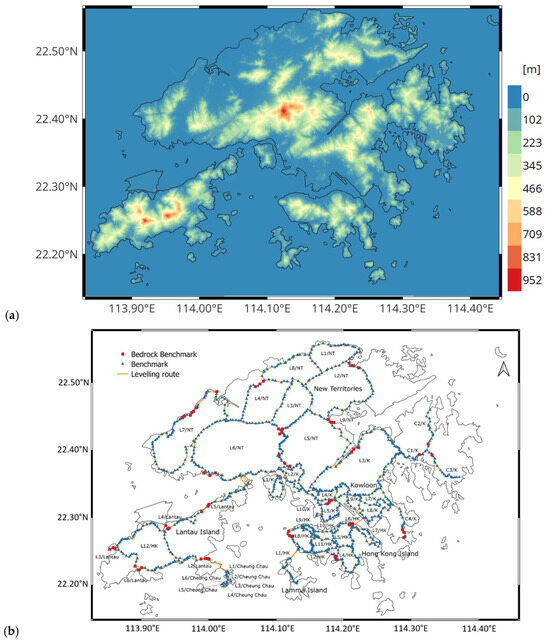
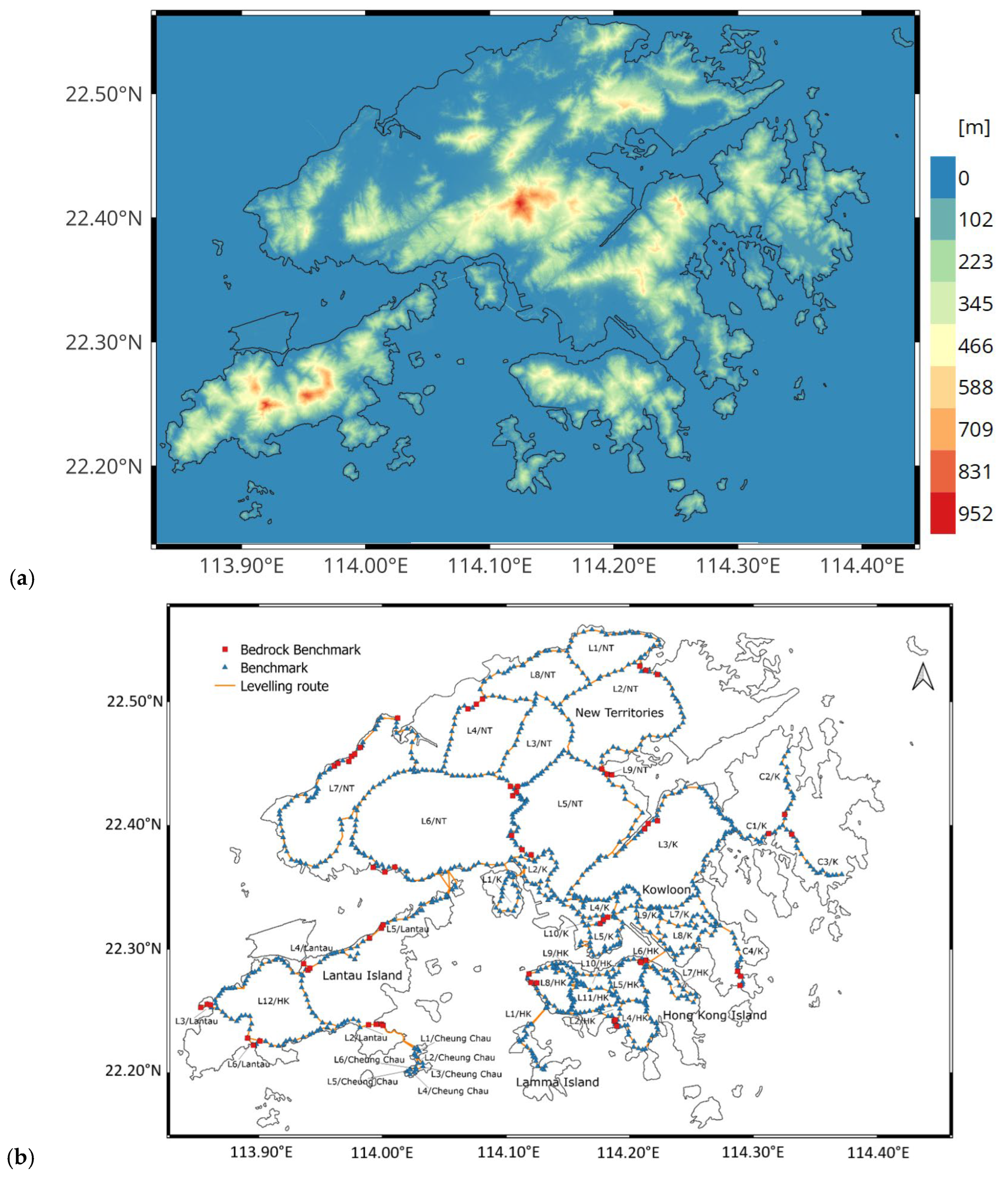
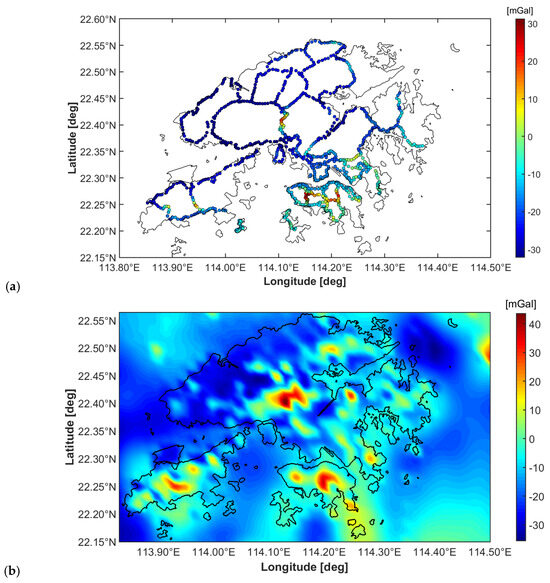
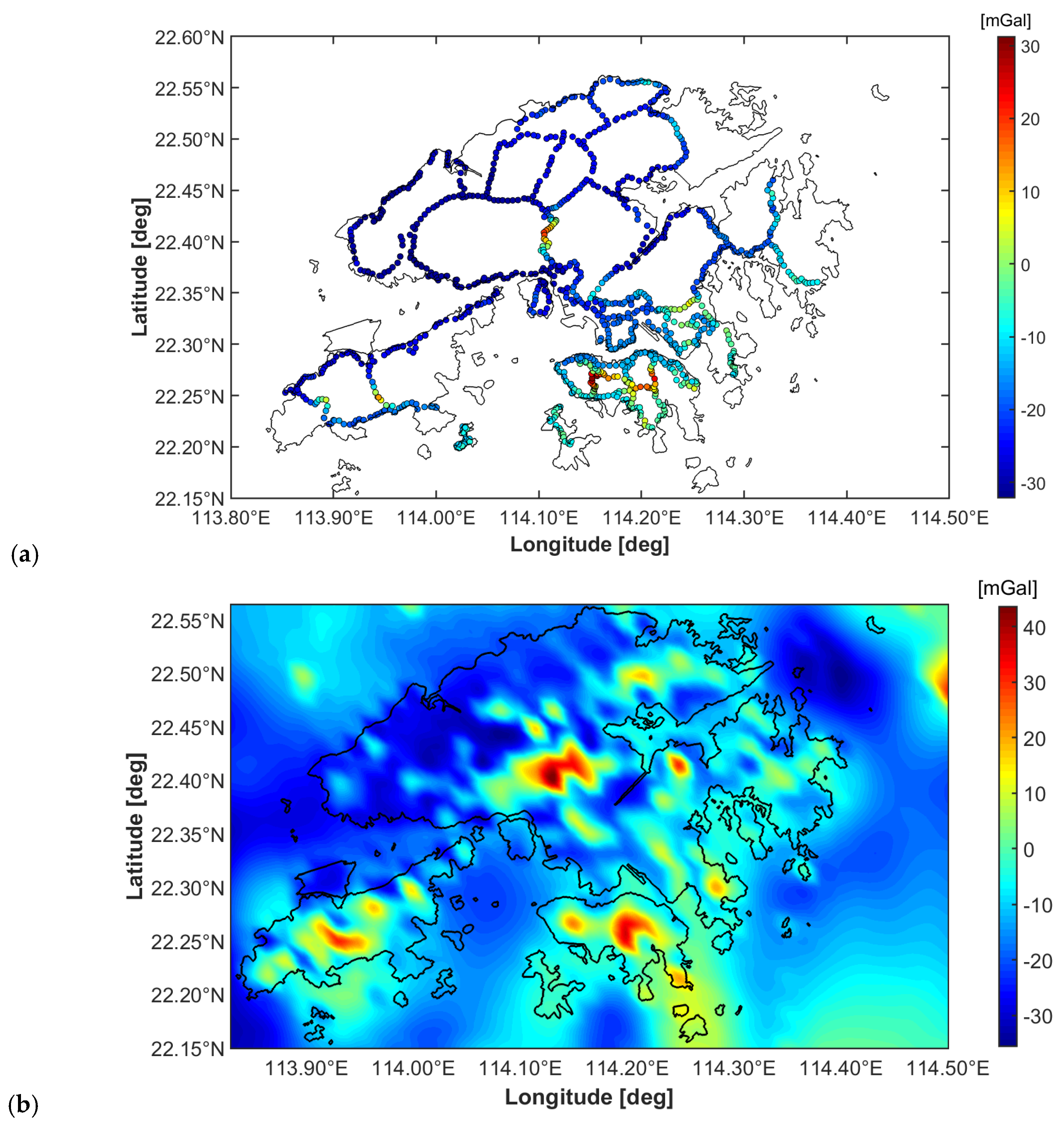
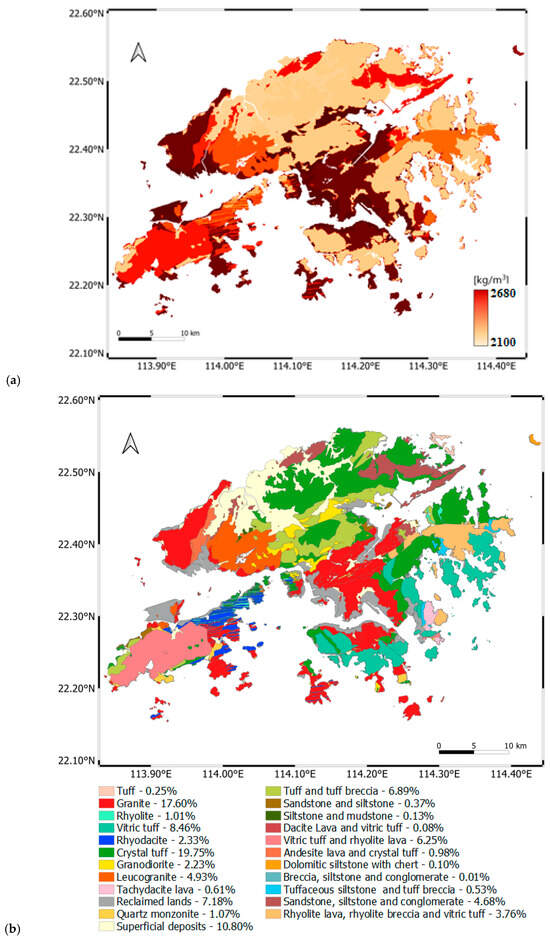
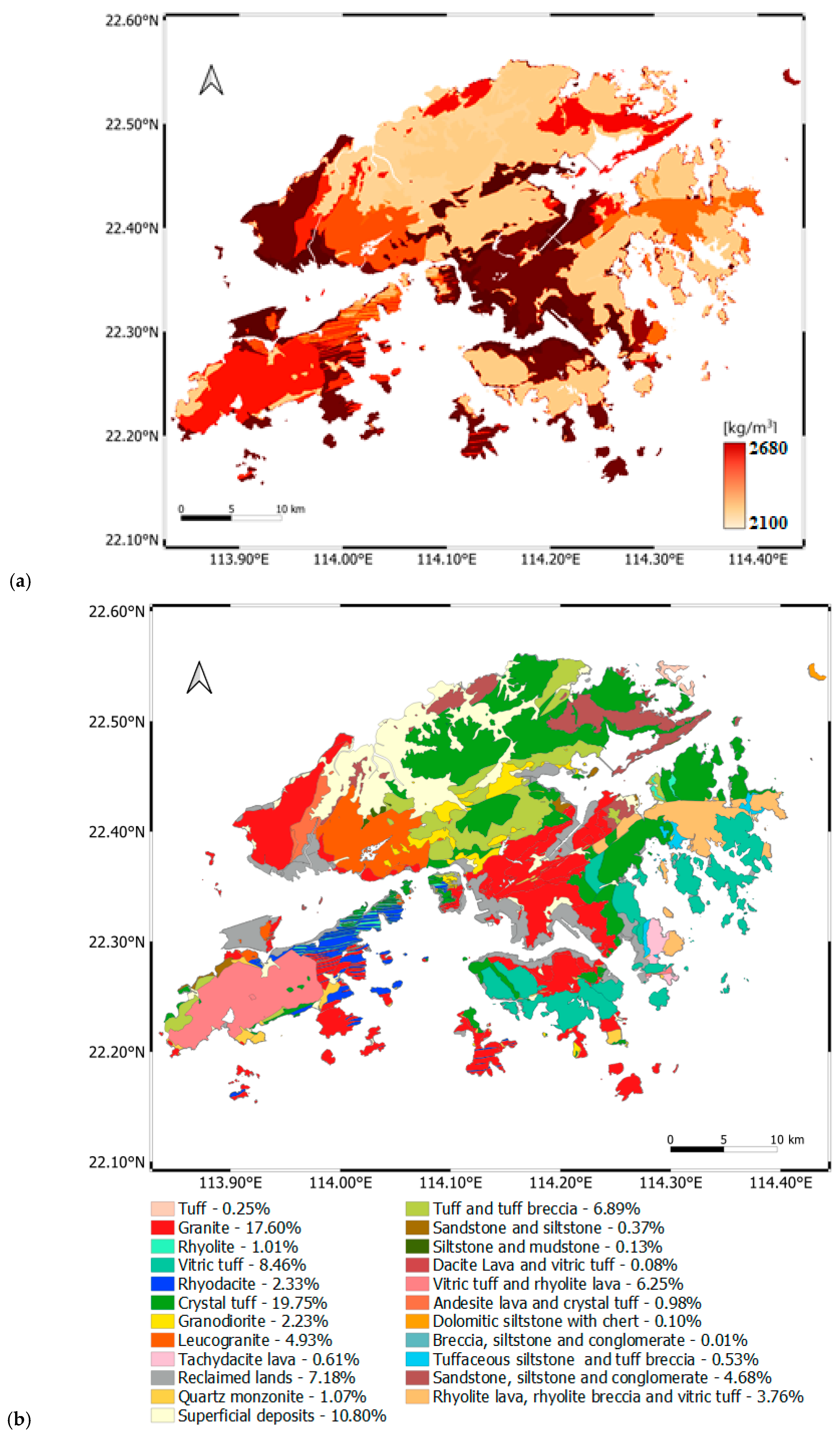
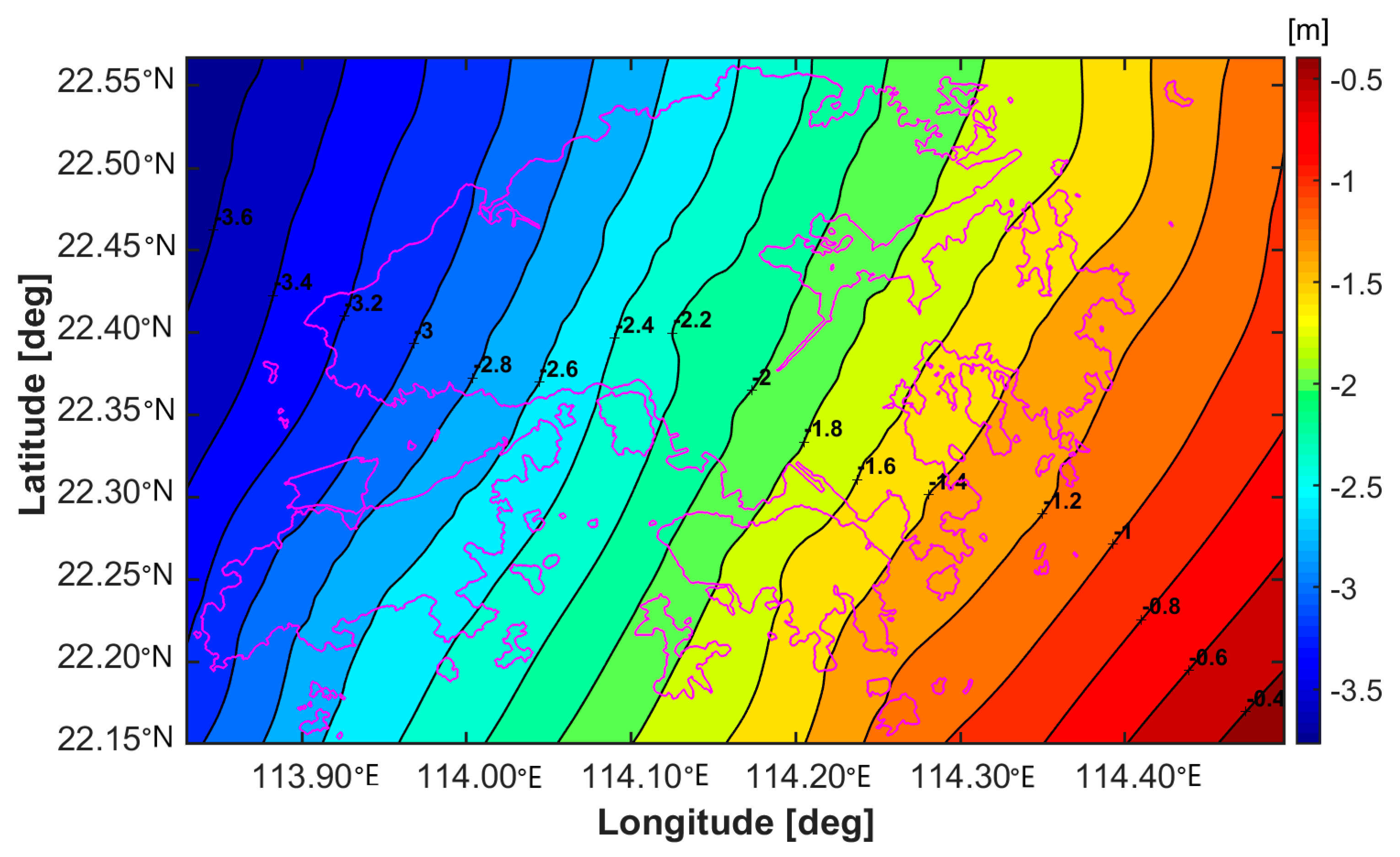
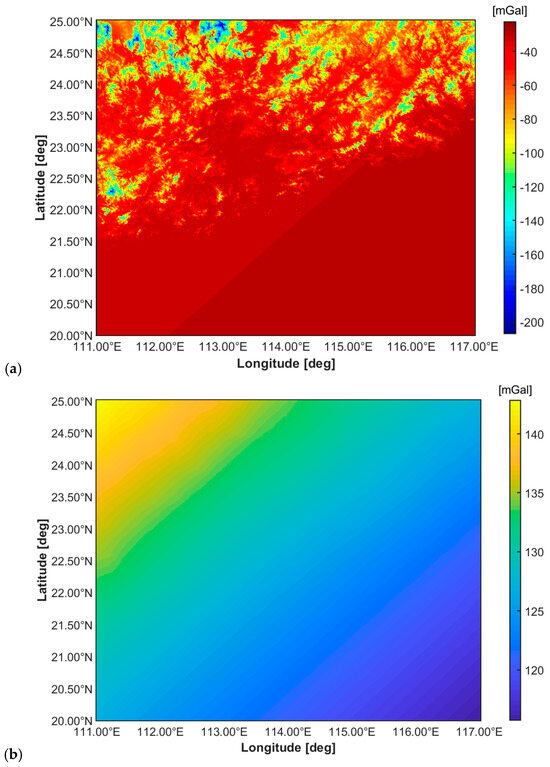
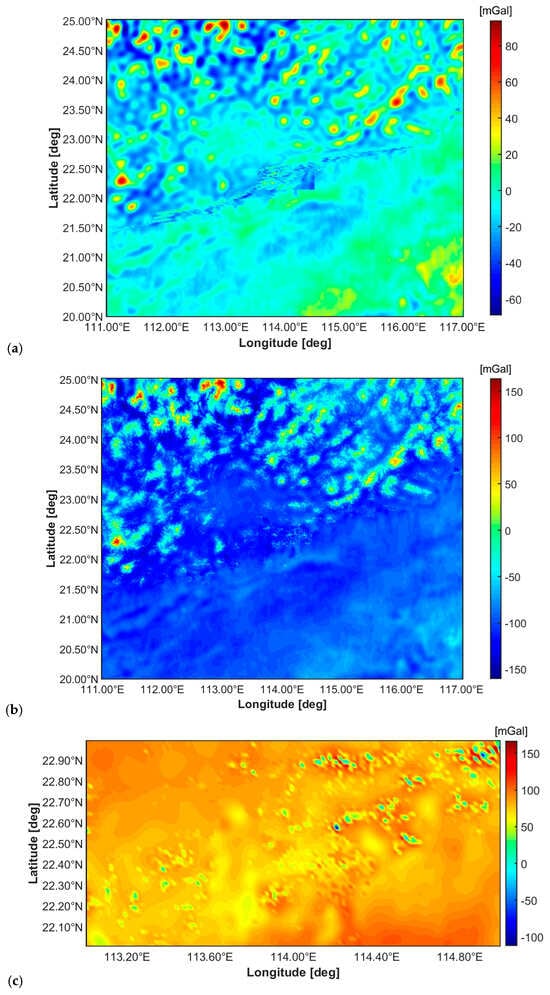
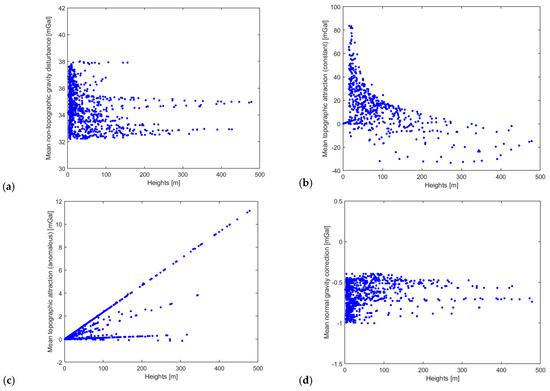
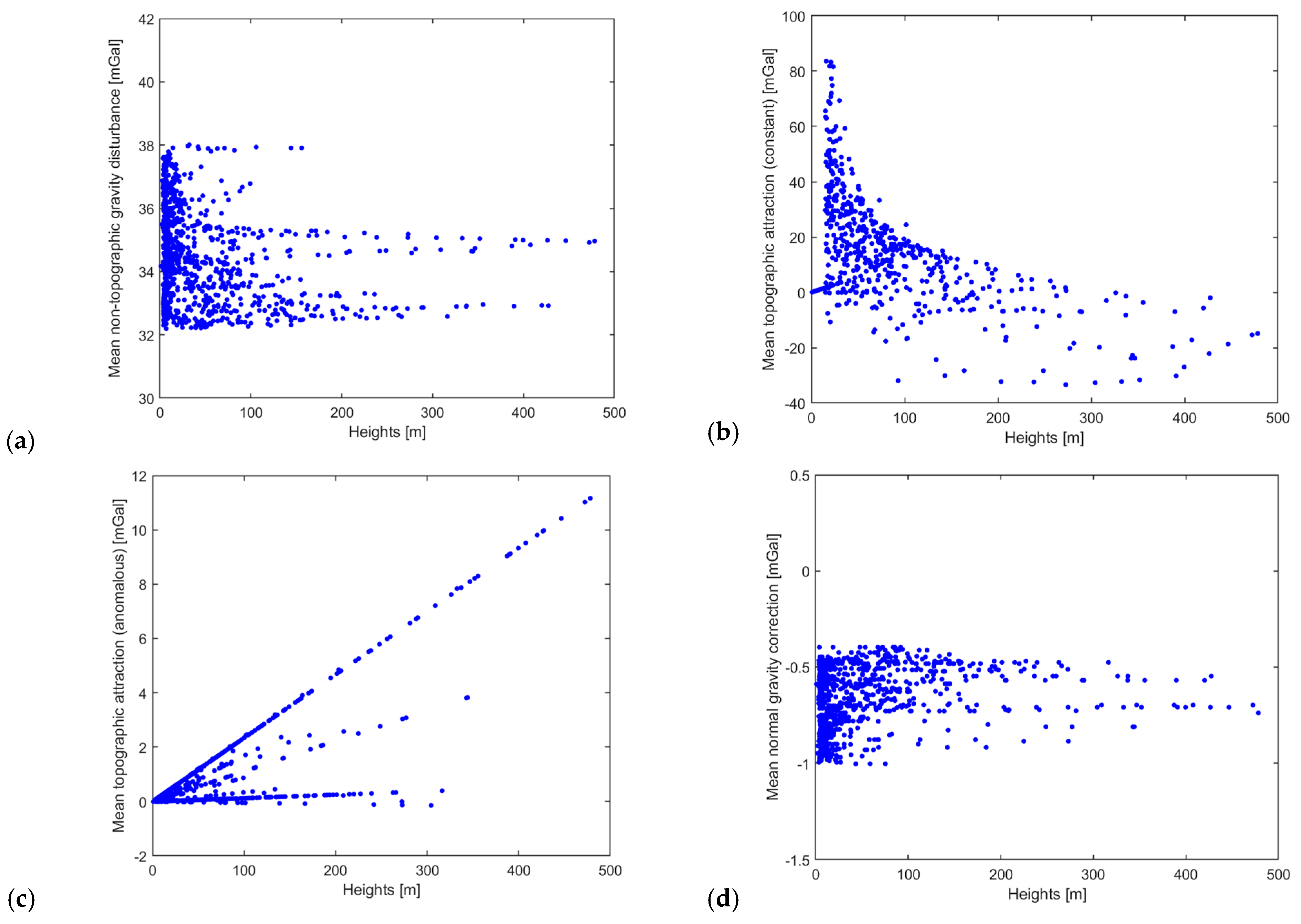
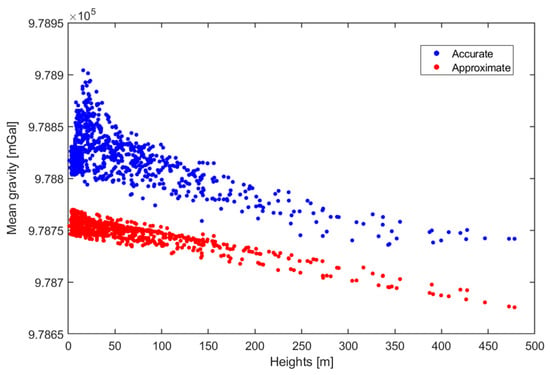
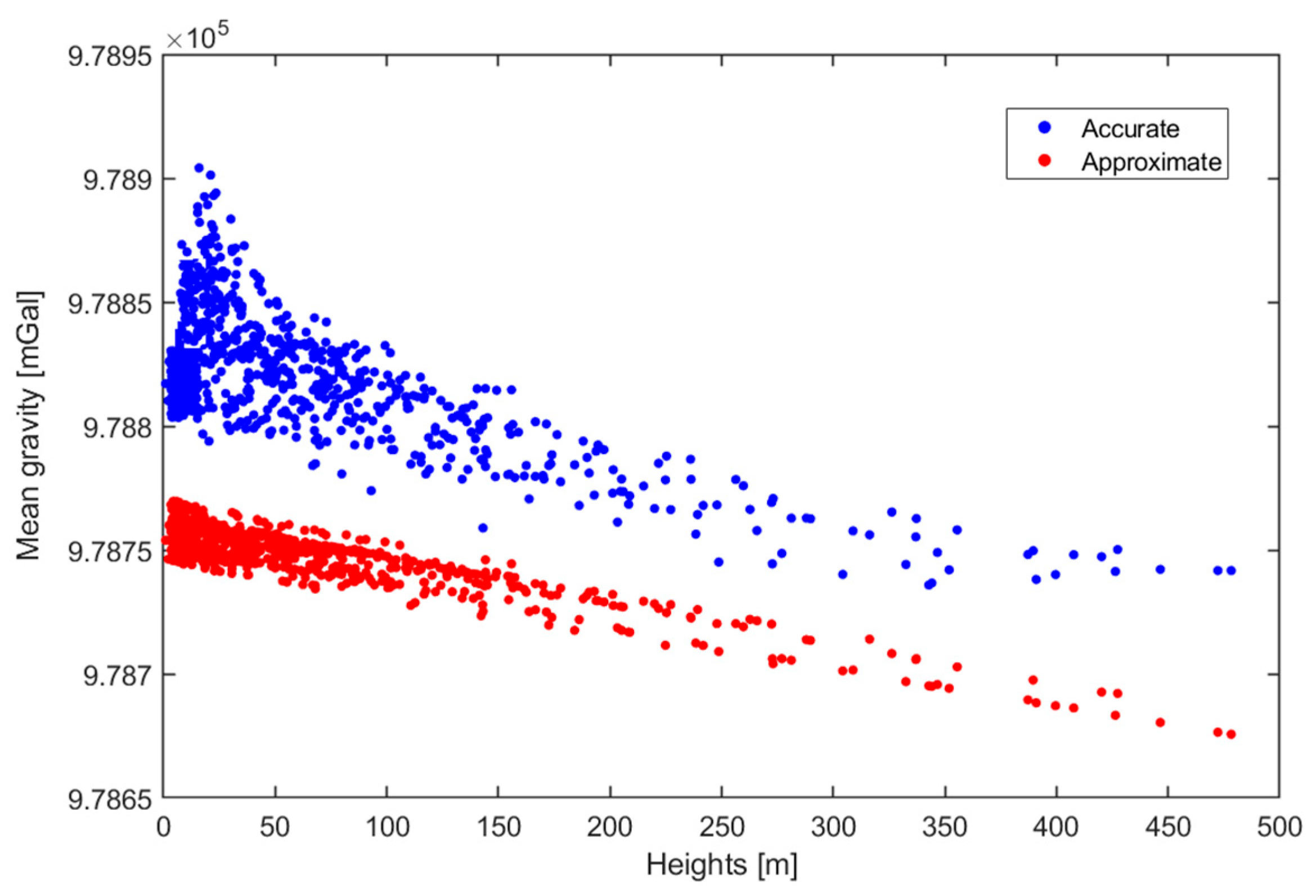
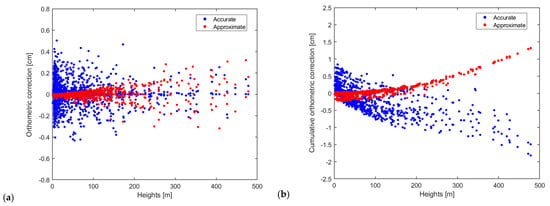
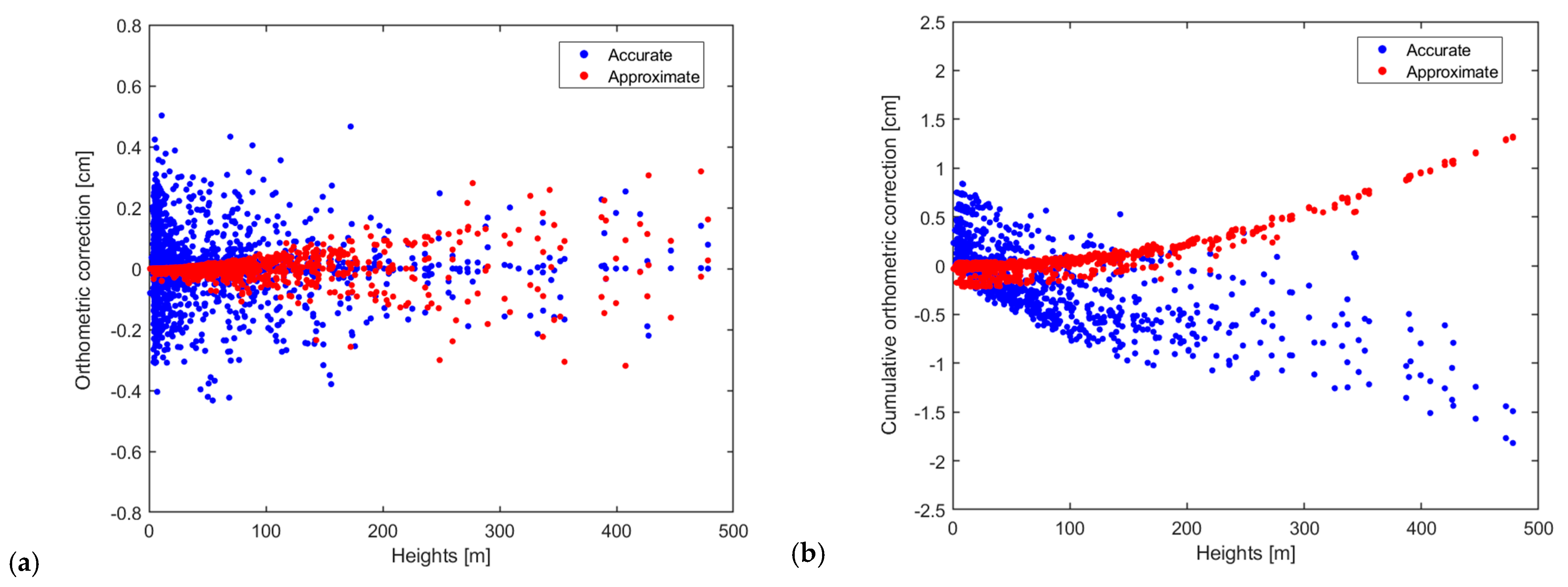
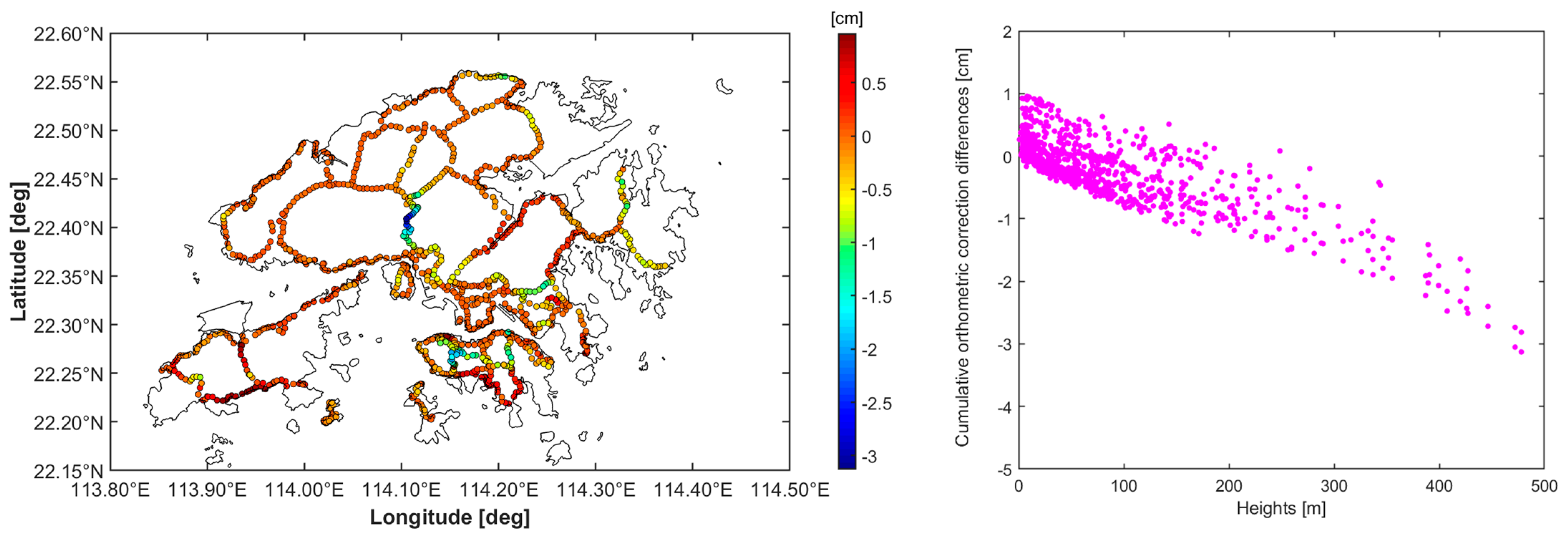
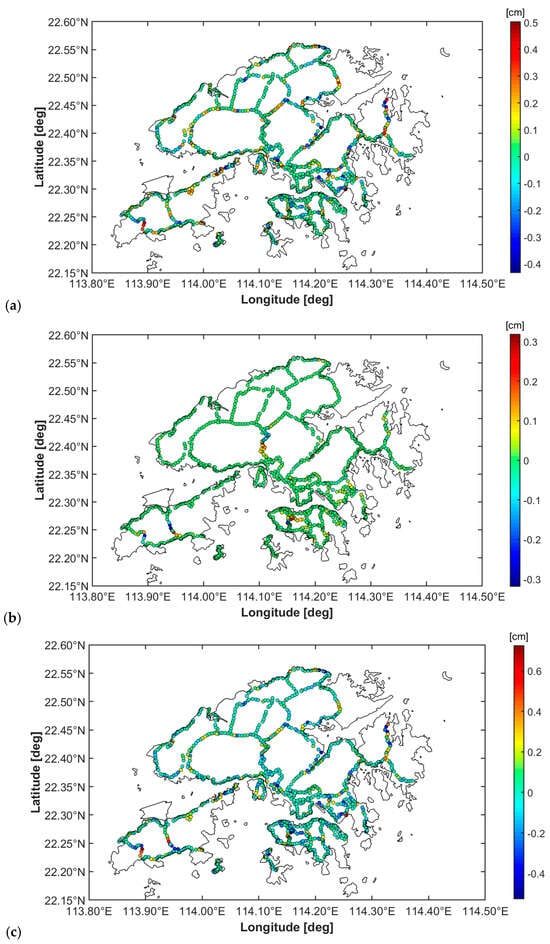
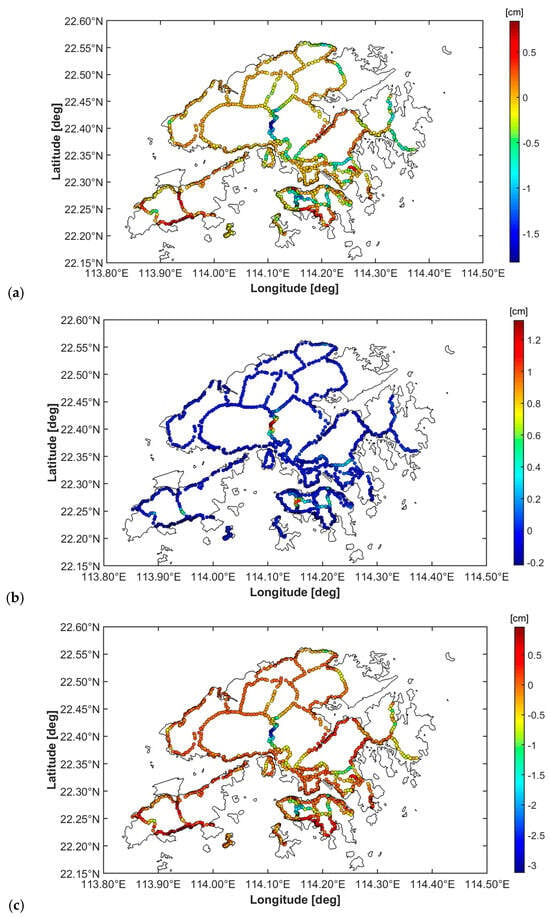
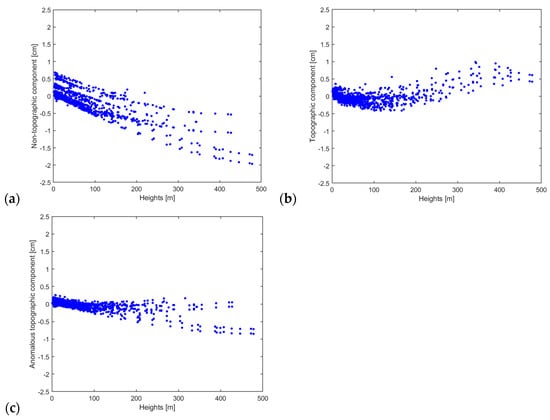
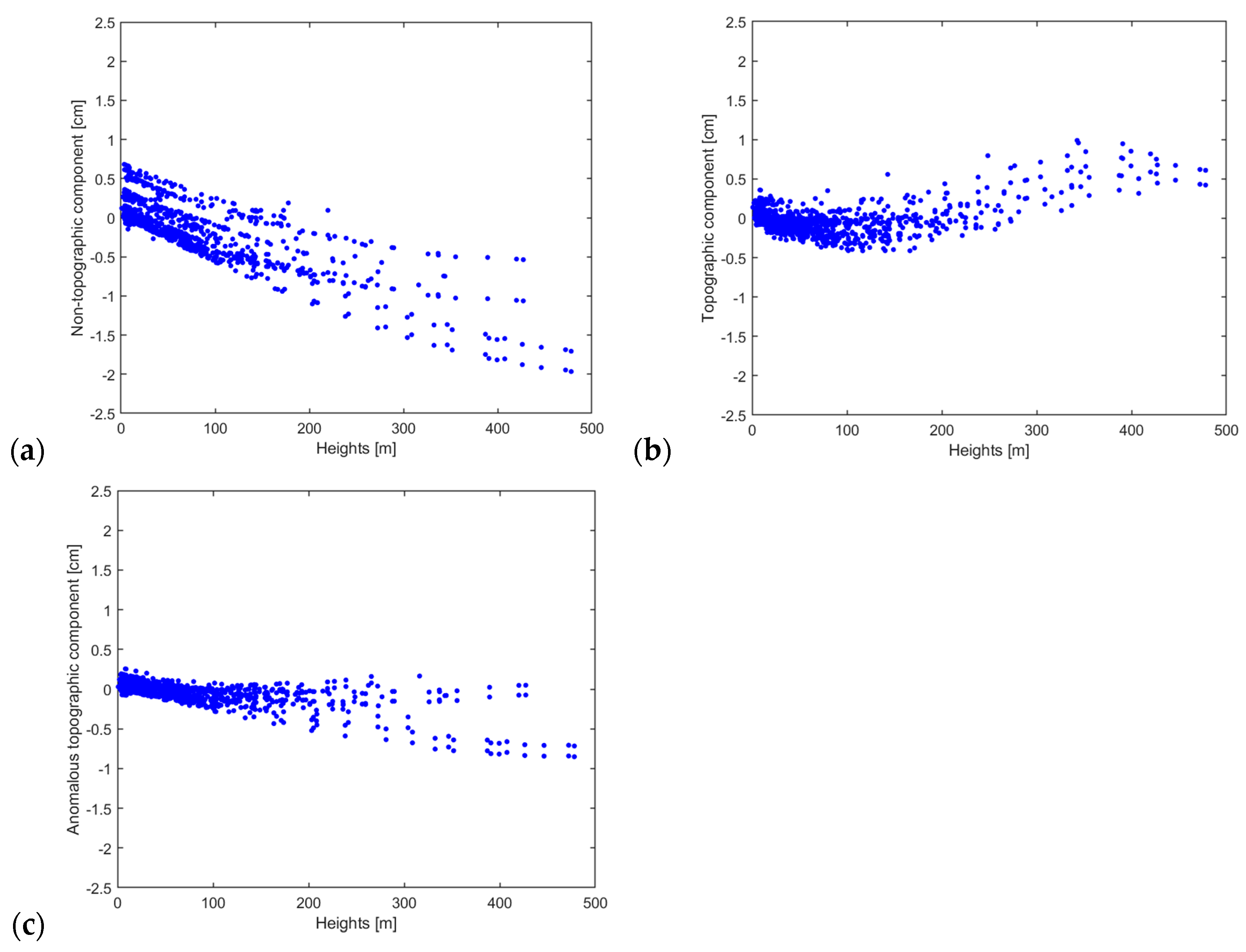

Disclaimer/Publisher’s Note: The statements, opinions and data contained in all publications are solely those of the individual author(s) and contributor(s) and not of MDPI and/or the editor(s). MDPI and/or the editor(s) disclaim responsibility for any injury to people or property resulting from any ideas, methods, instructions or products referred to in the content. |
© 2025 by the authors. Licensee MDPI, Basel, Switzerland. This article is an open access article distributed under the terms and conditions of the Creative Commons Attribution (CC BY) license (https://creativecommons.org/licenses/by/4.0/).