Landslide Risk Assessment in the Xiluodu Reservoir Area Using an Integrated Certainty Factor–Logistic Regression Model


Abstract
1. Introduction
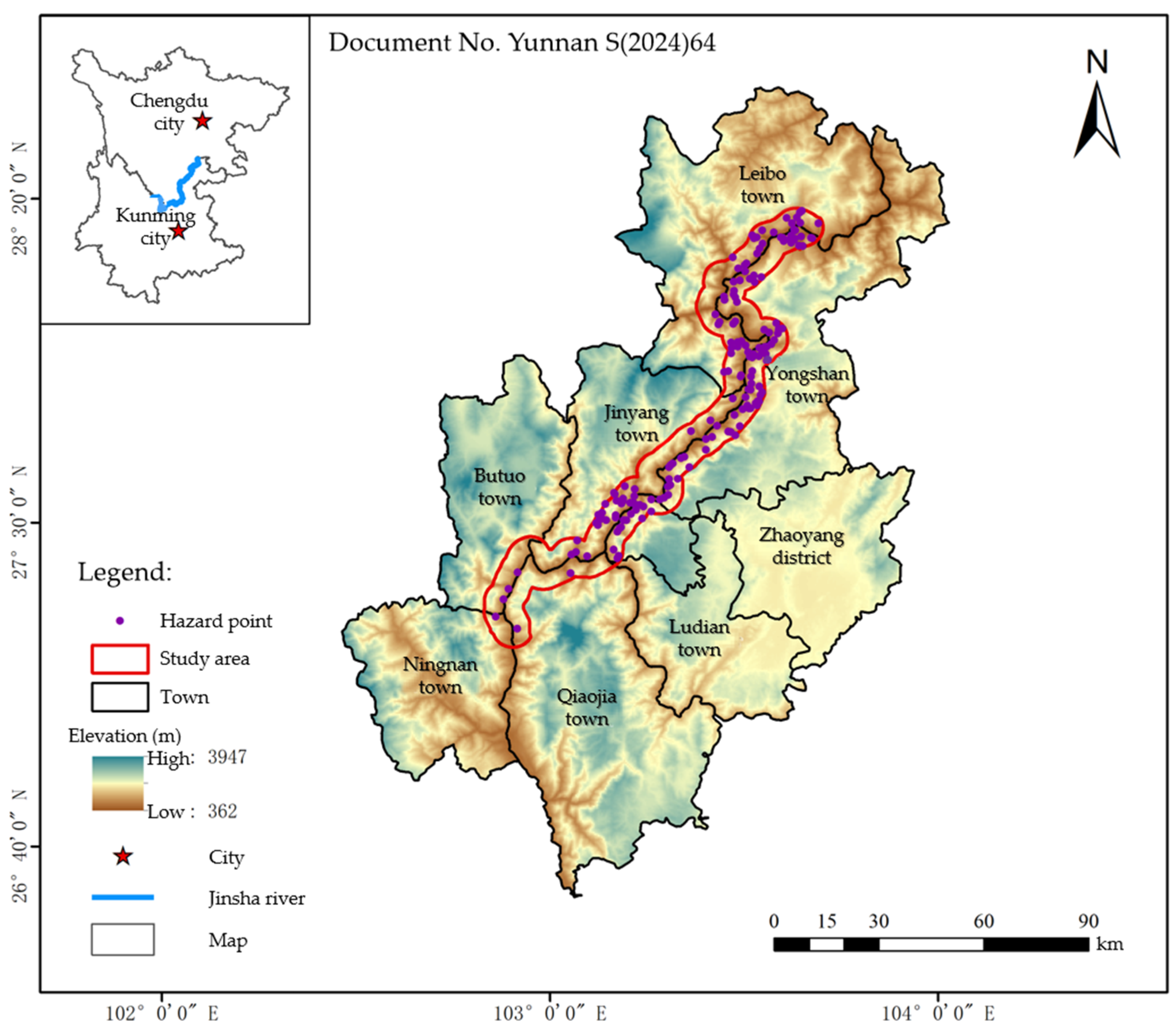
2. Overview of the Study Area
2.1. Geographical Condition of the Study Area
2.2. Data Sources
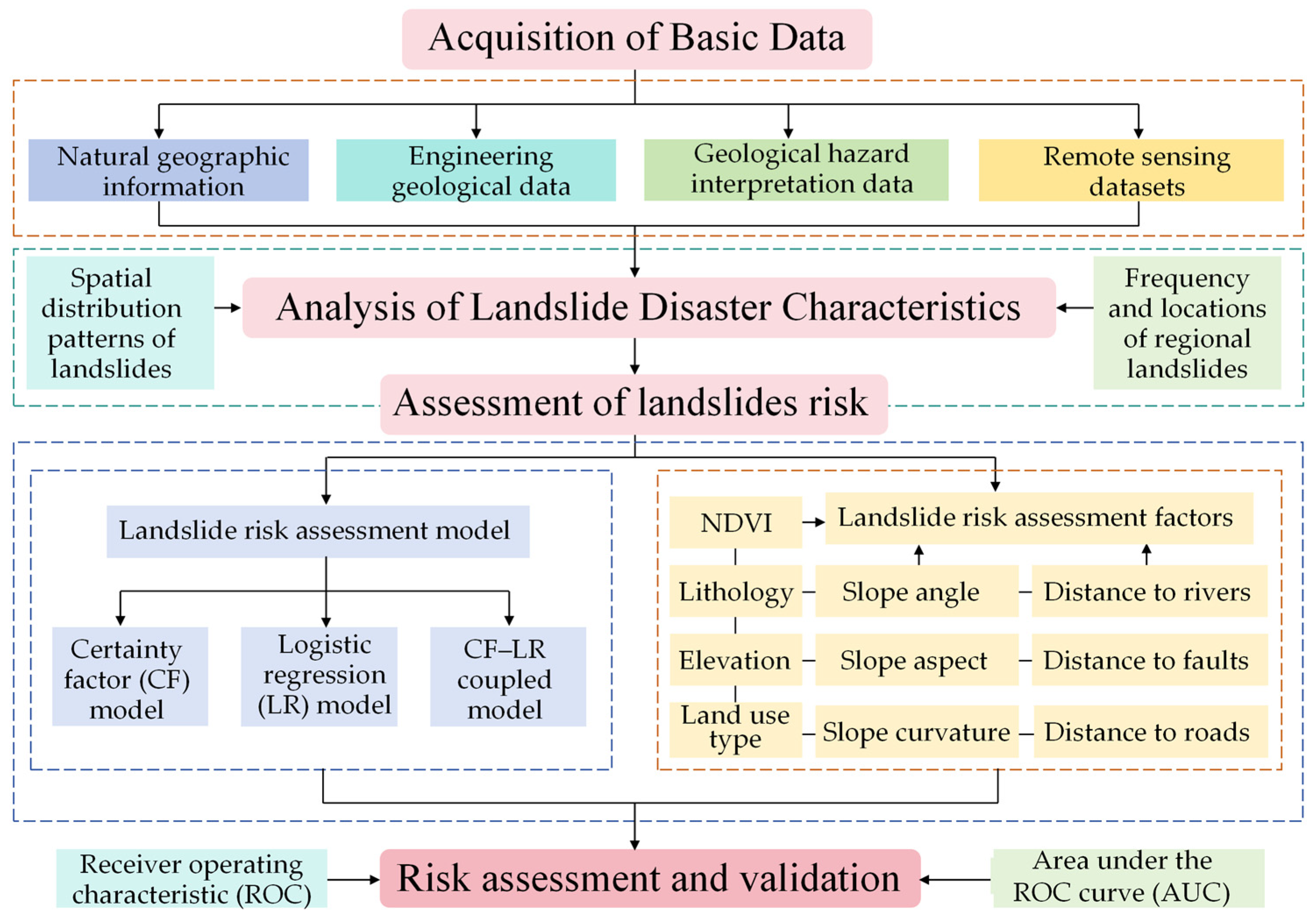
3. Methodology
3.1. Certainty Factor (CF) Model
3.2. Logistic Regression (LR) Model
3.3. CF–Logistic Regression Coupled Model
3.4. Computational Model
4. Landslide Susceptibility Assessment
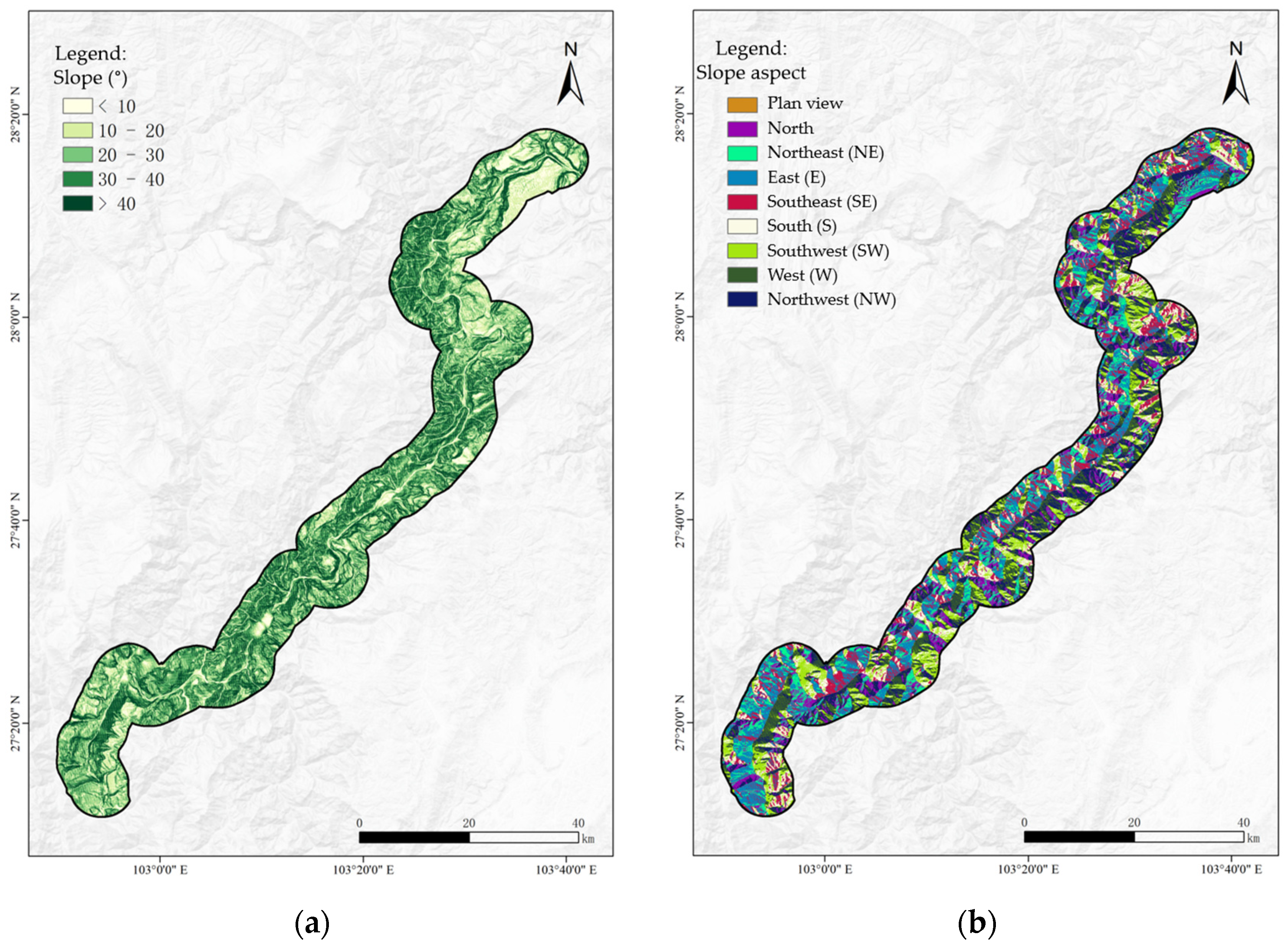
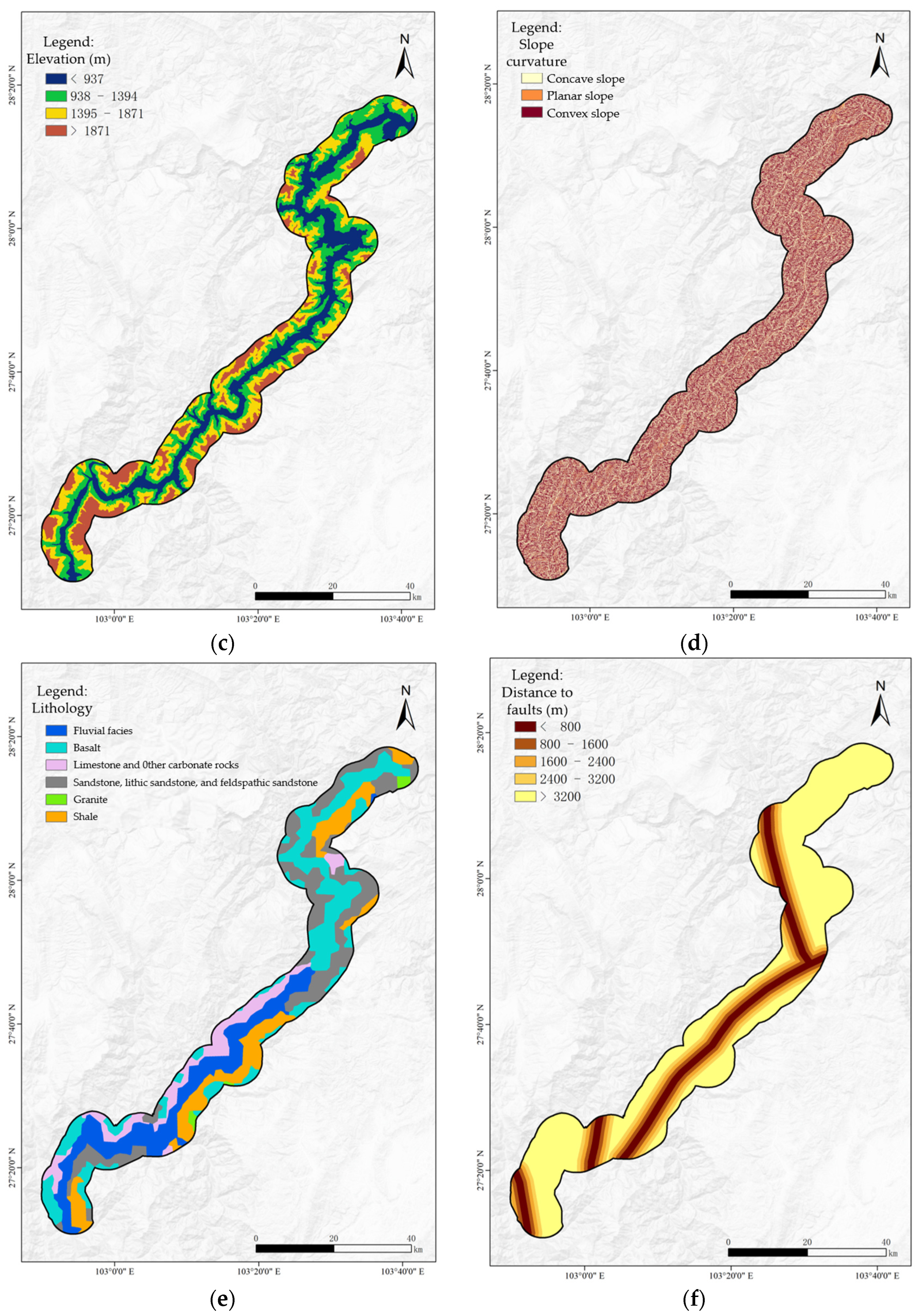
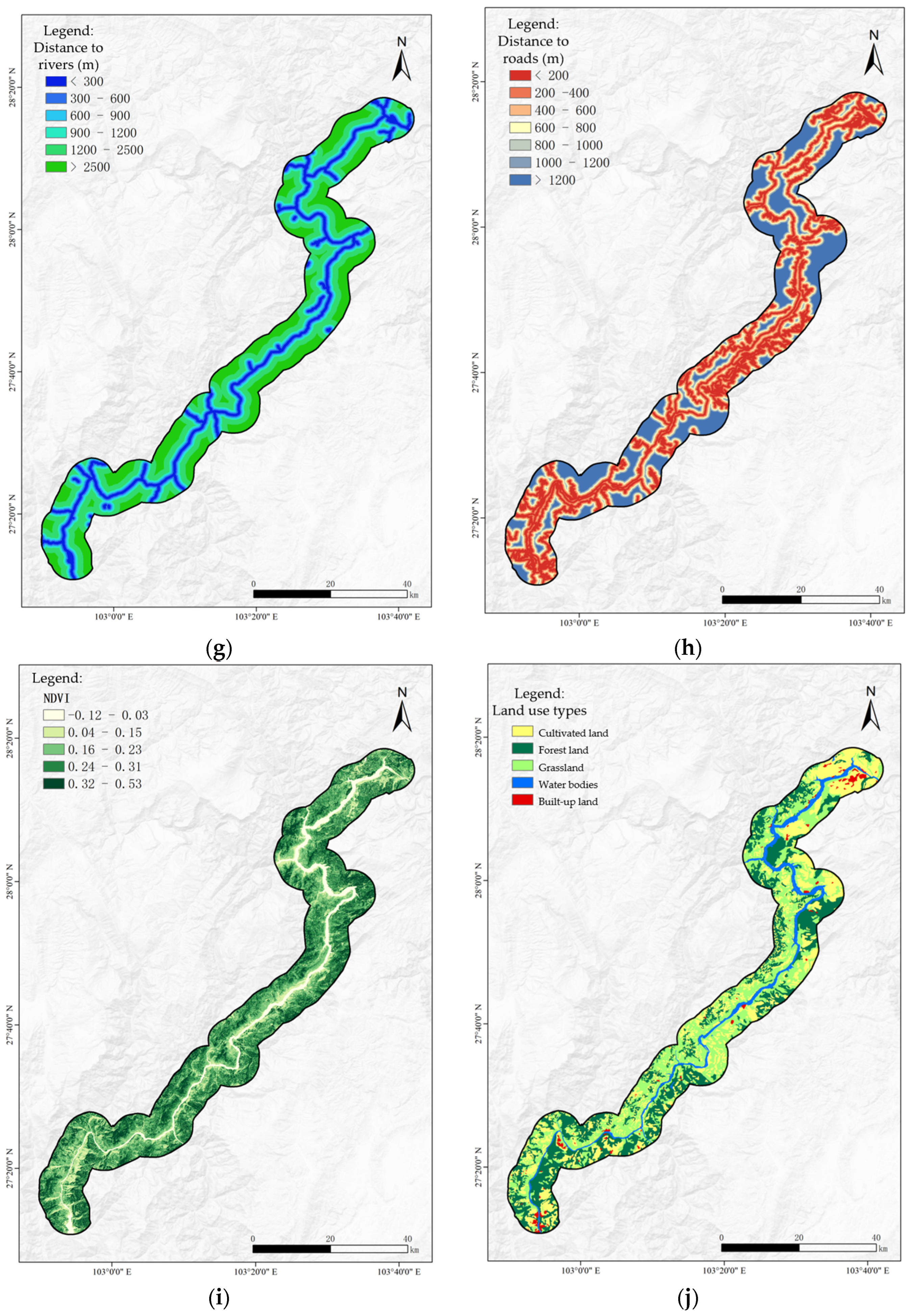
4.1. Selection and Classification of Assessment Factors
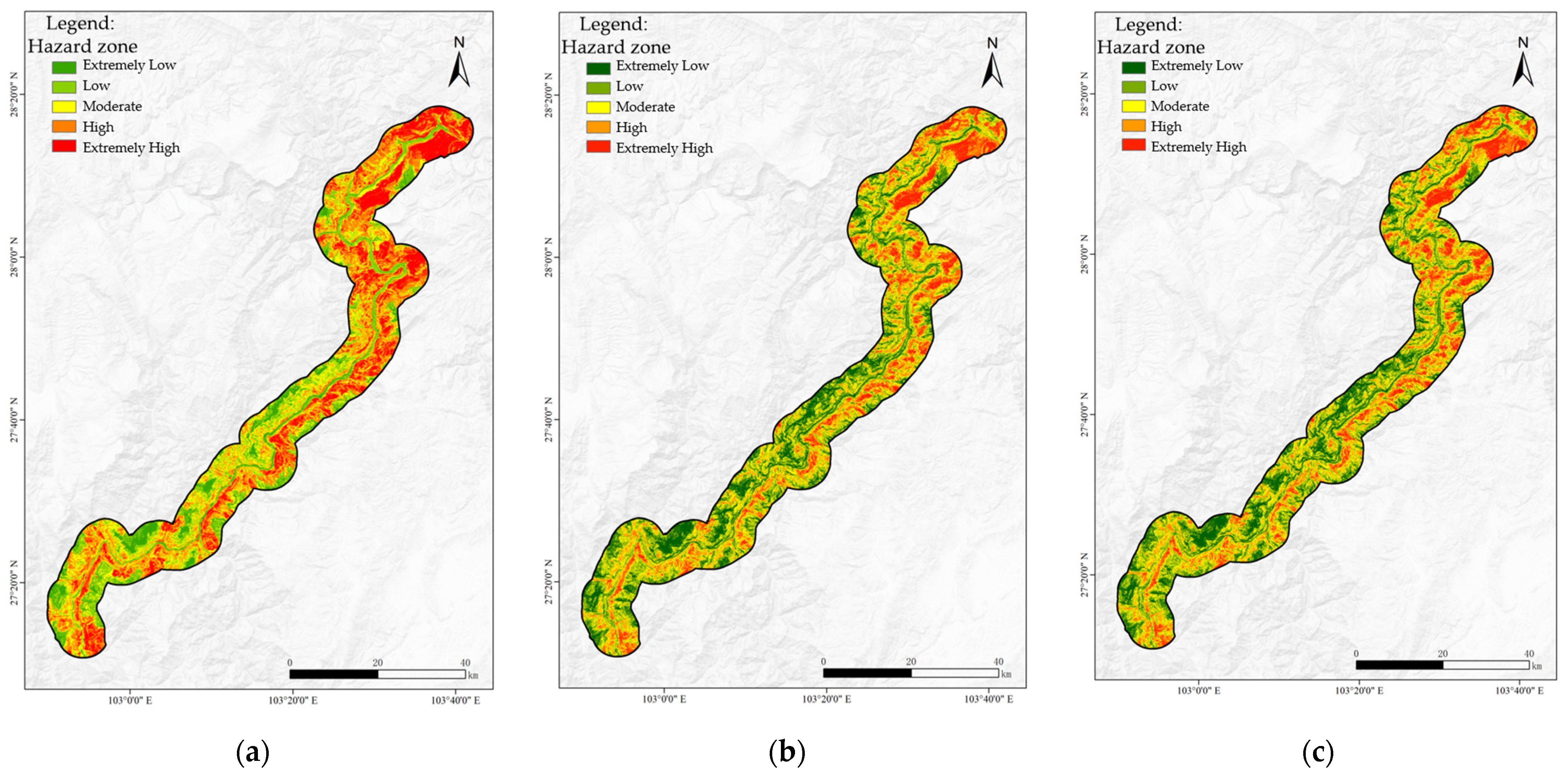
4.2. Assessment of Certainty Factor (CF) Model
4.3. Assessment of Logistic Regression (LR) Model

| Type | B 1 | SE 2 | Wald 3 | df 4 | Collinearity Statistics | |
|---|---|---|---|---|---|---|
| TOL 5 | VIF 6 | |||||
| Lithology | 7.276 | 2.478 | 8.625 | 1.000 | 0.869 | 1.150 |
| Land use type | 4.136 | 2.191 | 3.562 | 1.000 | 0.824 | 1.214 |
| Slope curvature | −1.122 | 2.873 | 0.152 | 1.000 | 0.931 | 1.074 |
| Slope aspect | 25.152 | 6.570 | 14.657 | 1.000 | 0.921 | 1.086 |
| Slope angle | 6.794 | 2.180 | 9.711 | 1.000 | 0.969 | 1.032 |
| Distance to rivers | 1.187 | 4.457 | 0.071 | 1.000 | 0.895 | 1.117 |
| Elevation | 5.325 | 1.171 | 20.694 | 1.000 | 0.841 | 1.189 |
| Distance to faults | 5.408 | 5.632 | 0.922 | 1.000 | 0.951 | 1.051 |
| Distance to roads | 4.618 | 4.302 | 1.152 | 1.000 | 0.902 | 1.109 |
| NDVI | 5.656 | 2.776 | 4.151 | 1.000 | 0.885 | 1.130 |
| Constant | −11.148 | 2.295 | 23.597 | 1.000 | − | − |
4.4. Assessment of CF–Logistic Regression Coupled Model
5. Results of Hazard Assessment
6. Discussion and Comparison of Model Accuracy Assessment
6.1. Distribution of Disaster Points
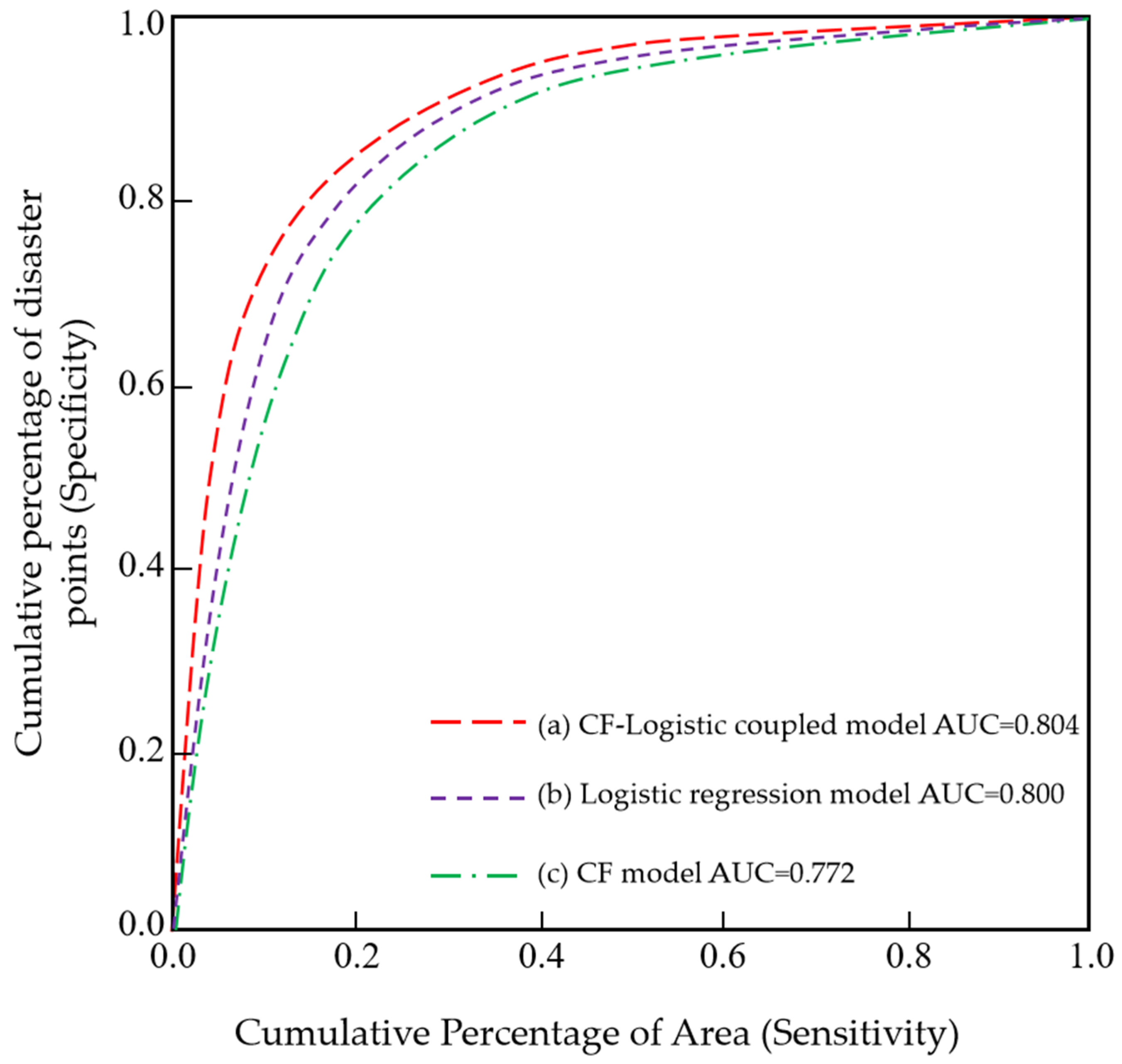
6.2. Model Accuracy Validation
6.3. Sensitivity Analysis and Independent Validation of the Coupled Model
6.4. Implications for Disaster Risk Management
7. Conclusions
- (1)
- The integrated CF–LR framework effectively combines the strengths of both models—capturing sensitivity to factor attribute values (CF) while quantifying relative factor weights (LR). This offers a balanced and robust approach for landslide susceptibility mapping in complex reservoir environments.
- (2)
- The susceptibility maps produced here identify high-risk zones primarily concentrated along the banks of the Jinsha River near the dam core area and densely populated downstream regions. These insights provide critical technical support for targeted hazard prevention, land use planning, and infrastructure protection.
- (3)
- The identification of dominant conditioning factors—including lithology, slope angle, and proximity to rivers and roads—provides a clearer understanding of landslide mechanisms in the Xiluodu Reservoir area, contributing to broader geohazard research in mountainous reservoir settings.
Author Contributions
Funding
Data Availability Statement
Acknowledgments
Conflicts of Interest
Abbreviations
| CF | Certainty factor |
| LR | Logistic regression |
| ROC | Receiver operating characteristic |
| AUC | Area under the ROC curve |
References
- Salui, C.L.; Chattoraj, S.L.; Prasain, G.P.; Sharma, P. Risk resilience of growing settlements in landslide prone hilly areas: Case study on Kalimpong-I block, Darjeeling District, West Bengal. Nat. Hazards 2025, 121, 13387–13405. [Google Scholar] [CrossRef]
- Kavus, B.Y.; Taskin, A. Assessment of landslides induced by earthquake risk of Istanbul: A comprehensive study utilizing an integrated DFS-AHP and DFS-EDAS approach. Soil Dyn. Earthq. Eng. 2025, 191, 109285. [Google Scholar] [CrossRef]
- Sven, M.; Debasish, J.; Sriram, N.; Taciroglu, E. Risk-Optimal and Equitable Retrofitting Strategy Using a Siamese Graph Neural Network for Earthquake-Induced Landslide Hazards. J. Comput. Civ. Eng. 2025, 39, 04024063. [Google Scholar] [CrossRef]
- Gebrehiwot, A.; Berhane, G.; Kide, Y.; Teklay, W.; Mekonen, B.; Fissha, Y. Landslide susceptibility mapping in Lesalso (Laelay Maichew), Northern Ethiopia: A GIS approach using frequency ratio and analytical hierarchy process methods. Model. Earth Syst. Environ. 2025, 11, 421. [Google Scholar] [CrossRef]
- Belogurov, V. The GIS-technology for predicting development a landslide & the scientific, regulatory and practical activity under Rockburst Risk. E3S Web Conf. 2025, 614, 02002. [Google Scholar] [CrossRef]
- Wang, P.; Deng, H.I.; Liu, Y. GIS-based landslide susceptibility zoning using a coupled model: A case study in Badong County, China. Environ. Sci. Pollut. Res. 2024, 4, 6213–6231. [Google Scholar] [CrossRef]
- Song, Z. Study on Landslide Susceptibility Based on Multi-Model Coupling: A Case Study of Sichuan Province, China. Sustainability 2024, 16, 6803. [Google Scholar] [CrossRef]
- Jin, J.L.; Cui, Y.L.; Xu, C.; Zheng, J.; Miao, H.B. Application of logistic regression model for hazard assessment of landslides caused by the 2012 Yiliang Ms 5.7 earthquake in Yunnan province, China. J. Mt. Sci. 2023, 20, 657–669. [Google Scholar] [CrossRef]
- Liu, D.; Hu, W.; Zhang, H.; Yu, R.; Zhao, J.; Huang, L. Vulnerability Evaluation of Power Grid Geological Hazards Based on Information Model. In Proceedings of the 2024 Boao New Power System International Forum-Power System and New Energy Technology Innovation Forum (NPSIF), Boao, China, 8–10 December 2024; pp. 585–590. [Google Scholar] [CrossRef]
- Zhao, P.; Wang, Y.; Xie, Y.; Uddin, M.G.; Xu, Z.X.; Chang, X.W.; Zhang, Y.H. Landslide susceptibility assessment using information quantity and machine learning integrated models: A case study of Sichuan province, southwestern China. Earth Sci. Inform. 2025, 18, 1–19. [Google Scholar] [CrossRef]
- Devkota, K.C.; Regmi, A.D.; Pourghasemi, H.R.; Yoshida, K.; Pradhan, B.; Ryu, I.C.; Dhital, M.R.; Althuwaynee, O.F. Landslide susceptibility mapping using certainty factor, index of entropy and logistic regression models in GIS and their comparison at Mugling–Narayanghat road section in Nepal Himalaya. Nat. Hazards 2013, 65, 135–165. [Google Scholar] [CrossRef]
- Crawford, M.M.; Koch, H.J.; Dortch, J.M.; Glade, T.; Murty, T.S. Evaluating map quality and model performance through iterative statistics-based landslide susceptibility in eastern KY. Nat. Hazards 2025, 121, 11633–11661. [Google Scholar] [CrossRef]
- Rahaman, A.; Dondapati, A.; Gupta, S.; Raj, R. Leveraging artificial neural networks for robust landslide susceptibility mapping: A geospatial modeling approach in the ecologically sensitive Nilgiri District, Tamil Nadu. Microelectron. J. 2024, 2, 258–269. [Google Scholar] [CrossRef]
- Bao, J.W.; Luo, X.J.; Shi, Y.L.; Hou, M.Y.; Lv, J.C.; Liu, G.X. A Method for Identifying Landslide-Prone Areas Using Multiple Factors and Adaptive Probability Thresholds: A Case Study in Northern Tongren, Longwu River Basin, Qinghai Province. Remote Sens. 2025, 17, 1380. [Google Scholar] [CrossRef]
- Jaafari, A. Landslide susceptibility assessment using novel hybridized methods based on the support vector regression. Ecol. Eng. 2024, 208, 107372. [Google Scholar] [CrossRef]
- Yu, L.B.; Wang, Y.; Biswajeet, P. Enhancing landslide susceptibility mapping incorporating landslide typology via stacking ensemble machine learning in three Gorges reservoir, China. Geosci. Front. 2024, 15, 81–99. [Google Scholar] [CrossRef]
- Zhang, A.; Zhao, X.W.; Zhao, X.Y.Z.; Zheng, X.Z.; Zeng, M.; Huang, X.; Wu, P.; Jiang, T.; Wang, S.C.; He, J.; et al. Comparative study of different machine learning models in landslide susceptibility assessment: A case study of Conghua district, Guangzhou, China. China Geol. 2024, 7, 104–115. [Google Scholar] [CrossRef]
- Cao, W.G.; Fu, Y.; Dong, Q.Y.; Wang, H.G.; Ren, Y.; Li, Z.Y.; Du, Y.Y. Landslide susceptibility assessment in western Henan province based on a comparison of conventional and ensemble machine learning. China Geol. 2023, 6, 409–419. [Google Scholar] [CrossRef]
- Saha, A.; Tripathi, L.; Villuri, V.G.K.; Bhardwaj, A. Exploring machine learning and statistical approach techniques for landslide susceptibility mapping in Siwalik Himalayan Region using geospatial technology. Environ. Sci. Pollut. Res. 2024, 31, 10443–10459. [Google Scholar] [CrossRef]
- Sini, M.; Bernat Gazibara, S.; Rossi, M.; Sinčić, M.; Gazibara, S.B.; Rossi, M.; Arbanas, S.M. Comparison of conditioning factor classification criteria in large-scale statistically based landslide susceptibility models. Nat. Hazards Earth Syst. Sci. 2025, 25, 183–206. [Google Scholar] [CrossRef]
- Assis, A.; Dantas, J.; Andrade, E. The performance-interpretability trade-off: A comparative study of machine learning models. J. Reliab. Intell. Environ. 2025, 11, 1. [Google Scholar] [CrossRef]
- Ma, K.; Guo, D.Y.; Wu, J.; Wang, R.L.; Huang, H.L.; Zhang, S.C.; He, G. Analysis of the slope damage characteristics of the Xiluodu Hydropower Station during the impoundment period. Bull. Eng. Geol. Environ. 2025, 84, 303. [Google Scholar] [CrossRef]
- Vincent, L.; Carolyn, H.; Stuart, M.; David, L.J.; Alexander, P.W.; Cleary, D.A.; Gary, W.D. Combining statistical design with deterministic modelling to assess the effect of site-specific factors on the extent of landslides. Rock Mech. Rock Eng. 2022, 55, 259–273. [Google Scholar] [CrossRef]
- Ali, S.A.; Parvin, F. GIS-Based Landslides Risk Assessment Applying Certainty Factor (CF) and Ensemble with Deep Learning Neural Network (DLNN): A Study of Cachar District of Assam, India. In Proceedings of the National Conference on Landslide Risk Assessment and Mitigation in India, New Delhi, India, 1–2 November 2022; Springer Proceedings in Earth and Environmental Sciences. pp. 208–232. [Google Scholar] [CrossRef]
- Van Phong, T.; Dam, N.D.; Trinh, P.T.; Dung, N.V.; Hieu, N.; Tran, C.Q.; Van, T.D.; Nguyen, Q.C.; Prakash, I.; Binh Thai Pham, B.T. GIS-Based Logistic Regression Application for Landslide Susceptibility Mapping in Son La Hydropower Reservoir Basin. CIGOS 2021, Emerging Technologies and Applications for Green Infrastructure. Lect. Notes Civ. Eng. 2022, 203, 1841–1849. [Google Scholar] [CrossRef]
- Zhang, J.B.; Zhu, C.; Xie, L.F.; Wu, S.S.; Cao, C.; Wang, M.; Cui, S.H. Comparative study on landslide susceptibility assessment of different models: A case study of alpine mountainous region in Xinjiang. Bull. Eng. Geol. Environ. 2025, 84, 95. [Google Scholar] [CrossRef]
- Elfengour, A.; Motaki, H.E.; Bouzidi, A.E. Landslides Susceptibility Modelling using Multivariate Logistic Regression Model in the Sahla Watershed in Northern Morocco. Soc. Nat. 2021, 33, 1–20. [Google Scholar] [CrossRef]
- Wang, Z.; Tang, J. Prediction of Landslide Susceptibility Based on Neural Network Model and Negative Sample Selected by Information Value Model. Pol. J. Environ. Stud. 2025, 34, 2417–2430. [Google Scholar] [CrossRef]
- Nassim, H.; Mouloud, H.; Amal, M.; Hallal, N.; Hamidatou, M.; Medjnoun, A.; Hamai, L.; Lamali, A.; Hassan, H.M.; Fahem, D. GIS-based statistical and limit equilibrium models in the assessment of slope stability and landslide susceptibility: The case study of the Aomar Miocene basin, Bouira, Algeria. Environ. Earth Sci. 2024, 83, 578. [Google Scholar] [CrossRef]
- Tran, T.T.; Tran, T.A.; Nguyen, V.A.; Nguyen, T.T.H.; Vu, V.L.; Hoang, A.T.; Vo, T.T.H. Integrating remote sensing, GIS and machine learning approaches in evaluation of landslide susceptibility in mountainous region of Nghe an province, Vietnam. IOP Conf. Ser. Earth Environ. Sci. 2024, 6, 1345. [Google Scholar] [CrossRef]
- Huang, Y.T.; Guo, Y.G. Risk assessment of rain-induced debris flow in the lower reaches of Yajiang River based on GIS and CF coupling models. Open Geosci. 2023, 15, 20220472. [Google Scholar] [CrossRef]
- Wang, C.H.; Li, F.; Chang, D.T.T.; Huang, F.C. Back-analysis of a rainfall-induced landslide case history using deterministic and random limit equilibrium methods. Eng. Geol. 2023, 317, 107055. [Google Scholar] [CrossRef]
- Chen, L.K.; Chang, C.H.; Liu, C.H.; Ho, J.Y. Application of a three-dimensional deterministic model to assess potential landslides, a case Study: Antong hot spring area in Hualien, Taiwan. Water 2020, 12, 480. [Google Scholar] [CrossRef]
- Shen, Y.S.; Zhang, C.; Wang, Y.J.; Zhang, D. Geohazard Susceptibility Assessment Based on Cf-Lr Model For Xinyang City, Henan Province. Geol. Resour. 2024, 33, 74–81, 134. [Google Scholar] [CrossRef]
- Qin, Y.G.; Yang, G.L.; Lu, K.P.; Sun, Q.Z.; Xie, J.; Wu, Y.W. Performance Evaluation of Five GIS-Based Models for Landslide Susceptibility Prediction and Mapping: A Case Study of Kaiyang County, China. Sustainability 2021, 13, 6441. [Google Scholar] [CrossRef]
- Pathak, L.; Baral, B.; Joshi, K.; Basnet, D.R.; Godone, D. Landslides in the Himalayas: The Role of Conditioning Factors and Their Resolution in Susceptibility Mapping. Geosciences 2025, 15, 131. [Google Scholar] [CrossRef]
- Long, X.; Xiang, Q.; Zhang, R.G.; Huang, H. Incorporating the Results of Geological Disaster Ecological Risk Assessment into Spatial Policies for Ecological Functional Areas: Practice in the Qilian Mountains of China. Sustainability 2024, 16, 2976. [Google Scholar] [CrossRef]
- Li, Y.W.; Wang, X.M.; Hang, M. Influence of human activity on landslide susceptibility development in the three Gorges area. Nat. Hazards 2020, 104, 2115–2151. [Google Scholar] [CrossRef]
- Li, G.; Dong, J.J.; Che, M.L.; Wang, X.; Fan, J.; Dong, G.H. GIS and machine learning models target dynamic settlement patterns and their driving mechanisms from the Neolithic to Bronze Age in the northeastern Tibetan Plateau. Remote Sens. 2024, 16, 1454. [Google Scholar] [CrossRef]
- Menon, V.; Kolathayar, S. Empirical and machine learning-based approaches to identify rainfall thresholds for landslide prediction: A case study of Kerala, India. Discov. Appl. Sci. 2025, 7, 203. [Google Scholar] [CrossRef]
- Badapalli, P.K.; Nakkala, A.B.; Kottala, R.B.; Gugulothu, S.; Hasher, F.F.B.; Mishra, V.N.; Zhran, M. Landslide Susceptibility Level Mapping in Kozhikode, Kerala, Using Machine Learning-Based Random Forest, Remote Sensing, and GIS Techniques. Land 2025, 14, 1453. [Google Scholar] [CrossRef]
- Nguyen, D.D.; Tiep, N.V.; Bui, Q.A.T.; Le, H.V.; Prakash, I.; Costache, R.; Pandey, M.; Pham, B.T. Landslide Susceptibility Mapping Using RBFN-Based Ensemble Machine Learning Models. Cmes-Comput. Model. Eng. Sci. 2025, 142, 467–500. [Google Scholar] [CrossRef]
- Qiu, H.Z.; Chen, X.Q.; Feng, P.; Wang, R.C.; Hu, W.; Zhang, L.P.; Pasuto, A. Advancing predictive accuracy of shallow landslide using strategic data augmentation. J. Rock Mech. Geotech. Eng. 2025, 17, 4273–4287. [Google Scholar] [CrossRef]
- Yang, J.E.; Kou, P.L.; Dong, X.; Xia, Y.; Gu, Q.C.; Tao, Y.X.; Feng, J.F.; Ji, Q.; Wang, W.Z.; Avtar, R. Reservoir water level decline accelerates ground subsidence: InSAR monitoring and machine learning prediction of surface deformation in the Three Gorges Reservoir area. Front. Earth Sci. 2025, 12, 1–17. [Google Scholar] [CrossRef]
- Zhang, J.; Yuan, C.Y.; Yang, J.Y.; Zhao, L.H. Research on Energy Consumption Prediction Models for High-Rise Hotels in Guangzhou, Based on Different Machine Learning Algorithms. Buildings 2024, 14, 15. [Google Scholar] [CrossRef]
- Zhu, L.; Wang, G.J.; Huang, F.; Li, Y.; Chen, W.; Hong, H.Y. Landslide susceptibility prediction using sparse feature extraction and machine learning models based on GIS and remote sensing. IEEE Geosci. Remote Sens. Lett. 2021, 99, 3001505. [Google Scholar] [CrossRef]
- Topali, Z.K.; Ozcan, A.K.; Gokceoglu, C. Performance Comparison of Landslide Susceptibility Maps Derived from Logistic Regression and Random Forest Models in the Bolaman Basin, Türkiye. Nat. Hazards Rev. 2024, 25, 16. [Google Scholar] [CrossRef]
- Gonzalez, Y.T.; Ajmera, B.; Sampaio, A.; Benjamin Shafer, B. Evaluating Landslide Occurrences in North Dakota—Traditional Interpretation versus Multivariate Logistic Regression Analysis. Geotech. Front. 2025, 27, 56–68. [Google Scholar] [CrossRef]


| Assessment Factors | NDVI | Lithology | Land Use Type | Slope Curvature | Distance to Rivers | Slope Aspect | Slope Angle | Elevation | Distance to Faults | Distance to Roads |
|---|---|---|---|---|---|---|---|---|---|---|
| NDVI | 1.000 | −0.090 | −0.416 | −0.005 | 0.442 | −0.130 | 0.033 | 0.510 | 0.012 | 0.235 |
| Lithology | − | 1.000 | 0.106 | 0.028 | −0.138 | −0.132 | 0.059 | −0.051 | −0.251 | −0.113 |
| Land use type | − | − | 1.000 | 0.069 | −0.254 | 0.028 | 0.091 | −0.292 | −0.156 | −0.095 |
| Slope curvature | − | − | − | 1.000 | −0.030 | −0.011 | 0.191 | 0.007 | −0.111 | 0.042 |
| Distance to rivers | − | − | − | − | 1.000 | 0.001 | −0.055 | 0.686 | 0.017 | 0.380 |
| Slope aspect | − | − | − | − | − | 1.000 | 0.001 | 0.020 | −0.009 | −0.029 |
| Slope angle | − | − | − | − | − | − | 1.000 | 0.022 | −0.199 | 0.055 |
| Elevation | − | − | − | − | − | − | − | 1.000 | −0.078 | 0.360 |
| Distance to faults | − | − | − | − | − | − | − | − | 1.000 | 0.007 |
| Distance to roads | − | − | − | − | − | − | − | − | − | 1.000 |
| Assessment Factors | Indicator Grading | CF Value | Assessment Factors | Indicator Grading | CF Value |
|---|---|---|---|---|---|
| Slope angle | <10 | 0.613 | Slope aspect | Plan view | −1 |
| 10~20 | 0.789 | North | 0.384 | ||
| 20~30 | 0.598 | Northeast (NE) | 0.276 | ||
| 30~40 | 0.525 | East (E) | 0.188 | ||
| >40 | −0.111 | Southeast (SE) | 0.039 | ||
| Elevation | <937 | 0.763 | South (S) | −0.088 | |
| 938~1394 | 0.890 | Southwest (SW) | 0.290 | ||
| 1395~1871 | 0.547 | West (W) | 0.383 | ||
| >1871 | −0.678 | Northwest (NW) | 0.505 | ||
| slope curvature | <−0.05 | 0.847 | Distance to rivers (m) | <300 | 0.419 |
| −0.05~0.05 | 0.463 | 300~600 | 0.535 | ||
| >0.05 | 0.869 | 600~900 | 0.640 | ||
| Distance to faults (m) | 0~800 | 0.652 | 900~1200 | 0.575 | |
| 800~1600 | 0.510 | 1200~2500 | 0.296 | ||
| 1600~2400 | 0.411 | >2500 | 0.292 | ||
| 2400~3200 | 0.637 | Distance to roads (m) | <200 | 0.578 | |
| >3200 | 0.660 | 200~400 | 0.141 | ||
| Land use type | Cultivated land | 0.695 | 400~600 | 0.387 | |
| Forest land | 0.269 | 600~800 | 0.495 | ||
| Grassland | 0.246 | 800~1000 | 0.105 | ||
| Water bodies | −0.155 | 1000~1200 | 0.510 | ||
| Built-up land | 0.862 | >1200 | 0.176 | ||
| Lithology | Clastic rocks | 0.667 | NDVI | −0.12~0.03 | −0.310 |
| Shale | 0.609 | 0.04~0.15 | 0.745 | ||
| Basalt | 0.237 | 0.16~0.23 | 0.486 | ||
| Granite | 0.75 | 0.24~0.31 | 0.695 | ||
| Granite | −0.098 | 0.32~0.53 | 0.656 | ||
| Granite | −0.34 |
| Type | B 1 | SE 2 | Wald 3 | df 4 | Collinearity Statistics | |
|---|---|---|---|---|---|---|
| TOL 5 | VIF 6 | |||||
| Lithology | 8.284 | 2.376 | 12.157 | 1.000 | 0.894 | 1.119 |
| Land use type | 1.617 | 2.028 | 0.636 | 1.000 | 0.846 | 1.182 |
| Slope curvature | −0.257 | 2.859 | 0.008 | 1.000 | 0.930 | 1.075 |
| Slope aspect | 5.644 | 2.021 | 7.803 | 1.000 | 0.969 | 1.032 |
| Slope angle | 1.348 | 4.477 | 0.091 | 1.000 | 0.823 | 1.215 |
| Distance to rivers | 4.827 | 1.125 | 18.409 | 1.000 | 0.837 | 1.195 |
| Elevation | 2.882 | 5.495 | 0.275 | 1.000 | 0.943 | 1.060 |
| Distance to faults | 2.544 | 4.168 | 0.373 | 1.000 | 0.899 | 1.112 |
| Distance to roads | 6.449 | 2.774 | 5.405 | 1.000 | 0.845 | 1.184 |
| NDVI | −0.777 | 0.647 | 1.442 | 1.000 | 0.831 | 1.204 |
| Constant | −6.467 | 2.006 | 10.392 | 1.000 | − | − |
| Hazard Zone Levels | Collinearity Statistics | ||
|---|---|---|---|
| CF Model | LR Model | CF–LR Coupled Model | |
| Extremely high | 0.8388~0.9994 | 0.7991~0.9987 | 0.8100~1 |
| High | 0.6037~0.8387 | 0.5602~0.7990 | 0.5700~0.8000 |
| Moderate | 0.3490~0.6036 | 0.3173~0.5601 | 0.3300~0.5600 |
| Low | 0.1257~0.3489 | 0.1098~0.3172 | 0.1200~0.3200 |
| Extremely Low | 0.0002~0.1256 | 0~0.1097 | 0~0.1100 |
| Hazard Zone Levels | CF Model | LR Model | CF–LR Coupled Model | |||||||||
|---|---|---|---|---|---|---|---|---|---|---|---|---|
| Area (km2) | Number | Percentage (%) | Density (%) | Area (km2) | Number | Percentage (%) | Density (%) | Area (km2) | Number | Percentage (%) | Density (%) | |
| Extremely high | 335.068 | 91 | 52.30 | 34.10 | 194.809 | 61 | 35.06 | 35.26 | 191.220 | 58 | 33.33 | 39.60 |
| High | 555.972 | 50 | 28.74 | 29.90 | 389.665 | 57 | 32.76 | 32.95 | 392.875 | 59 | 33.91 | 34.10 |
| Moderate | 464.125 | 21 | 12.07 | 11.14 | 527.658 | 36 | 20.69 | 20.23 | 512.449 | 43 | 24.71 | 18.81 |
| Low | 348.445 | 9 | 5.17 | 15.13 | 476.151 | 18 | 10.34 | 10.38 | 485.808 | 10 | 5.57 | 5.83 |
| Extremely Low | 155.446 | 3 | 1.72 | 9.73 | 270.658 | 2 | 1.15 | 1.18 | 276.604 | 4 | 2.30 | 1.66 |
Disclaimer/Publisher’s Note: The statements, opinions and data contained in all publications are solely those of the individual author(s) and contributor(s) and not of MDPI and/or the editor(s). MDPI and/or the editor(s) disclaim responsibility for any injury to people or property resulting from any ideas, methods, instructions or products referred to in the content. |
© 2025 by the authors. Licensee MDPI, Basel, Switzerland. This article is an open access article distributed under the terms and conditions of the Creative Commons Attribution (CC BY) license (https://creativecommons.org/licenses/by/4.0/).
Share and Cite
Fan, J.; Meiliya, Y.; Wu, S. Landslide Risk Assessment in the Xiluodu Reservoir Area Using an Integrated Certainty Factor–Logistic Regression Model. Geomatics 2025, 5, 59. https://doi.org/10.3390/geomatics5040059
Fan J, Meiliya Y, Wu S. Landslide Risk Assessment in the Xiluodu Reservoir Area Using an Integrated Certainty Factor–Logistic Regression Model. Geomatics. 2025; 5(4):59. https://doi.org/10.3390/geomatics5040059
Chicago/Turabian StyleFan, Jing, Yusufujiang Meiliya, and Shunchuan Wu. 2025. "Landslide Risk Assessment in the Xiluodu Reservoir Area Using an Integrated Certainty Factor–Logistic Regression Model" Geomatics 5, no. 4: 59. https://doi.org/10.3390/geomatics5040059
APA StyleFan, J., Meiliya, Y., & Wu, S. (2025). Landslide Risk Assessment in the Xiluodu Reservoir Area Using an Integrated Certainty Factor–Logistic Regression Model. Geomatics, 5(4), 59. https://doi.org/10.3390/geomatics5040059