Review

Disability Identification Instruments in Low- and Lower-Middle-Income Countries: A Literature Review of Prevalence, Populations, and Characteristics


1
Care Ethics, Disability Studies in Nederland, University of Humanistic Studies, 3512 HD Utrecht, The Netherlands
2
Cultural Anthropology and Development Studies, Radboud University, 6500 HC Nijmegen, The Netherlands
*
Author to whom correspondence should be addressed.
Disabilities 2026, 6(2), 39; https://doi.org/10.3390/disabilities6020039
Submission received: 6 January 2026 / Revised: 31 March 2026 / Accepted: 14 April 2026 / Published: 16 April 2026

Abstract

International agreements require reducing and eliminating the exclusion faced by persons with disabilities. Achieving this goal depends on having reliable data on persons with disabilities, yet a wide variety of instruments are used to identify who is counted as disabled. This literature review aims to investigate different approaches to disability identification in terms of the prevalence rates they produce, the population they capture, and their defining characteristics. We searched five databases and identified fifteen studies conducted in an international development context. The results show that prevalence estimates and populations vary considerably across instruments. We inductively identify four main approaches to disability identification and discuss key characteristics of each. The results reiterate that there is no ‘gold standard’ for identifying disability; there are multiple conceptualizations of what disability is, each reflected in different instruments and assumptions. Promoting greater reflexivity amongst practitioners can foster transparency and accountability in data collection and use.

1. Introduction

Disability is commonly understood as a multidimensional phenomenon arising from the interaction between individuals with impairments and the social, environmental, and institutional contexts in which they live. Its meaning and boundaries vary considerably across contexts and conceptual frameworks [1]. Disability is conceptualized in multiple ways—including medical, charity, spiritual, social, human-rights, or ecological models. Each of these paradigms highlights different causes and solutions, and influences how (and why) we identify which part of the population is—and is not—disabled. As a result, different conceptualizations of disability lead to different approaches to identifying and measuring it. Measurement instruments do not merely capture disability; they operationalize particular understandings of what disability is.
A variety of instruments are used to identify and categorize human beings as disabled, all based on one or more different conceptualizations of what disability is. The Washington Group Short Set of questions—which asks respondents whether they have difficulty seeing, hearing, walking, remembering, with self-care, and communicating—and its variations [2,3,4] are an example of an instrument used to identify disability in a population. Alternative approaches to categorizing persons as disabled include variations in a subjective question (e.g., asking respondents, “Do you have a disability?”), clinical diagnoses of conditions considered disabling, assessments of functioning, or inquiries into participation, among many others.
Development organizations and international agencies are increasingly paying attention to the needs of persons with disabilities. International frameworks such as the United Nations Convention on the Rights of Persons with Disabilities (UNCRPD) and the Sustainable Development Goals (SDGs) call for reducing and eliminating the exclusion faced by persons with disabilities. Most recently, in early 2025, the international disability community presented the Amman-Berlin Declaration on Global Disability Inclusion, declaring that endorsers would “strengthen our efforts to gather data and evidence on the situation of persons with disabilities and on disability-inclusive international development cooperation as well as humanitarian action” [5] (p. 3). These and many more global and local declarations provide a strong impetus for disability data collection within the development agenda, as data disaggregation by disability is increasingly considered necessary to achieve inclusive action [3].
Effective design, monitoring, and resource allocation towards disability-inclusive development require clarity on who is identified as disabled. Yet, there is no consensus on how disability should be identified and categorized. This lack of consensus is compounded by the fact that disability is conceptualized in multiple ways, and that different instruments operationalize different dimensions of the concept [6]. In addition, there is increased debate on how best to collect data and which instrument serves this purpose best, taking into account the low-resource settings and cultural diversity in which many non-governmental organizations (NGOs) and international agencies operate. These elements contribute to a lack of information and evidence on the effectiveness of disability-inclusive development [7,8].
So far, the relative strengths and weaknesses of different disability identification instruments have been described in isolated studies [9,10,11,12], often in global Northern contexts. Most of these studies have examined and compared instruments at the individual study level, often focusing on one or a few instruments. What is missing is a systematic synthesis that maps the broader range of instruments and assesses how they differ and overlap. We lack a consolidated overview of the advantages and limitations of the main types of instruments, and clear criteria indicating under which conditions specific instruments are most suitable for use in practice and policy in the context of international development.
This literature review examines comparative studies of disability identification instruments in low and lower-middle income countries (LMIC) contexts. It asks: how do different approaches to identifying and categorizing disability compare in terms of the prevalence rates, captured populations, and reported suitability for research, policy, and practice?

2. Materials and Methods

A literature review was chosen as the approach for this study, as the purpose is to identify available evidence in the literature, summarize results, identify research gaps, and assess the size and scope of the available literature. A protocol is available from the authors upon request.
For studies to be included, they had to meet several criteria. Included studies were peer-reviewed articles for which a full-text version was available in English. All studies had to be original research comparing two or more instruments for identifying disability in the same population, which discuss the strengths and weaknesses of the different instruments, either explicitly or implicitly.
The year 2011 was chosen as the point of departure, as this was the year the first World Report on Disability was published, a catalyst to urging further implementation of the UNCRPD. This report concluded that “a lack of rigorous and comparable data on disability and evidence on programmes that work often impedes understanding and action” [13] (p. 263). This review concentrates on populations in or from LMIC contexts because these are the settings where international agencies and NGOs frequently operate and disability data are most limited. We, therefore, included studies conducted in LMICs, as classified by the World Bank in 2025 [14], as well as studies carried out in higher-income countries that focused on populations originating from LMICs (e.g., refugees) in humanitarian aid contexts. This allowed us to examine how these instruments perform across populations with different social and cultural understandings of disability. We excluded articles that were limited to studying a specific impairment (e.g., visual impairment), as these do not cover the breadth of the concept of ‘disability’, and articles that only discussed one instrument for categorizing disability.
The search was conducted in May 2025. Searches were conducted in bibliographic databases (WorldCat, Scopus, Web of Science, and Google Scholar), supplemented by targeted searches of relevant sources, including the International Centre for Evidence in Disability website. An initial search was conducted in PubMed; however, this yielded predominantly clinical and biomedical studies that fell outside the scope of this review. PubMed was therefore excluded from the final set of databases searched. Given the declining accuracy of Google Scholar, the studies in the first 10 pages were included for review.
As there are few studies that compare two or more measures of disability, a broad array of search terms was used to ensure none were missed. The search terms ‘disability’, ‘disability data’ or ‘impairment’ were combined using the Boolean AND, with one or more of the terms ‘measur*’, ‘Washington Group’, ‘WGSS’, ‘inclusion’, ‘direct question’, ‘UNCRPD, ‘SDG’, ‘categori*’, and ‘classification’ (see Table 1). Originally, the authors had planned to also search for additional terms such as ‘clinical’, ‘strength’, ‘weakness’, ‘measure’, and ‘self-report’, but these returned too many studies reporting on physical/medical strengths and weaknesses of individuals with disabilities or impairments, clinical trials, or physical assessments. These search terms were therefore excluded. Broad search terms were used in order to maximize sensitivity to comparative original studies. Searches were filtered for English language and publication date 2011 and beyond. Although filtering for English language studies is a clear limitation in a review focused on the Global South, disability as a concept is often untranslatable. Translating non-English articles without correct cultural understanding might lead to linguistic incompatibility and mistranslation of study results.
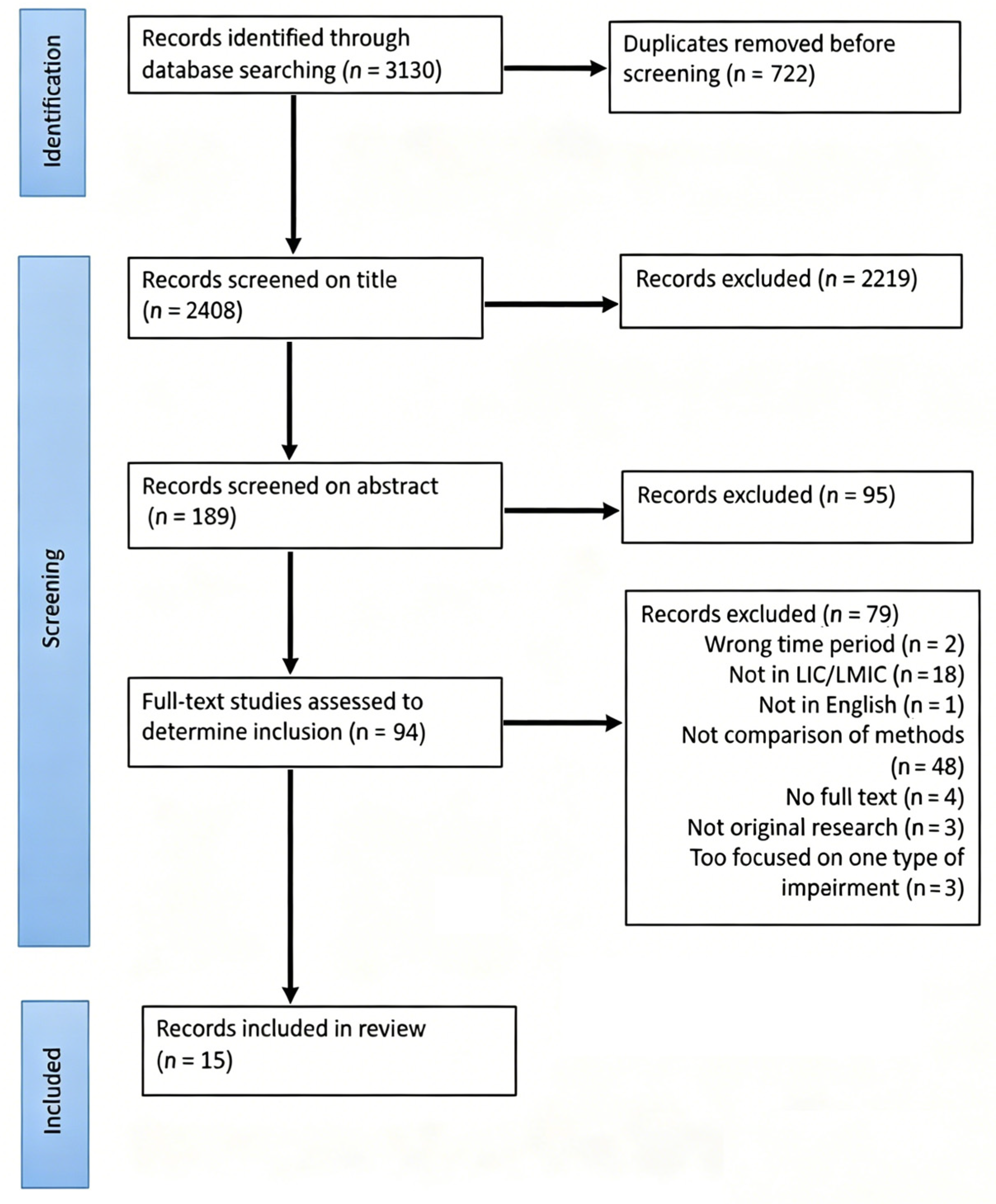
During the identification of studies, records were entered into Rayyan, an app for conducting systematic reviews and scoping studies [15]. Over the course of the search, we identified 3130 articles for inclusion, of which 722 were then removed as duplicates. The remaining 2408 articles were screened based on title. Subsequently, 2219 articles were excluded: 3 because they were not located in low and lower-middle income countries (LIC/LMIC) as defined by the World Bank, and the rest because they were not on the topic. The remaining 189 articles were screened by abstract; 95 articles were further excluded, as they did not fit our criteria. Then, 94 articles were read fully, after which 79 were excluded, because they neither focused on LIC/LMIC settings nor on populations originating from LIC/LMICs, and/or they did not compare two or more disability identification methods. The remaining 15 articles were included in this review. This process is demonstrated in Figure 1. Screening was done by the first author; any doubtful cases were discussed with the other author until a consensus was reached.
The first author did a thorough reading of the studies and recorded the study location, population, and instruments used in the study. Where studies reported prevalence and population overlap of two or more instruments, the details were extracted and analyzed to detect and describe patterns consistently across the studies. Inductive thematic content analysis was used as the analytic approach, with the specific instruments being the unit of observation. In the first step, we noted per study which instruments were used, prevalence data (if any), and key points that the authors make about the instruments. Next, in order to make further analysis easier, the specific instruments were clustered together based on similar features. This resulted in the development of four main clusters of instruments. Going forward, segments were coded in an iterative process; the main themes being the characteristics (i.e., perceived strengths and weaknesses) of the various (clusters of) instruments.

3. Results

In this section, we first present the fifteen included studies. We then look at the overall prevalence and population patterns that were observed across the various studies. Following that, we analyze how these instruments can be grouped into different clusters of disability identification instruments based on their intended use and other characteristics.

3.1. Studies Included

The fifteen studies included in this review represent twelve original data sets: studies 6 and 7 and studies 12–14 analyze overlapping samples. Table 2 summarizes the publications, including authors, year, country, study population, and the disability identification instruments used. The studies span a range of contexts—from small samples of 161 respondents to national censuses involving thousands. Collectively, they employ more than twenty-three standardized and non-standardized instruments to identify disability, with all studies incorporating a version of the Washington Group questions. Full instrument details are provided in Appendix A.

3.2. The Prevalence of Disability in the Population

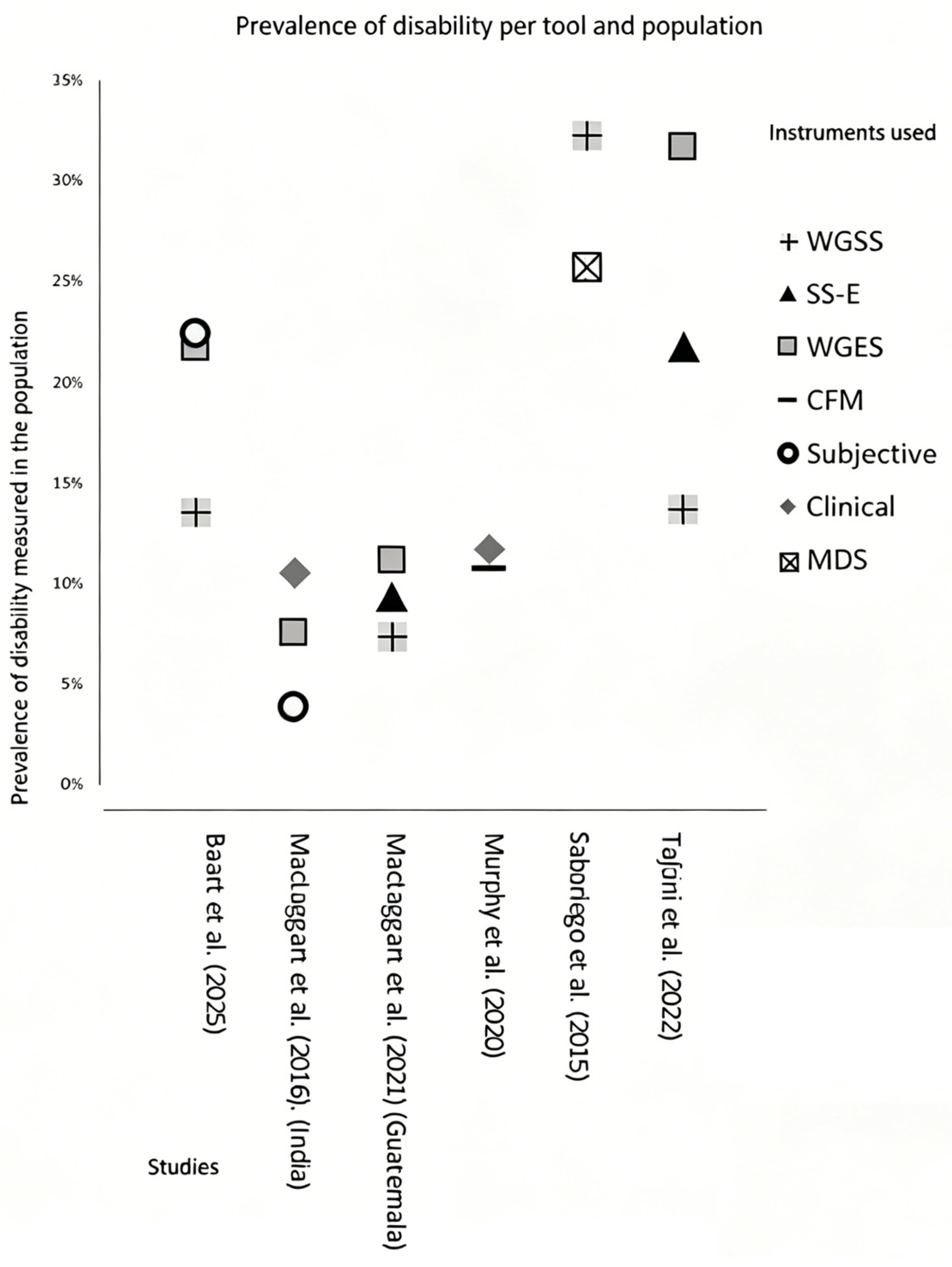
Individual studies have shown that the instrument used to identify disability influences the prevalence rate for disability in that population. Bringing together multiple studies, this review extends and systematizes this insight across diverse study contexts. We focused on the six studies included in this review that reported prevalence data using more than one instrument within the same population, i.e., the same people were assessed for two or more instruments [16,21,22,24,25,30]. The figure includes six studies in which multiple instruments were applied to the same population, allowing direct comparison of how different instruments produce different prevalence estimates. Each symbol represents a prevalence estimate identified using a specific disability identification instrument within a study population. Visualizing the data (Figure 2) emphasizes and reinforces what each of the individual studies demonstrates separately: the relative measured prevalence of disability is highly dependent on the instrument used and the cut-off points applied. Mactaggart et al. assessed two separate populations in Cameroon and in India [21]. For this analysis, we have included the data from India. Mactaggart et al. also assessed the same questions in multiple countries; for this analysis, we chose the data set from Guatemala [22].
The variation in prevalence is inherent to the instruments and what they intend to capture. Notably, the Washington Group Short Set (WGSS) consistently yields lower disability prevalence estimates when compared to the Washington Group Short Set—Enhanced (SS-E), the Washington Group Extended Set (WGES), or the Washington Group Child Functioning Module (CFM). These latter instruments incorporate the WGSS’s six core domains but add supplementary questions targeting psychosocial aspects. This discrepancy highlights the critical role of whether or not mental health is included in the assessment of disability, and reflects the fact that adding more domains to an instrument will be reflected in the prevalence, as this means more people will qualify for inclusion in the category.
The variation in prevalence, however, also demonstrates methodological inconsistency across studies. Mactaggart et al., for example, used the Washington Group Extended Set, but excluded four of the domains (pain, fatigue, anxiety, and depression) from the final analysis [21]. And where most used the Washington Group’s recommended guidelines for the disability cut-off, namely, to count as disabled anyone who reported ‘a lot of difficulty’ or ‘cannot do at all’ for one or more domains, Sabariego et al. used a different cut-off and included anyone with at least two questions answered with ‘some difficulty’ in the category of the disabled [25]. This is reflected in the relative prevalence, with Sabariego et al.’s WGSS counting more people as disabled than the other studies. It is thus not only different instruments that affect the results but also the cut-off points as chosen by the researchers.
Additionally, the relative ranking of subjective questions fluctuates greatly across the studies. In Mactaggart et al.’s study, the subjective question is phrased as “Do you consider yourself to have a disability?”, resulting in a disability prevalence of 3.8% [21]; the Baart et al. study uses the phrase “Do you have any long-standing illness, disability or infirmity?” and has a prevalence of 22.4% [16]. This is partly due to varying populations and contexts, but most likely also due to the inherent variability and differing nuances in the questions. Our visualization shows that differences in how disability is defined and measured influence prevalence estimates, echoing earlier observations that “definitions, terminology, measurement, and instructions to respondents and enumerators matter for understanding disability prevalence” [31] (p. 275).

3.3. Overlap in Disabled Populations Across Instruments

An intuitive assumption is that differences in prevalence rates simply reflect that different instruments capture larger or smaller portions of the same population. Earlier research, however, suggests that this is not the case: different instruments often identify different individuals as disabled [32]. Of the studies included in this review, five explicitly examine population overlap across instruments [16,17,21,28,29], providing direct evidence for this claim.
Baart et al., in a study among self-identified persons with disabilities in Cambodia, found that only 91% of these individuals would be classified as disabled using the Washington Group Short Set [17]. In addition, they report only limited correspondence between functional difficulties and the corresponding impairments as self-identified by respondents. Specifically, the overlap is 69% for visual difficulty, 23% for hearing difficulty, 70% for walking difficulty, and 45% for difficulty remembering.
In a study of Syrian refugees in Turkey, Baart et al. observed that only 32% of persons categorized as disabled using the WGSS and a subjective question were consistently identified as disabled across instruments [16]. Similarly, Mactaggart et al. report limited overlap between the WGSS and clinical assessments: 33% of the individuals identified as disabled in Cameroon, and 45% of the people in India were classified as disabled by both approaches [21]. Sprunt and colleagues further demonstrated this discrepancy by cross-tabulating clinical assessments with the Child Functional Module. They found that a significant number of children without clinical impairments were nonetheless reported as having ‘a lot of difficulty/cannot do’, particularly in learning, remembering, and focusing, which are easily missed domains in one-time clinical assessments [28]. In another study, Sprunt and Marella compared Learning and Support Needs with the Washington Group’s Child Functioning Module (CFM) and a clinical assessment, noting that there is a group of children with high learning and support needs, but that would not be considered disabled based on the CFM or a clinical assessment of disability [29].
Together, these findings underscore a critical point: different disability identification instruments not only produce different prevalence rates but also classify distinct—and often only partially overlapping—populations as disabled. The specific choice of instrument, therefore, determines which segments of the population are included within the category of disability and which are excluded.

3.4. Clusters of Disability Identification Approaches

Across the included studies, more than twenty different instruments were used to categorize respondents as disabled. To synthesize these diverse approaches and facilitate analysis, we grouped them into four clusters. These clusters were not predefined but were derived inductively during the analysis, based on their understandings of disability and modes of implementation. Each group reflects a different way of conceptualizing disability and therefore uses a different logic of categorization. The clusters are:
  • Functioning approaches: Disability is understood as difficulties in performing everyday activities. These instruments ask respondents about limitations or difficulties in domains such as seeing, hearing, walking, remembering, or participation in the community. Examples include the Washington Group variations and the Model Disability Survey. Respondents report their own difficulties and can subsequently be placed on a spectrum ranging from no difficulties to severely disabled. The specific cut-off defining what counts as disabled depends on analyst-defined thresholds.
  • Clinical approaches: Disability is defined as the presence of an impairment or diagnosis. These approaches rely on standardized medical or psychological tests (e.g., vision or hearing tests and cognitive screening instruments), which vary per (potential) diagnosis. Here, the authority to categorize lies with the external professional conducting the assessment.
  • Subjective question approaches: Disability is treated as a matter of self-identity. Respondents are asked directly, for example, “Do you have a disability?” or “Are you limited by a long-standing health condition?” The categorization is based entirely on self-report, shaped by respondents’ own understandings of disability and the surrounding cultural or social context.
  • Service-based approaches: Disability is conceptualized as eligibility for, need of, and/or use of disability-specific services and support. These approaches identify individuals through administrative data (e.g., use of assistive devices, enrolment in special education programs, and recipient of government grants) or through questions about support needs. The categorization authority rests with external systems or providers.
Although the clusters of instruments were derived inductively from the reviewed studies, they also reflect the analytic approaches of different ways of considering disability. Functioning-based instruments reflect the ICF and social models of disability, as they define disability through limitations in everyday functioning. Clinical instruments are more likely to align with the medical model, viewing disability primarily as impairment or diagnosis to be detected at the individual level. Questions that ask persons to self-identify can emphasize and require self-definition, akin to an identity-based model of disability. Service-based instruments mirror welfare or administrative logics, where disability is constructed through eligibility for benefits or services. Disability identification instruments are not merely technical instruments, but are all rooted in distinct conceptual paradigms of disability, which shape who is counted and for what purpose.
These four clusters capture the major conceptual pathways through which disability has been operationalized in the studies included in this review: as activity limitation, impairment, identity, or service eligibility. While some instruments straddle more than one cluster, this typology provides a clear and practical framework for comparing how approaches to disability categorization function in research, policy, and practice.

3.5. Cluster Characteristics

Using thematic content analysis, we distilled the key characteristics for each cluster of disability categorization instruments from the included studies. These themes were derived inductively from the data rather than predefined in advance. The themes covered include:
  • Population captured: what is the population that is identified as disabled using this cluster of instruments?
  • Who assesses: is the respondent themselves or is an external ‘expert’ responsible for the identification of said respondent as disabled?
  • Level of analysis: is the instrument intended to identify disability within a specific individual or is it intended for use in population-level surveys?
  • Ease of implementation: is the assessment simple, low-cost, and easy to execute?
  • Policy relevance: is the information produced by these instruments useful for designing and implementing policies and programs?
  • (Ethical) considerations: what questions and ethical considerations should be considered when deciding on the use of these instruments?
One key finding is that only the subjective question allows an individual to self-identify as disabled. In all other cases, the categorization of an individual as abled or disabled is determined by a party external to the person being categorized: for most approaches, disability status is determined by the analyst or external assessor, who applies thresholds that may not be communicated to respondents. The inclusion or exclusion of individuals from the disability category may thus be based on criteria that are not transparent to those being categorized, and can be adjusted post hoc [17,25,29].
We also note differences in whether instruments are intended to measure disability across a population or whether instruments are intended to categorize a specific individual as being disabled. The Washington Group questions, for example, take a margin of error in ‘incorrectly’ identifying those with temporary difficulties [19]. This is not seen to be a problem as the questions are designed for population-level data disaggregation, where small inaccuracies do not substantially affect overall estimates [33]. By contrast, subjective questions, the clinical assessment, and the service-based assessment are intended to label a specific person as being abled or disabled, and can therefore be more suitable for assigning individual resources or targeting interventions [29]. We note that all instruments can be used at all levels and that this is done in practice, but care must be taken if an instrument is used at a level beyond their intent as mistakes can be made, such as development organizations using the Washington Group questions to determine individual access requirements [4], which could lead to error and (unintended) exclusion.
Another important aspect is whether the instruments are easy to implement for those collecting and providing the data. Some of the assessment instruments (e.g., Washington Group questions; subjective questions) consist of only a few questions, meaning they can be more easily integrated into existing surveys and take only a few minutes of time for both respondents and data collectors [22,30]. Others, such as clinical assessments and question sets such as the Model Disability Survey, can take a long time (30+ min) to carry out the assessment or to ask all the questions. In addition, they require specialized and trained staff to collect the data and perform the analysis [22,25,30]. This makes them resource- and time-intensive and thus less suitable for low-resource contexts or regular monitoring.
Different approaches also support different policy and programmatic purposes. For example, functioning-based instruments are useful for cross-cultural and over-time monitoring [19,21,26,29], whereas clinical assessments can identify specific health conditions and support referral to rehabilitation and interventions [30].
No instrument is universally suitable. For instance, the Washington Group questions as a stand-alone instrument are not appropriate for screening individuals in need of rehabilitation services and assistive products [18,21,25,28]. Clinical diagnoses are not appropriate to assign resources, as they do not assess broader functioning [18,19,29]. Subjective questions do not provide consistent data across time and culture due to untranslatable and/or stigmatizing wordings [23,27] and do not provide enough specific information to be useful for planning and prioritization [22]. Question sets with a posteriori analysis, such as the MDS, do not allow for referral of those with unmet needs to services [22] and may not be appropriate for cross-country comparison, given that the cut-off changes depending on the population [25]. Service-based instruments are not appropriate for international comparison and disaggregation, as they are dependent on the environment, policies, and resourcing [29].
Each approach also carries distinct (ethical) implications:
  • Functioning instruments may reduce exclusion because they avoid stigmatizing language [16].
  • Some variations of functioning instruments undercount psychosocial disabilities [16,20,22,30].
  • Clinical instruments exclude those without formal diagnoses for any health or body structure issues, access to testing, or with impairments for which no clinical tests exist [21,27,28].
  • Subjective questions may exclude those who do not (wish to) identify as disabled because of stigma or cultural understandings [26].
  • Service-based approaches may omit individuals who are unable to access services or undercount those who function well in inclusive environments. Services are also dependent on policies and resourcing [29].
  • Self-reported instruments risk over-reporting when financial incentives are involved [28].
At a broader level, some instruments—particularly clinical and subjective ones—are less aligned with the social and rights-based paradigm of disability as framed in the UNCRPD. Others place the power to categorize in the hands of professionals or institutions, challenging the notion that individuals should self-identify as disabled. Finally, measurement choices may have political implications, as some approaches yield higher or lower prevalence estimates and can therefore serve strategic interests.
A summary of these findings is presented in Table 3.

4. Discussion

This literature review examines how different instruments—such as the Washington Group questions—function as instruments for identifying and categorizing disability, including the power dynamics inherent in this process. It contributes to ongoing debates about the measurement of disability by synthesizing how different identification instruments conceptualize disability and how these conceptualizations shape who is counted as disabled. With this review, we aim to synthesize insights about the use and characteristics of different categorization instruments used, drawing from fifteen studies which compare two or more instruments to categorize people as disabled in low- and lower-middle-income countries.
Through this review, we identified over 23 specific instruments, clustered them into four main approaches, and outlined the key characteristics of each. Our meta-level analysis of these studies aligns with earlier research [6,31], confirming that the instrument used to categorize disability in research influences results, including disability prevalence rates and inclusion criteria. The findings underscore and emphasize that measurement choices are not merely technical but reflect different underlying models of disability, whereby each privileges certain experiences and excludes others. Each instrument captures different aspects of disability, leading to distinct demographic and health profiles among those identified [10,34,35]. In addition, some instruments include the option to employ different cut-off points between disability and non-disability, meaning that even when using the same instrument, the delineation between the two may vary. Where disability lies on a continuum of abled–disabled will be context-dependent. This has practical implications for who is and is not identified as disabled.
Such variation is not inherently problematic—provided that researchers and other users of these instruments acknowledge the specific purpose and limitations of each instrument. Each instrument captures a particular dimension of disability. These dimensions might include, for example, individuals with a clinical diagnosis, those who self-identify as disabled, or those at risk of participation restrictions. This understanding suggests that striving for an objective ‘gold standard’ in quantitative disability measurement may be misguided [36]. Instead, the focus should shift toward reflexivity and transparency in instrument choice—acknowledging that each captures a particular dimension of disability shaped by theoretical and contextual assumptions. By making these choices transparent, we can enhance the validity of findings and foster more consistent and accountable research and policy practices.
Each approach to identifying disability has characteristics that make it suitable for certain purposes but not others. To support an informed reflection, we have developed criteria that clarify when and why a particular type of instrument may be appropriate (see Table 4). These criteria have been derived from the patterns identified in Table 3. Rather than prescribing a hierarchy, these criteria are intended to guide deliberate, context-sensitive decision-making. They represent a first step to helping researchers and policy makers make deliberate decisions, as the choice of instrument should be guided by the specific objectives, resources, and context of measurement. For a concise overview of instrument suitability by purpose, see Appendix B.
Beyond these practical considerations, it is crucial to acknowledge that the act of categorization itself is not neutral. As Bowker & Leigh Star and Bennani remind us, classification systems are never merely technical tools but social and political constructions [37,38]. This is as true for the categorization of disability as it is for any other social category. The categorization of disability, like any social classification, is not neutral—it actively constructs what it claims to describe. Those who select and apply disability identification instruments and determine the cut-off between disabled and not-disabled should therefore take responsibility for using these instruments accurately and for being transparent about how their category is constructed.
The global origins of most disability measurement tools make this issue especially pertinent. Even though data gaps are largest in LMICs [39], many instruments for categorizing individuals as disabled are rooted in Western epistemologies [40]. This means that the categorization and quantification of disability in the South is often based on instruments and assumptions implemented by Northern specialists [41,42,43], presuming a universal understanding that may not hold in different cultural contexts. In addition, the concept of ‘disability’ is not universally translatable, further complicating application across cultural contexts [44]. Instruments may not fully reflect the lived reality and disability paradigms in the South, which may differ significantly [44,45,46,47], requiring increased reflection and transparency when choosing which instrument to use.
Taken together, these reflections underline that disability statistics are not only technical artifacts but also political acts of boundary-making. Understanding who is counted—and who is left out—requires attention not only to methodological design but also to the cultural, linguistic, and ethical assumptions embedded in the instruments themselves.

4.1. Implications

The above means that future research should focus on three main avenues. First, understanding instrument differences in the demographic that is captured by the instrument. Understanding the exact demographic that is captured by, e.g., the WGSS as opposed to a clinical assessment, can help future researchers and development practitioners make more effective choices on which instrument to use to capture the population they aim to reach. An example could be whether certain instruments are more favorable towards including or excluding individuals by gender or age. Second, experimenting with combinations of instruments to better capture the multidimensional nature of disability: could combining a subjective question with the Washington Group questions better capture both those with difficulties functioning physically, as well as those who may have difficulty participating in society due to the (self)-label of being disabled? Third, disability studies and their funding structures should ensure that research is increasingly steered and conducted by disabled people from the Global South, addressing concerns about the mismatch between measurement instruments and the lived realities of those being categorized.
For praxis, the above proposes a reflection on the choices made when categorizing persons as abled or disabled: encouraging reflexivity at the design stage of data collection and documenting the rationale behind instrument selection. Acknowledging context and purpose, considering culture and politics, and recognizing potential consequences for the categorized persons provide opportunities to work in more transparent and consistent ways. This reflection could be reported in the methodology of any study to invite discussion and provide accountability. Including such reflections in the methodological sections of research publications would strengthen transparency and foster dialog about the implications of measurement choices.

4.2. Limitations

Although this review focused on populations in or originating from low- and lower-middle-income countries, limiting inclusion to English-language articles may have affected the results, as relevant locally published research may have been excluded. In addition, some studies were conducted in languages other than English, but the study results were published in English, leading to additional potential misunderstanding of the concept of disability as the words are translated back. However, given the conceptual subtlety of disability and the linguistic experience of the term itself [40,48] we concluded that relying on machine-translated articles would not adequately capture the necessary nuance, particularly as non-native speakers.
The criteria for included studies to be peer-reviewed, chosen to set quality standards, and ease access, also excluded the potentially relevant gray literature, particularly national disability reports and NGO publications. This would be valuable to investigate in the future. Screening was conducted by the first author, with uncertain cases being discussed with the second author. Double independent screening could strengthen the methodological rigor of such a study; however, this was not done, given the aim to compare approaches rather than evaluate the quality of the included studies. Any studies prior to 2011 were excluded to limit results, which means some relevant information could have been missed as well. Broad search terms were used to maximize sensitivity; however, additional terms, such as disaggregation, could have been used to identify additional studies. Nevertheless, the included studies cover a diverse range of countries, instruments, and research designs, providing a sufficiently broad evidence base to identify major trends and conceptual patterns in how disability is categorized. This suggests that the findings therefore offer a meaningful overview of current practices and highlight key areas where further empirical work is needed.

5. Conclusions

In this review, we grouped over 23 specific disability identification instruments into four main clusters: functional, clinical, subjective questions, and services. For each cluster, we detailed who performs the categorization, whether the instrument is designed for individual or population-level categorization, and other characteristics as highlighted across 15 studies. Finally, we translated these insights into practical criteria to guide researchers and data collectors in choosing appropriate methods. We note that there is no ‘gold standard’ for identifying disability, but multiple conceptualizations of what disability is, each translating into a different instrument to categorize individuals in the abled/disabled binary. Recognizing that each instrument reflects a particular way of understanding disability helps clarify that measurement is never neutral but shaped by underlying assumptions and purposes. We call for increased reflexivity amongst decision-makers.
Further research could develop the criteria for use into practical guidelines for practitioners and decision-makers, as well as reflect further on what the impact would be—financial, practical, personal, and political—when favoring one method of categorization over the other. In addition, future Southern-based studies could enhance the debate on how globally used disability identification instruments align or diverge from locally grounded approached.

Author Contributions

Conceptualization, J.B. and W.E.; methodology, J.B. and W.E.; formal analysis, J.B.; data curation, J.B.; writing—original draft preparation, J.B.; writing—review and editing, J.B. and W.E.; visualization, J.B. All authors have read and agreed to the published version of the manuscript.

Funding

This research received no external funding.

Institutional Review Board Statement

Not applicable.

Informed Consent Statement

Not applicable.

Data Availability Statement

No new data were created or analyzed in this study. Data sharing is not applicable to this article.

Conflicts of Interest

The authors declare no conflicts of interest.

Disability Language/Terminology Positionality Statement

In this text, we use persons with disabilities to refer to the people; we use the terms disabled and non-disabled/abled to reflect the social categories constructed by those doing the labeling.

Abbreviations

The following abbreviations are used in this manuscript:
CFMWashington Group Child Functioning Module
LFS-DSMLabor Force Survey Disability Module
LICLow-Income Countries
LMICLow and Lower-Middle Income Countries
LSNLearning and Support Needs
MDATMalawi Development Assessment Tool
MDSModel Disability Survey
NGONon-Governmental Organization
SDGSustainable Development Goals
SS-EWashington Group Short Set Enhanced
UNCRPDUnited Nations Convention on the Rights of Persons with Disabilities
WGWashington Group
WGESWashington Group Extended Set
WGSSWashington Group Short Set

Appendix A

Table A1. Description of included instruments.
InstrumentFull NameDeveloperShort Description
WGSSWashington Group Short SetWashington Group on Disability StatisticsSix question sequence asking:
Because of a health problem, do you have difficulty (1) seeing, (2) hearing, (3) walking or climbing steps, (4) remembering or concentrating, (5) with self-care such as washing all over or dressing or (6) communicating?
Four possible responses follow each of the questions, namely: No, no difficulty; Yes, some difficulty; Yes, a lot of difficulty; Cannot do at all.
LFS-DMLabor Force Disability Survey ModuleWashington Group on Disability Statistics & International Labour OrganizationWGSS as above, as well as 4 additional questions to cover anxiety and depression:
How often do you feel worried, nervous or anxious? Thinking about the last time you felt worried, nervous or anxious, how would you describe the level of these feelings? How often do you feel depressed? Thinking about the last time you felt depressed, how depressed did you feel?
Answer options for anxiety and depression include how often and the extent of the feelings.
SS-EWashington Group Short Set EnhancedWashington Group on Disability StatisticsLabor Force Survey Disability Module as above, plus 2 upper body function questions:
Do you have difficulty raising a 2-liter bottle of water or soda from waist to eye level? Do you have difficulty using your hands and fingers, such as picking up small objects, for example, a button or pencil, or opening or closing containers or bottles?
Answer options are the same as for WGSS.
WGESWashington Group Extended SetWashington Group on Disability StatisticsQuestions as above, but additional five questions to cover pain and fatigue. Questions cover how often and if yes, how much pain and fatigue respondent has.
CFMChild Functioning ModuleWashington Group & UNICEFQuestionnaire on functioning in children, adapted to developmental stage. Includes 24 questions covering seeing, hearing, walking, self-care, speaking, learning, remembering, concentrating, behavior, socialization, and mood. Scoring as with the WGSS above.
MDATMalawi Development Assessment ToolUniversity of LiverpoolFor use in children. Assesses four domains: (1) gross motor coordination (36 items), (2) fine motor coordination (36 items), (3) social (30 items), and (4) language (36 items), with 138 items in the published version of the tool.
n/aSubjective questionn/aQuestion: What type of disability would you say you have?
Answer options were: Auditory, Intellectual, Physical, Visual, Speaking, or Multiple.
n/aTwo question setUK office for National Statistics1. Do you have any long-standing illness, disability or infirmity?
2. Does this limit your activities in any way?
n/aTumbling E single optotypen/aChart depicts E’s which get increasingly smaller. People need to describe the direction of the E.
n/aSnellen chartn/aSimilar to tumbling E, but consisting of a variety of capital letters becoming increasingly smaller.
n/aOtoacoustic Emissions Testingn/aA specialized probe equipped with speakers and a microphone is placed in the ear canal, with the intent of picking up the sounds produced by the movement of outer hair cells.
RAMRapid Assessment of Musculoskeletal ImpairmentOxford University & International Centre for Evidence in Disability (ICED) Six questions asking about misshapen body, difficulty using arms and legs or other parts of the body, need for mobility aids and convulsions or involuntary movement. If answering Yes to any question respondents is referred to clinical specialist for further examination.
MMSEMini Mental State ExaminationMF FolsteinBrief neurophysiological test
RAABRapid Assessment of Avoidable BlindnessInternational Centre for Eye Health, LSHTMPopulation eye health survey that assesses prevalence and cause of vision impairment and blindness.
PHQ9Patient Health QuestionnaireK Kroenke, RL Spitzer and JB Williams Three self-reported screening questions with a further six questions if screen is positive; measures frequency of depression.
n/aSubjective questionDeveloped for one contextQuestion: “Do you consider yourself to have a disability?”
MDSModel Disability SurveyWorld Health Organization and World Bank60–120 min interview, covering socio-demographic characteristics; work history and benefits; environmental factors; functioning; health conditions and capacity; health-care utilization; and satisfaction, personality and well-being.
3RGPHSubjective questionn/aQuestion: “Has the person any chronic disease or any predominant handicap?”
ECAM3Subjective questionn/aQuestion: “Is (Name) the victim of a handicap?”
DHS-MICSSubjective questionCameroonian DHSQuestion set, asking whether respondents is missing a body part; missing an extremity; with deformed limbs; can hardly see; can hardly hear; has behavioral disorders.
LSNLearning and Support NeedsDeveloped for one context3 questions:
1. “Compared with children of the same age, how much personal assistance at school does (child’s name) require with any of the following tasks?
2. “Are there any adaptations to learning or assessment that you currently make for (child’s name)?
3. “Is (child’s name) currently using any of the following types of assistive devices?
ICSIntelligibility in Context ScaleMcLeod, Harrison, & McCormackParent-completed questionnaire consisting of 7 items, to rate the degree to which children’s speech is understood by different communication partners on a 5-point scale.
CNTABCambridge Neuropsychological Test Automated
Battery
University of Cambridge Battery of subtests, intended to assess cognitive function.

Appendix B

Table A2. Overview of instrument suitability by purpose.
Purpose of UseFunctioningClinicalSubjectiveServices
Population monitoring & cross-country comparisonWell-suited, can be low-cost depending on the instrument, widely applicableNot suitableLimited: prone to stigma/cultural biasNot suitable
(criteria vary)
Clinical care & interventionNot suitable for diagnosisWell suited for identifying health conditionsNot suitableNot suitable
Self-identification & empowermentLimited suitability: dependent on self-reportNot suitableWell-suited, aligns with self-identificationNot suitable
Policy & administrative planningSuitable for population level policy development and planning, not independent allocationLimited: suitable for planning health servicesNot suitableLimited: suited where administrative data exist and criteria are transparent
In-depth analysis of functioningSuitable at population level where it captures spectrum of disability and participation measuresNot suitableNot suitableNot suitable

References

  1. Cote, A.; Banks, M. Global Disability Inclusion Report; UNICEF: New York, NY, USA, 2025. [Google Scholar]
  2. Duell-Piening, P. Refugee Displacement, Disability and Human Rights; The Production, Processing and Power of Data; Routledge: England, UK, 2025. [Google Scholar]
  3. O’Reilly, C.F.; Jagoe, C. Disaggregation of Humanitarian Data by Disability: A Realist Evaluation of the Use of the Washington Group Questions to Support More Inclusive Practices. J. Int. Humanit. Action 2024, 9, 6. [Google Scholar] [CrossRef] [Scilit]
  4. Robinson, A.; Nguyen, L.; Smith, F. Use of the Washington Group Questions in Non-Government Programming. Int. J. Environ. Res. Public Health 2021, 18, 11143. [Google Scholar] [CrossRef] [Scilit]
  5. Global Disability Summit. Amman-Berlin Declaration on Global Disability Inclusion. 2025. Available online: https://www.globaldisabilitysummit.org/resource/amman-berlin-declaration/.
  6. Cockburn, L.; Roberts, J.; Lee, S.; Nganji, J.; Ho, N.C.W.; Kuntjoro, A.; Mbibeh, L.; Sikapa, L.; Animbom, P.N.; Fru, S.; et al. Considerations When Asking about “Disability” in Disability Inclusive Research. Disabil. Rehabil. 2024, 46, 5114–5133. [Google Scholar] [CrossRef] [Scilit]
  7. Goujon, N.; Devine, A.; Baker, S.M.; Sprunt, B.; Edmonds, T.J.; Booth, J.K.; Keeffe, J.E. A Comparative Review of Measurement Instruments to Inform and Evaluate Effectiveness of Disability Inclusive Development. Disabil. Rehabil. 2014, 36, 804–812. [Google Scholar] [CrossRef] [Scilit] [PubMed]
  8. Kuper, H.; Davey, C.; Banks, L.M.; Shakespeare, T. Trials and Tribulations of Collecting Evidence on Effectiveness in Disability-Inclusive Development: A Narrative Review. Sustainability 2020, 12, 7823. [Google Scholar] [CrossRef] [Scilit]
  9. Amilon, A.; Christensen, M.L. Changing Disability Status and Changes in Health, Participation Restrictions and Activity Limitations in Denmark: Does the Choice of Measure Matter? Scand. J. Disabil. Res. 2025, 27, 15–29. [Google Scholar] [CrossRef] [Scilit]
  10. Bourke, J.A.; Nichols-Dunsmuir, A.; Begg, A.; Dong, H.; Schluter, P.J. Measuring Disability: An Agreement Study between Two Disability Measures. Disabil. Health J. 2021, 14, 100995. [Google Scholar] [CrossRef] [Scilit]
  11. Landes, S.D.; Hall, J.P.; Swenor, B.K.; Vaitsiakhovich, N. Comparative Performance of Disability Measures. PLoS ONE 2025, 20, e0318745. [Google Scholar] [CrossRef] [Scilit]
  12. Shogren, K.A.; Pace, J.R.; Wittenburg, D.C.; Raley, S.K.; Hicks, T.A.; Rifenbark, G.G.; Lane, K.L.; Anderson, M.H. Self-Report and Administrative Data on Disability and IEP Status: Examining Differences and Impacts on Intervention Outcomes. J. Disabil. Policy Stud. 2022, 33, 253–266. [Google Scholar] [CrossRef] [Scilit]
  13. World Health Organization; World Bank. World Report on Disability; World Health Organization: Geneva, Switzerland, 2011. [Google Scholar]
  14. World Bank. World Bank Country and Lending Groups. Available online: https://datahelpdesk.worldbank.org/knowledgebase/articles/906519-world-bank-country-and-lending-groups (accessed on 22 April 2025).
  15. Ouzzani, M.; Hammady, H.; Fedorowicz, Z.; Elmagarmid, A. Rayyan—A web and mobile app for systematic reviews. Syst. Rev. 2016, 5, 210. [Google Scholar] [CrossRef] [Scilit]
  16. Baart, J.; Elbers, W.; Schippers, A.; Polack, S. The Definition Dilemma: How Definitions of Disability Shape Statistics on Social Participation. Int. J. Environ. Res. Public Health 2025, 22, 603. [Google Scholar] [CrossRef] [Scilit]
  17. Baart, J.; Elbers, W.; Schippers, A. Who Is Disabled? On Whether the Functional Definition of Disability Targets the Same Individuals as the Subjective Definition. Front. Sustain. 2023, 4, 1163128. [Google Scholar] [CrossRef] [Scilit]
  18. Boggs, D.; Kuper, H.; Mactaggart, I.; Bright, T.; Murthy, G.; Hydara, A.; McCormick, I.; Tamblay, N.; Alvarez, M.L.; Atijosan-Ayodele, O.; et al. Exploring the Use of Washington Group Questions to Identify People with Clinical Impairments Who Need Services Including Assistive Products: Results from Five Population-Based Surveys. Int. J. Environ. Res. Public Health 2022, 19, 4304. [Google Scholar] [CrossRef] [Scilit]
  19. Dunne, T.F.; Chandna, J.; Majo, F.; Tavengwa, N.; Mutasa, B.; Chasekwa, B.; Ntozini, R.; Prendergast, A.J.; Humphrey, J.H.; Gladstone, M.J. Performance of the UNICEF/UN Washington Group Tool for Identifying Functional Difficulty in Rural Zimbabwean Children. PLoS ONE 2022, 17, e0274664. [Google Scholar] [CrossRef] [Scilit]
  20. Emerson, E.; Llewellyn, G. The Prevalence of Disability among Adolescents and Young Adults in Low and Middle-Income Countries: A Cross-Sectional Comparison of Two Measures. Disabil. Health J. 2025, 18, 101777. [Google Scholar] [CrossRef] [Scilit]
  21. Mactaggart, I.; Kuper, H.; Murthy, G.V.S.; Oye, J.; Polack, S. Measuring Disability in Population Based Surveys: The Interrelationship between Clinical Impairments and Reported Functional Limitations in Cameroon and India. PLoS ONE 2016, 11, e0164470. [Google Scholar] [CrossRef] [Scilit]
  22. Mactaggart, I.; Bek, A.H.; Banks, L.M.; Bright, T.; Dionicio, C.; Hameed, S.; Neupane, S.; Murthy, G.V.S.; Orucu, A.; Oye, J.; et al. Interrogating and Reflecting on Disability Prevalence Data Collected Using the Washington Group Tools: Results from Population-Based Surveys in Cameroon, Guatemala, India, Maldives, Nepal, Turkey and Vanuatu. Int. J. Environ. Res. Public Health 2021, 18, 9213. [Google Scholar] [CrossRef] [Scilit]
  23. Mörchen, M.; Zambrano, O.; Páez, A.; Salgado, P.; Penniecook, J.; von Lindau, A.B.; Lewis, D. Disability-Disaggregated Data Collection: Hospital-Based Application of the Washington Group Questions in an Eye Hospital in Paraguay. Int. J. Environ. Res. Public Health 2019, 16, 3085. [Google Scholar] [CrossRef] [Scilit] [PubMed]
  24. Murphy, R.; Jolley, E.; Lynch, P.; Mankhwazi, M.; Mbukwa, J.; Bechange, S.; Gladstone, M.J.; Schmidt, E. Estimated Prevalence of Disability and Developmental Delay among Preschool Children in Rural Malawi: Findings from “Tikule Limodzi,” a Cross-Sectional Survey. Child Care Health Dev. 2020, 46, 187–194. [Google Scholar] [CrossRef] [Scilit] [PubMed]
  25. Sabariego, C.; Oberhauser, C.; Posarac, A.; Bickenbach, J.; Kostanjsek, N.; Chatterji, S.; Officer, A.; Coenen, M.; Chhan, L.; Cieza, A. Measuring Disability: Comparing the Impact of Two Data Collection Approaches on Disability Rates. Int. J. Environ. Res. Public Health 2015, 12, 10329–10351. [Google Scholar] [CrossRef] [Scilit]
  26. Simo Fotso, A.; Duthé, G.; Odimegwu, C. A Comparative Analysis of Disability Measures in Cameroonian Surveys. Popul. Health Metr. 2019, 17, 16. [Google Scholar] [CrossRef] [Scilit] [PubMed]
  27. Sprunt, B.; Hoq, M.; Sharma, U.; Marella, M. Validating the UNICEF/Washington Group Child Functioning Module for Fijian Schools to Identify Seeing, Hearing and Walking Difficulties. Disabil. Rehabil. 2017, 41, 201–211. [Google Scholar] [CrossRef] [Scilit] [PubMed]
  28. Sprunt, B.; McPake, B.; Marella, M. The UNICEF/Washington Group Child Functioning Module—Accuracy, Inter-Rater Reliability and Cut-off Level for Disability Disaggregation of Fiji’s Education Management Information System. Int. J. Environ. Res. Public Health 2019, 16, 806. [Google Scholar] [CrossRef] [Scilit]
  29. Sprunt, B.; Marella, M. Combining Child Functioning Data with Learning and Support Needs Data to Create Disability-Identification Algorithms in Fiji’s Education-Management Information System. Int. J. Environ. Res. Public Health 2021, 18, 9413. [Google Scholar] [CrossRef] [Scilit]
  30. Tofani, M.; Galeoto, G.; Berardi, A.; Iorio, S.; Conte, A.; Fabbrini, G.; Valente, D.; Marceca, M. Measuring Disability among Migrants with Washington Group Tools: Reflections for Field Use. Healthcare 2022, 10, 1860. [Google Scholar] [CrossRef] [Scilit]
  31. Pettinicchio, D.; Maroto, M. Who Counts? Measuring Disability Cross-Nationally in Census Data. J. Surv. Stat. Methodol. 2021, 9, 257–284. [Google Scholar] [CrossRef] [Scilit]
  32. Molden, T.H.; Tøssebro, J. Disability Measurements: Impact on Research Results. Scand. J. Disabil. Res. 2012, 14, 340–357. [Google Scholar] [CrossRef] [Scilit]
  33. The Washington Group on Disability Statistics. Frequently Asked Questions. Available online: https://www.washingtongroup-disability.com/resources/frequently-asked-questions/ (accessed on 17 July 2025).
  34. Amilon, A.; Hansen, K.M.; Kjær, A.A.; Steffensen, T. Estimating Disability Prevalence and Disability-Related Inequalities: Does the Choice of Measure Matter? Soc. Sci. Med. 2021, 272, 113740. [Google Scholar] [CrossRef] [Scilit]
  35. Lauer, E.A.; Henly, M.; Coleman, R. Comparing Estimates of Disability Prevalence Using Federal and International Disability Measures in National Surveillance. Disabil. Health J. 2019, 12, 195–202. [Google Scholar] [CrossRef] [Scilit]
  36. Jamieson, M.K.; Govaart, G.H.; Pownall, M. Reflexivity in Quantitative Research: A Rationale and Beginner’s Guide. Soc. Personal. Psychol. Compass 2023, 17, e12735. [Google Scholar] [CrossRef] [Scilit]
  37. Bowker, G.C.; Leigh Star, S. Sorting Things Out: Classification and Its Consequences; MIT Press: Cambridge, MA, USA, 1999. [Google Scholar]
  38. Bennani, H. From Experiences to Numbers: The Production of International Disability Statistics. Disabil. Soc. 2024, 39, 1859–1883. [Google Scholar] [CrossRef] [Scilit]
  39. Chataika, T.; McKenzie, J.A. Global Institutions and Their Engagement with Disability Mainstreaming in the South: Development and (Dis)Connections. In Disability in the Global South: The Critical Handbook; Grech, S., Soldatic, K., Eds.; Springer: Cham, Switzerland, 2016. [Google Scholar]
  40. Roy, A. Decolonizing Disability Studies: Identities, Epistemologies and Global South Perspectives. Creat. Launcher 2024, 9, 70–81. [Google Scholar] [CrossRef] [Scilit]
  41. Goodley, D.; Lawthom, R.; Liddiard, K.; Runswick-Cole, K. Key Concerns for Critical Disability Studies. Int. J. Disabil. Soc. Justice 2021, 1, 27–49. [Google Scholar] [CrossRef] [Scilit]
  42. Hickey-Moody, A.; Garg, D. Disability, Intersectionality and Decolonial Perspectives from the Global South. In The Routledge International Handbook of Critical Disability Studies; Ellis, K., Kent, M., Cousins, K., Eds.; Routledge: England, UK, 2025. [Google Scholar]
  43. Mupoperi, M.W. Challenging Knowledge Production in Disability Issues from the Global North to the Global South. Glob. Sci. J. 2021, 9, 1380–1387. [Google Scholar]
  44. Rao, S.; Kalyanpur, M. Universal Notions of Development and Disability: Towards Whose Imagined Vision? Disabil. Glob. South 2020, 7, 1830–1851. [Google Scholar]
  45. Grech, S.; Soldatic, K. (Eds.) Disability in the Global South: The Critical Handbook; Springer International Publishing: Cham, Switzerland, 2016. [Google Scholar] [CrossRef] [Scilit]
  46. Grischow, J.; Naami, A.; Mprah, W.; Mfoafo-M’carthy, M. Methodologically Thinking: Doing Disability Research in Ghanaian Cultural Communities. Scand. J. Disabil. Res. 2021, 23, 169–179. [Google Scholar] [CrossRef] [Scilit]
  47. Meekosha, H.; Soldatic, K. Human Rights and the Global South: The Case of Disability. Third World Q. 2011, 32, 1383–1397. [Google Scholar] [CrossRef] [Scilit]
  48. Ghosh, N.; Bhaduri, S. Categorizing Disability: Perspectives from West Bengal, India. Rev. Disabil. Stud. Int. J. 2024, 19, 1–33. [Google Scholar]
Figure 1. Flow Chart of included articles.
Disabilities 06 00039 g001
Figure 2. Prevalence of disability per instrument and study population [16,21,22,24,25,30].
Disabilities 06 00039 g002
Table 1. Search strategy used in electronic databases.
#Search StrategyDatabase
1disability AND measure AND Washington GroupWorldCat, Scopus, Google Scholar
2measuring AND disability AND inclusionWorldCat, Scopus
3measur* AND impairment AND WGSSWorldCat, Scopus
4disability data AND WGSSWorldCat, Scopus, Web of Science
5disability data AND Washington GroupWorldCat, Scopus, Web of Science
6washington AND group AND measur* AND impairmentScopus
7disability AND measure AND direct AND questionScopus
8uncrpd AND data disability Scopus, Web of Science
9sdg AND data AND disability AND methodScopus
10disability data AND LMICWeb of Science, Google Scholar
11washington group AND measur* AND impairmentWeb of Science
12disability AND measure AND direct questionWeb of Science, Google Scholar
13Searched entire databaseInternational Centre for Evidence in Disability
14categoris* AND disabilityScopus
15categor* AND disabil*Scopus
16clinical AND washington AND groupScopus
17disability AND classification AND methodGoogle Scholar
Table 2. The studies included in the review.
#Author(s) (Year)Location of StudyStudy PopulationDisability Identification Instruments Used
1Baart et al. (2025) [16]Turkey1555 adult Syrian refugees in Istanbul
  • Washington Group Short Set (WGSS)
  • WGSS-Enhanced (SS-E)
  • Subjective question: Two-question sequence asking about limitations due to disability or illness
2Baart et al. (2023) [17]Cambodia422 respondents aged 4–91
  • Washington Group Short Set (WGSS)
  • Subjective question: “what type of disability do you have?”
3Boggs et al. (2022) [18]The Gambia, Cameroon, Chile, India and TurkeyChildren
(Cameroon, India, Turkey), adults 35+ (The Gambia) and adults 50+ (Chile).
  • Washington Group Short Set (WGSS)
  • WGSS-Enhanced (SS-E)
  • Washington Group Extended Set (WGES)
  • Washington Group Child Functioning Module (CFM)
  • Clinical assessment (Tumbling E single optotype; Otoacoustic Emissions Testing; Rapid Assessment of Musculoskeletal Impairment; Mini Mental State Examination)
4Dunne et al. (2022) [19]Zimbabwe1920 children aged 24 months
  • Washington Group Child Functioning Module (CFM)
  • Malawi Development Assessment Tool (MDAT)
5Emerson & Llewellyn (2025) [20]40 LMICs45,370 adolescents (15–17 yrs) and 178,689 young adults (18–25 yrs)
  • Washington Group Short Set (WGSS)
  • WG Child Functioning Module (CFM)
6Mactaggart et al. (2016) [21]Cameroon and IndiaPopulation-based survey of 3567 people in India and 3574 people in Cameroon
  • Washington Group Extended Set (WGES)
  • Clinical assessment (Adapted Rapid Assessment of Avoidable Blindness (RAAB); Otoacoustic Emissions Testing; Rapid Assessment of Musculoskeletal Impairment; Patient Health Questionnaire (PHQ9))
  • Subjective question: “Do you consider yourself to have a disability?” (India only)
7Mactaggart et al. (2021) [22]Cameroon, Guatemala, India,
Maldives, Nepal, Turkey and Vanuatu
53,000 adults from 7 countries
  • Washington Group Short Set (WGSS)
  • Labor Force Survey Disability Module (LFS-DM)
  • WGSS-Enhanced (SS-E)
  • Washington Group Extended Set (WGES)
8Mörchen et al. (2019) [23]Paraguay999 patients visiting a rural satellite eye hospital
  • Washington Group Short Set (WGSS)
  • Washington Group Extended Set (WG-ES)
9Murphy et al. (2020) [24]Malawi960 children attending preschool centers in Thyolo district
  • WG Child Functioning Module (CFM)
  • Malawi Development Assessment Tool (MDAT)
10Sabariego et al. (2015) [25]CambodiaConvenience sample of 500 adults in Kampong Thom and Kampot provinces
  • Washington Group Short Set (WGSS)
  • Model Disability Survey (MDS)
11Simo Fotso et al. (2019) [26]CameroonSecondary analysis of four census datasets
  • Subjective question: “Has the person any chronic disease or any predominant handicap?”
  • Subjective question: “Is (Name) the victim of a handicap?”
  • Washington Group Short Set (WGSS)
  • Other screening instrument: asking about missing limbs, functioning and disorders
12Sprunt et al. (2017) [27]Fiji472 children aged 5–15 from special and mainstream schools
  • WG Child Functioning Module (CFM)
  • Clinical: (visual assessment, hearing assessment, Rapid Assessment of Musculoskeletal Impairment)
13Sprunt et al. (2019) [28]Fiji472 children aged 5–15 from special and mainstream schools
  • WG Child Functioning Module (CFM)
  • Clinical: (visual assessment, hearing assessment, Rapid Assessment of Musculoskeletal Impairment; Intelligibility in Context Scale; Cambridge Neuropsychological Test Automated Battery)
14Sprunt & Marella (2021) [29]Fiji472 children aged 5–15 years special and mainstream schools
  • WG Child Functioning Module (CFM)
  • Learning and Support Needs (LSN) (does child need personal assistance, adaptations or assistive devices?)
  • Clinical: (visual assessment, hearing assessment, Rapid Assessment of Musculoskeletal Impairment; Intelligibility in Context Scale; Cambridge Neuropsychological Test Automated Battery)
15Tofani et al. (2022) [30]Italy161 adult migrants
  • Washington Group Short Set (WGSS)
  • WGSS-Enhanced (SS-E)
  • Washington Group Extended Set (WG-ES)
Table 3. Characteristics of the four clusters.
ClusterPopulation CapturedWho
Assesses
Level of AnalysisEase of ImplementationPolicy Relevance(Ethical) Considerations
FunctioningRespondents who state they have difficulties functioning in certain life areas.ExternalPopulation
  • Can be low-cost
  • Short
  • Easy analysis
  • Some variations such as the MDS are resource-intensive and require trained analytical staff.
  • Not appropriate for targeted interventions at individual level
  • Good for monitoring across countries and time if analysis is done similarly each time
  • Good for data disaggregation if analysis is done similarly each time
  • Some variations may undercount psychosocial disability
  • Avoids the term “disability”
  • Can reflect the spectrum from no to severe impairments or difficulties
  • Criteria for categorization as disabled may not be transparent
ClinicalRespondents who have a measurable impairment as assessed by the specific test undertaken.ExternalIndividual
  • Resource-intensive
  • Requires trained clinical staff
  • Useful for planning rehabilitation
  • Less useful for assigning resources and developing policies as functional abilities within diagnoses differ
  • Reinforces medical model
  • Power to categorize as disabled lies with authority figure (i.e., medical professional)
  • Limited to tested impairments
  • Excludes those who experience exclusion but have no ‘diagnosis’
  • Lack of instruments to measure psychosocial domains
  • Tests/assessments may not be culturally relevant
SubjectiveRespondents who identify themselves with the term ‘disability’RespondentIndividual
  • Low-cost
  • Short
  • Not appropriate for monitoring across countries and time
  • Provides little information for planning and prioritization of needs
  • Allows respondents to self-identify
  • Excludes those who do not understand the question or feel stigma associated with disability
  • Ignores co-morbidity
ServicesRespondents who are already receiving services intended for persons with disabilities or who are identified as needing those services.ExternalIndividual
  • Simple if data is already available in administrative systems
  • Asking about needs may be appropriate for resource planning
  • Appropriate for monitoring across time if inclusion criteria are not changed
  • Context-dependent
  • In/exclusion criteria can be changed
  • May exclude respondents who are not able to access services
  • In an inclusive environment, may undercount those who might need services in any other place
Table 4. Criteria for use of different disability identification approaches.
ClusterUse When…Do Not Use When…
Functioning
  • Aim is monitoring of the population across countries or time (WG)
  • Surveys must be low-cost and quick (WG)
  • Stigma towards and misunderstanding of the label ‘disability’ might lead to exclusion of relevant parts of the population
  • In-depth analysis across severity levels is of interest
  • Time, resources, and analytic capacity are sufficient
  • Goal is individual diagnosis, clinical intervention or service referral
  • Need to capture compensated impairments (e.g., corrected vision)
  • Need to capture nuanced psychosocial issues
  • Criteria for categorization need to be transparent to respondents
  • Aim is comparison of the population across countries or time (MDS)
Clinical
  • Purpose is to detect specific health conditions or diagnoses
  • Purpose is to refer to rehabilitation or clinical intervention
  • Resources and trained staff are available
  • Precision at individual level is needed
  • Goal is broad monitoring, policy planning or assigning of resources
  • Setting is low-resource
  • Psychosocial or functional limitations beyond diagnoses are important
  • Tests/assessments are not adapted to specific cultural context
Subjective question
  • Interest lies in self-identification
  • Resources are very limited
  • Identity (rather than prevalence) is the key focus
  • Comparability across contexts or time is required
  • Multiple and/or specific domains of functioning must be captured
  • Stigma makes self-reporting unreliable
  • Goal is service referral, monitoring or policy planning
Services
  • Reliable administrative data on service use and/or needs exist
  • Aim is resource planning or tracking beneficiaries
  • Low additional data-collection costs are preferred
  • True prevalence or unmet need must be estimated
  • Service eligibility rules are narrow, shifting, or exclude many people
  • International comparability is needed
  • Criteria for access to services are unclear or nontransparent
Disclaimer/Publisher’s Note: The statements, opinions and data contained in all publications are solely those of the individual author(s) and contributor(s) and not of MDPI and/or the editor(s). MDPI and/or the editor(s) disclaim responsibility for any injury to people or property resulting from any ideas, methods, instructions or products referred to in the content.