
Disability Identification Instruments in Low- and Lower-Middle-Income Countries: A Literature Review of Prevalence, Populations, and Characteristics


Abstract
1. Introduction
2. Materials and Methods
3. Results
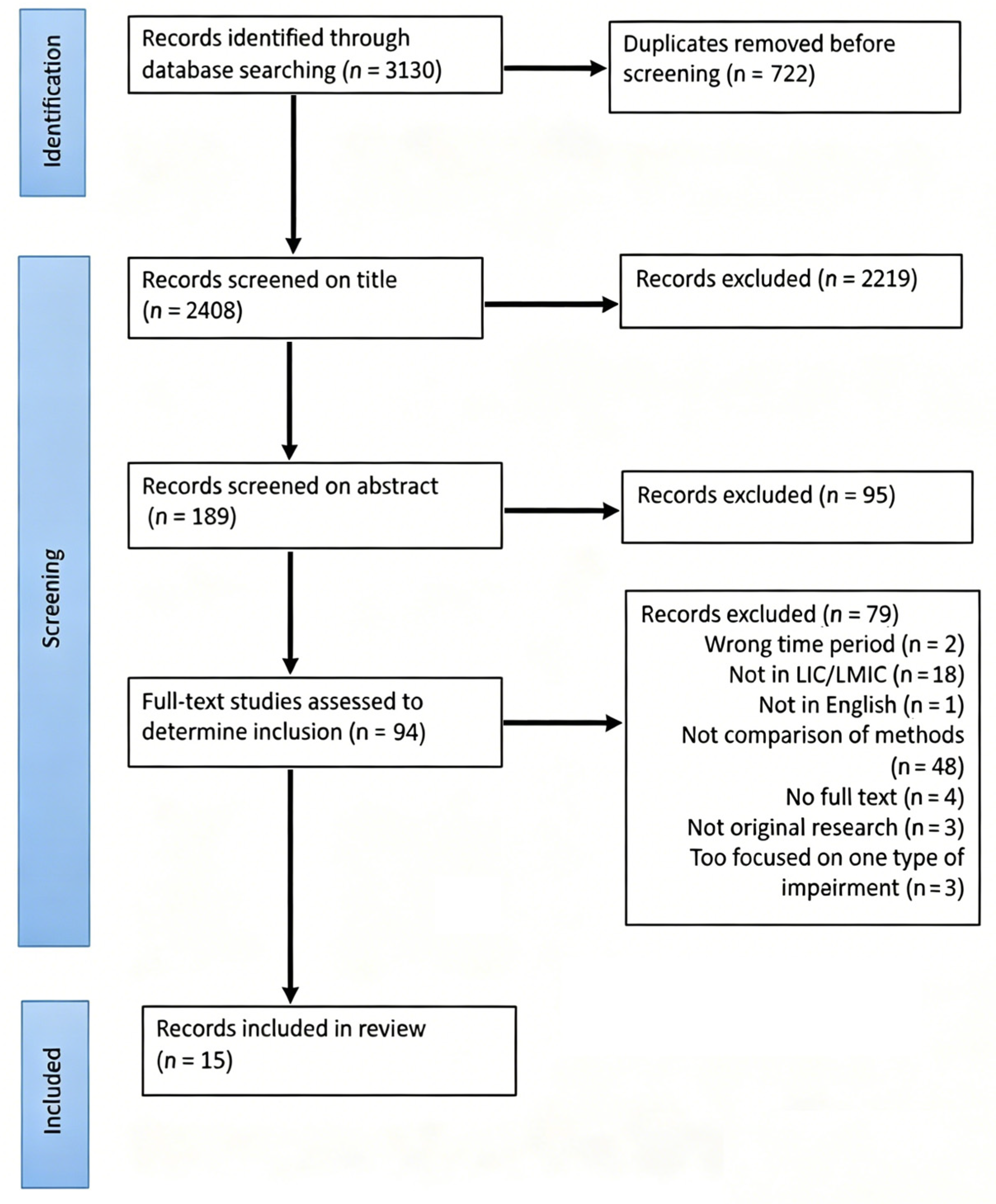
3.1. Studies Included
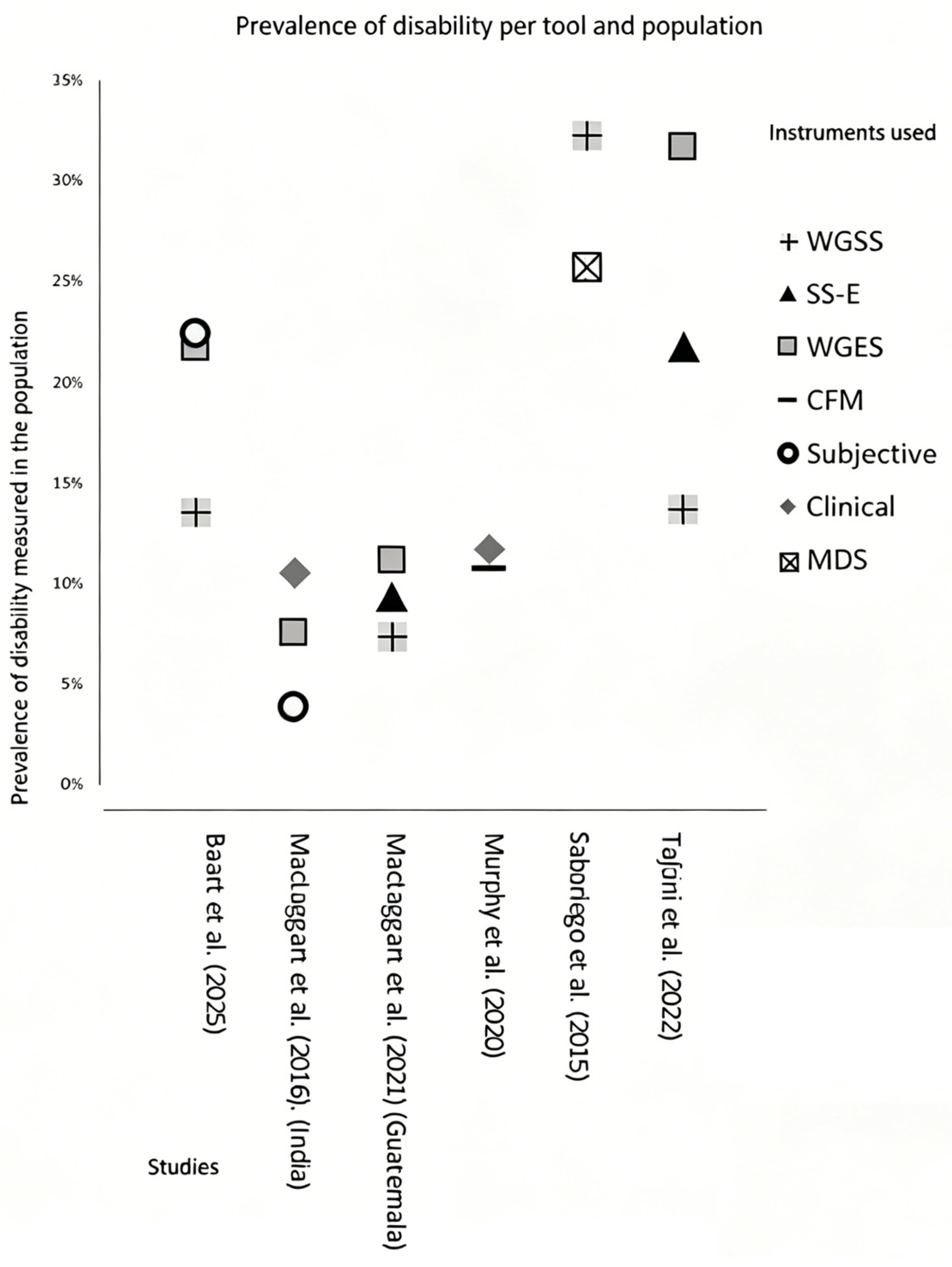
3.2. The Prevalence of Disability in the Population
3.3. Overlap in Disabled Populations Across Instruments
3.4. Clusters of Disability Identification Approaches
- Functioning approaches: Disability is understood as difficulties in performing everyday activities. These instruments ask respondents about limitations or difficulties in domains such as seeing, hearing, walking, remembering, or participation in the community. Examples include the Washington Group variations and the Model Disability Survey. Respondents report their own difficulties and can subsequently be placed on a spectrum ranging from no difficulties to severely disabled. The specific cut-off defining what counts as disabled depends on analyst-defined thresholds.
- Clinical approaches: Disability is defined as the presence of an impairment or diagnosis. These approaches rely on standardized medical or psychological tests (e.g., vision or hearing tests and cognitive screening instruments), which vary per (potential) diagnosis. Here, the authority to categorize lies with the external professional conducting the assessment.
- Subjective question approaches: Disability is treated as a matter of self-identity. Respondents are asked directly, for example, “Do you have a disability?” or “Are you limited by a long-standing health condition?” The categorization is based entirely on self-report, shaped by respondents’ own understandings of disability and the surrounding cultural or social context.
- Service-based approaches: Disability is conceptualized as eligibility for, need of, and/or use of disability-specific services and support. These approaches identify individuals through administrative data (e.g., use of assistive devices, enrolment in special education programs, and recipient of government grants) or through questions about support needs. The categorization authority rests with external systems or providers.
3.5. Cluster Characteristics
- Population captured: what is the population that is identified as disabled using this cluster of instruments?
- Who assesses: is the respondent themselves or is an external ‘expert’ responsible for the identification of said respondent as disabled?
- Level of analysis: is the instrument intended to identify disability within a specific individual or is it intended for use in population-level surveys?
- Ease of implementation: is the assessment simple, low-cost, and easy to execute?
- Policy relevance: is the information produced by these instruments useful for designing and implementing policies and programs?
- (Ethical) considerations: what questions and ethical considerations should be considered when deciding on the use of these instruments?
- Functioning instruments may reduce exclusion because they avoid stigmatizing language [16].
- Subjective questions may exclude those who do not (wish to) identify as disabled because of stigma or cultural understandings [26].
- Service-based approaches may omit individuals who are unable to access services or undercount those who function well in inclusive environments. Services are also dependent on policies and resourcing [29].
- Self-reported instruments risk over-reporting when financial incentives are involved [28].
4. Discussion
4.1. Implications
4.2. Limitations
5. Conclusions
Author Contributions
Funding
Institutional Review Board Statement
Informed Consent Statement
Data Availability Statement
Conflicts of Interest
Disability Language/Terminology Positionality Statement
Abbreviations
| CFM | Washington Group Child Functioning Module |
| LFS-DSM | Labor Force Survey Disability Module |
| LIC | Low-Income Countries |
| LMIC | Low and Lower-Middle Income Countries |
| LSN | Learning and Support Needs |
| MDAT | Malawi Development Assessment Tool |
| MDS | Model Disability Survey |
| NGO | Non-Governmental Organization |
| SDG | Sustainable Development Goals |
| SS-E | Washington Group Short Set Enhanced |
| UNCRPD | United Nations Convention on the Rights of Persons with Disabilities |
| WG | Washington Group |
| WGES | Washington Group Extended Set |
| WGSS | Washington Group Short Set |
Appendix A

| Instrument | Full Name | Developer | Short Description |
|---|---|---|---|
| WGSS | Washington Group Short Set | Washington Group on Disability Statistics | Six question sequence asking: Because of a health problem, do you have difficulty (1) seeing, (2) hearing, (3) walking or climbing steps, (4) remembering or concentrating, (5) with self-care such as washing all over or dressing or (6) communicating? Four possible responses follow each of the questions, namely: No, no difficulty; Yes, some difficulty; Yes, a lot of difficulty; Cannot do at all. |
| LFS-DM | Labor Force Disability Survey Module | Washington Group on Disability Statistics & International Labour Organization | WGSS as above, as well as 4 additional questions to cover anxiety and depression: How often do you feel worried, nervous or anxious? Thinking about the last time you felt worried, nervous or anxious, how would you describe the level of these feelings? How often do you feel depressed? Thinking about the last time you felt depressed, how depressed did you feel? Answer options for anxiety and depression include how often and the extent of the feelings. |
| SS-E | Washington Group Short Set Enhanced | Washington Group on Disability Statistics | Labor Force Survey Disability Module as above, plus 2 upper body function questions: Do you have difficulty raising a 2-liter bottle of water or soda from waist to eye level? Do you have difficulty using your hands and fingers, such as picking up small objects, for example, a button or pencil, or opening or closing containers or bottles? Answer options are the same as for WGSS. |
| WGES | Washington Group Extended Set | Washington Group on Disability Statistics | Questions as above, but additional five questions to cover pain and fatigue. Questions cover how often and if yes, how much pain and fatigue respondent has. |
| CFM | Child Functioning Module | Washington Group & UNICEF | Questionnaire on functioning in children, adapted to developmental stage. Includes 24 questions covering seeing, hearing, walking, self-care, speaking, learning, remembering, concentrating, behavior, socialization, and mood. Scoring as with the WGSS above. |
| MDAT | Malawi Development Assessment Tool | University of Liverpool | For use in children. Assesses four domains: (1) gross motor coordination (36 items), (2) fine motor coordination (36 items), (3) social (30 items), and (4) language (36 items), with 138 items in the published version of the tool. |
| n/a | Subjective question | n/a | Question: What type of disability would you say you have? Answer options were: Auditory, Intellectual, Physical, Visual, Speaking, or Multiple. |
| n/a | Two question set | UK office for National Statistics | 1. Do you have any long-standing illness, disability or infirmity? 2. Does this limit your activities in any way? |
| n/a | Tumbling E single optotype | n/a | Chart depicts E’s which get increasingly smaller. People need to describe the direction of the E. |
| n/a | Snellen chart | n/a | Similar to tumbling E, but consisting of a variety of capital letters becoming increasingly smaller. |
| n/a | Otoacoustic Emissions Testing | n/a | A specialized probe equipped with speakers and a microphone is placed in the ear canal, with the intent of picking up the sounds produced by the movement of outer hair cells. |
| RAM | Rapid Assessment of Musculoskeletal Impairment | Oxford University & International Centre for Evidence in Disability (ICED) | Six questions asking about misshapen body, difficulty using arms and legs or other parts of the body, need for mobility aids and convulsions or involuntary movement. If answering Yes to any question respondents is referred to clinical specialist for further examination. |
| MMSE | Mini Mental State Examination | MF Folstein | Brief neurophysiological test |
| RAAB | Rapid Assessment of Avoidable Blindness | International Centre for Eye Health, LSHTM | Population eye health survey that assesses prevalence and cause of vision impairment and blindness. |
| PHQ9 | Patient Health Questionnaire | K Kroenke, RL Spitzer and JB Williams | Three self-reported screening questions with a further six questions if screen is positive; measures frequency of depression. |
| n/a | Subjective question | Developed for one context | Question: “Do you consider yourself to have a disability?” |
| MDS | Model Disability Survey | World Health Organization and World Bank | 60–120 min interview, covering socio-demographic characteristics; work history and benefits; environmental factors; functioning; health conditions and capacity; health-care utilization; and satisfaction, personality and well-being. |
| 3RGPH | Subjective question | n/a | Question: “Has the person any chronic disease or any predominant handicap?” |
| ECAM3 | Subjective question | n/a | Question: “Is (Name) the victim of a handicap?” |
| DHS-MICS | Subjective question | Cameroonian DHS | Question set, asking whether respondents is missing a body part; missing an extremity; with deformed limbs; can hardly see; can hardly hear; has behavioral disorders. |
| LSN | Learning and Support Needs | Developed for one context | 3 questions: 1. “Compared with children of the same age, how much personal assistance at school does (child’s name) require with any of the following tasks? 2. “Are there any adaptations to learning or assessment that you currently make for (child’s name)? 3. “Is (child’s name) currently using any of the following types of assistive devices? |
| ICS | Intelligibility in Context Scale | McLeod, Harrison, & McCormack | Parent-completed questionnaire consisting of 7 items, to rate the degree to which children’s speech is understood by different communication partners on a 5-point scale. |
| CNTAB | Cambridge Neuropsychological Test Automated Battery | University of Cambridge | Battery of subtests, intended to assess cognitive function. |
Appendix B
| Purpose of Use | Functioning | Clinical | Subjective | Services |
|---|---|---|---|---|
| Population monitoring & cross-country comparison | Well-suited, can be low-cost depending on the instrument, widely applicable | Not suitable | Limited: prone to stigma/cultural bias | Not suitable (criteria vary) |
| Clinical care & intervention | Not suitable for diagnosis | Well suited for identifying health conditions | Not suitable | Not suitable |
| Self-identification & empowerment | Limited suitability: dependent on self-report | Not suitable | Well-suited, aligns with self-identification | Not suitable |
| Policy & administrative planning | Suitable for population level policy development and planning, not independent allocation | Limited: suitable for planning health services | Not suitable | Limited: suited where administrative data exist and criteria are transparent |
| In-depth analysis of functioning | Suitable at population level where it captures spectrum of disability and participation measures | Not suitable | Not suitable | Not suitable |
References
- Cote, A.; Banks, M. Global Disability Inclusion Report; UNICEF: New York, NY, USA, 2025. [Google Scholar]
- Duell-Piening, P. Refugee Displacement, Disability and Human Rights; The Production, Processing and Power of Data; Routledge: England, UK, 2025. [Google Scholar]
- O’Reilly, C.F.; Jagoe, C. Disaggregation of Humanitarian Data by Disability: A Realist Evaluation of the Use of the Washington Group Questions to Support More Inclusive Practices. J. Int. Humanit. Action 2024, 9, 6. [Google Scholar] [CrossRef] [Scilit]
- Robinson, A.; Nguyen, L.; Smith, F. Use of the Washington Group Questions in Non-Government Programming. Int. J. Environ. Res. Public Health 2021, 18, 11143. [Google Scholar] [CrossRef] [Scilit]
- Global Disability Summit. Amman-Berlin Declaration on Global Disability Inclusion. 2025. Available online: https://www.globaldisabilitysummit.org/resource/amman-berlin-declaration/.
- Cockburn, L.; Roberts, J.; Lee, S.; Nganji, J.; Ho, N.C.W.; Kuntjoro, A.; Mbibeh, L.; Sikapa, L.; Animbom, P.N.; Fru, S.; et al. Considerations When Asking about “Disability” in Disability Inclusive Research. Disabil. Rehabil. 2024, 46, 5114–5133. [Google Scholar] [CrossRef] [Scilit]
- Goujon, N.; Devine, A.; Baker, S.M.; Sprunt, B.; Edmonds, T.J.; Booth, J.K.; Keeffe, J.E. A Comparative Review of Measurement Instruments to Inform and Evaluate Effectiveness of Disability Inclusive Development. Disabil. Rehabil. 2014, 36, 804–812. [Google Scholar] [CrossRef] [Scilit] [PubMed]
- Kuper, H.; Davey, C.; Banks, L.M.; Shakespeare, T. Trials and Tribulations of Collecting Evidence on Effectiveness in Disability-Inclusive Development: A Narrative Review. Sustainability 2020, 12, 7823. [Google Scholar] [CrossRef] [Scilit]
- Amilon, A.; Christensen, M.L. Changing Disability Status and Changes in Health, Participation Restrictions and Activity Limitations in Denmark: Does the Choice of Measure Matter? Scand. J. Disabil. Res. 2025, 27, 15–29. [Google Scholar] [CrossRef] [Scilit]
- Bourke, J.A.; Nichols-Dunsmuir, A.; Begg, A.; Dong, H.; Schluter, P.J. Measuring Disability: An Agreement Study between Two Disability Measures. Disabil. Health J. 2021, 14, 100995. [Google Scholar] [CrossRef] [Scilit]
- Landes, S.D.; Hall, J.P.; Swenor, B.K.; Vaitsiakhovich, N. Comparative Performance of Disability Measures. PLoS ONE 2025, 20, e0318745. [Google Scholar] [CrossRef] [Scilit]
- Shogren, K.A.; Pace, J.R.; Wittenburg, D.C.; Raley, S.K.; Hicks, T.A.; Rifenbark, G.G.; Lane, K.L.; Anderson, M.H. Self-Report and Administrative Data on Disability and IEP Status: Examining Differences and Impacts on Intervention Outcomes. J. Disabil. Policy Stud. 2022, 33, 253–266. [Google Scholar] [CrossRef] [Scilit]
- World Health Organization; World Bank. World Report on Disability; World Health Organization: Geneva, Switzerland, 2011. [Google Scholar]
- World Bank. World Bank Country and Lending Groups. Available online: https://datahelpdesk.worldbank.org/knowledgebase/articles/906519-world-bank-country-and-lending-groups (accessed on 22 April 2025).
- Ouzzani, M.; Hammady, H.; Fedorowicz, Z.; Elmagarmid, A. Rayyan—A web and mobile app for systematic reviews. Syst. Rev. 2016, 5, 210. [Google Scholar] [CrossRef] [Scilit]
- Baart, J.; Elbers, W.; Schippers, A.; Polack, S. The Definition Dilemma: How Definitions of Disability Shape Statistics on Social Participation. Int. J. Environ. Res. Public Health 2025, 22, 603. [Google Scholar] [CrossRef] [Scilit]
- Baart, J.; Elbers, W.; Schippers, A. Who Is Disabled? On Whether the Functional Definition of Disability Targets the Same Individuals as the Subjective Definition. Front. Sustain. 2023, 4, 1163128. [Google Scholar] [CrossRef] [Scilit]
- Boggs, D.; Kuper, H.; Mactaggart, I.; Bright, T.; Murthy, G.; Hydara, A.; McCormick, I.; Tamblay, N.; Alvarez, M.L.; Atijosan-Ayodele, O.; et al. Exploring the Use of Washington Group Questions to Identify People with Clinical Impairments Who Need Services Including Assistive Products: Results from Five Population-Based Surveys. Int. J. Environ. Res. Public Health 2022, 19, 4304. [Google Scholar] [CrossRef] [Scilit]
- Dunne, T.F.; Chandna, J.; Majo, F.; Tavengwa, N.; Mutasa, B.; Chasekwa, B.; Ntozini, R.; Prendergast, A.J.; Humphrey, J.H.; Gladstone, M.J. Performance of the UNICEF/UN Washington Group Tool for Identifying Functional Difficulty in Rural Zimbabwean Children. PLoS ONE 2022, 17, e0274664. [Google Scholar] [CrossRef] [Scilit]
- Emerson, E.; Llewellyn, G. The Prevalence of Disability among Adolescents and Young Adults in Low and Middle-Income Countries: A Cross-Sectional Comparison of Two Measures. Disabil. Health J. 2025, 18, 101777. [Google Scholar] [CrossRef] [Scilit]
- Mactaggart, I.; Kuper, H.; Murthy, G.V.S.; Oye, J.; Polack, S. Measuring Disability in Population Based Surveys: The Interrelationship between Clinical Impairments and Reported Functional Limitations in Cameroon and India. PLoS ONE 2016, 11, e0164470. [Google Scholar] [CrossRef] [Scilit]
- Mactaggart, I.; Bek, A.H.; Banks, L.M.; Bright, T.; Dionicio, C.; Hameed, S.; Neupane, S.; Murthy, G.V.S.; Orucu, A.; Oye, J.; et al. Interrogating and Reflecting on Disability Prevalence Data Collected Using the Washington Group Tools: Results from Population-Based Surveys in Cameroon, Guatemala, India, Maldives, Nepal, Turkey and Vanuatu. Int. J. Environ. Res. Public Health 2021, 18, 9213. [Google Scholar] [CrossRef] [Scilit]
- Mörchen, M.; Zambrano, O.; Páez, A.; Salgado, P.; Penniecook, J.; von Lindau, A.B.; Lewis, D. Disability-Disaggregated Data Collection: Hospital-Based Application of the Washington Group Questions in an Eye Hospital in Paraguay. Int. J. Environ. Res. Public Health 2019, 16, 3085. [Google Scholar] [CrossRef] [Scilit] [PubMed]
- Murphy, R.; Jolley, E.; Lynch, P.; Mankhwazi, M.; Mbukwa, J.; Bechange, S.; Gladstone, M.J.; Schmidt, E. Estimated Prevalence of Disability and Developmental Delay among Preschool Children in Rural Malawi: Findings from “Tikule Limodzi,” a Cross-Sectional Survey. Child Care Health Dev. 2020, 46, 187–194. [Google Scholar] [CrossRef] [Scilit] [PubMed]
- Sabariego, C.; Oberhauser, C.; Posarac, A.; Bickenbach, J.; Kostanjsek, N.; Chatterji, S.; Officer, A.; Coenen, M.; Chhan, L.; Cieza, A. Measuring Disability: Comparing the Impact of Two Data Collection Approaches on Disability Rates. Int. J. Environ. Res. Public Health 2015, 12, 10329–10351. [Google Scholar] [CrossRef] [Scilit]
- Simo Fotso, A.; Duthé, G.; Odimegwu, C. A Comparative Analysis of Disability Measures in Cameroonian Surveys. Popul. Health Metr. 2019, 17, 16. [Google Scholar] [CrossRef] [Scilit] [PubMed]
- Sprunt, B.; Hoq, M.; Sharma, U.; Marella, M. Validating the UNICEF/Washington Group Child Functioning Module for Fijian Schools to Identify Seeing, Hearing and Walking Difficulties. Disabil. Rehabil. 2017, 41, 201–211. [Google Scholar] [CrossRef] [Scilit] [PubMed]
- Sprunt, B.; McPake, B.; Marella, M. The UNICEF/Washington Group Child Functioning Module—Accuracy, Inter-Rater Reliability and Cut-off Level for Disability Disaggregation of Fiji’s Education Management Information System. Int. J. Environ. Res. Public Health 2019, 16, 806. [Google Scholar] [CrossRef] [Scilit]
- Sprunt, B.; Marella, M. Combining Child Functioning Data with Learning and Support Needs Data to Create Disability-Identification Algorithms in Fiji’s Education-Management Information System. Int. J. Environ. Res. Public Health 2021, 18, 9413. [Google Scholar] [CrossRef] [Scilit]
- Tofani, M.; Galeoto, G.; Berardi, A.; Iorio, S.; Conte, A.; Fabbrini, G.; Valente, D.; Marceca, M. Measuring Disability among Migrants with Washington Group Tools: Reflections for Field Use. Healthcare 2022, 10, 1860. [Google Scholar] [CrossRef] [Scilit]
- Pettinicchio, D.; Maroto, M. Who Counts? Measuring Disability Cross-Nationally in Census Data. J. Surv. Stat. Methodol. 2021, 9, 257–284. [Google Scholar] [CrossRef] [Scilit]
- Molden, T.H.; Tøssebro, J. Disability Measurements: Impact on Research Results. Scand. J. Disabil. Res. 2012, 14, 340–357. [Google Scholar] [CrossRef] [Scilit]
- The Washington Group on Disability Statistics. Frequently Asked Questions. Available online: https://www.washingtongroup-disability.com/resources/frequently-asked-questions/ (accessed on 17 July 2025).
- Amilon, A.; Hansen, K.M.; Kjær, A.A.; Steffensen, T. Estimating Disability Prevalence and Disability-Related Inequalities: Does the Choice of Measure Matter? Soc. Sci. Med. 2021, 272, 113740. [Google Scholar] [CrossRef] [Scilit]
- Lauer, E.A.; Henly, M.; Coleman, R. Comparing Estimates of Disability Prevalence Using Federal and International Disability Measures in National Surveillance. Disabil. Health J. 2019, 12, 195–202. [Google Scholar] [CrossRef] [Scilit]
- Jamieson, M.K.; Govaart, G.H.; Pownall, M. Reflexivity in Quantitative Research: A Rationale and Beginner’s Guide. Soc. Personal. Psychol. Compass 2023, 17, e12735. [Google Scholar] [CrossRef] [Scilit]
- Bowker, G.C.; Leigh Star, S. Sorting Things Out: Classification and Its Consequences; MIT Press: Cambridge, MA, USA, 1999. [Google Scholar]
- Bennani, H. From Experiences to Numbers: The Production of International Disability Statistics. Disabil. Soc. 2024, 39, 1859–1883. [Google Scholar] [CrossRef] [Scilit]
- Chataika, T.; McKenzie, J.A. Global Institutions and Their Engagement with Disability Mainstreaming in the South: Development and (Dis)Connections. In Disability in the Global South: The Critical Handbook; Grech, S., Soldatic, K., Eds.; Springer: Cham, Switzerland, 2016. [Google Scholar]
- Roy, A. Decolonizing Disability Studies: Identities, Epistemologies and Global South Perspectives. Creat. Launcher 2024, 9, 70–81. [Google Scholar] [CrossRef] [Scilit]
- Goodley, D.; Lawthom, R.; Liddiard, K.; Runswick-Cole, K. Key Concerns for Critical Disability Studies. Int. J. Disabil. Soc. Justice 2021, 1, 27–49. [Google Scholar] [CrossRef] [Scilit]
- Hickey-Moody, A.; Garg, D. Disability, Intersectionality and Decolonial Perspectives from the Global South. In The Routledge International Handbook of Critical Disability Studies; Ellis, K., Kent, M., Cousins, K., Eds.; Routledge: England, UK, 2025. [Google Scholar]
- Mupoperi, M.W. Challenging Knowledge Production in Disability Issues from the Global North to the Global South. Glob. Sci. J. 2021, 9, 1380–1387. [Google Scholar]
- Rao, S.; Kalyanpur, M. Universal Notions of Development and Disability: Towards Whose Imagined Vision? Disabil. Glob. South 2020, 7, 1830–1851. [Google Scholar]
- Grech, S.; Soldatic, K. (Eds.) Disability in the Global South: The Critical Handbook; Springer International Publishing: Cham, Switzerland, 2016. [Google Scholar] [CrossRef] [Scilit]
- Grischow, J.; Naami, A.; Mprah, W.; Mfoafo-M’carthy, M. Methodologically Thinking: Doing Disability Research in Ghanaian Cultural Communities. Scand. J. Disabil. Res. 2021, 23, 169–179. [Google Scholar] [CrossRef] [Scilit]
- Meekosha, H.; Soldatic, K. Human Rights and the Global South: The Case of Disability. Third World Q. 2011, 32, 1383–1397. [Google Scholar] [CrossRef] [Scilit]
- Ghosh, N.; Bhaduri, S. Categorizing Disability: Perspectives from West Bengal, India. Rev. Disabil. Stud. Int. J. 2024, 19, 1–33. [Google Scholar]

| # | Search Strategy | Database |
|---|---|---|
| 1 | disability AND measure AND Washington Group | WorldCat, Scopus, Google Scholar |
| 2 | measuring AND disability AND inclusion | WorldCat, Scopus |
| 3 | measur* AND impairment AND WGSS | WorldCat, Scopus |
| 4 | disability data AND WGSS | WorldCat, Scopus, Web of Science |
| 5 | disability data AND Washington Group | WorldCat, Scopus, Web of Science |
| 6 | washington AND group AND measur* AND impairment | Scopus |
| 7 | disability AND measure AND direct AND question | Scopus |
| 8 | uncrpd AND data disability | Scopus, Web of Science |
| 9 | sdg AND data AND disability AND method | Scopus |
| 10 | disability data AND LMIC | Web of Science, Google Scholar |
| 11 | washington group AND measur* AND impairment | Web of Science |
| 12 | disability AND measure AND direct question | Web of Science, Google Scholar |
| 13 | Searched entire database | International Centre for Evidence in Disability |
| 14 | categoris* AND disability | Scopus |
| 15 | categor* AND disabil* | Scopus |
| 16 | clinical AND washington AND group | Scopus |
| 17 | disability AND classification AND method | Google Scholar |
| # | Author(s) (Year) | Location of Study | Study Population | Disability Identification Instruments Used |
|---|---|---|---|---|
| 1 | Baart et al. (2025) [16] | Turkey | 1555 adult Syrian refugees in Istanbul |
|
| 2 | Baart et al. (2023) [17] | Cambodia | 422 respondents aged 4–91 |
|
| 3 | Boggs et al. (2022) [18] | The Gambia, Cameroon, Chile, India and Turkey | Children (Cameroon, India, Turkey), adults 35+ (The Gambia) and adults 50+ (Chile). |
|
| 4 | Dunne et al. (2022) [19] | Zimbabwe | 1920 children aged 24 months |
|
| 5 | Emerson & Llewellyn (2025) [20] | 40 LMICs | 45,370 adolescents (15–17 yrs) and 178,689 young adults (18–25 yrs) |
|
| 6 | Mactaggart et al. (2016) [21] | Cameroon and India | Population-based survey of 3567 people in India and 3574 people in Cameroon |
|
| 7 | Mactaggart et al. (2021) [22] | Cameroon, Guatemala, India, Maldives, Nepal, Turkey and Vanuatu | 53,000 adults from 7 countries |
|
| 8 | Mörchen et al. (2019) [23] | Paraguay | 999 patients visiting a rural satellite eye hospital |
|
| 9 | Murphy et al. (2020) [24] | Malawi | 960 children attending preschool centers in Thyolo district |
|
| 10 | Sabariego et al. (2015) [25] | Cambodia | Convenience sample of 500 adults in Kampong Thom and Kampot provinces |
|
| 11 | Simo Fotso et al. (2019) [26] | Cameroon | Secondary analysis of four census datasets |
|
| 12 | Sprunt et al. (2017) [27] | Fiji | 472 children aged 5–15 from special and mainstream schools |
|
| 13 | Sprunt et al. (2019) [28] | Fiji | 472 children aged 5–15 from special and mainstream schools |
|
| 14 | Sprunt & Marella (2021) [29] | Fiji | 472 children aged 5–15 years special and mainstream schools |
|
| 15 | Tofani et al. (2022) [30] | Italy | 161 adult migrants |
|
| Cluster | Population Captured | Who Assesses | Level of Analysis | Ease of Implementation | Policy Relevance | (Ethical) Considerations |
|---|---|---|---|---|---|---|
| Functioning | Respondents who state they have difficulties functioning in certain life areas. | External | Population |
|
|
|
| Clinical | Respondents who have a measurable impairment as assessed by the specific test undertaken. | External | Individual |
|
|
|
| Subjective | Respondents who identify themselves with the term ‘disability’ | Respondent | Individual |
|
|
|
| Services | Respondents who are already receiving services intended for persons with disabilities or who are identified as needing those services. | External | Individual |
|
|
|
| Cluster | Use When… | Do Not Use When… |
|---|---|---|
| Functioning |
|
|
| Clinical |
|
|
| Subjective question |
|
|
| Services |
|
|
Disclaimer/Publisher’s Note: The statements, opinions and data contained in all publications are solely those of the individual author(s) and contributor(s) and not of MDPI and/or the editor(s). MDPI and/or the editor(s) disclaim responsibility for any injury to people or property resulting from any ideas, methods, instructions or products referred to in the content. |
© 2026 by the authors. Licensee MDPI, Basel, Switzerland. This article is an open access article distributed under the terms and conditions of the Creative Commons Attribution (CC BY) license.
Share and Cite
Baart, J.; Elbers, W. Disability Identification Instruments in Low- and Lower-Middle-Income Countries: A Literature Review of Prevalence, Populations, and Characteristics. Disabilities 2026, 6, 39. https://doi.org/10.3390/disabilities6020039
Baart J, Elbers W. Disability Identification Instruments in Low- and Lower-Middle-Income Countries: A Literature Review of Prevalence, Populations, and Characteristics. Disabilities. 2026; 6(2):39. https://doi.org/10.3390/disabilities6020039
Chicago/Turabian StyleBaart, Judith, and Willem Elbers. 2026. "Disability Identification Instruments in Low- and Lower-Middle-Income Countries: A Literature Review of Prevalence, Populations, and Characteristics" Disabilities 6, no. 2: 39. https://doi.org/10.3390/disabilities6020039
APA StyleBaart, J., & Elbers, W. (2026). Disability Identification Instruments in Low- and Lower-Middle-Income Countries: A Literature Review of Prevalence, Populations, and Characteristics. Disabilities, 6(2), 39. https://doi.org/10.3390/disabilities6020039