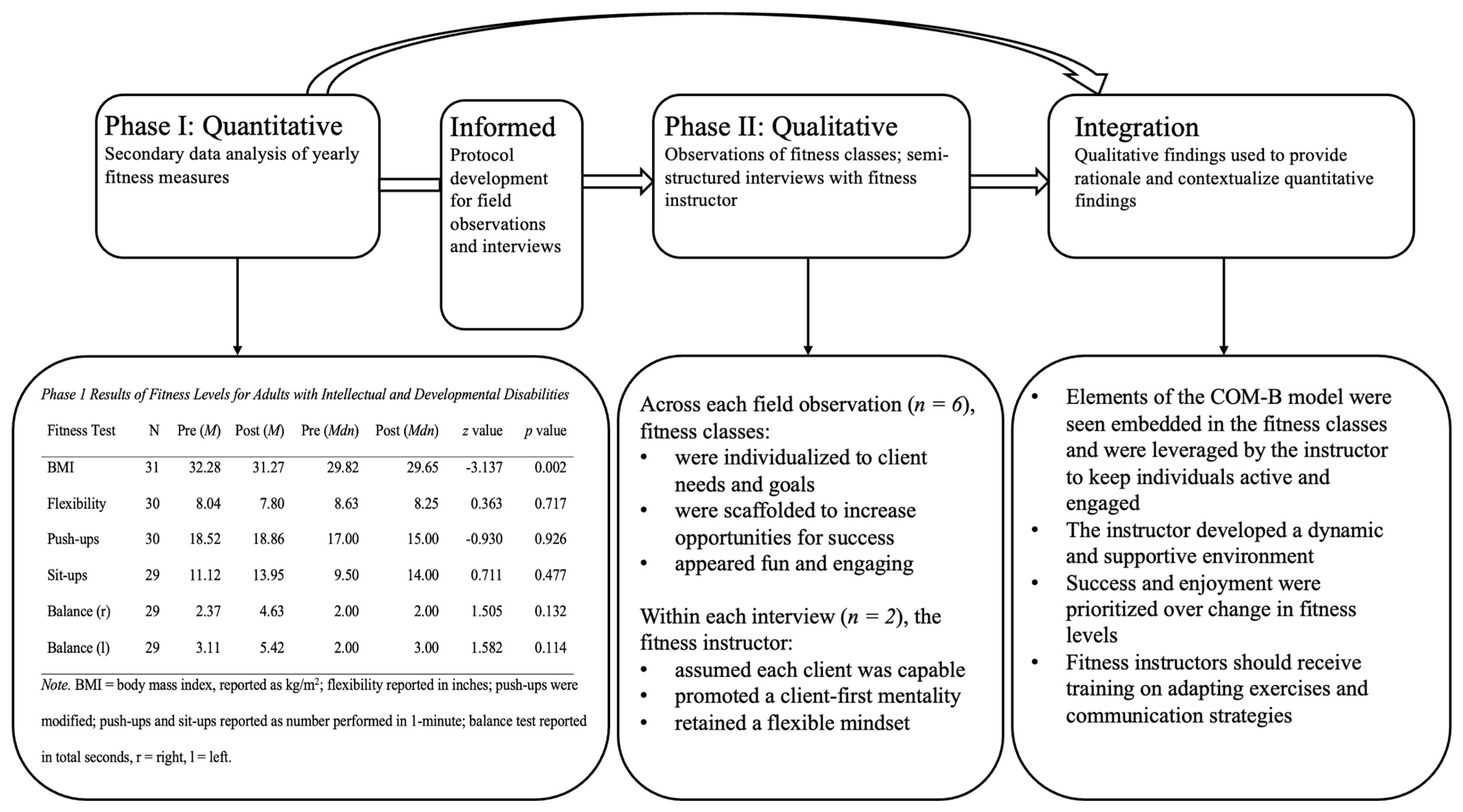



A Mixed Methods Analysis of an Adapted Fitness Program for Adults with Intellectual and Developmental Disabilities

Abstract
1. Introduction
- How do fitness outcomes, such as strength and flexibility, differ before and after a twelve-month enrollment in a fitness program for adults with intellectual and developmental disabilities?
- How does the fitness instructor determine and prioritize program goals?
- What instructional practices does the fitness instructor implement that can potentially influence the capability, opportunity, and motivation of adult clients with intellectual and developmental disabilities?
2. Materials and Methods
2.1. Setting and Participants
2.2. Phase One
2.2.1. Quantitative Data Collection
2.2.2. Data Analysis
2.2.3. Data Integration
2.3. Phase Two
2.3.1. Qualitative Data Collection
Field Observations
Semi-Structured Interviews
2.3.2. Data Analysis
2.4. Research Team Positionality
2.5. Credibility and Trustworthiness
3. Results
3.1. Fitness Performance Outcomes
3.2. Program Goals and Instructional Strategies
3.2.1. Fitness Program Goals
A lot of our clients say things like, ‘I want to go to college’, or ‘I want to do all these things’, and if they express that, then I see it as my job to do everything I can to help make it happen. One of our guys said the other day, ‘I want to become a wrestler.’ And I thought, who am I to say no to that? If that’s what he wants, then okay, let’s start lifting weights. I’ll start treating this like you’re training to be a wrestler. Cool, let’s go. Honestly, when someone tells me I can’t do something, it just fuels me even more. That’s when I go 150%.
3.2.2. Instructional Strategies
Strategies Promoting Capability
Um, the fitness world has always really just been my comfort zone. The teaching route, like I said, I was really excited about it. Of course, I’ll be completely honest, I just did not necessarily like, what the school systems were doing. And so I was like, well, I’d rather teach and instruct and pass on what I know, as far as the fitness world I can control. And that’s kind of fitness gives you the freedom to not only just obviously exercise, but then you can really, really teach kind of how you want to kind of follow your own mold and following your own path. And, um, you know, you know, that kind of thing. So, it just gave me a lot of freedom, and which I really did not see in the school system, unfortunately. So not to knock any teachers not to knock any school systems and any ISDs or anything like that. Just it just wasn’t a good fit for me.
Strategies Promoting Opportunity
Strategies Promoting Motivation
4. Discussion
4.1. Fitness Outcomes and Program Goals
4.2. Instructional Approaches
4.3. Implications for Practice
4.4. Limitations and Future Research Directions
5. Conclusions
Author Contributions
Funding
Institutional Review Board Statement
Informed Consent Statement
Data Availability Statement
Acknowledgments
Conflicts of Interest
Disability Language/Terminology Positionality Statement
Abbreviations
| BMI | Body Mass Index |
| COM-B | Capability, Opportunity, Motivation-Behavior |
References
- Physical Activity Guidelines Advisory Committee. 2018 Physical Activity Guidelines Advisory Committee Scientific Report; US Department of Health and Human Services: Rockville, MD, USA, 2018.
- Dairo, Y.M.; Collett, J.; Dawes, H.; Oskrochi, G.R. Physical activity levels in adults with intellectual disabilities: A systematic review. Prev. Med. Rep. 2016, 4, 209–219. [Google Scholar] [CrossRef] [PubMed]
- Stancliffe, R.J.; Anderson, L.L. Factors associated with meeting physical activity guidelines by adults with intellectual and developmental disabilities. Res. Dev. Disabil. 2017, 62, 1–14. [Google Scholar] [CrossRef] [PubMed]
- Oppewal, A.; Hilgenkamp, T.I.; Van Wijck, R.; Evenhuis, H.M. Cardiorespiratory fitness in individuals with intellectual disabilities: A review. Res. Dev. Disabil. 2013, 34, 3301–3316. [Google Scholar] [CrossRef]
- Graham, A.; Reid, G. Physical fitness of adults with an intellectual disability: A 13-year follow-up study. Res. Q. Exerc. Sport 2000, 71, 152–161. [Google Scholar] [CrossRef]
- Zghal, F.; Borji, R.; Colson, S.S.; Sahli, S.; Rebai, H. Neuromuscular characteristics in trained vs. sedentary male adults with intellectual disability. J. Intellect. Disabil. Res. 2019, 63, 1334–1345. [Google Scholar] [CrossRef] [PubMed]
- Bergström, H.; Hagströmer, M.; Hagberg, J.; Elinder, L.S. A multi-component universal intervention to improve diet and physical activity among adults with intellectual disabilities in community residences: A cluster randomised controlled trial. Res. Dev. Disabil. 2013, 34, 3847–3857. [Google Scholar] [CrossRef]
- Hildebrandt, V.H.; Chorus, A.M.J.; Stubbe, J.H. Trend Report on Physical Activity and Health 2008/2009; TNO Innovation for Life: Leiden, The Netherlands, 2010. [Google Scholar]
- Lynch, L.; McCarron, M.; Eustace-Cook, J.; Burke, É.; McCallion, P. Physical health effects of sedentary behaviour on adults with an intellectual disability: A scoping review. J. Intellect. Disabil. 2025, 29, 167–193. [Google Scholar] [CrossRef] [PubMed]
- Sutherland, G.; Couch, M.A.; Iacono, T. Health issues for adults with developmental disability. Res. Dev. Disabil. 2002, 23, 422–445. [Google Scholar] [CrossRef] [PubMed]
- Bossink, L.W.; van der Putten, A.A.; Vlaskamp, C. Understanding low levels of physical activity in people with intellectual disabilities: A systematic review to identify barriers and facilitators. Res. Dev. Disabil. 2017, 68, 95–110. [Google Scholar] [CrossRef] [PubMed]
- Eisenberg, Y.; Vanderbom, K.A.; Vasudevan, V. Does the built environment moderate the relationship between having a disability and lower levels of physical activity? A systematic review. Prev. Med. 2017, 95, S75–S84. [Google Scholar] [CrossRef]
- Dixon-Ibarra, A.; Nery-Hurwit, M.; Driver, S.; MacDonald, M. Using health promotion guidelines for persons with disabilities to develop and evaluate a physical activity program for individuals with multiple sclerosis: A feasibility study. Eval. Program Plan. 2017, 61, 150–159. [Google Scholar] [CrossRef] [PubMed]
- Martin, J.J. Benefits and barriers to physical activity for individuals with disabilities: A social-relational model of disability perspective. Disabil. Rehabil. 2013, 35, 2030–2037. [Google Scholar] [CrossRef] [PubMed]
- Calder, A.; Sole, G.; Mulligan, H. The accessibility of fitness centers for people with disabilities: A systematic review. Disabil. Health J. 2018, 11, 525–536. [Google Scholar] [CrossRef] [PubMed]
- Boer, P.H.; Meeus, M.; Terblanche, E.; Rombaut, L.; Wandele, I.D.; Hermans, L.; Gysel, T.; Ruige, J.; Calders, P. The influence of sprint interval training on body composition, physical and metabolic fitness in adolescents and young adults with ID: A randomized controlled trial. Clin. Rehabil. 2014, 28, 221–231. [Google Scholar] [CrossRef] [PubMed]
- Lotan, M.; Yalon-Chamovitz, S.; Weiss, P.L.T. Improving physical fitness of individuals with intellectual and developmental disability through a virtual reality intervention program. Res. Dev. Disabil. 2009, 30, 229–239. [Google Scholar] [CrossRef] [PubMed]
- Shields, N.; Taylor, N.F.; Wee, E.; Wollersheim, D.; O’Shea, S.D.; Fernhall, B. A community-based strength training programme increases muscle strength and physical activity in young people with Down syndrome: A randomised controlled trial. Res. Dev. Disabil. 2013, 34, 4385–4394. [Google Scholar] [CrossRef]
- Savage, M.N.; Colombo-Dougovito, A.M. Capabilities, opportunities, and motivation: Exploring fitness program experiences of adults with intellectual and developmental disabilities. Int. J. Environ. Res. Public Health 2023, 20, 5771. [Google Scholar] [CrossRef]
- Bartlo, P.; Klein, P.J. Physical activity benefits and needs in adults with intellectual disabilities: Systematic review of the literature. Am. J. Intellect. Dev. Disabil. 2011, 116, 220–232. [Google Scholar] [CrossRef] [PubMed]
- Obrusnikova, I.; Firkin, C.J.; Cavalier, A.R.; Suminski, R.R. Effects of resistance training interventions on muscular strength in adults with intellectual disability: A systematic review and meta-analysis. Disabil. Rehabil. 2022, 44, 4549–4562. [Google Scholar]
- Bouzas, S.; Martínez-Lemos, R.I.; Ayán, C. Effects of exercise on the physical fitness level of adults with intellectual disability: A systematic review. Disabil. Rehabil. 2019, 41, 3118–3140. [Google Scholar] [CrossRef] [PubMed]
- Chueh, T.Y.; Wu, J.H.; Hung, W.K.; Pan, C.C.; Chou, C.C.; Huang, C.J.; Wu, C.T. The effects of single bouts of physical activity on cognition in adolescents and young adults with intellectual disabilities: A systematic review. J. Appl. Res. Intellect. Disabil. 2025, 38, e70026. [Google Scholar] [CrossRef]
- Michie, S.; Van Stralen, M.M.; West, R. The behaviour change wheel: A new method for characterising and designing behaviour change interventions. Implement. Sci. 2011, 6, 42. [Google Scholar] [CrossRef]
- Mahy, J.; Shields, N.; Taylor, N.F.; Dodd, K.J. Identifying facilitators and barriers to physical activity for adults with down syndrome. J. Intellect. Disabil. Res. 2010, 54, 795–805. [Google Scholar] [CrossRef] [PubMed]
- West, R.; Michie, S. A brief introduction to the COM-B Model of behaviour and the PRIME Theory of motivation [v1]. Qeios 2020, 2. [Google Scholar] [CrossRef]
- Rimmer, J.H.; Braddock, D. Health promotion for people with physical, cognitive, and sensory disabilities: An emerging national priority. Am. J. Health Promot. 2002, 16, 220–224. [Google Scholar] [CrossRef] [PubMed]
- Creswell, J.W.; Plano Clark, V.L.; Gutmann, M.; Hanson, W. Advanced mixed methods research designs. In Handbook on Mixed Methods in the Behavioral and Social Sciences; Tashakkori, A., Teddlie, C., Eds.; Sage: Thousand Oaks, CA, USA, 2003; pp. 209–240. [Google Scholar]
- Ivankova, N.V.; Creswell, J.W.; Stick, S.L. Using mixed-methods sequential explanatory design: From theory to practice. Field Methods 2006, 18, 3–20. [Google Scholar] [CrossRef]
- Creswell, J.W.; Plano Clark, V.L. Designing and Conducting Mixed Methods Research, 3rd ed.; SAGE Publications: Thousand Oaks, CA, USA, 2017. [Google Scholar]
- Bradley, E.H.; Curry, L.A.; Ramanadhan, S.; Rowe, L.; Nembhard, I.M.; Krumholz, H.M. Research in action: Using positive deviance to improve quality of health care. Implement. Sci. 2009, 4, 25. [Google Scholar] [CrossRef]
- Morgan, D.L. Integrating Qualitative and Quantitative Methods: A Pragmatic Approach; Sage: Thousand Oaks, CA, USA, 2014. [Google Scholar]
- Morse, J.M. Approaches to qualitative-quantitative methodological triangulation. Nurs. Res. 1991, 40, 120–123. [Google Scholar] [CrossRef] [PubMed]
- Divine, G.; Norton, H.J.; Hunt, R.; Dienemann, J. A review of analysis and sample size calculation considerations for Wilcoxon tests. Anesth. Analg. 2013, 117, 699–710. [Google Scholar] [CrossRef] [PubMed]
- Braun, V.; Clarke, V. Using thematic analysis in psychology. Qual. Res. Psychol. 2006, 3, 77–101. [Google Scholar] [CrossRef]
- VERBI Software. MAXQDA, version 24; VERBI Software: Berlin, Germany, 2025. Available online: https://www.maxqda.com (accessed on 1 February 2025).
- Levitt, H.M.; Motulsky, S.L.; Wertz, F.J.; Morrow, S.L.; Ponterotto, J.G. Recommendations for designing and reviewing qualitative research in psychology: Promoting methodological integrity. Qual. Psychol. 2017, 4, 2–22. [Google Scholar] [CrossRef]
- Ryan, J.; McCallion, P.; McCarron, M.; Luus, R.; Burke, E.A. Overweight/obesity and chronic health conditions in older people with intellectual disability in Ireland. J. Intellect. Disabil. Res. 2021, 65, 1097–1109. [Google Scholar] [CrossRef] [PubMed]
- Perkoski, V.; Shotwell, M.; Chatto, C.; Chandler, J. Pushing forward: Understanding physical activity in adults with medical complexity. Health Care Transit. 2025, 3, 100102. [Google Scholar] [CrossRef]
- Hassan, N.M.; Landorf, K.B.; Shields, N.; Munteanu, S.E. Effectiveness of interventions to increase physical activity in individuals with intellectual disabilities: A systematic review of randomised controlled trials. J. Intellect. Disabil. Res. 2019, 63, 168–191. [Google Scholar] [CrossRef] [PubMed]
- Carey, E.; Ryan, R.; Sheikhi, A.; Dore, L. Exercising autonomy: The effectiveness and meaningfulness of autonomy support interventions engaged by adults with intellectual disability. A mixed-methods review. Br. J. Learn. Disabil. 2023, 51, 307–323. [Google Scholar] [CrossRef]
- Michalsen, H.; Wangberg, S.C.; Anke, A.; Hartvigsen, G.; Jaccheri, L.; Arntzen, C. Family members and health care workers’ perspectives on motivational factors of participation in physical activity for people with intellectual disability: A qualitative study. J. Intellect. Disabil. Res. 2020, 64, 259–270. [Google Scholar] [CrossRef] [PubMed]
- Bodde, A.E.; Seo, D.C. A review of social and environmental barriers to physical activity for adults with intellectual disabilities. Disabil. Health J. 2009, 2, 57–66. [Google Scholar] [CrossRef] [PubMed]


| Characteristic | Adults with Intellectual and Developmental Disabilities | Fitness Instructor |
|---|---|---|
| Age (years) | 34.2 (range: 18–58) | 32 |
| Gender | ||
| Female | 16 (52%) | |
| Male | 15 (48%) | 1 (100%) |
| Race/ethnicity | ||
| African American | 3 (10%) | 1 (100%) |
| Caucasian | 22 (71%) | |
| Hispanic | 6 (19%) | |
| Years in fitness program | 2.5 (range: 1–5) | |
| Instruction experience (years) | 12 |
| COM-B Component | Component Description | Field Observation Examples | Field Observation: Illustrative Quotes | Interview Examples | Interview: Illustrative Quotes |
|---|---|---|---|---|---|
| Physical capability | Physical skill, strength, stamina, and balance | Clients were observed using exercise equipment, changing their exercise form when the instructor asked for change. Modifications used for some clients such as wall pushups to replace traditional pushups. | Instructor: That’s almost it. Get down more. Client #01: squats lower Instructor: Perfect. Good job Client #01: I got it. | Discussion on class type and how to work on client individual needs while teaching in large group. | Instructor: So, let’s say (client) is really good with lower body strength but his upper body strength and cardio need work. That’s a goal for the group. So maybe do some front raises, superset with some squats. He is getting what he needs. So, everybody’s hitting on their weaknesses while some may be building on their strengths at the same time. |
| Psychological capability | Knowledge or psychological skills (e.g., understanding and memory) | After exercise descriptions and demonstration, the fitness instructor checked for understanding. Clients shook their heads or verbalized they understood or asked for further clarification. | Instructor: Show me your pushup position. Client #02: Like this? Instructor: Yes, that looks good! | The instructor expanded on how to engage clients when doing the exercise and checking for understanding. | Instructor: I’m a firm believer in is telling you what I want to do, letting it sink in, going over it two or three times, and then showing and then allowing people to ask questions, and then modeling again, while answering questions. Checking for comprehension as we go and then go in and modeling. |
| Environmental opportunity | Time, finances, materials, and resources related to environmental system | The fitness trainer provided opportunities to use new exercise machines. He described the exercise, modeled how to use the equipment, and demonstrated the exercise. When clients tried the exercise, he provided feedback and behavior-specific praise. | Client#04: What’s this? Instructor: This is called our leg extension and leg curl machine. [Instructor models exercise and how to change the weight on the machine]. | The instructor explored the effectiveness of the program and opportunities throughout the program. | Instructor: You’re meeting somebody where they are; nobody is the same. If (client name) and (client name) both struggle with pushups, (client) might do them on the wall and (client) might do them on the ground but they’re still doing the movement so never making somebody feel less than for showing an inkling of different in what somebody else is doing because they are still achieving the goal. |
| Social opportunity | Interpersonal influences, culture, and social norms | The instructor connected individually with clients. | Instructor: Who remembers my favorite exercise with TRX? Client #05: Squat! Instructor: What is yours? | The instructor uses intentional pairings to help push clients to meet their goals. | Instructor: You can see, when you pair people correctly, the person starting to nudge ahead the individuals, like a constant battle and I don’t know if they have any idea they’re doing it. But that’s how they grow, whether it be through competition, whether just seeing somebody else model, what you want to achieve, and I just love it. |
| Automatic motivation | Emotional reactions, desires, drive, and impulses | Instructor included choice regularly into fitness sessions. | Instructor: Let’s write down everyone’s activity choice for today. Client #06: I want baseball today. Client#08: Let’s do the obstacle course. Instructor: What are we listening to today? Client#04: NAS! (Old Town Road) | Instructor talked about fun environments motivating clients. | Instructor: I just really believe that if you are having fun, no matter what kind of fun you’re having, you are more subjectable to learn in that type of environment versus other environments that you’re in. |
| Reflective motivation | Conscious plans and evaluations (beliefs about what is good and bad) | The instructor began fitness classes with individualized goal setting. Clients got to choose their goals. | Instructor: Going to talk about goal sheets before starting. What are your goals? Client #03: Lift more weights Client #04: Lose 60 pounds | The fitness instructor discussed beliefs that may have influenced exercise behaviors. | Instructor: I probably going to say both. If you have CrossFit parents at home growing up your entire life, you’re probably going to be more prone to that. I had a client who had goal that he didn’t want to stay in a wheelchair all the time. He is taking some PT sessions on a regular basis. |
Disclaimer/Publisher’s Note: The statements, opinions and data contained in all publications are solely those of the individual author(s) and contributor(s) and not of MDPI and/or the editor(s). MDPI and/or the editor(s) disclaim responsibility for any injury to people or property resulting from any ideas, methods, instructions or products referred to in the content. |
© 2026 by the authors. Licensee MDPI, Basel, Switzerland. This article is an open access article distributed under the terms and conditions of the Creative Commons Attribution (CC BY) license.
Share and Cite
Savage, M.N.; Colombo-Dougovito, A.M.; Kelly, F. A Mixed Methods Analysis of an Adapted Fitness Program for Adults with Intellectual and Developmental Disabilities. Disabilities 2026, 6, 27. https://doi.org/10.3390/disabilities6020027
Savage MN, Colombo-Dougovito AM, Kelly F. A Mixed Methods Analysis of an Adapted Fitness Program for Adults with Intellectual and Developmental Disabilities. Disabilities. 2026; 6(2):27. https://doi.org/10.3390/disabilities6020027
Chicago/Turabian StyleSavage, Melissa N., Andrew M. Colombo-Dougovito, and Farwa Kelly. 2026. "A Mixed Methods Analysis of an Adapted Fitness Program for Adults with Intellectual and Developmental Disabilities" Disabilities 6, no. 2: 27. https://doi.org/10.3390/disabilities6020027
APA StyleSavage, M. N., Colombo-Dougovito, A. M., & Kelly, F. (2026). A Mixed Methods Analysis of an Adapted Fitness Program for Adults with Intellectual and Developmental Disabilities. Disabilities, 6(2), 27. https://doi.org/10.3390/disabilities6020027