Article

Thermal Analysis-Based Elucidation of the Phase Behavior in the HBTA:TOPO Binary System

1
Faculty of Chemistry and Pharmacy, Sofia University “St. Kl. Ohridski”, 1 James Bourchier Blvd., 1164 Sofia, Bulgaria
2
School of Chemistry, The University of Melbourne, Victoria 3010, Australia
3
Department of Analytical Chemistry and Environmental Chemistry, Faculty of Chemistry and Technology, University of Split, Rudjera Boskovica 35, 21000 Split, Croatia
4
Department of Chemical Engineering, The University of Melbourne, Victoria 3010, Australia
5
National Centre of Excellence Mechatronics and Clean Technologies, 8 Kliment Ohridski Blvd., 1756 Sofia, Bulgaria
*
Authors to whom correspondence should be addressed.
Thermo 2026, 6(1), 9; https://doi.org/10.3390/thermo6010009 (registering DOI)
Submission received: 30 November 2025 / Revised: 12 January 2026 / Accepted: 23 January 2026 / Published: 25 January 2026

Abstract

The development of deep eutectic solvents (DESs) is a key issue for the realization of green and efficient metal extraction processes. The present study aims to experimentally construct the phase diagram of the binary system consisting of tri-n-octylphosphine oxide (TOPO) and 4,4,4-trifluoro-1-phenyl-1,3-butanedione (HBTA) and, thus, determine its eutectic composition for the solvent extraction of Li+. Differential scanning calorimetry was used to characterize the phase transitions (melting temperatures and enthalpies) over the entire composition range of the binary mixture. Its eutectic composition was established at HBTA:TOPO mass ratio of 60:40. For further validation of the eutectic composition from the experimentally measured thermal effects for melting of different HBTA:TOPO mass ratios, a Tammann diagram was also constructed. Only mixtures with HBTA:TOPO mass ratios of 70:30, 60:40 (eutectic composition), and 50:50 were liquids at 30 °C, while at room temperature of 25 °C, the 70:30 mixture formed crystals. All three mixtures, which were liquids at 30 °C, were found to extract Li+ effectively. However, at a room temperature of 25 °C, only the eutectic mixture (60:40 mass ratio) extracted Li+ effectively, while the mixture with HBTA:TOPO mass ratio of 50:50 formed crystals when mechanically agitated and, therefore, was deemed as unsuitable for Li+ extraction.

1. Introduction

The development of novel solvent systems with tailored thermal and physicochemical properties has attracted significant attention in areas such as minerals processing, especially when green extraction technologies are the preferred option. Particularly promising among these solvent systems are the so-called deep eutectic solvents (DESs), which are formed through the interaction of two or more components to create a eutectic mixture with a melting point significantly lower than those of the individual ingredients [1,2,3]. Due to their tunable properties and low toxicity, volatility, and flammability compared to solvent extraction (SX) diluents, DESs are increasingly being studied as environmentally friendly alternatives to conventional SX systems in a broad range of applications [3,4,5,6].
The application of DES as an alternative to conventional SX organic phases is an area of research that has seen growing interest, particularly in areas such as hydrometallurgy, metal recovery from industrial and electronic waste [7] with a focus on rare earth metals and lithium [8,9]. DES studies involving the processing of Li+ [10,11] have been motivated to a great extent by the growing demand for this metal in the manufacturing of lithium-ion batteries of portable electronic devices and electric vehicles [12]. The most pressing challenge currently facing the lithium mining industry is to increase production to satisfy growing demand from the lithium market [13]. SX systems that extract Li+ commonly use β-diketones [14,15], such as 4,4,4-trifluoro-1-phenyl-1,3-butanedione (HBTA) in combination with tri-n-octylphosphine oxide (TOPO), using conventional diluents (e.g., kerosene [16,17,18,19]) or ionic liquids [20] as diluents. The addition of TOPO in these systems was aimed at achieving synergistic extraction in combination with HBTA rather than at forming a DES. The extraction can be described by Equation (1).
x H B T A o + y T O P O o + z L i a + + x O H a z L i x B T A T O P O o + x H 2 O a
where o and a refer to the organic and aqueous phases, respectively.
There is a discrepancy between different authors regarding the numerical values of the stoichiometric coefficients x, y, and z, determined by slope analysis (e.g., x = 1, y = 1, z = 1 [19]; x = 2, y = 1, z = 1 [17]; x = 2, y = 2, z = 2 [16]).
Similar studies have also used β-diketones like HBTA to form ionic liquids for Li+ extraction, with HBTA and 1-hexyl-3-methylimidazolium chloride in 2-octanone, found to be the most effective Li+ extraction system, among those studied [15].
HBTA—TOPO mixtures with 2:1 and 1:1 molar ratios (53:47 and 36:64 mass ratio), claimed as DESs, have been used for Li+ extraction from LiCoO2 and lithium ion battery black mass [21] and from the mother liquor of lithium carbonate [22], respectively. However, DES compositions in these studies have not been confirmed by thermal analysis. Hanada and Goto have determined the eutectic composition of the mixture of another β-diketone, 4,4,4-trifluoro-1-(2-thienyl)-1,3-butanedione (HTTA), with TOPO as 2:1 molar ratio using Differential Scanning Calorimetry (DSC) and have obtained a similar result by Conductor-like Screening Model for Real Solvents (COSMO-RS) calculations, thus demonstrating the relatively good agreement between the two approaches for this eutectic system [11]. COSMO-RS calculations for the HBTA—TOPO mixture, conducted as part of the same study, have suggested a eutectic composition of 84:16 (5.25:1) molar ratio, significantly different from the 2:1 and 1:1 molar ratios mentioned above and corresponding to 75:25 mass ratio, though no comparison with DSC measurements was provided and successful Li+ extraction experiments with both HTTA—TOPO and HBTA—TOPO mixtures, both at 2:1 molar ratio (53:47 mass ratio) were conducted [11].
The study of the thermal properties of such mixtures is of great importance since they directly affect the corresponding phase behavior (e.g., melting, crystallization, and glass transitions), solubility, and suitability as DES extractants [23]. Such thermal analysis techniques are DSC and Differential Thermal Analysis (DTA) [24,25]. DSC enables the identification of eutectic compositions by revealing characteristic endothermic peaks associated with the lowest melting temperatures, which are essential for ensuring that DESs remain liquid under desired operating conditions [23]. Moreover, DSC allows for the construction of equilibrium phase diagrams, the evaluation of melting enthalpies, and the assessment of thermal stability—all critical parameters in the design and application of DESs in separation processes, extraction technologies, and material science. However, in the literature, experimentally constructed phase diagrams of deep eutectic solvents (DES) are scarce [26,27,28]. Several issues contribute to this fact. First, the melts in such systems are highly viscous, making the determination of melting and crystallization temperatures challenging. The DSC peaks observed are often broad, and some DES can form a glass upon cooling. Homogenization of the mixtures can also be problematic, and some DES components (e.g., citric acid) may decompose during melting, making the thermal measurements complicated. Second, conventional thermal methods such as DSC and DTA often fail, as reversible and irreversible processes can overlap. This limitation can be addressed using temperature-modulated DSC (TMDSC). Therefore, most phase diagrams of DES are obtained through computational modeling [11].
This paper reports on a comprehensive thermal analysis of the HBTA—TOPO binary system over the entire composition range using DSC to provide an in-depth understanding of its thermodynamics and to determine its melting temperatures, phase diagram, and eutectic composition, thus resolving the abovementioned discrepancy between such compositions reported in earlier studies. Li+ extraction results at room temperature of 25 °C and at 30 °C are provided, which support the thermal analysis findings.

2. Materials and Methods

2.1. Reagents

The binary extractant mixtures produced and studied contained 4,4,4-trifluoro-1-phenyl 1,3-butanedione (HBTA, 99%, Sigma-Aldrich, St. Louis, MO, USA) and tri-n-octylphosphine oxide (TOPO, 99%, Sigma-Aldrich).
For solvent extraction studies, feed solutions were produced using lithium chloride (anhydrous, 99.0%, ChemSupply, Gillman, South Australia, Australia) and were buffered using ammonium chloride (99.5%, ChemSupply) and ammonia solution (28%, ChemSupply).
All solutions were made in deionized water (Milli-Q Academic Water Purification System, Millipore, Burlington, MA, USA).

2.2. DSC Analysis

TMDSC was employed to differentiate between reversible and nonreversible transitions [29,30,31]. Mixtures of HBTA and TOPO with predefined compositions were initially loaded into the DSC analyzer (TA, New Castle, DE, USA). The samples were cooled to −40 °C and held at this temperature for 10 min. They were then heated at a rate of 10 K/min to achieve complete melting. Following this step, the molten samples were cooled to −10 °C at the same controlled rate of 10 K/min to record the cooling (crystallization) curves. To ensure reproducibility, three successive heating and cooling cycles were accomplished for each composition, and the curves from the second cycle were used to construct the phase diagram.
Since the precise performance of thermal analysis is of key importance for the reliability of the results obtained, it is necessary to present the sequence of operations when performing it. First, the two components (TOPO and HBTA) were mixed in various well-defined mass ratios (in 10 wt% increments), then the samples were placed in a refrigerator at −10 °C. The resulting solid mixtures were transferred to a TMDSC analyzer (TA, New Castle, DE, USA), allowing heating/cooling from −40 °C to 400 °C, and cooled to −40 °C, then heated up at a rate of 2 K/min until complete melting of the samples. The modulation amplitude was 0.637 K and the modulation period 120 s. Reproducibility of the results was achieved by conducting three cycles of heating to melting and cooling to crystallization of the mixtures.

2.3. DES Solvent Extraction

Homogenous and transparent liquids were formed by stirring at 500 rpm and 40 °C mixtures containing 10 g of HBTA and TOPO in mass ratios of 70:30, 60:40 and 50:50 which remained liquids at 30 °C but further cooling down to room temperature of 25 °C resulted in crystals formation in the mixture with HBTA:TOPO mass ratio of 70:30. The mixtures were heated and stirred in a custom water bath, heated by a thermoregulator (TH5, Ratek, Boronia, Victoria, Australia), and positioned on top of a mixing platform (MULTISTIRRER Digital 15, VELP, Usmate, Italy). Once a homogeneous liquid was formed, it was then cooled to room temperature prior to use in the SX experiments.
In each SX experiment, 6 mL of feed solution containing 1 mM Li+ was buffered with 0.01 M ammonium chloride and 0.01 M ammonia and adjusted to pH 10 using 1 M ammonia solution. The solution pH was measured with a multiparameter laboratory bench-top pH meter (SmartCHEM-Lab, TPS, Brendale, Queensland, Australia) equipped with a pH probe (IJ44C, Ionode, Sumner, Queensland, Australia). The feed solution was placed in a glass jar and stirred at 30 °C for 15 min. After that, 3 mL of the binary organic phase was added, and the two phases were stirred at 1000 rpm for 30 min.
The complete separation of the two phases after finishing the extraction experiments was achieved by centrifugation (Centurion Scientific, C2 series, Lancing, UK) at 4000 rpm for 15 min, and the Li+ concentration in the aqueous phases was determined by inductively coupled plasma—optical emission spectrometry (Model 5100, Agilent, Mulgrave, Victoria, Australia).

3. Results and Discussion

3.1. Thermal Analysis and Phase Behavior of the HBTA—TOPO Binary System

It is known that mixtures of suitable chemical species can form eutectic mixtures, which are defined as deep eutectics, when their melting temperatures, Tm, are sufficiently lower compared to those of their constituent components. To be used as extractants, it is preferable that these eutectic compositions are liquids at room temperature or slightly above room temperature. To develop such a suitable eutectic mixture for Li+ extraction, the thermal behavior of the HBTA—TOPO binary system was investigated by TMDSC over the entire range of compositions from pure TOPO to pure HBTA, as shown in Figure 1.
No noticeable difference was observed between the DSC runs of a given composition for both melting temperature (Tm) and melting enthalpy (ΔHm).
As can be seen in Figure 1a the DSC curves in heating mode for the different mixture compositions are characterized by endothermic peaks corresponding to the melting of the mixtures’ components. The melting of pure TOPO and HBTA resulted in well-defined, relatively narrow endothermic peaks, while the melting of the binary mixtures is characterized by broad endothermic effects, most of them with two maxima of the corresponding DSC curves. For compositions between 30:70 and 50:50 (HBTA:TOPO), as well as for the 80:20 and 90:10 mixtures, two distinct endothermic peaks are clearly resolved. The lower-temperature peak corresponds to eutectic melting, while the higher-temperature peak arises from melting of the remaining non-eutectic mixture. In the composition range between 55 and 70% HBTA, the melting temperatures are very similar, reaching a minimum at 60% HBTA. This is reflected in the DSC thermograms by the appearance of a single, symmetric Gaussian peak for the eutectic composition (60:40), whereas compositions in the 55–70% HBTA interval exhibit broader and more complex melting peaks. The shape of the first derivative of the DSC peak of the eutectic composition (Figure 1a, inset) proves that the melting peak is a symmetrical Gaussian peak, which is also evidence that this composition (60:40) corresponds to a eutectic. For all compositions exhibiting eutectic melting, the eutectic phase melts first, producing a sharper endothermic peak, followed immediately by melting of the mixture enriched in the excess component (HBTA or TOPO), depending on which side of the eutectic the composition lies.
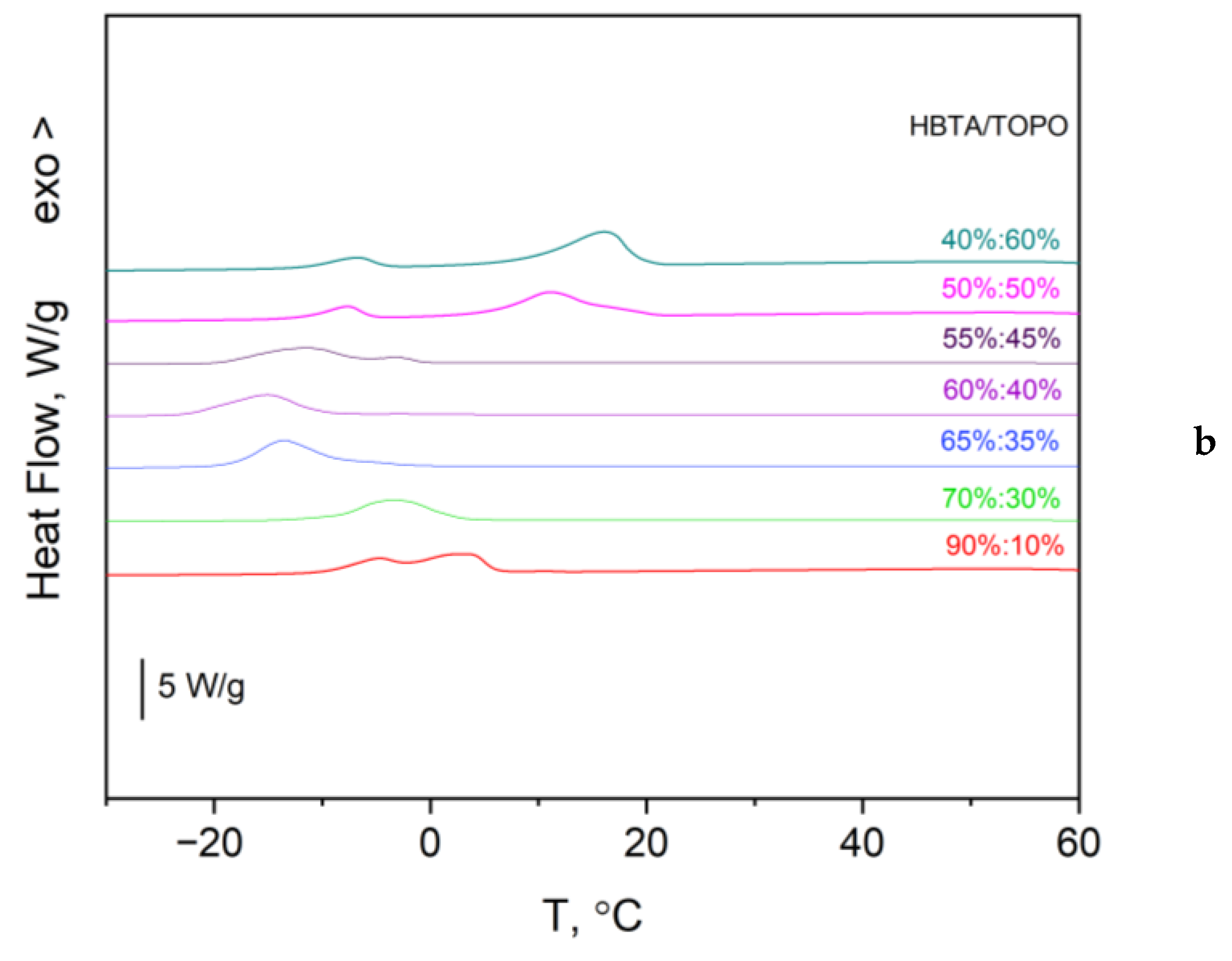
The DSC study conducted in cooling mode of compositions around the eutectic composition (Figure 1b) also revealed a single exothermic peak and the lowest crystallization temperature for the HBTA:TOPO mass ratio of 60:40, thus confirmed the results of the thermal analysis in the heating mode (Figure 1a). This result is slightly different from that obtained by Hanada and Goto, i.e., 75:25, using COSMO-RS calculations [11]. The observed difference in the melting and crystallization temperatures of a given composition was due to the necessary supercooling (ΔT) to initiate the nucleation process, which for organic compounds is often significantly higher than for metals. It is also important to emphasize that the studied binary system around the eutectic composition was in a liquid state at room temperature, which is illustrated in Figure 2. It is important to note that while in the heating mode these compositions show close melting temperatures (solidus and liquidus temperatures), in the cooling mode (Figure 1b), a very clear difference in their crystallization temperatures is visible. The 60:40 composition has by far the lowest crystallization temperature, and this makes it most suitable for ion extraction.
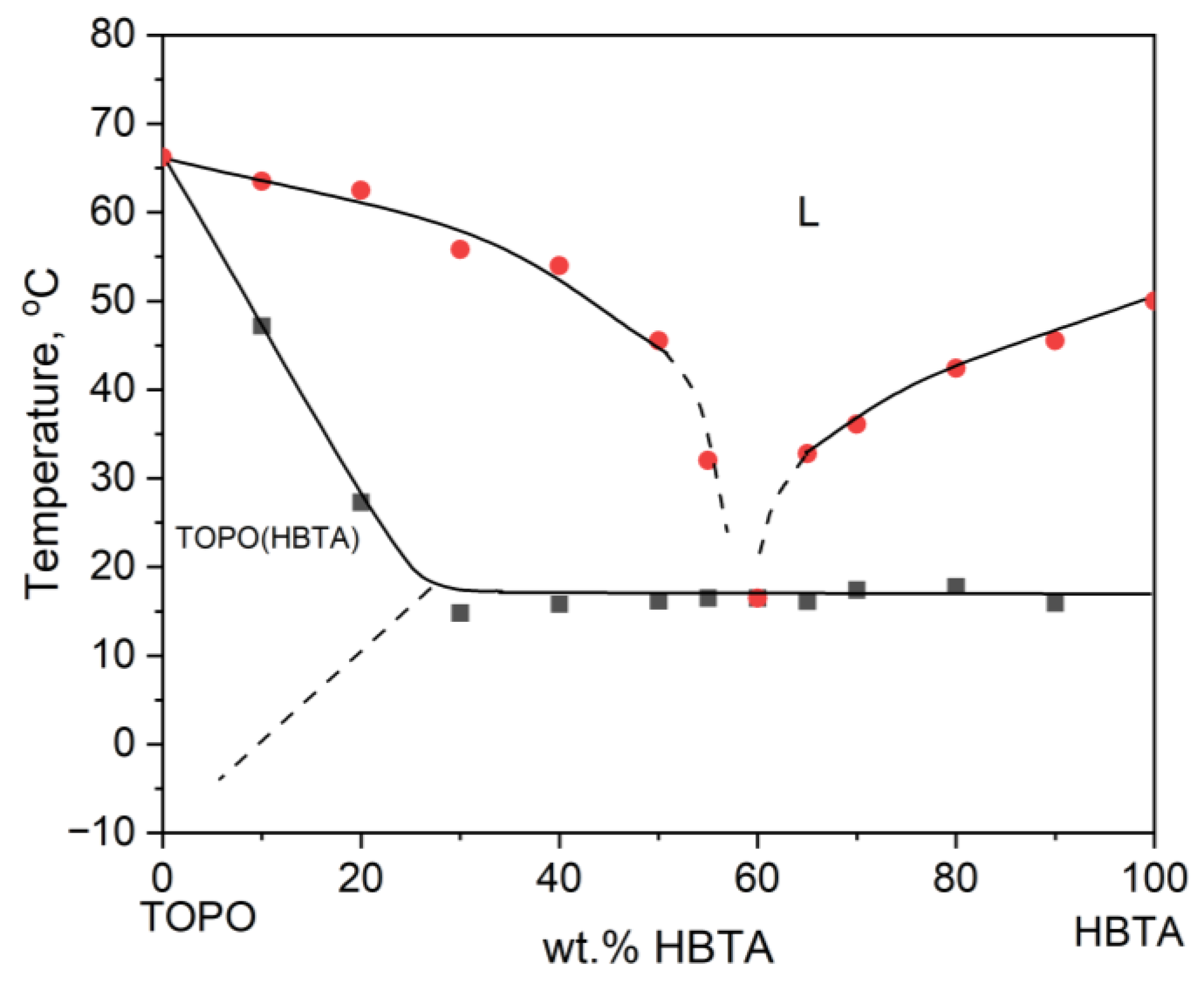
The DSC analysis performed on the different HBTA—TOPO compositions allowed the experimental construction of the binary phase diagram (Figure 2). From the thermal curves, Figure 1a, both “solidus” and “liquidus” temperatures can be determined for each composition studied. The temperature at which the tangent to the inflection point of the DSC peak intersects the baseline extension (Tonset) was used to plot the “solidus” line on the phase diagram. For the plotting of the “liquidus” line, the temperature at the end of the thermal peak was used since beyond this temperature the system was a single-phase melt. It should also be considered that during heating in DSC measurements, there is overshooting of the true liquidus. It should be emphasized that for plotting the “liquidus” line, there was no ambiguity as to which temperature should be used, while for plotting the “solidus” line, it could be speculated as to whether it would not be more correct to use the temperature at the start of the DSC peak from baseline. Moreover, it is generally accepted that for binary systems, especially organic ones, where the phases have broader, not well-defined “solid–liquid” transitions, the onset temperatures allow a clearer way to plot the boundaries of the different phases.
It should also be noted that for the pure substances and the eutectic mixture, we assumed a single melting temperature, regardless of the relatively broad but simultaneously distinct single thermal peaks. The reason for this assumption was the fact that we conducted the melting of the substances in a dynamic DSC regime, and furthermore, the organic system under study was characterized by low thermal conductivity (hindered thermal transport). Because of this approach, a steeper descent of the liquidus line to the eutectic point was observed (Figure 2), which did not in any way impair the use of the diagram for practical purposes. Also of note was the identified presence of a solid solution of HBTA in the TOPO (TOPO(HBTA)), evidenced by the “lifting” of the solidus line on the side of the TOPO component. In this way, we obtained a rather well-formed phase diagram, which could serve both for practical purposes in the preparation of various mixtures of the two organic compounds and for a more in-depth study of the thermodynamics of this binary system. In this regard, the melting enthalpy values of different compositions of the binary mixture were also measured and were found to vary from 135 J/g for pure TOPO to 95 J/g for pure HBTA, depending on the mass ratio of the two components. These results can be used further in the detailed study of the system thermodynamics, e.g., to evaluate deviations from ideality in the melt or solid phase/solid solution and to construct a detailed phase diagram based only on thermodynamic data.
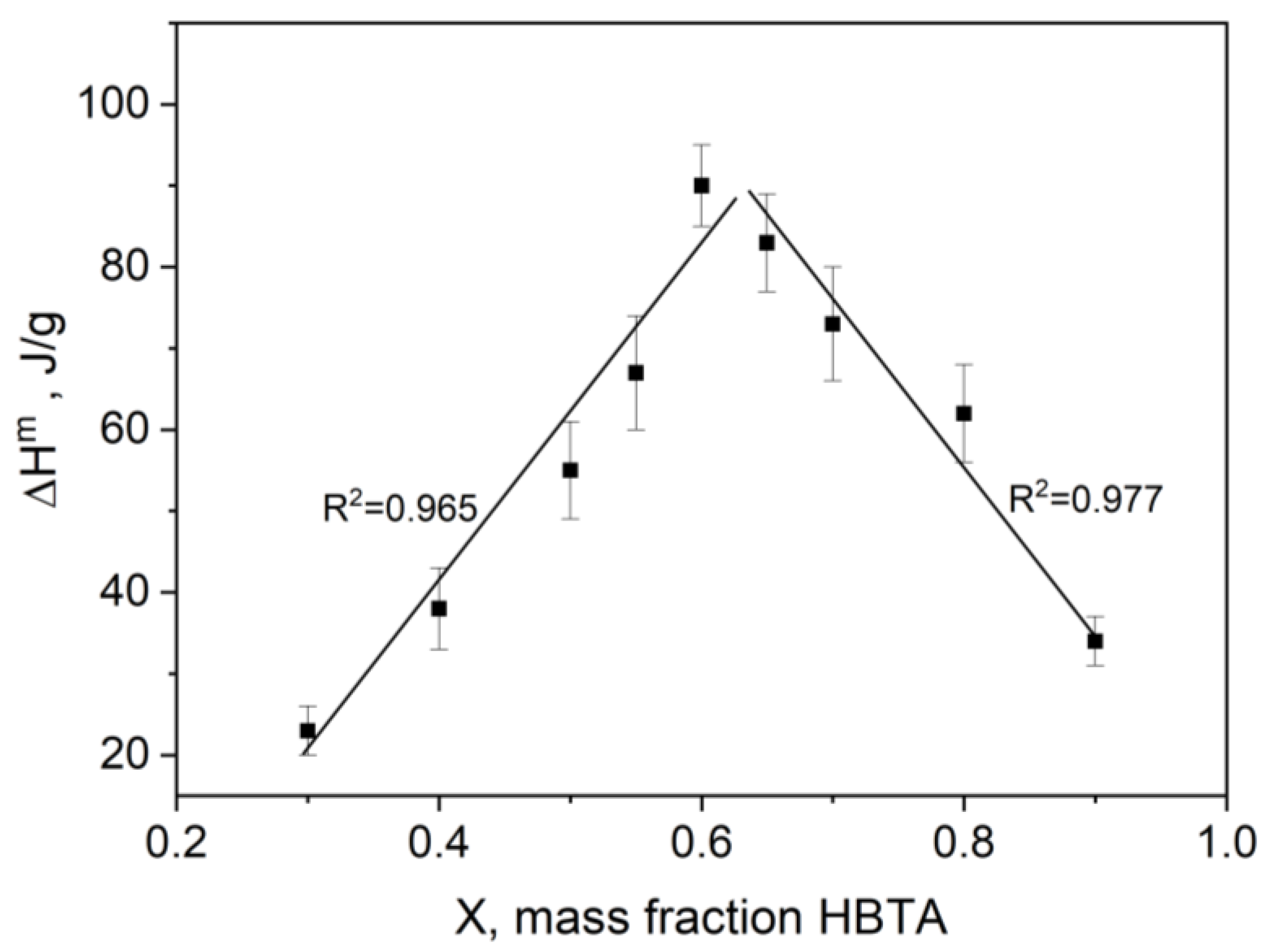
Proper determination of a eutectic composition usually involves constructing a Tammann plot, which is an essential tool derived from phase diagram theory [32,33,34]. This plot for the binary mixture studied is shown in Figure 3 and Table 1. It predicts the variation in enthalpy associated with a first-order transformation as a function of concentration, utilizing the lever rule. For eutectic melting, the mole fraction of component HBTA (xeut) corresponds to a single melting effect with enthalpy ΔHeut. For other compositions, the enthalpy released at the eutectic temperature (ΔH) is proportional to the mole fraction of the eutectic liquid formed and described by Equation (2).
ΔH = xeut⋅ΔHeut
Equation (2) allows the precise determination of xeut through the Tammann plot, where enthalpy contributions are plotted against composition. The intercept of the linear segments in the plot provides the eutectic composition and solid solubilities at the eutectic temperature. It should be noted that for compositions close to the eutectic point, the thermal peaks overlap significantly, leading to increased uncertainty in the determination of the melting enthalpies of both the eutectic and the residual mixture by peak deconvolution, as illustrated in Figure 3. Nevertheless, the composition dependence of the melting enthalpy provides additional evidence for identifying the eutectic composition.
The slight discrepancy observed between the eutectic composition determined from melting enthalpy measurements and that derived from the thermal curves is due to the complex nature of the thermal peaks, characterized by overlap and peak convolution. Despite extensive efforts to maximize experimental precision, including preliminary sample homogenization, repeated measurements at identical compositions, and strict control of heating rates, the system remains inherently challenging for phase analysis. This intrinsic complexity likely accounts for the scarcity of reported phase diagrams for similar organic systems in the literature.
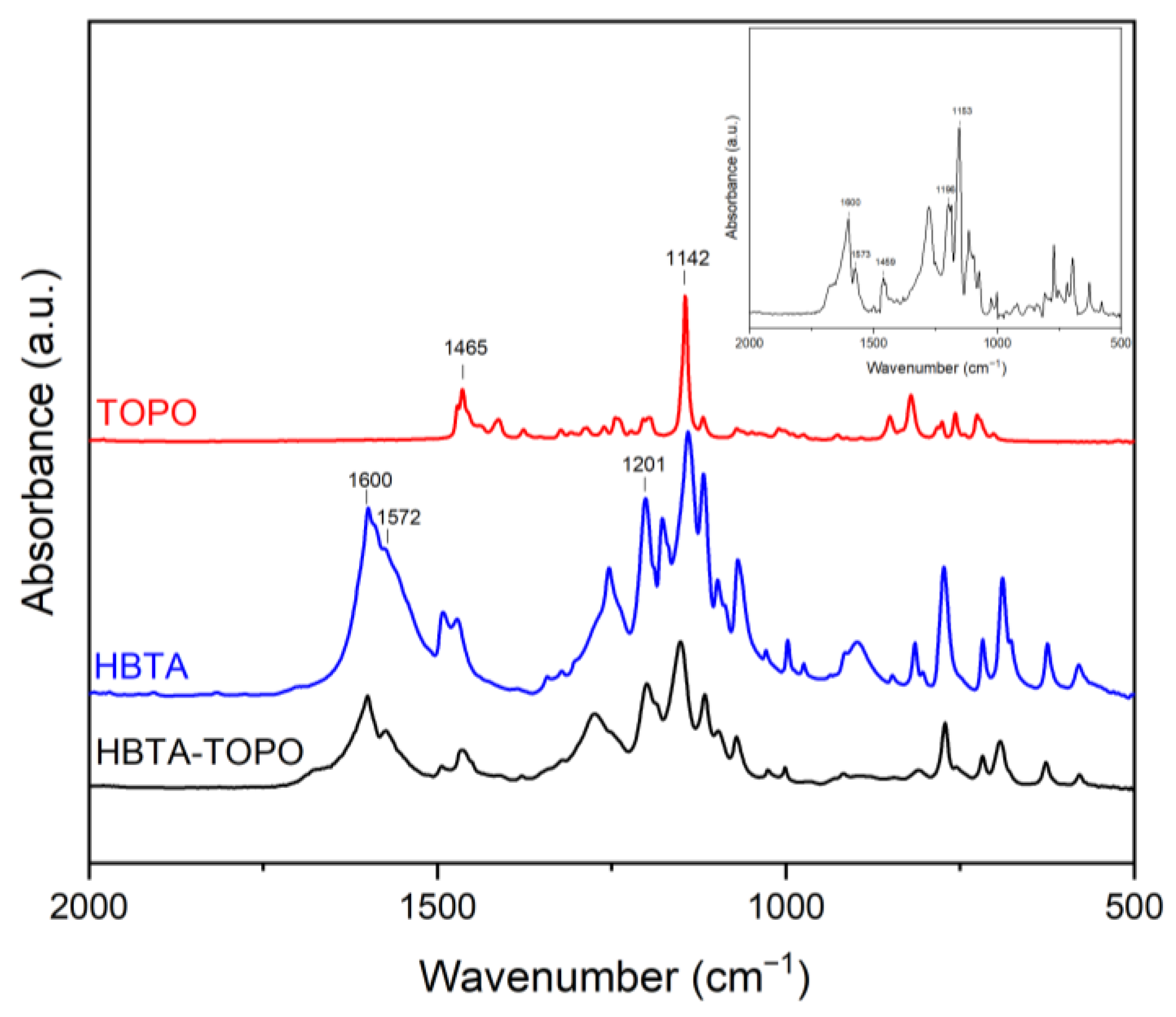
Figure 4 presents the FTIR spectra of the starting compounds HBTA and TOPO, together with that of their eutectic mixture. The eutectic spectrum largely preserves the characteristic absorption bands of both components, showing only minor changes in the line positions and intensities. These minor changes indicate weak intermolecular interactions between HBTA and TOPO. The absence of new absorption lines indicates that there is no chemical interaction and that the structure of the starting molecules is not changed in the eutectic mixture. From the IR differential spectrum (Figure 4, inset), the presence of aromatic and conjugated carbonyl vibrational modes can be seen, which corresponds to weak electronic interactions between trioctylphosphine oxide and the β-diketone. The FTIR does not indicate the formation of hydrogen or covalent bonds. Rather, these are weak P → C=O interactions (that slightly perturb the electronic structure of the β-diketone) expressed in small changes and variations in the intensity of the carbonyl and aromatic lines.

3.2. Li+ Extraction into the HBTA–TOPO DES

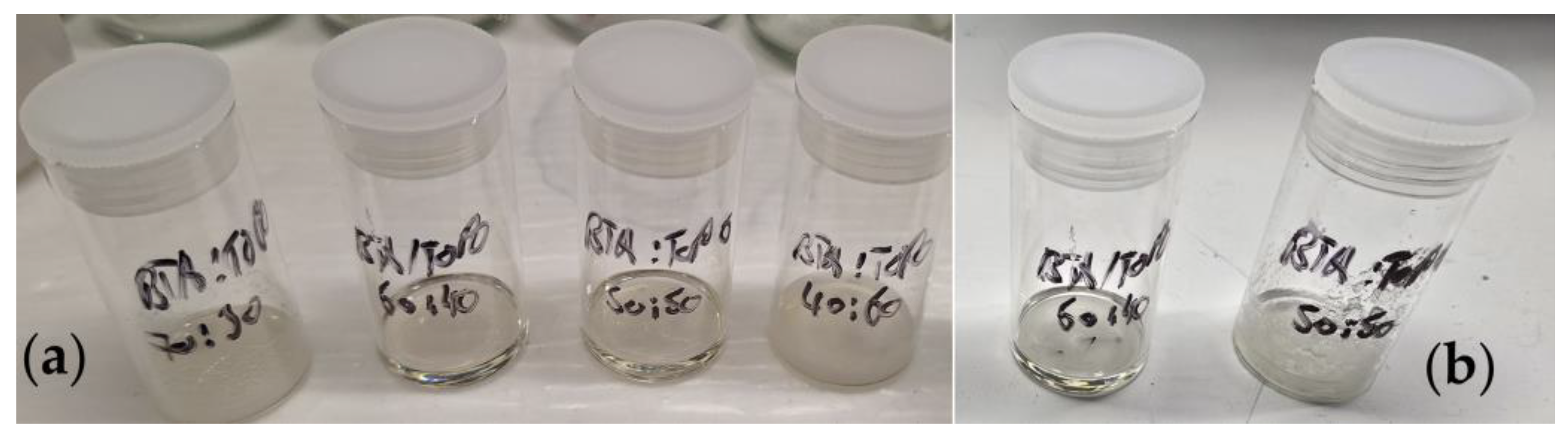
The extraction experiments conducted at 30 °C and involving as liquid organic phase HBTA–TOPO mixtures of mass ratios of 70:30, 60:40 (eutectic composition), and 50:50 resulted in near-complete Li+ extraction, i.e., 98.05 ± 1.97%, 96.89 ± 0.98%, and 99.64 ± 0.34, respectively. However, at a room temperature of 25 °C, the mixture with HBTO:TOPO mass ratio of 50:50 formed crystals upon mechanical agitation and was deemed unsuitable for Li+ extraction (Figure 5), while the eutectic mixture extracted 99.43 ± 46% of the Li+ in the aqueous phase. The application of pH 10 was selected as a suitable pH for Li+ extraction by HBTA based on the stoichiometric equation describing the extraction reaction (Equation (1)) and previous studies, where pH values of 10 and above were identified as suitable extraction conditions [19,20]. The Li+ extraction experiment from a neutral aqueous solution did not result in any Li+ being extracted, thus confirming that alkali conditions are required for Li+ extraction by the HBTA:TOPO eutectic mixture.

4. Conclusions

The thermal behavior of the binary mixture of HBTA and TOPO was investigated to evaluate its potential as a Li+ extractant. Melting temperatures and enthalpies of fusion were measured across the full composition range, enabling the construction of a complete phase diagram and identification of the eutectic composition. The constructed phase diagram was proved to be of eutectic type with a eutectic composition of 60:40 HBTA:TOPO mass ratio and the presence of a solid solution of HBTA in TOPO. The extraction capabilities for Li+ of this binary mixture were investigated at HBTA:TOPO mass ratios of 70:30, 60:40, and 50:50 at 30 °C and 60:40 at 25 °C, which were the only stable liquid compositions at these temperatures. All these compositions allowed complete Li+ extraction; however, the eutectic mixture was found to be the only stable liquid at room temperature of 25 °C suitable for Li+ extraction. Based on both the thermal and extraction studies outlined in this paper, it was concluded that Li+ extraction with the eutectic HBTA–TOPO binary mixture was a potential green alternative to conventional extraction systems for Li+ separation.

Author Contributions

Conceptualization, T.G.S. and S.D.K.; methodology, T.G.S. and S.D.K.; validation, T.S., J.N.S. and C.F.C.; formal analysis, T.S.; investigation, S.I., C.F.C., T.S. and L.K.; data curation, T.S.; writing—original draft preparation, T.G.S., S.D.K. and C.F.C.; writing—review and editing, S.D.K. and T.G.S.; visualization, S.I. and J.N.S.; supervision, T.G.S.; funding acquisition, T.G.S. All authors have read and agreed to the published version of the manuscript.

Funding

This work was supported by the Bulgarian National Science Fund, grant number KП-06-H89/10. Research equipment of the project № BG16RFPR002-1.014-0006 “National Centre of Excellence Mechatronics and Clean Technologies” was used for DSC experimental work, which was financially supported by the European Regional Development Fund under the “Research Innovation and Digitization for Smart Transformation” program 2021-2027. T.G.S. and S.D.K acknowledge the European Union\u2014NextGenerationEU, through the National Recovery and Resilience Plan of the Republic of Bulgaria, project No BG-RRP-2.004-0008. The authors are grateful to Melbourne Trace Analysis for Chemical, Earth and Environmental Sciences (TrACEES) Platform for access to their inductively coupled plasma—optical emission spectrometer and for technical assistance by Yukie O’Bryan.

Data Availability Statement

Data is contained within the article.

Conflicts of Interest

The authors declare no conflicts of interest.

References

  1. Abbott, A.P.; Capper, G.; Davies, D.L.; Rasheed, R.K.; Tambyrajah, V. Novel solvent properties of choline chloride/urea mixtures. Chem. Commun. 2003, 70–71. [Google Scholar] [CrossRef] [PubMed]
  2. Smith, E.L.; Abbott, A.P.; Ryder, K.S. Deep eutectic solvents (dess) and their applications. Chem. Rev. 2014, 114, 11060–11082. [Google Scholar] [CrossRef] [PubMed]
  3. Sekharan, T.R.; Chandira, R.M.; Tamilvanan, S.; Rajesh, S.C.; Venkateswarlu, B.S. Deep eutectic solvents as an alternate to other harmful solvents. Biointerface Res. Appl. Chem. 2022, 12, 847–860. [Google Scholar]
  4. Zhang, Q.; De Oliveira Vigier, K.; Royer, S.; Jérôme, F. Deep eutectic solvents: Syntheses, properties and applications. Chem. Soc. Rev. 2012, 41, 7108–7146. [Google Scholar] [CrossRef]
  5. Padinhattath, S.P.; Shaibuna, M.; Gardas, R.L. Solvent extraction with hydrophobic deep eutectic solvents: A benign alternative for efficient industrial wastewater treatment. In Deep Eutectic Solvents; American Chemical Society: Washington, DC, USA, 2025; Volume 1504, pp. 271–290. [Google Scholar]
  6. Paiva, A.; Craveiro, R.; Aroso, I.; Martins, M.; Reis, R.L.; Duarte, A.R.C. Natural deep eutectic solvents—Solvents for the 21st century. ACS Sustain. Chem. Eng. 2014, 2, 1063–1071. [Google Scholar] [CrossRef]
  7. Martín, M.; García-Díaz, I.; López, F. Properties and perspective of using deep eutectic solvents for hydrometallurgy metal recovery. Miner. Eng. 2023, 203, 108306. [Google Scholar] [CrossRef]
  8. Lee, H.; Kim, J.; Lee, J.; Yang, H.; Jo, S.; Choi, W.; Kim, J.; Hong, H. Research trends in rare metal recovery processes using deep eutectic solvents. Korean J. Met. Mater. 2025, 63, 651–661. [Google Scholar] [CrossRef]
  9. Alguacil, F. Utilizing deep eutectic solvents in the recycle, recovery, purification and miscellaneous uses of rare earth elements. Molecules 2024, 29, 1356. [Google Scholar] [CrossRef]
  10. Xue, K.; Fan, D.; Wang, X.; Dong, Z.; Zhu, Z.; Cui, P.; Meng, F.; Wang, Y.; Qi, J. Lithium extraction from aqueous medium using hydrophobic deep eutectic solvents. J. Environ. Chem. Eng. 2023, 11, 110490. [Google Scholar] [CrossRef]
  11. Hanada, T.; Goto, M. Synergistic deep eutectic solvents for lithium extraction. ACS Sustain. Chem. Eng. 2021, 9, 2152–2160. [Google Scholar] [CrossRef]
  12. Goodenough, J.B.; Park, K.S. The li-ion rechargeable battery: A perspective. J. Am. Chem. Soc. 2013, 135, 1167–1176. [Google Scholar] [CrossRef] [PubMed]
  13. Martin, G.; Rentsch, L.; Höck, M.; Bertau, M. Lithium market research—Global supply, future demand and price development. Energy Storage Mater. 2017, 6, 171–179. [Google Scholar] [CrossRef]
  14. Kanagasundaram, T.; Murphy, O.; Haji, M.N.; Wilson, J.J. The recovery and separation of lithium by using solvent extraction methods. Coord. Chem. Rev. 2024, 509, 215727. [Google Scholar] [CrossRef]
  15. Li, R.; Wang, Y.; Chen, L.; Duan, W.; Ren, Z.; Zhou, Z. Ionic liquid for selective extraction of lithium ions from tibetan salt lake brine with high na/li ratio. Desalination 2024, 574, 117274. [Google Scholar] [CrossRef]
  16. Zhang, L.; Li, L.; Rui, H.; Shi, D.; Peng, X.; Ji, L.; Song, X. Lithium recovery from effluent of spent lithium battery recycling process using solvent extraction. J. Hazard. Mater. 2020, 398, 122840. [Google Scholar] [CrossRef]
  17. Zhang, L.; Li, L.; Shi, D.; Li, J.; Peng, X.; Nie, F. Selective extraction of lithium from alkaline brine using hbta-topo synergistic extraction system. Sep. Purif. Technol. 2017, 188, 167–173. [Google Scholar] [CrossRef]
  18. Zhang, L.; Li, L.; Shi, D.; Peng, X.; Song, F.; Nie, F.; Han, W. Recovery of lithium from alkaline brine by solvent extraction with β-diketone. Hydrometallurgy 2018, 175, 35–42. [Google Scholar] [CrossRef]
  19. Ni, C.; Liu, C.; Han, Z.; Wang, J.; Liang, Y.; Zhong, H.; He, Z. Sustainable and efficient recovery of lithium from rubidium raffinate via solvent extraction. J. Environ. Chem. Eng. 2024, 12, 113374. [Google Scholar] [CrossRef]
  20. Masmoudi, A.; Zante, G.; Trébouet, D.; Barillon, R.; Boltoeva, M. Solvent extraction of lithium ions using benzoyltrifluoroacetone in new solvents. Sep. Purif. Technol. 2021, 255, 117653. [Google Scholar] [CrossRef]
  21. Septioga, K.; Fajar, A.T.N.; Wakabayashi, R.; Goto, M. Deep eutectic solvent-aqueous two-phase leaching system for direct separation of lithium and critical metals. ACS Sustain. Resour. Manag. 2024, 1, 2482–2491. [Google Scholar] [CrossRef]
  22. Zhang, L.; Li, J.; Ji, L.; Li, L. Separation of lithium from alkaline solutions with hydrophobic deep eutectic solvents based on β-diketone. J. Mol. Liq. 2021, 344, 117729. [Google Scholar] [CrossRef]
  23. Croft, C.F.; Sarafska, T.; Spassov, T.G.; Kolev, S.D. Development of a polymer inclusion film incorporating a 1-dodecanol-decanoic acid eutectic mixture for the extraction of dy3+ and y3+. React. Funct. Polym. 2025, 216, 106454. [Google Scholar] [CrossRef]
  24. Zhang, P.; Tu, Z.; Zhang, X.; Hu, X.; Wu, Y. Acidic protic ionic liquid-based deep eutectic solvents capturing SO2 with low enthalpy changes. AIChE J. 2023, 69, e18145. [Google Scholar] [CrossRef]
  25. Trombino, S.; Siciliano, C.; Procopio, D.; Curcio, F.; Laganà, A.S.; Di Gioia, M.L.; Cassano, R. Deep eutectic solvents for improving the solubilization and delivery of dapsone. Pharmaceutics 2022, 14, 333. [Google Scholar] [CrossRef]
  26. De Las Heras, I.; Dufour, J.; Coto, B. A novel method to obtain solid–liquid equilibrium and eutectic points for hydrocarbon mixtures by using differential scanning calorimetry and numerical integration. Fuel 2021, 297, 120788. [Google Scholar] [CrossRef]
  27. Craveiro, R.; Aroso, I.; Flammia, V.; Carvalho, T.; Viciosa, M.T.; Dionísio, M.; Barreiros, S.; Reis, R.L.; Duarte, A.R.C.; Paiva, A. Properties and thermal behavior of natural deep eutectic solvents. J. Mol. Liq. 2016, 215, 534–540. [Google Scholar] [CrossRef]
  28. Alhadid, A.; Nasrallah, S.; Mokrushina, L.; Minceva, M. Design of Deep Eutectic Systems: Plastic Crystalline Materials as Constituents. Molecules 2022, 27, 6210. [Google Scholar] [CrossRef]
  29. Schawe, J.E.K.; Höhne, G.W.H. The analysis of temperature modulated dsc measurements by means of the linear response theory. Thermochim. Acta 1996, 287, 213–223. [Google Scholar] [CrossRef]
  30. Jiang, Z.; Imrie, C.T.; Hutchinson, J.M. An introduction to temperature modulated differential scanning calorimetry (tmdsc): A relatively non-mathematical approach. Thermochim. Acta 2002, 387, 75–93. [Google Scholar] [CrossRef]
  31. Schawe, J.E.K. A comparison of different evaluation methods in modulated temperature dsc. Thermochim. Acta 1995, 260, 1–16. [Google Scholar] [CrossRef]
  32. Findlay, A. The Phase Rule and Its Applications; Longmans, Green, and Company: London, UK, 1911. [Google Scholar]
  33. Guenet, J.-M. Contributions of phase diagrams to the understanding of organized polymer-solvent systems. Thermochim. Acta 1996, 284, 67–83. [Google Scholar] [CrossRef]
  34. Rycerz, L. Practical remarks concerning phase diagrams determination on the basis of differential scanning calorimetry measurements. J. Therm. Anal. Calorim. 2013, 113, 231–238. [Google Scholar] [CrossRef]
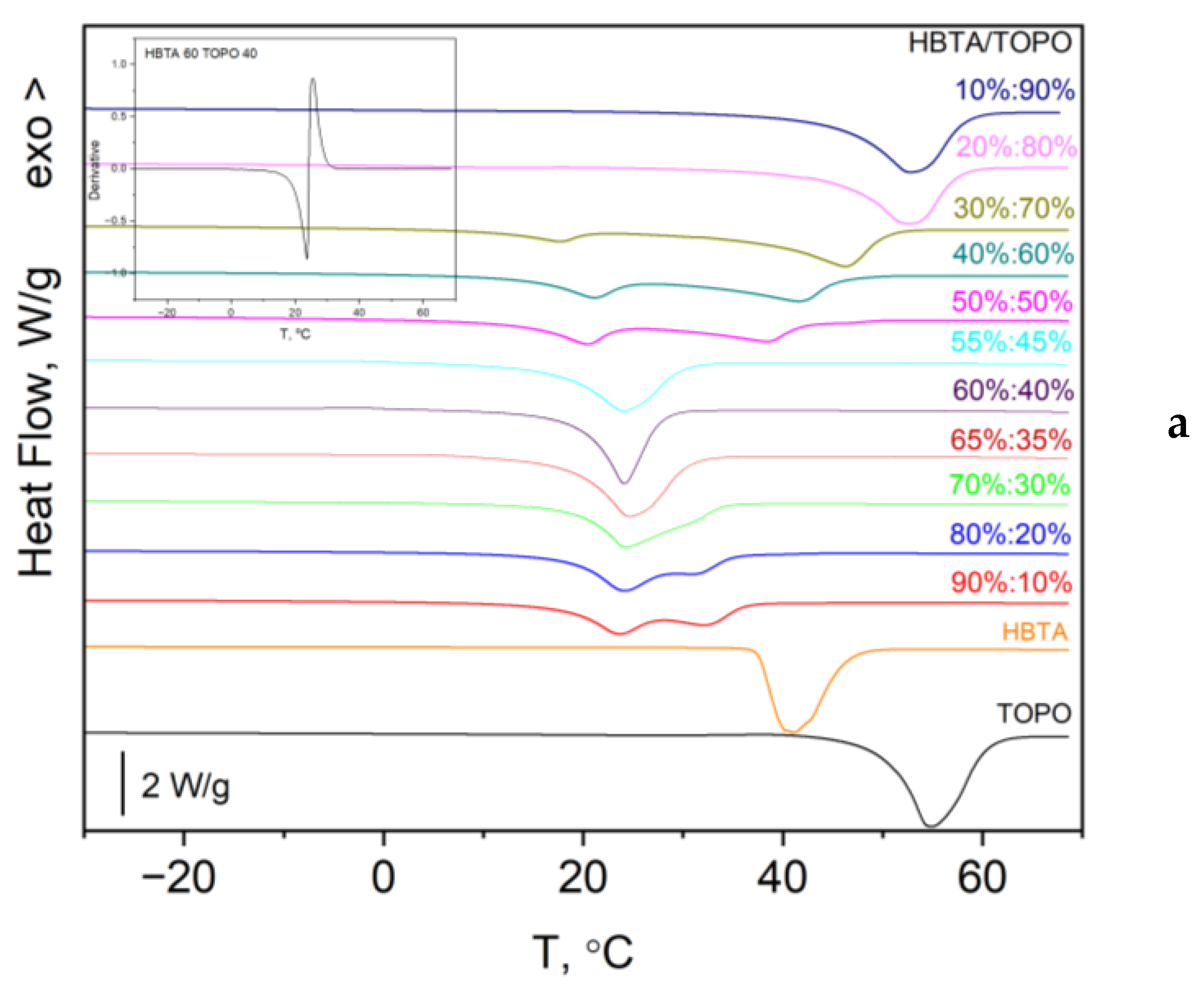
Figure 1. DSC curves for different HBTA–TOPO compositions (2 K/min heating and cooling rate) in heating (a) and cooling (b) modes ((a), inset: first derivative of the eutectic DSC peak).
Thermo 06 00009 g001aThermo 06 00009 g001b
Figure 2. Phase diagram of the HBTA–TOPO binary system, based on DSC analysis.
Thermo 06 00009 g002
Figure 3. Tammann plot of the binary HBTA–TOPO mixture.
Thermo 06 00009 g003
Figure 4. FTIR spectra of TOPO, HBTA, and HBTA-TOPO eutectic mixture. (inset–differential spectrum of the eutectic composition).
Thermo 06 00009 g004
Figure 5. (a) Photograph of freshly prepared HBTA–TOPO mixtures with different HBTA:TOPO mass ratios (i.e., 70:30, 60:40, 50:50, and 40:60) at room temperature (25 °C) with the only liquids being those with HBTA:TOPO mass ratios of 60:40 and 50:50. (b) Photograph of the mixtures with HBTA:TOPO mass ratios of 60:40 and 50:50 after mechanical agitation, showing crystal formation in the latter mixture with 50:50 mass ratio.
Thermo 06 00009 g005
Table 1. Eutectic melting enthalpies of different HBTA:TOPO compositions.
Composition
HBTA:TOPO,
Mass %
90:1080:2070:3065:3560:4055:4550:5040:6030:70
ΔHeut, J/g34 ± 362 ± 673 ± 783 ± 690 ± 567 ± 755 ± 638 ± 523 ± 3
Disclaimer/Publisher’s Note: The statements, opinions and data contained in all publications are solely those of the individual author(s) and contributor(s) and not of MDPI and/or the editor(s). MDPI and/or the editor(s) disclaim responsibility for any injury to people or property resulting from any ideas, methods, instructions or products referred to in the content.