


Abstract
Singlet oxygen (1O2) is a key mediator in photodynamic therapy (PDT), and its generation and reactivity in biological systems have been extensively studied. It has been shown that laser radiation at near-infrared (NIR) regions can be used to directly generate 1O2. In this work, we investigated photosensitizer-free 1O2 generation using an original all-fiber pulsed laser operating at 1066 nm and 1241 nm and evaluated its impact on mitochondrial activity in U-87 MG glioblastoma cells. Singlet oxygen was evaluated using the 1,3-diphenylisobenzofuran (DPBF) chemical probe and confirmed with argon-purging controls, demonstrating clear oxygen- and wavelength-dependent effects. Laser irradiation of glioblastoma cells demonstrated distinct effects depending on the wavelength, although decrease in cellular metabolic activity was observed in both cases. Interestingly, some inhibitory effect was also observed when the culture medium was pre-irradiated at 1241 nm and subsequently added to intact cells. These results demonstrate that laser radiation at both studied wavelengths can elicit measurable biological effects, although the relative efficiency in chemical versus cellular systems varies. Collectively, these findings provide a foundation for further systematic studies of wavelength-specific NIR interactions with cellular and molecular components in biological environments.
1. Introduction
The development of laser-based technologies has revolutionized medicine and biology. Lasers are now widely used for optical coherence tomography (OCT) in ophthalmology, laser eye surgery (e.g., LASIK, photorefractive keratectomy), among many other applications (e.g., dermatology, oncology, surgery) [1]. Among therapeutic uses, photodynamic therapy (PDT) remains a promising modality. PDT conventionally employs exogenous photosensitizers (PSs) that absorb light, transition from the singlet excited state to the triplet state via intersystem crossing, and then transfer their energy to ground-state molecular oxygen (3O2) to produce singlet oxygen (1O2) [2]. This Type II PDT mechanism is well-characterized and underlies cytotoxic effects against cancer cells, although its efficiency is limited in hypoxic tumor microenvironments. A comprehensive recent review discusses 1O2 properties, methods of generation, and detection [3].
Direct optical excitation of molecular oxygen is an intriguing idea as it eliminates the need for a photosensitizer and relies only on the radiation with specific wavelength. The most obvious candidate is the 1268 nm wavelength, which corresponds to singlet oxygen phosphorescence and has long been used for spectroscopic detection of 1O2 [4]. This wavelength was indeed successfully employed in many studies, but other wavelengths also showed comparable efficiency, including 1064 nm [5,6]. For example, irradiation at 1267 nm was shown to selectively trigger 1O2 (but not superoxide or H2O2) in melanoma and other cell lines, with mitochondrial permeability transition and apoptosis effects, supporting high selectivity of 1O2 at that wavelength [7]. This finding is corroborated by a study using 1270 nm irradiation, which reported complete cell death in MCF-7 cells [6]. Furthermore, the efficiency of direct 1O2 generation was investigated at several wavelengths (1064, 1122, 1244, and 1267 nm) using chemical trap and SOSG fluorescence probe methods [8]. The study found that 1267 nm yielded the highest 1O2 production, while 1064 nm showed comparable efficiency under some conditions. The study also demonstrated that irradiation at 1244 nm has significant potential for singlet oxygen generation.
This study investigates the effects of 1241 nm and 1066 nm laser irradiation on singlet oxygen (1O2) generation and the subsequent biological responses in a glioblastoma cell line. These wavelengths were selected for two main reasons. First, as previously indicated, both are of significant interest for exciting molecular oxygen to its singlet state. Second, we employed a novel dual-wavelength all-fiber pulsed laser system [9] that provides simultaneous output at 1066 nm and 1241 nm, thereby enabling a direct comparative investigation. We hypothesize that, while 1066 nm radiation may serve as a reference due to its well-characterized biomedical applications, ~1241 nm radiation might be more specific for the singlet oxygen generation, resulting in distinct biological effects. The hypothesis is further supported by the energetic consideration of the molecular oxygen transition: the energy gap between the triplet ground state and the first excited singlet state is approximately 1 eV, which corresponds closely to a photon wavelength of 1240 nm. Therefore, irradiation at 1241 nm provides photon energies that are well matched to this transition, making direct excitation of molecular oxygen physically plausible. Although the 1268 nm band is commonly cited as the characteristic phosphorescence maximum of singlet oxygen, this transition exhibits a finite spectral width (~30–40 nm), reflecting its vibronic structure. Consequently, excitation at shorter wavelengths such as 1241 nm can still overlap with the high-energy edge of the band. In this region, photon energy remains sufficient to populate the singlet oxygen state, albeit with reduced absorption probability, providing a plausible explanation for the observed effects at 1241 nm.
For biological testing, we employed the U-87 MG glioblastoma cell line, a widely used in vitro model of human brain tumor. The clinical relevance of glioblastoma lies in its aggressive growth, poor prognosis, and the therapeutic challenges posed by the restrictive blood–brain barrier [10]. Conventional photodynamic therapy (PDT) is largely ineffective because the delivery of photosensitizers to the tumor site is severely constrained by this barrier [11]. Consequently, the development of light-based strategies capable of generating reactive oxygen species directly, without reliance on exogenous agents, represents a promising alternative for overcoming these limitations in treatment-resistant brain tumors. Our data indeed demonstrates distinct cellular responses to 1241 nm irradiation compared with 1066 nm, suggesting unique underlying photobiological mechanisms and highlighting the potential of 1241 nm light as a promising candidate for future biomedical applications. The penetration depth of NIR radiation is a key factor for translational relevance, particularly for glioblastoma. Previous studies in animal models and humans indicate that wavelengths within the near-infrared (NIR) window interact with biological tissue in ways that allow deeper light propagation than in the visible range. In specific models, NIR light has been measured to penetrate neural tissues on the order of sub-millimetres in rodents, and other studies using high surface irradiances report that a small fraction of incident NIR light can reach depths of millimetres to centimetres through skin, skull, and brain tissue in larger models. While scattering generally decreases and absorption by water increases at longer NIR wavelengths, actual penetration depth depends strongly on tissue type, power density, and wavelength [12,13]. Importantly, NIR light in this range has been reported to partially transmit through the skull, suggesting potential feasibility for non-invasive brain applications.
2. Materials and Methods
The excitation source was a bi-chromatic radiation generator [9], providing two outputs with synchronous pulsed generation at 1066 nm and 1241 nm wavelengths. For all experiments, the radiation from the two wavelengths was delivered via separate optical fiber outputs, enabling synchronous irradiation of two biological samples. The first output provided 1 ns pulsed laser radiation at 1066 nm with 260 mW average power, 1.04 nJ energy and 0.9 W peak power. The second output provided 0.4 ns pulsed laser radiation at 1241 nm with 300 mW average power, 1.2 nJ energy and 2.5 W peak power. The radiation from both outputs was collimated into a 3 mm diameter spot before illuminating the sample. Thus, the power density was 3.7 W/cm2 at 1066 nm and 4.3 W/cm2 at 1241 nm.
Prior to cell irradiation experiments, singlet oxygen generation was verified using the 1,3-diphenylisobenzofuran (DPBF) assay, a widely used chemical probe with well-characterized photophysical properties. DPBF reacts rapidly and relatively selectively with 1O2 via a [4+2] cycloaddition mechanism, forming a non-conjugated endoperoxide. This reaction disrupts the π-conjugated system of DPBF, resulting in a decrease in its characteristic absorbance at ~410 nm, which can be readily monitored spectrophotometrically. The choice of DPBF is motivated by its high sensitivity, fast reaction kinetics with singlet oxygen, and experimental simplicity, making it one of the most commonly used probes for initial verification of 1O2 generation in photochemical systems. Although DPBF itself is not used in biomedical applications, it plays an important role as a standard photophysical tool to confirm and compare singlet oxygen generation efficiency under defined irradiation conditions. This step is critical for establishing a mechanistic link between the optical excitation parameters and downstream biological effects, such as oxidative stress and metabolic alterations observed in cellular models.
Two quartz cuvettes were washed three times with 1 mL of EtOH. A small amount of DPBF, just visibly taken with a spatula, was diluted in 2.2 mL of 100% EtOH and mixed thoroughly. After 30 min, the solution appeared slightly yellowish. Two samples were prepared by mixing 1 mL of this DPBF solution with 2 mL of EtOH in quartz cuvettes. Absorbance spectra were recorded from 190 to 1100 nm using a UV-1900 spectrophotometer (Shimadzu, Kyoto, Japan), showing the characteristic DPBF band near 410 nm with an optical density (OD) of approximately 1.0 in a 1 cm quartz cuvette. Using the molar extinction coefficient reported for DPBF in ethanol (ε = 2.71 × 10³ M−1·cm−1) [14], the initial DPBF concentration was estimated from the Beer–Lambert law (A = ε·c·l) to be ~3.7 × 10⁻⁴ M (≈370 µM). The samples were kept in the dark, with no significant change in absorbance observed after one hour. One sample was irradiated with a 1066 nm laser and the other with a 1241 nm laser for one hour, followed by absorbance measurement. Irradiation continued for a total of two hours with absorbance spectra recorded periodically. Next, two samples of (DPBF) in EtOH were prepared according to the protocol described above. Argon gas was purged through each sample for 20 min to displace dissolved oxygen. Following argon purging, the samples were measured in the same way.
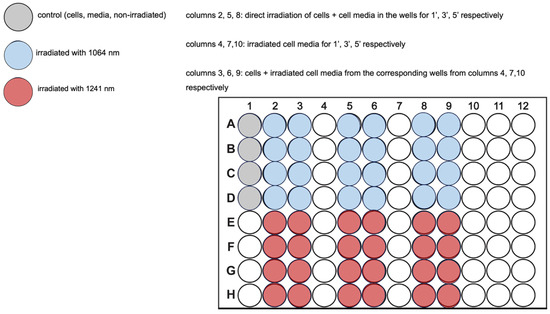
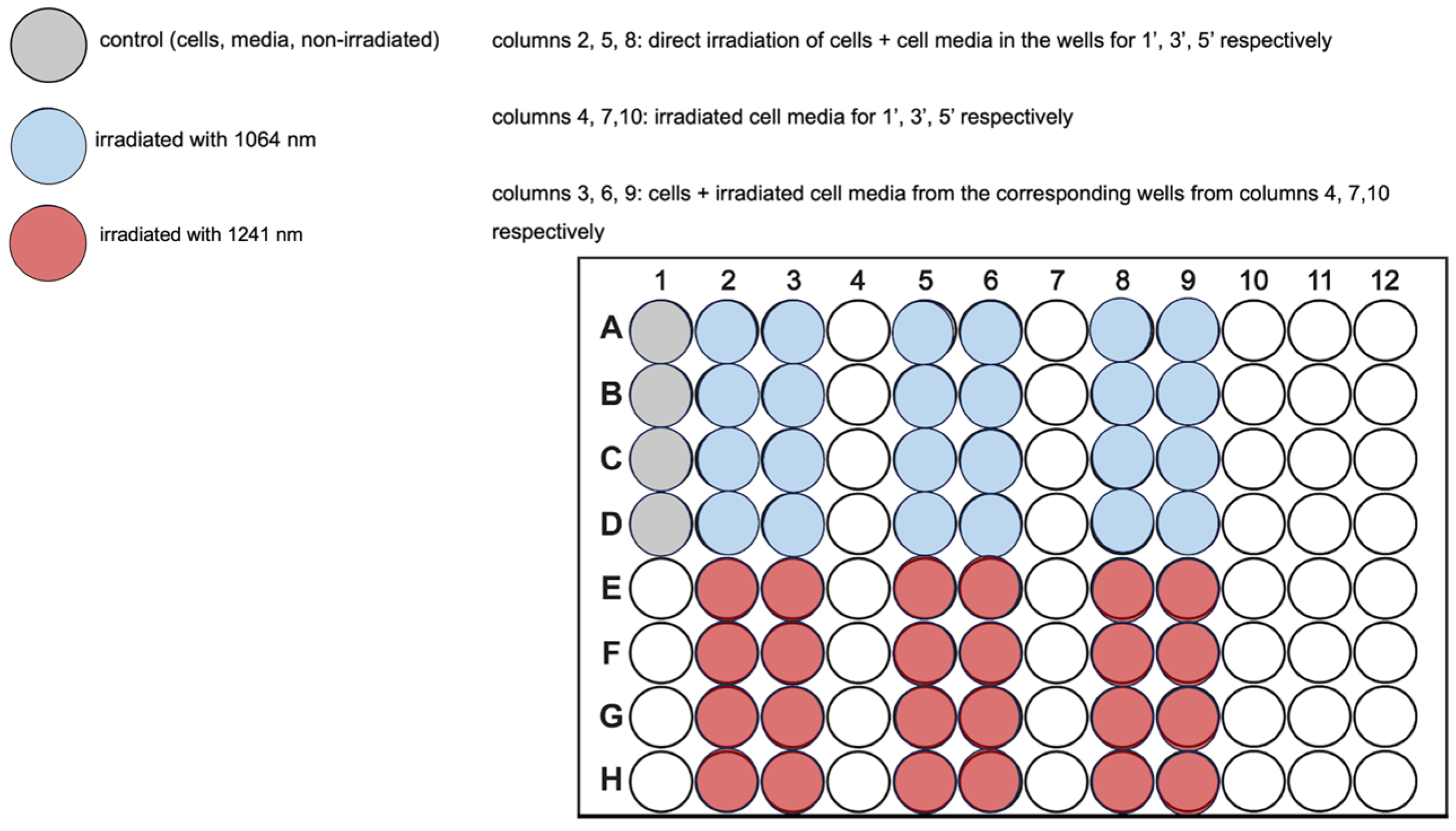
To evaluate the impact of singlet oxygen generated by laser irradiation on cellular function, the U-87 MG glioblastoma cell line was used as an in vitro model. The U87 MG human glioblastoma cell line was purchased from the Russian cell culture collection (Russian Branch of the ETCS, St. Petersburg, Russia). The cells were cultivated in Minimum Essential Medium α (MEM α; Sigma-Aldrich, St. Louis, MO, USA) supplemented with 10% FBS (Gibco BRL Co., Gaithersburg, MD, USA), 2 mM L-glutamine (Sigma-Aldrich, St. Louis, MO, USA), 250 mg/mL amphotericin B, and 100 U/mL penicillin/streptomycin (Gibco BRL Co., Gaithersburg, MD, USA). Cells were maintained at 37 °C in a humidified atmosphere containing 5% CO2. For the experiment, cells were seeded at a density of 5000 cells per well in a 96-well polystyrene plate with 200 µL of RPMI-1640 supplemented with 10% fetal bovine serum and 1X antibiotic-antimycotic solution (penicillin/streptomycin/amphotericin), one day prior to experimentation to allow for attachment. On the day of the experiment, media (180 µL) from wells in column 2 were carefully aspirated and transferred to adjacent wells in column 3, with parallel transfers performed between columns 6 to 7 and 9 to 10. Irradiation was applied to cells in columns 2, 5, and 8, and to cell-free media in columns 4, 7, and 10, using near-infrared lasers at 1066 nm and 1241 nm wavelengths (Figure 1).
Figure 1.
Experimental design scheme illustrating direct irradiation of cells (columns 2, 5, 8) and cell-free media (columns 4, 7, 10) with 1066 nm and 1241 nm lasers, followed by transfer of irradiated media to adjacent wells (columns 3, 6, 9) to assess indirect effects. White circles indicate empty wells.
Exposure durations were set at 1, 3, and 5 min for respective columns. Subsequently, irradiated media from columns 4, 7, and 10 were added to wells in columns 3, 6, and 9 to assess potential indirect effects mediated through treated media. Following irradiation, plates were returned to the incubator at 37 °C and 5% CO2 for 4 days. On the 4th day after irradiation, cell viability was quantified utilizing the MTT assay. A stock solution of MTT (0.25 mg/mL; Sigma-Aldrich, Steinheim, Germany) was freshly prepared in serum-free RPMI-1640 medium supplemented with 1X antibiotic-antimycotic.
Culture media were carefully removed from wells, and 200 µL of MTT solution was added to each well, followed by incubation for 4 h at 37 °C. The supernatant was then removed carefully to avoid cell loss or disturbance. Subsequently, 200 µL of dimethyl sulfoxide (DMSO) was added to dissolve formazan crystals, and absorbance was recorded at 570–620 nm after a 10 min incubation period. Non-irradiated cells in non-irradiated cell media were included to account for potential background signal arising from serum and phenol red. All the experiments were conducted in quadruplicates.
3. Results
3.1. Direct Singlet Oxygen Generation: DPBF Assay
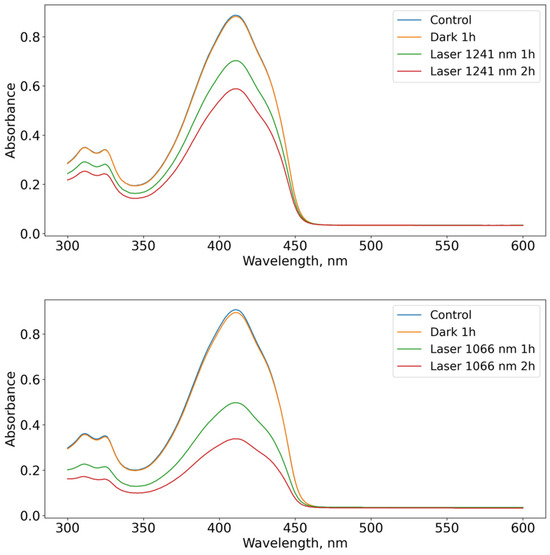
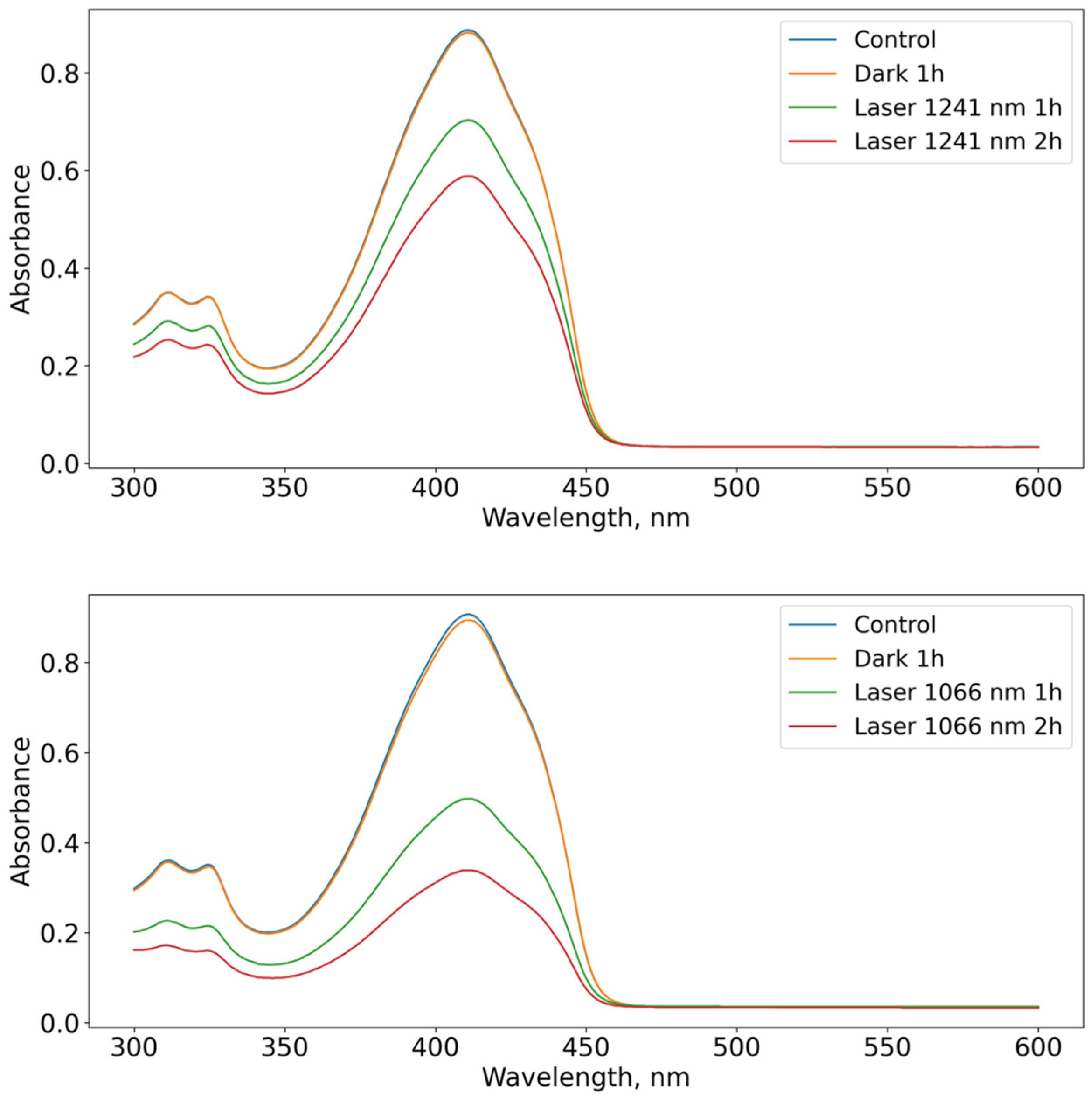
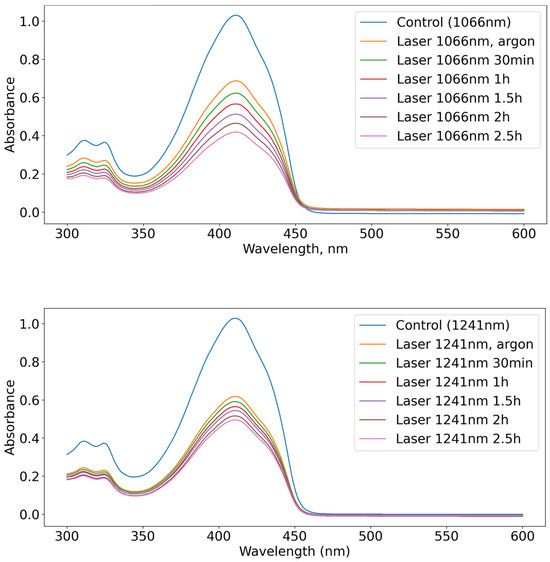
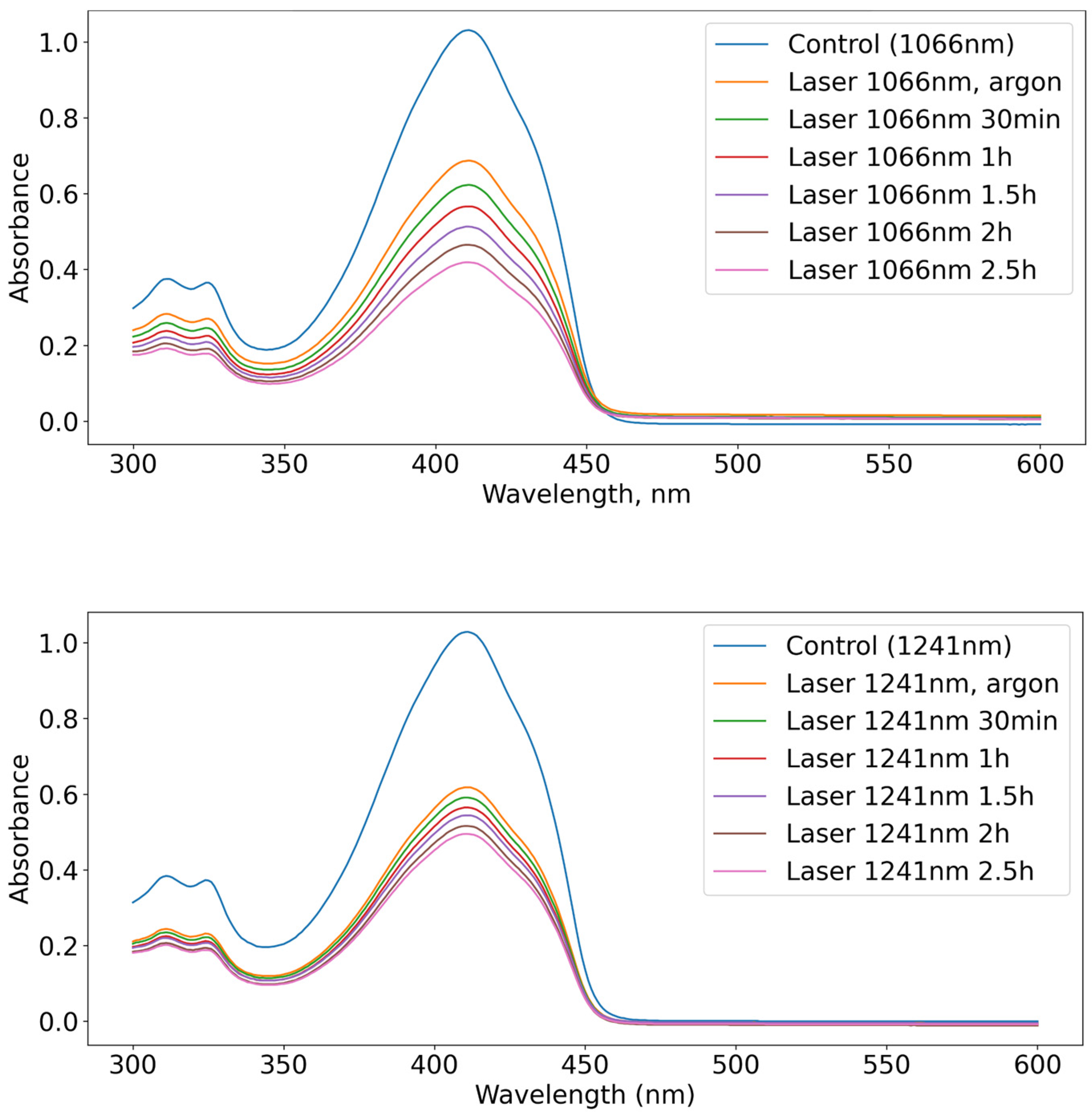
The DPBF assay relies on the oxidation of DPBF by singlet oxygen, which results in a loss of conjugation within the DPBF molecule and consequently a decrease in its absorbance at 410 nm. This decrease is proportional to singlet oxygen concentration, enabling kinetic evaluation of 1O2 production. Results showed a more pronounced decay in the absorbance of DPBF at 410 nm when irradiated at 1066 nm compared to 1241 nm, indicating higher singlet oxygen production at 1066 nm (Figure 2). These findings are in line with previously reported results [8]. Purging the initial sample with argon was found to alter the absorbtion spectrum (Figure 3). Absorbance measurements were taken five times at 30 min intervals, corresponding to sequential irradiations at 1066 nm and 1241 nm wavelengths for each sample. Results indicated that argon purging markedly reduced DPBF degradation, consistent with a decrease in singlet oxygen generation due to lowered oxygen availability. These findings substantiate that the observed effects are due to singlet oxygen generation. We acknowledge that 1,3-diphenylisobenzofuran (DPBF) is not a fully specific probe for singlet oxygen and can be influenced by external factors. However, it remains a widely used method for the initial evaluation of photoinduced singlet oxygen generation. While some decrease in DPBF absorbance upon argon purging was observed, the overall trends under irradiation remain consistent with singlet oxygen involvement. Ethanol does not represent a biological medium, and the DPBF assay is presented here as a proof-of-concept rather than a direct representation of physiological conditions. Excluding the diminution of the signal due to the Ar purging, the evolution under irradiation at 1066 nm is not so different from the one observed in oxygenated solutions.
Figure 2.
DPBF absorption spectra under 1241 nm and 1066 nm irradiation. Faster decay at 410 nm in the 1066 nm group reflects more efficient singlet oxygen generation compared to 1241 nm.
Figure 3.
Time-dependent DPBF degradation under 1066 nm and 1241 nm irradiation with oxygen or argon atmosphere. Absorbance at 410 nm was measured at 30 min intervals. Argon purging reduced DPBF decay, confirming the dependence on dissolved oxygen.
3.2. Biological Assays in Glioblastoma Cells
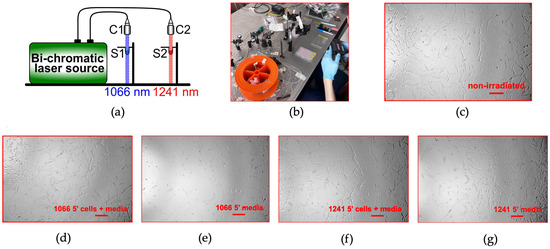
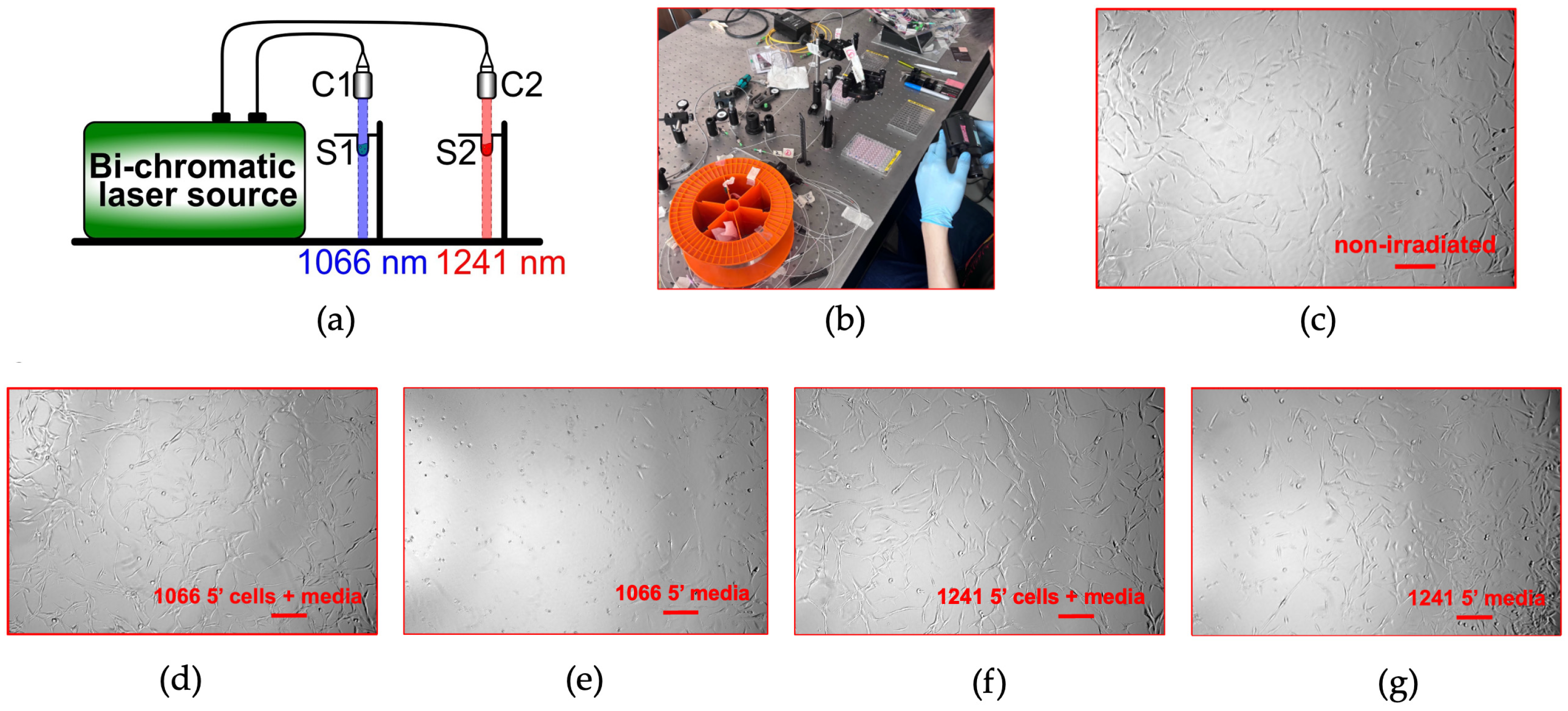
Exposure of U-87 MG glioblastoma cells to 1241 nm irradiation resulted in a statistically significant reduction in cellular metabolic activity, as assessed by the MTT assay. The effect of 1241 nm was more pronounced than that of 1066 nm under both experimental conditions: when cells were irradiated together with their media, and when only the media was irradiated and subsequently added to the cells. Concurrently, cell morphology changed under irradiated media, with cells transitioning from a spindle-shaped to a more rounded or sphere-like appearance, as observed using an inverted research microscope Eclipse Ti-S (Nikon Corporation, Tokyo, Japan) (Figure 4). This morphological shift is indicative of cellular stress and cytoskeletal reorganization, often associated with early apoptotic events or altered adhesion properties [15].
Figure 4.
(a) Laser experimental setup scheme, where: C1, C2—collimators, S1, S2—biological samples; (b) experimental setup for cell sample irradiation, as captured on the photograph; (c–g) Microscopy images of U-87 MG cells captured 4 days after irradiation for 5 min, with either combined irradiation of cells and media or media alone. Images were taken at ×10 magnification, scale bar represents 200 μm. The panels illustrated the effect of irradiation duration and wavelength (1066 nm and 1241 nm) on cell morphology and density.
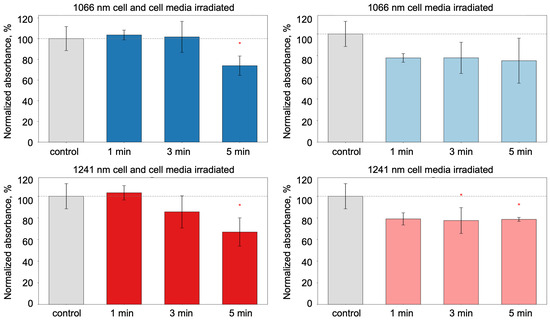
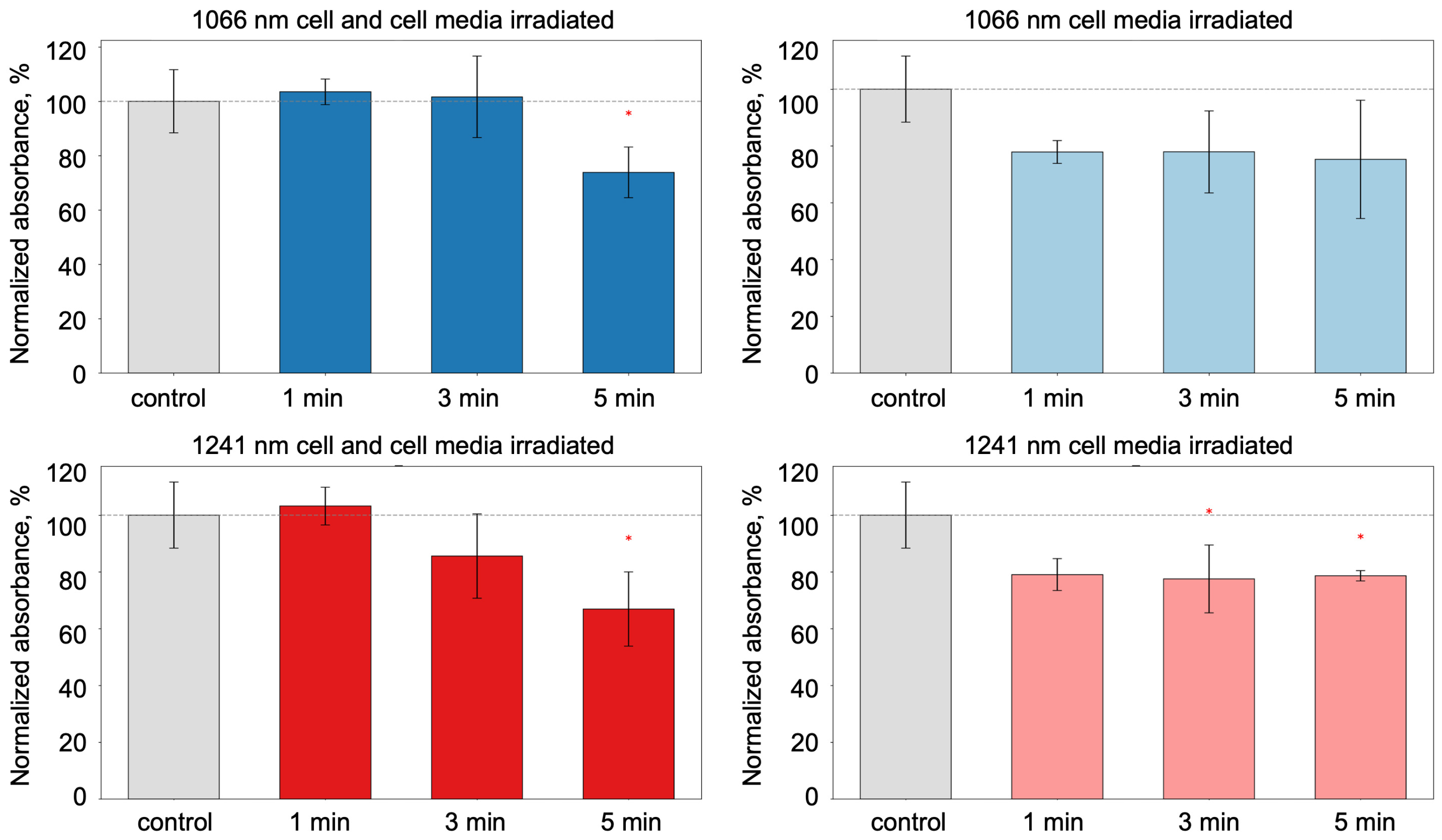
Cellular metabolic activity was assessed four days post-irradiation using the MTT assay. Absorbance values were normalized to non-irradiated controls (100%). Data are presented as mean ± SD, with statistically significant differences relative to control indicated by * (p < 0.05), as determined by one-way ANOVA followed by Tukey’s post hoc test. Exposure to 1241 nm irradiation for 5 min resulted in a greater reduction in normalized metabolic activity compared with 1066 nm under both experimental conditions. Irradiation of media alone (CM) produced measurable effects, indicating indirect 1O2-mediated modulation of cell metabolism, whereas direct irradiation of cells and media (M) elicited stronger responses. Gray dashed line represents control baseline (100%). Color coding distinguishes the series: control (gray), 1066 nm (blue shades), and 1241 nm (red shades) (Figure 5). Importantly, the irradiation did not lead to a significant elevation of temperature. Thus, irradiation at 1241 nm for 5 min resulted in a temperature increase to 39.9 °C, whereas irradiation at 1066 nm for 5 min did not show any significant temperature elevation. A temperature of 40 °C, even when maintained for longer periods, typically induces only mild or insignificant effects on cancer cell viability and proliferation in the absence of combined radio- or chemotherapy, and is not considered sufficient to account for pronounced cytotoxic or functional changes on its own. Therefore, the biological effects we observe are unlikely to be attributable to this minor thermal rise and are instead best interpreted as arising from photobiological, rather than thermal, mechanisms [16].
Figure 5.
U-87 MG cells were exposed to 1066 nm or 1241 nm irradiation under two experimental setups: (i) irradiation of cells together with their culture media (M), and (ii) irradiation of cell-free media followed by addition to cells (CM). Data are presented as mean ± SD, with statistically significant differences relative to control indicated by * (p < 0.05), as determined by one-way ANOVA followed by Tukey’s post hoc test.
4. Discussion
Our study demonstrates that bichromatic NIR laser source operating at 1066 nm and 1241 nm can generate singlet oxygen (1O2) without the use of exogenous photosensitizers, corroborating previous findings on direct oxygen excitation in the NIR spectral range. In chemical DPBF assays, 1066 nm irradiation induced a more pronounced 1O2-dependent decay, suggesting higher photophysical efficiency at this wavelength under the conditions tested. Argon purging experiments confirmed that the observed DPBF degradation is oxygen-dependent, indicating that the effects are specifically mediated by singlet oxygen.
Interestingly, the biological assays revealed wavelength-specific patterns in U-87 MG glioblastoma cells. For 1066 nm irradiation, a measurable decrease in metabolic activity was observed only when cells were irradiated together with their media. In contrast, 1241 nm irradiation produced measurable decreases in metabolic activity under both experimental setups: direct irradiation of cells and media, as well as irradiation of media alone followed by its addition to cells. This suggests that 1241 nm NIR light can exert biological effects through both direct cellular interaction and modification of extracellular components—potentially serum lipids or other medium constituents. The relatively modest reduction in metabolic activity (Figure 5) observed under these conditions likely arises from several factors. First, photosensitizer-free singlet oxygen generation is inherently less efficient than conventional photodynamic therapy, resulting in a comparatively lower oxidative burden at the cellular level. In addition, the exposure time to NIR irradiation was relatively short. It should also be noted that the MTT assay primarily reflects mitochondrial metabolic function rather than direct cytotoxicity and may therefore underestimate early or sublethal alterations such as mitochondrial membrane depolarization or transient redox imbalance. This interpretation is consistent with the observed morphological changes, which indicate functional perturbations even in the context of moderate reductions in apparent cell viability [17]. Finally, in the indirect (media-transfer) configuration, reactive species formed in the irradiated medium are likely short-lived or partially quenched before reaching the cells, thereby diminishing the apparent biological effect.
However, an important limitation of the present study concerns the interpretation of experiments involving irradiation of the culture medium alone. These results indicate that NIR exposure can induce photochemical modifications of medium components (e.g., riboflavin, phenol red, or serum-derived molecules), potentially generating cytotoxic products independent of direct cellular irradiation. This observation introduces an alternative explanation for the reduced metabolic activity observed in cells exposed to pre-irradiated medium and complicates the direct attribution of biological effects solely to singlet oxygen (1O2) generated at the cellular level. Moreover, the composition of standard cell culture media differs substantially from the in vivo extracellular environment, limiting the direct physiological translatability of these findings. Therefore, while the irradiated-medium experiments highlight the potential contribution of extracellular photochemistry, they also underscore the need for cautious interpretation of the underlying mechanisms. Taken together, our results likely reflect a combination of processes, including (i) direct 1O2 generation and action within cells, and (ii) indirect effects mediated by photo-induced modifications of extracellular components. Future studies employing more physiologically relevant models and selective quenching approaches will be necessary to disentangle these contributions and to determine the extent to which NIR-induced oxidative mechanisms operate under in vivo conditions.
Unlike classical photodynamic therapy (PDT), which relies on exogenous photosensitizers, these results demonstrate that direct NIR irradiation can induce biologically relevant oxidative effects in both cellular and extracellular environments. These findings are consistent with previous reports showing that PDT can modify the composition of cell culture medium and the extracellular milieu [18], although the exact chemical species responsible for the observed cytotoxicity remains to be identified. Further studies are needed to characterize the medium modifications and their contribution to cellular responses.
The difference in cellular response between 1066 nm and 1241 nm lasers could be largely explained by wavelength-dependent water absorption: greater absorbance at 1241 nm could promote modification of extracellular medium components, resulting in cytotoxicity even when only the medium is irradiated.
While our experiments were focused on 1066 nm and 1241 nm, these results underscore the importance of wavelength-specific investigations. Although 1066 nm showed superior singlet oxygen generation in chemical assays, 1241 nm produced stronger biological effects in the indirect setup, highlighting the complex relationship between chemical singlet oxygen yield and cellular responses. These findings suggest that NIR light can modulate cellular bioenergetics and oxidative stress via both direct and medium-mediated mechanisms, offering a potential strategy to overcome the limitations of conventional PDT in hypoxic tumors like glioblastoma. At this stage, the precise molecular mechanism underlying the observed reduction in metabolic activity remains speculative.
However, by analogy with recent work showing that methylene-blue–generated singlet oxygen can reset mitochondrial energetics and partially reverse the Warburg phenotype in cancer cells, it is plausible that targeted 1O2 signaling contributes to a metabolic “reset” also in our system [19]. While the present data do not directly test these pathways, they provide a rationale for future studies explicitly addressing whether NIR-induced singlet oxygen can reprogram mitochondrial function and redox-regulated metabolic circuits in glioblastoma.
5. Conclusions
Our results provide evidence that NIR irradiation at 1066 nm and 1241 nm induces singlet oxygen formation and modulates glioblastoma cell metabolism in a wavelength- and exposure-dependent manner. The observed differential effects between chemical and biological systems highlight the need for careful evaluation of direct 1O2 generation in complex cellular environments. The bichromatic fiber laser system employed in this study represents a promising photonic tool to explore novel non-invasive strategies for modulating tumor bioenergetics and oxidative stress.
Author Contributions
Conceptualization, A.I., S.K. and A.M.; methodology, A.N. and A.M.; validation, S.K., K.B. and A.N.; formal analysis, M.N.; investigation, M.N., V.V. and A.L.; resources, K.B. and A.N.; writing—original draft preparation, M.N. and V.V.; writing—review and editing, A.L., A.I. and A.M. All authors have read and agreed to the published version of the manuscript.
Funding
This work was supported by Russian Science Foundation (№ 24-12-00314, https://rscf.ru/en/project/24-12-00314/).
Institutional Review Board Statement
Not applicable.
Informed Consent Statement
Not applicable.
Data Availability Statement
The original contributions presented in this study are included in the article. Further inquiries can be directed to the corresponding author.
Acknowledgments
The authors used ChatGPT (OpenAI, GPT-5.3) solely for language editing and proofreading. All content was reviewed by the authors, who take full responsibility for the manuscript.
Conflicts of Interest
The authors declare no conflicts of interest. The funders had no role in the design of the study; in the collection, analyses, or interpretation of data; in the writing of the manuscript; or in the decision to publish the results.
Abbreviations
The following abbreviations are used in this manuscript:
| ANOVA | Analysis of variance |
| CM | Cell culture media |
| DMSO | Dimethyl sulfoxide |
| DPBF | 1,3—diphenylisobenzofuran |
| EtOH | Ethanol |
| LASIK | Laser-assisted in situ keratomileusis |
| MTT | 3-(4,5-dimethylthiazol-2-yl)-2,5-dephenyltetrazolium bromide assay |
| NIR | Near-infrared |
| OCT | Optical coherence tomography |
| OD | Optical density |
| PDT | Photodynamic therapy |
| PSs | Photosensitizers |
| RPMI-1640 | Roswell Park Memorial Institute cell culture medium |
| SD | Standard deviation |
| SOSG | Singlet Oxygen Sensor Green |
References
- Yun, S.H.; Kwok, S.J.J. Light in Diagnosis, Therapy and Surgery. Nat. Biomed. Eng. 2017, 1, 0008. [Google Scholar] [CrossRef] [Scilit] [PubMed]
- El-Sadek, M.Z.; El-Aziz, M.K.A.; Shaaban, A.H.; Mostafa, S.A.; Wadan, A.-H.S. Advancements and Emerging Trends in Photodynamic Therapy: Innovations in Cancer Treatment and Beyond. Photochem. Photobiol. Sci. 2025, 24, 1489–1511. [Google Scholar] [CrossRef] [Scilit] [PubMed]
- Cui, S.; Guo, X.; Wang, S.; Wei, Z.; Huang, D.; Zhang, X.; Zhu, T.C.; Huang, Z. Singlet Oxygen in Photodynamic Therapy. Pharmaceuticals 2024, 17, 1274. [Google Scholar] [CrossRef] [Scilit] [PubMed]
- Khan, A.U.; Kasha, M. Direct Spectroscopic Observation of Singlet Oxygen Emission at 1268 nm Excited by Sensitizing Dyes of Biological Interest in Liquid Solution. Proc. Natl. Acad. Sci. USA 1979, 76, 6047–6049. [Google Scholar] [CrossRef] [Scilit] [PubMed]
- Blázquez-Castro, A. Direct 1O2 Optical Excitation: A Tool for Redox Biology. Redox Biol. 2017, 13, 39–59. [Google Scholar] [CrossRef] [Scilit] [PubMed]
- Dremin, V.; Semyachkina-Glushkovskaya, O.; Rafailov, E. Direct Laser-Induced Singlet Oxygen in Biological Systems: Application From in Vitro to in Vivo. IEEE J. Sel. Top. Quantum Electron. 2023, 29, 1–11. [Google Scholar] [CrossRef] [Scilit]
- Novikova, I.N.; Potapova, E.V.; Dremin, V.V.; Dunaev, A.V.; Abramov, A.Y. Laser-Induced Singlet Oxygen Selectively Triggers Oscillatory Mitochondrial Permeability Transition and Apoptosis in Melanoma Cell Lines. Life Sci. 2022, 304, 120720. [Google Scholar] [CrossRef] [Scilit] [PubMed]
- Makovik, I.; Vinokurov, A.; Dunaev, A.; Rafailov, E.; Dremin, V. Efficiency of Direct Photoinduced Generation of Singlet Oxygen at Different Wavelengths, Power Density and Exposure Time of Laser Irradiation. Analyst 2023, 148, 3559–3564. [Google Scholar] [CrossRef] [Scilit] [PubMed]
- Nyushkov, B.; Ivanenko, A.; Smirnov, S.; Turitsyn, S. Transient Light Shift Register Mechanism of Bi-Chromatic Pulse Generation. Optica 2023, 10, 1029. [Google Scholar] [CrossRef] [Scilit]
- Noorani, I.; De La Rosa, J. Breaking Barriers for Glioblastoma with a Path to Enhanced Drug Delivery. Nat. Commun. 2023, 14, 5909. [Google Scholar] [CrossRef] [Scilit] [PubMed]
- Bhanja, D.; Wilding, H.; Baroz, A.; Trifoi, M.; Shenoy, G.; Slagle-Webb, B.; Hayes, D.; Soudagar, Y.; Connor, J.; Mansouri, A. Photodynamic Therapy for Glioblastoma: Illuminating the Path toward Clinical Applicability. Cancers 2023, 15, 3427. [Google Scholar] [CrossRef] [Scilit] [PubMed]
- Abdo, A.; Sahin, M. NIR Light Penetration Depth in the Rat Peripheral Nerve and Brain Cortex. In Proceedings of the 2007 29th Annual International Conference of the IEEE Engineering in Medicine and Biology Society; IEEE: Lyon, France, 2007; pp. 1723–1725. [Google Scholar]
- Henderson, T.A.; Morries, L. Near-Infrared Photonic Energy Penetration: Can Infrared Phototherapy Effectively Reach the Human Brain? Neuropsychiatr. Dis. Treat. 2015, 11, 2191–2208. [Google Scholar] [CrossRef] [Scilit] [PubMed]
- Stan, Ș.; Ramalho, J.P.P.; Holca, A.; Chiș, V. Photophysical Properties of 1,3-Diphenylisobenzofuran as a Sensitizer and Its Reaction with O2. Molecules 2025, 30, 3021. [Google Scholar] [CrossRef] [Scilit] [PubMed]
- Xiao, X.; Che, L.; Li, Y.; Peng, R.; Wang, M.; Xiao, W.; Pan, F.; Wang, H. Label-Free Observation of Morphological Alteration of Irradiated-Urothelial Bladder Carcinoma Cells through Digital Holographic Microscopy. Front. Phys. 2022, 10, 925523. [Google Scholar] [CrossRef] [Scilit]
- Crezee, J.; Franken, N.A.P.; Oei, A.L. Hyperthermia-Based Anti-Cancer Treatments. Cancers 2021, 13, 1240. [Google Scholar] [CrossRef] [Scilit] [PubMed]
- Ghasemi, M.; Turnbull, T.; Sebastian, S.; Kempson, I. The MTT Assay: Utility, Limitations, Pitfalls, and Interpretation in Bulk and Single-Cell Analysis. Int. J. Mol. Sci. 2021, 22, 12827. [Google Scholar] [CrossRef] [Scilit] [PubMed]
- Olivier, D.; Douillard, S.; Lhommeau, I.; Patrice, T. Photodynamic Treatment of Culture Medium Containing Serum Induces Long-Lasting Toxicity In Vitro. Radiat. Res. 2009, 172, 451–462. [Google Scholar] [CrossRef] [Scilit] [PubMed]
- Da Veiga Moreira, J.; Schwartz, L.; Jolicoeur, M. Singlet Oxygen-Induced Mitochondrial Reset in Cancer: A Novel Approach for Ovarian Cancer Therapy. Metabolites 2024, 14, 648. [Google Scholar] [CrossRef] [Scilit] [PubMed]
Disclaimer/Publisher’s Note: The statements, opinions and data contained in all publications are solely those of the individual author(s) and contributor(s) and not of MDPI and/or the editor(s). MDPI and/or the editor(s) disclaim responsibility for any injury to people or property resulting from any ideas, methods, instructions or products referred to in the content. |
© 2026 by the authors. Licensee MDPI, Basel, Switzerland. This article is an open access article distributed under the terms and conditions of the Creative Commons Attribution (CC BY) license.