Article

Scalable Fabrication of Non-Toxic Polyamide 6 Hybrid Nanofiber Membranes Using CuO for Antimicrobial and Aerosol Filtration Protection


1
Department of Tissue Engineering, Institute of Experimental Medicine of the Czech Academy of Sciences, Vídeňská 1083, 142 20 Prague, Czech Republic
2
Respilon Membranes Sro, Nové Sady 988/2, Staré Brno, 602 00 Brno, Czech Republic
3
Faculty of Mechatronics, Institute for New Technologies and Applied Informatics, Technical University of Liberec, Studentska 1402/2, 461 17 Liberec, Czech Republic
*
Author to whom correspondence should be addressed.
Textiles 2026, 6(1), 2; https://doi.org/10.3390/textiles6010002 (registering DOI)
Submission received: 7 November 2025 / Revised: 13 December 2025 / Accepted: 18 December 2025 / Published: 29 December 2025
(This article belongs to the Special Issue Advances in Technical Textiles)

Abstract

Electrospinning has advanced from a lab technique to an industrial method, enabling modern filters that are high-performing, sustainable, recyclable, and non-toxic. This study produced recycled PA6 nanofibers using green solvents and incorporated non-toxic CuO nanoparticles via industrial free-surface electrospinning. Polymer solutions with concentrations of 12.5, 15.0 and 17.5 (w/v)% were electrospun directly onto recyclable polypropylene spunbond/meltblown nonwoven substrates to produce nanofibers with average fiber sizes of 80–250 nm. Electrospinning parameter optimization revealed that the 12.5 wt.% PA6 solution and the 2–3 mm·s−1 winding speed had the optimal performance, attaining 98.06% filtering efficiency and a 142 Pa pressure drop. The addition of 5 wt.% CuO nanoparticles increased the membrane density and reduced the pressure drop to 162 Pa, thereby improving the filtration efficiency to 98.23%. Bacterial and viral filtration studies have demonstrated pathogen retention above 99%. Moreover, antibacterial and antiviral testing has demonstrated that membranes trap and inactivate microorganisms, resulting in a 2.0 log (≈approximately 99%) reduction in viral titer. This study shows that recycled PA6 can be converted into high-performance membranes using green, industrial electrospinning, introducing innovations such as non-toxic CuO functionalization and ultra-fine fibers on recyclable substrates, yielding sustainable filters with strong antimicrobial and filtration performance, which are suitable for personal protective equipment and medical filtration.

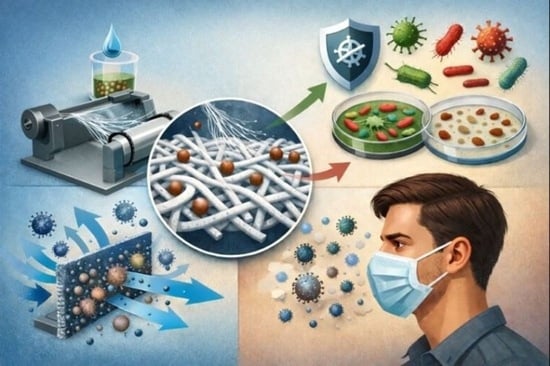
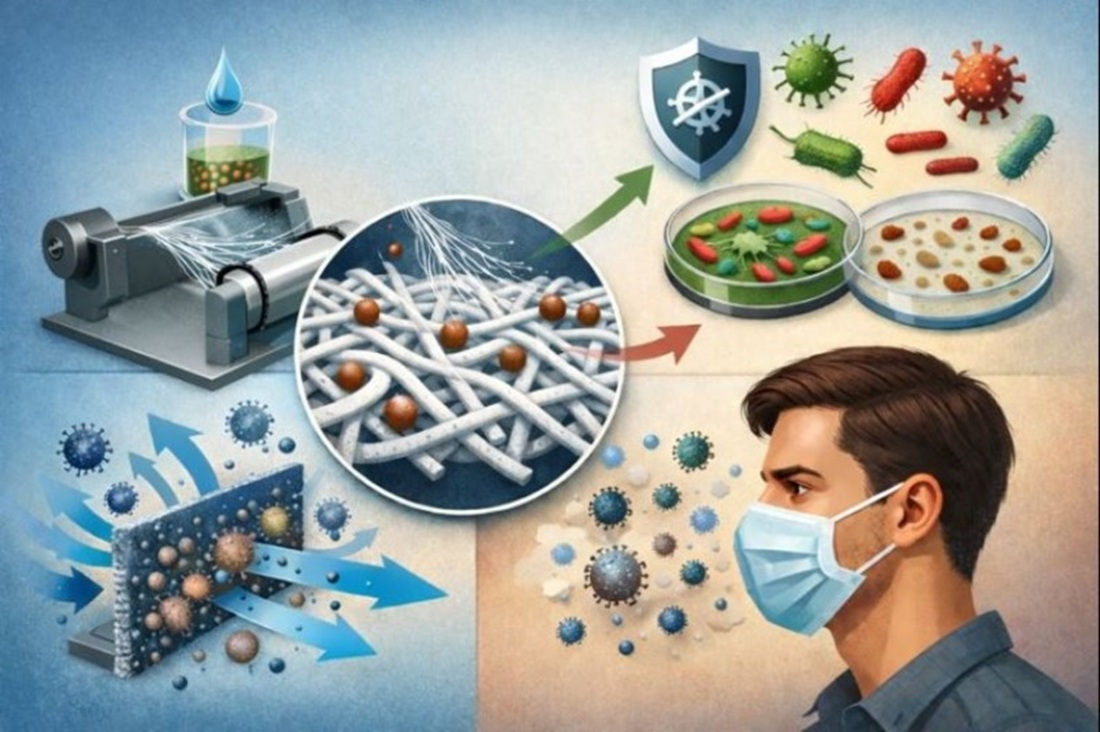
Graphical Abstract

1. Introduction

Recent global events, exemplified by the COVID-19 pandemic, have underscored the critical need for highly effective air filtration systems in protective equipment, such as respiratory masks, to mitigate the spread of viral and bacterial pathogens [1,2]. Airborne contaminants, including pollen, bacteria, free-floating microorganisms, and virus-carrying aerosols, are persistent sources of environmental pollutants and human health threats, frequently leading to severe respiratory infections and allergies. Fine particulate matter (PM), particularly aerosols smaller than 2.5 µm, is deemed especially hazardous due to its small size and complexity, making its removal challenging for conventional air filters [3,4].
Conventional commercial respiratory masks typically rely on melt-blown layers, commonly made of polypropylene (PP), which possess large fiber diameters, usually ranging from 2 to 7 µm, specifically 1–2 µm [5]. While the filtration efficiency can be improved by adding multiple layers, this process significantly increases the air pressure drop, consequently compromising the crucial factor of breathability [6,7]. Moreover, traditional filtration media primarily trap pathogens without inactivating them, which leads to a risk of microbial proliferation on the filter surface [8,9,10].
To overcome these limitations, nanotechnology, particularly the use of nanofibers, offers a promising avenue [2,11]. Nanofibers exhibit unique characteristics, including an extremely high surface-area-to-volume ratio, nanoscale pore size, and a thin fiber architecture [12,13,14]. These features enable remarkably enhanced particle capture capability without significantly reducing air pressure, thereby ensuring good breathability [15,16]. Electrospinning stands out as a rapid, effective, and relatively inexpensive technique for fabricating ultrathin fibers from both natural and synthetic polymers, allowing for precise control over material composition and morphology [17]. Notably, industrial approaches, such as needleless electrospinning, facilitate the mass production necessary for large-scale applications of this technology [18,19].
Polyamide 6 (PA6), a synthetic polymer, is often used in electrospinning due to its durability and potential for high mechanical performance. Previous studies on PA6 nanofibers have suggested good antibacterial efficacy against bacteria, with an inhibition zone of 12–18 mm against S. aureus [20,21,22]. A key strategy to enhance the protective capacity of nanofiber filters involves incorporating antimicrobial and antiviral agents directly into the polymeric matrix [23,24,25]. Copper oxide nanoparticles (CuO NPs) have emerged as a desirable additive, recognized as a cost-effective alternative to noble metal nanoparticles, possessing remarkable antimicrobial and antiviral properties [26,27]. The mechanism by which CuO NPs inhibit pathogens includes the release of metallic ions and the generation of reactive oxygen species (ROS), which cause damage to the bacterial cell membrane and challenge cellular viability [28,29]. CuO compounds are notably effective against both Gram-positive (S. aureus) and Gram-negative (E. coli) bacterial strains [30]. Furthermore, copper-based coatings have demonstrated significant virucidal activity, achieving a 99% reduction in virus replication against viruses such as SARS-CoV-2 within a few hours [31,32].
However, incorporating nanoparticles presents inherent challenges, namely the tendency of NPs to aggregate within the polymer solution due to high surface energy, which can diminish their functional properties [33]. Moreover, the potential leaching of NPs from the material into the environment poses risks of toxicity, limiting the long-term stability and reusability of the composite [34,35]. Therefore, ensuring the stable fixation of CuO NPs within a biocompatible polymeric matrix is essential.
Building on these requirements, this study presents the scalable fabrication of hybrid PA6 nanofiber membranes incorporating uniformly distributed and stably immobilized CuO nanoparticles. Our approach aims to create a non-toxic, environmentally safe composite that achieves dual functionality: high-efficiency aerosol filtration, especially for fine particulate matter, and a strong, sustained antimicrobial performance against common pathogens. By addressing the major limitations of nanoparticle agglomeration and leaching, the produced membranes offer improved stability, breathability, and multifunctional protection, positioning them as promising candidates for hygienic textiles, respiratory masks, and advanced air filtration systems.

2. Materials and Methods

2.1. Materials

Recycled PA6 (Econyl® Recycled 27, Arco, Italy) was supplied by Aquafil S.p.A. The manufacturer does not publicly publish a “typical molecular weight (Mn/Mw)” for ECONYL-recycled PA6 (Arco, Italy). The polymer solution was prepared by dissolving PA6 beads in a mixture of acetic acid and formic acid (VWR International s.r.o., Prague, Czech Republic). Copper (II) oxide (CuO) nanoparticles with a 38 nm average particle size were purchased from Nanografi Nanotechnology (Ankara, Turkey). A recyclable composite spunbond/meltblown polypropylene nonwoven substrate (FNAE 1915 PP SB/MB, 17/25 gsm) used for nanofiber deposition and roll-to-roll production was purchased from Ecotextil s.r.o. (Prague, Czech Republic).

2.2. Preparation of Nanofiber Solutions

The polymer solutions were prepared by dissolving recycled PA 6 granules in a binary solvent system composed of acetic acid and formic acid in a 1:1 volume ratio. The polymer concentration was adjusted to 12.5%, 15%, and 17.5% (w/v) (Table 1). Correctly prepared mixtures exhibited a water-like transparency, whereas turbid or residue-containing mixtures were considered unsuitable for further processing.
Initially, the specified volumes of acetic acid and formic acid were transferred into a glass container and placed on a magnetic stirrer (VELP ARE F20500162, VELP Scientifica Srl, Usmate Velate, Italy). The solvents were pre-mixed using a magnetic stir bar (VELP Scientifica Srl, Usmate Velate, Italy), after which the required amount of PA6 granules was gradually added to prevent aggregation. The stirring speed was maintained at 500 rpm, and the temperature was set to 50 °C to accelerate the dissolution process. The solution was maintained under these conditions until the polymer had completely dissolved, and a homogeneous solution was formed, typically within 3–4 h.
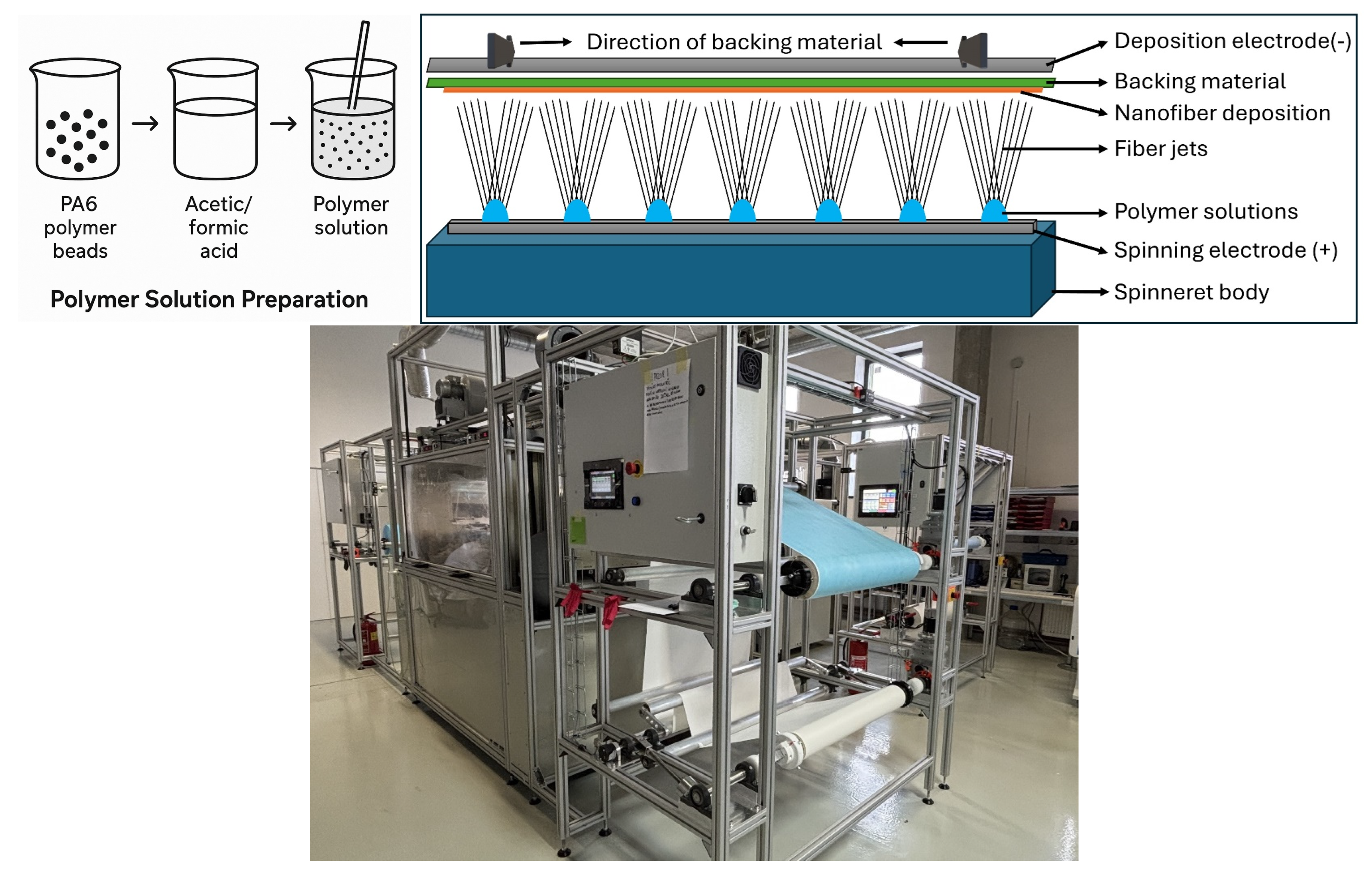
For composite formulations, CuO NPs (5 w/v %) were first dispersed in the acidic solvent system using an IKA T-25 digital ULTRA-TURRAX homogenizer (IKA-Werke GmbH & Co. KG, Staufen, Germany) operated for 30 min. The concentration of CuO was determined and optimized in our previous study [36]. After achieving a uniform nanoparticle dispersion, the mixture was added to the PA6 polymer solution at the target concentration and further mechanically stirred until a homogeneous solution was obtained. The polymer solution preparation, its electrospinning process and nanofiber membrane preparation are illustrated in Figure 1.

2.3. The Electrospinning Process and Fabrication of Nanofiber Membranes

The nanofiber membranes were fabricated using a free-surface needleless electrospinning technique on an industrial-scale electrospinning unit with a spinning width of 80 cm and a total length of 2 m as previously described [19]. Prior to electrospinning, the spinning chamber was conditioned to maintain a relative humidity of 35% and a temperature of 22 °C using an integrated, custom-made air-drying system. These controlled environmental parameters were crucial in ensuring the consistent quality of pristine PA6 nanofibers and their hybrid composites containing additives. The electrospinning system was equipped with a roll-to-roll nanofiber deposition module. A spunbond/meltblown polypropylene substrate (FNAE 1915 PP SB/MB) was loaded onto the unwinder unit, passed through the spinning chamber, and attached to the winder unit for continuous membrane collection.
The spinneret electrodes were positioned 315 mm from the collector electrode, and the polymer solution was supplied through a connected pumping hose. Electrical clamps were connected to the electrode spinnerets to apply a high voltage during the electrospinning process. The polymer solution feed rate was adjusted between 100 mL·h−1, with a shuttle speed of 150 mm·s−1 to regulate uniform solution distribution. Before initiating the process, the chamber was inspected to ensure cleanliness and the absence of any objects that might obstruct machine components or nonwoven substrate movement.
The high-voltage source was set to +70 kV (spinneret electrodes) and −30 kV (collector electrode), and the winding speed was adjusted to 1, 3, 5, 7, and 10 mm·s−1, depending on the desired nanofiber thickness. During electrospinning, the current value displayed on the high-voltage source was continuously monitored to maintain stable nanofiber production, with an optimal range of 0.05 to 0.1 mA.
Upon achieving the target production volume, the electrospinning process was terminated, and the produced nanofiber roll was removed from the winder and prepared for subsequent characterization and analysis.

2.4. Characterization of Nanofiber Membranes

The morphology and average diameter of the pristine PA6 and hybrid nanofiber membranes were analyzed using scanning electron microscopy (SEM; Phenom ProX, Thermo Fisher Scientific, Waltham, MA, USA). Prior to imaging, the samples were trimmed to fit the SEM stubs and sputter-coated with a thin conductive layer of approximately 5 nm gold using a LUXOR_AU coater (Luxor Tech, Mechelen, Belgium) to minimize surface charging effects. The SEM micrographs were processed and analyzed using ImageJ software 1.54r to determine the average fiber diameter and size distribution. The chemical composition and crystallinity of the nanofibers were characterized by Fourier-transform infrared spectroscopy (FTIR; Nicolet iZ10 and Nicolet iN10 MX, Thermo Scientific, Brno, Czech Republic) in the spectral range of 400–4000 cm−1. The elemental composition of the nanofiber membranes was further examined using energy-dispersive X-ray spectroscopy (EDS) coupled with field-emission scanning electron microscopy (FE-SEM; Carl Zeiss ULTRA Plus, Oberkochen, Germany) to obtain qualitative and semi-quantitative elemental mapping based on characteristic X-ray emissions generated by the interaction of the electron beam with the sample surface.

2.5. Filtration Efficiency Test of PA6 Membranes

The air filtration efficiency and pressure drop characteristics of the PA6 nanofiber mats produced via industrial-scale electrospinning were evaluated using a TSI 8130A filtration tester (TSI Incorporated, Shoreview, MN, USA) in accordance with EN 149:2001 [37]. The measurements were conducted at a particle size of 0.3 μm and an airflow rate of 95 L·min−1.

2.6. Filtration Test Results for Bacterial and Viral Filtration Efficiency

2.6.1. Method for In Vitro Determination of Bacterial Filtration Efficiency (BFE)

The bacterial filtration efficiency (BFE) of the PA6 nanofiber membranes was evaluated in accordance with EN 14683: Medical Face Masks—Requirements and Test Methods [38]. This European Standard specifies the construction, design, performance, and testing procedures for medical face masks intended to limit the transmission of infectious agents from staff to patients during surgical procedures and similar medical settings.
The test principle is based on a specimen of the filter material being clamped between a six-stage Andersen cascade impactor and an aerosol chamber (Thermo Fisher Scientific, Franklin, MA, USA). An aerosol containing Staphylococcus aureus is generated in the chamber and drawn through the test specimen and the impactor under vacuum. The BFE is expressed as the percentage reduction in the number of colony-forming units (CFU) that penetrate the mask material relative to the initial challenge aerosol.
Commercially available tryptic soy agar, tryptic soy broth, and peptone water (Sigma-Aldrich, Darmstadt, Germany) were employed for microbial culture and dilution. The bacterial challenge suspension was prepared by inoculating S. aureus into 30 mL of tryptic soy broth in an Erlenmeyer flask and incubating at (37 ± 2) °C for (24 ± 2) h with mild shaking. The culture was then diluted in peptone water to achieve a concentration of approximately 5 × 10⁵ CFU/mL. The bacterial challenge was maintained at (2200 ± 500) CFU per test, with a mean particle size (MPS) of (3.0 ± 0.3) µm.
During testing, the bacterial aerosol was delivered to a nebulizer via a peristaltic or syringe pump. A positive control run was first performed without a test specimen, followed by test runs in which specimens were mounted between the aerosol chamber and the impactor. The flow rate through the cascade impactor was maintained at 28.3 L·min−1, with the bacterial challenge delivered for 1 min and airflow sustained for an additional 2 min. Positive and negative control runs were included before and after each test series.
The BFE (%) was calculated according to Equation (1):
B = ( C T ) C × 100
where C is the mean total plate count from the two positive control runs and T is the total plate count for the test specimen.

2.6.2. Method for In Vitro Determination of Viral Filtration Efficiency (VFE)

The VFE of the nanofiber membranes was evaluated using a procedure analogous to the BFE method, with the challenge organism replaced by bacteriophage phiX174. A specimen of the test material was clamped between a six-stage Andersen cascade impactor and an aerosol chamber, and an aerosolized suspension of the bacteriophage was drawn through the sample under vacuum. The VFE value represents the percentage reduction in plaque-forming units (PFU) that penetrated the test specimen relative to the challenge aerosol.
Commercially available tryptic soy agar, tryptic soy broth, and peptone water were used as culture media and diluents. The VFE test procedure followed ASTM F2101 [39] with controlled parameters ensuring a mean particle size of (3.0 ± 0.3) µm. Two VFE protocols were implemented:
  • VFE 110—the challenge concentration was maintained at (1100 ± 3300) PFU, enabling filtration efficiencies up to >99.9%.
  • VFE 125—the challenge concentration was ≥1 × 10⁶ PFU, allowing efficiencies up to >99.9999%.
In both tests, the bacteriophage phiX174 suspension was aerosolized using a nebulizer and introduced to the sample at a constant flow rate. Aerosol droplets were collected using an Andersen six-stage sampler, allowing for reproducible quantification of viable viral particles that passed through the test material. This standardized method provides a reliable comparison of filtration efficiencies between different nanofiber membranes.

2.7. Bacteriostatic and Bactericidal Properties of Nanofibers

The bacteriostatic and bactericidal activities of the prepared nanofiber membranes were evaluated by coincubation with representative Gram-positive and Gram-negative bacterial strains. The selected strains of Staphylococcus aureus subsp. aureus CCM 2022 (Gram-positive) and Escherichia coli CCM 4517 (Gram-negative) are standard reference (Sourced Czech collection of microorganism, Masaryk University of Brno) microorganisms commonly employed for assessing the antimicrobial efficacy of materials.
For both experiments, Mueller–Hinton agar (MH agar) with a reduced agar concentration was used to enhance the diffusion of potential antibacterial agents. Fresh overnight bacterial cultures of each strain were prepared in nutrient broth and adjusted to a turbidity of 0.5 McFarland standard using a Biosan densitometer (Biosan Ltd., Riga, Latvia) in phosphate buffer. The viable cell count of each bacterial suspension was determined using the plate count agar method to establish the baseline bacterial concentration prior to testing.
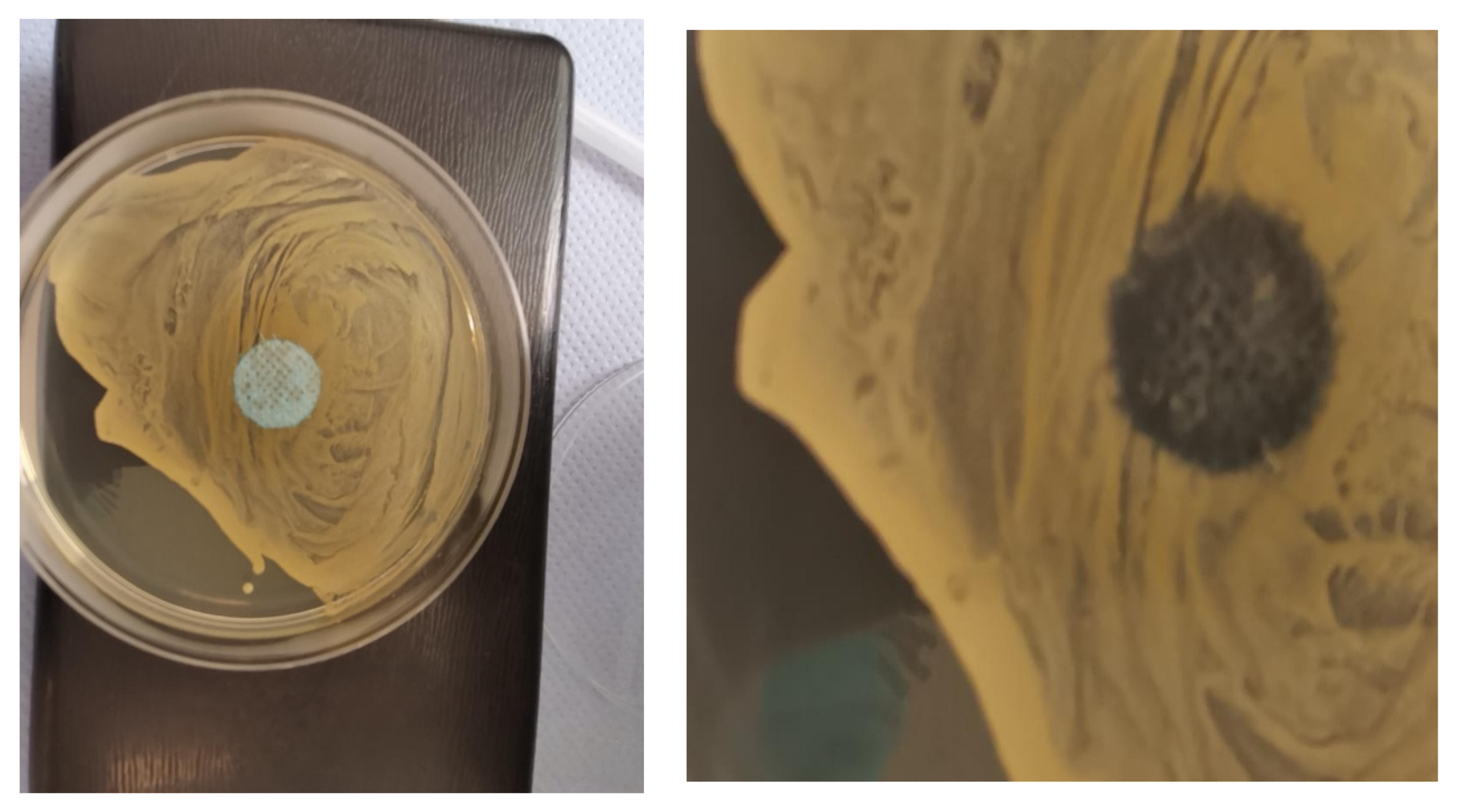
Experiment A (Diffusion Test): Nanofiber samples were placed in direct contact with bacterial suspensions on MH agar plates and incubated for 24 h at 37 °C in triplicate for each strain. Following incubation, the nanofiber specimens were carefully removed with sterile needles and forceps, and the surrounding zones of bacterial growth inhibition or reduction were visually inspected and recorded.
Experiment B (Coincubation in Buffer): To further assess the bacteriostatic/bactericidal effects in liquid medium, nanofiber samples (without a colored protective layer) were coincubated in 1 mL phosphate buffer containing the same concentration of S. aureus CCM 2022 (Sourced Czech collection of microorganism, Masaryk University of Brno) cells as used in the diffusion method. The incubation was carried out for 2 h at room temperature under gentle agitation. Immediately after incubation, the plate count agar method was performed to determine the number of surviving bacterial cells. This test was conducted only for S. aureus CCM 2022, as the E. coli CCM 4517 suspension was not included in the buffer coincubation study.
All experiments were conducted in triplicate, and the results were expressed as the mean values of the observed inhibition zones (Experiment A) and surviving colony counts (Experiment B), providing insight into the bacteriostatic or bactericidal behavior of the tested nanofiber membranes.

2.8. Determination of Antiviral Activity of Nanofiber Membranes

The antiviral properties of the pristine PA6 nanofibers and their CuO NPs hybrid nanofiber membranes were assessed by an accredited external laboratory (Public Health Institute Ostrava, Czech Republic) in accordance with ČSN ISO 18184:2025—Textiles: Determination of Antiviral Activity of Textile Products [40] (Screening Method). The Modified Vaccinia Virus Ankara (MVA; ATCC VR-1508) was selected as the test virus, and BHK-21 (American Type Culture Collection, Manassas, VA, USA) cells were used for viral propagation and titration. The growth medium was Dulbecco’s modified eagle medium (DMEM) supplemented with 10% Fetal bovine serum (FBS).
Samples of each material (0.100 ± 0.012 g) were sterilized by UV radiation and inoculated with 50 µL of viral suspension. The inoculated samples were incubated for 2 h at 25 ± 1 °C and 90% relative humidity under laboratory lighting. After the contact period, 5 mL of neutralizing medium was added, and the mixture was vortexed (5 × 5 s). Serial tenfold dilutions of the neutralized suspension were prepared and titrated on confluent monolayers of BHK-21 cells using a microplate format.
Virus titers were calculated after 6 days of incubation at 37 ± 1 °C according to the Spearman–Kärber method and expressed as log TCID50 mL−1. The antiviral activity value (Mv) was determined as the difference between the mean virus titer on the control material (Va) and that on the tested material (Vc):
M v = V a V c
All validity criteria specified in the standard were fulfilled (control titer variation ≤ 0.2 log TCID50 mL−1).

2.9. Biocompatibility Testing

2.9.1. Cell Seeding and Culture Conditions

Biocompatibility of the pristine nanofibers and hybrid nanofibers was evaluated in the form of extracts. 8.5 cm2 of the material sterilized by ethylene oxide was leached in 6.25 mL of the culture medium for 24 h in the same conditions as the cells were cultured.
3T3 mouse fibroblasts were seeded in a density of 5000 cells/well of a 96-well plate in 200 µL of DMEM (cat. no. D6429, Sigma-Aldrich, Merck, St. Louis, MO, USA.) with 10% Fetal bovine serum (FBS; cat. no. 10270106, Gibco, Thermo Fisher Scientific, Waltham, MA, USA.) and 100 U/mL penicillin (Cat. No. 15140122. Thermo Fisher Scientific, Waltham, MA, USA.) and 100 µg/mL streptomycin (cat. no. P4333, Gibco, Thermo Fisher Scientific, Waltham, MA, USA.) 24 h before the extract addition and cultured at 37 °C, 10% CO2, and high humidity.
200 µL of the extract or culture medium, which served as a negative control, was pipetted on the cells, and cytotoxicity was assessed after 24 and 72 h.

2.9.2. Metabolic Activity

MTS assay (CellTiter 96® AQueous One Solution Cell Proliferation Assay; cat. no. G1111, Promega Corporation, Madison, WI, USA.) was used to analyze cell metabolic activity. Six replicates were used, and one well without cells was used as a background control for the extract. Cells were incubated in MTS solution (20 µL) and 100 μL of the fresh culture medium at 37 °C for 2 h. Mitochondrial enzymes metabolized the MTS substrate to violet formazan absorbing light at 490 nm. The solution’s absorbance (100 µL) was measured in clean microplates using a microplate reader (Infinite M200 PRO, Tecan Group Ltd., Männedorf, Switzerland) at 490 nm with a reference wavelength of 690 nm. The absorbance of the background well was subtracted from the values of the corresponding group.

2.9.3. Cell Morphology

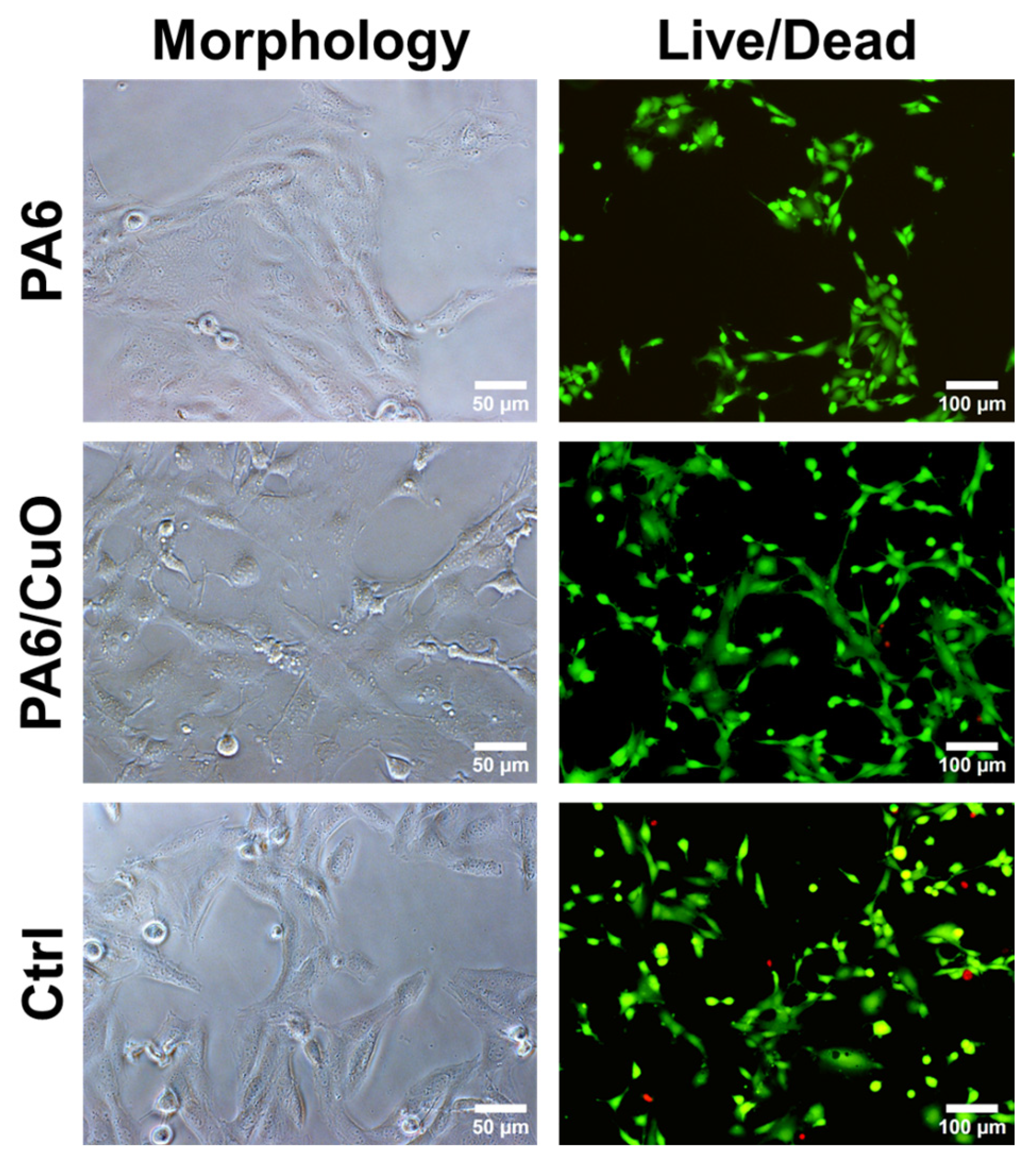
Cell morphology was observed using light microscopy (LM) with an Olympus IX70 microscope equipped with an Olympus DP80 camera, a 20× objective lens, and a 10× eyepiece (Olympus Corporation, Tokyo, Japan).

2.9.4. Live/Dead Staining

The viability of cells was detected using fluorescent live/dead staining (L/D). A 2′,7′-Bis(2-carboxyethyl)-5(6)-carboxyfluorescein acetoxymethyl ester (BCECF-AM; cat.no. B8806, Sigma-Aldrich, Merck, St. Louis, MO, USA.) probe was added to the cells at a concentration of 10 µM in culture medium without any supplements to stain live cells, incubated for 30 min at 37 °C in the dark. BCECF-AM was hydrolyzed inside the live cells by cytosolic esterase to BCECF, which emits light in the green part of the spectrum λex/λem = 503/528 nm. Propidium iodide (PI; cat. no. P4864, Sigma-Aldrich) was added to the cells at a concentration of 5 μg/mL in culture medium without supplements to stain dead cells. The cells were incubated for 10 min at 37 °C in the dark. PI does not penetrate the membrane of living cells, so it stains only the DNA of dead cells. Subsequently, the samples were rinsed with culture medium and visualized using an Olympus IX70 fluorescence microscope with a DP80 camera and a 10× objective lens (Olympus Corporation, Tokyo, Japan).

2.9.5. Statistics and Use of Generative Artificial Intelligence

Statistical evaluation was performed using GraphPad Prism 9.0.2 for each experimental time point. Normality was tested by Shapiro–Wilk test. If the normality test was passed, a One-Way ANOVA with Tukey multiple comparisons test was performed. If the normality test failed, Kruskal–Wallis with Dunn’s multiple comparisons test was performed. The statistical difference between the groups is marked as a line. * p < 0.05, ** p < 0.01, *** p < 0.001, **** p < 0.0001.
Generative artificial intelligence (GenAI) has been used in this paper for interpretation of bactericidal performance of nanofiber membranes.

3. Results

3.1. Electrospinning and Morphological Characteristics of Pristine PA6 Nanofiber Membranes

Pristine PA6 and hybrid nanofibers were electrospun directly onto polypropylene (PP) spunbond/meltblown nonwoven substrates using an industrial-scale electrospinning system [19]. Initially, nanofibers were deposited in various polymer solution concentrations and rewinding (collection) speeds to investigate their influence on fiber morphology and membrane uniformity. The nanofibers fabricated from PA6 solutions of different concentrations exhibited distinct average fiber diameters. Specifically, the 12.5% (w/v) PA6 solution produced nanofibers with an average diameter of approximately 88.3 nm; the 15% (w/v) solution yielded fibers with a diameter of 117.5 nm, and the 17.5% (w/v) solution resulted in thicker fibers with an average diameter of 186.5 nm. The SEM micrographs of hybrid nanofibers with CuO nanoparticles and pristine PA6 nanofibers produced at different polymer solution concentrations using a winding speed of 3 mm·s−1 are presented in Table 2. These images illustrate the morphological differences in fiber diameter and surface uniformity as a function of polymer concentration.
The SEM analysis of the PA6/CuO membranes (Table 2) reveals the presence of sparsely distributed bright micro-objects embedded within the nanofibrous network. Although these features may superficially resemble agglomerated nanoparticles, their well-defined rod- and flower/star-like morphology with sharp faceted edges indicates that they are secondary CuO microcrystals rather than random aggregates. Image analysis of the SEM micrographs shows that these structures have lateral dimensions on the order of a few micrometers (typically ~5–15 µm), much larger than the nominal primary CuO nanoparticle size (~38 nm). Such micron-scale “nanoflowers”, “nanoleaves” and flake-like CuO architectures assembled from nanoscale building blocks are well documented in the literature and are generally attributed to self-assembly and oriented-attachment growth mechanisms. Fan et al. reported the spontaneous formation of CuO nanoflakes and microflowers on copper substrates and explained the flower-like morphology by an oriented-attachment mechanism. Sabbaghan et al. showed that CuO nanostructures composed of 7–28 nm subunits evolve into diverse morphologies dominated by oriented attachment and self-assembly. Zainelabdin et al. [41] further demonstrated that CuO nanoparticles can attach to form nanoleaves and more complex CuO/ZnO “nanocorals”, and a hierarchical oriented-attachment pathway from 1D Cu(OH)2 nanowires to 2D CuO nanoleaves has been explicitly described. In line with these reports, we attribute the micron-sized rod and flower-like objects observed in our membranes to hierarchical CuO crystal formation driven by oriented attachment and recrystallization of the primary nanoparticles during solution preparation and electrospinning, rather than to simple nanoparticle agglomeration.
The EDS and FTIR analyses provided complementary insights into the composition and chemical structure of the pristine 12.5 w/v % PA6 nanofibers and their 5 w/v % CuO nanoparticle-incorporated hybrid nanofibers (Table 3).
The energy-dispersive X-ray spectroscopy (EDS) spectra of the pristine PA6 nanofibers revealed the presence of carbon (C), nitrogen (N), and oxygen (O) as the main elements, corresponding to the typical chemical composition of PA6. In contrast, the EDS spectrum of the CuO-loaded hybrid nanofibers displayed additional peaks attributed to copper (Cu), confirming the successful incorporation of CuO nanoparticles within the nanofiber matrix [42]. The homogeneous distribution of Cu signals across the analyzed area indicated that the nanoparticles were well dispersed throughout the nanofiber surface without visible agglomeration. The relative increase in oxygen content in the hybrid sample further supported the presence of CuO as an inorganic additive.
The Fourier-transform infrared (FTIR) spectra of both pristine and hybrid PA6 nanofibers exhibited the characteristic absorption bands of PA 6: the amide I band at around 1635–1650 cm−1 (C=O stretching), the amide II band near 1535 cm−1 (N–H bending and C–N stretching), and the amide III band at 1260 cm−1. The peaks at 3290–3300 cm−1 and 3070 cm−1 were attributed to N–H stretching vibrations of the amide group, while the absorptions at 2930–2850 cm−1 corresponded to aliphatic C–H stretching of the PA6 backbone.
In the hybrid nanofiber spectrum, these characteristic PA6 peaks were retained, indicating that the polymer’s molecular structure remained intact after CuO incorporation. However, minor spectral shifts and a slight increase in intensity of the bands around 430–600 cm−1 were observed, corresponding to the Cu–O stretching vibration, thus confirming the successful integration of CuO nanoparticles into the PA6 matrix [42,43]. The overall results demonstrated that the addition of CuO did not chemically degrade or alter the PA6 structure, but rather imparted additional functionalities, suggesting strong interfacial compatibility between the nanoparticles and the polymer chains.
These findings confirm that the pristine and CuO-modified PA6 nanofibers maintained their chemical integrity, while the addition of CuO NPs provided a distinct inorganic signature and potential for enhanced antibacterial properties.
As the winding speed decreased, a greater amount of nanofiber material accumulated, resulting in higher membrane basis weight and density, which in turn led to an increase in both filtration efficiency and pressure drop values. Conversely, as the winding speed increased, the nanofiber layer became thinner and less dense, resulting in a reduction in filtration performance accompanied by a corresponding decrease in pressure drop.
By adjusting the rewinding speed of the substrate during electrospinning, nanofibers with varying basis weights were obtained. Lower collection speeds resulted in higher nanofiber deposition and thus denser membrane structures, while higher speeds produced thinner coatings. Consequently, membranes fabricated under different electrospinning parameters exhibited variations in air filtration efficiency and pressure drop characteristics. The filtration performance of pristine PA6 nanofiber membranes produced at different polymer concentrations and rewinding speeds is summarized in Table 4.
The analysis of 21 samples (three times each) and 63 individual filtration tests conducted using a TSI 8130A filtration tester (TSI Incorporated, Shoreview, MN, USA) demonstrated that the most optimal filtration performance was achieved at a winding speed of 3 mm·s−1 when using a 12.5 wt.% PA6 solution. The filtration efficiencies above 98.06% were associated with excessively high pressure drops, making the resulting filter media unsuitable for facemask applications due to poor breathability. Conversely, conditions that produced lower pressure drops also led to reduced filtration efficiency, which is undesirable as insufficient particle or microbial retention compromises the protective function of the filter. Therefore, this parameter set provides the best balance between high filtration efficiency and acceptable pressure drop. This configuration was therefore identified as the primary production parameter set, providing the best balance between filtration efficiency and pressure drop. These optimized parameters will serve as the foundation for subsequent experiments involving the incorporation of functional additives to enhance the filtration capacity further and introduce additional performance features into the nanofiber mats. The variation in fiber diameters observed among the PA6 nanofibers produced at different polymer concentrations was an expected outcome, as higher solution concentrations typically lead to increased fiber thickness. The variation in winding speed, however, did not significantly influence the fiber diameter or morphology. Instead, it primarily affected the density of nanofiber deposition on the nonwoven substrate. All SEM images of prepared nanofibers in 12.5 w/v % concentration has been given in Supplementary Files (Figure S1). The CuO-loaded PA6 membrane achieves a higher filtration efficiency while maintaining the pressure drop within an acceptable and application-relevant range. In contrast, other processing conditions that approach similar efficiencies often require substantially higher pressure drops (e.g., 189.3 Pa at lower efficiency 95.57%).
Therefore, the observed increase from 98.06% to 98.23% is meaningful, not merely statistically but functionally, as it demonstrates an improved efficiency–pressure drop balance, which is a key performance metric for advanced filtration membranes. This improvement is particularly important at high filtration efficiency levels, where further gains are inherently difficult to achieve.
Adding 5 w/v % CuO changes the solution viscosity and introduces solid inclusions [44]. Both effects typically yield (i) smaller pores/higher packing from finer or more tightly packed fibers [45] and (ii) surface roughness and higher surface energy [34], which improve particle capture by diffusion/interception [46]. Those mechanisms explain the rise from 98.06% to 98.23%. The same microstructural changes and possible partial pore blocking by protruding/crystallized nanoparticles also increase flow resistance, resulting in a range of 142 to 162 Pa.
The BFE and VFE of the pristine PA6 and hybrid nanofiber membranes were evaluated in accordance with EN 14683 and ASTM F2101 standards. The results are summarized in Table 5 and Table 6.
The pristine 12.5 wt.% PA6 nanofiber membrane produced at a winding speed of 3 mm·s−1 exhibited an average BFE of 99.27% ± 0.09, demonstrating excellent bacterial barrier performance consistent with Type IIR medical mask requirements. The high BFE values can be attributed to the uniform nanofiber morphology, narrow pore-size distribution, and high surface area of the electrospun mat, which collectively enhance the interception and diffusion-based capture of bacterial aerosols.
The VFE results showed a comparable trend, with efficiencies exceeding 99.2%, confirming that the nanofiber membrane was equally effective in capturing submicron viral aerosols containing bacteriophage φX174. These high VFE values indicate that the PA6 nanofiber structure provides a sufficiently tortuous air pathway capable of retaining viral particles through electrostatic attraction and mechanical sieving.

3.2. Bacteriostatic and Bactericidal Performance of Nanofiber Membranes

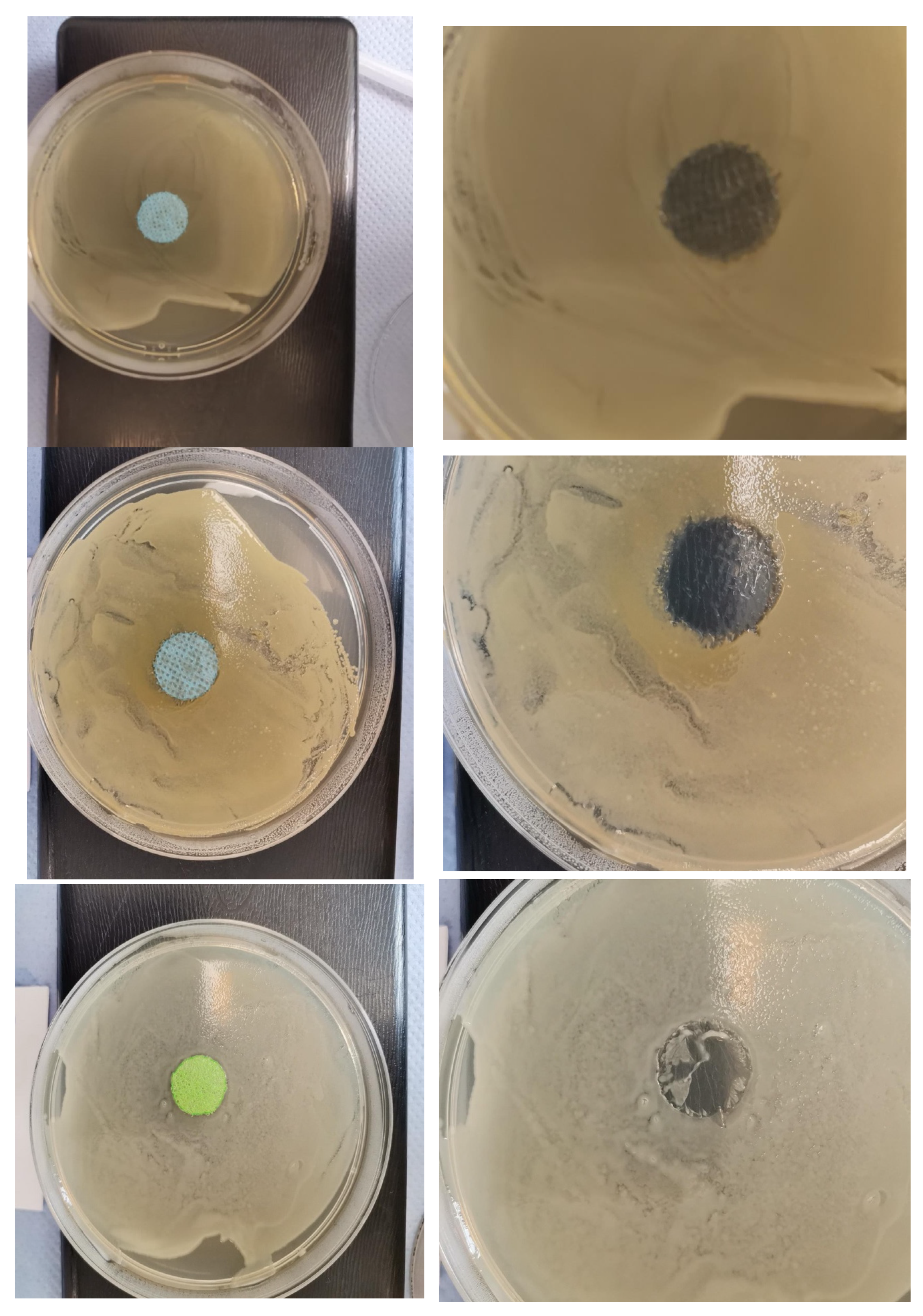
The bacteriostatic and bactericidal activities of the pristine and CuO-modified PA6 nanofiber membranes were evaluated against the Gram-positive Staphylococcus aureus subsp. aureus CCM 2022 and Gram-negative Escherichia coli CCM 4517 strains, following the coincubation and diffusion methods described in Section 2.7. (Figure 2).
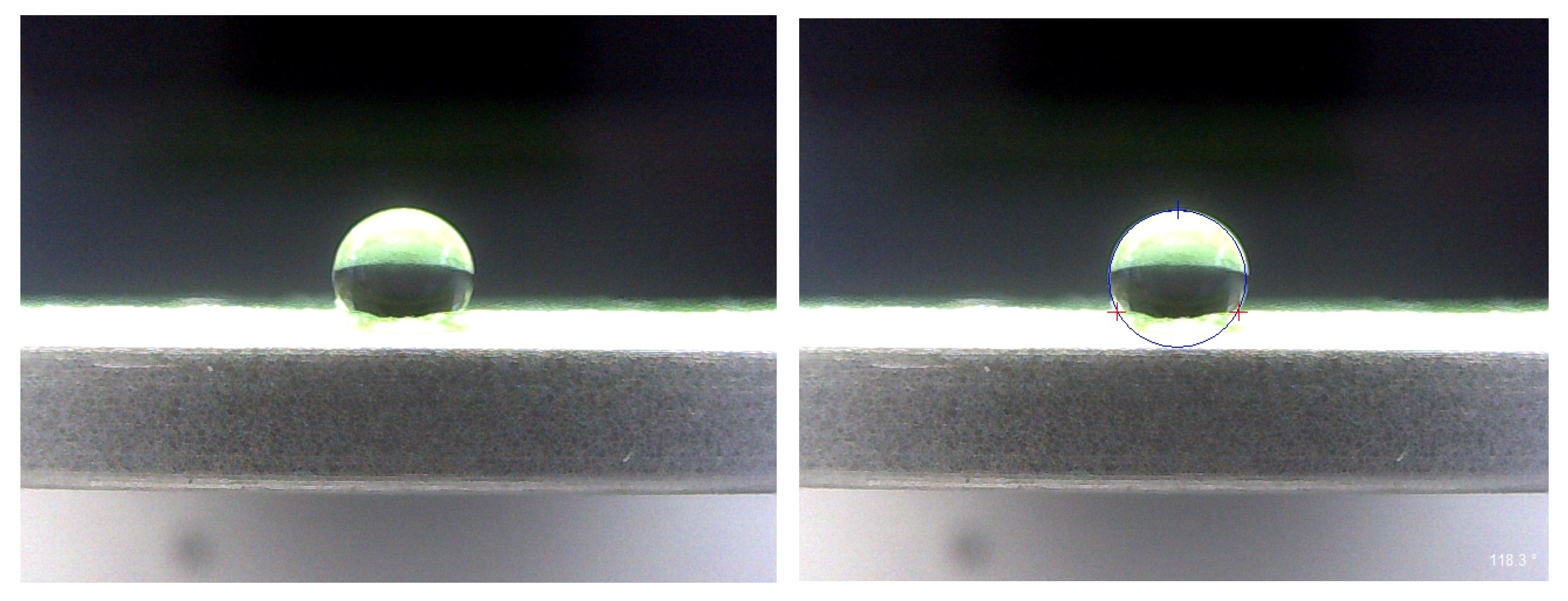
The results revealed that the pristine PA6 nanofiber membranes permitted limited bacterial growth beneath the membrane surface for both bacterial strains. Notably, although bacterial colonies were visible under the samples, no inhibition zones (halo formation) were observed around the pristine membranes, indicating the absence of leachable antibacterial agents. Nevertheless, the overall bacterial growth under the pristine PA6 membranes was lower than expected, suggesting that the dense nanofiber network and hydrophobic surface (Figure 3) may have provided a physical barrier that restricted nutrient diffusion and bacterial proliferation at the membrane interface [47,48].
In contrast, the CuO-incorporated hybrid PA6 nanofibers exhibited strong antibacterial activity against S. aureus (CCM 2022), with a pronounced reduction in viable colonies and clear evidence of bactericidal behavior [49]. This enhanced activity can be attributed to the release of Cu2+ ions and the generation of reactive oxygen species (ROS) from CuO nanoparticles, which disrupt bacterial cell membranes, denature proteins, and interfere with essential metabolic processes [50]. The greater susceptibility of S. aureus is consistent with its Gram-positive cell wall structure, characterized by a thick peptidoglycan layer and the absence of an outer lipid membrane, making it more vulnerable to Cu2+-induced oxidative stress and ion penetration.
However, the hybrid nanofibers showed limited antibacterial efficacy against E. coli (CCM 4517) [51]. This reduced effect is likely due to the outer lipopolysaccharide membrane present in Gram-negative bacteria, which acts as a protective diffusion barrier, reducing the penetration of Cu2+ ions and ROS. Additionally, E. coli possesses multiple efflux mechanisms and antioxidant defenses that mitigate the toxicity of metal ions [52,53].
Overall, these findings suggest that while pristine PA6 nanofibers provide passive bacterial resistance through physical entrapment and restricted nutrient transfer, the incorporation of CuO nanoparticles confers active antibacterial properties, particularly effective against Gram-positive bacteria. The results highlight the potential of CuO-functionalized PA6 nanofiber membranes for antimicrobial air filtration and biomedical protective applications, where bacterial contamination and biofilm formation are critical concerns.
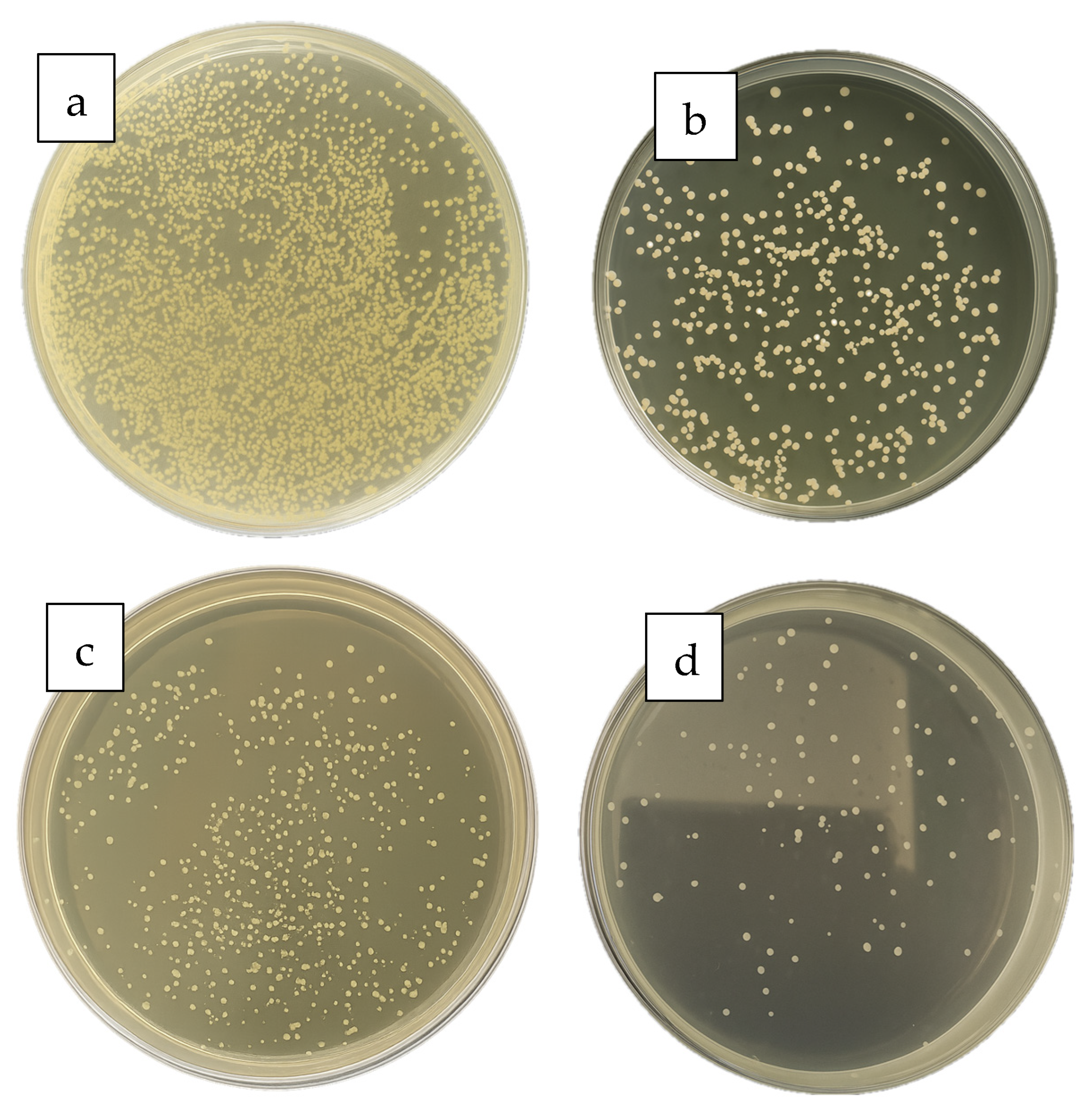
In the 2 h coincubation assay performed in phosphate buffer (1 mL) with S. aureus CCM 2022 (initial concentration 1.16 × 10⁸ CFU·mL−1), the pristine PA6 nanofibers reduced the surviving cell count to 1.25 × 10⁷ CFU·mL−1, whereas the CuO–PA6 hybrid nanofibers (5 wt.% CuO) yielded 4.76 × 10⁷ CFU·mL−1.
[ %   reduction = ( N 0 N t ) / N 0 × 100 ]
Expressed as a percentage reduction, pristine PA6 achieved 89.2% reduction, while CuO–PA6 achieved 59.0% reduction. On a log scale, this corresponds to ~0.97 log10 and 0.39 log10 reductions, respectively (Figure 4).
The counterintuitive superiority of pristine PA6 over PA6-CuO in liquid buffer likely reflects the matrix- and medium-dependent mechanisms rather than an intrinsic lack of activity of CuO. First, phosphate buffer can complex/precipitate Cu2+ (formation of Cu phosphate species), markedly lowering the bioavailable Cu ion fraction [54] and quenching ROS, thereby attenuating CuO’s contact/ion-release-mediated killing [55]. Second, CuO nanoparticles embedded within the PA6 matrix may be poorly exposed to the liquid phase over the short 2 h window (limited wetting/swelling and slow ion-release kinetics), whereas on agar (Experiment A), the same hybrid showed strong activity—consistent with surface-contact-dominated killing in semi-solid media [56,57]. Third, pristine PA6 can still reduce CFU in a small-volume suspension via physical sequestration/adhesion [58] (hydrophobic and electrostatic interactions) and mechanical entrapment of cells within the highly porous/entangled fiber network; this lowers colony counts in the supernatant without requiring any leachable agents, explaining the absence of halos in agar yet a sizable CFU drop in buffer.
Overall, Experiment B indicates that antibacterial efficacy is strongly medium-dependent: the hybrid’s advantage on agar (Experiment A) does not necessarily translate to phosphate-buffered suspensions within short exposure times.

3.3. Antiviral Activity of the Nanofiber Membrane

The antiviral test results are summarized in Table 7 and Table 8. After 2 h of contact with the Modified Vaccinia Virus Ankara, the pristine PA6 control sample exhibited a virus titer of 5.50 log TCID50 mL−1, while the PA6/CuO hybrid nanofiber membrane reduced the viral titer to 3.50 log TCID50 mL−1, corresponding to an antiviral activity value of Mv = 2.00 log, i.e., a 99% reduction in infectious virus particles.
This result demonstrates that the incorporation of CuO nanoparticles effectively enhances the antiviral performance of the PA6 nanofiber membrane. The virucidal effect of CuO is mainly attributed to oxidative stress induced by reactive oxygen species and Cu2+ ion release, which cause structural damage to the viral envelope and degradation of viral proteins and nucleic acids. The MVA strain, being an enveloped virus, is particularly susceptible to such oxidative and ionic mechanisms. It is obvious that the Cu release from CuO is much higher in complex cell-culture media (DMEM + FBS) than in plain PBS, so the bioavailable Cu+/Cu2+ that drives killing is greater in DMEM [59].
In contrast, the pristine PA6 nanofiber membrane showed no significant reduction in viral titer, confirming that CuO acts as the primary antiviral component. The results are consistent with previous literature reporting strong antiviral activity of CuO-embedded polymers and textiles [60,61,62]. The observed 2 log reduction within 2 h places the hybrid PA6/CuO nanofiber membrane among materials with high antiviral efficacy according to ISO 18184 classification.

3.4. Biocompatibility Evaluation of the Nanofibers

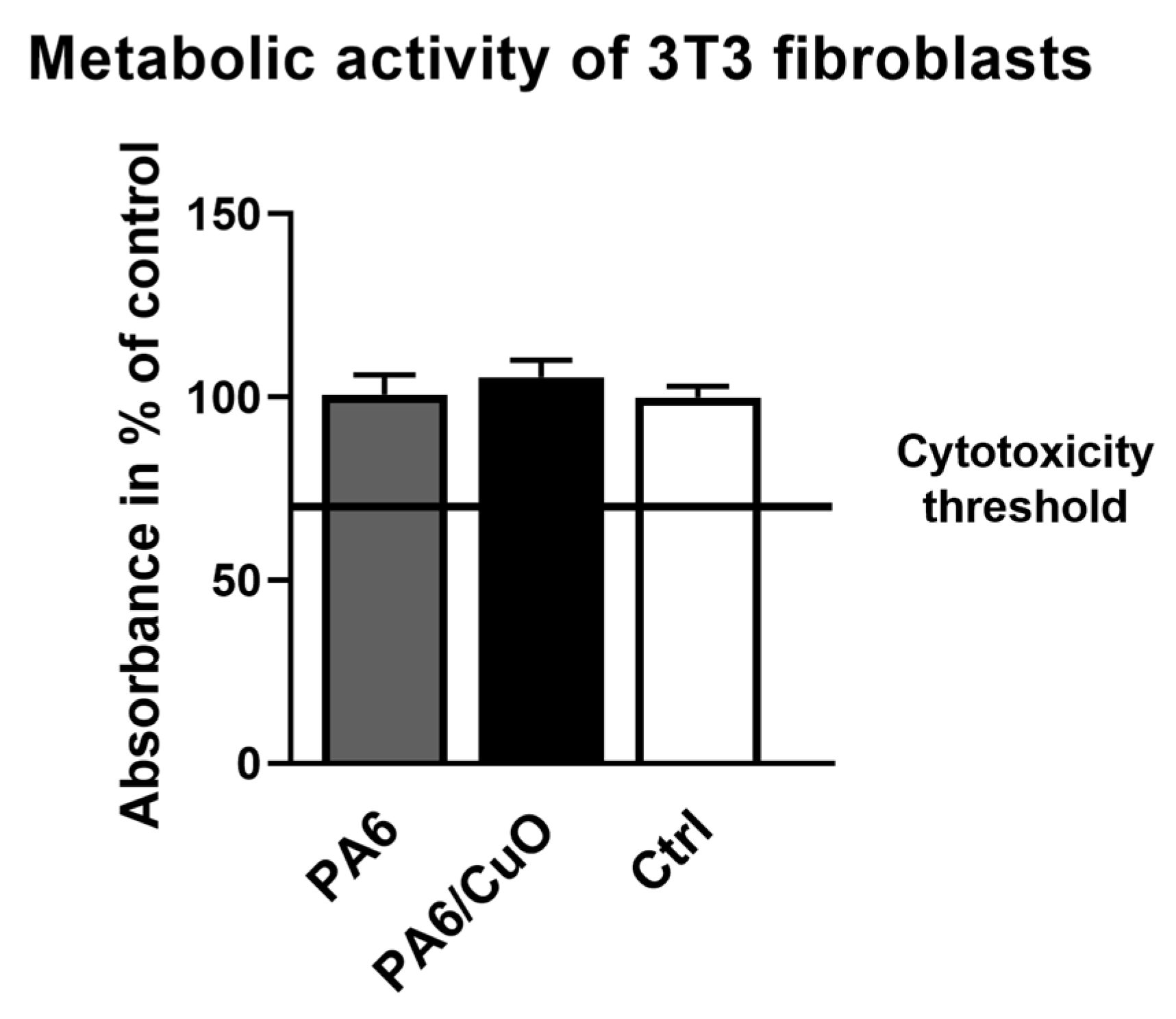
The metabolic activity of 3T3 fibroblasts cultured in extracts from the materials shows no cytotoxic effect after either 24 or 72 (Figure S2) h. The measured values did not fall below 70% of the control, the cytotoxicity threshold. No differences in metabolic activity were observed (Figure 5).
Morphology of the 3T3 fibroblasts cultured in the extract from PA6, PA6/CuO, and control culture medium showed well-spread morphology of adhering cells under the light microscope. No visible differences were observed between the sample groups 24 h after exposure to the extracts (Figure 6).
Live/Dead fluorescent staining confirmed the morphology observed by light microscopy and the viability of the cells (green cytoplasm) in all the sample groups. Almost no dead cells (red nucleus) were observed in any of the sample groups. The number of cells seemed to be comparable among the sample groups. Data shown is only for 24-h cultivation.

4. Conclusions

This study establishes a scalable and environmentally responsible approach for producing recycled PA6 nanofiber membranes and demonstrates their successful functionalization with non-toxic CuO nanoparticles. By optimizing key electrospinning parameters, the work identified 12.5 wt.% PA6 polymer solutions yielding membranes with a filtration efficiency of 98.06% and a pressure drop of 142 Pa. Incorporating 5 wt.% CuO nanoparticles increased membrane density and further enhanced filtration performance to 98.23%, accompanied by a moderate rise in pressure drop to 162 Pa. Structural, chemical, and elemental analyses confirmed the formation of uniform nanofibers and the stable, homogeneous integration of CuO nanoparticles without altering the PA6 chemical structure.
The antimicrobial and antiviral evaluations revealed significant functional advantages: pristine PA6 membranes exhibited passive bacteriostasis, while CuO-modified membranes achieved strong bactericidal activity against Staphylococcus aureus and moderate inhibition of Escherichia coli. Viral testing according to ČSN ISO 18184:2025 demonstrated a 2.0-log reduction (≈99%) in Modified Vaccinia Virus Ankara within 2 h, confirming their virucidal potential. Biocompatibility assays further verified the absence of cytotoxic effects, supporting the safe use of these membranes in respiratory and biomedical filtration applications.
Beyond these specific findings, the study highlights the broader significance of integrating recycled polymers and green-solvent electrospinning into industrial membrane manufacturing. The demonstrated process is directly transferable to continuous production lines and compatible with common nonwoven substrates, offering a practical route toward large-scale, sustainable filtration materials that combine high efficiency, antimicrobial action, and reduced environmental impact.
Several aspects merit further investigation. Long-term performance under operational stress—such as humidity fluctuations, mechanical abrasion, and prolonged airflow—should be explored to assess durability. The kinetics of Cu2+ release and its stability across different environmental conditions remain key variables for ensuring consistent antimicrobial performance. Future work may integrate multiple functional additives, evaluate full-scale prototypes in real filtration systems, and incorporate life-cycle assessment to quantify environmental benefits and industrial feasibility.
In summary, this work delivers a green, recyclable, and multifunctional nanofiber membrane platform that merges technical performance with sustainability principles. The results create a solid foundation for advancing next-generation filtration technologies in personal protective equipment, medical devices, and air purification systems while supporting broader circular economic goals.

Supplementary Materials

The following supporting information can be downloaded at: https://www.mdpi.com/article/10.3390/textiles6010002/s1, Figure S1: SEM images of PA6 nanofibers prepared at different rewinding speeds while maintaining a constant solution concentration of 12.5 wt.%, Figure S2: Metabolic activity of 3T3 fibroblasts in a 24-h extract from PA6 and PA6/CuO measured after 72-h exposition.

Author Contributions

Conceptualization, R.Ž., B.Y. and M.B.; methodology, B.Y., F.Y. and R.Ž.; software, B.Y. and R.Ž.; validation, E.F., B.Y. and M.B.; formal analysis, R.Ž. and E.F.; investigation, R.Ž. and B.Y.; resources, M.B. and E.F.; data curation, M.B. and E.F.; writing—original draft preparation, B.Y. and R.Ž.; writing—review and editing, B.Y. and R.Ž.; visualization, B.Y., F.Y. and R.Ž.; supervision, E.F., M.B. and F.Y.; project administration, M.B.; funding acquisition, M.B. All authors have read and agreed to the published version of the manuscript.

Funding

This paper is funded by the European Union European Defence Fund EDF-2021-OPEN-R-2 under grant agreement 101110262, project Nano-SHIELD. The views and opinions expressed are those of the authors and do not necessarily reflect those of the European Union or the European Commission. Neither the European Union nor the granting authority can be held responsible for them.

Data Availability Statement

The raw data supporting the conclusions of this article will be made available by the authors on request.

Acknowledgments

During the preparation of this manuscript/study, the author(s) used chatgpt5-thinking for the purposes of interpretation of bactericidal performance of nanofiber membranes. The authors have reviewed and edited the output and take full responsibility for the content of this publication.

Conflicts of Interest

Authors Baturalp Yalcinkaya and Matej Buzgo were employed by the company Respilon Membranes s.r.o. The remaining authors declare that the research was conducted in the absence of any commercial or financial relationships that could be construed as potential conflicts of interest.

References

  1. Tabatabaei, N.; Faridi-Majidi, R.; Boroumand, S.; Norouz, F.; Rahmani, M.; Rezaie, F.; Fayazbakhsh, F.; Faridi-Majidi, R. Nanofibers in Respiratory Masks: An Alternative to Prevent Pathogen Transmission. IEEE Trans. NanoBiosci. 2022, 22, 685–701. [Google Scholar] [CrossRef]
  2. Lyu, C.; Zhao, P.; Xie, J.; Dong, S.; Liu, J.; Rao, C.; Fu, J. Electrospinning of Nanofibrous Membrane and Its Applications in Air Filtration: A Review. Nanomaterials 2021, 11, 1501. [Google Scholar] [CrossRef]
  3. Xing, Y.-F.; Xu, Y.-H.; Shi, M.-H.; Lian, Y.-X. The Impact of PM2.5 on the Human Respiratory System. J. Thorac. Dis. 2016, 8, E69. [Google Scholar]
  4. Thurston, G.; Awe, Y.; Ostro, B.; Sanchez-Triana, E. Are All Air Pollution Particles Equal? How Constituents and Sources of Fine Air Pollution Particles (PM2.5) Affect Health; World Bank: Washington, DC, USA, 2021. [Google Scholar]
  5. Drabek, J.; Zatloukal, M. Meltblown Technology for Production of Polymeric Microfibers/Nanofibers: A Review. Phys. Fluids 2019, 31, 91301. [Google Scholar] [CrossRef]
  6. Zhu, M.; Han, J.; Wang, F.; Shao, W.; Xiong, R.; Zhang, Q.; Pan, H.; Yang, Y.; Samal, S.K.; Zhang, F. Electrospun Nanofibers Membranes for Effective Air Filtration. Macromol. Mater. Eng. 2017, 302, 1600353. [Google Scholar] [CrossRef]
  7. Lu, T.; Cui, J.; Qu, Q.; Wang, Y.; Zhang, J.; Xiong, R.; Ma, W.; Huang, C. Multistructured Electrospun Nanofibers for Air Filtration: A Review. ACS Appl. Mater. Interfaces 2021, 13, 23293–23313. [Google Scholar] [CrossRef] [PubMed]
  8. Beckman, I.P.; Berry, G.; Cho, H.; Riveros, G. Alternative High-Performance Fibers for Nonwoven HEPA Filter Media. Aerosol Sci. Eng. 2023, 7, 36–58. [Google Scholar] [CrossRef]
  9. Kemp, P.; Neumeister-Kemp, H.; Lysek, G.; Murray, F. Survival and Growth of Micro-Organisms on Air Filtration Media during Initial Loading. Atmos. Environ. 2001, 35, 4739–4749. [Google Scholar] [CrossRef]
  10. Mittal, H.; Parks, S.R.; Pottage, T.; Walker, J.T.; Bennett, A.M. Survival of Microorganisms on HEPA Filters. Appl. Biosaf. 2011, 16, 163–166. [Google Scholar] [CrossRef]
  11. Amini, G.; Samiee, S.; Gharehaghaji, A.A.; Hajiani, F. Fabrication of Polyurethane and Nylon 66 Hybrid Electrospun Nanofiber Layer for Waterproof Clothing Applications. Adv. Polym. Technol. 2016, 35, 419–427. [Google Scholar] [CrossRef]
  12. Avossa, J.; Batt, T.; Pelet, T.; Sidjanski, S.P.; Schönenberger, K.; Rossi, R.M. Polyamide Nanofiber-Based Air Filters for Transparent Face Masks. ACS Appl. Nano Mater. 2021, 4, 12401–12406. [Google Scholar] [CrossRef]
  13. Blanco, M.; Monteserín, C.; Gómez, E.; Aranzabe, E.; Vilas Vilela, J.L.; Pérez-Márquez, A.; Maudes, J.; Vaquero, C.; Murillo, N.; Zalakain, I. Polycarbonate Nanofiber Filters with Enhanced Efficiency and Antibacterial Performance. Polymers 2025, 17, 444. [Google Scholar] [CrossRef]
  14. Chen, R.; Zhang, H.; Wang, M.; Zhang, X.; Gan, Z. Thermoplastic Polyurethane Nanofiber Membrane Based Air Filters for Efficient Removal of Ultrafine Particulate Matter PM0.1. ACS Appl. Nano Mater. 2020, 4, 182–189. [Google Scholar] [CrossRef]
  15. Liu, H.; Zhang, S.; Liu, L.; Yu, J.; Ding, B. High-performance PM0.3 Air Filters Using Self-polarized Electret Nanofiber/Nets. Adv. Funct. Mater. 2020, 30, 1909554. [Google Scholar] [CrossRef]
  16. Patel, P.; Yadav, B.K.; Patel, G. State-of-the-Art and Projected Developments of Nanofiber Filter Material for Face Mask Against COVID-19. Recent. Pat. Nanotechnol. 2022, 16, 262–270. [Google Scholar] [CrossRef] [PubMed]
  17. Yalcinkaya, F. Preparation of Various Nanofiber Layers Using Wire Electrospinning System. Arab. J. Chem. 2019, 12, 5162–5172. [Google Scholar] [CrossRef]
  18. Yalcinkaya, B.; Strejc, M.; Yalcinkaya, F.; Spirek, T.; Louda, P.; Buczkowska, K.E.; Bousa, M. An Innovative Approach for Elemental Mercury Adsorption Using X-Ray Irradiation and Electrospun Nylon/Chitosan Nanofibers. Polymers 2024, 16, 1721. [Google Scholar] [CrossRef]
  19. Yalcinkaya, B.; Buzgo, M. Optimization of Electrospun TORLON® 4000 Polyamide-Imide (PAI) Nanofibers: Bridging the Gap to Industrial-Scale Production. Polymers 2024, 16, 1516. [Google Scholar] [CrossRef]
  20. Ryšánek, P.; Malý, M.; Čapková, P.; Kormunda, M.; Kolská, Z.; Gryndler, M.; Novák, O.; Hocelíková, L.; Bystrianský, L.; Munzarová, M. Antibacterial Modification of Nylon-6 Nanofibers: Structure, Properties and Antibacterial Activity. J. Polym. Res. 2017, 24, 208. [Google Scholar] [CrossRef]
  21. Dhineshbabu, N.R.; Karunakaran, G.; Suriyaprabha, R.; Manivasakan, P.; Rajendran, V. Electrospun MgO/Nylon 6 Hybrid Nanofibers for Protective Clothing. Nano-Micro Lett. 2014, 6, 46–54. [Google Scholar] [CrossRef]
  22. Jabur, A.R.; Abbas, L.K.; Moosa, S.A. Antibacterial Activity of Electrospun Silver Nitrate/Nylon 6 Polymeric Nanofiber Water Filtration Mats. Al-Khwarizmi Eng. J. 2017, 13, 84–93. [Google Scholar] [CrossRef]
  23. Ali, A.; Baheti, V.; Vik, M.; Militky, J. Copper Electroless Plating of Cotton Fabrics after Surface Activation with Deposition of Silver and Copper Nanoparticles. J. Phys. Chem. Solids 2020, 137, 109181. [Google Scholar] [CrossRef]
  24. Garcia, M.M.; Da Silva, B.L.; Sorrechia, R.; Pietro, R.C.L.R.; Chiavacci, L.A. Sustainable Antibacterial Activity of Polyamide Fabrics Containing ZnO Nanoparticles. ACS Appl. Bio Mater. 2022, 5, 3667–3677. [Google Scholar] [CrossRef]
  25. Zhang, M.; Song, W.; Tang, Y.; Xu, X.; Huang, Y.; Yu, D. Polymer-Based Nanofiber–Nanoparticle Hybrids and Their Medical Applications. Polymers 2022, 14, 351. [Google Scholar] [CrossRef]
  26. Hashmi, M.; Ullah, S.; Kim, I.S. Copper Oxide (CuO) Loaded Polyacrylonitrile (PAN) Nanofiber Membranes for Antimicrobial Breath Mask Applications. Curr. Res. Biotechnol. 2019, 1, 1–10. [Google Scholar] [CrossRef]
  27. Xie, G.; Liu, Z.; Zhu, Z.; Liu, Q.; Ge, J.; Huang, Z. Simultaneous Removal of SO2 and NOx from Flue Gas Using a CuO/Al2O3 Catalyst Sorbent: I. Deactivation of SCR Activity by SO2 at Low Temperatures. J. Catal. 2004, 224, 36–41. [Google Scholar] [CrossRef]
  28. Ma, X.; Zhou, S.; Xu, X.; Du, Q. Copper-Containing Nanoparticles: Mechanism of Antimicrobial Effect and Application in Dentistry-a Narrative Review. Front. Surg. 2022, 9, 905892. [Google Scholar] [CrossRef]
  29. Gudkov, S.V.; Burmistrov, D.E.; Fomina, P.A.; Validov, S.Z.; Kozlov, V.A. Antibacterial Properties of Copper Oxide Nanoparticles. Int. J. Mol. Sci. 2024, 25, 11563. [Google Scholar] [CrossRef] [PubMed]
  30. Azam, A.; Ahmed, A.S.; Oves, M.; Khan, M.S.; Memic, A. Size-Dependent Antimicrobial Properties of CuO Nanoparticles against Gram-Positive and-Negative Bacterial Strains. Int. J. Nanomed. 2012, 7, 3527–3535. [Google Scholar] [CrossRef]
  31. Mantlo, E.K.; Paessler, S.; Seregin, A.; Mitchell, A. Luminore Coppertouch Surface Coating Effectively Inactivates SARS-CoV-2, Ebola Virus, and Marburg Virus in Vitro. Antimicrob. Agents Chemother. 2021, 65, 10–1128. [Google Scholar] [CrossRef] [PubMed]
  32. Hosseini, M.; Chin, A.W.; Behzadinasab, S.; Poon, L.L.; Ducker, W.A. Cupric Oxide Coating That Rapidly Reduces Infection by SARS-CoV-2 via Solids. ACS Appl. Mater. Interfaces 2021, 13, 5919–5928. [Google Scholar] [CrossRef]
  33. Brunelli, A.; Calgaro, L.; Semenzin, E.; Cazzagon, V.; Giubilato, E.; Marcomini, A.; Badetti, E. Leaching of Nanoparticles from Nano-Enabled Products for the Protection of Cultural Heritage Surfaces: A Review. Environ. Sci. Eur. 2021, 33, 48. [Google Scholar] [CrossRef]
  34. Kajau, A.; Motsa, M.; Mamba, B.B.; Mahlangu, O. Leaching of CuO Nanoparticles from PES Ultrafiltration Membranes. ACS Omega 2021, 6, 31797–31809. [Google Scholar] [CrossRef]
  35. Mahlangu, O.T.; Motsa, M.M.; Richards, H.; Mamba, B.B.; George, M.J.; Nthunya, L.N. The Impact of Nanoparticle Leach on Sustainable Performance of the Membranes—A Critical Review. Environ. Nanotechnol. Monit. Manag. 2024, 22, 100984. [Google Scholar] [CrossRef]
  36. Yalcinkaya, B.; Buzgo, M. A Guide for Industrial Needleless Electrospinning of Synthetic and Hybrid Nanofibers. Polymers 2025, 17, 3019. [Google Scholar] [CrossRef] [PubMed]
  37. EN 149:2001; Respiratory Protective Devices—Filtering Half Masks to Protect Against Particles. European Standard Norm: Brussels, Belgium, 2001. Available online: https://standards.iteh.ai/catalog/standards/cen/f440f60a-91c1-497b-815e-4e9d46436256/en-149-2001a1-2009?srsltid=AfmBOoryhMFRgOotTdorm6NvlLLhNQWE2lTmg9hKlQNkDFgBrIjTi9V0 (accessed on 6 November 2025).
  38. EN 14683:2025; European Standard Norm Medical Face Masks—Requirements and Test Methods. ISO: Geneva, Switzerland, 2025. Available online: https://standards.iteh.ai/catalog/standards/cen/a6af61a7-49b8-4db9-aab9-5cae296b5bbf/en-14683-2025?srsltid=AfmBOopX-VxmrY4n_qEzlUw8t7IEl1AbE4MJyiS3uLyhx26_w1UgDtpP (accessed on 6 November 2025).
  39. ASTM F2101; Standard Test Method for Evaluating the Bacterial Filtration Efficiency (BFE) of Medical Face Mask Materials, Using a Biological Aerosol of Staphylococcus Aureus. ASTM International: Conshohocken, PA, USA, 2023. Available online: https://store.astm.org/f2101-22.html (accessed on 6 November 2025).
  40. ISO 18184:2025; The International Organization for Standardization. Textiles—Determination of Antiviral Activity of Textile Products. ISO: Geneva, Switzerland, 2025. Available online: https://www.iso.org/obp/ui/en/#iso:std:iso:18184:ed-3:v1:en (accessed on 6 November 2025).
  41. Zainelabdin, A.; Amin, G.; Zaman, S.; Nur, O.; Lu, J.; Hultman, L.; Willander, M. CuO/ZnO Nanocorals synthesis via hydrothermal technique: Growth mechanism and their application as Humidity Sensor. J. Mater. Chem. 2012, 22, 11583–11590. [Google Scholar] [CrossRef]
  42. Arun, K.; Batra, A.; Krishna, A.; Bhat, K.; Aggarwal, M.; Francis, P.J. Surfactant Free Hydrothermal Synthesis of Copper Oxide Nanoparticles. Am. J. Mater. Sci. 2015, 5, 36–38. [Google Scholar]
  43. Varughese, A.; Kaur, R.; Singh, P. Green Synthesis and Characterization of Copper Oxide Nanoparticles Using Psidium Guajava Leaf Extract; IOP Publishing: Bristol, UK, 2020; Volume 961, p. 012011. [Google Scholar]
  44. Al Kayal, T.; Giuntoli, G.; Cavallo, A.; Pisani, A.; Mazzetti, P.; Fonnesu, R.; Rosellini, A.; Pistello, M.; D’Acunto, M.; Soldani, G. Incorporation of Copper Nanoparticles on Electrospun Polyurethane Membrane Fibers by a Spray Method. Molecules 2023, 28, 5981. [Google Scholar] [CrossRef]
  45. Mpukuta, O.; Dincer, K.; Özaytekin, İ. Effect of Dynamic Viscosity on Nanofiber Diameters and Electrical Conductivity of Polyacrylonitrile Nanofibers Doped Nano-Cu Particles. Int. J. Innov. Eng. Appl. 2020, 4, 1–8. [Google Scholar] [CrossRef]
  46. Salkovskiy, Y.; Fadeev, A. High-Efficiency Retention of Ultrafine Aerosols by Electrospun Nanofibers. Sci. Rep. 2022, 12, 20850. [Google Scholar] [CrossRef]
  47. Habibi, S.; Ghajarieh, A. Application of Nanofibers in Virus and Bacteria Filtration. Russ. J. Appl. Chem. 2022, 95, 486–498. [Google Scholar] [CrossRef]
  48. Yang, K.; Shi, J.; Wang, L.; Chen, Y.; Liang, C.; Yang, L.; Wang, L.-N. Bacterial Anti-Adhesion Surface Design: Surface Patterning, Roughness and Wettability: A Review. J. Mater. Sci. Technol. 2022, 99, 82–100. [Google Scholar] [CrossRef]
  49. Wardlaw, T.A.; Masri, A.; Brown, D.M.; Johnston, H.J. Assessing Antibacterial Properties of Copper Oxide Nanomaterials on Gut-Relevant Bacteria In Vitro: A Multifaceted Approach. Nanomaterials 2025, 15, 1103. [Google Scholar] [CrossRef]
  50. Chen, S.; Xie, Y.; Ma, K.; Wei, Z.; Ran, X.; Fu, X.; Zhang, C.; Zhao, C. Electrospun Nanofibrous Membranes Meet Antibacterial Nanomaterials: From Preparation Strategies to Biomedical Applications. Bioact. Mater. 2024, 42, 478–518. [Google Scholar] [CrossRef]
  51. Gad, E.S.; Salem, S.S.; Selim, S.; Almuhayawi, M.S.; Alruhaili, M.H.; Al Jaouni, S.K.; Saddiq, A.A.; Owda, M.E. A Comprehensive Study on Characterization of Biosynthesized Copper-Oxide Nanoparticles, Their Capabilities as Anticancer and Antibacterial Agents, and Predicting Optimal Docking Poses into the Cavity of S. Aureus DHFR. PLoS ONE 2025, 20, e0319791. [Google Scholar] [CrossRef] [PubMed]
  52. Maher, C.; Hassan, K.A. The Gram-Negative Permeability Barrier: Tipping the Balance of the in and the Out. MBio 2023, 14, e01205-23. [Google Scholar] [CrossRef] [PubMed]
  53. Borisov, V.B.; Siletsky, S.A.; Nastasi, M.R.; Forte, E. ROS Defense Systems and Terminal Oxidases in Bacteria. Antioxidants 2021, 10, 839. [Google Scholar] [CrossRef]
  54. Hans, M.; Erbe, A.; Mathews, S.; Chen, Y.; Solioz, M.; Mücklich, F. Role of Copper Oxides in Contact Killing of Bacteria. Langmuir 2013, 29, 16160–16166. [Google Scholar] [CrossRef] [PubMed]
  55. Edwards, M.; Hidmi, L.; Gladwell, D. Phosphate Inhibition of Soluble Copper Corrosion By-Product Release. Corros. Sci. 2002, 44, 1057–1071. [Google Scholar] [CrossRef]
  56. Wang, J.; Zhu, Y.; Zhang, G.; Liu, J.; Shen, T.; Wei, X. Design on Antibacterial and Cytocompatible TiO2-CuxO/Ag Coating through Regulation of Ions Release. J. Mater. Res. Technol. 2024, 30, 3766–3779. [Google Scholar]
  57. Kent, R.D.; Vikesland, P.J. Dissolution and Persistence of Copper-Based Nanomaterials in Undersaturated Solutions with Respect to Cupric Solid Phases. Environ. Sci. Technol. 2016, 50, 6772–6781. [Google Scholar] [CrossRef] [PubMed]
  58. Čuk, N.; Simončič, B.; Fink, R.; Tomšič, B. Bacterial Adhesion to Natural and Synthetic Fibre-Forming Polymers: Influence of Material Properties. Polymers 2024, 16, 2409. [Google Scholar] [CrossRef]
  59. Hedberg, J.; Karlsson, H.L.; Hedberg, Y.; Blomberg, E.; Wallinder, I.O. The Importance of Extracellular Speciation and Corrosion of Copper Nanoparticles on Lung Cell Membrane Integrity. Colloids Surf. B Biointerfaces 2016, 141, 291–300. [Google Scholar] [CrossRef]
  60. Jayaramudu, T.; Kokkarachedu, V. CuO Nanoparticles for Antimicrobial/Antiviral Applications. In Nanoparticles in Modern Antimicrobial and Antiviral Applications; Springer: Berlin/Heidelberg, Germany, 2024; pp. 97–118. [Google Scholar]
  61. Abd-Elhameed, A.Y.; Eladly, A.M.; Abdel-radi, A.W.; Mekky, A.E. In Vitro Myco-Synthesized Copper Oxide Nanoparticles: A Promising Antiviral Agent with Antioxidant, Anti-Inflammatory, and Anti-Cancer Activity. Microb. Biosyst. 2024, 9, 1167. [Google Scholar] [CrossRef]
  62. Cui, W.Y.; Yoo, H.J.; Li, Y.G.; Baek, C.; Min, J. Electrospun Nanofibers Embedded with Copper Oxide Nanoparticles to Improve Antiviral Function. J. Nanosci. Nanotechnol. 2021, 21, 4174–4178. [Google Scholar] [CrossRef] [PubMed]
Figure 1. Schematic diagram of the polymer solution and nanofiber preparation, pilot size electrospinning device [36]. Adapted from [36], Polymers, 2025.
Textiles 06 00002 g001
Figure 2. In vitro antibacterial diffusion test (Experiment A) of pristine PA6 and PA6-CuO hybrid nanofiber membranes against Gram-positive (S. aureus CCM 2022) and Gram-negative (E. coli CCM 4517) bacterial strains.
Textiles 06 00002 g002aTextiles 06 00002 g002b
Figure 3. Polyamide 6 nanofiber contact angle, (118.3°).
Textiles 06 00002 g003
Figure 4. Coincubation assay (Experiment B) showing bacterial growth of Staphylococcus aureus CCM 2022 after exposure to pristine PA6 (a) suspension with coincubated nanomaterial diluted 3 times, (b) suspension with coincubated nanomaterial diluted 4 times and CuO-modified PA6 (c) suspension with coincubated nanomaterial diluted 3 times, (d) suspension with coincubated nanomaterial diluted 4 times, nanofiber membranes in phosphate buffer (2 h).
Textiles 06 00002 g004
Figure 5. Metabolic activity of 3T3 fibroblasts in 24-h extract from PA6 and PA6/CuO measured after 24-h exposition. Culture medium served as a negative control. The cytotoxic threshold, 70% of the metabolic activity of the control, is marked as a line.
Textiles 06 00002 g005
Figure 6. Morphology and Live/Dead staining of 3T3 fibroblasts cultured in the 24-h extracts from PA6, PA6/CuO, and in the culture medium, which served as a negative control. Morphology was observed 24 h after exposure to the extracts by light microscope. Scale bar 50 µm. Live/Dead staining was observed 24 h after exposure to the extracts by epifluorescence microscope. The cell cytoplasm of live cells is stained in green; the nuclei of dead cells are stained in red. Scale bar 100 µm.
Textiles 06 00002 g006
Table 1. Concentration of PA6 polymer solutions and their composite formulations.
Polymer/NanoparticleConcentration (w/v) %SolventSolvent Ratio
PA612.5Acidic/formic acid1/1
PA615.0Acidic/formic acid1/1
PA617.5Acidic/formic acid1/1
PA6/CuO12.5/5Acidic/formic acid1/1
Table 2. SEM images of pristine PA6 nanofibers and fiber diameter distributions.
Textiles 06 00002 i001Textiles 06 00002 i002
Textiles 06 00002 i003Textiles 06 00002 i004
Textiles 06 00002 i005Textiles 06 00002 i006
Textiles 06 00002 i007Textiles 06 00002 i008
Table 3. EDS analysis and FTIR test results of PA6 pristine and hybrid nanofibers.
Textiles 06 00002 i009
Textiles 06 00002 i010
Textiles 06 00002 i011
Table 4. Filtration efficiency test result of pristine PA6 nanofibers deposited in various solution concentrations and substrate winding speeds according to EN 149:2001.
Polymer Solution Concentrations12.5 w/v %15 w/v %17.5 w/v %
Substrate Winding Speed for Nanofiber DepositionsFE (%)Pressure Drop (Pa)FE (%)Pressure Drop (Pa)FE (%)Pressure Drop (Pa)
1 mm/s99.98 ± 0.01354.8 ± 1699.86 ± 0.12312.6 ± 3899.79 ± 0.15311.2 ± 17
2 mm/s99.34 ± 0.25191.9 ± 5.898.91 ± 0.21209.6 ± 2.797.57 ± 0.24189.3 ± 1.4
3 mm/s98.06 ± 0.03142.5 ± 5.896.56 ± 0.53158.6 ± 2.286.88 ± 0.79128.3 ± 1.9
4 mm/s88.32 ± 2.37110.8 ± 5.592.68 ± 0.43134.4 ± 2.985.52 ± 1.37121.5 ± 5.4
5 mm/s89.22 ± 2.56110.7 ± 4.289.10 ± 0.14120.2 ± 1.076.71 ± 5.67107.2 ± 2.3
7 mm/s82.85 ± 1.30101.0 ± 1.776.98 ± 1.75103.3 ± 2.074.38 ± 0.63100.9 ± 2.0
10 mm/s78.47 ± 3.9689.9 ± 3.971.81 ± 1.7194.8 ± 0.666.22 ± 2.3585.9 ± 3.0
Table 5. Bacterial filtration efficiency of pristine PA6 nanofibers.
SampleSample NoBFE Results
12.5 w/v % PA6199.29%
299.16%
399.35%
499.27%
Average99.26%
Table 6. Viral filtration efficiency of pristine PA6 nanofibers.
SampleTestSample NoVFE Results
12.5 w/v % PA6Viral Filtration Efficiency
(VFE 110)
(%)
(0.3 µm)
199.21
299.17
399.48
499.11
599.46
699.31
Average99.29
Viral Filtration Efficiency
(VFE125)
(%)
(0.3 µm)
199.13
299.12
399.10
499.10
599.12
699.15
Average99.12
Table 7. The results for Vaccinia virus, strain Modified Vaccinia virus Ankara.
Samplelg TCID50/mL
2 h
Value of Antiviral
Activity (Mv)
2 h
PA6/CuO (Vc)35002000
Control Sample (Va)5500
Table 8. Control of test homogeneity.
Contact Timelg TCID50/mL
Max
lg TCID50/mL
Min
lg TCID50/mL
Mean
Max–Min
Mean
Control Valid
(≤0.2)
Pristine PA6 Nanofibers—2 h5.505.505.500.00Yes
Disclaimer/Publisher’s Note: The statements, opinions and data contained in all publications are solely those of the individual author(s) and contributor(s) and not of MDPI and/or the editor(s). MDPI and/or the editor(s) disclaim responsibility for any injury to people or property resulting from any ideas, methods, instructions or products referred to in the content.