Article

Full-Field In-Plane Tensile Characterization of Cotton Fabrics Using 2D Digital Image Correlation


1
University of Belgrade, Faculty of Mechanical Engineering, Center for Optical Measurement, 11000 Belgrade, Serbia
2
Department for Forensic Engineering, University of Criminal Investigation and Police Studies, 11000 Belgrade, Serbia
3
Academy of Technical-Art Vocational Studies, 11000 Belgrade, Serbia
4
CIS Institute, 11000 Belgrade, Serbia
5
University of East Sarajevo, Faculty of Technology Zvornik, 75400 Zvornik, Bosnia and Herzegovina
*
Author to whom correspondence should be addressed.
Textiles 2025, 5(4), 67; https://doi.org/10.3390/textiles5040067
Submission received: 5 October 2025 / Revised: 4 November 2025 / Accepted: 26 November 2025 / Published: 11 December 2025

Abstract

Textile materials are widely used in diverse applications, yet their anisotropic structure and large deformations present major challenges in mechanical characterization. Conventional uniaxial tensile tests can quantify bulk properties but offer limited insight into local strain distributions. In this work, it was shown that a 2D Digital Image Correlation (DIC) technique captures full-field strain data in three types of woven cotton fabrics with distinct weave patterns and densities, each tested in warp and weft orientations. In controlled tensile experiments conducted per EN ISO 13934-1, DIC revealed that strain in the loading direction (EpsY) was highly orientation-dependent (p < 0.001), whereas strain perpendicular to loading (EpsX) was unaffected by orientation (p = 0.193). These findings contrast with traditional tensile data, which indicate significant orientation effects on maximum force and elongation (both p < 0.001). Compared to point-based techniques, 2D DIC provided richer information on anisotropic deformation, including the ability to detect local strain concentrations before failure. The strong interaction between fabric type and orientation indicates that each fabric exhibits distinct strain response when loaded along warp and weft directions, underscoring the importance of evaluating both orientations when designing or selecting textiles for multidirectional loading. By combining standard tensile testing with full-field optical strain measurements, a more comprehensive understanding of textile behavior emerges, enabling improved material selection, enhanced product performance, and broader applications in engineering and textile fields.

1. Introduction

Textiles play an important role in various applications, ranging from simple household products to advanced technical uses [1]. Textiles encompass products with diverse functionalities, requiring strict adherence to performance criteria like tensile strength, elasticity, air permeability, biocompatibility [2,3,4,5,6,7,8,9], etc. The functionality of textiles depends on meeting these criteria, emphasizing the necessity of precise mechanical characterization. Strength is one of the main mechanical properties in performance tests for any textile material.
Standardized tensile tests are widely employed to assess material strength functionality [10,11]. These tests typically demonstrate that extension, rather than shear, is the primary breaking mechanism at the micro level for fibrous materials. However, woven fabrics are bi-modular, anisotropic, and dimensionally variable under external loading, creating challenges in their experimental analysis [11,12]. Although theoretically significant, traditional tensile tests are time-consuming, costly, and provide limited insights into textile properties due to their reliance on point-based strain measurements and labor-intensive setups.
Fabric strength prediction holds theoretical and practical significance; however, aside from uniaxial tensile strength, all other strengths must be measured experimentally. This process is often time-consuming and costly due to the lack of straightforward test procedures and tools. Optical methods like Digital Image Correlation (DIC) address these limitations by enabling precise strain and displacement characterization under moderate loads. DIC provides detailed, full-field strain data, making it highly valuable for analyzing specimen behavior under tensile loading [13,14,15,16]. By capturing strain distribution across the entire surface, DIC provides deeper insights compared to traditional point-based methods, particularly for anisotropic materials such as textiles.
In textile research, understanding local strain distributions is crucial because fabrics exhibit highly heterogeneous deformation patterns due to their woven architecture, yarn crimp, and inter-fiber slippage. Traditional tensile tests provide only average or bulk mechanical parameters, which cannot capture localized effects such as strain concentration around yarn crossovers, regions of differential extension between warp and weft, or early onset of damage. Mapping local strain fields enables a more accurate interpretation of the fabric’s anisotropic behavior and structural integrity, especially in applications where local overstretching or non-uniform deformation may lead to premature failure. With the use of the contactless optical Digital Image Correlation method [17], full-field displacement and strain measurements are possible, significantly addressing the limitations of traditional techniques. By acquiring large datasets in a single experiment, DIC minimizes setup time and costs while identifying critical strain areas and principal stress orientations. These capabilities enable a deeper understanding of material behavior during testing, consolidating its advantages as a comprehensive optical technique for strain analysis [18,19].
The aim of this paper is to demonstrate, quantitatively and with statistical rigor, that a single-camera 2D Digital Image Correlation (2D-DIC) setup can deliver reliable, full-field strain data for woven fabrics subjected to the standard strip tensile method (EN ISO 13934-1). Unlike earlier textile-focused DIC reports, which have been largely qualitative or limited to one fabric architecture, we (i) benchmark three industrial-grade cotton fabrics with distinct mass per unit area, (ii) evaluate anisotropic behavior in both warp and weft orientations, and (iii) validate DIC-derived strain fields against force–elongation data through two-way ANOVA and Tukey post hoc analysis. By establishing the accuracy of 2D-DIC in capturing longitudinal, transverse, and Poisson-related strains up to failure, the study provides a reproducible protocol that can shorten test cycles, reduce experimental setup and handling time, and supply designers with spatially resolved strain maps unavailable from conventional extensometry. These contributions position 2D-DIC as a practical, higher-information alternative for routine mechanical characterization in textile design, manufacturing, and quality-assurance workflows.

2. Materials and Methods

A planar textile specimen is subjected to uniaxial tensile testing in accordance with the protocol outlined in EN ISO 13934-1 [20]. The standard describes the method for calculating the maximum force and equivalent elongation of textile materials using the strip method. This approach is used on woven textile materials, such as fabrics with stretch properties based on the presence of an elastomeric fiber, mechanical treatment, or chemical treatment [6]. The strip method, as outlined in EN ISO 13934-1, was selected for its proven reliability in evaluating the tensile properties of anisotropic textiles, ensuring accurate characterization of warp and weft behaviors.
In this study, three specimens for each group of materials were prepared using three cotton textiles for warp and weft separately, marked as Fabric 1, Fabric 2, and Fabric 3, with 18 samples in total. Although EN ISO 13934-1 prescribes a minimum of five specimens per direction for certification testing, the present study followed the standard’s geometry and loading conditions but used a smaller sample set for method validation purposes. Basic fabric properties are presented in Table 1. As shown in Figure 1 strip specimens with dimensions of 50 mm × 350 mm were created in accordance with standard EN ISO 13934-1 [20]. Each specimen was inserted into the tensile testing machine, which measured each specimen until it broke. All experiments were performed in a controlled atmosphere at 20 ± 2 °C and 65 ± 5% relative humidity. The specimens were tested without prior 24 h conditioning, but identical environmental conditions were maintained for all fabric types and orientations to ensure result consistency.
The Tinius Olsen H10KT tensile testing machine (Tinius Olsen, Redhill, UK) was used for all experiments. The specimens were fixed with flat-plate pneumatic grips. For all measurements, tensile loading was carried out using displacement control, with the upper grip moving at a constant speed of 100 mm/min to maintain uniform strain rates during testing. The pneumatic grips were placed 200 mm apart from one another. The preload of 2.0 N was applied for each experiment to ensure consistent tension across specimens before initiating tensile loading.
The DIC method is applied in single-camera or two-camera systems, allowing for two-dimensional (2D-DIC) and three-dimensional (3D-DIC) measurement outputs, respectively [21,22,23]. In the case of 2D-DIC, it is essential that the planar object moves in the object plane, which is nominally parallel to the sensor plane of the camera [17,18,19]. Opposed to 3D-DIC, 2D-DIC has several drawbacks (out-of-plane movement should be avoided, the object should be flat, etc.), but it also has some benefits, such as straightforward calibration, simple experimental setup, faster result computing, etc. So, when using 2D-DIC for in-plane measurement, the following three hypotheses are typically held true:
  • The sample is presumably planar. This presumption holds for initially flat specimens with or without geometric discontinuities (such as cracks, notches, or cut-outs) or gradients in material characteristics.
  • The camera sensor plane and the sample plane are parallel. A nominally planar object is considered to be subjected to a combination of in-plane tension, in-plane shear, or in-plane biaxial loading so that the sample primarily deforms inside the original planar surface. Poisson’s effect in the crack tip region (which causes slight out-of-plane motion) is expected to be minimal in comparison to the applied in-plane deformations when cracked or notched specimens are loaded.
  • The loaded sample is deformed only in the original plane.
The surface structure is an essential requirement for measurement. To clearly assign the pixels in the camera images, the specimen’s surface must be patterned. The relevant pixel area in the target image can then be assigned to a pixel area in the reference image. To create a stochastic pattern with high contrast, black paint dots were applied to one surface of the specimen. The Basler acA-1920 camera (Basler, Ahrensburg, Germany), paired with a 50 mm lens, was chosen for its high resolution and ability to capture detailed strain patterns. Camera was positioned at a distance of 103 cm from the specimen. Consistent illumination using an LED lamp minimized shadows and ensured accurate image acquisition (Figure 1a). Figure 1a shows the experimental optical setup. The region of interest of the strip specimen is shown in Figure 1b; it was used to measure the surface strain.
In this study, images were taken automatically at a frequency of one picture per second. Both tensile loading and image acquisition began at the same time. After the experiment, the strain was calculated using GOM Correlate 2018 software (GOM, Braunschweig, Germany) and further analysis was conducted using Python 3. The Python was utilized for advanced strain data post-processing, using libraries NumPy 2.3 for numerical analysis and Matplotlib 3.10 for visualizing strain distributions.

2.1. Statistics

Statistical analysis was performed for two set of results: (1) maximum force and elongation recorded on tensile testing machine and (2) strain values obtained by DIC measurement. Statistical results and conclusions are compared afterwards. The statistical analysis was carried out using Python.

2.1.1. Maximum Force and Elongation Recorded on Tensile Testing Machine

In order to assess the mechanical properties of three distinct cotton fabrics (Fabric 1, Fabric 2, and Fabric 3) under tensile loading, a statistical analysis was conducted, and two factors were considered:
  • Factor A: Type of fabric (Fabric 1, Fabric 2, Fabric 3)
  • Factor B: Specimen orientation (warp vs. weft)
Each combination of factors (Fabric × Orientation) was tested using three specimens, leading to an experimental design with a total of 18 measurements.
A two-way analysis of variance (ANOVA) with replication was performed to determine whether there were statistically significant effects of fabric type and orientation on the measured maximum force and elongation, as well as to detect any possible interaction between factors A and B. Two separate two-way ANOVA analyses were performed for each of the dependent variables (maximum force and elongation). Where ANOVA results indicated significance (p < 0.05), a post hoc Tukey test was applied to identify which specific pairs of groups (e.g., Fabric 1—warp vs. Fabric 2—warp, Fabric 3—weft vs. Fabric 3—warp, etc.) differed significantly.
ANOVA is a statistical method used to determine if there are significant differences between group means by analyzing the variance among groups relative to variance within groups. The p-value represents the probability of observing these results if the null hypothesis (no difference between groups) is true. Tukey’s post hoc test is then applied to identify which specific group pairs differ significantly.

2.1.2. Strain Values Obtained by DIC Measurement

In order to evaluate the strain distribution obtained using DIC, the maximum principal strain values in both the x-direction (EpsX) and y-direction (EpsY) were extracted for each specimen where the y-axis coincides with the tensile-loading (axial) direction and the x-axis is transverse to it. These measurements were collected for three different fabric types (Fabric 1, Fabric 2, and Fabric 3) and in two orientations (warp and weft). Each Fabric × Orientation combination included three replicates, resulting in a total of 18 measurements per strain component (EpsX and EpsY).
A two-way ANOVA with replication was performed to assess:
  • The main effect of Fabric type on strain values;
  • The main effect of Orientation (warp vs. weft);
  • The potential interaction between Fabric type and Orientation.
Following the ANOVA, a Tukey post hoc test was conducted to determine which specific group pairs exhibited significant differences. The hypothesis testing was performed at a significance level of 0.05 (α = 0.05), meaning p-values below 0.05 were considered statistically significant.

3. Results and Discussion

As noted previously, complex tensile strains occur in the strip specimen during tensile load as a result of the unique fiber structure. Positive longitudinal and simultaneous transverse strain occurrence in the tensile load direction (y-axis in this investigation). Epsilon Y (EpsY) is used to represent the strain in longitudinal strain and Epsilon X (EpsX) in transverse contraction. Poisson’s ratio, one of a material’s fundamental properties, can be calculated using the relationship between EpsX and EpsY [13].
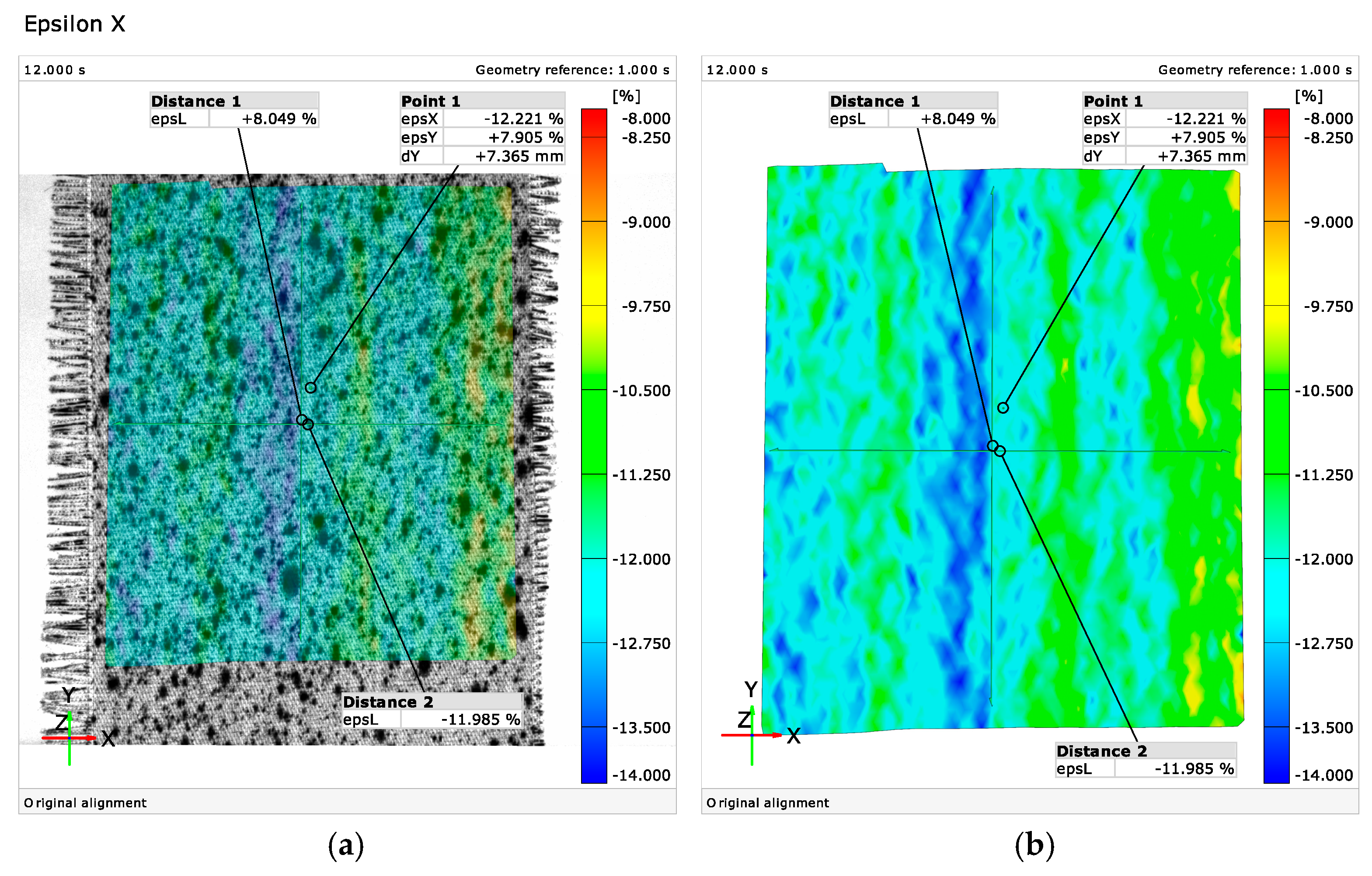
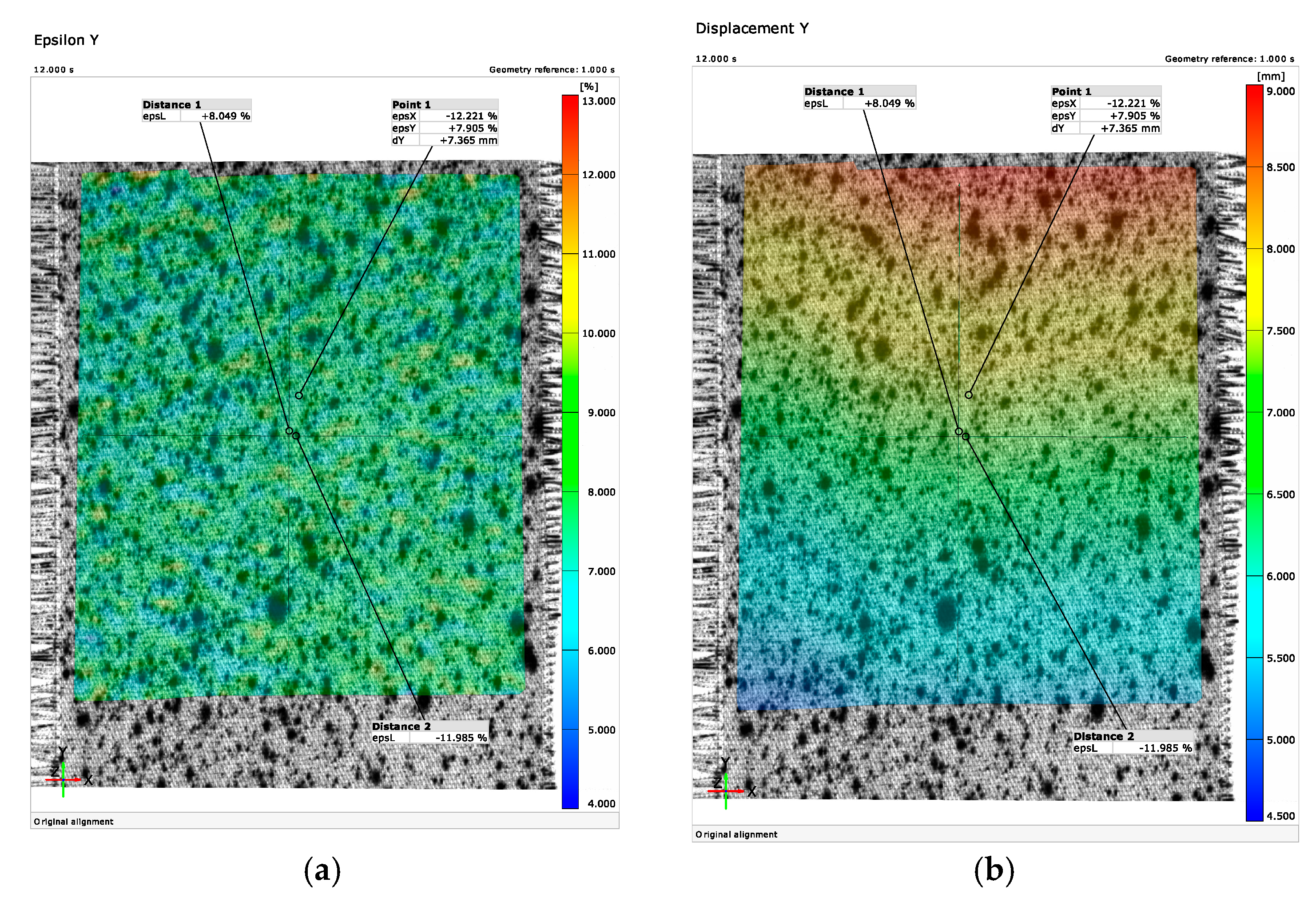
In this study, the results of the EpsX and EpsY strains are given. One point (Point 1) and two orthogonal lines (Distances 1 and 2), which are parallel to the y and x axes, respectively, were used to investigate the strain field. Additionally, experimental data is graphically displayed as a function of time. For the maximal axial force before the break, representative images of the EpsX, EpsY and Displacement Y field values are presented in Figure 2 and Figure 3 for Fabric 1. On the ordinate, a scale-in values are provided. The undeformed state of the specimens, or the state prior to the tensile loading, is represented by a value of 0 on the x-axis in Figure 4 and Figure 5. Tensile loading in the first two seconds of each experiment was low and should not be used for further evaluation.
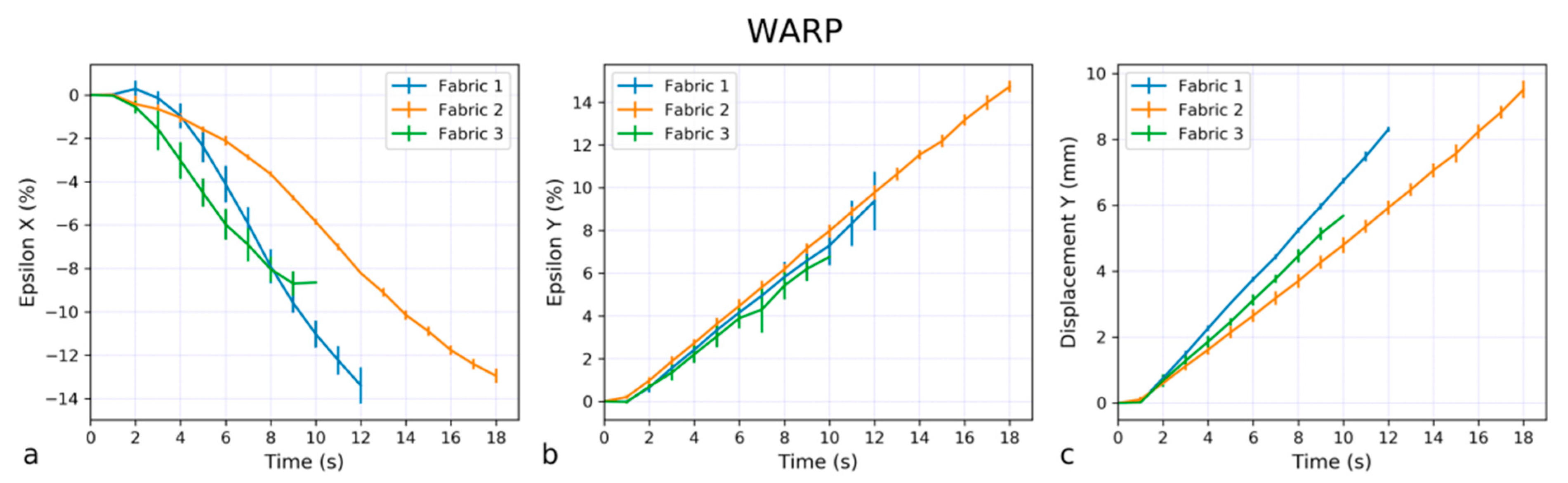
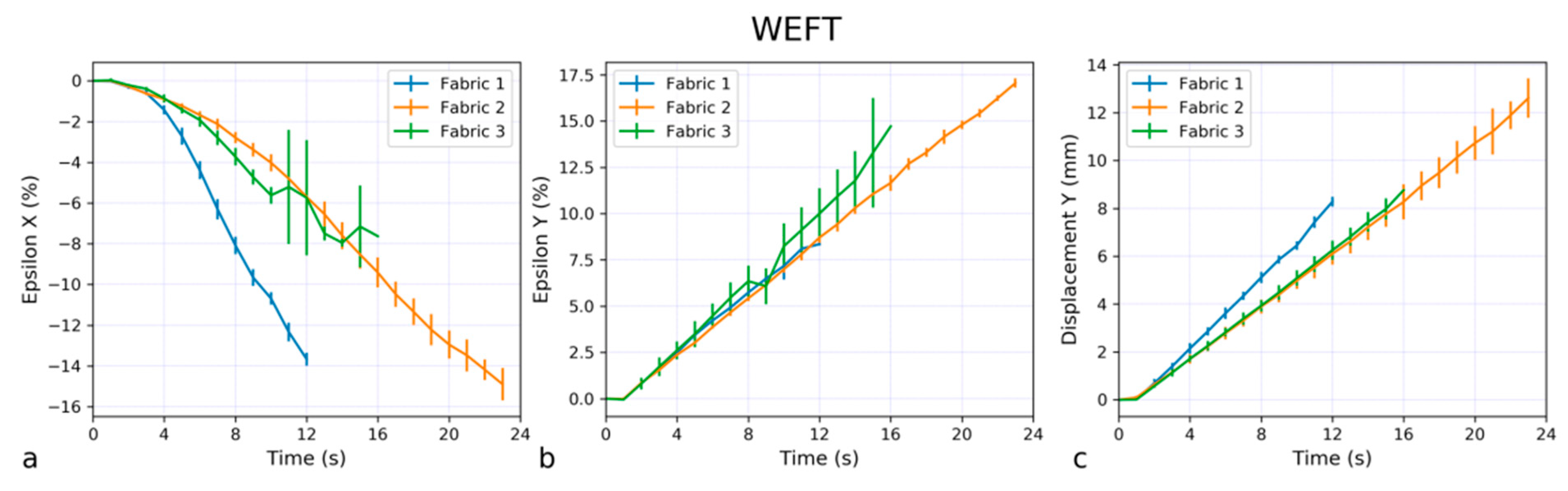
Point 1 is placed in the center of the region of interest, as shown in Figure 2. Diagrams for Point 1 for all three fabrics are presented separately for warp and weft, presenting time dependence of the EpsX, EpsY and displacement Y values, as shown in Figure 4 and Figure 5, respectively. Strain values for Distances 1 and 2 are used to calculate the Poisson ratio, as shown in Table 2. After the initial loading, the change in the values in Figure 5 are linear. The highest values of EpsX (12.713%) and EpsY (14.931%) at Point 1 are, as expected, before the break.
The value on the warp displacement diagram for Fabric 1 and 2 is almost twice as large as Fabric 3. Similar findings were recorded using the tensile testing machine (Table 2). Although there is hardly any difference in the mean value of the warp Maximum force for all three fabrics, the mean weft Maximum force value differs significantly. However, if the tension forces on the ends of the material are incorrectly adjusted and controlled during the experiment, the findings could diverge from the actual values.
Table 2, Table 3, Table 4 and Table 5 demonstrate that both the global tensile metrics (maximum force and elongation) and the full-field DIC metrics (EpsX and EpsY) depend strongly on fabric architecture and loading orientation. This anisotropic behavior stems from the distinctive micro-mechanics of woven textiles, which differ fundamentally from the isotropic solids for which most strength standards were originally written [11,24]. Textiles are discrete assemblies of yarns that can undergo large re-orientation and slippage; consequently, the link between macro-level load and micro-level failure is governed almost entirely by fiber extension rather than by shear. As seen in Figure 4, the longitudinal strain EpsY rises linearly until rupture, while Figure 5 shows that the transverse contraction EpsX evolves more modestly yet still distinguishes warp from weft. The ANOVA interaction (Fabric × Orientation) therefore reflects varying degrees of yarn realignment under tension: specimens loaded along the warp threads (e.g., Fabric 3) sustain higher forces but display lower elongation than the same fabrics loaded along the weft. By capturing these orientation-specific strain fields, information that conventional point extensometry cannot provide, 2D-DIC makes it possible to correlate local fiber kinematics with global strength limits, thereby offering a more mechanistically informed basis for textile design and quality control.

3.1. ANOVA Results for Maximum Force and Elongation

Table 3 presents the outcome of the two-way ANOVA, where both main factors, type of fabric and specimen orientation, and their interaction (Fabric × Orientation), emerged as statistically significant (p < 0.05). Specifically:
  • Effect of Fabric: There was a clear distinction among the three tested fabrics in terms of maximum force.
  • Effect of Orientation (warp vs. weft): Across all fabrics, warp-oriented specimens exhibited higher average tensile strength, although the degree of this difference varied from one fabric to another.
  • Interaction Between Fabric and Orientation: A significant Fabric × Orientation interaction (p < 0.05) indicates that the impact of orientation is not uniform across all fabrics. For instance, Fabric 3 displayed a considerably larger discrepancy between warp and weft (over 250 N difference on average), whereas Fabric 2 showed only a moderate divergence between these two orientations.
The Tukey post hoc (Appendix A) analysis further clarified which specific pairs of fabric–orientation groups differed significantly. The results revealed, for example, that Fabric 3–weft was consistently lower than the corresponding groups of Fabric 1 and Fabric 2, while Fabric 2–weft occasionally exceeded the warp orientation for the same fabric. Such findings highlight the importance of simultaneously evaluating both the fabric type and the orientation of the weave [10,12].
These statistical outcomes underscore two critical insights. First, the type of fabric plays a key role in determining overall tensile performance. As anticipated, differences in fiber composition, finishing treatments, and weave density each contribute to variable maximum-force values. Second, orientation (warp vs. weft) exerts a non-negligible influence, yet this influence is not uniform: it depends on each fabric’s structural characteristics. For example, Fabric 1 (cotton/polyester blend, balanced thread count) shows only a small warp–weft force gap (≈20 N; Table 2), whereas Fabric 2 (100% combed cotton) exhibits a moderate gap favoring the weft by ≈40 N. In contrast, Fabric 3, with a densely packed, mercerized warp (53 threads cm−1) but a sparse weft (30 threads cm−1), shows a pronounced reduction of ≈250 N when loaded off-axis in the weft direction. These examples illustrate the significant interaction detected between fabric type and orientation: for fabrics with highly asymmetric yarn densities (notably Fabric 3), loading in the weft direction can markedly reduce tensile strength relative to the warp.
From a practical standpoint, these findings indicate that relying exclusively on a single, standardized tensile test approach could overlook how the load-carrying capacity varies depending on the fabric’s orientation. Hence, when designing or selecting textiles for applications that involve multidirectional stresses, it becomes essential to evaluate both warp and weft directions to ensure reliable performance. This requirement is especially important in areas where mechanical failure in the weaker orientation might compromise the product’s integrity or safety.
The two-way ANOVA outputs for elongation are summarized in Table 3. The ANOVA results revealed the following:
  • Effect of Fabric: The extremely low p-value indicates a statistically significant difference among Fabric 1, Fabric 2, and Fabric 3 in terms of elongation.
  • Effect of Orientation: This finding confirms that warp vs. weft orientation strongly influences the observed elongation values.
  • Fabric × Orientation Interaction: A significant interaction suggests that the difference between warp and weft elongation depends on the specific fabric being tested.
The Tukey post hoc results (Appendix B) further reveal the pairwise contrasts. Notably, almost all group comparisons were significant at the 5% level, except for Fabric 1–warp vs. Fabric 1–weft (meandiff = −0.0833; p = 0.9998), indicating that for Fabric 1, elongation in the warp and weft directions was not statistically different. By contrast, large differences are evident in other pairs, for example, Fabric 2–weft vs. Fabric 3–warp (meandiff = 12.18; p < 0.0001), highlighting how certain fabrics exhibit strong orientation-dependent behavior.
The data clearly demonstrate that both fabric type and orientation significantly affect elongation. Fabric 2, composed of 100% combed cotton with moderate warp (33 threads cm−1) and weft (30 threads cm−1) densities, shows the highest elongation values, a behavior attributable to the high fiber alignment produced by combing, which enhances yarn extensibility, especially along the more compliant weft set. Fabric 3, by contrast, has markedly lower elongation in the warp but increases considerably in the weft direction; this anisotropy reflects its structure: a mercerized, high-count warp (53 threads cm−1) that limits extension, versus a lower-count weft (30 threads cm−1) that allows greater crimp recovery under load. The highly significant Fabric × Orientation interaction therefore arises from the different combinations of thread density, finishing treatment, and yarn crimp among the three textiles, confirming that the new 2D-DIC protocol captures structure-dependent mechanical behavior consistent with known textile-performance principles.
These findings underscore the importance of simultaneously considering fabric composition (e.g., fiber blend, finishing, and weave density) and orientation when evaluating elongation. While Fabric 1 exhibits relatively similar behavior in warp and weft (no statistically significant difference), Fabric 2 shows a pronounced increase in elongation in weft orientation, and Fabric 3 displays a large differential between warp and weft. This heterogeneity among fabrics indicates that extrapolating from a single orientation test could lead to misleading conclusions about a textile’s overall mechanical performance. Fabric 1, which consists of 78.9% cotton and 21.1% polyester, demonstrates a relatively isotropic behavior between the warp and weft directions, likely due to the polyester component imparting a uniform reinforcement effect. In contrast, Fabric 2 is made entirely of combed cotton, a processing method that aligns and cleans the fibers, resulting in a significant increase in elongation along the weft orientation. This directional disparity is attributed to the inherent structural properties of combed cotton, where fiber alignment is more pronounced in one direction, leading to anisotropic mechanical behavior. Meanwhile, Fabric 3, composed of 100% mercerized cotton, exhibits a marked differential between warp and weft. The mercerization process enhances the fiber’s strength, luster, and dimensional stability, but it also alters the fiber’s surface characteristics and inter-fiber bonding, which can lead to a higher degree of anisotropy in mechanical performance.
From an application standpoint, these results are crucial for textiles subject to multidirectional stresses. Designers and manufacturers should address the specific loading conditions likely to be encountered, ensuring that both warp and weft directions meet relevant performance thresholds. Furthermore, the use of a robust statistical approach (two-way ANOVA plus Tukey post hoc test) enabled a detailed comparison of the fabrics and their orientation-dependent behaviors, thus facilitating more informed decisions regarding material selection and product development.

3.2. ANOVA Results for EpsX and EpsY

Table 4 presents the results of the two-way ANOVA for EpsX and EpsY.
The p-values indicate the following key findings:
  • Fabric type significantly affects both EpsX and EpsY (p < 0.001). Fabric 2 exhibited the highest EpsY values, while Fabric 3 had the lowest. This suggests that Fabric 2 is structurally more flexible in the y-direction, potentially due to differences in weave density, fiber composition, or finishing processes.
  • Orientation has a significant effect on EpsY (p < 0.001), but not on EpsX (p = 0.193). This indicates that strain in the y-direction is more dependent on fiber orientation than strain in the x-direction. This could be due to anisotropic behavior in the weave structure, where fibers aligned in the y-direction experience higher deformations under loading.
  • The interaction between Fabric and Orientation is significant for both EpsX and EpsY, suggesting that the influence of orientation on strain varies depending on the fabric type. For instance:
-
Fabric 1 shows minimal differences between warp and weft, indicating a more balanced mechanical response in both directions.
-
Fabric 2 and Fabric 3 exhibit pronounced differences between warp and weft, meaning that their strain response is orientation-dependent.
-
EpsX is significantly lower for Fabric 2 in the weft direction, whereas EpsY is significantly higher for Fabric 2 in the weft direction. This suggests that Fabric 2 undergoes more elongation in the y-direction while resisting deformation in the x-direction.
Appendix C and Appendix D summarize the pairwise comparisons using Tukey post hoc tests. Tukey post hoc for EpsX indicates the following key findings:
  • Fabric 1 and Fabric 2 did not significantly differ in warp orientation, but in weft orientation, Fabric 2 had significantly lower EpsX than Fabric 1.
  • Fabric 3 exhibited the highest EpsX values, with significant differences from both Fabric 1 and Fabric 2 in most comparisons. This implies that Fabric 3 may have a lower stiffness in the x-direction, possibly due to its fiber arrangement or lower thread density in the warp direction.
  • The difference between warp and weft orientations was only significant for Fabric 2, where EpsX was lower in the weft direction.
Tukey post hoc for EpsY indicates the following key findings:
  • Fabric 2 showed significantly higher EpsY compared to Fabric 1 and Fabric 3.
  • The difference between warp and weft was statistically significant across most groups, reinforcing the idea that EpsY is more sensitive to fiber orientation than EpsX
  • The largest difference was observed between Fabric 2 (weft) and Fabric 3 (warp), with a mean difference of 10.61 (p < 0.001), confirming the pronounced effect of both Fabric type and Orientation on strain in the y-direction. The post hoc test further reveals that for Fabric 2 and Fabric 3, EpsY is significantly higher in the weft direction than in the warp direction. This suggests that these fabrics allow more deformation perpendicular to the warp fibers, likely due to differences in crimp or fiber flexibility.
Practical implications of these findings suggest that DIC-based strain analysis provides valuable insights into the anisotropic behavior of textile materials. The clear dependence of strain values on Fabric type and Orientation should be considered in applications where predictable mechanical performance is required, such as in textiles, protective clothing, and structural composites. Furthermore, the significant interaction between Fabric and Orientation highlights the need for careful selection of materials depending on the intended load direction. In practical applications, designing with Fabric 2 in a weft-dominant load scenario may lead to higher deformations, whereas Fabric 3 should be used in applications where lower strains are desired.

3.3. Comparison of ANOVA Results from Tensile Testing and DIC Analysis

The results obtained from tensile testing (maximum force and elongation) and those derived from DIC analysis (EpsX and EpsY) provide complementary insights into the mechanical behavior of the tested fabrics. While both methods reveal significant effects of fabric type and orientation, the DIC approach offers additional information that enhances the material characterization beyond what is possible through conventional tensile testing.
Across all measured parameters (maximum force, elongation, EpsX, and EpsY), the fabric type has a statistically significant effect (p < 0.001). This confirms that the mechanical response of the textiles is strongly dependent on fiber composition, weave structure, and finishing processes, regardless of whether the analysis is based on global tensile properties or local strain measurements. For maximum force, elongation, and EpsY, the orientation (warp vs. weft) has a significant effect (p < 0.001), indicating that fiber alignment plays a crucial role in determining the mechanical properties of the fabrics. This means that, in general, warp-oriented samples exhibit different mechanical behavior compared to weft-oriented samples, likely due to differences in thread density, fiber, and reinforcement structure in each direction.
One of the most striking differences between tensile testing and DIC analysis is that orientation significantly affects maximum force, elongation, and EpsY, but not EpsX (p = 0.193), as shown in Table 5. Tensile testing suggests that orientation plays a crucial role in both deformation and failure behavior, as both maximum force and elongation are significantly influenced by fiber alignment. In contrast, DIC analysis shows that EpsY behaves similarly to elongation, with significant orientation dependence, while EpsX does not exhibit this effect. This difference suggests that strain accumulation is not uniform across the sample, and the primary direction of deformation differs for different fabrics. EpsY captures strain in the loading direction, which aligns with global elongation, whereas EpsX captures strain perpendicular to loading, which is less influenced by orientation. This could indicate that the weave structure allows for greater strain redistribution in the x-direction, meaning that fabric threads can accommodate lateral deformation regardless of whether the sample is loaded in the warp or weft direction. In contrast, the y-direction is directly influenced by fiber alignment, leading to a stronger effect of orientation on EpsY.
Strain interaction effects also differ between the two methods. In tensile testing, the interaction effects for maximum force and elongation are strong (p < 0.001), meaning the difference between warp and weft varies significantly across fabric types. In DIC analysis, the interaction effect is significant for both EpsX (p = 0.011) and EpsY (p < 0.001), but it is weaker in EpsX. This suggests that strain accumulation patterns vary between fabrics differently than how force and elongation behave globally. In tensile testing, the global response (force and elongation) is affected by the entire fabric structure, while in DIC, local strain distributions may be more sensitive to fiber movement and slippage. The presence of an interaction effect in EpsX, even though the main effect of orientation is absent, suggests that some fabrics have more complex strain redistribution mechanisms that are not evident from force-displacement measurements alone.
The comparison between tensile testing and DIC highlights the advantages of DIC in capturing localized strain behavior that is not detectable through force and elongation measurements alone. While tensile testing provides a global assessment of material deformation until failure, DIC offers detailed strain field mapping, enabling the identification of anisotropic deformation patterns and localized stress concentrations. Unlike tensile testing, which assumes uniform stress distribution, DIC reveals variations in strain accumulation across the fabric, providing insights into fiber interactions, movement, and slippage. Furthermore, DIC allows for real-time monitoring of strain evolution, making it particularly valuable for understanding progressive damage mechanisms before ultimate failure. This enhanced characterization underscores the importance of integrating DIC with conventional tensile testing to achieve a more comprehensive understanding of textile mechanical behavior:
  • DIC reveals deformation anisotropy at an earlier stage.
    Tensile testing shows that orientation influences maximum elongation, but DIC shows that EpsY (strain in the loading direction) is more orientation-sensitive than EpsX.
    This suggests that DIC enables a deeper understanding of fiber interactions within the weave.
  • DIC identifies strain concentration zones before failure.
    In tensile testing, failure is recorded at the moment of specimen rupture, with no information on how the deformation evolved prior to breaking.
    DIC enables continuous strain monitoring, allowing detection of early damage accumulation, which can be critical for applications requiring long-term durability.
  • DIC captures lateral deformation that tensile tests cannot detect.
    Tensile testing only records elongation in the loading direction.
    DIC provides information on strain perpendicular to the loading direction (EpsX), which reveals lateral strain redistribution that may be crucial for understanding material ductility and flexibility.
  • DIC is essential for fabrics with complex structural responses.
    The significant Fabric × Orientation interaction effect in both EpsX and EpsY suggests that some fabrics exhibit non-uniform deformation.
    This complex behavior is difficult to interpret from tensile force and elongation alone, but DIC makes it quantifiable.
From an industrial perspective, the ability of DIC to identify local strain concentrations and orientation-dependent deformation patterns can be directly applied in automated inspection systems and predictive maintenance models. These strain maps allow manufacturers to detect weak regions before failure, optimize weave design for specific load conditions, and establish data-driven criteria for quality control. Therefore, the integration of DIC-based strain analysis into textile production workflows has the potential to significantly improve reliability, efficiency, and product performance.

4. Conclusions

The statistical analysis of strain measurements (EpsX and EpsY) obtained via DIC confirms that both fabric type and orientation significantly affect mechanical response. While Fabric has a strong effect on both strain components, Orientation has a pronounced influence on EpsY but a weaker effect on EpsX. The results emphasize the importance of considering fabric anisotropy in engineering applications and demonstrate the value of combining DIC measurements with statistical analysis for a comprehensive understanding of textile behavior.
While tensile testing remains the standard for determining bulk mechanical properties, the addition of DIC significantly improves material characterization by providing localized strain distributions.
  • DIC reveals microstructural strain evolution, offering insights beyond global elongation measurements.
  • The differences in ANOVA outcomes highlight that DIC captures deformation anisotropy that is not apparent in tensile testing.
  • By analyzing both EpsX and EpsY, DIC provides a more complete picture of how fabrics accommodate strain, redistributing stresses within their structure.
  • The combination of tensile testing and DIC enables a multi-scale understanding of textile behavior, making it an essential tool for optimizing fabric performance in structural applications.
Thus, incorporating DIC alongside conventional tensile testing significantly enhances material characterization, allowing for improved selection, design, and predictive modeling of fabric behavior under load.

Author Contributions

Conceptualization, N.M. and A.M.; Methodology, N.M., A.M. and M.R.; software, N.M.; validation, N.M., A.M., M.R. and S.P.; formal analysis, A.M.; Investigation, N.M., A.M., M.R. and S.P.; Resources, M.R. and S.P.; data curation, N.M.; Writing—original draft, N.M.; Writing—review & editing, A.M.; Visualization, M.R.; supervision, M.R.; project administration, S.P.; Funding acquisition, S.P. All authors have read and agreed to the published version of the manuscript.

Funding

This paper is funded through the EIT’s Higher Education Initiative A-SIDE project, coordinated by EIT RawMaterials, funded by the European Union.

Institutional Review Board Statement

Not applicable.

Data Availability Statement

The experimental results and statistical data used to support the findings of this study are included within the article and are available from the corresponding author upon request.

Conflicts of Interest

Author Mirjana Reljic was employed by the company CIS Institute. The remaining authors declare that the research was conducted in the absence of any commercial or financial relationships that could be construed as a potential conflict of interest. The funding sponsors had no role in the design of the study; in the collection, analyses, or interpretation of data; in the writing of the manuscript; and in the decision to publish the results.

Appendix A

Table A1. Multiple Comparison of Means-Tukey post hoc for maximum force.
Group1Group2Meandiffp-adjLowerUpperReject
Fabric1_WarpFabric1_Weft−20.66670.9823−124.453583.1201False
Fabric1_WarpFabric2_Warp−3.66671.0−107.4535100.1201False
Fabric1_WarpFabric2_Weft35.66670.8495−68.1201139.4535False
Fabric1_WarpFabric3_Warp2.66671.0−101.1201106.4535False
Fabric1_WarpFabric3_Weft−256.66670.0−360.4535−152.8799True
Fabric1_WeftFabric2_Warp17.00.9926−86.7868120.7868False
Fabric1_WeftFabric2_Weft56.33330.4874−47.4535160.1201False
Fabric1_WeftFabric3_Warp23.33330.9702−80.4535127.1201False
Fabric1_WeftFabric3_Weft−236.00.0001−339.7868−132.2132True
Fabric2_WarpFabric2_Weft39.33330.7936−64.4535143.1201False
Fabric2_WarpFabric3_Warp6.33330.9999−97.4535110.1201False
Fabric2_WarpFabric3_Weft−253.00.0−356.7868−149.2132True
Fabric2_WeftFabric3_Warp−33.00.8849−136.786870.7868False
Fabric2_WeftFabric3_Weft−292.33330.0−396.1201−188.5465True
Fabric3_WarpFabric3_Weft−259.33330.0−363.1201−155.5465True
The definitions of the variables: group1: The first fabric-orientation combination being compared. group2: The second fabric-orientation combination being compared. meandiff: The difference in mean EpsY values between group1 and group2. A positive value means group2 has a higher mean EpsY than group1, while a negative value means group1 has a higher mean EpsY than group2. p-adj: The adjusted p-value for the comparison, corrected for multiple testing. A value below 0.05 indicates a statistically significant difference between the two groups. lower: The lower bound of the 95% confidence interval for the mean difference. upper: The upper bound of the 95% confidence interval for the mean difference. reject: A Boolean (True/False) value indicating whether the null hypothesis (no difference between the groups) is rejected. If True, the two groups are significantly different; if False, the difference is not statistically significant.

Appendix B

Table A2. Multiple Comparison of Means-Tukey post hoc for elongation.
Group1Group2Meandiffp-adjLowerUpperReject
Fabric1_WarpFabric1_Weft−0.08330.9998−1.22111.0544False
Fabric1_WarpFabric2_Warp5.30.04.16226.4378True
Fabric1_WarpFabric2_Weft9.880.08.742211.0178True
Fabric1_WarpFabric3_Warp−2.30.0002−3.4378−1.1622True
Fabric1_WarpFabric3_Weft2.69670.01.55893.8344True
Fabric1_WeftFabric2_Warp5.38330.04.24566.5211True
Fabric1_WeftFabric2_Weft9.96330.08.825611.1011True
Fabric1_WeftFabric3_Warp−2.21670.0003−3.3544−1.0789True
Fabric1_WeftFabric3_Weft2.780.01.64223.9178True
Fabric2_WarpFabric2_Weft4.580.03.44225.7178True
Fabric2_WarpFabric3_Warp−7.60.0−8.7378−6.4622True
Fabric2_WarpFabric3_Weft−2.60330.0001−3.7411−1.4656True
Fabric2_WeftFabric3_Warp−12.180.0−13.3178−11.0422True
Fabric2_WeftFabric3_Weft−7.18330.0−8.3211−6.0456True
Fabric3_WarpFabric3_Weft4.99670.03.85896.1344True
The definitions of the variables: group1: The first fabric-orientation combination being compared. group2: The second fabric-orientation combination being compared. meandiff: The difference in mean EpsY values between group1 and group2. A positive value means group2 has a higher mean EpsY than group1, while a negative value means group1 has a higher mean EpsY than group2. p-adj: The adjusted p-value for the comparison, corrected for multiple testing. A value below 0.05 indicates a statistically significant difference between the two groups. lower: The lower bound of the 95% confidence interval for the mean difference. upper: The upper bound of the 95% confidence interval for the mean difference. reject: A Boolean (True/False) value indicating whether the null hypothesis (no difference between the groups) is rejected. If True, the two groups are significantly different; if False, the difference is not statistically significant.

Appendix C

Table A3. Multiple Comparison of Means-Tukey post hoc for EpsX.
Group1GROUP2Meandiffp-adjLowerUpperReject
Fabric1_WarpFabric1_Weft−0.09431.0−1.9861.7973False
Fabric1_WarpFabric2_Warp0.16730.9996−1.72432.059False
Fabric1_WarpFabric2_Weft−1.89670.0493−3.7883−0.005True
Fabric1_WarpFabric3_Warp4.10670.00012.2155.9983True
Fabric1_WarpFabric3_Weft4.91970.03.0286.8113True
Fabric1_WeftFabric2_Warp0.26170.9966−1.632.1533False
Fabric1_WeftFabric2_Weft−1.80230.0651−3.6940.0893False
Fabric1_WeftFabric3_Warp4.2010.00012.30946.0926True
Fabric1_WeftFabric3_Weft5.0140.03.12246.9056True
Fabric2_WarpFabric2_Weft−2.0640.0299−3.9556−0.1724True
Fabric2_WarpFabric3_Warp3.93930.00022.04775.831True
Fabric2_WarpFabric3_Weft4.75230.02.86076.644True
Fabric2_WeftFabric3_Warp6.00330.04.11177.895True
Fabric2_WeftFabric3_Weft6.81630.04.92478.708True
Fabric3_WarpFabric3_Weft0.8130.7026−1.07862.7046False
The definitions of the variables: group1: The first fabric-orientation combination being compared. group2: The second fabric-orientation combination being compared. meandiff: The difference in mean EpsY values between group1 and group2. A positive value means group2 has a higher mean EpsY than group1, while a negative value means group1 has a higher mean EpsY than group2. p-adj: The adjusted p-value for the comparison, corrected for multiple testing. A value below 0.05 indicates a statistically significant difference between the two groups. lower: The lower bound of the 95% confidence interval for the mean difference. upper: The upper bound of the 95% confidence interval for the mean difference. reject: A Boolean (True/False) value indicating whether the null hypothesis (no difference between the groups) is rejected. If True, the two groups are significantly different; if False, the difference is not statistically significant.

Appendix D

Table A4. Multiple Comparison of Means-Tukey post hoc for EpsY.
Group1Group2Meandiffp-adjLowerUpperReject
Fabric1_WarpFabric1_Weft−0.41870.9944−3.13322.2959False
Fabric1_WarpFabric2_Warp5.51270.00022.79818.2272True
Fabric1_WarpFabric2_Weft8.1660.05.451510.8805True
Fabric1_WarpFabric3_Warp−2.44070.0876−5.15520.2739False
Fabric1_WarpFabric3_Weft3.73330.0061.01886.4479True
Fabric1_WeftFabric2_Warp5.93130.00013.21688.6459True
Fabric1_WeftFabric2_Weft8.58470.05.870111.2992True
Fabric1_WeftFabric3_Warp−2.0220.1979−4.73650.6925False
Fabric1_WeftFabric3_Weft4.1520.00261.43756.8665True
Fabric2_WarpFabric2_Weft2.65330.0567−0.06125.3679False
Fabric2_WarpFabric3_Warp−7.95330.0−10.6679−5.2388True
Fabric2_WarpFabric3_Weft−1.77930.3041−4.49390.9352False
Fabric2_WeftFabric3_Warp−10.60670.0−13.3212−7.8921True
Fabric2_WeftFabric3_Weft−4.43270.0015−7.1472−1.7181True
Fabric3_WarpFabric3_Weft6.1740.00013.45958.8885True
The definitions of the variables: group1: The first fabric-orientation combination being compared. group2: The second fabric-orientation combination being compared. meandiff: The difference in mean EpsY values between group1 and group2. A positive value means group2 has a higher mean EpsY than group1, while a negative value means group1 has a higher mean EpsY than group2. p-adj: The adjusted p-value for the comparison, corrected for multiple testing. A value below 0.05 indicates a statistically significant difference between the two groups. lower: The lower bound of the 95% confidence interval for the mean difference. upper: The upper bound of the 95% confidence interval for the mean difference. reject: A Boolean (True/False) value indicating whether the null hypothesis (no difference between the groups) is rejected. If True, the two groups are significantly different; if False, the difference is not statistically significant.

References

  1. Anand, S.C.; Kennedy, J.F.; Miraftab, M.; Rajendran, S. (Eds.) Medical and Healthcare Textiles; Woodhead Publishiag Limited: Cambridge, UK, 2010. [Google Scholar]
  2. Asanovic, K.; Cerovic, D.; Mihailovic, T.; Kostic, M.M.; Reljic, M. Quality of clothing fabrics in terms of their comfort properties. Indian J. Fibre Text. Res. 2015, 40, 363–372. [Google Scholar]
  3. Reljic, M.; Stojiljkovic, S.; Stepanovic, J.; Lazic, B.; Stojiljkovic, M. Study of Water Vapor Resistance of Co/PES Fabrics Properties During Maintenance. In Experimental and Numerical Investigations in Materials Science and Engineering; Mitrovic, N., Milosevic, M., Mladenovic, G., Eds.; Springer International Publishing: Cham, Switzerland, 2019; pp. 72–83. [Google Scholar]
  4. Reljić, M.; Lazić, B.; Stepanović, J.; Dordić, D. Thermophysiological properties of knitted fabrics for sports underwear. Struct. Integr. Life 2017, 17, 145–149. [Google Scholar]
  5. Hu, J. Structure and Mechanics of Woven Fabrics; Woodhead Publishing Limited: Cambridge, UK, 2004. [Google Scholar]
  6. Klinge, U.; Otto, J.; Mühl, T. High structural stability of textile implants prevents pore collapse and preserves effective porosity at strain. BioMed Res. Int. 2015, 1, 953209. [Google Scholar] [CrossRef] [PubMed]
  7. Shah, A.A.; Shahid, M.; Siddiqui, N.A.; Nawab, Y.; Iqbal, M. Effect of Geometric Arrangement on Mechanical Properties of 2D Woven Auxetic Fabrics. Textiles 2022, 2, 606–623. [Google Scholar] [CrossRef]
  8. Asadi, H.; Uhlemann, J.; Stranghoener, N.; Ulbricht, M. Mechanical Property Characterization of Architectural Coated Woven Fabrics Subjected to Freeze–Thaw Cycles. Textiles 2024, 4, 26–39. [Google Scholar] [CrossRef]
  9. Luan, K.; Newman, Z.; West, A.; Lee, K.L.; Rokkam, S. Efficient Poisson’s Ratio Evaluation of Weft-Knitted Auxetic Metamaterials. Textiles 2023, 3, 275–286. [Google Scholar] [CrossRef]
  10. Penava, Ž.; Penava, D.Š.; Knezić, Ž. Determination of the Elastic Constants of Plain Woven Fabrics by a Tensile Test in Various Directions. Fibres Text. East. Eur. 2014, 22, 57–63. [Google Scholar]
  11. Wilusz, E. Military Textiles; Woodhead Publishing Limited: Cambridge, UK, 2008. [Google Scholar]
  12. Zheng, J.; Takatera, M.; Inui, S.; Shimizu, Y. Measuring Technology of the Anisotropic Tensile Properties of Woven Fabrics. Text. Res. J. 2008, 78, 1116–1123. [Google Scholar] [CrossRef]
  13. Hursa, A.; Rolich, T.; Ercegovic Razic, S. Determining Pseudo Poisson’s Ratio of Woven Fabric with a Digital Image Correlation Method. Text. Res. J. 2009, 79, 1588–1598. [Google Scholar] [CrossRef]
  14. Meskuotiene, A.; Dargiene, J.; Domskiene, J. Metrological performance of the digital image analysis method applied for investigation of textile deformation. Text. Res. J. 2015, 85, 71–79. [Google Scholar] [CrossRef]
  15. Ghazimoradi, M.; Carvelli, V.; Marchesi, M.C.; Frassine, R. Mechanical characterization of tetraxial textiles. J. Ind. Text. 2018, 48, 3–24. [Google Scholar] [CrossRef]
  16. Boisse, P.; Hamila, N.; Guzman-Maldonado, E.; Madeo, A.; Hivet, G.; dell’Isola, F. The bias-extension test for the analysis of in-plane shear properties of textile composite reinforcements and prepregs: A review. Int. J. Mater. Form. 2017, 10, 473–492. [Google Scholar] [CrossRef]
  17. Sutton, M.A.; Orteu, J.-J.; Hubert, W.S. Image Correlation for Shape, Motion and Deformation Measurements: Basic Concepts, Theory and Applications; Springer: New York, NY, USA, 2009. [Google Scholar] [CrossRef]
  18. Mitrović, N.; Golubović, Z.; Mitrović, A.; Travica, M.; Trajković, I.; Milošević, M.; Petrović, A. Influence of Aging on the Flexural Strength of PLA and PLA-X 3D-Printed Materials. Micromachines 2024, 15, 395. [Google Scholar] [CrossRef] [PubMed]
  19. Mitrović, N.; Mitrović, A.; Travica, M. Tensile Testing of Flat Thin Specimens Using the Two-Dimensional Digital Image Correlation Method. Struct. Integr. Life 2023, 23, 9–13. [Google Scholar]
  20. EN ISO 13934; Textiles—Tensile Properties of Fabrics—Part 1: Determination of Maximum Force and Elongation at Maximum Force Using the Strip Method. The International Organization for Standardization ISO: Geneva, Switzerland, 2013.
  21. Lomov, S.V.; Boisse, P.; Deluycker, E.; Morestin, F.; Vanclooster, K.; Vandepitte, D.; Verpoest, I.; Willems, A. Full-field strain measurements in textile deformability studies. Compos. Part A Appl. Sci. Manuf. 2008, 39, 1232–1244. [Google Scholar] [CrossRef]
  22. Fang, Q.; Chen, L.; Wang, W.; Zhang, C. Study on tensile properties of carbon fiber/epoxy laminated woven composites with ply splicing. J. Ind. Text. 2022, 52, 1528083722113630752. [Google Scholar] [CrossRef]
  23. Jing, L.; Guo, N.; Xu, H.; Jiang, J.; Zhang, T.; Chen, N. Tensile characteristics of flexible PU-coated multi-axial warp-knitted fabrics. J. Ind. Text. 2017, 47, 38–56. [Google Scholar] [CrossRef]
  24. Mitrovic, N.; Mitrovic, A.; Reljic, M. Strain measurement of medical textile using 2d digital image correlation method. Lect. Notes Netw. Syst. 2021, 153, 447–464. [Google Scholar]
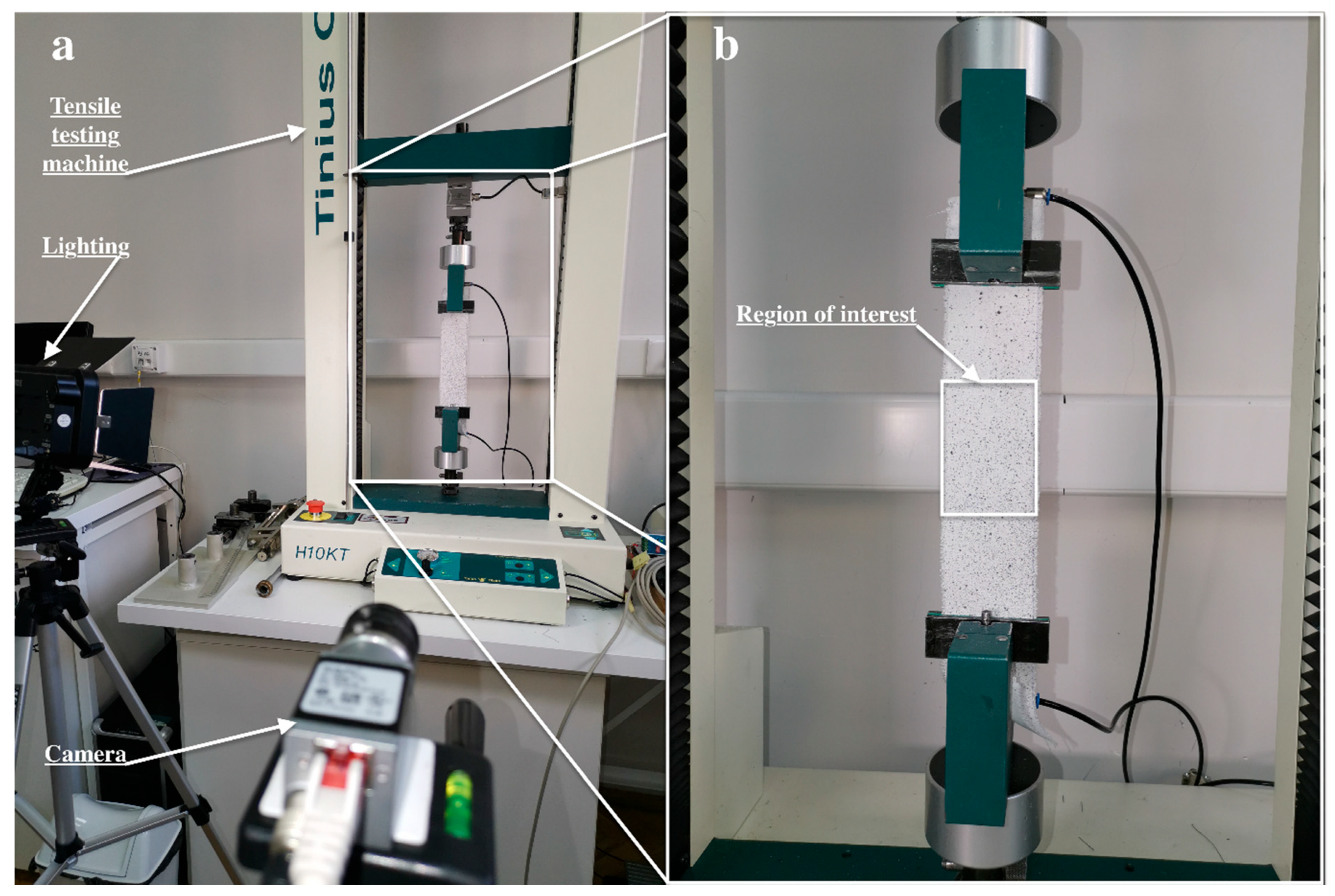
Figure 1. Experimental setup: (a) Camera, tensile testing machine and LED lighting. (b) Region of interest on the textile specimen.
Textiles 05 00067 g001
Figure 2. Representative EpsX strain field for Fabric 1 warp. (a) image overlay; (b) full strain field.
Textiles 05 00067 g002
Figure 3. Representative field for Fabric 1 warp. (a) EpsY full-field; (b) Displacement Y full-field.
Textiles 05 00067 g003
Figure 4. EpsX (a), EpsY (b) and Displacement Y (c) values for warp. The error bars represent the standard deviation of measurements for three samples of the same material during tensile loading until the break.
Textiles 05 00067 g004
Figure 5. EpsX (a), EpsY (b) and Displacement Y (c) values for weft. The error bars represent the standard deviation of measurements for three samples of the same material during tensile loading until the break.
Textiles 05 00067 g005
Table 1. Fabric Properties.
Number of Threads per Unit Length, Threads-cmFiber CompositionMass per Unit Area, g/m2
Fabric 1Warp47.278.9% cotton
21.1% polyester
107.6
Weft25.0
Fabric 2Warp33.1100% cotton (combed)124.4
Weft30.0
Fabric 3Warp52.6100% cotton (mercerized)126.5
Weft30.0
Table 2. Maximum force and elongation recorded on tensile testing machine and Poisson coefficient.
Maximum Mean Force, NStandard
Deviation, N
Mean
Elongation, %
Standard
Deviation, %
Mean Poisson Coefficient,/Standard
Deviation,/
Fabric 1Warp57947.49.400.5271.4500.034
Weft55929.29.320.4651.4750.024
Fabric 2Warp5767.4014.70.2000.8810.018
Weft61519.219.30.2700.7880.022
Fabric 3Warp58266.37.100.5151.3790.009
Weft32825.512.10.4040.7200.017
Table 3. Two-Way ANOVA Results for Maximum Force and Elongation.
Source of Variationp-Value
Maximum ForceElongation
Fabric (A)0.00006075.54 × 10−13
Orientation (B)0.00073061.63 × 10−9
Interaction (A × B)0.00004232.55 × 10−7
Table 4. Two-Way ANOVA for EpsX and EpsY.
Source of Variationp-Value
EpsXEpsY
Fabric2.37 × 10−85.73 × 10⁻⁸
Orientation0.1936.15 × 10−5
Fabric × Orientation0.01053.44 × 10−4
Table 5. Key Differences Between Tensile Testing and DIC ANOVA Results.
ParameterFabric Effect (p-Value)Orientation Effect (p-Value)Interaction Effect (p-Value)
Maximum Forcep < 0.001 (Significant)p < 0.001 (Significant)p < 0.001 (Significant)
Elongation (%)p < 0.001 (Significant)p < 0.001 (Significant)p < 0.001 (Significant)
EpsX (DIC)p < 0.001 (Significant)p = 0.193 (Not Significant)p = 0.011 (Significant)
EpsY (DIC)p < 0.001 (Significant)p < 0.001 (Significant)p < 0.001 (Significant)
Disclaimer/Publisher’s Note: The statements, opinions and data contained in all publications are solely those of the individual author(s) and contributor(s) and not of MDPI and/or the editor(s). MDPI and/or the editor(s) disclaim responsibility for any injury to people or property resulting from any ideas, methods, instructions or products referred to in the content.