All articles published by MDPI are made immediately available worldwide under an open access license. No special
permission is required to reuse all or part of the article published by MDPI, including figures and tables. For
articles published under an open access Creative Common CC BY license, any part of the article may be reused without
permission provided that the original article is clearly cited. For more information, please refer to
https://www.mdpi.com/openaccess.
Feature papers represent the most advanced research with significant potential for high impact in the field. A Feature
Paper should be a substantial original Article that involves several techniques or approaches, provides an outlook for
future research directions and describes possible research applications.
Feature papers are submitted upon individual invitation or recommendation by the scientific editors and must receive
positive feedback from the reviewers.
Editor’s Choice articles are based on recommendations by the scientific editors of MDPI journals from around the world.
Editors select a small number of articles recently published in the journal that they believe will be particularly
interesting to readers, or important in the respective research area. The aim is to provide a snapshot of some of the
most exciting work published in the various research areas of the journal.
Department of Hydroaerodynamics and Hydraulic Machines, Technical University of Sofia, 1000 Sofia, Bulgaria
2
Miracle Centre of Competence Lab “Intelligent Mechatronic Solutions in Textiles and Clothing” (MeTex), Technical University of Sofia, 1000 Sofia, Bulgaria
3
Centre for Research and Design in Human Comfort, Energy and Environment (CERDECEN), Technical University of Sofia, 1000 Sofia, Bulgaria
*
Author to whom correspondence should be addressed.
The present study examines the influence of material and structural parameters on the fit and air permeability of textile face masks, surgical masks, and certified respirators. Nine samples were tested using the AccuFIT 9000 for quantitative fit factor (FF) measurements and the FX-3340 MinAir for air permeability in both airflow directions. Results show that increased thickness moderately improves FF, supporting better facial sealing. However, mass per unit area and bulk density show weak or no correlation with FF. Air permeability correlates weakly and negatively with FF, especially during exhalation, but remains essential for wearer comfort. Notably, some textile masks outperformed certified respirators in terms of fit, highlighting the importance of design, elasticity, and edge sealing. The findings suggest that effective mask performance depends on more than filtration materials or certification levels. A balanced design combining breathability, structural optimisation, and ergonomic fit is essential for both comfort and protection. These insights can guide the development of more effective reusable and disposable face coverings, particularly in aerosol-rich environments.
The functional effectiveness of textile protective masks and respirators is determined by the interaction between their filtration capacity [1], air permeability [2], and quality of the fit of the mask/respirator to the face [3]. The fit depends primarily on the geometry and design of the mask or respirator [3,4], while their air permeability is mainly determined by the structure and characteristics of the composed layers [2,5]. Air permeability defines the breathing resistance, which influences both the protective efficiency and the comfort during use, including thermophysiological comfort [6,7]. Both the fit of the mask and the breathing resistance determine the risk of peripheral air leakage [8].
Studies have shown that the percentage of air leaking through personal protective equipment (PPE) varies significantly depending on the airflow rate: from 43% to 95% at 30 L/min and from 10% to 85% at 160 L/min [8]. Accordingly, the filtration efficiency is also sensitive to the flow rate—ranging from 5% to 53% at 30 L/min and from 15% to 84% at 160 L/min [8]. These dependencies explain the widespread use of electrostatic filtration in respirators. Despite their advantages, electrostatic filters are sensitive to moisture—the filtering charge significantly decreases after about 30 min of wear [9]. To overcome this drawback, some manufacturers include a layer of activated carbon that absorbs moisture and extends the period of effective protection [9].
The air permeability of masks and respirators is influenced by several material, geometric, and structural parameters—including fibre composition, fibre diameter, mask thickness, porosity, and finishing treatments [10]. A significant contribution to overall effectiveness comes not only from the filter material but also from the construction of the mask/respirator, especially the quality of the facial seal, which limits unsealed gaps around the face [11].
Normal human respiratory actions like speaking, sneezing, and coughing generate aerosols that can reach distances of over 2 metres [12]. Small particles in the 1–3 µm range, typical for viruses like SARS-CoV-2, remain airborne and viable for hours [11]. Therefore, effective facial protection is critically important in both public and occupational settings [13].
The filtering layer in face masks and respirators involves melt-blown and nanofibrous non-woven macrostructures. Melt-blown filters consist of fibres with diameters ranging from 1 to 8 µm and are characterised by high density and barrier efficiency [9]. Nanofibres, which have diameters below 1 µm, operate by mechanical filtration and gradually increase their effectiveness by retaining particles [14]. However, these structures are sensitive to moisture and freezing, which can block the pores or increase breathing resistance [9].
Wearing comfort depends on the microclimate created beneath the mask or respirator. The parameters of this microclimate are influenced by the temperature and humidity of exhaled air on the one hand, and by the transfer processes through the protective face covering on the other. Materials with high air permeability, water vapour permeability, and thermal conductivity provide better thermal comfort and reduce local irritation [15]. Metals such as copper, aluminium, and titanium, when integrated into the textile, improve thermal conductivity and contribute to a cooling effect [10].
The fit to the face is a critical factor for both protective performance and comfort during use. Poorly fitting masks (whether too tight or too loose) lead to discomfort, irritation, and air leakage, significantly reducing filtration efficiency [1]. Studies have shown that even a minimal gap between the mask and the face can result in substantial loss of protection. Curiously, some pleated surgical masks provide a better fit than certain 3D respirators [10].
There are significant differences in protective effectiveness between textile face masks and respirators. N95 respirators, certified by NIOSH, provide ≥95% filtration and a fit factor (FF) of ≥100 in quantitative tests [16]. Surgical masks and textile face coverings do not meet these standards [17,18,19]. In some cases, surgical masks exhibit up to 90% particle penetration, and even with “good” filters, measured leakage reaches 12–25% [18].
FFP2 and FFP3 respirators demonstrate substantially lower leakage levels (up to 8% and 2%, respectively) and filter at least 94% and 99% of airborne particles [17,18,19].
The protection assured by homemade textile masks strongly depends on the type of textile micro- and macrostructures, the number of layers, and their arrangement. However, due to the lack of a facial seal, homemade masks provide limited protection [20].
The aim of the present study is to assess the influence of the geometric, structural, and mass characteristics of various types of protective masks and respirators on their fit factor and air permeability. This study includes three groups of PPE: reusable textile masks, surgical masks, and certified respirators (N95/FFP2/FFP3). The evaluation is based on instrumental measurements using the AccuFIT 9000 and FX-3340 MinAir devices, analysing both the airflow in two directions (outside-to-inside and inside-to-outside airflow) and the quantitative FF.
2. Materials and Methods
2.1. Materials
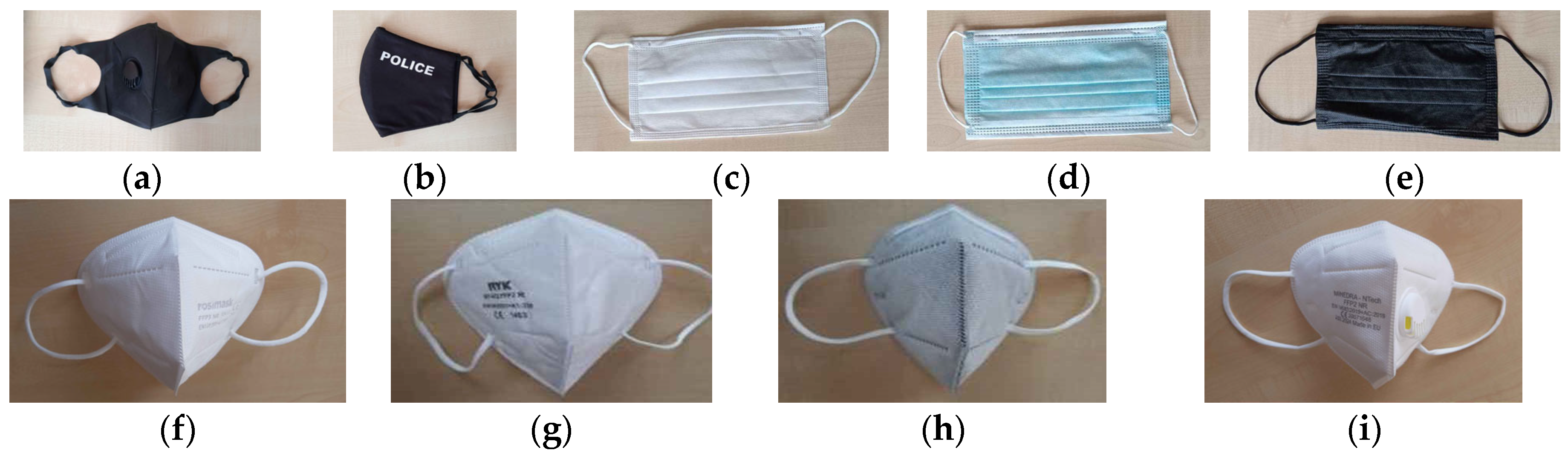
Nine types of protective face masks and respirators from different manufacturers, commonly available on the Bulgarian market, were examined. They are presented in Figure 1.
The examined masks and respirators were assigned codes for convenience, from Sample 1 to Sample 9. These codes, along with the classification by safety class and purpose, are presented in Table 1. Table 2 summarises the manufacturers and the corresponding standards of the examined items. Table 3 presents the type of protection provided and the options for cleaning and maintenance.
The masks and respirators were grouped into three categories based on their intended use:
Textile non-medical masks;
Surgical masks;
Respirators.
A destructive analysis was carried out to evaluate the internal structure: the number of compound layers, the type of macrostructure of each layer (knitted, non-woven, and woven), and the composition. Table 4 summarises the results for non-medical masks, Table 5 for surgical masks, and Table 6 for respirators.
2.2. Methods
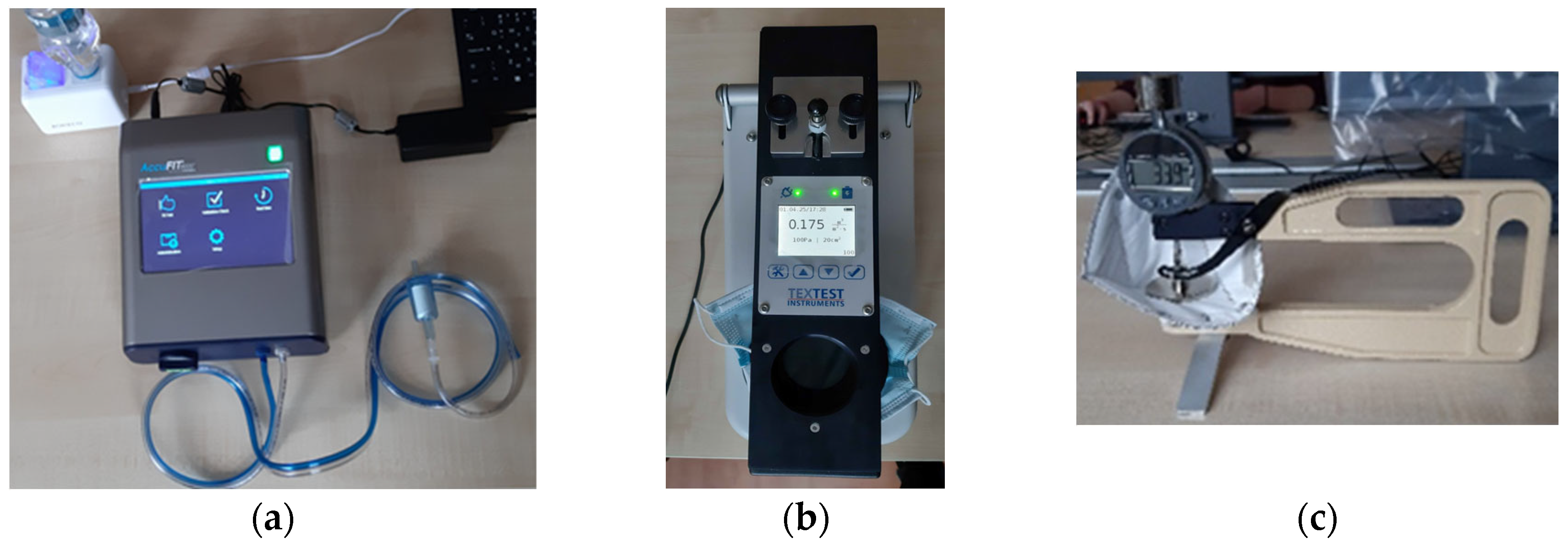
The instruments used in the experimental study are shown in Figure 2. The AccuFIT 9000, combined with the Ultrasonic particle generator U7146 Boneco (Figure 2a), was used for quantitative fit factor (FF) measurements of the masks and respirators [21]. The FX-3340 MinAir device (Textest AG, Schwerzenbach, Switzerland) (Figure 2b) was applied to determine the air permeability. The total weight and the mass of cut-out samples were measured using a KERN ABJ-NM/ABS-N analytical balance (min = 0.01 g, max = 220 g, and accuracy = 0.001 g). These measurements were used to calculate the surface mass and bulk density of the tested samples.
This study was conducted in three main stages: measurement of the geometric and mass characteristics of the samples and determination of their air permeability; evaluation of the FF; and data processing.
The thickness (δ, mm) of the samples was measured with a DD-200-T digital caliper (Figure 2c) following the standard ISO 1773:2002 [22]. The pressure applied during the measurement was 1 kPa, which complies with commonly used values for non-woven technical textiles, in line with EN ISO 5084:1996 [23] recommendations. First, the thickness and air permeability of each mask and respirator were measured. Five measurements at the edges and centre of each sample were performed.
Air permeability was measured in accordance with ISO 9237:1995 [24], using a pressure differential of Δp = 100 Pa between the two sides of each sample. Five measurements were performed on each side of every mask or respirator, in both directions: out–in (from the ambient environment to the face) and in–out (from the face to the ambient environment).
During air-permeability testing, the air-permeability coefficient Bp is actually determined—the rate at which air passes through a unit area under specified conditions (e.g., fixed Δp). Formally,
where Q is the volumetric flow rate (m3/s), A is the effective specimen area (m2), and V/Δt is the flow per second.
In the present paper, the terms “air permeability” and “air-permeability coefficient Bp” are used as synonyms, since the measured quantity is Bp.
FF was measured using the AccuFIT 9000 device. The sensor (CPC—Condensation Particle Counter), which counts the number of particles passing through it from the environment and from exhaled air, is built into the device. The device and the mask are connected via a double silicone tube. The tube is connected to the mask via a nozzle, which is attached to the mask using a special tool. There are no sensors located under the mask.
Equation (2) represents the way in which the AccuFIT 9000 device calculates the ratio between the particle concentration in the environment and under the mask/respirator.
where represents the average of the ambient particle concentrations before and after the test; Cbefore and Cafter are the concentrations in the ambient air prior to and following the measurement, respectively; and Cmask refers to the particle concentration measured in the microenvironment under the mask/respirator.
Particle concentrations are generally reported in particles per cubic centimetre (particles/cm3). According to the specifications of the AccuFIT 9000 device, it can detect particle concentrations ranging from 0 to 100,000 particles/cm3 and particle sizes between 0.015 and 1 μm. FF is a unitless value, as it represents the ratio of two concentrations.
An FF of 100 indicates that the air inside the mask is 100 times cleaner than the ambient air. Values lower than 100 suggest leakage and an inadequate facial seal.
Measurements were conducted with a single trained participant, deliberately eliminating inter-individual variation, which is typical when assessing FF. Using the same person for all masks allows the focus to remain on the effects related to the design of the mask/respirator and its constituent layers, without the influence of individual differences in facial anatomy, donning technique, and other variables. This approach ensures higher internal validity and facilitates direct comparison between the tested samples under identical conditions. The method is appropriate for the preliminary laboratory screening phase, where the objective is an unbiased assessment of differences between the tested specimens, rather than a general population-level evaluation.
The experiments were conducted in a controlled laboratory environment (Room 3416, Technical University of Sofia, 10 × 8 × 6 m). Room temperature was maintained between 22 °C and 23.5 °C using air conditioning. Each mask was tested for 15 min during normal seated breathing at rest.
All measurements were performed in PC mode of the software, which allowed real-time data visualisation and export via USB or network connection.
Prior to each measurement, the device was prepared by filling the alcohol cartridge with isopropyl alcohol, activating the filter element, and connecting the dual-channel sampling tube to the Ambient and Sample ports, with a HEPA filter placed on the Sample Line.
The measurement procedure included a sequence of validation steps: Min Fit Check (12 s), ZERO Check with HEPA filter (40 s), and Max Fit Check (96 s). If all checks were successfully passed, the system displayed a “PASS” message. Real-time fit factor measurement was then performed by connecting the sampling tube to the mask and initiating the test via the Real Time mode in the software interface. Upon test completion, the data were recorded and subjected to graphical and tabular processing.
Finally, all measurement results were statistically analysed and visualised using Microsoft Excel.
3. Results
3.1. Geometric and Mass Characteristics
Table 7 presents the results of the measurements of thickness, mass per unit area (weight), and bulk density of the investigated masks and respirators. The results show significant differences in thickness, mass per unit area, and bulk density among the examined protective masks and respirators.
The highest thickness was recorded for Sample 8 (1.53 mm), likely due to its six-layer structure, which includes four filtering layers (Table 6). It is followed by Sample 9 (1.36 mm). They are followed by Sample 1 (1.18 mm), made of polyurethane foam whose porous structure explains both the high thickness and the lowest values for mass per unit area (181.65 g/m2) and bulk density (144.78 kg/m3) among all samples.
Sample 8 (FFP2 respirator—grey) shows the greatest thickness (1.53 mm), which is logical considering the number of layers it is made of, and a high mass per unit area (248.96 g/m2). All respirators exhibit greater thickness compared to surgical masks, while non-medical masks exceed surgical masks in thickness due to the use of knitted macrostructure and polyurethane foam.
The highest mass per unit area was observed in Sample 2 (313.73 g/m2)—a textile mask made of knitted polyester with an intermediate filtering layer (Table 4). This sample also has the highest bulk density (306.65 kg/m3), which can be attributed to its dense structure and filter material. Respirators Sample 6 (FFP3) and Sample 7 (FFP2) show similar values in terms of mass per unit area and bulk density, while Sample 8 presents a higher mass per unit area but lower bulk density—likely due to well-compacted filtering layers.
Surgical masks (Samples 3, 4, and 5) are characterised by lower values of thickness, mass per unit area, and bulk density, corresponding to their lighter and finer structure.
3.2. Air Permeability
Table 8 presents the air permeability (m/s) of the nine masks and respirators, measured in two directions: out–in (from the ambient environment to the face) and in–out (from the face to the ambient environment). For each sample, the arithmetic mean, standard deviation (SD), and 95% confidence interval (95% CI) are provided, calculated using the t-distribution with n = 5 single measurements.
For the textile masks, Sample 1 shows high air permeability, similar in both directions: 1.338 m/s (95% CI 1.106–1.570) vs. 1.396 m/s (1.278–1.514). Sample 2 has almost twice lower air permeability than Sample 1 and is at an intermediate level between surgical masks and respirators. It is the only one that demonstrates a clearly expressed directionality: the front side is more permeable—0.540 (0.525–0.555) compared to 0.478 (0.453–0.503), with the intervals not overlapping. This indicates a statistically significant difference between the directions of airflow, as also confirmed by Student’s t-test. This is likely due to a real structural/surface difference between the sides (different permeability of the knitted pattern, finishing treatment, surface hairiness, etc.). Overall, Sample 2 provides good breathability for a textile mask but with sensitivity to orientation.
In the group of surgical masks (Samples 3, 4, and 5), there is a noticeable within-group heterogeneity. Sample 3 and Sample 5 have high air permeability and very close indicator values in both directions (≈1.30–1.38 m/s). The comparatively narrow 95% CI is a good signal for consistency and a small effect of the direction of air movement. Sample 4 contrasts with clearly lower permeability (≈0.23–0.25 m/s) and slightly wider 95% CI. This suggests differences in the multilayer construction/density of the material. Overall, for the group, high air permeability is characteristic, but with possible design variations. The directional effect is small and practically insignificant for Sample 3s and 5.
As expected, the group of respirators shows the lowest permeability. Sample 7 is very consistent with respect to the direction of air movement: 0.100 (0.089–0.111) versus 0.112 (0.103–0.122). Sample 8 is similar in regard to its level, with a slight reverse directionality: 0.138 (0.112–0.165) versus 0.113 (0.101–0.126). Sample 9 is more permeable within this group: 0.193 (0.143–0.244) versus 0.232 (0.164–0.301). Sample 6 is a special case: 0.084 (0.059–0.109) on the front side and 0.508 (−0.005–1.021) on the back side, with very large variability, which suggests non-uniformity of the structure or a problem with positioning/sealing.
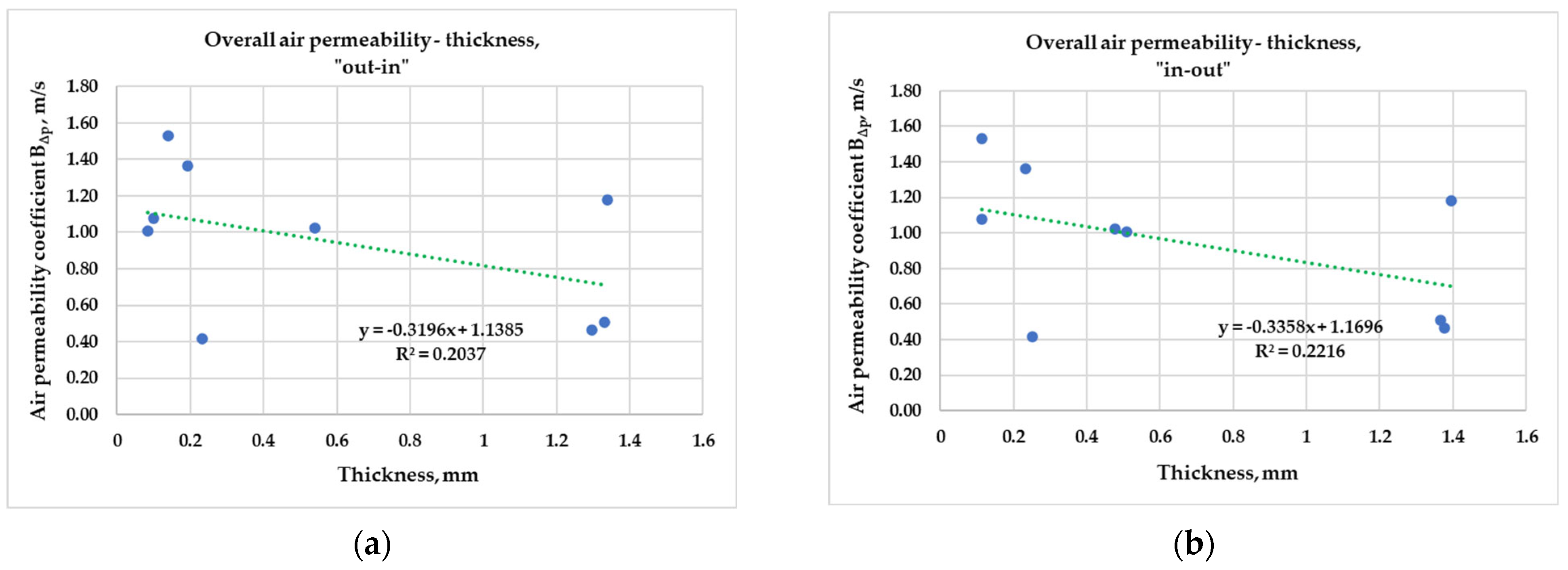
Figure 3 presents the effect of the thickness of masks and respirators on their air permeability in the two directions: out–in (Figure 3a) and in–out (Figure 3b).
In both directions, a slight negative linear trend is observed: with the increase in thickness increment, the air permeability decreases (slope ≈ −0.32 m/s per mm for out–in and ≈−0.34 m/s per mm for in–out). Nevertheless, thickness has a weak and statistically unconvincing linear effect on air permeability: R2 ≈ 0.2037 (out–in) and R2 ≈ 0.2216 (in–out). The trend lines are almost parallel, suggesting that the direction of air movement does not substantially change the relationship between the thickness and air permeability.
Besides the fact that thickness explains only ~20% of the variation, it is notable that the scatter of the points at similar thicknesses is large. This shows that the structure of mask/respirator and its characteristics (porosity, type and number of layers, and finishing treatment) probably make a greater contribution to air transfer than the geometric thickness itself. There are probably also individual influential points that weaken the linear correlation.
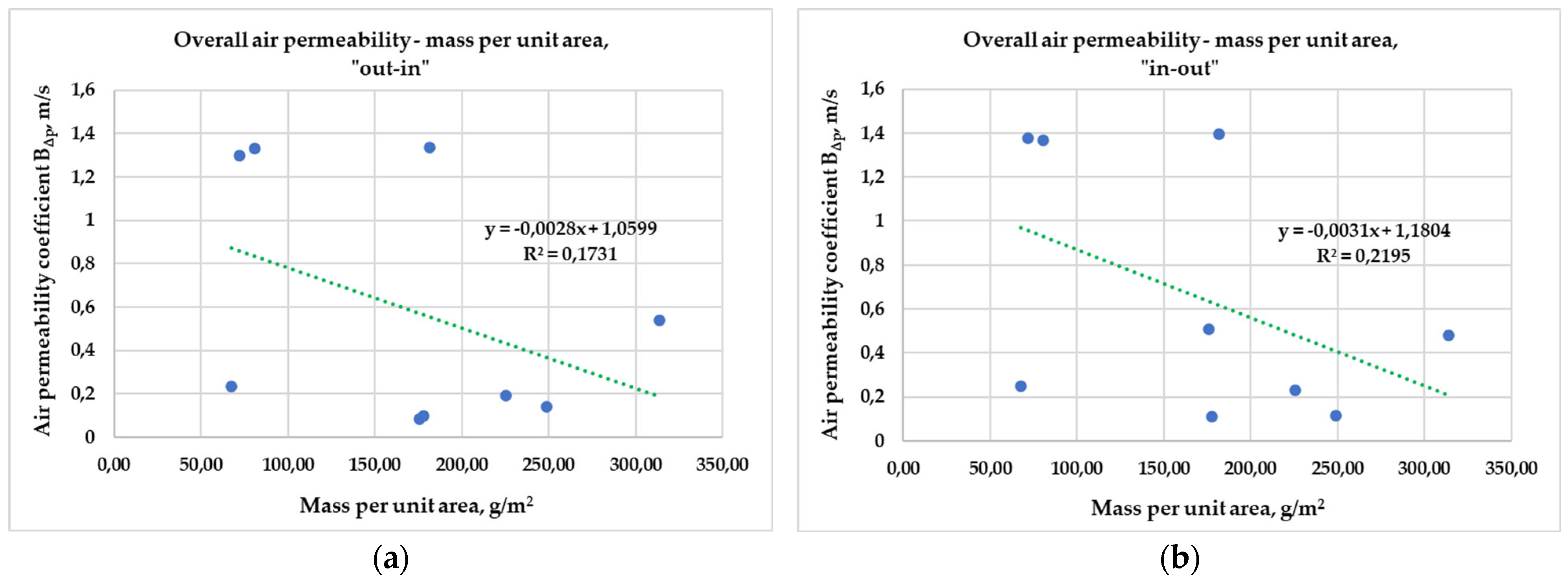
Figure 4 illustrates how the mass per unit area of masks and respirators influences their air permeability in the two directions: out–in (Figure 4a) and in–out (Figure 4b).
A negative linear trend is observed in both directions: with increasing mass per unit area (g/m2), air permeability decreases (slope ≈ −0.0028 m/s per g/m2 for out–in and ≈−0.0031 m/s per g/m2 for in–out). The mass per unit area has a moderate but limited linear effect on air permeability: R2 ≈ 0.17 (out–in) and R2 ≈ 0.22 (in–out). The trend lines are almost parallel, suggesting that the direction of air movement does not substantially change the relationship between the two parameters. It should be mentioned that the intercept is slightly higher for the in–out direction.
The coefficient of determination R2 = 0.2195 (in–out) is an acceptable “signal” for a trend, but not a sufficiently “good” correlation in the strict sense. This means that the linear model explains approximately 22% of the variation in air permeability. This is a moderate relationship: not weak, but far from a strong one and with limited predictive value. It should be noted, however, that in heterogeneous materials (different porosity of layers, multiple layers), such an R2 is realistic and shows a meaningful trend, but it does not capture the multitude of structural factors.
Despite the higher R2 compared to thickness, the scatter at similar values of mass per unit area remains significant. The conclusion is that the structure and characteristics probably make a greater contribution to air transfer through mask/respirator than the mass per unit area.
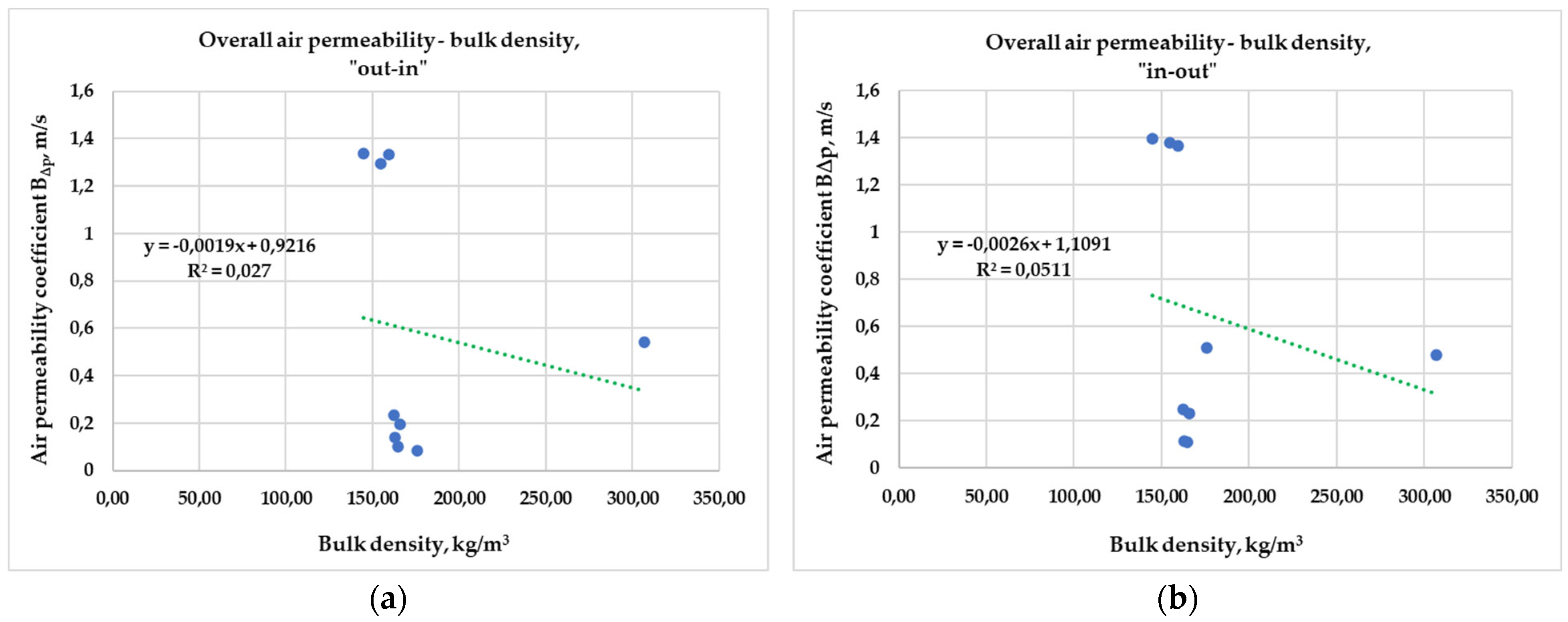
Figure 5 shows the influence of the bulk density of the masks and respirators on the overall air permeability of each of them, measured in two directions: from outside to inside and from inside to outside.
There is a slight negative trend: for the out–in direction, the slope is approx. −0.0019 m/s per kg/m3, and for the in–out, it is approx. −0.0026 m/s per kg/m3 (an increase of 100 kg/m3 is associated with a decrease in Bp of ~0.19–0.26 m/s). However, the linear relationship is very weak in both directions of air movement, as bulk density explains only 3–5% of the variation. The lines are almost parallel, indicating that the flow direction has little effect on the relationship; the intercept is slightly higher for the in–out direction (1.11 vs. 0.92 m/s). The large scatter at similar bulk densities again suggests that the structure and characteristics of the layers dominate over the bulk density of the mask or respirator.
3.3. Fit Factor
Table 9 presents the results of the measurements of particle concentrations in the environment and under the masks/respirators, as well as the calculated fit factor.
As expected, the obtained fit factor values are low—from 2.22 to 11.05 (mean, 3.80; SD ≈ 2.83). In eight of the nine cases, the values lie in a narrow range of ≈2.2–3.5 (mean = 2.89 and SD ≈ 0.85, i.e., if Sample 8, which has the highest FF value, is excluded). This indicates similar but insufficient fit and a noticeable inward leakage of the particles generated during the experiment. Sample 8 stands out as the most effective (FF = 11.05), with the lowest concentration under the mask (≈1.27 × 10³ particles/cm3 versus ≈8.24 × 10³ particles/cm3 in the ambient environment). Sample 9 is second in effectiveness (FF = 4.76). The remaining samples show similar characteristics, without clear differentiation among them.
The interpretation should be comparative across the samples, since the measured FF values are far below the reference thresholds for tight-fitting respirators (e.g., FF ≥ 100). The data nevertheless allow a reliable ranking by effectiveness within the investigated protective masks and respirators under identical conditions.
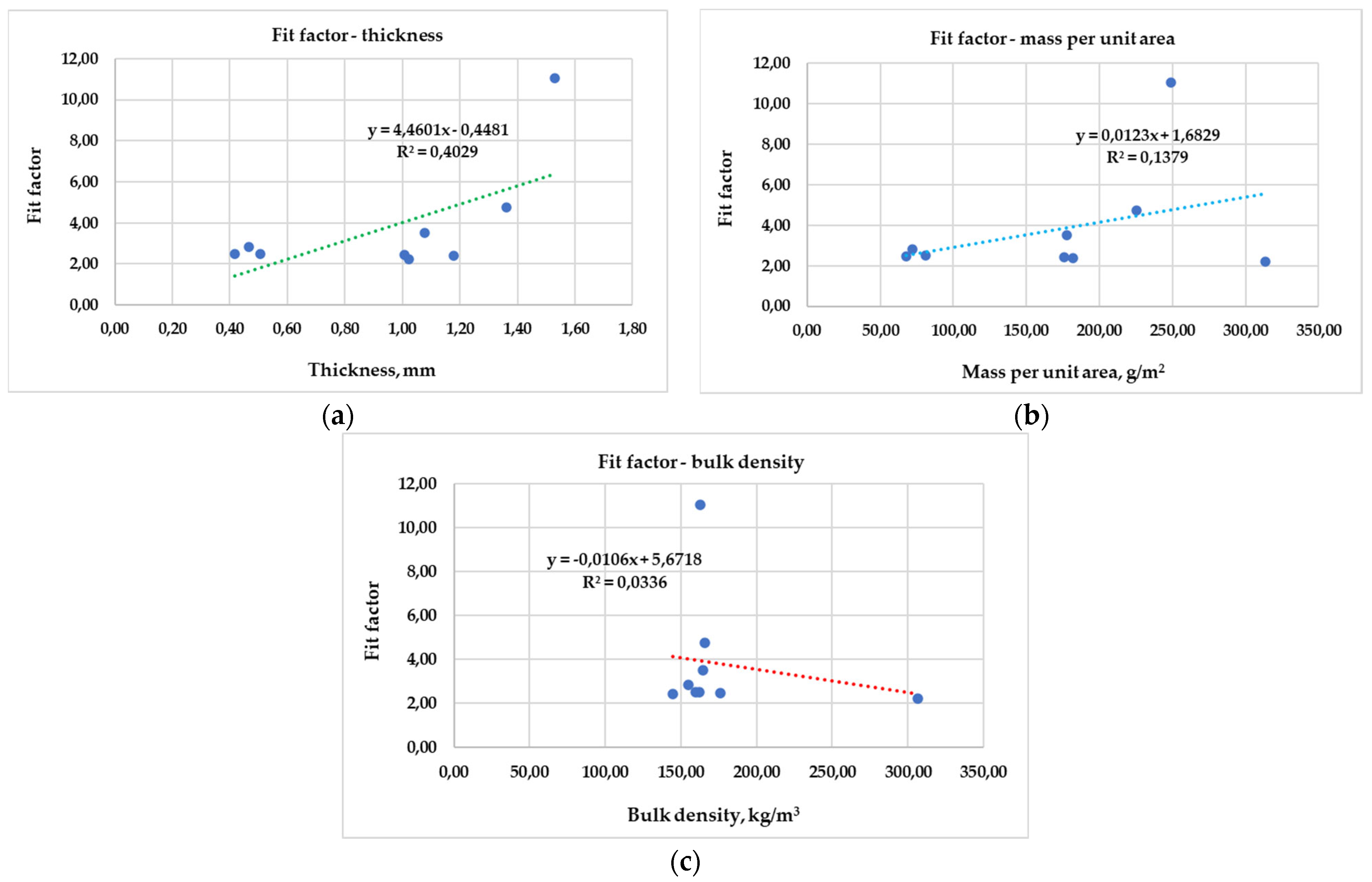
Figure 6 presents the dependence between the FF of the investigated masks/respirators and their geometric and mass characteristics.
The effect of the thickness on FF is shown in Figure 6a. The graph shows a moderately strong positive linear relationship between the thickness of masks/respirators and the fit factor. As thickness increases, FF also rises by approx. +4.46 FF units per 1 mm of thickness. This indicates that, overall, thicker samples provide a better fit and reduce particle penetration under the mask/respirator.
The coefficient of determination (R2 = 0.4029) shows that just over 40% of the variation in fit factor can be explained by thickness. This is a relatively high value for biomedical measurements, especially with a small number of observations. This suggests an existing, though incomplete, relationship between mask thickness and FF. The remaining variation is probably due to other factors, such as type and number of layers, porosity, elasticity, and facial geometry.
The effect of the mass per unit area of the mask/respirator on FF is shown in Figure 6b. A very weak positive linear relationship between the mass per unit area of the samples and the FF is observed. The slope of the regression line is only +0.0123 FF units per 1 g/m2, which means that increasing the mass per unit area has almost no effect on the FF. The coefficient of determination (R2 = 0.1379) also confirms that only about 14% of the variation in FF is explained, which is a very low value. The trend line may again be influenced by the presence of a single point with a high FF (~11) at a mass per unit area of around 300 g/m2.
The dependence between the bulk density of a mask/respirator and its fit factor is shown in Figure 6c. Again, here, as with the mass per unit area, the data show that bulk density has virtually no effect on the fit factor—the relationship is very weak (R2 = 0.0336), and the impact on the FF is negligible.
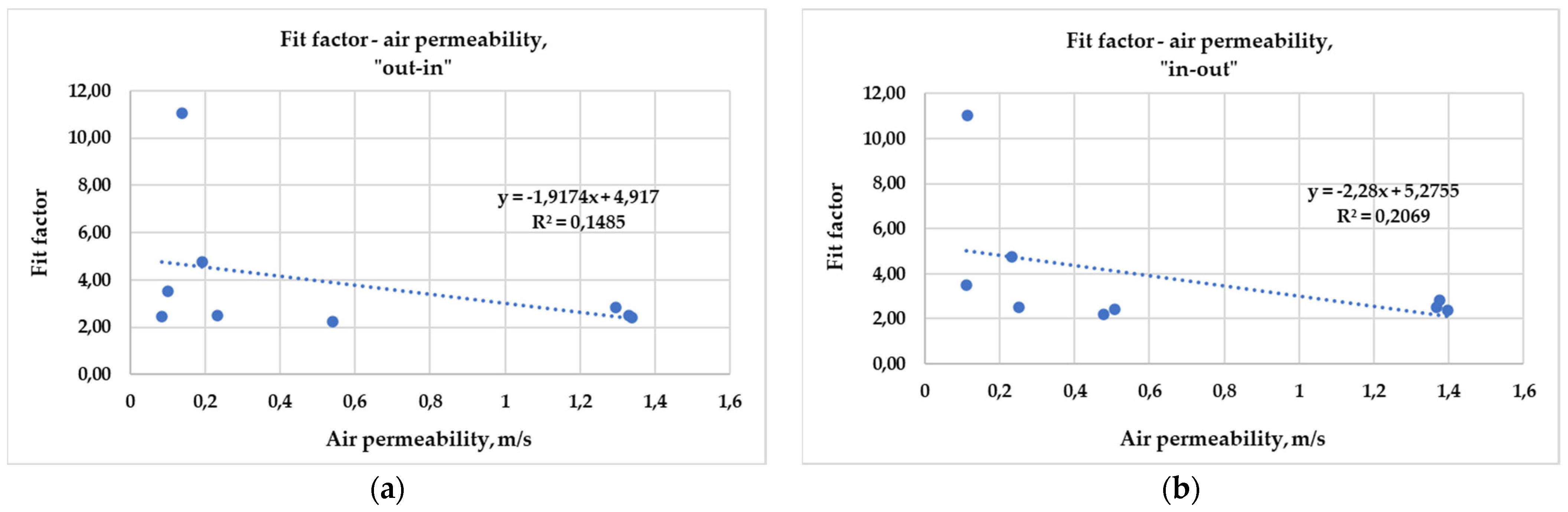
Figure 7 tries to find a dependence between the measured air permeability of the masks/respirators in both directions and their fit factor. The data in Figure 7a show a weak negative correlation between air permeability (out–in direction) and FF. It means that higher material permeability tends to be associated with a decrease in FF, i.e., slightly reduced sealing and protection. The slope of the regression line (−1.9174 FF units per 1 m/s) indicates that the effect is limited, while the low coefficient of determination (R2 = 0.1485) shows that only about 15% of the variation in FF can be explained by this parameter.
Similarly, the graph in Figure 7b shows a weak-to-moderate negative correlation between air permeability (in–out direction) and FF. Again, higher material air permeability tends to be associated with a decrease in FF, suggesting a slight deterioration in sealing and protection. The slope of the regression line (−2.28 FF units per 1 m/s) is somewhat more pronounced compared to the out–in measurement, but the effect remains limited. The coefficient of determination (R2 = 0.2069) indicates that about 21% of the variation in FF can be explained by this parameter. This is slightly higher than in Figure 7a, but still insufficient to be considered a primary factor. The presence of a single point with high FF (~11), as in Figure 7a, at low permeability could have a substantial influence on the trend line.
4. Discussion
The results of the study provide a detailed view of the relationship between the geometric and mass characteristics and the air-permeability coefficient of various protective masks and respirators, and their FF, which is a direct indicator of their protective effectiveness.
A moderately strong positive relationship was observed between the thickness of the masks and FF, with thicker samples generally showing better sealing and lower particle penetration. This corresponds to data from previous studies [17,25], according to which increasing the number of layers and thickness can improve filtration and fit, although not always in a strictly linear manner. Nevertheless, thickness explains only about half of the observed variation in FF. This result indicates that other design factors, such as the type and arrangement of layers, porosity, elasticity, and interaction with facial geometry, are also important.
Unlike thickness, mass per unit area and bulk density show only weak or negligible effects on fit factor. Although heavier or denser samples might intuitively suggest improved barrier performance, the data reveal a weak correlation for mass per unit area (R2 ≈ 0.14) and a very weak correlation for bulk density (R2 ≈ 0.03). This indicates that these parameters alone are not reliable predictors of sealing effectiveness, especially given the high structural diversity among the examined samples.
In the analysis of the air permeability of the investigated masks and respirators in two directions (out–in and in–out), it was found that thickness, mass per unit area, and bulk density exert different, but not sufficiently strong, influences. Thickness shows a weak-to-moderate negative relationship with permeability (R2 ≈ 0.20–0.22). It is logical to expect that thicker masks would allow less air to pass through, but the effect is not particularly strong and is likely influenced by internal structure and layer arrangement. Mass per unit area shows a moderate inverse relationship (R2 up to 0.22). This suggests that heavier or more textile layers in the structure can noticeably restrict air transfer through the mask/respirator, especially with more compact filter layers. Bulk density has a very weak effect (R2 ≤ 0.04) and cannot be considered a reliable indicator of air permeability due to the large variation among samples with similar density.
The investigation of the relationship between air permeability and the fit factor is logically justified, since both indicators are directly related to the movement of air and particles through or around the mask/respirator. Air permeability reflects the ability of the protective device to transmit air and, indirectly, its potential to transmit aerosol particles. Higher air permeability, under equally good sealing, could lead to a lower FF. On the other hand, excessively low permeability may increase breathing resistance and stimulate air leakage through peripheral gaps, thus also reducing the FF.
The direct relationship between air permeability and FF is weak and negative in both directions of airflow (out–in and in–out). The effect is more pronounced in the in–out direction (R2 = 0.2069), which may be due to structural asymmetry or surface treatments of the mask/respirator affecting sealing during exhalation. Nevertheless, the low R2 values indicate that permeability by itself is not a primary factor for fit, although it may contribute when considered in combination with other structural parameters.
The weak negative correlations obtained in the present study (R2 ≤ 0.21) indicate that air permeability by itself is not a leading factor for fit of the mask/respirator. However, it may play a role in combination with other parameters, such as thickness, layer structure and arrangement, elasticity, and the design of the mask/respirator edges. Similar results have also been reported in previous studies, where it was found that air permeability has limited predictive value for FF, while sealing effectiveness depends to a greater extent on the design and ergonomic conformity of the mask to the wearer’s face [26,27]. These conclusions confirm that optimal protective performance is achieved not so much through the management of air permeability (minimizing or maximizing), but rather through a balance between adequate filtration, sufficient breathability, and stable sealing to the face.
In terms of protective performance measured by FF, the highest value was recorded for Sample 8 (FF = 11.05). It is a six-layer construction with four filtering layers and considerable thickness (1.53 mm), which provides approximately 6–9 times less particle penetration compared to the other samples. Second is Sample 9 (FF = 4.76, FFP2 with valve), followed by Sample 7 (FF = 3.50, FFP2 without valve). All the others, including surgical masks (Samples 3, 4, and 5) and textile masks (Samples 1 and 2), fall within the range of FF ≈ 2.2–2.8, indicating similar but low effectiveness. Notable is the result of Sample 6 (FFP3), which, despite its higher filter class, achieved only FF = 2.44, a result comparable to that of surgical masks. This may be a consequence of sealing or positioning issues. The results obtained emphasize that the nominal filter class does not guarantee high fit, and that mask construction and ergonomics are decisive for actual protective performance.
The overall FF range (2.22–3.50, with one exception of FF = 11.05) clearly shows that none of the tested masks and respirators reaches the minimum reference values for tight-fitting respirators (FF ≥ 100). Of course, this study does not expect such protective performance, but it rather provides the possibility for comparative analysis between the samples. Despite the usefulness of this analysis, it becomes evident that for all nine personal protective devices intended for mass use, particle penetration remains substantial. This corresponds to other studies [27], which report that many consumer masks, and sometimes even certified respirators, do not provide high levels of protection.
The presence of Sample 8 with FF ≈ 11 and high thickness but moderate bulk density suggests that design features may outweigh purely geometric or mass parameters. This confirms the multifactorial nature of mask effectiveness, where sealing is determined not only by the properties of the barrier material but also by the ergonomic interaction of the mask with the wearer’s face.
Although the samples were functionally grouped as textile, surgical, and respirator masks, the structural analysis shows that many of them share common non-woven components (spun-bond and melt-blown layers). This overlap allowed for the identification of general trends across all products, regardless of nominal classification.
From a practical perspective, the data show that increasing thickness and reducing air permeability can partially improve FF. However, design optimisation should pay equal attention to material structure, elasticity, edge sealing, and compatibility with different facial shapes. This is particularly important in the development of high-performance protective masks for environments with high aerosol risk.
Future research directions include evaluations under different environmental conditions (e.g., humidity and movement) and conducting field measurements with at least three participants to account for the interaction between mask geometry and facial anatomy. In addition, airflow modelling and analysis of particle leakage pathways could help identify design improvements that enhance FF without significantly reducing breathability.
5. Conclusions
This present study provides a practical overview of how material characteristics and structural design influence the protective performance and comfort of nine types of textile masks and respirators. Increased thickness can moderately improve fit (fit factor), while mass per unit area and bulk density alone are not reliable predictors. Air permeability shows only a weak correlation with fit factor, yet it remains an important parameter for breathability and wearing comfort.
The results confirm that effective protection does not depend solely on filtering materials, but also on thoughtful design: particularly in terms of elasticity, layer structure, and edge sealing. Some textile-based constructions demonstrated a better fit than certified respirators, emphasising the importance of ergonomics over nominal filter class.
Ultimately, achieving a balance between adequate air permeability and stable fit is essential. Highly permeable masks may allow edge leakage, while overly tight designs can compromise comfort and usability. Future developments should focus on smart combinations of materials and ergonomic design to ensure both long-term comfort and reliable protection, especially in environments with increased aerosol exposure.
Author Contributions
Conceptualization, R.A.A.; methodology, M.I. and R.A.A.; software, M.I.; validation, M.I.; formal analysis, M.I. and R.A.A.; investigation, M.I.; resources, M.I. and R.A.A.; data curation, M.I.; writing—original draft preparation, M.I.; writing—review and editing, R.A.A.; visualization, M.I. and R.A.A.; supervision, R.A.A.; project administration, R.A.A.; funding acquisition, R.A.A. All authors have read and agreed to the published version of the manuscript.
Funding
The research presented in this publication was funded by the Internal Competition of the Technical University of Sofia, 2024, contract number 242ПД0029-02.
Institutional Review Board Statement
Ethical review and approval were waived for this study as it did not involve clinical research, medical intervention, invasive procedures, or the collection of personal data. The study consisted only of short-term wearing of masks/respirators under conditions equivalent to daily use, with no risks beyond ordinary life activities.
Informed Consent Statement
Informed consent was obtained from all subjects involved in the study.
Data Availability Statement
The original contributions presented in this study are included in the article. Further inquiries can be directed to the corresponding author.
Acknowledgments
During the preparation of this manuscript, the authors used Google Translate and ChatGPT 4.0 for translation from Bulgarian to English, as well as Grammarly for editing. The authors have reviewed and edited the output and take fully responsible for the content of this publication.
Conflicts of Interest
The authors declare no conflicts of interest.
References
Adanur, S.; Jayswal, A. Filtration mechanisms and manufacturing methods of face masks: An overview. J. Ind. Text.2022, 51 (Suppl. 3), 3683S–3717S. [Google Scholar] [CrossRef]
Angelova, R.A.; Velichkova, R.; Sofronova, D.; Markov, D.; Dimova, M.; Simova, I. Air permeability of protective face masks. In Proceedings of the 2023 XXXIII International Scientific Symposium Metrology and Metrology Assurance (MMA), Sozopol, Bulgaria, 7–11 September 2023; IEEE: London, UK, 2023; pp. 1–5. [Google Scholar]
O’Kelly, E.; Arora, A.; Pirog, S.; Ward, J.; Clarkson, P.J. Comparing the fit of N95, KN95, surgical, and cloth face masks and assessing the accuracy of fit checking. PLoS ONE2021, 16, e0245688. [Google Scholar] [CrossRef] [PubMed]
Knobloch, J.K.; Franke, G.; Knobloch, M.J.; Knobling, B.; Kampf, G. Overview of tight fit and infection prevention benefits of respirators (filtering face pieces). J. Hosp. Infect.2023, 134, 89–96. [Google Scholar] [CrossRef]
Pandey, L.K.; Singh, V.V.; Sharma, P.K.; Meher, D.; Biswas, U.; Sathe, M.; Ganesan, K.; Thakare, V.B.; Agarwal, K. Screening of core filter layer for the development of respiratory mask to combat COVID-19. Sci. Rep.2021, 11, 10187. [Google Scholar] [CrossRef]
Kwong, L.H.; Wilson, R.; Kumar, S.; Crider, Y.S.; Reyes Sanchez, Y.; Rempel, D.; Pillarisetti, A. Review of the breathability and filtration efficiency of common household materials for face masks. ACS Nano2021, 15, 5904–5924. [Google Scholar] [CrossRef]
Zhang, T.; Zhang, T.; Liu, S. A modified surgical face mask to improve protection and wearing comfort. Buildings2022, 12, 663. [Google Scholar] [CrossRef]
Chiera, S.; Cristoforetti, A.; Benedetti, L.; Nollo, G.; Borro, L.; Mazzei, L.; Tessarolo, F. A simple method to quantify outward leakage of medical face masks and barrier face coverings: Implication for the overall filtration efficiency. Int. J. Environ. Res. Public Health2022, 19, 3548. [Google Scholar] [CrossRef]
Otrisal, P.; Bungau, C.; Obsel, V.; Melicharik, Z.; Tont, G. Selected respiratory protective devices: Respirators and significance of some markings. Sustainability2021, 13, 4988. [Google Scholar] [CrossRef]
Lee, K.P.; Yip, J.; Kan, C.W.; Chiou, J.C.; Yung, K.F. Reusable face masks as alternative for disposable medical masks: Factors that affect their wear-comfort. Int. J. Environ. Res. Public Health2020, 17, 6623. [Google Scholar] [CrossRef]
Duncan, S.; Bodurtha, P.; Naqvi, S. The protective performance of reusable cloth face masks, disposable procedure masks, KN95 masks and N95 respira-tors: Filtration and total inward leakage. PLoS ONE2021, 16, e0258191. [Google Scholar] [CrossRef]
Wang, C.; Xu, J.; Zhai, H.; So, L.K.; Guo, H. Mapping full-range infection transmission from speaking, coughing, and sneezing in indoor environments and its impact on social distancing. J. Hazard. Mater.2025, 490, 137782. [Google Scholar] [CrossRef]
Morris, H.; Murray, R. Healthcare, hygiene, and personal protective equipment (PPE). In Medical Textiles; CRC Press: Boca Raton, FL, USA, 2021; pp. 261–310. [Google Scholar]
Song, J.Y.; Kim, S.; Park, J.; Park, S.M. Highly efficient, dual-functional self-assembled electrospun nanofiber filters for simultaneous PM removal and on-site eye-readable formaldehyde sensing. Adv. Fiber Mater.2023, 5, 1088–1103. [Google Scholar] [CrossRef] [PubMed]
Oner, E.; Seçkin, A.Ç.; Egeli, D.; Seçkin, M. Investigation of the thermal comfort properties of masks used during the COVID-19 pandemic. Int. J. Environ. Res. Public Health2022, 19, 11275. [Google Scholar] [CrossRef] [PubMed]
Zhuang, Z.; Bergman, M.; Lei, Z.; Niezgoda, G.; Shaffer, R. Recommended test methods and pass/fail criteria for a respirator fit capability test of half-mask air-purifying respirators. J. Occup. Environ. Hyg.2017, 14, 473–481. [Google Scholar] [CrossRef] [PubMed]
Chua, M.H.; Cheng, W.; Goh, S.S.; Kong, J.; Li, B.; Lim, J.Y.C.; Mao, L.; Wang, S.; Xue, K.; Yang, L.; et al. Face masks in the new COVID-19 normal: Materials, testing, and perspectives. Research2020, 2020, 7286735. [Google Scholar] [CrossRef]
Regli, A.; Sommerfield, A.; von Ungern-Sternberg, B.S. The role of fit testing N95/FFP2/FFP3 masks: A narrative review. Anaesthesia2021, 76, 91–100. [Google Scholar] [CrossRef]
ISO 1773:2002; Textiles—Determination of Thickness of Textile Fabrics. International Organization for Standardization ISO: Geneva, Switzerland, 2002.
ISO 5084:1996; Textiles—Determination of Thickness of Textiles and Textile Products. International Organization for Standardization ISO: Geneva, Switzerland, 1996.
ISO 9237:1995; Textiles—Determination of the Permeability of Fabrics to Air. International Organization for Standardization ISO: Geneva, Switzerland, 1995.
Wang, A.B.; Zhang, X.; Gao, L.J.; Zhang, T.; Xu, H.J.; Bi, Y.J. A review of filtration performance of protective masks. Int. J. Environ. Res. Public Health2023, 20, 2346. [Google Scholar] [CrossRef]
Oberg, T.; Brosseau, L.M. Surgical mask filter and fit performance. Am. J. Infect. Control2008, 36, 276–282. [Google Scholar] [CrossRef]
Chaaban, O.; Balanay, J.A.G.; Sousan, S. Assessment of best-selling respirators and masks: Do we have acceptable respiratory protection for the next pandemic? Am. J. Infect. Control2023, 51, 388–395. [Google Scholar] [CrossRef]
Figure 2.
Instruments used in the study: (a) AccuFIT 9000 and Ultrasonic particle generator U7146 Boneco; (b) air-permeability and pressure-drop meter FX-3340 MinAir; and (c) digital caliper DD-200-T.
Figure 2.
Instruments used in the study: (a) AccuFIT 9000 and Ultrasonic particle generator U7146 Boneco; (b) air-permeability and pressure-drop meter FX-3340 MinAir; and (c) digital caliper DD-200-T.
Figure 3.
Influence of the thickness of masks and respirators on their air permeability in the two directions: (a) out–in and (b) in–out.
Figure 3.
Influence of the thickness of masks and respirators on their air permeability in the two directions: (a) out–in and (b) in–out.
Figure 4.
Influence of the weight (mass per unit area) of masks and respirators on their air permeability in the two directions: (a) out–in and (b) in–out.
Figure 4.
Influence of the weight (mass per unit area) of masks and respirators on their air permeability in the two directions: (a) out–in and (b) in–out.
Figure 5.
Influence of the bulk density of masks and respirators on their air permeability in the two directions: (a) out–in and (b) in–out.
Figure 5.
Influence of the bulk density of masks and respirators on their air permeability in the two directions: (a) out–in and (b) in–out.
Figure 6.
Influence of the geometric and mass characteristics of masks and respirators on their fit factor: (a) influence of the thickness, (b) influence of the weight (mass per unit area), and (c) influence of the bulk density.
Figure 6.
Influence of the geometric and mass characteristics of masks and respirators on their fit factor: (a) influence of the thickness, (b) influence of the weight (mass per unit area), and (c) influence of the bulk density.
Figure 7.
Influence of mask/respirator air permeability coefficient in both directions on their fit factor: (a) air permeability for out–in and (b) air permeability for in–out.
Figure 7.
Influence of mask/respirator air permeability coefficient in both directions on their fit factor: (a) air permeability for out–in and (b) air permeability for in–out.
Table 1.
Assigned codes for the masks and respirators, type of protection, and purpose of use.
Table 1.
Assigned codes for the masks and respirators, type of protection, and purpose of use.
Sample
Type of PPE
Type of Protection
Purpose
Sample 1
Polyurethane sponge mask
Safety class “B”
Non-medical, sterile
Sample 2
Textile knitted, police
No data available
Non-medical, non-sterile
Sample 3
Surgical mask—white
Type I
Medical, non-sterile
Sample 4
Surgical mask—blue
Type IIR, BFE 99%
Medical, non-sterile
Sample 5
Surgical mask—black
BFE ≥ 98%
Medical, non-sterile
Sample 6
Respirator FFP3
BFE ≥ 99%
Medical, sterile
Sample 7
Respirator FFP2—white
BFE ≥ 95%
Non-medical, sterile
Sample 8
Respirator FFP2—grey
BFE ≥ 94%
Non-medical, sterile
Sample 9
Respirator FFP2—with valve
BFE ≥ 94%
Medical, sterile
Table 2.
Manufacturers and standards of the mask/respirators written on their packaging.
Table 2.
Manufacturers and standards of the mask/respirators written on their packaging.
Sample
Manufacturer
Standard
Sample 1
Fashion Mask, China
GB/T 32610-2016
Sample 2
No data available
No data available
Sample 3
Yavuz Medical®, Turkey
CE, EN14683, ISO9001:2015, ISO13485:2016
Sample 4
Medtex Swiss Ltd., Bulgaria
CE, EN14683:2019+AC
Sample 5
Etropal®, Bulgaria
CE, ISO13485:2016, EN14683:2019+AC:2019 (E)
Sample 6
Rosimask, Turkey
CE2841, EN149:2001+A1:2009
Sample 7
Wenzhou Meiyi Medical Device Co., Ltd., China
CE1463, EN149:2001+A1:2009
Sample 8
Jinjiang, China
GB2626-2006 KN95
Sample 9
Minedra-NTech, European Union (EU)
EN14683:2019+AC:2019, CE20071048
Table 3.
Protection, cleaning, and maintenance options.
Table 3.
Protection, cleaning, and maintenance options.
Sample
Protection
Cleaning and Maintenance
Sample 1
Protection against toxic gases—not applicable
Reusable. Wash at 30 °C
Sample 2
No data available
Reusable. Wash at 30 °C
Sample 3
No data available
Not reusable. Dispose after use. Store in a dry, cool, and ventilated place
Sample 4
High splash resistance
Not reusable. Dispose after use
Sample 5
Limits transmission of infectious agents during treatment and related procedures
Not reusable. Dispose after use
Sample 6
No data available
Not reusable. Dispose after use
Sample 7
Protection against dust, smoke, fog, microorganisms. Not suitable for gases, open flames, or underwater use
Not reusable. Dispose after use. Store at room temperature, RH < 80%, away from fire, moisture, and sunlight
Sample 8
Protection from pollen, dust, and mist. Not suitable for industrial use or unventilated areas. Not recommended for children or sleep
Not reusable. Dispose after use. Store away from ignition sources
Sample 9
Protection against bacteria
Not reusable. Dispose after use. Store in a cool, dry place away from vapour, heat, open flame, and sunlight
Table 4.
Non-medical masks: structure, composition, and number of the compound layers.
Table 4.
Non-medical masks: structure, composition, and number of the compound layers.
Sample
Number of Layers
Structure and Composition of the Layers
Sample 1
1
Single layer
Polyurethane foam
Sample 2
3
Outer layer
Knitted textile (polyester)
Intermediate layer
Melt-blown non-woven fabric (polypropylene)
Inner layer
Knitted textile (polyester)
Table 5.
Surgical masks: structure, composition, and number of the compound layers.
Table 5.
Surgical masks: structure, composition, and number of the compound layers.
Sample
Number of Layers
Structure and Composition of the Layers
Sample 3
3
Outer protection layer
Non-woven fabric (polypropylene)
Intermediate filtering layer
Melt-blown non-woven fabric (polypropylene)
Inner layer—for comfort
Non-woven fabric (polypropylene)
Sample 4
3
Outer protection layer
Non-woven fabric (polypropylene)
Intermediate filtering layer
Melt-blown non-woven fabric (polypropylene)
Inner layer—for comfort
Non-woven fabric (polypropylene)
Sample 5
3
Outer protection layer
Non-woven fabric (polypropylene)
Intermediate filtering layer
Melt-blown non-woven fabric (polypropylene)
Inner layer—for comfort
Non-woven fabric (polypropylene)
Table 6.
Respirators: structure, composition, and number of the compound layers.
Table 6.
Respirators: structure, composition, and number of the compound layers.
Sample
Number of Layers
Structure and Composition of the Layers
Sample 6
5
Outer protection layer
Needle-punched non-woven fabric (cotton)
Filter layers
First
Melt-blown non-woven fabric (polypropylene)
Second
Melt-blown non-woven fabric (polypropylene)
Third
Melt-blown non-woven fabric (polypropylene)
Inner layer—for comfort
Needle-punched non-woven fabric (cotton)
Sample 7
5
Outer protection layer
Spun-bond non-woven fabric (polypropylene)
Filter layers
First
Melt-blown non-woven fabric (polypropylene)
Second
Melt-blown non-woven fabric (polypropylene)
Third
Melt-blown non-woven fabric (polypropylene)
Inner layer—for comfort
Hot air cotton (low-density non-woven polypropylene)
Sample 8
6
Outer protection layer
Spun-bond non-woven fabric (polypropylene)
Filter layers
First
Melt-blown non-woven fabric (polypropylene)
Second
Hot air cotton (low-density non-woven polypropylene)
Third
Melt-blown non-woven fabric (polypropylene)
Fourth
Hot air cotton (low-density non-woven polypropylene)
Inner layer—for comfort
Spun-bond non-woven fabric (polypropylene)
Sample 9
5
Outer protection layer
Spun-bond non-woven fabric (polypropylene)
Filter layers
First
Melt-blown non-woven fabric (polypropylene)
Second
Melt-blown non-woven fabric (polypropylene)
Third
Melt-blown non-woven fabric (polypropylene)
Internal filtering
Spun-bond non-woven fabric (polypropylene)
Table 7.
Thickness, mass per unit area, and bulk density of the examined masks and respirators.
Table 7.
Thickness, mass per unit area, and bulk density of the examined masks and respirators.
Sample
Average Value
Thickness, mm
Mass Per Unit Area, g/m2
Bulk Density, kg/m3
Sample 1
1.18
181.65
144.78
Sample 2
1.02
313.73
306.65
Sample 3
0.46
71.82
154.62
Sample 4
0.42
67.57
162.29
Sample 5
0.51
80.79
159.42
Sample 6
1.01
175.82
175.98
Sample 7
1.08
177.80
164.82
Sample 8
1.53
248.96
162.81
Sample 9
1.36
225.64
165.76
Table 8.
Air permeability of the examined masks and respirators: average value, standard deviation (SD), and 95% confidence interval.
Table 8.
Air permeability of the examined masks and respirators: average value, standard deviation (SD), and 95% confidence interval.
Samples
Air Permeability, m/s
Out–In
In–Out
Average Value
SD
95% Confidence Interval
Average Value
SD
95% Confidence Interval
Sample 1
1.338
0.186
(1.106–1.570)
1.396
0.095
(1.278–1.514)
Sample 2
0.540
0.012
(0.525–0.554)
0.478
0.02
(0.454–0.503)
Sample 3
1.296
0.117
(1.151–1.441)
1.376
0.09
(1.264–1.488)
Sample 4
0.233
0.034
(0.191–0.275)
0.251
0.049
(0.190–0.312)
Sample 5
1.331
0.188
(1.097–1.565)
1.366
0.12
(1.217–1.515)
Sample 6
0.084
0.02
(0.059–0.109)
0.508
0.413
(0–1.021)
Sample 7
0.100
0.009
(0.088–0.112)
0.112
0.008
(0.103–0.122)
Sample 8
0.138
0.022
(0.112–0.165)
0.113
0.01
(0.101–0.126)
Sample 9
0.193
0.041
(0.143–0.244)
0.232
0.055
(0.164–0.301)
Table 9.
Particle concentration in the environment and under the mask/respirator, and fit factor.
Table 9.
Particle concentration in the environment and under the mask/respirator, and fit factor.
Sample
Particle Concentration, Particles/cm3
Fit Factor
Environment
Under Mask/Respirator
Sample 1
17,350.00
8756.78
2.40
Sample 2
7776.00
4013.08
2.22
Sample 3
10,574.00
4344.20
2.82
Sample 4
7284.00
3444.37
2.49
Sample 5
6473.00
3018.99
2.50
Sample 6
6429.00
3420.13
2.44
Sample 7
9122.00
3310.37
3.50
Sample 8
8244.00
1266.97
11.05
Sample 9
13,527.00
3433.86
4.76
Disclaimer/Publisher’s Note: The statements, opinions and data contained in all publications are solely those of the individual author(s) and contributor(s) and not of MDPI and/or the editor(s). MDPI and/or the editor(s) disclaim responsibility for any injury to people or property resulting from any ideas, methods, instructions or products referred to in the content.
Ivanova, M.; Angelova, R.A.
From Comfort to Protection: Quantitative Comparison of Fit and Air Permeability in Textile Masks and Respirators. Textiles2025, 5, 59.
https://doi.org/10.3390/textiles5040059
AMA Style
Ivanova M, Angelova RA.
From Comfort to Protection: Quantitative Comparison of Fit and Air Permeability in Textile Masks and Respirators. Textiles. 2025; 5(4):59.
https://doi.org/10.3390/textiles5040059
Chicago/Turabian Style
Ivanova, Maria, and Radostina A. Angelova.
2025. "From Comfort to Protection: Quantitative Comparison of Fit and Air Permeability in Textile Masks and Respirators" Textiles 5, no. 4: 59.
https://doi.org/10.3390/textiles5040059
APA Style
Ivanova, M., & Angelova, R. A.
(2025). From Comfort to Protection: Quantitative Comparison of Fit and Air Permeability in Textile Masks and Respirators. Textiles, 5(4), 59.
https://doi.org/10.3390/textiles5040059
Article Metrics
No
No
Article Access Statistics
For more information on the journal statistics, click here.
Multiple requests from the same IP address are counted as one view.
Ivanova, M.; Angelova, R.A.
From Comfort to Protection: Quantitative Comparison of Fit and Air Permeability in Textile Masks and Respirators. Textiles2025, 5, 59.
https://doi.org/10.3390/textiles5040059
AMA Style
Ivanova M, Angelova RA.
From Comfort to Protection: Quantitative Comparison of Fit and Air Permeability in Textile Masks and Respirators. Textiles. 2025; 5(4):59.
https://doi.org/10.3390/textiles5040059
Chicago/Turabian Style
Ivanova, Maria, and Radostina A. Angelova.
2025. "From Comfort to Protection: Quantitative Comparison of Fit and Air Permeability in Textile Masks and Respirators" Textiles 5, no. 4: 59.
https://doi.org/10.3390/textiles5040059
APA Style
Ivanova, M., & Angelova, R. A.
(2025). From Comfort to Protection: Quantitative Comparison of Fit and Air Permeability in Textile Masks and Respirators. Textiles, 5(4), 59.
https://doi.org/10.3390/textiles5040059