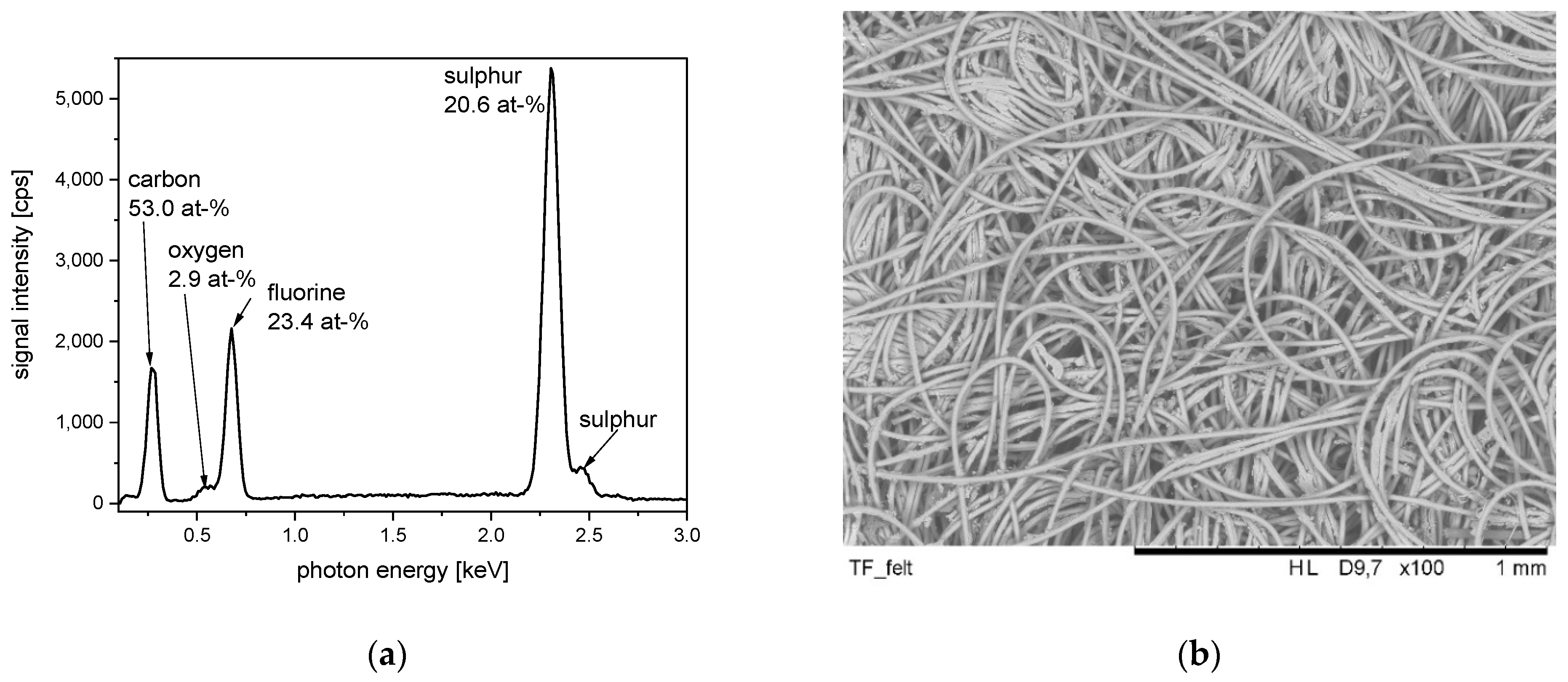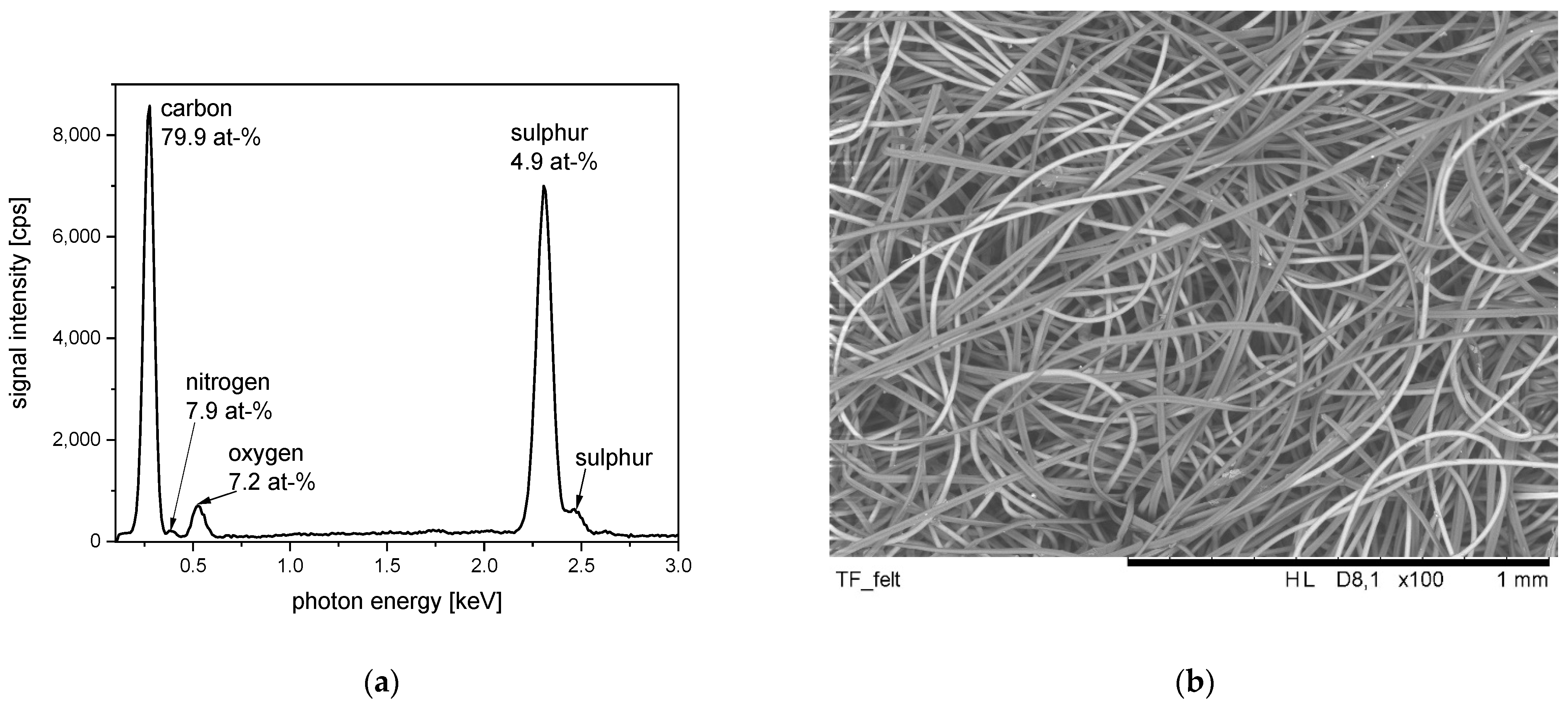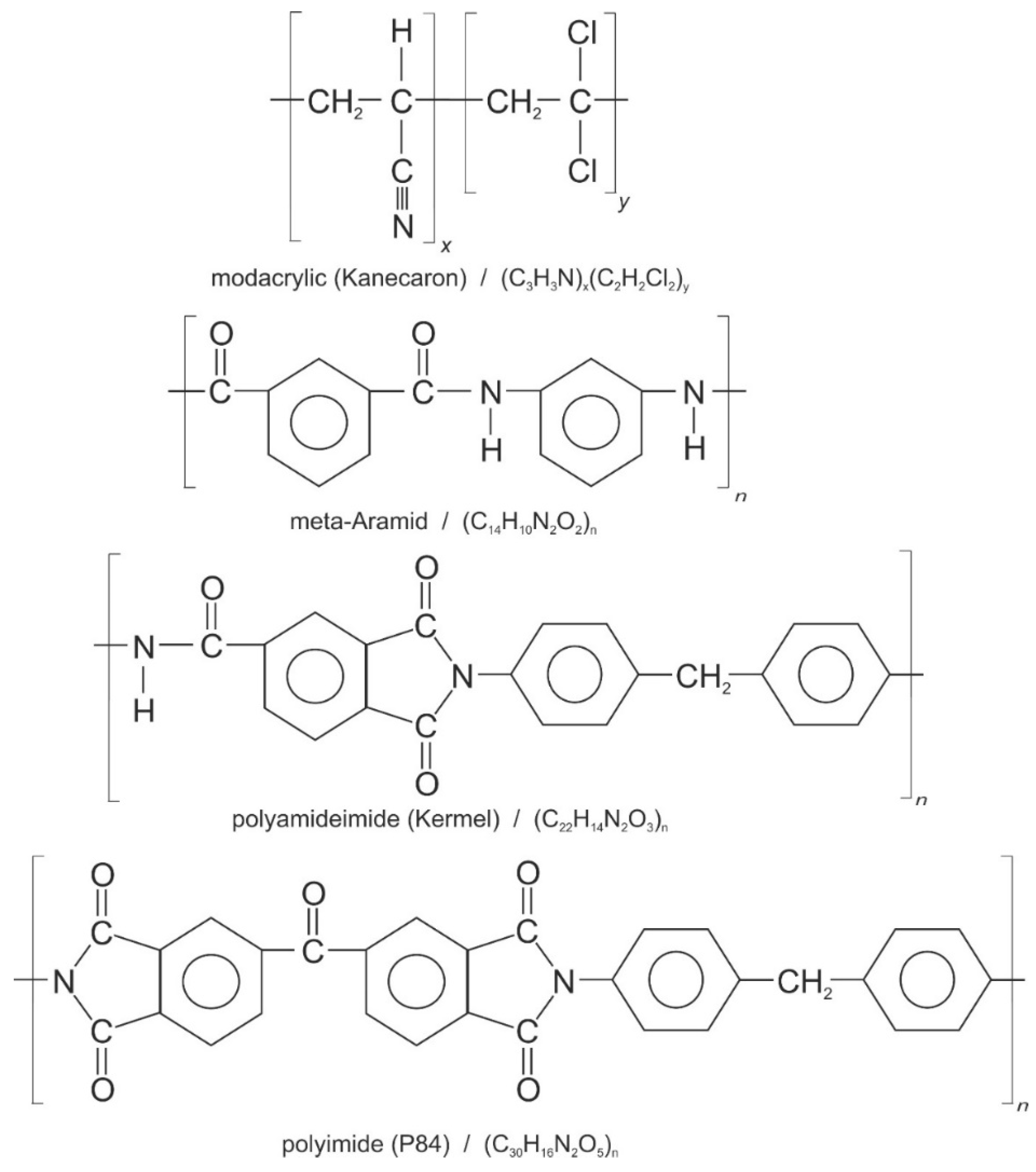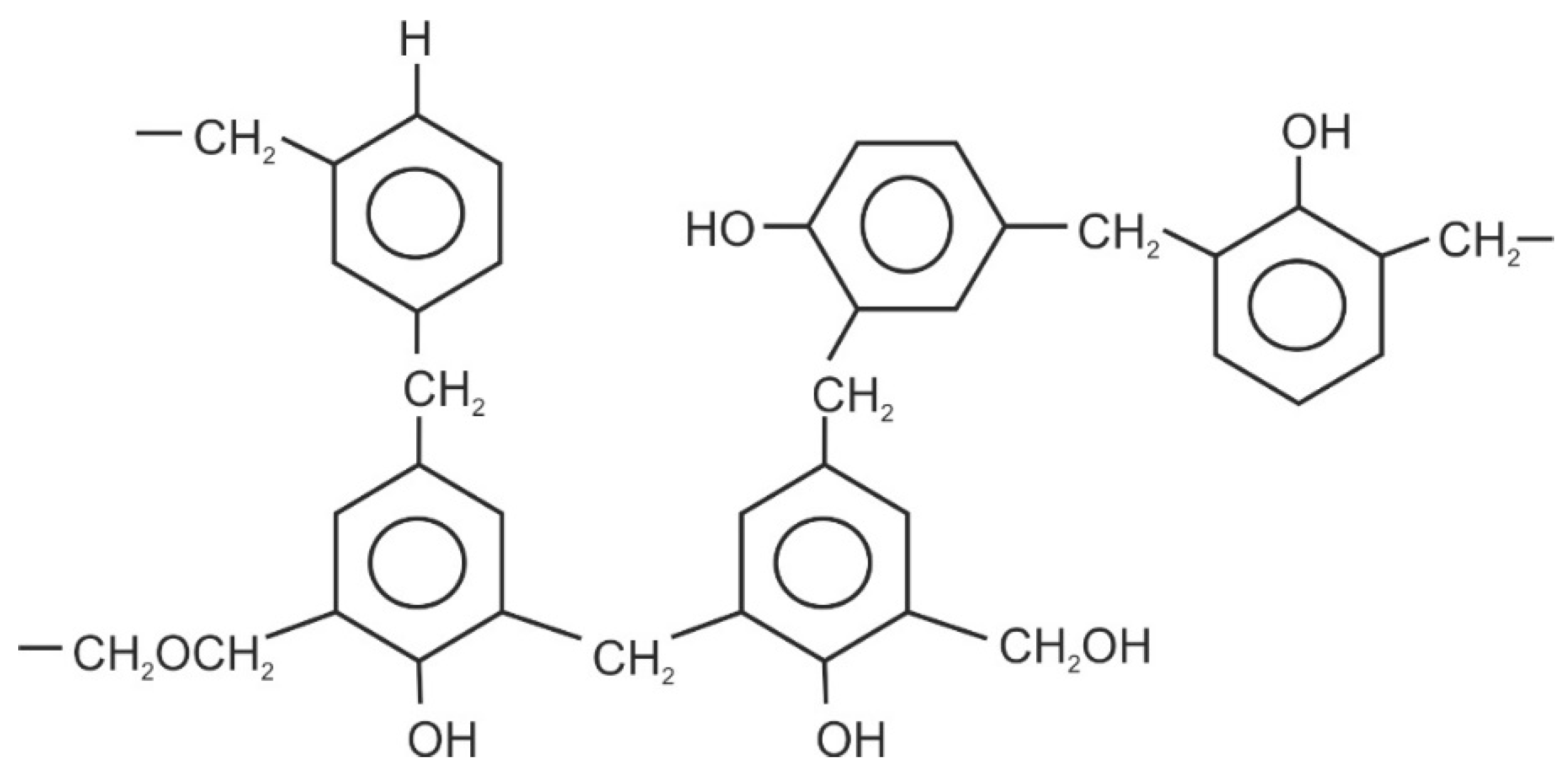

High-Performance and Functional Fiber Materials—A Review of Properties, Scanning Electron Microscopy SEM and Electron Dispersive Spectroscopy EDS

Abstract
1. Introduction
2. Analytical Methods and Challenges for SEM and EDS Measurements on Textiles
3. High-strength Fibers
4. Water- and Oil-Repellent Textiles
5. Fiber Materials with Extraordinary Chemical Stability
6. Fire-Retardant Textiles
7. Inorganic Fiber Materials
7.1. Glass Fibers and Basalt Fibers
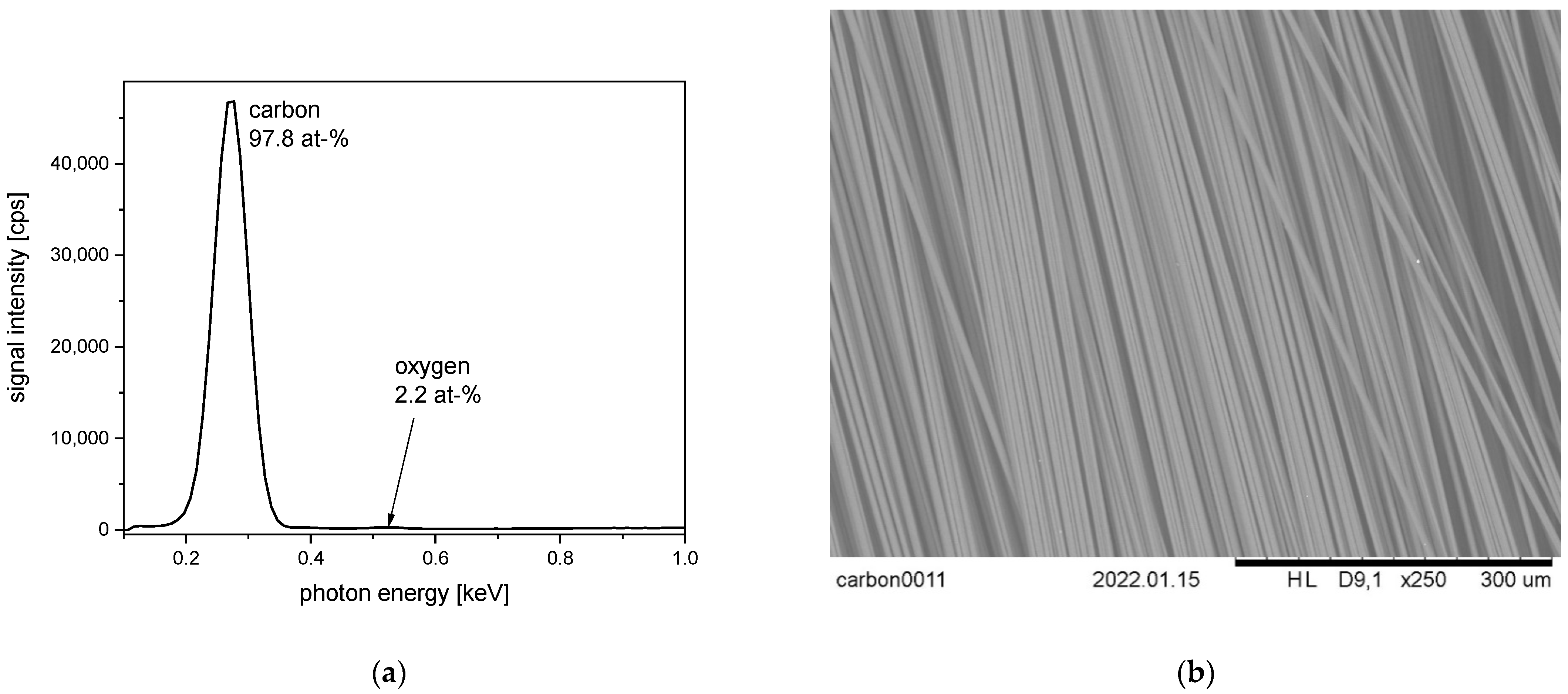
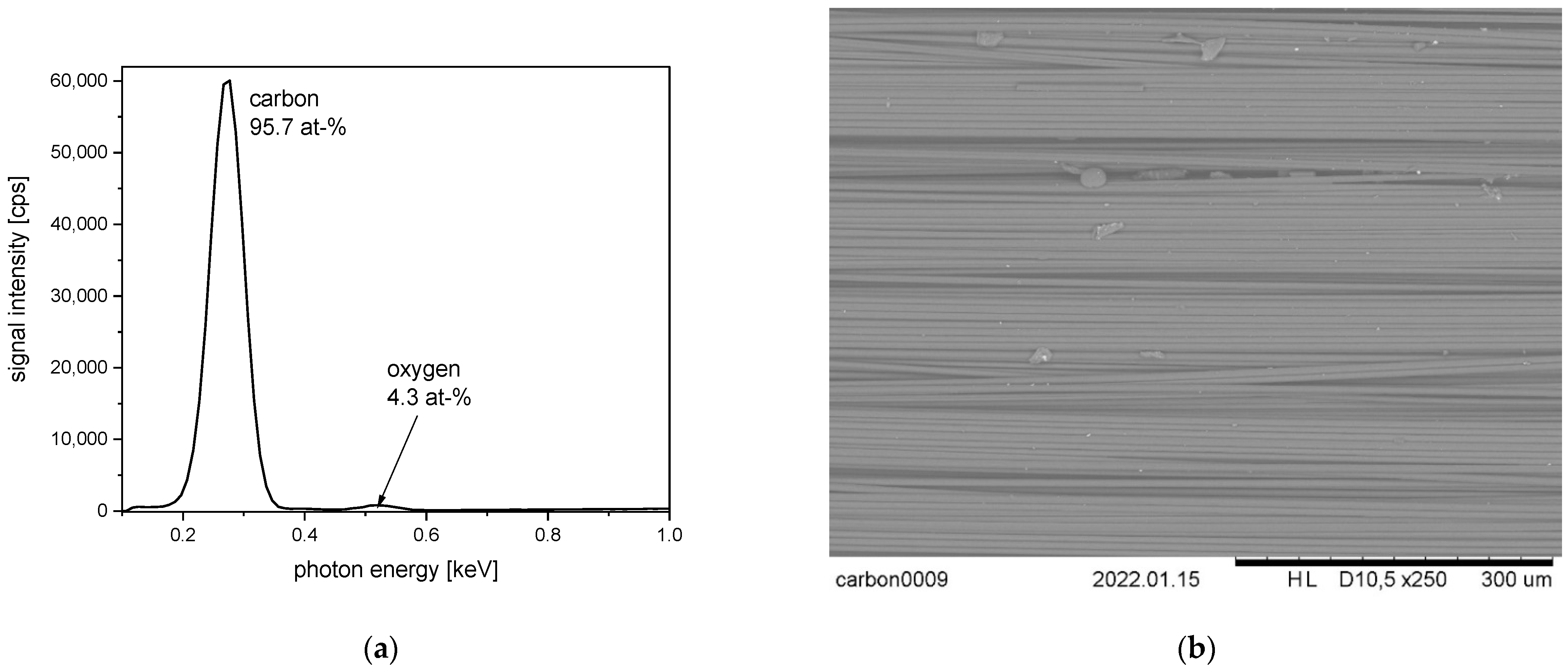
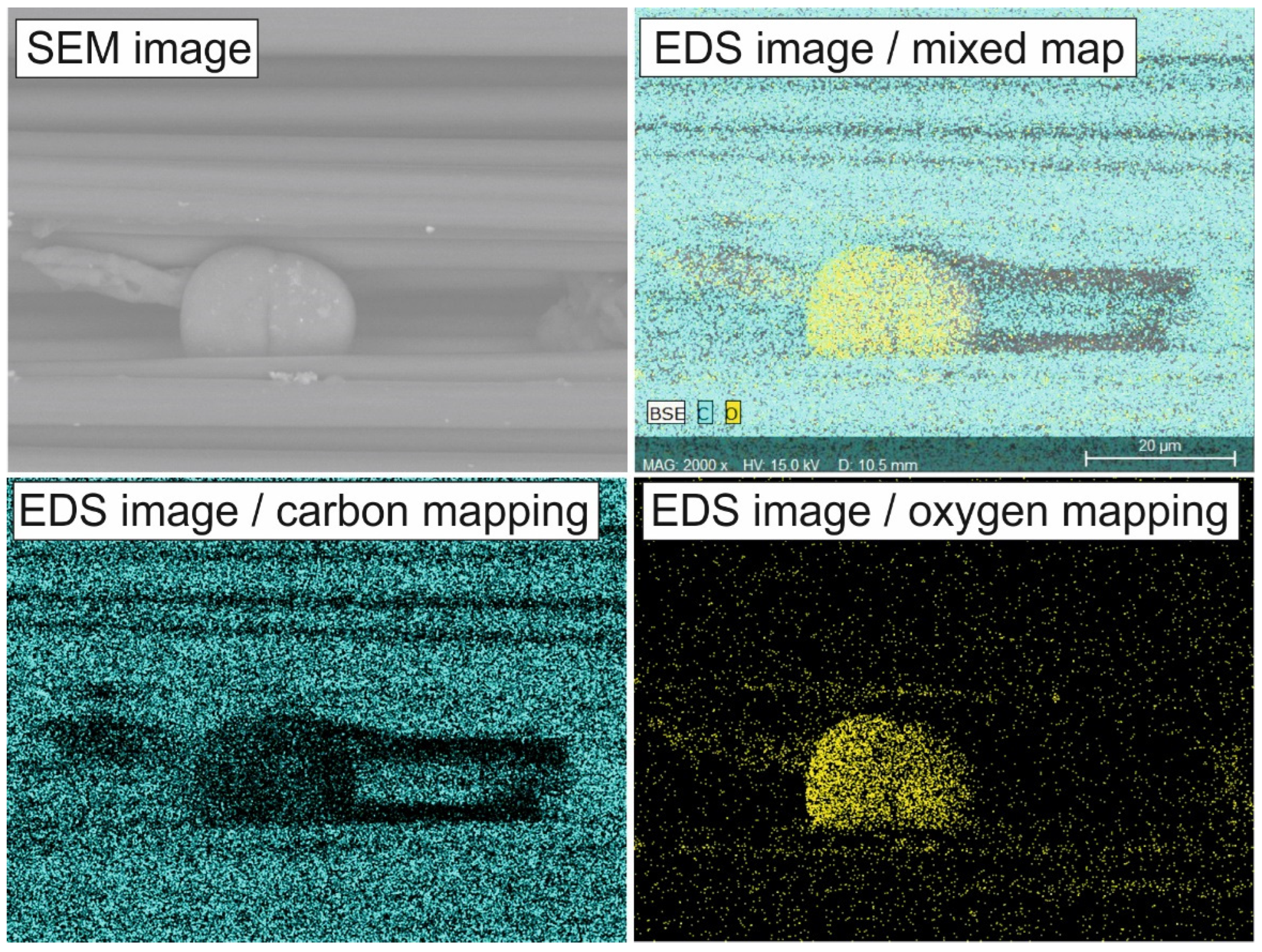
7.2. Carbon Fibers
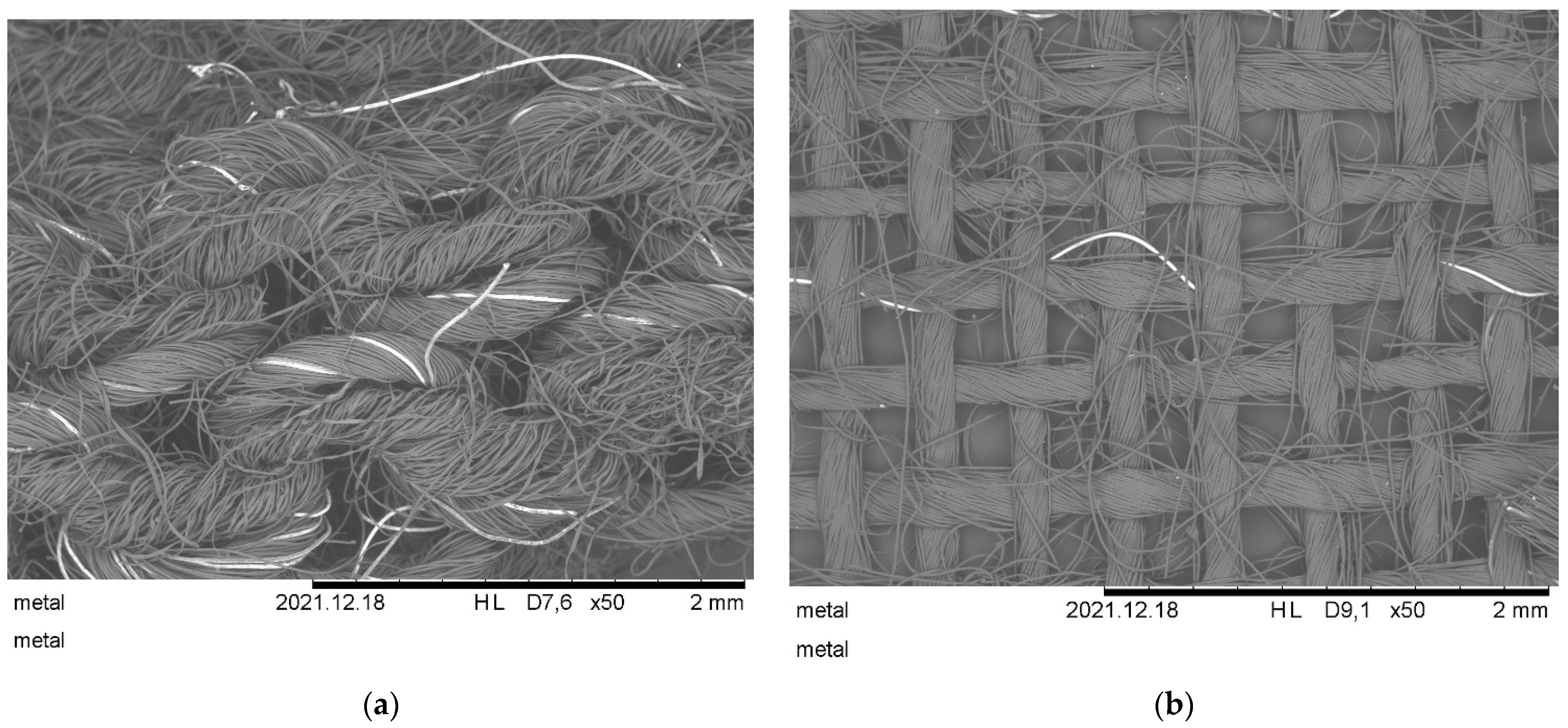
8. Metalized Textiles
9. Summary and Conclusions
Author Contributions
Funding
Institutional Review Board Statement
Informed Consent Statement
Data Availability Statement
Acknowledgments
Conflicts of Interest
References
- Hearle, J.W.S. High-Performance Fibres; Woodhead Publishing Limited: Cambridge, UK, 2001. [Google Scholar]
- Paul, R. High Performance Technical Textiles; John Wiley & Sons: Hoboken, NJ, USA, 2019. [Google Scholar]
- Sikkema, D.J.; Northolt, M.G.; Pourdeyhimi, B. Assessment of New High-Performance Fibers for Advanced Applications. MRS Bull. 2003, 28, 579–584. [Google Scholar] [CrossRef] [Scilit]
- Afshari, M.; Sikkema, D.J.; Lee, K.; Bogle, M. High performance fibers based on rigid and flexible polymers. Polym. Rev. 2008, 48, 230–274. [Google Scholar] [CrossRef] [Scilit]
- Avci, H.; Hassanin, A.; Hamouda, T.; Kilic, A. High performance fibers: A review on current state of art and future challenges. J. Eng. Archit. Fac. Eskiseh. Osman. Univ. 2019, 27, 130–155. [Google Scholar] [CrossRef] [Scilit]
- Mahltig, B. High-Performance Fibres—A Review of Properties and IR-Spectra. Tekstilec 2021, 64, 96–118. [Google Scholar] [CrossRef] [Scilit]
- Mahltig, B.; Textor, T. Nanosols and Textiles; World Scientific: Singapore, 2008. [Google Scholar]
- Paul, R. Functional Finishes for Textiles; Woodhead Publishing: Cambridge, UK, 2005. [Google Scholar]
- Mahltig, B.; Rabe, M.; Muth, M. Textiles, Dyeing, and Finishing. In Kirk-Othmer Encyclopedia of Chemical Technology; John Wiley & Sons, Inc.: Hoboken, NJ, USA, 2019; pp. 1–35. [Google Scholar] [CrossRef] [Scilit]
- Mahltig, B.; Textor, T. Nanocoatings by sol-gel processes for functionalization of polymer surfaces and textiles. In Handbook of Modern Coating Technologies; Aliofkhazraei, M., Ali, N., Chipara, M., Laidani, N.B., de Hosson, J.T.M., Eds.; Elsevier: Amsterdam, The Netherlands, 2021; pp. 1–23. [Google Scholar]
- Bourbigot, S.; Flambard, X. Heat resistance and flammability of high performance fibers: A review. Fire Mater. 2002, 26, 155–168. [Google Scholar] [CrossRef] [Scilit]
- Mohd, Y. A Review on Flame Retardant Textile Finishing: Current and Future Trends. Curr. Smart Mater. 2018, 3, 99–108. [Google Scholar]
- Engelhardt, A. Die Welt der Fasern. Textilplus 2018, 7/8, 10–13. [Google Scholar]
- Hamburger Tauwerk Fabrik GmbH (Hamburg, Germany). Company Web Page. 2022. Available online: www.htf-hh.com/ (accessed on 31 January 2022).
- Binamed Moll GmbH (Bayreuth, Germany). Company Web Page. 2022. Available online: www.binamed.de (accessed on 25 January 2022).
- Colliex, C.; Kohl, H. Elektronenmikroskopie; Wissenschaftliche Verlagsgesellschaft: Stuttgart, Germany, 2007. [Google Scholar]
- Gest, H. The discovery of microorganisms by Robert Hooke and Antoni van Leeuwenhoek, Fellows of The Royal Society. Notes Rec. R. Soc. Lond. 2004, 58, 187–201. [Google Scholar] [CrossRef] [Scilit]
- Pawley, J. The Development of Field-Emission Scanning Electron Microscopy. Scanning 1997, 19, 324–336. [Google Scholar]
- Brodusch, N.; Demers, H.; Gauvin, R. Field Emission Scanning Electron Microscopy: New Perspectives for Materials Chazracterization; Springer: Singapore, 2018. [Google Scholar]
- Knoll, M.; Ruska, E. Das Elektronenmikroskop. Z. Für Phys. 1932, 78, 318–339. [Google Scholar] [CrossRef] [Scilit]
- Chippindale, P. Replication of Textile Fibres in Electron Microscopy. J. Text. Inst. Trans. 1960, 51, T392–T397. [Google Scholar] [CrossRef] [Scilit]
- Guthrie, J.C. Progress in the electron microscopy of textile fibres. J. Text. Inst. Proc. 1956, 47, P248–P268. [Google Scholar] [CrossRef] [Scilit]
- Castaing, R.; Guinier, A. Sur l’exploration et l’analyse elementaire d’un echantillon par une sonde electronique. In Proceedings of the First International Congress of Electron Microscopy, Delft, The Netherlands, 4–8 July 1949; pp. 60–68. [Google Scholar]
- Castaing, R.; Guinier, A. Point-by-point chemical analysis by X-ray spectroscopy. Anal. Chem. 1953, 25, 724–726. [Google Scholar] [CrossRef] [Scilit]
- Colliex, C. The “father” of microanalysis: Raymond Castaing, creator of a generation of scientific instruments, still in worldwide operation. Comptes Rendus Phys. 2019, 20, 746–755. [Google Scholar] [CrossRef] [Scilit]
- Duncumb, P. Precipitation studies with EMMA-a combined electron microscope and x-ray microanalyzer. J. Electrochem. Soc. 1964, 111, C203. [Google Scholar]
- Duncumb, P. Microprobe design in the 1950s: Some examples in Europe. Microsc. Microanal. 2001, 7, 100–107. [Google Scholar] [CrossRef] [Scilit]
- Weiying, T.; Collier, B.J. The Environmental Scanning Electron Microscope: A New Tool for Textile Studies. Text. Chem. Colorist 1994, 26, 29–31. [Google Scholar]
- Danilatos, G.D. Introduction to the ESEM instrument. Microsc. Res. Tech. 1993, 25, 354–361. [Google Scholar] [CrossRef] [Scilit]
- Jenkins, L.M.; Donald, A.M. Use of Environmental Scanning Electron Microscope for the Observation of the Swelling Behaviour of Cellulosic Fibres. Scanning 1997, 19, 92–97. [Google Scholar] [CrossRef] [Scilit]
- Schellenberger, S.; Gillard, P.; Stare, A.; Hanning, A.; Levenstam, O.; Ross, S.; Cousins, I.T. Facing the rain after the phase out: Performance evaluation of alternative fluorinated and non-fluorinated durable water repellents for outdoor fabrics. Chemosphere 2018, 193, 675–684. [Google Scholar] [CrossRef] [Scilit]
- Mahltig, B.; Bidu, J.; Grethe, T.; Pascuali, P.; Kyosev, Y. Rasterelektronenmikroskopie an textilen Oberflächen. Textilplus 2013, 1, 30–33. [Google Scholar]
- Hitachi. Product Brochure TM3030. Available online: www.hitachi-hightech.com (accessed on 15 February 2022).
- Wei, Q.F.; Wang, X.Q.; Mather, R.R.; Fotheringham, A.F. New Approaches to Characterisation of Textile Materials Using Environmental Scanning Electron Microscope. Fibres Text. East. Eur. 2004, 12, 79–83. [Google Scholar]
- Muscariello, L.; Rosso, F.; Marino, G.; Giordano, A.; Barbarisi, M.; Cafiero, G.; Barbarisi, A. A critical overview of ESEM applications in the biological field. J. Cell. Physiol. 2005, 205, 328–334. [Google Scholar] [CrossRef] [Scilit] [PubMed]
- Li, V.C. Large volume, high-performance applications of fibers in civil engineering. J. Appl. Polym. Sci. 2002, 83, 660–686. [Google Scholar] [CrossRef] [Scilit]
- Grujicic, M.; Glomski, P.S.; He, T.; Arakere, G.; Bell, W.C.; Cheeseman, B.A. Material Modeling and Ballistic-Resistance Analysis of Armor-Grade Composites Reinforced with High-Performance Fibers. J. Mater. Eng. Perform. 2009, 18, 1169–1182. [Google Scholar] [CrossRef] [Scilit]
- Park, J.H.; Rutledge, G.C. Ultrafine high performance polyethylene fibers. J. Mater. Sci. 2018, 53, 3049–3063. [Google Scholar] [CrossRef] [Scilit]
- McQuerry, M. A Review of Ballistic, Slash, and Stab Protection for Integration in First Responder Personal Protective Clothing. J. Text. Sci. Fash. Technol. 2019, 2, 1–5. [Google Scholar] [CrossRef] [Scilit]
- Zhai, Y.; Mao, L.; Shen, Y.; Yan, X. Research Progress of Cut-Resistant Textile Materials. Front. Chem. 2021, 9, 745467. [Google Scholar] [CrossRef] [Scilit]
- Roy, R.; Majumdar, A.; Butola, B.S. Comparative Study of p-aramid Based Soft and Stiff Composite Panels for Protective Application. Fibers Polym. 2019, 20, 406–412. [Google Scholar] [CrossRef] [Scilit]
- Khusiafan, F.J. Use of Kevlar49 in Aircraft Components. Eng. Manag. Res. 2018, 7, 14–19. [Google Scholar] [CrossRef] [Scilit]
- Priyanka, P.; Dixit, A.; Mali, H.S. High strength Kevlar fiber reinforced advanced textile composites. Iran. Polym. J. 2019, 28, 621–638. [Google Scholar] [CrossRef] [Scilit]
- Stockdale, T.A.; Cole, D.P.; Staniszewski, J.M.; Roenbeck, M.R.; Papkov, D.; Lustig, S.R.; Dzenis, Y.A.; Strawhecker, E. Hierarchical Mechanisms of Lateral Interactions in High-Performance Fibers. ACS Appl. Mater. Interfaces 2020, 12, 22256–22267. [Google Scholar] [CrossRef] [Scilit] [PubMed]
- Tesoro, G.C.; Meiser, C.H. Some Effects of Chemical Composition on the Flammability Behavior of Textiles. Text. Res. J. 1970, 40, 430–436. [Google Scholar] [CrossRef] [Scilit]
- Yang, C.Q.; He, Q.; Lyon, R.E.; Hu, Y. Investigation of the flammability of different textile fabrics using micro-scale combustion calorimetry. Polym. Degrad. Stab. 2010, 95, 108–115. [Google Scholar] [CrossRef] [Scilit]
- BWF Protec. BWF Tec GmbH, Technical Data Sheet. 2021. Available online: https://bwf-group.com/en/protec/products/technical-needle-felts/ (accessed on 22 November 2021).
- Loy, W. Chemiefasern Für Technische Textilprodukte; Deutscher Fachverlag: Frankfurt am Main, Germany, 2008. [Google Scholar]
- Gul, R.; Islam, A.; Yasin, T.; Mir, S. Flame-retardant synergism of sepiolite and magnesium hydroxide in a linear low-density polyethylene composite. J. Appl. Polym. Sci. 2011, 121, 2772–2777. [Google Scholar] [CrossRef] [Scilit]
- Bilisik, K. Experimental determination of yarn pull-out properties of para-aramid (Kevlar®) woven fabric. J. Ind. Text. 2011, 41, 201–221. [Google Scholar] [CrossRef] [Scilit]
- Liu, X.; Yu, W.; Xu, P. Improving the Photo-stability of High Performance Aramid Fibers by Sol-gel treatment. Fibers Polym. 2008, 9, 455–460. [Google Scholar] [CrossRef] [Scilit]
- Liu, X.; Yu, W. Degradation of PBO Fiber by Heat and Light. RJTA 2006, 10, 26–32. [Google Scholar] [CrossRef] [Scilit]
- Kuraray. VectranTM, Product Brochure. 2021. Available online: https://www.kuraray.eu/products-solutions/product-ranges/vectran (accessed on 22 November 2021).
- Chae, H.G.; Kumar, S. Rigid-rod polymeric fibers. J. Appl. Polym. Sci. 2006, 100, 791–802. [Google Scholar] [CrossRef] [Scilit]
- Menczel, J.D.; Collins, G.L.; Saw, S.K. Thermal analysis of Vectran® fibers and films. J. Therm. Anal. 1997, 49, 201–208. [Google Scholar] [CrossRef] [Scilit]
- Yao, K.D.; Han, W.; Han, D. Flame-retarding modification of nylon 6 textile. J. Appl. Polym. Sci. 1992, 46, 467–470. [Google Scholar] [CrossRef] [Scilit]
- Kilinc, M.; Cakal, G.O.; Bayram, G.; Eroglu, I.; Özkar, S. Flame retardancy and mechanical properties of PET-based composites containing phosphorus and boron-based additives. J. Appl. Polym. Sci. 2015, 132, 42016. [Google Scholar] [CrossRef] [Scilit]
- Mather, R.R.; Wardman, R.H. The Chemistry of Textile Fibres; RSC Publishing: Cambridge, UK, 2011. [Google Scholar]
- Jakubke, H.-D.; Jeschkeit, H. Concise Encyclopedia Chemistry; Walter de Gruyter: Berlin, Germany, 1993. [Google Scholar]
- Anton, C.; Mackley, M.R.; Solbai, S.B. Extrusion processing of ultra-high molecular weight polyethylene; a new method for the production of high performance structures. Polym. Bull. 1987, 17, 175–179. [Google Scholar] [CrossRef] [Scilit]
- Deitzel, J.M.; McDaniel, P.; Gillespie, J.W. High performance polyethlyene fibers. In Structure and Properties of High-Performance Fibers; Bhat, G., Ed.; Woodhead Publishing: Cambridge, UK, 2017; pp. 167–185. [Google Scholar]
- Kavesh, S.; Prevorsek, D.C. Ultra high strength, high modulus polyethylene spectra fibers and composites. Int. J. Polym. Mater. Polym. Biomater. 1995, 30, 15–56. [Google Scholar] [CrossRef] [Scilit]
- Honeywell. Company Web Page. 2022. Available online: https://industrial.honeywell.com/us/en/products/high-strength-fibers (accessed on 25 January 2022).
- Exxon Mobil. Product Data Sheets on Company Web Page. 2022. Available online: https://www.exxonmobilchemical.com/en/resources/product-data-sheets/polyethylene/exceed-xp-performance-pe-polymers (accessed on 25 January 2022).
- Tongylzhong. Company Web Page. 2022. Available online: www.bjtyz.com/en/business/filamentary.html?gclid=CjwKCAiA3L6PBhBvEiwAINlJ9Pu_oKkuQ4KVR-w0x14WVyh-LfCvGGwL2I2fPFEk3G8-AIyTt4b3fxoCcOsQAvD_BwE (accessed on 25 January 2022).
- Akonda, M.H.; Kandola, B.K.; Horrocks, A.R. Effect of alkali and ultraviolet aging on physical, thermal, and mechanical properties of fibers for potential use as reinforcing elements in glass/silicate composites. Polym. Adv. Technol. 2012, 23, 1454–1463. [Google Scholar] [CrossRef] [Scilit]
- Liu, X.; Yu, W. Evaluating the thermal stability of high performance fibers by TGA. J. Appl. Polym. Sci. 2006, 99, 937–944. [Google Scholar] [CrossRef] [Scilit]
- Song, B.; Meng, L.H.; Huang, Y.D. Influence of plasma treatment time on plasma induced vapor phase grafting modification of PBO fiber surface. Appl. Surf. Sci. 2012, 258, 5505–5510. [Google Scholar] [CrossRef] [Scilit]
- Bartusch, M.; Hund, R.-D.; Hund, H.; Cherif, C. Surface Functionalisation of UHMW Polyethylene Textile with Atmospheric Pressure Plasma. Fibers Polym. 2014, 15, 736–743. [Google Scholar] [CrossRef] [Scilit]
- FashionWorld Network. Web Page. 2022. Available online: https://www.fashionatingworld.com/new1-2/dyneema-fiber-is-stronger-than-steel (accessed on 16 February 2022).
- Qin, Y.; Brydon, D.L.; Mather, R.R.; Wardman, R.H. Fibres from polypropylene and liquid crystal polymer blends: 3. A comparison of polyblend fibres containing Vectra A900, Vectra B950 and Rodrun LC3000. Polymer 1993, 34, 3597–3604. [Google Scholar] [CrossRef] [Scilit]
- Biswas, M.A.K.; Shayed, M.A.; Hund, R.D.; Cherif, C. Surface modification of Twaron aramid fiber by the atmospheric air plasma technique. Text. Res. J. 2013, 83, 406–417. [Google Scholar] [CrossRef] [Scilit]
- Mahltig, B. Hydrophobic and oleophobic finishes for textiles. In Functional Finishes for Textiles; Paul, R., Ed.; Woodhead Publishing: Cambridge, UK, 2015; pp. 387–428. [Google Scholar]
- Türk, M.; Ehrmann, A.; Mahltig, B. Water-, oil-, and soil-repellent treatment of textiles, artificial leather, and leather. J. Text. Inst. 2015, 106, 611–620. [Google Scholar] [CrossRef] [Scilit]
- Jung, H.; Kim, M.-K.; Jang, S. Liquid-repellent textile surfaces using zirconium (Zr)-based porous materials and a polyhedral oligomeric silsesquioxane coating. J. Colloid Interf. Sci. 2020, 563, 363–369. [Google Scholar] [CrossRef] [Scilit] [PubMed]
- Gargoubi, S.; Baffoun, A.; Harzallah, O.A.; Hamdi, M.; Boudokhane, C. Water repellent treatment for cotton fabrics with long-chain fluoropolymer and its short-chain eco-friendly alternative. J. Text. Inst. 2020, 111, 835–845. [Google Scholar] [CrossRef] [Scilit]
- Shabanian, S.; Khatir, B.; Nisar, A.; Golovin, K. Rational design of perfluorocarbon-free oleophobic textiles. Nat. Sustain. 2020, 3, 1059–1066. [Google Scholar] [CrossRef] [Scilit]
- Mahltig, B.; Tatlises, B.; Fahmi, A. Dendrimers for the functionalisation of textiles. In Dendrimers: Synthesis, Applications and Role in Nanotechnology; Harris, H.B., Turner, B.L., Eds.; Nova Science Publishers Inc.: New York, NY, USA, 2013; pp. 229–248. [Google Scholar]
- Paciorek, K.L.; Kratzer, R.H.; Kaufman, J. Oxidative thermal degradation of polytetrafluoroethylene. J. Polym. Sci. Polym. Chem. Ed. 1973, 11, 1465–1473. [Google Scholar] [CrossRef] [Scilit]
- Zhang, M.; Niu, H.; Chang, J.; Ge, Q.; Cao, L.; Wu, D. High-performance fibers based on copolyimides containing benzimidazole and ether moieties: Molecular packing, morphology, hydrogen-bonding interactions and properties. Polym. Eng. Sci. 2015, 55, 2615–2625. [Google Scholar] [CrossRef] [Scilit]
- Khan, M.U.; Mahltig, B. Modification of Polyacrylonitrile (PAN) fibers to improve affinity to anionic components. In Polymer Research: Communicating Current Advances, Contributions, Applications and Educational Aspects; Mendez-Vilas, A., Ed.; Formatex Research Center: Badajoz, Spain, 2018; pp. 19–26. [Google Scholar]
- Gupta, M.L.; Gupta, B.; Oppermann, W.; Hardtmann, G. Surface modification of polyacrylonitrile staple fibers via alkaline hydrolysis for superabsorbent applications. J. Appl. Polym. Sci. 2004, 91, 3127–3133. [Google Scholar] [CrossRef] [Scilit]
- Karbownik, I.; Rac-Rumijowska, O.; Fiedot-Tobola, M.; Rybicki, T.; Teterycz, H. The Preparation and Characterization of Polyacrylonitrile-Polyaniline (PAN/PANI) Fibers. Materials 2019, 12, 664. [Google Scholar] [CrossRef] [Scilit]
- Wang, H.; Wang, P.; Zhang, H.; Hu, D. Preparation and characterization of triangular hollow porous polyacrylonitrile fiber made by coaxial wet spinning. J. Appl. Polym. Sci. 2021, 138, 50816. [Google Scholar] [CrossRef] [Scilit]
- Tanthapanichakoon, W.; Furuuchi, M.; Nitta, K.-H.; Hata, M.; Endoh, S.; Otani, Y. Degradation of semi-crystalline PPS bag-filter materials by NO and O2 at high temperature. Polym. Degrad. Stab. 2006, 91, 1637–1644. [Google Scholar] [CrossRef] [Scilit]
- Lian, D.; Dai, J.; Zhang, R.; Niu, M.; Huang, Y. Enhancing the resistance against oxidation of polyphenylene sulphide fiber via incorporation of nano TiO2-SiO2 and its mechanistic analysis. Polym. Degrad. Stab. 2016, 129, 77–86. [Google Scholar] [CrossRef] [Scilit]
- Xiao, H.; Zhao, T. One-Bath Union Dyeing of Wool/Acrylic Blend Fabric with Cationic Reactive Dyes Based on Azobenzene. Fibers Polym. 2019, 19, 331–339. [Google Scholar] [CrossRef] [Scilit]
- Kalashnik, A.T.; Panishkina, O.N.; Serkov, A.T.; Budnitski, G.A. The structure of acrylic fibres. Fibre Chem. 2002, 34, 393–399. [Google Scholar] [CrossRef] [Scilit]
- Huang, H.; Liu, M.; Li, Y.; Yu, Y.; Yin, X.; Wu, J.; Chen, S.; Xu, J.; Wang, L.; Wang, H. Polyphenylene sulfide microfiber membrane with superhydrophobicity and superoleophilicity for oil/water separation. J. Mater. Sci. 2018, 53, 13243–13252. [Google Scholar] [CrossRef] [Scilit]
- Goodwin, P. Flammability Testing—A Burning Issue for Technical Textiles. Technol. Text. Int. 2006, 15, 11–14. [Google Scholar]
- Mazari, A.; Mazari, F.B.; Naeem, J.; Havelka, A.; Marahatta, P. Impact of ultraviolet radiation on thermal protective performance and comfort properties of firefighter protective clothing. Ind. Text. 2022, 73, 54–61. [Google Scholar] [CrossRef] [Scilit]
- Holder, K.M.; Smith, R.J.; Grunlan, J.C. A review of flame retardant nanocoatings prepared using layer-by-layer assembly of polyelectrolytes. J. Mater. Sci. 2017, 52, 12923–12959. [Google Scholar] [CrossRef] [Scilit]
- Kaneka Corporation. Company Web Page. 2022. Available online: https://www.modacrylic.com/en/about/advantage05 (accessed on 16 February 2022).
- Kakvan, A.; Najar, S.S.; Psikuta, A. Analysis of the Thermal Comfort Properties and Heat Protection Performance of Cotton/Nylon-Kermel Fabrics. J. Text. Polym. 2016, 4, 37–43. [Google Scholar]
- Evonik. P84 Fibre Technical Brochure. 2021. Available online: https://www.p84.com/en/polyimide-fibres-chemistry (accessed on 22 November 2021).
- Kynol. Product Brochure. 2021. Available online: http://www.kynol.de/products.html (accessed on 22 November 2021).
- Kofler, P.; Herten, A.; Heinrich, D.; Bottoni, G.; Hasler, M.; Faulhaber, M.; Bechtold, T.; Nachbauer, W.; Burtscher, M. Viscose as an alternative to aramid in workwear: Influence of endurance performance, cooling and comfort. Text. Res. J. 2013, 83, 2085–2092. [Google Scholar] [CrossRef] [Scilit]
- Heidari, S.; Paren, A. Surface Modification of Hybrid Fibres for Fire Protection. Fire Mater. 1993, 17, 65–69. [Google Scholar] [CrossRef] [Scilit]
- Kermel. Company Webpage. 2022. Available online: http://www.kermel.com/en/ (accessed on 16 February 2022).
- Ramgobin, A.; Fontaine, G.; Bourbigot, S. Investigation of the thermal stability and fire behavior of high performance polymer: A case study of polyimide. Fire Saf. J. 2021, 120, 103060. [Google Scholar] [CrossRef] [Scilit]
- Borgstädt, T.; Mahltig, B. Laser treatment of high-performance Kynol fibers: An example as alternative tool for coloration and imaging on surfaces of high-performance fibers. Tekst. Ind. 2020, 68, 4–9. [Google Scholar] [CrossRef] [Scilit]
- Pusch, J.; Wohlmann, B. Preox Fibers. In Inorganic and Composite Fibers; Mahltig, B., Kyosev, Y., Eds.; Woodhead Publishing: Cambridge, UK, 2018; pp. 53–60. [Google Scholar]
- Khan, A.N.; Abir, N.; Rakib, M.A.N.; Bhuiyan, E.M.S.; Howlader, M.R. A Review Paper on Textile Fiber Identification. IOSR J. Polym. Text. Eng. 2017, 4, 14–20. [Google Scholar] [CrossRef] [Scilit]
- Trevira. Company Web Page. 2022. Available online: https://www.trevira.de/trevira-cs/trevira-cs-wie-trevira-cs-funktioniert (accessed on 17 February 2022).
- Mahltig, B. Cellulosic-Based Composite Fibers; Mahltig, B., Kyosev, Y., Eds.; Woodhead Publishing: Cambridge, UK, 2018; pp. 277–302. [Google Scholar]
- Li, C.X.; Ji, Q.; Song, C.C.; Quan, F.Y. Flame Retardant Properties of Viscose Fibers Containing Talcum Powder. Adv. Mater. Res. 2014, 884, 208–211. [Google Scholar] [CrossRef] [Scilit]
- Paul, B.; Mahmud-Ali, A.; Lenninger, M.; Eberle, S.; Bernt, I.; Mayer, D.; Bechthold, T. Silica incorporated cellulose fibres as green concept for textiles with reduced flammability. Polym. Degrad. Stab. 2022, 195, 109808. [Google Scholar] [CrossRef] [Scilit]
- Xie, K.; Gao, A.; Zhang, Y. Flame retardant finishing of cotton fabric based on synergistic compounds containing boron and nitrogen. Carbohydr. Polym. 2013, 98, 706–710. [Google Scholar] [CrossRef] [Scilit]
- Nabipour, H.; Wang, X.; Song, L.; Hu, Y. Hydrophobic and flame-retardant finishing of cotton fabrics for water–oil separation. Cellulose 2020, 27, 4145–4159. [Google Scholar] [CrossRef] [Scilit]
- Kappes, R.S.; Urbainczyk, T.; Artz, U.; Textor, T.; Gutmann, J.S. Flame retardants based on amino silanes and phenylphosphonic acid. Polym. Degrad. Stab. 2016, 129, 168–179. [Google Scholar] [CrossRef] [Scilit]
- Castellano, A.; Colleoni, C.; Iacono, G.; Mezzi, A.; Plutino, M.R.; Malucelli, G.; Rosace, G. Synthesis and characterization of a phosphorous/nitrogen based sol-gel coating as a novel halogen- and formaldehyde-free flame retardant finishing for cotton fabric. Polym. Degrad. Stab. 2019, 162, 148–159. [Google Scholar] [CrossRef] [Scilit]
- Weil, E.D.; Levchik, S.V. Flame Retardants in Commercial Use or Development for Textiles. J. Fire Sci. 2008, 26, 243–281. [Google Scholar] [CrossRef] [Scilit]
- Kemp, S.E.; Annaheim, S.; Rossi, R.M.; Camenzind, M.A. Test method for characterizing the thermal protective performance of fabrics exposed to flammable liquid fires. Fire Mater. 2017, 41, 750–767. [Google Scholar] [CrossRef] [Scilit]
- Uddin, F. Recent Flame Retardant Consumption: Textiles. Int. J. Sci. Eng. Res. 2019, 10, 805–813. [Google Scholar]
- Kim, H.; Kim, J.-S.; Jeong, W. Study on the Flame Retardancy and Hazard Evaluation of Poly(acrylonitrile-co-vinylidene chloride) Fibers by the Addition of Antimony-Based Flame Retardants. Polymers 2022, 14, 42. [Google Scholar] [CrossRef] [Scilit] [PubMed]
- Cook, T.F. Inorganic Fibers—A Literature Review. J. Am. Ceram. Soc. 1991, 74, 2959–2978. [Google Scholar] [CrossRef] [Scilit]
- Mahltig, B. Introduction to Inorganic Fibers. In Inorganic and Composite Fibers; Mahltig, B., Kyosev, Y., Eds.; Woodhead Publishing: Cambridge, UK, 2018; pp. 1–30. [Google Scholar]
- Wiberg, N. Lehrbuch der Anorganischen Chemie; Walter de Gruyter: Berlin, Germany, 1995. [Google Scholar]
- Schawaller, D.; Clauß, B.; Buchmeiser, M.R. Ceramic Filament Fibers—A Review. Macromol. Mater. Eng. 2012, 297, 502–522. [Google Scholar] [CrossRef] [Scilit]
- Bauer, F.; Kempf, M.; Weiland, F.; Middendorf, P. Structure-property relationships of basalt fibers for high performance applications. Compos. Part B Eng. 2018, 145, 121–128. [Google Scholar] [CrossRef] [Scilit]
- Kim, J.S.; Lim, J.H.; Huh, Y. Melt-spinning basalt fibers based on dielectric heating and steady-state process characteristics. Fibers Polym. 2013, 14, 1148–1156. [Google Scholar] [CrossRef] [Scilit]
- Jamshaid, H.; Mishra, R. A green material from rock: Basalt fiber—A review. J. Text. Inst. 2016, 107, 923–937. [Google Scholar] [CrossRef] [Scilit]
- Pala, I.E.; Kaya, C.P. Textile fibres in product design. Ind. Text. 2021, 72, 340–345. [Google Scholar] [CrossRef] [Scilit]
- Martynova, E.; Cebulla, H. Glass Fibres. In Inorganic and Composite Fibers; Mahltig, B., Kyosev, Y., Eds.; Woodhead Publishing: Cambridge, UK, 2018; pp. 131–164. [Google Scholar]
- Wallenberger, T.; Bingham, P.A. Fiberglass and Glass Technology; Springer: New York, NY, USA, 2010. [Google Scholar]
- Teschner, R. Glasfasern; Springer: Berlin, Germany, 2019. [Google Scholar]
- Lipatov, Y.V.; Gutnikov, S.I.; Manylov, M.S.; Lazoryak, B.I. Effect of ZrO2 on the alkali resistance and mechanical properties of basalt fibers. Inorg. Mater. 2012, 48, 751–756. [Google Scholar] [CrossRef] [Scilit]
- Flores, O.; Bordia, R.K.; Nestler, D.; Krenkel, W.; Motz, G. Ceramic Fibers Based on SiC and SiCN Systems: Current Research, Development, and Commercial Status. Adv. Eng. Mater. 2014, 16, 621–636. [Google Scholar] [CrossRef] [Scilit]
- Mahltig, B.; Pastore, C. Mineral and Ceramic Fibres; Mahltig, B., Kyosev, Y., Eds.; Woodhead Publishing: Cambridge, UK, 2018; pp. 165–194. [Google Scholar]
- Ivashchenko, E.A. Sizing and finishing agents for basalt and glass fibers. Theor. Found. Chem. Eng. 2009, 43, 511–516. [Google Scholar] [CrossRef] [Scilit]
- Dibenedetto, A.T.; Lex, P.J. Evaluation of surface treatments for glass fibers in composite materials. Polym. Eng. Sci. 1989, 29, 543–555. [Google Scholar] [CrossRef] [Scilit]
- Biefeld, L.P.; Philipps, T.E. Finishes for glass fabrics for reinforcing polyester plastics. Ind. Eng. Chem. 1953, 45, 1281–1286. [Google Scholar] [CrossRef] [Scilit]
- Kiryukhin, D.P.; Krivonogova, E.A.; Kichigina, G.A.; Kushch, P.P.; Dorokhov, V.G.; Barelko, V.V. Preparation and properties of composites based on caramelized aluminoborosilicate fabric and tetrafluoroethylene telomers. Russ. J. Appl. Chem. 2016, 89, 758–765. [Google Scholar] [CrossRef] [Scilit]
- Mathieson, A.M.; Walker, G.F. Crystal structure of magnesium-vermiculite. Am. Mineral. 1954, 39, 231–255. [Google Scholar]
- Bassett, W.A. The Geology of Vermiculite Occurrences. Clays Clay Miner. 1961, 10, 61–69. [Google Scholar] [CrossRef] [Scilit]
- Skipper, N.T.; Soper, A.K.; McConnell, J.D.C. The structure of interlayer water in vermiculite. J. Chem. Phys. 1991, 94, 5751–5760. [Google Scholar] [CrossRef] [Scilit]
- Mahltig, B. Basalt Fibers; Mahltig, B., Kyosev, Y., Eds.; Woodhead Publishing: Cambridge, UK, 2018; pp. 195–214. [Google Scholar]
- Pico, D.; Wilms, C.; Seide, D.; Gries, T. Natural volcanic rock fibers. Chem. Fibers Int. 2011, 61, 90–91. [Google Scholar]
- Ruffen, C.; Mahltig, B. Basalt fibers as functional additives in coating of textiles. J. Coat. Technol. Res. 2021, 18, 271–281. [Google Scholar] [CrossRef] [Scilit]
- Hao, L.; Yu, W. Evaluation of thermal protective performance of basalt fiber nonwoven fabrics. J. Therm. Anal. Calorim. 2010, 100, 551–555. [Google Scholar] [CrossRef] [Scilit]
- Hao, L.; Yu, W. Comparison of thermal protective performance of aluminized fabrics of basalt fiber and glass fiber. Fire Mater. 2011, 35, 553–560. [Google Scholar] [CrossRef] [Scilit]
- Deak, T.; Czigany, T. Chemical Composition and Mechanical Properties of Basalt and Glass Fibers: A Comparison. Text. Res. J. 2009, 79, 645–651. [Google Scholar] [CrossRef] [Scilit]
- Overkamp, T.; Mahltig, B.; Kyosev, Y. Strength of basalt fibers influenced by thermal and chemical treatments. J. Ind. Text. 2018, 47, 815–833. [Google Scholar] [CrossRef] [Scilit]
- Peebles, L.H. Carbon Fibers; CRC Press: Boca Raton, FL, USA, 1995. [Google Scholar]
- Pusch, J.; Wohlmann, B. Carbon Fibers. In Inorganic and Composite Fibers; Mahltig, B., Kyosev, Y., Eds.; Woodhead Publishing: Cambridge, UK, 2018; pp. 31–52. [Google Scholar]
- Wangxi, Z.; Jie, L.; Gang, W. Evolution of structure and properties of PAN precursors during their conversion to carbon fibers. Carbon 2003, 41, 2805–2812. [Google Scholar] [CrossRef] [Scilit]
- Frank, E.; Hermanutz, F.; Buchmeiser, M.R. Carbon Fibers: Precursors, Manufacturing, and Properties. Macromol. Mater. Eng. 2012, 297, 493–501. [Google Scholar] [CrossRef] [Scilit]
- Su, Y.-J.; Ko, T.-H.; Lin, J.-H. Preparation of ultra-thin PAN based activated carbon fibers with physical activation. J. Appl. Polym. Sci. 2008, 108, 3610–3617. [Google Scholar] [CrossRef] [Scilit]
- Lee, Y.-S.; Basova, Y.V.; Edie, D.D.; Reid, L.K.; Newcombe, S.R.; Ryu, S.-K. Preparation and characterization of trilobal activated carbon fibers. Carbon 2003, 41, 2573–2584. [Google Scholar] [CrossRef] [Scilit]
- Banerjee, C.; Chandaliya, V.K.; Dash, P.S. Recent advancement in coal tar pitch-based carbon fiber precursor development and fiber manufacturing process. J. Anal. Appl. Pyrolysis 2021, 158, 105272. [Google Scholar] [CrossRef] [Scilit]
- Chand, S. Review Carbon fibers for composites. J. Mater. Sci. 2000, 35, 1303–1313. [Google Scholar] [CrossRef] [Scilit]
- Lertwassana, W.; Parnklang, T.; Mora, P.; Jubsilp, C.; Rimdusit, S. High performance aramid pulp/carbon fiber-reinforced polybenzoxazine composites as friction materials. Compos. Part B Eng. 2019, 177, 107280. [Google Scholar] [CrossRef] [Scilit]
- Aoki, R.; Yamaguchi, A.; Hashimoto, T.; Urushisaki, M.; Sakaguchi, T.; Kawabe, K.; Kondo, K.; Iyo, H. Preparation of carbon fibers coated with epoxy sizing agents containing degradable acetal linkages and synthesis of carbon fiber-reinforced plastics (CFRPs) for chemical recycling. Polym. J. 2019, 51, 909–920. [Google Scholar] [CrossRef] [Scilit]
- Zhang, T.; Song, Y.; Zhao, Y.; Zhang, B. Effect of hybrid sizing with nano-SiO2 on the interfacial adhesion of carbon fibers/nylon 6 composites. Colloids Surf. A 2018, 553, 125–133. [Google Scholar] [CrossRef] [Scilit]
- Kim, D.-K.; An, K.-H.; Bang, Y.H.; Kwac, L.-K.; Oh, S.-Y.; Kim, B.-J. Effects of electrochemical oxidation of carbon fibers on interfacial shear strength using a micro-bond method. Carbon Lett. 2016, 19, 32–39. [Google Scholar] [CrossRef] [Scilit]
- Küster, K.; Barburski, M.; Lomov, S.V.; Vanclooster, K. Metal Fibers—Steel; Mahltig, B., Kyosev, Y., Eds.; Woodhead Publishing: Cambridge, UK, 2018; pp. 219–242. [Google Scholar]
- Zimmermann, Y.; Neudeck, A.; Möhring, U. Metal-Coated Fibers; Mahltig, B., Kyosev, Y., Eds.; Woodhead Publishing: Cambridge, UK, 2018; pp. 243–276. [Google Scholar]
- Shahidi, S.; Moazzenchi, B.; Ghoranneviss, M. A review-application of physical vapor deposition (PVD) and related methods in the textile industry. Eur. Phys. J. Appl. Phys. 2015, 71, 31302. [Google Scholar] [CrossRef] [Scilit]
- Mahltig, B.; Darko, D.; Günther, K.; Haase, H. Copper Containing Coatings for Metallized Textile Fabrics. J. Fash. Technol. Text. Eng. 2015, 3/1, 1–10. [Google Scholar]
- Topp, K.; Haase, H.; Degen, C.; Illing, G.; Mahltig, B. Coatings with metallic effect pigments for antimicrobial and conductive coating of textiles with electromagnetic shielding properties. J. Coat. Technol. Res. 2014, 11, 943–957. [Google Scholar] [CrossRef] [Scilit]
- Mahltig, B.; Zhang, J.; Wu, L.; Darko, D.; Wendt, M.; Lempa, E.; Rabe, M.; Haase, H. Effect pigments for textile coating—A review on the broad range of advantageous functionalization. J. Coat. Technol. Res. 2017, 14, 35–55. [Google Scholar] [CrossRef] [Scilit]
- Grethe, T.; Lux, K.; Schwarz-Pfeiffer, A. Achieving Textile Based Supported Noble Metal Catalysts by Physical Vapor Deposition. In Proceedings of the Aachen-Dresden-Denkendorf International Textile Conference, Dresden, Germany, 28–29 November 2019. [Google Scholar]
- Grethe, T.; Günther, K.; Weide, T.; Schwarz-Pfeiffer, A. Achieving Electrical Conductivity in Textiles: An Overview of Current Techniques. In Textiles: Advances in Research and Applications (Chapter 6); Mahltig, B., Ed.; Nova Science Publishers: Hauppauge, NY, USA, 2017. [Google Scholar]
- Roh, J.-S.; Chi, Y.-S.; Kang, T.J.; Nam, S.W. Electromagnetic Shielding Effectiveness of Multifunctional Metal Composite Fabrics. Text. Res. J. 2008, 78, 825–835. [Google Scholar] [CrossRef] [Scilit]
- Kim, Y.I.; An, S.; Kim, M.-W.; Jo, H.-S.; Kim, T.-G.; Swihart, M.T.; Yarin, A.L.; Yoon, S.S. Highly transparent, conducting, body-attachable metallized fibers as a flexible and strechtable film. J. Alloys Compd. 2019, 790, 1127–1136. [Google Scholar] [CrossRef] [Scilit]
- Poser, M. Elektrosmog; Crotona Verlag GmbH: Amerang, Germany, 2017. [Google Scholar]
- Wu, Y.; Mechael, S.S.; Carmichael, T.B. Wearable E-Textiles Using a Textile-Centric Design Approach. Acc. Chem. Res. 2021, 54, 4051–4064. [Google Scholar] [CrossRef] [Scilit] [PubMed]
- Protz, K. Moderne Wundversorgung; Elsevier GmbH: München, Germany, 2005. [Google Scholar]
- Pollini, M.; Russo, M.; Licciulli, A.; Sannino, A.; Maffezzoli, A. Characterization of antibacterial silver coated yarns. J. Mater. Sci. Mater. Med. 2009, 20, 2361–2366. [Google Scholar] [CrossRef] [Scilit] [PubMed]
- Elsner, P.; Piehler, E. Einfluss multipler Waschzyklen auf die antimikrobielle Aktivität eines silberbeschichteten Textils. Dermatol. Beruf Und Umw. 2020, 68, 179–182. [Google Scholar] [CrossRef] [Scilit]
- Balagna, C.; Irfan, M.; Perero, S.; Miola, M.; Maina, G.; Santella, D.; Simone, A. Characterization of antibacterial silver nanocluster/silica composite coating on high performance Kevlar textile. Surf. Coat. Technol. 2017, 321, 438–447. [Google Scholar] [CrossRef] [Scilit]
- Balagna, C.; Irfan, M.; Perero, S.; Miola, M.; Maina, G.; Crosera, M.; Santella, D.; Simone, A.; Ferraris, M. Antibacterial nanostructured composite coating on high performance Vectran fabric for aerospace structures. Surf. Coat. Technol. 2019, 373, 47–55. [Google Scholar] [CrossRef] [Scilit]
- Irene, G.; Georgios, P.; Ioannis, C.; Anastasios, T.; Diamantis, P.; Marianthi, C.; Philippe, W.; Maria, S. Copper-coated textiles: Armor against MDR nosocomial pathogens. Diagn. Microbiol. Infect. Dis. 2016, 85, 205–209. [Google Scholar] [CrossRef] [Scilit]
- Mahltig, B.; Fiedler, D.; Fischer, A.; Simon, P. Antimicrobial coatings on textiles–modification of sol–gel layers with organic and inorganic biocides. J. Sol.-Gel Sci. Technol. 2010, 55, 269–277. [Google Scholar] [CrossRef] [Scilit]
- Kim, M.-W.; An, S.; Seok, H.; Yoon, S.S.; Yarin, A.L. Electrostatic Transparent Air Filter Membranes Composed of Metallized Microfibers for Particulate Removal. ACS Appl. Mater. Interfaces 2019, 11, 26323–26332. [Google Scholar] [CrossRef] [Scilit]
- Mahltig, B.; Haase, H. Comparison of the effectiveness of different silver-containing textile products on bacteria and human cells. J. Text. Inst. 2012, 103, 1262–1266. [Google Scholar] [CrossRef] [Scilit]
- Edwards, M.; Hidmi, L.; Gladwell, D. Phosphate inhibition of soluble copper corrosion by-product release. Corros. Sci. 2002, 44, 1057–1071. [Google Scholar] [CrossRef] [Scilit]
- Sandstrom, R.; Wu, R. Influence of phosphorus on the creep ductility of copper. J. Nucl. Mater. 2013, 441, 364–371. [Google Scholar] [CrossRef] [Scilit]
- Shyr, T.-W.; Shie, J.-W. Electromagnetic shielding mechanisms using soft magnetic stainless steel fiber enabled polyester textiles. J. Magn. Magn. Mater. 2012, 324, 4127–4132. [Google Scholar] [CrossRef] [Scilit]
- Li, N.; Wang, J.; Liu, D.; Huang, X.; Xu, Z.; Zhang, C.; Zhang, Z.; Zhong, M. Selective spectral optical properties and structure of aluminum phosphate for daytime passive radiative cooling application. Sol. Energy Mater. Sol. Cells 2019, 194, 103–110. [Google Scholar] [CrossRef] [Scilit]
- Supplit, R.; Schubert, U. Corrosion protection of aluminum pigments by sol-gel coatings. Corros. Sci. 2007, 49, 3325–3332. [Google Scholar] [CrossRef] [Scilit]
- Verma, C.; Verma, D.K.; Ebenso, E.E.; Quraishi, M.A. Sulfur and phosphorus heteroatom-containing compounds as corrosion inhibitors: An overview. Heteroat. Chem. 2018, 29, e21437. [Google Scholar] [CrossRef] [Scilit]





| Fiber | Tensile Strength [cN/tex] | Density [g/cm3] | LOI [%] | Maximum Temperature of Usage Tmax [°C] | Selected Properties | References |
|---|---|---|---|---|---|---|
| Polyethylene HPPE, (Dyneema) | 280/330 | 0.95/0.97 | 18 | 90 | High strength, high elastic modulus | [47,48,49] |
| Para-Aramid, (Kevlar) | 232/235 | 1.44 | 28–30 | 190/200 |
Extraordinary mechanical
properties, stability against contact heat | [11,47,48,50,51,52] |
| Aromatic polyester, (Vectran) | 200–250 | 1.4 | 28/30 | 195 | High strength and modulus, thermoplastic | [1,53,54,55] |
| Phenylene Benzobisoxazol, PBO (Zylon) | 327/370 | 1.56 | 56–68 | 310/350 |
Extraordinary mechanical
properties, stability against contact heat | [11,47,48,51,52] |
| Polyamide, Nylon | 40–60 | 1.13–1.16 | 24 | 110/115 | Mechanically stable, stable against abrasion | [47,48,56,57,58,59] |
| Polyester, PET | 35–56 | 1.38–1.41 | 21–22 | 150 | Low cost | [47,56,57,58,59] |
| Fiber | Sum Formula of Repeating Unit | Content of Chemical Elements [at-%] | ||||
|---|---|---|---|---|---|---|
| Carbon | Nitrogen | Oxygen | Fluorine | Sulfur | ||
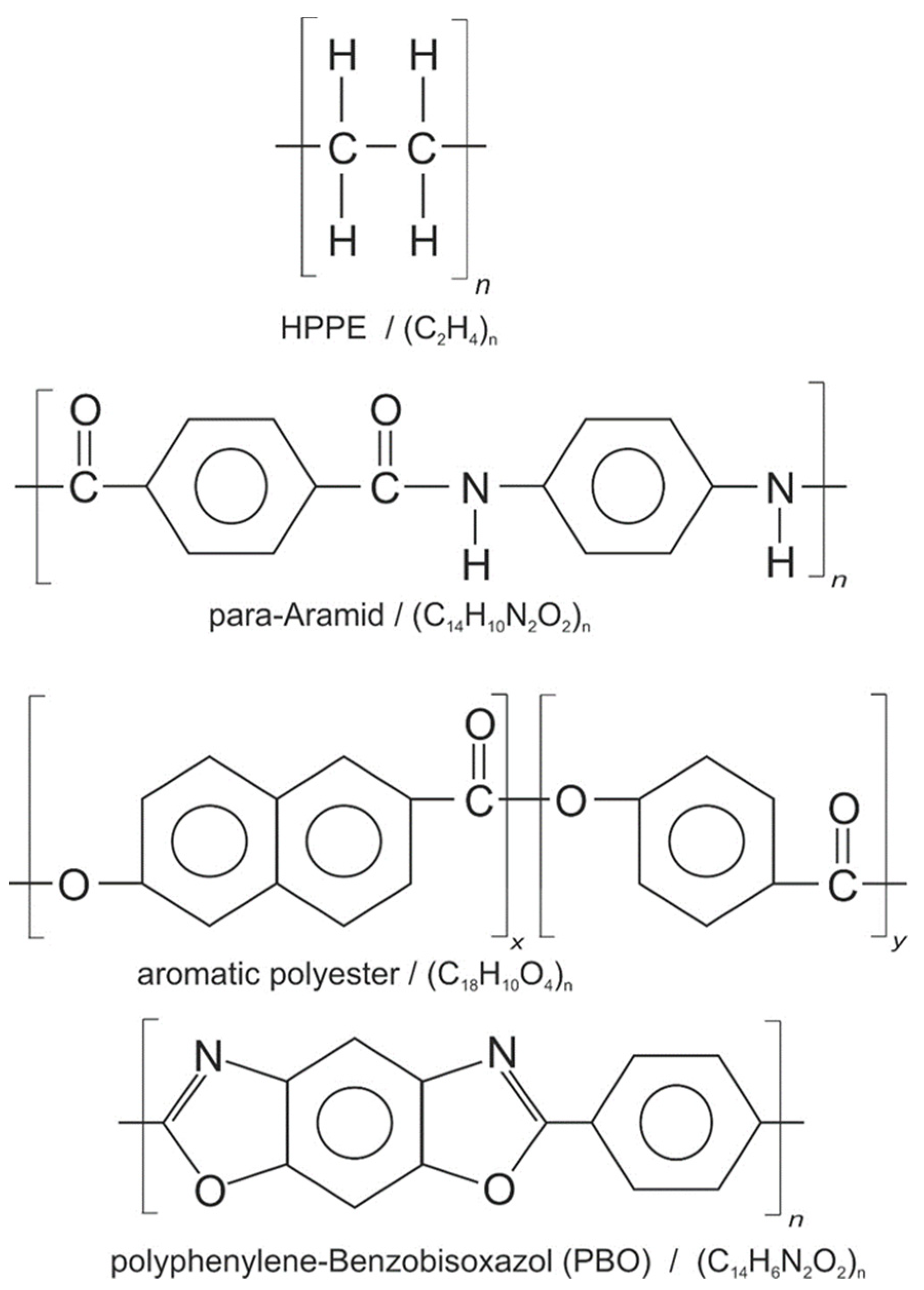
| Polyethylene HPPE (Dyneema) | (C2H4)x | 100 | --- | --- | --- | --- |
| Para-Aramid (Kevlar) | (C14H10N2O2)x | 77.8 | 11.1 | 11.1 | --- | --- |
| Meta-Aramid (Nomex) | (C14H10N2O2)x | 77.8 | 11.1 | 11.1 | --- | --- |
| Aromatic polyester (Vectran) | (C18H10O4)x | 81.8 | --- | 18.2 | --- | --- |
| Phenylene Benzobisoxazol, PBO (Zylon) | (C14H6N2O2)x | 77.8 | 11.1 | 11.1 | --- | --- |
| Polyamide, PA6.6 (Nylon) | (C12H22N2O2)x | 75.0 | 12.5 | 12.5 | --- | --- |
| Polyester, PET | (C10H8O4)x | 71.4 | --- | 28.6 | --- | --- |
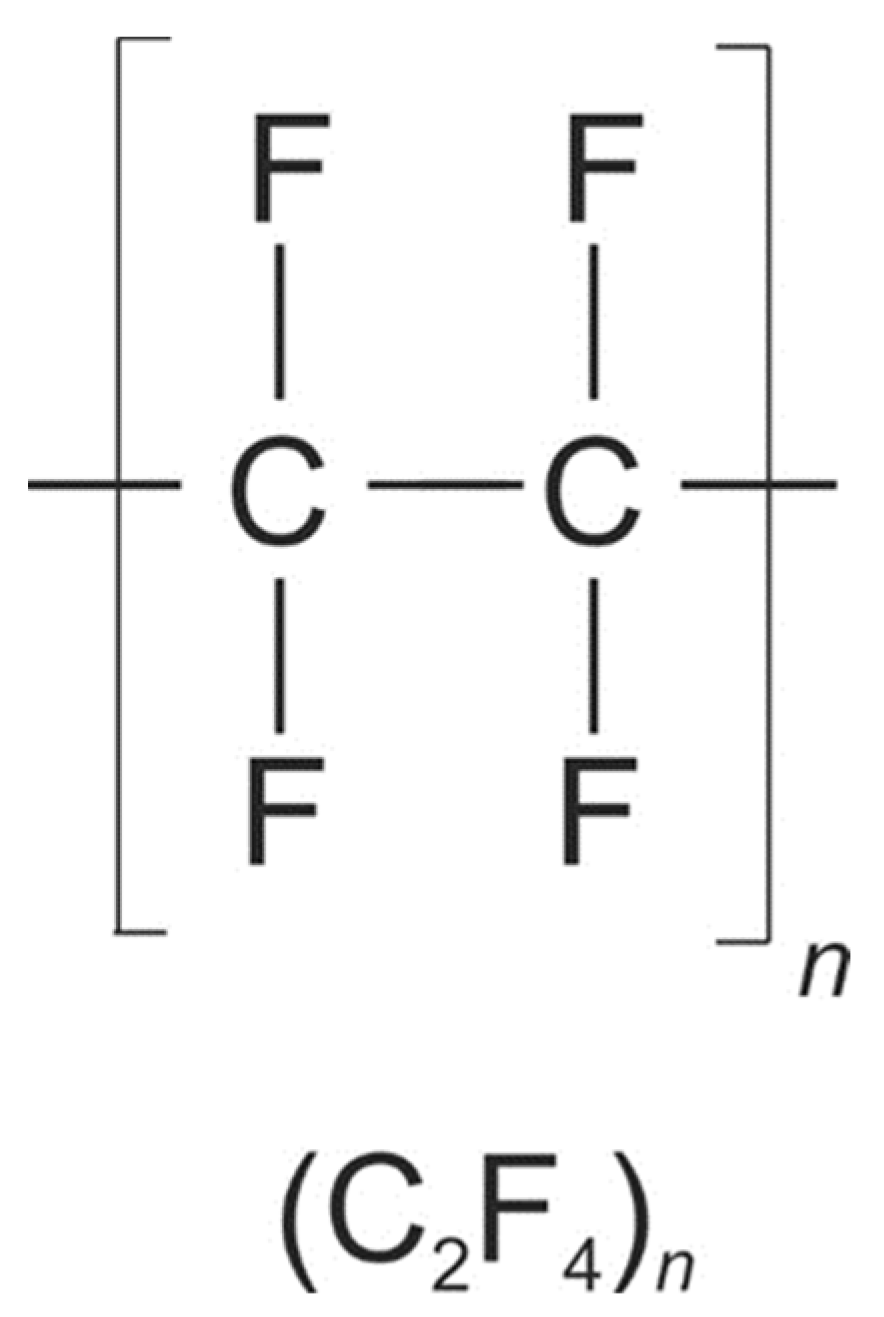
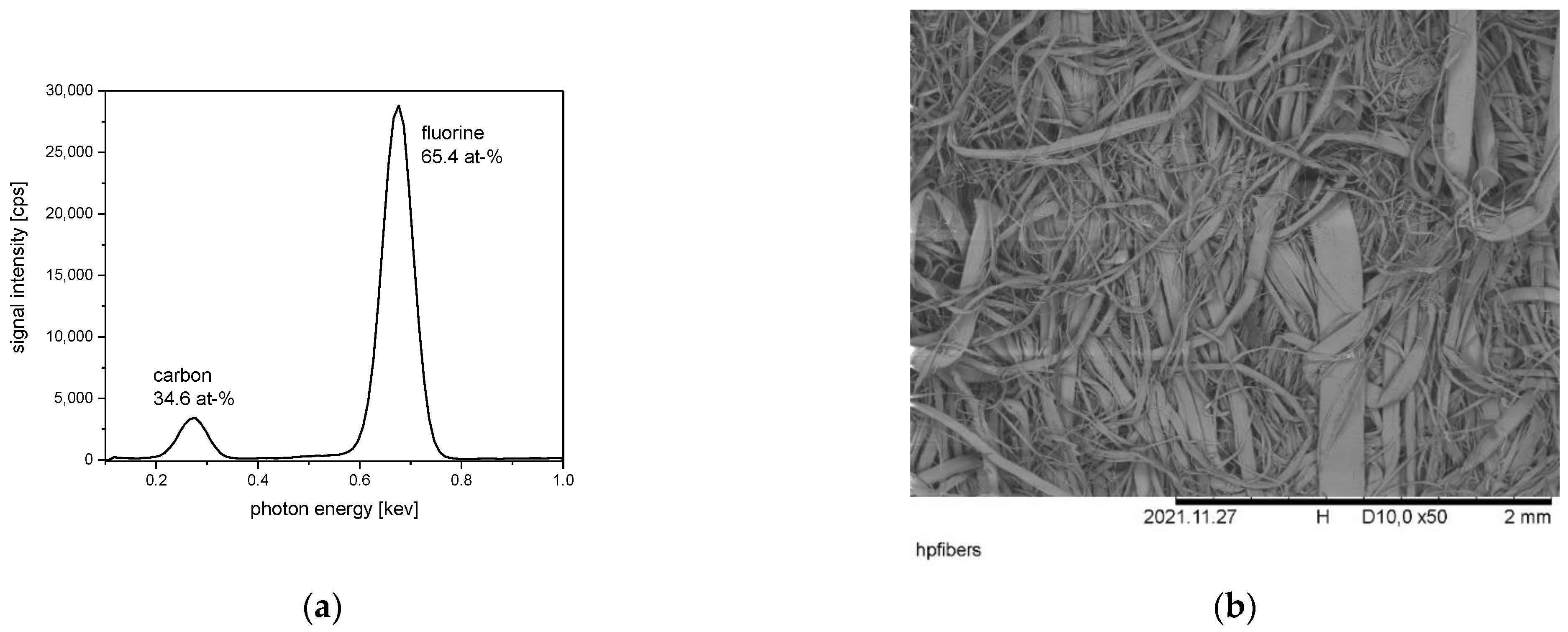
| Polytetrafluoroethylene PTFE (Teflon) | (C2F4)x | 33.3 | --- | --- | 66.7 | |
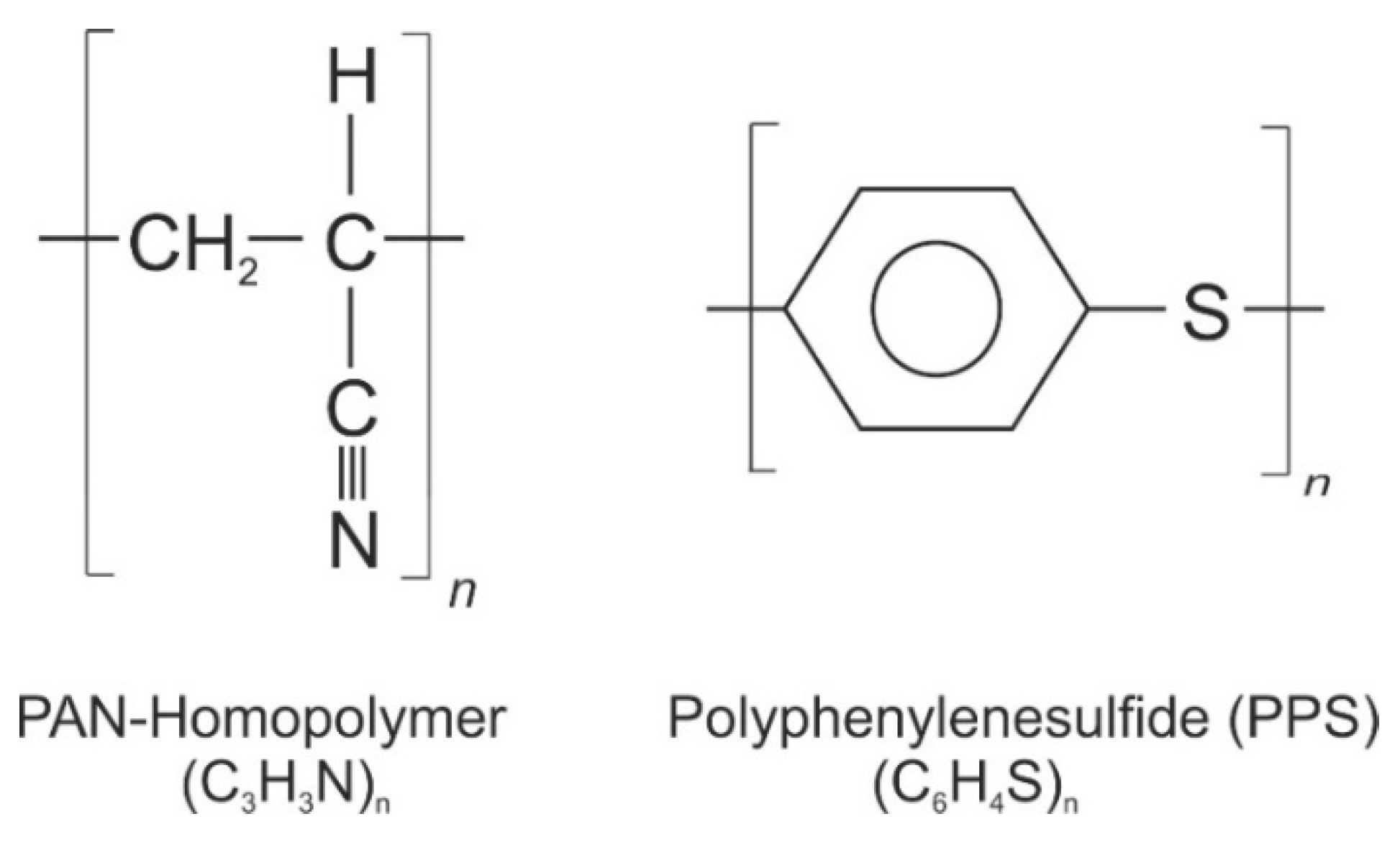
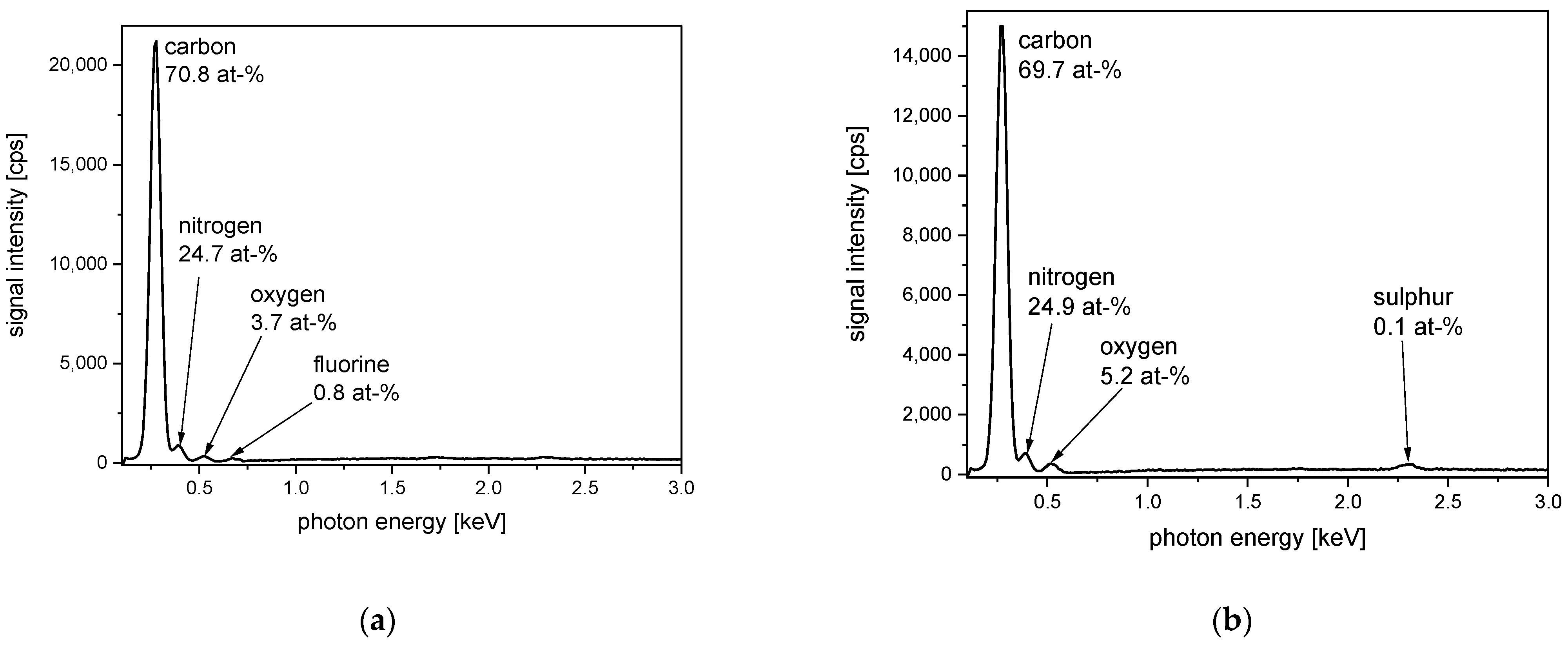
| PAN-homopolymer, polyacrylonitrile | (C3H3N)x | 75.0 | --- | 25.0 | --- | --- |
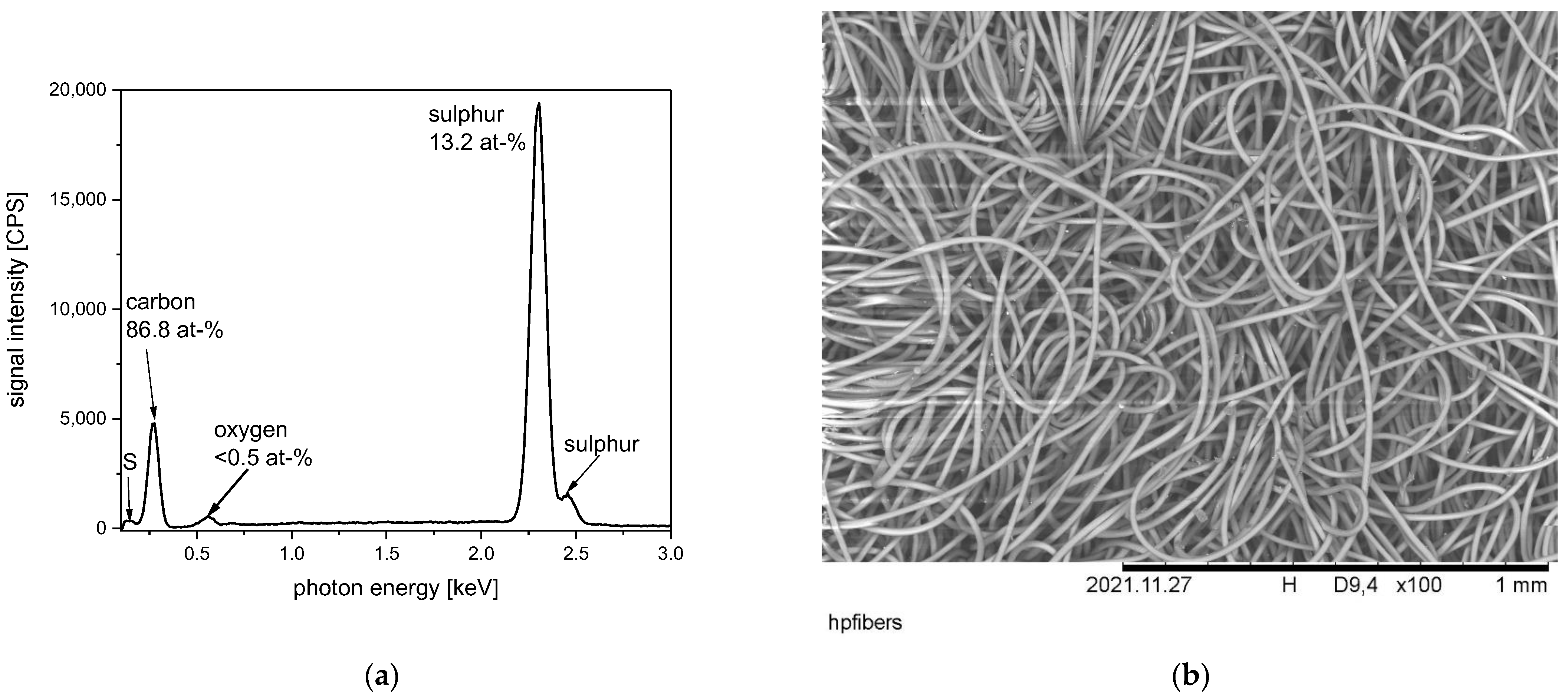
| Polyphenylene sulfide, PPS | (C6H4S)x | 85.7 | --- | --- | --- | 14.3 |
| Polyamideimide, PAI (Kermel) | (C22H14N2O3)x | 81.5 | 7.4 | 11.1 | --- | --- |
| Polyimide, PI (P84) | (C30H16N2O5)x | 81.1 | 5.4 | 13.5 | --- | --- |
| Fiber | Density [g/cm3] | LOI [%] | Maximum Temperature of Usage Tmax [°C] | Selected Properties | References |
|---|---|---|---|---|---|
| Chlorinated modacrylic, (Kanecaron) | --- | 31 | High chemical stability against acid and alkali | [48,93] | |
| Meta-Aramid, (Nomex) | 1.38 | 30–32 | 200 | Good temperature stability | [11,47] |
| Polyamideimide, PAI, (Kermel) | 1.34 | 30–32 | 180/200 | Good temperature stability | [47,94] |
| Polyimide, PI (P84) | 1.41 | 36/38 | 180/260 | Good mechanical and thermal properties | [11,47,95] |
| Phenolic/formaldehyde resin, Novolac resin, (Kynol) | 1.27 | 30–34 | 150/200 | Resitant against heat and fire | [47,96] |
| FR viscose | --- | 23–29 | Humidity up-take, antistatic | [97,98] |
Publisher’s Note: MDPI stays neutral with regard to jurisdictional claims in published maps and institutional affiliations. |
© 2022 by the authors. Licensee MDPI, Basel, Switzerland. This article is an open access article distributed under the terms and conditions of the Creative Commons Attribution (CC BY) license (https://creativecommons.org/licenses/by/4.0/).
Share and Cite
Mahltig, B.; Grethe, T. High-Performance and Functional Fiber Materials—A Review of Properties, Scanning Electron Microscopy SEM and Electron Dispersive Spectroscopy EDS. Textiles 2022, 2, 209-251. https://doi.org/10.3390/textiles2020012
Mahltig B, Grethe T. High-Performance and Functional Fiber Materials—A Review of Properties, Scanning Electron Microscopy SEM and Electron Dispersive Spectroscopy EDS. Textiles. 2022; 2(2):209-251. https://doi.org/10.3390/textiles2020012
Chicago/Turabian StyleMahltig, Boris, and Thomas Grethe. 2022. "High-Performance and Functional Fiber Materials—A Review of Properties, Scanning Electron Microscopy SEM and Electron Dispersive Spectroscopy EDS" Textiles 2, no. 2: 209-251. https://doi.org/10.3390/textiles2020012
APA StyleMahltig, B., & Grethe, T. (2022). High-Performance and Functional Fiber Materials—A Review of Properties, Scanning Electron Microscopy SEM and Electron Dispersive Spectroscopy EDS. Textiles, 2(2), 209-251. https://doi.org/10.3390/textiles2020012