This is an early access version, the complete PDF, HTML, and XML versions will be available soon.
Open AccessArticle
Ionic Association in Ammonium Fe(II) Sulfate and Ammonium Fe(III) Sulfate Aqueous Solutions by Ultrasonic Relaxation Spectroscopy
by
Maria Risva
 Maria Risva
Alexandros Petrakis
Alexandros Petrakis
Angelos G. Kalampounias
 Angelos G. Kalampounias
1
Department of Chemistry, University of Ioannina, 45110 Ioannina, Greece
2
Institute of Materials Science and Computing, University Research Center of Ioannina (URCI), 45110 Ioannina, Greece
*
Author to whom correspondence should be addressed.
Physchem 2026, 6(3), 38; https://doi.org/10.3390/physchem6030038 (registering DOI)
Submission received: 26 February 2026
/
Revised: 31 March 2026
/
Accepted: 20 June 2026
/
Published: 23 June 2026
Abstract
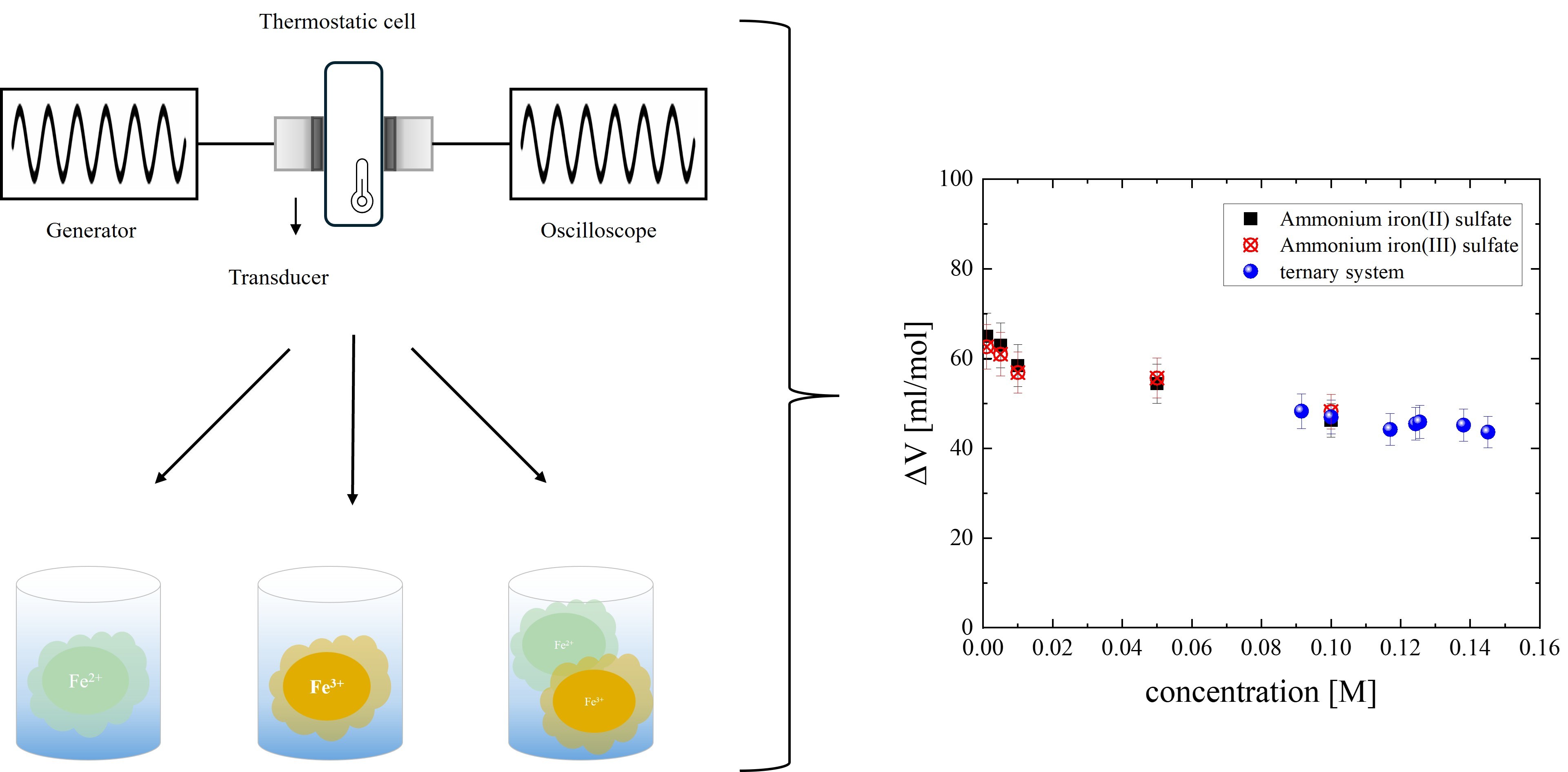
In this work, an ultrasonic relaxation spectroscopic study of aqueous ammonium Fe(II) sulfate, aqueous ammonium Fe(III) sulfate and the corresponding ternary system has been undertaken. A variety of acoustic parameters including relaxation frequency, relaxation amplitude and speed of sound were determined as a function of solution concentration. In addition, the adiabatic compressibility and the molar volume change during the ionic association in ammonium Fe(II) sulfate and ammonium Fe(III) sulfate aqueous solutions were also estimated from the acoustic data. This approach facilitated a comprehensive characterization of the three systems across different concentrations. In the two binary systems, the presence of an ion association mechanism was identified involving the divalent and trivalent iron ions, with the sulfate anions, respectively. Furthermore, in the ternary system, an internal sphere oxidation–reduction mechanism occurred between the divalent and trivalent iron ions. All ions within each solution play an active role in shaping the structure of water molecules, owing to the prevailing kosmotropic characteristics specific to each solution. The results are examined within the context of the current phenomenological understanding in the field.
Share and Cite
MDPI and ACS Style
Risva, M.; Petrakis, A.; Kalampounias, A.G.
Ionic Association in Ammonium Fe(II) Sulfate and Ammonium Fe(III) Sulfate Aqueous Solutions by Ultrasonic Relaxation Spectroscopy. Physchem 2026, 6, 38.
https://doi.org/10.3390/physchem6030038
AMA Style
Risva M, Petrakis A, Kalampounias AG.
Ionic Association in Ammonium Fe(II) Sulfate and Ammonium Fe(III) Sulfate Aqueous Solutions by Ultrasonic Relaxation Spectroscopy. Physchem. 2026; 6(3):38.
https://doi.org/10.3390/physchem6030038
Chicago/Turabian Style
Risva, Maria, Alexandros Petrakis, and Angelos G. Kalampounias.
2026. "Ionic Association in Ammonium Fe(II) Sulfate and Ammonium Fe(III) Sulfate Aqueous Solutions by Ultrasonic Relaxation Spectroscopy" Physchem 6, no. 3: 38.
https://doi.org/10.3390/physchem6030038
APA Style
Risva, M., Petrakis, A., & Kalampounias, A. G.
(2026). Ionic Association in Ammonium Fe(II) Sulfate and Ammonium Fe(III) Sulfate Aqueous Solutions by Ultrasonic Relaxation Spectroscopy. Physchem, 6(3), 38.
https://doi.org/10.3390/physchem6030038
Article Metrics
Article Access Statistics
For more information on the journal statistics, click
here.
Multiple requests from the same IP address are counted as one view.