Article

Functionalized Benzoxazole–Pyrimidine Derivatives for Deep Bioimaging: A DFT Study of Molecular Architecture and One- and Two-Photon Absorption


Optical Spectroscopy and Laser Research Group (GEL), Department of Physics, Universidad Popular del Cesar, Sabanas Campus, Diagonal 21 No. 29-56, Sabanas del Valle, Valledupar 200005, Cesar, Colombia
*
Author to whom correspondence should be addressed.
Physchem 2026, 6(1), 8; https://doi.org/10.3390/physchem6010008

Submission received: 26 November 2025 / Revised: 8 January 2026 / Accepted: 28 January 2026 / Published: 2 February 2026
(This article belongs to the Section Theoretical and Computational Chemistry)

Abstract

This study investigates how different substituents modulate the electronic structure and optical properties of seven derivatives of Pyrimidine-benzoxazole (FB.01) in DMSO, aiming to optimize their performance as deep bioimaging probes. The π-conjugated FB.01 core was functionalized with methyl, phenyl, N-oxide, exocyclic phenyl, carboxyl, N(OH)2, and pyridine. Geometry optimizations were performed using DFT (B3LYP/6-311+G(d,p) with SMD), followed by analysis of frontier orbitals, electronegativity, hardness, and total energy. TD-DFT and the Sum-Over-States approach simulated molar absorptivity spectra and two-photon absorption cross-sections. Results show that minor torsions influence optical responses: the FB.01 skeleton remains nearly planar, though substituents alter π-overlap and shift the LUMO, while the HOMO stays at −7.65 eV. N-oxide and carboxyl groups stabilize the LUMO, narrowing the energy gap (down to 5.20 eV in FB.04 and 6.07 eV in FB.06), whereas methyl widens it (6.38 eV). All compounds preserve a strong UV-band; conjugation increases absorptivity, and FB.04 exhibits a 31 nm red-shift. TPA grows with conjugation and peaks dramatically in FB.04 (23 GM), surpassing other derivatives. These findings highlight three design principles: strong acceptors like N-oxide effectively lower the LUMO and enhance TPA; additional aromatic rings boost one-photon absorption; and carboxyl or N(OH)2 groups finely tune polarity without disrupting planarity.

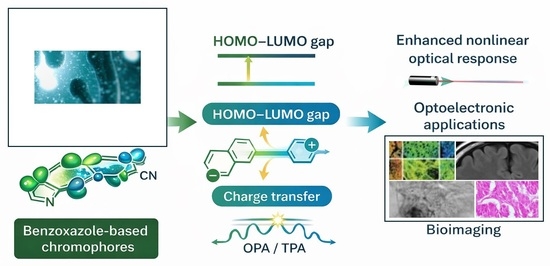
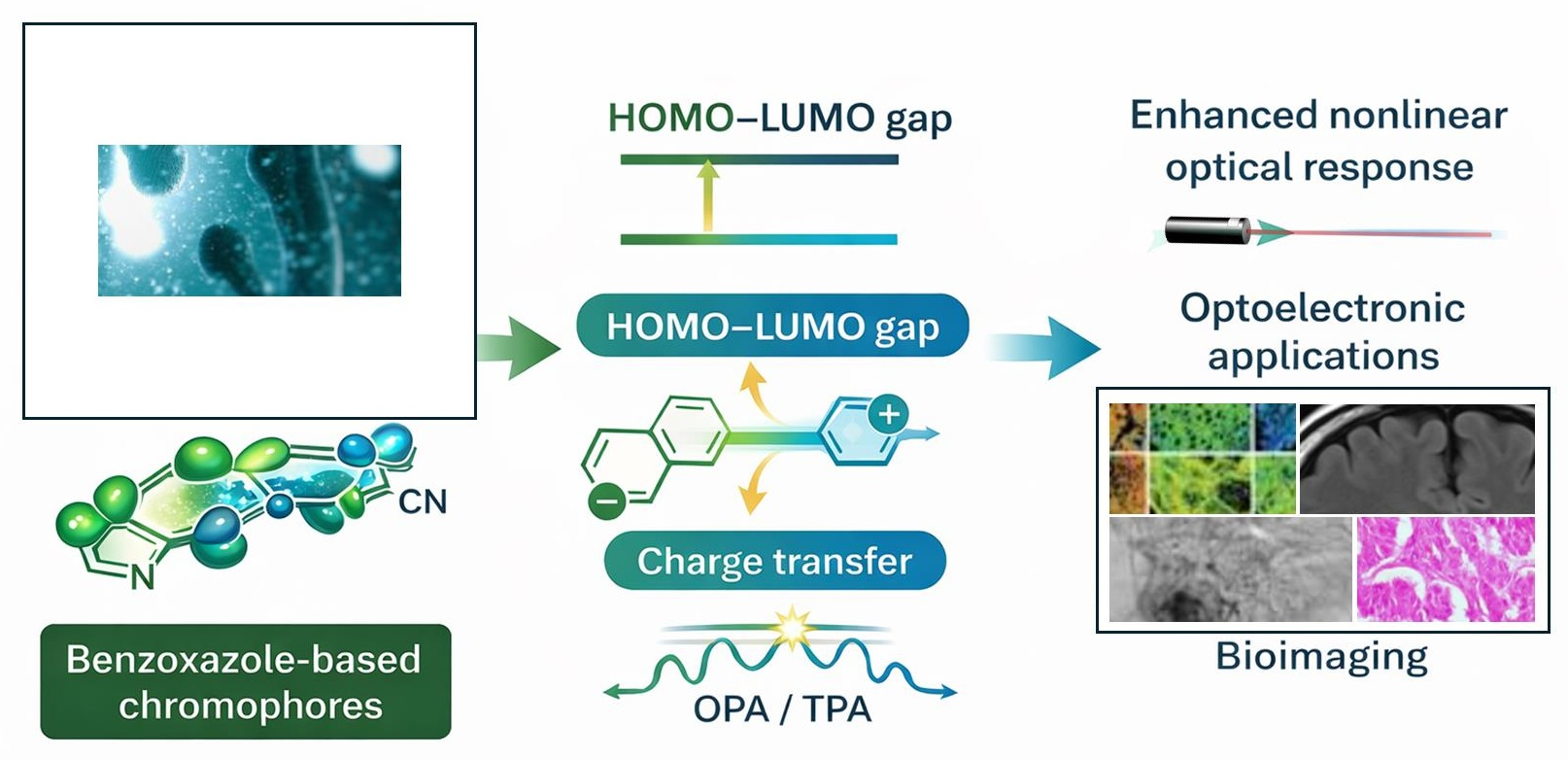
Graphical Abstract

1. Introduction

Multiphoton microscopy has been established over the last few decades as one of the most powerful [1] techniques to observe living tissues with subcellular resolution [2]. The most widely used principle today is the simultaneous absorption of two photons (TPA), a nonlinear optical process that allows the excitation of fluorescent molecules with low-energy light within the biological radiation range, minimizing phototoxicity and scattering in the sample [3]. Even so, the quantum efficiency of most available organic dyes remains incipient; only a handful of them have TPA cross-sections high enough to generate an intense signal without resorting to power densities that could damage biological structures [4,5]. This limitation has driven the search for chromophore families whose electronic parameters can be finely tuned through subtle structural changes, so that the optical response is optimized without sacrificing solubility or photochemical stability [6,7].
Within this effort, benzoxazole-type heteroaromatics stand out for combining several desirable qualities: a rigid platform that limits vibrational deactivation, a high transition moment in the ultraviolet, and synthetic chemoselectivity that facilitates their functionalization [8,9]. When a pyrimidine fragment is anchored at position 4 of the system, electron-accepting centers emerge that can induce extensive intramolecular charge transfers, a phenomenon that often enhances polarizability and, consequently, nonlinear performance [10,11,12]. The current literature also shows that extending conjugation through additional rings or introducing electron-donor and electron-acceptor groups modulates the HOMO–LUMO gap (Highest Occupied Molecular Orbital—Lowest Unoccupied Molecular Orbital) almost additively, which offers a palette of possibilities to shift absorption toward wavelengths compatible with standard laser instrumentation [13,14,15,16,17].
On the other hand, the use of density functional theory (DFT) and its time-dependent formulation (TD-DFT) has become an indispensable ally for the rational design of new dyes [18,19,20]. These methods allow predicting equilibrium geometries, charge distributions, and electronic spectra with an adequate balance between accuracy and computational cost. However, there is still a need to link these predictions with more global parameters (dipole moment, electronegativity, molecular hardness), which can guide the selection of the most relevant synthetic routes [21,22,23,24]. The correlation between these descriptors and multiphoton efficiency has not yet been explored in sufficient depth in benzoxazole systems with nitrogen-containing rings.
In this context, the present research proposes a systematic study of pyrimidine–benzoxazole derivatives functionalized with substituents of different electronic nature. Using FB.01 as the reference core structure, each derivative incorporates a single, well-defined modification: FB.02 contains a σ-donating methyl group (-CH3) that subtly raises the HOMO [25]; FB.03 and FB.05 introduce phenyl substituents that extend the π-conjugated framework, with FB.05 [26]; FB.04 corresponds to a 4-nitroso-pyrimidine derivative, introducing a strong electron-withdrawing –NO group [27]; FB.05 featuring a phenyl group at the C-4 position of the pyrimidine ring [28]; FB.06 bears a carboxyl substituent (-COOH), enhancing molecular polarity and hydrogen-bonding capability [29]; FB.07 corresponds to a nitrogen dihydroxide–substituted derivative, represented as N(OH)2 in the proposed structure, which provides additional acceptor character [30]; and FB.08 replaces the terminal phenyl group with a 4-pyridyl moiety, whose heteroaromatic nitrogen acts as a coordination site and increases the overall molecular dipole moment [31].
Three central guidelines are adopted: maintaining the coplanarity of the π-skeleton as far as intrinsic torsions allow; evaluating substituents that represent different regimes of charge donation and withdrawal; and analyzing the compounds in a polar medium such as dimethyl sulfoxide (DMSO), a solvent widely accepted in biological assays due to its ability to dissolve both hydrophilic and lipophilic molecules [32,33,34]. The approach adopted aims, on the one hand, to theoretically estimate the feasibility of these chromophores as deep bioimaging probes and, on the other, to provide general guidelines for substituent engineering in future research. The practical interest of this strategy is to reveal the structural parameters that most influence the nonlinear response (coplanarity, conjugated length, localized polarity), facilitating the selection of substituents that enhance TPA efficiency without compromising photostability or ease of synthesis.

2. Computational Methods

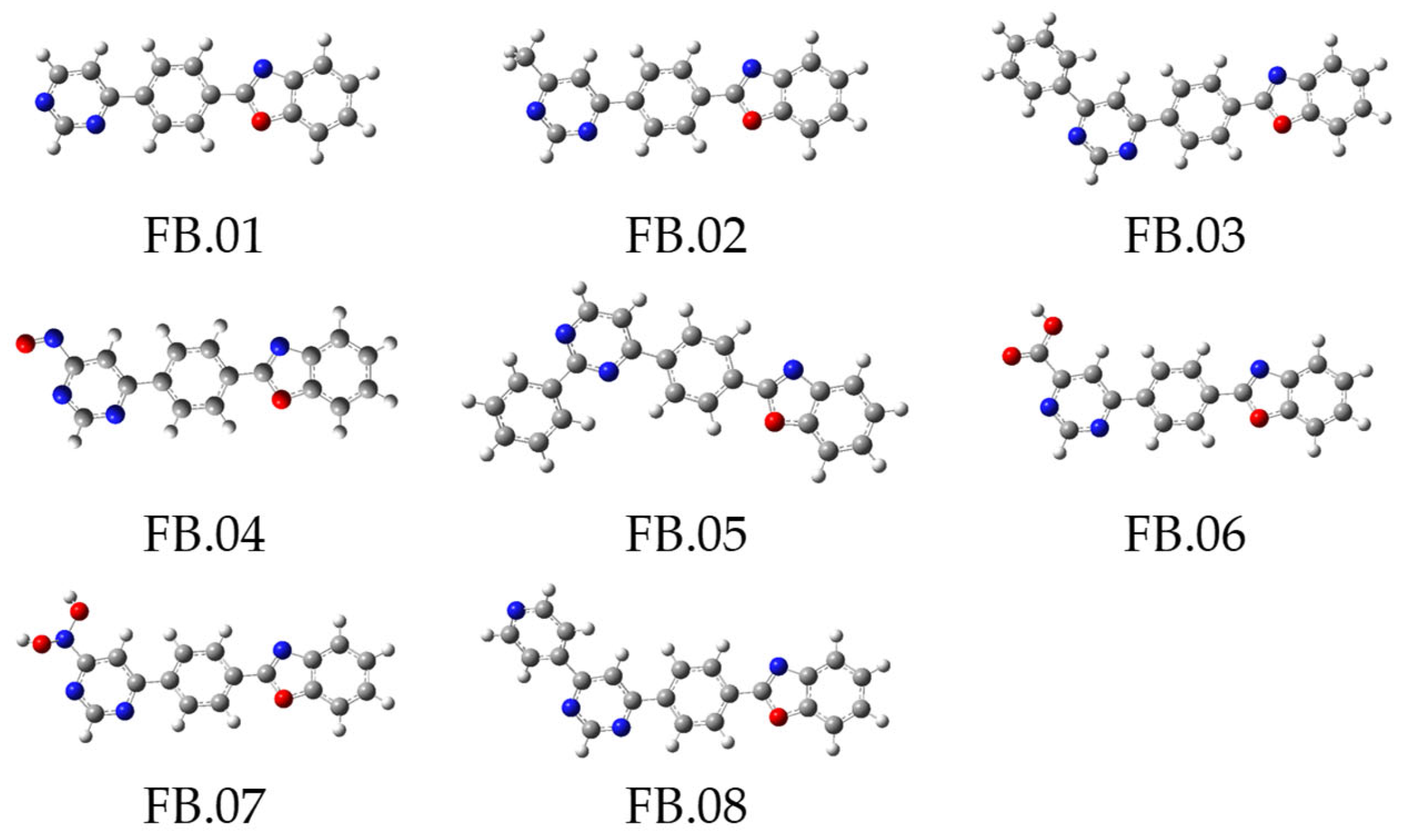
The compounds under study (Figure 1) were designed and modeled in their ground state using Gaussian 09, employing DFT (time-independent density functional theory) with B3LYP hybrid functionals and 6-31g+(d,p) Gaussian basis sets [35]. B3LYP may overestimate CT stabilization and red shifts. Solute–solvent interactions were treated with the SMD (solvation model based on density) continuum solvent model using DMSO [9]. The molecular architecture is detailed below.
The parent compound FB.01 was chosen as a π-conjugated platform because it combines three aromatic units that communicate electronically. Its systematic name is PB.01 the pyrimidine (acceptor), the phenyl ring (semi-donor spacer), and the benzoxazole bicyclic core create an electronic corridor that favors charge displacement and provides two heteroatoms available for coordination or protonation [36]. In FB.02, a methyl group was introduced at the site of highest electron density in the benzoxazole. The -CH3 acts as a weak σ-donor; it raises the HOMO energy, narrows the HOMO–LUMO gap, makes the molecule more hydrophobic, and alters the dipole moment, polarizability, and hyperpolarizability vectors, which are decisive features for nonlinear optical response [37].
For FB.03, an extra phenyl ring was added at the opposite end of the benzoxazole. The new aromatic unit extends conjugation and, being a resonance donor, pushes density toward the center of the system. It also increases the hydrophobic surface and improves solubility in organic solvents such as DMSO, which is useful in thin-film processing or pharmaceutical formulation [26]. In FB.04, nitric oxide was incorporated onto the pyrimidine, which decreases the basicity of the heteroatom, strengthens hydrogen bond acceptance, and offers a coordination site for transition metals. The result is a more polar molecule, with ortho/para-selective synthetic routes and potential for redox-active supramolecular assemblies [17].
FB.05 was designed by coupling a phenyl group to carbon 4 of the pyrimidine, that is, the intermediate carbon between the two nitrogens. This anchor maximizes direct pyrimidine–phenyl conjugation, shifts density away from the nitrogens (modulating their basicity), and provides steric bulk that can improve selectivity toward biological targets by hindering undesired orientations [38]. In FB.06, a carboxylic acid group (-COOH) was coupled to the benzoxazole. Carboxyl introduces an ionization site that increases water solubility in physiological media, allows the formation of salts or esters for controlled release, and strengthens hydrogen bonding interactions with proteins or oxide surfaces; it also acts as a moderate electron-withdrawing group, fine-tuning the absorption spectrum [39].
FB.07 incorporates a fragment N(OH)2 onto the central ring. The N(OH)2 adds two hydrogen-bond donor/acceptor sites, greatly increases polarity, and offers a microenvironment capable of proton exchange or participation in dynamic tautomerism, valuable features for chemical sensors and for tuning the photophysics of the system via protonic switching [30]. Although no explicit NO2 derivative was included, the N-oxide functionality in FB.04 behaves electronically as a strong π-acceptor, comparable to classical nitro substituents in push–pull systems. FB.08 replaces the terminal phenyl with a 4-pyridyl moiety. The basic nitrogen of pyridine provides an extra protonation or metal-coordination site, improves affinity for polar surfaces, and alters the electronic distribution through the –M/–I effect, all without sacrificing aromatic planarity. This yields a more polarizable derivative, capable of forming complexes and of being selectively functionalized at positions 3 or 4 of the new heteroaromatic ring.
With this family of Pyrimidine-benzoxazole derivatives, a range of current needs in medicinal chemistry are addressed: a controlled balance between lipophilicity and polarity, sufficient rigidity to bind to aromatic targets, heteroatomic sites capable of coordinating metals or participating in hydrogen bonding, and an adjustable photophysical spectrum that supports applications in bioimaging, phototherapy, and biomedical optoelectronic devices.
With the molecular structures optimized, a study of spatial configuration was carried out because the coplanarity of the carbonyl maximizes conjugation, shifts the C=O band to lower frequency, alters α-acidity and nucleophilicity, reduces the HOMO–LUMO gap, and influences packing, aromatic stacking, and catalytic recognition, which is important in biomedical applications. In addition, the frontier orbitals (HOMO and LUMO), electronic properties, and intrinsic chemical reactivity were studied, analyzing characteristics such as total energy, HOMO and LUMO orbital energies, energy gap, electronegativity, hardness, and dipole moment.
Then, TD-DFT (time-dependent density functional theory) was used to calculate transition probabilities among 30 states of each compound, which were used to model molar absorptivity spectra in DMSO. The functionals used were CAM-B3LYP, the basis sets were 6-311g+(d,p), and the solvation model used was SMD [9]. CAM-B3LYP was employed specifically to assess the robustness of charge-transfer states against functional-dependent artifacts. Measuring molar absorptivity reveals how much light each derivative absorbs, assigning wavelength and evaluating excitation efficiency. The emission spectrum, along with quantum yield and Stokes shift, shows what fraction of energy is released radiatively, establishing chromatic purity, stability, and suitability for the desired biomedical applications.
The two-photon absorption spectra were obtained using the SOS (sum-over-states) method, calculating transition dipole moments among the first 30 states using twice the energy of the one-photon transitions, since high TPA values indicate potential for deep-activated photodynamic therapy or optogenetics, while comparison among FB derivatives indicates which substitutions (methyl, phenyl, N-oxide) optimize this nonlinear response without sacrificing solubility or biocompatibility.

3. Results

3.1. Atomic Cartesian Coordinates

Below is the spatial information, that is, the (x, y, z) coordinates of the atoms that constitute each compound in DMSO from Table 1, in Bohr units; the 0 1 at the beginning of each line indicates the ground state in which the compounds were optimized.
The three-dimensional model of FB.01 (Table 1) indicates that the benzoxazole, phenyl, and pyrimidine rings are almost aligned in the same plane (deviations ≤ 3 Å along the Z-axis); the heteroatoms (N, O) barely protrude. This coplanarity maximizes the overlap of π orbitals along the ~17 Bohr of the X-axis, explains the wide conjugation corridor responsible for the moderate HOMO–LUMO gap (6.32 eV), and reinforces the longitudinal polarizability. In FB.02 (Table 2) the benzoxazole–phenyl–pyrimidine skeleton retains the global planarity: almost all aromatic atoms fall within a ±3 Å band over the XY plane; only the carbon of the newly incorporated CH3 group departs ~1 Å outward. This slight bulge does not break conjugation: the π pathway still extends about 17 Bohr along the X-axis, but the σ donor of the methyl raises the HOMO and narrows the HOMO–LUMO interval to 6.38 eV.
In FB.03 (Table 1) the insertion of the second phenyl ring partially breaks the global planarity: while the central benzoxazole–phenyl–pyrimidine path remains within ±3 Å, the new phenyl appears rotated ~35° and protrudes up to 4 Å above the XY plane (Z-axis). This torsion reduces π-orbital overlap at the left end, so the effective conjugation is shortened by ≈3 Bohr, and the electronic corridor becomes fragmented. Consequences: the HOMO–LUMO gap drops only to 6.29 eV. In FB.04 (Table 1) the pyrimidine N-oxide (N+→O, red and blue spheres to the right) keeps the benzoxazole–phenyl–pyrimidine scaffold practically coplanar: the majority of π-conjugated atoms oscillate within ±2.5 Å over the XY plane. The axial oxygen of the N-oxide protrudes only ~1 Å and does not induce perceptible torsion; thus, the conjugated path continues extending ~17 Bohr along the X-axis. The introduction of the N-oxide dipole increases the acceptor character, lowers the LUMO, and narrows the gap to 5.20 eV, raising the longitudinal polarizability and the charge density at the right end.
In FB.05 (Table 1) the main π chain—benzoxazole–phenyl–pyrimidine—remains coplanar within ±2 Å over the XY plane and extends almost 19 Bohr along the X-axis. However, the phenyl added at C-4 of the pyrimidine rotates ~70° with respect to the skeleton and protrudes up to 4 Å in Z. This torsion interrupts lateral conjugation: the new ring participates only by induction (not by resonance), so the HOMO–LUMO gap hardly varies (6.33 eV) and the overall dipole moment falls to 1.82 D. In FB.06 (Table 2) the benzoxazole–phenyl–pyrimidine π spine preserves the fundamental coplanarity: almost all aromatic atoms remain within ±2 Å over the XY plane, maintaining a conjugated corridor of ~17 Bohr along the X-axis. The newly anchored carboxylic group (C=O and O–H, red spheres to the right) tilts about 25–30°; its two oxygens protrude ~1.5 Å, introducing little torsion but a strong local dipole. This appendage withdraws electron density, slightly lowers the LUMO, and narrows the gap to 6.07 eV, while raising the overall dipole moment to 5.16 D.
In FB.07 (Table 1) the benzoxazole–phenyl–pyrimidine backbone remains essentially flat (most aromatic atoms oscillate within ±2 Å over the XY plane and the π corridor extends ~17 Bohr along the X-axis), but the newly introduced N(OH)2 fragment (C(OH)2, red spheres) projects to both sides of the plane by about 2 Å. This protrusion does not cut longitudinal conjugation, but it does generate a strong local dipole and dense H-bond donor/acceptor sites that swell the overall dipole moment (2.80 D) and promote intermolecular networks. In FB.08 (Table 2) the benzoxazole–phenyl–pyrimidine π route remains almost perfectly coplanar (±2 Å over the XY plane) and extends a little more than 18 Bohr along the X-axis. The key change is the terminal phenyl replaced by a pyridine twisted ~60° with respect to the skeleton: its blue nitrogen protrudes ~3 Å out of the plane. This torsion interrupts lateral conjugation, but not longitudinal; the HOMO–LUMO gap remains at 6.20 eV, and axial polarizability stays high. The pyridinic nitrogen provides a protonation/coordination center that increases the overall dipole moment to 4.21 D and enables directed bonds to metals or proteins.

3.2. HOMO and LUMO Orbitals

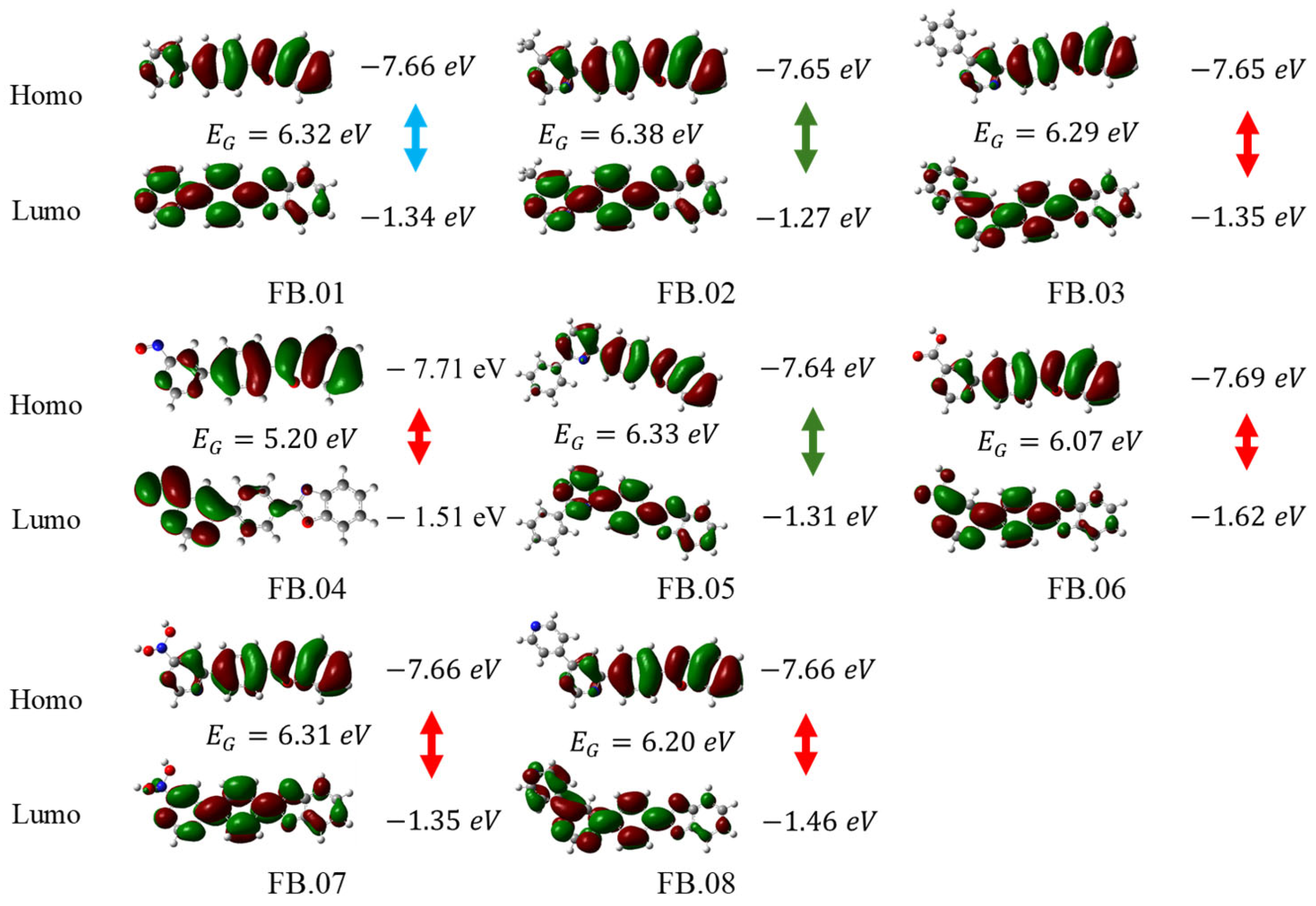
In Figure 2, throughout the series, the HOMO orbital remains confined to the original benzoxazole backbone, while the LUMO shows characteristic shifts depending on the incorporated substituent: in FB.01 it is oriented toward the pyrimidine; in FB.02 it also points to that end but does not include the added methyl group; in FB.03 it is concentrated in the center of the molecule, with less presence at the ends; in FB.04 it migrates toward the pyrimidine and covers the N-oxide, leaving the opposite benzoxazole exposed; in FB.05 it returns to the center without reaching the attached phenyl; in FB.06 it extends to the pyrimidine and includes the carboxyl group; in FB.07 it advances to the same end and partially covers the N(OH)2; and in FB.08 it projects toward the pyrimidine, integrating the terminal 4-pyridyl moiety ring.

3.3. Electronic Properties and Intrinsic Chemical Reactivity

In DMSO (see Table 2), the total energy ( E T ) confirms the increasing stability with the extension of conjugation. FB.01 starts at −24,326.87 eV; the simple methylation of FB.02 makes it more negative (−25,396.99 eV). The insertion of a second phenyl in FB.03 lowers the energy even further (−30,614.84 eV), a value that is repeated in FB.05 when that phenyl is directly anchored to the pyrimidine (−30,614.83 eV). The N-oxide of FB.04 is stabilized at −27,845.02 eV; the carboxyl group of FB.06 at −29,458.54 eV; the N(OH)2 of FB.07 at −29,924.71 eV, while the 4-pyridyl moiety of FB.08 reaches −31,059.26 eV, the lowest in the series.
In Table 2 and Figure 2, the frontier levels show a practically constant HOMO (−7.64 to −7.71 eV) except for the N-oxide: FB.04 drops to −7.71 eV, indicating electron-withdrawing behavior. The LUMO varies more: −1.27 eV in FB.02, −1.34 eV in FB.01, −1.35 eV in FB.03 and FB.07, −1.31 eV in FB.05, −1.46 eV in FB.08, and −1.62 eV in FB.06; the extreme value comes from FB.04 at −2.51 eV, reflecting the electron-attracting effect of the N-oxide. Consequently, the energy gap ( E G ) ranges from 5.20 eV (FB.04) to 6.38 eV (FB.02), staying around 6.30 eV for most (FB.01, FB.03, FB.05, FB.07) and dropping to 6.07 eV in the carboxylated FB.06 and 6.20 eV in the pyridine FB.08. Electronegativity ( χ ) follows the same pattern: 4.46 eV for FB.02, 4.47 eV in FB.05, 4.50 eV in FB.01 and FB.03, 4.51 eV in FB.07, 4.56 eV in FB.08, 4.65 eV in FB.06, and 5.11 eV in FB.04. The resulting hardness ( η ) remains high (≈3.15 eV) for the neutral derivatives but drops to 2.60 eV in FB.04 and 3.04 eV in FB.06, indicating higher chemical softness where polarizing groups are introduced.
The dipole moment reveals the charge redistribution (Table 2). The values are low in FB.05 (1.82 D) and intermediate in FB.01, FB.03, and FB.07 (2.76–2.80 D). The methylated FB.02 drops slightly to 2.63 D. Upon incorporating carboxyl (FB.06) and 4-pyridyl moiety (FB.08), they increase to 5.16 D and 4.21 D, respectively. The maximum corresponds to the N-oxide FB.04 with 6.60 D, consistent with its strong N + O dipole. These data confirm that the modifications introduce predictable adjustments in reactivity and polarity without excessively disturbing the overall stability of the benzoxazole–phenyl–pyrimidine core.

3.4. One Photon Absorption (OPA)

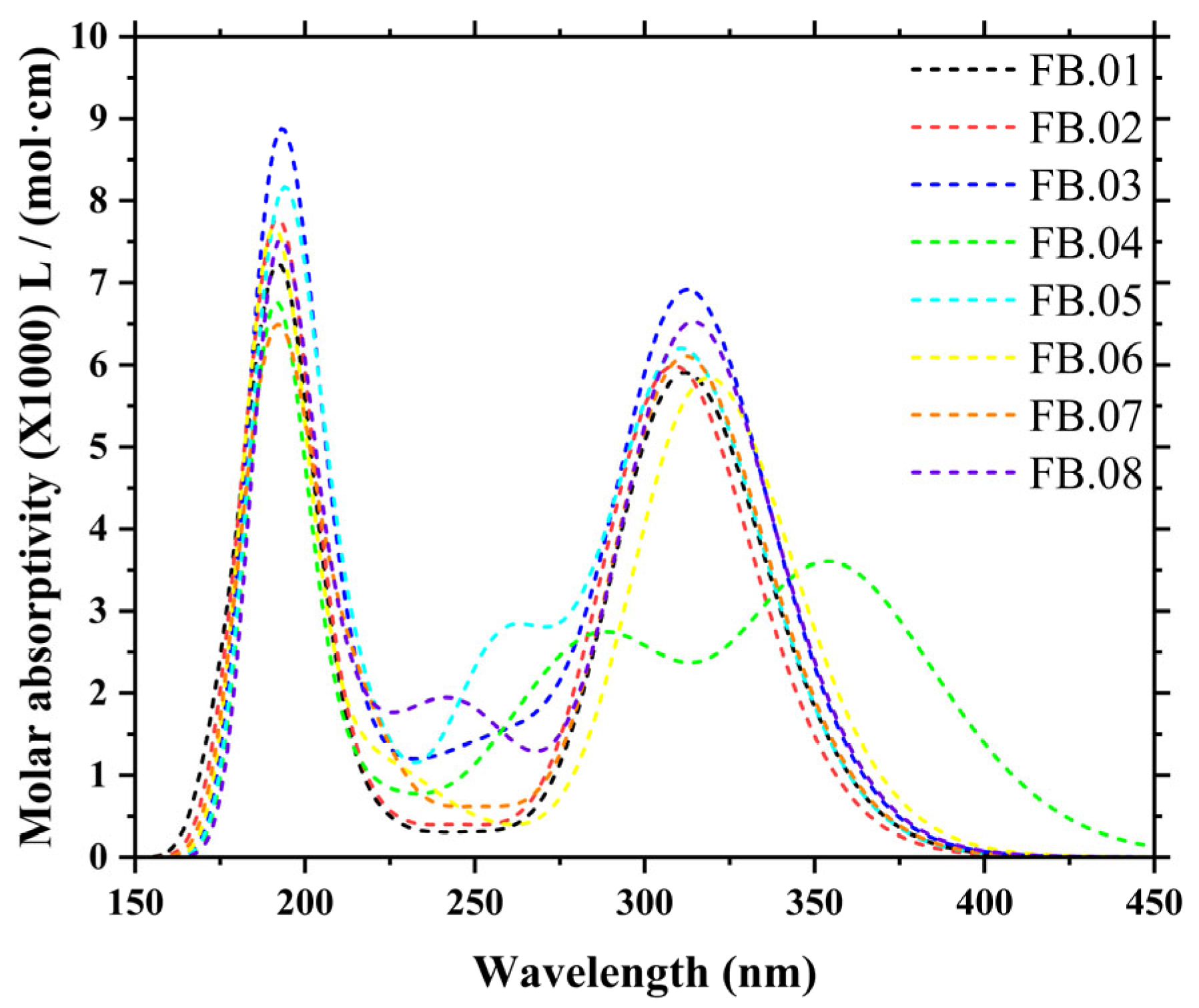
FB.01 (see Figure 3). It shows an intense peak at 192 nm with a molar absorptivity of 7.23 × 10 3   L   m o l 1 c m 1 ; the second maximum is located at 312 nm and reaches 5.91 × 10³ L mol−1 cm−1. These values correspond to n π transitions of the benzoxazole–phenyl–pyrimidine corridor and serve as a reference for the series. FB.02 (see Figure 3). The methyl substituent keeps the first maximum at 192 nm, raising it to 7.79 × 10 3   L   m o l 1 c m 1 . The second peak, slightly red-shifted, appears at 309 nm with 5.99 × 10 3   L   m o l 1 c m 1 , indicating a slight reduction in excitation energy.
FB.03 (see Figure 3). The insertion of an additional phenyl strengthens the entire curve: the first maximum appears at 193 nm with 8.88 × 10 3   L   m o l 1 c m 1 and the second at 313 nm with 6.92 × 10 3   L   m o l 1 c m 1 , values that confirm the extended conjugation of the system. FB.04 (see Figure 3). When oxidizing the pyrimidine to N-oxide, the first peak remains at 192 nm with 6.76 × 10 3   L   m o l 1 c m 1 , but the second band shifts markedly to 343 nm, where it reaches 3.40 × 10³ L mol−1 cm−1 and extends into the visible region, showing a significant stabilization of the LUMO. FB.05 (see Figure 3). The coupling of a phenyl to the pyrimidine produces a shoulder in the 250–280 nm region and maintains the main pair at 194 nm with 8.17 × 10³ L mol−1 cm−1 and at 311 nm with 6.21 × 10 3   L   m o l 1 c m 1 , indicating new π π transitions without major spectral shifts.
FB.06 (see Figure 3). The introduction of the carboxyl group preserves the first band at 191 nm with 7.68 × 10 3   L   m o l 1 c m 1 , while the second appears at 319 nm with 5.84 × 10 3   L   m o l 1 c m 1 and shows greater width, reflecting additional n→π* transitions from the carbonyl. FB.07 (see Figure 3). The N(OH)2 contributes polarity without excessively altering the positions: 192 nm with 6.49 × 10 3   L   m o l 1 c m 1 and 312 nm with 6.11 × 10 3   L   m o l 1 c m 1 are observed, along with a small crest near 260 nm attributed to the two hydroxyl groups. FB.08 (see Figure 3). The replacement of phenyl by a 4-pyridyl moiety maintains a peak at 193 nm with 7.54 × 10 3   L   m o l 1 c m 1 and another at 313 nm with 6.53 × 10 3   L   m o l 1 c m 1 , accompanied by a slight shoulder between 250 and 270 nm arising from π π transitions of the heteroaromatic nitrogen. All molecules retain an intense deep-ultraviolet band associated with the benzoxazole core; the shifts and intensity variations in the second band reveal how each substituent modulates conjugation and charge-transfer character, with the N-oxide (FB.04) inducing the most pronounced bathochromic shift and the additional phenyl (FB.03) producing the greatest enhancement in absorption.

3.5. Two Photon Absorption (TPA)

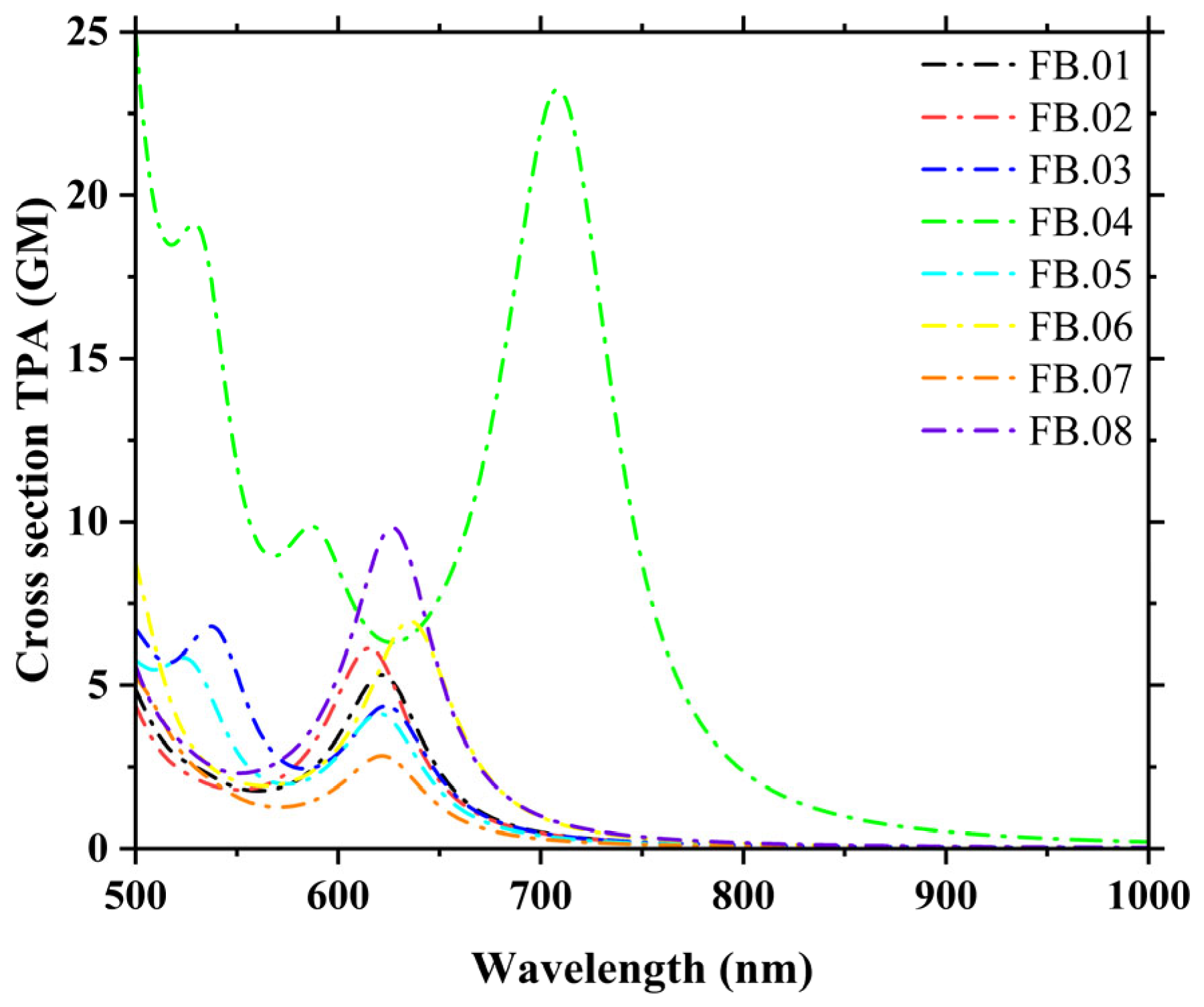
For FB.01 (see Figure 4), the highest peak appears around 605 nm with an intensity of 4.5 GM. The full width at half maximum (FWHM) is about 40 nm, so the area under the curve in the visible region reaches about 160 GM, reflecting modest absorption. In FB.02 (see Figure 4), the maximum is located near 600 nm and reaches about 6 GM. Its FWHM is estimated at 45 nm, and the integrated area is about 200 GM, indicating slightly higher capture capacity than FB.01.
The profile of FB.03 (see Figure 4) shows two crests: the main one at 550 nm with 7 GM and a secondary one at 600 nm with 6.5 GM. The typical FWHM is about 50 nm, and the integrated area rises to about 300 GM, indicating significant absorption. FB.04 stands out clearly. It shows a dominant peak of 23 GM around 720 nm and two smaller ones, one of 17 GM near 510 nm and another of 9 GM around 590 nm. The main crest is broad, about 80 nm, and the overall area approaches 1000 GM, making it the compound with the highest absorption capacity in the set.
In FB.05 (see Figure 4), peaks of 6 GM at 540 nm and 5 GM at 600 nm are observed. With an average width of about 45 nm, the integrated area is around 230 GM, placing it in an intermediate range. For FB.06 (see Figure 4), the maximum appears at 520 nm with 4 GM and at 600 nm with 3 GM. Its typical width is 40 nm, and the area under the curve is about 150 GM, revealing the lowest absorption efficiency in the series. FB.07 (see Figure 4) reaches its highest value at 540 nm with 5 GM and shows a FWHM of about 40 nm; the integrated area is around 180 GM, slightly higher than that of FB.06. FB.08 (see Figure 4) exhibits a peak of 8 GM centered at 600 nm with a width of about 50 nm. The integration yields about 250 GM, giving it an absorption capacity comparable to that of FB.05 and notably higher than that of FB.06 and FB.01.

4. Discussion

The pyrimidine–benzoxazole derivatives reveal that relatively small topological modifications induce clearly differentiated electronic and photophysical responses. Three-dimensional models indicate that the benzoxazole–phenyl–pyrimidine π-column remains nearly coplanar across the series; however, the incorporation of additional rings or polar substituents introduces local torsions of up to ~70°, reducing orbital overlap at the molecular termini and modulating the effective conjugation pathway. The strict coplanarity observed for FB.01, FB.02, and FB.04 extends π-delocalization over approximately 17 Bohr, whereas the external phenyl group in FB.05 and the twisted pyridine ring in FB.08 partially disrupt alignment, diminishing π-interaction on the substituted side. These geometric distortions directly govern LUMO positioning and longitudinal polarizability, which are key parameters for nonlinear optical responses.
From an electronic perspective, the HOMO energies remain nearly invariant (−7.64 to −7.66 eV), except in the presence of strong electron-accepting groups. In particular, the 4-nitroso derivative FB.04 stabilizes both frontier orbitals, lowering the HOMO to −7.71 eV and shifting the LUMO to −2.51 eV, which compresses the gap to 5.20 eV. A similar but less pronounced effect is observed for the carboxyl-substituted FB.06, where LUMO stabilization (−1.62 eV) reduces the gap to 6.07 eV, while simple methylation in FB.02 slightly raises the LUMO (−1.27 eV) and widens the gap to 6.38 eV. Orbital density maps corroborate these trends, showing HOMOs largely localized on the benzoxazole core and LUMOs progressively shifted toward the pyrimidine or electron-withdrawing substituents, delineating internal charge-transfer pathways that promote excited states with intramolecular CT character. The increasing dipole moment—from 1.82 D in FB.05 to 6.60 D in FB.04—further reflects enhanced charge separation, suggesting stronger stabilization of CT states in polar environments.
The one-photon absorption (OPA) spectra in DMSO preserve an intense deep-UV band (~192 nm) associated with the benzoxazole moiety, whose intensity grows with extended conjugation, reaching 8.88 × 10³ L mol−1 cm−1 for the diphenyl-substituted FB.03. A second π→π* transition appears between 309 and 319 nm for most derivatives but exhibits a pronounced bathochromic shift to 343 nm in FB.04, consistent with strong LUMO stabilization induced by the nitroso group. The presence of carbonyl (FB.06) and nitrogen dihydroxide (FB.07) functionalities broadens the high-energy band, indicating partial n→π* contributions. Overall, the OPA response is governed by the donor–acceptor balance imposed by the substituents and by the preservation of molecular coplanarity.
The two-photon absorption (TPA) profiles show even greater sensitivity to structural and electronic factors. The progressive extension of conjugation from FB.01 to FB.03 enhances the TPA cross-section from ~160 to ~300 GM without drastic gap reduction, indicating that increased delocalization alone can improve nonlinear response. In contrast, FB.04 exhibits a markedly amplified TPA activity, with a dominant band centered near 720 nm (≈230 GM) and an integrated cross-section approaching 1000 GM. This enhancement correlates with strong intramolecular charge separation and gap compression, which favor virtual intermediate states of appropriate symmetry for two-photon excitation. Qualitative analysis of natural transition orbitals (NTOs) for FB.03 and FB.04 indicates a pronounced spatial separation between hole and electron densities, consistent with longer charge-transfer distances and higher CT indices, providing a direct link between efficient charge displacement and enhanced TPA response. FB.06 and FB.07, despite containing highly polar groups, display moderate cross-sections (150–180 GM), likely due to partial conjugation disruption and less effective CT delocalization, while the twisted pyridyl substituent in FB.08 restores TPA efficiency (~250 GM) by contributing acceptor character to the LUMO without excessive gap widening.
The pronounced bathochromic shifts and enhanced TPA observed for FB.04 are associated with strong intramolecular charge transfer. Although hybrid functionals such as B3LYP are known to overestimate CT stabilization, comparison with CAM-B3LYP confirms that the enhanced CT character of FB.04 is not an artifact but an intrinsic consequence of its strong acceptor nature and preserved coplanarity.
It should be noted that these solvent-dependent photophysical trends are interpreted within the framework of the SMD implicit solvation model, which treats the solvent as a polarizable continuum and neglects specific solute–solvent interactions and dynamic reorganization effects. As a consequence, the stabilization of highly polar CT excited states—particularly relevant for TPA efficiency—may be underestimated, especially for derivatives such as FB.04 and FB.03. Nevertheless, SMD provides a computationally efficient and internally consistent description of average solvent effects, making it suitable for comparative analysis across the homologous series and for identifying robust structure–property relationships governing nonlinear optical performance.

5. Conclusions

The study confirms that the benzoxazole–phenyl–pyrimidine core is a versatile scaffold: it tolerates various substitutions without losing electronic stability or global coplanarity, a prerequisite for maintaining an efficient conjugation pathway. The results reveal three design principles. First, introducing strong acceptors that selectively lower the LUMO—such as the N-oxide—is the most effective strategy to enhance two-photon absorption, provided that planarity is not sacrificed. Second, increasing conjugation length with additional aromatic rings amplifies OPA intensity and moderately raises TPA, but its impact is lower than that of polar electronic alteration. Third, incorporating mild donor groups (methyl) or moderate dipoles (carboxyl, N(OH)2) finely tunes the gap and the dipole moment, allowing the excitation energy to be adjusted without significant losses in UV transparency.
In terms of applications, FB.04 emerges as a priority candidate for two-photon bioimaging and for active layers in photonic devices that require large TPA cross-sections in the near-red region. FB.03 and FB.05 offer an attractive balance between high UV–blue absorptivity and intermediate TPA, useful in photopolymerization or frequency conversion. The carboxylated and diol derivatives, although less efficient in TPA, have pronounced dipoles and anchoring sites that facilitate supramolecular functionalization, opening the door to sensors or self-assembled matrices.
To address the known tendency of B3LYP to artificially stabilize charge-transfer excitations, TD-DFT calculations were also performed using the range-separated CAM-B3LYP functional. While absolute excitation energies are blue-shifted, the relative ordering and the enhancement of CT character in FB.04 remain preserved.

Author Contributions

Conceptualization was carried out by O.A. and R.F.; methodology by R.F. and E.R.; software development by E.R.; validation by R.F. and O.A.; and formal analysis by E.R. and R.F. The investigation was conducted by all of the authors. Resources were provided by O.A. Data curation was handled by E.R. and R.F. Writing—original draft preparation, review, and editing were performed by E.R., O.A. and R.F. Visualization and supervision were carried out by R.F. Project administration was managed by E.R. and R.F. All authors have read and agreed to the published version of the manuscript.

Funding

Parts of this research have been funded by the General System of Royalties (SGR) in Colombia through the investment project entitled “HUMAN CAPITAL TRAINING IN MASTER’S AND DOCTORAL PROGRAMS FOR THE DEPARTMENT OF CESAR”, with code BPIN 20211000100130. Additional support was provided by the Vice-Rectorate for Research, the Faculty of Basic Sciences, and the Department of Physics at the Universidad Popular del Cesar.

Data Availability Statement

The data supporting the findings of this study, including optimized structures, electronic properties, and nonlinear optical responses, were obtained through quantum chemical calculations using Gaussian 09 software. These data are available from the corresponding author upon reasonable request.

Acknowledgments

To the professors and student researchers of the Optical Spectroscopy and Laser Group (GEL).

Conflicts of Interest

The authors declare no conflicts of interest.

Abbreviations

The following abbreviations are used in this manuscript:
DFTDensity functional theory
TD-DFTDensity functional theory time-dependent
CTCharge-transfer
OPAOne-photon absorption
TPATwo-photon absorption

References

  1. Pragti Kundu, B.K.; Chen, R.; Diao, J.; Sun, Y. Near-Infrared Bioimaging Using Two-photon Fluorescent Probes. Adv. Healthc. Mater. 2025, 14, 2403272. [Google Scholar] [CrossRef] [PubMed]
  2. Aghigh, A.; Bancelin, S.; Rivard, M.; Pinsard, M.; Ibrahim, H.; Légaré, F. Second harmonic generation microscopy: A powerful tool for bio-imaging. In Biophysical Reviews; Springer Science and Business Media Deutschland GmbH: Berlin/Heidelberg, Germany, 2023; Volume 15, pp. 43–70. [Google Scholar]
  3. Soleimany, A.; Aghmiouni, D.K.; Amirikhah, M.; Shokrgozar, M.A.; Khoee, S.; Sarmento, B. Two-Photon Mediated Cancer Therapy: A Comprehensive Review on Two-Photon Photodynamic Therapy and Two-Photon-Activated Therapeutic Delivery Systems. Adv. Funct. Mater. 2024, 34, 2408594. [Google Scholar] [CrossRef]
  4. Lu, J.; Puzyrev, D.N.; Pankratov, V.V.; Skryabin, D.V.; Yang, F.; Gong, Z.; Surya, J.B.; Tang, H.X. Two-colour dissipative solitons and breathers in microresonator second-harmonic generation. Nat. Commun. 2023, 14, 2798. [Google Scholar] [CrossRef] [PubMed]
  5. Wang, H.; Pan, C.F.; Li, C.; Menghrajani, K.S.; Schmidt, M.A.; Li, A.; Fan, F.; Zhou, Y.; Zhang, W.; Wang, H.; et al. Two-photon polymerization lithography for imaging optics. Int. J. Extrem. Manuf. 2024, 6, 042002. [Google Scholar] [CrossRef]
  6. Krawczyk, P. 4-(4-Chloro-2-oxo-3(1H -phenanthro [9,10- d] imidazol-2-yl)-2 H -chromen-6-yl) benzaldehyde as a fluorescent probe for medical imaging: Linear and nonlinear optical properties. Photochem. Photobiol. Sci. 2020, 19, 473–484. [Google Scholar] [CrossRef]
  7. Shetty, N.; Schalka, S.; Lim, H.W.; Mohammad, T.F. The effects of UV filters on health and the environment. Photochem. Photobiol. Sci. 2023, 22, 2463–2471. [Google Scholar] [CrossRef]
  8. Iqbal, A.; Siddiqi, H.M.; Zubair, M.; Akhter, T.; Park, O.O.; Saeed, A. Investigation of thermal and fluorescent properties of benzoxazole-linked triphenylamine-based co-polyimides. High Perform. Polym. 2020, 32, 231–241. [Google Scholar] [CrossRef]
  9. Rivera, E.; Ceballo, R.; Neira, O.; Avila, O.; Fonseca, R. DFT Study of Functionalized Benzoxazole-Based D–π–A Architectures: Influence of Ionic Fragments on Optical Properties and Their Potential in OLED and Solar Cell Devices. Molecules 2025, 30, 3737. [Google Scholar] [CrossRef]
  10. Ahmed, K.; Choudhary, M.I.; Saleem, R.S.Z. Heterocyclic pyrimidine derivatives as promising antibacterial agents. Eur. J. Med. Chem. 2023, 259, 115701. [Google Scholar] [CrossRef]
  11. Ullah, A.; Shah Bukhari, K.; Khan, S.; Farooq, F.; Wahab, A.; Hussain, T.; Saleem, S.; Babar, N. Diversification Via Coupling Reactions and Biological Activities of Pyrimidine Derivatives. ChemistrySelect 2023, 8, e202303072. [Google Scholar] [CrossRef]
  12. Natarajan, R.; Anthoni Samy, H.N.; Sivaperuman, A.; Subramani, A. Structure-Activity Relationships of Pyrimidine Derivatives and their Biological Activity—A Review. Med. Chem. 2022, 19, 10–30. [Google Scholar]
  13. Ganiev, B.; Mardonov, U.; Kholikova, G. Molecular Structure, HOMO-LUMO, MEP-—Analysis of Triazine Compounds Using DFT (B3LYP) Calculations. Mater. Today Proc. 2023, 80, 3229–3234. Available online: https://www.sciencedirect.com/science/article/pii/S2214785323048733?casa_token=HHo7ZaKiVJcAAAAA:h8VPbK6hHneetJihnzV5KBe6InlvQ_aw6mS5cWhnPOIORYC9-EYCJP1q42SkRDmWp8avJwpxqhw2 (accessed on 13 November 2025). [CrossRef]
  14. Thanmayalaxmi, D.; Suvitha, A.; Sakthivel, P.; Alharbi, N.; Florence, S.; Trilaksana, H.; El-Mansy, M.A.M. Quantum Computational and Spectroscopic Investigation (UV), MEP, HOMO-LUMO, Pharmacokinetic Studies of Meloxicam: A DFT Study. In Springer Proceedings in Physics; Springer Nature: Berlin/Heidelberg, Germany, 2024; Volume 414, pp. 91–101. Available online: https://link.springer.com/chapter/10.1007/978-3-031-69970-2_8 (accessed on 13 November 2025).
  15. Kalaycı, T.; Kınaytürk, N.K.; Tunalı, B. Experimental and theoretical investigations (FTIR, UV-VIS spectroscopy, HOMO-LUMO, NLO and MEP analysis) of aminothiophenol isomers. Bull. Chem. Soc. Ethiop. 2021, 35, 601–614. [Google Scholar] [CrossRef]
  16. Elangovan, N.; Sowrirajan, S.; Arumugam, N.; Rajeswari, B.; Mathew, S.; Priya, C.G.; Venkatraman, B.R.; Mahalingam, S.M. Theoretical Investigation on Solvents Effect in Molecular Structure (TD-DFT, MEP, HOMO-LUMO), Topological Analysis and Molecular Docking Studies of N-(5-((4-Ethylpiperazin-1-yl)Methyl)Pyridin-2-yl)-5-Fluoro-4-(4-Fluoro-1-Isopropyl-2-Methyl-1H-Benzo[d] Imidazol-6-yl) Pyrimidin-2-Amine. Polycycl. Aromat. Compd. 2024, 44, 4467–4490. [Google Scholar]
  17. Wang, R.; Zou, C.; Zhang, Y. A DFT Study of N2O Homogeneous and Heterogeneous Reduction Reaction by the Carbon Monoxide. Combust. Sci. Technol. 2022, 194, 963–976. [Google Scholar] [CrossRef]
  18. Moradpour, B.; Omidyan, R. DFT/TD-DFT study of electronic and phosphorescent properties in cycloplatinated complexes: Implications for OLEDs. RSC Adv. 2022, 12, 34217–34225. [Google Scholar] [CrossRef]
  19. Kalavathi, A.; Saravanakumar, P.; Satheeshkumar, K.; Vennila, K.N.; Elango, K.P. Spectral and DFT/TD-DFT studies on turn-on fluorescent detection of Al(III) by a quinolin-8-ol-based Schiff base and its bioimaging. J. Mol. Struct. 2023, 1289, 135895. [Google Scholar] [CrossRef]
  20. Elwahy, A.H.M.; Eid, E.M.; Abdel-Latif, S.A.; Hassaneen, H.M.E.; Abdelhamid, I.A. Design, Synthesis, DFT, TD-DFT/PCM Calculations, and Molecular Docking Studies on the Anti-COVID-19, and Anti-SARS Activities of Some New Bis-Thiazoles and Bis-Thiadiazole. Polycycl. Aromat. Compd. 2023, 43, 6407–6436. [Google Scholar] [CrossRef]
  21. Njeumen, C.A.; Ejuh, G.W.; Assatse, Y.T.; Kamsi, R.A.Y.; Ndjaka, J.M.B. Computational studies of reactivity descriptors, electronic and nonlinear optical properties of multifunctionalized fullerene ylide with acetylsalicylic acid. J. Mol. Model. 2021, 27, 165. [Google Scholar] [CrossRef]
  22. Sakr, M.A.S.; Sherbiny, F.F.; El-Etrawy, A.A.S. Hydrazone-based Materials; DFT, TD-DFT, NBO Analysis, Fukui Function, MESP Analysis, and Solar Cell Applications. J. Fluoresc. 2022, 32, 1857–1871. [Google Scholar] [CrossRef]
  23. Canimkurbey, B.; Kir, M.N.K.; Eryilmaz, S.; Gul, M. Novel alkyne chromophore of the isophorone derivatives: Synthesis, electrochemical evaluation, DFT, and processable bottom contact/top-gate OFET applications. J. Mater. Sci. Mater. Electron. 2024, 35, 695. [Google Scholar] [CrossRef]
  24. Raftani, M.; Abram, T.; Bennani, N.; Bouachrine, M. Theoretical study of new conjugated compounds with a low bandgap for bulk heterojunction solar cells: DFT and TD-DFT study. Results Chem. 2020, 2, 100040. [Google Scholar] [CrossRef]
  25. Kraus, J.; Brehm, S.; Himcinschi, C.; Kortus, J. Structural and Thermodynamic Properties of Filter Materials: A Raman and DFT Investigation. In Multifunctional Ceramic Filter Systems for Metal Melt Filtration; Springer: Berlin/Heidelberg, Germany, 2024; pp. 111–134. Available online: https://link.springer.com/chapter/10.1007/978-3-031-40930-1_5 (accessed on 4 June 2024).
  26. Miar, M.; Shiroudi, A.; Pourshamsian, K.; Oliaey, A.R.; Hatamjafari, F. Theoretical investigations on the HOMO–LUMO gap and global reactivity descriptor studies, natural bond orbital, and nucleus-independent chemical shifts analyses of 3-phenylbenzo[d]thiazole-2(3H)-imine and its para-substituted derivatives: Solvent and substituent effects. J. Chem. Res. 2021, 45, 147–158. [Google Scholar] [CrossRef]
  27. Ravindranath, L.; Srishailam, K.; Venkatram Reddy, B. Experimental and DFT Quantum Chemical Studies on Structural, Vibrational and Molecular Properties of Some Substituted 4-Phenylphenols. Polycycl. Aromat. Compd. 2023, 43, 9233–9268. [Google Scholar] [CrossRef]
  28. Hassani Daramroudi, A.; Taherpour, A.A.; Jamshidi, M. Modeling of an efficient donor-π-acceptor-π organic solar cell: A first principle study of a hole–electron process by DFT and TD-DFT study. J. Iran. Chem. Soc. 2024, 21, 1353–1368. [Google Scholar] [CrossRef]
  29. Hou, X.; Shao, M.; Zhang, L.; Yang, Y.; Xiao, Z. Identification of N-phenyl-N-(quinolin-4-yl) amino carboxylic acids as URAT1 inhibitors with hypouricemic effects. Bioorganic Med. Chem. Lett. 2025, 117, 130053. [Google Scholar] [CrossRef]
  30. Quimque, M.T.J.; Go, A.D.; Lim, J.A.K.; Vidar, W.S.; Macabeo, A.P.G. Mycobacterium tuberculosis Inhibitors Based on Arylated Quinoline Carboxylic Acid Backbones with Anti-Mtb Gyrase Activity. Int. J. Mol. Sci. 2023, 24, 11632. [Google Scholar] [CrossRef]
  31. Crespi, A.F.; Lázaro-Martínez, J.M. Can a gem-Diol Moiety Be Isolated? A Reaction Study by NMR and X-ray Spectroscopies. J. Chem. Educ. 2023, 100, 4536–4542. [Google Scholar] [CrossRef]
  32. Roy, A.; Bahe, A.K.; Chanderiya, A.; Dangi, H.; Mishra, P.; Mishra, A.K.; Das, R. Synthesis of nitrogen and oxygen containing heterocyclic compounds using nano catalyst: A review. J. Turk. Chem. Soc. Sect. A Chem. 2021, 8, 851–862. [Google Scholar] [CrossRef]
  33. Arafath, M.A.; Adam, F.; Ahamed, M.B.K.; Karim, M.R.; Uddin, M.N.; Yamin, B.M.; Abdou, A. Ni(II), Pd(II) and Pt(II) complexes with SNO-group thiosemicarbazone and DMSO: Synthesis, characterization, DFT, molecular docking and cytotoxicity. J. Mol. Struct. 2023, 1278, 134887. [Google Scholar] [CrossRef]
  34. Nasidi, I.I.; Tanış, E.; Kaygili, O.; Naeem, S.; Majid, A.; Mehnen, B.; Bulut, N. Tailoring the optical and spectroscopic properties of ascorbic acid via solvation with DMSO: A theoretical study using different quantum models. Chem. Phys. 2024, 8, 100429. [Google Scholar] [CrossRef]
  35. Medimagh, M.; Ben Mleh, C.; Issaoui, N.; Kazachenko, A.S.; Roisnel, T.; Al-Dossary, O.M.; Marouani, H.; Bousiakoug, L.G. DFT and molecular docking study of the effect of a green solvent (water and DMSO) on the structure, MEP, and FMOs of the 1-ethylpiperazine-1,4-diium bis(hydrogenoxalate) compound. J. Mol. Liq. 2023, 369, 120851. [Google Scholar] [CrossRef]
  36. Deringer, V.L.; Bartók, A.P.; Bernstein, N.; Wilkins, D.M.; Ceriotti, M.; Csányi, G. Gaussian Process Regression for Materials and Molecules. Chem. Rev. 2021, 121, 10073–10141. [Google Scholar] [CrossRef]
  37. Da Costa, T.M.; Corrêa, D.S. Síntese e caracterização de novos derivados benzoxazol e naftoxazol. Rev. Iniciação Científica ULBRA 2021, 1, 2021. [Google Scholar]
  38. Santos, C.M.M.; Silva, A.M.S. Transition Metal-Catalyzed Transformations of Chalcones. In Chemical Record; John Wiley and Sons Inc.: Hoboken, NJ, USA, 2024; Volume 24. [Google Scholar]
  39. Dwivedi, A.R.; Kumar, V.; Yadav, R.P.; Kumar, N.; Jangid, K.; Anand, P.; Sharma, D.K.; Barnawal, S.; Kumar, V. Design, synthesis and evaluation of 4-phenyl-1,2,3-triazole substituted pyrimidine derivatives as antiproliferative and tubulin polymerization inhibitors. J. Mol. Struct. 2022, 1267, 133592. [Google Scholar] [CrossRef]
Figure 1. Derivatives of PB.01 in DMSO. Note: White spheres represent hydrogen atoms, gray spheres represent carbon atoms, blue spheres represent nitrogen atoms, and red spheres represent oxygen atoms.
Physchem 06 00008 g001
Figure 2. Frontier HOMO and LUMO Orbitals. Note: Violet and green distinguish the phase of the wave function: violet represents ψ > 0, green represents ψ < 0. The blue arrow indicates the reference band gap, green arrows show increases in the band gap, and red arrows indicate decreases in the band gap.
Physchem 06 00008 g002
Figure 3. Molar absorptivity of the FB.01 derivatives in DMSO.
Physchem 06 00008 g003
Figure 4. Two-photon absorption (TPA) of FB.01 derivatives in DMSO.
Physchem 06 00008 g004
Table 1. Spatial configuration of PB.01 derivatives in DMSO.
Physchem 06 00008 i001Physchem 06 00008 i002Physchem 06 00008 i003
FB.01FB.02FB.03
Physchem 06 00008 i004Physchem 06 00008 i005Physchem 06 00008 i006
FB.04FB.05FB.06
Physchem 06 00008 i007Physchem 06 00008 i008
FB.07FB.08
White sphere represents hydrogen atoms, yellow spheres represent carbon atoms, blue spheres represent nitrogen atoms, and red spheres represent oxygen atoms.
Table 2. Electronic properties and intrinsic chemical reactivity.
COs E T
(eV)
E H (eV) E L
(eV)
E G (eV) χ η Dipole Moment
(Debye)
FB.01−24,326.87−7.66−1.346.324.503.162.76
FB.02−25,396.99−7.65−1.276.384.463.192.63
FB.03−30,614.84−7.65−1.356.294.503.152.76
FB.04−27,845.02−7.71−2.515.205.112.606.60
FB.05−30,614.83−7.64−1.316.334.473.161.82
FB.06−29,458.54−7.69−1.626.074.653.045.16
FB.07−29,924.71−7.66−1.356.314.513.162.80
FB.08−31,059.26−7.66−1.466.204.563.104.21
Note: Total energy ET, HOMO EH, LUMO EL, energy gap EG, electronegativity χ, molecular hardness η, and dipole moment.
Disclaimer/Publisher’s Note: The statements, opinions and data contained in all publications are solely those of the individual author(s) and contributor(s) and not of MDPI and/or the editor(s). MDPI and/or the editor(s) disclaim responsibility for any injury to people or property resulting from any ideas, methods, instructions or products referred to in the content.