Computational Biocompatibility and Safety Evaluation of Metal-Doped PET-Carbon Quantum Dots via Multi-Target Molecular Docking and ADMET Analysis on Human Proteins

 , ,
, ,  ,
, 
Abstract
1. Introduction
2. Computational Approach
2.1. Preparation and Characterization of PET-CQDs Structures
2.2. Identification and Preparation of Molecular Targets
2.3. Docking Protocol
2.4. ADMET Properties
2.5. Data Analysis
3. Results and Discussion
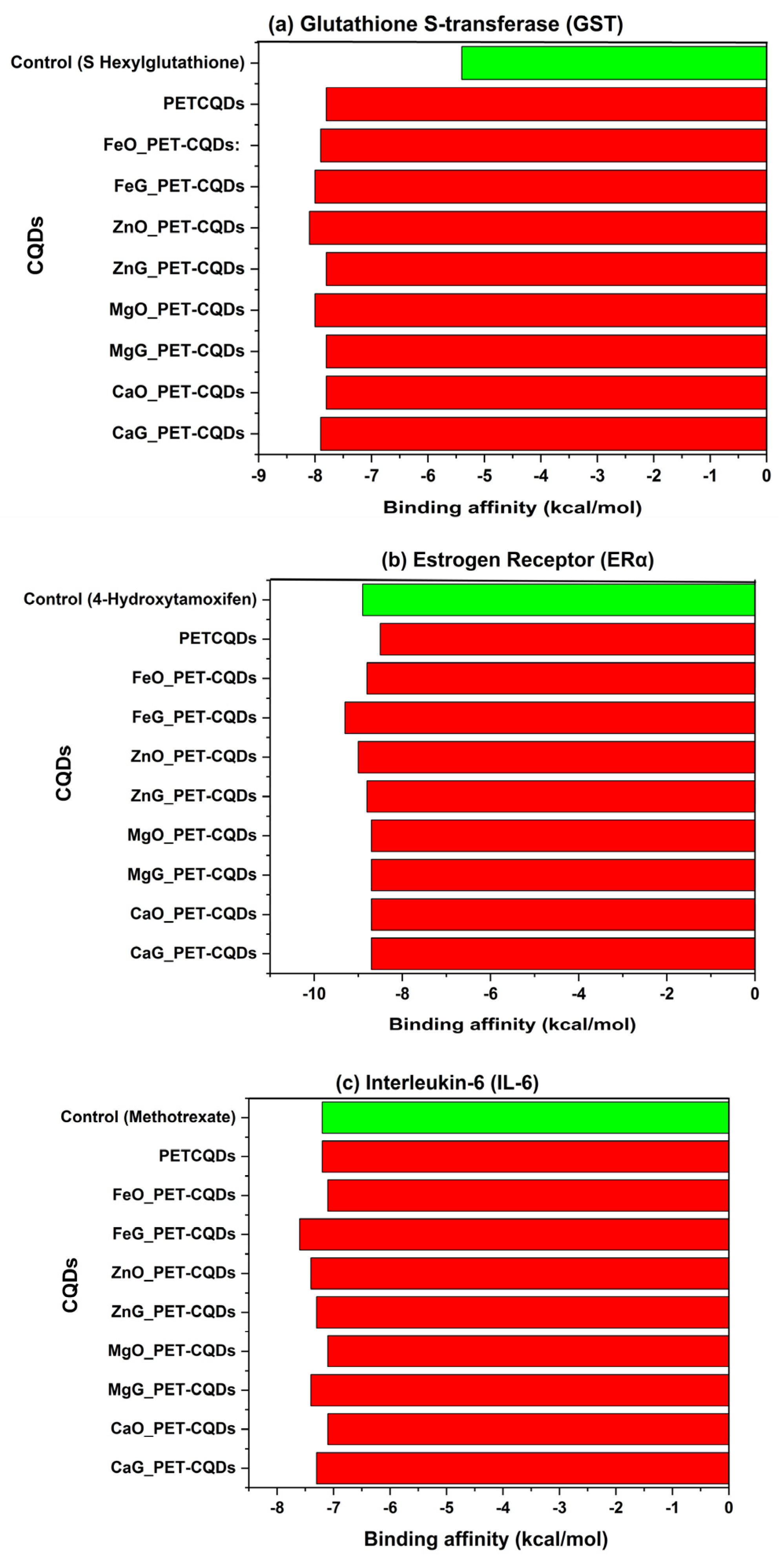
3.1. Detoxification Pathways
3.2. Endocrine Disruption Potential
3.3. Inflammation Response
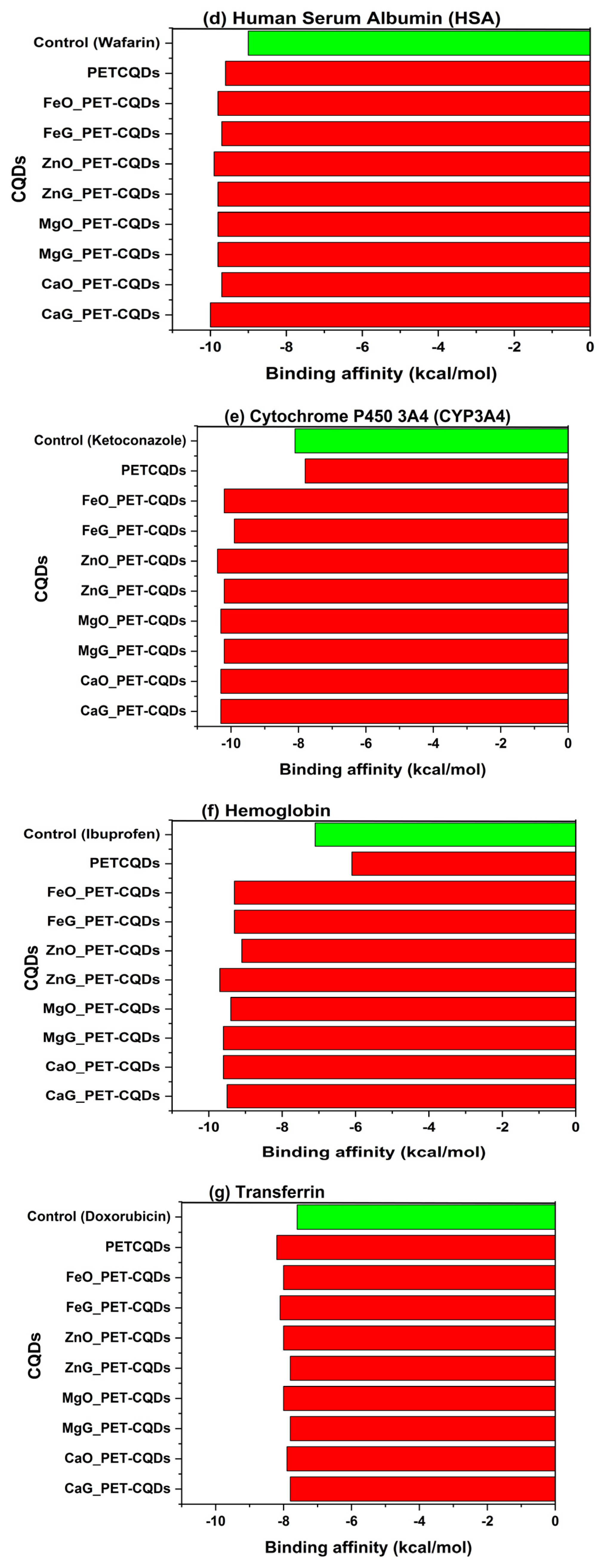
3.4. Distribution and Plasma Transport
3.5. Metabolism
3.6. Systemic Biocompatibility
3.7. Uptake and Bioavailability
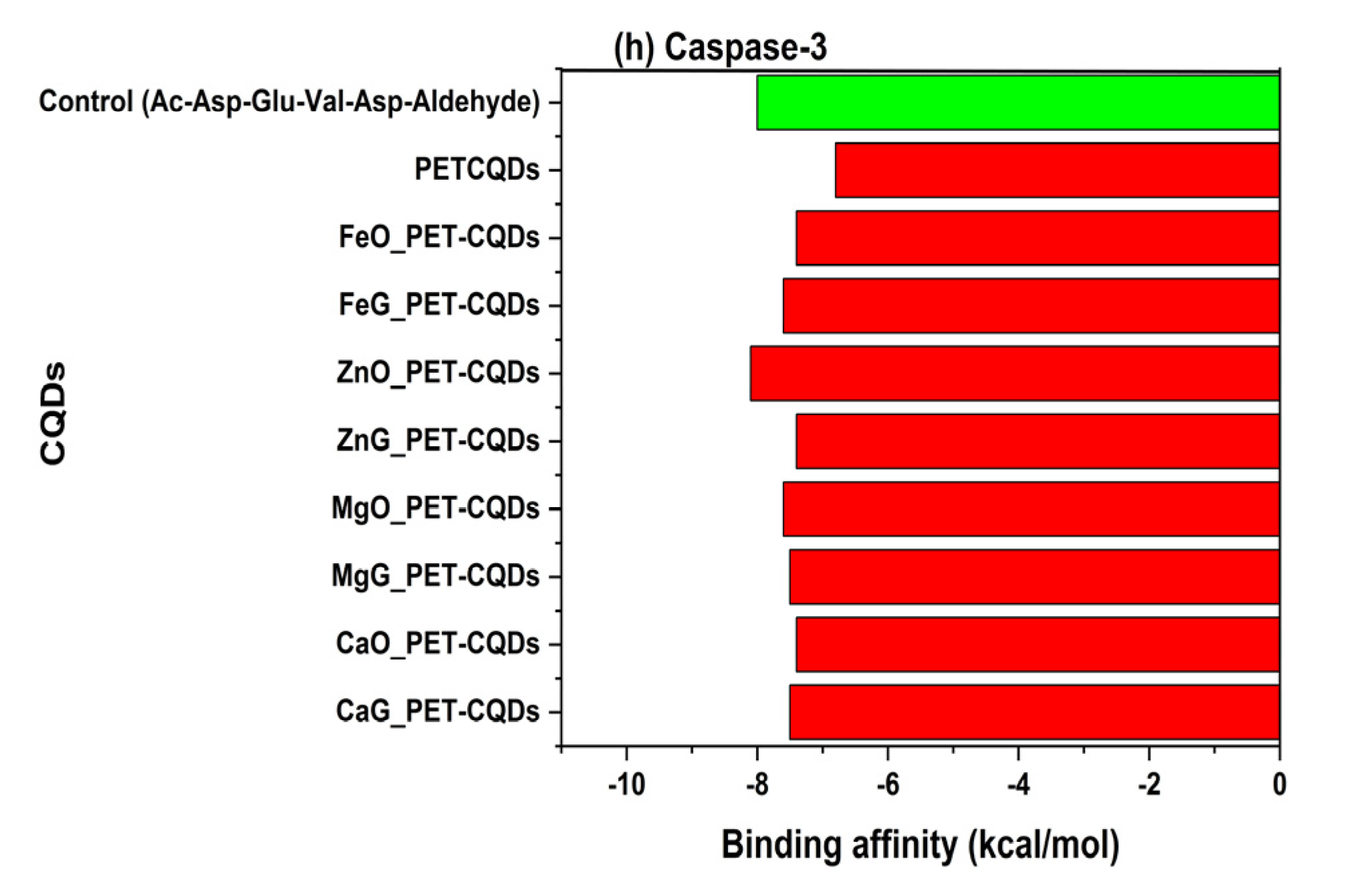
3.8. Apoptotic or Cytotoxicity Signaling
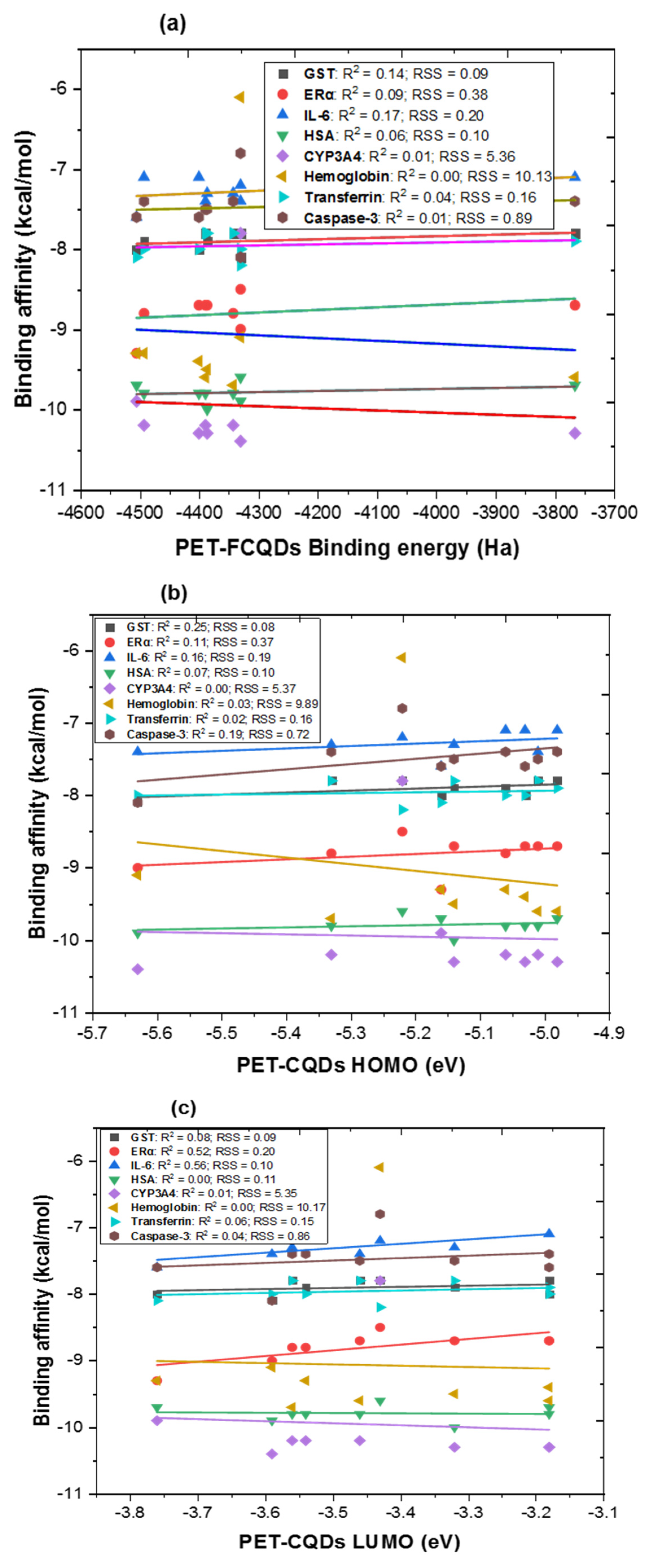
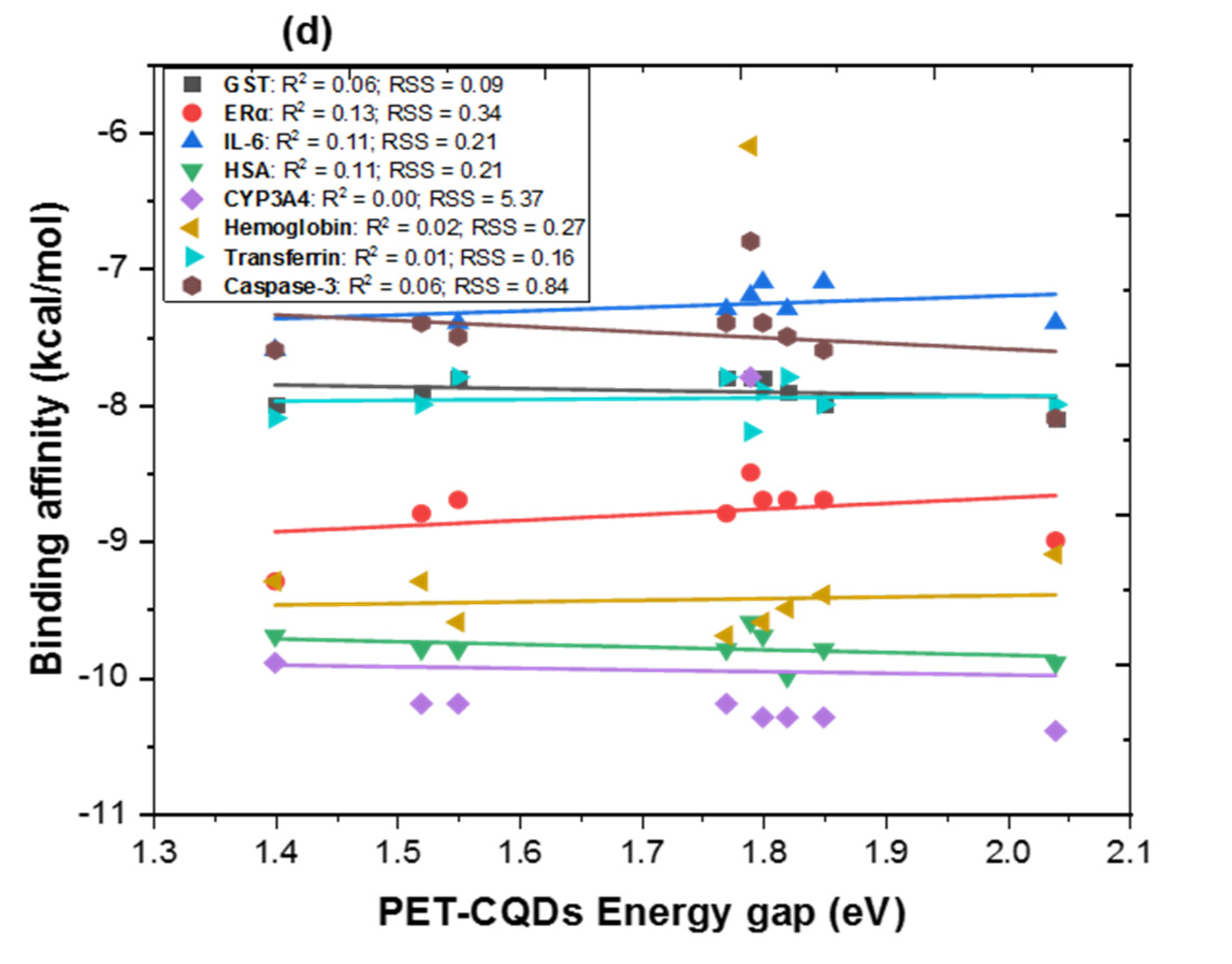
3.9. Relationship Between Quantum Chemical Descriptors of PET-CQDs and Their Binding Affinities
3.10. ADMET Properties of Metal-Doped PET-CQDs
4. Conclusions and Recommendation
- GST interacted best with PET-CQDs, CaO_PET-CQDs, MgG_PET-CQDs, and FeG_PET-CQDs.
- ERα exhibited strong binding to all doped variants, indicating potential endocrine receptor affinity.
- IL-6 binding was most favorable for CaO_PET-CQDs and FeO_PET-CQDs.
- HSA showed the highest affinity for CaG_PET-CQDs and FeO_PET-CQDs.
- CYP3A4 favored pristine PET-CQDs, suggesting minimal interference with metabolic detoxification.
- Hemoglobin bound strongly to MgG_PET-CQDs (−9.6 kcal/mol) and FeO_PET-CQDs.
- Transferrin showed a preference for FeG_PET-CQDs, while caspase-3 displayed only weak, transient interactions across all variants.
Supplementary Materials
Author Contributions
Funding
Institutional Review Board Statement
Informed Consent Statement
Data Availability Statement
Conflicts of Interest
References
- Sharma, A.K.; Kuamri, N.; Chauhan, P.; Thakur, S.; Kumar, S.; Shandilya, M. Comprehensive Insights into Carbon Quantum Dots: Synthesis Strategies and Multidomain Applications. J. Fluoresc. 2025, 1–35. [Google Scholar] [CrossRef] [PubMed]
- Enyoh, C.E.; Wang, Q.; Wang, W.; Suzuki, M.; Masuda, G.; Nakajima, D.; Lu, S. Green One-Step Synthesis and Characterization of Fluorescent Carbon Quantum Dots from PET Waste as a Dual-Mode Sensing Probe for Pd(II), Ciprofloxacin, and Fluoxetine via Fluorescence Quenching and Enhancement Mechanisms. Surfaces 2025, 8, 24. [Google Scholar] [CrossRef]
- Li, X.; Fu, Y.; Zhao, S.; Xiao, J.; Lan, M.; Wang, B.; Zhang, K.; Song, X.; Zeng, L. Metal Ions-Doped Carbon Dots: Synthesis, Properties, and Applications. Chem. Eng. J. 2022, 430, 1333101. [Google Scholar] [CrossRef]
- Enyoh, C.E.; Wang, Q.; Tochukwu, O.M.; Miho, S.; Weiqian, W.; Daisuke, N. Dual-site doping of PET-derived carbon quantum dots with alkali-earth and transition metals for adsorption of PFOS, ibuprofen, sucralose, and decabromodiphenyl oxide. Sep. Purif. Technol. 2025, 372, 133418. [Google Scholar] [CrossRef]
- Kyriakides, T.R.; Raj, A.; Tseng, T.H.; Xiao, H.; Nguyen, R.; Mohammed, F.S.; Halder, S.; Xu, M.; Wu, M.J.; Bao, S.; et al. Biocompatibility of nanomaterials and their immunological properties. Biomed. Mater. 2021, 16, 042005. [Google Scholar] [CrossRef]
- Park, H.Y.; Chung, C.; Eiken, M.K.; Baumgartner, K.V.; Fahy, K.M.; Leung, K.Q.; Bouzos, E.; Asuri, P.; Wheeler, K.E.; Riley, K.R. Silver nanoparticle interactions with glycated and non-glycated human serum albumin mediate toxicity. Front. Toxicol. 2023, 5, 1081753. [Google Scholar] [CrossRef]
- Verma, S.K.; Nandi, A.; Simnani, F.Z.; Singh, D.; Sinha, A.; Naser, S.S.; Sahoo, J.; Lenka, S.S.; Panda, P.K.; Dutt, A.; et al. In silico nanotoxicology: The computational biology state of art for nanomaterial safety assessments. Mater. Des. 2023, 235, 112452. [Google Scholar] [CrossRef]
- Enyoh, C.E.; Maduka, T.; Wang, Q.; Islam, M.R. In Silico Screening of Active Compounds in Garri for the Inhibition of Key Enzymes Linked to Diabetes Mellitus. ACS Food Sci. Technol. 2022, 2, 1597–1611. [Google Scholar] [CrossRef]
- Enyoh, C.E.; Wang, Q. Sex toys for pleasure, but there are risks in silico toxicity studies of leached micronanoplastics and phthalates. Hyg. Environ. Health Adv. 2024, 10, 100092. [Google Scholar] [CrossRef]
- Enyoh, C.E.; Duru, C.E.; Ovuoraye, P.E.; Wang, Q. Evaluation of nanoplastics toxicity to the human placenta in systems. J. Hazard. Mater. 2023, 446, 130600. [Google Scholar] [CrossRef]
- Enyoh, C.E.; Wang, Q. Box–Behnken design and machine learning optimization of PET fluorescent carbon quantum dots for removing fluoxetine and ciprofloxacin with molecular dynamics and docking studies as potential antidepressant and antibiotic. Sep. Purif. Technol. 2025, 362, 131975. [Google Scholar] [CrossRef]
- Mazari, A.M.A.; Zhang, L.; Ye, Z.W.; Zhang, J.; Tew, K.D.; Townsend, D.M. The Multifaceted Role of Glutathione S-Transferases in Health and Disease. Biomolecules 2023, 13, 688. [Google Scholar] [CrossRef] [PubMed]
- Alnasser, S.M. The role of glutathione S-transferases in human disease pathogenesis and their current inhibitors. Genes Dis. 2024, 12, 101482. [Google Scholar] [CrossRef] [PubMed]
- Vila-Viçosa, D.; Teixeira, V.H.; Santos, H.A.; Machuqueiro, M. Conformational Study of GSH and GSSG Using Constant-pH Molecular Dynamics Simulations. J. Phys. Chem. B 2013, 117, 7507–7517. [Google Scholar] [CrossRef]
- Cripps, S.M.; Marshall, S.A.; Mattiske, D.M.; Ingham, R.Y.; Pask, A.J. Estrogenic endocrine disruptor exposure directly impacts erectile function. Commun. Biol. 2024, 7, 403. [Google Scholar] [CrossRef]
- Shanle, E.K.; Xu, W. Endocrine disrupting chemicals targeting estrogen receptor signaling: Identification and mechanisms of action. Chem. Res. Toxicol. 2011, 24, 6–19. [Google Scholar] [CrossRef]
- Ribay, K.; Kim, M.T.; Wang, W.; Pinolini, D.; Zhu, H. Predictive Modeling of Estrogen Receptor Binding Agents Using Advanced Cheminformatics Tools and Massive Public Data. Front. Environ. Sci. 2016, 4, 12. [Google Scholar] [CrossRef]
- Aliyu, M.; Zohora, F.T.; Anka, A.U.; Ali, K.; Maleknia, S.; Saffarioun, M.; Azizi, G. Interleukin-6 cytokine: An overview of the immune regulation, immune dysregulation, and therapeutic approach. Int. Immunopharmacol. 2022, 111, 109130. [Google Scholar] [CrossRef]
- Boraschi, D.; Li, D.; Li, Y.; Italiani, P. In Vitro and In Vivo Models to Assess the Immune-Related Effects of Nanomaterials. Int. J. Environ. Res. Public Health 2021, 18, 11769. [Google Scholar] [CrossRef]
- Stank, A.; Kokh, D.B.; Fuller, J.C.; Wade, R.C. Protein Binding Pocket Dynamics. Acc. Chem. Res. 2016, 49, 809–815. [Google Scholar] [CrossRef]
- Fanali, G.; di Masi, A.; Trezza, V.; Marino, M.; Fasano, M.; Ascenzi, P. Human serum albumin: From bench to bedside. Mol. Asp. Med. 2012, 33, 209–290. [Google Scholar] [CrossRef] [PubMed]
- Gao, H.; He, Q. The interaction of nanoparticles with plasma proteins and the consequent influence on nanoparticles behavior. Expert Opin. Drug Deliv. 2014, 11, 409–420. [Google Scholar] [CrossRef] [PubMed]
- Lee, P.; Wu, X. Review: Modifications of human serum albumin and their binding effect. Curr. Pharm. Des. 2015, 21, 1862–1865. [Google Scholar] [CrossRef]
- De, T.; Trieu, V.; Myers, S.; Qazi, S.; Saund, S.; Lee, C. Sub-15 nm Nanoparticles for Drug Delivery: Emerging Frontiers and Therapeutic Potential. Int. J. Mol. Sci. 2025, 26, 10842. [Google Scholar] [CrossRef] [PubMed]
- Sevrioukova, I.F.; Poulos, T.L. Structural and mechanistic insights into the interaction of cytochrome P4503A4 with bromoergocryptine, a type I ligand. J. Biol. Chem. 2012, 287, 3510–3517. [Google Scholar] [CrossRef]
- Hirano, Y.; Yoneda, S.; Yasuda, K.; Kurita, N.; Kawagoe, F.; Mikami, B.; Takita, T.; Yasukawa, K.; Ikushiro, S.; Takimoto-Kamimura, M.; et al. Cooperative inhibition in cytochrome P450 between a substrate and an apparent noncompetitive inhibitor. J. Biol. Chem. 2025, 301, 108513. [Google Scholar] [CrossRef]
- Coll-Satue, C.; Jansman, M.M.T.; Thulstrup, P.W.; Hosta-Rigau, L. Optimization of Hemoglobin Encapsulation within PLGA Nanoparticles and Their Investigation as Potential Oxygen Carriers. Pharmaceutics 2021, 13, 1958. [Google Scholar] [CrossRef]
- Guo, Q.; Qian, C.; Wang, X.; Qian, Z.M. Transferrin receptors. Exp. Mol. Med. 2025, 57, 724–732. [Google Scholar] [CrossRef]
- Daniels, T.R.; Bernabeu, E.; Rodríguez, J.A.; Patel, S.; Kozman, M.; Chiappetta, D.A.; Holler, E.; Ljubimova, J.Y.; Helguera, G.; Penichet, M.L. The transferrin receptor and the targeted delivery of therapeutic agents against cancer. Biochim. Biophys. Acta 2012, 1820, 291–317. [Google Scholar] [CrossRef]
- Wei, R.; Hu, S.; Wang, J.; Lei, Q.; Jiang, Z.; Wang, B.; Yang, H.; Yan, F.; Cai, L.; Tian, J.; et al. Oral delivery of teriparatide utilizing biocompatible transferrin-engineered MOF nanoparticles for osteoporosis therapy. Mater. Today Bio 2025, 35, 102318. [Google Scholar] [CrossRef]
- Ramalho, M.J.; Loureiro, J.A.; Coelho, M.A.N.; Pereira, M.C. Transferrin Receptor-Targeted Nanocarriers: Overcoming Barriers to Treat Glioblastoma. Pharmaceutics 2022, 14, 279. [Google Scholar] [CrossRef]
- Zhang, N.; Wang, J.; Bing, T.; Liu, X.; Shangguan, D. Transferrin receptor-mediated internalization and intracellular fate of conjugates of a DNA aptamer. Mol. Ther. Nucleic Acids 2022, 27, 1249–1259. [Google Scholar] [CrossRef]
- Mustafa, M.; Ahmad, R.; Tantry, I.Q.; Ahmad, W.; Siddiqui, S.; Alam, M.; Abbas, K.; Moinuddin; Hassan, M.I.; Habib, S.; et al. Apoptosis: A Comprehensive Overview of Signaling Pathways, Morphological Changes, and Physiological Significance and Therapeutic Implications. Cells 2024, 13, 1838. [Google Scholar] [CrossRef]
- Wu, K.; Kwon, S.H.; Zhou, X.; Fuller, C.; Wang, X.; Vadgama, J.; Wu, Y. Overcoming Challenges in Small-Molecule Drug Bioavailability: A Review of Key Factors and Approaches. Int. J. Mol. Sci. 2024, 25, 13121. [Google Scholar] [CrossRef]
- Zhra, M.; Qasem, R.J.; Aldossari, F.; Saleem, R.; Aljada, A. A Comprehensive Exploration of Caspase Detection Methods: From Classical Approaches to Cutting-Edge Innovations. Int. J. Mol. Sci. 2024, 25, 5460. [Google Scholar] [CrossRef]
- Berger, T.A.; Berger, B.K.; Kogelman, K. 10.18—Chromatographic Separations and Analysis: Supercritical Fluid Chromatography for Chiral Analysis and Semi-Preparative Purification. In Comprehensive Chirality, 2nd ed.; Cossy, J., Ed.; Academic Press: Oxford, UK, 2024; pp. 355–393. [Google Scholar]
- Vidaurre, R.; Bramke, I.; Puhlmann, N.; Owen, S.F.; Angst, D.; Moermond, C.; Venhuis, B.; Lombardo, A.; Kümmerer, K.; Sikanen, T.; et al. Design of greener drugs: Aligning parameters in pharmaceutical R&D and drivers for environmental impact. Drug Discov. Today 2024, 29, 104022. [Google Scholar] [CrossRef]



| Structure | Configuration | SMILES |
|---|---|---|
 | PET-CQDs: polyethylene terephthalate fluorescent carbon quantum dots | O=C(O)C2C(=O)C=C3C=CC1=C4C(=CCC1=O)C(O)=CC2C34 |
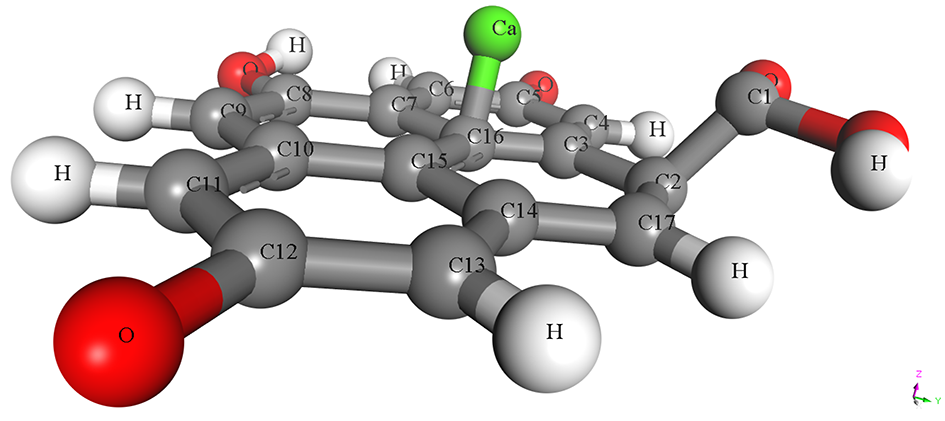 | Ca-G_PET-CQDs: Calcium doped at the graphitic site of the PET-CQDs. | O=C(O)C2C(=O)C=C3C=CC1=C4C(=CCC1=O)C(O)=CC2C34[Ca] |
 | Ca-O_PET-CQDs: Calcium doped at the carbonyl site of the PET-CQDs. | O=C(O)C1C(=O)C=c2ccc3/C(=[O+]/[Ca])CC=c4c(O)cc1c2c34 |
 | Mg-G_PET-CQDs: Magnesium doped at the graphitic site of the PET-CQDs. | O=C(O)C2C(=O)C=C3C=CC1=C4C(=CCC1=O)C(O)=CC2C34[Mg] |
 | Mg-O_PET-CQDs: Magnesium doped at the carbonyl site of the PET-CQDs. | O=C(O)C1C(=O)C=c2ccc3/C(=[O+]/[Mg])CC=c4c(O)cc1c2c34 |
 | Fe-G_PET-CQDs: Iron doped at the graphitic site of the PET-CQDs. | O=C(O)C2C(=O)C=C3C=CC1=C4C(=CCC1=O)C(O)=CC2C34[Fe] |
 | Fe-O_PET-CQDs: Iron doped at the carbonyl site of the PET-CQDs. | O=C(O)C1C(=O)C=c2ccc3/C(=[O+]/[Fe])CC=c4c(O)cc1c2c34 |
 | Zn-G_PET-CQDs: Zinc doped at the graphitic site of the PET-CQDs. | O=C(O)C2C(=O)C=C3C=CC1=C4C(=CCC1=O)C(O)=CC2C34[Zn] |
 | Zn-O_PET-CQDs: Zinc doped at the carbonyl site of the PET-CQDs. | O=C(O)C1C(=O)C=c2ccc3/C(=[O+]/[Zn])CC=c4c(O)cc1c2c34 |
| Physiochemical Properties | PET-CQDs | Ca-G_PET-CQDs | Ca-O_PET-CQDs | Mg-G_PET-CQDs | Mg-O_PET-CQDs | Fe-G_PET-CQDs | Fe-O_PET-CQDs | Zn-G_PET-CQDs | Zn-O_PET-CQDs |
|---|---|---|---|---|---|---|---|---|---|
| Lipophilicity | |||||||||
| Log Po/w (iLOGP) | 1.32 | 0.00 | 0.00 | 0.00 | 0.00 | 0.00 | 0.00 | 0.00 | 0.00 |
| Log Po/w (XLOGP3) | 0.23 | 0.48 | 0.23 | 0.48 | 0.23 | 0.48 | 0.23 | 0.48 | 0.23 |
| Log Po/w (WLOGP) | 0.44 | 1.74 | 0.44 | 1.74 | 0.44 | 1.74 | 0.44 | 1.74 | 0.44 |
| Log Po/w (MLOGP) | 0.95 | 0.86 | 0.95 | 0.86 | 0.95 | 0.86 | 0.95 | 0.86 | 0.95 |
| Log Po/w (SILICOS-IT) | 2.70 | −0.05 | 0.38 | −0.14 | 0.28 | 0.05 | 0.47 | 0.11 | 0.53 |
| Consensus Log Po/w | 1.13 | 0.61 | 0.40 | 0.59 | 0.38 | 0.63 | 0.42 | 0.64 | 0.43 |
| Water Solubility | |||||||||
| Log S (SILICOS-IT) | −3.60 | −1.28 | −3.87 | −1.24 | −3.82 | −1.32 | −3.91 | −1.35 | −3.94 |
| Solubility (mg/mL) | 0.0734 | 17.6 | 0.045 | 18.6 | 0.048 | 16.6 | 0.043 | 16.1 | 0.042 |
| Class | Soluble | Soluble | Soluble | Soluble | Soluble | Soluble | Soluble | Soluble | Soluble |
| Pharmacokinetics | |||||||||
| GI absorption | High | High | High | High | High | High | High | High | High |
| Log Kp (skin permeation) (cm/s) | −7.93 | −8.00 | −8.18 | −7.91 | −8.08 | −8.10 | −8.27 | −8.16 | −8.33 |
| Drug-likeness | |||||||||
| Lipinski Rule | Yes; 0 violation | Yes; 0 violation | Yes; 0 violation | Yes; 0 violation | Yes; 0 violation | Yes; 0 violation | Yes; 0 violation | Yes; 0 violation | Yes; 0 violation |
| Veber (GSK) Rule | Yes | Yes | Yes | Yes | Yes | Yes | Yes | Yes | Yes |
| Egan (phatmacial) Filter | Yes | Yes | Yes | Yes | Yes | Yes | Yes | Yes | Yes |
| Muegge (Bayer) Filter | Yes | Yes | Yes | Yes | Yes | Yes | Yes | Yes | Yes |
| Bioavailability score | 0.56 | 0.56 | 0.55 | 0.56 | 0.55 | 0.56 | 0.55 | 0.56 | 0.55 |
| Medicinal Chemistry | |||||||||
| PAINS | 0 alert | 0 alert | 0 alert | 0 alert | 0 alert | 0 alert | 0 alert | 0 alert | 0 alert |
| Brenk | 1 alert; beta keto anhydride | 1 alert; beta keto anhydride | 2 alert; beta keto anhydride and charged oxygen | 1 alert; beta keto anhydride | 2 alert; beta keto anhydride and charged oxygen | 2 alert; beta keto anhydride and heavy metal | 3 alert; beta keto anhydride, charged oxygen and heavy metal | 2 alert; beta keto anhydride and heavy metal | 3 alert; beta keto anhydride, charged oxygen and heavy metal |
| Synthetic accessibility | 3.35 | 4.83 | 3.50 | 4.90 | 3.49 | 4.89 | 3.53 | 4.89 | 3.53 |
| Lead-likeness | Yes | Yes | Yes | Yes | Yes | No; 1 violation molecular weight > 350 | No; 1 violation molecular weight > 350 | No; 1 violation molecular weight > 350 | No; 1 violation molecular weight > 350 |
| Absorption | |||||||||
| Human Intestinal Absorption | Yes | Yes | Yes | Yes | Yes | Yes | Yes | Yes | Yes |
| Blood–Brain Barrier | Yes | Yes | Yes | Yes | Yes | Yes | Yes | Yes | Yes |
| Caco-2 permeable | Yes | Yes | Yes | Yes | Yes | Yes | Yes | Yes | Yes |
| P-glycoprotein substrate | Yes | Yes | Yes | Yes | Yes | Yes | Yes | Yes | Yes |
| P-glycoprotein inhibitor | Non-inhibitor | Non-inhibitor | Non-inhibitor | Non-inhibitor | Non-inhibitor | Non-inhibitor | Non-inhibitor | Non-inhibitor | Non-inhibitor |
| Renal Organic Cation Transporter | Non-inhibitor | Non-inhibitor | Non-inhibitor | Non-inhibitor | Non-inhibitor | Non-inhibitor | Non-inhibitor | Non-inhibitor | Non-inhibitor |
| Distribution | |||||||||
| Subcellular localization (Mitochondria) | Yes | Yes | Yes | Yes | Yes | Yes | Yes | Yes | Yes |
| Metabolism | |||||||||
| CYP450 2C9 substrate | No | No | No | No | No | No | No | No | No |
| CYP450 3A4 substrate | No | No | No | No | No | No | No | No | No |
| CYP450 1A2 inhibitor | Non-inhibitor | Non-inhibitor | Non-inhibitor | Non-inhibitor | Non-inhibitor | Non-inhibitor | Non-inhibitor | Non-inhibitor | Non-inhibitor |
| CYP450 2C9 inhibitor | Non-inhibitor | Non-inhibitor | Non-inhibitor | Non-inhibitor | Non-inhibitor | Non-inhibitor | Non-inhibitor | Non-inhibitor | Non-inhibitor |
| CYP450 2D6 inhibitor | Non-inhibitor | Non-inhibitor | Non-inhibitor | Non-inhibitor | Non-inhibitor | Non-inhibitor | Non-inhibitor | Non-inhibitor | Non-inhibitor |
| CYP450 2C19 inhibitor | Non-inhibitor | Non-inhibitor | Non-inhibitor | Non-inhibitor | Non-inhibitor | Non-inhibitor | Non-inhibitor | Non-inhibitor | Non-inhibitor |
| CYP Inhibitory Promiscuity | Low | Low | Low | Low | Low | Low | Low | Low | Low |
| Excretion | |||||||||
| CLp (Plasma Clearance) | 1 | 0 | No Data | 0 | No Data | 1 | 1 | 1 | 1 |
| CLr (Renal Clearance) | 1 | 0 | No Data | 0 | No Data | 0 | 1 | 0 | 1 |
| T1/2 (Half-life) | Short (0.09) | −0.32 | No Data | −0.32 | No Data | 0.01 | −0.08 | −0.07 | 0.02 |
| MRT (Mean Residence Time) | 0.2 | −0.34 | No Data | −0.34 | No Data | −0.04 | 0.03 | −0.15 | 0.14 |
| Toxicity | |||||||||
| Human Ether-a-go-go-Related Gene Inhibition | Weak inhibitor | Weak inhibitor | Weak inhibitor | Weak inhibitor | Weak inhibitor | Weak inhibitor | Weak inhibitor | Weak inhibitor | Weak inhibitor |
| Ames test | Non-toxic | Non-toxic | Non-toxic | Non-toxic | Non-toxic | Non-toxic | Non-toxic | Non-toxic | Non-toxic |
| Carcinogenicity | Non-carcinogenic | Non-carcinogenic | Non-carcinogenic | Non-carcinogenic | Non-carcinogenic | Non-carcinogenic | Non-carcinogenic | Non-carcinogenic | Non-carcinogenic |
| Biodegradation | Readily biodegradable | Not readily biodegradable | Readily biodegradable | Not readily biodegradable | Readily biodegradable | Not readily biodegradable | Readily biodegradable | Not readily biodegradable | Readily biodegradable |
| Acute Oral Toxicity | III (>500 mg/kg LD50 < 5000 mg/kg) | III (>500 mg/kg LD50 < 5000 mg/kg) | III (>500 mg/kg LD50 < 5000 mg/kg) | III (>500 mg/kg LD50 < 5000 mg/kg) | III (>500 mg/kg LD50 < 5000 mg/kg) | III (>500 mg/kg LD50 < 5000 mg/kg) | III (>500 mg/kg LD50 < 5000 mg/kg) | III (>500 mg/kg LD50 < 5000 mg/kg) | III (>500 mg/kg LD50 < 5000 mg/kg) |
Disclaimer/Publisher’s Note: The statements, opinions and data contained in all publications are solely those of the individual author(s) and contributor(s) and not of MDPI and/or the editor(s). MDPI and/or the editor(s) disclaim responsibility for any injury to people or property resulting from any ideas, methods, instructions or products referred to in the content. |
© 2025 by the authors. Licensee MDPI, Basel, Switzerland. This article is an open access article distributed under the terms and conditions of the Creative Commons Attribution (CC BY) license (https://creativecommons.org/licenses/by/4.0/).
Share and Cite
Enyoh, C.E.; Maduka, T.O.; Wang, Q.; Suzuki, M.; Enyoh, I.S. Computational Biocompatibility and Safety Evaluation of Metal-Doped PET-Carbon Quantum Dots via Multi-Target Molecular Docking and ADMET Analysis on Human Proteins. Physchem 2025, 5, 55. https://doi.org/10.3390/physchem5040055
Enyoh CE, Maduka TO, Wang Q, Suzuki M, Enyoh IS. Computational Biocompatibility and Safety Evaluation of Metal-Doped PET-Carbon Quantum Dots via Multi-Target Molecular Docking and ADMET Analysis on Human Proteins. Physchem. 2025; 5(4):55. https://doi.org/10.3390/physchem5040055
Chicago/Turabian StyleEnyoh, Christian Ebere, Tochukwu Oluwatosin Maduka, Qingyue Wang, Miho Suzuki, and Ifunanya Scholastica Enyoh. 2025. "Computational Biocompatibility and Safety Evaluation of Metal-Doped PET-Carbon Quantum Dots via Multi-Target Molecular Docking and ADMET Analysis on Human Proteins" Physchem 5, no. 4: 55. https://doi.org/10.3390/physchem5040055
APA StyleEnyoh, C. E., Maduka, T. O., Wang, Q., Suzuki, M., & Enyoh, I. S. (2025). Computational Biocompatibility and Safety Evaluation of Metal-Doped PET-Carbon Quantum Dots via Multi-Target Molecular Docking and ADMET Analysis on Human Proteins. Physchem, 5(4), 55. https://doi.org/10.3390/physchem5040055