


Abstract
Rice intensification influences soil biodiversity and ecological functioning in paddy ecosystems; however, its effects on soil nematode communities across different rice production systems remain poorly understood in the Vietnamese Mekong Delta (MD). This study evaluated the effects of rice cropping practices in the MD on nematode community composition, trophic structure, functional guilds, diversity, plant-parasitic nematodes (PPN), and soil chemical properties. A total of 91 soil samples were collected from double-rice intensive (RR), triple-rice intensive (RRR), and rice–upland–rice rotational (RUR) systems. Thirty nematode genera were identified, with a total abundance showing high variability, but no significant differences among cropping systems. Community composition differed considerably among systems, with Chronogaster dominating across all systems, particularly under RRR, whereas RUR supported more dominant genera with higher abundances of Tyleptus, Mesodorylaimus, Cephalobus, and Calolaimus. RUR exhibited significantly greater genus richness, and higher abundances of fungivores, omnivores, and higher colonizer–persister groups (cp4–cp5), indicating greater soil food-web complexity and ecological stability. In contrast, RRR was characterized by bacterivore-dominated communities, and increased abundance of cp3 nematodes, suggesting simplified community structures associated with agricultural intensification. Plant-parasitic nematodes remained relatively stable across management systems, despite taxon-specific responses. Soil pH, organic matter, and nitrogen availability were strongly associated with nematode community variation. Therefore, crop diversification through rotational practices enhanced belowground biodiversity, and promoted more sustainable soil ecological functioning in intensive rice production systems.
1. Introduction
Rice paddies account for nearly 9% of the world’s cropland area and are characterized by environmental conditions that promote soil organic carbon storage [1]. In the Vietnamese Mekong Delta (MD), rice cultivation covers approximately 1.8 million hectares, accounting for nearly 45% of the total delta area, and contributing to more than 70% of Vietnam’s rice export production [2]. Rice production also plays an essential role in the economic sustainability of Vietnam [3]. Particularly, intensive rice cultivation systems in the MD comprise mono-, double-, and triple-rice cropping systems, in which rice is cultivated in one, two, or three consecutive cropping cycles per year within the same paddy field. Highly intensive rice cultivation systems depend heavily on synthetic fertilizers and pesticides to maintain high productivity. However, this dependence may reduce farmers’ economic returns [4]. In addition, excessive cultivation intensity has been reported to deteriorate soil physical properties, particularly macroporosity, and saturated hydraulic conductivity [5], while also decreasing soil nitrogen availability [6]. Furthermore, substantial water inputs are required to maintain rice cultivation during the dry season, particularly under the increasing pressures associated with climate change. However, intensive rice cultivation practices, including continuous rice cropping, fertilizer application, irrigation management, and pesticide use, may substantially deteriorate soil ecological processes and biodiversity in paddy ecosystems [7,8]. Conservation of paddy rice soils plays a critical role in maintaining soil fertility, and ecosystem services that underpin food security while contributing to achieving the Sustainable Development Goals (SDGs). In the MD, intensive rice monoculture involving two or three cropping cycles per year, within the same field, has been widely adopted as a conventional cultivation system for decades. Nowadays, soils are facing serious challenges arising from climate change, such as salinity intrusion and drought, which are further exacerbated by the overuse of chemical fertilizers and pesticides. Reducing intensive monoculture rice cultivation through the introduction of upland crops has been recommended as an adaptive strategy to climate change, and as an approach to promote agricultural sustainability. Therefore, understanding the response of soil nematode communities to different cropping systems is important for developing and continuously improving soil management practices that enhance soil properties and support long-term monitoring strategies.
Nematodes are highly diverse and abundant soil organisms, distributed across a wide range of geographical regions and climatic conditions [9,10]. They occupy multiple trophic levels within the soil food web, and are widely recognized as sensitive bio-indicators of soil environmental conditions, and ecosystem functioning [11]. Nematode community composition has been extensively used to evaluate soil health, nutrient cycling, and ecological disturbance in soils of terrestrial ecosystems [12]. However, paddy soils constitute a unique environment for soil biota, characterized by prolonged waterlogged conditions, periodic flooding–drainage cycles, and dynamic physicochemical fluctuations. This is driven by rice growth stages and agricultural management practices, such as fertilization and irrigation [13,14]. These environmental fluctuations strongly influence soil biological communities, including microorganisms and nematodes [15,16]. Water management, fertilization, irrigation, and organic amendments have all been reported to significantly affect nematode abundance, diversity, community structure, and ecological functions across agroecosystems [17,18] that may respond to changes in soil physicochemical properties [19,20].
In paddy rice fields, several studies have investigated nematode communities under different environmental and management conditions. For example, nematode community composition differed between paddy and upland rice systems across flooding–drainage cycles [21], while long-term fertilization altered micro-eukaryotic and nematode community structures in soils [22,23]. Fertilization regime influences soil nematode communities by supplying nutrients, resulting in increased nematode abundance in paddy–upland rotation [24,25]. In addition, climate-related stresses, including salinity intrusion and rising temperatures, have been shown to influence nematode abundance and community composition in paddy fields [26,27]. These stressors represent major constraints to rice cultivation in the MD, one of the world’s most vulnerable delta regions, which is increasingly affected by saline water intrusion and drought [28]. Consequently, rice cropping frequency should be considered an important disturbance factor influencing soil properties and shaping free-living nematode community composition. Therefore, understanding the structure and distribution of soil nematode communities across different paddy rice cropping systems is essential for developing sustainable crop, water, and soil management strategies.
Among soil nematodes, plant-parasitic nematodes are considered important pests in rice production systems worldwide. Species such as Hirschmanniella oryzae and Meloidogyne graminicola have been widely reported in rice-growing regions and can significantly reduce plant growth and grain yield [29,30,31]. The occurrence and distribution of plant-parasitic nematodes associated with rice have been documented in several countries, including Vietnam, Myanmar, Kenya, Ecuador, and Pakistan [32,33,34,35,36]. Our previous study clarified that the rotation of sesame in paddy rice significantly reduced the abundance of rice-root nematode Hirschmanniella oryzae over a three-year field trial [37]. The presence of Hirschmanniella oryzae correlated to the reduction in rice yield in the intensive triple-rice system in the MD [38]. Despite increasing attention to nematode ecology in rice agroecosystems, information regarding the distribution and community assemblages of nematodes under different rice cropping frequencies in the MD remains limited. Understanding how rice cultivation intensity shapes soil nematode communities, particularly plant-parasitic nematodes, is important for developing sustainable rice production and soil health management strategies in this region. Therefore, this study aimed to evaluate the effects of conventional double- and triple-rice cropping systems and rice–upland crop rotations on soil nematode community structure, composition and diversity. Soil chemical properties were also analyzed to determine their associations with nematode communities across cropping systems.
2. Materials and Methods
2.1. Study Area
Paddy rice fields were selected across the MD based on rice cropping frequency, including double- and triple-rice cropping systems, representing two and three rice crops per year in the same field, respectively. A total of 91 soil samples were collected, comprising 63 samples (69%) from double-rice systems, and 28 samples (31%) from highly intensive triple-rice systems. The double-rice system consisted of 30 samples from rotational systems of two rice crops and one upland crop per year (rice–upland crop–rice, namely RUR), and 33 samples from intensive double-rice systems (two rice crops per year, namely RR). The triple-rice system consisted of three rice crops per year (RRR). Information regarding area and rice variety was also recorded (Supplementary Table S1). In the MD, rice cropping systems were dominated by intensive production systems, with single-rice intensive accounting for less than 3% of the cultivated area, while double-rice and triple-rice systems represented approximately 52% and 34%, respectively [39]. The remaining area (approximately 10%) was occupied by integrated rice–aquaculture systems, predominantly rice–shrimp systems.
2.2. Soil Sampling
A total of 10 soil cores were randomly collected from each rice field (approximately 1000–2000 m2) using a 2.0 cm diameter soil auger at a depth of 0–20 cm, corresponding to the cultivated root zone. The soil cores were subsequently pooled and homogenized to obtain a composite sample for each field. Each paddy rice field was considered an independent sampling unit for statistical analyses, while the 10 soil cores collected within each field were combined into a single composite sample and not treated as separate replicates. Soil sampling was conducted from July to August 2024. Samples were placed in plastic bags and transported to the laboratory under cooled conditions. Upon arrival, each composite sample was divided into two subsamples: one portion was used for nematode extraction, while the remaining portion was air-dried for soil chemical analyses. Nematodes were extracted within one week after sampling to minimize storage-induced changes. Soil moisture content was determined to express nematode abundance on a dry-weight basis.
2.3. Nematode Community Analysis
A 20 g subsample of homogenized moist soil from each composite soil sample was used for nematode extraction using the Baermann funnel method [40], which has been reported to improve extraction efficiency in clay-rich soils. Nematode suspensions were collected after 48 h at room temperature. Extracted nematodes were killed and fixed in hot 4% formaldehyde solution and stored until slide preparation and identification. A drop of 1% Rose Bengal solution was added to stain the nematodes. Total nematode abundance was determined under a microscope and expressed as individuals per 100 g dry soil. For taxonomic identification, 50 individuals were randomly selected from each sample; however, when total abundance was fewer than 50 individuals, all individuals were identified. Nematodes were mounted in glycerin (99.5%) on glass slides and sealed with paraffin rings prior to taxonomic identification.
Nematodes were observed and identified using ImageFocus Plus V2 software coupled to a compound light microscope equipped with 10×, 40×, and 100× objective lenses. Nematodes were identified to genus level and subsequently assigned to five trophic groups according to the classification of Yeates et al. [41], which originally recognizes eight feeding categories: (1) plant feeders, (2) hyphal feeders, (3) bacterial feeders, (4) substrate ingesters, (5) predators of animals, (6) unicellular eukaryote feeders, (7) dispersal or infective stages of parasites, and (8) omnivores. For the purposes of ecological analysis, these categories were consolidated into the five trophic groups commonly used in soil nematode ecology: bacterivores (including bacterial feeders and substrate ingesters), fungivores (hyphal feeders), plant parasites (plant feeders), omnivores, and predators. This broader classification facilitates comparisons among studies and is widely used in assessments of soil food webs and ecosystem functioning. Nematode c colonizer–persister (c–p) values were assigned following the c–p classification system proposed by Bongers [42] and Bongers and Bongers [43]. Community indices of genus richness were calculated using PRIMER v6 software [44].
The frequency of occurrence (FO) of plant-parasitic nematodes was calculated using the following equation (FO) [45]: FO = (n/N) × 100; where n represents the number of samples in which a specific plant-parasitic nematode species was detected, and N represents the total number of samples analyzed.
2.4. Soil Chemical Analyses
Soil chemical properties, including pH (H2O), electrical conductivity (EC) (mS/cm), available N (mgN/kg), available phosphorus (P) (mgP/kg), and exchangeable potassium (K+) (meqK+/100 g), were determined following standard analytical procedures. Soil pH was measured in a 1:2.5 (w/v) soil-to-water suspension, and electrical conductivity (EC) was determined using a Horiba LAQUAtwin pH/EC meter.
Soil ammonium (NH4+) concentration was determined colorimetrically following the method described by Bremner and Keeney [46]. Soil samples were extracted with 2 M KCl at a 1:10 (w/v) soil-to-solution ratio and shaken for one hour. After centrifugation and filtration, NH4+ concentrations were determined colorimetrically using sodium nitroprusside, sodium salicylate, sodium citrate, and sodium tartrate with a UV–Vis spectrophotometer at 650 nm. Soil nitrate (NO3−) concentrations were determined using UV absorbance at 220 nm.
Available phosphorus (P) was extracted using the Bray II extraction method. Briefly, 2 g of soil was mixed with 14 mL of Bray II extractant (0.1 N HCl + 0.03 N NH4F) in a 50 mL Falcon tube and shaken for 1 min. The suspension was filtered, and available P concentrations were determined colorimetrically using the molybdate blue method with a UV–Vis spectrophotometer at 880 nm.
Organic matter (OM) (%) was determined by the Walkley–Black method, which is based on the oxidation of organic matter by K2Cr2O7, followed by titration of the excess K2Cr2O7 with 0.5 N FeSO4 using diphenylamine as the color indicator. Exchangeable potassium (K+) was extracted from 2.5 g of soil using 30 mL of 0.1 M BaCl2. Samples were shaken for 1 h, centrifuged, and filtered; the extraction was repeated three times. Potassium (K+) in the extract solution was determined by atomic absorption spectrophotometry after dilution with distilled water and addition of cesium chloride (CsCl) as a releasing agent. Potassium (K+) in the extract solution was measured at 766 nm.
2.5. Statistical Analysis
Each paddy rice field was treated as an independent sampling unit for statistical analyses. The 10 soil cores collected within each field were pooled into a single composite sample and were not treated as separate replicates. Unequal sample sizes among cropping systems reflected the actual distribution of rice production systems in the Mekong Delta. Nematode count data were log-transformed [log(x + 1)] prior to analysis to improve normality and homogeneity of variances.
To evaluate the effects of cropping patterns (RR, RRR, and RUR) on abundance of nematode genera, the abundance and relative abundance of trophic groups and functional guilds, metabolic footprints, biodiversity indices, and soil physicochemical properties, the differences were evaluated using one-way analysis of variance (ANOVA). The assumptions of normality and homogeneity of variances were assessed using the Shapiro–Wilk and Levene’s tests, respectively. When these assumptions were met, differences in the abundance of nematode genera, the abundance and relative abundance of trophic groups and functional guilds, metabolic footprints, and biodiversity indices were analyzed using one-way ANOVA, followed by Tukey’s honestly significant difference (HSD) test for pairwise comparisons where significant treatment effects were detected (p < 0.05). When these assumptions were not met, the non-parametric Kruskal–Wallis test was used instead, with statistical significance determined at p < 0.05.
To evaluate the effects of cropping systems (intensive and rotation) and rice cropping frequency (double-rice and triple-rice) on abundance of nematode genera, the abundance and relative abundance of trophic groups and functional guilds, metabolic footprints, biodiversity indices and soil physicochemical properties, the cropping systems were grouped accordingly; intensive rice systems included RR and RRR, whereas the rotational system included RUR. For the rice cropping frequency comparison, double-rice systems comprised RR and RUR, while triple-rice systems comprised RRR. Differences between the two groups were evaluated using an independent-samples t-test after confirming the assumptions of normality and homogeneity of variances. When these assumptions were not met, the non-parametric Mann–Whitney U test was used instead. Soil chemical properties were analyzed using the same statistical approach as that applied to the nematode community data. All statistical analyses were conducted using Statistica version 7.0 and Minitab version 16.
Furthermore, differences in nematode community composition and soil physicochemical properties and the correlation among them were assessed using Permutational Multivariate Analysis of Variance (PERMANOVA) based on Bray–Curtis dissimilarities. Permutational Analysis of Multivariate Dispersion (PERMDISP) was performed to assess the homogeneity of multivariate dispersion among groups prior to interpreting the PERMANOVA results. Canonical correspondence analysis (CCA) was conducted to examine the relationships between nematode community composition and soil chemical properties. PERMANOVA was performed by the PRIMER version 7 plus PERMANOVA+.
3. Results
3.1. Total Abundance of Nematodes Among Rice Cropping Systems
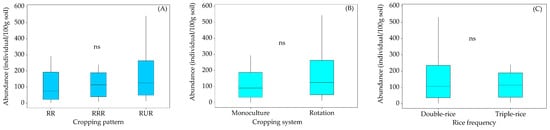
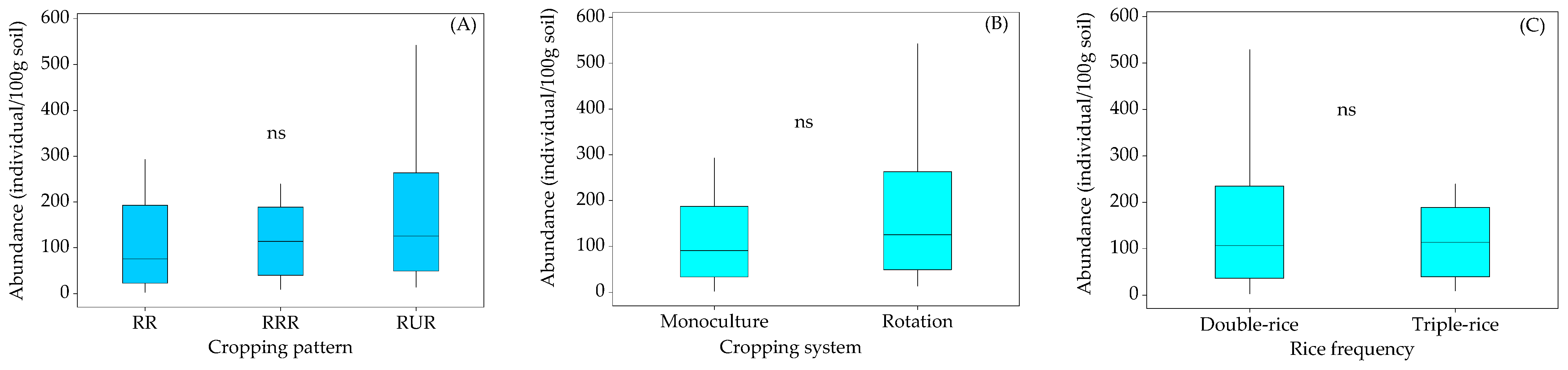
A total of 30 nematode genera were identified. Total nematode abundance varied substantially across rice cropping patterns, ranging from 3 to 1419 individuals per 100 g of dry soil (Supplementary Table S1). Although double-rice systems tended to exhibit greater mean abundance, no significant differences in total nematode abundance were detected among cropping systems (p = 0.433; Figure 1A). This finding was further supported by the non-parametric Kruskal–Wallis test (p = 0.322), indicating that rice cropping patterns did not significantly influence overall nematode abundance.
Figure 1.
Nematode abundance among cropping patterns (A), cropping systems (B), and rice cropping frequency (C). Boxplots represent nematode abundance under different cropping systems: RUR (rice–upland crop–rice rotation), RR (double-rice), and RRR (triple-rice). The box indicates the interquartile range, the horizontal line represents the median, whiskers indicate the data range. ns—no significant difference (p < 0.05).
Comparison between continuous rice intensive systems (double- and triple-rice systems) and rotational systems revealed slightly greater nematode abundance under rotational systems; however, these differences were not statistically significant (p = 0.235; Figure 1B). Similarly, total nematode abundance did not differ significantly between double-rice and triple-rice systems, despite a tendency toward greater abundance under double-rice cultivation (p = 0.921; Figure 1C).
3.2. Free-Living Nematode Community Assemblages Among Systems
3.2.1. Community Composition
A total of 25 free-living nematode genera were identified across cropping patterns. Variations in nematode community composition were observed with a total of 15, 16, and 18 genera identified in soils under RR, RRR, and RUR systems, respectively (Supplementary Table S2). Among these, Chronogaster was the dominant genus across cropping patterns, although its relative abundance varied considerably among systems. The highest dominance of Chronogaster was recorded in the RRR system, followed by the RR system, accounting for 49.2% and 33.4% of the total community composition, respectively. Mesodorylaimus also exhibited relatively high dominance in RR and RRR systems, contributing 21.1% and 14.0% of the total abundance, respectively. In the RR system, Panagrolaimus, Filenchus, Cephalobus, and Chrysonema were among the predominant genera, accounting for 13.5%, 10.0%, 6.1%, and 5.9% of the total abundance, respectively. In the rotational R–U–R system, Tyleptus and Mesodorylaimus were the most dominant genera, accounting for 17.0% and 15.6% of the total abundance, respectively. Other predominant genera in the R–U–R system included Cephalobus, Calolaimus, and Aphelenchoides, which contributed 14.3%, 13.3%, and 8.9% of the total abundance, respectively.
Among cropping patterns, nematode abundance varied with significant differences detected for genera Calolaimus, Tyleptus, and Chronogaster (Kruskal–Wallis test, adjusted p < 0.01). Calolaimus and Tyleptus exhibited greater abundance in RUR, whereas Chronogaster abundance was significantly lower in the RUR system than in both RR and RRR systems (Supplementary Table S3).
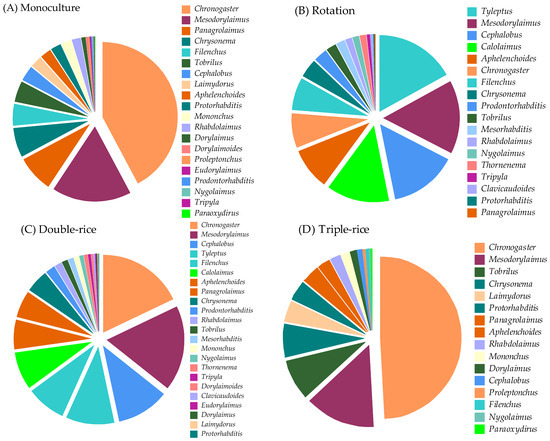
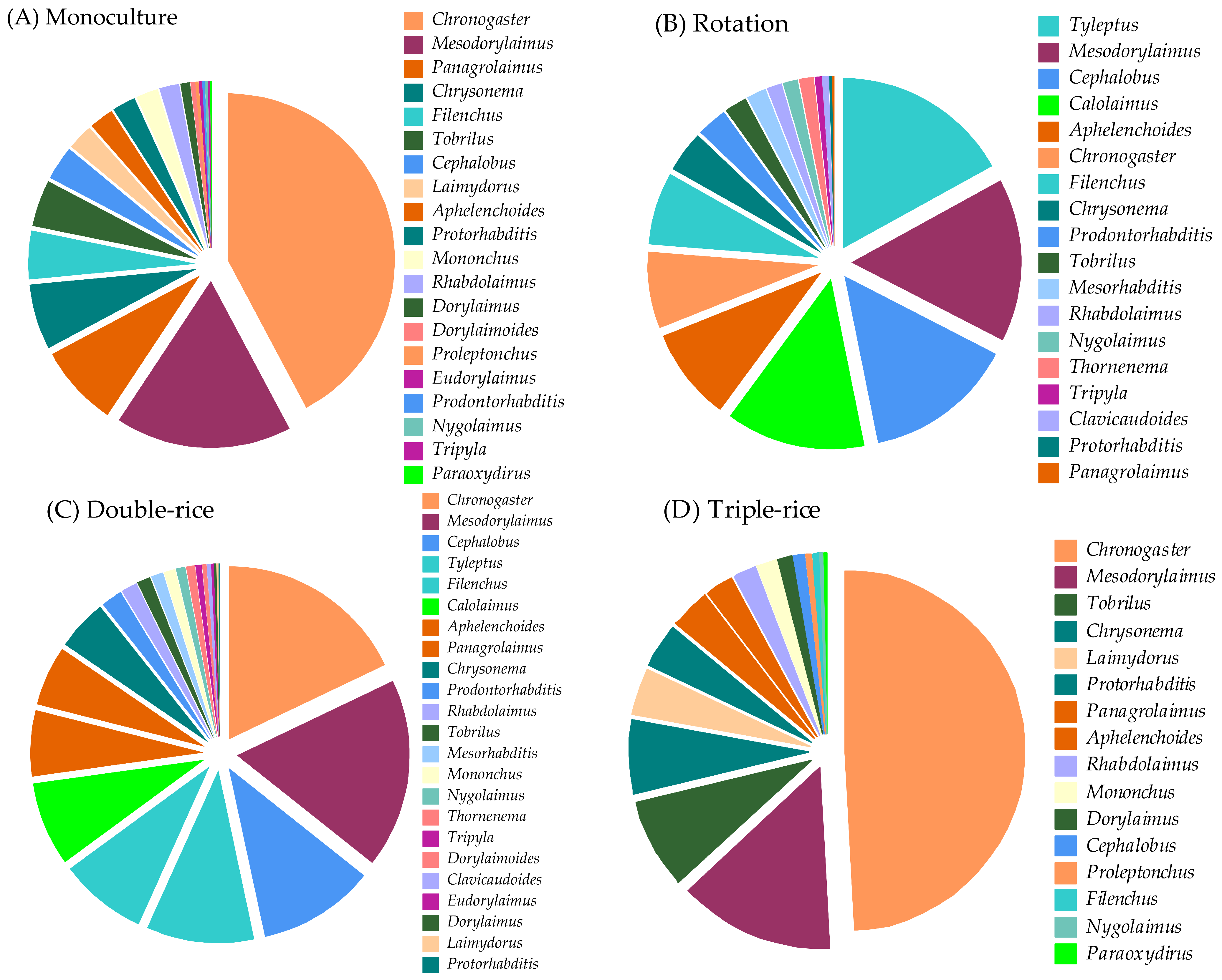
Across cropping systems, a total of 20 and 18 nematode genera were identified in intensive and rotational systems, respectively (Figure 2A,B). Community composition differed substantially between cropping systems, particularly in dominant taxa. In intensive systems, Chronogaster was the predominant genus, accounting for 42.2% of total abundance, followed by Mesodorylaimus and Panagrolaimus, which represented 17.1% and 7.9% of the community, respectively (Figure 2A). In contrast, rotational systems exhibited a more even community structure, with dominant genera including Tyleptus, Mesodorylaimus, Cephalobus, Calolaimus, Aphelenchoides, Chronogaster, and Filenchus, each contributing between 6.9% and 17.0% of total abundance (Figure 2B).
Figure 2.
Community composition of nematode genera based on relative abundance in soils under intensive (A) and rotational systems (B), and across rice cropping frequencies, including double-rice (C) and triple-rice systems (D). Order of nematode genera in decreasing relative abundance within each system.
Among intensive and rotation systems, genus-specific abundance responses were limited. Particularly, Calolaimus and Tyleptus exhibited significantly greater abundance under rotational systems compared with intensive systems (adjusted p < 0.001). Conversely, Chronogaster abundance was significantly greater in intensive systems (adjusted p = 0.031) (Supplementary Table S4).
Across rice cropping frequencies, the number of genera was significantly greater in double-rice systems than in triple-rice systems, with 23 and 16 genera identified, respectively (Figure 2C,D). Community composition also varied between rice frequencies. In double-rice systems, the nematode community was primarily dominated by Mesodorylaimus and Chronogaster, followed by Cephalobus, Tyleptus, Filenchus, Calolaimus, Aphelenchoides, and Panagrolaimus, with relative abundances ranging from 5.6% to 17.9% (Figure 2C). Conversely, triple-rice systems were characterized by a strong dominance of Chronogaster, which accounted for 49.2% of total abundance, followed by Mesodorylaimus (14.0%), Tobrilus (8.1%), and Chrysonema (6.6%) (Figure 2D, Supplementary Table S4).
Chronogaster abundance was significantly greater under triple-rice systems than double-rice systems (adjusted p = 0.0045). Overall, rice intensification appeared to affect the abundance of specific dominant taxa rather than altering broad taxonomic patterns.
3.2.2. Trophic Structure
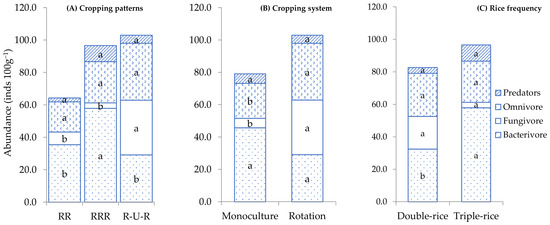
Permutational Multivariate Analysis of Variance (PERMANOVA) was conducted to assess the overall effects of cropping pattern, cropping system, and rice cropping frequency on nematode trophic structure, including bacterivores, fungivores, herbivores, omnivores, and predators across paddy rice fields. The results indicated that trophic structure differed significantly among cropping patterns (PERMANOVA, Bray–Curtis distance, R2 = 0.052, p = 0.008), cropping systems (R2 = 0.026, p = 0.026), and rice cropping frequencies (R2 = 0.033, p = 0.010). Bacterivore abundance differed significantly among cropping patterns (p = 0.025) and rice cropping frequencies (p = 0.007), whereas fungivore abundance varied significantly among cropping patterns (p = 0.012) and cropping systems (p = 0.003). Omnivore abundance also differed significantly between cropping systems (p = 0.037). In contrast, no significant differences were detected for herbivores or predators. Post hoc pairwise comparisons using Dunn’s test with Holm correction revealed that bacterivore abundance was significantly greater in the RRR system compared with both RR and RUR systems (p = 0.043) (Figure 3A). Fungivore abundance was significantly greater in the RUR system than in both RR and RRR systems. Among cropping systems, rotational systems had greater abundances of fungivores (p = 0.003) and omnivores (p = 0.037) than intensive systems (Figure 3B). Furthermore, bacterivore abundance was lower in double-rice systems than in triple-rice systems (p = 0.007) (Figure 3C).
Figure 3.
Abundance of free-living nematode trophic groups among cropping patterns (A) (RR, RRR, RUR), cropping systems (B) [intensive (RR, RRR) and rotation (RUR)], and rice cropping frequencies (C) (double- and triple-rice). Different letters within the same trophic group indicate significant differences based on post hoc pairwise comparisons (p < 0.05). RR: rice–rice; RRR: rice–rice–rice; R–U–R: rice–upland crop–rice.
3.2.3. Functional Guilds
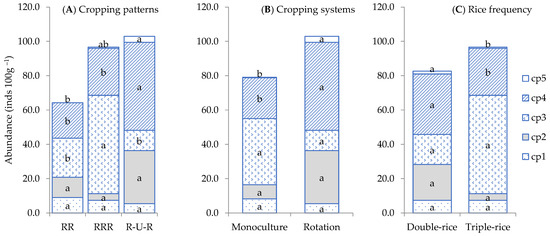
Functional guild composition exhibited differential responses to rice management practices. Significant differences were detected for cp3 among cropping patterns and rice frequencies (p < 0.001), whereas cp4 and cp5 varied significantly among cropping patterns and cropping systems (p < 0.05). In contrast, cp1 and cp2 remained relatively stable across management categories (Table 1). Dunn’s post hoc comparisons revealed that cp3 abundance was significantly greater in the RRR system than in the RR and RUR systems (Figure 4A). For cp5, significantly greater abundance was observed in the RUR system compared with the RR system (p = 0.014). Although cp4 tended to exhibit greater abundance in the RUR system relative to the RR and RRR systems, no significant pairwise differences were detected following multiple comparison correction. Across cropping systems, both cp4 and cp5 differed significantly between intensive and rotation systems (p < 0.05), with greater abundances observed under rotation systems compared with intensive systems (Figure 4B). Regarding rice frequency, cp4 and cp5 abundance was significantly higher in the double-rice system than in the triple-rice system (p < 0.001; Figure 4C). In contrast, the abundance of cp3 nematodes tended to be higher in the triple-rice system, although the difference was only marginally significant (p = 0.054).
Table 1.
Results of the Kruskal–Wallis test (H-values and p-values) for the abundance of nematode functional guilds among cropping patterns (RR, RRR, RUR), Mann–Whitney U test for cropping systems (intensive and rotation), and rice frequencies (double- and triple-rice crop). cp: colonizer–persister value.
Figure 4.
Abundance of functional guilds of nematode communities among cropping patterns (A) (RR, RRR, RUR), cropping systems (B) [intensive (RR, RRR) and rotation (RUR)], and rice cropping frequencies (C) (double- and triple-rice). Different letters within the same trophic group indicate significant differences based on post hoc pairwise comparisons (p < 0.05). RR: rice–rice; RRR: rice–rice–rice; R–U–R: rice–upland–rice.
3.2.4. Metabolic Footprints
Across the cropping patterns, overall metabolic footprint composition differed significantly (p = 0.020) based on Permutational Multivariate Analysis of Variance (PERMANOVA) using Bray–Curtis dissimilarities (R2 = 0.059). Univariate analyses showed significant differences among cropping patterns for structure footprint (p = 0.009), fungivore footprint (p = 0.008) and bacterivore footprint (p = 0.012; Table 2). Fungivore footprint greatly differed between cropping systems (p = 0.002), whereas bacterivore footprint was significantly different across frequencies of rice (p = 0.003). Rotational systems had, on average, larger fungivore footprints than intensive systems, as revealed by post hoc pairwise comparisons, while bacterivore footprints were significantly larger under triple-rice systems compared with double-rice ones (Table 2).
Table 2.
The metabolic footprints of free-living nematode communities under cropping patterns (RR, RRR, RUR), cropping systems [intensive (RR, RRR) rotation (RUR)], and rice cropping frequencies (double- and triple-rice). Different letters indicate significant differences among groups, whereas the same letter indicates no significant difference (p < 0.05); ns—non-significant. RR: rice–rice; RRR: rice–rice–rice; RUR: rice–upland–rice.
3.2.5. Diversity Indices
Species richness differed significantly among cropping patterns (p = 0.00054) (Table 3). The rice–upland rotational system (RUR) exhibited the highest richness, averaging 4.0 genera, whereas continuous double-rice (RR) and triple-rice (RRR) systems showed lower richness values, averaging two genera. Post hoc comparisons revealed that richness in RUR was significantly greater than in both RR and RRR systems (adjusted p < 0.01), whereas no significant difference was detected between RR and RRR. Species richness also differed significantly between cropping systems (p = 0.0028), with rotational systems exhibiting higher richness (three genera) than intensive systems (two genera). These findings suggest that crop diversification through rotation promotes greater nematode taxonomic diversity compared with continuous intensive practices. In contrast, species richness did not differ significantly between rice cultivation frequencies (p = 0.582). Double-rice systems exhibited a mean richness of three genera, whereas triple-rice systems averaged two genera, indicating that increasing rice cultivation frequency from two to three crops per year had limited effects on nematode taxonomic richness.
Table 3.
Biodiversity indices of nematode communities among cropping patterns, cropping systems, and rice cultivation frequencies. Values are presented as mean ± standard deviation (SD). Different letters within the same category indicate significant differences according to post hoc pairwise comparisons (p < 0.05); ns: non-significant. RR: rice–rice; RRR: rice–rice–rice; RUR: rice–upland–rice.
The Shannon–Wiener diversity index (H) differed significantly among cropping patterns (p = 0.006) (Table 3). The RUR system exhibited the highest diversity, which was significantly greater than that of the double-rice (RR) system. Pielou’s evenness index (J’) also varied significantly among cropping patterns (p = 0.017), with the highest value observed in the RRR and the lowest in the RR (Table 3) systems. Among cropping systems, the Shannon–Wiener diversity index (H) differed significantly between systems (p = 0.008), with the rotational system exhibiting a significantly higher index than the monoculture system. In contrast, Pielou’s evenness index (J’) did not differ significantly among cropping systems (p = 0.532). For rice frequency, Pielou’s evenness index (J’) in the RRR system exhibits a higher evenness than the RR system (p = 0.032). The Shannon–Wiener diversity index (H) did not differ significantly between rice frequencies (p = 0.763).
3.3. Plant-Parasitic Nematodes Associated with Rice
Total plant-parasitic nematode abundance showed numerical variation among rice production systems; however, these differences were not statistically significant among cropping patterns (p = 0.299), cropping systems (p = 0.182), or rice frequency categories (p = 0.184). A total of five plant-parasitic nematode genera were identified, including Hirschmanniella, Meloidogyne, Criconemella, Tylenchorhynchus, and Tylenchus. Among these, Hirschmanniella was the dominant genus, with a mean abundance of 68 individuals per 100 g dry soil, and an occurrence frequency of 74.7% across all sampling sites. Among the identified genera, only Criconemella exhibited significant variation among management categories, differing significantly across cropping patterns (p = 0.0025), cropping systems (p < 0.001), and rice frequency categories (p = 0.0499) (Table 4). Post hoc pairwise comparisons indicated that Criconemella abundance was significantly greater under the RUR system than under RR and RRR systems, was higher in rotational systems than intensive systems, and was greater in double-rice systems compared with triple-rice systems. In contrast, the abundances of Meloidogyne, Hirschmanniella, Tylenchorhynchus, and Tylenchus did not differ significantly among management categories.
Table 4.
Abundance of individual plant-parasitic nematode genera across cropping patterns (RR, RRR, RUR), cropping systems [intensive (RR, RRR) and rotation (RUR)], and rice cropping frequencies (double- and triple-rice). Different letters within the same category indicate significant differences based on post hoc pairwise comparisons (p < 0.05). RR: rice–rice; RRR: rice–rice–rice; RUR: rice–upland–rice.
3.4. Soil Physicochemical Properties Among Rice Cropping Systems
PERMANOVA revealed significant differences in overall soil physicochemical properties among cropping patterns (Pseudo-F = 6.95, R2 = 0.142, p = 0.001), cropping systems (Pseudo-F = 5.06, R2 = 0.056, p = 0.001), and rice frequencies (Pseudo-F = 9.35, R2 = 0.099, p = 0.001) (Supplementary Table S5). PERMDISP indicated significant heterogeneity in multivariate dispersion among cropping patterns (p = 0.013) and cropping systems (p = 0.002), suggesting that these PERMANOVA results should be interpreted with caution. In contrast, multivariate dispersion did not differ significantly between double-rice and triple-rice systems (p = 0.344).
At the individual variable level, significant differences among cropping patterns were observed for soil pH (p < 0.001), electrical conductivity (p < 0.001), available phosphorus (p = 0.032), NH4+-N (p = 0.002), NO3−-N (p < 0.001), OM (p < 0.001), and exchangeable potassium (p = 0.004), whereas inorganic N did not differ significantly among cropping patterns (p = 0.096) (Table 5). Post hoc comparisons indicated that the rotational rice–upland–rice (RUR) system contributed substantially to these differences, particularly for pH, nitrogen and phosphorus availability.
Table 5.
Kruskal–Wallis results among cropping patterns. Different letters within the same category indicate significant differences based on post hoc pairwise comparisons (p < 0.05). RR: rice–rice; RRR: rice–rice–rice; RUR: rice–upland–rice.
Comparisons between cropping systems revealed significant differences between intensive and rotational systems for pH (p < 0.001), available phosphorus (p = 0.017), NH4-N (p < 0.001), NO3-N (p < 0.001), and OM (p = 0.016) (Table 6). In contrast, EC, inorganic N, and exchangeable K did not differ significantly between cropping systems (p > 0.05). Similarly, significant differences between double-rice and triple-rice systems were observed for pH (p < 0.001), EC (p < 0.001), available phosphorus (p = 0.042), NH4-N (p = 0.031), NO3-N (p = 0.008), OM (p < 0.001), and exchangeable potassium (p = 0.018), whereas inorganic N remained statistically similar between rice frequency categories (p = 0.072). Overall, double-rice systems tended to exhibit higher pH, available phosphorus, nitrate concentrations, and exchangeable potassium, whereas triple-rice systems were characterized by greater EC, NH4-N concentrations, and OM values.
Table 6.
Soil physicochemical property among cropping systems and rice frequency. Different letters within the same category indicate significant differences based on post hoc pairwise comparisons (p < 0.05). RR: rice–rice; RRR: rice–rice–rice; RUR: rice–upland–rice.
3.5. Relationships Between Nematode Trophic Structure and Soil Chemical Properties
Canonical correspondence analysis (CCA) revealed significant associations between soil physicochemical properties and nematode community composition (permutation test, p = 0.005). The first two canonical axes demonstrated strong community–environment relationships, with canonical correlations of 0.899 and 0.865 for Axis 1 and Axis 2, respectively. Axis 1 was primarily associated with gradients in soil organic carbon (OM), pH, and inorganic nitrogen forms, particularly nitrate (NO3−–N) and ammonium (NH4+–N), indicating that these variables contributed substantially to community differentiation. Axis 2 was predominantly structured by pH gradients and showed moderate associations with nitrogen-related variables. In contrast, electrical conductivity (EC) and exchangeable potassium contributed comparatively little to community separation. Overall, the significant permutation results indicate that variation in soil chemical properties plays an important role in shaping nematode community structure across the studied systems.
4. Discussion
4.1. Nematode Communities Across Paddy Rice Systems
Nematodes play important ecological roles in rice ecosystems [47] and are widely recognized as reliable indicators of soil health and ecosystem functioning [48,49]. Paddy rice represents a unique agroecosystem characterized by prolonged waterlogged conditions throughout most of the crop growth period [50], while simultaneously providing numerous ecosystem services [51]. This agroecosystem supports diverse biological communities, including nematode communities [52,53], thereby highlighting its ecological importance for biodiversity conservation and soil sustainability. In paddy rice fields, free-living nematode communities have been reported to exhibit high taxonomic diversity, with the most dominant genera including Acrobeloides, Cephalobus, Chronogaster, Panagrolaimus, Mesodorylaimus, Trypila, Mylonchulus, Mononchus, and Tobrilus [21,54]. In addition, paddy rice fields have a range of plant-parasitic nematode communities, dominated by Hirschmanniella, Meloidogyne, Tylenchorhynchus, Helicotylenchus, Pratylenchus and Ditylenchus [29,32,55]. In the present study, 30 nematode genera were identified, including five genera of plant-parasitic nematodes such as Hirschmanniella, Meloidogyne, Tylenchus, Criconmella and Tylenchorhynchus, which is consistent with previous studies conducted in Japan [52], Myanmar [33], Pakistan [35] and India [20]. Among these studies, Chronogaster was the most dominant genus, accounting for approximately 29% of the total abundance of identified taxa. This genus has previously been reported as one of the dominant nematode taxa in aquatic ecosystems [56]. Thus, paddy rice fields, where waterlogging is present throughout most of the rice growth period, may provide suitable conditions for this genus. Other genera identified in this study include Mesodorylaimus, Cephalobus, Tyleptus, Filenchus, Aphelenchoides and Panagrolaimus. The occurrence of these nematode genera have also been reported from paddy rice ecosystems in Japan and Iran [21,57]. Furthermore, the occurrence of Calolaimus in paddy rice fields was documented in the present study; this genus has frequently been reported as a characteristic component of freshwater ecosystems [58]. The high diversity of nematode community composition in paddy rice fields suggests that waterlogging conditions may provide suitable habitats for sustaining diverse free-living nematode communities. Therefore, the conservation of paddy soils is important for maintaining soil health and ecosystem functioning, and may contribute to climate change mitigation by supporting ecological processes associated with greenhouse gas (GHG) regulation.
There are several PPN that have been reported in rice such as Helicotylenchus spp., Trichodorus spp., Xiphinema spp., Aphelenchoides spp., Ditylenchus spp., Heterodera spp., Hirschmanniella spp., Meloidogyne spp. and Pratylenchus spp. [59]. These nematodes, which are associated with rice plants, are considered important pathogens that reduce rice plant growth and productivity [29,55]. In the present study, five plant-parasitic nematode genera were identified, including Hirschmanniella, Meloidogyne, Criconemella, Tylenchorhynchus, and Tylenchus. Among these genera, Hirschmanniella was the dominant taxon, with an occurrence frequency of 74.7% across paddy rice systems in the MD, Vietnam. This genus has commonly been reported as the dominant nematode taxon associated with rice cultivation across rice ecosystems in Thailand [54] and is recognized for its negative effects on rice growth and productivity [31]. Additionally, Meloidogyne spp. called rice root-knot nematodes have been reported as important pathogens with the potential to cause substantial damage, particularly in upland rice systems [60,61]. Previous studies clarified that Hirschmanniella spp. and Meloidogyne spp., particularly H. oryzae and M. graminicola, are widely distributed in paddy rice ecosystems [54,62]. Previous studies have reported yield losses caused by M. graminicola based on inoculum density per plant, per unit weight or volume of soil, or the relationship between nematode populations at inoculation and harvest with rice yields [63,64]. However, these studies did not clearly establish a damage threshold at which M. graminicola significantly reduces rice yield compared with nematode-free soil. According to Bridge and Page [65], an initial population of 4000 M. graminicola juveniles per plant may cause yield losses of up to 72%. The impact of H. oryzae on rice yield has also been shown to depend on rice cultivar, soil type, and the growth stage at inoculation. Previous studies reported yield losses ranging from 27% to 39% following inoculation with 100 or 1200 nematodes per plant, depending on the experimental conditions [66,67]. In another study, Babatola and Bridge [68] reported that inoculation with 1000 H. oryzae individuals per plant reduced grain yield by up to 69%. An interesting observation in the present study was that Criconemella and Tylenchus showed significantly greater occurrence in rotational rice–sweet potato systems, particularly where sweet potato was incorporated into one cropping cycle within the rice-based system. This result is consistent to the finding by Karuri et al. [69] and Coyne et al. [70] who reported that the presence of Criconemella and Tylenchus was associated with sweet potato plants in Kenya and Uganda and causes significant damage. These findings suggest that changes in cropping systems within paddy rice fields can alter nematode community composition, particularly by influencing the structure and distribution of plant-parasitic nematodes.
4.2. Water Regime Shapes Nematode Community Composition, Trophic Structure and Metabolic Footprint
Soil conditions are vital in shaping the belowground organism communities, such as enchytraeids [71], protozoa [72] and nematodes [73]. In paddy rice fields, waterlogging regimes promote favorable conditions that induces changes in soil food-web complexity [74]. In the present study, the nematode community composition was changed under the presence and absence of upland crops, and those between double and triple rice. These changes could be explained by shifts in soil conditions caused by management practices associated with growth of upland crops and the differences in rice cropping frequency. The response of dominant genera Chronogaster was significantly greater in intensive rice systems (RR, RRR) than that in a rotation system (RUR). This finding can be explained by the prolonged waterlogged conditions that are commonly seen in intensive rice systems, which provide a favorable environment for Chronogaster previously reported to be a dominant nematode in aquatic environment [56,58]. Their abundance may be reduced in rotation systems, where one period has been replaced by sesame and sweet potato, due to variation in waterlogging conditions. Previous studies expressed that water management and hydrological conditions are major drivers shaping soil physicochemical properties and biological communities in paddy–upland rotational systems [14]. In this study, Hirschmanniella was the most dominant, with frequent occurrences across paddy rice fields in the MD. This result is consistent with the findings of Maung et al. [33], who reported that the populations of Hirschmanniella oryzae and second-stage juveniles of Meloidogyne graminicola were greater in irrigated rice systems than in upland fields in Myanmar, and their frequent occurrences responded to altered water regimes in paddy rice [21] or in rice fields of Kenya [36]. Changes in irrigation practices and water regimes not only alter nematode abundance, but also modify nematode-based soil food-web structure and functioning, which may indirectly regulate plant-parasitic nematode populations. Numerous studies further suggest that hydrological conditions, including alternate wetting and drying, water-saving irrigation, seasonal precipitation patterns, and wastewater irrigation, significantly influence soil microbial communities, nematode community composition, functional diversity, and trophic interactions [75,76]. In addition, the effects of soil moisture on nematode communities may interact with other environmental factors, such as soil texture, community assembly processes, organic amendments, and vegetation structure, further influencing ecosystem functioning and energy flow pathways [77,78].
Particularly, soil conditions represent major environmental constraints that drive changes in dwelling soil biota [79], which occupy multiple trophic levels and are interconnected within complex soil food-web structures [80]. The alterations in soil chemical properties can directly influence nematode trophic structures [37] by modifying soil resource availability like nitrogen, phosphorus, and potassium, as well as microbial communities [78], which constitute the primary food resources for bacterivorous nematodes [19]. In particular, soil moisture has been recognized as a key abiotic driver shaping nematode community structure [75]. Observation in previous studies reported that nematode communities are strongly influenced by seasonal climatic variations, with precipitation being considered one of the major environmental factors affecting nematode distribution and community dynamics [38,76,81]. In the current study, PERMANOVA revealed significant differences in overall soil chemical properties among cropping patterns and the community composition, trophic structure, and metabolic footprint of nematode communities. Particularly, the differences among soil organic carbon (OM), pH, EC, and inorganic nitrogen forms alter the changes in soil nematode communities, trophic structure, and metabolic footprints. Our result is supported by Wan et al. [82] who reported that organic amendments increased the relative allocation of energy flux to microbivores, supporting higher flow uniformity and greater nematode diversity. Moreover, soil pH and EC are key parameters inducing changes in microbial communities, thus affecting nematode communities and trophic structure [83].
4.3. Fertilization Regimes-Induced Changes in Soil Chemical Properties Shape Nematode Diversity
In this study, PERMANOVA revealed significant differences in soil physicochemical properties among cropping patterns (RR, RRR, and RUR), cropping systems (intensive and rotation), and rice frequency (double- and triple-rice systems). However, PERMDISP detected significant differences in multivariate dispersion for cropping systems and rice frequency, indicating that the corresponding PERMANOVA results may partly reflect differences in within-group variability. This finding suggests greater heterogeneity in soil physicochemical properties among sampling sites within these groups. The significant multivariate dispersion observed for cropping systems may be explained by the grouping of RR and RRR into the intensive cropping system. Although both represent intensive rice production, they differ in rice frequency, which has previously been identified as a major factor influencing soil physicochemical properties [84]. Similarly, for rice frequency, the double-rice category included both RR and RUR systems. As RUR incorporates an upland crop in the rotation, greater variation in soil physicochemical properties within the double-rice group is expected [37]. This heterogeneity is likely associated with differences in crop rotation, management intensity, fertilizer and organic matter inputs, irrigation practices, and other environmental factors among the respective cropping systems [6,14].
In the paddy rice fields of the MD, nitrogen fertilization and pesticide application are major concerns affecting the sustainability of rice production systems [8,85,86]. In our study, nematode composition, diversity index and trophic footprint were changed. In particular, the presence or absence of upland crops across cropping systems enhanced nematode community composition, diversity, and the metabolic footprint of fungivores. This result can be explained by effects of fertilization and water regimes on soil chemical properties such as soil pH, EC, available phosphorus, available nitrogen and OM, resulting in changes in nematode community composition. A previous study reported that the fertilization intensity strongly influences soil microbial communities, which serve as important resources for soil food webs and indirectly affect nematodes as potential biological vectors [18]. Li et al. [87] reported that fertilizer application affected soil physicochemical properties, influenced the abundance of nitrogen-cycling functional genes, and consequently modified soil nematode community composition and structure [88]. Previous studies have reported that nitrogen enrichment significantly reduced soil nematode diversity (3.2%), maturity index (6.1%), structure index (12.3%), and the abundance of omnivorous–predatory nematodes (28.3%) [89]. Inorganic fertilization can substantially modify bacterial and fungal communities in paddy soils [90], which represent the primary food resources for bacterivorous and fungivorous nematodes. Furthermore, increases in soil nematode abundance following fertilization have been consistently observed across different moisture regimes in paddy rice–upland wheat systems [24]. Similarly, incremental nutrient inputs have been shown to increase soil nematode abundance in paddy–upland rotation systems [25].
5. Conclusions
Rice cropping practices significantly influenced nematode community composition, trophic structure, functional guilds, diversity, and soil chemical properties. Rotational systems, particularly rice–upland–rice, promoted higher nematode richness, maintained a more balanced community structure, and were associated with significantly higher abundances of fungivores, omnivores, and higher cp-value nematodes, including Tyleptus, Mesodorylaimus, Cephalobus, and Calolaimus. This result indicates the enhancement of soil food-web complexity and ecological stability. In contrast, intensive systems, especially extremely intensive triple-rice cultivation, favored bacterivore-dominated communities, with Chronogaster dominating across all systems, reflecting simplified community structures. Plant-parasitic nematodes were relatively stable across rice systems, particularly the frequency of Hirschmanniella, whereas the presence of Criconemella differed among systems where rice has been rotated with sweet potato. Moreover, soil chemical properties, particularly pH, organic matter, and nitrogen availability, were associated with the variations in nematode community structure. These findings suggest that crop diversification through rotational practices enhances belowground biodiversity and promotes more sustainable soil ecological functioning in rice production systems.
Supplementary Materials
The following supporting information can be downloaded at: https://www.mdpi.com/article/10.3390/conservation6030089/s1, Supplementary Table S1. Information on soil samples and nematode community composition across study areas; Supplementary Table S2. Nematode community composition among cropping patterns (RR, RRR, and RUR); Supplementary Table S3. Nematode community composition among cropping systems (intensive rice cultivation and rice–upland crop rotation); Supplementary Table S4. Nematode community composition among rice cropping frequencies (double- and triple-cropping systems). Supplementary Table S5. PERMANOVA results.
Author Contributions
N.V.S.: Writing—Original Draft, Visualization, Methodology, Investigation, Data Curation, Conceptualization, Writing—Review and Editing; L.T.N.T.: Methodology, Visualization, Investigation, Review and Editing; N.T.T.O.: Methodology, Investigation; N.K.N.: Methodology, Investigation; D.P.N.N.: Methodology, Investigation; T.K.N.: Methodology, Visualization, Investigation; C.A.P.: Methodology, Visualization, Investigation; C.M.K.: Review and Editing; N.T.K.P.: Methodology, Visualization, Data Curation, Review and Editing; K.T.: Review and Editing. All authors have read and agreed to the published version of the manuscript.
Funding
This research was funded by the Ministry of Education and Training in Vietnam, grant number B2024-TCT-05.
Institutional Review Board Statement
Not applicable.
Informed Consent Statement
Not applicable.
Data Availability Statement
The data presented in this study are available on request from the corresponding author.
Acknowledgments
The authors sincerely thank the farmers for permitting soil sample collection from their fields. The authors also thank Natalie Mullins, from the School of Agricultural, Environmental and Veterinary Sciences, Charles Sturt University, for her careful editing of the English language in the manuscript.
Conflicts of Interest
The authors declare no conflicts of interest.
References
- Liu, Y.; Ge, T.; van Groenigen, K.J.; Yang, Y.; Wang, P.; Cheng, K.; Zhu, Z.; Wang, J.; Li, Y.; Guggenberger, G.; et al. Rice paddy soils are a quantitatively important carbon store according to a global synthesis. Commun. Earth Environ. 2021, 2, 154. [Google Scholar] [CrossRef] [Scilit]
- Tran, D.D.; Park, E.; Thu Van, C.; Nguyen, T.D.; Nguyen, A.H.; Linh, T.C.; Quyen, P.H.; Tran, D.A.; Nguyen, H.Q. Advancing sustainable rice production in the Vietnamese Mekong delta insights from ecological farming systems in An Giang province. Heliyon 2024, 10, e37142. [Google Scholar] [CrossRef] [Scilit] [PubMed]
- Maitah, K.; Smutka, L.; Sahatqija, J.; Maitah, M.; Anh, N.P. Rice as a determinant of Vietnamese economic sustainability. Sustainability 2020, 12, 5123. [Google Scholar] [CrossRef] [Scilit]
- Linh, T.B.; Cornelis, W.; Van Elsacker, S.; Khoa, L.V. Socio-economic evaluation on how crop rotations on clayed soils affect rice yield and farmers’ income in the Mekong delta, Vietnam. Int. J. Environ. Rural Dev. 2014, 4, 62–68. [Google Scholar] [CrossRef] [Scilit]
- Linh, T.B.; Ghyselinck, T.; Khanh, T.H.; Van Dung, T.; Guong, V.T.; Van Khoa, L.; Cornelis, W. Temporal variation of hydro-physical properties of paddy clay soil under different rice-based cropping systems. Land Degrad. Dev. 2017, 28, 1752–1762. [Google Scholar] [CrossRef] [Scilit]
- Lu, J.; Hu, Z.; Xu, Z.H.; Cao, Z.H.; Zhuang, S.Y.; Yang, L.Z.; Lin, X.G.; Dong, Y.H.; Yin, R.; Ding, J.L.; et al. Effects of rice cropping intensity on soil nitrogen mineralization rate and potential in buried ancient paddy soils from the neolithic age in China’s Yangtze River delta. J. Soils Sediments 2009, 9, 526–536. [Google Scholar] [CrossRef] [Scilit]
- Tong, Y.D. Rice intensive cropping and balanced cropping in the Mekong delta, Vietnam–economic and ecological considerations. Ecol. Econ. 2017, 132, 205–212. [Google Scholar] [CrossRef] [Scilit]
- Salazar, C.; Rand, J. Pesticide use, production risk and shocks. The case of rice producers in Vietnam. J. Environ. Manag. 2020, 253, 109705. [Google Scholar] [CrossRef] [Scilit]
- van den Hoogen, J.; Geisen, S.; Wall, D.H.; Wardle, D.A.; Traunspurger, W.; de Goede, R.G.M.; Adams, B.J.; Ahmad, W.; Ferris, H.; Bardgett, R.D.; et al. A global database of soil nematode abundance and functional group composition. Sci. Data 2020, 7, 103. [Google Scholar] [CrossRef] [Scilit] [PubMed]
- Fierer, N.; Strickland, M.S.; Liptzin, D.; Bradford, M.A.; Cleveland, C.C. Global patterns in belowground communities. Ecol. Lett. 2009, 12, 1238–1249. [Google Scholar] [CrossRef] [Scilit] [PubMed]
- Zhao, J.; Neher, D.A. Soil nematode genera that predict specific types of disturbance. Appl. Soil Ecol. 2013, 64, 135–141. [Google Scholar] [CrossRef] [Scilit]
- Čerevková, A.; Renčo, M.; Miklisová, D.; Gömöryová, E. Soil nematode communities in managed and natural temperate forest. Diversity 2021, 13, 327. [Google Scholar] [CrossRef] [Scilit]
- Yu, H.Y.; Li, F.B.; Liu, C.S.; Huang, W.; Liu, T.X.; Yu, W.M. Chapter five–iron redox cycling coupled to transformation and immobilization of heavy metals: Implications for paddy rice safety in the red soil of South China. Adv. Agron. 2016, 137, 279–317. [Google Scholar] [CrossRef] [Scilit]
- Zhou, W.; Lv, T.F.; Chen, Y.; Westby, A.P.; Ren, W.J. Soil physicochemical and biological properties of paddy-upland rotation: A review. Sci. World J. 2014, 2014, 856352. [Google Scholar] [CrossRef] [Scilit]
- Wang, X.Y.; He, T.H.; Gen, S.Y.; Zhang, X.Q.; Wang, X.; Jiang, D.; Li, C.Y.; Li, C.S.; Wang, J.L.; Zhang, W.Y.; et al. Soil properties and agricultural practices shape microbial communities in flooded and rainfed croplands. Appl. Soil Ecol. 2020, 147, 11. [Google Scholar] [CrossRef] [Scilit]
- Zhang, Y.; Chen, X.; Geng, S.; Zhang, X. A review of soil waterlogging impacts, mechanisms, and adaptive strategies. Front. Plant Sci. 2025, 16, 1545912. [Google Scholar] [CrossRef] [Scilit] [PubMed]
- Papatheodorou, E.M.; Kordatos, H.; Kouseras, T.; Monokrousos, N.; Menkissoglu-Spiroudi, U.; Diamantopoulos, J.; Stamou, G.P.; Argyropoulou, M.D. Differential responses of structural and functional aspects of soil microbes and nematodes to abiotic and biotic modifications of the soil environment. Appl. Soil Ecol. 2012, 61, 26–33. [Google Scholar] [CrossRef] [Scilit]
- Roth, E.; Samara, N.; Ackermann, M.; Seiml-Buchinger, R.; Saleh, A.; Ruess, L. Fertilization and irrigation practice as source of microorganisms and the impact on nematodes as their potential vectors. Appl. Soil Ecol. 2015, 90, 68–77. [Google Scholar] [CrossRef] [Scilit]
- Kitagami, Y.; Kawai, K.; Ekino, T. Soil physicochemical properties shape distinct nematode communities in serpentine ecosystems. Pedobiologia 2021, 85–86, 150725. [Google Scholar] [CrossRef] [Scilit]
- Mondal, S.; Ghosh, S.; Pari, A.; Bhattacharyya, K.; Bhowmick, A.R.; Khan, M.R.; Mukherjee, A. Unveiling the drivers of nematode community structure and function across rice agroecosystems. Appl. Soil Ecol. 2023, 182, 104715. [Google Scholar] [CrossRef] [Scilit]
- Okada, H.; Niwa, S.; Takemoto, S.; Komatsuzaki, M.; Hiroki, M. How different or similar are nematode communities between a paddy and an upland rice fields across a flooding-drainage cycle? Soil Biol. Biochem. 2011, 43, 2142–2151. [Google Scholar]
- Murase, J.; Hida, A.; Ogawa, K.; Nonoyama, T.; Yoshikawa, N.; Imai, K. Impact of long-term fertilizer treatment on the microeukaryotic community structure of a rice field soil. Soil Biol. Biochem. 2015, 80, 237–243. [Google Scholar] [CrossRef] [Scilit]
- Bi, L.D.; Zhang, B.; Liu, G.R.; Li, Z.Z.; Liu, Y.R.; Ye, C.; Yu, X.C.; Lai, T.; Zhang, J.G.; Yin, J.M.; et al. Long-term effects of organic amendments on the rice yields for double rice cropping systems in Subtropical China. Agric. Ecosyst. Environ. 2009, 129, 534–541. [Google Scholar] [CrossRef] [Scilit]
- Liu, T.; Whalen, J.K.; Shen, Q.; Li, H. Increase in soil nematode abundance due to fertilization was consistent across moisture regimes in a paddy rice–upland wheat system. Eur. J. Soil Biol. 2016, 72, 21–26. [Google Scholar] [CrossRef] [Scilit]
- Hu, C.; Xia, X.G.; Han, X.M.; Chen, Y.F.; Qiao, Y.; Liu, D.H.; Li, S.L. Soil nematode abundances were increased by an incremental nutrient input in a paddy-upland rotation system. Helminthologia 2018, 55, 322–333. [Google Scholar] [CrossRef] [Scilit] [PubMed]
- Sinh, N.V.; Chau, M.K.; Vo, Q.M.; Le, V.K.; Nguyen, T.K.P.; Araki, M.; Perry, R.N.; Tran, A.D.; Dang, D.M.; Tran, B.L.; et al. Impacts of saltwater intrusion on soil nematodes community in alluvial and acid sulfate soils in paddy rice fields in the Vietnamese Mekong delta. Ecol. Indic. 2021, 122, 107284. [Google Scholar] [CrossRef] [Scilit]
- Wang, J.Q.; Li, M.; Zhang, X.H.; Liu, X.Y.; Li, L.Q.; Shi, X.Z.; Hu, H.W.; Pan, G.X. Changes in soil nematode abundance and composition under elevated CO2 and canopy warming in a rice paddy field. Plant Soil 2019, 445, 425–437. [Google Scholar] [CrossRef] [Scilit]
- van Aalst, M.A.; Koomen, E.; de Groot, H.L.F. Vulnerability and resilience to drought and saltwater intrusion of rice farming households in the Mekong delta, Vietnam. Econ. Disasters Clim. Change 2023, 7, 407–430. [Google Scholar] [CrossRef] [Scilit]
- Dutta, T.; Ganguly, A.; Gaur, H. Global status of rice root-knot nematode, Meloidogyne graminicola. Afr. J. Microbiol. Res. 2012, 6, 6016–6021. [Google Scholar] [CrossRef] [Scilit]
- Kyndt, T.; Fernandez, D.; Gheysen, G. Plant-parasitic nematode infections in rice: Molecular and cellular insights. Annu. Rev. Phytopathol. 2014, 52, 135–153. [Google Scholar] [CrossRef] [Scilit] [PubMed]
- Abd-Elbary, N.A.; Eissa, M.F.M.; Youssef, M.M.A. Pathogenicity of the rice root nematode, Hirschmanniella oryzae to rice plants in relation to nematode reproduction, plant growth, grain yield and biochemical changes. Arch. Phytopathol. Plant Prot. 2012, 45, 2324–2334. [Google Scholar] [CrossRef] [Scilit]
- Khuong, N.B. Plant-parasitic nematodes of South Viet nam. J. Nematol. 1983, 15, 319–323. [Google Scholar] [PubMed]
- Maung, Z.T.Z.; Kyi, P.P.; Myint, Y.Y.; Lwin, T.; de Waele, D. Occurrence of the rice root nematode Hirschmanniella oryzae on monsoon rice in Myanmar. Trop. Plant Pathol. 2010, 35, 3–10. [Google Scholar] [CrossRef] [Scilit]
- Gilces, C.T.; Santillan, D.N.; Velasco, L.V. Plant-parasitic nematodes associated with rice in Ecuador. Nematropica 2016, 46, 45–53. [Google Scholar]
- Musarrat, A.R.; Shahina, F.; Shah, A.A.; Saba, R.; Feroza, K. Community analysis of plant parasitic and free living nematodes associated with rice and soybean plantation from Pakistan. Appl. Ecol. Environ. Res. 2016, 14, 19–33. [Google Scholar] [CrossRef] [Scilit]
- Ndirangu, K.J.; Pili, N.N.; Chelal, J.; Biwot, J.; Kandie, F.; Razieh, Y.; Quintanilla, M.; Ouedraogo, R.S.; Hughes, D.; Kantor, M.; et al. Occurrence of plant-parasitic nematodes on rice (Oryza sativa) in Kenya with a focus on Hirschmanniella oryzae. Nematology 2024, 26, 1179–1193. [Google Scholar] [CrossRef] [Scilit]
- Sinh, N.V.; Nguyen, P.T.K.; Araki, M.; Perry, R.N.; Ba Tran, L.; Minh Chau, K.; Min, Y.Y.; Toyota, K. Effects of cropping systems and soil amendments on nematode community and its relationship with soil physicochemical properties in a paddy rice field in the Vietnamese Mekong delta. Appl. Soil Ecol. 2020, 156, 103683. [Google Scholar] [CrossRef] [Scilit]
- Sinh, N.V.; Nguyen, P.K.T.; Araki, M.; Perry, R.N.; Tran, L.B.; Chau, K.M.; Min, Y.Y.; Toyota, K. Seasonal variation and vertical distribution of nematode communities and their relation to soil chemical property and rice productivity under triple rice cultivation in the Mekong delta, Vietnam. Nematology 2021, 23, 33–46. [Google Scholar]
- Sinh, N.V. Crop Rotation and Soil Amendments Influence Beneficial Nematodes and Suppress Plant-Parasitic Nematodes in Paddy Rice Fields in the Mekong Delta, Viet Nam. Doctoral Dissertation, Tokyo University of Agriculture and Technology, Tokyo, Japan, 2020. [Google Scholar]
- Van Bezooijen, J. Methods and Techniques for Nematology; Wageningen University: Wageningen, The Netherlands, 2006. [Google Scholar]
- Yeates, G.W.; Bongers, T.; Degoede, R.G.M.; Freckman, D.W.; Georgieva, S.S. Feeding-habits in soil nematode families and genera—An outline for soil ecologists. J. Nematol. 1993, 25, 315–331. [Google Scholar] [CrossRef] [Scilit] [PubMed]
- Bongers, T. The maturity index-an ecological measure of environmental disturbance based on nematode species composition. Oecologia 1990, 83, 14–19. [Google Scholar] [CrossRef] [Scilit] [PubMed]
- Bongers, T.; Bongers, M. Functional diversity of nematodes. Appl. Soil Ecol. 1998, 10, 239–251. [Google Scholar] [CrossRef] [Scilit]
- Clarke, K.R.; Gorley, R.N. Primer v6: User Manual/Tutorial (Plymouth Routines in Multivariate Ecological Research); PRIMER-E Ltd.: Plymouth, UK, 2006. [Google Scholar]
- Matlala, F.L.; Fourie, H.; Haddad, W.; De Waele, D.; Daneel, M.S. Prevalence of plant-parasitic nematodes in nethouse tomato production in Limpopo province, South Africa, and relationships with physico-chemical soil properties. J. Plant Dis. Prot. 2025, 132, 140. [Google Scholar] [CrossRef] [Scilit]
- Bremner, J.; Keeney, D. Determination and isotope-ratio analysis of different forms of nitrogen in soils: 3. Exchangeable ammonium, nitrate, and nitrite by extraction-distillation methods. Soil Sci. Soc. Am. J. 1996, 30, 577–582. [Google Scholar]
- Mokuah, D.; Karuri, H.; Nyaga, J.M. Food web structure of nematode communities in irrigated rice fields. Heliyon 2023, 9, e13183. [Google Scholar] [CrossRef] [Scilit] [PubMed]
- Du Preez, G.C.; Daneel, M.S.; Wepener, V.; Fourie, H. Beneficial nematodes as bioindicators of ecosystem health in irrigated soils. Appl. Soil Ecol. 2018, 132, 155–168. [Google Scholar] [CrossRef] [Scilit]
- Neher, D.A. Role of nematodes in soil health and their use as indicators. J. Nematol. 2001, 33, 161–168. [Google Scholar] [CrossRef] [Scilit] [PubMed]
- Kyuma, K. Paddy Soil Science; Kyoto University Press: Kyoto, Japan, 2004; p. 278. [Google Scholar]
- Chivenge, P.; Angeles, O.; Hadi, B.; Acuin, C.; Connor, M.; Stuart, A.; Puskur, R.; Johnson-Beebout, S. Chapter 10—Ecosystem services in paddy rice systems. In The Role of Ecosystem Services in Sustainable Food Systems; Rusinamhodzi, L., Ed.; Academic Press: Cambridge, MA, USA, 2020; pp. 181–201. [Google Scholar]
- Okada, H.; Niwa, S.; Hiroki, M. Nematode fauna of paddy field flooded all year round. Nematol. Res. 2016, 46, 65–70. [Google Scholar] [CrossRef] [Scilit]
- Prot, J.C.; Rahman, M.L. Nematode ecology, economic importance, and management in rice ecosystems in South and Southeast Asia. In Rice Pest Science and Management; Teng, P.S., Heong, K.L., Moody, K., Eds.; International Rice Research Institute: Manila, Philippines, 1994. [Google Scholar]
- Ruanpanun, P.; Pirankham, P.; Supajariyapong, S.; Homkajorn, N.; Doonan, J.M.; Kosawang, C. Mapping soil nematode communities in thai paddy fields using EDNA metabarcoding and morphological analysis. Physiol. Mol. Plant Pathol. 2026, 144, 103220. [Google Scholar] [CrossRef] [Scilit]
- Peng DeLiang, P.D.; Gaur, H.S.; Bridge, J. Nematode parasites of rice. In Plant-Parasit Nematodes Sub-Tropical Agriculture, 3rd ed.; CAB International: Wallingford, UK, 2018. [Google Scholar]
- Tahseen, Q. Nematodes in aquatic environments: Adaptations and survival strategies. Biodivers. J. 2012, 3, 13–40. [Google Scholar]
- Shahabi, S.; Kheiri, A.; Rakhshandehroo, F.; Jamali, S. Occurrence and distribution of nematodes in rice fields in Guilan province, Iran and the first record of Mylonchulus polonicus (stefanski, 1915) Cobb, 1917 (nematoda: Mononchina). J. Plant Prot. Res. 2016, 56, 420–429. [Google Scholar] [CrossRef] [Scilit]
- Abebe, E.; Andrássy, I.; Traunspurger, W. Freshwater Nematodes: Ecology and Taxonomy; CAB International Publishing: Wallingford, UK, 2006. [Google Scholar]
- Coyne, D.L.; Thio, B.; Plowright, R.A.; Hunt, D.J. Observations on the community dynamics of plant parasitic nematodes of rice in Cote d’ivoire. Nematology 1999, 1, 433–441. [Google Scholar] [CrossRef] [Scilit]
- Mantelin, S.; Bellafiore, S.; Kyndt, T. Meloidogyne graminicola: A major threat to rice agriculture. Mol. Plant Pathol. 2017, 18, 3–15. [Google Scholar] [PubMed]
- Dutta, T.K.; Akhil, V.S. The relative infection potential of Meloidogyne incognita and M. graminicola in the basmati rice cultivar pb1121. Plant Pathol. 2024, 73, 262–271. [Google Scholar]
- Troccoli, A.; de Sa, M.G.; Viaene, N.; Damme, N. Pm 7/158 (1) Meloidogyne graminicola. EPPO Bull. 2025, 55, 42–65. [Google Scholar] [CrossRef] [Scilit]
- Khan, M.R.; Ahamad, F. Incidence of root-knot nematode (Meloidogyne graminicola) and resulting crop losses in paddy rice in northern india. Plant Dis. 2019, 104, 186–193. [Google Scholar] [PubMed]
- Golden, A.M.; Birchfield, W. Eppo datasheet: Meloidogyne graminicola. EPPO Bull. 2025, 55, 242–249. [Google Scholar] [CrossRef] [Scilit]
- Bridge, J.; Page, S.L.J. The rice root-knot nematode, Meloidogyne graminicola, on deepwater rice (Oryza sativa subsp. Indica). Rev. Nématologie 1982, 5, 225–232. [Google Scholar]
- Yamsonrat, S. Studies on rice-root nematodes (Hirschmanniella spp.) in Thailand. Plant Dis. Report. 1967, 51, 960–963. [Google Scholar]
- Mathur, V.K.; Prasad, S.K. Occurrence and distribution of Hirschmanniella oryzae in the indian union with description of H. mangaloriensis sp. Indian J. Nematol. 1971, 1, 220–226. [Google Scholar]
- Babatola, J.O.; Bridge, J. Pathogenicity of Hirschmanniella oryzae, H. spinicaudata and H. imamuri on rice. J. Nematol. 1979, 11, 128–132. [Google Scholar] [PubMed]
- Karuri, H.W.; Olago, D.; Neilson, R.; Njeri, E.; Opere, A.; Ndegwa, P. Plant parasitic nematode assemblages associated with sweet potato in Kenya and their relationship with environmental variables. Trop. Plant Pathol. 2017, 42, 1–12. [Google Scholar]
- Coyne, D.L.; Talwana, H.A.; Maslen, N.R. Plant-parasitic nematodes associated with root and tuber crops in Uganda. Afr. Plant Prot. 2003, 9, 87–98. [Google Scholar] [CrossRef] [Scilit]
- Jänsch, S.; Römbke, J.; Didden, W. The use of enchytraeids in ecological soil classification and assessment concepts. Ecotoxicol. Environ. Saf. 2005, 62, 266–277. [Google Scholar] [CrossRef] [Scilit] [PubMed]
- Asiloglu, R.; Shiroishi, K.; Suzuki, K.; Turgay, O.C.; Harada, N. Soil properties have more significant effects on the community composition of protists than the rhizosphere effect of rice plants in alkaline paddy field soils. Soil Biol. Biochem. 2021, 161, 108397. [Google Scholar] [CrossRef] [Scilit]
- Martin, T.; Sprunger, C.D. Nematodes require space: The relationship between nematode community assemblage and soil carbon across varying aggregate fractions. Geoderma 2023, 436, 116536. [Google Scholar] [CrossRef] [Scilit]
- van der Laan, A.; van Eekeren, N.; Wassen, M.J.; Rebel, K.T.; van Dijk, J. Soil biota response to raised water levels and reduced nutrient inputs in agricultural peat meadows. Appl. Soil Ecol. 2025, 207, 105932. [Google Scholar] [CrossRef] [Scilit]
- Ahmed, Z.; Xu, J.; Liu, W.; Liu, X.; Li, Y.; Guo, H.; Chen, S. Short-term effect of changing water regimes on the soil nematode community in rice-duckweed system under water-saving irrigation. Eur. J. Soil Biol. 2026, 128, 103791. [Google Scholar] [CrossRef] [Scilit]
- Li, Y.; Guo, J.; Wang, X.; Lian, T.; Yuan, R.; Feng, J.; Zhao, C.; Miao, R.; Liu, Y. Precipitation addition during growing and non-growing seasons interactively affects the abundance of soil nematode communities in a Semi-Arid Steppe. Catena 2025, 249, 108686. [Google Scholar] [CrossRef] [Scilit]
- Lei, H.; Lin, N.; Zhang, J.; Hou, C.; Yue, C.; Chen, Y.; Wu, J. Effect of soil moisture on nematode abundance and composition is modulated by determinism in community assembly in a Savanna. Authorea 2025, 2025. [Google Scholar] [CrossRef] [Scilit] [PubMed]
- Louisson, Z.; Gutiérrez-Ginés, M.J.; Taylor, M.; Buckley, H.L.; Hermans, S.M.; Lear, G. Soil conditions are a more important determinant of microbial community composition and functional potential than neighboring plant diversity. iScience 2024, 27, 110056. [Google Scholar] [CrossRef] [Scilit] [PubMed]
- Siebert, J.; Sünnemann, M.; Auge, H.; Berger, S.; Cesarz, S.; Ciobanu, M.; Guerrero-Ramírez, N.R.; Eisenhauer, N. The effects of drought and nutrient addition on soil organisms vary across taxonomic groups, but are constant across seasons. Sci. Rep. 2019, 9, 639. [Google Scholar] [CrossRef] [Scilit] [PubMed]
- Ingham, E.R.; Trofymow, J.A.; Ingham, R.E.; Coleman, D.C. Interactions of bacteria, fungi, and their nematode grazers: Effects on nutrient cycling and plant growth. Ecol. Monogr. 1985, 55, 119–140. [Google Scholar] [CrossRef] [Scilit]
- Nielsen, U.N.; Ayres, E.; Wall, D.H.; Li, G.; Bardgett, R.D.; Wu, T.H.; Garey, J.R. Global-scale patterns of assemblage structure of soil nematodes in relation to climate and ecosystem properties. Glob. Ecol. Biogeogr. 2014, 23, 968–978. [Google Scholar] [CrossRef] [Scilit]
- Wan, B.; Hu, Z.; Liu, T.; Yang, Q.; Li, D.; Zhang, C.; Chen, X.; Hu, F.; Kardol, P.; Griffiths, B.S.; et al. Organic amendments increase the flow uniformity of energy across nematode food webs. Soil Biol. Biochem. 2022, 170, 108695. [Google Scholar] [CrossRef] [Scilit]
- Salamun, P.; Kucanova, E.; Brazova, T.; Miklisova, D.; Renco, M.; Hanzelova, V. Diversity and food web structure of nematode communities under high soil salinity and alkaline ph. Ecotoxicology 2014, 23, 1367–1376. [Google Scholar] [CrossRef] [Scilit] [PubMed]
- Olk, D.C.; Cassman, K.G.; Randall, E.W.; Kinchesh, P.; Sanger, L.J.; Anderson, J.M. Changes in chemical properties of organic matter with intensified rice cropping in tropical lowland soil. Eur. J. Soil Sci. 1996, 47, 293–303. [Google Scholar] [CrossRef] [Scilit]
- Braun, G.; Braun, M.; Kruse, J.; Amelung, W.; Renaud, F.G.; Khoi, C.M.; Duong, M.V.; Sebesvari, Z. Pesticides and antibiotics in permanent rice, alternating rice-shrimp and permanent shrimp systems of the coastal Mekong delta, Vietnam. Environ. Int. 2019, 127, 442–451. [Google Scholar] [CrossRef] [Scilit] [PubMed]
- Nguyen, V.-H.; Stuart, A.M.; Nguyen, T.-M.-P.; Pham, T.-M.-H.; Nguyen, N.-P.-T.; Pame, A.R.P.; Sander, B.O.; Gummert, M.; Singleton, G.R. An assessment of irrigated rice cultivation with different crop establishment practices in Vietnam. Sci. Rep. 2022, 12, 401. [Google Scholar] [CrossRef] [Scilit] [PubMed]
- Li, W.X.; Wang, C.; Zheng, M.M.; Cai, Z.J.; Wang, B.R.; Shen, R.F. Fertilization strategies affect soil properties and abundance of n-cycling functional genes in an acidic agricultural soil. Appl. Soil Ecol. 2020, 156, 103704. [Google Scholar] [CrossRef] [Scilit]
- Hu, J.; Chen, G.; Hassan, W.M.; Lan, J.; Si, W.; Wang, W.; Li, G.; Du, G. The impact of fertilization intensity on soil nematode communities in a Tibetan plateau grassland ecosystem. Appl. Soil Ecol. 2022, 170, 104258. [Google Scholar] [CrossRef] [Scilit]
- Kong, W.; Eisenhauer, N.; Peñuelas, J.; Qiu, L.; Gou, X.; Song, Y.; Jiao, J.; Jia, X.; Wang, X.; Shao, M.; et al. Climate and soil ph modulate global negative effects of nitrogen enrichment on soil nematodes. Soil Biol. Biochem. 2025, 208, 109860. [Google Scholar] [CrossRef] [Scilit]
- Wang, J.C.; Song, Y.; Ma, T.F.; Raza, W.; Li, J.; Howland, J.G.; Huang, Q.W.; Shen, Q.R. Impacts of inorganic and organic fertilization treatments on bacterial and fungal communities in a paddy soil. Appl. Soil Ecol. 2017, 112, 42–50. [Google Scholar] [CrossRef] [Scilit]

Disclaimer/Publisher’s Note: The statements, opinions and data contained in all publications are solely those of the individual author(s) and contributor(s) and not of MDPI and/or the editor(s). MDPI and/or the editor(s) disclaim responsibility for any injury to people or property resulting from any ideas, methods, instructions or products referred to in the content. |
© 2026 by the authors. Licensee MDPI, Basel, Switzerland. This article is an open access article distributed under the terms and conditions of the Creative Commons Attribution (CC BY) license.