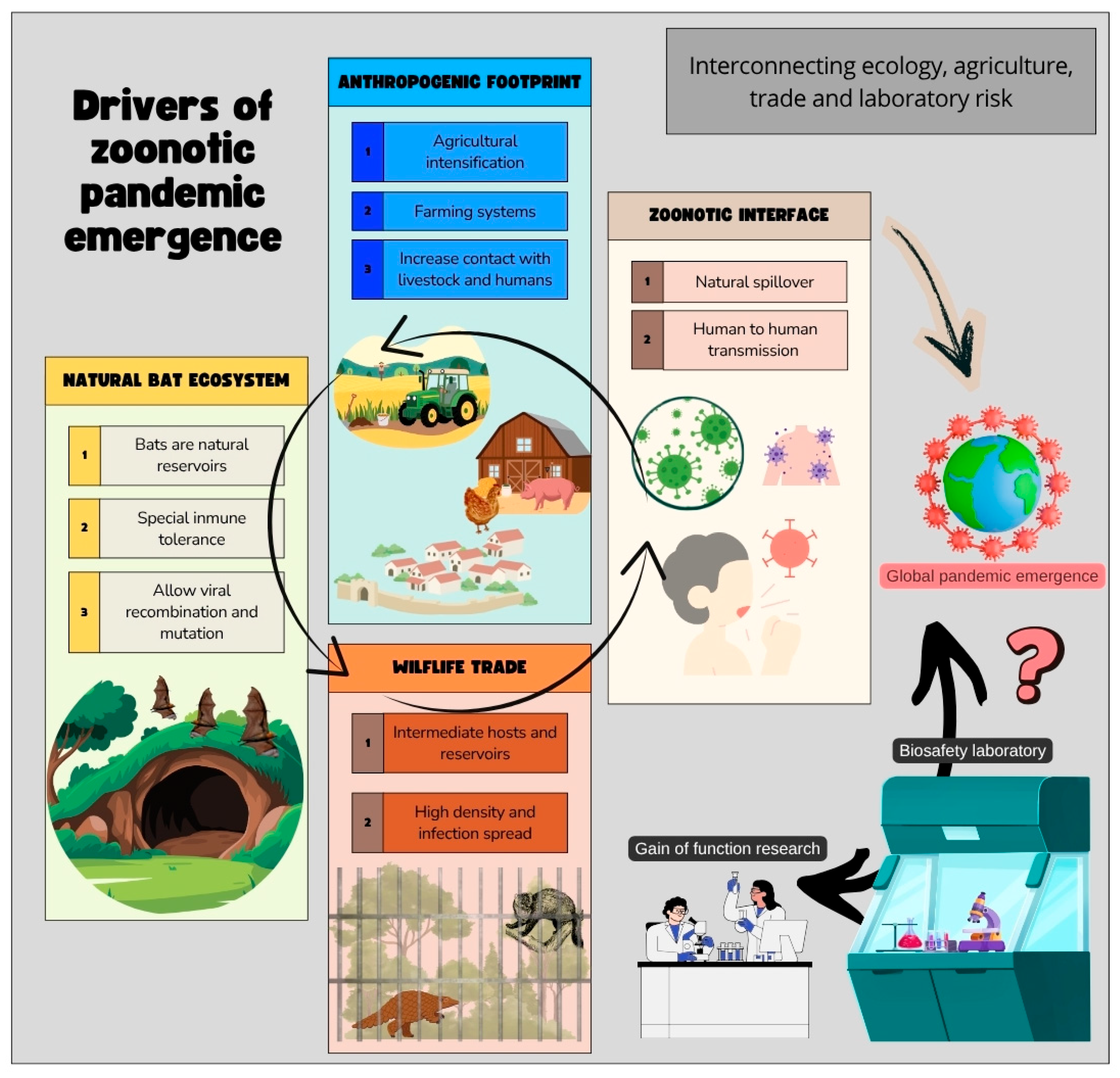

The Alleged Role of Bats in Successive Global Pandemics and Its Implications for Conservation


Abstract
1. Bats: A Group Facing Conservation Challenges and a Poor Reputation
2. Bats as Viral Reservoirs
3. The Role of Bats in Major Pandemics of the Twenty-First Century

| Outbreak/Disease | Viral Family (Genus) | Genetic Material | Proposed Reservoir (Long-Term Maintenance) | Proposed Host (Intermediate or Accidental) | Studies Supporting Zoonotic/Animal Origin | Studies Disputing Zoonotic Origins |
|---|---|---|---|---|---|---|
| Nipah Virus (NiV) Disease | Paramyxoviridae | -ssRNA | Fruit bats (Pteropus spp.) | Intermediate: Pigs Accidental: Humans. | [51,53,56,88] | - |
| SARS (SARS-CoV-1) | Coronaviridae (Betacoronavirus) | +ssRNA | Horseshoe bats (Rhinolophus sinicus). | Intermediate: Civets. Accidental: Humans. | [45,58,60] | - |
| MERS (MERS-CoV) | Coronaviridae (Betacoronavirus) | +ssRNA | Bats (Vespertilio superans and others). | Intermediate: Dromedary camels. Accidental: Humans. | [62,64,65,66,89] | - |
| Ebola (Ebola virus) | Filoviridae | -ssRNA | Fruit bats. | Intermediate: Non-human primates and forest antelopes. Accidental: Humans. | [47,68,70,90,91] | [92] |
| COVID-19 (SARS-CoV-2) | Coronaviridae (Betacoronavirus) | +ssRNA | Bats Rhinolophus sp. | Intermediate: Pangolins. Accidental: Humans. | [72,75,77,93,94,95,96,97,98,99] | [100,101,102,103,104,105,106,107,108] |
| Marburg (Marburg virus) | Filoviridae | -ssRNA | Egyptian fruit bat (Rousettus aegyptiacus). | Accidental: Humans. | [81,82,83] | - |
4. Ecological and Socio-Economic Drivers of Pandemic Emergence
5. Biosafety Risks and the Origins of COVID-19 Competing Scientific Theories
6. Conclusions and Future Directions
Author Contributions
Funding
Institutional Review Board Statement
Informed Consent Statement
Data Availability Statement
Conflicts of Interest
References
- Simmons, N.B.; Cirranello, A.L. Bat Species of the World: A Taxonomic and Geographic Database (Version 1.4); American Museum of Natural History: New York, NY, USA, 2023. [Google Scholar]
- Ramírez-Fráncel, L.A.; García-Herrera, L.V.; Losada-Prado, S.; Reinoso-Flórez, G.; Sánchez-Hernández, A.; Estrada-Villegas, S.; Lim, B.K.; Guevara, G. Bats and their vital ecosystem services: A global review. Integr. Zool. 2022, 17, 2–23. [Google Scholar] [PubMed]
- Kunz, T.H.; Braun de Torrez, E.; Bauer, D.; Lobova, T.; Fleming, T.H. Ecosystem services provided by bats. Ann. N. Y. Acad. Sci. 2011, 1223, 1–38. [Google Scholar] [CrossRef] [PubMed]
- Liu, Y.; Geng, Y.; Pan, Y.; Zeng, H.; Huang, Z.; Taylor, P.J.; Jiang, T. Climate-Driven Shifts in Bat Distributions Reveal Functional Reorganization and Spatial Mismatch Across Agroecosystems. Biology 2025, 14, 1528. [Google Scholar] [CrossRef] [PubMed]
- Boyles, J.G.; Cryan, P.M.; McCracken, G.F.; Kunz, T.H. Economic importance of bats in agriculture. Science 2011, 332, 41–42. [Google Scholar] [CrossRef] [PubMed]
- Fleming, T.H.; Geiselman, C.; Kress, W.J. The evolution of bat pollination: A phylogenetic perspective. Ann. Bot. 2009, 104, 1017–1043. [Google Scholar] [CrossRef] [PubMed]
- Mickleburgh, S.P.; Hutson, A.M.; Racey, P.A. A review of the global conservation status of bats. Oryx 2002, 36, 18–34. [Google Scholar] [CrossRef]
- Kingston, T. Cute, creepy, or crispy—How values, attitudes, and norms shape human behavior toward bats. In Bats in the Anthropocene: Conservation of Bats in a Changing World; Springer International Publishing: Cham, Switzerland, 2015; pp. 571–595. [Google Scholar]
- O’Shea, T.J.; Cryan, P.M.; Hayman, D.T.; Plowright, R.K.; Streicker, D.G. Multiple mortality events in bats: A global review. Mammal Rev. 2016, 46, 175–190. [Google Scholar] [CrossRef]
- Frick, W.F.; Kingston, T.; Flanders, J. A review of the major threats and challenges to global bat conservation. Ann. N. Y. Acad. Sci. 2020, 1469, 5–25. [Google Scholar] [PubMed]
- Bayat, S.; Geiser, F.; Kristiansen, P.; Wilson, S.C. Organic contaminants in bats: Trends and new issues. Environ. Int. 2014, 63, 40–52. [Google Scholar] [CrossRef] [PubMed]
- Blehert, D.S.; Hicks, A.C.; Behr, M.J.; Meteyer, C.U.; Berlowski-Zier, B.M.; Buckles, E.L.; Coleman, J.T.H.; Darling, S.R.; Gargas, A.; Niver, R.; et al. Bat white-nose syndrome: An emerging fungal pathogen? Science 2009, 323, 227. [Google Scholar] [CrossRef] [PubMed]
- Arnett, E.B.; Baerwald, E.F. Impacts of wind energy development on bats: Implications for conservation. In Bat Evolution, Ecology, and Conservation; Springer: New York, NY, USA, 2013; pp. 435–456. [Google Scholar]
- Balmori-de la Puente, A.; Balmori, A. Main Causes of Bat Mortality Obtained Through Admission to Rescue Centres. Diversity 2025, 17, 567. [Google Scholar] [CrossRef]
- Divljan, A.; Parry-Jones, K.; Eby, P. Deaths and injuries to Grey-headed Flying-foxes, Pteropus poliocephalus shot at an orchard near Sydney, New South Wales. Aust. Zool. 2011, 35, 698–710. [Google Scholar]
- Oleksy, R.Z.; Ayady, C.L.; Tatayah, V.; Jones, C.; Froidevaux, J.S.P.; Racey, P.A.; Jones, G. The impact of the Endangered Mauritian flying fox Pteropus niger on commercial fruit farms and the efficacy of mitigation. Oryx 2018, 55, 110–119. [Google Scholar] [CrossRef]
- Florens, F.B.V.; Baider, C. Mass-culling of a threatened island flying fox species failed to increase fruit growers’ profits and revealed gaps to be addressed for effective conservation. J. Nat. Conserv. 2019, 47, 58–64. [Google Scholar] [CrossRef]
- Tollington, S.; Kareemun, Z.; Augustin, A.; Lallchand, K.; Tatayah, V.; Zimmermann, A. Quantifying the damage caused by fruit bats to backyard lychee trees in Mauritius and evaluating the benefits of protective netting. PLoS ONE 2019, 14, e0220955. [Google Scholar] [CrossRef] [PubMed]
- Lunney, D.; Moon, C. Blind to bats? Traditional prejudices and today’s bad press render bats invisible to public consciousness. In Biology and Conservation of Australasian Bats; Royal Zoological Society of New South Wales: Mosman, Australia, 2011; pp. 44–63. [Google Scholar]
- Tuttle, M.D. The Secret Lives of Bats: My Adventures with the World’s Most Misunderstood Mammals; Houghton Mifflin Harcourt: Boston, MA, USA, 2015. [Google Scholar]
- Brown, N.; Escobar, L.E. A review of the diet of the common vampire bat (Desmodus rotundus) in the context of anthropogenic change. Mamm. Biol. 2023, 103, 433–453. [Google Scholar] [CrossRef]
- Rocke, T.; Streicker, D.; Leon, A. Management of vampire bats and rabies: Past, present, and future. In History of Rabies in the Americas: From the Pre-Columbian to the Present, Volume I: Insights to Specific Cross-Cutting Aspects of the Disease in the Americas; Springer International Publishing: Cham, Switzerland, 2023; pp. 199–222. [Google Scholar]
- Viana, M.; Benavides, J.A.; Broos, A.; Ibañez Loayza, D.; Niño, R.; Bone, J.; da Silva Filipe, A.; Orton, R.; Valderrama Bazan, W.; Matthiopoulos, J.; et al. Effects of culling vampire bats on the spatial spread and spillover of rabies virus. Sci. Adv. 2023, 9, eadd7437. [Google Scholar] [CrossRef] [PubMed]
- Ávila-Vargas, L.; Soler-Tovar, D.; Dong, Q.; Escobar, L.E. Anticoagulants for the control of the common vampire Bat (Desmodus rotundus). Zoonoses Public Health 2025, 72, 101–116. [Google Scholar] [PubMed]
- Guyton, J.A.; Brook, C.E. African bats: Conservation in the time of Ebola. Therya 2015, 6, 69–88. [Google Scholar] [CrossRef]
- Ejotre, I.; Reeder, D.M.; Matuschewski, K.; Kityo, R.; Schaer, J. Negative perception of bats, exacerbated by the SARS-CoV-2 pandemic, may hinder bat conservation in Northern Uganda. Sustainability 2022, 14, 16924. [Google Scholar] [CrossRef] [PubMed]
- Nanni, V.; Mammola, S.; Macías-Hernández, N.; Castrogiovanni, A.; Salgado, A.L.; Lunghi, E.; Ficetola, G.F.; Modica, C.; Alba, R.; Spiriti, M.M.; et al. Global response of conservationists across mass media likely constrained bat persecution due to COVID-19. Biol. Conserv. 2022, 272, 109591. [Google Scholar] [CrossRef] [PubMed]
- MacFarlane, D.; Rocha, R. Guidelines for communicating about bats to prevent persecution in the time of COVID-19. Biol. Conserv. 2020, 248, 108650. [Google Scholar] [CrossRef] [PubMed]
- Lu, M.; Wang, X.; Ye, H.; Wang, H.; Qiu, S.; Zhang, H.; Liu, Y.; Luo, J.; Feng, J. Does public fear that bats spread COVID-19 jeopardize bat conservation? Biol. Conserv. 2021, 257, 109104. [Google Scholar] [CrossRef]
- Letko, M.; Seifert, S.N.; Olival, K.J.; Plowright, R.K.; Munster, V.J. Bat-borne virus diversity, spillover and emergence. Nat. Rev. Microbiol. 2020, 18, 461–471. [Google Scholar] [CrossRef] [PubMed]
- Haydon, D.T.; Cleaveland, S.; Taylor, L.H.; Laurenson, M.K. Identifying reservoirs of infection: A conceptual and practical challenge. Emerg. Infect. Dis. 2002, 8, 1468–1473. [Google Scholar] [CrossRef] [PubMed]
- Ashford, R.W. When is a reservoir not a reservoir? Emerg. Infect. Dis. 2003, 9, 1495. [Google Scholar] [PubMed]
- Lloyd-Smith James, O.; George, D.; Pepin, K.M.; Pitzer, V.E.; Pulliam, J.R.C.; Dobson, A.P.; Hudson, P.J.; Grenfell, B.T. Epidemic dynamics at the human-animal interface. Science 2009, 326, 1362–1367. [Google Scholar] [CrossRef] [PubMed]
- Plowright Raina, K.; Parrish, C.R.; McCallum, H.; Hudson, P.J.; Ko, A.I.; Graham, A.L.; Lloyd-Smith, J.O. Pathways to zoonotic spillover. Nat. Rev. Microbiol. 2017, 15, 502–510. [Google Scholar] [CrossRef] [PubMed]
- Calisher Charles, H.; Childs, J.E.; Field, H.E.; Holmes, K.V.; Schountz, T. Bats: Important reservoir hosts of emerging viruses. Clin. Microbiol. Rev. 2006, 19, 531–545. [Google Scholar] [CrossRef] [PubMed]
- Wang, L.F.; Anderson, D.E. Viruses in bats and potential spillover to animals and humans. Curr. Opin. Virol. 2019, 34, 79–89. [Google Scholar] [CrossRef] [PubMed]
- Luis, A.D.; Hayman, D.T.S.; O’Shea, T.J.; Cryan, P.M.; Gilbert, A.T.; Pulliam, J.R.C.; Mills, J.N.; Timonin, M.E.; Willis, C.K.R.; Cunningham, A.A.; et al. A comparison of bats and rodents as reservoirs of zoonotic viruses: Are bats special? Proc. R. Soc. B Biol. Sci. 2013, 280, 20122753. [Google Scholar] [CrossRef]
- Brook, C.E.; Dobson, A.P. Bats as ‘special’reservoirs for emerging zoonotic pathogens. Trends Microbiol. 2015, 23, 172–180. [Google Scholar] [CrossRef] [PubMed]
- Banerjee, A.; Baker, M.L.; Kulcsar, K.; Misra, V.; Plowright, R.; Mossman, K. Novel insights into immune systems of bats. Front. Immunol. 2020, 11, 507886. [Google Scholar] [CrossRef]
- Hayman, D.T.S.; Bowen, R.A.; Cryan, P.M.; McCracken, G.F.; O’Shea, T.J.; Peel, A.J.; Gilbert, A.; Webb, C.T.; Wood, J.L.N. Ecology of zoonotic infectious diseases in bats: Current knowledge and future directions. Zoonoses Public Health 2013, 60, 2–21. [Google Scholar] [PubMed]
- Weller, T.J.; Castle, K.T.; Liechti, F.; Hein, C.D.; Schirmacher, M.R.; Cryan, P.M. First direct evidence of long-distance seasonal movements and hibernation in a migratory bat. Sci. Rep. 2016, 6, 34585. [Google Scholar] [CrossRef] [PubMed]
- Nabi, G.; Wang, Y.; Lü, L.; Jiang, C.; Ahmad, S.; Wu, Y.; Li, D. Bats and birds as viral reservoirs: A physiological and ecological perspective. Sci. Total Environ. 2021, 754, 142372. [Google Scholar] [CrossRef] [PubMed]
- Selvey, L.A.; Wells, R.M.; McCormack, J.G.; Ansford, A.J.; Murray, K.; Rogers, R.J.; Lavercombe, P.S.; Selleck, P.; Sheridan, J.W. Infection of humans and horses by a newly described morbillivirus. Med. J. Aust. 1995, 162, 642–644. [Google Scholar] [CrossRef] [PubMed]
- Chua, K.B.; Chua, B.H.; Wang, C.W. Anthropogenic deforestation, El Niiio and the emergence of Nipah virus in Malaysia. Malays. J. Pathol. 2002, 24, 15–21. [Google Scholar] [PubMed]
- Ge, X.Y.; Li, J.L.; Yang, X.L.; Chmura, A.A.; Zhu, G.; Epstein, J.H.; Mazet, J.K.; Hu, B.; Zhang, W.; Peng, C.; et al. Isolation and characterization of a bat SARS-like coronavirus that uses the ACE2 receptor. Nature 2013, 503, 535–538. [Google Scholar] [CrossRef] [PubMed]
- Nikolay, B.; Salje, H.; Hossain, M.J.; Khan, A.K.M.D.; Sazzad, H.M.S.; Rahman, M.; Daszak, P.; Ströher, U.; Pulliam, J.R.C.; Kilpatrick, A.M.; et al. Transmission of Nipah virus—14 years of investigations in Bangladesh. N. Engl. J. Med. 2019, 380, 1804–1814. [Google Scholar] [CrossRef] [PubMed]
- Leroy, E.M.; Kumulungui, B.; Pourrut, X.; Rouquet, P.; Hassanin, A.; Yaba, P.; Délicat, A.; Paweska, J.T.; Gonzalez, J.-P.; Swanepoel, R. Fruit bats as reservoirs of Ebola virus. Nature 2005, 438, 575–576. [Google Scholar] [CrossRef] [PubMed]
- O’Shea, T.J.; Cryan, P.M.; Cunningham, A.A.; Fooks, A.R.; Hayman, D.T.S.; Luis, A.D.; Peel, A.J.; Plowright, R.K.; Wood, J.L.N. Bat flight and zoonotic viruses. Emerg. Infect. Dis. 2014, 20, 741. [Google Scholar] [CrossRef] [PubMed]
- Field, H.E.; Mackenzie, J.S.; Daszak, P. Henipaviruses: Emerging paramyxoviruses associated with fruit bats. In Wildlife and Emerging Zoonotic Diseases: The Biology, Circumstances and Consequences of Cross-Species Transmission; Childs, J.E., Mackenzie, J.S., Richt, J.A., Eds.; Current Topics in Microbiology and Immunology; Springer: Berlin, Germany, 2007; Volume 315, pp. 133–159. [Google Scholar]
- Yob, J.M.; Field, H.; Rashdi, A.M.; Morrissy, C.; van der Heide, B.; Rota, P.; bin Adzhar, A.; White, J.; Daniels, P.; Jamaluddin, A.; et al. Nipah virus infection in bats (order Chiroptera) in peninsular Malaysia. Emerg. Infect. Dis. 2001, 7, 439. [Google Scholar] [CrossRef] [PubMed]
- Chua, K.B.; Bellini, W.J.; Rota, P.A.; Harcourt, B.H.; Tamin, A.; Lam, S.K.; Ksiazek, T.G.; Rollin, P.E.; Zaki, S.R.; Shieh, W.; et al. Nipah virus: A recently emergent deadly paramyxovirus. Science 2000, 288, 1432–1435. [Google Scholar] [CrossRef] [PubMed]
- Breed, A.C.; Field, H.E.; Epstein, J.H.; Daszak, P. Emerging henipaviruses and flying foxes: Conservation and management perspectives. Biol. Conserv. 2006, 143, 2249–2260. [Google Scholar]
- Luby, S.P. The pandemic potential of Nipah virus. Antivir. Res. 2013, 100, 38–43. [Google Scholar] [CrossRef] [PubMed]
- Arankalle, V.A.; Bandyopadhyay, B.T.; Ramdasi, A.Y.; Jadi, R.; Patil, D.R.; Rahman, M.; Majumdar, M.; Banerjee, P.S.; Hati, A.K.; Goswami, R.P.; et al. Genomic characterization of Nipah virus, West Bengal, India. Emerg. Infect. Dis. 2011, 17, 907–909. [Google Scholar] [CrossRef] [PubMed]
- World Health Organization. Nipah Virus (NiV). Available online: https://www.who.int/news-room/fact-sheets/detail/nipah-virus (accessed on 26 September 2023).
- Epstein, J.H.; Field, H.E.; Luby, S.; Pulliam, J.R.; Daszak, P. Nipah virus: Impact, origins, and causes of emergence. Curr. Infect. Dis. Rep. 2006, 8, 59–65. [Google Scholar] [CrossRef] [PubMed]
- Ksiazek, T.G.; Erdman, D.; Goldsmith, C.S.; Zaki, S.R.; Peret, T.; Emery, S.; Tong, S.; Urbani, C.; Comer, J.A.; Lim, W.; et al. A novel coronavirus associated with severe acute respiratory syndrome. N. Engl. J. Med. 2003, 348, 1953–1966. [Google Scholar] [CrossRef] [PubMed]
- Li, W.; Shi, Z.; Yu, M.; Ren, W.; Smith, C.; Epstein, J.H.; Wang, H.; Crameri, G.; Hu, Z.; Zhang, H.; et al. Bats are natural reservoirs of SARS-like coronaviruses. Science 2005, 310, 676–679. [Google Scholar] [CrossRef] [PubMed]
- Lau, S.K.P.; Woo, P.C.Y.; Li, K.S.M.; Huang, Y.; Tsoi, H.W.; Wong, B.H.L.; Wong, S.S.Y.; Leung, S.Y.; Chan, K.H.; Yuen, K.Y. Severe acute respiratory syndrome coronavirus-like virus in Chinese horseshoe bats. Proc. Natl. Acad. Sci. USA 2005, 102, 14040–14045. [Google Scholar] [CrossRef] [PubMed]
- Peiris, J.S.M.; Lai, S.T.; Poon, L.L.M.; Guan, Y.; Yam, L.Y.C.; Lim, W.; Nicholls, J.; Yee, W.K.S.; Yan, W.W.; Cheung, M.T.; et al. Coronavirus as a possible cause of severe acute respiratory syndrome. Lancet 2003, 361, 1319–1325. [Google Scholar] [CrossRef] [PubMed]
- Zaki, A.M.; Van Boheemen, S.; Bestebroer, T.M.; Osterhaus, A.D.; Fouchier, R.A. Isolation of a novel coronavirus from a man with pneumonia in Saudi Arabia. N. Engl. J. Med. 2012, 367, 1814–1820. [Google Scholar] [CrossRef] [PubMed]
- Memish, Z.A.; Mishra, N.; Olival, K.J.; Fagbo, S.F.; Kapoor, V.; Epstein, J.H.; AlHakeem, R.; Durosinloun, A.; Al Asmari, M.; Islam, A.; et al. Middle East respiratory syndrome coronavirus in bats, Saudi Arabia. Emerg. Infect. Dis. 2013, 19, 1819. [Google Scholar] [CrossRef] [PubMed]
- Azhar, E.I.; El-Kafrawy, S.A.; Farraj, S.A.; Hassan, A.M.; Al-Saeed, M.S.; Hashem, A.M.; Madani, T.A. Evidence for camel-to-human transmission of MERS coronavirus. N. Engl. J. Med. 2014, 370, 2499–2505. [Google Scholar] [PubMed]
- Corman, V.M.; Ithete, N.L.; Richards, L.R.; Schoeman, M.C.; Preiser, W.; Drosten, C.; Drexler, J.F. Rooting the phylogenetic tree of middle East respiratory syndrome coronavirus by characterization of a conspecific virus from an African bat. J. Virol. 2014, 88, 11297–11303. [Google Scholar] [CrossRef] [PubMed]
- Yang, L.; Wu, Z.; Ren, X.; Yang, F.; Zhang, J.; He, G.; Dong, J.; Sun, L.; Zhu, Y.; Zhang, S.; et al. MERS–related betacoronavirus in Vespertilio superans bats, China. Emerg. Infect. Dis. 2014, 20, 1260–1262. [Google Scholar] [CrossRef] [PubMed]
- Zumla, A.; Hui, D.S.; Perlman, S. Middle East Respiratory Syndrome. Lancet 2015, 386, 995–1007. [Google Scholar] [CrossRef] [PubMed]
- World Health Organization. Middle East Respiratory Syndrome Coronavirus (MERS-CoV). 2025. Available online: https://www.who.int/news-room/fact-sheets/detail/middle-east-respiratory-syndrome-coronavirus-(mers-cov) (accessed on 6 February 2026).
- Pigott, D.M.; Golding, N.; Mylne, A.; Huang, Z.; Henry, A.J.; Weiss, D.J.; Brady, O.J.; Kraemer, M.U.G.; Smith, D.L.; Moyes, C.L.; et al. Mapping the zoonotic niche of Ebola virus disease in Africa. eLife 2014, 3, e04395. [Google Scholar] [CrossRef] [PubMed]
- Leendertz, S.A.J.; Gogarten, J.F.; Düx, A.; Calvignac-Spencer, S.; Leendertz, F.H. Assessing the evidence supporting fruit bats as the primary reservoirs for Ebola viruses. EcoHealth 2016, 13, 18–25. [Google Scholar] [PubMed]
- Jacobsen, K.H.; Aguirre, A.A.; Bailey, C.L.; Baranova, A.V.; Crooks, A.T.; Croitoru, A.; Delamater, P.L.; Gupta, J.; Kehn-Hall, K.; Narayanan, A.; et al. Lessons from the Ebola outbreak: Action items for emerging infectious disease preparedness and response. EcoHealth 2016, 13, 200–212. [Google Scholar] [CrossRef] [PubMed]
- World Health Organization. Ebola Virus Disease Situation Report. 2016. Available online: https://apps.who.int/iris/handle/10665/208883 (accessed on 10 June 2016).
- Zhou, P.; Yang, X.-L.; Wang, X.-G.; Hu, B.; Zhang, L.; Zhang, W.; Si, H.-R.; Zhu, Y.; Li, B.; Huang, C.-L.; et al. A pneumonia outbreak associated with a new coronavirus of probable bat origin. Nature 2020, 579, 270–273. [Google Scholar] [CrossRef] [PubMed]
- Corman, V.M.; Landt, O.; Kaiser, M.; Molenkamp, R.; Meijer, A.; Chu, D.K.; Bleicker, T.; Brünink, S.; Schneider, J.; Schmidt, M.L.; et al. Detection of 2019 novel coronavirus (2019-nCoV) by real-time RT-PCR. Eurosurveillance 2020, 25, 2000045. [Google Scholar] [CrossRef] [PubMed]
- Liu, K.; Pan, X.; Li, L.; Yu, F.; Zheng, A.; Du, P.; Han, P.; Meng, Y.; Zhang, Y.; Wu, L.; et al. Binding and molecular basis of the bat coronavirus RaTG13 virus to ACE2 in humans and other species. Cell 2021, 184, 3438–3451. [Google Scholar] [CrossRef] [PubMed]
- Temmam, S.; Vongphayloth, K.; Baquero, E.; Munier, S.; Bonomi, M.; Regnault, B.; Douangboubpha, B.; Karami, Y.; Chrétien, D.; Sanamxay, D.; et al. Bat coronaviruses related to SARS-CoV-2 and infectious for human cells. Nature 2022, 604, 330–336. [Google Scholar] [CrossRef] [PubMed]
- Lam, T.T.Y.; Jia, N.; Zhang, Y.W.; Shum, M.H.H.; Jiang, J.F.; Zhu, H.C.; Tong, Y.G.; Shi, Y.X.; Ni, X.B.; Liao, Y.S.; et al. Identifying SARS-CoV-2-related coronaviruses in Malayan pangolins. Nature 2020, 583, 282–285. [Google Scholar] [CrossRef] [PubMed]
- Liu, P.; Jiang, J.Z.; Wan, X.F.; Hua, Y.; Li, L.; Zhou, J.; Wang, X.; Hou, F.; Chen, J.; Zou, J.; et al. Are pangolins the intermediate host of the 2019 novel coronavirus (SARS-CoV-2)? PLoS Pathog. 2020, 16, e1008421. [Google Scholar] [CrossRef] [PubMed]
- World Health Organization. West Africa’s First-Ever Case of Marburg Virus Disease Confirmed in Guinea. 2021. Available online: https://www.afro.who.int/news/west-africas-first-ever-case-marburg-virus-disease-confirmed-guinea (accessed on 10 April 2026).
- World Health Organization. Marburg Virus Disease—Equatorial Guinea and the United Republic of Tanzania (Disease Outbreak News). 2023. Available online: https://www.who.int/emergencies/disease-outbreak-news/item/2023-DON467 (accessed on 10 April 2026).
- World Health Organization. Marburg Virus Disease. 2024. Available online: https://www.who.int/news-room/fact-sheets/detail/marburg-virus-disease (accessed on 10 April 2026).
- Towner, J.S.; Amman, B.R.; Sealy, T.K.; Carroll, S.A.R.; Comer, J.A.; Kemp, A.; Swanepoel, R.; Paddock, C.D.; Balinandi, S.; Khristova, M.L.; et al. Isolation of genetically diverse Marburg viruses from Egyptian fruit bats. PLoS Pathog. 2009, 5, e1000536. [Google Scholar] [CrossRef] [PubMed]
- Pawęska, J.T.; Storm, N.; Grobbelaar, A.A.; Markotter, W.; Kemp, A.; Jansen van Vuren, P.; Nel, L.H. Shedding of Marburg virus in naturally infected Egyptian fruit bats. Emerg. Infect. Dis. 2020, 26, 3051–3053. [Google Scholar] [PubMed]
- Chakraborty, S.; Chandran, D.; Mohapatra, R.K.; Alagawany, M.; Yatoo, M.I.; Islam, M.A.; Sharma, A.; Dhama, K. Marburg virus disease-a mini-review. J. Exp. Biol. Agric. Sci. 2022, 10, 689–696. [Google Scholar]
- Bokelmann, M.; Vogel, U.; Debeljak, F.; Düx, A.; Riesle-Sbarbaro, S.; Lander, A.; Wahlbrink, A.; Kromarek, N.; Neil, S.; Couacy-Hymann, E.; et al. Tolerance and persistence of Ebola virus in primary cells from Mops condylurus, a potential Ebola virus reservoir. Viruses 2021, 13, 2186. [Google Scholar] [CrossRef] [PubMed]
- Marí Saéz, A.; Weiss, S.; Nowak, K.; Lapeyre, V.; Zimmermann, F.; Düx, A.; Kühl, H.S.; Kaba, M.; Regnaut, S.; Merkel, K.; et al. Investigating the zoonotic origin of the West African Ebola epidemic. EMBO Mol. Med. 2015, 7, 17–23. [Google Scholar] [PubMed]
- López-Baucells, A.; Rocha, R.; Fernández-Llamazares, Á. When bats go viral: Negative framings in virological research imperil bat conservation. Mammal. Rev. 2018, 48, 62–66. [Google Scholar]
- Johnson, C.K.; Hitchens, P.L.; Pandit, P.S.; Rushmore, J.; Evans, T.S.; Young, C.C.; Doyle, M.M. Global shifts in mammalian population trends reveal key predictors of virus spillover risk. Proc. R. Soc. B Biol. Sci. 2020, 287, 20192736. [Google Scholar] [CrossRef]
- Eaton, B.T.; Broder, C.C.; Wang, L.F. Hendra and Nipah viruses: Pathogenesis and therapeutics. Curr. Mol. Med. 2005, 5, 805–816. [Google Scholar] [CrossRef] [PubMed]
- Hemida, M.G.; Chu, D.K.W.; Poon, L.L.M.; Perera, R.A.P.M.; Alhammadi, M.A.; Ng, H.-y.; Siu, L.Y.; Guan, Y.; Alnaeem, A.; Peiris, M. MERS coronavirus in dromedary camel herd, Saudi Arabia. Emerg. Infect. Dis. 2014, 20, 1231. [Google Scholar] [CrossRef] [PubMed]
- Gire, S.K.; Goba, A.; Andersen, K.G.; Sealfon, R.S.; Park, D.J.; Kanneh, L.; Jalloh, S.; Momoh, M.; Fullah, M.; Dudas, G.; et al. Genomic surveillance elucidates Ebola virus origin and transmission during the 2014 outbreak. Science 2014, 345, 1369–1372. [Google Scholar] [CrossRef] [PubMed]
- De Nys, H.M.; Kingebeni, P.M.; Keita, A.K.; Butel, C.; Thaurignac, G.; Villabona-Arenas, C.-J.; Lemarcis, T.; Geraerts, M.; Vidal, N.; Esteban, A.; et al. Survey of Ebola viruses in frugivorous and insectivorous bats in Guinea, Cameroon, and the Democratic Republic of the Congo, 2015–2017. Emerg. Infect. Dis. 2018, 24, 2228. [Google Scholar] [CrossRef] [PubMed]
- Blacksell, S.D.; Dhawan, S.; Kusumoto, M.; Le, K.K.; Summermatter, K.; O’Keefe, J.; Kozlovac, J.P.; Almuhairi, S.S.; Sendow, I.; Scheel, C.M.; et al. Laboratory-acquired infections and pathogen escapes worldwide between 2000 and 2021: A scoping review. Lancet Microbe 2024, 5, e194–e202. [Google Scholar] [PubMed]
- Andersen, K.G.; Rambaut, A.; Lipkin, W.I.; Holmes, E.C.; Garry, R.F. The proximal origin of SARS-CoV-2. Nat. Med. 2020, 26, 450–452. [Google Scholar] [CrossRef] [PubMed]
- Rulli, M.C.; D’Odorico, P.; Galli, N.; Hayman, D.T. Land-use change and the livestock revolution increase the risk of zoonotic coronavirus transmission from rhinolophid bats. Nat. Food 2021, 2, 409–416. [Google Scholar] [CrossRef] [PubMed]
- Hassanin, A.; Grandcolas, P.; Veron, G. Covid-19: Natural or anthropic origin? Mammalia 2021, 85, 1–7. [Google Scholar]
- Hao, Y.J.; Wang, Y.L.; Wang, M.Y.; Zhou, L.; Shi, J.Y.; Cao, J.M.; Wang, D.P. The origins of COVID-19 pandemic: A brief overview. Transbound. Emerg. Dis. 2022, 69, 3181–3197. [Google Scholar] [PubMed]
- Ruiz-Aravena, M.; McKee, C.; Gamble, A.; Lunn, T.; Morris, A.; Snedden, C.E.; Yinda, C.K.; Port, J.R.; Buchholz, D.W.; Yeo, Y.Y.; et al. Ecology, evolution and spillover of coronaviruses from bats. Nat. Rev. Microbiol. 2022, 20, 299–314. [Google Scholar] [CrossRef] [PubMed]
- Sánchez, C.A.; Li, H.; Phelps, K.L.; Zambrana-Torrelio, C.; Wang, L.-F.; Zhou, P.; Shi, Z.-L.; Olival, K.J.; Daszak, P. A strategy to assess spillover risk of bat SARS-related coronaviruses in Southeast Asia. Nat. Commun. 2022, 13, 4380. [Google Scholar] [PubMed]
- Latinne, A.; Hu, B.; Olival, K.J.; Zhu, G.; Zhang, L.; Li, H.; Chmura, A.A.; Field, H.E.; Zambrana-Torrelio, C.; Epstein, J.H.; et al. Origin and cross-species transmission of bat coronaviruses in China. Nat. Commun. 2024, 15, 10705. [Google Scholar] [CrossRef] [PubMed]
- US Office of the Director of National Intelligence (ODNI). Updated Assessment on COVID-19 Origins. Available online: https://www.dni.gov/files/ODNI/documents/assessments/Declassified-Assessment-on-COVID-19-Origins.pdf (accessed on 29 October 2021).
- US Senate Committee on Health Education Labor Pensions Minority Oversight Staff. An Analysis of the Origins of the COVID-19 Pandemic, Interim Report. Available online: https://www.help.senate.gov/imo/media/doc/report_an_analysis_of_the_origins_of_covid-19_102722.pdf (accessed on 27 October 2022).
- Relman, D.A. Opinion: To stop the next pandemic, we need to unravel the origins of COVID-19. Proc. Natl. Acad. Sci. USA 2020, 117, 29246–29248. [Google Scholar] [CrossRef] [PubMed]
- Frutos, R.; Serra-Cobo, J.; Chen, T.; Devaux, C.A. COVID-19: Time to exonerate the pangolin and bats and identify the real viral culprits. Viruses 2021, 13, 744. [Google Scholar] [CrossRef]
- Bloom, J.D.; Chan, Y.A.; Baric, R.S.; Bjorkman, P.J.; Cobey, S.; Deverman, B.E.; Fisman, D.N.; Gupta, R.; Iwasaki, A.; Lipsitch, M.; et al. Investigate the origins of COVID-19. Science 2021, 372, 694. [Google Scholar] [CrossRef] [PubMed]
- Maxmen, A.; Mallapaty, S. The COVID lab-leak hypothesis: What scientists do and don’t know. Nature 2021, 594, 313–315. [Google Scholar] [CrossRef] [PubMed]
- Thacker, P.D. The COVID-19 lab leak hypothesis: Did the media fall victim to a misinformation campaign? BMJ 2021, 374, n1656. [Google Scholar] [CrossRef] [PubMed]
- Segreto, R.; Deigin, Y.; McCairn, K.; Sousa, A.; Sirotkin, D.; Sirotkin, K.; Couey, J.J.; Jones, A.; Zhang, D. Should we discount the laboratory origin of COVID-19? Environ. Chem. Lett. 2021, 19, 2743–2757. [Google Scholar] [CrossRef] [PubMed]
- Sachs, J.D.; Karim, S.S.A.; Aknin, L.; Allen, J.; Brosbøl, K.; Colombo, F.; Barron, G.C.; Espinosa, M.F.; Gaspar, V.; Gaviria, A.; et al. The Lancet Commission on lessons for the future from the COVID-19 pandemic. Lancet 2022, 400, 1224–1280. [Google Scholar] [CrossRef] [PubMed]
- Jones, K.E.; Patel, N.G.; Levy, M.A.; Storeygard, A.; Balk, D.; Gittleman, J.L.; Daszak, P. Global trends in emerging infectious diseases. Nature 2008, 451, 990–993. [Google Scholar] [CrossRef] [PubMed]
- Allen, T.; Murray, K.A.; Zambrana-Torrelio, C.; Morse, S.S.; Rondinini, C.; Di Marco, M.; Breit, N.; Olival, K.J.; Daszak, P. Global hotspots and correlates of emerging zoonotic diseases. Nat. Commun. 2017, 8, 1124. [Google Scholar] [CrossRef] [PubMed]
- Pike, B.L.; Saylors, K.E.; Fair, J.N.; LeBreton, M.; Tamoufe, U.; Djoko, C.F.; Rimoin, A.W.; Wolfe, N.D. The origin and prevention of pandemics. Clin. Infect. Dis. 2010, 50, 1636–1640. [Google Scholar] [CrossRef] [PubMed]
- Frutos, R.; Lopez Roig, M.; Serra-Cobo, J.; Devaux, C.A. COVID-19: The conjunction of events leading to the coronavirus pandemic and lessons to learn for future threats. Front. Med. 2020, 7, 223. [Google Scholar] [CrossRef]
- Keesing, F.; Belden, L.K.; Daszak, P.; Dobson, A.; Harvell, C.D.; Holt, R.D.; Hudson, P.; Jolles, A.; Jones, K.E.; Mitchell, C.E.; et al. Impacts of biodiversity on the emergence and transmission of infectious diseases. Nature 2010, 468, 647–652. [Google Scholar] [CrossRef] [PubMed]
- Khalil, H.; Ecke, F.; Evander, M.; Magnusson, M.; Hörnfeldt, B. Declining ecosystem health and the dilution effect. Sci. Rep. 2016, 6, 31314. [Google Scholar] [CrossRef] [PubMed]
- Plowright, R.K.; Foley, P.; Field, H.E.; Dobson, A.P.; Foley, J.E.; Eby, P.; Daszak, P. Urban habituation, ecological connectivity and epidemic dampening: The emergence of Hendra virus from flying foxes (Pteropus spp.). Proc. R. Soc. B Biol. Sci. 2011, 278, 3703–3712. [Google Scholar] [CrossRef]
- Ostfeld, R.S.; Keesing, F. Biodiversity series: The function of biodiversity in the ecology of vector-borne zoonotic diseases. Can. J. Zool. 2000, 78, 2061–2078. [Google Scholar] [CrossRef]
- Civitello, D.J.; Cohen, J.; Fatima, H.; Halstead, N.T.; Liriano, J.; McMahon, T.A.; Ortega, C.N.; Sauer, E.L.; Sehgal, T.; Young, S.; et al. Biodiversity inhibits parasites: Broad evidence for the dilution effect. Proc. Natl. Acad. Sci. USA 2015, 112, 8667–8671. [Google Scholar] [CrossRef] [PubMed]
- Platto, S.; Zhou, J.; Wang, Y.; Wang, H.; Carafoli, E. Biodiversity loss and COVID-19 pandemic: The role of bats in the origin and the spreading of the disease. Biochem. Biophys. Res. Commun. 2021, 538, 2–13. [Google Scholar] [CrossRef] [PubMed]
- Cummings, C.A.; Vicente-Santos, A.; Carlson, C.J.; Becker, D.J. Viral epidemic potential is not uniformly distributed across the bat phylogeny. Commun. Biol. 2025, 8, 1510. [Google Scholar] [CrossRef] [PubMed]
- Gippet, J.M.; Carlson, C.J.; Klaftenberger, T.; Schweizer, M.; Eskew, E.A.; Gore, M.L.; Bertelsmeier, C. Wildlife trade drives animal-to-human pathogen transmission over 40 years. Science 2026, 392, 178–182. [Google Scholar] [CrossRef] [PubMed]
- Cox-Witton, K.; Baker, M.L.; Edson, D.; Peel, A.J.; Welbergen, J.A.; Field, H. Risk of SARS-CoV-2 transmission from humans to bats–An Australian assessment. One Health 2021, 13, 100247. [Google Scholar] [CrossRef] [PubMed]
- Muluneh, A.G.; Moa, A.; Lim, S.; MacIntyre, C.R. Mapping biosafety level 3 (BSL-3) and BSL-4 laboratories for public health threats reduction. J. Public Health 2025, 1–13. [Google Scholar] [CrossRef]
- Selgelid, M.J. Gain-of-function research: Ethical analysis. Sci. Eng. Ethics 2016, 22, 923–964. [Google Scholar] [CrossRef] [PubMed]
- Resnik, D.B. Biosafety, biosecurity, and bioethics. Monash Bioeth. Rev. 2024, 42, 137–167. [Google Scholar] [CrossRef] [PubMed]
- Giordano, J.; DiEuliis, D. Dual use and gain-of-function research: A significant endeavor with biosecurity imperatives. MSphere 2025, 10, e00289-25. [Google Scholar] [CrossRef] [PubMed]
- Venter, M.; Manuguerra, J.C.; Watson, J.M.; Fischer, T.K.; Blacksell, S.D.; Summermatter, K.; Damon, I.K.; Drosten, C.; Alviola, P.; Assiri, A.; et al. COVID’s origins: What we do and don’t know. Nature 2026, 650, 829–833. [Google Scholar] [CrossRef] [PubMed]
- Menachery, V.D.; Yount, B.L.; Sims, A.C.; Debbink, K.; Agnihothram, S.S.; Gralinski, L.E.; Graham, R.L.; Scobey, T.; Plante, J.A.; Royal, S.R.; et al. SARS-like WIV1-CoV poised for human emergence. Proc. Natl. Acad. Sci. USA 2016, 113, 3048–3053. [Google Scholar] [CrossRef] [PubMed]
- Hoffmann, M.; Kleine-Weber, H.; Schroeder, S.; Krüger, N.; Herrler, T.; Erichsen, S.; Schiergens, T.S.; Herrler, G.; Wu, N.-H.; Nitsche, A.; et al. SARS-CoV-2 cell entry depends on ACE2 and TMPRSS2 and is blocked by a clinically proven protease inhibitor. Cell 2020, 181, 271–280. [Google Scholar] [CrossRef] [PubMed]
- Cohen, J. Virologist accused of starting COVID-19 fights funding ban. Science 2026, 392, 795. [Google Scholar] [CrossRef] [PubMed]
- Barbier, E.B. Habitat loss and the risk of disease outbreak. J. Environ. Econ. Manag. 2021, 108, 102451. [Google Scholar] [CrossRef]
- Borham, A.; Abdel Motaal, K.; ElSersawy, N.; Ahmed, Y.F.; Mahmoud, S.; Musaibah, A.S.; Abdelnaser, A. Climate change and zoonotic disease outbreaks: Emerging evidence from epidemiology and toxicology. Int. J. Environ. Res. Public Health 2025, 22, 883. [Google Scholar] [CrossRef] [PubMed]
- Khujanazarov, I.; Tursunov, M.; Nurova, S.; Musayeva, S.; Urazbaeva, D. Investigating the Epidemiology of Zoonotic Diseases and their Implications for Public Health Systems and Disease Control. J. Anim. Environ. 2025, 17, 269–282. [Google Scholar] [CrossRef]
- Han, B.A.; Schmidt, J.P.; Bowden, S.E.; Drake, J.M. Rodent reservoirs of future zoonotic diseases. Proc. Natl. Acad. Sci. USA 2015, 112, 7039–7044. [Google Scholar] [CrossRef] [PubMed]
- Olival, K.J.; Hosseini, P.R.; Zambrana-Torrelio, C.; Ross, N.; Bogich, T.L.; Daszak, P. Host and viral traits predict zoonotic spillover from mammals. Nature 2017, 546, 646–650. [Google Scholar] [CrossRef] [PubMed]
- Karesh, W.B.; Cook, R.A.; Bennett, E.L.; Newcomb, J. Wildlife trade and global disease emergence. Emerg. Infect. Dis. 2005, 11, 1000. [Google Scholar] [CrossRef] [PubMed]
- Smith, K.M.; Anthony, S.J.; Switzer, W.M.; Epstein, J.H.; Seimon, T.; Jia, H.; Sanchez, M.D.; Huynh, T.T.; Galland, G.G.; Shapiro, S.E.; et al. Zoonotic viruses associated with illegally imported wildlife products. PLoS ONE 2012, 7, e29505. [Google Scholar] [CrossRef] [PubMed]
- Martínez, V.P.; Di Paola, N.; Alonso, D.O.; Pérez-Sautu, U.; Bellomo, C.M.; Iglesias, A.A.; Coelho, R.M.; López, B.; Periolo, N.; Larson, P.A.; et al. “Super-spreaders” and person-to-person transmission of Andes virus in Argentina. N. Engl. J. Med. 2020, 383, 2230–2241. [Google Scholar] [CrossRef] [PubMed]
- Toledo, J.; Haby, M.M.; Reveiz, L.; Sosa Leon, L.; Angerami, R.; Aldighieri, S. Evidence for human-to-human transmission of hantavirus: A systematic review. J. Infect. Dis. 2022, 226, 1362–1371. [Google Scholar] [PubMed]
- Imperiale, M.J.; Casadevall, A. Rethinking gain-of-function experiments in the context of the COVID-19 pandemic. MBio 2020, 11, 10–1128. [Google Scholar] [CrossRef]
- Soto-López, J.D.; García-Martín, J.M.; Lizana-Ciudad, D.; Lizana, M.; Hernández-Tabernero, L.; Fernández-Soto, P.; Velásquez-González, O.E.; Aragón, S.L.; Belhassen-García, M.; Muro, A. Taxonomic and functional profiling of bat guano microbiota from hiking trail-associated tunnels: A potential risk for human health? Environ. Microbiome 2025, 20, 123. [Google Scholar] [CrossRef] [PubMed]
- Bat Conservation International. Our Work for Bat Conservation. 2026. Available online: https://www.batcon.org/our-work/ (accessed on 5 June 2026).
- Bat Conservation International. Bats & Wind Energy. 2026. Available online: https://www.batcon.org/our-work/research-and-scalable-solutions/wind-energy/ (accessed on 5 June 2026).
- Renewable Energy Wildlife Institute. Making Wind Energy Safer for Bats: Wind-Wildlife Success Stories. 2026. Available online: https://rewi.org/news-events/success-stories/success-story-bats/ (accessed on 5 June 2026).

Disclaimer/Publisher’s Note: The statements, opinions and data contained in all publications are solely those of the individual author(s) and contributor(s) and not of MDPI and/or the editor(s). MDPI and/or the editor(s) disclaim responsibility for any injury to people or property resulting from any ideas, methods, instructions or products referred to in the content. |
© 2026 by the authors. Licensee MDPI, Basel, Switzerland. This article is an open access article distributed under the terms and conditions of the Creative Commons Attribution (CC BY) license.
Share and Cite
Balmori, A.; Balmori-de la Puente, A. The Alleged Role of Bats in Successive Global Pandemics and Its Implications for Conservation. Conservation 2026, 6, 80. https://doi.org/10.3390/conservation6030080
Balmori A, Balmori-de la Puente A. The Alleged Role of Bats in Successive Global Pandemics and Its Implications for Conservation. Conservation. 2026; 6(3):80. https://doi.org/10.3390/conservation6030080
Chicago/Turabian StyleBalmori, Alfonso, and Alfonso Balmori-de la Puente. 2026. "The Alleged Role of Bats in Successive Global Pandemics and Its Implications for Conservation" Conservation 6, no. 3: 80. https://doi.org/10.3390/conservation6030080
APA StyleBalmori, A., & Balmori-de la Puente, A. (2026). The Alleged Role of Bats in Successive Global Pandemics and Its Implications for Conservation. Conservation, 6(3), 80. https://doi.org/10.3390/conservation6030080