Article

Modelling the Present and Future Distribution of Vormela peregusna in the Westernmost Part of Its Range—Relevance for Conservation in the Face of Climate Change


1
Institute of Biodiversity and Ecosystem Research, Bulgarian Academy of Sciences, 1 Tsar Osvoboditel Blvd, 1000 Sofia, Bulgaria
2
Faculty of Biology, Sofia University “St. Kliment Ohridski”, 8 Dragan Tsankov Blvd, 1164 Sofia, Bulgaria
*
Author to whom correspondence should be addressed.
Conservation 2026, 6(2), 41; https://doi.org/10.3390/conservation6020041
Submission received: 30 January 2026 / Revised: 19 March 2026 / Accepted: 25 March 2026 / Published: 2 April 2026

Abstract

Our knowledge of the marbled polecat (Vormela peregusna), a vulnerable mustelid species, is inadequate and fragmentary. Developing effective conservation strategies is significantly hampered by a lack of information on its distribution and preferred habitats. This research uses 77 recent species’ presence records to model its current distribution and predict its near-future distribution across a significant part of its European range under two climate change scenarios. Regions characterized by arid conditions and low elevations exhibit the highest suitability, but intensive agriculture causes habitat degradation and fragmentation across significant portions of these areas. Under the moderate future climate scenario (SSP2-4.5), the model predicts an increase in suitability across extensive parts of hilly areas, alongside a reduction in regions such as the sub-Mediterranean zones. This change is mainly attributable to rising winter temperatures. The pessimistic scenario (SSP5-8.5) forecasts a considerable decline in suitability, driven by anticipated high summer temperatures and changes in precipitation patterns. The territories crucial for the prolonged preservation of V. peregusna in the Balkans and the importance of preserving landscape heterogeneity in agricultural areas were highlighted. The resulting distribution predictions provide useful information to assist in the development of region-specific measures for better monitoring and conservation of the marbled polecat.

1. Introduction

The escalating climate crisis is fundamentally destabilizing the complex ecosystems that support life on Earth, making climate change one of the most significant challenges that humankind has ever faced. Studies have already documented responses in plant and animal species to recent climate trends [1,2,3]. Many investigations report shifts in species distributions and alterations in ecological patterns [4,5,6]. In Europe, many investigations report current or projected extinction, population decline, reduction, and/or range shifts in many mammalian species due to climate change [7,8,9,10,11]. Understanding potential ecological responses to a rapidly changing environment is crucial for enacting effective conservation policies [12]. In this regard, modelling species distributions under various future climate scenarios is a promising tool [13]. However, it faces many difficulties, one of the most common being a lack of source data on the modern distribution of some taxa. Moreover, developing reliable models for wide-ranging species is particularly problematic, as in many cases they have much broader climatic niches than those inferred from models based on limited available data [8]. A typical example is the marbled polecat (Vormela peregusna Guldenstaedt, 1770), a mustelid species distributed from the western part of Southeast Europe to northern China and eastern Mongolia [14]. As a rare small carnivore with a cryptic lifestyle, it could be classified as one of the least-studied mammals in Europe. Negative trends in the population (number and distribution) of V. peregusna are known in some parts of its extensive range [15]. However, due to limited knowledge, its conservation is a real challenge, even though it is subject to many regulations and listed as Vulnerable on the IUCN Red List. The main threats are habitat loss, degradation, and fragmentation, as well as the use of rodenticides, road traffic, and a decrease in its main prey [16]. Climate change will probably intensify the effects of other threats [17,18]. A reduction in suitable habitats is predicted in the future, especially in the territories surrounding the Black Sea [19].
Paradoxically, there are some indications of a westward expansion of the range of V. peregusna. In recent years, the species has been recorded in Montenegro [20] and Bosnia and Herzegovina [21]. This raises the question of whether we know enough about its ecological niche and current status in Europe. Species distribution and habitat preference data regarding its European range are scarce.
The territory of Bulgaria (almost 11,000 km2), accounting for more than half of the species’ distribution area in the Balkans, can be considered as highly representative of the westernmost part of its range. Although the species is widespread in the country, it is rarely recorded. Most registrations date before 2000 [22,23]. Few data are available on its occurrence in the first quarter of the 21st century [24,25,26]. The territory of Bulgaria represents the core area of the range of the Balkan subpopulation of the species, which gives it particular importance for the survival of the species in the future [23]. Patchily distributed in the country, the marbled polecat is known to prefer dry, open habitats: pastures, meadows, stony terrain, wastelands, orchards, vineyards, and settlements [22,23]. The species is found predominantly in lowland areas, but in some parts of the range it is distributed up to 2000–3000 m above sea level [27]. On the Balkan Peninsula, it was recorded at about 1400 m a.s.l. in Bulgaria [24] and at more than 2000 m a.s.l. in Serbia [28]. According to the conventional view of the marbled polecat’s ecology, this carnivore is associated predominantly with colonies of large steppe rodents [29]. However, recent data suggest a wider habitat preference [24] and a weaker relation between its distribution and its traditionally considered optimal prey, the ground squirrel [30].
Habitat suitability models for V. peregusna have been developed for Asian semi-desert territories [31], for Turkiye [32], for the whole range of the species [19], or for its western part [33]. However, they are not particularly applicable to predicting habitat suitability in a specific region, such as the Balkan Peninsula, due to the strong variability of environmental factors within the species’ extensive range. Data insufficiency hampers tracing out the regional specificity in habitat choices of this species. More knowledge is needed about its ecological niche and habitat requirements in the European part of its geographic range to make species conservation efforts more effective.
We hypothesized that the expected climate changes will lead to changes in the habitat suitability of the marbled polecat on the territory of Bulgaria, and the direction of the changes may be different (negative or positive) in different parts of the country and under different climate scenarios. This study aims to provide valuable information to support the development of region-specific measures so as to improve the monitoring and conservation of the species. For this purpose, our objectives were (1) to examine the statistical relationships between species distribution and its environment, based on recent records of marbled polecats from Bulgaria for the period 2000–2024, (2) to propose informed hypotheses about the specific environmental drivers influencing its habitat suitability and to generate maps depicting potential distribution across the country, and (3) to project and evaluate regions that might be conducive to the species’ future survival in the Balkans, using CMIP6 climate projections under two Shared Socioeconomic Pathways reflecting different degrees of climate impact.

2. Materials and Methods

In order to collect the maximum amount of data, in addition to the records of the marbled polecat from the authors’ studies, we also used other sources. A review of the available literature presenting field studies of the mammalian fauna in Bulgaria, as well as data from projects (regarding the Natura 2000 network, biodiversity monitoring, faunal and ecological studies of mammals) was conducted. Data were also collected from social media. To develop habitat distribution models for Vormela perеgusna, we used MaxEnt, a presence-only modelling approach that estimates distribution from occurrence locations and environmental background samples [34]. MaxEnt uses environmental variables to estimate the probability distribution of a species based on the principle of maximum entropy. This means that the predicted distribution is the most spread out (that is, the least biased), given the available information (environmental variables) and constraints (species occurrence data). It was shown to be a hypercomplex regression technique equivalent to Poisson regression that uses random background absence points to calibrate the model [35]. MaxEnt tolerates low sample sizes (i.e., <100), but larger sample sizes are desirable when this is equivalent to better coverage of the study area [36]. This approach is particularly valuable when modelling with opportunistic occurrence data. It produces robust results with sparse, irregularly sampled data and minor location errors [37].
The modelling was based on 77 occurrence points from Bulgaria (Table S1). The sources of the records were as follows: reports of accidental observations—52% (47% by experts, 5% by non-experts), questionnaires—38%, literature data—7% [29,30,31], and social networks—3%. Only records from the first quarter of the 21st century were considered and used to model the species’ distribution. Most sightings of live or dead specimens were from expert reports, which ensures their reliability. All were accidental. Given the low reliability of questionnaire data, interviews were conducted primarily with local herders and hunters, who were expected to be sufficiently experienced to identify the species from a description and a picture. In addition, sometimes misleading questions were asked to increase the credibility of the data. A significant part of the registrations was supported by photographic/video material (this applies entirely to the data from social media). We considered the recommendations for use of social media data in conservation science [38] by minimizing and anonymizing those data in our study.
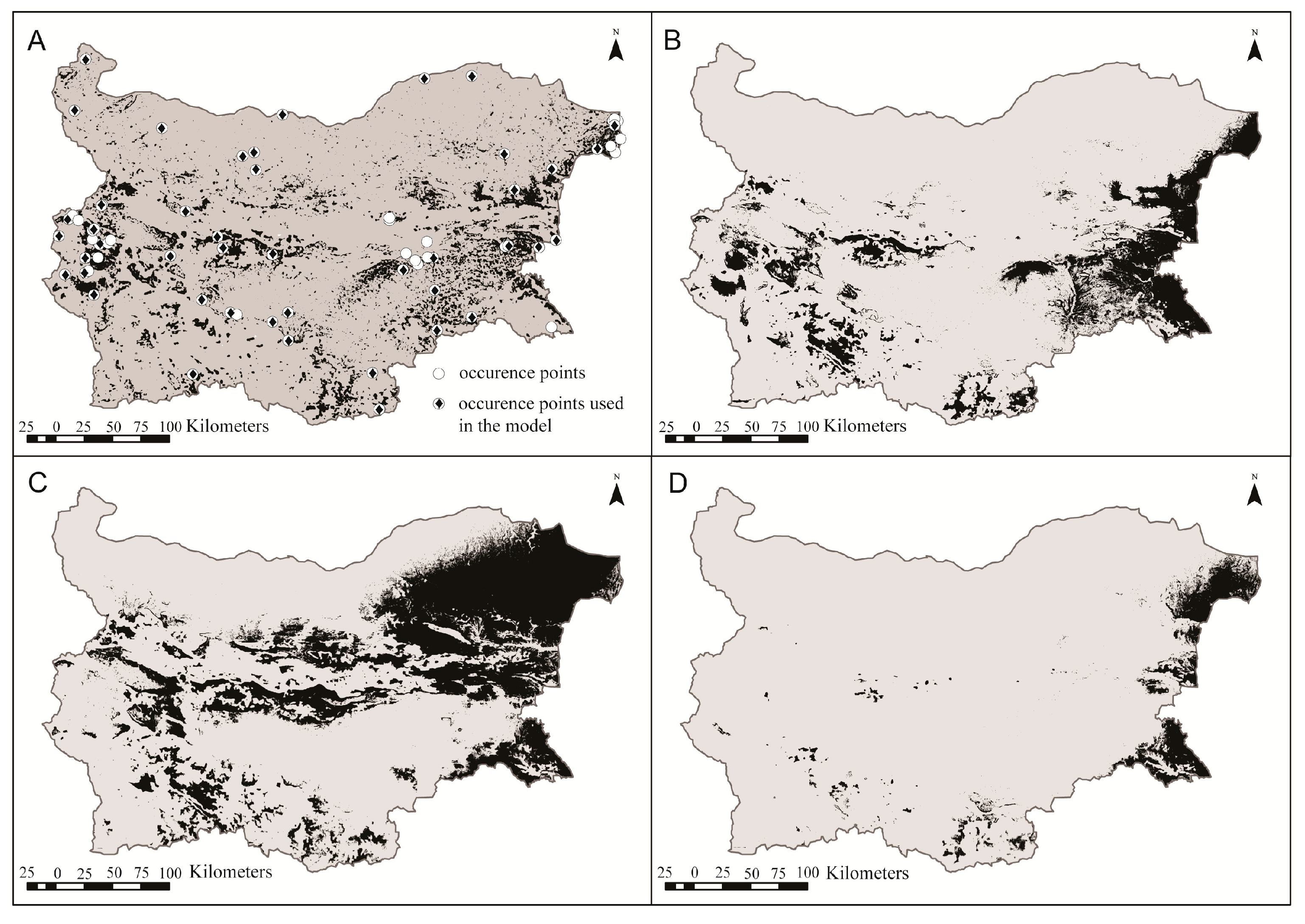
To reduce the effect of spatial data aggregation and avoid spatial autocorrelation, the occurrence points were rarefied to a Euclidean distance of 10 km, retaining as many points as possible (Figure 1). Thus, of the initial 77 points in the modelling, 49 points were used. Given the character of the data (mainly questionnaire surveys and accidental finds of animals hit by vehicles), one could suppose that a degree of spatial bias is linked with proximity to settlements. This potential data’s spatial bias is addressed by creating a bias grid [39], which ensures that pseudo-absences are selected with a probability similar to that of presences and helps balance the influence of proximity to settlements on model predictions. The bias grid represents the density of Corine land cover class “1.1.2 Discontinuous urban fabric” for each pixel, estimated using a moving window of 10 km radius. The highest density values, corresponding to large, highly urbanized areas, are set as “no data” to avoid extracting background points from them, as the occurrence of the marbled polecat in such areas is unlikely.
We selected a preliminary set of environmental variables that represent land cover, topography, and climate. All environmental layers were represented at a 30 m × 30 m cell size in ArcGIS 10 (ESRI, Redlands, CA, USA). Since this resolution is too small, to better correspond with the ecological characteristics of the species (e.g., the size of home range), the environmental variables characterizing the land surface were presented as mean values (density) for each 30 m × 30 m pixel using a circular moving window with a radius of 1 km. After clipping each environmental layer to the extent of our study area, we transformed the data into ASCII files, the final data format required by MaxEnt. Before modelling, we eliminated some highly intercorrelated bioclimatic variables (correlation coefficients calculated in ArcGIS 10, >0.7) because multicollinearity could violate statistical assumptions and perhaps affect model predictions.
Land cover predictors were based on two sources. Most of them represent third-level land cover classes of Corine Land Cover 2012 v20 [40]. We included those land cover classes that are widely distributed throughout the country and are believed to determine essential features of the marbled polecat habitat (Table 1): clc211, clc243, and clc324. We obtained two other land cover characteristics from the Copernicus Land Monitoring Service: grassland (grass) [41] and tree cover density (tcd) [42]. Preliminary analyses showed that they reflect the distribution of these vegetation types across the country more accurately than the analogous Corine Land Cover categories. The relief was characterized by the terrain ruggedness index (TRI) and slope. These variables were generated from the digital elevation model (DEM) after removing production artefacts using 10 successive smoothing filters in Spatial Analyst (ESRI, Redlands, CA, USA). The slope of the terrain is negatively correlated with the anthropogenic impact on vegetation and land cover in general. On flat terrain, agriculture is the most intensive, and forest vegetation is significantly reduced, replaced mainly by open spaces composed of cultivated areas, pastures, meadows, and, to a lesser extent, shrubs and thinned forests. TRI is the mean of the absolute differences between the value of a cell and its surrounding cells [43]. It quantifies the heterogeneity or complexity of the terrain, which is a key factor influencing local habitat diversity and resource availability. This index, like the slope, influences the degree of anthropogenic impact on habitats.
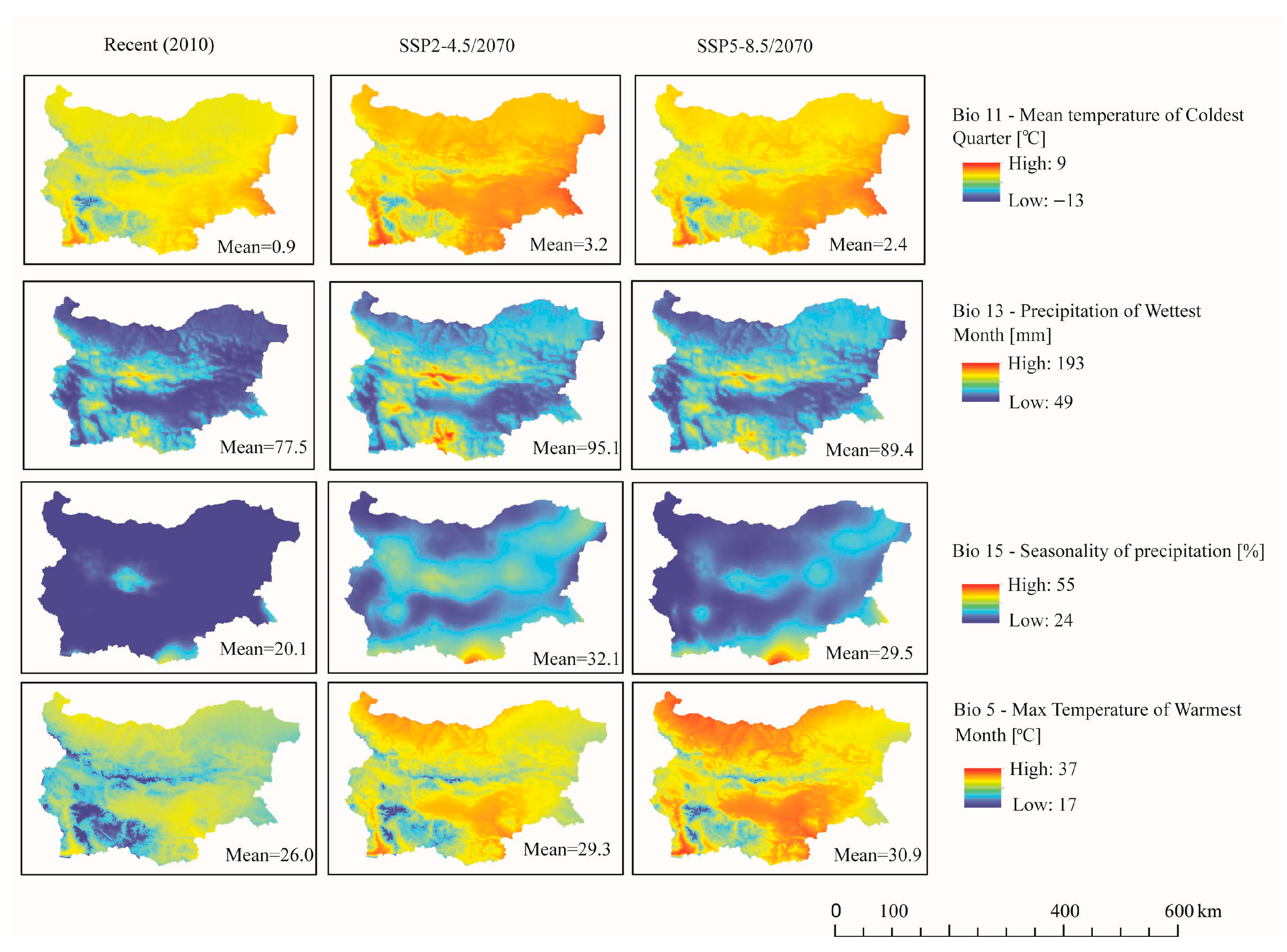
To examine how the distribution of the species depends on climate, we used four uncorrelated bioclimatic variables across the country (see above)—bio5, bio11, bio13, and bio15 (Table 1)—for two 30-year periods (1980–2010 and 2040–2070). These variables were based on the EC-Earth3-Veg model (European Union), a product of the recent generation phase 6 of the Coupled Model Intercomparison Project (CMIP). We chose this model for its superior performance in the European environment [44]. We obtained baseline and future climate data using the chelsa-cmip6 v.1.0 Python 3 package [45], which provides cloud access to CMIP6 data. Specifically, we downloaded these bioclimatic variables from CHELSA (Climatologies with High resolution for the Earth’s Land Surface Areas) [46]. To predict the distribution of V. peregusna in future climate change, we chose two contrasting socioeconomic scenarios: medium stabilization (SSP2-4.5) and very high emissions (SSP5-8.5). The analysis of the spatial differentiation and average values of the selected bioclimatic variables within the country in the historical present (1980–2010) and in the near future (2040–2070) under these scenarios (Figure 1) provides a basis for interpreting the modelling results.
The maximum temperature of the warmest month (bio5) reflects the main gradient within the country—altitude—which determines the territorial differentiation of the mammalian fauna in Bulgaria [47]. The average values for the studied territory for both future scenarios are higher than the current ones and, as expected, are highest in SSP5-8.5 (Figure 1). The values of the mean temperature of the coldest quarter (bio11) in the projections exceed the current values, with the highest for SSP2-4.5. Both bio5 and bio11 illustrate the differences between sub-Mediterranean climate regions, especially the Black Sea coasts with low summer and high winter temperatures (low annual amplitude), and the lowlands with a transitional continental climate showing higher annual amplitude. The average estimates of precipitation of the wettest month (bio13) and precipitation seasonality (bio15), which represents the variation in monthly precipitation totals over the year, expressed as a coefficient of variation (%), increase in the projections, with the highest values for the mild climate change scenario, SSP2-4.5. In the future, a significant portion of the country is expected to exhibit a more uneven distribution of precipitation throughout the year.
In the Maxent modelings, 85% of locations were used for training, with 15% for testing; the Cloglog transformation was applied to the output, modeling the probability of species presence and relating it to abundance [48]. The average of 30 cross-validations provided the final suitability estimate. Maps showing habitat suitability from 0 to 1 were converted to binary using a threshold of 0.541 (Maximum Training Sensitivity plus Specificity Cloglog). Two models were built: one for current distribution using all variables, and another for predicting future distribution under the SSP2-4.5 and SSP5-8.5 scenarios, excluding land cover due to a lack of future data. Land cover’s impact is partly accounted for by the variables slope and TRI, which reflect the impact of human activity on land cover, and this relationship is unlikely to change in the near future. Although these models can’t capture local land-cover details, they should accurately forecast overall distribution trends under future climates.

3. Results

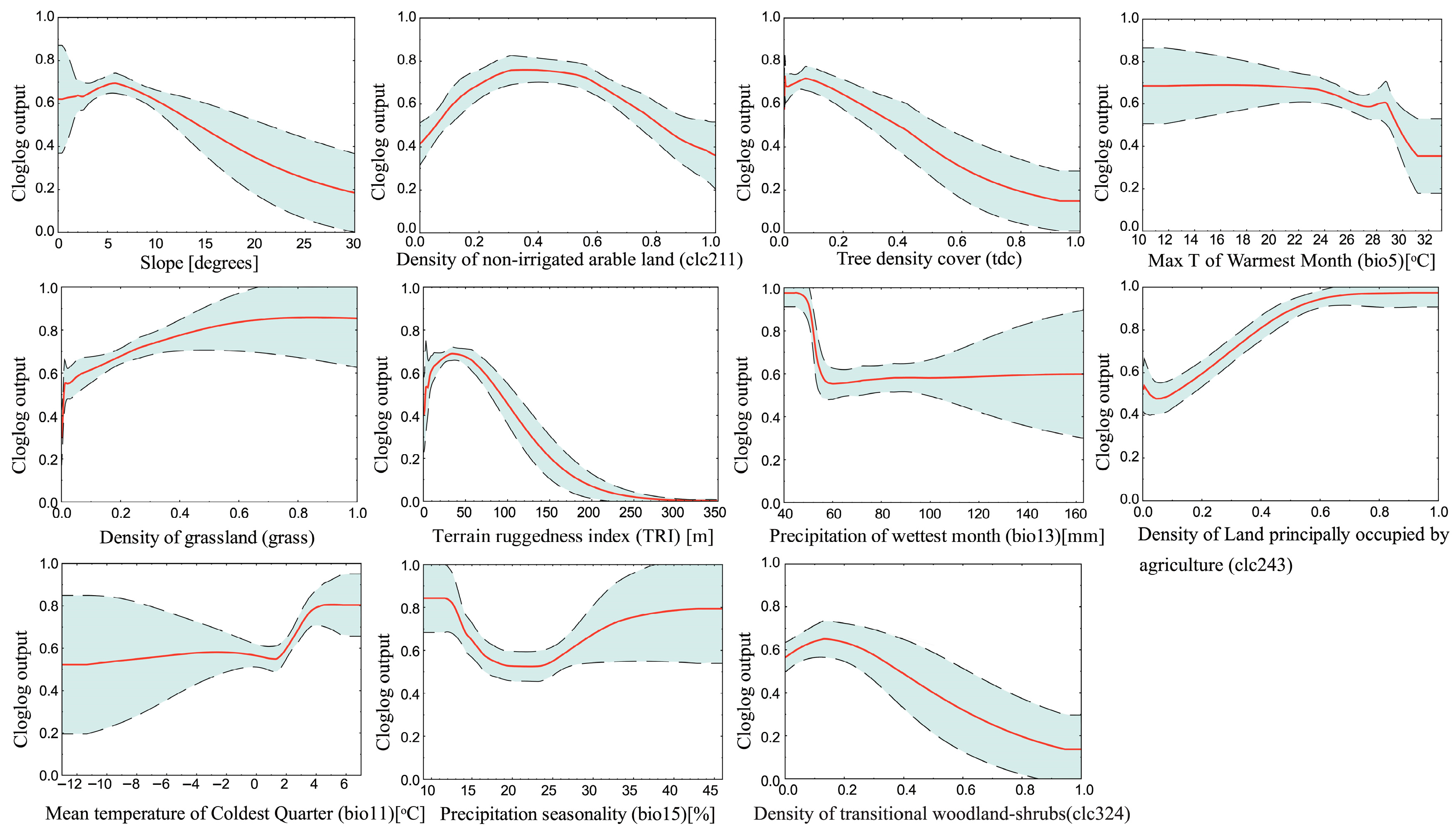
The distribution of Vormela peregusna occurrence records and suitable habitats, determined by the model using all selected variables, is illustrated in Figure 2A. The second approach, dealing with climate variables only, resulted in a less detailed model of the present distribution of the species (Figure 2B) and two models of predicted future distribution (Figure 2C,D). The significant difference between the latter two reveals that the effect of climate change on the species depends significantly on its strength. The suitability curves along the corresponding gradients show how the selected variables from the first model determine the distribution of the species (Figure 3).

3.1. Present-Day Species Distribution Model (“Full” Model)

The AUC value of 0.871 indicated that the model’s predictive ability was close to excellent. According to the model (Figure 2A), the area of suitable habitat for the marbled polecat in Bulgaria is 14,429 km2 (approximately 13% of the country’s territory). They are scattered throughout the country, but the patches are relatively small and isolated. Several areas with an increased concentration of high-suitability patches can be observed, corresponding to the areas with the most registrations—in the northeast, the middle parts of western Bulgaria, and some central parts of the country.
Based on the permutation importance of variables (Table 1) and the response curves (Figure 3), it can be said that the habitat suitability of V. peregusna is most affected by the slope, the relative share of non-irrigated arable land (clc211), and tree density cover (tdc). The most influential climatic variable for predicting the species’ occurrence is the Maximum temperature of the Warmest Month (bio5). Overall, our data indicate that species prefer flat or moderately rugged terrain, open landscapes (mainly agricultural and grassland), and moderately high summer temperatures.

3.2. Projection of the Suitable Habitat for Vormela peregusna Under Future Climate Change

The AUC value of 0.766 indicated that the second model’s predictive ability was moderate. As expected, the model based solely on climatic variables and terrain peculiarities is more general (Figure 2B) because, in the absence of land cover characteristics, it cannot describe the local distribution of the marbled polecat’s suitable habitats in detail. Nevertheless, the main areas with appropriate conditions coincide primarily with those established in the “full” model. The total area of suitable habitats in the recent climate is approximately the same as in the first (“full”) model (15,539 km2 and 14,429 km2, respectively). Suitable area is roughly twice as large (31,078 km2) in the SSP2-4.5 scenario, but much smaller (5328 km2) in the SSP5-8.5 scenario.
The most influential variable in predicting the occurrence of the marbled polecat is slope (Table 1), which is expected, given its effect on agricultural development, which in turn determines the distribution of the main landcover types. The second most important factor is the mean temperature of the coldest quarter (bio11). The other climate variable, which obviously could impact the future distribution of the species, is the precipitation of the wettest month (bio13). According to the more optimistic scenario (SSP2-4.5), moderate climate change is expected to significantly increase the area of suitable habitat for V. peregusna (Figure 2C). The species will lose some of its current suitable territories, but gain even larger ones. In the worst-case scenario (SSP5-8.5), relatively large areas with favorable conditions for the species are preserved only near the coast of Black Sea (Figure 2D). Small patches of suitable habitats are also found in some southern mountainous areas.

4. Discussion

4.1. Current Distribution and Optimal Habitats’ Model of V. peregusna

According to the occurrence points from the first quarter of the 21st century, the marbled polecat is widespread throughout Bulgaria (Figure 2A). The “full” model highlights a higher concentration of suitable habitats along the Black Sea coast, in northeast and central western Bulgaria, the eastern lowlands, the sparsely forested hilly areas and low mountains in southeastern Bulgaria, as well as in the mountain valley fields in central regions. The high mountains do not provide favorable conditions for the species. The areas identified by us as having the highest suitability for V. peregusna largely coincide with the territories in which the species had the highest density at the end of the 20th century [49].
In the “full” model, the variables associated with land cover had the highest total relative importance (approximately 48%) in predicting the distribution of V. peregusna in the study area (Table 1). Characteristics related to relief and climate have approximately equal relative contributions to the model (27% and 26%, respectively).
The slope has the most decisive influence on the distribution of the marbled polecat, followed by cultivated areas and forests (Table 1, Figure 3). Agricultural and grassland densities are positively related to suitability (environmental variables clc211, grass, clc243). Habitat suitability declines with increases in slope, Terrain Ruggedness Index (TRI), the density of transitional woodland-shrubs (clc324), and tree density cover (tdc). These curves depict the habitat suitability of the marbled polecat in relation to the type of human activity under varying combinations of these factors. Plains typically have flat or slightly rugged terrain, which facilitates the intensification of agriculture, leading to extensive forest clearing. Conversely, mountainous regions, less suitable for agriculture, tend to be dominated by forests and shrubs, habitats that the species prefer less. Further details concerning these relationships are illustrated by the hump-shaped curve for the density of non-irrigated arable land (clc211). It implies that the species favors landscapes with a moderate share of arable land while avoiding landscapes characterized by intensive agriculture, with very large areas of continuous arable land. The deleterious effects of intensive monoculture agriculture on animal species and communities have been documented by several studies [50,51,52]. The negative impact of large monoculture fields on mustelids is associated with a reduction in prey diversity, number, and year-round availability, secondary poisoning from rodenticides, and lack of shelters for hunting, breeding, and hiding from larger mammalian and avian predators [53,54,55].
The preference of the marbled polecat for cultivated areas and grasslands, and the avoidance of forests, revealed by the model, correspond well with the ecology of the species, which is known as an open space dweller [56]. The modelling results concerning the species’ land cover preferences are comparable to those of the larger-scale model in the western part of its range [33]. However, there is a significant difference in the contribution of these land cover categories to the two models. In the larger-scale study [33], more than half of the permutation importance is associated with pastures and grasslands, whereas in our model the importance of pastures is more minor and commensurate with that of arable lands (Table 1). These differences are likely due to discrepancies in the set of variables used and the environmental context of the input data. In the Balkans, most of the lowlands are occupied by arable land, and therefore, the majority of registrations of the marbled polecat are from such areas. In the study of the larger part of its western range [33], there is a strong concentration of records from Asian Turkiye and the eastern coast of the Mediterranean Sea, where landscape and climatic characteristics (long, hot, and dry summers) predispose to poorly developed agriculture and the prevalence of pastures and dry grasslands. In contrast, a similar modelling approach applied for the territory of Iran has revealed forest areas and rivers as variables with a positive effect on habitat suitability [31]. These results are not unexpected given the significant physiographic differences between the two study areas. Bulgaria experiences a transitional continental climate with Mediterranean climatic influence in the southern regions. Temperatures and precipitation in the country’s lowlands are moderate [57]. In contrast, the investigated Khorasan Razavi province in Iran is characterized by a mid-latitude steppe climate, extremely low levels of precipitation and humidity, and sparse vegetation [58]. In these harsh conditions, forest habitats likely provide more food and other resources for the marbled polecat than open habitats. To gain deeper insight into the species’ habitat preferences, we should consider the scale at which we assess its distribution. At the habitat level, it can be said that V. peregusna is associated with open, dry habitats. However, at the microhabitat level, in some areas, especially in vast deserts or semi-deserts, its spatial niche is associated with places of greater humidity and more luxuriant vegetation.
Inconsistencies in the results of different studies are probably also due to the geographic scope of the models produced. For species with a wide distribution, such as V. peregusna, a detailed habitat suitability model is challenging to obtain for the entire range. The uneven effort in collecting data strongly affects the results. Species’ habitat preferences can vary greatly depending on the climatic and landscape context. Thus, the discrepancies in results across different distribution models illustrate the regional character of species’ ecological patterns, suggesting the need for more regional investigations for conservation purposes and for cautious extrapolation of the results to other areas of its range.
The extent to which climate shapes the distribution of the marbled polecat is evident from the total contribution (26%) of the climate characteristics (bio5, bio13, bio11, and bio15) to our model (Table 1). The maximum temperature of the warmest month (bio5) is of greatest importance for the polecat, strongly negatively affecting the species at values above 29 °C. The suitability curve of this variable remains relatively flat in most of its range, dropping sharply at higher temperatures (Figure 3). Therefore, an anticipated increase in future temperatures (Figure 1) can reduce suitability if accompanied by higher maximum summer temperatures. However, a future increase in winter temperatures (Figure 1) could benefit the species, as the curve of the mean temperature of the coldest quarter (bio11) shows a preference for higher temperatures. For the precipitation of the wettest month (bio13), the suitability is highest at the lower end of the gradient, signifying the species’ preference for low-altitude areas with low rainfall. In such regions, grasslands and areas with moderate arable land density are prevalent, and summer droughts are common. It is plausible that a future increase in precipitation (Figure 1), especially in the lower parts of the country, may have a detrimental impact.
As might be expected, due to the homogeneity of precipitation seasonality (bio 15) within the study area (Figure 1), suitability is weakly influenced by this parameter (Table 1, Figure 3). Although our model and that of a larger-scale investigation of the western part of the species’ range [33] highlight temperature as a more influential bioclimatic factor than precipitation, other studies, which deal only with climatic variables, indicate precipitation as the most influential factor in the species’ potential distribution [19,32]. The significance of these two climatic factors can be expected to vary spatially. In desert and semi-desert areas in some parts of the species’ geographical range in Asia, precipitation could be an important limiting factor. In its habitats in Europe, characterized by more moderate climate conditions, extremely low precipitation is not as typical.
Assuming that the climatic and landscape conditions in Bulgaria are similar to those in the other Balkan countries, we view our results as indicative that habitat loss due to intensive agriculture in wide areas is the main factor limiting the distribution of the marbled polecat in the westernmost part of its range.

4.2. Projection of Suitable Habitats for Vormela peregusna Under Future Climate Change

Predictions for the near future show a significant increase in the area of the species’ suitable habitats under the more favorable scenario of medium stabilization of gas emissions, SSP2-4.5 (Figure 2C). However, the pessimistic scenario of very high emissions, SSP5-8.5 (Figure 2D), foresees preserving only one-third of the current area of suitable habitat. Temperature and humidity are obviously of decisive importance in shaping the distribution of the species in the future. Of the factors that can be expected to change in the future (i.e., excluding slope and TRI), the mean temperature of the coldest quarter (bio11) and the precipitation of the wettest month (bio13) have the largest contributions to the Maxent model.
According to the suitability curve of bio11 (Figure 3), the species prefers areas with higher winter temperatures. The high values of the variable, according to scenario SSP2-4.5 (Figure 1), lead to an increase in the suitability in wide areas in hilly regions with a higher altitude, especially in northeastern Bulgaria (Figure 2C). The relief in these areas is favorable according to the slope and TRI response curves (Figure 3), as the hilly terrain will prevent the conversion of wide areas into arable land. Thus, it can be assumed that the state of land cover will also be favorable to the marbled polecat. In this scenario, the increase in winter temperatures will turn some areas that are currently suitable, such as the sub-Mediterranean parts of the country, into unsuitable ones (Figure 2C).
Under the pessimistic scenario, SSP5-8.5 (Figure 2D), the expected significant increase in summer temperatures, combined with an increase in the precipitation of the wettest month (Figure 1), is probably the main reason for the considerable deterioration in the habitat suitability of the marbled polecat. The distribution of the species will be limited to some areas along the Black Sea coast and isolated spots inland (Figure 2D), where, due to the proximity of the sea or higher altitude, the changes in summer temperature and precipitation are less pronounced.
Undoubtedly, many factors beyond climate must be taken into account to fully predict future changes in habitat suitability. This is even more problematic in the cases of species with large geographic ranges and a scarcity of presence data, such as V. peregusna. Several studies demonstrate that species distribution models (SDM) based on correlations between species presence data and environmental predictors are controversial and should be applied with caution [59]. The fundamental problematic features of the analyses of species range dynamics by using SDMs concern the collection of arduous and non-methodical species presence data collection, incorrect extrapolations of current correlations to the future, unforeseen restrictions on dispersal possibilities, and unpredictable biotic interactions [60]. The present and future distribution models developed here for V. peregusna suffer from some shortcomings that are common in correlative SDMs. First, the occurrence data used are biased due to uneven sampling and difficult detection of the species. Second, the modelling process does not account for biotic interactions (such as food availability, competition, predation, etc.) or the constraints imposed by the limited dispersal ability and physical barriers of the species. Moreover, changes in some landscape features over time are difficult to predict (especially anthropogenic ones). In the study area, all these factors cannot be ignored.
Although providing a more detailed and accurate picture of habitat suitability for regional (including national) purposes, small-scale modelling may be inferior in some respects to large-scale modelling. The use of presence data from a smaller territory creates a prerequisite for obtaining a more limited spatial niche than the actual one. Moreover, species’ climatic niches can change over time [61]. We tend to assume that our predictive model is relatively restrictive and that the marbled polecat may exhibit more plasticity with respect to its climatic niche.
Our results on the current habitat suitability of the marbled polecat in the westernmost part of its range, as well as its probable changes resulting from climate change, could be useful for the development of effective conservation measures for the species in the Balkans and neighbouring territories with similar conditions. Taking into account the contemporary distribution of this vulnerable mustelid species and the predictions revealed here for the near future, we can delineate the areas of greatest significance for its conservation. Obviously, the north-east part of Bulgaria is of particular importance for the sustainable maintenance of the regional populations of V. peregusna. The connectivity between this territory and the only incontestably occupied area by the species in Romania [62] underscores its value for the conservation of its Balkan populations. The importance of suitable territories for the species along the Black Sea is also highlighted by a study for Turkiye [32]. The predicted preservation of suitable climatic conditions in these regions in Bulgaria and neighboring Turkiye would ensure the existence of large areas and good connectivity of suitable habitat for the species in the long term. In this regard, it is important to preserve landscape features that are vulnerable to human activities. In the context of a changing climate, protecting suitable habitats for the marbled polecat in the Black Sea region and implementing measures against threats to the species and its potential prey should be a priority when planning national or regional strategies for its protection.
Further research is needed to clarify the interspecific relationships of the marbled polecat, i.е., the effect of the presence and abundance of prey species and larger predators on the distribution of this mustelid.

Supplementary Materials

The following supporting information can be downloaded at https://www.mdpi.com/article/10.3390/conservation6020041/s1. Table S1: Occurrence points of Vormela peregusna in Bulgaria.

Author Contributions

Conceptualization, S.Z. and V.P.; methodology, S.Z. and V.P.; software, V.P.; validation, S.Z. and V.P.; formal analysis, V.P.; investigation, S.Z., V.P. and Z.Z.; resources, S.Z., V.P. and Z.Z.; data curation, S.Z. and Z.Z.; writing—original draft preparation, S.Z. and V.P.; writing—review and editing, S.Z., V.P. and Z.Z.; visualization, S.Z. and V.P.; supervision, S.Z. and V.P.; project administration, S.Z.; funding acquisition, not applicable. All authors have read and agreed to the published version of the manuscript.

Funding

This study is a part of the projects under grant contract numbers ДО-230/06-12-2018, DIR–59318-1-2 (2011–2012), and KP-06-N61/6–14.12.2022.

Institutional Review Board Statement

This study was conducted in accordance with the Scientific Council of the Institute of Biodiversity and Ecosystem Research, Bulgarian Academy of Sciences, protocol code 03/02 from 1 March 2011, protocol code 52/5.4 from 19 June 2018 and protocol code 03/01 from 17 March 2023.

Informed Consent Statement

Informed consent was obtained from all subjects involved in the study.

Data Availability Statement

The data used for modelling are provided in the Supplementary Materials.

Acknowledgments

The authors are grateful to all colleagues and non-experts who contributed to the collection of the distribution data of V. peregusna.

Conflicts of Interest

The authors declare no conflicts of interest.

References

  1. Root, T.L.; Price, J.T.; Hall, K.R.; Schneider, S.H.; Rosenzweig, C.; Pounds, J.A. Fingerprints of global warming on wild animals and plants. Nature 2003, 421, 57–60. [Google Scholar] [CrossRef]
  2. Parmesan, C. Ecological and evolutionary responses to recent climate change. Annu. Rev. Ecol. Evol. Syst. 2006, 37, 637–669. [Google Scholar] [CrossRef]
  3. VanDerWal, J.; Murphy, H.T.; Kutt, A.S.; Perkins, G.C.; Bateman, B.L.; Perry, J.J.; Reside, A.E. Focus on poleward shifts in species’ distribution underestimates the fingerprint of climate change. Nat. Clim. Change 2013, 3, 239–243. [Google Scholar] [CrossRef]
  4. Pereira, H.M.; Leadley, P.W.; Proença, V.; Alkemade, R.; Scharlemann, J.P.W.; Fernandez-Manjarrés, J.F.; Araújo, M.B.; Balvanera, P.; Biggs, R.; Cheung, W.W.L.; et al. Scenarios for global biodiversity in the 21st century. Science 2010, 330, 1496–1501. [Google Scholar] [CrossRef] [PubMed]
  5. Araújo, M.B.; Alagador, D.; Cabeza, M.; Nogués-Bravo, D.; Thuiller, W. Climate change threatens European conservation areas. Ecol. Lett. 2011, 14, 484–492. [Google Scholar] [CrossRef]
  6. Nogués-Bravo, D.; Rahbek, C. Communities under climate change. Science 2011, 334, 1070–1071. [Google Scholar] [CrossRef]
  7. Thomas, C.D.; Cameron, A.; Green, R.E.; Bakkenes, M.; Beaumont, L.J.; Collingham, Y.C.; Erasmus, B.F.N.; de Siqueira, M.F.; Grainger, A.; Hannah, L.; et al. Extinction risk from climate change. Nature 2004, 427, 145–148. [Google Scholar] [CrossRef]
  8. Levinsky, I.; Skov, F.; Svenning, J.C.; Rahbekm, C. Potential impacts of climate change on the distributions and diversity patterns of European mammals. Biodivers. Conserv. 2007, 16, 3803–3816. [Google Scholar] [CrossRef]
  9. Chen, I.C.; Hill, J.K.; Ohlemüller, R.; Roy, D.B.; Thomas, C.D. Rapid range shifts of species associated with high levels of climate warming. Science 2011, 333, 1024–1026. [Google Scholar] [CrossRef]
  10. Schloss, C.A.; Nuñez, T.A.; Lawler, J.J. Dispersal will limit ability of mammals to track climate change in the Western Hemisphere. Proc. Natl. Acad. Sci. USA 2012, 109, 8606–8611. [Google Scholar] [CrossRef]
  11. Årevall, J.; Early, R.; Estrada, A.; Wennergren, U.; Eklöf, A.C. Conditions for successful range shifts under climate change: The role of species dispersal and landscape configuration. Divers. Distrib. 2018, 24, 1598–1611. [Google Scholar] [CrossRef]
  12. Hassan, R.; Scholes, R.; Ash, N. Ecosystems and Human Well-Being: Current State and Trends: Findings of the Condition and Trends Working Group (Millennium Ecosystem Assessment Series); Island Press: Washington, DC, USA, 2005. [Google Scholar]
  13. Schwartz, M.W. Using niche models with climate projections to inform conservation management decisions. Biol. Conserv. 2012, 155, 149–156. [Google Scholar] [CrossRef]
  14. Rozhnov, V.V.  Vormela peregusna. In The Atlas of European Mammals; Mitchell-Jones, A.J., Amori, G., Bogdanowicz, W., Krystufek, B., Reijnders, P.J.H., Spitzenberger, F., Stubbe, M., Thissen, J.B.M., Vohralik, V., Zima, J., Eds.; Academic Press: London, UK, 1999; pp. 340–342. [Google Scholar]
  15. Abramov, A.V. Vormela peregusna (Europe Assessment). The IUCN Red List of Threatened Species 2025, e.T29680A215859833. Available online: https://www.iucnredlist.org/species/29680/215859833 (accessed on 24 January 2026).
  16. Spassov, N. Marbled polecat (Vormela peregusna). In Mammals Important for Conservation in Bulgaria; Popov, V., Spasov, N., Ivanova, T., Mihova, B., Georgiev, K., Eds.; Dutch Mammal Society VZZ: Arnhem, The Netherlands, 2007; pp. 270–273. (In Bulgarian) [Google Scholar]
  17. Opdam, P.; Wascher, D. Climate change meets habitat fragmentation: Linking landscape and biogeographical scale levels in research and conservation. Biol. Conserv. 2004, 117, 285–297. [Google Scholar] [CrossRef]
  18. Brook, B.W.; Sodhi, N.S.; Bradshaw, C.J.A. Synergies among extinction drivers under global change. Trends Ecol. Evol. 2008, 23, 453–460. [Google Scholar] [CrossRef] [PubMed]
  19. Cheng, X.; Han, Y.; Lin, J.; Jiang, F.; Cai, Q.; Shi, Y.; Cui, D.; Wen, X. Time to Step Up Conservation: Climate Change Will Further Reduce the Suitable Habitats for the Vulnerable Species Marbled Polecat (Vormela peregusna). Animals 2023, 13, 2341. [Google Scholar] [CrossRef]
  20. Radonjić, M.; Šestović, B.; Peereboom, J.N.; Ralević, S. First Evidence of the Presence of the Marbled Polecat Vormela peregusna (Güldenstädt, 1770) (Carnivora: Mustelidae) in Montenegro. Acta Zool. Bulg. 2022, 74, 189–194. Available online: http://www.acta-zoologica-bulgarica.eu/2022/002566 (accessed on 24 January 2026).
  21. Simonović, P.; Dekić, R.; Nikolić, V. New record of marbled polecat Vormela peregusna out of its current distribution range. Kragujev. J. Sci. 2023, 45, 341–344. [Google Scholar] [CrossRef]
  22. Atanassov, N. Vormela peregusna (Güldenstädt, 1770) in Bulgarien und auf der Balkanhalbinsel. Z. Saugetierkd. 1966, 31, 454–464. (In Germany) [Google Scholar]
  23. Spassov, N.; Georgiev, K.; Ivanova, N.; Ivanov, V. Study of the status of marbled polecat (Vormela peregusna peregusna Guld.) in Western and North-Eastern Bulgaria with data on the status of its potential main prey species and competitors. Hist. Nat. Bulg. 2002, 14, 123–140. [Google Scholar]
  24. Racheva, V.; Zlatanova, D.; Peshev, D.; Markova, E. Camera Traps Recorded Use of Sett Sites by Badgers (Meles meles L., Mammalia) in Different Habitats. Acta Zool. Bulg. 2012, 64, 145–150. Available online: www.acta-zoologica-bulgarica.eu/downloads/acta-zoologica-bulgarica/2012/64-2-145-150.pdf (accessed on 24 January 2026).
  25. Ivanov, V.; Spassov, N. Some new data on the distribution, habitats and ecology of the threatened European mustelids Mustela eversmanii and Vormela peregusna in Bulgaria. Hist. Nat. Bulg. 2015, 21, 267–271. [Google Scholar] [CrossRef]
  26. Zidarova, S. Present distribution of the marbled polecat Vormela peregusna in central Western Bulgaria, with an observation on its defensive behaviour. Acta Zool. Bulg. 2022, 74, 403–408. [Google Scholar]
  27. Abramov, A.V. Marbled Polecat Vormela peregusna (Güldenstädt, 1770). In Carnivora. Handbook of the Mammals of Europe; Loy, A., Ciucci, P., Eds.; Springer: Cham, Switzerland, 2026; pp. 785–801. [Google Scholar] [CrossRef]
  28. Milenković, M.; Paunivić, M.; Abel, H.; Griffiths, H.J. The marbled polecat, Vormela peregusna (Giildenstaedt 1770) in FR Yugoslavia and elsewhere. In Mustelids in a Modern World: Management and Conservation Aspects of Small Carnivore and Human Interactions; Griffiths, H.J., Ed.; Backhuys Publishers: Leiden, The Netherlands, 2000; pp. 321–329. [Google Scholar]
  29. Geptner, V.G.; Nasimovich, A.A.; Bannikov, A.G.; Hoffmann, R.S. Mammals of the Soviet Union; Smithsonian Institution Libraries and National Science Foundation: Washington, DC, USA, 1988; Volume 2, Available online: https://www.biodiversitylibrary.org/page/32107414 (accessed on 24 January 2026).
  30. Zidarova, S.; Kostova, R.; Vlasseva, A. Surveying Open Habitats in Natura 2000 Sites in Bulgaria to Assess Food Availability for the Marbled Polecat Vormela peregusna (Güldenstädt, 1770) and Steppe Polecat Mustela eversmannii (Lesson, 1827) (Carnivora: Mustelidae). Acta Zool. Bulg. 2024, 76, 77–86. [Google Scholar] [CrossRef]
  31. Sarbaz, M.; Khani, A.; Farashi, A. Predicting presence of marbled polecat (Vormela peregusna) in Khorasan Razavi province using MaxEnt. Exp. Anim. Biol. 2018, 7, 35–44. [Google Scholar]
  32. Evcin, Ö.; Kalleci, B. New records of marbled polecat, Vormela peregusna (Guldenstaedt, 1770) in Türkiye, current and potential distribution under climate change. Sumar. List. 2025, 149, 137–151. [Google Scholar] [CrossRef]
  33. Wright, P.G.R.; Croose, E.; Hunter, S.B.; MacPherson, J.; Çoraman, E.; Yarotskiy, V.; Moisieieva, V.; Karapandža, B.; Hoxha, B.; Madalina, P.; et al. Can social media be used to inform the distribution of the marbled polecat, Vormela peregusna? Mammal Res. 2023, 68, 295–304. [Google Scholar] [CrossRef]
  34. Phillips, S.J.; Anderson, R.P.; Schapire, R.E. Maximum entropy modeling of species geographic distributions. Ecol. Model. 2006, 190, 231–259. [Google Scholar] [CrossRef]
  35. Renner, I.W.; Warton, D.I. Equivalence of MAXENT and Poisson point process models for species distribution modeling in ecology. Biometrics 2013, 69, 274–281. [Google Scholar] [CrossRef] [PubMed]
  36. Tessarolo, G.; Rangel, T.F.; Araujo, M.B.; Hortal, J. Uncertainty associated with survey design in species distribution models. Divers. Distrib. 2014, 20, 1258–1269. [Google Scholar] [CrossRef]
  37. Elith, J.; Graham, C.H.; Anderson, R.P.; Dudík, M.; Ferrier, S.; Guisan, A.; Hijmans, R.J.; Huettmann, F.; Leathwick, J.R.; Lehmann, A.; et al. Novel methods improve prediction of species’ distributions from occurrence data. Ecography 2006, 29, 129–151. [Google Scholar] [CrossRef]
  38. Di Minin, E.; Fink, C.; Hausmann, A.; Kremer, J.; Kulkarni, R. How to address data privacy concerns when using social media data in conservation science. Conserv. Biol. 2021, 35, 437–446. [Google Scholar] [CrossRef]
  39. Phillips, S.J.; Dudík, M.; Elith, J.; Graham, C.H.; Lehmann, A.; Leathwick, J.; Ferrier, S. Sample selection bias and presence-only distribution models: Implications for background and pseudo-absence data. Ecol. Appl. 2009, 19, 181–197. [Google Scholar] [CrossRef] [PubMed]
  40. SIG-GR @ Ministère du Logement et de l’Aménagement du Territoire—Département de L’aménagement du Territoire. Corine Land Cover 2012; European Union Open Data Portal: Luxembourg, 2020; Available online: http://data.europa.eu/88u/dataset/corine-land-cover-2012 (accessed on 21 January 2026).
  41. European Environment Agency (EEA); Copernicus Land Monitoring Service (CLMS). Grassland 2015, Europe, 3-Yearly, European Union. 2018. Available online: https://sdi.eea.europa.eu/catalogue/copernicus/api/records/35a036bb-c027-401c-8625-2ecf722e8461?language=all (accessed on 21 February 2024).
  42. European Environment Agency (EEA); Copernicus Land Monitoring Service (CLMS). High Resolution Layer—Tree Cover Density (HRL TCD), European Union. 2024. Available online: https://land.copernicus.eu/en/products/high-resolution-layer-tree-cover-density (accessed on 21 February 2024).
  43. Riley, S.J.; De Gloria, S.D.; Elliot, R. A terrain ruggedness index that quantifies topographic heterogeneity. Intermt. J. Sci. 1999, 5, 23–27. [Google Scholar]
  44. Ruosteenoja, K. Applicability of CMIP6 Models for Building Climate Projections for Northern Europe; Report 2021:7; Finnish Meteorological Institute: Helsinki, Finland, 2021. [Google Scholar] [CrossRef]
  45. Karger, D.N.; Chauvier, Y.; Zimmermann, N.E. chelsa-cmip6 1.0: A python package to create high resolution bioclimatic variables based on CHELSA ver. 2.1 and CMIP6 data. Ecography 2023, 2023, e06535. [Google Scholar] [CrossRef]
  46. Karger, D.N.; Conrad, O.; Böhner, J.; Kawohl, T.; Kreft, H.; Soria-Auza, R.W.; Zimmermann, N.E.; Linder, H.P.; Kessler, M. Climatologies at high resolution for the Earth’s land surface areas. Sci. Data 2017, 4, 170122. [Google Scholar] [CrossRef] [PubMed]
  47. Popov, V. Terrestrial mammals of Bulgaria: Zoogeographical and ecological patterns of distribution. In Biogeography and Ecology of Bulgaria; Fet, V., Popov, A., Eds.; Springer: Dordrecht, The Netherlands, 2007; pp. 9–37. [Google Scholar]
  48. Phillips, S.J.; Anderson, R.P.; Dudík, M.; Schapire, R.E.; Blair, M.E. Opening the black box: An open-source release of Maxent. Ecography 2017, 40, 887–893. [Google Scholar] [CrossRef]
  49. Spassov, N.; Spiridonov, G. Vormela peregusna (Guldenstaedt, 1770)—Tigeriltis. In Handbuch der Säugetiere Europas; Aula Verlag: Wiesbaden, Germany, 1993; Volume 5/II, pp. 817–855. (In Germany) [Google Scholar]
  50. Stoate, C.; Boatman, N.D.; Borralho, R.J.; Rio Carvalho, C.; de Snoo, G.R.; Eden, P. Ecological impacts of arable intensification in Europe. J. Environ. Manag. 2001, 63, 337–365. [Google Scholar] [CrossRef]
  51. Benton, T.G.; Vickery, J.A.; Wilson, J.D. Farmland biodiversity: Is habitat heterogeneity the key? Trends Ecol. Evol. 2003, 18, 182–188. [Google Scholar] [CrossRef]
  52. Torre, I.; Requejo, A.; Arrizabalaga, A.; Baucells, J. Disentangling the Effects of Climate and Land Uses on Small Mammals in Agroecosystems of NE Spain. Diversity 2024, 16, 343. [Google Scholar] [CrossRef]
  53. Croose, E.; Duckworth, J.W.; Ruette, S.; Skumatov, D.V.; Kolesnikov, V.V.; Saveljev, A.P. A review of the status of the Western polecat Mustela putorius: A neglected and declining species? Mammalia 2018, 82, 550–564. [Google Scholar] [CrossRef]
  54. Torre, I.; Raspall, A.; Arrizabalaga, A.; Díaz, M. Weasel (Mustela nivalis) decline in NE Spain: Prey or land use change? Mammal Res. 2018, 63, 501–505. [Google Scholar] [CrossRef]
  55. Schenker, L. Assessing the Ecological Value of Small Structures for Mustelid Populations in Agricultural Landscapes. Master’s Thesis, Faculty of Science, University of Bern, Bern, Switzerland, 2023. [Google Scholar]
  56. Novikov, G.A. Carnivorous Mammals of the Fauna of the USSR; Israeli Program for Scientific Translation: Jerusalem, Israel, 1962. [Google Scholar]
  57. Malcheva, K.; Bocheva, L.; Chervenkov, H. Chapter II. The climate in the past and the present. In Bulgaria’s Changing Climate—Data and Analysis; Marinova, T., Bocheva, L., Eds.; National Institute of Meteorology and Hydrology: Sofia, Bulgaria, 2023; pp. 23–28. (In Bulgarian) [Google Scholar]
  58. Peel, M.C.; Finlayson, B.L.; McMahon, T.A. Updated world map of the Köppen–Geiger climate classification. Hydrol. Earth Syst. Sci. 2007, 11, 1633–1644. [Google Scholar] [CrossRef]
  59. Soley-Guardia, M.; Alvarado-Serrano, D.; Anderson, R. Top ten hazards to avoid when modeling species distributions: A didactic guide of assumptions, problems, and recommendations. Ecography 2024, 4, e06852. [Google Scholar] [CrossRef]
  60. Briscoe, N.J.; Elith, J.; Salguero-Gómez, R.; Lahoz-Monfort, J.J.; Camac, J.S.; Giljohann, K.M.; Holden, M.H.; Hradsky, B.A.; Kearney, M.R.; McMahon, S.M.; et al. Forecasting species range dynamics with process-explicit models: Matching methods to applications. Ecol. Lett. 2019, 22, 1940–1956. [Google Scholar] [CrossRef] [PubMed]
  61. Wiens, J.J.; Zelinka, J. How many species will Earth lose to climate change? Glob. Change Biol. 2024, 30, e17125. [Google Scholar] [CrossRef]
  62. Murariu, D.; Munteanu, D. Fascicula 5—Carnivora. In Fauna României: Volume XVI, Mammalia; The Publishing House of the Romanian Academy: Bucharest, Romania, 2005; pp. 1–223. (In Romanian) [Google Scholar]
Figure 1. Climate changes on the territory of Bulgaria for the present (1980–2010) and the period 2040–2070 according to the CMIP6 EC-Earth3-Veg model for two climate scenarios (SSP2-4.5, SSP5-8.5).
Conservation 06 00041 g001
Figure 2. Modelled suitable habitats (black) of Vormela peregusna: (A) in the recent climate (based on cover, topography, and climate); (B) in the recent climate (based only on climate); (C) in the near future (climate scenario SSP2-4.5); (D) in the near future (climate scenario SSP5-8.5).
Conservation 06 00041 g002
Figure 3. Response curves of the environmental predictors, arranged by permutation importance. The bold red curves show the mean response of the 30 replicate Maxent runs, and the dotted lines represent the mean +/− one standard deviation.
Conservation 06 00041 g003
Table 1. Еstimates of relative contributions of the environmental variables to the MaxEnt “full” model (based on land cover, relief and climatic variables) and predictive model (based on relief, and climatic variables).
VariableAbbreviationPermutation Importance (%)
“Full” ModelPredictive Model
Slopeslope2141.1
Non-irrigated arable landCLC21114.6
Tree density covertdc14.6
Maximum temperature of Warmest Monthbio512.35.8
Grasslandgrass9.3
Terrain ruggedness indexTRI6.114.9
Precipitation of Wettest Monthbio13613
Land principally occupied by agricultureCLC2435.7
Mean temperature of Coldest Quarterbio114.317.9
Precipitation Seasonalitybio153.77.3
Transitional woodland-shrubCLC3243.7
Disclaimer/Publisher’s Note: The statements, opinions and data contained in all publications are solely those of the individual author(s) and contributor(s) and not of MDPI and/or the editor(s). MDPI and/or the editor(s) disclaim responsibility for any injury to people or property resulting from any ideas, methods, instructions or products referred to in the content.