
Postfire Asymmetric Reptile and Amphibian Responses in a Mediterranean Forest Ecosystem

 , , , ,
Abstract
1. Introduction
2. Materials and Methods
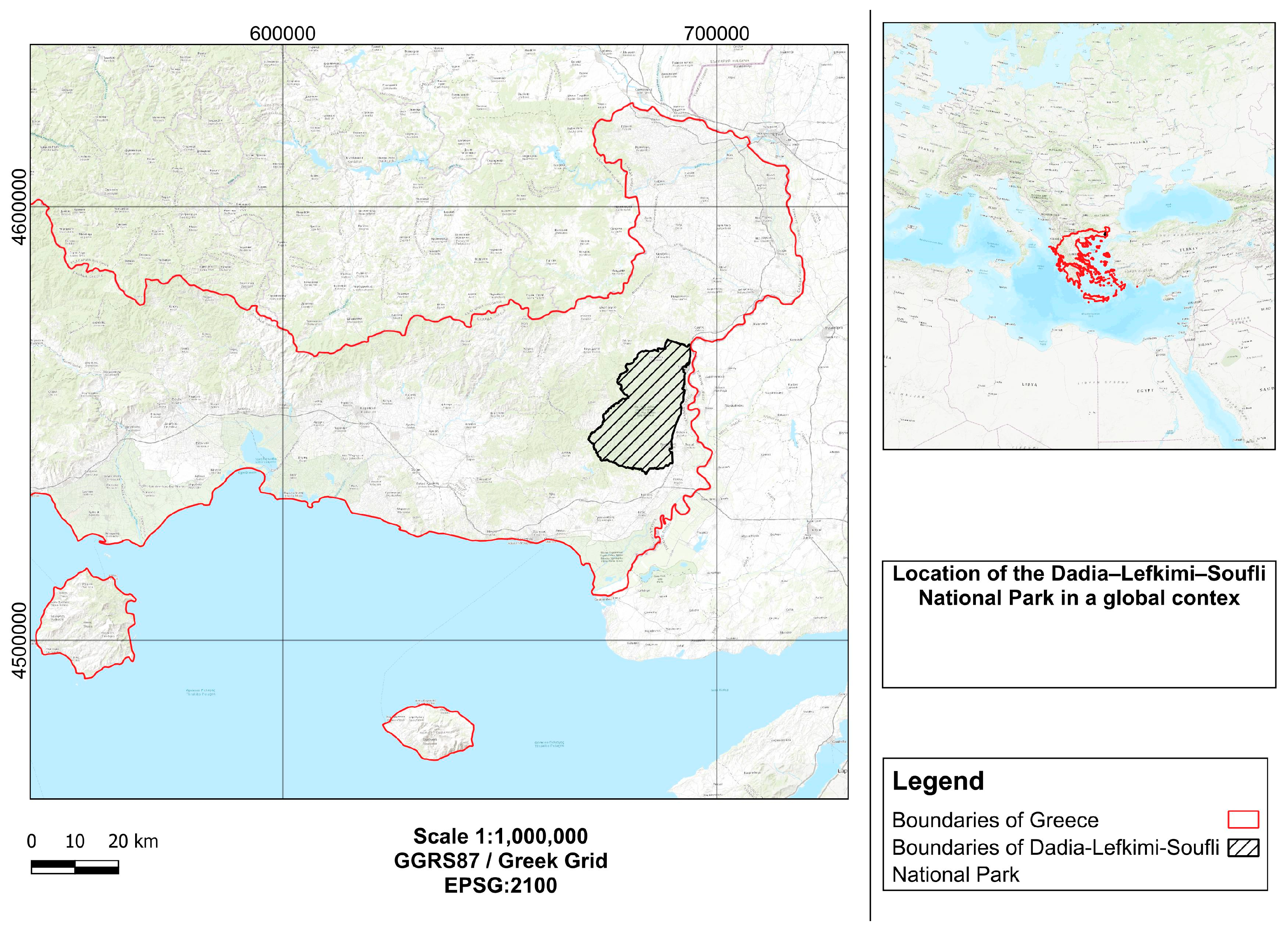
2.1. Sampling Area
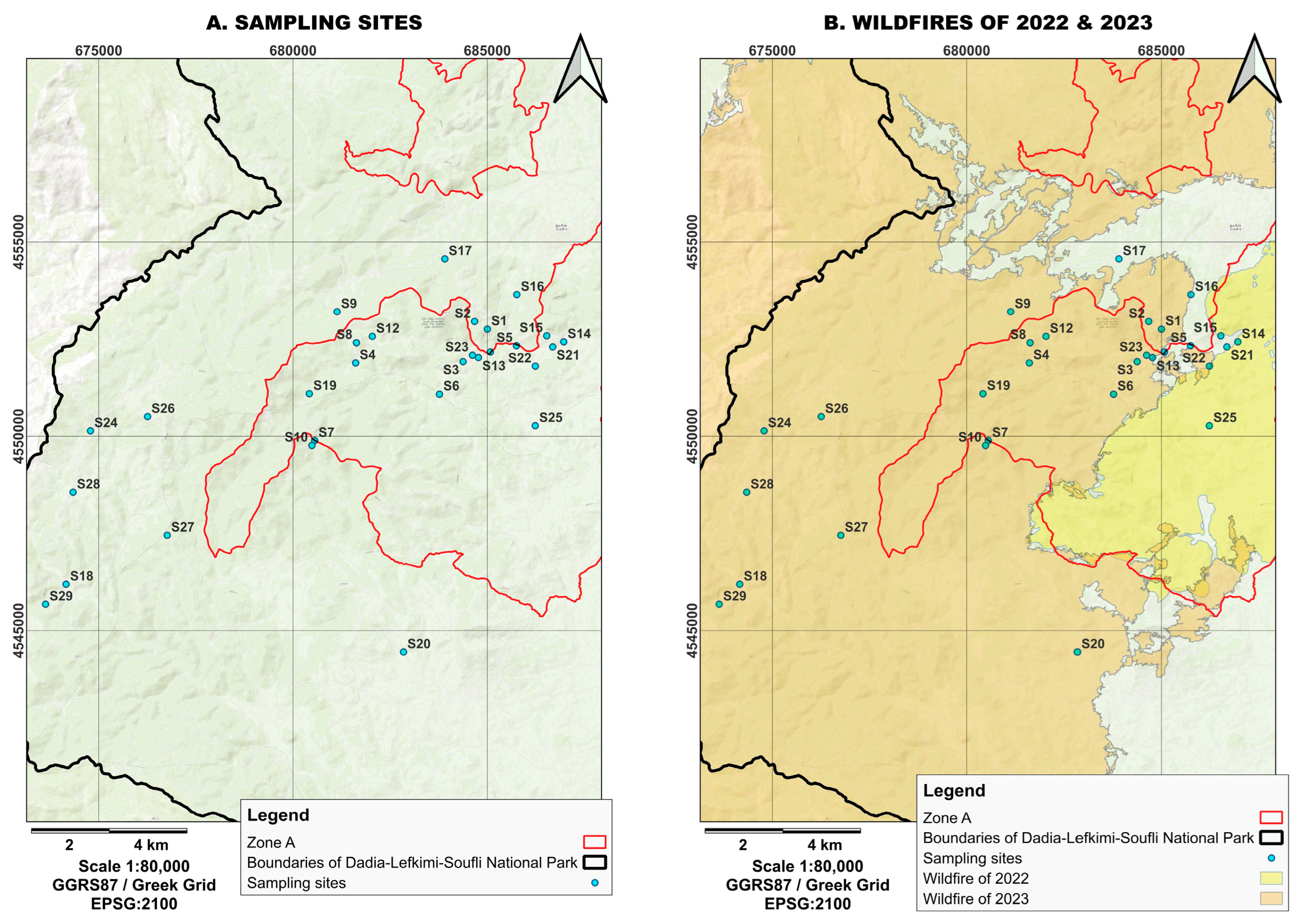
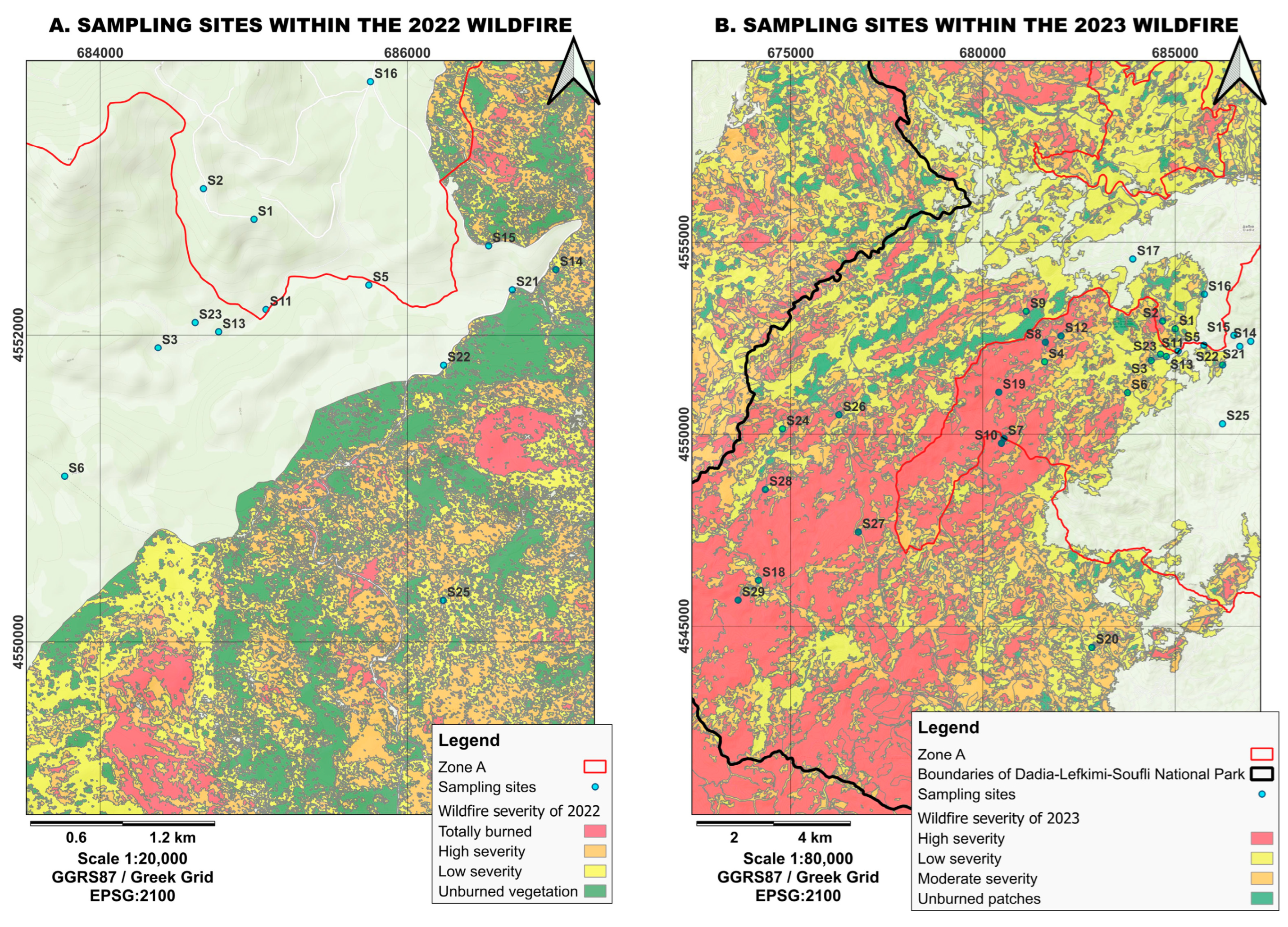
2.2. Sampling Methodology
2.3. Diversity Indices
2.4. Data Analyses
3. Results
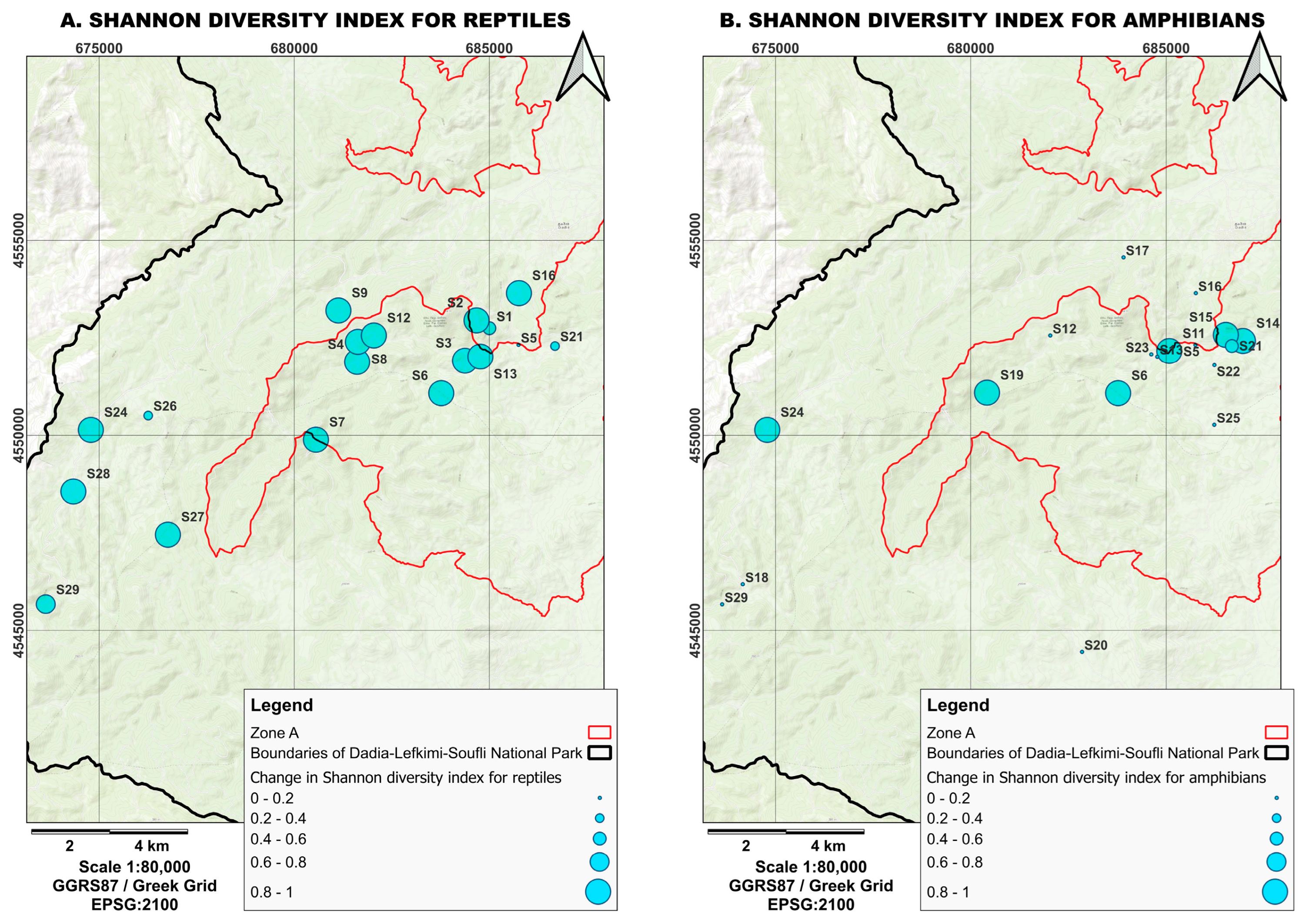
3.1. Effects of Fire on Reptilian Populations
3.2. Effects of Fire on Amphibian Populations
4. Discussion
Supplementary Materials
Author Contributions
Funding
Institutional Review Board Statement
Informed Consent Statement
Data Availability Statement
Acknowledgments
Conflicts of Interest
References
- Santos, X.; Cheylan, M. Taxonomic and functional response of a Mediterranean reptile assemblage to a repeated fire regime. Biol. Conserv. 2013, 168, 90–98. [Google Scholar] [CrossRef]
- Pausas, J.G.; Keeley, J.E. Evolutionary fire ecology: An historical account and future directions. Bioscience 2023, 73, 602–608. [Google Scholar] [CrossRef] [PubMed]
- He, T.; Lamont, B.B.; Pausas, J.G. Fire as a key driver of Earth’s biodiversity. Biol. Rev. 2019, 94, 1983–2010. [Google Scholar] [CrossRef] [PubMed]
- Blanco-Rodríguez, M.Á.; Ameztegui, A.; Alday, J.G.; Lecina-Diaz, J.; Pineda-Zapata, S.; Coll, L. Fire severity shapes landscape heterogeneity in Mediterranean forest ecosystems. Landsc. Ecol. 2025, 40, 210. [Google Scholar] [CrossRef]
- Fernandes, P.M. Fire-smart management of forest landscapes in the Mediterranean basin under global change. Landsc. Urban Plan. 2013, 110, 175–182. [Google Scholar] [CrossRef]
- Vaz, P.G. Wildfire Resilience in Mediterranean Landscapes: A Review; Universidade de Lisboa: Lisboa, Portugal, 2009; p. 33. [Google Scholar]
- Brotons, L.; Aquilué, N.; de Cáceres, M.; Fortin, M.-J.; Fall, A. How Fire History, Fire Suppression Practices and Climate Change Affect Wildfire Regimes in Mediterranean Landscapes. PLoS ONE 2013, 8, e62392. [Google Scholar] [CrossRef]
- Mantero, G.; Morresi, D.; Marzano, R.; Motta, R.; Mladenoff, D.J.; Garbarino, M. The influence of land abandonment on forest disturbance regimes: A global review. Landsc. Ecol. 2020, 35, 2723–2744. [Google Scholar] [CrossRef]
- Dupuy, J.-l.; Fargeon, H.; Martin-StPaul, N.; Pimont, F.; Ruffault, J.; Guijarro, M.; Hernando, C.; Madrigal, J.; Fernandes, P. Climate change impact on future wildfire danger and activity in southern Europe: A review. Ann. For. Sci. 2020, 77, 35. [Google Scholar] [CrossRef]
- Salis, M.; Del Giudice, L.; Jahdi, R.; Alcasena-Urdiroz, F.; Scarpa, C.; Pellizzaro, G.; Bacciu, V.; Schirru, M.; Ventura, A.; Casula, M.; et al. Spatial Patterns and Intensity of Land Abandonment Drive Wildfire Hazard and Likelihood in Mediterranean Agropastoral Areas. Land 2022, 11, 1942. [Google Scholar] [CrossRef]
- Hantson, S.; Hamilton, D.S.; Burton, C. Changing fire regimes: Ecosystem impacts in a shifting climate. One Earth 2024, 7, 942–945. [Google Scholar] [CrossRef]
- Kelly, L.T.; Giljohann, K.M.; Duane, A.; Aquilué, N.; Archibald, S.; Batllori, E.; Bennett, A.F.; Buckland, S.T.; Canelles, Q.; Clarke, M.F.; et al. Fire and biodiversity in the Anthropocene. Science 2020, 370, eabb0355. [Google Scholar] [CrossRef] [PubMed]
- González, T.M.; González-Trujillo, J.D.; Muñoz, A.; Armenteras, D. Effects of fire history on animal communities: A systematic review. Ecol. Process. 2022, 11, 11. [Google Scholar] [CrossRef]
- Plumanns-Pouton, E.; Santos, J.L.; Aponte, C.; Brotons, L.; Kelly, L.T.; Mason, S.C., Jr.; Parris, K.; Ponisio, L.; Keith, D.A. The Mechanisms Through Which Fire Drives Population Change in Terrestrial Biota. Glob. Change Biol. 2025, 31, e70479. [Google Scholar] [CrossRef]
- Ferreira, C.C.; Santos, X.; Carretero, M.A. Does ecophysiology mediate reptile responses to fire regimes? Evidence from Iberian lizards. PeerJ 2016, 4, e2107. [Google Scholar] [CrossRef]
- Renken, R.B. Does fire affect amphibians and reptiles in eastern U.S. oak forests? In Fire in Eastern Oak Forests: Delivering Science to Land Managers; Dickinson, M.B., Ed.; Department of Agriculture, Forest Service, Northern Research Station: Newtown Square, PA, USA, 2006; pp. 158–166. [Google Scholar]
- Vitt, L.J.; Caldwell, J.P. Herpetology: An Introductory Biology of Amphibians and Reptiles, 4th ed.; Academic Press: London, UK, 2014. [Google Scholar]
- Russell, K.R.; Van Lear, D.H.; Guynn, D.C. Prescribed fire effects on herpetofauna: Review and management implications. Wildl. Soc. Bull. 1999, 27, 374–384. [Google Scholar]
- Wells, K. The Ecology and Behavior of Amphibians; The University of Chicago Press: Chicago, IL, USA; London, UK, 2007. [Google Scholar]
- Hossack, B.R.; Lowe, W.H.; Corn, P.S. Rapid Increases and Time-Lagged Declines in Amphibian Occupancy after Wildfire. Conserv. Biol. 2013, 27, 219–228. [Google Scholar] [CrossRef]
- Dixon, K.M.; Cary, G.J.; Worboys, G.L.; Gibbons, P. The disproportionate importance of long-unburned forests and woodlands for reptiles. Ecol. Evol. 2018, 8, 10952–10963. [Google Scholar] [CrossRef]
- Pinto, T.; Moreira, B.; Freitas, H.; Santos, X. The role of fire history, land-use, and vegetation structure on the response of Mediterranean lizards to fire. For. Ecol. Manag. 2018, 419–420, 139–145. [Google Scholar] [CrossRef]
- Chergui, B.; Fahd, S.; Santos, X. Are reptile responses to fire shaped by forest type and vegetation structure? Insights from the Mediterranean basin. For. Ecol. Manag. 2019, 437, 340–347. [Google Scholar] [CrossRef]
- Nimmo, D.G.; Kelly, L.T.; Spence-Bailey, L.M.; Watson, S.J.; Taylor, R.S.; Clarke, M.F.; Bennett, A.F. Fire Mosaics and Reptile Conservation in a Fire-Prone Region. Conserv. Biol. 2013, 27, 345–353. [Google Scholar] [CrossRef]
- Santos, X.; Chergui, B.; Belliure, J.; Moreira, F.; Pausas, J.G. Reptile responses to fire across the western Mediterranean Basin. Conserv. Biol. 2025, 39, e14326. [Google Scholar] [CrossRef] [PubMed]
- Smith, A.L.; Lim, A.S.Y. Hidden influence of fire on locally rare and cryptic reptile species. Ecology 2025, 106, e70121. [Google Scholar] [CrossRef] [PubMed]
- Schurbon, J.M.; Fauth, J.E. Effects of Prescribed Burning on Amphibian Diversity in a Southeastern U.S. National Forest. Conserv. Biol. 2003, 17, 1338–1349. [Google Scholar] [CrossRef]
- dos Anjos, A.G.; Solé, M.; Benchimol, M. Fire effects on anurans: What we know so far? For. Ecol. Manag. 2021, 495, 119338. [Google Scholar] [CrossRef]
- Eales, J.; Haddaway, N.R.; Bernes, C.; Cooke, S.J.; Jonsson, B.G.; Kouki, J.; Petrokofsky, G.; Taylor, J.J. What is the effect of prescribed burning in temperate and boreal forest on biodiversity, beyond pyrophilous and saproxylic species? A systematic review. Environ. Evid. 2018, 7, 19. [Google Scholar] [CrossRef]
- Sanz-Aguilar, A.; Anadón, J.D.; Giménez, A.; Ballestar, R.; Graciá, E.; Oro, D. Coexisting with fire: The case of the terrestrial tortoise Testudo graeca in mediterranean shrublands. Biol. Conserv. 2011, 144, 1040–1049. [Google Scholar] [CrossRef]
- Hailey, A. The effects of fire and mechanical habitat destruction on survival of the tortoise Testudo hermanni in northern Greece. Biol. Conserv. 2000, 92, 321–333. [Google Scholar] [CrossRef]
- Valakos, E.D.; Pafilis, P.; Sotiropoulos, K.; Lymberakis, P.; Maragou, P.; Foufopoulos, J. The Amphibians and Reptiles of Greece; Chimaira: Frankfurt am Main, Germany, 2008. [Google Scholar]
- Kati, V.; Foufopoulos, J.; Ioannidis, Y.; Papaioannou, H.; Poirazidis, K.; Lebrun, P. Diversity, ecological structure and conservation of herpetofauna in a Mediterranean area (Dadia National Park, Greece). Amphib.-Reptil. 2007, 28, 517–529. [Google Scholar] [CrossRef]
- Christopoulos, A. New record of Telescopus fallax (Squamata: Colubridae) in Rhodope Prefecture, Thrace, Greece. Herpetol. Notes 2022, 15, 873–876. [Google Scholar]
- Bakaloudis, D.E.; Vlachos, C.G.; Holloway, G.J. Habitat use by short-toed eagles Circaetus gallicus and their reptilian prey during the breeding season in Dadia Forest (north-eastern Greece). J. Appl. Ecol. 1998, 35, 821–828. [Google Scholar] [CrossRef]
- Bakaloudis, D. Spatial and temporal variation of reptiles. In The Dadia-Lefkimi-Soufli Forest National Park, Greece: Biodiversity, Management and Conservation; Catsadorakis, G., Kallander, H., Eds.; WWF Greece: Athens, Greece, 2010; pp. 139–150. [Google Scholar]
- Koukouli, M.-E.; Pseftogkas, A.; Karagkiozidis, D.; Mermigkas, M.; Panou, T.; Balis, D.; Bais, A. Extreme wildfires over Northern Greece during Summer 2023—Part B. Adverse effects on regional air quality. Atmos. Res. 2025, 320, 108034. [Google Scholar] [CrossRef]
- Buckland, S.T.; Anderson, D.R.; Burnham, K.P.; Laake, J.L.; Borchers, D.L.; Thomas, L. Introduction to Distance Sampling. Estimating Abundance of Biological Populations; Oxford University Press: Oxford, UK, 2001. [Google Scholar]
- Jaeger, R.G. Transect sampling. In Biological Diversity Handbook Series Measuring and Monitoring Biological Diversity; Heyer, W.R., Donnelly, M.A., McDiarmin, R.W., Hayek, L.C., Foster, M.C., Eds.; Smithsonian Institution Press: Washington, DC, USA; London, UK, 1994; pp. 103–107. [Google Scholar]
- MacKenzie, D.I.; Nichols, J.D.; Lachman, G.B.; Droege, S.; Andrew Royle, J.; Langtimm, C.A. Estimating site occupancy rates when detection probabilities are less than one. Ecology 2002, 83, 2248–2255. [Google Scholar] [CrossRef]
- MacKenzie, D.I.; Nichols, J.D.; Royle, J.A.; Pollock, K.H.; Bailey, L.; Hines, J.E. Occupancy Estimation and Modeling: Inferring Patterns and Dynamics of Species Occurrence, 2nd ed.; Academic Press: Boston, MA, USA, 2018. [Google Scholar]
- Shannon, C.E. A mathematical theory of communication. Bell Syst. Tech. 1948, 27, 379–423. [Google Scholar]
- Krebs, C.J. Ecological Methodology; Harper Collins: New York, NY, USA, 1998. [Google Scholar]
- Simpson, E.H. Measurement of diversity. Nature 1949, 163, 688. [Google Scholar] [CrossRef]
- Margalef, R. Homage to Evelyn Hutchinson, or why is there an upper limit to diversity. Trans. Conn. Acad. Arts Sci. 1972, 44, 211–235. [Google Scholar]
- Oksanen, J.; Simpson, G.; Blanchet, F.; Kindt, R.; Legendre, P.; Minchin, P.; O’Hara, R.; Solymos, P.; Stevens, M.; Szoecs, E.; et al. vegan: Community Ecology Package. R Package Version 2.8-0. Available online: https://vegandevs.github.io/vegan/ (accessed on 14 December 2025).
- R Development Core Team. R: A Language and Environment for Statistical Computing (Version 4.3); R Foundation for Statistical Computing: Vienna, Austria, 2024. [Google Scholar]
- Kelly, L.T.; Haslem, A.; Holland, G.J.; Leonard, S.W.J.; MacHunter, J.; Bassett, M.; Bennett, A.F.; Bruce, M.J.; Chia, E.K.; Christie, F.J.; et al. Fire regimes and environmental gradients shape vertebrate and plant distributions in temperate eucalypt forests. Ecosphere 2017, 8, e01781. [Google Scholar] [CrossRef]
- Kennedy, P.L.; Fontaine, J.B. Synthesis of Knowledge on the Effects of Fire and Fire Surrogates on Wildlife in U.S. Dry Forests; Oregon State University Agricultural Experiment Station: Hermiston, OR, USA, 2009. [Google Scholar]
- Klaus, J.M.; Noss, R.F. Specialist and generalist amphibians respond to wetland restoration treatments. J. Wildl. Manag. 2016, 80, 1106–1119. [Google Scholar] [CrossRef]
- Moseley, K.R.; Castleberry, S.B.; Schweitzer, S.H. Effects of prescribed fire on herpetofauna in bottomland hardwood forests. Southeast Nat. 2003, 2, 475–486. [Google Scholar]
- Crisafulli, C.M.; Trippe, L.S.; Hawkins, C.P.; MacMahon, J.A. Amphibian Responses to the 1980 Eruption of Mount St. Helens. In Ecological Responses to the 1980 Eruption of Mount St. Helens; Dale, V.H., Swanson, F.J., Crisafulli, C.M., Eds.; Springer: New York, NY, USA, 2005; pp. 183–197. [Google Scholar]
- Gorman, T.A.; Haas, C.A.; Himes, J.G. Evaluating Methods to Restore Amphibian Habitat in Fire-Suppressed Pine Flatwoods Wetlands. Fire Ecol. 2013, 9, 96–109. [Google Scholar] [CrossRef]
- Larson, D.M. Grassland Fire and Cattle Grazing Regulate Reptile and Amphibian Assembly Among Patches. Environ. Manag. 2014, 54, 1434–1444. [Google Scholar] [CrossRef]
- Ruthven, D.C.; Kazmaier, R.T.; Janis, M.W. Short-term response of herpetofauna to various burning regimes in the South Texas plains. Southeast Nat. 2008, 53, 480–487. [Google Scholar] [CrossRef]
- Keyser, P.D.; Sausville, D.J.; Ford, W.M.; Schwab, D.J.; Brose, P.H. Prescribed fire impacts to amphibians and reptiles in shelterwood-harvested oak-dominated forests. Va. J. Sci. 2004, 55, 159–168. [Google Scholar]
- Santos, X.; Belliure, J.; Gonçalves, J.F.; Pausas, J.G. Resilience of reptiles to megafires. Ecol. Appl. 2022, 32, e2518. [Google Scholar] [CrossRef] [PubMed]
- Mulhall, S.J.; Di Stefano, J.; Dorph, A.; Swan, M.; Sitters, H. Do reptile responses to habitat structure and time since fire depend on landscape structure? For. Ecol. Manag. 2024, 553, 121564. [Google Scholar] [CrossRef]
- WWF Hellas. Management Guidelines for the Restoration of Forest Ecosystems After the Evros Fire 2023; WWF Hellas: Athens, Greece, 2024; p. 28. [Google Scholar]
- Chergui, B.; Rodríguez-Caro, R.C.; Graciá, E.; Fahd, S.; Santos, X. Population density of the spur-thighed tortoise Testudo graeca declines after fire in north-western Africa. PLoS ONE 2019, 14, e0220969. [Google Scholar] [CrossRef]
- Lecq, S.; Ballouard, J.M.; Caron, S.; Livoreil, B.; Seynaeve, V.; Matthieu, L.A.; Bonnet, X. Body condition and habitat use by Hermann’s tortoises in burnt and intact habitats. Conserv. Physiol. 2014, 2, cou019. [Google Scholar] [CrossRef][Green Version]
- Anadón, J.D.; Giménez, A.; Martínez, M.; Martínez, J.; Pérez, I.; Esteve, M.A. Factors determining the distribution of the spur-thighed tortoise Testudo graeca in south-east spain: A hierarchical approach. Ecography 2006, 29, 339–346. [Google Scholar] [CrossRef]
- Dorcas, M.E.; Willson, J.D. Innovative Methods for Studies of Snake Ecology and Conservation. In Snakes; Mullin, S.J., Seigel, R.A., Eds.; Cornell University Press: Ithaca, NY, USA, 2011; pp. 5–37. [Google Scholar]
- Braithwaite, R.W. Effects of Fire Regimes on Lizards in the Wet-Dry Tropics of Australia. J. Trop. Ecol. 1987, 3, 265–275. [Google Scholar] [CrossRef]
- Pilliod, D.S.; Bury, R.B.; Hyde, E.J.; Pearl, C.A.; Corn, P.S. Fire and amphibians in North America. For. Ecol. Manag. 2003, 178, 163–181. [Google Scholar] [CrossRef]
- Driscoll, D.A.; Henderson, M.K. How many common reptile species are fire specialists? A replicated natural experiment highlights the predictive weakness of a fire succession model. Biol. Conserv. 2008, 141, 460–471. [Google Scholar] [CrossRef]
- Lindenmayer, D.B.; Wood, J.T.; MacGregor, C.; Michael, D.R.; Cunningham, R.B.; Crane, M.; Montague-Drake, R.; Brown, D.; Muntz, R.; Driscoll, D.A. How predictable are reptile responses to wildfire? Oikos 2008, 117, 1086–1097. [Google Scholar] [CrossRef]
- Catsadorakis, G.; Källander, H. The Dadia–Lefkimi–Soufli Forest National Park, Greece: Biodiversity, Management and Conservation; WWF Greece: Athens, Greece, 2010. [Google Scholar]
- Poirazidis, K. Systematic Raptor Monitoring as conservation tool: 12 year results in the light of landscape changes in Dadia-Lefkimi-Soufli National Park. Nat. Conserv. 2017, 22, 17–50. [Google Scholar] [CrossRef]
- Pausas, J.G.; Fernández-Muñoz, S. Fire regime changes in the Western Mediterranean Basin: From fuel-limited to drought-driven fire regime. Clim. Change 2012, 110, 215–226. [Google Scholar] [CrossRef]
- Abatzoglou, J.T.; Kolden, C.A.; Cullen, A.C.; Sadegh, M.; Williams, E.L.; Turco, M.; Jones, M.W. Climate change has increased the odds of extreme regional forest fire years globally. Nat. Comm. 2025, 16, 6390. [Google Scholar] [CrossRef]
- Moreira, F.; Ascoli, D.; Safford, H.; Adams, M.A.; Moreno, J.M.; Pereira, J.M.C.; Catry, F.X.; Armesto, J.; Bond, W.; González, M.E.; et al. Wildfire management in Mediterranean-type regions: Paradigm change needed. Environ. Res. Lett. 2020, 15, 011001. [Google Scholar] [CrossRef]



| Taxa | S1 | S2 | S3 | S4 | S5 | S6 | S7 | S8 | S9 | S10 | S11 | S12 | S13 | S14 | S15 | S16 | S17 | S18 | S19 | S20 | S21 | S22 | S23 | S24 | S25 | S26 | S27 | S28 | S29 |
|---|---|---|---|---|---|---|---|---|---|---|---|---|---|---|---|---|---|---|---|---|---|---|---|---|---|---|---|---|---|
| Amphibians | |||||||||||||||||||||||||||||
| Bombina variegata | 10 | 12 | 6 | 2 | 4 | 2 | 100 | ||||||||||||||||||||||
| Bufo bufo | 2 | 8 | 4 | 1 | 7 | 1 | |||||||||||||||||||||||
| Bufotes virids | 1 | 1 | 100 | ||||||||||||||||||||||||||
| Hyla orientalis | 12 | 3 | 2 | 3 | |||||||||||||||||||||||||
| Lissotriton schmidtleri | 50 | 100 | 1 | 1 | 2 | 4 | 60 | 5 | 40 | 10 | 1 | ||||||||||||||||||
| Pelophylax sp. | 100 | 150 | 15 | 2 | 10 | 130 | 50 | 70 | 50 | 10 | 15 | ||||||||||||||||||
| Rana graeca | 1 | ||||||||||||||||||||||||||||
| Rana dalmatina | 3 | 1 | 2 | 1 | 3 | ||||||||||||||||||||||||
| Salamandra salamandra | 1 | 32 | 1 | 1 | 1 | 19 | 4 | ||||||||||||||||||||||
| Triturus ivanbureschi | 5 | 21 | 1 | 1 | 14 | ||||||||||||||||||||||||
| Reptiles | |||||||||||||||||||||||||||||
| Emys orbicularis | 2 | ||||||||||||||||||||||||||||
| Mauremys rivulata | 1 | 4 | 3 | ||||||||||||||||||||||||||
| Testudo graeca | 1 | 7 | 9 | 1 | 2 | 1 | 1 | 3 | 6 | 1 | 2 | ||||||||||||||||||
| Testudo hermanni | 2 | 1 | 1 | 2 | 2 | 3 | 6 | 4 | 3 | ||||||||||||||||||||
| Ablepharus kitaibelii | 1 | 1 | 1 | 2 | |||||||||||||||||||||||||
| Lacerta trilineata | 15 | 2 | 10 | 4 | 8 | 3 | 2 | 6 | 5 | 18 | 13 | 5 | 1 | 9 | |||||||||||||||
| Lacerta viridis | 5 | 20 | 22 | 4 | 6 | 15 | 21 | 8 | 10 | 7 | 2 | ||||||||||||||||||
| Mediodactylus kotschyi | 2 | 1 | |||||||||||||||||||||||||||
| Ophisops elegans | 6 | 4 | 2 | 1 | 2 | 2 | 1 | ||||||||||||||||||||||
| Podarcis sp. | 1 | 4 | 1 | 8 | |||||||||||||||||||||||||
| Podarcis muralis | 9 | 8 | 4 | 9 | 15 | 19 | 21 | 4 | 6 | 9 | 4 | 2 | |||||||||||||||||
| Pseudopus apodus | 1 | 1 | 1 | 2 | |||||||||||||||||||||||||
| Dolichophis caspius | 1 | 1 | |||||||||||||||||||||||||||
| Elaphe quatuorlineata | 1 | ||||||||||||||||||||||||||||
| Malpolon insignitus | 1 | ||||||||||||||||||||||||||||
| Natrix natrix | 2 | 5 | 1 | 1 | 1 | 2 | |||||||||||||||||||||||
| Natrix tessellata | 1 | 1 | |||||||||||||||||||||||||||
| Xerotyphlops vermicularis | 1 | 2 | |||||||||||||||||||||||||||
| Zamenis longissima | 1 | ||||||||||||||||||||||||||||
| Species number | 5 | 4 | 2 | 16 | 14 | 8 | 3 | 2 | 8 | - | - | 14 | 6 | - | - | 2 | 2 | 4 | - | 19 | 5 | 2 | 12 | 3 | 2 | 11 | 4 | 3 | 6 |
| 1–D | 0.72 | 0.61 | 0.44 | 0.72 | 0.74 | 0.75 | 0.29 | 0.42 | 0.71 | - | - | 0.84 | 0.71 | - | - | 0.48 | 0.17 | 0.58 | - | 0.67 | 0.54 | 0.49 | 0.66 | 0.62 | 0.28 | 0.69 | 0.62 | 0.64 | 0.65 |
| H′ | 1.40 | 1.09 | 0.64 | 1.70 | 1.73 | 1.71 | 0.56 | 0.61 | 1.52 | - | - | 2.20 | 1.48 | - | - | 0.67 | 0.31 | 1.07 | - | 1.62 | 1.01 | 0.69 | 1.47 | 1.03 | 0.45 | 1.49 | 1.15 | 1.06 | 1.30 |
| Taxa | S1 | S2 | S3 | S4 | S5 | S6 | S7 | S8 | S9 | S10 | S11 | S12 | S13 | S14 | S15 | S16 | S17 | S18 | S19 | S20 | S21 | S22 | S23 | S24 | S25 | S26 | S27 | S28 | S29 |
|---|---|---|---|---|---|---|---|---|---|---|---|---|---|---|---|---|---|---|---|---|---|---|---|---|---|---|---|---|---|
| Amphibians | |||||||||||||||||||||||||||||
| Bombina variegata | 2 | 7 | 4 | ||||||||||||||||||||||||||
| Bufo bufo | 1 | 1 | 7 | ||||||||||||||||||||||||||
| Bufotes virids | 2 | ||||||||||||||||||||||||||||
| Hyla orientalis | 3 | 100 | 1 | ||||||||||||||||||||||||||
| Lissotriton schmidtleri | 100 | 4 | 7 | 9 | 2 | 4 | 150 | 100 | 27 | 100 | |||||||||||||||||||
| Pelophylax sp. | 100 | 10 | 18 | 25 | 50 | 2 | 10 | 14 | 100 | 100 | 9 | 100 | 15 | 50 | 50 | ||||||||||||||
| Rana graeca | |||||||||||||||||||||||||||||
| Rana dalmatina | 2 | 2 | 3 | ||||||||||||||||||||||||||
| Salamandra salamandra | 7 | 63 | 1 | 3 | 2 | 19 | 4 | ||||||||||||||||||||||
| Triturus ivanbureschi | 1 | 14 | |||||||||||||||||||||||||||
| Reptiles | |||||||||||||||||||||||||||||
| Emys orbicularis | |||||||||||||||||||||||||||||
| Mauremys rivulata | 1 | 23 | 15 | 21 | 19 | ||||||||||||||||||||||||
| Testudo graeca | 1 | 1 | |||||||||||||||||||||||||||
| Testudo hermanni | 1 | ||||||||||||||||||||||||||||
| Ablepharus kitaibelii | |||||||||||||||||||||||||||||
| Lacerta trilineata | 2 | 3 | 1 | 3 | 14 | ||||||||||||||||||||||||
| Lacerta viridis | 3 | 11 | |||||||||||||||||||||||||||
| Mediodactylus kotschyi | 1 | ||||||||||||||||||||||||||||
| Ophisops elegans | 5 | 2 | |||||||||||||||||||||||||||
| Podarcis sp. | |||||||||||||||||||||||||||||
| Podarcis muralis | 3 | 6 | 1 | ||||||||||||||||||||||||||
| Pseudopus apodus | |||||||||||||||||||||||||||||
| Dolichophis caspius | |||||||||||||||||||||||||||||
| Elaphe quatuorlineata | |||||||||||||||||||||||||||||
| Malpolon insignitus | |||||||||||||||||||||||||||||
| Natrix natrix | |||||||||||||||||||||||||||||
| Natrix tessellata | |||||||||||||||||||||||||||||
| Xerotyphlops vermicularis | |||||||||||||||||||||||||||||
| Zamenis longissima | |||||||||||||||||||||||||||||
| Species number | 2 | 1 | 1 | - | 12 | - | - | - | 1 | 2 | 3 | - | 2 | 5 | 3 | 1 | 2 | 4 | 1 | 6 | 6 | 3 | 4 | 1 | 2 | 2 | 1 | - | 3 |
| 1–D | 0.44 | 0.00 | 0.00 | - | 0.68 | - | - | - | 0.00 | 0.24 | 0.36 | - | 0.42 | 0.75 | 0.04 | 0.00 | 0.17 | 0.58 | 0.00 | 0.69 | 0.62 | 0.48 | 0.53 | 0.00 | 0.40 | 0.50 | 0.00 | - | 0.36 |
| H′ | 0.64 | 0.00 | 0.00 | - | 1.45 | - | - | - | 0.00 | 0.40 | 0.63 | - | 0.61 | 1.56 | 0.10 | 0.00 | 0.31 | 1.07 | 0.00 | 1.27 | 1.11 | 0.83 | 0.84 | 0.00 | 0.59 | 0.69 | 0.00 | - | 0.60 |
Disclaimer/Publisher’s Note: The statements, opinions and data contained in all publications are solely those of the individual author(s) and contributor(s) and not of MDPI and/or the editor(s). MDPI and/or the editor(s) disclaim responsibility for any injury to people or property resulting from any ideas, methods, instructions or products referred to in the content. |
© 2026 by the authors. Licensee MDPI, Basel, Switzerland. This article is an open access article distributed under the terms and conditions of the Creative Commons Attribution (CC BY) license.
Share and Cite
Sagonas, K.; Daftsios, T.; Iakovidis, D.; Gogolos, N.; Mitsopoulos, I.; Zafeiropoulos, V.; Maragou, P. Postfire Asymmetric Reptile and Amphibian Responses in a Mediterranean Forest Ecosystem. Conservation 2026, 6, 29. https://doi.org/10.3390/conservation6010029
Sagonas K, Daftsios T, Iakovidis D, Gogolos N, Mitsopoulos I, Zafeiropoulos V, Maragou P. Postfire Asymmetric Reptile and Amphibian Responses in a Mediterranean Forest Ecosystem. Conservation. 2026; 6(1):29. https://doi.org/10.3390/conservation6010029
Chicago/Turabian StyleSagonas, Kostas, Thomas Daftsios, Dionisios Iakovidis, Nikolaos Gogolos, Ioannis Mitsopoulos, Vasileios Zafeiropoulos, and Panayiota Maragou. 2026. "Postfire Asymmetric Reptile and Amphibian Responses in a Mediterranean Forest Ecosystem" Conservation 6, no. 1: 29. https://doi.org/10.3390/conservation6010029
APA StyleSagonas, K., Daftsios, T., Iakovidis, D., Gogolos, N., Mitsopoulos, I., Zafeiropoulos, V., & Maragou, P. (2026). Postfire Asymmetric Reptile and Amphibian Responses in a Mediterranean Forest Ecosystem. Conservation, 6(1), 29. https://doi.org/10.3390/conservation6010029