Article

The Bioremediation Potential of Perennial Ryegrass (Lolium perenne L.) in the Presence of Cadmium or Copper


by
Pavlína Eliška Šotek
1,
Marianna Molnárová
1,*,
Ammara Nawaz
1,2 and
Agáta Fargašová
1
1
Department of Environmental Ecology and Landscape Management, Faculty of Natural Sciences, Comenius University Bratislava, Mlynská Dolina B2, Ilkovičova 6, SK-842 15 Bratislava, Slovakia
2
Institute of Zoology, Slovak Academy of Sciences, Dúbravská Cesta 9, SK-845 06 Bratislava, Slovakia
*
Author to whom correspondence should be addressed.
Stresses 2026, 6(1), 3; https://doi.org/10.3390/stresses6010003
Submission received: 12 December 2025 / Revised: 4 January 2026 / Accepted: 7 January 2026 / Published: 12 January 2026
(This article belongs to the Topic Effect of Heavy Metals on Plants, 2nd Volume)

Abstract

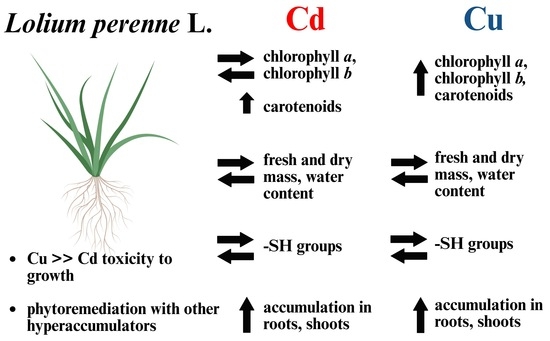
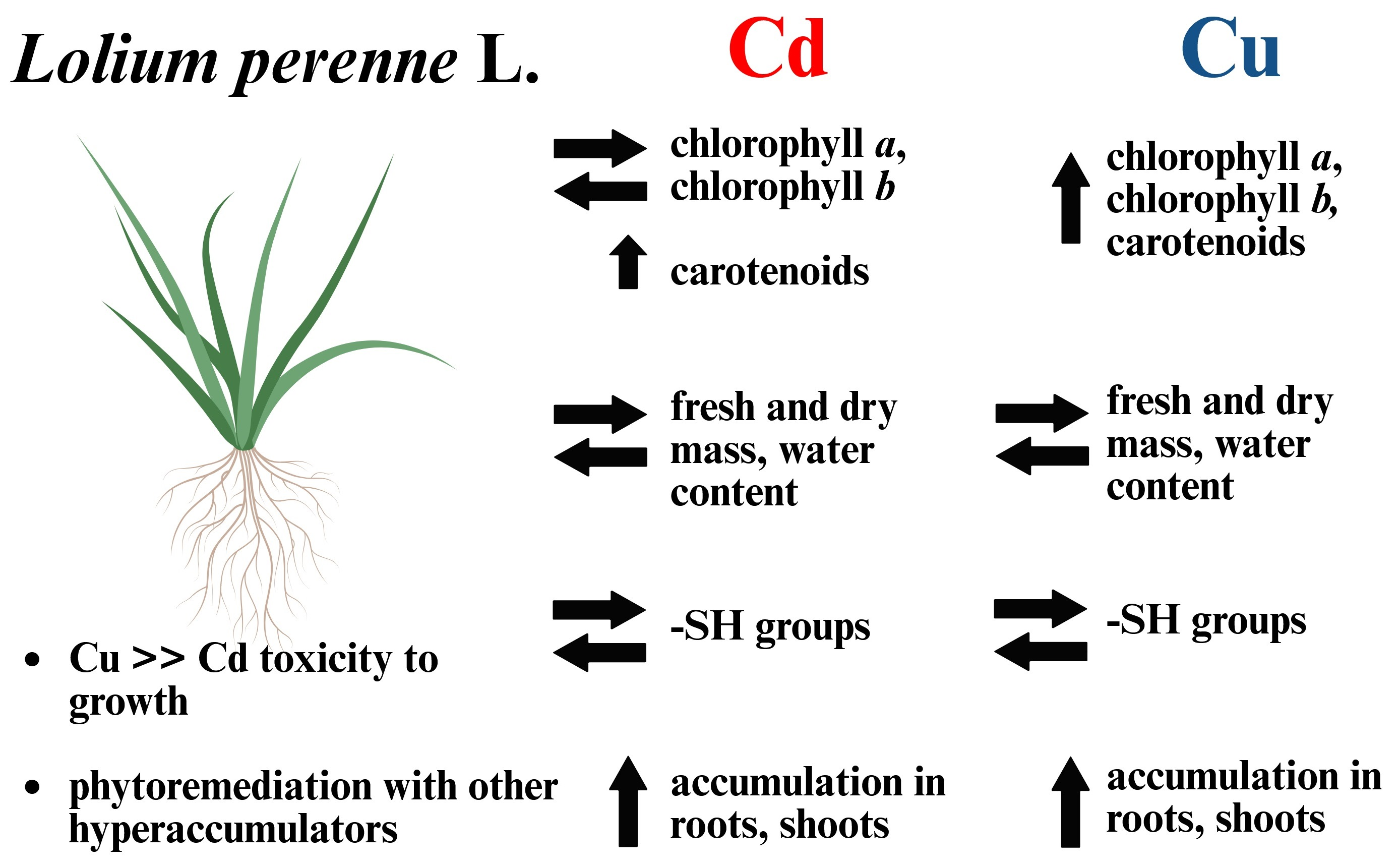
Our main goal was to determine whether the accumulation of Cd and Cu is harmful for L. perenne or whether this plant can be used in the bioremediation, e.g., of wastewaters or contaminated soils. The IC50 values (concentration at which the tested parameter is inhibited to 50% against the control) for root and shoot inhibition after 14 days showed that Cu, as an essential element for plants, was more toxic than Cd. The translocation factor (TF), which refers to metal transport from the root to the shoot, did not exceed values of 0.228 and 0.353 for Cd and Cu, respectively, indicating their accumulation mostly in the roots rather than in the shoots. The protein thiol (-SH) groups as a parameter of the increased level of reactive oxygen species did not confirm the significantly higher level of oxidative stress for Cu, which is a redox-active cation. We confirmed a statistically significant positive correlation between -SH groups and chlorophyll a (r = 0.79; p < 0.05) and chlorophyll b (r = 0.84; p < 0.01) in the presence of Cd. We concluded that bioaccumulation of the tested metals occurred mostly in the roots, and the photosynthetic pigment content in the shoots was not significantly impaired by the increased presence of Cd or Cu in the shoots. Therefore, we suggest L. perenne as a suitable candidate for the phytomining or phytoextraction of metals, mostly from wastewater, in cooperation with other plant hyperaccumulators.

Graphical Abstract

1. Introduction

Heavy (toxic) metal pollution is a global problem that is increasing due to anthropogenic activities such as mining, industry, agriculture, and burning fossil fuels. Many locations polluted by cadmium (Cd) are in Asia [1], but other possible Cd and Cu sources could be the proximity of motorways, which increased the metals in the soil up to 20 cm in depth [2], using of compost or manure [3] or foliar application of soil dust enriched with risk elements or cuprous oxide fungicides [4,5]. The mean values for the topsoil of Europe are 0.28 mg Cd/kg and 17.3 mg Cu/kg [6]. Although the tolerance for people recommended by the FAO/WHO is 10–35 μg/d, the average daily absorption of Cd in Asia is 25–75 μg [7]. The problem with Cd is also related to its persistence in the environment and in the human body, where it accumulates in the kidneys and causes the well-known itai-itai disease [8]. Mining areas are also affected by higher Cd concentrations, such as the Gümüsköy mining area in Turkey where the mean value of Cd in soil is 82.8 mg/kg, and in native plants, the amount is 55.4 and 43.5 mg/kg for roots and shoots, respectively [9]. Another Cd-polluted site is the Bołeslaw Mine and Metallurgical Plant in Bukowno (Poland), where the Cd concentration in the soil was up to 51.9 mg/kg [10].
Copper (Cu) can enter the environment through mining; for example the concentration of Cu in artisanal rock waste in the Amazon was 19,034 mg Cu/kg [11], in a pit lake near an abandoned mine in Agrokipia (Cyprus), 225.4 µg Cu/L was measured [12], and in the Sudbury mining and smelting region of Canada, the Cu concentration reached 2892 mg Cu/kg [13]. However, agricultural activities also contribute to increased copper pollution through the use of copper-based biocides and fungicides, especially in vineyards [14], where the average Cu concentration in vineyard soil is 49.3 mg Cu/kg, which is three times higher than the average concentration in European soils [15]. For example, the average Cu concentration in the vineyards of central Italy was 60 mg Cu/kg, and the highest measured concentration was 150 mg Cu/kg [16]. Copper-based fungicides are used worldwide in other economically important agricultural plant species [5]. Therefore, studying their toxicity to plants is essential to prevent groundwater pollution by copper and organic fungicides using cover crops in vineyards [17].
Cd, a non-essential widespread metal that is not a redox-active ion, can be absorbed by plant roots through the metabolic pathways of nutrients such as zinc, iron, and calcium, owing to its high mobility and water solubility or the fluidity of water [18,19]. In plants, Cd can cause a wide range of physiological and biochemical problems [20] as the indirect induction of oxidative stress by generating highly reactive oxygen species (ROS) and free radicals [21,22], the reaction of ROS with proteins, lipids, and photosynthetic pigments leading to enzyme inactivation, lipid peroxidation, and membrane damage [23], imbalance in nutrient uptake [24], or the inhibition of photosynthesis, chlorophyll synthesis [25], respiration, gas exchange, and water movement [26]. The most visible morphological changes are the inhibition of root and shoot growth, chlorosis, necrosis, and leaf roll [27], leading to a decrease in fresh mass (FM) and dry mass (DM) [28].
Remediation methods reduce metal bioavailability, mobility, and toxicity in heavy metal-contaminated environments and include physical removal, detoxification, bioleaching, and phytoremediation [29], immobilization by altering the pH or adding organic matter such as manure [30], using biosorbents such as biochar or zeolites [31], and using microorganisms that can leach metals through composting [32]. Other methods, such as removal by acid washing and incineration, are also available; however, they are more expensive and cannot be used for crops [33]. Sequestration through exopolymers can only be performed in a laboratory, and the active mixing of top and deep soils to dilute metal contamination destroys the soil structure and is not possible in all land areas, such as vineyards [14].
Phytoremediation is an ideal method that does not negatively affect the environment and is cost-effective. This method is distinct from phytoextraction, phytovolatilization, phytodegradation, phytostabilization, and rhizodegradation. Phytoextraction uses plants, and after sufficient growth and accumulation in the roots and shoots, the plants are harvested and disposed of. This method is suggested for low to moderately contaminated environments, and because of the relatively long time required for cleaning the environment, which also depends on the choice of plant, it is particularly suitable as a complementary method to others or for the final cleaning of the environment in a noninvasive way [34]. There are now more than 500 confirmed hyperaccumulator plant species, including Helianthus annuus L., Brassica juncea L., Typha latifolia L., Arabidopsis halleri L., and Vallisneria spiralis L., but the future of remediation also depends on the search for new potential hyperaccumulators [35]. Medicinal plants can also be effective hyperaccumulators or excluders [36]; however, we focus on Poaceae plants, which may be promising heavy metal phytoremediators and ecorestoration phytoremediators at contaminated mining sites [37]. Brooks mentioned that only Thlaspi caerulescens is a Cd hyperaccumulator that can hyperaccumulate over 3.5% zinc (DM) and at the same time over 0.1% Cd [38] (p. 255). For a plant to be called a hyperaccumulator of Cd, it must accumulate 100 μg/g (ppm) (DM), compared to a normal plant that would have 0.1 μg/g (DM). For a plant to be called a copper hyperaccumulator, it must accumulate 5000 μg/g (DM) compared to a normal plant that would have 10 μg/g [38] (p. 64). The threshold for hyperaccumulators differs for each element [39]. The Cd content is considered to be higher than 100 mg/kg DM, the Cu content is higher than 1000 mg/kg DM, and the Mn or Zn content is higher than 10,000 mg/kg DM [35,39,40]. Many hyperaccumulator plants are rare, with restricted ranges on metalliferous soils, making them sensitive to destructive forces such as mining, forestry development, fires, and urban expansion [41].
Perennial ryegrass (Lolium perenne L.) of the Poaceae family is an easy to cultivate, fast-growing, drought-resistant, and high-biomass forage grass [42,43] that grows in heavy metal-contaminated sites and tolerates or accumulates Cu, Pb, and Zn [44,45]. Ryegrass, widely used as a feed crop for pigs, cattle, sheep, and other large livestock animals, is frequently cultivated in many parts of China because of its high yield and nutrient content [46,47]. Although L. perenne shows signs of being a hyperaccumulator of heavy metals such as Cu, Zn, and Pb [48,49,50,51,52,53], the influence of Cd and Cu and their accumulation in plants has not yet been extensively investigated over a wide range. Many studies have been conducted on soils where metal adsorption on soil particles is dependent on the type of soil and, therefore, could play a role in the bioavailability of these metals to plants. To the best of our knowledge, perennial ryegrass has only been studied in the presence of Cd [54,55], where Xie et al. [55] found that the plant could reduce total Cd in soil and that the optimal bioremediation time was 60 d. Jarvis and Jones [54] observed that the total uptake Cd per gram of dry weight of root in hydroponic cultivation is nearly constant and much greater than that of the corresponding shoots.
In this study, we evaluated the effects of Cd and Cu on L. perenne growth. The effects of the treatments on growth, photosynthetic pigments (PP; chlorophyll a, chlorophyll b, and total carotenoids), protein thiol groups as parameters of higher ROS production, fresh mass (FM), dry mass (DM), water content (WC), and metal accumulation in the roots and shoots were assessed. These results provide a theoretical and practical basis for understanding the effects of Cd and Cu on the potential hyperaccumulator L. perenne, elucidating its suitability for phytoremediation. Although growth and photosynthetic parameters have been measured in ryegrass in the presence of Cd or Cu, protein thiol groups have not been measured or published to the best of our knowledge. As parameters of higher oxidative stress, only the activities of enzymes (superoxide dismutase, catalase, and peroxidase) and malondialdehyde with proline have been studied in the presence of Cd [55]. Therefore, the determination of thiol groups can reveal whether phytochelatins and glutathione, as cysteine-rich proteins/peptides, are depleted/inhibited [56] or whether damage caused by higher ROS levels in this plant does not occur. This parameter, together with others, including the bioaccumulation of metals and correlation analyses, can help us understand the suitability of this plant for the remediation of contaminated areas in the future.

2. Results

2.1. Inhibition of Root and Shoot Growth

The IC50 values for the inhibition of root and shoot growth in L. perenne are shown in Table 1. According to the results, both metals were more toxic to the shoots than to the roots of the plants. For Cd, the IC50 value for shoots was almost 3.95 times lower (IC50 = 708 mg Cd/L) than that for the roots. Cu toxicity was several times greater than Cd toxicity, and its IC50 value for shoots was 1877 times higher than that for roots.

2.2. Fresh Mass (FM), Dry Mass (DM) and Water Content (WC) of Roots and Shoots

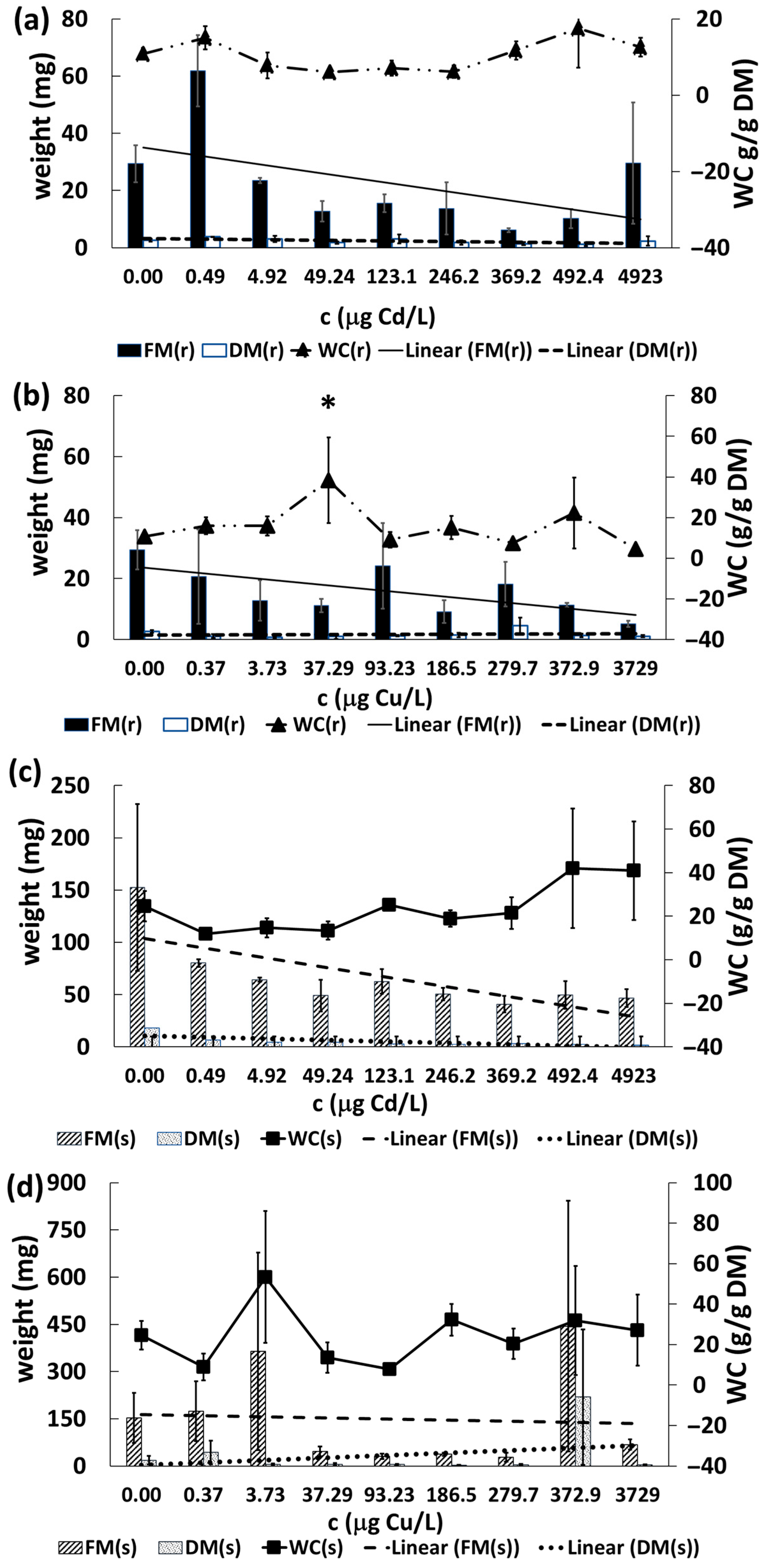
Similarly to the case of the IC50 values in Table 1, where Cu was more toxic to root growth than Cd, the decrease in FM and DM was also greater in the presence of Cu than in Cd, as shown in Figure 1. While Cu at the lower tested concentrations had less of an inhibitory effect on FM production of the shoots, the lowest Cd concentration (0.49 μg/L) decreased the fresh mass of the shoots by approximately 1.9 times (Figure 1c). The DM obtained for the roots and shoots showed a decreasing trend with increasing concentrations of Cd and Cu (Figure 1). As shown Figure 1a–d, we can see that while in the presence of Cd, the WC of shoots slightly but not significantly increased in the presence of Cd (Figure 1c), whereas the WC of roots appeared to remain unchanged with increasing Cd concentration (Figure 1a). The contrary observation is observed in Figure 1b for Cu, where we confirm the significantly higher WC content of roots at 37.29 μg Cu/L (p < 0.05).

2.3. Photosynthetic Pigments and Protein Thiol (-SH) Group Content

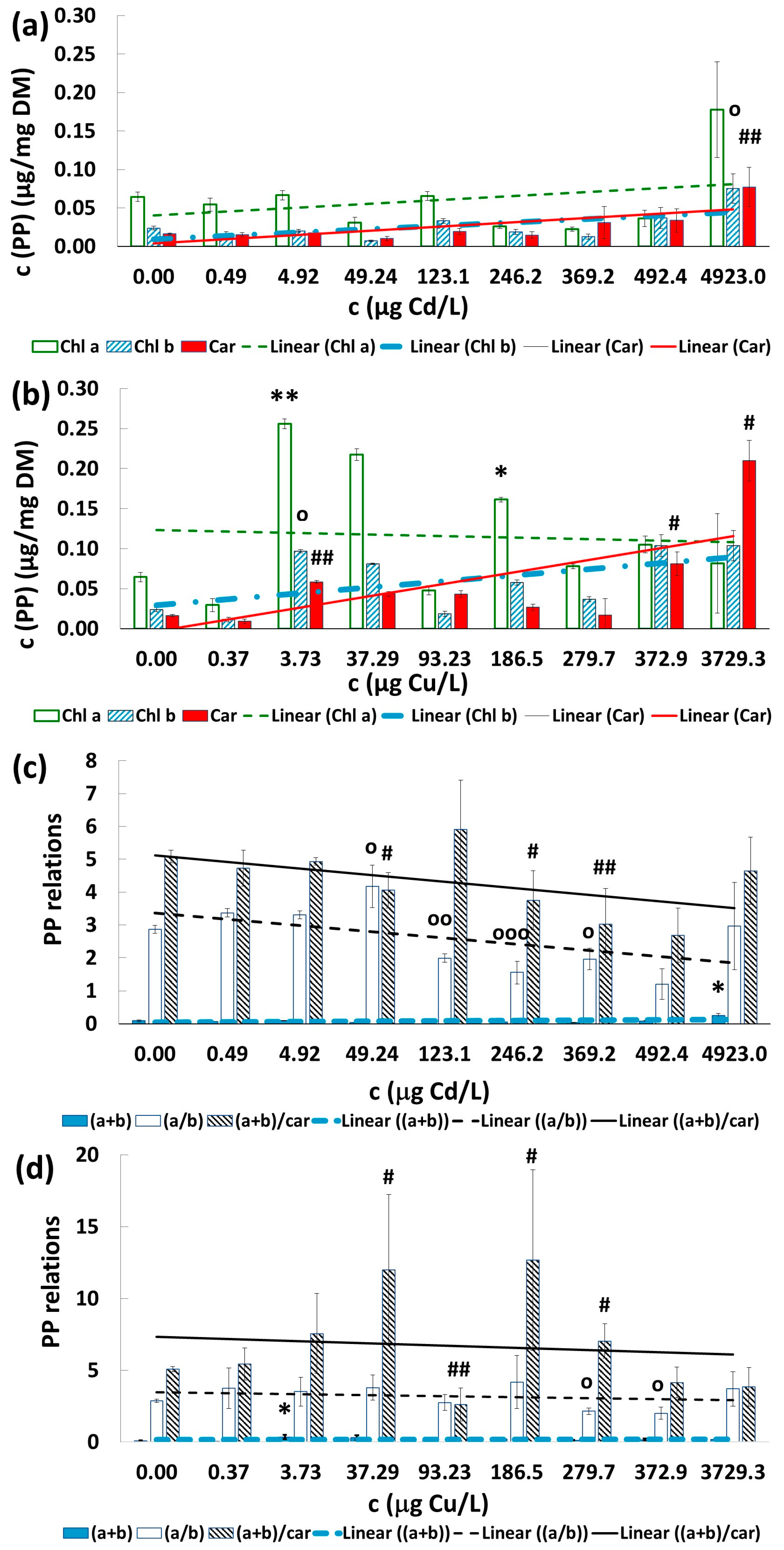
The next parameters were photosynthetic pigments, where trendlines increased in the presence of Cd for all studied pigments (Figure 2a). Chlorophyll a in the presence of Cu was significantly higher than that in the control group at 3.73 μg Cu/L (Figure 2b). In the presence of both metals, we observed an increase in total carotenoid content and an increasing trend in the chlorophyll b content. The total carotenoid content increased in the presence of Cd, and the sum of chlorophylls (a + b) at most concentrations decreased only slightly. The ratio between the sum of chlorophylls and the total carotenoids, expressed as (a + b)/car, decreased, as shown in Figure 2c. The highest level of (a + b) in the presence of Cd was confirmed at the highest tested Cd concentration (4923 μg/L). The highest ratio of (a + b)/car in the presence of Cu was measured at 37.29 and 186.5 μg Cu/L, while the lowest value for this parameter was calculated at a concentration of 93.23 μg Cu/L (Figure 2d). These high values are the result of the very high production of chlorophyll a and b, as shown in Figure 2b. There was no distinct evidence for the inhibition of only one type of chlorophyll in the presence of either Cd or Cu (Figure 2a–d), which is beneficial for the use of perennial ryegrass for bioremediation because it is not harmful to the photosynthesis of the plant.
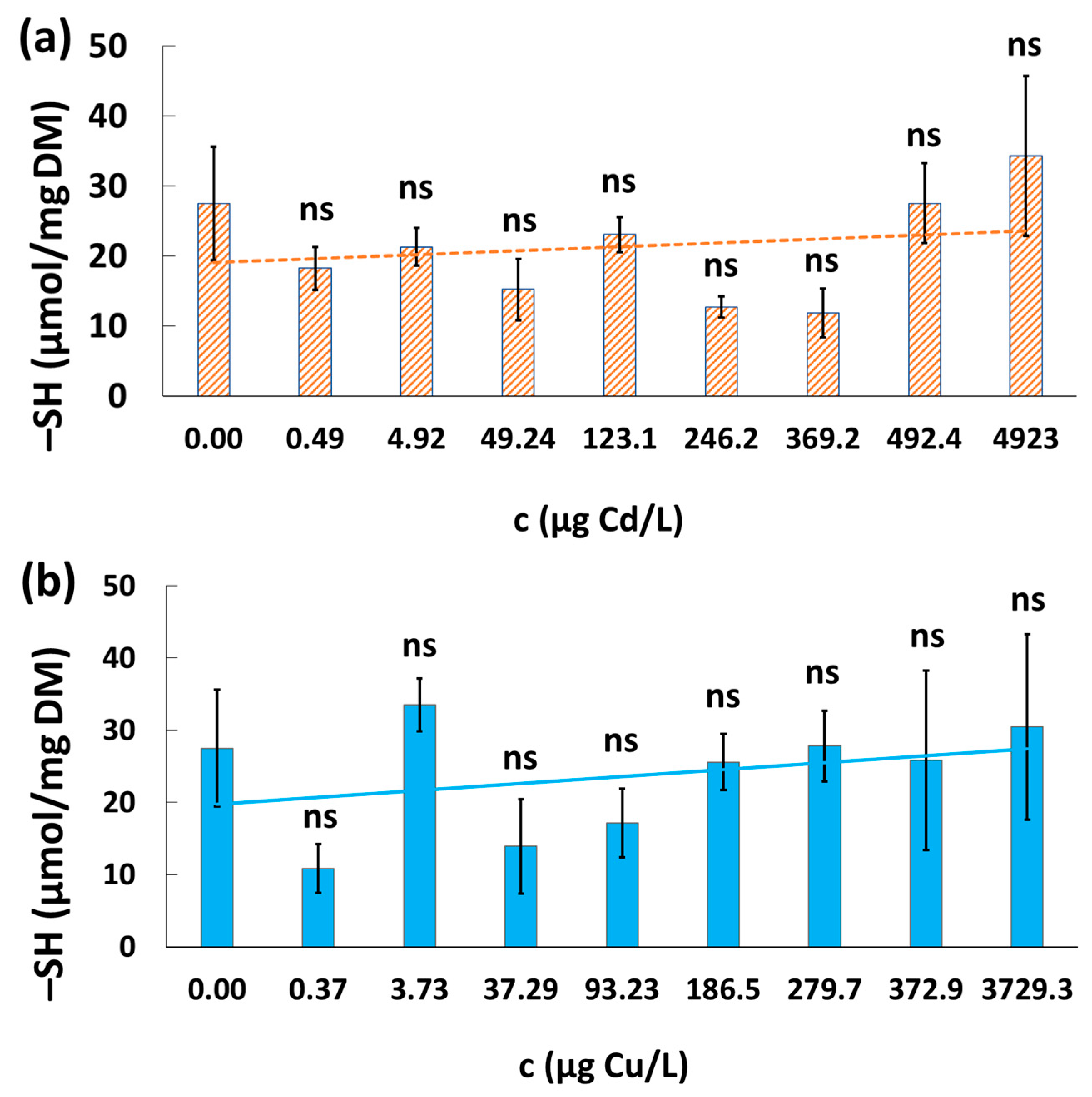
The lowest concentration of –SH was measured after the addition of 0.37 and 37.29 µg Cu/L, as shown in Figure 3b. The highest value of –SH (33.467 µmol/mg DM) was measured at 3.73 µg Cu/L. This value was comparable to the highest amount of –SH observed in the presence of Cd (Figure 3a). Because the Shapiro–Wilk test of normality was significant, we used a non-parametric Kruskal–Wallis test as an alternative to one-way ANOVA. However, no significant changes were observed between the control and each concentration (Figure 3) or for all pairs of concentrations (Tables S1 and S2). Therefore, we can conclude that metals had no harmful effect on this parameter in L. perenne. This observation increases the possibility of using this plant for remediation.

2.4. Bioaccumulation of Cadmium and Copper and Their Translocation in Plants

Values of bioaccumulation factor (BAF), shown in Table 2, were lower for the shoots compared to the BAF of the roots. The highest number was measured at 492.3 µg Cd/L, where the BAF of the shoots was 202 times lower than that of the roots (Table 2). Stimulation of all photosynthetic pigments, including total carotenoids at 3729.27 µg Cu/L (Figure 2b), could be related to the lowest accumulated content of Cu in shoots (62.02 µg/g DM in Table 2) measured at this concentration of Cu in the present study. Similarly to the translocation factor (TF) for L. perenne growing in the presence of Cd, the TF for plants growing in the presence of Cu was less than 1. The highest increase in BAF occurred at 37.29 µg Cu/L, where the BAF of the shoots was 2.83 times lower than that of the roots (Table 2). Although the difference in the BAF values was not as high as that for Cd, TF did not exceed the highest calculated value of 0.353 at the lowest tested concentration (37.29 µg Cu/L).
Correlation analyses of all parameters studied in the presence of Cd or Cu are presented in Table 3a,b, where the significant Pearson correlation coefficients are shown in bold font. The accumulation of Cd in roots was highly positive and correlated with WC in roots (r = 0.88, Table 3a), although this correlation was not significant. The same observation was confirmed for the WC of the shoots and the accumulation of Cd in the roots, with a Pearson correlation coefficient of 0.82. However, highly positive and significant correlations were confirmed between WC and chlorophyll b (r = 0.82; p < 0.01), total carotenoids (r = 0.77; p < 0.05), and protein thiol (-SH) groups (r = 0.75; p < 0.05). Because chlorophyll b is synthesized from chlorophyll a [57], we calculated a highly positive correlation between chlorophyll a and chlorophyll b (r = 0.89; p < 0.01), which shows that Cd did not interrupt this synthesis process. This conclusion is consistent with our observation of no significant changes in (a + b) and (a/b) evaluations in Figure 2c. However, chlorophyll b concentration was significantly associated with total carotenoid synthesis or the actual content of total carotenoids (r = 0.91; p < 0.001) and increased thiol groups (r = 0.84; p < 0.01) (Table 3a). All photosynthetic pigments showed highly positive but non-significant correlations between Cd accumulation in shoots and chlorophyll a (r = 0.90), chlorophyll b (r = 0.79), and total carotenoids (r = 0.87) (Table 3a). The accumulation of Cu in the shoots (Table 3b) confirmed a highly positive but not significant correlation between chlorophyll a (r = 0.96) and chlorophyll b (r = 0.62). The correlation was highly positive in the presence of Cd (Table 3a) only between the accumulation of Cd in roots and the WC of roots and shoots. In the presence of Cu, the accumulation of Cu in shoots was positively correlated with the WC of roots (r = 0.88), as well as with the WC of shoots (r = 0.98) (Table 3b). A highly positive but not significant correlation was confirmed between root FM and chlorophyll b (r = 0.83; p < 0.01), as well as between root growth and chlorophyll b (r = 0.84; p < 0.05) and total carotenoids (r = 0.84; p < 0.05) (Table 3b). Similarly, for Cd, shown in Table 3a, a highly positive significant correlation was observed between the WC of the shoots and the protein thiol groups (r = 0.83; p < 0.01) as well as for chlorophyll b and total carotenoids (r = 0.68; p < 0.05), as shown in Table 3b. A negative correlation was observed between root growth and Cd accumulation in the plant (roots, r = −0.61; shoots, r = −0.52) (Table 3a). Similar negative correlations between shoot growth and Cu accumulation in the plants (roots r = 0.97, shoots r = 0.99) are shown in Table 3b.

3. Discussion

As Ke et al. [58] introduced, soil heavy metal (HM) contamination is a global environmental pollution problem. One-sixth of the agricultural land in China is polluted, and 600,000 hm2 of brown land sites in the United States are polluted by HM. In Europe, the number of estimated potentially contaminated sites exceeds 2.5 million, and the number of identified contaminated sites is approximately 342,000, with HM pollution accounting for 34.8% of these sites [58,59].
To our knowledge, the phytoremediation and phytomining potential of perennial ryegrass has not been comprehensively studied for its use in the removal of toxic metals from the environment, except for some partial determination of harmful effects of Cd, Cu, Pb, and Zn in articles by Jarvis and Jones [54]; Wang et al. [53]; Broadhurst and Chaney [52]; Huo et al. [51]; and Xie et al. [55]. Smith [60], de Conti et al. [61], and Nie et al. [62] studied the toxicity of copper in ryegrass. These authors observed Cu toxicity in plants through morphological changes and nutritional imbalance and identified that phenolic compounds are involved in alleviating Cd and Cu toxicity in ryegrass. Smith [60] observed that the concentrations of all elements decreased in ryegrass grown on two sludge-treated soils as a simple linear function of increasing soil pH. De Conti et al. [61] focused on enhancing the mechanism of tolerance to Cu toxicity in ryegrass plants used as a cover crop in vineyards during Fe fertilization with a complex of ethylenediamine-N,N′-bis(2-hydroxyphenylacetic acid) (EDDHA) or ethylenediaminetetraacetic acid (EDTA). Higher Cu concentrations persist in vineyard soils after long-term use of Cu-based fungicides [61]. Nie et al. [62] focus on increasing the ryegrass remediation potential by the synergistic action of selenium and Bacillus proteolyticus SES for the decontamination of Cu-Cd-Cr concentrations in the soil.
Some studies have focused on the bioavailability of metals in mixtures, such as municipal sewage sludge [63] and heavy metal-contaminated iron ore tailings [64]. Renoux et al. [63] tested 100 mg Cd/kg dry mass of sludges or 3000 mg Cu/kg dry mass added to the sludges from the Montreal Urban Community (MUC) and the Bécancour (BEC) municipal wastewater treatment plants located in the province of Quebec (Canada), in which ryegrass seedlings were exposed to their toxic effect. They observed that Cd concentrations in 15-day-old shoots increased in seedlings grown in the presence of MUC or BEC. Cd was added in the mentioned concentration up to eight times for BEC and 3.75 times for MUC sludges compared to the control growing on the reference soil. However, the Cu concentrations did not increase as much, only 1.83 times higher for BEC and no significant changes for MUC sludge. In our experiments, we observed a more toxic effect of Cd on shoot DM than that of Cu, as shown in Figure 1c,d. Some studies have focused on the accumulation of Cd and Cu from mixtures in contaminated urban areas using electrokinetics and electrokinetics coupled with a permeable reactive barrier, biochar, and maifanite [64,65,66,67]. Sarathchandra et al. [68] studied the accumulation of As, Cu, Fe, Mn, Pb, Ni and Zn in the shoots of ryegrass, which decreased in the presence of compost in the soil. They focused on the improper disposal of heavy metal-contaminated iron ore tailings, which pose a significant risk to the environment. The addition of compost and cultivation of ryegrass could be a long-term, cost-effective solution for the remediation of iron ore tailings. The BCF was higher than 1 for Cu, and the Cu concentration in the shoots was higher in the 45-day seedlings than in the 60-day seedlings. In their experiment, they determined the highest Cu concentration (approximately 15 mg/kg DM) in the seedlings sown in mine tailings. As they did not mention the Cu concentration in the tailings and compost-amended tailings after 7-day equilibration, it is difficult to compare their Cu value in the shoots with the other values in Table 2. We determined a BAF value of 289,067 at 37.29 µg Cu/L (Table 2), while Saratchandra et al. [68] calculated the BCF for Cu as 2.3 for 45 days and 1.4 for 60 days of the experiment. Our research can help clarify the mechanisms and usability of this promising plant for bioremediation and biomineralization technologies. Zhang et al. [47] studied the uptake of Cd and Cu (together with As, Hg, Ni, Pb, and Zn) by ryegrass shoots and their concentrations were up to 1.4 mg Cd/kg and 80 mg Cu/kg, while in the soil samples studied, they were (in mg/kg) Cd = 7.18 and Cu = 2.36 × 10³. Similarly, for the roots, concentrations up to 3 mg Cd/kg and 300 mg Cu/kg were used in the present study. In our hydroponic experiments with a concentration of 3729 mg Cu/kg in the cultivation medium, which is approximately 0.63- times more than that in the study of Zhang et al. [47], we measured 3504 mg Cu/kg DM in the roots, as well as 62 mg Cu/kg DM in the shoots (Table 2), which is close to the Cu concentration in the shoots of Zhang et al. [47].
In the study by Dresler et al. [69], the FM of Zea mays shoots and roots (also from the same Poaceae family as ryegrass) was reduced by 40% and 50%, and 34% and 57% in the presence of 50 and 100 μg Cd/L, respectively. Root FM was reduced by 50 and 100 μg Cu/L more than with Cd (80%); however, unlike our results, the addition of both Cu concentrations reduced shoot FM by 70% (both concentrations), which is also more than with Cd [69]. The lowest FM of the root was measured at the highest concentration of 3729 μg Cu/L (83% reduction compared to the control), while the highest FM weight of the root was for the control (Figure 1b). The FM of the shoots decreased slowly in the presence of Cu (Figure 1d) compared to the higher decrease trendline in the presence of Cd (Figure 1c). However, the highest concentrations tested for Cd and Cu increased WC in the shoots by up to 66% for 4923 μg Cd/L and 10% for 3729 μg Cu/L, respectively (Figure 1c,d). Similarly, for Cd, the TF of Cu was also low, and the highest increase occurred at 3729 μg Cu/L, where the BAF of the shoot was 47 times lower than that of the root (Table 2). Although the difference in BAF was not as high as that for Cd, TF did not exceed 0.35 (37.29 μg/L). A similar observation was made for the salt-tolerant dwarf shrub Tetraena qataranse, in which a higher BAF was measured for the root (3.9 mg/kg DM) than for the shoot (0.5 mg/kg DM) after adding 5.7 mg Cu/kg [70].
Hu et al. [71], in addition to observing a decrease in biomass in the presence of Cd, also studied the level of oxidative stress together with photosynthetic pigments. They observed a non-significant decrease in the level of all PPs in the hydroponically cultivated seedlings in Hoagland nutrient solution in the presence of 0.5 mg Cd/L compared to their control. The accumulation of Cd in leaves also has deleterious effects on chlorophyll biosynthesis, transpiration, respiration, and stomatal opening, which ultimately inhibits the photosynthetic rate [72]. To our knowledge, these photosynthetic pigments have not been determined in ryegrass; therefore, in the next part of the discussion, we attempt to compare our results with those of plants in close groups, hyperaccumulators, and the Poaceae family. The bioaccumulation of Cd by Arthrocnemum macrostachyum of the Amaranthaceae family was tested by Redondo-Gómez et al. [73], where the bioaccumulation factor (BAF) exceeded the critical value (1.0) for all Cd treatments. The accumulation of Cd was mainly in the roots, whereas in the shoots, it increased slowly. However, the statistically significant PP content decreased for all pigment types up to 1.35 mmol/L (152 mg/L). We observed slightly higher but non-significant PP concentrations of 123.1 mg/L, as shown in Figure 2a. Poaceae plants are potential phytoremediators and are frequently used to remove toxic metals from contaminated sites [37]. Along with Zea mays, the genus Lolium is a wild grass species that generally grows in contaminated roadside soils. Although Patra et al. [37] mentioned that more species of the Poaceae family are good candidates for phytostabilization of Cd-contaminated soils due to their ability to accumulate metals mainly in the roots, L. perenne, as a potential candidate for phytoextraction of Cd due our study, can also expand this list. From our experiments, it seems that at the contaminated sites with concentrations of around 100 mg Cd/L in the soil liquid, the ryegrass is still able to grow and accumulates this element mainly in its roots (Table 2), while no higher consumption of antioxidants in the form of protein thiol groups (Figure 3) is observed as a parameter of protein oxidation. Hu et al. [71] measured the level of oxidative stress in the presence of Cd in perennial ryegrass in a hydroponic experiment. Although they confirmed a higher level of lipoperoxidation in the form of malondialdehyde (MDA) and increased peroxidase activity, the activity of catalase was decreased, which can indicate a decreased level of hydrogen peroxide or a harmful effect of Cd on this enzyme. This trend was more pronounced in the roots, whereas the catalase activity did not change in the shoots. Xie et al. [55] also observed higher activity of superoxide dismutase, catalase, and peroxidase together with increased production of MDA and proline in ryegrass seedlings grown in the presence of Cd. These observations indicate increased oxidative stress. In our observations, we used protein thiol group measurements to assess the level of stress in the presence of different Cd concentrations, but no significant changes in these parameters were observed. Therefore, we suppose that antioxidant capacity in the form of chelating molecules, such as phytochelatins and reduced glutathione, could still be effective in minimizing the indirect prooxidative effect of Cd.

4. Materials and Methods

4.1. Plant Materials and Experimental Design

We used the methods described by the OECD [74], US EPA [75], and STN [76] standardized norms. The seeds of Lolium perenne L. (cv. Jozífek) used in these experiments were provided by Agrostis Trávniky Ltd. (Rousínov u Vyškova, Czech Republic). The seeds were sown in vertical plastic containers (Phytotoxkit®; MicroBioTests Inc., Ghent, Belgium) measuring 21.0 × 15.5 cm in size. As substrate, cellulose and filter paper soaked with 24 mL of ½ Hoagland solution [77] were used as a cultivation medium with the following final concentrations (µmol/L), 0.099 KH2PO4; 1.248 KNO3; 1.799 Ca(NO3)2·4H2O; 1.022 MgSO4·7H2O; 0.061 ferric citrate; 11.564 H3BO3; 2.286 MnCl2·4H2O; 0.191 ZnSO4·7H2O; 0.080 CuSO4·5H2O; and 0.018 (NH4)6Mo7O24·4H2O, with final pH value of 6.00 ± 0.30. The seeds were germinated in a cultivation chamber under dark conditions at 25 ± 1 °C for 7 days.
Root and shoot lengths were measured one week after germination. The seeds were then moved into 1 L cultivation plastic containers covered with black color to avoid light exposure to the roots (12 seedlings/container) in the presence of Cd or Cu in 1 L of ½ Hoagland solution, where they hydroponically grew for another 2 weeks with aeration of the roots at a temperature of 25 ± 1 °C with a light regime of 16/8 h day/night at 10,900 lx. Seedlings were placed in plastic straws and inserted into holes in the lid (one seedling per straw and hole). The ½ Hoagland solution without metal addition was used for the control plants. The test Cd concentrations ranged from 0.49 µg Cd/L (4.38 µmol/L) to 4.923 mg Cd/L (43.79 µmol/L), and Cd was used as CdCl2·2.5H2O. Cu concentrations in the form of CuCl2·2H2O were used from 0.37 µg Cu/L (0.0059 µmol/L) to 3.729 mg Cu/L (58.66 µmol/L). These concentrations were chosen as the most relevant from our previous studies. For each tested concentration (eight for Cd and eight for Cu), at least two parallels were used in two independent experiments. The plants were removed after two weeks of cultivation in the presence of the metal (21-day-old seedlings), and the lengths of the roots and shoots were measured separately, together with the FM and DM of the roots and shoots. At least 3 seedlings were used for each concentration in more than two independent experiments.
All chemicals used were of analytical purity (p.a.). The chemicals were purchased as follows: CuCl2·2H2O (Merck, Darmstadt, Germany), Ca(NO3)2·4H2O (Centralchem, Bratislava, Slovakia), ferric citrate (Sigma-Aldrich, St. Louis, MO, USA), H2O2 (ITES Vranov, Ltd., Vranov nad Topľou, Slovakia), and other chemicals were purchased from Lachema-Chemapol (Brno, Czech Republic).

4.2. Determination of Physiological and Biochemical Parameters

For the determination of photosynthetic pigments (PP; chlorophyll a, chlorophyll b, and total carotenoids), 30 mg of fresh shoots (above-ground parts) was taken and homogenized with 6 mL of 95% ethanol (0.5% w/v) until the plant biomass was white, according to Molnárová and Fargašová [78], with equations for ethanol from Lichtenthaler and Wellburn [79]. The homogenate was centrifuged at 2900× g for 2 min, and the photosynthetic pigments in the supernatant were measured spectrophotometrically at 470, 649, and 665 nm. The concentrations were calculated using the following equations [79]:
Chl a (µg/mL) = 13.95(A665) − 6.88 (A649)
Chl b (µg/mL) = 24.96(A649) − 7.32 (A665)
Car (µg/mL) = (1000(A470) − 2.05 (Chl a) − 114.8(Chl b))/245
where Chl a is chlorophyll a, Chl b is chlorophyll b, and Car represents total carotenoids. These equations were recalculated per µg/mg DM.
To determine the protein thiol groups, 500 µL of 0.5% (w/v) fresh leaf homogenate was used, according to Molnárová and Fargašová [78], Ellman et al. [80], and Viner et al. [81]. Next, we weighed the fresh mass (FM) and dry mass (DM) and calculated the water content (WC) in the roots and shoots. For DM measurement, plants were divided into roots and shoots and dried at 55 °C in a hot-air sterilizer (YCO-010, Gemmy Industrial Corporation, Taiwan) until a constant weight was reached, and water content (WC) was calculated according to the equation of Drazic and Mihailovic [82]:
W C ( g / g   D M ) = F M D M D M
where DM is the dry mass of the root or shoot and FM is the fresh mass of the root or shoot.
Because the root mass of a single plant is below the balance threshold, we used the total root (and shoot) mass from all experiments combined as pooled samples for the weight measurement. The minimum weight of 11 mg DM of the roots or shoots was then used for mineralization, followed by the determination of Cd and Cu using the galvanostatic chronopotentiometric electrochemical method on the EcaFlow 150GLP (Istran, Bratislava, Slovakia) [78]. Metal ions (M) were electrochemically deposited from the flowing sample solution in the porous working electrode: M2+ ⟶ M0—2 e, where e is an electron [83]. The deposition was performed by applying a suitable deposition current. In the next step, the deposit was stripped galvanostatically, and the stripping chronopotentiogram was recorded and evaluated. The method measures Cd and Cu metal ions together in the concentration range of 0.5–1000 µg Cu/L with a reproducibility of 1.5% at 50 µg/L for Cu in the measured solution [83]. The method is comparable to atomic absorption spectrometry (AAS) in terms of the sensitivity, accuracy, precision, and reliability of the measured values. The bioaccumulation factor (BAF) and translocation factor (TF) for Cu and Cd were calculated as follows:
B A F = m e t a l   c o n c e n t r a t i o n   i n   t h e   r o o t s   o r   s h o o t s m e t a l   c o n c e n t r a t i o n   i n   t h e   c u l t i v a t i o n   m e d i u m
T F = m e t a l   c o n c e n t r a t i o n   i n   t h e   s h o o t s m e t a l   c o n c e n t r a t i o n   i n   t h e   r o o t s

4.3. Statistical Analysis

The IC50 values, together with their 95% confidence intervals (CI), were acquired by probit analyses in MS Excel 2010 (Microsoft Corporation, Washington, DC, USA) with manually inserted suitable formulas. Statistical significance was calculated using an unpaired two-tailed Student’s t-test in MS Excel 2010 for roots and shoots for both metals against their control group without adding metals. If the Shapiro–Wilk test of normality was significant, we used a non-parametric Kruskal–Wallis test with Dwass–Steel–Critchlow–Fligner pairwise comparisons as an alternative to one-way ANOVA. Statistical significance was evaluated at the level of * p < 0.05, ** p < 0.01, and *** p < 0.001 for the graphs, where the arithmetic averages are shown with their standard error of the mean (SEM). Kruskal–Wallis tests and correlation analyses among all parameters were performed using Jamovi v. 2.3.18 (The Netherlands; https://www.jamovi.org/, accessed on 10 December 2024).

5. Conclusions

Both Cd and Cu are relatively common in the natural environment and can accumulate in plants, thereby entering the food chain. The results showed that both metals were more toxic to shoots than to roots, although most of the metal accumulation occurred in the roots. Therefore, it seems that there is a mechanism to protect the shoots from the toxic effects of these compounds in the aboveground parts of plants. We did not observe any significant changes in the protein thiol groups or FM and DM in the roots and shoots. Increased levels of protein thiol groups are a parameter of protein oxidation and are confirmed at higher levels of oxidative stress. If the plant is unable to fight increased levels of reactive oxygen species, this parameter will decrease first. However, our research suggests that L. perenne is not damaged by the presence of Cd or Cu via protein oxidation. Cd and Cu had negative but insignificant effects on the physiological and morphological parameters of L. perenne. Moreover, the ability of this plant to accumulate these metals and withstand even higher concentrations of them positions this plant closer to the list of potential hyperaccumulators. The optimal property of hyperaccumulators is a higher accumulation of metals in the shoots than in the roots. Because this plant accumulated Cd and Cu mainly in its roots, it cannot be considered a standard hyperaccumulator but can be a suitable candidate for rhizofiltration of water bodies and wastewater treatment systems of root-based remediation. There are more manufacturers in the world that are focused on soil and wastewater treatment solutions using plants in the form of constructed or floating wetlands to treat industrial wastewater and sewage, including ecological settlements. For example, perennial ryegrass could be used in the form of floating islets alongside other relevant plants, such as Typha latifolia and Carex species, which are already used for wastewater remediation. Because perennial ryegrass has a shorter root system, the height of the water column should be smaller, or some type of natural flow through the pipe in the floating islet could be used for the higher bioaccumulation of metals from the contaminated water. Furthermore, as some research has been conducted on using cover plants in vineyards to prevent groundwater contamination by copper from fungicides or for phytostabilization in contaminated soils, this plant could be a good candidate for this role, given that it is a terrestrial grass native to Europe and other continents and is widely cultivated. In addition, its capacity for the bioaccumulation of copper in its roots does not pose a danger to herbivores.

Supplementary Materials

The following supporting information can be downloaded at https://www.mdpi.com/article/10.3390/stresses6010003/s1; Table S1. Effect of Cd on protein thiol groups (–SH) in L. perenne after two weeks of growth in the presence of metals; Table S2. Effect of Cu on protein thiol groups (–SH) in L. perenne after two weeks of growth in the presence of metals.

Author Contributions

Conceptualization, P.E.Š. and M.M.; methodology, A.F.; validation, M.M.; investigation, P.E.Š.; resources, M.M. and A.N.; writing—original draft preparation, P.E.Š.; writing—review and editing, M.M., A.N. and A.F.; visualization, P.E.Š.; supervision, M.M. and A.F. All authors have read and agreed to the published version of the manuscript.

Funding

This research received no external funding.

Institutional Review Board Statement

Not applicable.

Informed Consent Statement

Not applicable.

Data Availability Statement

The original contributions presented in this study are included in the article/Supplementary Material. Further inquiries can be directed to the corresponding author.

Acknowledgments

Graphical Abstract was created in BioRender: Molnarova, M. (2025) https://BioRender.com/y36p233, created on 10 November 2025.

Conflicts of Interest

The authors declare no conflicts of interest.

References

  1. Ikeda, M.; Zhang, Z.-W.; Shimbo, S.; Watanabe, T.; Nakatsuka, H.; Moon, C.-S.; Matsuda-Inoguchi, N.; Higashikawa, K. Urban population exposure to lead and cadmium in east and south-east Asia. Sci. Total Environ. 2000, 249, 373–384. [Google Scholar] [CrossRef]
  2. Kuklová, M.; Hniličková, H.; Hnilička, F.; Pivková, I.; Kukla, J. Impact of expressway on physiology of plants and accumulation of risk elements in forest ecosystems. Plant Soil Environ. 2019, 65, 46–53. [Google Scholar] [CrossRef]
  3. Mbarki, S.; Talbi, O.; Skalicky, M.; Vachova, P.; Hejnak, V.; Hnilicka, F.; Al-ashkar, I.; Abdelly, C.; Rahman, M.A.; El Sabagh, A.; et al. Comparison of grain sorghum and alfalfa for providing of sandy soil with different soil amendments and salt stress. Front. Environ. Sci. 2022, 10, 1022629. [Google Scholar] [CrossRef]
  4. Lhotská, M.; Zemanová, V.; Pavlík, M.; Pavlíková, D.; Hnilička, F.; Popov, M. Leaf fitness and stress response after the application of contaminated soil dust particulate matter. Sci. Rep. 2022, 12, 10046. [Google Scholar] [CrossRef]
  5. Dos Santos Silva, J.V.; Furtado de Almeida, A.-A.; Ahnert, D.; da Silva, N.M.; Souza dos Santos, M.L.; de Almeida Santos, N.; Baligar, V.C. Foliar applied cuprous oxide fungicide induces physiological, biochemical and molecular changes in cacao leaves. Sci. Hortic. 2020, 265, 109224. [Google Scholar] [CrossRef]
  6. Kabata-Pendias, A. Trace Elements in Soils and Plants, 4th ed.; CRC Press: Boca Raton, FL, USA, 2011. [Google Scholar]
  7. Cai, K.; Yu, Y.; Zhang, M.; Kim, K. Concentration, source, and total health risks of cadmium in multiple media in densely populated areas, China. Int. J. Environ. Res. Public Health 2019, 16, 2269. [Google Scholar] [CrossRef]
  8. Nishijo, M.; Nakagawa, H.; Suwazono, Y.; Nogawa, K.; Kido, T. Causes of death in patients with Itai-itai disease suffering from severe chronic cadmium poisoning: A nested case-control analysis of a follow-up study in Japan. BMJ Open 2017, 13, e015694. [Google Scholar] [CrossRef] [PubMed]
  9. Palutoglu, M.; Akgul, B.; Suyarko, V.; Yakovenko, M.; Kryuchenko, N.; Sasmaz, A. Phytoremediation of cadmium by native plants grown on mining soil. Bull. Environ. Contam. Toxicol. 2017, 100, 293–297. [Google Scholar] [CrossRef]
  10. Baran, A.; Czech, T.; Wieczorek, J. Chemical properties and toxicity of soils contaminated by mining activity. Ecotoxicology 2014, 23, 1234–1244. [Google Scholar] [CrossRef]
  11. Covre, W.P.; Ramos, S.J.; da Silveira Pereira, W.V.; de Souza, E.S.; Martins, G.C.; Teixeira, O.M.M.; do Amarante, C.B.; Dias, Y.N.; Fernandes, A.R. Impact of copper mining wastes in the Amazon: Properties and risks to environment and human health. J. Hazard. Mater. 2022, 421, 126688. [Google Scholar] [CrossRef]
  12. Hadjipanagiotou, C.; Christou, A.; Zissimos, A.M.; Chatzitheodoridis, E.; Varnavas, S. Contamination of stream waters, sediments, and agricultural soil in the surroundings of an abandoned copper mine by potentially toxic elements and associated environmental and potential human health–derived risks: A case study from Agrokipia, Cyprus. Environ. Sci. Pollut. Res. 2020, 27, 41279–41298. [Google Scholar] [CrossRef]
  13. Hutchinson, T.C.; Whitby, L.M. Heavy-metal pollution in the Sudbury mining and smelting region of Canada, I. Soil and vegetation contamination by nickel, copper, and other metals. Environ. Conserv. 2009, 1, 123–132. [Google Scholar] [CrossRef]
  14. Mackie, K.A.; Müller, T.; Kandeler, E. Remediation of copper in vineyards—A mini review. Environ. Pollut. 2012, 167, 16–26. [Google Scholar] [CrossRef] [PubMed]
  15. Ballabio, C.; Panagos, P.; Lugato, E.; Huang, J.H.; Orgiazzi, A.; Jones, A.; Fernández-Ugalde, O.; Borrelli, P.; Montanarella, L. Copper distribution in European topsoils: An assessment based on LUCAS soil survey. Sci. Total Environ. 2018, 636, 282–298. [Google Scholar] [CrossRef] [PubMed]
  16. De Bernardi, A.; Marini, E.; Casucci, C.; Tiano, L.; Marcheggiani, F.; Vischetti, C. Copper monitoring in vineyard soils of central Italy subjected to three antifungal treatments, and effects of sub-lethal copper doses on the earthworm Eisenia fetida. Toxics 2022, 10, 310. [Google Scholar] [CrossRef] [PubMed]
  17. Ortega, P.; Sánchez, E.; Gil, E.; Matamoros, V. Use of cover crops in vineyards to prevent groundwater pollution by copper and organic fungicides. Soil column studies. Chemosphere 2022, 303, 134975. [Google Scholar] [CrossRef]
  18. Ali, B.; Qian, P.; Jin, R.; Khan, M.; Aziz, R.; Tian, T.; Zhou, W. Physiological and ultra-structural changes in Brassica napus seedlings induced by cadmium stress. Biol. Plant. 2014, 58, 131–138. [Google Scholar] [CrossRef]
  19. Cosio, C.; Martinoia, E.; Keller, C. Hyperaccumulation of cadmium and zinc in Thlaspi caerulescens and Arabidopsis halleri at the leaf cellular level. Plant Physiol. 2004, 134, 716–725. [Google Scholar] [CrossRef]
  20. Zou, J.; Yue, J.; Jiang, W.; Liu, D. Effects of cadmium stress on root tip cells and some physiological indexes in Allium cepa var. Agrogarum L. Acta Biol. Crac. Ser. Bot. 2012, 54, 129–141. [Google Scholar] [CrossRef]
  21. Chaoui, A.; Mazhoudi, S.; Ghorbal, M.H.; Ferjani, E.E. Cadmium and zinc induction of lipid peroxidation and effects on antioxidant enzyme activities in bean (Phaseolus vulgaris L.). Plant Sci. 1997, 127, 139–147. [Google Scholar] [CrossRef]
  22. di Toppi, S.L.; Gabbrielli, R. Response to cadmium in higher plants. Environ. Exp. Bot. 1999, 41, 105–130. [Google Scholar] [CrossRef]
  23. Singh, S.; Eapen, S. Cadmium accumulation and its influence on lipid peroxidation and antioxidative system in an aquatic plant, Bacopa monnieri L. Chemosphere 2006, 62, 233–246. [Google Scholar] [CrossRef]
  24. Zhou, J.; Wang, J.J.; Wang, J.; Wu, H.; Ou, Y.; Li, B. Transcriptional, physiological and cytological analysis validated the roles of some key genes linked Cd stress in Salix matsudana Koidz. Environ. Exp. Bot. 2017, 134, 116–129. [Google Scholar] [CrossRef]
  25. Jia, L.; Liu, Z.; Chen, W.; Ye, Y.; Yu, S.; He, X. Hormesis effects induced by cadmium on growth and photosynthetic performance in a hyperaccumulator. Lonicera japonica Thunb. J. Plant Growth Regul. 2015, 34, 13–21. [Google Scholar] [CrossRef]
  26. Tang, Y.; Xie, Y.; Sun, G.; Tan, H.; Lin, L.; Li, H.; Liao, M.; Wang, Z.; Lv, X.; Liang, D.; et al. Cadmium-accumulator straw application alleviates cadmium stress of lettuce (Lactuca sativa) by promoting photosynthetic activity and antioxidative enzyme activities. Environ. Sci. Pollut. Res. 2018, 25, 30671–30679. [Google Scholar] [CrossRef]
  27. Schützendübel, A.; Schwanz, P.; Teichmann, T.; Gross, K.; Langenfeld-Heyser, R.; Godbold, D.L.; Polle, A. Cadmium-induced changes in antioxidative systems, H2O2 content and differentiation in pine (Pinus sylvestris) roots. Plant Physiol. 2001, 127, 887–892. [Google Scholar] [CrossRef]
  28. Riziwan, M.; Ali, S.; Abbas, T.; Zia-ur-Rehman, M.; Hannan, F.; Keller, C.; Al-Wabel, M.I.; Ok, Y.S. Cadmium minimization in wheat: A critical review. Ecotoxicol. Environ. Saf. 2016, 130, 43–53. [Google Scholar] [CrossRef]
  29. Thakare, M.; Sarma, H.; Datar, S.; Roy, A.; Pawar, P.; Gupta, K.; Pandit, S.; Prasad, R. Understanding the holistic approach to plant-microbe remediation technologies for removing heavy metals and radionuclides from soil. Curr. Res. Biotechnol. 2021, 3, 84–98. [Google Scholar] [CrossRef]
  30. Brandt, K.K.; Holm, P.E.; Noybroe, O. Evidence for bioavailable copper-dissolved organic matter complexes and transiently increased copper bioavailability in manure-amended soils as determined by bioluminescent bacterial biosensors. Environ. Sci. Technol. 2008, 42, 3102–3108. [Google Scholar] [CrossRef]
  31. Vishnu, D.; Dhandapani, B.; Kannappan Panchamoorthy, G.; Vo, D.-V.N.; Ramakrishnan, S.R. Comparison of surface-engineered superparamagnetic nanosorbents with low-cost adsorbents of cellulose, zeolites and biochar for the removal of organic and inorganic pollutants: A review. Environ. Chem. Lett. 2021, 19, 3181–3208. [Google Scholar] [CrossRef]
  32. Kumar, B.L.; Gopal, D.V.R.S. Effective role of indigenous microorganisms for sustainable environment. 3Biotech 2015, 5, 867–876. [Google Scholar] [CrossRef] [PubMed]
  33. Abumaizar, R.J.; Smith, E.H. Heavy metal contaminants removal by soil washing. J. Hazard. Mater. 1999, 70, 71–86. [Google Scholar] [CrossRef]
  34. Jadia, C.D.; Fulekar, M.H. Phytoremediation of heavy metals: Recent techniques. Afr. J. Biotechnol. 2009, 8, 921–928. [Google Scholar]
  35. Reeves, R.D.; Baker, A.J.M.; Jaffré, T.; Erskine, P.D.; Echevarria, G.; van der Ent, A. A global database for plants that hyperaccumulate metal and metalloid trace elements. New Phytol. 2017, 218, 397–400. [Google Scholar] [CrossRef]
  36. Masarovičová, E.; Kráľová, K.; Kummerová, M. Principles of classification of medicinal plants as hyperaccumulators or excluders. Acta Physiol. Plant 2010, 32, 823–829. [Google Scholar] [CrossRef]
  37. Patra, D.K.; Acharya, S.; Pradhan, C.; Patra, H.K. Poaceae plants as potential phytoremediators of heavy metals and eco-restoration in contaminated mining sites. Environ. Technol. Innov. 2021, 21, 101293. [Google Scholar] [CrossRef]
  38. Brooks, R.R. (Ed.) Plants That Hyperaccumulate Heavy Metals; CAB International: Wallingford, UK, 1998; 384p. [Google Scholar]
  39. Furini, E. (Ed.) Plants and Heavy Metals; SpringerBriefs in Biometals; Springer: Dordrecht, The Netherlands, 2012. [Google Scholar] [CrossRef]
  40. Baker, A.J.M.; Brooks, R.R. Terrestrial higher plants which hyperaccumulate metallic elements—A review of their distribution, ecology and phytochemistry. Biorecovery 1989, 1, 81–126. [Google Scholar]
  41. Jaffré, T.; Reeves, R.D.; Baker, A.J.M.; Schat, H.; van der Ent, A. The discovery of nickel hyperaccumulation in the New Caledonian tree Pycnandra acuminate 40 years on: An introduction to a Virtual Issue. New Phytol. 2018, 218, 397–400. [Google Scholar] [CrossRef] [PubMed]
  42. Xie, H.; Zhu, L.; Wang, J. Combined treatment of contaminated soil with a bacterial Stenotrophomonas strain DXZ9 and ryegrass (Lolium perenne) enhances DDT and DDE remediation. Environ. Sci. Pollut. Res. 2018, 25, 31895–31905. [Google Scholar] [CrossRef]
  43. Vigliotta, G.; Matrella, S.; Cicatelli, A.; Guarino, F.; Castiglione, S. Effects of heavy metals and chelants on phytoremediation capacity and on rhizobacterial communities of maize. J. Environ. Manage. 2016, 179, 93–102. [Google Scholar] [CrossRef]
  44. Gawryluk, A.; Wylupek, T.; Wolanski, P. Assessment of Cu, Pb and Zn content in selected species of grasses and in the soil of the roadside embankment. Ecol. Evol. 2020, 10, 9841–9852. [Google Scholar] [CrossRef]
  45. Khalid, S.; Shahid, M.; Niazi, N.K.; Murtaza, B.; Bibi, I.; Dumat, C. A comparison of technologies for remediation of heavy metal contaminated soils. J. Geochem. Explor. 2017, 182, 247–268. [Google Scholar] [CrossRef]
  46. Mori, A. Farmyard manure application and associated root proliferation improve the net greenhouse gas balance of Italian ryegrass—Maize double-cropping field in Nasu, Japan. Sci. Total Environ. 2021, 792, 148332. [Google Scholar] [CrossRef]
  47. Zhang, H.; Li, Y.; Li, R.; Wu, W.; Abdelrahman, H.; Wang, J.; Al-Solaimani, S.G.; Antoniadis, V.; Rinklebe, J.; Lee, S.S.; et al. Mitigation of the mobilization and accumulation of toxic metal(loid)s in ryegrass using sodium sulfide. Sci. Total Environ. 2024, 909, 168387. [Google Scholar] [CrossRef] [PubMed]
  48. Mahar, A.; Wang, P.; Ali, A.; Awasthi, M.K.; Lahori, A.H.; Wang, Q.; Li, R.; Zhang, Z. Challenges and opportunities in the phytoremediation of heavy metals contaminated soils: A review. Ecotox. Environ. Saf. 2016, 126, 111–121. [Google Scholar] [CrossRef]
  49. Salama, A.K.; Osman, K.A.; Gouda, N.A.-R. Remediation of lead and cadmium-contaminated soils. Int. J. Phytoremediat. 2016, 18, 364–367. [Google Scholar] [CrossRef]
  50. Zhang, J.; Wang, W.; Geng, Y.; Ren, X.; Wang, Z.; Cao, S. The response to the combine pollution of cadmium, zinc and lead by the antioxidant activity of Lolium perenne L. J. Agro-Environ. Sci. 2018, 37, 1117–1124. [Google Scholar]
  51. Huo, W.; Zhao, Z.; Wang, L.; Zou, R.; Fan, H. Study of the effects of intercropping different hyperaccumulator and accumulator plants on Cd uptake and transportation by maize. Earth Sci. Front. 2019, 26, 118–127. [Google Scholar] [CrossRef]
  52. Broadhurst, C.L.; Chaney, R.L. Growth and metal accumulation of an Alyssum murale nickel hyperaccumulator ecotype co-cropped with Alyssum montanum and perennial ryegrass in serpentine. Soil. Front. Plant Sci. 2016, 7, 451. [Google Scholar] [CrossRef]
  53. Wang, K.; Huang, H.; Zhu, Z.; Li, T.; He, Z.; Yang, X.; Alva, A. Phytoextraction of metals and rhizoremediation of PAHs in co-contaminated soil by co-planting of Sedum alfredii with ryegrass (Lolium perenne) or castor (Ricinus communis). Int. J. Phytoremediat. 2013, 15, 283–298. [Google Scholar] [CrossRef]
  54. Jarvis, S.C.; Jones, L.H.P. Uptake and transport of cadmium by perennial ryegrass from flowing solution culture with a constant concentration of cadmium. Plant Soil 1978, 49, 333–342. [Google Scholar] [CrossRef]
  55. Xie, H.; Ma, Y.; Wang, Y.; Sun, F.; Liu, R.; Liu, X.; Xu, Y. Biological response and phytoremediation of perennial ryegrass to halogenated flame retardants and Cd in contaminated soils. J. Environ. Chem. Eng. 2021, 9, 106526. [Google Scholar] [CrossRef]
  56. Faizan, M.; Alam, P.; Hussain, A.; Karabulut, F.; Tonny, S.H.; Cheng, S.H.; Yusuf, M.; Adil, M.F.; Shear, S.; Alomrani, S.O.; et al. Phytochelatins: Key regulator against heavy metal toxicity in plants. Plant Stress 2024, 11, 100355. [Google Scholar] [CrossRef]
  57. Eggink, L.L.; LoBrutto, R.; Brune, D.C.; Brusslan, J.; Yamasato, A.; Tanaka, A.; Hoober, J.K. Synthesis of chlorophyll b: Localization of chlorophyllide a oxygenase and discovery of a stable radical in the catalytic subunit. BMC Plant Biol. 2004, 4, 5. [Google Scholar] [CrossRef]
  58. Ke, T.; Guo, G.; Liu, J.; Zhang, C.; Tao, Y.; Wang, P.; Xu, Y.; Chen, L. Improvement of the Cu and Cd phytostabilization efficiency of perennial ryegrass through the inoculation of three metal-resistant PGPR strains. Environ. Pollut. 2021, 271, 116314. [Google Scholar] [CrossRef]
  59. Panagos, P.; Van Liedekerke, M.; Yigini, Y.; Montanarella, L. Contaminated sites in Europe: Review of the current situation based on data collected through a European network. J. Environ. Public Health 2013, 2013, 158764. [Google Scholar] [CrossRef]
  60. Smith, S.R. Effect of soil pH on availability to crops of metals in sewage sludge-treated soils. I. Nickel, copper and zinc uptake and toxicity to ryegrass. Environ. Pollut. 1994, 85, 321–327. [Google Scholar] [CrossRef]
  61. De Conti, L.; Cesco, S.; Mimmo, T.; Pii, Y.; Valentinuzzi, F.; Melo, G.W.B.; Ceretta, C.A.; Trentin, E.; Marques, A.C.R.; Brunetto, G. Iron fertilization to enhance tolerance mechanisms to copper toxicity of ryegrass plants used as cover crop in vineyards. Chemosphere 2020, 243, 125928. [Google Scholar] [CrossRef]
  62. Nie, M.; Wu, C.; Tang, Y.; Shi, G.; Wang, X.; Hu, C.; Cao, J.; Zhao, X. Selenium and Bacillus proteolyticus SES synergistically enhanced ryegrass to remediate Cu–Cd–Cr contaminated soil. Environ. Pollut. 2023, 323, 121272. [Google Scholar] [CrossRef] [PubMed]
  63. Renoux, A.Y.; Rochelau, S.; Sarrazin, M.; Sunahara, G.I.; Blais, J.-F. Assessment of a sewage sludge treatment on cadmium, copper and zinc bioavailability in barley, ryegrass and earthworms. Environ. Pollut. 2007, 145, 41–50. [Google Scholar] [CrossRef] [PubMed]
  64. Dradrach, A.; Karczewka, A.; Bogacz, A.; Kawałko, D.; Pruchniewicz, D. Accumulation of potentially toxic metals in ryegrass (Lolium perenne, L.) and other components of lawn vegetation in variously contaminated sites of urban areas. Sustainability 2024, 16, 8040. [Google Scholar] [CrossRef]
  65. Deng, J.; Zhou, H.; Jiang, S.; Wang, Z.; Li, S.; Wu, T.; Li, M.; Zhan, Y. Remediation of Cd and Cu compound contaminated woil with ryegrass (Lolium perenne L.) combined with electrokinetics. Sep. Sci. Technol. 2025, 60, 302–315. [Google Scholar] [CrossRef]
  66. Zhou, H.; Deng, J.; Ye, M.; Jiang, S.; Li, S.; Wu, T.; Li, M.; Zhan, Y. Ryegrass (Lolium perenne L.) assisted electrokinetics coupled with permeable reactive barrier for the remediation of cadmium and copper compound contaminated soil. J. Environ. Chem. Eng. 2024, 12, 113281. [Google Scholar] [CrossRef]
  67. Ding, Y.; Wang, W.; Ao, S. The regulating effects and mechanism of biochar and maiganite on copper and camium in a polluted soil-Lolium perenne L. system. PeerJ 2021, 9, e11921. [Google Scholar] [CrossRef]
  68. Sarathchandra, S.S.; Rengel, Z.; Solaiman, Z.M. Remediation of heavy metal-contaminated iron ore tailings by applying compost and growing perennial ryegrass (Lolium perenne L.). Chemosphere 2022, 288, 132573. [Google Scholar] [CrossRef] [PubMed]
  69. Dresler, S.; Hanaka, A.; Bednarek, W.; Maksymiec, W. Accumulation of low-molecular-weight organic acids in roots and leaf segments of Zea mays plants treated with cadmium and copper. Acta Physiol. Plant. 2014, 36, 1565–1575. [Google Scholar] [CrossRef]
  70. Usman, K.; Al-Ghouti, M.A.; Abu-Dieyeh, M.H. The assessment of cadmium, chromium, copper, and nickel tolerance and bioaccumulation by shrub plant Tetraena qataranse. Sci. Rep. 2019, 9, 5658. [Google Scholar] [CrossRef] [PubMed]
  71. Hu, Y.; Habibul, N.; Hu, Y.-Y.; Meng, F.-L.; Zhang, X.; Sheng, G.-P. Mixture toxicity and uptake of 1-butyl-3methylimidazolium bromide and cadmium co-contaminants in water by perennial ryegrass (Lolium perenne L.). J. Hazard. Mater. 2020, 386, 121972. [Google Scholar] [CrossRef]
  72. Hasanuzzaman, M.; Prasad, M.N.V.; Fujita, M. Cadmium Toxicity and Tolerance in Plants: From Physiology to Remediation; Academic Press: London, UK; Elsevier: Amsterdam, The Netherlands, 2018. [Google Scholar]
  73. Redondo-Gómez, S.; Mateos-Naranjo, E.; Andrades-Moreno, L. Accumulation and tolerance characteristics of cadmium in a halophytic Cd-hyperaccumulator, Arthrocnemum macrostachyum. J. Hazard. Mater. 2010, 184, 299–307. [Google Scholar] [CrossRef]
  74. OECD. Guidelines for the testing of chemicals. In Terrestrial Plant Test: Seedling Emergence and Seedling Growth Test, Test 208; OECD: Paris, France, 2006. [Google Scholar]
  75. US EPA. Ecological Effects Test Guidelines, 712-C-011. OCSPP 850.4150: Vegetative Vigor; U.S. Environmental Protection Agency: Washington, DC, USA, 2012.
  76. STN 83 8303; Skúšanie Nebezpečných Vlastností Odpadov. Ekotoxicita. Skúšky Akútnej Toxicity na Vodných Organizmoch a Skúšky Inhibície Rastu Rias a Vyšších Kultúrnych Rastlín. [Testing of Dangerous Properties of Wastes. Ecotoxicity. Acute Toxicity Tests on Aquatic Organisms and Growth Inhibition Tests of Algae and Higher Cultivated Plants]. Office for Standardization, Metrology and Testing of the Slovak Republic: Bratislava, Slovakia, 1999. (In Slovak)
  77. Hoagland, D.R.; Arnon, D.I. The Water-Culture Method for Growing Plants Without Soil; Circular 347; California Agricultural Experiment Station: Berkeley, CA, USA, 1950; p. 32. [Google Scholar]
  78. Molnárová, M.; Fargašová, A. Relationship between various physiological and biochemical parameters activated by cadmium in Sinapis alba L. and Hordeum vulgare L. Ecol. Eng. 2012, 49, 65–72. [Google Scholar] [CrossRef]
  79. Lichtenthaler, H.K.; Wellburn, A.R. Determination of total carotenoids and chlorophylls a and b of leaf extracts in different solvents. Biochem. Soc. Trans. 1983, 11, 591–592. [Google Scholar] [CrossRef]
  80. Ellman, G.L.; Courtney, K.D.; Andres, V.; Featherstone, R.M. A new and rapid colorimetric determination of acetylcholinesterase activity. Biochem. Pharmacol. 1961, 7, 88–90. [Google Scholar] [CrossRef]
  81. Viner, R.I.; Krainev, A.G.; Williams, T.D.; Schoneich, C.; Bigelow, D.J. Identification of oxidation sensitive peptides within the cytoplasmic domain of the sarcoplasmic reticulum Ca2+-ATPase. Biochemistry 1997, 36, 7706–7716. [Google Scholar] [CrossRef]
  82. Drazic, G.; Mihailovic, N. Modification of cadmium toxicity in soybean seedlings by salicylic acid. Plant Sci. 2005, 168, 511–517. [Google Scholar] [CrossRef]
  83. Istran. Determination of Zn, Cd, Pb and Cu in Clear as Well as in Turbid Samples; Application list No. 67, manual guide v.2009-10 for EcaFlow 150GLP; Istran: Bratislava, Slovak Republic, 2009. [Google Scholar]
Figure 1. Fresh (FM), dry (DM) mass, and water content (WC) of the roots (a,b) and shoots (c,d) of L. perenne after two weeks of growth in the presence of Cd (a,c) and Cu (b,d); (n ≥ 3). The arithmetic averages and their standard errors of the mean (SEM) are shown in the graph. Statistical significance was evaluated using an unpaired two-tailed Student’s t-test, where * p < 0.05 was compared to the suitable control. Legend: r, roots; s, shoots.
Stresses 06 00003 g001
Figure 2. Concentrations of photosynthetic pigments (PP) (a,b) and their relationships (ratios and sum) (c,d) in the leaves of L. perenne after two weeks of growth in the presence of Cd (a,c) and Cu (b,d) (n ≥ 4). The arithmetic averages with their standard errors of the mean (SEM) are shown in the graph. Statistical significance was evaluated using an unpaired two-tailed Student’s t-test, where * p < 0.05, ** p < 0.01, o p < 0.05, oo p < 0.01, ooo p < 0.001, # p < 0.05, and ## p < 0.01 are compared to the suitable control. The asterisk (*) indicates Chl a, the circle (o) indicates Chl b, and the hashtag (#) indicates Car. Legend: c, concentration; Chl a, chlorophyll a; Chl b, chlorophyll b; Car, total carotenoids; DM, dry mass.
Stresses 06 00003 g002
Figure 3. Effect of Cd (a) and Cu (b) on protein thiol groups (–SH) in L. perenne after two weeks of growth in the presence of metals (n ≥ 4). The arithmetic averages with their standard error of the mean (SEM) are shown on the graph. Lines in the graphs represent the trend lines. Statistical significance was evaluated using a non-parametric one-way ANOVA Kruskal–Wallis test with Dwass–Steel–Critchlow–Fligner pairwise comparisonsat the level of p < 0.05 to the suitable control. Legend: DM, dry mass; ns, not significant.
Stresses 06 00003 g003
Table 1. IC50 values with their 95% confidence intervals (CI) for the inhibition of root and shoot growth of L. perenne seedlings that grew for two weeks in the presence of Cd or Cu.
Lolium perenneIC50 (mg/L)
(LCI-UCI)
RootShoot
Cd2793
(2609–2991)
708
(661–758)
Cu807
(757–860)
0.43
(0.35–0.53)
Legend: LCI, lower confidence interval; UCI, upper confidence interval.
Table 2. Concentration of Cd and Cu with the standard error of means (SEM) in roots and shoots of L. perenne after two weeks of growth in the presence of Cd (n = 3).
c
(µg Cd/L)
c (Roots)
(µg/g DM)
BAF-Rootsc (Shoots)
(µg/g DM)
BAF-ShootsTF
0nd-nd--
49.23035 ± 20261.687693 ± 24414.0850.228
492.333,322 ± 27,94767.686165 ± 300.3350.005
4923.016,222 ± 64833.2952534 ± 24960.5150.156
c
(µg Cu/L)
01649 ± 110-30.2 ± 4.0--
37.291,078,011 ± 1,524,53828,908.850381,532 ± 146710,231.4830.353
372.914,759 ± 840439.579414 ± 3221.1100.029
3729.33504 ± 4720.94062.0 ± 0.90.0170.018
Legend: BAF, bioaccumulation factor; c, concentration; DM, dry mass; nd, not detectable; TF, translocation factor.
Table 3. Cd (a) and Cu (b) correlation matrices for the parameters studied using Pearson’s correlation coefficient r and statistical significance p (* p < 0.05; ** p < 0.01; *** p < 0.001).
(a)
CdCd AccumulationGrowthMass of RootMass of ShootPP
RootShootRootShootFMDMWCFMDMWCchl achl bcar
Cd accum.-shoot0.08
Growth-root−0.61−0.52
Growth-shoot0.14−0.71−0.49
mass of root-FM−0.460.440.78−0.80
mass of root-DM−0.730.290.86 *−0.760.81 **
mass of root-WC0.88−0.060.05−0.210.35−0.06
mass of shoot-FM−0.57−0.510.68−0.190.420.420.06
mass of shoot-DM−0.65−0.560.62−0.070.330.290.040.97 ***
mass of shoot-WC0.820.36−0.610.01−0.27−0.430.54−0.13−0.19
chl a0.040.90−0.25−0.690.330.290.160.02−0.070.51
chl b0.450.79−0.47−0.450.08−0.010.34−0.13−0.240.82 *0.89 **
car0.440.87−0.54−0.43−0.01−0.200.41−0.31−0.340.77 *0.82 **0.91 ***
–SH0.400.48−0.33−0.360.210.150.430.290.190.75 *0.79 *0.84 **0.66
(b)
CuCu AccumulationGrowthMass of RootMass of ShootPP
RootShootRootShootFMDMWCFMDMWCchl achl bcar
Cu accum.-shoot1.00
Growth-root−0.50−0.42
Growth-shoot0.970.990.49
mass of root-FM−0.48−0.400.89 *0.13
mass of root-DM−0.55−0.470.37−0.440.36
mass of root-WC0.830.88−0.10−0.27−0.24−0.36
mass of shoot-FM0.900.940.060.57−0.10−0.320.19
mass of shoot-DM0.960.98−0.250.07−0.13−0.120.250.74 *
mass of shoot-WC0.900.98−0.100.37−0.42−0.15−0.080.600.12
chl a0.980.96−0.180.03−0.52−0.340.570.25−0.140.64
chl b0.680.62−0.84 *−0.19−0.83 **−0.370.300.460.340.650.63
car0.04−0.05−0.84 *−0.30−0.64−0.33−0.250.070.090.230.010.68 *
–SH−0.61−0.68−0.250.05−0.270.24−0.470.310.010.83 **0.290.510.40
Legend: accum.—accumulation; chl a—chlorophyll a; chl b—chlorophyll b; car—total carotenoids; DM—dry mass; FM—fresh mass; PP—photosynthetic pigments; –SH—protein thiol groups; WC—water content.
Disclaimer/Publisher’s Note: The statements, opinions and data contained in all publications are solely those of the individual author(s) and contributor(s) and not of MDPI and/or the editor(s). MDPI and/or the editor(s) disclaim responsibility for any injury to people or property resulting from any ideas, methods, instructions or products referred to in the content.