


Abstract
This study examines how geopolitical uncertainty (GEOUN) influences domestic touristic purchase intention (TPI) through consumer ethnocentrism (CETH), consumer xenocentrism (CXEN), and touristic motivation (TMOT) in the Dominican Republic, a tourism-dependent developing economy. Integrating insights from uncertainty-identity theory (UIT), the theory of planned behavior (TPB), and consumer culture theory (CCT), we propose that macro-level geopolitical instability triggers identity-driven and motivational responses that shape consumer travel decisions. Using survey data from 374 Dominican consumers, we find that GEOUN significantly increases ethnocentric attitudes and touristic motivation, which in turn boost domestic travel intention. Touristic motivation emerges as the strongest predictor of TPI and serves as a key mediator linking uncertainty and identity-based factors to travel intention. However, xenocentrism does not significantly predict travel intention, revealing a gap between aspirational foreign affinity and actual choices under uncertainty. These findings extend consumer behavior theory by highlighting how identity-protective and motivational mechanisms shape decision-making under threat. Practically, the results suggest that in volatile environments, tourism marketing should emphasize national belonging, emotional security, and cultural pride to position domestic tourism as both an economic stabilizer and a psychological resource.
1. Introduction
Tourism drives economic growth and social stability across many small island developing states (SIDS), including the Dominican Republic, by generating jobs, foreign exchange, and cultural visibility. However, the sector remains exposed to macro-level shocks, pandemics, armed conflicts, inflationary spikes, and political turmoil (Alleyne et al., 2021). These disruptions, often grouped under the category of geopolitical uncertainty (GEOUN), have shifted from episodic events to persistent features of the global environment (Perry et al., 2024). Understanding how consumers in developing countries think and behave under ongoing volatility has become a pressing theoretical and practical task.
The Dominican Republic relies heavily on tourism as a pillar of its economy, as this sector accounts for approximately 8.6% of national GDP, generates about 8.1% of employment, and contributes roughly 31% of foreign income (Superintendencia de Bancos de la República Dominicana, 2025). Given this economic weight, global geopolitical uncertainty is particularly relevant due to its potential impact on Dominican tourists’ behavior. For example, the war in Ukraine triggered increases in energy and food prices, which reduced disposable income (Cárdenas & Hernández, 2022), while the deep security crisis in Haiti led to official “do not travel” warnings and the collapse of its tourism industry (Government of the Republic of Haiti et al., 2024). The combination of diminished purchasing power and fear of regional insecurity produces a contraction in international travel and reinforces the preference for domestic destinations perceived as more stable (Giordano & Michalczewsky, 2022). In this context, it is pertinent to investigate how perceptions of geopolitical instability affect domestic tourism decisions, given the potential of these dynamics to reconfigure domestic tourism demand and mitigate the impacts of external crises on the Dominican economy.
Prior work has largely examined how perceived risk suppresses international travel (Fuchs & Reichel, 2011; Matiza & Slabbert, 2021; Matoscámara et al., 2023). Far less attention has been given to domestic touristic purchase intention (TPI) under comparable conditions or to the psychological processes that connect global instability to tourism decisions in non-Western, developing contexts. The Dominican Republic, an economy reliant on tourism and increasingly affected by external pressures ranging from geopolitical conflict and migration to food-security threats, offers a compelling setting to investigate these dynamics.
This study integrates uncertainty-identity theory (UIT) (Hogg, 2007; Hogg & Adelman, 2013), which holds that people under threat pursue identity-affirming actions to regain control and meaning. The Theory of Planned Behavior (TPB) (Ajzen, 1991) complements this lens by explaining how cognitive orientations (e.g., ethnocentric or xenocentric beliefs) and motivational states crystallize into intentions. Consumer culture theory (CCT) (Arnould & Thompson, 2005) further situates these processes by showing how consumers negotiate tensions between global influences and local identities through identity-laden consumption. Together, these perspectives ground a conceptual model linking geopolitical uncertainty to touristic purchase intention through consumer ethnocentrism, xenocentrism, and touristic motivation.
Although consumer ethnocentrism (CETH) typically predicts preferences for domestic products and heightened national pride (Camacho et al., 2022a; Sharma, 2015), xenocentrism, a preference for foreign cultural products, often aligns with globalized consumption aspirations in postcolonial and developing markets (Balabanis & Diamantopoulos, 2016; Camacho et al., 2020; Rojas-Méndez & Chapa, 2020). Little evidence, however, clarifies how these competing orientations shape tourism choices when geopolitical conditions grow unstable. In addition, touristic motivation (TMOT), a proximal driver of travel behavior (Ban et al., 2025; Camacho & Miranda, 2025; Pereira et al., 2022), may mediate links between identity-based orientations and concrete intentions, an underexplored avenue.
Research Questions
- RQ1: How does geopolitical uncertainty influence touristic purchase intention among consumers in the Dominican Republic?
- RQ2: To what extent do consumer ethnocentrism and xenocentrism mediate the relationship between geopolitical uncertainty and touristic purchase intention?
- RQ3: Does touristic motivation operate as a psychological pathway linking identity-based orientations (ethnocentric or xenocentric) to behavioral intentions?
While this study is grounded in data from the Dominican Republic, its theoretical contributions are not country-bound. The mechanisms linking geopolitical uncertainty, identity orientations (ethnocentrism and xenocentrism), and touristic decision-making are theorized to operate similarly across other Small Island Developing States (SIDS) and small open economies where tourism is economically and culturally salient. In these settings, geopolitical volatility often translates into localized identity repair and motivational realignment. Although external validation is needed, the conceptual model and the consumer-level geopolitical uncertainty (GEOUN) scale are designed for adaptation and testing across regions with similar economic structures and volatility exposure.
This study advances global consumer behavior in two ways. First, it offers empirical evidence from a non-Western, developing economy that remains underrepresented in tourism research. Second, it challenges assumptions about the behavioral salience of xenocentrism and underscores tourism’s motivational and identity-regulatory roles amid geopolitical instability.
This article makes two coequal contributions. (1) Integrated uncertainty–identity–motivation model (SIDS domestic tourism). We propose and test a model linking GEOUN to domestic TPI via identity (CETH/CXEN) and motivation, integrating UIT, the TPB, and CCT. The framework explains how macro-level threat cues can reconfigure, rather than merely suppress, tourism readiness by channeling demand toward proximate, identity-affirming options. (2) Consumer-level GEOUN scale. We introduce and validate a consumer-perceived geopolitical uncertainty measure appropriate for tourism/consumer studies, report reliability and convergent validity, and disclose the full items for reuse generalizability. Although estimated with data from the Dominican Republic, the theorized mechanisms generalize to SIDS and small open economies where domestic substitution, identity repair, and perceived control/proximity are salient under geopolitical volatility. We delineate scope conditions, domestic vs. international intention, feasibility constraints, and threat salience, and provide a replication agenda to test these boundaries across regions and market segments.
The paper proceeds as follows: Section 2 reviews literature on geopolitical uncertainty, consumer ethnocentrism and xenocentrism, and touristic motivation, alongside the guiding theories. Section 3 details methods, including measures, sampling, and data collection. Section 4 reports results. Section 5 discusses the results. Section 6 presents the conclusions, outlining theoretical and managerial implications, limitations, and directions for future research.
2. Literature Review
2.1. Theoretical Foundations
This study integrates UIT (Hogg, 2007; Hogg & Adelman, 2013), TPB (Ajzen, 1991), and CCT (Arnould & Thompson, 2005) to frame how geopolitical threats influence tourism choices. UIT holds that when uncertainty or threat escalates, individuals seek psychological security through affiliation with salient in-groups. In consumer behavior, that impulse often surfaces as a preference for domestic options that affirm national identity, particularly under perceived external threat. For example, recent research found that during crisis conditions, consumers gravitate toward local products in line with UIT’s predictions (Zhao et al., 2024). However, while UIT has informed studies of domestic product choice in crises, it has rarely been applied to tourism behavior, a gap the present study begins to fill by examining identity-driven travel responses under uncertainty.
TPB explains intention as a function of attitudes, subjective norms, and perceived behavioral control (Ajzen, 1991). In the context of this research, TMOT operates as an attitudinal antecedent, while CETH and CXEN represent value-laden dispositions that shape beliefs and perceived norms about domestic versus foreign travel. Prior tourism studies have successfully used TPB to predict travel intentions (Jiang et al., 2022), and incorporating identity-based dispositions into this framework helps clarify how macro-level uncertainty might crystallize into individual tourism intentions. In short, TPB provides a helpful structure for linking geopolitical cues to behavior through travelers’ attitudes and perceived control.
CCT broadens the perspective by emphasizing the symbolic meanings and identity negotiations inherent in consumption (Arnould & Thompson, 2005). In tourism, it highlights how travelers navigate tensions between global influences and local identities, making travel decisions a form of identity expression (Belk & Sobh, 2019). Ethnocentric and xenocentric orientations function as interpretive frames through which consumers engage domestic and foreign cultural representations. Together, UIT, TPB, and CCT specify a process model that links geopolitical uncertainty to TPI via identity-relevant beliefs and motivation. In particular, UIT illuminates how threats can sway identity-driven responses (e.g., heightened ethnocentrism or dampened xenocentrism), the TPB framework shows how such identity-laden attitudes and motivational forces translate into intentions, and CCT contextualizes these dynamics within global–local cultural tensions. By integrating these perspectives, our approach connects macro-level uncertainty with micro-level identity and motivation, directly informing the study’s hypotheses
2.2. Geopolitical Uncertainty and Consumer Behavior
Geopolitical uncertainty reflects consumers’ subjective perceptions of instability triggered by political, economic, or security developments beyond personal control (Auruškevičienė et al., 2025). Events such as interstate conflict, sanctions, pandemics, and displacement heighten ambiguity and unpredictability (Caldara & Iacoviello, 2022; Rahman et al., 2021). Scholars distinguish these subjective appraisals from institutional or media framings, underscoring cognitive–affective elements like threat appraisal, worry, and control beliefs (Arzova et al., 2024). In regions like the Caribbean, these perceptions are magnified by structural vulnerabilities: small island economies are tightly tied to larger markets, prone to price shocks, and often subject to geopolitical spillovers (Vargas & Hess, 2019). For instance, instability in neighboring Haiti and global conflicts (e.g., Ukraine conflict) have raised perceived uncertainty among Dominican consumers. While global indexes broadly measure geopolitical risk (Caldara & Iacoviello, 2022), our focus is on subjective consumer-level uncertainty and its behavioral ramifications.
Consumer psychology indicates that uncertainty activates identity-regulatory responses often expressed in consumption choices that affirm belonging or control (Hogg, 2007). However. tourism decisions remain under-theorized, as most prior research on travel risk has emphasized avoidance of international travel rather than identity-driven shifts toward domestic tourism. The present study addresses this gap by treating perceived geopolitical uncertainty as a proximal trigger of identity-laden appraisals and motivations that can shape domestic travel intentions. In other words, we posit that when consumers feel global instability, it triggers psychological processes (rooted in identity needs) that influence how appealing domestic versus foreign travel appears (Bizumic et al., 2021).
Self-uncertainty often pushes individuals toward in-groups that offer order, meaning, and shared norms (Hogg, 2007). In consumer contexts, this tendency surfaces as increased support for domestic producers and preferences for home-country offerings whenever external threats loom (Balabanis & Diamantopoulos, 2016; Shimp & Sharma, 1987). Choosing domestic options under threat signals loyalty and economic solidarity, which in turn can reduce anxiety by reinforcing one’s sense of control and identity (Mandel et al., 2017).
Macro shocks amplify this dynamic. Research on animosity and crisis consumption shows that geopolitical tensions and sanctions heighten protectionist sentiments and bias evaluations of out-groups, even when perceptions of product quality remain stable (Gyimóthy et al., 2022). In small, open economies where import exposure is high, perceived external threats often map onto moralized domestic preferences. Caribbean contexts add salience due to historical dependencies and recurring price volatility (Forgenie et al., 2024). Taken together, theories of self-uncertainty and compensatory control, coupled with crisis consumption evidence, support a positive link from geopolitical uncertainty to ethnocentric beliefs and judgments favoring domestic tourism choices. Building on these theoretical insights, the study proposes:
H1a:
Geopolitical uncertainty positively influences consumer ethnocentrism (CETH).
Periods of geopolitical instability can heighten perceived vulnerability, increase collective threat salience, and redirect consumer attitudes toward in-group protection and familiar cultural references. Under such conditions, uncertainty tends to amplify national attachment and reinforce loyalty to domestic institutions and symbols. While xenocentrism reflects admiration for foreign offerings perceived as superior in quality, prestige, or modernity (Balabanis & Diamantopoulos, 2016; Camacho et al., 2020), this orientation may be suppressed when global instability makes foreign destinations seem risky or inaccessible. Rather than serving as a source of aspirational identity enhancement, foreign travel may be reframed as unsafe or impractical.
When political tensions, war, or diplomatic rifts are salient, out-group trust is likely to erode, and consumers become more skeptical of international providers and destinations. Perceived external threats can activate ethnocentric tendencies and reduce openness to foreign consumption, especially in developing or postcolonial settings where geopolitical narratives are tied to national security and sovereignty. Media coverage and public discourse often reinforce these protective responses by framing foreign environments as unstable or unsafe (Kapuściński & Richards, 2016).
Furthermore, uncertainty can undermine the symbolic appeal of foreign brands or destinations by shifting attention from their aspirational qualities (modernity, status, safety) toward perceived vulnerability, exposure, and uncontrollable risk. In this sense, xenocentric admiration may diminish not because foreign offerings lose their intrinsic appeal but because the context of uncertainty makes their consumption less desirable or feasible.
While some perspectives might argue that anxious consumers could seek escape through fantasizing about far-off destinations (i.e., a scenario in which uncertainty could enhance the allure of foreign travel for specific segments), we contend that the dominant effect of geopolitical uncertainty is to dampen xenocentrism. Protective, risk-averse responses are likely to outweigh any cosmopolitan or aspirational urges under threat. Thus, we posit:
H1b:
Geopolitical uncertainty negatively influences consumer xenocentrism.
Uncertainty heightens the need for coping, escape, and meaning, needs that travel often serves (Gyimóthy et al., 2022). Uncertainty not only biases people toward protective attitudes, but it also alters their motivational state. Intuitively, heightened uncertainty increases the need for coping and escape, and travel can often fulfill these needs. In line with uncertainty–identity theory, when threat levels rise, individuals seek out activities that restore a sense of agency, structure, or self-integrity (Hogg, 2023).
Compensatory control research shows that individuals pursue activities that restore agency, structure, and positive effect (Mandel et al., 2017). Tourism meets these aims by offering controllable experiences (itineraries, familiar services) and symbolic renewal (self-expansion, belonging), thereby strengthening push motives such as escape, relaxation, and identity affirmation (Sumhyai & Punyasiri, 2024). Beyond push factors, uncertainty can raise pull motives: proximity, perceived safety, and cultural familiarity of local destinations become more attractive when global volatility grows (Rahman et al., 2021). Empirical evidence from health and security crises shows that consumers often respond to uncertainty by shifting their travel plans toward closer-to-home, simpler trips rather than abandoning travel entirely (Bae & Chang, 2021). In SIDS, domestic tourism can deliver novelty with reduced logistical strain, which keeps motivational intensity high while minimizing perceived exposure (Karrow, 2014). Thus, both psychological restoration and pragmatic recalibration suggest that geopolitical uncertainty can elevate overall touristic motivation, particularly for domestic experiences that promise control, familiarity, and identity repair. Therefore:
H1c:
Geopolitical uncertainty positively influences touristic motivation (TMOT).
While uncertainty can fuel motivation, it often discourages the actual intention to follow through on travel purchases once risk and resource constraints come into play. From a behavioral economics viewpoint, heightened uncertainty triggers loss aversion and ambiguity aversion, leading to a reduced willingness to commit funds when outcomes feel unpredictable (Papagianni et al., 2023). Tourism is discretionary and experience-based; perceived threats to safety, reliability, or budget frequently lead to postponement or substitution (Li et al., 2021). Research during crises documents that heightened uncertainty lowers booking likelihood, increases preference for wait-and-see strategies, and shortens planning horizons (Fang & Partovi, 2022).
Furthermore, the intention–behavior gap in travel tends to widen during periods of volatility. Sudden changes, such as price spikes, travel restrictions, or fuel surcharges, introduce additional uncertainties that can derail even well-formed travel plans (Pappas, 2021). In developing economies, consumers face added exposure to income shocks and currency fluctuations (Tung & Thang, 2022). Domestic options can mitigate some concerns, yet uncertainty still raises cancellation risk, lowers perceived control over ancillary services, and erodes confidence, key antecedents of intention in the TPB framework (Ajzen, 1991). Consequently, the net effect of geopolitical uncertainty on TPI should skew negative after accounting for risk, control, and financial strain, even if motivational desires remain active (Papagianni et al., 2023).
Crucially, however, our context focuses on domestic tourism intention as the outcome. We argue that geopolitical threats do not merely suppress tourism demand; they also reconfigure it by channeling would-be travelers toward closer, identity-affirming options. In SIDS and comparable contexts, geopolitical threat cues can reconfigure, not simply depress, tourism readiness by channeling demand toward proximate, identity-affirming, and high-control options. GEOUN can activate coping and restoration needs, prompting consumers to seek familiar, controllable, and emotionally safe experiences, especially domestic tourism. Building on UIT, we expect this uncertainty to stimulate TMOT by increasing the desire to escape volatility and restore psychological equilibrium. Previous studies suggest that under threat, people turn to experiences that provide affective relief and structure (Hogg, 2023; Sumhyai & Punyasiri, 2024). Therefore, we hypothesize:
H1d:
Geopolitical uncertainty positively influences domestic touristic purchase intention (TPI).
2.3. Consumer Ethnocentrism
Consumer ethnocentrism denotes a preference for domestic offerings rooted in collective identity, national pride, and a moral duty to support the home economy (Shimp & Sharma, 1987). Prior research across cultures finds that ethnocentric tendencies become stronger in times of economic insecurity or cultural threat, nudging consumers toward locally made choices (Guo & Zhou, 2017; Zhang & Takahashi, 2024). In Latin America, including the Dominican Republic, CETH often serves as a subtle form of resistance to perceived foreign economic dominance, shaping purchase decisions to assert cultural autonomy (Areiza-Padilla & Cervera-Taulet, 2023). During periods of national stress or crisis, these orientations tend to intensify. For instance, recent studies of pandemic and political turmoil report that external threats heighten in-group solidarity and bolster pro-domestic attitudes (Camacho et al., 2022a; Papagianni et al., 2023). Nevertheless, the specific mediating role of ethnocentrism in linking geopolitical uncertainty to tourism choices remains underexplored. While Kock et al. (2019) were among the first to apply the concept of ethnocentrism to tourism, empirical work remains scarce on how this mindset translates into travel motivations or intentions under geopolitical threats. The present study addresses this gap by locating ethnocentrism within a process model that ties macro-level uncertainty to motivation and intention in domestic tourism.
By examining ethnocentrism alongside its counterpart (xenocentrism), the study captures how opposing identity-based orientations jointly mediate the impact of geopolitical uncertainty on tourism decisions. Ethnocentrism represents the inward, protective response to threat, whereas xenocentrism offers an outward-looking orientation—together, they provide a more complete picture of the influences on identity in our model.
Identity theories predict that uncertainty heightens the need for belonging and meaning, which often channels into identity-affirming consumption (Hogg, 2023). Ethnocentrism provides that channel: it frames domestic spending as loyalty and moral responsibility (Sharma, 2015; Shimp & Sharma, 1987). Within the TPB, such moralized beliefs work as attitudinal and normative inputs that energize motives to act (Ajzen, 1991). In tourism, that energy maps onto classic push motives (escape, pride, self-affirmation) and pull motives such as cultural familiarity and perceived authenticity of local destinations (Ayoub & Mohamed, 2024). Empirical work on crisis consumption shows that perceived external threat strengthens pro-home evaluations and a preference for proximal, familiar experiences, thereby reducing cognitive strain and supporting self-regulatory goals (Gyimóthy et al., 2022). In SIDS and Latin American settings, supporting local providers functions not only as leisure but also as a prosocial act that benefits community welfare, further amplifying motivational salience (Camacho et al., 2020). Consequently, ethnocentric beliefs should heighten the desire to engage with domestic tourism (museum visits, heritage sites, local resorts) because these experiences validate national identity, signal solidarity, and promise psychologically “safe” novelty close to home. Therefore, we hypothesize:
H2a:
Consumer ethnocentrism positively influences touristic motivation (TMOT).
Despite its motivational lift, ethnocentrism can dampen intention once consumers weigh risk, control, and resource constraints. Travel purchases are discretionary and often substantial; under uncertainty, even highly patriotic consumers become loss-averse and may avoid financial commitments (Jiang et al., 2022). Ethnocentric consumers often moralize spending priorities, privileging staple local goods and essential services over leisure categories viewed as indulgent or postponable, especially when household budgets feel strained (Prince et al., 2019). In other words, the same moral commitment to one’s community that elevates interest in domestic tourism can also impose frugality when conditions are uncertain.
In TPB terms, strong ethnocentric sentiments might inadvertently lower perceived behavioral control (since spending on travel could threaten household finances) and create subjective norms favoring caution, both of which work against forming a travel intention (Ajzen, 1991). Consistent with this reasoning, tourism studies find that greater perceived risk or uncertainty leads to lower booking rates, more last-minute decision-making, and general hesitation to travel (Backhaus et al., 2023). In developing contexts, exchange-rate pass-through and price volatility amplify these frictions, making prepayment and nonrefundable terms feel untenable even for domestic trips (Ding & Timmer, 2023). Thus, while ethnocentric beliefs stoke pro-domestic sentiment and pride, the same moralized duty to safeguard household resources can steer consumers toward low-cost symbolic support (e.g., buying local food, crafts) rather than committing to travel purchases (Prince et al., 2019). The expected net effect, stronger motivation but weaker TPI, reflects a motivation–intention decoupling under conditions of geopolitical and economic uncertainty (Papagianni et al., 2023). Therefore, we hypothesized:
H2b:
Consumer ethnocentrism negatively influences touristic purchase intention (TPI).
Geopolitical uncertainty, manifested through war, diplomatic tension, or restrictive foreign policy, can significantly influence how individuals perceive and approach international travel (Papagianni et al., 2023). In times of heightened geopolitical instability, consumers may become more concerned about national security, cultural preservation, or economic self-reliance (Hogg, 2023). These perceptions can foster stronger ethnocentric attitudes, leading individuals to prioritize domestic over international options as a protective or patriotic response (Gyimóthy et al., 2022).
Consumer ethnocentrism, in this context, acts as a psychological filter that reorients travel preferences inward (Kock et al., 2019). Instead of directly suppressing or enhancing travel motivation, geopolitical uncertainty may trigger ethnocentric beliefs that reframe motivation toward destinations perceived as safer, familiar, and aligned with national identity (Li et al., 2021). Ethnocentric consumers are more likely to view domestic travel as morally appropriate and socially beneficial, particularly during uncertain global conditions (Kock et al., 2019).
This mediating mechanism is consistent with consumer behavior models that recognize the role of value-based ideologies in shaping motivational outcomes (Sharma, 2015). Ethnocentrism translates macro-level uncertainty into micro-level motivational patterns by encouraging affective and cognitive alignment with domestic travel (Gyimóthy et al., 2022). Therefore, rather than geopolitical uncertainty influencing motivation directly, its effect is channeled through an increased salience of ethnocentric beliefs, which in turn shape the nature, strength, and direction of touristic motivation (Jiang et al., 2022).
This mediational path also explains variation in travel behavior during political instability: individuals with high ethnocentric tendencies may become more motivated to explore domestic destinations, while those with low ethnocentrism may not respond to geopolitical uncertainty in the same way (Kock et al., 2019). Thus, consumer ethnocentrism serves as a meaningful intervening variable linking perceptions of global instability with the internal drivers of tourism behavior (Papagianni et al., 2023).
H2c:
Consumer ethnocentrism mediates the relationship between geopolitical uncertainty and touristic motivation.
We propose that CETH mediates the relationship between GEOUN and TMOT. Perceptions of international instability may heighten in-group salience and nationalist sentiment, which in turn channel motivational energy toward domestic travel options. This pathway aligns with research showing that ethnocentric beliefs reframe local tourism as morally appropriate and socially beneficial during uncertain times (Gyimóthy et al., 2022; Kock et al., 2019). As such, we expect that geopolitical uncertainty elevates ethnocentrism, thereby increasing the motivation to travel domestically.
2.4. Consumer Xenocentrism
As the conceptual opposite of ethnocentrism’s home-country loyalty, consumer xenocentrism reflects a bias that foreign products and experiences are superior to local ones. Consumer xenocentrism denotes a preference for foreign products or cultural representations judged superior to local alternatives (Camacho et al., 2020; Rojas-Méndez & Chapa, 2020). Unlike cosmopolitanism, which can value both local and global offerings, xenocentrism devalues the local and often grows from postcolonial hierarchies or internalized perceptions of local inferiority (Balabanis & Diamantopoulos, 2016). In developing markets, xenocentrism frequently manifests through status-seeking consumption and aspirational behaviors (Camacho & Miranda, 2025; Litheko, 2025; Christodoulides et al., 2025). For instance, global brands have a strong presence in Caribbean markets such as the Dominican Republic (Cucato et al., 2025), reflecting a common assumption that “imported” products equate to higher quality. However, when it comes to tourism, direct evidence on xenocentrism’s effects is sparse; few studies have examined whether preferring foreign culture translates into actual travel choices.
Xenocentrism frequently surfaces in symbolic preferences and identity talk rather than in consistent purchase follow-through. Financial constraints, travel frictions, and risk perceptions can dilute conversion from admiration to action (Jiang et al., 2022). High costs, travel logistics, and risk perceptions can all intervene between wanting to travel abroad and actually booking a trip. As a result, we anticipate that xenocentrism will chiefly intensify the desire to travel (i.e., boost touristic motivation) but might not directly increase the likelihood of making a purchase commitment. This proposition aligns with prior findings in consumer goods: for example, Camacho et al. (2020) showed that xenocentrism can indirectly drive purchase intentions through positive attitudes toward foreign products. The present study extends that line of inquiry into the tourism realm by examining whether a similar pattern holds, specifically, whether xenocentrism elevates travel motivation but has a weak or negligible direct effect on intention. We empirically test this distinction in our model.
Xenocentric beliefs often cast foreign destinations and cultural experiences as markers of modernity, prestige, and competence. That framing aligns with aspiration- and status-driven motives that animate travel desire (Mandler et al., 2021). Research on global consumption shows that perceived brand/globalness signals quality and cosmopolitan identity, which in turn feed approach-oriented motives such as self-enhancement and distinction (Mandler et al., 2021). Applied to tourism, foreign destinations operate like “global brands”: they promise symbolic capital (worldliness, sophistication) and competence cues (infrastructure, service standards), which heighten both push motives (escape, self-expansion) and pull motives (Dai et al., 2022). In essence, to a xenocentric consumer, an international trip promises both the internal rewards of experiencing something esteemed and the external validation of being associated with globally recognized locales.
Identity theories also predict this lift. Under uncertainty, people seek meaning and positive distinctiveness; for xenocentric consumers, out-group affiliation can deliver that boost by associating the self with admired foreign cultures (Hogg, 2023). Media narratives that spotlight safety protocols and efficiency abroad can further elevate motivational salience by reinforcing beliefs about foreign superiority (Liu et al., 2016). Even when constraints limit action, desire often escalates first: browsing, daydreaming, and planning intensify as consumers imagine themselves within prestigious global settings (Dai et al., 2022). Consequently, xenocentrism should correlate with stronger TMOT, as the promise of symbolic status and perceived competence fuels the urge to travel internationally, even if eventual purchases remain contingent on feasibility (Cucato et al., 2025)
H3a:
Consumer xenocentrism positively influences touristic motivation (TMOT).
However, having the urge to travel abroad is not the same as actually doing so. Aspirational orientations like xenocentrism rarely map cleanly onto commitments when resource limits, risk, and control beliefs are taken into account. The intention–behavior literature documents sizable conversion losses once costs, logistics, and uncertainty weigh in (Jiang et al., 2022). In the case of travel, this drop-off can be pronounced. Planning an international vacation often requires substantial upfront payments, complex coordination of transport and visas, and acceptance of uncertainties like exchange-rate fluctuations or potential policy changes. Each of these factors heightens ambiguity and risk, which can deter even enthusiastic travelers (Lenkovskaya & Sweldens, 2025). In developing economies, income variability and credit frictions further dampen readiness to convert admiration of the foreign into firm purchase intention (Oh, 2023).
Within the Theory of Planned Behavior, xenocentrism functions mainly as an attitudinal disposition; it does not automatically improve perceived behavioral control or supportive subjective norms (Ajzen, 1991). Without gains in those levers, the direct path from xenocentric attitude to TPI often washes out. Instead, xenocentrism tends to work indirectly through motivation and situational feasibility (e.g., promotions, visa ease, safety cues). Empirical work on global consumer segments echoes this attenuation: admiration for global brands frequently predicts interest and search but not purchase when price premiums or usage risks loom (Camacho & Miranda, 2025; Rojas-Méndez & Davies, 2024; Rojas-Méndez & Kolotylo, 2022). Therefore, we hypothesize:
H3b:
Consumer xenocentrism has no significant direct effect on touristic purchase intention (TPI).
While CXEN may energize aspirational motives, we theorize that it does not directly influence TPI. The intention–behavior gap literature highlights that high admiration for foreign destinations often remains symbolic, especially under feasibility constraints, such as financial cost, policy restrictions, and perceived risk (Oh, 2023; Sheeran & Webb, 2016). Therefore, even if xenocentric individuals express elevated motivation or interest, their intention to act (purchase) remains low in volatile contexts. This leads us to hypothesize that there is no significant direct effect of CXEN on TPI.
2.5. Touristic Motivation
Touristic motivation (TMOT) captures the psychological forces that propel individuals toward travel (Dai et al., 2022). Classic frameworks distinguish push motives (escape, self-enhancement) from pull motives (destination attributes), while contemporary work extends this view to include emotional, existential, and ethical dimensions, which are salient in small island developing states (SIDS) such as the Dominican Republic (Jamal & Higham, 2021). Motivation links identity needs and environmental appraisals to intention formation by shaping evaluations, affect, and perceived value (Jiang et al., 2022). Despite centrality in tourism theory, few studies test TMOT as a process variable that channels geopolitical stress or cultural orientations into concrete intentions. The present study positions TMOT as that bridge. In doing so, we explicitly link macro-level geopolitical threats and identity-based attitudes to behavioral intentions through a motivational pathway. By treating touristic motivation as the central conduit, the model explains how uncertainty-triggered identity shifts (heightened ethnocentrism or aspirational xenocentrism) are channeled into an increased readiness to travel.
Motivation supplies the energizing and directional force that tilts evaluations toward action. Within the Theory of Planned Behavior, attitudinal appraisals shaped by motivational states feed forward into intention once norms and perceived control align (Ajzen, 1991). Push motives such as escape, restoration, and identity affirmation raise anticipated affect and perceived benefits, while pull motives—safety, accessibility, and authenticity- reduce cognitive effort during choice (Dai et al., 2022). Empirical research routinely links stronger motives to higher willingness to pay, shorter decision cycles, and greater booking likelihood across leisure segments (Ayoub & Mohamed, 2024). During turbulent periods, motivation also guides substitution: consumers pivot from far, complex trips to nearer, feasible options rather than abandoning travel desire (Gyimóthy et al., 2022). In SIDS, local destinations can satisfy motives for novelty, belonging, and moral gratification (supporting local economies), which further narrows the attitude–intention gap (Alberts, 2016). Taken together, motivational intensity increases the probability of commitment by elevating expected value and confidence in the decision, yielding a positive effect on TPI.
H4a:
Touristic motivation positively influences touristic purchase intention (TPI).
Geopolitical uncertainty, as argued earlier, heightens threat appraisal and identity needs, which first register as psychological activation rather than immediate intention changes (Hogg, 2007). Through compensatory processes, individuals seek activities that restore agency, coherence, and positive affect; travel frequently serves those ends (Mandel et al., 2017). GEOUN, therefore, can increase certain travel motives: it tends to amplify push motives like the urge to escape or to find security in familiar environments, and it shifts pull motives toward destinations that are closer or culturally aligned (Gyimóthy et al., 2022). These motivational shifts, in turn, shape attitudes and perceived value, which TPB identifies as proximal drivers of intention (Ajzen, 1991). In developing contexts, this pathway gains force because motivation can reframe constraints, leading people to prefer domestic micro-trips, daycations, or heritage visits that feel controllable and identity-affirming (Alberts, 2016). Thus, TMOT functions as the central mechanism translating geopolitical volatility into actionable readiness, mediating the GEOUN–TPI relationship. Based on the prior, we hypothesize:
H4b:
Touristic motivation mediates the relationship between geopolitical uncertainty and touristic purchase intention.
Ethnocentrism, as a value orientation, infuses domestic travel with added meaning, which in turn elevates motivation. Ethnocentrism moralizes domestic consumption by linking purchase choices with loyalty and communal responsibility (Camacho et al., 2022a). That belief system fuels motivational content (pride, belonging, authenticity seeking) that makes domestic tourism feel purposeful and emotionally rewarding; CETH also reframes local destinations as culturally rich and normatively “right,” strengthening both push motives (identity affirmation) and pull motives (heritage, local cuisine, community encounters) (Kock et al., 2019). However, as discussed earlier, deciding to travel still requires practical feasibility. High ethnocentrism does not automatically guarantee one can afford or arrange a trip, so its impact on actual purchase intentions may be indirect. Specifically, we posit that CETH’s influence on TPI operates chiefly through its effect on motivation: ethnocentric beliefs heighten the desire to travel and the perceived value of domestic trips, which then lead to higher intention to act if the individual has the means and opportunity to do so (Jiang et al., 2022). This mediated effect aligns with broader consumer findings, which show that value-laden orientations shape behavior primarily through motivational and evaluative shifts rather than direct compulsion (Balabanis & Siamagka, 2022). In SIDS, CETH-driven motives can include pro-social aims (supporting local livelihoods), which further elevate anticipatory satisfaction and intention when budgets permit (Hampton & Jeyacheya, 2020). Therefore, we hypothesize:
H4c:
Touristic motivation mediates the relationship between consumer ethnocentrism (CETH) and touristic purchase intention (TPI).
TMOT is proposed as a key mechanism by which xenocentrism affects purchase intention. While CXEN may not directly commit to travel decisions due to constraints, their admiration for foreign destinations can increase internal desire and affective anticipation. Drawing on research on symbolic consumption and aspirational identity (Diamantopoulos et al., 2019; Mandler et al., 2021), we suggest that this motivational lift bridges the gap between values and behavior when conditions permit. Therefore, we hypothesize that TMOT mediates the relationship between CXEN and TPI.
Xenocentrism casts foreign travel as highly desirable, but as noted, it often fails to translate into action unless conditions are favorable. Xenocentric consumers derive motivational energy from the idea of superior foreign experiences; they are drawn to international travel for status, self-enhancement, and the allure of worldliness (Camacho et al., 2020; Camacho & Miranda, 2025; Rojas-Méndez & Davies, 2024). That appraisal stimulates approach motives, self-enhancement, distinction, worldliness, and intensifies search, dreaming, and planning for international travel (Diamantopoulos et al., 2019). Yet direct conversion into intention often stalls once price premiums, logistical hurdles, and uncertainty enter the decision (Sheeran & Webb, 2016). In developing economies, income variability and policy frictions (visas, exchange risk) add further drag, leaving motivation as the key conduit through which xenocentric attitudes can influence eventual choices (Rosselló & Santana-Gallego, 2024). TMOT elevates anticipated affect and perceived value; when enabling conditions appear, discounts, perceived safety, financing options, and intention follow (Ajzen, 1991). This pattern reflects an indirect-only mediation where CXEN heightens desire while the direct path to TPI remains weak or null absent feasibility gains (Jiang et al., 2022). Therefore, we hypothesize:
H4d:
Touristic motivation mediates the relationship between consumer xenocentrism (CXEN) and touristic purchase intention (TPI).
2.6. Touristic Purchase Intention (TPI)
Touristic purchase intention (TPI) denotes consumers’ cognitive readiness to commit resources to tourism-related transactions and reflects the proximal step before actual behavior (Ajzen, 1991). In tourism, intention consolidates evaluations from push–pull motives, perceived value, and feasibility judgments into a commit-or-defer decision. Classic decision research shows that intention strengthens when anticipated affect and value rise and when perceived barriers (cost, time, risk) decline (Ajzen, 1991). Risk and uncertainty play a central role: heightened safety concerns, policy volatility, or price instability often shift consumers toward postponement, substitution (e.g., shorter or nearer trips), or lower-commitment alternatives (Neuburger & Egger, 2021). At the same time, strong motives can sustain desire and keep intention viable by reframing options toward controllable, familiar experiences, an especially pertinent pattern for small island developing states (Gyimóthy et al., 2022).
TPI also sits within a well-documented intention–behavior gap. Even when attitudes and motives favor travel, constraints (budget liquidity, family obligations, cancellation risk) and low perceived behavioral control can suppress conversion at the booking stage (Ajzen, 1991). Domestic tourism may narrow this gap by reducing informational ambiguity and logistical complexity, but macro-level shocks can still erode confidence and extend decision cycles. Existing tourism studies typically treat intention as a function of motives and attitudes, while giving limited attention to distal, macro-contextual drivers, notably geopolitical uncertainty and culturally inflected beliefs about the domestic versus the foreign (Papagianni et al., 2023). This omission is consequential in the Caribbean and the Dominican Republic, where exposure to external shocks and import-dependent price movements heightens perceived volatility (Hampton & Jeyacheya, 2020).
The present study addresses this gap through a mediated-process model. It theorizes that GEOUN exerts its influence on TPI primarily indirectly through identity-laden orientations, CETH and CXEN, and through TMOT as the proximal psychological engine. This specification aligns with intention theory, which posits that contextual forces serve as antecedents that operate through attitudinal, normative, and control pathways rather than acting directly on intention (Ajzen, 1991). By testing these indirect links in a developing-country setting, the study clarifies when and how macro-level volatility translates into concrete readiness to purchase tourism experiences. Significantly, none of these constructs operates in isolation; geopolitical uncertainty, ethnocentrism, xenocentrism, and touristic motivation are synthesized into a unified framework that drives domestic travel intentions under threat. This integrative perspective ensures that the conceptual model (Figure 1) is guided by a cohesive narrative linking context, identity, motivation, and behavior.
Figure 1.
Conceptual framework.
3. Materials and Methods
3.1. Measurement Instruments
All study constructs were operationalized using previously validated Likert-type scales, ensuring content validity and cross-study comparability (Appendix A). Each item was rated on a five-point scale ranging from 1 = “strongly disagree” to 5 = “strongly agree.” Scale adaptation followed a back-translation procedure to maintain semantic equivalence for the Dominican context. Minor wording adjustments ensured linguistic clarity and cultural relevance without altering the theoretical meaning of items.
Given the lack of an established consumer-level scale for geopolitical uncertainty in travel, we developed the GEOUN items through a systematic, theory-driven process. We first delineated the construct domain by reviewing research on risk perception and geopolitical threats in tourism, including war, political instability, and news-driven risk salience. Macro-level geopolitical risk indices and recent tourism studies (Gunay et al., 2024; Kazakova & Kim, 2021; Papagianni et al., 2023) guided the identification of core themes: perceived international instability, conflict-related concerns, and the influence of geopolitical news on personal travel decisions. Based on these themes, we drafted an initial pool of items and refined them through expert review to ensure content validity and clarity. Academic colleagues and tourism risk specialists evaluated each item’s relevance and wording, resulting in minor revisions to ensure cultural and linguistic appropriateness. We then pilot-tested the provisional scale with Dominican consumers (n = 30) to check item comprehension and contextual relevance and to further adjust wording where necessary. This multi-step procedure, grounded in theory, qualitative input, and expert feedback, yielded a four-item GEOUN scale that taps perceptions of global political instability, diplomatic conflict, and travel-related concerns triggered by geopolitical events (see Appendix B: GEOUN Scale Disclosure, for full item wording). Respondents in the main study rated each item on a 5-point Likert scale (1 = strongly disagree, 5 = strongly agree). Confirmatory factor analysis (CFA) supported the scale’s measurement quality, with strong internal consistency (Cronbach’s α = 0.827), high composite reliability (CR = 0.833), and satisfactory average variance extracted (AVE = 0.555), consistent with convergent validity. Item-level distributional diagnostics indicated departures from normality within acceptable bounds for ML estimation, with skewness for GEOUN1–GEOUN4 ranging from 0.64 to 1.00 and kurtosis from 0.18 to 1.73 (N = 374). As a robustness check, we re-estimated the model using robust ML with bootstrapped standard errors, which produced the same substantive conclusions.
CETH was adapted from the CETSCALE (Shimp & Sharma, 1987). CXEN was adapted from Balabanis and Diamantopoulos (2016). The initial pool comprised five reflective indicators. CFA diagnostics indicated that CXEN5 loaded weakly (standardized λ below conventional thresholds) and overlapped conceptually with the other items (postponement/behavioral phrasing). Following common retention rules, we removed CXEN5 and retained CXEN1–CXEN4, which showed satisfactory loadings and reliability. TMOT was adapted from Yoon and Uysal (2005), and TPI was assessed was adapted from Hsu and Huang (2010). All instruments demonstrated established construct reliability and validity in previous cross-cultural studies. Pretesting with a small Dominican sample (n = 30) confirmed item clarity and contextual relevance before full data collection (see Appendix A for the full questionnaire).
3.2. Sampling Procedure and Data Collection
The study focused on adult residents of the Dominican Republic who had taken part in, or shown interest in, making a touristic decision during the prior and after 12 months. These settings matter because tourism drives the national economy and shapes consumer behavior through geopolitical and cultural perceptions. We used purposive, nonprobability sampling to include individuals who met three criteria: age 18 or older, residence in the Dominican Republic, and either prior domestic travel or clear interest in tourism activities. Recruitment relied on three coordinated channels: (1) social media advertisements and tourism-related groups on Facebook and Instagram targeting users in the Dominican Republic aged 18 and above, (2) email outreach through university mailing lists and student tourism clubs, and (3) collaboration with two regional tourism organizations who distributed the online survey link through WhatsApp groups and internal newsletters. Messaging emphasized voluntary participation, anonymity, and the study’s relevance to local tourism and national development. To encourage heterogeneity in the non-probability sample, we monitored demographic quotas during data collection to ensure inclusion across gender, age, and income groups. The online survey platform restricted multiple submissions using IP address filters, and pretesting with 30 participants helped verify comprehension and routing logic.
After screening 525 questionnaires, for completeness and response consistency, we retained 374 cases (71.2%). This size satisfies common SEM guidelines, roughly 10 respondents per estimated parameter or at least 200 cases for models of medium complexity (Hair et al., 2014). Data collection ran from March to May 2025 via an online questionnaire hosted on SurveyMonkey. The digital format enabled broad geographic reach and low-contact procedures. Before starting, participants received an explanation of the study’s academic purpose, anonymity, and voluntary nature, then completed the survey in about 10 min.
3.3. Data Analysis Techniques
Data analysis followed a multi-stage procedure designed to ensure both measurement reliability and structural validity of the proposed model. All analyses were conducted using IBM SPSS 26 for preliminary screening and AMOS 26 for structural equation modeling (SEM). Data were first examined for missing values, outliers, and normality.
Psychometric validation used a two-stage approach: exploratory factor analysis in SPSS, then confirmatory factor analysis in AMOS. Composite reliability ranged from 0.892 to 0.899 (>0.70), and AVE exceeded 0.50 for all constructs, supporting convergent validity (Fornell & Larcker, 1981). Discriminant validity held under both the Fornell–Larcker test and HTMT, with all HTMT values below 0.85.
In this study, we utilized structural equation modeling (SEM) as our primary analytical approach to examine the complex network of relationships in our conceptual model. SEM was chosen because it allows simultaneous estimation of multiple interrelated relationships involving both observed variables and latent constructs, enabling a comprehensive test of our hypotheses within a single, coherent model (Hair & Sarstedt, 2019). We implemented a two-step SEM approach: first, a confirmatory factor analysis was conducted to validate the measurement model (ensuring that our survey items reliably captured each theoretical construct), and second, we estimated the structural model to test the hypothesized direct and indirect paths among those constructs. This approach is well-suited to our study, as it accounts for measurement error and jointly analyzes all model components, thereby improving the precision of estimates and overall model fit (Hair et al., 2017). However, the SEM approach has certain limitations in our context. Because the data are cross-sectional and based on self-reported measures, the analysis is correlational; our results reflect associations rather than definitive causal relationships (Hair et al., 2017), and using a single source for all variables may introduce common method (common source) bias in the findings. Additionally, standard SEM techniques assume linear relationships among variables, which may oversimplify nonlinear patterns. We acknowledge these limitations and have interpreted the SEM results with appropriate caution, focusing on theoretical implications rather than causal inference.
Structural equation modeling with maximum likelihood tested the hypothesized relations among latent variables. Mediation was evaluated with bootstrapping (5000 resamples) to obtain 95% bias-corrected confidence intervals. Model fit met conventional cutoffs (CFI = 0.959, TLI = 0.953, RMSEA = 0.053, SRMR = 0.041; Hu & Bentler, 1999). All paths reached significance (p < 0.001), with standardized estimates ≥ 0.39, indicating medium to large effects (Cohen, 1977).
Given that data were self-reported, several procedural and statistical remedies addressed potential common method variance (CMV). Procedurally, respondent anonymity and randomized item order reduced evaluation apprehension. Statistically, Harman’s single-factor test, and confirmatory factor analysis (CFA) marker technique confirmed that no single latent factor accounted for more than (31.379%) of the total variance (Podsakoff et al., 2003). Given the relatively high mean and limited dispersion of CXEN (M = 3.63, SD = 0.42), we examined distributional properties (skew/kurtosis) and potential ceiling tendencies. To prove possible suppression by feasibility, we included perceived control and perceived risk as covariates predicting TMOT and TPI and compared the structural paths before and after adjustment.
4. Results
4.1. Sample Characteristics
Table 1 exhibits demographics. Participants (N = 374) skewed young, with nearly three quarters between 18 and 34 years (18–24: 127, 34.0%; 25–34: 150, 40.1%). Representation tapered at older bands: 35–44 accounted for 59 (15.8%), 45–54 for 28 (7.5%), 55–64 for 8 (2.1%), and 65+ for 2 (0.5%). The modal band was 25–34, and the age distribution concentrated in the two youngest brackets. Female numbered 227 (60.7%) and male 147 (39.3%), a ratio of roughly 1.5 to 1, indicating a female-leaning sample. Educational attainment tilted toward higher education. Half held a bachelor’s degree (187, 50.0%) and 11.0% held a graduate degree (41), so 61.0% reported at least a bachelor’s credential. Another 33.7% indicated postsecondary study without a bachelor’s degree (some college: 61, 16.3%; associate: 65, 17.4%). Only 5.3% reported high school or less (less than high school: 5, 1.3%; high school or equivalent: 15, 4.0%). Household income concentrated in lower to lower-middle brackets. The most common category was $15,000–$19,999 (140, 37.4%), followed by $5000–$9999 (85, 22.7%) and $10,000–$14,999 (76, 20.3%). In total, 81.7% fell below $20,000, with smaller shares at $20,000–$24,999 (58, 15.5%), $25,000 and up (10, 2.7%), and $0–$4999 (5, 1.3%). Overall, the sample leaned young, female, and college-educated, with income concentrated below $20,000.
Table 1.
Demographic profile.
4.2. Descriptive Statistics and Reliability
Table 2 reports descriptives, reliability, and inter-construct correlations for the five latent variables. Internal consistency looked strong (α = 0.827–0.920), with composite reliability above 0.70 and AVE above 0.50 for every construct, supporting convergent validity (Hair et al., 2014). The adapted scales performed well in the Dominican sample.
Table 2.
Descriptive statistics.
CXEN showed the highest reliability (α = 0.920) yet no significant bivariate links with the other constructs, implying that xenocentric attitudes, though internally consistent, did not translate into motivation or intention here.
TMOT correlated most strongly with TPI (r = 0.546, p < 0.001), consistent with the theory of planned behavior’s view of motivation as a proximal driver of intention (Ajzen, 1991). TMOT also related to GEOUN (r = 0.578, p < 0.001) and CETH (r = 0.646, p < 0.001), suggesting that geopolitical instability co-occurs with stronger motivational and identity-based tendencies in domestic tourism.
GEOUN’s association with CETH (r = 0.695, p < 0.001) aligns with uncertainty–identity logic: instability heightens identity-affirming consumption (Hogg, 2007; Balabanis & Diamantopoulos, 2016). Its positive link with TPI (r = 0.418, p < 0.001) points to a compensatory tilt toward domestic travel as a stabilizing, meaning-seeking outlet (Arnould & Thompson, 2005).
CXEN’s null relationships with motivation and intention diverge from work tying xenocentrism to aspirational global consumption (Camacho et al., 2020). Two readings fit the pattern: a ceiling effect (M = 3.63) that limits variance, or a dissociation in which admiration for the foreign fails to convert into action during uncertain periods.
Overall, TMOT functions as the main psychological conduit from macro-level uncertainty to readiness to purchase, while CETH amplifies domestic loyalty; CXEN remains inert under uncertainty-driven, home-oriented conditions.
Discriminant validity was examined with Fornell–Larcker and HTMT criteria (Table 3). First, the square root of AVE for each construct exceeded its inter-construct correlations (see Table 2: √AVE on the diagonal for TPI = 0.839, GEOUN = 0.745, TMOT = 0.775, CETH = 0.782, CXEN = 0.862), satisfying the Fornell–Larcker guideline. In addition, each construct’s AVE surpassed its maximum shared variance (MSV), indicating that indicators converge more strongly on their intended latent factor than on other constructs. Second, HTMT values fell well below conservative thresholds (all < 0.85), providing a stricter confirmation of discriminant validity. Notably, CXEN recorded very low HTMT ratios with the other variables, reinforcing its theoretical distinctiveness, even though it showed limited predictive links in subsequent models. Taken together, these tests support the conclusion that the five constructs capture non-overlapping phenomena in this dataset. CXEN exhibited reduced variance with mild negative skew, consistent with a ceiling tendency. Adding perceived control and perceived risk as covariates did not materially alter the CXEN to TMOT/TPI paths (|Δβ| < 0.05; unchanged significance), indicating that CXEN remains behaviorally inert for domestic TPI in this sample.
Table 3.
HTMT analysis.
4.3. Confirmatory Factor Analysis (CFA)
Confirmatory factor analysis evaluated each scale’s internal consistency and latent structure (Table 4). Composite reliability ranged from 0.833 to 0.920, comfortably above the 0.70 benchmark, and Cronbach’s alpha values, though not displayed, tracked this pattern, indicating dependable score precision. Convergent validity held across constructs: AVE values spanned 0.555 (GEOUN) to 0.743 (CXEN), meaning the latent factors captured more than half of their indicators’ variance. Item performance looked strong as well. Standardized loadings cleared 0.60 for every indicator, with most above 0.70; TPI items loaded from 0.79 to 0.87 (CR = 0.905; AVE = 0.705), while CXEN items loaded from 0.80 to 0.92 (CR = 0.920; AVE = 0.743), reflecting clean ties between items and their intended constructs.
Table 4.
Model fit.
Discriminant validity followed the Fornell–Larcker logic via maximum shared variance. For each construct, MSV fell below its AVE; the largest MSV (0.483) still trailed the AVE for CETH (0.611) and GEOUN (0.555). This pattern suggests limited overlap among constructs despite theoretical proximity, GEOUN and CETH correlate, yet not enough to threaten distinctness. As a further check on stability, MaxR(H) values ranged from 0.836 (GEOUN) to 0.929 (CXEN), implying that the latent structure would replicate under comparable sampling and measurement conditions.
Together, these results indicate a measurement model with dependable reliability, solid convergence of indicators on their targets, and adequate separation among constructs, suitable foundations for subsequent structural tests.
4.4. Structural Model Results and Hypotheses Validation
Table 5 summarizes the direct effects among the focal constructs. Geopolitical uncertainty (GEOUN) exhibited a strong positive association with consumer ethnocentrism (CETH) (β = 0.542, p < 0.001), indicating that when individuals perceive greater global or regional instability, they reinforce pro-domestic orientations as a form of psychological and cultural security. GEOUN also showed a modest but significant positive effect on touristic motivation (TMOT) (β = 0.193, p < 0.001), consistent with the idea that uncertainty can stimulate travel desire as a coping or restorative response. In turn, CETH positively predicted TMOT (β = 0.469, p < 0.001), suggesting that stronger pro-domestic attitudes heighten motivation for local and culturally resonant travel experiences. By contrast, consumer xenocentrism (CXEN) did not significantly predict TMOT (β = −0.023, p = 0.390), underscoring the limited behavioral relevance of admiration for foreign offerings under uncertain conditions.
Table 5.
Hypotheses validation.
At the behavioral stage, TMOT emerged as the strongest direct predictor of touristic purchase intention (TPI) (β = 0.479, p < 0.001), confirming its central role as the proximal psychological driver of travel decisions. GEOUN also had a small but significant positive direct effect on TPI (β = 0.140, p = 0.027), contrary to the preregistered expectation of a negative sign, suggesting that uncertainty can—in domestic contexts—enhance readiness for proximate or identity-affirming travel. Neither CETH (β = −0.055, p = 0.506) nor CXEN (β = −0.005, p = 0.866) displayed significant direct effects on TPI, implying that value-based orientations influence behavior primarily indirectly through motivation rather than via direct compulsion. Overall, the pattern supports a motivation-centered mechanism: GEOUN (and CETH) strengthen travel desire, and motivation is the pathway that translates desire into concrete purchase intentions.
The findings reveal a consistent pattern in how geopolitical uncertainty (GEOUN) shapes consumer behavior. The positive, significant effect of GEOUN on consumer ethnocentrism (CETH) indicates that macro-level threat cues heighten in-group–affirming preferences: when people perceive global or regional instability, they gravitate toward domestic products and experiences that reinforce belonging and national identity. In turn, the strong positive relationship between CETH and touristic motivation (TMOT) shows that ethnocentrism supplies the psychological energy that fuels domestic travel intentions. Ethnocentric consumers frame local tourism as a moral and meaningful act—one that supports the national economy and aligns with social responsibility. Additionally, the direct positive effect of GEOUN on TMOT suggests that uncertainty can increase the desire to travel, plausibly as a coping response that addresses needs for emotional restoration, safety, and escape during volatile periods.
At the behavioral level, TMOT exerts the most powerful influence on touristic purchase intention (TPI), confirming its role as the primary psychological bridge between attitudes and action. The small but significant positive effect of GEOUN on TPI signals a compensatory mechanism: rather than avoiding travel, some consumers turn inward, favoring nearby, familiar, or identity-affirming experiences when volatility rises. By contrast, CETH and consumer xenocentrism (CXEN) show no significant direct effects on intention, implying that value-based orientations influence behavior mainly indirectly through motivation. The non-significant CXEN paths further underscore an attitude–behavior gap: admiration for foreignness remains largely symbolic and does not readily translate into tourism behavior under uncertainty. Taken together, these results support a motivation-centered model in which identity affirmation and coping needs channel uncertainty into renewed interest in domestic travel.
4.5. Mediation Analysis
Mediation was assessed via bias-corrected bootstrapping (5000 resamples; 95% CIs). Table 6 and Figure 2 present mediation analysis results. GEOUN heightens ethnocentrism, which in turn lifts TMOT (β = 0.328, p < 0.001), the largest indirect effect in the model. Rising volatility pushes consumers toward domestically aligned beliefs (belonging, pride, duty), and those beliefs translate into stronger motivation—especially for local travel. This pathway drives much of the model’s explanatory power. Uncertainty increases intention via motivation (β = 0.119, p < 0.01) while retaining a direct effect on intention (β = 0.140, p = 0.027). Roughly 46% of GEOUN’s total effect on intention flows through motivation 0.119/(0.119 + 0.140)0.119/(0.119 + 0.140)0.119/(0.119 + 0.140). Practically, uncertainty reshapes demand rather than suppressing it, nudging consumers toward nearby, familiar options.
Table 6.
Mediation analysis.
Figure 2.
Structural equation model.
CETH affects TPI only through motivation (β = 0.225, p < 0.001); the direct path is nonsignificant. Appeals to national pride or “support local” work when they activate concrete motives (escape, restoration, belonging); without that lift in motivation, intention remains unchanged. All CXEN indirect paths are nonsignificant (CIs include zero). Admiration for the foreign stays symbolic and does not convert into motivation or intention when feasibility, risk, and control constraints loom.
The pattern supports a motivation-centered mechanism: macro-level threat cues elevate identity-protective beliefs (CETH) and coping-oriented motives (TMOT), which then propel intention. Partial mediation for GEOUN indicates that uncertainty not only energizes motives but also exerts a smaller, direct compensatory pull toward booking, likely via shorter, closer, and identity-affirming trips. Indirect-only effects for CETH clarify that value-laden orientations require motivational activation to affect intention. The absence of CXEN effects highlights a value–action gap: xenocentric admiration remains symbolically potent yet behaviorally quiet in uncertain contexts.
5. Discussion
This discussion interprets the reported relationships among GEOUN, CETH, TMOT, CXEN, and TPI in light of the manuscript’s theoretical framing and reviewed evidence. It organizes the findings around four themes: uncertainty as an identity cue and motivational catalyst; ethnocentrism’s indirect, motivation-centered pathway to intention; the mediation architecture linking macro-level threat to purchase readiness; and the attenuation of xenocentrism under volatility. Throughout, it situates the estimates within streams on uncertainty–identity processes, tourism motivation and substitution toward proximate options, and consumer (xeno/ethno)centrism, integrating domain-specific work by different authors alongside broader contributions. The aim is to surface convergences and tensions with prior research without advancing implications or conclusions, thereby clarifying how the present evidence refines ongoing debates in the literature.
The structural paths indicate that GEOUN increases CETH and also elevates domestic TMOT, with a small positive direct association to domestic TPI. Read through the lens of uncertainty–identity theory, threat and instability heighten the need for self-definition and in-group affirmation (Hogg, 2007; Hogg & Adelman, 2013; Hogg, 2023). The literature review positions domestic tourism as a proximate arena for such identity work, where proximity, familiarity, and moral consonance allow consumers to re-establish order (Gyimóthy et al., 2022; Hampton & Jeyacheya, 2020). In that light, the positive relation between GEOUN and TMOT is consistent with accounts that turbulence may reconfigure, rather than uniformly suppress, demand by shifting attention toward controllable, identity-congruent options. At the same time, the small positive coefficient between GEOUN and TPI sits in productive tension with risk-sensitive views that emphasize planning contraction and demand deferral under volatility (Backhaus et al., 2023), as well as with news-framing work showing that salience of geopolitical risk generally dampens perceived destination safety (Kapuściński & Richards, 2016). The pattern here therefore juxtaposes substitution dynamics into domestic travel (Gyimóthy et al., 2022) against more classical risk-aversion narratives, inviting closer consideration of boundary conditions under which macro threats channel readiness rather than curtail it.
CETH strongly predicts TMOT but does not connect directly to TPI. This sequencing aligns with the manuscript’s TPB framing in which intention is proximally driven by attitudinal and control appraisals (Ajzen, 1991), and with long-standing evidence that ethnocentrism moralizes domestic choice without mechanically compelling purchase (Guo & Zhou, 2017; Shimp & Sharma, 1987). The review underscores that identity-laden beliefs provide meaning (loyalty, belonging, authenticity) that feeds motivational content; the present estimates clarify that TMOT is the conduit through which such meanings translate into readiness. This motivation-centered bridge is consistent with tourism scholarship that treats push–pull motives as the immediate link between meaning and intention (Yoon & Uysal, 2005) and with pandemic-era narratives in which identity-aligned consumption becomes energizing when it promises safety and control (Hampton & Jeyacheya, 2020). Read together, the findings refine a common assumption in the ethnocentrism literature, often treated as behaviorally imperative, by situating its influence as catalytic for motivation rather than as a direct determinant of intention.
Mediation analyses show a layered chain from GEOUN to CETH to TMOT and then to TPI, alongside a smaller parallel between GEOUN and TPI path. This architecture mirrors the review’s integration of uncertainty–identity theory with motivation research: macro-level volatility is first rendered subjectively meaningful via identity processes (Hogg, 2007; Hogg & Adelman, 2013; Hogg, 2023) and then becomes behaviorally proximal through motivational activation built around escape, restoration, proximity, and controllability (Gyimóthy et al., 2022; Jiang et al., 2022; Yoon & Uysal, 2005). The residual direct link from GEOUN to TPI complements, rather than displaces, this mediated sequence, echoing the review’s suggestion that contextual cues can trigger a readiness to act even when identity and motivational states already account for substantial variance (Backhaus et al., 2023; Hampton & Jeyacheya, 2020). In aggregate, the model’s emphasis on TMOT as the operative mechanism clarifies how identity work under threat is operationalized at the intention stage.
Despite high reliability and elevated means, CXEN shows no association with either TMOT or TPI in the reported models. This stands in contrast to streams where xenocentrism elevates perceived quality and attitudes toward foreign offerings, often yielding indirect intention effects in product contexts (Balabanis & Diamantopoulos, 2016; Balabanis & Siamagka, 2022). The manuscript’s literature review already anticipates a contingent potency of xenocentrism: under uncertainty, feasibility and perceived control can widen the intention–behavior gap, leaving symbolic admiration behaviorally quiet (Cucato et al., 2025; Kock et al., 2019). The present attenuation therefore contrasts with the positive, attitude-mediated links documented in Camacho et al.’s (2020, 2022b) product studies, while resonating with their tourism-focused reflections on context, feasibility, and social signaling (Camacho & Miranda, 2025). Taken together, the null paths suggest that when identity-protective and control-oriented appraisals are salient, xenocentric valuations remain symbolically meaningful yet fail to energize motivation or intention in domestic travel decisions.
The configuration observed, GEOUN heightening CETH, CETH amplifying TMOT, TMOT dominating TPI, and CXEN attenuating, dovetails with the manuscript’s regional framing, where domestic tourism can serve as a channel for identity repair and controlled novelty in small-island or tourism-dependent contexts (Gyimóthy et al., 2022; Hampton & Jeyacheya, 2020). Relative to Camacho and colleagues’ findings in consumer markets where xenocentrism translated into favorable product appraisals and indirect intention (Camacho et al., 2020, 2022b), the present tourism setting under geopolitical turbulence foregrounds an identity-protective route that privileges ethnocentric meaning and motivational activation. At the same time, the small positive direct link from GEOUN to TPI complicates expectations based on generalized uncertainty aversion (Backhaus et al., 2023; Kapuściński & Richards, 2016), aligning instead with Camacho et al.’s (2022a) argument that contextual shocks can reorder choice sets and redirect demand toward proximate, socially endorsed options. This juxtaposition, domain-specific activation of ethnocentrism alongside a muted xenocentrism, encourages dialogue across strands that emphasize status-laden admiration for the foreign (Balabanis & Diamantopoulos, 2016; Balabanis & Siamagka, 2022) and those that emphasize identity stabilization and perceived control during turbulence (Gyimóthy et al., 2022; Hogg, 2007; Hampton & Jeyacheya, 2020).
In summary, the present findings directly address each research question (RQ1–RQ3). With respect to RQ1, which asked how GEOUN influences TPI, the structural model confirms that GEOUN significantly affects domestic travel intention (exhibiting a small positive direct effect and larger indirect effects via identity and motivation). RQ2 examined whether CETH and CXEN mediate the GEOUN–TPI relationship. The results provide partial confirmation: GEOUN significantly heightens CETH, which in turn elevates TPI indirectly through TMOT, whereas CXEN does not significantly translate into motivation or intention. Finally, RQ3 asked if TMOT serves as a psychological pathway linking identity-based orientations to intention. This proposition is supported by the data, as TMOT emerged as the key mechanism converting identity-driven effects (particularly ethnocentrism) into purchase intentions, while xenocentric attitudes remained behaviorally inert. Thus, each research question was validated by the findings, confirming the predicted identity–motivation linkages and clarifying the distinct roles of CETH, CXEN, and TMOT in shaping domestic travel intentions.
6. Conclusions
This study tested how GEOUN shapes domestic TPI through CETH, CXEN, and TMOT in a small-island, developing context. Survey data from Dominican consumers (N = 374) and structural equation modeling yielded four main results. First, GEOUN strengthens CETH (β = 0.542, p < 0.001) and directly heightens TMOT (β = 0.193, p < 0.001). Second, TMOT stands as the closest predictor of TPI (β = 0.479, p < 0.001). Third, CETH lifts TMOT (β = 0.469, p < 0.001) but shows no direct link to TPI. Fourth, CXEN, despite high internal consistency, does not carry through to motivation or intention. Mediation tests point to a motivation-centered architecture: the strongest indirect path runs GEOUN to CETH to TMOT, GEOUN also reaches TPI via TMOT, and a small positive direct path to intention remains. Overall, geopolitical volatility converts into domestic travel readiness primarily through identity-protective beliefs that energize motivation.
6.1. Theoretical Implications
Theoretically, the work advances an integrated process model that connects context (GEOUN) to intention (TPI) through identity (CETH) and motivation (TMOT), extending uncertainty–identity and TPB-aligned accounts in tourism. TMOT emerges as the mechanism that turns identity meanings into readiness to act. Ethnocentrism influences intention only indirectly, clarifying that value-laden beliefs require motivational activation to affect commitment. Xenocentrism’s lack of behavioral traction under turbulence documents an attitude–behavior gap: admiration for the foreign stays symbolic when feasibility and control matter most.
6.2. Managerial Implications
Managerially, priorities shift toward motivational levers that align with identity-protective appraisals during volatile periods. Destination marketers and policymakers can highlight proximity, familiarity, cultural pride, and emotional safety; package low-complexity, high-control options (short stays, heritage circuits, daycations); and convert pro-domestic sentiment into concrete cues tied to timely, bookable offers. Because CETH operates through motivation, effective campaigns link national belonging to specific experiences and value propositions rather than relying solely on identity rhetoric. The small positive direct effect of GEOUN on intention also supports agile, uncertainty-aware promotions that channel compensatory demand toward nearby, identity-affirming choices.
6.3. Practical Implications
In tourism-dependent economies exposed to geopolitical volatility, decision-makers can translate our findings into identity-affirming marketing strategies to bolster domestic tourism resilience. Our evidence shows that instability heightens consumer ethnocentrism and domestic travel motivation, leading many travelers to turn to familiar, local experiences as a source of comfort and pride when global conditions feel unsafe. Tourism marketers should harness this by designing campaigns that celebrate national culture and pride, using national symbols, heritage narratives, or patriotic slogans, to frame domestic vacations as both fulfilling getaways and acts of solidarity that support the national economy. By aligning messages with travelers’ identity needs and offering convenient, low-risk local trip options, managers can channel uncertainty-driven anxieties into renewed demand for domestic travel, helping the tourism sector remain resilient amid global shocks.
6.4. Limitations
Several limits warrant caution. Cross-sectional, self-reported data constrain causal inference and leave residual common-method risk despite safeguards. A nonprobability, country-specific sample centered on a tourism-dependent SIDS narrows generalizability. Nonetheless, our scope conditions, identity salience, feasibility constraints, and threat proximity, are applicable to numerous global regions, including parts of Southeast Asia, the Caribbean, and the Pacific. These structural similarities suggest that the theorized pathways can be meaningfully extended and empirically tested elsewhere. The GEOUN scale, while reliable and convergent, captures perceptions at a single point and needs testing across contexts and shocks. Finally, the outcome reflects intention rather than revealed behavior, and intention–behavior gaps persist. We anticipate that CXEN maps more strongly onto international than domestic purchase intentions because foreign-oriented admiration is more actionable when perceived feasibility and control are higher. A two-domain model that distinguishes domestic from international TPI is therefore a priority for future research; we recommend adding explicit international-intention items and testing whether CXEN to TPI strengthens under that domain.
The sample is younger, female-leaning, and higher-educated, with a larger share of lower-income respondents, which is appropriate for an initial theory test but limits generalizability. This composition may accentuate identity-protective orientations, potentially inflating CETH, while budget and feasibility constraints can attenuate CXEN’s translation into TPI for international travel. In other words, xenocentric admiration may remain symbolic under resource constraints, whereas TMOT continues to operate as a proximal driver of domestic intention. Future studies should replicate with quota or probability samples stratified by region, age, gender, and income, and, where feasible, apply post-stratification weights to better align the sample with population benchmarks.
6.5. Future Research
Future work should track dynamics and sequencing with longitudinal or experimental designs; incorporate perceived behavioral control, risk tolerance, and budget constraints to explain when motivation turns into bookings; compare domestic versus international intention to examine substitution under different uncertainty profiles; validate and refine GEOUN across countries and crises; and segment consumers by identity orientations to test heterogeneous responses to motivation-framed interventions. These steps would deepen theory on how instability reorganizes demand and guide policies that stabilize tourism through identity-congruent, motivation-aware design.
We recommend future comparative studies across SIDS and non-SIDS contexts to test whether the same uncertainty–identity–motivation mechanisms apply across different geopolitical climates and consumer segments. Cross-national tests with stratified or quota samples could offer more nuanced insights into boundary conditions and enhance the external validity of our findings. The study advances tourism and consumer behavior by (i) demonstrating an integrated uncertainty–identity–motivation account of domestic travel intention in a SIDS setting, and (ii) offering a consumer-level GEOUN scale with evidence of reliability and convergent validity. The explanatory logic, threat-induced domestic substitution, and identity repair operating through motivation should extend to SIDS and small open economies where proximity and control are salient, while we expect differences for international intention and in markets with higher feasibility (income/control) or lower threat salience. We therefore encourage cross-national tests (SIDS vs. non-SIDS), two-domain intention models (domestic/international), and quota/probability samples that vary by region, age, gender, and income to assess the model’s portability and boundary conditions.
Author Contributions
Conceptualization, L.J.C.; methodology, L.J.C.; software, L.J.C.; validation, L.J.C.; formal analysis, L.J.C.; investigation, L.J.C., S.P. and R.M.; resources, L.J.C., S.P. and R.M.; data curation, L.J.C.; writing—original draft preparation, L.J.C.; writing—review and editing, L.J.C., S.P. and R.M.; visualization, L.J.C.; supervision, L.J.C.; project administration, L.J.C. All authors have read and agreed to the published version of the manuscript.
Funding
This research received no external funding.
Institutional Review Board Statement
Ethical review and approval were waived for this study because, in the Dominican Republic, there is no specific legislation requiring ethical approval for this type of research. To maintain ethical considerations, participants were presented with informed consent in the online survey form explaining the purpose of the study, their voluntary participation, and their right to withdraw at any time without consequences. To ensure confidentiality, no personal identification information was collected, and all responses were recorded anonymously. Data was securely stored and accessible only to the research team. The questionnaire focused exclusively on consumer attitudes related to ethnocentrism, xenocentrism, geopolitical perceptions, touristic motivation, and purchase intentions, constructs relevant to identity and travel behavior. As such, the study posed minimal risk to participants, with no sensitive, invasive, or psychologically distressing items included.
Informed Consent Statement
Informed consent was obtained from all subjects involved in the study.
Data Availability Statement
The raw data supporting the conclusions of this article will be made available by the author on request.
Conflicts of Interest
The author declares no conflicts of interest.
Appendix A. Questionnaire
Table A1.
Questionnaire.
Appendix B
Table A2.
Item-level statistics for GEOUN.
References
- Ajzen, I. (1991). The theory of planned behavior. Organizational Behavior and Human Decision Processes, 50(2), 179–211. [Google Scholar] [CrossRef] [Scilit]
- Alberts, A. (2016). Immigration-dependent extensive growth in small island tourism economies: The cases of Aruba and Sint Maarten. International Development Planning Review, 38(1), 75–93. [Google Scholar] [CrossRef] [Scilit]
- Alleyne, L. D., Okey, O.-O., & Moore, W. (2021). The volatility of tourism demand and real effective exchange rates: A disaggregated analysis. Tourism Review (Association Internationale d’experts Scientifiques Du Tourisme), 76(2), 489–502. [Google Scholar] [CrossRef] [Scilit]
- Areiza-Padilla, J. A., & Cervera-Taulet, A. (2023). Consequences of xenocentrism and ethnocentrism on brand image of Starbucks: Moderating effects of national culture and perceived brand globalness between Colombia and Spain. Cross Cultural & Strategic Management, 30(3), 620–643. [Google Scholar] [CrossRef] [Scilit]
- Arnould, E. J., & Thompson, C. J. (2005). Consumer culture theory (CCT): Twenty years of research. Journal of Consumer Research, 31(4), 868–882. [Google Scholar] [CrossRef] [Scilit]
- Arzova, S. B., Şahin, B. Ş., Ertuğrul, H. M., & Polat, O. (2024). Dynamic interconnectedness of economic confidence, energy prices, and interest rates: Insights from the euro area. Central Bank Review, 24(3), 100169. [Google Scholar] [CrossRef] [Scilit]
- Auruškevičienė, V., Survilaitė, E., Misiūnas, D., & Reardon, J. (2025). Geopolitical uncertainty and spending behavior: Examining the roles of consumer risk perception, coping appraisal, and resilience. Organizations and Markets in Emerging Economies, 16(1 (32)), 6–30. [Google Scholar] [CrossRef] [Scilit]
- Ayoub, D., & Mohamed, D. N. H. S. (2024). The impact of push-pull motives on internal tourists’ visit and revisit intentions to Egyptian domestic destinations: The mediating role of country image. Humanities & Social Sciences Communications, 11(1), 358. [Google Scholar] [CrossRef] [Scilit]
- Backhaus, C., Heussler, T., & Croce, V. (2023). Planning horizon in international travel decision-making: The role of individual and cultural determinants. Journal of Travel Research, 62(2), 432–447. [Google Scholar] [CrossRef] [Scilit]
- Bae, S. Y., & Chang, P.-J. (2021). The effect of coronavirus disease-19 (COVID-19) risk perception on behavioural intention towards “untact” tourism in South Korea during the first wave of the pandemic (March 2020). Current Issues in Tourism, 24(7), 1017–1035. [Google Scholar] [CrossRef] [Scilit]
- Balabanis, G., & Diamantopoulos, A. (2016). Consumer xenocentrism as determinant of foreign product preference: A system justification perspective. Journal of International Marketing, 24(3), 58–77. [Google Scholar] [CrossRef] [Scilit]
- Balabanis, G., & Siamagka, N. T. (2022). A meta-analysis of consumer ethnocentrism across 57 countries. International Journal of Research in Marketing, 39(3), 745–763. [Google Scholar] [CrossRef] [Scilit]
- Ban, O., Faur, M., Coita, D. C., Benea, C., Özdoğan, O. N., & Kavoura, A. (2025). Tourists’ destination perception of competitiveness based on travel motivation. Journal of Vacation Marketing, 1. [Google Scholar] [CrossRef] [Scilit]
- Belk, R., & Sobh, R. (2019). No assemblage required: On pursuing original consumer culture theory. Marketing Theory, 19(4), 489–507. [Google Scholar] [CrossRef] [Scilit]
- Bizumic, B., Monaghan, C., & Priest, D. (2021). The return of ethnocentrism. Political Psychology, 42(S1), 29–73. [Google Scholar] [CrossRef] [Scilit]
- Caldara, D., & Iacoviello, M. (2022). Measuring geopolitical risk. American Economic Review, 112(4), 1194–1225. [Google Scholar] [CrossRef] [Scilit]
- Camacho, L. J., & Miranda, R. (2025). The xenocentric tourist: An examination of motivation and purchase intention in the Dominican Republic’s Tourism Sector. Multidisciplinary Business Review, 18(1), 79–93. [Google Scholar] [CrossRef] [Scilit]
- Camacho, L. J., Ramirez-Correa, P., & Salazar-Concha, C. (2022a). Consumer ethnocentrism and country of origin: Effects on online consumer purchase behavior in times of pandemic. Sustainability, 14(1), 348. [Google Scholar] [CrossRef] [Scilit]
- Camacho, L. J., Salazar-Concha, C., & Ramirez-Correa, P. (2020). The influence of xenocentrism on purchase intentions of the consumer: The mediating role of product attitudes. Sustainability, 12(4), 1647. [Google Scholar] [CrossRef] [Scilit]
- Camacho, L. J., Salazar-Concha, C., & Ramirez-Correa, P. (2022b). Xenocentrism and formal education: Evaluating its impact on the behavior of Chilean consumers. Journal of Risk and Financial Management, 15, 166. [Google Scholar] [CrossRef] [Scilit]
- Cárdenas, M., & Hernández, A. (2022). The economic impact of the war in Ukraine on Latin America and the Caribbean. (UNDP LAC Policy Documents Series No. 29). United Nations Development Programme, Latin America and the Caribbean. Available online: https://www.undp.org/sites/g/files/zskgke326/files/2022-08/PDS-Number29%20Ucrania%20EN.pdf (accessed on 15 October 2025).
- Christodoulides, G., Chatzipanagiotou, K., Baker, J., & Buhalis, D. (2025). Conceptualizing and measuring customer luxury experience in hotels. Journal of Travel Research, 1. [Google Scholar] [CrossRef] [Scilit]
- Cohen, J. (1977). Statistical power analysis for the behavioral sciences (Revised ed.). Academic Press. [Google Scholar]
- Cucato, J. S. T., Strehlau, V. I., Bizarrias, F. S., & Strehlau, S. (2025). The polycentric consumer in tourism: Ethnocentrism and xenocentrism profiles’ interplay with authenticity in tourists’ destination choices. Journal of Hospitality and Tourism Insights, 8(6), 2277–2295. [Google Scholar] [CrossRef] [Scilit]
- Dai, F., Wang, D., & Kirillova, K. (2022). Travel inspiration in tourist decision making. Tourism Management, 90, 104484. [Google Scholar] [CrossRef] [Scilit]
- Diamantopoulos, A., Davydova, O., & Arslanagic-Kalajdzic, M. (2019). Modeling the role of consumer xenocentrism in impacting preferences for domestic and foreign brands: A mediation analysis. Journal of Business Research, 104, 587–596. [Google Scholar] [CrossRef] [Scilit]
- Ding, D., & Timmer, Y. (2023). Exchange rate elasticities of international tourism and the role of dominant currency pricing. International Finance Discussion Papers, 1378, 1–52. [Google Scholar] [CrossRef] [Scilit]
- Fang, J., & Partovi, F. Y. (2022). Technology planning in the hotel industry. Tourism Management Perspectives, 44, 101018. [Google Scholar] [CrossRef] [Scilit]
- Forgenie, D., Hutchinson, S. D., & Muhammad, A. (2024). Dynamic analysis of Caribbean food import demand. Journal of Agriculture and Food Research, 15, 100989. [Google Scholar] [CrossRef] [Scilit]
- Fornell, C., & Larcker, D. F. (1981). Structural equation models with unobservable variables and measurement error: Algebra and statistics. Journal of Marketing Research, 18(3), 382–388. [Google Scholar] [CrossRef] [Scilit]
- Fuchs, G., & Reichel, A. (2011). An exploratory inquiry into destination risk perceptions and risk reduction strategies of first time vs. repeat visitors to a highly volatile destination. Tourism Management, 32(2), 266–276. [Google Scholar] [CrossRef] [Scilit]
- Giordano, P., & Michalczewsky, K. (2022). The trade fallout of the war in Ukraine on Latin America and the Caribbean. (IDB Policy Brief No. IDB-PB-00365). Inter-American Development Bank. Available online: https://publications.iadb.org/publications/english/document/The-fallout-of-the-war-in-Ukraine-on-Latin-America-and-the-Caribbean.pdf (accessed on 1 October 2025).
- Government of the Republic of Haiti, European Union, Inter-American Development Bank, United Nations & World Bank. (2024). Rapid crisis impact assessment for Haiti. World Bank. Available online: https://thedocs.worldbank.org/en/doc/aebfe0d6bc8d531600611abb53f1f5a5-0370012025/original/WB-RCIA-REP-ENG.pdf (accessed on 15 October 2025).
- Gunay, S., Kirimhan, D., & Payne, J. E. (2024). Geopolitical risks and tourism industry interactions: Evidence from tokens and equity markets. Tourism Economics, 31(3), 402–425. [Google Scholar] [CrossRef] [Scilit]
- Guo, G., & Zhou, X. (2017). Consumer ethnocentrism on product judgment and willingness to buy: A meta-analysis. Social Behavior and Personality, 45(1), 163–176. [Google Scholar] [CrossRef] [Scilit]
- Gyimóthy, S., Braun, E., & Zenker, S. (2022). Travel-at-home: Paradoxical effects of a pandemic threat on domestic tourism. Tourism Management, 93, 104613. [Google Scholar] [CrossRef] [Scilit]
- Hair, J. F., Babin, B. J., & Krey, N. (2017). Covariance-based structural equation modeling in the journal of advertising: Review and recommendations. Journal of Advertising, 46(1), 163–177. [Google Scholar] [CrossRef] [Scilit]
- Hair, J. F., & Sarstedt, M. (2019). Factors versus composites: Guidelines for choosing the right structural equation modeling method. Project Management Journal, 50(6), 619–624. [Google Scholar] [CrossRef] [Scilit]
- Hair, J. F., Jr., Sarstedt, M., Hopkins, L., & Kuppelwieser, V. G. (2014). Partial least squares structural equation modeling (PLS-SEM): An emerging tool in business research. European Business Review, 26(2), 106–121. [Google Scholar] [CrossRef] [Scilit]
- Hampton, M. P., & Jeyacheya, J. (2020). Tourism-dependent small islands, inclusive growth, and the blue economy. One Earth, 2(1), 8–10. [Google Scholar] [CrossRef] [Scilit]
- Hogg, M. A. (2007). Uncertainty–identity theory. Advances in Experimental Social Psychology, 39, 69–126. [Google Scholar] [CrossRef] [Scilit]
- Hogg, M. A. (2023). Walls between groups: Self-uncertainty, social identity, and intergroup leadership. Journal of Social Issues, 79(2), 825–840. [Google Scholar] [CrossRef] [Scilit]
- Hogg, M. A., & Adelman, J. (2013). Uncertainty-identity theory: Extreme groups, radical behavior, and authoritarian leadership. Journal of Social Issues, 69(3), 436–454. [Google Scholar] [CrossRef] [Scilit]
- Hsu, H. C., & Huang, S. (2010). An extension of the theory of planned behavior model for tourists. Journal of Hospitality & Tourism Research, 36(3), 390–417. [Google Scholar] [CrossRef] [Scilit]
- Hu, L., & Bentler, P. M. (1999). Cutoff criteria for fit indexes in covariance structure analysis: Conventional criteria versus new alternatives. Structural Equation Modeling: A Multidisciplinary Journal, 6(1), 1–55. [Google Scholar] [CrossRef] [Scilit]
- Jamal, T., & Higham, J. (2021). Justice and ethics: Towards a new platform for tourism and sustainability. Journal of Sustainable Tourism, 29(2–3), 143–157. [Google Scholar] [CrossRef] [Scilit]
- Jiang, X., Qin, J., Gao, J., & Gossage, M. G. (2022). How tourists’ perception affects travel intention: Mechanism pathways and boundary conditions. Frontiers in Psychology, 13, 821364. [Google Scholar] [CrossRef] [Scilit]
- Kapuściński, G., & Richards, B. (2016). News framing effects on destination risk perception. Tourism Management, 57, 234–244. [Google Scholar] [CrossRef] [Scilit]
- Karrow, T. (2014). Rev. of Tourism and inclusive growth in small island developing states. Tourism Geographies, 16(4), 704–705. [Google Scholar] [CrossRef] [Scilit]
- Kazakova, A., & Kim, I. (2021). Geopolitical-risk and economic policy—Uncertainty impacts on tourist flows from neighboring countries: A wavelet analysis. Sustainability, 13(24), 13751. [Google Scholar] [CrossRef] [Scilit]
- Kock, F., Josiassen, A., Assaf, A. G., Karpen, I., & Farrelly, F. (2019). Tourism ethnocentrism and its effects on tourist and resident behavior. Journal of Travel Research, 58(3), 427–439. [Google Scholar] [CrossRef] [Scilit]
- Lenkovskaya, M., & Sweldens, S. (2025). How numerical cognition explains ambiguity aversion. Journal of Consumer Research, 51(6), 1120–1143. [Google Scholar] [CrossRef] [Scilit]
- Li, X., Gong, J., Gao, B., & Yuan, P. (2021). Impacts of COVID-19 on tourists’ destination preferences: Evidence from China. Annals of Tourism Research, 90, 103258. [Google Scholar] [CrossRef] [Scilit]
- Litheko, A. (2025). Xenocentrism and ethnocentrism on travel destination’s purchase intentions in South Africa: Consumer behavior post-pandemic. Latin American Business and Sustainability Review, 2(1), 20–31. [Google Scholar] [CrossRef] [Scilit]
- Liu, B., Pennington-Gray, L., & Krieger, J. (2016). Tourism crisis management: Can the extended parallel process model be used to understand crisis responses in the cruise industry? Tourism Management, 55, 310–321. [Google Scholar] [CrossRef] [Scilit]
- Mandel, N., Rucker, D. D., Levav, J., & Galinsky, A. D. (2017). The compensatory consumer behavior model: How self-discrepancies drive consumer behavior. Journal of Consumer Psychology, 27(1), 133–146. [Google Scholar] [CrossRef] [Scilit]
- Mandler, T., Bartsch, F., & Han, C. M. (2021). Brand credibility and marketplace globalization: The role of perceived brand globalness and localness. Journal of International Business Studies, 52, 1559–1590. [Google Scholar] [CrossRef] [Scilit]
- Matiza, T., & Slabbert, E. (2021). Tourism is too dangerous! Perceived risk and the subjective safety of tourism activity in the era of COVID-19. GeoJournal of Tourism and Geosites, 36(2spl), 580–588. [Google Scholar] [CrossRef] [Scilit]
- Matoscámara, R. F., Matoscámara, M. R., & Palmero, A. J. (2023). Perceived risk in cancun tourism. A destination marketing perspective. UCJC Business and Society Review, 77, 160–209. [Google Scholar] [CrossRef] [Scilit]
- Neuburger, L., & Egger, R. (2021). Travel risk perception and travel behaviour during the COVID-19 pandemic 2020: A case study of the DACH region. Current Issues in Tourism, 24(7), 1003–1016. [Google Scholar] [CrossRef] [Scilit]
- Oh, H. (2023). Moderation analysis of exchange rate, tourism and economic growth in Korea. PLoS ONE, 18(2), e0279937. [Google Scholar] [CrossRef] [Scilit]
- Papagianni, E., Evgenidis, A., Tsagkanos, A., & Megalooikonomou, V. (2023). Tourism demand in the face of geopolitical risk: Insights from a cross-country analysis. Journal of Travel Research. advance online publication. [Google Scholar] [CrossRef] [Scilit]
- Pappas, N. (2021). COVID-19: Holiday intentions during a pandemic. Tourism Management, 84, 104287. [Google Scholar] [CrossRef] [Scilit] [PubMed]
- Pereira, V., Gupta, J. J., & Hussain, S. (2022). Impact of travel motivation on tourist’s attitude toward destination: Evidence of mediating effect of destination image. Journal of Hospitality & Tourism Research, 46(5), 946–971. [Google Scholar] [CrossRef] [Scilit]
- Perry, N. S., Gumede, A., & Munien, S. (2024). A comparative analysis of responses to the COVID-19 tourism disruptions among small, medium and micro enterprises in coastal locations: Case studies of cape town and durban, South Africa. Development Southern Africa, 41(4), 704–719. [Google Scholar] [CrossRef] [Scilit]
- Podsakoff, P. M., MacKenzie, S. B., Lee, J.-Y., & Podsakoff, N. P. (2003). Common method biases in behavioral research: A critical review of the literature and recommended remedies. Journal of Applied Psychology, 88(5), 879–903. [Google Scholar] [CrossRef] [Scilit]
- Prince, M., Yaprak, A. N., & Palihawadana, D. (2019). The moral bases of consumer ethnocentrism and consumer cosmopolitanism as purchase dispositions. The Journal of Consumer Marketing, 36(3), 429–438. [Google Scholar] [CrossRef] [Scilit]
- Rahman, M. K., Gazi, M. A. I., Bhuiyan, M. A., & Rahaman, M. A. (2021). Effect of COVID-19 on tourist travel risk and management perceptions. PLoS ONE, 16(9), e0256486. [Google Scholar] [CrossRef] [Scilit]
- Rojas-Méndez, J. I., & Chapa, S. (2020). X-Scale: A new scale to measure consumer xenocentrism. Marketing Intelligence & Planning, 38(3), 354–368. [Google Scholar] [CrossRef] [Scilit]
- Rojas-Méndez, J. I., & Davies, G. (2024). Promoting country image and tourism in new or underdeveloped markets. Journal of Travel Research, 63(3), 755–768. [Google Scholar] [CrossRef] [Scilit]
- Rojas-Méndez, J. I., & Kolotylo, J. (2022). Why do Russian consumers prefer foreign-made products and brands? Journal of Global Marketing, 35(3), 208–227. [Google Scholar] [CrossRef] [Scilit]
- Rosselló, J., & Santana-Gallego, M. (2024). The effect of visa types on international tourism. Economic Modelling, 137, 106757. [Google Scholar] [CrossRef] [Scilit]
- Sharma, P. (2015). Consumer ethnocentrism: Reconceptualization and cross-cultural validation. Journal of International Business Studies, 46(3), 381–389. [Google Scholar] [CrossRef] [Scilit]
- Sheeran, P., & Webb, T. L. (2016). The intention-behavior gap. Social and Personality Psychology Compass, 10(9), 503–518. [Google Scholar] [CrossRef] [Scilit]
- Shimp, T. A., & Sharma, S. (1987). Consumer ethnocentrism: Construction and validation of the CETSCALE. Journal of Marketing Research, 24(3), 280–289. [Google Scholar] [CrossRef] [Scilit]
- Sumhyai, P., & Punyasiri, S. (2024). The causal effect of perceived destination images and perceived experience quality toward revisit intention to world heritage site: A case study on thai tourists and ayutthaya world heritage site in Thailand. Pakistan Journal of Life and Social Sciences, 22(1), 5405–5417. [Google Scholar] [CrossRef] [Scilit]
- Superintendencia de Bancos de la República Dominicana. (2025). Informe banca y turismo 2024-preliminar. Santo domingo, república dominicana: SB. Available online: https://sb.gob.do/media/203mpag0/informe-banca-y-turismo-2024.pdf (accessed on 1 October 2025).
- Tung, L. T., & Thang, P. N. (2022). impact of exchange rate on foreign tourist demand: Evidence from developing countries. GeoJournal of Tourism and Geosites, 45Suppl. S4, 1579–1585. [Google Scholar] [CrossRef] [Scilit]
- Vargas, M., & Hess, D. (2019). The caribbean and its linkages with the world: A GVAR model approach. In IMF working papers 2019 (Vol. 256). International Monetary Fund. [Google Scholar] [CrossRef] [Scilit]
- Yoon, Y., & Uysal, M. (2005). An examination of the effects of motivation and satisfaction on destination loyalty: A structural model. Tourism Management, 26(1), 45–56. [Google Scholar] [CrossRef] [Scilit]
- Zhang, L., & Takahashi, Y. (2024). Both cosmopolitanism and ethnocentrism are positively associated with individual differences in global literacy. Personality and Individual Differences, 222, 112585. [Google Scholar] [CrossRef] [Scilit]
- Zhao, T., Liang, Z., Du, Y., Huang, E., & Zou, Y. (2024). When brands push us away: How brand rejection enhances in-group brand preference. Journal of Theoretical and Applied Electronic Commerce Research, 19(4), 3123–3136. [Google Scholar] [CrossRef] [Scilit]
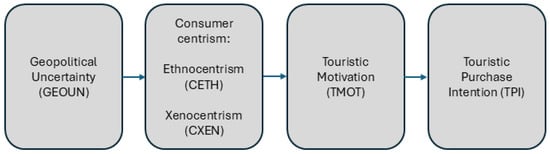
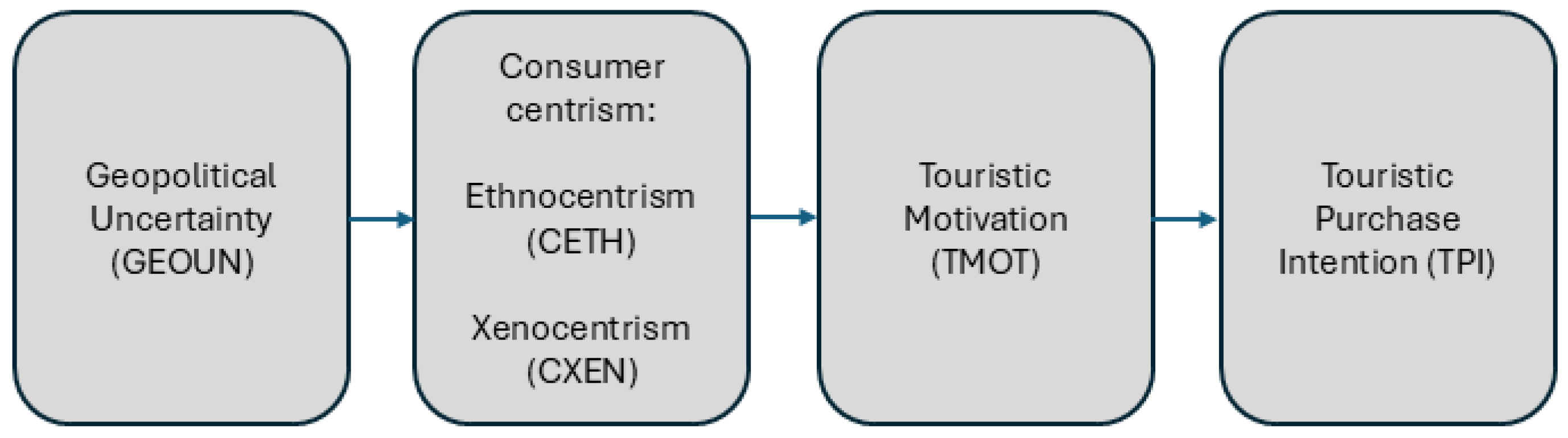
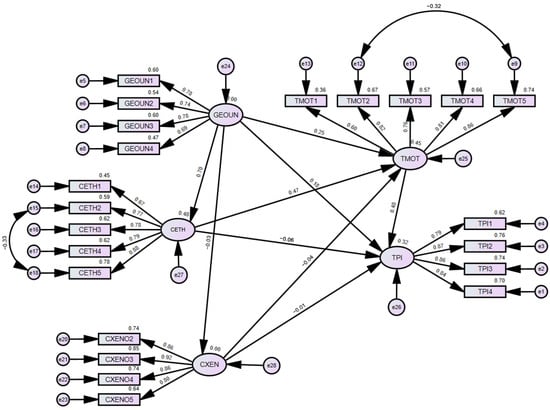
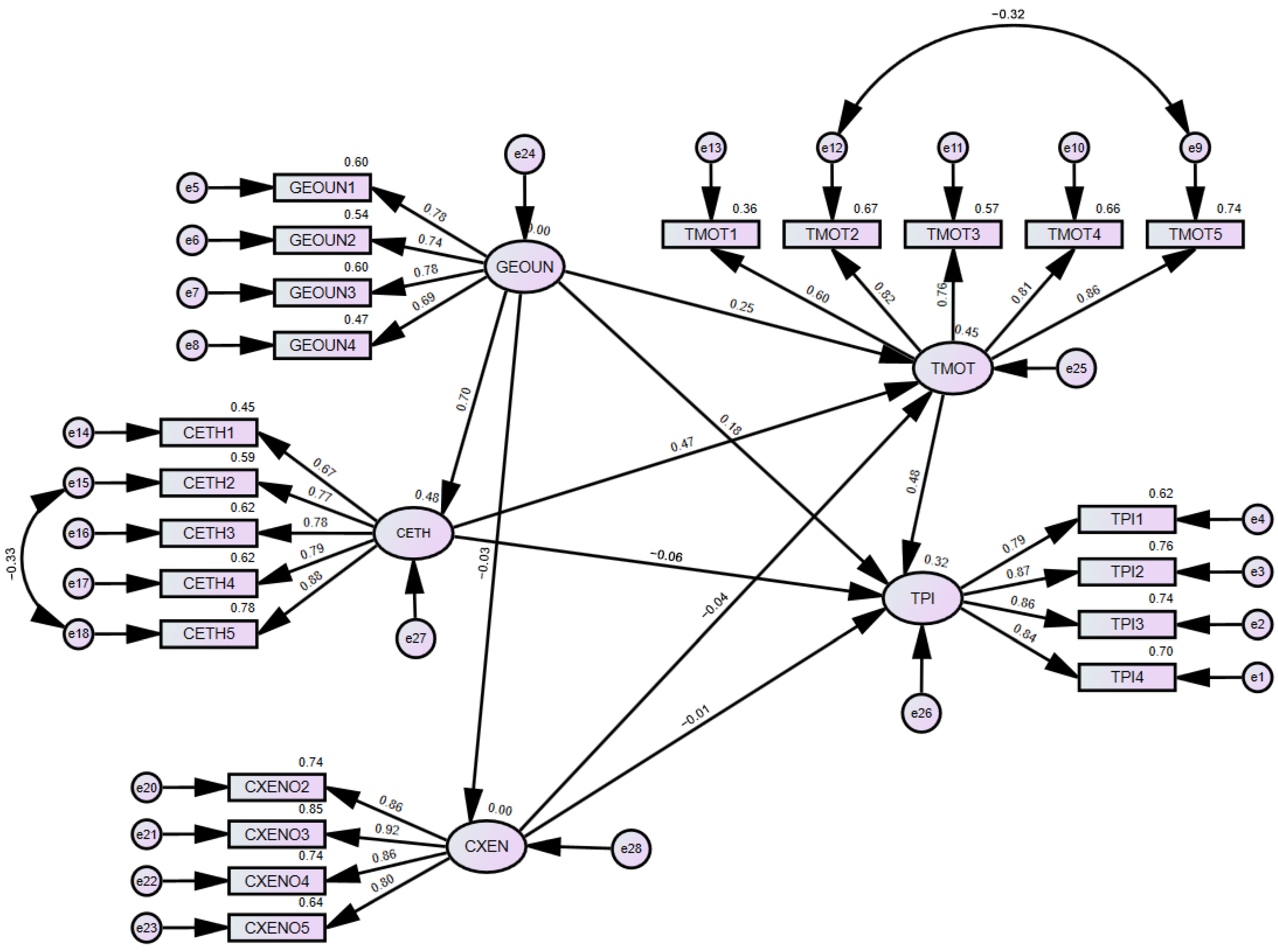

Disclaimer/Publisher’s Note: The statements, opinions and data contained in all publications are solely those of the individual author(s) and contributor(s) and not of MDPI and/or the editor(s). MDPI and/or the editor(s) disclaim responsibility for any injury to people or property resulting from any ideas, methods, instructions or products referred to in the content. |
© 2025 by the authors. Licensee MDPI, Basel, Switzerland. This article is an open access article distributed under the terms and conditions of the Creative Commons Attribution (CC BY) license (https://creativecommons.org/licenses/by/4.0/).