Review

A Focused Review of Nanomaterial-Enhanced Cement-Based Adhesives for Optimized FRP-to-Concrete Bonding


by
Mohammad Al-Zu’bi
1,*,
Mazen J. Al-Kheetan
2 and
Musab Rabi
3
1
Department of Civil Engineering, Munib and Angela Masri Faculty of Engineering, Aqaba University of Technology, Aqaba 11947, Jordan
2
Department of Civil and Environmental Engineering, College of Engineering, Mutah University, Karak 61710, Jordan
3
Department of Civil Engineering, Jerash University, Jerash 26150, Jordan
*
Author to whom correspondence should be addressed.
Constr. Mater. 2026, 6(2), 15; https://doi.org/10.3390/constrmater6020015
Submission received: 27 November 2025 / Revised: 21 January 2026 / Accepted: 19 February 2026 / Published: 24 February 2026

Abstract

The ongoing concern about sustainable infrastructure has driven the development of cement-based adhesives (CBAs) for fibre-reinforced polymer (FRP)-based concrete retrofitting. Nevertheless, traditional CBAs usually have low bond strength, low crack resistance, and low long-term durability that undermine the performance of FRP–concrete systems. To address these limitations, this focused review examines the potential of nanomaterial-modified CBAs to enhance interfacial bond behaviour and overall structural performance. A systematic assessment of recent experimental studies was used to analyze CBAs modified with nanosilica, carbon nanotubes, graphene oxide, and other nanomaterials. The roles of these nanomaterials in improving adhesion mechanisms, stress transfer efficiency, crack control, and resistance to environmental stressors are critically discussed. We also contrast the performance of neat and nano-modified CBAs in FRP-based retrofitting systems, with particular emphasis on bond behaviour, mechanical response, and durability-related performance. Particular emphasis is put on innovative high-strength self-compacting cementitious adhesives (IHSSC-CAs), which are identified as an emerging class of sustainable bonding materials combining high mechanical performance with improved environmental compatibility in relation to traditional bonding systems. The paper concludes with the identification of key research gaps, a discussion of practical implementation challenges, and an outline of future research directions for the development of next-generation sustainable and resilient concrete retrofitting technologies.

1. Introduction

Fibre-reinforced polymer (FRP) composites have demonstrated a high degree of success in retrofitting concrete structures. Nonetheless, the bonding performance at the FRP–adhesive–concrete interface is very significant to the overall success of such retrofitting techniques. This can be attributed to the fact that the stress-transferring and -distributing medium between the FRP materials and the concrete substrate is the adhesive layer [1]. Therefore, the nature of the adhesive is very critical in determining the bond strength of the FRP–adhesive–concrete system, and, therefore, the choice of a suitable bonding agent is critical in every retrofitting exercise.
Many attempts have been made to the production of sophisticated bonding agents to optimize the retrofitting systems. Among them, epoxy resin, which is an amorphous and highly crosslinked polymer, is still the most popular polymer used to bond FRP materials with the substrates of the concrete elements that have deteriorated to restore their mechanical properties, such as strength, stiffness, and structural integrity [1,2,3]. The popularity of epoxy-resin bonding systems can be explained by the favourable properties they have that include, but are not limited to, ease of processing, compatibility with a wide range of fibres, resistance to wear, good adhesion to heterogeneous substrates, and resistance to chemical attack [1,2,4,5,6]. Nevertheless, along with these positive aspects, epoxy adhesives have some serious limitations, including poor fire resistance (i.e., high flammability) and the release of toxic fumes and steroids, which can negatively affect the skin. Also, at temperatures above their glass transition temperature (Tg), which is usually between 55 °C and 75 °C, the epoxy resins undergo a loss of important mechanical properties, including yield strength, which impairs the performance of the bond of FRP–adhesive–concrete and ultimately stress transfer capability [7,8].
Thus, cement-based adhesives (CBAs) made of mineral-derived materials have become an interesting and promising alternative to epoxy resins. CBAs have many benefits, such as no toxic fume emission, non-combustibility, and safe operation at high temperatures or under fire. They also cost less compared to polymer adhesives. It has been shown that CBAs are capable of effectively enhancing strong composite action between FRP composites and concrete, and thus they can be used in both externally bonded reinforcement (EBR)- and near-surface mounted (NSM)-FRP retrofit applications [7,9,10].
Considering the increasing demand for safer, more environmentally friendly, and flame-retardant retrofitting systems, the present review critically examines the potential of nanomaterial-enhanced CBAs as viable alternatives to conventional epoxy resins in FRP–concrete strengthening applications. While existing review studies have predominantly focused on epoxy-based FRP strengthening systems, there is, to the best of the authors’ knowledge, a notable lack of dedicated reviews addressing CBAs, and particularly nanomaterial-modified CBAs, as structural bonding agents. Moreover, prior reviews have rarely provided systematic comparisons between neat CBAs, nano-modified CBAs, and epoxy adhesives, nor do they adequately address emerging high-performance formulations such as innovative high-strength self-compacting cementitious adhesives (IHSSC-CAs). This review addresses these gaps by offering a bond-performance-centred synthesis that emphasizes interfacial behaviour, including pull-out capacity, fatigue resistance, and thermal performance, rather than focusing solely on global flexural strength. In addition, a comparative framework is developed to evaluate epoxy adhesives, conventional CBAs, and nanomaterial-enhanced CBAs, while consolidating available evidence on IHSSC-CAs as a distinct and promising class of sustainable structural adhesives. The focused scope of this review is intentionally adopted due to the relatively limited number of studies on CBAs compared to epoxy-based systems, enabling a deeper synthesis of how nanomaterial incorporation influences interfacial bond behaviour, mechanical performance, and durability-related responses, while providing application-oriented insights relevant to both EBR- and NSM-FRP strengthening systems.

2. CBAs for Concrete Retrofitting

This section provides an overview of cement-based bonding approaches employed in FRP strengthening of concrete, including both adhesive-controlled systems (e.g., EBR and NSM applications) and broader cementitious matrix-based strengthening solutions. Although these systems differ in configuration and thickness of the cementitious layer, they share common interfacial mechanisms governing load transfer, crack development, and debonding, which are essential for understanding the evolution and performance of CBAs.

2.1. Overview of CBA-Based FRP Retrofitting Systems

The studies reviewed in this subsection are discussed to establish a broad contextual background on the use of cement-based materials as bonding and load-transfer media in FRP-strengthened concrete members, forming the foundation for subsequent discussions on adhesive-controlled bond behaviour.
The analysis of retrofitting of RC elements with FRP bonded with CBAs was explored in several studies [11,12,13,14]. As an example, Dai et al. [13] examined flexural performance and failure of externally reinforced concrete (RC) beams that are reinforced with textile-reinforced engineered cementitious composite (TR-ECC). They found that flexural capacity and yield load of the steel reinforcement increased by 119% and 61.3%, respectively, when a single layer of carbon textile reinforcement was used with ECC as compared to an unstrengthened control beam. In addition, there was a 160% increase in flexural strength when two layers of carbon textile reinforcement were employed together with ECC. What was interesting was that some common failure modes like intermediate crack-induced (IC) debonding and plate-end debonding that are typical in externally bonded FRP systems were not observed. These significant improvements in flexural capacity and ductile failure behaviour were explained by the combined strengthening effect of the textile reinforcement and ECC, and by the pseudo-plastic nature of the TR-ECC material.
Ombres [11] investigated Fibre-Reinforced Cementitious Mortars (FRCMs), which involves the flexural behaviour of externally bonded to a cementitious mortar (EB) by carbon fibre meshes. Results indicated that there was an increase in the ultimate load capacity of the strengthened beams between 10% and 44% relative to the control specimen. On the same note, Hashemi and Al-Mahaidi [14] examined RC beams that were retrofitted using carbon FRP (CFRP) fabric and textile, together with cement-based bonding agents. Their study showed load-bearing capacity enhancements of 10% to 35% for beams strengthened with CFRP fabric and approximately 27% for those strengthened with CFRP textiles, relative to the unstrengthened control beams. These results suggest that effective composite action can be achieved between CFRP, mortar, and concrete when cement mortar is employed as a bonding agent. Brückner et al. [12] also demonstrated the effectiveness of flexural strengthening of RC slabs using textile fabric embedded in a cementitious matrix, showing improvements in ultimate load capacity without evidence of bond failure between the strengthening layers and the concrete substrate. However, another study involving externally bonded CFRP sheets applied with a polymer-modified mortar reported only a marginal gain in ultimate strength, with no observed enhancement in beam stiffness [15].
Building on this contextual overview, the following subsections focus more specifically on adhesive-controlled FRP systems, where the performance of the thin bonding layer governs interfacial stress transfer, failure modes, and overall structural response.

2.2. Comparative Performance: CBAs vs. Epoxy Adhesives

To identify the most effective bonding agents, further research [9,16,17] has been conducted to compare the behaviour of FRP-strengthened concrete members bonded with either epoxy or CBAs. Täljsten and Blanksvärd [9] investigated the flexural performance of RC slabs and small-scale concrete beams retrofitted using externally bonded CFRP grids with both adhesive types. They found that slabs bonded with a cementitious adhesive exhibited performance comparable to that of slabs bonded with epoxy resin. Notably, the cement-bonded slab exhibited a ductile failure mode, whereas the epoxy-bonded slabs failed in a brittle manner. In another study, Carolin et al. [16] evaluated the flexural behaviour of RC beams strengthened with NSM-CFRP and recommended cement grout as a practical replacement for epoxy in on-site applications. Moreover, a study on shear strengthening of RC beams through an externally bonded CFRP grid with cement-based and epoxy adhesives showed that cementitious bonding agents, when applied with CFRP grids, may provide an attractive alternative to epoxy-bonded CFRP sheets [17].
Nevertheless, Burke et al. [18] revealed that epoxy adhesives performed better in NSM-FRP strengthening systems of concrete structures in comparison to cementitious grout adhesives at room temperature (approximately 21 °C). Even though the cementitious bond adhesive showed some satisfactory bond behaviour, it led to an inefficiency in the use of the FRP reinforcement. In the replacement of epoxy by CBAs, a more conservative strain limit must be used to prevent debonding failures. As per the study conducted by Al-Mahmoud et al. [19], mortar-strengthened beams showed lower ultimate load capacity and fewer cracks as compared to epoxy resin-strengthened beams. It was also observed that CFRP rods glued with epoxy resin were more adhesive to concrete. In a later study, Al-Mahmoud et al. [20] confirmed the same results, that epoxy resin exhibited more shear strength improvement than mortar.

2.3. Bond Behaviour and Pull-Out Performance in CBA–FRP Systems

This subsection specifically addresses adhesive-governed bond behaviour in CBA–FRP systems, with emphasis on pull-out performance, debonding mechanisms, and stress transfer efficiency at the FRP–adhesive–concrete interface.
Further studies [21,22,23] confirmed the fact that final pull-out strengths of FRP bars in grooves filled with mortar were always less than in those bonded with epoxy, and debonding failure was also common at the mortar–concrete interface. The results of the most important studies analyzed in this part are summarized in Table 1, that is, the structural performance and material interactions of FRP–concrete elements bonded with CBAs.

2.4. Limitations of Conventional CBAs

Despite their demonstrated potential in adhesive-controlled FRP strengthening applications, conventional CBAs exhibit several limitations that restrict their broader adoption.
Previous research [24,25,26] indicates that CBAs can be a good alternative to epoxy adhesives, which have a promising effect on composite performance; nevertheless, they also have several limitations. These weaknesses are mainly explained by the fact that they are vulnerable to hydrothermal conditions. Particularly at high temperatures, CBAs experience physical and chemical changes that eventually degrade their mechanical characteristics. This degradation may alter their capacity to withstand heat transfer, and this may permit a longer thermal penetration across a wide temperature span (400–1200 °C) and longer times. Also, the process of drying may affect the occurrence of restraint stresses in CBAs. Consequently, the peak of high-strength and non-polymerized CBAs is necessary to enhance the performance of retrofitting of the reinforced structure with FRP. This is possible by increasing the bond strength at the concrete-cement/FRP interfaces without compromising structural performance in the presence of fire. As with epoxy adhesives, the addition of nanoparticles to CBAs has been found to enhance overall performance by a significant amount.

3. Nanomaterial-Enhanced CBAs

3.1. Forms of Nanomaterial-Enhanced CBAs

The application of nanomaterials, including graphene oxide (GO), graphene nanoplatelets (GNPs), carbon nanofibres (CNFs), carbon nanotubes (CNTs), and nano silica (NS), in CBAs has been demonstrated to impact their performance properties [27,28,29,30,31,32,33,34]. As an example, Mohammed et al. [27] studied the effect of GO on the fresh and mechanical characteristics of CBAs. Their results showed that GO is a potential additive in manufacturing high-strength CBAs. In this case, particularly the tensile strength of GO-modified mixes (GM) was raised by about 45% compared to the control mixes (CMs). This was because GO was able to prevent the initiation and propagation of cracks, probably at nanoscale and up to the microscale, thus increasing tensile strength. Further, the compression strength of GM improved by 13.5% when compared to the CM. This increase could be ascribed to the GO-induced alteration in the pore structure whereby the fine pores are increased and, therefore, the cementitious microstructure becomes denser. Pull-off tests to determine the strength of bonding with concrete surfaces illustrated a 78% higher increase when GO-modified CBAs were applied with pre-treatment of surfaces. In fresh property, the initial setting time was reduced from 160 min in the CM to 120 min in GM, probably because of the large surface area of GO. The same trend was noted in the final setting time, which reduced from 480 min in the CM to 420 min in GM.
Mohammed et al. [30] illustrated that the addition of GO in 0.01, 0.03, and 0.06 wt.% into the cement matrix increased the transport characteristics of the cement, such as lower water sorptivity and penetration of chloride ions. This enhancement was possibly attributable to an increase in gel pores, which was aided by GO, resulting in a tight cement paste microstructure. In a similar test, Mohammed et al. [31] evaluated the effect of 0.06 wt.% GO on the freeze–thaw durability of hardened cement. The outcomes showed that the weight loss was reduced from 0.25% in the reference mix to 0.8% in the GO-modified mix after 540 freeze–thaw cycles. This improvement was explained by the changes in pore structure, which limited the freezing of water in the finer pores and suppressed the nanoscale crack propagation. Also, the incorporation of GO encouraged the release of air in the mix, thus relieving the build-up of osmotic pressure. The air content in the GO mixes was also reported to increase by 40% compared to the CMs. GO also decreased the mesopore volume of the matrix, hence decreasing the uptake of water and enhancing compressive strength.
Alwash et al. [32] examined the effects of GO, GNPs, and NS together on promoting the mechanical performance and durability of CBAs. The addition of 0.05 wt.% GO caused flexural strength to increase by 24% although chloride penetration depth increased slightly, and compressive strength was not significantly improved. Additionally, compressive and flexural strengths were raised by 29% and 37%, respectively, and chloride penetration was cut by 61% by adding 3 wt.% NS. There was once again an increase in compressive and flexural strengths in a hybrid mixture of 3 wt.% NS and 1.5 wt.% GO by 46% and 57%, respectively, and a 54% decrease in chloride penetration.
Al Muhit et al. [33] examined the mechanical behaviour of cement composites with 0.01 wt.% and 0.05 wt.% GO additions, noting respective improvements in compressive strength of 3.4% and 29%. Abu Al-Rub et al. [34] reported that incorporating treated and untreated CNFs and CNTs at concentrations of 0.1% and 0.2 wt.%, respectively, improved the flexural strength, Young’s modulus, ductility, and toughness of cement paste by approximately 60%, 25%, 73%, and 170%, respectively. However, they recommended a 0.1 wt.% dosage as optimal for maintaining good dispersion of high-aspect-ratio nanofilaments, as 0.2 wt.% could lead to agglomeration and reduced effectiveness. Table 2 summarizes the enhancements in CBAs resulting from the addition of nanoparticles.

3.2. Innovative High-Strength Self-Compacting Cementitious Adhesives (IHSSC-CAs)

3.2.1. Development and Material Properties of IHSSC-CAs

IHSSC-CAs represent an advanced formulation of nanomaterial-modified CBAs, developed by Mohammed et al. [27]. This adhesive is made by adding GO and a superplasticizer in cement mortar as per the requirements mentioned in BS EN 196-1 [35], BS EN 196-3 [36], and BS EN 480-1 [37]. The resulting mixture was proven to have a pot life of up to 120 min and a flow rate of 7.5%. Notably, the IHSSC-CA demonstrated excellent mechanical performance, with tensile, compressive, and pull-off strengths are 13.8 MPa, 101 MPa, and 1.2 MPa, respectively. These superior mechanical characteristics indicate that IHSSC-CAs have great potential for use in a wide variety of structural applications, as adhesive anchoring systems, FRP strengthening systems, and as a bonding interface between existing and freshly cast concrete elements.

3.2.2. Bond Behaviour in NSM-FRP Applications

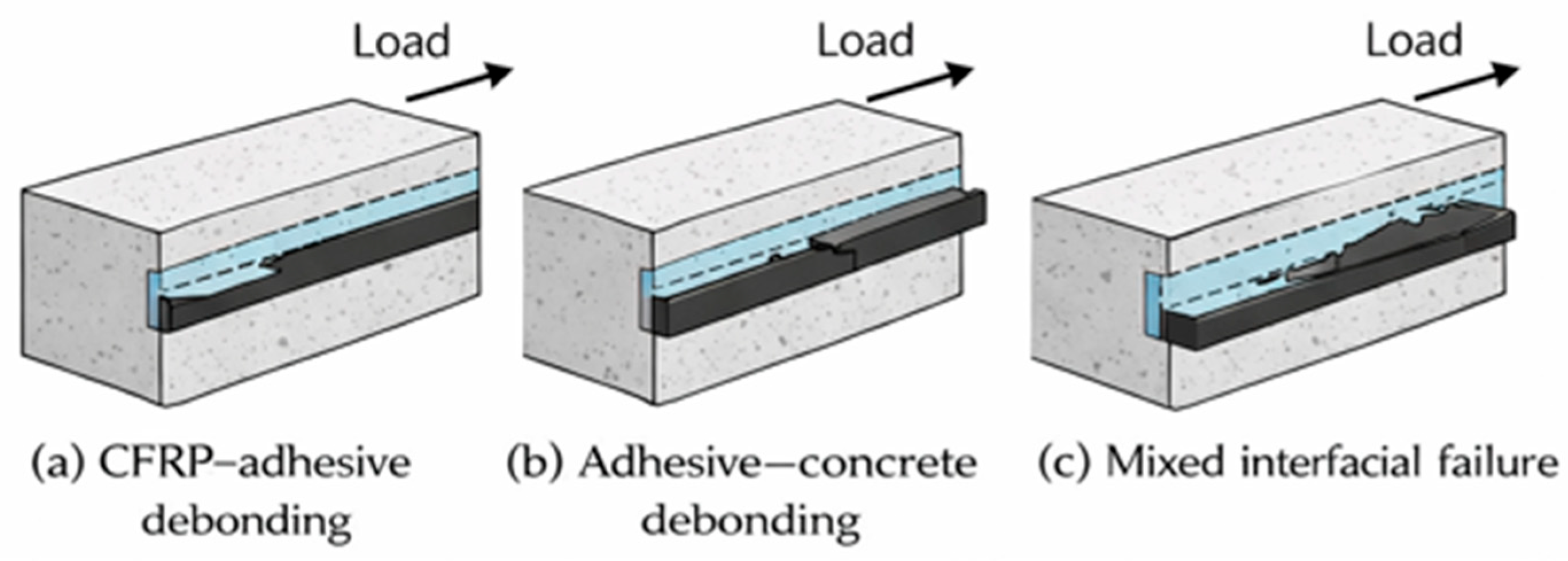
Mohammed et al. [38,39] and Al-Saadi et al. [40] performed a series of experiments on NSM-CFRP-strengthened concrete specimens using three different adhesives: epoxy, polymer CBA (PCA), and the IHSSC-CA under monotonic pull-out loading up to failure. In terms of ease of application in NSM-CFRP systems, the results of this study showed the superiority of IHSSC-CA because of its self-compacting characteristics, improved flowability, and workability. Additionally, the specimens that were bonded with IHSSC-CA showed better composite interaction between the CFRP reinforcement and the concrete substrate, so they had higher bond strength with more ductile behaviour than those bonded with epoxy or PCA. As shown in [35], the failure modes were also different for the adhesives, with IHSSC-CA showing less surface damage and better load transfer. The higher surface roughness in CFRP strips with IHSSC-CA bond was explained by the formation of a uniform adhesive layer, which helped to distribute stress more evenly and activate more CFRP threads to resist loading. This reduced the risk of the localized concentrations of stress, which were more prominent in the epoxy and PCA-bonded specimens. Furthermore, the improved interlocking of IHSSC-CA with the CFRP surface, facilitated by its high fluidity and improved penetration into surface irregularities, contributed to enhanced bond behaviour. In contrast, specimens bonded with PCA and epoxy adhesives exhibited non-uniform stress transfer and localized deformation at the CFRP–adhesive interface, which can be attributed to uneven adhesive distribution and limited mechanical interlock associated with higher viscosity systems. The schematic failure modes associated with these adhesive-controlled mechanisms are illustrated in Figure 1.
Al-Saadi et al. [26] carried out pull-out tests (i.e., single lap shear tests) on concrete prisms with fatigue loading conditions to investigate the bond behaviour between the concrete substrate and the NSM-CFRP strips with the use of the PCA and the IHSSC-CA. The results showed that specimens using IHSSC-CA had higher performances with longer fatigue life and higher ability to withstand high fatigue loads than specimens bonded with PCA. This improvement was attributed to the superior mechanical and bond strength properties of the IHSSC-CA. Pore structure analysis further verified that with the more effective composite interaction between the CFRP strips and the concrete substrate when IHSSC-CA were used, the specimens could withstand higher fatigue loading ranges and had higher durability compared with the specimens bonded with PCA.

3.2.3. Thermal Performance and Elevated-Temperature Bond Behaviour

Moreover, because of the high fluidity (i.e., self-compacting) properties and long pot life of IHSSC-CA, it was observed from the visual inspection that a constant and continuous adhesive layer completely encapsulated the CFRP strip along the bonded length with a minimal number of voids. This helped to achieve a uniform stress distribution and promoted full composite action between the NSM-CFRP reinforcement and the adhesive–concrete interface. In contrast, specimens glued with PCA exhibited partial coverage of the CFRP surface, an inconsistent adhesive layer, voids, and surface cracking. These deficiencies were mainly due to the low fluidity and lower pot life of PCA, which made proper compaction difficult. As a result, the stress was unevenly distributed and only localized in the bonded regions, resulting in incomplete composite action. Therefore, NSM-CFRP specimens with IHSSC-CA showed much better fatigue performance and life cycles than specimens with PCA.
Mohammed et al. [41] assessed the mechanical behaviour of Normal Strength Concrete (NSC) and IHSSC-CA at high temperatures. In addition, the bond performance of NSM-CFRP-strengthened concrete prisms was investigated by conducting direct pull-out (i.e., single-lap shear) tests under ambient and high temperatures. The results showed that the compressive strength of IHSSC-CA decreased by 11.5%, 21.2%, and 40% after being exposed to temperatures of 400 °C, 600 °C, and 800 °C, respectively. In contrast, NSC had significantly higher strength losses of 23.6%, 45.5%, and 76.4% at the same temperatures. A similar trend was noticed for the tensile strength. For IHSSC-CA, tensile strength decreased by 15.4% and 31.5% at 400 °C and 600 °C, respectively, with 60.8% of the initial tensile strength retained at 800 °C. In comparison, NSC exhibited a much sharper decrease in the tensile strength, which was reduced to 50% at 400 °C and 28% at 600 °C, reaching the minimum value of 0.3 MPa at 800 °C. These results suggest that IHSSC-CA has better thermal resistance and keeps better mechanical performance and bond integrity under high temperatures.
The results of the pull-out tests further demonstrated the superior bond performance of IHSSC-CA. At room temperature (21 °C), the average pull-out force reached 34.5 kN, which is comparable to the value of 41 kN reported for similar specimens bonded with epoxy adhesive [42]. Notably, failure at 21 °C occurred through rupture of the CFRP strip, with no interfacial debonding observed, indicating that the bond capacity exceeded the tensile capacity of the reinforcement. The corresponding adhesive-governed bond failure mechanisms are schematically illustrated in Figure 2.

3.2.4. Structural Behaviour of IHSSC-CA in Full-Scale RC Members

Al-Saadi et al. [43] studied the structural performance of 10 RC girders that were strengthened and repaired using NSM-CFRP strips bonded with either IHSSC-CA or traditional epoxy adhesives. Half of the beams were subjected to monotonic loading up to the point of failure, while the other five were fatigued. The experimental results showed that girders attached with epoxy adhesive had a higher level and accelerated strain development in the concrete, steel reinforcement, and CFRP strips during the fatigue test. In addition, these beams exhibited greater crack width expansion, greater deflection, more significant stiffness degradation, and faster damage accumulation compared to those strengthened and repaired with IHSSC-CA.
These observations give more insight into the better performance of IHSSC-CA in the strengthening of RC beams under fatigue conditions, especially in terms of structural serviceability and practical application. Furthermore, the specimens with IHSSC-CA showed better bond performance and better stress transfer from CFRP reinforcement to the concrete substrate and between internal steel reinforcement and the surrounding concrete. This increased interaction was attributed to the ability of IHSSC-CA to maintain composite action in the NSM-CFRP system under repeated loading conditions.
Al-Saadi et al. [44] performed flexural tests on full-size RC beams repaired and reinforced using NSM-CFRP strips bonded on either epoxy adhesive or IHSSC-CA. As RTD results showed, the use of brittle adhesives, such as epoxy, for bonding the CFRP to ductile RC beams reduced the ductility. In contrast, with the use of more ductile bonding material, such as IHSSC-CA, the ductility of the strengthened and repaired beams was improved. Specifically, ultimate flexural capacity increased by 43% and 53% of the control beam for epoxy-repaired and -strengthened beams, respectively. However, these enhancements were accompanied by decreases in ductility (as measured by deflection) of 38% and 44% respectively. On the other hand, the ductility of beams strengthened and repaired with IHSSC-CA has shown 88% and 59% improvements, and 21% and 28% improvements in the ultimate flexural capacity, respectively. These findings suggest that while epoxy-bonded beams have higher load-carrying capacity, probably due to the higher tensile strength of epoxy adhesive (32 MPa) compared to IHSSC-CA (18.6 MPa), the use of IHSSC-CA significantly enhances the ductility and provides a more balanced solution when the strength and deformability of the structure are important.
A summary of the reviewed studies involving mechanical, bond, and durability performance of IHSSC-CA in NSM-CFRP systems is shown in Table 3, highlighting its superior properties with an advantage over traditional epoxy and polymer cement-based alternatives.
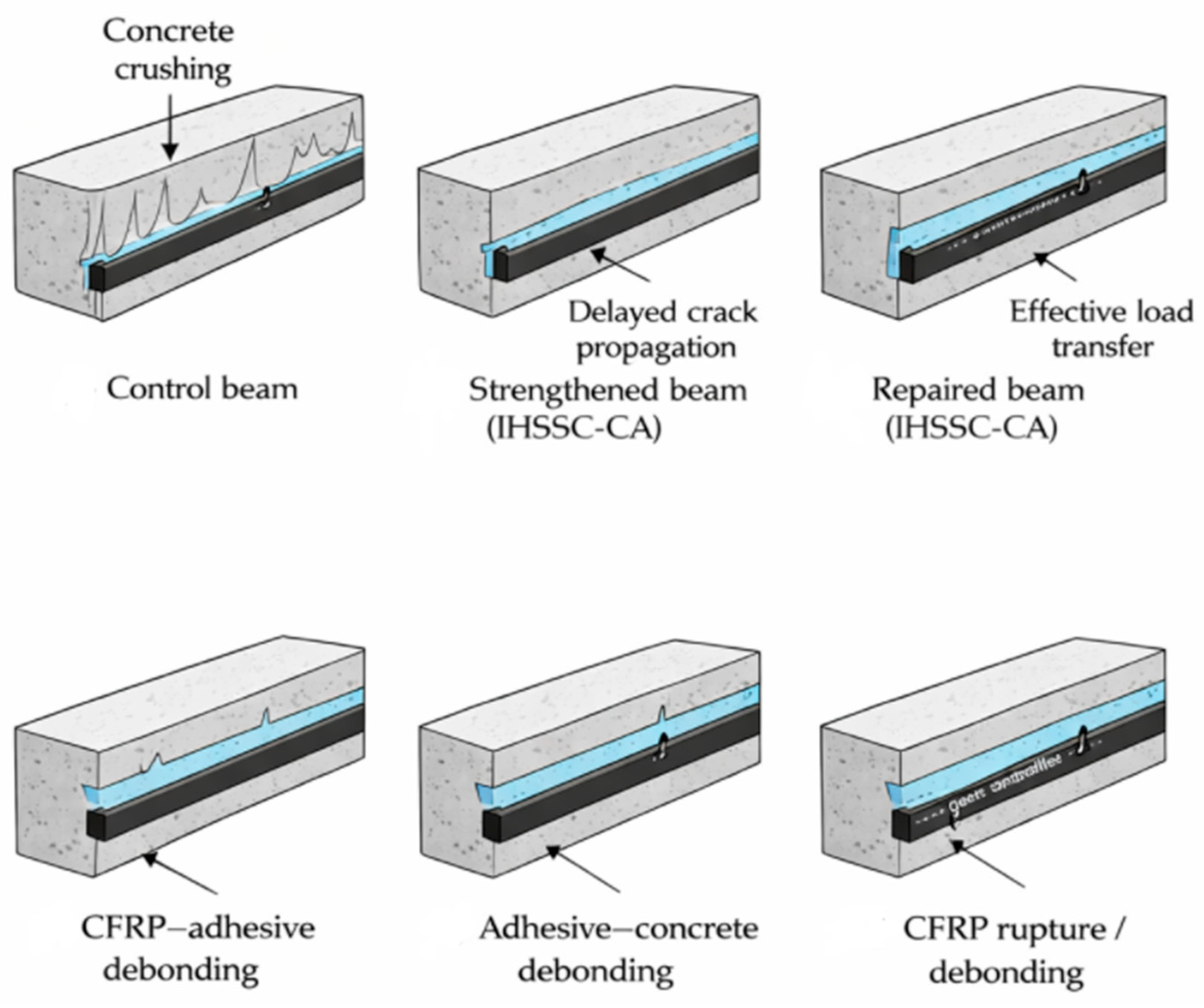
Furthermore, RC beams strengthened and repaired using IHSSC-CA predominantly failed through the rupture of CFRP strips after significant deformation, indicating a ductile and bond-effective structural response. In contrast, beams bonded with epoxy adhesive exhibited sudden failure associated with concrete cover separation, resulting from the loss of composite action in the NSM-CFRP system. The typical flexural failure mechanisms associated with strengthened and repaired beams are schematically illustrated in Figure 3.
In addition, IHSSC-CA proved better load transfer efficiency between the RC beams and the CFRP strips compared to the epoxy adhesive. Notably, the residual strength of beams bonded using IHSSC-CA was also quite high beyond the peak load, which was not the case for the epoxy-bonded specimens. This post-peak strength retention is one of the main merits of IHSSC-CA in the application of NSM-CFRP because it improves structural safety and serviceability during the service life of rehabilitated RC structures.

4. Conclusions

This review dealt with the development and use of cement-based adhesives (CBAs) in the structural retrofitting of concrete members using fibre-reinforced polymer (FRP) composites. The limitations on performance of traditional CBAs were evaluated, and recent progress in which nanomaterial-modified CBAs were used was critically discussed. Based on this review, the following conclusions can be drawn:
  • Traditional CBAs have been proven to have limited effectiveness in FRP-based retrofitting systems because of their relatively low mechanical properties, less-than-optimal bond performance, and poor compatibility with reinforcement materials when compared to conventional epoxy adhesives.
  • The incorporation of nanomaterials, such as nano silica, carbon nanotubes, graphene oxide, and others into CBAs has enhanced the mechanical strength, durability and interfacial bonding between CBAs and concrete substrates and FRP reinforcements to a great extent. These enhancements overcome some of the limitations of unmodified CBAs and facilitate their wider use in retrofitting practices.
  • Even at low dosages (typically 0.01–5% by weight), nanomaterials have shown a double and quadruple improvement in the mechanical performance of CBAs, especially tensile and compressive strength and bond efficiency, thus improving structural reliability and service life.
  • Among the promising advancements, innovative high-strength self-compacting cementitious adhesives (IHSSC-CAs) have been developed as alternatives to epoxy and polymer-modified adhesives that are viable and sustainable. These materials not only provide improved the bond strength, stiffness, fatigue resistance, and residual performance of both externally bonded (EBR)- and near-surface mounted (NSM)-FRP systems but also have a variety of practical advantages, such as high-flowability, workability, and extended open time during application.
  • Unlike epoxies, IHSSC-CAs are environmentally friendly from the very start, not emitting toxic fumes and creating safer conditions for workers working on-site during the retrofitting processes.
Overall, nanotechnology-enhanced CBAs are an attractive solution for sustainable, high-performance, and durable FRP retrofitting systems. Continued research is required to optimize mix design, standardize testing methods, and assess long-term performance in real-world applications so that further adoption of these next-generation adhesives in the construction industry can be supported.

5. Recommendations for Future Work

Despite an increasing interest in nanomaterial-modified CBAs, such as IHSSC-CAs, for the retrofit of concrete structures with FRP systems, there is still a lack of research. To close these gaps and pave the way toward this transition of these high-performance materials from laboratory invention to the field, the research directions listed below are proposed as paths to research in the future:
  • The current nano-modified CBAs research study is primarily focused on small-scale elements. Future work should examine the performance of large-scale retrofitted elements using both EBR- and NSM-FRP techniques under different loading and environmental conditions. Moreover, since the two systems experience different stress distribution and bond mechanisms, tailored investigations are required to get a deeper insight into the interaction of nano-modified CBAs with each of these systems at structural scales.
  • Nanomaterial-modified CBAs may interact in different ways with different types of FRP reinforcements (e.g., carbon, glass, and basalt). Further studies are required to understand the physicochemical interactions between nanomaterials, cementitious matrices, and reinforcement surfaces and the collective role with regard to bond strength and load transfer mechanisms, as well as durability.
  • Retrofitting involves both reinforcement materials and cementitious substrates, which have inherently different mechanical and chemical properties. Future work should discuss how to prepare compatible and synergistic formulations that optimize performance and compensate for the differences in shrinkage, thermal expansion, and adhesion behaviour. Novel hybrid systems with epoxy-CBA blends or staged applications may also show promising results.
  • Apart from organic matrices like epoxy, in the case of inorganic cement-based substrates, there are unique possibilities in the surface functionalization of nanomaterials to enhance dispersion, bonding, and reactivity. Research is required on tailored functionalization approaches that improve the mechanical and thermal properties of CBAs while maintaining the flowability and workability.
  • Theoretical and numerical modelling of nanomaterial-enhanced CBAs in FRP retrofitting systems remains limited. Future studies should prioritize the development of bond–slip constitutive models that capture nanomodification effects on interfacial behaviour, along with temperature-dependent degradation, fatigue damage evolution under cyclic loading, and time-dependent durability formulations. The adoption of probabilistic modelling approaches is also recommended to account for material variability and environmental effects, supporting experimental validation and facilitating design-oriented implementation.
  • Researchers are encouraged to draw on recent key reviews and research that investigate:
    • The current approach of carbon- and silicon-based nanomaterials is used to enhance the mechanical, thermal, and microstructural properties of epoxy and CBAs used in FRP-based retrofitting systems [45,46];
    • The first known study on the use of nanomaterial-enhanced epoxy adhesives (NMEAs) in NSM-FRP retrofitting applications [47].
  • Recent investigations have advanced the understanding of FRP–concrete bond behaviour in high-performance and innovative cementitious matrices, including ultra-high-strength and fibre-reinforced concretes, 3D-printed cement-based materials, and thermoplastic FRP systems with enhanced interfacial features [48,49,50]. Moreover, recent work on the mechanical performance and life-cycle sustainability of FRP-strengthened concrete elements has highlighted the growing importance of environmentally responsible retrofitting strategies and integrated performance assessment [51]. Collectively, these studies provide a valuable mechanistic understanding of interfacial behaviour and durability considerations, and they offer a strong foundation for future interdisciplinary research and innovation in sustainable concrete retrofitting systems.
  • Uniform dispersion of nanomaterials (e.g., GO, CNTs, CNFs) within cementitious matrices is crucial to realize their intended benefits. Future research should focus on optimizing dispersion methods (e.g., ultrasonication, surfactants, or functionalization) and on evaluating their impact on the rheological, mechanical, and interfacial properties of nanomodified CBAs to ensure reliable field performance.
  • While nanomaterial-enhanced CBAs show promising laboratory-scale performance, their scalability, cost-effectiveness, and practical implementation under field conditions remain open questions. Future studies should address life-cycle costs, material availability, and comparative performance with conventional solutions, especially for large-scale retrofitting projects.

Author Contributions

Conceptualization, M.A.-Z.; Methodology, M.J.A.-K.; Formal analysis, M.R.; Investigation, M.A.-Z. and M.J.A.-K.; Data curation, M.A.-Z.; Writing—original draft, M.A.-Z.; Writing— review & editing, M.A.-Z. and M.J.A.-K.; Visualization, M.R. All authors have read and agreed to the published version of the manuscript.

Funding

This research received no external funding.

Data Availability Statement

No new data were created or analyzed in this study. Data sharing is not applicable to this article.

Conflicts of Interest

The authors declare no conflict of interest.

Abbreviations

The following abbreviations are used in this manuscript:
CBAsCement-Based Adhesives
CNFsCarbon Nanofibers
CNTsCarbon Nanotubes
EBExternally Bonded
FRCMFibre-Reinforced Cementitious Mortar
FRPFibre-Reinforced Polymer
GOGraphene Oxide
GNPsGraphene Nanoplatelets
ICIntermediate Crack-Induced
IHSSC-CAInnovative High-Strength Self-Compacting Cementitious Adhesive
NSNano Silica
NSCNormal Strength Concrete
NSMNear-Surface Mounted
PCAPolymer Cement-Based Adhesive
RCReinforced Concrete
SEMScanning Electron Microscopy
TR-ECCTextile-Reinforced Engineered Cementitious Composite

References

  1. Irshidat, M.R.; Al-Saleh, M.H. Effect of using carbon nanotube modified epoxy on bond–slip behavior between concrete and FRP sheets. Constr. Build. Mater. 2016, 105, 511–518. [Google Scholar] [CrossRef]
  2. Abdullah, S.R.; Rosli, F.N.; Ali, N.; Abd Hamid, N.A.; Salleh, N. Modified epoxy for fibre reinforced polymer strengthening of concrete structures. Int. J. Integr. Eng. 2020, 12, 103–113. [Google Scholar] [CrossRef]
  3. Liu, S.; Chevali, V.S.; Xu, Z.; Hui, D.; Wang, H. A review of extending performance of epoxy resins using carbon nanomaterials. Compos. Part B Eng. 2018, 136, 197–214. [Google Scholar] [CrossRef]
  4. Johnsen, B.B.; Kinloch, A.J.; Mohammed, R.D.; Taylor, A.C.; Sprenger, S. Toughening mechanisms of nanoparticle-modified epoxy polymers. Polymer 2007, 48, 530–541. [Google Scholar] [CrossRef]
  5. Quan, D.; Urdániz, J.L.; Ivanković, A. Enhancing mode-I and mode-II fracture toughness of epoxy and carbon fibre reinforced epoxy composites using multi-walled carbon nanotubes. Mater. Des. 2018, 143, 81–92. [Google Scholar] [CrossRef]
  6. Ashrafi, B.; Guan, J.; Mirjalili, V.; Zhang, Y.; Chun, L.; Hubert, P.; Simard, B.; Kingston, C.T.; Bourne, O.; Johnston, A. Enhancement of mechanical performance of epoxy/carbon fiber laminate composites using single-walled carbon nanotubes. Compos. Sci. Technol. 2011, 71, 1569–1578. [Google Scholar] [CrossRef]
  7. Al-Abdwais, A.; Al-Mahaidi, R. Modified cement-based adhesive for near-surface mounted CFRP strengthening system. Constr. Build. Mater. 2016, 124, 794–800. [Google Scholar] [CrossRef]
  8. Tatar, J.; Milev, S. Durability of externally bonded fiber-reinforced polymer composites in concrete structures: A critical review. Polymers 2021, 13, 765. [Google Scholar] [CrossRef] [PubMed]
  9. Täljsten, B.; Blanksvärd, T. Mineral-based bonding of carbon FRP to strengthen concrete structures. J. Compos. Constr. 2007, 11, 120–128. [Google Scholar] [CrossRef]
  10. Al-Saadi, N.T.K.; Al-Mahaidi, R.; Abdouka, K. Bond behaviour between NSM CFRP strips and concrete substrate using single-lap shear testing with cement-based adhesives. Aust. J. Struct. Eng. 2016, 17, 28–38. [Google Scholar] [CrossRef]
  11. Ombres, L. Flexural analysis of reinforced concrete beams strengthened with a cement based high strength composite material. Compos. Struct. 2011, 94, 143–155. [Google Scholar] [CrossRef]
  12. Brückner, A.; Ortlepp, R.; Curbach, M. Textile reinforced concrete for strengthening in bending and shear. Mater. Struct. 2006, 39, 741–748. [Google Scholar] [CrossRef]
  13. Dai, J.G.; Wang, B.; Xu, S.L. Textile reinforced engineered cementitious composites (TR-ECC) overlays for the strengthening of RC beams. In Proceedings of the 2nd Asia-Pacific Conference on FRP Structures (APFIS 2009), Seoul, Republic of Korea, 9–11 December 2009. [Google Scholar]
  14. Hashemi, S.; Al-Mahaidi, R. Experimental and finite element analysis of flexural behavior of FRP-strengthened RC beams using cement-based adhesives. Constr. Build. Mater. 2012, 26, 268–273. [Google Scholar] [CrossRef]
  15. Wiberg, A. Strengthening of Concrete Beams Using Cementitious Carbon Fibre Composites. Ph.D. Thesis, Byggvetenskap, Stockholm, Sweden, 2003. [Google Scholar]
  16. Carolin, A.; Nordin, H.; Täljsten, B. Concrete beams strengthened with near surface mounted reinforcement of CFRP. In Proceedings of the International Conference on FRP Composites in Civil Engineering, Hong Kong, China, 12–15 December 2001; Volume 2, pp. 1059–1066. [Google Scholar]
  17. Blanksvärd, T.; Täljsten, B.; Carolin, A. Shear strengthening of concrete structures with the use of mineral-based composites. J. Compos. Constr. 2009, 13, 25–34. [Google Scholar] [CrossRef]
  18. Burke, P.J.; Bisby, L.A.; Green, M.F. Effects of elevated temperature on near surface mounted and externally bonded FRP strengthening systems for concrete. Cem. Concr. Compos. 2013, 35, 190–199. [Google Scholar] [CrossRef]
  19. Al-Mahmoud, F.; Castel, A.; François, R.; Tourneur, C. Strengthening of RC members with near-surface mounted CFRP rods. Compos. Struct. 2009, 91, 138–147. [Google Scholar] [CrossRef]
  20. Al-Mahmoud, F.; Castel, A.; Minh, T.Q.; François, R. Reinforced concrete beams strengthened with NSM CFRP rods in shear. Adv. Struct. Eng. 2015, 18, 1563–1574. [Google Scholar] [CrossRef]
  21. Al-Mahmoud, F.; Castel, A.; François, R.; Tourneur, C. Anchorage and tension-stiffening effect between near-surface-mounted CFRP rods and concrete. Cem. Concr. Compos. 2011, 33, 346–352. [Google Scholar] [CrossRef]
  22. Soliman, S.M.; El-Salakawy, E.; Benmokrane, B. Bond performance of near-surface-mounted FRP bars. J. Compos. Constr. 2011, 15, 103–111. [Google Scholar] [CrossRef]
  23. De Lorenzis, L.; Rizzo, A.; La Tegola, A. A modified pull-out test for bond of near-surface mounted FRP rods in concrete. Compos. Part B Eng. 2002, 33, 589–603. [Google Scholar] [CrossRef]
  24. Neville, A.M. Properties of Concrete, 5th ed.; Pearson Education: Harlow, UK, 2012. [Google Scholar]
  25. Al-Saadi, N.T.K.; Mohammed, A.; Al-Mahaidi, R. Fatigue performance of NSM CFRP strips embedded in concrete using innovative high-strength self-compacting cementitious adhesive (IHSSC-CA) made with graphene oxide. Compos. Struct. 2017, 163, 44–62. [Google Scholar] [CrossRef]
  26. Al-Saadi, N.T.K.; Mohammed, A.; Al-Mahaidi, R.; Sanjayan, J. A state-of-the-art review: Near-surface mounted FRP composites for reinforced concrete structures. Constr. Build. Mater. 2019, 209, 748–769. [Google Scholar] [CrossRef]
  27. Mohammed, A.; Al-Saadi, N.T.K.; Al-Mahaidi, R. Utilization of graphene oxide to synthesize high-strength cement-based adhesive. J. Mater. Civ. Eng. 2017, 29, 04016258. [Google Scholar] [CrossRef]
  28. Lv, S.; Liu, J.; Sun, T.; Ma, Y.; Zhou, Q. Effect of GO nanosheets on shapes of cement hydration crystals and their formation process. Constr. Build. Mater. 2014, 64, 231–239. [Google Scholar] [CrossRef]
  29. Chuah, S.; Pan, Z.; Sanjayan, J.G.; Wang, C.M.; Duan, W.H. Nano reinforced cement and concrete composites and new perspective from graphene oxide. Constr. Build. Mater. 2014, 73, 113–124. [Google Scholar] [CrossRef]
  30. Mohammed, A.; Sanjayan, J.G.; Duan, W.H.; Nazari, A. Incorporating graphene oxide in cement composites: A study of transport properties. Constr. Build. Mater. 2015, 84, 341–347. [Google Scholar] [CrossRef]
  31. Mohammed, A.; Sanjayan, J.G.; Duan, W.H.; Nazari, A. Graphene oxide impact on hardened cement expressed in enhanced freeze–thaw resistance. J. Mater. Civ. Eng. 2016, 28, 04016072. [Google Scholar] [CrossRef]
  32. Alwash, D.; Kalfat, R.; Du, H.; Al-Mahaidi, R. Development of a new nano modified cement-based adhesive for FRP strengthened RC members. Constr. Build. Mater. 2021, 277, 122318. [Google Scholar] [CrossRef]
  33. Al Muhit, B.A.; Nam, B.H.; Zhai, L.; Zuyus, J. Effects of microstructure on the compressive strength of graphene oxide-cement composites. In Proceedings of the Transportation Research Board 94th Annual Meeting, Washington, DC, USA, 11–15 January 2015. [Google Scholar]
  34. Abu Al-Rub, R.K.; Tyson, B.M.; Yazdanbakhsh, A.; Grasley, Z. Mechanical properties of nanocomposite cement incorporating surface-treated and untreated carbon nanotubes and carbon nanofibers. J. Nanomech. Micromech. 2012, 2, 1–6. [Google Scholar] [CrossRef]
  35. BS EN 196-1; Methods of Testing Cement—Part 1: Determination of Strength. British Standards Institution (BSI): London, UK.
  36. BS EN 196-3; Methods of Testing Cement—Part 3: Determination of Setting Times and Soundness. British Standards Institution (BSI): London, UK.
  37. BS EN 480-1; Admixtures for Concrete, Mortar and Grout—Test Methods—Part 1: Reference Concrete and Reference Mortar for Testing. British Standards Institution (BSI): London, UK.
  38. Mohammed, A.; Al-Saadi, N.T.K.; Al-Mahaidi, R. Assessment of bond strength of NSM CFRP strips embedded in concrete using cementitious adhesive made with graphene oxide. Constr. Build. Mater. 2017, 154, 504–513. [Google Scholar] [CrossRef]
  39. Mohammed, A.; Al-Saadi, N.T.K.; Al-Mahaidi, R. Assessing the contribution of the CFRP strip of bearing the applied load using near-surface mounted strengthening technique with innovative high-strength self-compacting cementitious adhesive (IHSSC-CA). Polymers 2018, 10, 66. [Google Scholar] [CrossRef]
  40. Al-Saadi, N.T.K.; Mohammed, A.; Al-Mahaidi, R. Bond performance of NSM CFRP strips embedded in concrete using direct pull-out testing with cementitious adhesive made with graphene oxide. Constr. Build. Mater. 2018, 162, 523–533. [Google Scholar] [CrossRef]
  41. Mohammed, A.; Al-Saadi, N.T.K.; Al-Mahaidi, R. Bond behaviour between NSM CFRP strips and concrete at high temperature using innovative high-strength self-compacting cementitious adhesive (IHSSC-CA) made with graphene oxide. Constr. Build. Mater. 2016, 127, 872–883. [Google Scholar] [CrossRef]
  42. Khshain, N.T.; Al-Mahaidi, R.; Abdouka, K. Bond behaviour between NSM CFRP strips and concrete substrate using single-lap shear testing with epoxy adhesive. Compos. Struct. 2015, 132, 205–214. [Google Scholar] [CrossRef]
  43. Al-Saadi, N.T.K.; Mohammed, A.; Al-Mahaidi, R. Fatigue performance of near-surface mounted CFRP strips embedded in concrete girders using cementitious adhesive made with graphene oxide. Constr. Build. Mater. 2017, 148, 632–647. [Google Scholar] [CrossRef]
  44. Al-Saadi, N.TK.; Mohammed, A.; Al-Mahaidi, R. Performance of RC beams rehabilitated with NSM CFRP strips using innovative high-strength self-compacting cementitious adhesive (IHSSC-CA) made with graphene oxide. Compos. Struct. 2017, 160, 392–407. [Google Scholar] [CrossRef]
  45. Al-Zu’bi, M.; Fan, M.; Anguilano, L. Advances in bonding agents for retrofitting concrete structures with fibre reinforced polymer materials: A review. Constr. Build. Mater. 2022, 330, 127115. [Google Scholar] [CrossRef]
  46. Al-Zu’bi, M.; Anguilano, L.; Fan, M. Effect of incorporating carbon- and silicon-based nanomaterials on the physico-chemical properties of a structural epoxy adhesive. Polym. Test. 2023, 128, 108221. [Google Scholar] [CrossRef]
  47. Al-Zu’bi, M.; Fan, M.; Anguilano, L. Near-surface mounted-FRP flexural retrofitting of concrete members using nanomaterial-modified epoxy adhesives. J. Build. Eng. 2024, 84, 108549. [Google Scholar] [CrossRef]
  48. Zeng, J.J.; Liao, J.; Zhuge, Y.; Guo, Y.C.; Zhou, J.K.; Huang, Z.H.; Zhang, L. Bond behavior between GFRP bars and seawater sea-sand fiber-reinforced ultra-high strength concrete. Eng. Struct. 2022, 254, 113787. [Google Scholar] [CrossRef]
  49. Zeng, J.J.; Sun, H.Q.; Deng, R.B.; Yan, Z.T.; Zhuge, Y. Bond Performance Between FRP Bars and 3D-Printed High-Performance Concrete. In Structures; Elsevier: Amsterdam, The Netherlands, 2025; Volume 73, p. 108377. [Google Scholar]
  50. Zeng, J.J.; Sun, H.Q.; Xia, J.R.; Feng, S.Z.; Zhao, B.; Zhou, J.K.; Zhuge, Y. Bond behavior between concrete and thermoplastic GFRP bars with novel surface features. Eng. Struct. 2025, 343, 121161. [Google Scholar] [CrossRef]
  51. Al-Zu’bi, M.; Shamass, R.; Ferreira, F.P.V. Mechanical performance and life cycle assessment of BFRP-reinforced AAC slabs strengthened with basalt macro-fibers. Constr. Build. Mater. 2025, 461, 139917. [Google Scholar] [CrossRef]
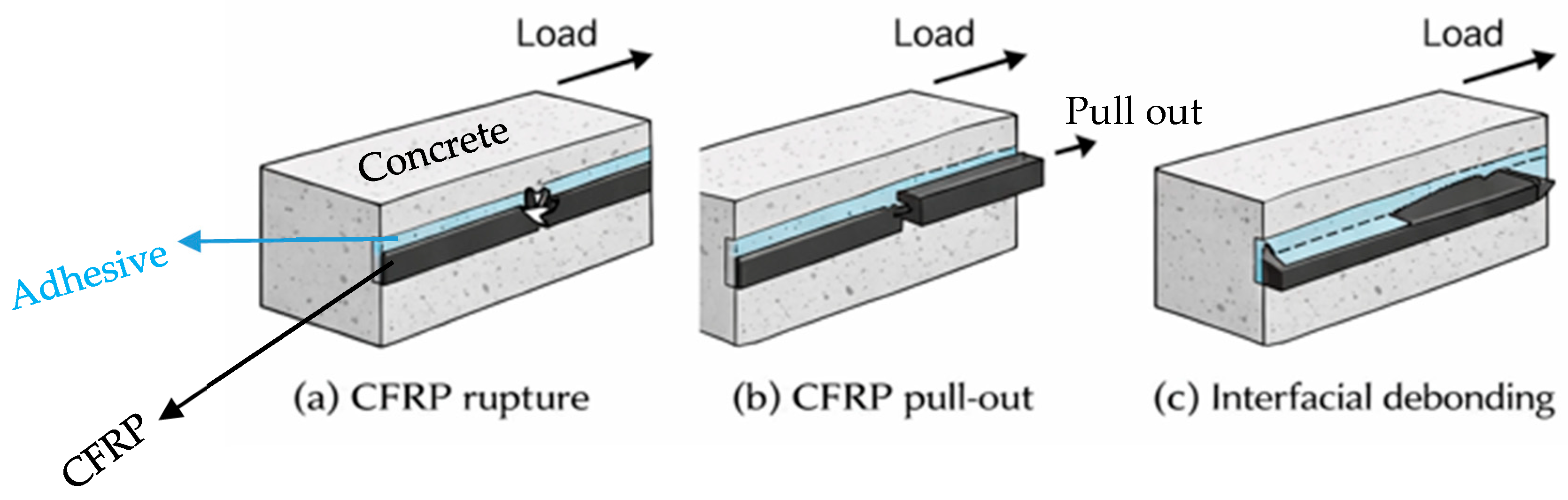
Figure 1. Schematic representation in typical adhesive-controlled failure modes in NSM-CFRP concrete joints.
Constrmater 06 00015 g001
Figure 2. Idealized schematics illustrating adhesive-governed bond failure mechanisms in IHSSC-CA–FRP systems.
Constrmater 06 00015 g002
Figure 3. Schematic illustration of typical flexural failure mechanisms in RC beams strengthened or repaired with NSM-CFRP strips using IHSSC-CA (Top) and epoxy adhesives (Bottom).
Constrmater 06 00015 g003
Table 1. Summary of experimental studies on FRP-retrofitted elements using CBAs.
Ref.Strengthening/Retrofitting TechniqueAdhesive TypeTarget ImprovementKey Findings
[9]EBCementitious vs. epoxy adhesiveFlexural performanceComparable performance: cement-bonded slabs showed ductile failure.
[11]FRCM (cementitious matrix + carbon fibre mesh)Ultimate load capacityStrengthened beams showed 10–44% increase in ultimate load.
[12]Textile fabric in a cementitious matrixFlexural strengthImproved ultimate capacity with no bond failure between matrix and concrete.
[13]TR-ECC (textile-reinforced cementitious composite)Flexural capacity and failure mechanismFlexural capacity improved by 119% (one layer) and 160% (two layers); no IC or plate-end debonding.
[14]Cement-based adhesive with CFRP fabric/textileLoad-bearing capacityLoad capacity improved by 10–35% (fabric) and ~27% (textile).
[15]Polymer-modified mortarUltimate strength and stiffnessMarginal gain in strength; no improvement in stiffness.
[16]NSMCement groutFlexural performance and practicalityCement grout is recommended as a practical alternative to epoxy in NSM-CFRP systems.
[17]EBCement-based adhesive with CFRP gridsShear strengtheningFavourable alternative to epoxy; compatible with CFRP grids.
[18]NSMCement grout vs. epoxyBond strength at ambient temperatureEpoxy outperformed cement grout; cement showed reduced FRP utilization.
[19]Mortar vs. epoxyUltimate load and crackingMortar resulted in lower load capacity and fewer cracks.
[20]Mortar vs. epoxyShear strengthEpoxy improved the shear strength more than mortar.
[21,22,23]Mortar vs. epoxyPull-out capacity and bond behaviourMortar-filled grooves had lower pull-out capacity; debonding at the mortar-concrete interface was common.
Table 2. Summary of the key enhancements of CBA’s properties with the addition of nanoparticles.
Ref.NanomaterialConcentrationProperty (% Enhancement)
[27]GON/ACompressive strength (13.5%), splitting tensile strength (45%), and bond strength (78%)
[28]GO nanosheets0.03 and 0.04 wt.%Compressive strength (52.4% and 52.9%) and flexural strength (34.3% and 37.5%)
[30]GO0.01, 0.03, and 0.06 wt.%Water sorptivity and chloride penetration (N/A)
[31]GO0.06 wt.%Weight loss, air content (40%), water absorption, and compressive strength
[32]GO, NS, and
GNP
(1) 0.05 wt.% GO
(2) 3 wt.% NS
(3) 3 wt.% of NS combined with 1.5 wt.% of GO
(4) 0.075 wt.% GNP
(1) Compressive strength (24%)
(2) Compressive (29%) and flexural strength (37%), chloride penetration (reduced by 61%)
(3) Compressive (46%) and flexural strength (57%), chloride penetration (reduced by 54%)
(4) Pull-out force (73%), bond strength (49%), and fracture energy (178%)
[33]GO0.01 and 0.05 wt.%Compressive strength (3.4% and 29%)
[34]CNFs and CNTs0.1 and 0.2 wt.%The average ductility (73%), the average flexural strength (60%), the average Young’s modulus (25%), and the average modulus of toughness (170%)
Table 3. Table 3. Summary of studies on the performance of IHSSC-CA in FRP-strengthened concrete systems.
Ref.Adhesives InvestigatedTest Types/ConditionsKey Findings
[25]PCA, IHSSC-CAPull-out tests under fatigue loadingIHSSC-CA demonstrated superior fatigue resistance and durability, owing to a stronger bond and a more robust pore structure.
[27]IHSSC-CA (GO + superplasticizer in cement mortar)Material characterization (flow, strength, pull-off)High tensile (13.8 MPa) and compressive (101 MPa) strengths; excellent flow and pot life.
[38,39,40]Epoxy, PCA, IHSSC-CAPull-out tests under monotonic loadingIHSSC-CA showed the best workability, ductility, bond strength, and superior load transfer.
[41]IHSSC-CA vs. NSC at elevated temperaturesMechanical tests at 21 °C, 400 °C, 600 °C, 800 °CIHSSC-CA retained higher strength and bond capacity than NSC at elevated temperatures.
[43]Epoxy vs. IHSSC-CAFatigue tests on RC girdersIHSSC-CA showed less strain, cracking, and stiffness degradation under fatigue loading.
[44]Epoxy vs. IHSSC-CAFlexural tests on full-scale RC beamsIHSSC-CA provided higher ductility and post-peak strength retention than epoxy.
Disclaimer/Publisher’s Note: The statements, opinions and data contained in all publications are solely those of the individual author(s) and contributor(s) and not of MDPI and/or the editor(s). MDPI and/or the editor(s) disclaim responsibility for any injury to people or property resulting from any ideas, methods, instructions or products referred to in the content.