Experimental and Analytical Investigations on Glass-FRP Shear Transfer Reinforcement for Composite Concrete Construction

Abstract
1. Introduction
Research Significance
2. Experimental Program
2.1. Test Specimens
2.2. Materials Properties
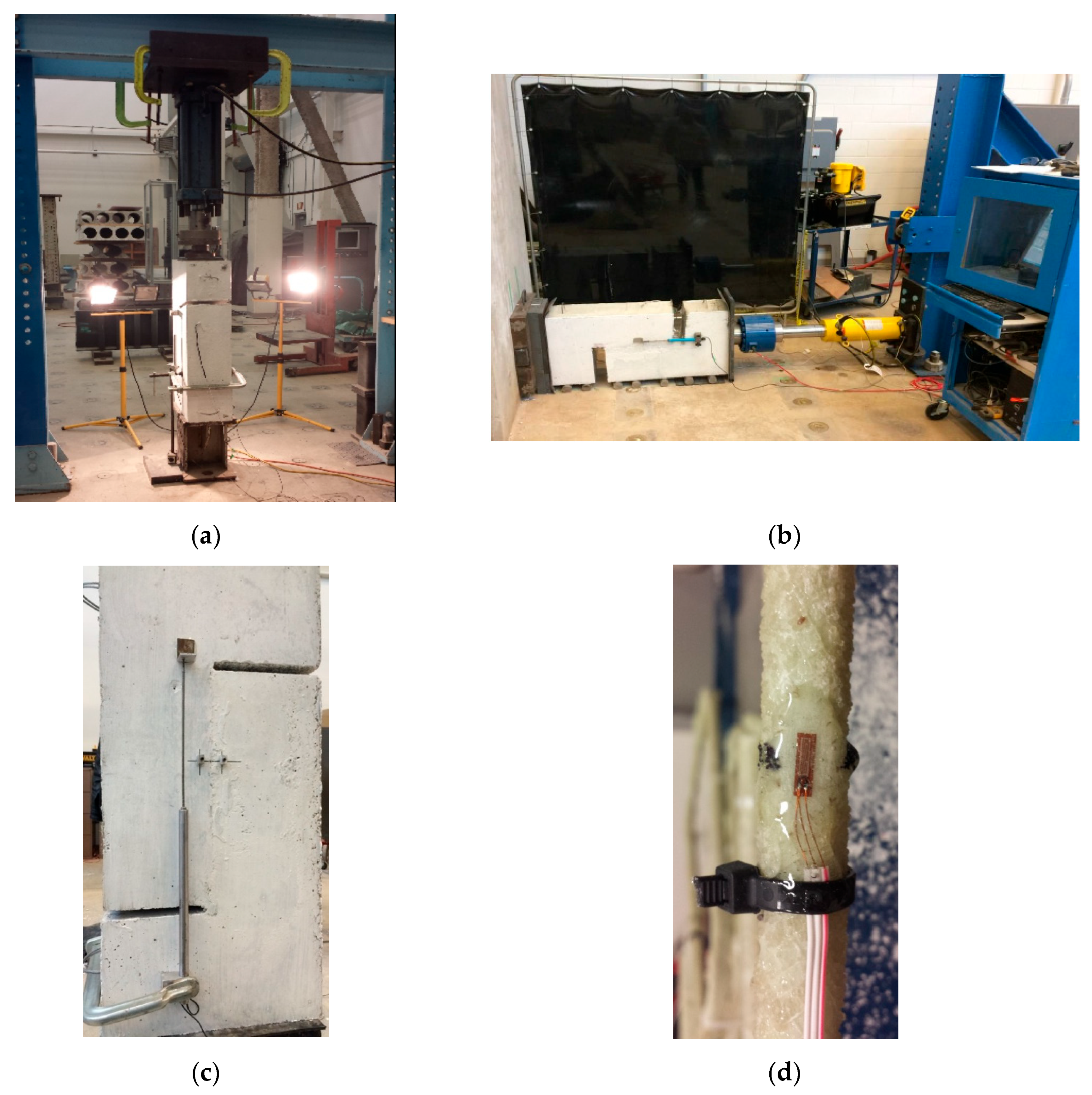
2.3. Test Setup and Instrumentations
3. Test Results and Discussion
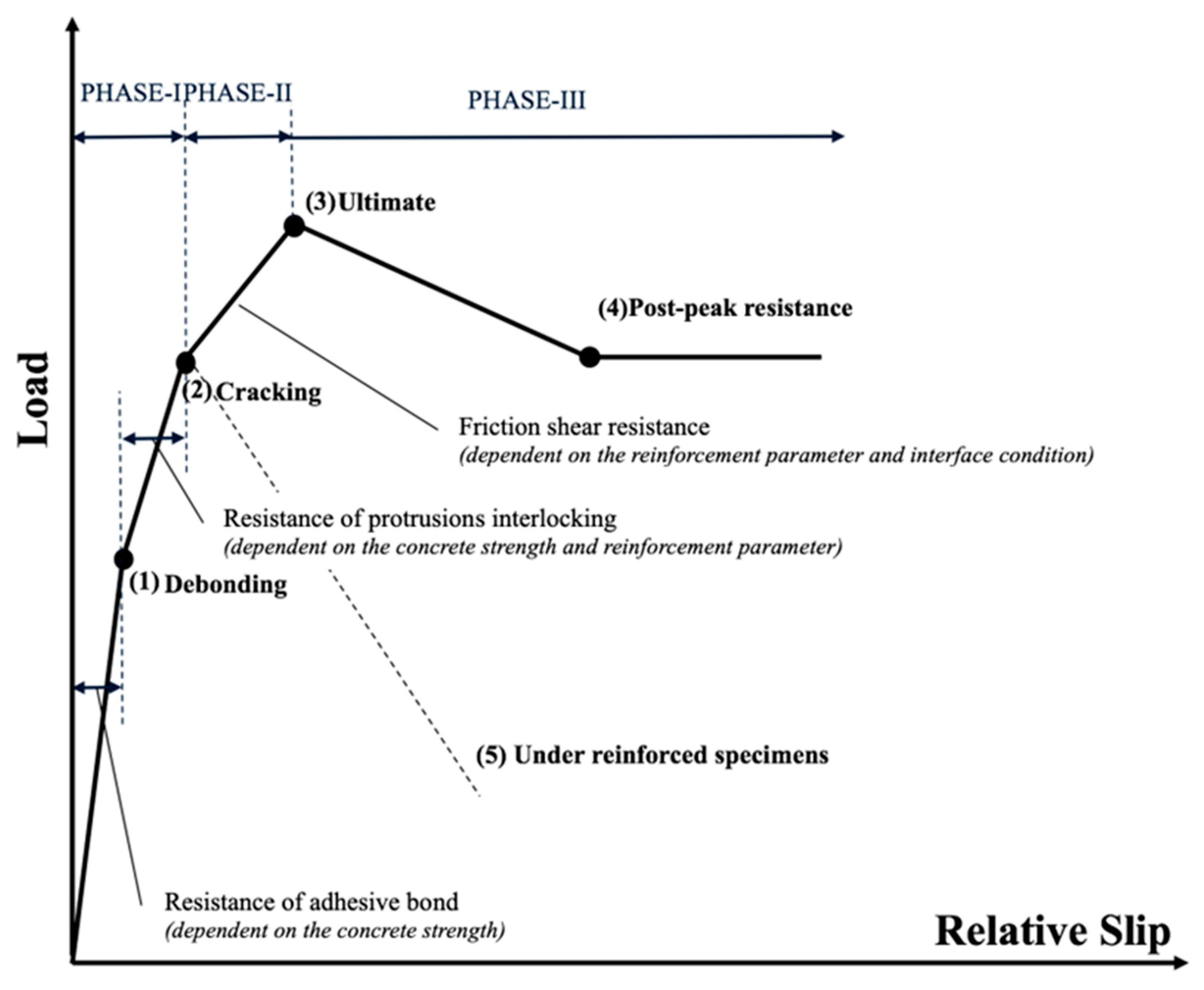
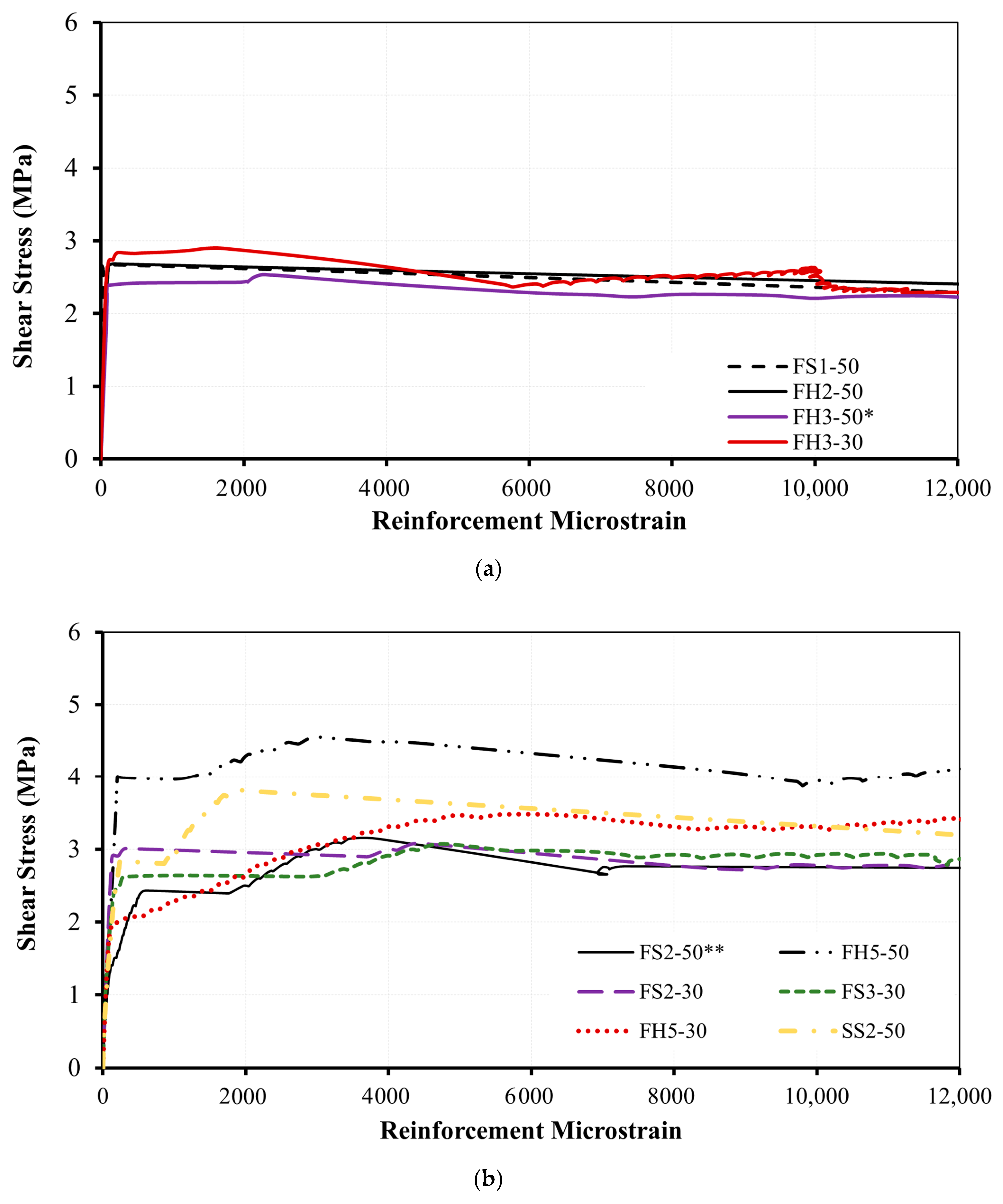
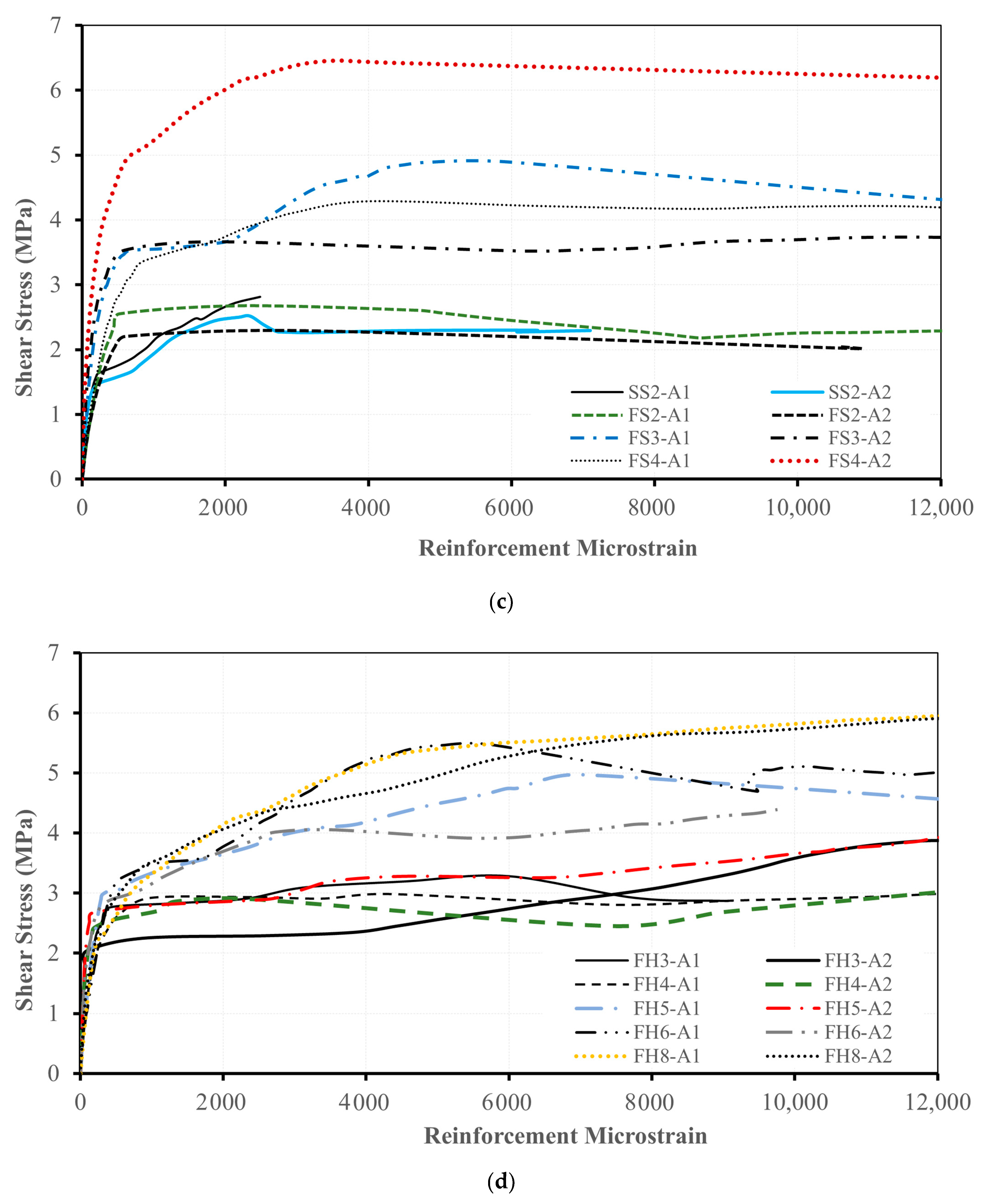
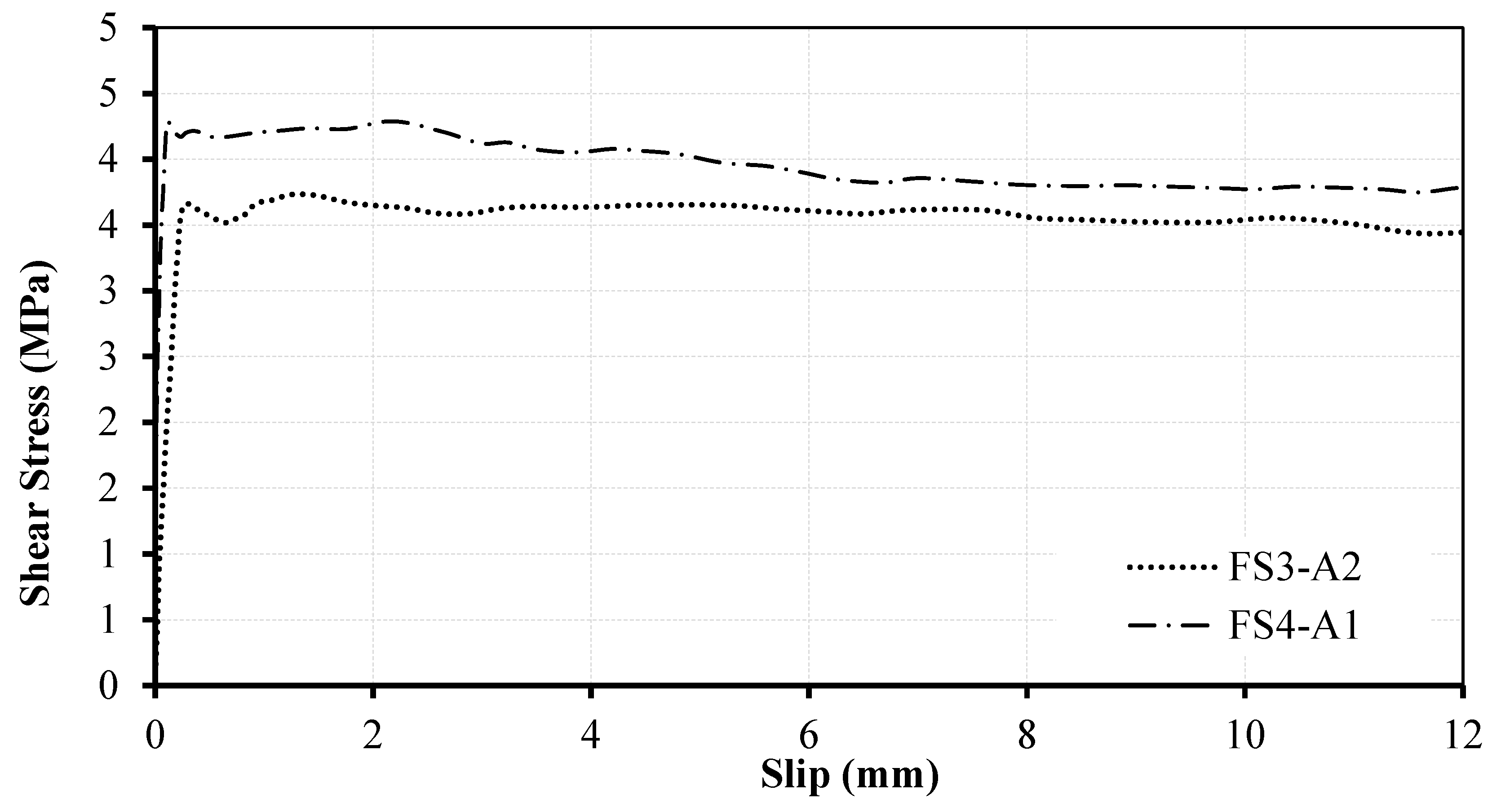
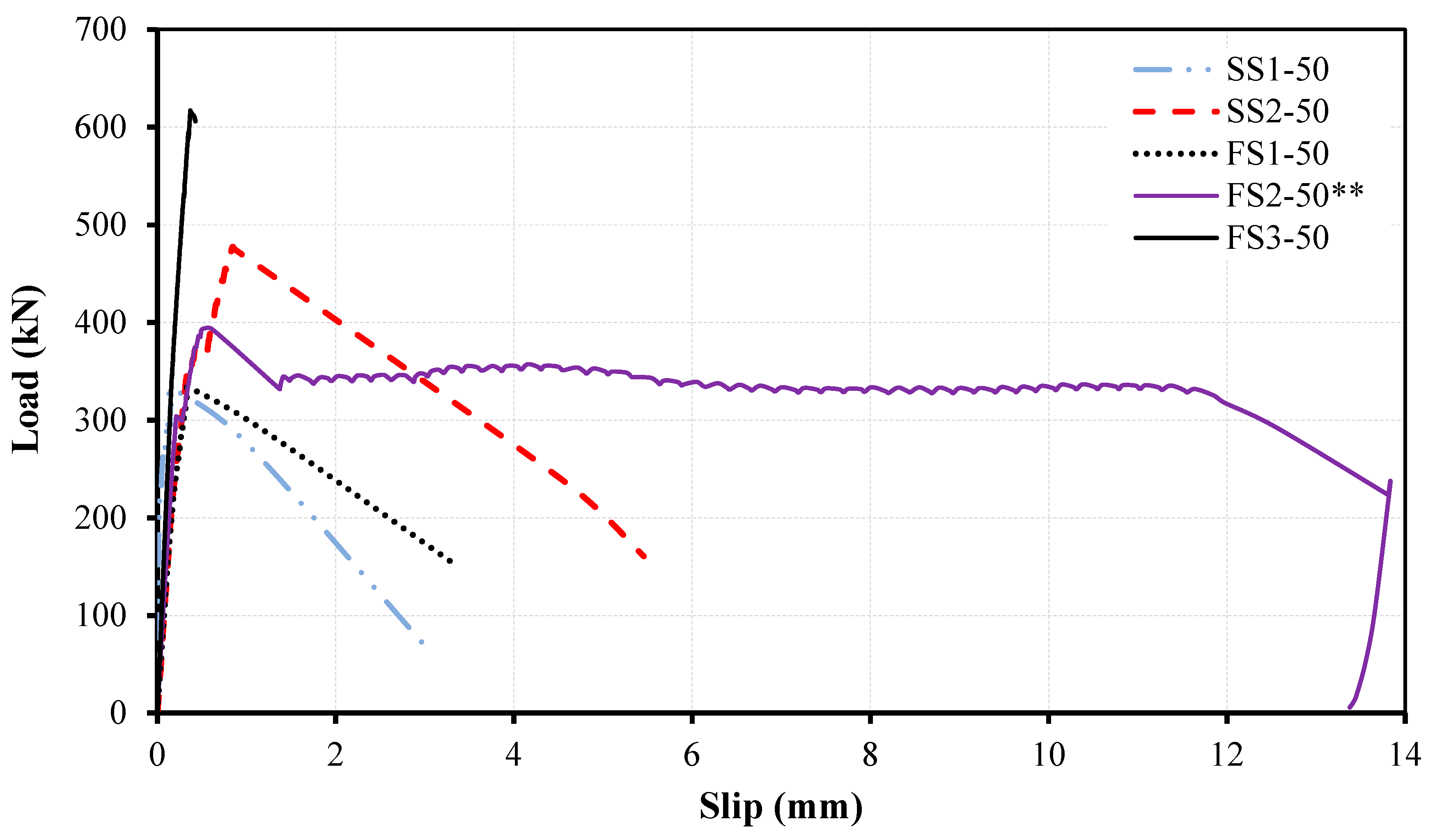
3.1. General Behavior
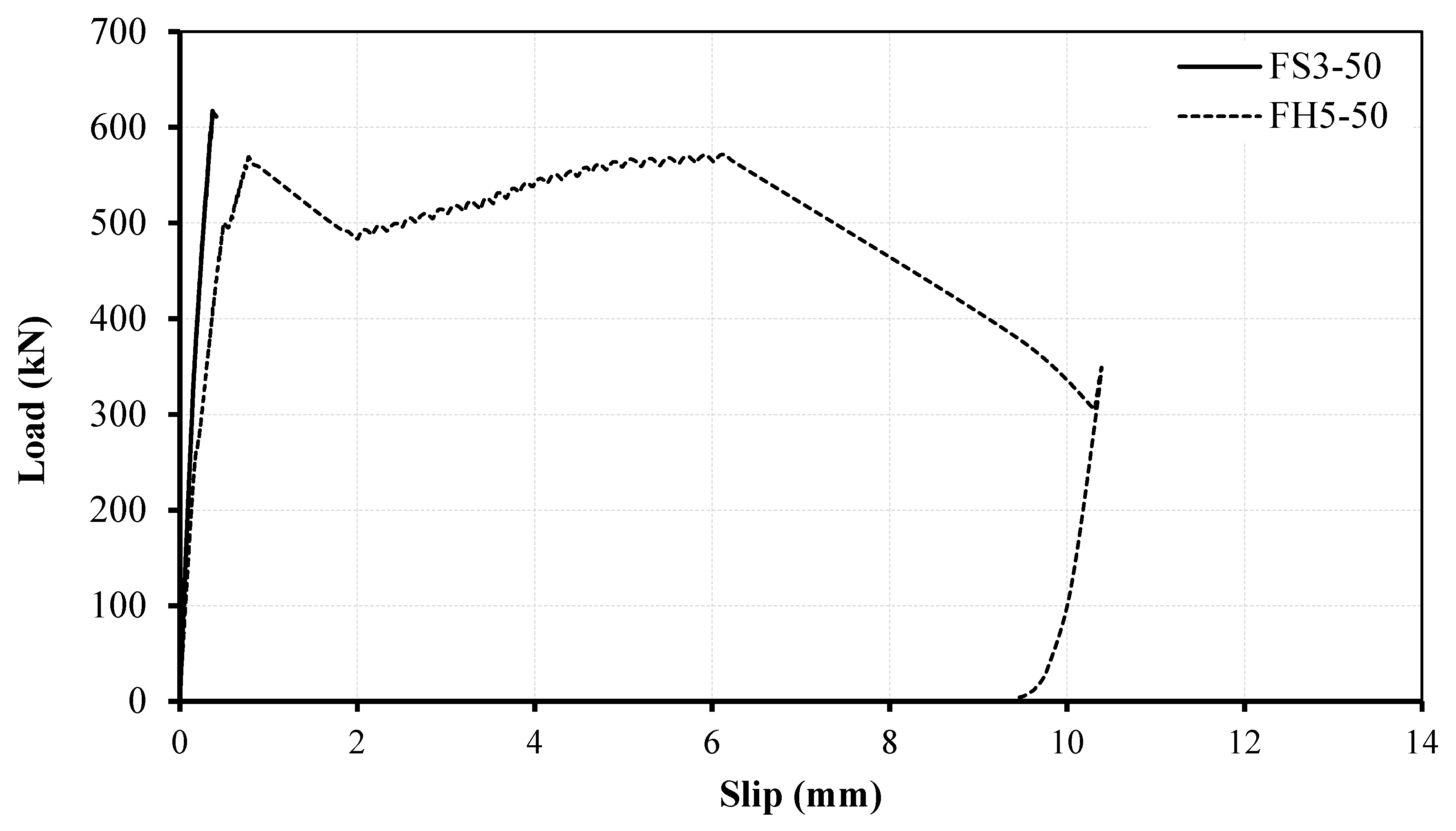
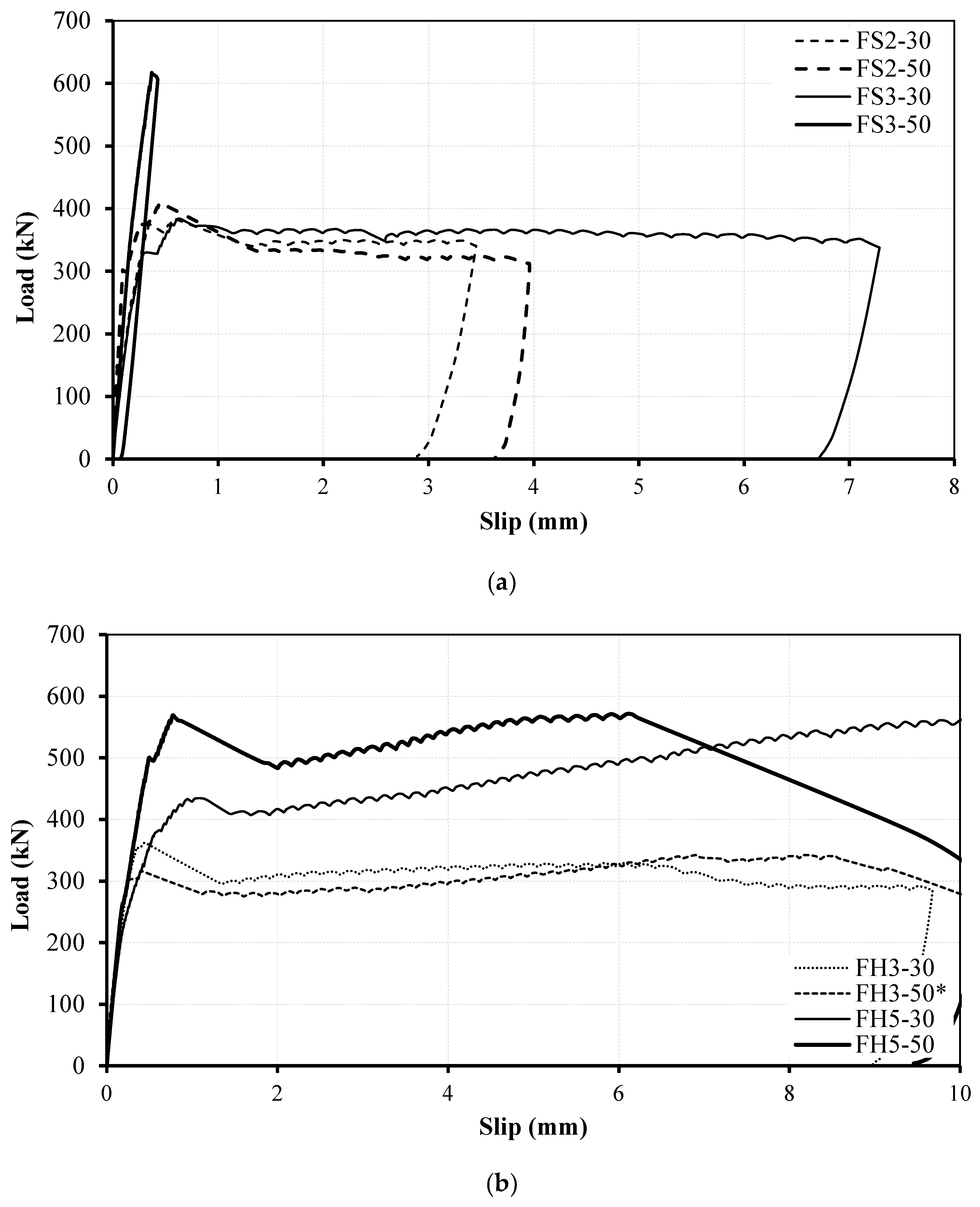
3.1.1. Phase I: Pre-Cracking Behavior
3.1.2. Phase II: Post-Cracking Behavior
3.1.3. Phase-III: Post-Ultimate Behavior
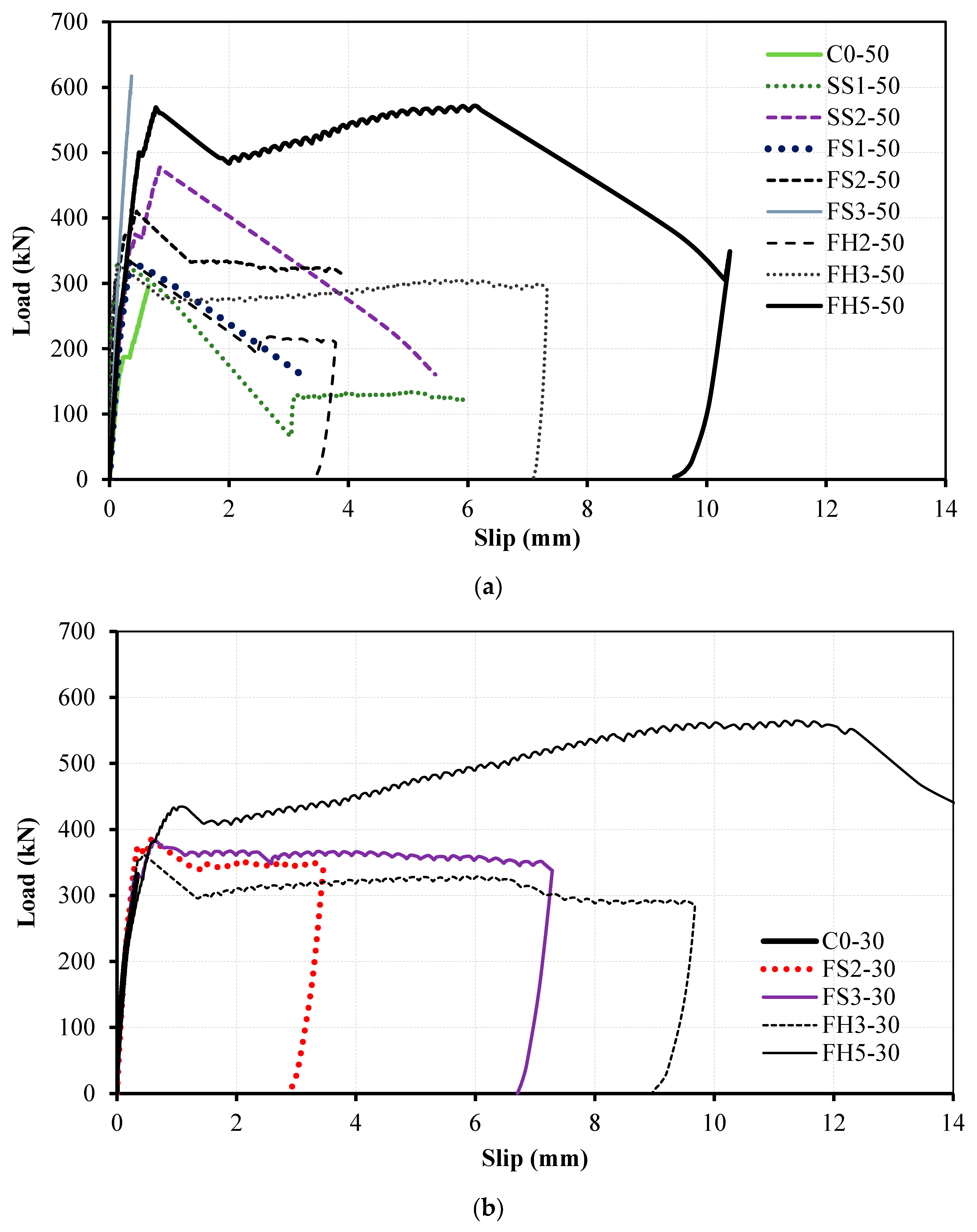
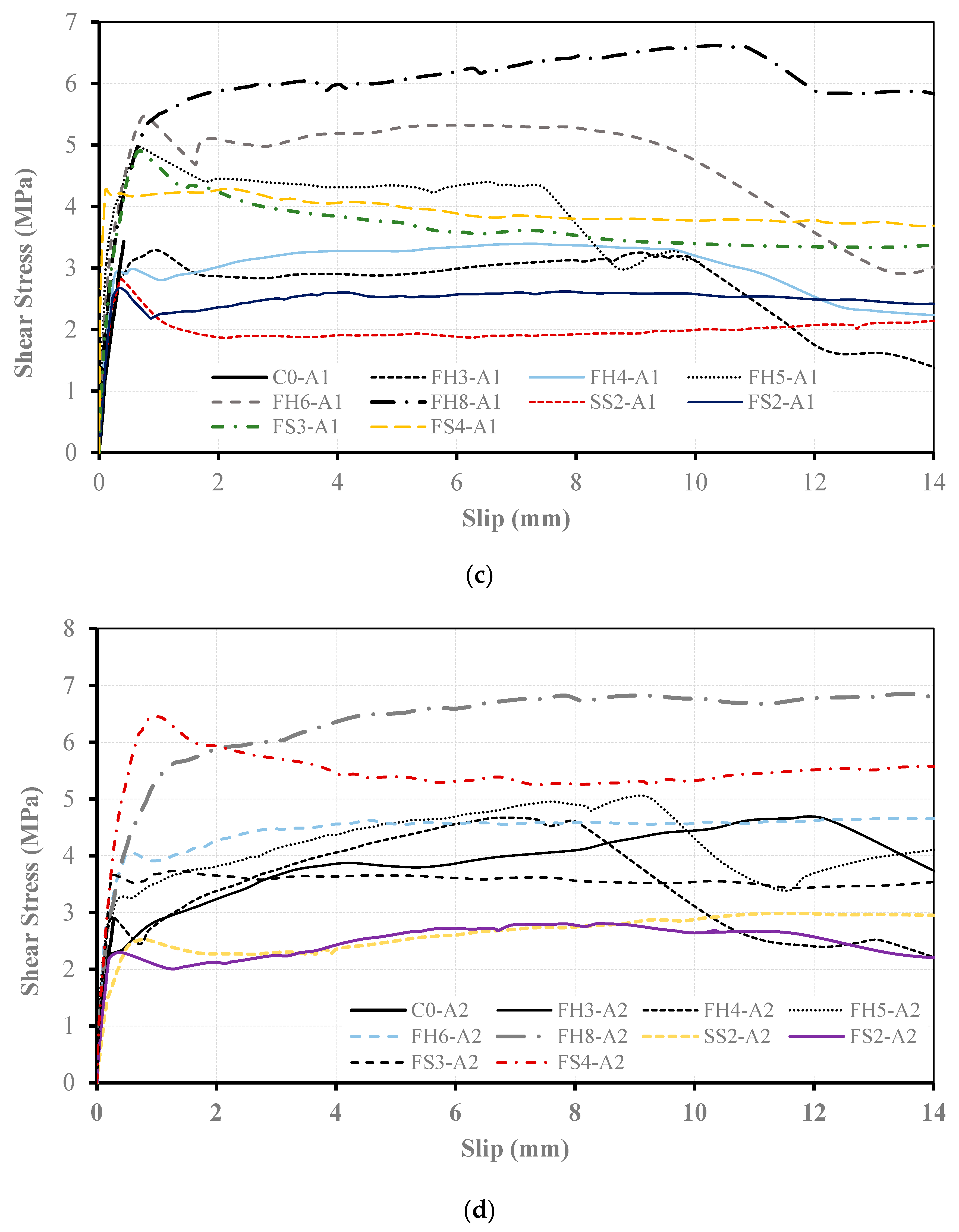
3.2. Effect of the Reinforcement Stiffness Parameter ()
3.3. Effect of the Reinforcement Type (GFRP vs. Steel)
3.4. Effect of the Reinforcement Shape (Stirrups vs. Headed Bars)
3.5. Effect of the Concrete Compressive Strength ()
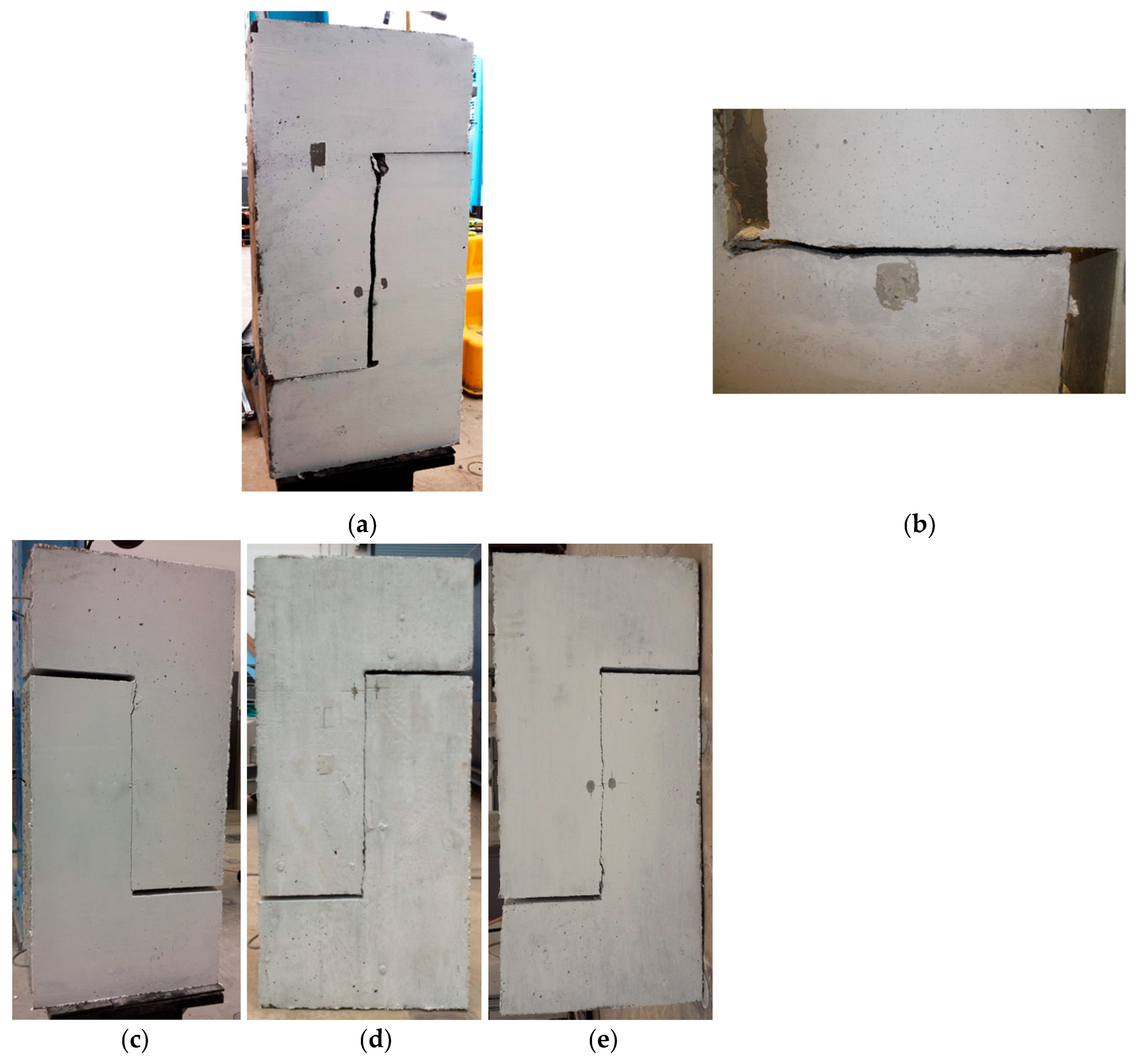
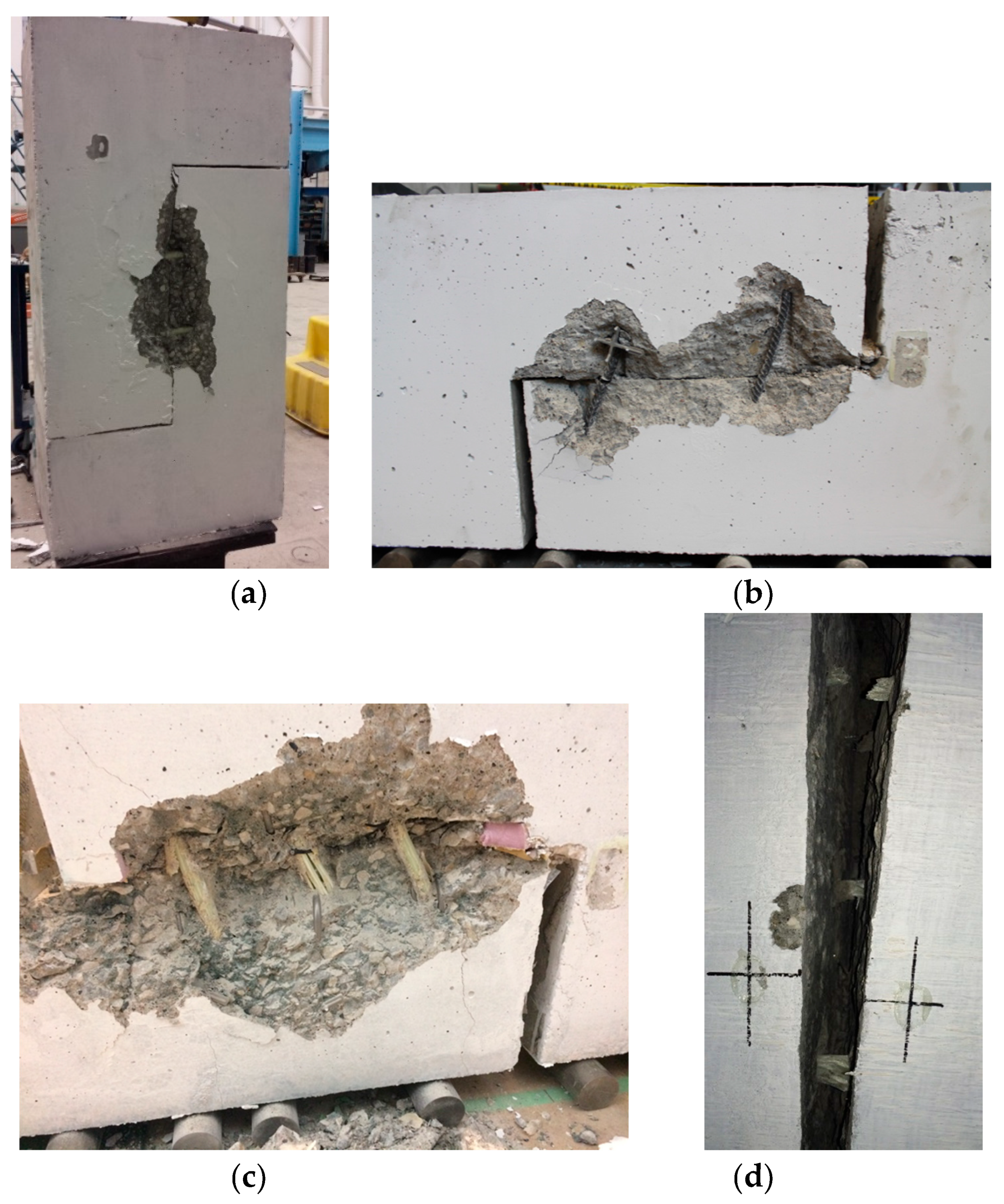
3.6. Failure Modes
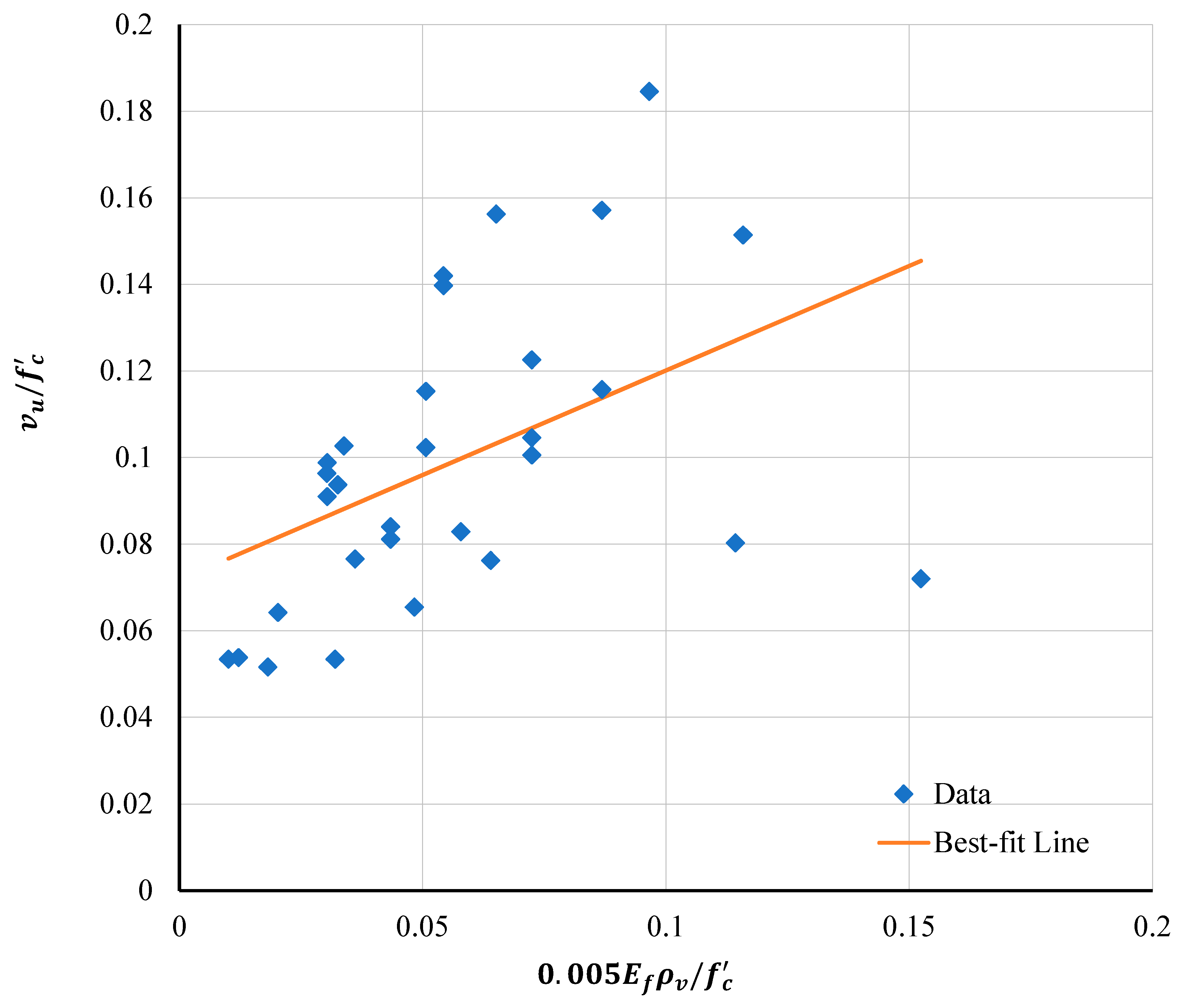
4. Proposed Shear Friction Equation
5. Conclusions
- A minimum GFRP transverse reinforcement stiffness parameter () of 203 N/mm2 is required to activate the reinforcement contribution in proving additional frictional shear resistance after the interface cracking phase.
- The axial reinforcement stiffness of the GFRP reinforcement was found to be the dominant shear transfer parameter after the initiation of the interface cracking.
- Specimens with a low GFRP axial stiffness parameter, below the limit of 203 N/mm2, failed suddenly at the cracking load. The reinforcement provided was not capable to carry any additional load.
- Interfaces with GFRP headed bars and stirrups having similar stiffness were found to exhibit similar shear transfer strength. Both reinforcement types could be used.
- Like steel-reinforced interfaces, the shear stress-slip () response of as-cast cold-joint GFRP-reinforced concrete interfaces involves three successive phases, which are pre-cracking, post-cracking, and post-ultimate.
- Higher concrete compressive strength results in higher shear transfer strength and stiffer pre-cracked load-slip response, on the condition that the reinforcement stiffness is higher than the minimum of 203 N/mm2.
- The strain limit value of 5000 is a reasonable approximation for the strain of the GFRP bars across the interface at the ultimate load.
Author Contributions
Funding
Data Availability Statement
Acknowledgments
Conflicts of Interest
Abbreviations
| area of the concrete section resisting shear transfer | |
| area of the reinforcement crossing the shear plane | |
| cohesion stress of the interface surface | |
| modulus of elasticity of GFRP reinforcement | |
| modulus of elasticity of steel reinforcement | |
| concrete compressive strength | |
| yield strength of the steel reinforcement crossing the shear interface | |
| length of the shear interface | |
| permanent load perpendicular to the shear plane (positive if compression and negative if tension) | |
| ultimate shear transfer stress | |
| angle of reinforcement inclination to the shear plane | |
| concrete density modification factor | |
| strain in the GFRP reinforcement | |
| coefficient of friction | |
| reinforcement ratio of the reinforcement crossing the shear interface () | |
| minimum ratio of the shear transfer reinforcement | |
| reinforcement stiffness parameter | |
| total normal stress to the shear plane | |
| externally applied normal stress () |
References
- Pianca, F.; Schell, H.; Cautillo, G. The performance of epoxy coated reinforcement: Experience of the Ontario ministry of transportation. Int. J. Mater. 2005, 23, 286–308. [Google Scholar] [CrossRef]
- Manalo, A.C.; Mendis, P.; Bai, Y.; Jachmann, B.; Sorbello, C.D. Fiber-Reinforced Polymer Bars for Concrete Structures: State-of-the-Practice in Australia. J. Compos. Constr. 2021, 25, 05020007. [Google Scholar] [CrossRef]
- Al Omar, S.; Abdelhadi, A. Comparative Life-Cycle Assessment of Steel and GFRP Rebars for Procurement Sustainability in the Construction Industry. Sustainability 2024, 16, 3899. [Google Scholar] [CrossRef]
- Younis, A.; Ebead, U. Long-Term Cost Performance of Corrosion-Resistant Reinforcements in Structural Concrete. In Proceedings of the International Conference on Civil Infrastructure and Construction (CIC), Doha, Qatar, 2–5 February 2020; Volume 2020, pp. 801–805. [Google Scholar] [CrossRef]
- CSA S806-12 R2021; Design and Construction of Building Structures with Fibre-Reinforced Polymer. Canadian Standards Association (CSA): Toronto, ON, Canada, 2021.
- ACI 440.11-22; Building Code Requirements for Structural Concrete Reinforced with Glass Fiber-Reinforced Polymer (GFRP) Bars—Code and Commentary. American Concrete Institute (ACI): Detroit, MI, USA, 2022.
- CSA S6-19; Canadian Highway Bridge Design Code. Canadian Standards Association (CSA): Toronto, ON, Canada, 2019.
- Alkatan, J. FRP Shear Transfer Reinforcement for Composite Concrete Construction. Master’s Thesis, University of Windsor, Windsor, ON, Canada, 2016; 144p. [Google Scholar]
- Birkeland, P.W.; Birkeland, H.W. Connections in Precast Concrete Construction. ACI J. 1966, 63, 345–368. [Google Scholar]
- Mattock, A.H.; Hawkins, N.M. Shear Transfer in Reinforced Concrete—Recent Research. PCI J. 1972, 17, 55–75. [Google Scholar] [CrossRef]
- Walraven, J.; Frenay, J.; Pruijssers, A. Influence of Concrete Strength and Load History on the Shear Friction Capacity of Concrete Members. PCI J. 1987, 32, 66–84. [Google Scholar] [CrossRef]
- Zilch, K.; Reinecke, R. Capacity of Shear Joints Between High-Strength Precast Elements and Normal-Strength Cast-In-Place Decks. In Proceedings of the International Symposium on High Performance Concrete Precast/Prestressed Concrete, Federal Highway Administration, Washington, DC, USA, 25–27 September 2000; pp. 551–560. [Google Scholar]
- Hofbeck, J.; Ibrahim, I.; Mattock, A. Shear Transfer in Reinforced Concrete. ACI J. 1969, 66, 119–128. [Google Scholar]
- Paulay, T.; Park, R.; Phillips, M.H. Horizontal Construction Joints in Cast-in-Place Reinforced Concrete; ACI Special Publication SP-4: Shear in Reinforced Concrete; American Concrete Institute: Detroit, MI, USA, 1974; Volume 2, pp. 559–611. [Google Scholar]
- Davaadorj, O.; Calvi, P.M.; Stanton, J.F. Shear stress transfer across concrete-to-concrete interfaces: Experimental evidence and available strength models. PCI J. 2020, 65, 87–111. [Google Scholar] [CrossRef]
- Loov, R.E.; Patnaik, A.K. Horizontal Shear Strength of Composite Concrete Beams with a Rough Interface. PCI J. 1994, 39, 48–69. [Google Scholar] [CrossRef]
- Khan, L.; Mitchell, A. Shear Friction Tests with High-Strength Concrete. ACI Strucutral J. 2002, 1, 98–103. [Google Scholar]
- Mattock, A.H. Shear friction and high-strength concrete. ACI Structutral J. 2001, 98, 50–59. [Google Scholar]
- Harries, K.; Zeno, G.; Shahrooz, B. Toward an Improved Understanding of Shear-Friction Behaviour. ACI Strucutral J. 2012, 109, 835–844. [Google Scholar]
- Hanson, N. Precast-Prestressed Concrete Bridges 2. Horizontal Shear Connections. PCA J. 1960, 2, 38–58. [Google Scholar]
- CSA A23.3-19; Design of Concrete Structures. Canadian Standards Association (CSA): Toronto, ON, Canada, 2019.
- ACI 318-25; Building Code Requirements for Structural Concrete and Commentary. American Concrete Institute: Farmington Hills, MI, USA, 2019.
- AASHTO. LFRD Bridge Design Specefications, 10th ed.; American Association of State Highway and Transportation Officials: Washington, DC, USA, 2024; ISBN 978-1-56051-523-4. [Google Scholar]
- Aljada, B.; El-Ragaby, A.; El-Salakawy, E. GFRP Stirrups as Shear Friction Reinforcement for Different Concrete Interfaces. J. Compos. Constr. 2024, 28, 04024051. [Google Scholar] [CrossRef]
- Aljada, B.H.; El Ragaby, A.; El-Salakawy, E. Glass Fiber-Reinforced Polymer Bars as Shear-Friction Reinforcement for Concrete Cold Joints. ACI Struct. J. 2024, 121, 47–60. [Google Scholar]
- Alruwaili, M. Shear Transfer Mechanism in FRP Reinforced Composite Concrete Structures. Master’s Thesis, University of Windsor, Windsor, ON, Canada, 2018; 94p. [Google Scholar]
- Vega, C.J.; Belarbi, A.; Nanni, A. Experimental Assessment of Shear Transfer Capacity of GFRP Reinforcement Using the Push-Off Test. J. Compos. Constr. 2024, 28, 04024056. [Google Scholar] [CrossRef]
- ACI 224.3R-95; Joints in Concrete Construction. American Concrete Institute: Farmington Hills, MI, USA, 1995.
- Carnes, T.S.; Roberts-Wollmann, C.L.; Brand, A.S. Effect of delayed casting time on the interfacial fracture properties of cementitious materials. Constr. Build. Mater. 2025, 491, 142684. [Google Scholar] [CrossRef]
- V-ROD. Fiber Glass Reinforcement. 2016. Available online: https://fiberglassrebar.com/product/structural/ (accessed on 15 October 2025).
- ASTM C39; Standard Test Method for Compressive Strength of Cylindrical Concrete Specimens. ASTM International: West Conshohocken, PA, USA, 2018.
- Mattock, A.H. Reader Comments on “Influence of Concrete Strength and Load History on the Shear Friction Capacity of Concrete Members” by Walraven et al. PCI J. 1988, 33, 165–166. Available online: https://www.pci.org/PCI_Docs/Publications/PCI%20Journal/1988/January/Reader%20Comments.pdf (accessed on 15 October 2025).


| Research | Expression (SI Units) | Limits/Notes |
|---|---|---|
| Birkeland and Birkeland (1966) [9] | for monolithic concrete. for artificially roughened joints. –1 for ordinary construction joints. | |
| Mattock (2001) [18] | For concrete placed against hardened concrete not intentionally roughened: | |
| Khan and Mitchell (2002) [17] | ||
| Harries et al. (2012) [19] | For cold-joint interfaces: | |
| CSA A23.3-19 [21] | For concrete placed against hardened concrete not intentionally roughened: | MPa |
| AC1 318-25 [22] | For concrete placed against hardened concrete not intentionally roughened: |
| Series | Specimen ID | (MPa) | Reinforcement Type and Shape | (mm2) | (mm2) | (%) | (MPa) |
|---|---|---|---|---|---|---|---|
| I | C0-50 | 50 | NA | 0 | 125,000 (250 500) | 0.00 | 0 |
| SS1-50 | Steel stirrup | 200 | 0.16 | 320 | |||
| SS2-50 | 400 | 0.32 | 640 | ||||
| FS1-50 | GFRP stirrup | 253.4 | 0.20 | 101 | |||
| FS2-50 | 506.8 | 0.41 | 203 | ||||
| FS2-50 * | 506.8 | 0.41 | |||||
| FS2-50 ** | 506.8 | 0.41 | |||||
| FS3-50 | 760.2 | 0.61 | 304 | ||||
| FH2-50 | GFRP headed bar | 253.4 | 0.20 | 122 | |||
| FH3-50 | 380.1 | 0.30 | 182 | ||||
| FH3-50 * | 380.1 | 0.30 | |||||
| FH5-50 | 633.5 | 0.51 | 304 | ||||
| II | C0-30 | 30 | NA | 0 | 0.00 | 0 | |
| FS2-30 | GFRP stirrup | 506.8 | 0.41 | 203 | |||
| FS3-30 | 760.2 | 0.61 | 304 | ||||
| FH3-30 | GFRP headed bar | 380.1 | 0.30 | 182 | |||
| FH5-30 | 633.5 | 0.51 | 304 | ||||
| III | C0-35A1 | 35 | NA | 0.0 | 100,000 (250 400) | 0.00 | 0 |
| SS2-35A1 | Steel stirrup | 400.0 | 0.40 | 800 | |||
| FS2-35A1 | GFRP stirrup | 506.8 | 0.51 | 253 | |||
| FS3-35A1 | 760.2 | 0.76 | 380 | ||||
| FS4-35A1 | 1013.6 | 1.01 | 507 | ||||
| FH3-35A1 | GFRP headed bar | 380.1 | 0.38 | 228 | |||
| FH4-35A1 | 506.8 | 0.51 | 304 | ||||
| FH5-35A1 | 633.5 | 0.63 | 380 | ||||
| FH6-35A1 | 760.2 | 0.76 | 456 | ||||
| FH8-35A1 | 1013.6 | 1.01 | 608 | ||||
| C0-35A2 | NA | 0.0 | 75,000 (250 300) | 0.00 | 0 | ||
| SS2-35A2 | Steel stirrup | 400.0 | 0.53 | 1067 | |||
| FS2-35A2 | GFRP stirrup | 506.8 | 0.68 | 338 | |||
| FS3-35A2 | 760.2 | 1.01 | 507 | ||||
| FS4-35A2 | 1013.6 | 1.35 | 676 | ||||
| FH3-35A2 | GFRP headed bar | 380.1 | 0.51 | 304 | |||
| FH4-35A2 | 506.8 | 0.68 | 405 | ||||
| FH5-35A2 | 633.5 | 0.84 | 507 | ||||
| FH6-35A2 | 760.2 | 1.01 | 608 | ||||
| FH8-35A2 | 1013.6 | 1.35 | 811 |
| Reinforcement | Nominal Cross-Sectional Area (mm2) | (MPa) | Tensile Modulus Ef (GPa) | Average Ultimate Tensile Strain, (%) | |
|---|---|---|---|---|---|
| Type | Shape | ||||
| GFRP | Stirrup | 126.7 | 1140 | 50 | 2.17 |
| Headed bar | 126.7 | 1312 | 60 | 2.00 | |
| Steel | Stirrup | 100 | fy = 400 | 200 | εy = 0.2 |
| Specimen ID | (MPa) | (N/mm2) | At Ultimate | |||
|---|---|---|---|---|---|---|
(kN) | (MPa) | Slip (mm) | Reinforcement Strain | |||
| C0-50 | 50 | 0 | 296 | 2.37 | 0.66 | - |
| SS1-50 | 320 | 334 | 2.67 | 0.14 | - | |
| SS2-50 | 640 | 477 | 3.81 | 0.85 | 1904 | |
| FS1-50 | 101 | 334 | 2.67 | 0.34 | 22 | |
| FS2-50 * | 203 | 402 | 3.21 | 0.48 | 3881 | |
| FS3-50 | 304 | 617 | 4.94 | 0.37 | 402 | |
| FH2-50 | 122 | 336 | 2.69 | 0.31 | 389 | |
| FH3-50 * | 182 | 323 | 2.58 | 0.28 | 2260 | |
| FH5-50 | 304 | 569 | 4.55 | 0.77 | 2953 | |
| C0-30 | 30 | 0 | 332 | 2.65 | 0.34 | - |
| FS2-30 | 203 | 385 | 3.08 | 0.58 | 4466 | |
| FS3-30 | 304 | 384 | 3.07 | 0.64 | 4847 | |
| FH3-30 | 182 | 362 | 2.89 | 0.44 | 1472 | |
| FH5-30 | 304 | 433 | 3.46 | 0.94 | 4973 | |
| C0-35A1 | 35 | 0 | 343 | 3.43 | 0.41 | - |
| SS2-35A1 | 800 | 281 | 2.81 | 0.39 | 2486 | |
| FS2-35A1 | 253 | 268 | 2.68 | 0.34 | 2209 | |
| FS3-35A1 | 380 | 489 | 4.89 | 0.72 | 5962 | |
| FS4-35A1 | 507 | 429 | 4.29 | 0.11 | 3976 | |
| FH3-35A1 | 228 | 328 | 3.28 | 1.00 | 5993 | |
| FH4-35A1 | 304 | 294 | 2.94 | 0.37 | 2383 | |
| FH5-35A1 | 380 | 497 | 4.97 | 0.67 | 6988 | |
| FH6-35A1 | 456 | 547 | 5.47 | 0.80 | 5752 | |
| FH8-35A1 | 608 | 550 | 5.50 | 1.00 | 5889 | |
| C0-35A1 | 0 | 217 | 2.89 | 0.28 | - | |
| SS2-35A2 | 1067 | 189 | 2.52 | 0.83 | 2343 | |
| FS2-35A2 | 338 | 172 | 2.29 | 0.41 | 3113 | |
| FS3-35A2 | 507 | 275 | 3.66 | 0.92 | 8828 | |
| FS4-35A2 | 676 | 484 | 6.46 | 0.94 | 3619 | |
| FH3-35A2 | 304 | 213 | 2.84 | 0.97 | 6563 | |
| FH4-35A2 | 405 | 218 | 2.90 | 0.30 | 2308 | |
| FH5-35A2 | 507 | 264 | 3.52 | 1.00 | 9010 | |
| FH6-35A2 | 608 | 304 | 4.05 | 0.60 | 3543 | |
| FH8-35A2 | 811 | 397 | 5.30 | 0.97 | 6081 | |
Disclaimer/Publisher’s Note: The statements, opinions and data contained in all publications are solely those of the individual author(s) and contributor(s) and not of MDPI and/or the editor(s). MDPI and/or the editor(s) disclaim responsibility for any injury to people or property resulting from any ideas, methods, instructions or products referred to in the content. |
© 2026 by the authors. Licensee MDPI, Basel, Switzerland. This article is an open access article distributed under the terms and conditions of the Creative Commons Attribution (CC BY) license.
Share and Cite
El Ragaby, A.; Alkatan, J.; Ghrib, F.; Alruwaili, M. Experimental and Analytical Investigations on Glass-FRP Shear Transfer Reinforcement for Composite Concrete Construction. Constr. Mater. 2026, 6, 5. https://doi.org/10.3390/constrmater6010005
El Ragaby A, Alkatan J, Ghrib F, Alruwaili M. Experimental and Analytical Investigations on Glass-FRP Shear Transfer Reinforcement for Composite Concrete Construction. Construction Materials. 2026; 6(1):5. https://doi.org/10.3390/constrmater6010005
Chicago/Turabian StyleEl Ragaby, Amr, Jehad Alkatan, Faouzi Ghrib, and Mofrhe Alruwaili. 2026. "Experimental and Analytical Investigations on Glass-FRP Shear Transfer Reinforcement for Composite Concrete Construction" Construction Materials 6, no. 1: 5. https://doi.org/10.3390/constrmater6010005
APA StyleEl Ragaby, A., Alkatan, J., Ghrib, F., & Alruwaili, M. (2026). Experimental and Analytical Investigations on Glass-FRP Shear Transfer Reinforcement for Composite Concrete Construction. Construction Materials, 6(1), 5. https://doi.org/10.3390/constrmater6010005