Figure 1.
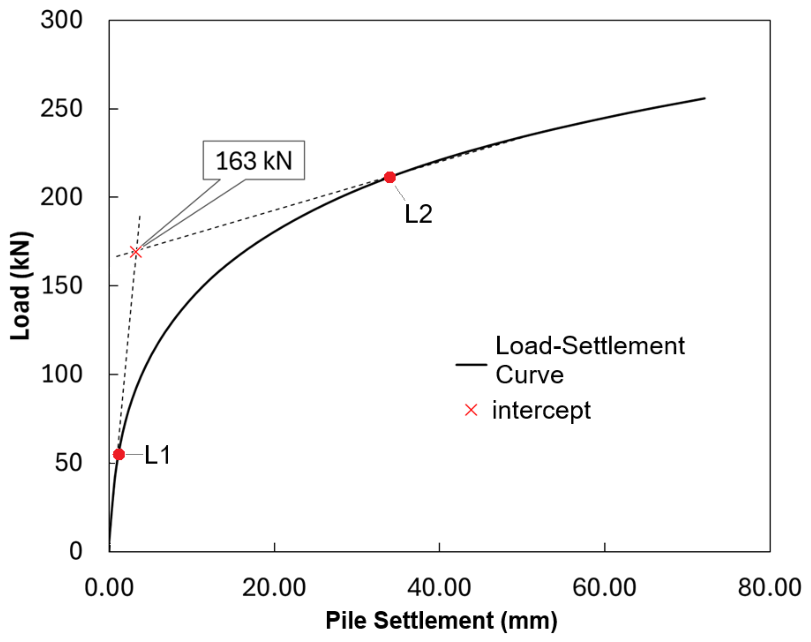
Illustration example of the L1–L2 graphical method for determining interpreted pile capacity from the load–settlement curve.
Figure 1.
Illustration example of the L1–L2 graphical method for determining interpreted pile capacity from the load–settlement curve.
Figure 2.
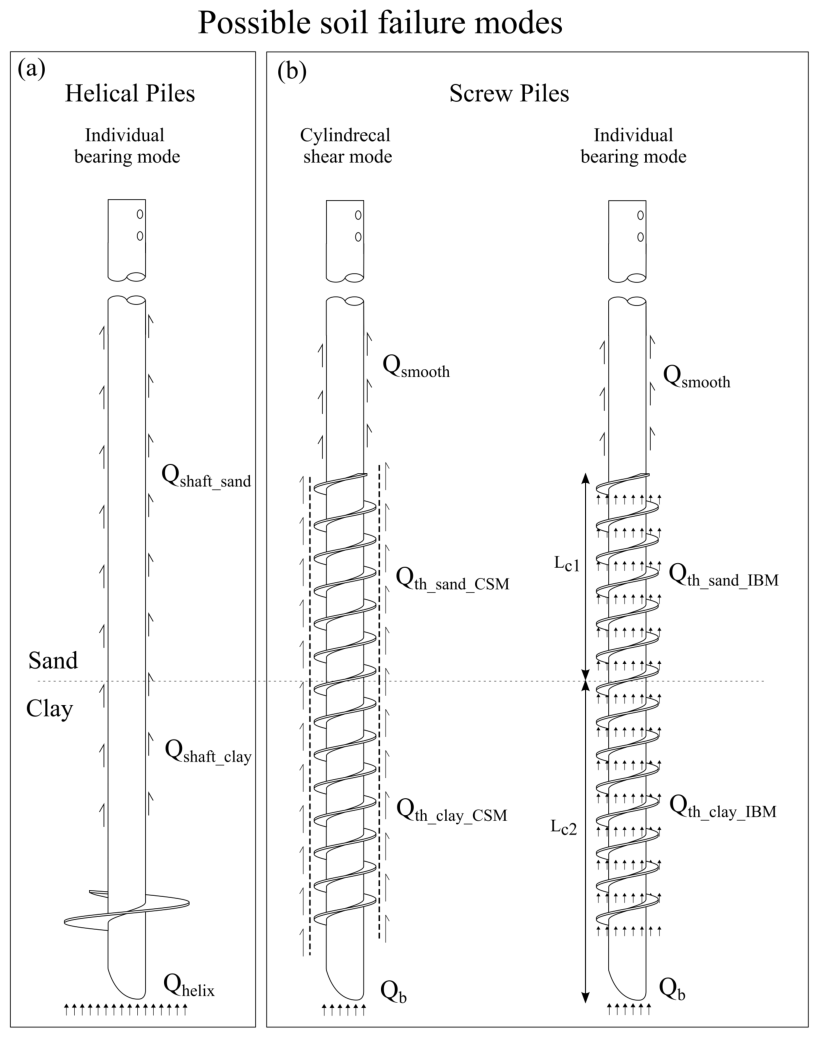
Pile capacity components and possible failure modes for (a) helical piles and (b) screw piles.
Figure 2.
Pile capacity components and possible failure modes for (a) helical piles and (b) screw piles.
Figure 3.
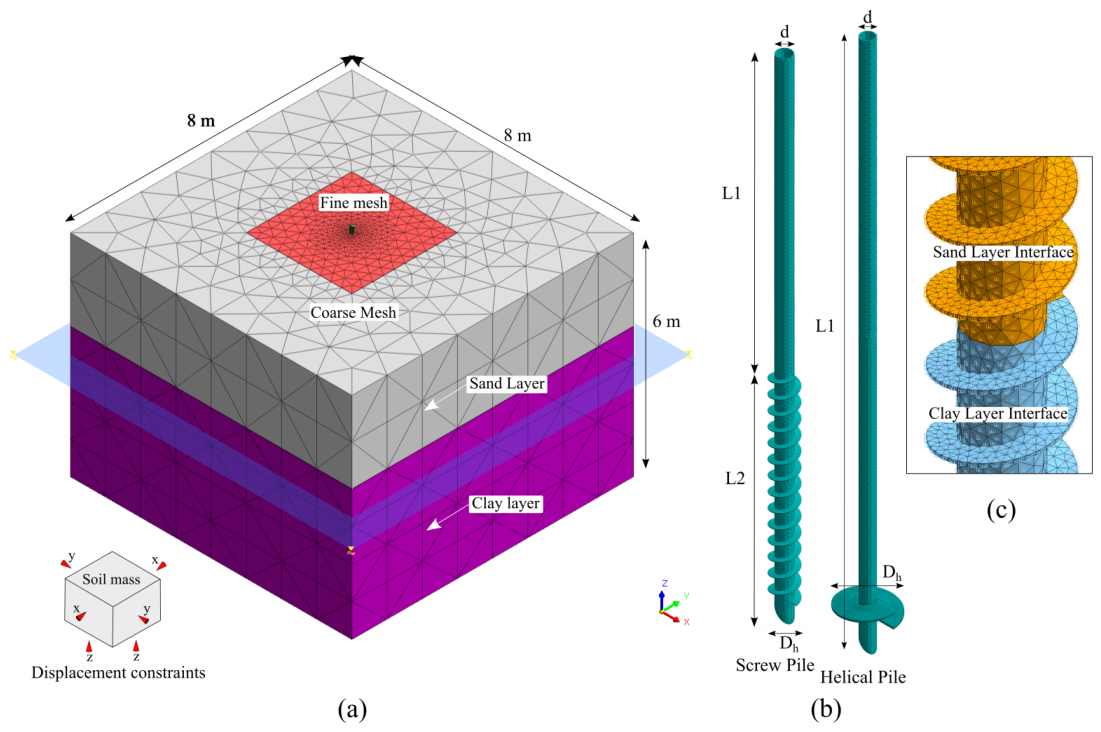
(a) Soil mesh boundaries, (b) Pile models geometry and mesh, (c) Pile interface element in sand and clay layer.
Figure 3.
(a) Soil mesh boundaries, (b) Pile models geometry and mesh, (c) Pile interface element in sand and clay layer.
Figure 4.
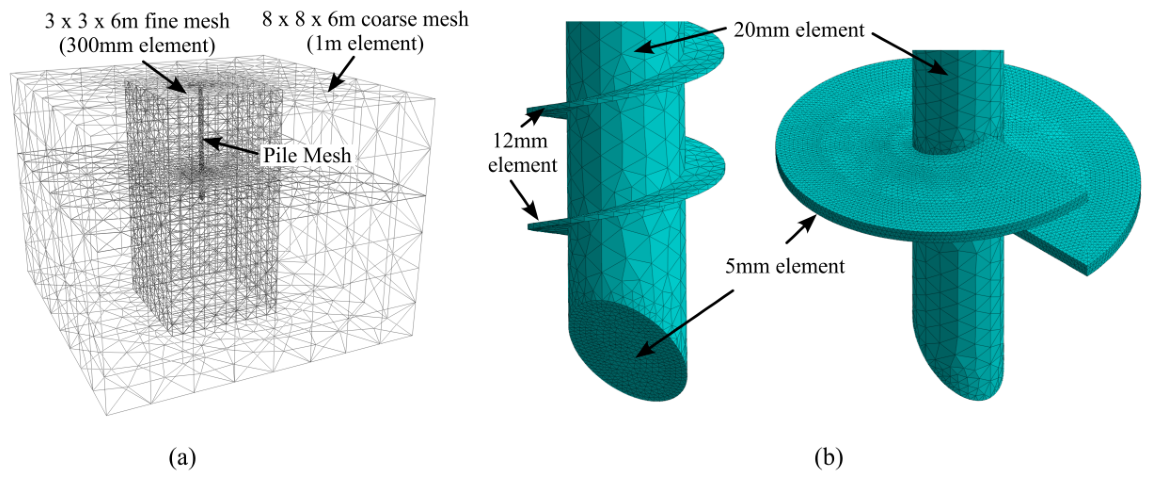
(a) Soil block mesh refinement. (b) Screw and • mesh refinement.
Figure 4.
(a) Soil block mesh refinement. (b) Screw and • mesh refinement.
Figure 5.
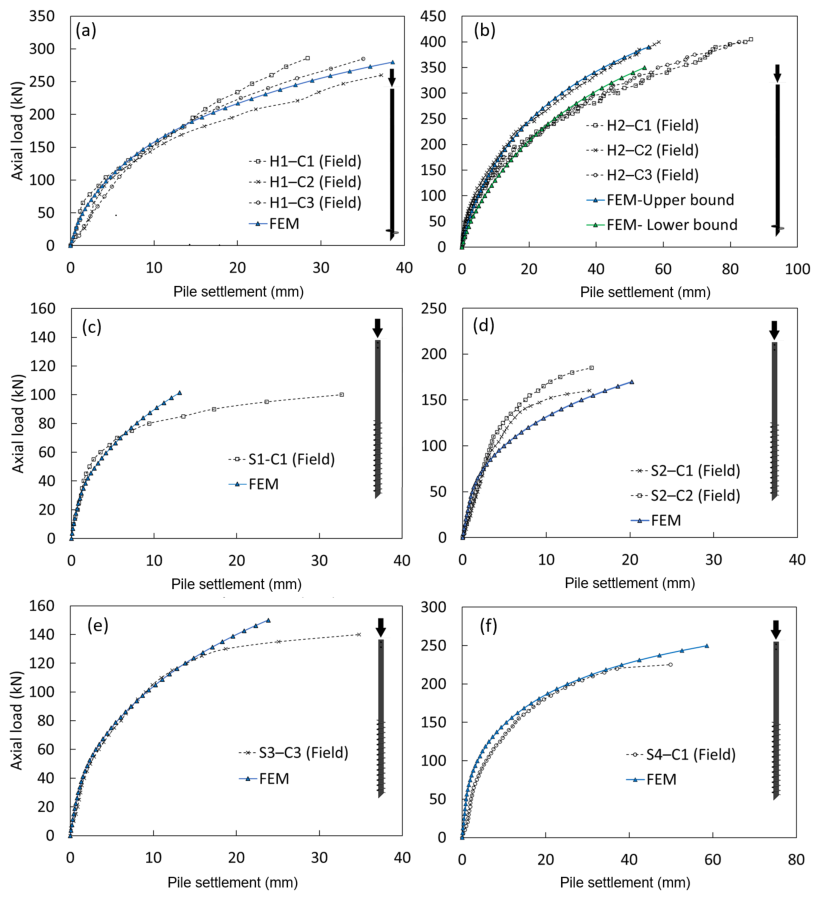
Calibration and validation of FEM against compression pile load test results of pile type: (a): H1, (b): H2, (c): S1, (d): S2, (e): S3 and (f): S4.
Figure 5.
Calibration and validation of FEM against compression pile load test results of pile type: (a): H1, (b): H2, (c): S1, (d): S2, (e): S3 and (f): S4.
Figure 6.
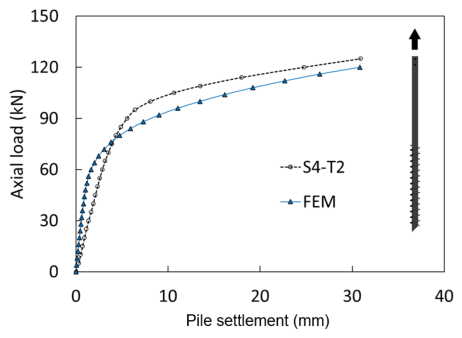
Validation of FEM against tension pile load test results of pile S4.
Figure 6.
Validation of FEM against tension pile load test results of pile S4.
Figure 7.
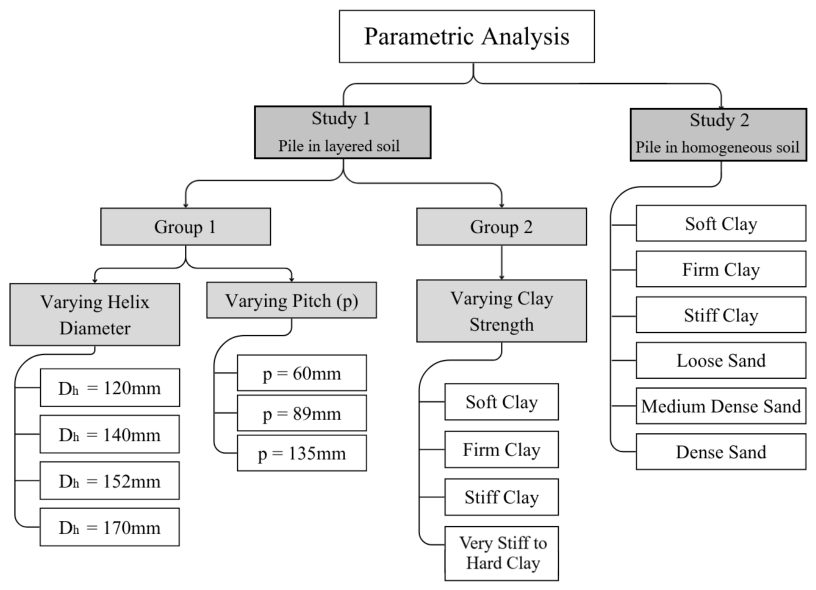
Flowchart of the parametric analysis for screw piles in layered soil and single-layered homogeneous soil profiles.
Figure 7.
Flowchart of the parametric analysis for screw piles in layered soil and single-layered homogeneous soil profiles.
Figure 8.
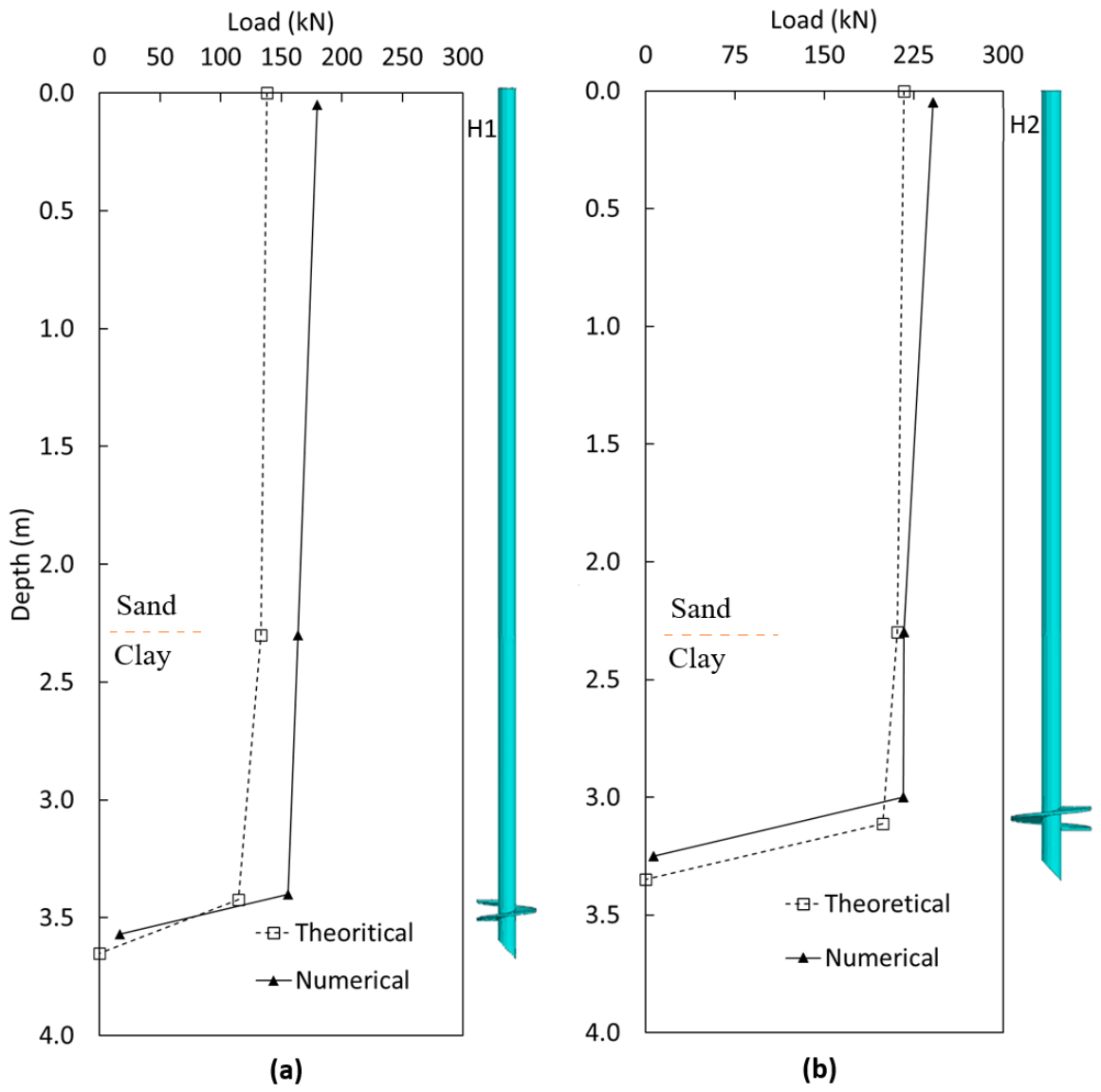
Load distribution comparison between numerical graphical capacity and theoretical capacity for helical piles: (a) H1 and (b) H2.
Figure 8.
Load distribution comparison between numerical graphical capacity and theoretical capacity for helical piles: (a) H1 and (b) H2.
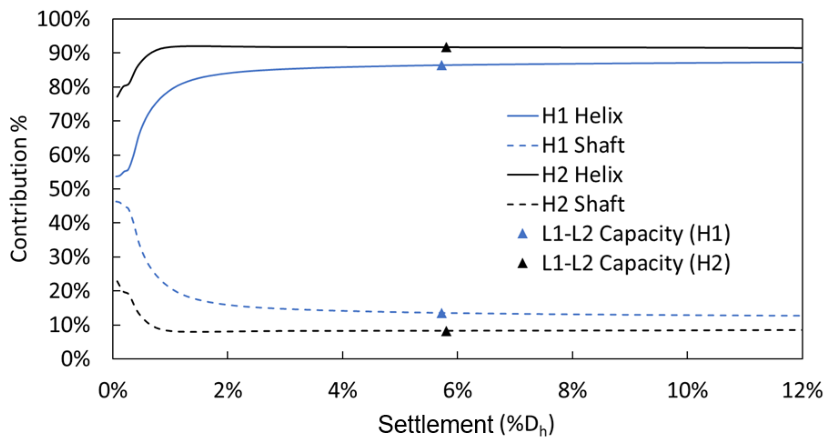
Figure 9.
Contributions of shaft and helix resistances to the axial load carrying capacity for H1 and H2 piles.
Figure 9.
Contributions of shaft and helix resistances to the axial load carrying capacity for H1 and H2 piles.
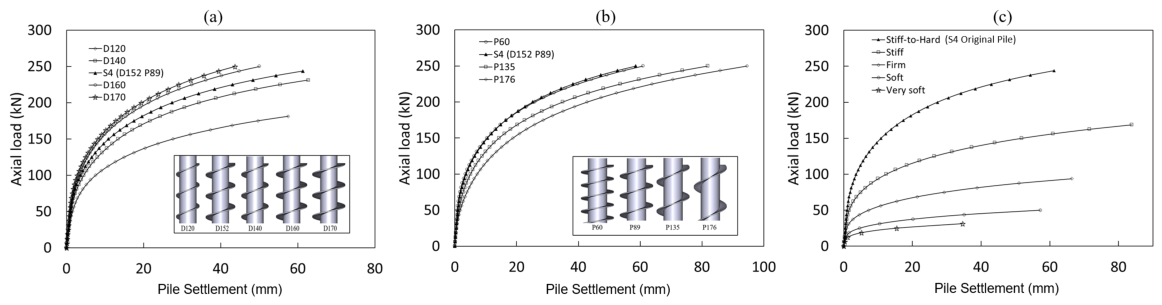
Figure 10.
Load–settlement curves results for Study 1: (a) Group 1 with variable , (b) Group 1 with variable p, and (c) Group 2.
Figure 10.
Load–settlement curves results for Study 1: (a) Group 1 with variable , (b) Group 1 with variable p, and (c) Group 2.
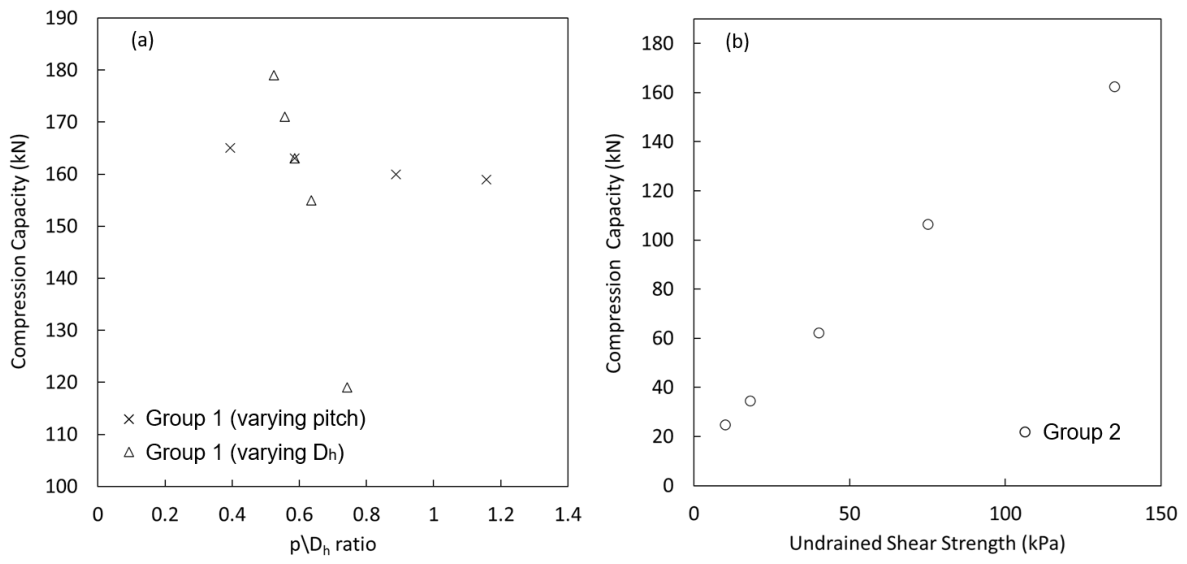
Figure 11.
Parametric analysis for pile capacity determined by the 10% method: (a) influence of ratio for variable pitch (p) and helix diameter () in Group 1; (b) influence of undrained shear strength () in Group 2.
Figure 11.
Parametric analysis for pile capacity determined by the 10% method: (a) influence of ratio for variable pitch (p) and helix diameter () in Group 1; (b) influence of undrained shear strength () in Group 2.
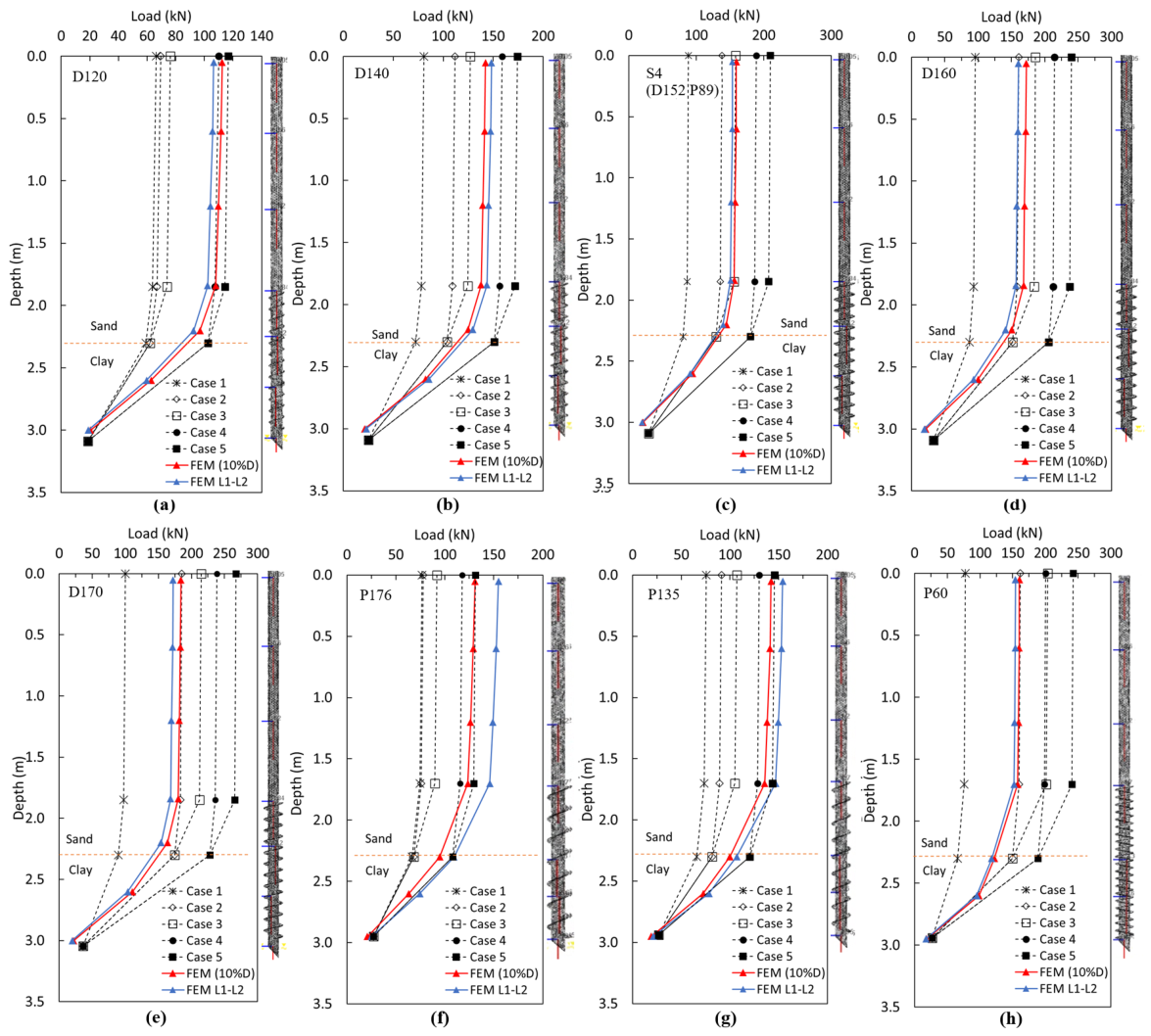
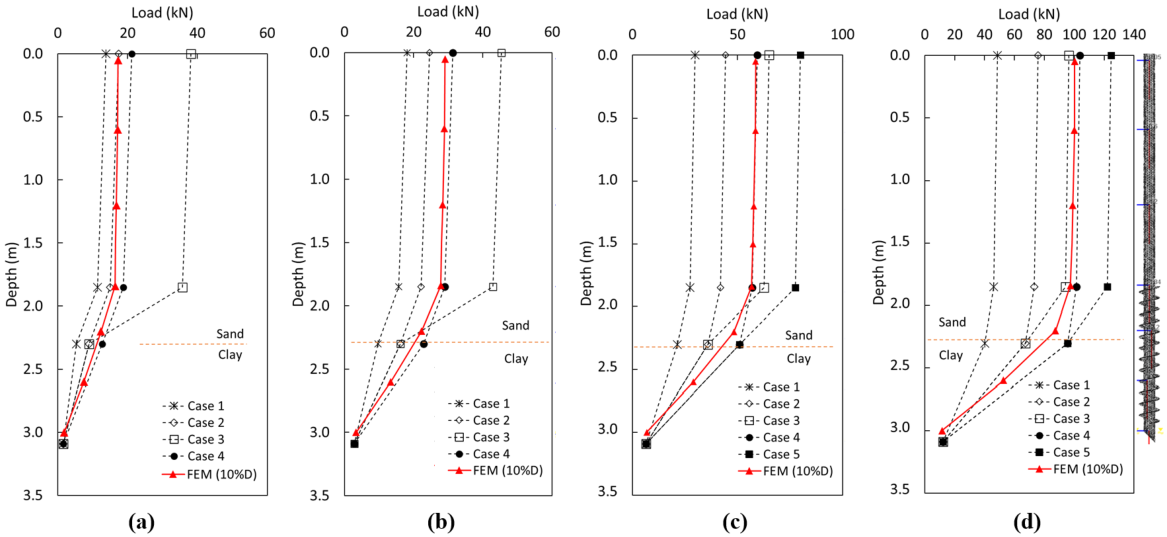
Figure 12.
Numerical and theoretical load distribution for Group 1 considering different failure-mode cases for (a) = 120 mm, (b) = 140 mm, (c) Original S4 pile with = 152 mm and p = 89 mm, (d) = 160 mm, (e) = 170 mm, (f) p = 176 mm, (g) p = 135 mm, and (h) p = 60 mm.
Figure 12.
Numerical and theoretical load distribution for Group 1 considering different failure-mode cases for (a) = 120 mm, (b) = 140 mm, (c) Original S4 pile with = 152 mm and p = 89 mm, (d) = 160 mm, (e) = 170 mm, (f) p = 176 mm, (g) p = 135 mm, and (h) p = 60 mm.
Figure 13.
Numerical and theoretical load distribution for Group 2 considering different failure-mode cases for (a) very soft clay, (b) soft clay, (c) firm clay, and (d) stiff clay.
Figure 13.
Numerical and theoretical load distribution for Group 2 considering different failure-mode cases for (a) very soft clay, (b) soft clay, (c) firm clay, and (d) stiff clay.
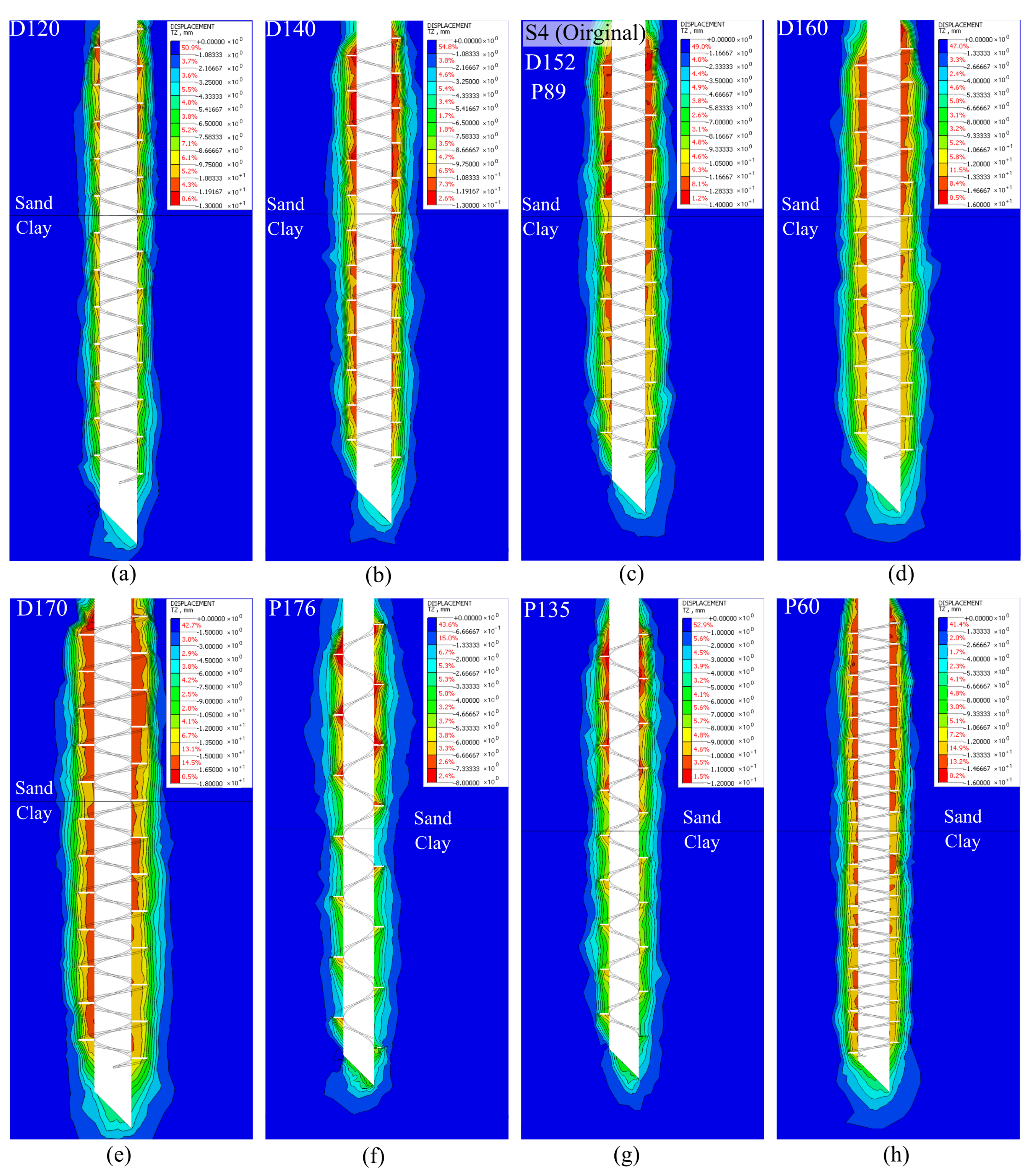
Figure 14.
Vertical displacement contours at the 10% capacity load for Group 1: (a) D120 (), (b) D140, (c) original pile S4 (D152, P89) (), (d) D160, (e) D170, (f) P176, (g) P135, and (h) P60.
Figure 14.
Vertical displacement contours at the 10% capacity load for Group 1: (a) D120 (), (b) D140, (c) original pile S4 (D152, P89) (), (d) D160, (e) D170, (f) P176, (g) P135, and (h) P60.
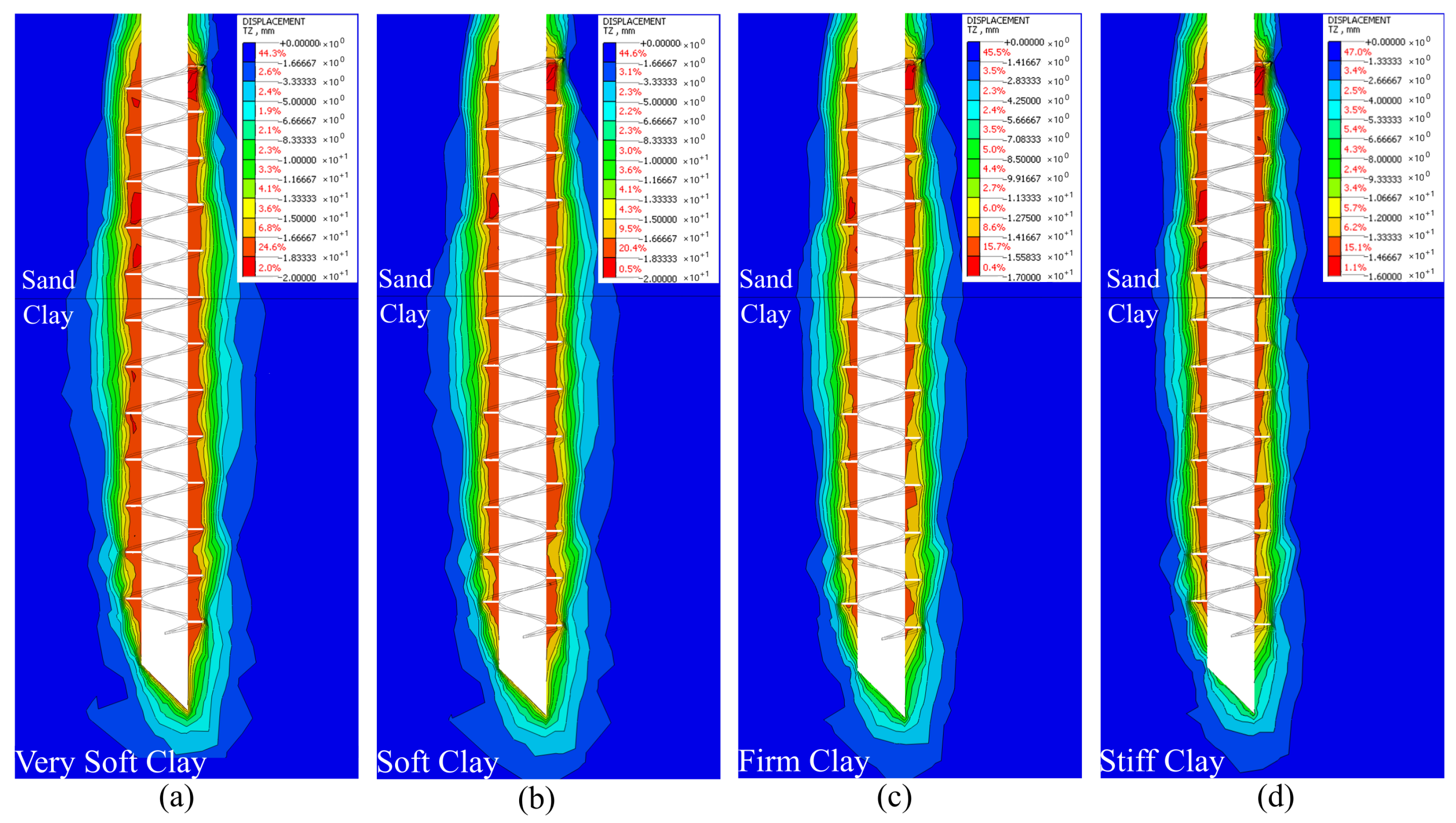
Figure 15.
Vertical displacement contours at the 10% capacity load for Group 2: (a) very soft clay, (b) soft clay, (c) firm clay, and (d) stiff clay.
Figure 15.
Vertical displacement contours at the 10% capacity load for Group 2: (a) very soft clay, (b) soft clay, (c) firm clay, and (d) stiff clay.
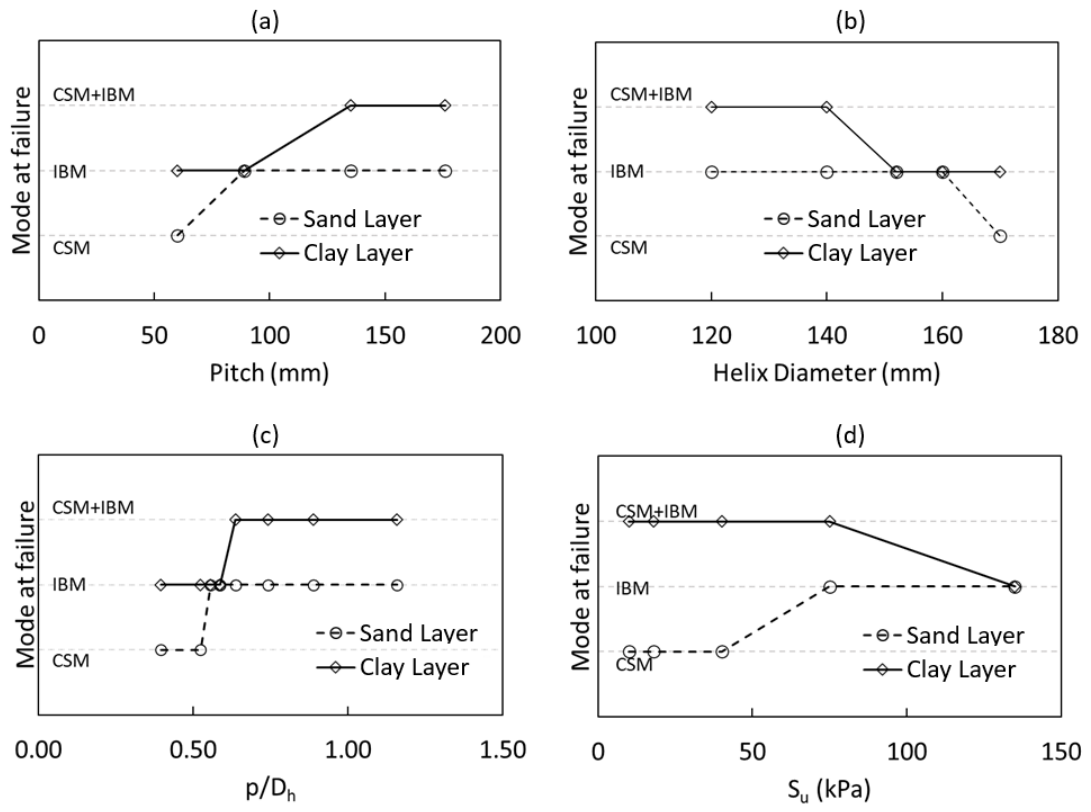
Figure 16.
Identified failure modes at the ultimate state for Study 1 Groups 1 and 2, in sand and clay layers: (a) influence of helix pitch (p); (b) influence of helix diameter (); (c) influence of the ratio; and (d) influence of undrained shear strength ().
Figure 16.
Identified failure modes at the ultimate state for Study 1 Groups 1 and 2, in sand and clay layers: (a) influence of helix pitch (p); (b) influence of helix diameter (); (c) influence of the ratio; and (d) influence of undrained shear strength ().
Figure 17.
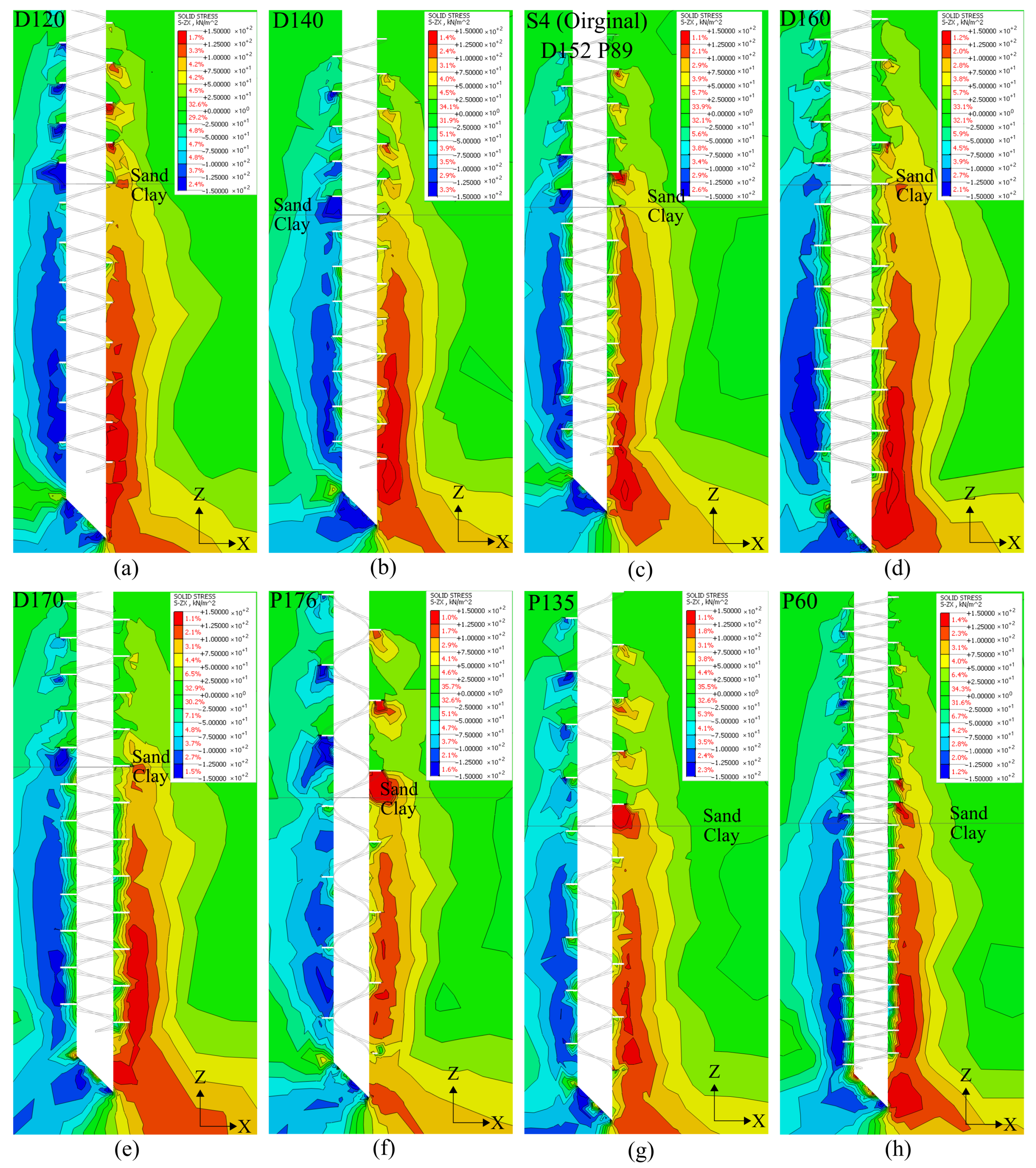
Shear stress contours at the 10% capacity load for Group 1: (a) D120, (b) D140, (c) original pile S4 (D152, P89), (d) D160, (e) D170, (f) P176, (g) P135, and (h) P60.
Figure 17.
Shear stress contours at the 10% capacity load for Group 1: (a) D120, (b) D140, (c) original pile S4 (D152, P89), (d) D160, (e) D170, (f) P176, (g) P135, and (h) P60.
Figure 18.
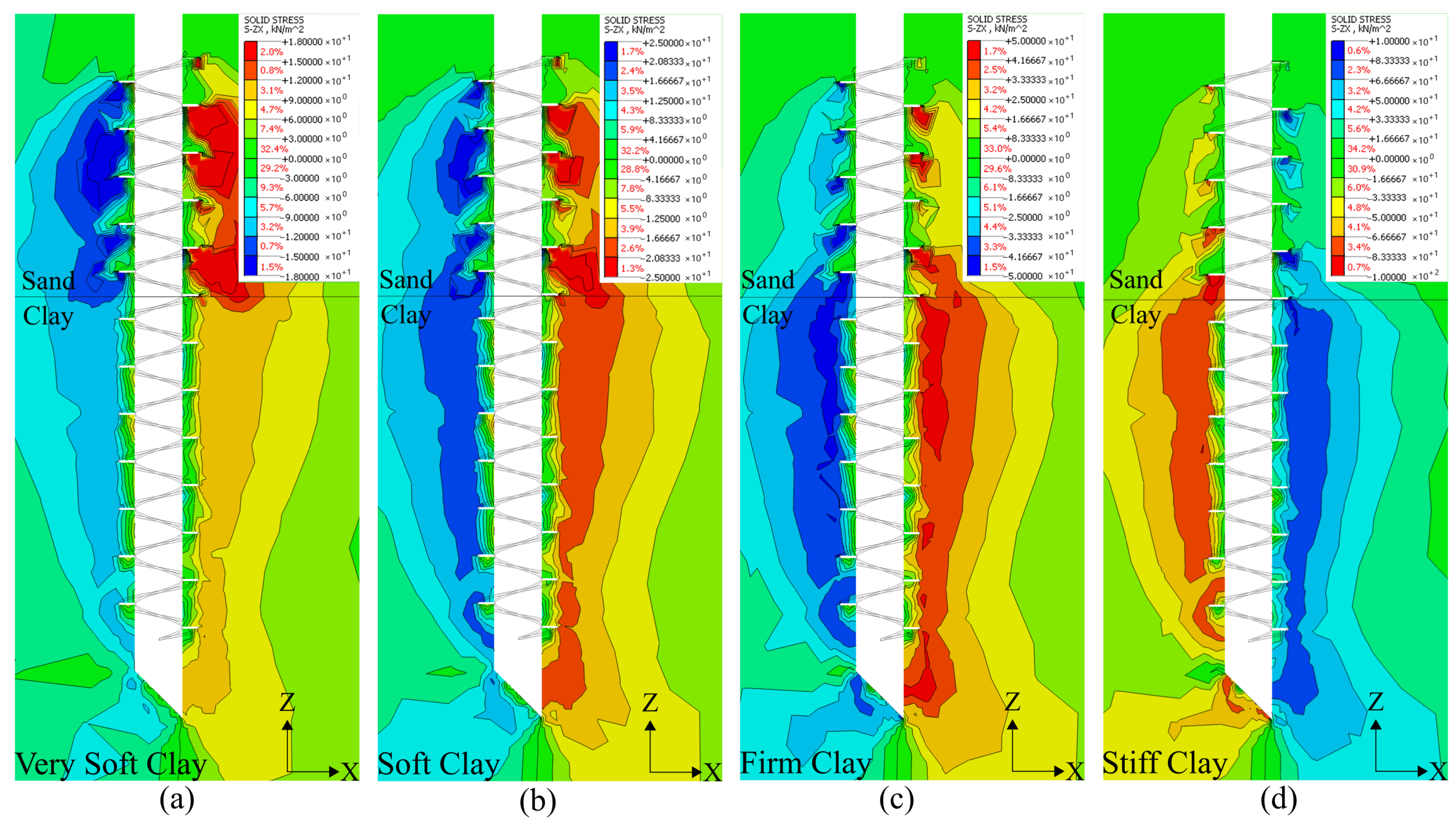
Shear stress contours at the 10% capacity load for Group 2: (a) very soft clay, (b) soft clay, (c) firm clay, and (d) stiff clay.
Figure 18.
Shear stress contours at the 10% capacity load for Group 2: (a) very soft clay, (b) soft clay, (c) firm clay, and (d) stiff clay.
Figure 19.
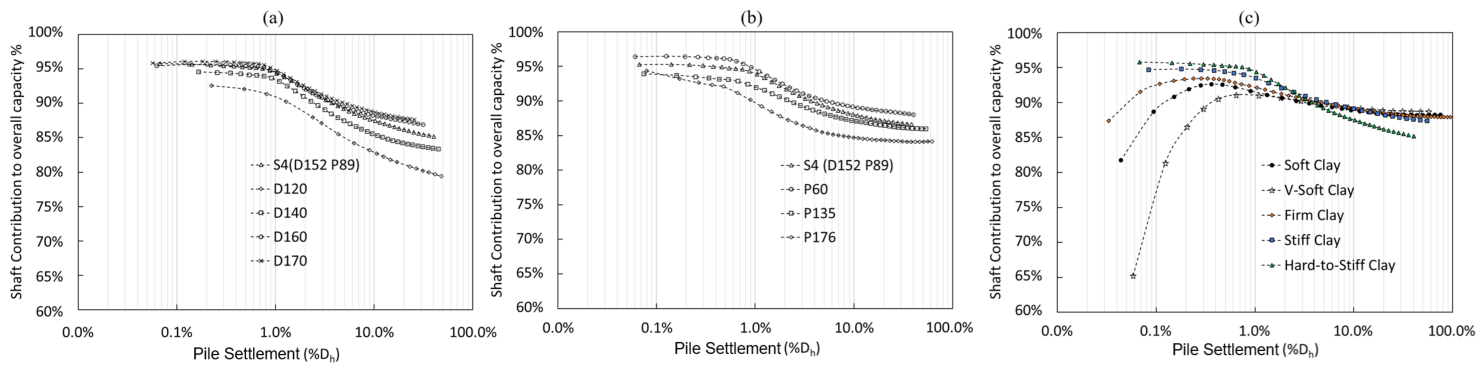
Shaft contribution to the overall 10% capacity: (a) Group 1 (varying ); (b) Group 1 (varying p); and (c) Group 2.
Figure 19.
Shaft contribution to the overall 10% capacity: (a) Group 1 (varying ); (b) Group 1 (varying p); and (c) Group 2.
Figure 20.
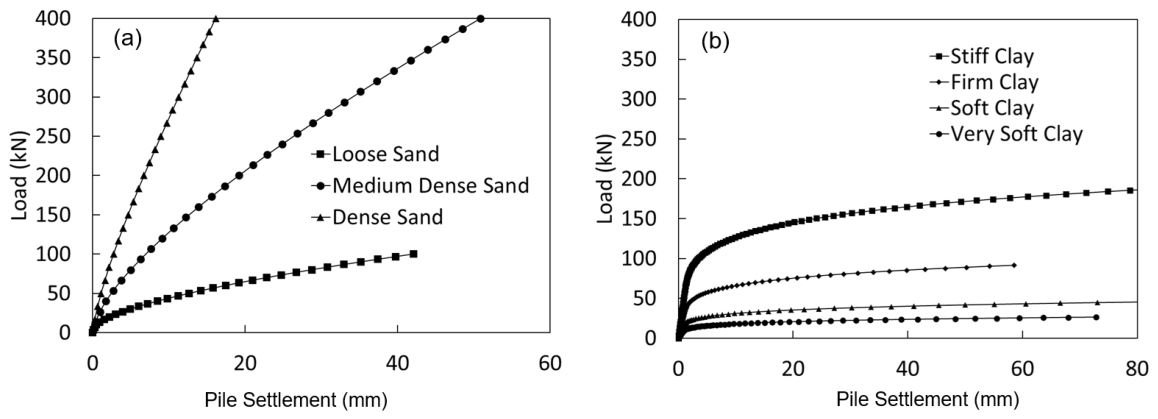
Load–settlement curve results for Study 2 parametric analysis: (a) sand and (b) clay.
Figure 20.
Load–settlement curve results for Study 2 parametric analysis: (a) sand and (b) clay.
Figure 21.
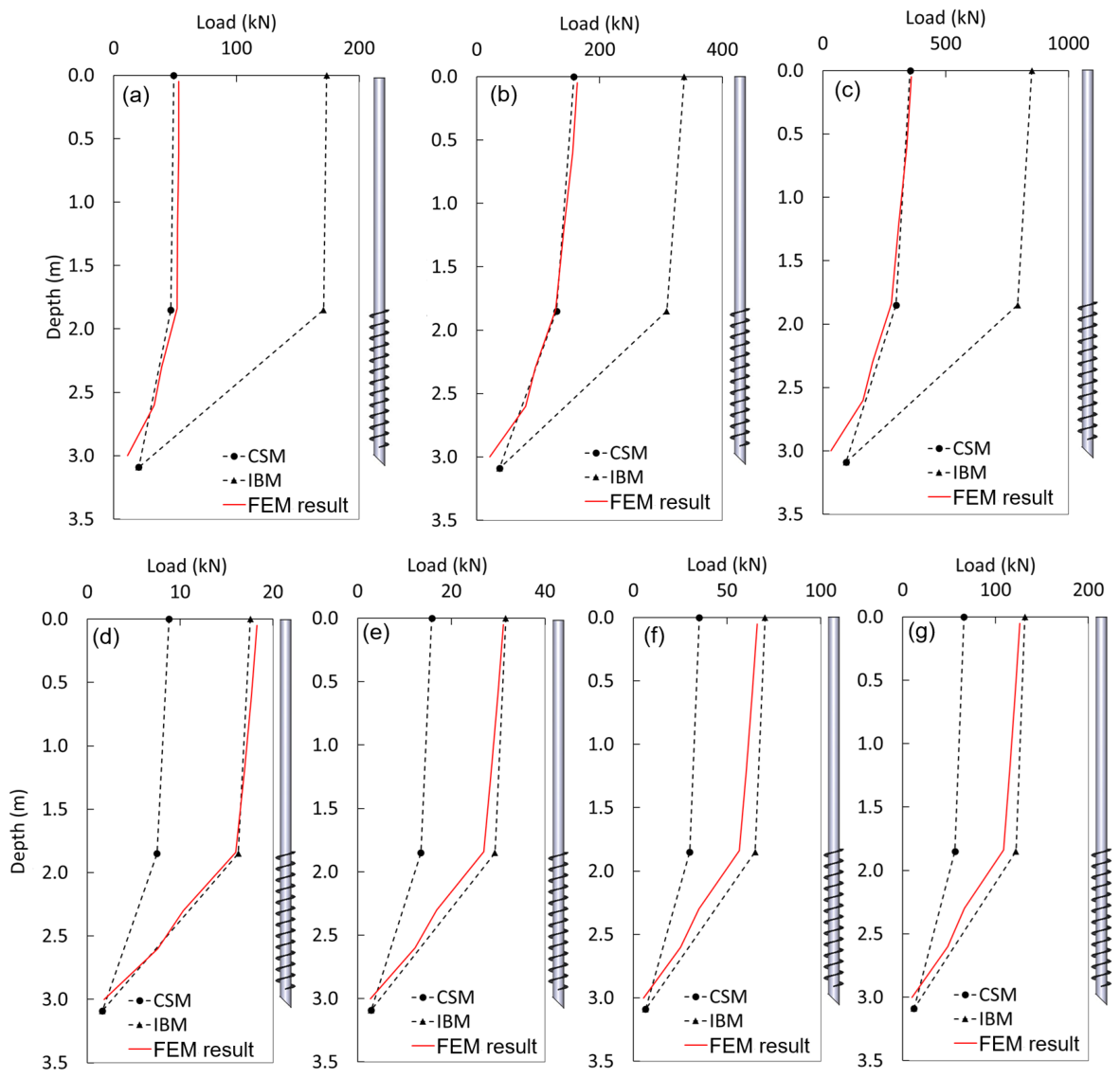
Numerical and theoretical load distribution for Study 2 considering different failure-modes for (a) loose sand, (b) medium dense sand, (c) dense sand, (d) very soft clay, (e) soft clay, (f) firm clay, and (g) stiff clay.
Figure 21.
Numerical and theoretical load distribution for Study 2 considering different failure-modes for (a) loose sand, (b) medium dense sand, (c) dense sand, (d) very soft clay, (e) soft clay, (f) firm clay, and (g) stiff clay.
Figure 22.
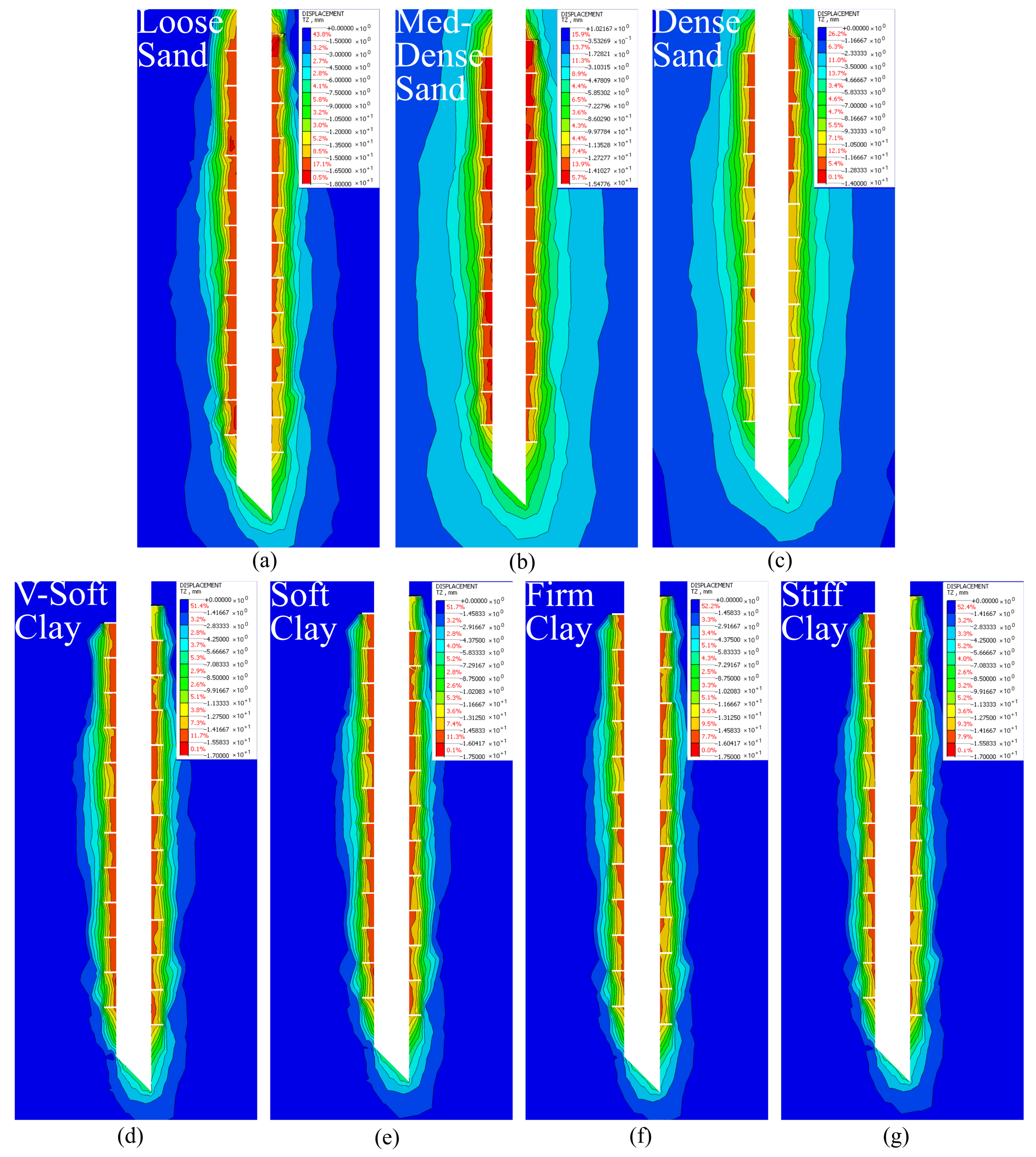
Vertical displacement contours at the 10% pile settlement in Study 2 for (a) loose sand, (b) medium dense sand, (c) dense sand, (d) very soft clay, (e) soft clay, (f) firm clay, and (g) stiff clay.
Figure 22.
Vertical displacement contours at the 10% pile settlement in Study 2 for (a) loose sand, (b) medium dense sand, (c) dense sand, (d) very soft clay, (e) soft clay, (f) firm clay, and (g) stiff clay.
Figure 23.
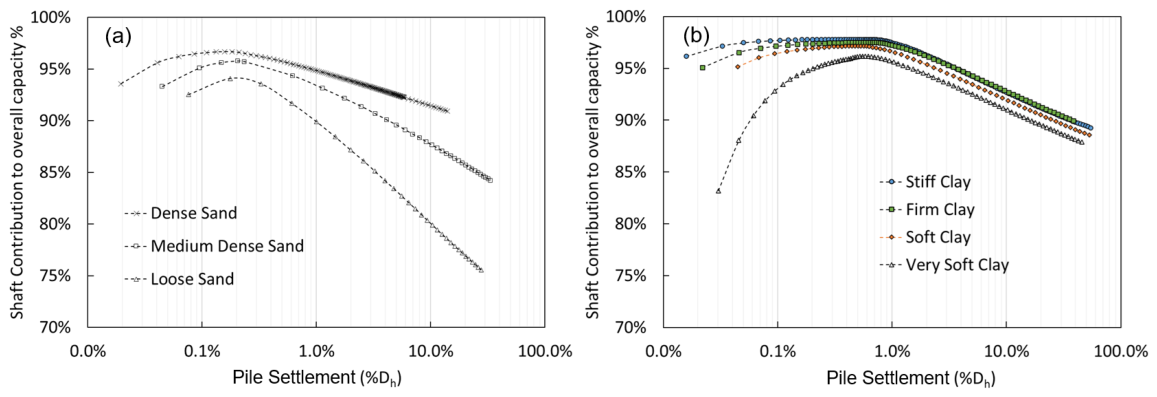
Shaft contribution to the overall 10% capacity for (a) piles in homogeneous sand layer and (b) piles in homogeneous clay layer.
Figure 23.
Shaft contribution to the overall 10% capacity for (a) piles in homogeneous sand layer and (b) piles in homogeneous clay layer.
Table 1.
Soil profile and preliminary parameters.
Table 1.
Soil profile and preliminary parameters.
| Depth (m) | Soil Type | SPT N Value | Consistency | | | |
|---|
| 0 | FILL | 8 | loose | 29 | - | 19 |
| 0.762 | Clayey Sand | 6 | loose | 28 | - | 21 |
| 1.524 | Poorly Graded Sand with Silt | 10 | loose | 29 | - | 20 |
| 2.286 | Sandy Lean Clay | 18 | Stiff | - | 88.3 | 23.5 |
| 3.048 | Sandy Lean Clay | 39 | Very stiff | - | 176.6 | 23 |
| 3.81 | Sandy Lean Clay | 88 | Hard | - | 267.5 | 22.5 |
| 4.572 | Sandy Lean Clay | 115 | Hard | - | 267.5 | 22.7 |
Table 2.
Geometric parameters and number of samples of the screw and helical piles in the field experimental program [
7].
Table 2.
Geometric parameters and number of samples of the screw and helical piles in the field experimental program [
7].
| Pile | Type | L1 (mm) | L2 (mm) | d (mm) | (mm) | Pitch (mm) | Number of Piles |
|---|
| S1 | Screw pile | 1650 | 1150 | 76 | 127 | 76 | 3 |
| S2 | Screw pile | 1900 | 1150 | 76 | 127 | 76 | 4 |
| S3 | Screw pile | 1550 | 1240 | 89 | 152 | 89 | 4 |
| S4 | Screw pile | 1850 | 1240 | 89 | 152 | 89 | 3 |
| H1 | Helical pile | 3650 | - | 76 | 254 | 76 | 3 |
| H2 | Helical pile | 3350 | - | 89 | 356 | 89 | 6 |
Table 3.
Main hardening soil model parameters used for MIDAS GTS NX input for soil materials.
Table 3.
Main hardening soil model parameters used for MIDAS GTS NX input for soil materials.
| Parameter | Sand Layer | Clay Layer |
|---|
| (kPa) | 20 | 21 |
| (MPa) | 13.8 | 50 |
| (MPa) | 13.8 | 50 |
| (MPa) | 41.4 | 150 |
| m | 0.63 | 0.8 |
| 25 | - |
| (kPa) | - | 88 to 267 |
| 0.3 | 0.495 |
| 0.97 | 0.8 |
Table 4.
Interface reduction factors for different pile types installed at different depths.
Table 4.
Interface reduction factors for different pile types installed at different depths.
| Pile Type | Test | Installation Depth (m) | for Sand | for Clay |
|---|
| S1 | Compression | 2.8 | 0.6 | 0.3 |
| S2 | Compression | 3 | 0.6 | 0.5 |
| S3 | Compression | 2.8 | 0.5 | 0.3 |
| S4 | Tension | 3 | 0.6 | 0.5 |
| S4 | Compression | 3 | 0.6 | 0.5 |
| H1 | Compression | 3.6 | 0.6 | 0.5 |
| H2 | Compression | 3.3 | 0.4 to 0.5 | 0.2 to 0.25 |
Table 5.
Variable parameters considered in Group 1 parametric analysis.
Table 5.
Variable parameters considered in Group 1 parametric analysis.
| Case | Shaft Diameter (mm) | Helix Diameter (mm) | Helix Pitch (mm) |
|---|
| Original pile S4 (D152 P89) * | 89 | 152 | 89 |
| D120 | 89 | 120 | 89 |
| D140 | 89 | 140 | 89 |
| D160 | 89 | 160 | 89 |
| D170 | 89 | 170 | 89 |
| P60 | 89 | 152 | 60 |
| P135 | 89 | 152 | 135 |
| P176 | 89 | 152 | 176 |
Table 6.
Clay parameters considered Group 2.
Table 6.
Clay parameters considered Group 2.
| Soil Type | | (MPa) | (MPa) | (kPa) |
|---|
| Very soft Clay | 15 | 10.5 | 3.5 | 10 |
| Soft | 16 | 16 | 5.3 | 18 |
| Firm | 18 | 26.7 | 8.9 | 40 |
| Stiff | 20 | 59 | 19.6 | 75 |
| Very Stiff to Hard * | 21 | 150 | 50 | 88–267 |
Table 7.
Soil parameters for Study 2.
Table 7.
Soil parameters for Study 2.
| Soil Type | Relative Density % | MPa | MPa | | | (kPa) |
|---|
| Loose Sand | 15 | 41.4 | 13.8 | 0.0 | 25 | 0 |
| Medium Dense Sand | 50 | 72 | 24 | 4.0 | 35 | 0 |
| Dense Sand | 75 | 158.4 | 52.8 | 7 | 42 | 0 |
| Very Soft Clay | - | 10.5 | 3.5 | 0 | 0 | 10 |
| Soft Clay | - | 16 | 5.3 | 0 | 0 | 18 |
| Firm Clay | - | 26.7 | 8.9 | 0 | 0 | 40 |
| Stiff Clay | - | 59 | 19.6 | 0 | 0 | 75 |
Table 8.
Axial capacity of helical piles obtained from numerical, theoretical and field (graphical and 10%) results.
Table 8.
Axial capacity of helical piles obtained from numerical, theoretical and field (graphical and 10%) results.
| Pile | H1 | H2 |
|---|
| Numerical (graphical) (kN) | 189 | 254 |
| Numerical (10%) (kN) | 238 | 320 |
| Theoretical (IBM) (kN) | 138 | 217 |
| Field (graphical) | 188 | 230 |
| Field (10%) | 249 | 315 |
Table 9.
Different failure-mode cases for theoretical capacity calculation of screw piles.
Table 9.
Different failure-mode cases for theoretical capacity calculation of screw piles.
| Soil Layer | Case 1
| Case 2 | Case 3 | Case 4 | Case 5 |
|---|
| Sand | CSM | CSM | IBM | CSM | IBM |
| Clay | CSM | IBM | IBM | IBM + CSM | IBM + CSM |
Table 10.
Pile capacity obtained from Study 1 results using the graphical and 10% methods.
Table 10.
Pile capacity obtained from Study 1 results using the graphical and 10% methods.
| Case | (kN) | QL1–L2 (kN) | at QL1–L2 (mm) |
|---|
| Original pile S4 (D152 P89) | 167 | 163 | 9% |
| D120 | 116 | 119 | 11% |
| D140 | 152 | 155 | 11% |
| D160 | 183 | 171 | 8% |
| D170 | 192 | 179 | 8% |
| P60 | 138 | 159 | 14% |
| P135 | 153 | 160 | 11% |
| P176 | 170 | 165 | 9% |
| Very Soft Clay | 25 | 19 | 4% |
| Soft Clay | 35 | 32 | 8% |
| Firm Clay | 62 | 60 | 9% |
| Stiff Clay | 106 | 107 | 10% |
Table 11.
Back-calculated values of and from the shaft resistance results of Study 1 parametric analysis.
Table 11.
Back-calculated values of and from the shaft resistance results of Study 1 parametric analysis.
| Layer | Sand | Clay |
|---|
| Depth
| 0.9 m
| 2.0 m
| 2.6 m
|
|---|
| Factor
| | | |
|---|
| S4 (D152 P89) | 0.33 | 1.69 | 1.88 |
| D120 | 0.48 | 1.57 | 1.16 |
| D140 | 0.46 | 1.89 | 1.57 |
| D160 | 0.43 | 2.55 | 1.97 |
| D170 | 0.42 | 2.38 | 2.16 |
| P60 | 0.29 | 3.12 | 2.01 |
| P135 | 0.82 | 3.11 | 1.57 |
| P176 | 0.90 | 2.51 | 1.43 |
| V-soft clay | 0.12 | 0.86 | 2.94 |
| Soft clay | 0.13 | 1.10 | 2.59 |
| Firm clay | 0.15 | 1.76 | 2.43 |
| Stiff clay | 0.23 | 1.35 | 2.65 |
Table 12.
Comparison between the 10% numerical capacity and theoretical (IBM and CSM) capacities for Study 2.
Table 12.
Comparison between the 10% numerical capacity and theoretical (IBM and CSM) capacities for Study 2.
| Soil Type | 10%Dh Capacity (kN) | Theoretical IBM (kN) | Theoretical CSM (kN) |
|---|
| Loose Sand | 55 | 173 | 49 |
| Medium Dense Sand | 170 | 338 | 158 |
| Dense Sand | 381 | 851 | 355 |
| Very Soft Clay | 20 | 18 | 9 |
| Soft Clay | 34 | 32 | 16 |
| Firm Clay | 71 | 70 | 35 |
| Stiff Clay | 138 | 132 | 66 |
Table 13.
Back-calculated values of and from the results of Study 2 parametric analysis.
Table 13.
Back-calculated values of and from the results of Study 2 parametric analysis.
| Depth: | 0.95 m | 2.4 m |
|---|
| Sand Soils | | |
| Dense | 8.6 | 9.2 |
| Medium Dense | 2.3 | 4.0 |
| Loose | 0.1 | 1.5 |
| Clay Soils | | |
| Stiff | 0.5 | 2.4 |
| Firm | 0.5 | 2.3 |
| Soft | 0.5 | 2.4 |
| Very Soft | 0.5 | 2.6 |