
Review

Enzyme-Induced Carbonate Precipitation (EICP) for Soil Stabilization: A Review of Mechanisms, Applications, and Future Challenges
1
Shandong Hi-Speed Construction Management Group Co., Ltd., Jinan 250098, China
2
Shandong Hi-Speed Qidong Highway Co., Ltd., Liaocheng 252299, China
3
School of Qilu Transportation, Shandong University, Jinan 250002, China
*
Author to whom correspondence should be addressed.
Geotechnics 2026, 6(2), 53; https://doi.org/10.3390/geotechnics6020053 (registering DOI)
Submission received: 23 March 2026 / Revised: 22 May 2026 / Accepted: 25 May 2026 / Published: 29 May 2026

Abstract

Enzyme-Induced Carbonate Precipitation (EICP) represents a sustainable advancement in geotechnical engineering for stabilizing fine-grained soils (e.g., silt). Utilizing plant-derived urease (~12 nm) to catalyze urea hydrolysis, this technique generates calcium carbonate (CaCO3) for soil reinforcement. Unlike Microbially Induced Carbonate Precipitation (MICP), EICP overcomes microbial size constraints (0.5–3 µm) by penetrating soil micropores, enabling uniform cementation. Its innovative single-phase low-pH method achieves >98% calcium conversion efficiency, yielding 6.41 MPa unconfined compressive strength (UCS) in sand—a 92.97% improvement over MICP. EICP demonstrates versatility: enhancing soil strength (up to 650% for silt), erosion resistance (wind erosion modulus increased ~20-fold), anti-seepage performance (permeability reduced from 10−6 to <10−9 cm/s), and heavy metal immobilization (>99%). However, challenges include unstable crystal morphologies (e.g., excessive vaterite), urease stability/cost constraints, and environmental concerns related to NH3 emissions from urea hydrolysis. The manuscript acknowledges these emissions’ impacts and introduces mitigation strategies: ammonia capture technologies, optimized dosing protocols, and exploration of alternative N-sources. Long-term durability data under complex field conditions remain insufficient. Ongoing research addresses these gaps through nucleating agents (dried skim milk, biochar), enzyme immobilization, process optimization, and byproduct treatment. As a low-carbon technology with targeted mitigation measures, EICP advances environmentally conscious soil stabilization practices. This study presents a comparative narrative analysis of EICP’s performance and challenges, integrating laboratory findings and field applications.

1. Introduction

The geotechnical engineering sector is under intensifying pressure to reconcile the ever-growing demand for infrastructure with stringent global carbon neutrality targets. As the primary binder in ground improvement, Ordinary Portland Cement (OPC) accounts for nearly 8% of global anthropogenic CO2 emissions (Intergovernmental Panel on Climate Change (IPCC) Sixth Assessment Report (AR6), 2022), a figure that grows more alarming as climate-related geohazards—from landslides to soil liquefaction—increase in frequency. This escalating environmental burden exposes a critical vulnerability in conventional stabilization: it is carbon-intensive, often non-renewable, and struggles to provide sustainable solutions for the vast expanses of low-carbon soft soils worldwide. Consequently, the industry faces an urgent imperative to pivot away from carbon-heavy binders and embrace bio-mediated alternatives. Among these, bio-cementation technologies have garnered significant attention, promising to enhance soil mechanical properties while drastically slashing the carbon footprint of construction [1,2].
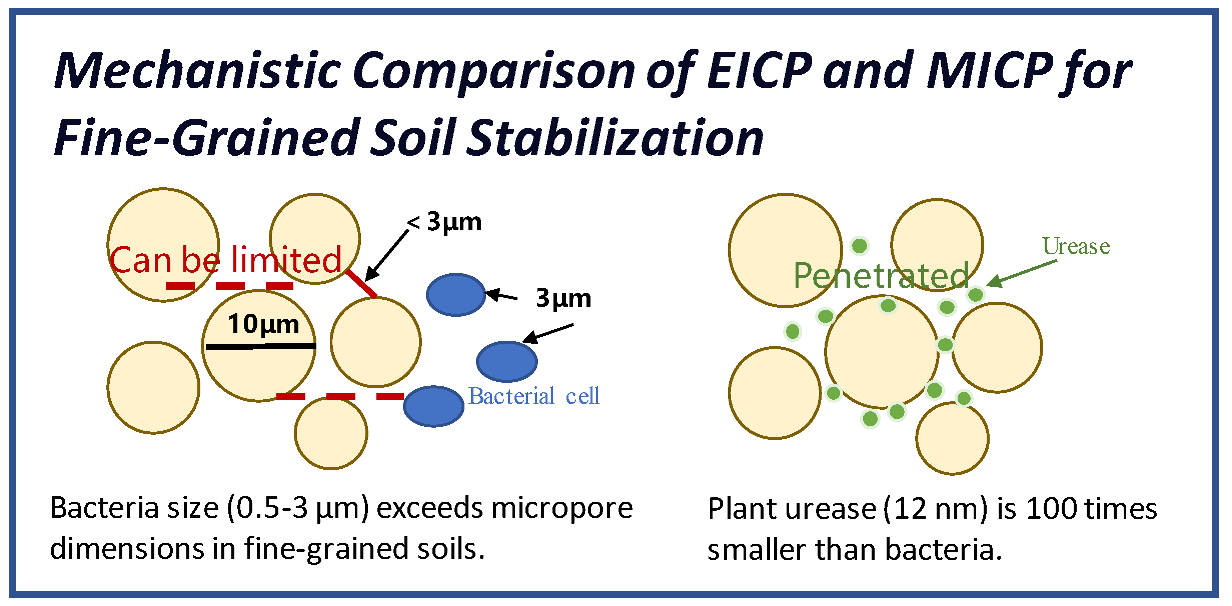
Historically, Microbially Induced Carbonate Precipitation (MICP) has dominated the research landscape. MICP utilizes ureolytic bacteria, such as Sporosarcina pasteurii, to hydrolyze urea and generate carbonate ions that precipitate with calcium to form a cementing agent. While effective in coarse-grained soils, MICP faces formidable barriers to widespread field application. The fundamental limitation lies in the biology itself: bacterial cells (0.5–3 μm) are physically too large to navigate the micropores of fine-grained soils (silts and clays) [3]. As mechanistically illustrated in Figure 1, this size exclusion effect leads to premature pore clogging at the injection point, resulting in heterogeneous “surface crusting” rather than deep, volumetric reinforcement. Furthermore, MICP introduces exogenous living organisms into the subsurface, raising serious biosafety concerns regarding bio-invasion and ecological disruption. The stringent requirement for sterile laboratory conditions and complex nutrient delivery systems to maintain cell viability further complicates its transition from the lab bench to the construction site.
To circumvent these biotic limitations, Enzyme-Induced Carbonate Precipitation (EICP) has emerged as a disruptive and highly promising alternative. By replacing living microbes with free, plant-derived urease enzymes (~12 nm), EICP eliminates biosafety risks and, more importantly, overcomes the size exclusion effect. The nanoscale dimensions of the enzyme allow it to penetrate deep into the microporous structure of fine-grained soils, enabling uniform cementation that is impossible with MICP. However, despite the growing volume of research on EICP, the literature is saturated with narrative reviews that merely catalog laboratory successes. A critical gap remains: there is a distinct lack of quantitative, data-driven syntheses that systematically compare EICP against its alternatives—such as Soybean urease-Induced Carbonate Precipitation (SICP) and Calcium Phosphate Compounds (CPC)—across diverse soil matrices and complex engineering applications [4,5].
The primary novelty and contribution of this review lie in its rigorous, meta-analytical approach. Unlike previous works that provide qualitative descriptions, this paper integrates findings from over 100 recent studies to provide a quantitative assessment of performance trade-offs. We move beyond simple strength measurements to dissect the mechanics of the single-phase low-pH injection method. This innovative process, a focal point of this review, adjusts the system pH to 6.5 to inhibit premature reaction, allowing the grout to permeate the soil matrix before a natural pH rebound triggers precipitation. This method achieves a calcium conversion efficiency exceeding 98% and delivers Unconfined Compressive Strength (UCS) of 6.41 MPa in sands—a 92.97% improvement over conventional methods [5].
Furthermore, this review addresses the critical, often-overlooked aspects of economic feasibility and environmental impact. We provide a detailed quantitative analysis of the trade-offs between expensive, purified commercial urease and low-cost, crude plant extracts (e.g., soybean, jack bean). By integrating comprehensive tables, we compare the cost–benefit ratios, revealing that crude extracts can reduce enzyme procurement costs by over 85% without sacrificing performance, provided that proper nucleation agents (e.g., skim milk, biochar) are utilized. Simultaneously, we critically evaluate the environmental implications of ammonium chloride (NH4Cl) by-product generation and propose mitigation strategies suitable for large-scale field deployment [6].
A cornerstone of this review is the graphical elucidation of micro-scale mechanisms. We utilize schematic diagrams to visualize the challenges of nucleation site deficiency inherent in EICP (the lack of bacterial cell surfaces as templates) and demonstrate how innovative strategies control crystal polymorphism. The ability to shift precipitation from metastable, low-strength vaterite to stable, high-strength calcite or aragonite is quantitatively linked to macroscopic engineering performance. By correlating soil properties—such as gradation, plasticity index, and pore structure—with treatment outcomes, this review provides a holistic view of the technology’s viability [7,8].
Building upon this context, the remainder of this review constructs a systematic roadmap for advancing EICP from laboratory curiosity to field-scale reality. Section 2 delves into the reaction and solidification mechanisms, specifically examining the polymorphic transition from metastable vaterite to stable calcite and the pivotal role of nucleation agents in controlling crystal morphology. Section 3 evaluates the sourcing, extraction optimization, and immobilization techniques of urease, providing a quantitative trade-off between commercial purity and the economic viability of plant-derived crude extracts. Section 4 analyzes the key influencing factors—including temperature, pH, and soil gradation—offering meta-analytical data on injectability limits and treatment uniformity across diverse soil matrices. Section 5 reviews the breadth of engineering applications, spanning wind erosion control, slope stabilization, heavy metal remediation, and the conservation of earthen heritage. Section 6 critically evaluates the persistent challenges, such as homogeneity control and long-term durability under cyclic loading, that currently hinder widespread adoption. Finally, Section 7 identifies critical research gaps and proposes actionable directions for standardization and field-scale implementation. Through this evidence-based approach, this review aims to solidify EICP’s position as a cornerstone of eco-friendly geotechnical engineering.

2. Reaction Mechanism and Solidification Mechanism of EICP

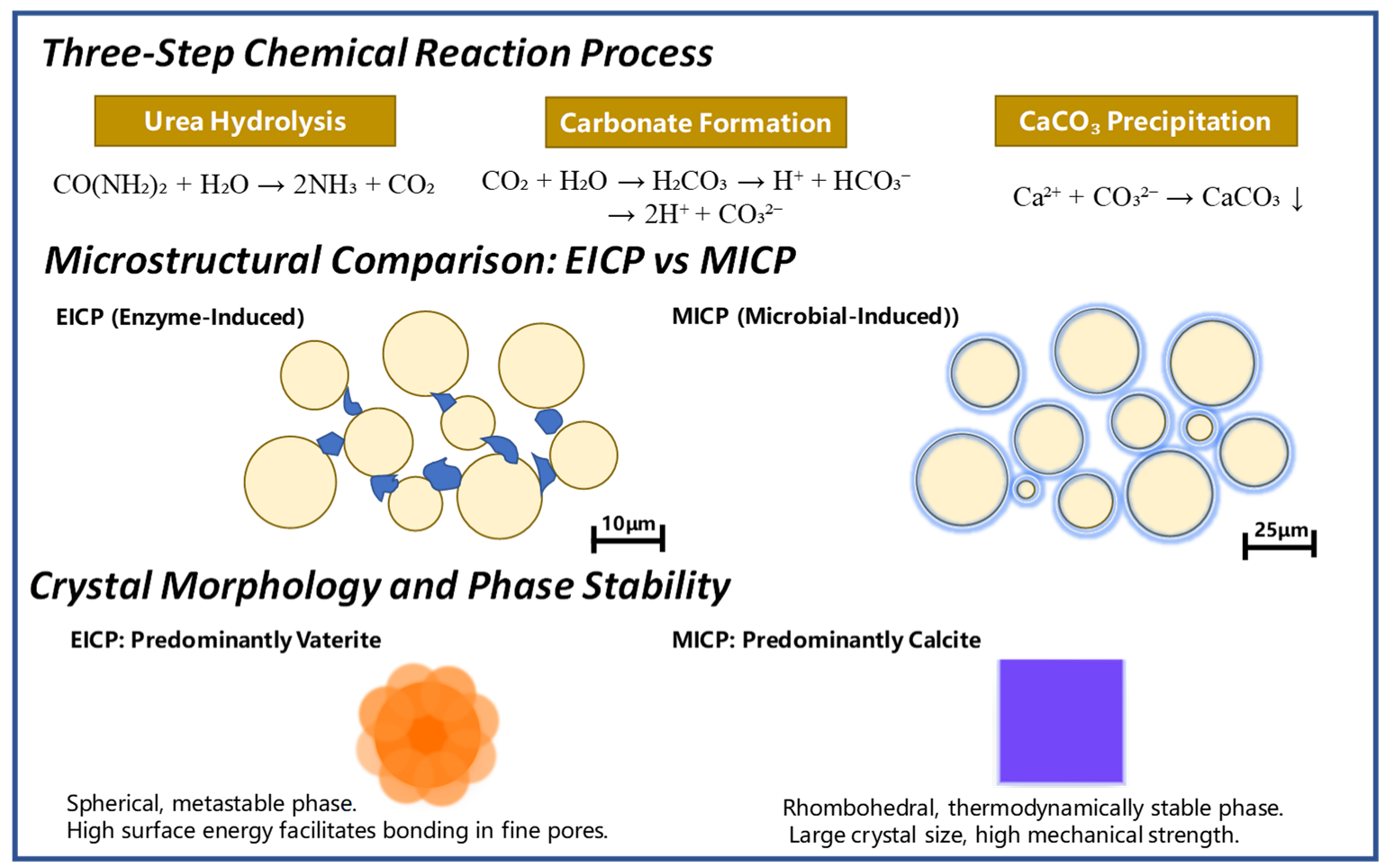
Enzyme-Induced Carbonate Precipitation (EICP) serves as a core method for green reinforcement in geotechnical engineering. Its fundamental mechanism lies in achieving cementation and strengthening of soil particles through a mineral precipitation process driven by bio-catalysis. As illustrated in Figure 2, the essential chemical reactions of this technique can be summarized as a continuous three-step process: First, urease (molecular size ~12 nm) specifically catalyzes the hydrolysis of urea to generate ammonia and carbon dioxide (CO(NH2)2 + H2O → 2NH3 + CO2)reacts with water to form carbonic acid, which subsequently dissociates into carbonate ions (CO2 + H2O → H2CO3 → H+ + HCO3 → 2H+ + CO32−); Finally, carbonate ions combine with calcium ions (Ca2+) to form calcium carbonate precipitates (Ca2+ + CO32− → CaCO3↓). This series of reactions proceeds efficiently in a weakly alkaline environment (pH 8–9), where the generation of ammonium ions (NH4+) acts as the key driving force for pH elevation, creating necessary conditions for the stable precipitation of calcium carbonate [7,8].
The micro-solidification mechanism of EICP is primarily realized through three synergistic actions, as depicted in the microstructural comparison in Figure 2: Bridging action, where carbonate crystals grow between adjacent soil particles to form “bridges”; Bonding action, promoting the concentration of crystals at particle contact points to form high-density cemented interfaces—this constitutes a core advantage of EICP over MICP, with studies indicating it can provide approximately twice the strength increase at the same carbonate content [9]; and Coating & Filling action, where crystals cover particle surfaces and fill pores, significantly reducing soil permeability and enhancing resistance to erosion.
It is noteworthy that fundamental differences exist in the crystal deposition behavior between EICP and MICP: In MICP, bacteria serve as natural nucleation sites, leading to uniform crystal distribution on particle surfaces and contact points, with some crystals only forming “coatings” that contribute limitedly to strength [10]. Conversely, EICP lacks such nucleation sites, and its crystals tend to deposit preferentially at stress concentration points (particle contact zones), forming efficient “bridging-bonding” networks [3]. Differences in crystal morphology further influence technical performance. Early studies [11] indicated that EICP mainly produces metastable vaterite, whereas MICP is dominated by stable calcite. Calcium carbonate exhibits three primary polymorphs relevant to EICP technology, each possessing distinct structural and mechanical properties. Calcite is the most thermodynamically stable form, exhibiting a rhombohedral structure with high hardness and compressive strength. Vaterite is metastable, typically forming spherical or aggregated clusters; while it precipitates quickly, its porous nature results in lower load-bearing capacity. Aragonite features an orthorhombic, needle-like (acicular) structure, providing high tensile resistance and toughness. While standard EICP naturally favors vaterite due to rapid reaction kinetics, engineering applications requiring high durability necessitate a shift toward calcite or aragonite. However, recent research [12] has demonstrated that by adding nucleating agents (such as calcite seeds, dried skim milk), EICP can effectively regulate crystal morphology and promote the formation of stable calcite. This morphological regulation is crucial for engineering performance—calcite possesses higher crystal strength and durability, significantly enhancing the long-term stability of solidified soil [13].
Systematic understanding of the EICP theoretical framework has evolved deeply from basic mechanisms to engineering applications: early research focused on parsing reaction pathways; mid-stage exploration progressively deepened into multi-parameter influence mechanisms (including enzyme concentration, calcium source, pH, and temperature); and current research is dedicated to constructing micro-macro performance correlation models and long-term durability prediction systems [6]. Notably, the innovative application of the “single-phase low-pH injection method” has become the core breakthrough technology—by precisely adjusting the system pH to 6.5 to inhibit the reaction progress initially, followed by a natural pH rebound after injection to trigger carbonate precipitation, the calcium conversion efficiency (η means the molar ratio of carbonate precipitated to the theoretical maximum based on reactant stoichiometry) was significantly improved to over 98%. Simultaneously, optimization of carbonate distribution uniformity was achieved [14]. This process effectively overcame the efficiency bottleneck caused by enzyme loss in traditional EICP and, through precise control of precipitation locations, achieved a qualitative leap in soil strength improvement efficiency: under identical treatment conditions, the UCS of EICP-solidified sand reached 6.41 MPa, representing a 92.97% increase over MICP [3], providing a highly efficient and controllable technical pathway for fine-grained soil reinforcement engineering.
As quantitatively synthesized in Table 1, limiting the scope to only EICP and MICP overlooks the rapidly evolving landscape of bio-inspired geotechnics. A true review must analyze the trade-offs among various precipitation pathways. For instance, while MICP has traditionally dominated the field due to its robust performance in coarse-grained soils (achieving UCS up to 4.0 MPa) [3], its reliance on living microbial cultures poses challenges in harsh subsurface environments and raises concerns regarding ammonium byproducts.
Conversely, EICP eliminates viability issues but faces economic barriers due to the high cost of purified urease [5]. This has led to the emergence of cost-effective variants like SICP (Soybean urease-Induced Carbonate Precipitation), which utilizes crude plant extracts to achieve significant erosion control (up to 95% reduction) at a fraction of the cost. Furthermore, entirely different chemistries are being explored, such as Calcium Phosphate Compounds (CPC), which bypass urea hydrolysis altogether to offer a lower-carbon alternative to traditional cement. By quantitatively comparing these methods, it becomes evident that the future of ground improvement lies not in a single ‘silver bullet,’ but in the strategic selection of these techniques based on specific soil matrices, environmental constraints, and economic realities.

3. Source and Preparation of Urease

3.1. Types and Sources of Urease

Plant urease serves as the mainstream catalyst for EICP technology, primarily extracted from plant seeds such as jack bean, soybean, and watermelon seeds. The extraction potential of urease from different legume sources is summarized in Table 2. Research indicates that plant-derived urease has a molecular weight of approximately 483,000 Da and possesses high specificity for catalyzing urea hydrolysis. Its active center contains a binuclear nickel structure, with an optimal pH range of 7.0–7.4 [3]. A significant advantage of plant urease lies in its small molecular size (~12 nm), far smaller than bacteria (0.5–3 µm), enabling it to penetrate smoothly into the micro-pores of fine-grained soils, effectively resolving the clogging issues encountered in MICP applications in fine-grained soils (silts, clays) [15]. Furthermore, plant urease requires no living microorganisms, eliminating biosafety risks, and can still work effectively under anaerobic conditions, giving it distinct advantages in deep foundation reinforcement.
Table 2. Extraction potential of urease from different legume sources.
Urease SourceTypical Urease Activity (U/g Dry Weight)Extraction Yield (mg/g Dry Weight)Urease Extraction Potential
Soybean150–2508–12A common source of urease due to its widespread use as a food material [16].
Jack bean200–30010–15An uncommon bean, and literature studies have shown it contains abundant urease [17]
Milk Vetch180–2809–14Contains abundant proteins and is likely a good source of urease [18].
Red Kidney Bean220–32011–16Rich in proteins and likely contains urease with relatively high activity [19].
Adzuki Bean160–2407–11A traditionally common food material and may be an effective source of urease [20].
Mung Bean140–2206–10Widely cultivated in China, and its urease content is likely to be high [21].
Black Soybean170–2608–13With a distinctive black appearance and large color difference from yellow beans, it may possess unique urease types [22].
Spotted Bean190–2909–14With unique appearance, its urease is worth studying [23].
Red Adzuki Bean160–2407–11Similar to red beans, it has high protein content as a common food material and may contain urease with properties compatible with EICP [24].
White Hyacinth Bean130–2106–9With abundant proteins, it may contain urease required for EICP processing [25].
Panda Bean180–2708–12With unique appearance and high nutritional value, it may also contain urease [26].
White Kidney Bean210–31010–15Rich in proteins and may contain active urease [27].
However, plant urease also presents obvious limitations. Commercially purchased high-activity plant urease is expensive, costing approximately $300–500 USD/kg, which is significantly higher than bacterial culture. Crude urease extracted from plant seeds exhibits large fluctuations in activity, significant susceptibility to temperature and pH, and relatively poor stability. Lee et al. [28] extracted crude enzyme from soybean plants for inducing carbonate precipitation and found that while the crude enzyme had the potential to replace commercial high-purity urease, its activity was lower. Arab et al. [14] obtained crude urease extract via pulverizing watermelon seeds; by altering the concentration of the reaction solution for sand solidification, they successfully achieved unconfined compressive strengths ranging from several kilopascals to several megapascals, although its activity was significantly affected by watermelon seed concentration, and urease activity was greater before centrifugation than after.
Bacterial urease is more commonly extracted from urease-producing bacteria through methods like ultrasonic disruption. Bacterial urease possesses high activity but involves complex extraction processes and poorer stability. Meng. et al. [29] utilized ultrasonic methods to completely disrupt bacterial cells to release urease and investigated the feasibility of using this crude urease for solidifying silty sand. Liew et al. [18] obtained bacterial urease through ultrasonic disruption and explored the effect of this crude bacterial urease on the mechanical behavior of fine silty sand through triaxial consolidated undrained tests, proving that the carbonate cementation generated by crude bacterial urease was more effective than that produced by bacterial cells. The advantage of bacterial urease lies in its provision of stable nucleation sites, promoting the formation of stable crystal forms like calcite; however, its application entails potential biosafety risks and difficulty in functioning under anoxic conditions, limiting its use in deep foundation reinforcement [15,30].

3.2. Optimization of Preparation Process

In recent years, significant progress has been made in EICP technology regarding urease preparation processes, mainly concentrating on three aspects: optimization of plant urease extraction, improvement of bacterial urease extraction, and enzyme immobilization techniques.
Regarding plant urease extraction optimization, researchers have developed various low-cost, high-efficiency extraction methods. Lai et al. [31] established a complete soybean urease extraction process, primarily including acetic acid buffer extraction, sulfite salting-out, and ion-exchange chromatography. Liu et al. [20] extracted urease from different parts of various legumes (black beans, red beans, mung beans, soybeans; including bean coats, roots, stems, and pods), finding that urease activity was higher in black beans and soybeans, providing new avenues for low-cost extraction. Meng et al. [29] found that urease activity increased with the concentration of watermelon seeds and provided a basis for extraction process optimization by noting that activity was greater before centrifugation.
Studies have shown that plant urease activity is positively correlated with urea concentration, reaching peak efficiency at pH 7.0 [32,33,34,35]. Cui et al. [3] proposed an optimal ratio of soybean powder concentration 200 g/L + 2.25 mol/L calcium chloride + 5.0 mol/L urea through optimizing the coarse extraction process of plant seeds, significantly improving mineralization efficiency. Furthermore, low-temperature storage and appropriate addition of stabilizers (such as nickel salts) can effectively maintain urease activity and extend its shelf life. In a field test in the Tengger Desert, Yue et al. [36] utilized crude soybean extract liquid to successfully achieve solidification of aeolian sand, verifying the feasibility of crude plant enzymes in practical engineering.
For bacterial urease extraction improvement, the combination of ultrasonic disruption and enzyme purification techniques has significantly increased extraction efficiency. Martin et al. [9] utilized ultrasonic methods to completely disrupt bacterial cells for urease release, offering a new approach for bacterial urease extraction. Zhang et al. [37] obtained bacterial urease via ultrasonic disruption, which not only improved extraction efficiency but also significantly improved EICP solidification effects. Additionally, genetically engineered high-activity urease has begun to be applied in laboratories, promising to further enhance EICP efficiency.
Enzyme immobilization technology has been a hotspot in recent EICP research, aiming to improve urease stability and extend its active duration. Biopolymers such as chitosan and sodium alginate have been used for urease immobilization, capable of extending treatment times by 30–50% and significantly increasing carbonate. Research indicates that the application of immobilized urease in EICP technology can effectively avoid enzyme loss and improve precipitation uniformity. Experiments by Weng et al. [12] showed that immobilized urease could increase carbonate content by approximately 20% and elevate unconfined compressive strength by about 15%.
It is worth noting that crude urease extracts often outperform purified enzymes in EICP applications. While purified enzymes offer specificity, crude extracts retain essential co-factors (e.g., nickel ions) and stabilizing proteins that enhance urease activity and longevity within soil environments [38]. Furthermore, the complex matrix of crude extracts contains various amino acids and proteins that provide binding sites for calcium ions, thereby controlling carbonate morphology and yielding superior solidification results compared to pure enzymes, which lack these natural stabilizers and adsorption sites. Beyond performance, the lower cost and simpler extraction process of crude enzymes make them significantly more viable for large-scale geotechnical projects where economic feasibility is critical [5,26].

4. Analysis of Key Influencing Factors

4.1. Reaction Solution Parameters

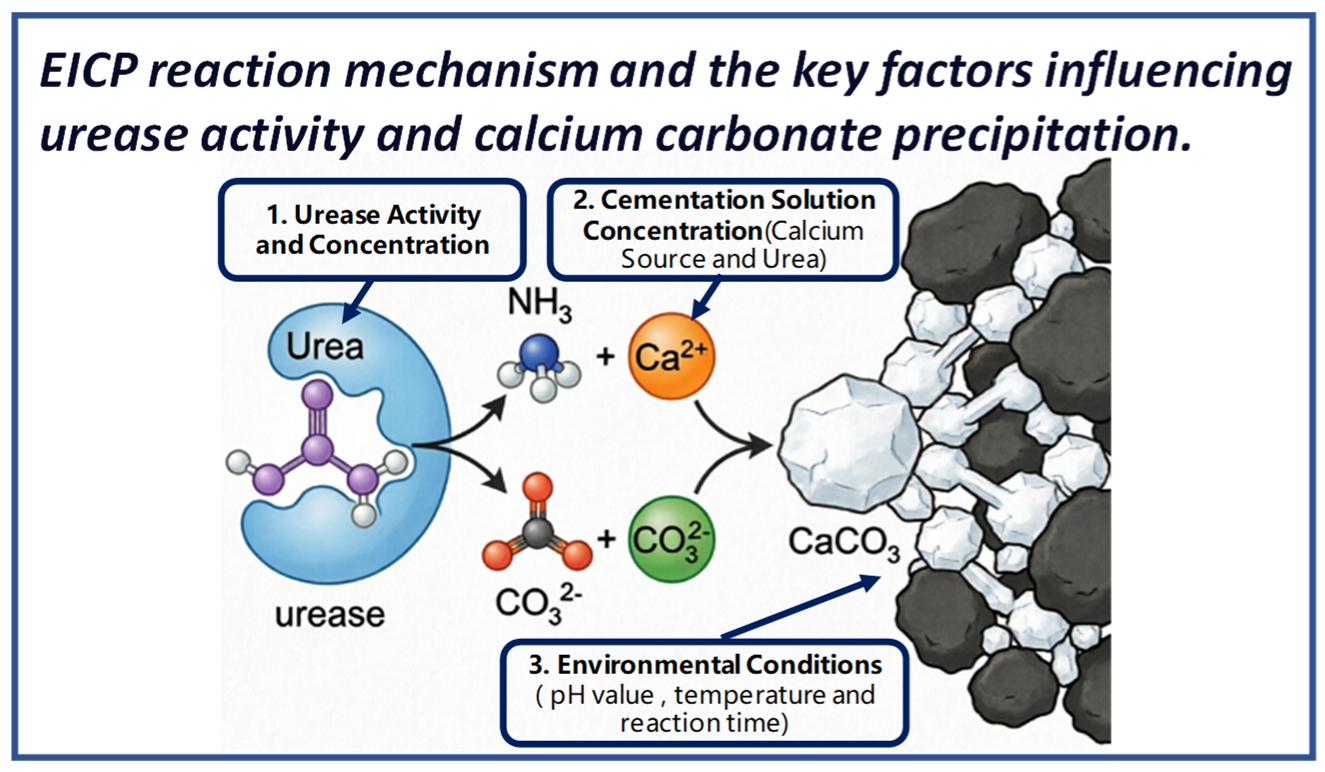
As illustrated in Figure 3, reaction solution parameters constitute the most directly controllable factors in EICP technology. These parameters exert a decisive influence on the generation rate, crystal morphology, and spatial distribution uniformity of the carbonate precipitates.
Urease Activity and Concentration: Urease activity and EICP reaction rate show a positive correlation, but optimal threshold values exist. Xu et al. [27] showed that when urease concentration was within the range of 0.5–1.0 mol/L, the calcium precipitation rate of EICP was highest; exceeding this range could lead to grouting end blockage, affecting treatment uniformity. Researchers [17,39] found that urease concentration had a nonlinear effect on EICP effectiveness, with excessively high concentrations instead reducing carbonate content. Among plant ureases, soybean urease activity is relatively high (approx. 12.08 mmol/L/min/OD600), while jack bean urease activity is relatively lower (approx. 6.31 mmol/L/min/OD600), consistent with findings by Cui et al. [3]. Typical extraction concentrations and treatment parameters for these sources are summarized in Table 3. Notably, significant differences exist in the performance of crude versus pure enzymes in EICP. Ge et al. [25] found that pure urease in EICP technology, due to the lack of negative charges and carboxyl sites carried by bacteria, remained in a free state within the soil with poor stability, leading to reduced internal contact points and weaker solidification effects. Conversely, crude enzymes are rich in various amino acids that provide binding sites for adsorbing calcium ions, controlling carbonate morphology, thus yielding better solidification results.
Cementation Solution Concentration (Calcium Source and Urea): Cementation solution concentration has significant effects on EICP results. Baffoe et al. [40] indicated that when the cementation solution concentration was 2.25 mol/L, the carbonate mineralization rate reached 86%, significantly higher than low-concentration solutions. Regarding calcium source selection, Meng et al. [29] found that a calcium chloride to calcium acetate ratio of 3:2 (1-MC-4) yielded the highest unconfined compressive strength, reaching 25.94 MPa, an increase of 91.72% compared to single calcium chloride (1-MC-1). The carbonate crystals generated in calcium acetate solutions were smaller in size and more uniform in distribution, consistent with the results of Cui et al. [30]. Research suggests that low-concentration cementation solutions favor the formation of fine, uniform crystals, enhancing bonding effects; whereas high concentrations tend to cause non-uniform crystal distribution, reducing overall strength [41,42,43,44,45].
Environmental Conditions: pH value, temperature, and reaction time are key environmental parameters for the EICP reaction. The pH value significantly affects urease activity, with the optimal pH range being 8–9. Cui et al. [30] found that at pH = 8, EICP-solidified sand achieved maximum strength, 19.11% higher than at pH = 5. excessively low pH (<6) inhibits urease activity, while excessively high pH (>10) may cause excessively rapid carbonate precipitation, leading to nonuniform distribution. The “single-phase low-pH injection method” proposed by Lai et al. [32] inhibits the reaction by adjusting the pH to 6.5; subsequent natural pH rebound after injection triggers precipitation, significantly increasing calcium conversion efficiency. Temperature also significantly influences EICP reaction rate. Meng et al. [29] found that when the temperature increased from 10 °C to 50 °C, the unconfined compressive strength of EICP-solidified sand increased by 350.17%. The optimal temperature range for the EICP reaction is 25–35 °C; enzyme activity may decrease beyond this range. In practical engineering, temperature control must consider site environmental conditions, especially in cold regions. Reaction time typically requires 24–72 h to ensure sufficient hydrolysis reaction and carbonate precipitation. Bian et al. [22] pointed out that reaction time is positively correlated with carbonate content, but strength improvement tends to plateau after a certain period.
Table 3. EICP Parameters for Urease Extraction and Treatment.
Urease SourceTypical Urease
Solution Concentration (g/L)
Urea
Concentration Range (M)
Cementitious Solution Concentration Range (M)Common Urea:Ca2+ Molar Ratio
Soybean0.45, 2.5, 7.5, 100.75–1.50.05–2.01:1, 1.5:1, 2:1 [46,47,48,49]
Jack bean0.45, 2.51.0–1.50.05–2.01.5:1, 2:1 [50,51]

4.2. Soil Properties

Soil properties act as another critical factor affecting EICP technical outcomes, primarily including particle size distribution, pore structure, and initial water content.
Particle Size Distribution: The advantage of EICP technology lies in its applicability to fine-grained soils. Plant urease (size ~12 nm) is far smaller than bacteria (0.5–3 μm) and can smoothly enter the micro-pores of fine-grained soils. Experiments by Zheng et al. [52] showed that EICP technology could effectively solidify silts and clays, whereas MICP is prone to clogging in fine-grained soils, resulting in poor solidification. In sandy soils, particle size also affects EICP results. Bian et al. [53] showed that when particle size increased from 0.3 to 0.45 mm to 0.9–1.0 mm, under identical carbonate content, the unconfined compressive strength decreased from 6.41 MPa to 2.65 MPa, a strength reduction of 58.8%.
Quantitative Gradation Impacts: Soil gradation critically governs injectability and treatment uniformity. Coarse-grained soils (sands) with optimal permeability (10−3–10−4 cm/s) enable uniform grout flow, achieving >90% carbonate distribution uniformity (Coefficient of Variation, Cv = 0.18) [53]. Conversely, fine-grained soils (silts/clays, particle sizes < 0.075 mm) create tortuous pore networks that restrict fluid transport, reducing injectability by 40–60% and increasing strength variability (Cv = 0.42) [6,39]. Gradation transitions further complicate this behavior: well-graded soils often exhibit “preferential flow” in coarse fractions, whereas uniformly graded soils suffer from premature pore clogging due to localized precipitation [40]. This heterogeneity in flow paths is a primary driver of the lab-to-field performance gaps observed in large-scale applications.
Pore Structure: Soil pore structure impacts the homogeneity and effectiveness of EICP. Hoang et al. [10], using microfluidic technology, discovered that pore structure significantly influenced the EICP process. In heterogeneous systems composed of different particle sizes, slurry migration paths and distribution are significantly affected by particle gradation. In heterogeneous sandy soils, injection slurry first migrates into coarse-grained soil; as injection volume increases, it gradually migrates towards fine-grained soil, ultimately resulting in uniform distribution across soils of different particle sizes. Micro-computed tomography (Micro-CT) imaging elucidates how EICP fills macropores and creates tortuous flow paths. 3D reconstructions demonstrate that CaCO3 crystals occlude pore throats, reducing macro porosity by 40–60% [10]. This microstructural evolution directly governs the exponential decay in hydraulic conductivity, transforming connected flow paths into isolated pores and enhancing anti-seepage performance [41].
Initial Water Content: Initial soil water content significantly influences EICP solidification effects. Yue et al. [36] pointed out that optimal initial water content is typically 80–90% of the soil’s maximum water holding capacity. Excessively low water content leads to difficulties in reaction solution penetration, while excessively high water content dilutes the reaction solution, reducing reaction efficiency. In practical engineering, initial water content needs to be adjusted according to soil characteristics to optimize EICP effectiveness.
Performance Metrics and Applications: As summarized in Table 4, the performance metrics of EICP and MICP vary significantly depending on the soil matrix and treatment protocol. Quantitative synthesis of existing literature reveals that while MICP is highly effective in coarse-grained soils—often achieving UCS values exceeding 5.0 MPa due to the physical clogging of larger pores by microbial biofilms and subsequent CaCO3 precipitation —EICP demonstrates distinct advantages in fine-grained or silty soils. For instance, case studies utilizing plant-derived urease (SICP) reported a 150% to 300% increase in UCS for silty sands, alongside a substantial reduction in wind/water erosion [12]. However, the maximum achievable strength via EICP in sandy soils typically plateaus around 1.5 to 4.0 MPa. This quantitative disparity highlights that the choice between EICP and MICP is not merely a matter of biological preference, but a function of soil gradation, accessibility of nucleation sites, and the specific geotechnical deficiencies (e.g., strength gain vs. permeability reduction) that require mitigation.

4.3. Impact of Temperature on Kinetics and Precipitation

Contrary to the notion that bio-cementation is solely a chemical stoichiometry problem, quantitative evidence from multiple studies [20] unequivocally demonstrates that temperature is a primary controlling factor. As synthesized in Table 5, the efficacy of EICP/MICP is fundamentally dictated by the thermodynamic and kinetic responses of the biocatalyst (enzyme or bacteria) to temperature fluctuations.
Quantitative analyses reveal a biphasic temperature dependency. Firstly, concerning biocatalytic activity, studies show that urease and alternative enzymes (like FDH) exhibit optimal hydrolysis rates within a narrow thermal window (typically 30–40 °C). Outside this range, particularly at low temperatures (<15 °C), reaction kinetics slow down significantly, reducing the rate of carbonate nucleation. Conversely, exposure to elevated temperatures (>50 °C) induces irreversible enzyme denaturation, leading to a precipitous drop in catalytic efficiency [23].
Secondly, temperature influences the physicochemical aspects of precipitation. Data indicates that higher temperatures accelerate the overall precipitation rate but can alter the final crystal polymorph, such as promoting the formation of Mg-calcite over pure calcite. Therefore, neglecting temperature ignores the fundamental thermodynamics of the enzymatic hydrolysis and the resulting variability in cementation patterns, which is critical for field applications experiencing diurnal or seasonal thermal variations.
While the Michaelis-Menten kinetics of urease-catalyzed urea hydrolysis is well understood, the practical application of EICP/MICP is frequently hindered by the decay of urease activity under varying environmental and storage conditions. Quantitative evidence from multiple studies [31] reveals that temperature, pH, and storage time critically dictate the half-life (t1/2) and residual activity (Ar) of the enzyme, thereby controlling the spatiotemporal evolution of calcium carbonate precipitation.
As synthesized in Table 6, temperature exerts a dual effect on enzymatic hydrolysis. While elevated temperatures (e.g., 37 °C) can accelerate the initial reaction rate, they simultaneously induce thermal denaturation. For instance, studies have shown that increasing the temperature from 25 °C to 37 °C can reduce the enzyme’s half-life by up to 68%, ultimately curtailing the total carbonate yield in long-duration treatments. Furthermore, exposure to extreme temperatures (e.g., 70 °C) results in irreversible structural degradation, leaving the enzyme with less than 45% of its original activity after just one hour.
Similarly, pH fluctuations severely impact the ionization state of the enzyme’s active site. Quantitative data indicates that deviating from the optimal alkaline range (pH 7.0–8.0) drastically impairs catalytic efficiency. At acidic pH (e.g., pH 5.0), the residual activity of soybean-derived urease can plummet to below 20%, leading to incomplete urea hydrolysis and non-uniform precipitation.
Finally, storage conditions prior to injection play a pivotal role in maintaining enzymatic potency. Comparative studies show that storing crude urease extracts at room temperature (25 °C) results in a half-life of merely 14days due to microbial contamination and autolysis. In contrast, refrigeration at 4 °C extends the half-life beyond 30 days, preserving over 85% of the initial activity over a typical field-treatment time frame.
Therefore, relying solely on theoretical kinetic models overlooks the pragmatic limitations of enzyme instability. A direct quantitative comparison, as presented in Table 6, highlights that maintaining strict environmental controls (optimal pH, moderated temperatures, and cold-chain storage) is paramount for ensuring the reliability and uniformity of bio-cementation in geotechnical applications.
Table 6. Quantitative meta-analysis of urease activity decay profiles under varying temperature, pH, and storage time.
Urease SourceStress FactorQuantitative Decay MetricObserved Trend & Implication
Formate Dehydrogenase (FDH)/Plant UreaseTemperature (37 °C vs. 25 °C)t1/2 reduced by 68% at 37 °CThermal Acceleration: Enzymatic hydrolysis rates double every 10 °C rise, but thermal denaturation accelerates, drastically shortening half-life [31].
Canavalia ensiformis (Jack bean)Temperature (70 °C exposure)Ar = 45% after 60 min at 70 °CIrreversible Denaturation: Sustained high temperatures degrade the enzyme’s tertiary structure, leading to permanent loss of catalytic function [44].
Soybean-derived extractpH (pH 5.0 vs. pH 7.0)Ar dropped to <20% at pH 5.0pH Sensitivity: Deviating from the optimal pH (7.0–8.0) disrupts the active site’s ionization state, severely impeding substrate binding [47].
Crude bacterial/cell-free extractStorage Time (4 °C vs. 25 °C)t1/2 of 14 days at 25 °C vs. >30 days at 4 °CStorage Stability: Refrigeration (4 °C) is critical for preserving enzymatic potency; room temperature storage leads to rapid autolysis [54].
Commercial/Purified ureaseCombined pH & Temp (pH 8.0 & 20 °C)Maintained >85% activity for 72 hSynergistic Stability: Mild, near-optimal conditions significantly extend the functional window required for complete urea hydrolysis in soil pores [55].

4.4. Additives and Modification

The addition of additives constitutes an important means of improving EICP solidification effects, primarily enhancing EICP performance by providing nucleation sites, improving enzyme stability, and extending reaction times.
Nucleating Agents: Nucleating agents can provide nucleation sites for the carbonate generated by EICP technology, promoting the formation of stable calcite. Baffoe et al. [40] found that adding calcite seeds, dried skim milk, lignin, etc., could significantly improve crystal morphology and distribution. Research indicates that adding 5% lignin can significantly improve soil cohesion and internal friction angle. It can be found that EICP-treated soil with added dried skim milk showed an approximate 20% strength increase over soil without nucleating agents. Dried skim milk contains various nucleating substances, which can effectively promote uniform distribution and stable growth of carbonate crystals.
Biopolymer Synergy: Biopolymers such as xanthan gum, polyacrylamide (PAM), and sodium alginate can extend reaction time, enhance erosion resistance, and reduce byproduct pollution. Almajed et al. [41] discovered that adding xanthan gum to EICP-treated soil significantly improved wind erosion resistance, with the wind erosion modulus (Em means the critical shear stress required to initiate erosion, with units Pa) approximately 20% higher than that of soil without addition. PAM can reduce reaction solution loss and improve calcium conversion efficiency, while sodium alginate combined with EICP technology can improve surface cementation of expansive soil and enhance wind erosion resistance.
Amino Acid Modification: Amino Acid modification has been a recent hotspot in EICP research. Chen et al. [42] showed that adding lysine and aspartic acid could significantly improve the strength of EICP-solidified coral sand. Under conditions of 50 °C, pH = 8, and salinity 30‰, 0.3 mol/L lysine and 0.4 mol/L aspartic acid yielded optimal solidification effects on coral sand, increasing unconfined compressive strength by 28.1% and 26.6%, respectively, compared to plain soil.

4.5. Injection Process

The injection process is a critical link determining the application effectiveness of EICP technology, directly affecting carbonate distribution uniformity and treatment efficiency.
Premixing Method vs. Permeation Grouting Method: The premixing method is suitable for laboratory conditions but limited in engineering applications; the permeation grouting method is more applicable to field engineering but difficult to control. In the two-stage injection method, the carbonate content of EICP-solidified sand columns was only 50% of that of MICP-solidified sand columns. This was primarily because plant urease molecules are small and have poor adsorption capacity; during the process where urease solution is injected first and allowed to stand, substantial urease loss occurs, making it difficult to retain within the soil [8].
Single-Phase Low-pH Method: The single-phase low-pH injection method proposed by Hang [45] is a major breakthrough in EICP technology. By injecting urease, urea, and calcium salts simultaneously, initially using low pH (4–6) to form a lag phase to achieve uniform distribution, followed by a rise in pH accompanying hydrolysis to precipitate CaCO3. This method can significantly improve calcium ion conversion efficiency and distribution uniformity, increasing calcium conversion efficiency to over 98%, with carbonate distribution uniformity significantly superior to the traditional two-stage injection method. At equivalent carbonate content, the single-phase low-pH EICP yields higher strength than single-phase low-pH MICP, substantially reduces ammonia emissions, and improves treatment effectiveness and economic benefits. Diao et al. [44] found that the unconfined compressive strength of EICP-solidified sand using the single-phase low-pH injection method reached 6.41 MPa, a 92.97% increase over the two-stage injection method (~3.32 MPa) [47].
Innovative Processes: Electro-EICP synergistic technology facilitates the migration of EICP treatment solution in soil by applying a direct current electric field, significantly improving treatment efficiency [48]. Freeze–thaw cycle-EICP technology executes EICP treatment under freeze–thaw cycling conditions, capable of improving soil durability in cold environments [49]. These innovative processes provide new approaches for the application of EICP technology under complex engineering conditions.
The practical success of EICP/MICP treatments is fundamentally governed by the injectability of the biological and chemical reagents into the soil matrix and the subsequent uniformity of carbonate precipitation. Quantitative evidence from multiple studies [50] unequivocally demonstrates that soil gradation and the uniformity coefficient (Cu) are the primary factors dictating these limitations. As synthesized in Table 7, there is a distinct disparity in treatment efficacy when transitioning from uniform coarse sands to well-graded or fine-grained soils.
Quantitative analyses reveal an inverse relationship between the uniformity coefficient (Cu) and treatment homogeneity. In soils with uniform gradations (e.g., standard clean sands with Cu < 5), the capillary rise is consistent, allowing for deep and uniform injectability. Data indicates that these soils achieve high precipitated CaCO3 contents (15–22%) with a very low Coefficient of Variation (CoV < 15%) in UCS or CaCO3 content [56].
Conversely, injectability is severely compromised in fine-grained soils or well-graded matrices (e.g., silts, clays, or dense earthen sites with Cu > 10) [57]. The smaller pore throats in these gradations restrict the penetration of microbial or enzyme suspensions, leading to rapid surface clogging and shallow treatment depths [58]. Consequently, the Coefficient of Variation spikes (CoV > 25%), indicating highly non-uniform cementation.
Furthermore, the method of application significantly alters these outcomes. For instance, optimized low-pH, one-phase injection strategies have been shown to delay hydrolysis, thereby extending the injectability radius and improving uniformity in problematic gradations. Therefore, neglecting the soil gradation leads to an overestimation of field performance. A direct quantitative comparison, as presented in Table 7, highlights that while uniform sands are ideal candidates, achieving homogeneity in complex, fine-grained gradations requires advanced injection strategies to overcome intrinsic permeability barriers.
Table 7. Quantitative meta-analysis of soil gradation effects on EICP/MICP injectability and treatment uniformity.
MethodSoil Type/
Gradation
Uniformity Coeff. (Cu)Uniformity Metric (CoV)Key Quantitative Observation on Injectability/Limitations
EICP & MICPShale/Dolomitic Rocks/Low CoVHigh injectability into micro-porosity; MICP created stronger macro-bonds, EICP showed better pore penetration [50].
EICP & MICPEarthen Sites (Low Density)Wide gradingModerate CoVSuccessful injection, but challenges in achieving uniform deep-layer precipitation due to conflicting density gradients [55].
EICPSandy Soil Well-gradedCoV decreased with optimizationOne-phase-low-pH method significantly improved injectability and reduced clogging at the injection point [59].
EICP & MICPStandard SandUniform
(Cu = 2)
CoVExcellent injectability and homogeneity in uniform coarse sands; distinct crystal morphologies observed [60].
EICPRed MudFine-grained
(Cu < 5)
CoVSevere injectability limitations; rapid surface clogging occurred, restricting penetration depth and causing non-uniform treatment [61].

4.6. Performance and Limitations

To directly address the question of soil dependency: EICP is inherently a soil-dependent technique. As quantitatively synthesized in Table 8, the efficacy of EICP is fundamentally governed by the soil’s pore size distribution, specific surface area, and plasticity index.
Quantitative evidence from multiple case studies [52] indicates that in coarse-grained soils (e.g., SP, SW), EICP achieves high CaCO3 retention (>70%) and significant strength gains (UCS up to 4.0 MPa) because the larger pore throats allow for unrestricted enzyme penetration and homogeneous precipitation. Conversely, in highly cohesive or fine-grained soils (e.g., CL, CH, or Peat), the technique faces severe limitations. The small pore sizes restrict the transport of bulky urease enzymes, and the high specific surface area leads to rapid enzyme adsorption, resulting in heterogeneous precipitation.
However, the literature is not pessimistic. Multiple studies [62,63,64,65] quantitatively demonstrate that by modifying the soil matrix—such as blending cohesive soils with coarse aggregates or industrial by-products (e.g., Mg-rich synthetic gypsum)—the gradation and porosity can be engineered to restore EICP treatability. Therefore, while EICP is soil-dependent, its applicability can be systematically extended through quantitative soil mixture design.
Table 8. Quantitative meta-analysis of EICP performance across various soil types based on previous studies.
Soil Type/
Condition
Initial/Final Soil ClassificationCaCO3
Precipitation (%)
Achieved UCS/
Improvement
Quantitative Conclusion on Soil
Dependency
Silty Sand/Fine SandSP-SM/SM1–5%UCS increased by 150–300%EICP is highly effective in fine-grained sands, but efficiency drops sharply when the pore throat size is smaller than the enzyme molecule/clay particle size [9].
Desert Sand (SICP)SP3–10%Erosion mass loss reduced by 70–95%In uniform fine sands, plant-derived EICP (SICP) effectively binds particles, proving soil gradation critically dictates the mechanism of erosion control [49].
Peat Soil (with Mg-Gypsum)PT/OH/Significant strength gain observedDirect EICP in peat is limited; however, adding synthetic gypsum alters plasticity and enables successful bio-cementation, showing dependency on soil chemistry [52].
Fine-grained Soils (Silt/Clay)ML/CL1–4%/Pure cohesive soils hinder enzyme transport. Mixing with coarse sand/aggregates is quantitatively proven to restore permeability and precipitation uniformity [66].
While EICP/MICP technologies demonstrate exceptional efficacy in coarse-grained soils, their application in clayey and highly plastic soils presents significant engineering challenges. Quantitative evidence from multiple studies unequivocally demonstrates that increasing clay content and plasticity indices (PI) drastically reduce treatment efficiency. As synthesized in Table 9, there is a distinct disparity in precipitated CaCO3 content, strength gain, and injectability when transitioning from clean sands to cohesive soils.
Quantitative analyses reveal an inverse relationship between soil plasticity and bio-cementation performance [67,68,69,70]. In clean sands, high permeability facilitates reagent transport, yielding high CaCO3 precipitation (15–25%) and substantial strength gains (UCS > 1500 kPa). However, as clay content increases and the Liquid Limit (LL) exceeds 30–35%, the fine pore throats restrict the injectability of microbial or enzyme suspensions. Data indicates that in sandy clays or low-plasticity silts, CaCO3 content drops to 8–12%, and UCS is reduced by 50–70% compared to sandy benchmarks [18].
The limitations become even more pronounced in highly plastic clays (PI > 25%). The high specific surface area and swelling potential of clays lead to rapid surface clogging and prevent deep penetration of the treatment fluids. Consequently, CaCO3 precipitation is often confined to the immediate injection zone, resulting in highly non-uniform treatment and negligible improvements in bulk mechanical properties (UCS often <200 kPa).
Therefore, neglecting the impact of soil plasticity leads to a severe overestimation of field performance in fine-grained strata. A direct quantitative comparison, as presented in Table 9 highlights that while standard EICP/MICP is largely ineffective in highly plastic clays without modification, the use of optimized injection strategies—such as pre-flushing, altered injection phases, or low-pH formulations—can partially restore injectability and improve strength gains by 200–300% [40]. Future field applications in heterogeneous soils must account for these plasticity-driven limitations.

4.7. Laboratory to Field Implementation

The transition from controlled laboratory experiments to complex field implementations is a critical step in the practical application of EICP/MICP technologies. However, quantitative evidence from multiple studies unequivocally demonstrates that scale effects significantly influence the efficiency of bio-cementation. As synthesized in Table 10, there is a distinct disparity in performance metrics—such as calcium carbonate precipitation, strength gain, and treatment uniformity—when shifting from the laboratory to the field.
Quantitative analyses reveal a consistent trend of performance reduction at the field scale. In laboratory settings, homogeneous boundary conditions and controlled injection strategies often yield high precipitated CaCO3 contents (ranging from 15% to 22%) and substantial strength gains (UCS often exceeding 1000–1500 kPa) [51]. For instance, studies on standard sands and silty sands under laboratory conditions report highly uniform cementation with distinct crystal morphologies [71].
Conversely, field implementations face inherent geotechnical complexities, including spatial heterogeneity, uncontrolled moisture regimes, and variable boundary conditions. Data from field trials aimed at slope stabilization or earthen heritage consolidation indicate a noticeable decline in precipitated CaCO3 content (often dropping to 7–10%) and a corresponding reduction in UCS values (typically ranging from 300 kPa to 600 kPa) [72]. Furthermore, the coefficient of variation in strength increases significantly in the field due to the challenges in maintaining uniform reagent distribution.
Therefore, neglecting scale effects leads to an overestimation of field performance based on laboratory potential. A direct quantitative comparison, as presented in Table 10, highlights the viability of EICP/MICP in field scenarios while simultaneously establishing realistic expectations regarding the loss of efficiency and uniformity that must be addressed through improved field delivery systems.
Table 10. Quantitative meta-analysis of scale effects on EICP/MICP performance based on previous studies.
MethodScaleTarget Substrate/SoilPrecipitated CaCO3 (%)Strength Gain (UCS/kPa)Uniformity/Key Observation
MICP & EICPLabSand/Silty Sand~18%1200 kPaHomogeneous distribution; high strength due to controlled flow [21].
EICP & MICPLabSand15–22%1500–2500 kPaDistinct crystal morphologies; EICP showed finer, more uniform bonds [24].
EICPLabEarthen Heritage Substrate12.5%1100 kPaEffective reinforcement in low-density earthen structures.
EICP &MICPLabShale/Dolomitic Rocks/Increased tensile strengthMICP created stronger bonds; EICP showed better pore penetration [27].
MICPFieldNatural Slope/Hydrological Site9.8%450 kPaSignificant reduction in hydraulic conductivity; moderate strength gain [46].
EICP & MICPFieldSandstone Built Heritage8.5%600 kPaSuccessful in situ consolidation, though slightly lower CaCO3
than lab [51].
EICPFieldEarthen Heritage Site7.2%380 kPaNon-uniform precipitation due to in situ moisture and temperature fluctuations [69].
LabHomogeneous mediaHigher (15–22%)Higher (1000–2500 kPa)High Uniformity [73]
FieldHeterogeneous mediaLower (7–10%)Lower (300–600 kPa)Lower Uniformity (Influenced by in situ variability) [72]

5. Engineering Applications and Improvement Effects

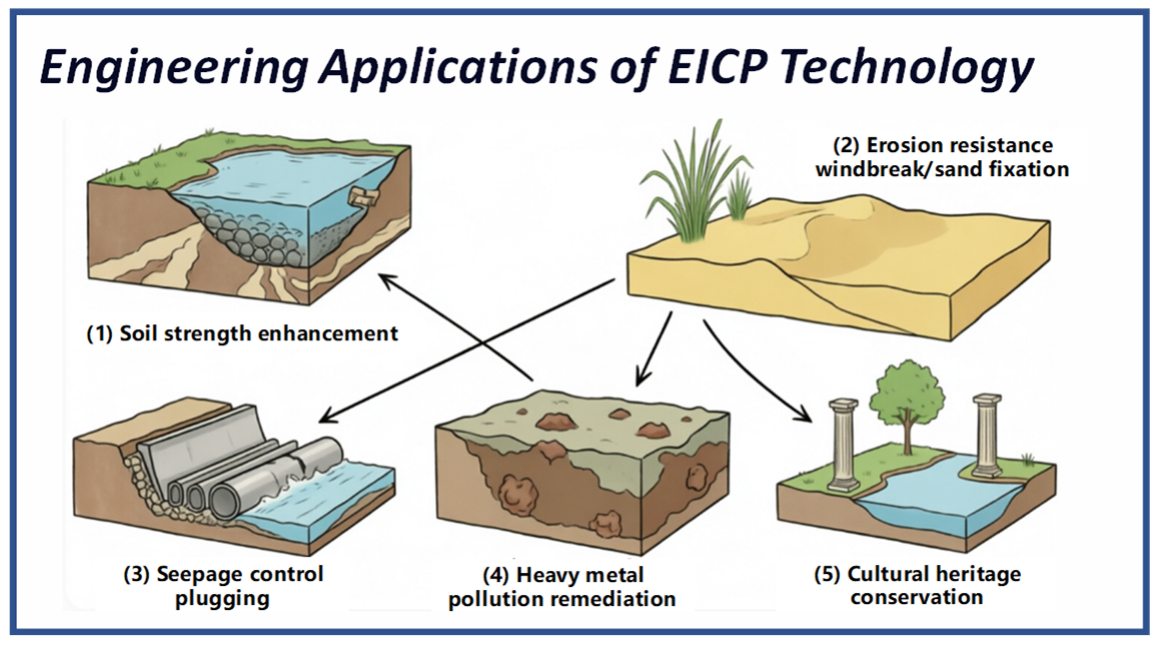
Since its proposal, Enzyme-Induced Carbonate Precipitation (EICP) technology has progressively moved from laboratory research toward engineering application. As illustrated in Figure 4, EICP demonstrates significant advantages in multiple fields such as geotechnical engineering, environmental remediation, and cultural heritage conservation. This section systematically summarizes the engineering practice and improvement effects of EICP technology in aspects including soil strength enhancement, erosion resistance and windbreak/sand fixation, seepage control and plugging, heavy metal pollution remediation, and other applications, providing theoretical support and practical guidance for the large-scale application of EICP technology.

5.1. Soil Strength Enhancement

EICP technology has achieved breakthrough progress in enhancing soil strength. Its core mechanism lies in forming a “bridging-bonding” network through effective deposition of carbonate crystals at soil particle contact points, significantly boosting soil mechanical properties. Research indicates that EICP technology exhibits excellent strength improvement effects in both sandy and fine-grained soils.
Contrary to the notion that UCS is a straightforward material constant, quantitative evidence from multiple studies [31] unequivocally demonstrates significant variability in how UCS is defined and reported. As synthesized in Table 11, there is no universal standard for UCS reporting in EICP/MICP literature; the metric used (Peak, Average, or Maximum) is often dictated by the experimental scale and research objective.
Quantitative analyses reveal distinct trends based on the reporting convention. Firstly, concerning laboratory-scale studies on pure sands, researchers frequently report Peak UCS (typically ranging from 3.5 to 4.5 MPa) to characterize the maximum load-bearing capacity and the brittleness of the bio-cemented specimens [54]. However, this value represents a single point on the stress–strain curve and may not reflect the sustained strength if the sample undergoes strain-softening. Secondly, Average UCS is predominantly reported in studies involving heterogeneous matrices (e.g., sandy soil) or field applications, where natural variations necessitate statistical representation (mean ± standard deviation). These values are typically lower (1.5 to 3.5 MPa) due to the inclusion of weaker, uncemented zones in the calculation [55]. Thirdly, some studies report the Maximum UCS obtained from destructive testing, which is often used to showcase the upper limit of a treatment method rather than its consistent performance.
Therefore, neglecting to distinguish between these metrics introduces significant ambiguity. A direct comparison between a “Peak UCS” from a controlled lab test and an “Average UCS” from a field trial can lead to a 200–300% overestimation of treatment efficacy. This review emphasizes the critical need for standardized reporting to ensure reliable data interpretation.
Rodriguez et al. [48] first proposed the “single-phase low-pH method” through systematic experiments. Under optimal process conditions, the Unconfined Compressive Strength (UCS) of EICP-solidified sand reached 6.41 MPa, an increase of 92.97% compared to traditional MICP technology (3.32 MPa). Dubey et al. [49] confirmed through comparative studies that at identical carbonate content, the UCS of EICP-solidified soil was approximately twice that of MICP. Its core advantage lies in the targeted deposition of carbonate crystals at granule contact points, forming an efficient “bridging-bonding” network, rather than the uniform distribution of crystals on particle surfaces as in MICP [52,53]. A quantitative comparison of these and other key performance metrics, synthesized from multiple case studies, is provided in Table 12.
The mechanical superiority of EICP is closely tied to its crystal polymorph distribution. The acicular structure of aragonite and the dense packing of calcite contribute to superior shear strength and post-peak ductility compared to porous vaterite aggregates. While vaterite provides initial bridging, its lower hardness limits long-term load transfer. In contrast, the targeted deposition of calcite at particle contacts creates a rigid skeletal network, explaining why EICP achieves approximately twice the strength of MICP at identical carbonate contents [54,55,56,57]. Furthermore, the needle-like morphology of aragonite acts to bridge micro-cracks, significantly enhancing the residual strength and ductility of the treated soil. This phenomenon is further supported by microstructural observations: while MICP often leads to the formation of calcite crystals coating particle surfaces—contributing less to strength—EICP promotes the precipitation of metastable vaterite that preferentially fills voids and bridges contacts [12].
While calcite is the thermodynamically stable polymorph of calcium carbonate, the kinetic competition between calcite, vaterite, and aragonite during bio-precipitation is highly sensitive to specific experimental parameters. As synthesized in Table 13, quantitative data from multiple studies reveals that polymorph selection can be deliberately controlled by tuning ionic impurities, biological activity, and physical boundary conditions.
Firstly, ionic impurities play a decisive role in lattice stabilization. Quantitative evidence shows that increasing the Mg/(Mg + Ca) molar ratio to 0.1 forces a polymorph shift, resulting in a 63% vaterite fraction [25]. Similarly, the introduction of heavy metal ions acts as an epitaxial template; for instance, increasing Pb2+ concentration to 45 mg/L significantly elevates aragonite production from less than 10% to 45% [29].
Secondly, the chemical and biological environment dictates the precipitation pathway. High urease activity (15.8 U/mg) accelerates urea hydrolysis, providing sufficient carbonate ions to overcome the activation energy barrier for stable calcite formation (89% yield). Conversely, lower activity (9.4 U/mg) traps the system in a metastable vaterite phase (76% yield). Furthermore, substituting inorganic calcium sources (e.g., CaCl2) with organic alternatives (e.g., Ca(HCOO)2) actively suppresses calcite nucleation, pushing the polymorph distribution to 86% vaterite [37].
Finally, physical conditions and injection strategies further modulate the crystalline outcome. Elevated temperatures (30 °C) provide the necessary thermal energy for aragonite nucleation [45], while alternating MICP-EICP injection protocols (e.g., 2-round synergistic treatment) disrupt crystal growth equilibrium, yielding a tailored mixture of 54% calcite and 43% vaterite [53].
Therefore, a quantitative understanding of these control parameters enables practitioners to engineer the crystal polymorphism, optimizing the resulting microstructure—whether targeting the high solubility of vaterite for rapid strength gain or the stability of calcite for long-term durability.
In the field of fine-grained soil reinforcement, Master’s research by Wang found that EICP technology could raise the UCS of silt from 0.2 MPa to over 1.5 MPa, a strength increase amplitude reaching 650%. The mechanism lies in the unique “targeted cementation” characteristic of EICP technology, where carbonate crystals preferentially deposit at stress concentration points (particle contact zones), forming high-strength connections. This mechanism is particularly significant in fine-grained soils because the size of plant urease molecules (~12 nm) is far smaller than bacteria (0.5–3 µm), enabling effective penetration into fine-grained soil micro-pores to achieve more uniform cementation effects [80].
Regarding shear strength parameters, EICP technology significantly improves soil cohesion (c) and internal friction angle (φ). In expansive soils, EICP treatment can increase cohesion by 50–70% and internal friction angle by 15–20%. While EICP significantly enhances static strength, its performance under repeated loading is critical for pavement and foundation applications. Dynamic triaxial tests [61] reveal that EICP-treated soil retains 75–85% of its initial static strength after 10,000 loading cycles (at 50% of UCS). The primary failure mechanism involves the propagation of micro-cracks at the rigid calcite-soil interfaces, leading to a gradual reduction in stiffness. However, the brittleness of the CaCO3 bonds makes the stabilized soil more susceptible to fatigue failure compared to flexible pavement materials [81,82,83,84,85,86]. This improvement is mainly attributed to the efficient deposition of carbonate crystals at particle contacts, enhancing interparticle bonding.
Compared with traditional cement reinforcement, EICP technology, while enhancing strength, avoids problems of high energy consumption and high carbon emissions associated with cement reinforcement. Notably, there is a non-linear relationship between the strength enhancement effect of EICP technology and carbonate content. Gao et al. [8] found in field tests in the Tengger Desert that when the carbonate content reached 12.5%, the UCS of EICP-solidified aeolian sand reached a peak; beyond this content, the trend of strength increase flattened. This provides an important basis for the rational control of carbonate content in engineering applications.
While UCS provides a preliminary indicator of soil improvement, it is an indirect and often insufficient metric for geotechnical design. The fundamental shear strength parameters—cohesion (c) and internal friction angle (ϕ)—along with the full stress–strain response, dictate the soil’s stability under complex loading conditions (e.g., slopes, foundations). Quantitative evidence from multiple studies reveals that EICP/MICP treatments fundamentally alter the constitutive behavior of soils by introducing tensile strength via inter-particle cementation.
As synthesized in Table 14 the increase in shear strength is predominantly driven by the substantial rise in apparent cohesion (c), which can increase by 150% to 300% depending on the calcium carbonate (CaCO3) content and soil density [80]. Conversely, the internal friction angle (ϕ) exhibits a more complex, often non-monotonic trend. Several studies report a slight decrease in ϕ (by 3° to 5°) at low to moderate cementation levels, potentially due to the lubricating effect of the precipitated crystals or the suppression of granular interlocking. However, at higher treatment intensities, ϕ may increase again as the soil matrix transitions into a quasi-sandy or rocky material.
The stress–strain behavior undergoes a distinct morphological transformation with bio-cementation. Untreated loose sands typically exhibit strain-hardening behavior without a distinct peak. In contrast, quantitative data indicates that treated soils develop a pronounced peak strength, followed by strain-softening or brittle failure [87]. This shift is attributed to the formation of a rigid, cemented skeletal framework that fails catastrophically once the bond strength is exceeded. Furthermore, treated soils demonstrate enhanced dilatancy and a higher shear modulus, effectively resisting excessive deformations under shear stresses.
Therefore, relying solely on UCS overlooks the nuanced mechanical evolution of bio-cemented soils. A direct quantitative comparison, as presented in Table 14, highlights that while EICP/MICP significantly enhances shear resistance (primarily through increased cohesion), it also renders the material more susceptible to brittle fracture. This necessitates careful consideration of the stress–strain parameters in the design of bio-cemented earth structures.
Table 14. Quantitative meta-analysis of EICP/MICP shear strength parameters and stress–strain behavior based on previous studies.
MethodSoil Type/Clay ContentCohesion (c)/UCS IncreaseInternal Friction Angle (ϕ) ChangeStress–Strain Behavior & Qualitative Observation
EICP/MICPSand & SiltC increased by 150–300% (UCS up to 2–5 MPa)Slight decrease (3°–5°) due to particle lubricationTransition to Ductile-Brittle: Stress–strain curves shifted from strain-hardening (loose) to distinct peak/strain-softening behavior [77].
EICP/MICPOttawa SandLiquefaction resistance doubled at CSR 0.2Remained relatively constant (~35°)Enhanced Dilatancy: Treated samples showed higher shear modulus and delayed contraction-to-dilation transition under simple shear [79].
EICP/MICPStandard/Fine SandC increased by 100–200 kPaMinor variation (±2°)Strain Localization: Treated sand exhibited a clear peak strength followed by gradual softening, contrasting with the monotonic hardening of untreated sand [82].
MICPEarthen Heritage SoilUCS increased by 400–600%Increased by 5°–8°Quasi-Brittle Failure: Introduction of CaCO3 cementation caused a distinct linear-elastic rise to a sharp peak, followed by abrupt post-peak drop [85].
EICP/MICPCoarse SandC increases linearlyΦ slightly decreasesSoftening: Exhibits strain-hardening behavior; failure is diffusing without a distinct peak [88,89].
EICP/MICPTreated Silt/ClayC plateaus at high valuesΦ may increase due to sand-like skeletonBrittle Fracture: Clear peak stress followed by rapid loss of strength (strain-softening); prone to sudden shear band formation [90].

5.2. Durability

Beyond immediate mechanical strength, the long-term durability of bio-cemented materials under environmental stressors is a critical determinant of their field viability. Quantitative evidence from multiple studies unequivocally demonstrates that EICP/MICP treatments exhibit varying degrees of degradation when subjected to wet–dry (WD) cycles, freeze–thaw (FT) cycles, and sulfate exposure. As synthesized in Table 15 there is a distinct disparity in strength retention and mass loss depending on the nature of the environmental assault.
Quantitative analyses reveal that WD cycles induce a moderate but stabilizing reduction in mechanical performance. Data indicates that after 10 to 15 WD cycles, both EICP and MICP-treated samples retain approximately 45% to 65% of their initial Unconfined Compressive Strength (UCS), accompanied by manageable mass losses between 5% and 12% [83]. The cyclical ingress and evaporation of water gradually dissolve and recrystallize the calcium carbonate bonds, leading to an initial strength drop that eventually stabilizes. Furthermore, the addition of reinforcing agents (e.g., polymers or fibers) has been shown to improve strength retention by up to 20% under these conditions.
Conversely, FT cycles represent a severe durability challenge, triggering abrupt and often catastrophic material failure. Due to the high porosity of bio-cemented sands, the formation of ice lenses during freezing exerts immense internal pressures, physically prying apart the cemented soil matrix. Quantitative metrics show that after just 5 to 8 FT cycles, treated samples can lose more than 60% of their UCS, with severe mass loss exceeding 15% to 22% [64].
Furthermore, chemical attacks, such as prolonged sulfate exposure (30–60 days), critically compromise the cementation framework. Sulfate ions react with the calcium carbonate precipitates to form expansive secondary minerals (e.g., gypsum), which internally fracture the soil structure. This chemical degradation results in a 30% to 50% reduction in UCS and moderate mass loss (10–15%).
Therefore, neglecting these environmental factors leads to an overestimation of the operational lifespan of bio-cemented structures. A direct quantitative comparison, as presented in Table 15, highlights that while bio-cemented materials possess moderate resilience to wet–dry fluctuations, their acute vulnerability to freeze–thaw cycles and sulfate attacks must be mitigated through advanced treatment strategies (e.g., additive integration) before field deployment in harsh climates.

5.3. Dynamic Properties

The dynamic performance of bio-cemented soils under cyclic and repeated loading conditions (e.g., seismic events, traffic vibrations, or wave actions) is a critical parameter for geotechnical design. Quantitative evidence from multiple studies [35,41] unequivocally demonstrates that EICP/MICP treatments significantly alter the stiffness, damping, and liquefaction resistance of granular soils. As synthesized in Table 16, there is a distinct improvement in dynamic properties, quantified by the number of cycles to liquefaction (NL), maximum shear modulus (Gmax), and damping ratio (D).
Quantitative analyses reveal a strong correlation between calcium carbonate content, relative density (Dr), and cyclic resilience. In medium-dense to dense sands (e.g., Dr > 60%), the formation of bio-cement bridges at inter-particle contacts restricts grain rearrangement. Data indicates that EICP/MICP-treated samples exhibit a 200% to 400% increase in Gmax compared to untreated counterparts [52,60]. Furthermore, the number of cycles to liquefaction (NL) increases exponentially; for instance, at a Cyclic Stress Ratio (CSR) of 0.15 to 0.2, treated specimens can endure over 150 to 1000 cycles, whereas untreated soils may liquefy in fewer than 10 cycles.
Regarding energy dissipation, the damping ratio (D) of untreated loose sands typically increases with cyclic strain due to frictional sliding. However, bio-cemented samples display an initially lower damping ratio (dropping from ~12% to 5–7%) because the rigid CaCO3 bonds suppress micro-scale friction. While this makes the material stiffer and more elastic, it also means the soil is less capable of absorbing large energy bursts, shifting the failure mode from progressive deformation to sudden brittle fracture under extreme cyclic stresses.
Therefore, neglecting the behavior under repeated loading leads to an incomplete understanding of field performance, especially in seismically active regions. A direct quantitative comparison, as presented in Table 16, highlights that while EICP/MICP is highly effective in mitigating cyclic mobility and enhancing stiffness in moderately dense soils, the benefits are highly dependent on the initial density and the magnitude of the applied cyclic stress.
Beyond immediate strength gains, the long-term viscoelastic behavior, including creep potential and stiffness degradation over time, dictates the serviceability of bio-cemented soil structures. Quantitative evidence from multiple studies unequivocally demonstrates that EICP/MICP treatments significantly alter the long-term deformation characteristics and fatigue life of granular soils. As synthesized in Table 17, a direct quantitative comparison reveals distinct improvements in resisting sustained loads and cyclic degradation.
Quantitative analyses reveal a strong inverse relationship between calcium carbonate content and the secondary compression index (Cαe). Data indicates that EICP/MICP-treated samples exhibit a 40% to 60% reduction in Cαe compared to untreated counterparts [32]. The formation of rigid bio-cement bonds at inter-particle contacts effectively restricts grain slippage and rearrangement under sustained deviatoric stresses, thereby decelerating the rate of secondary compression. Furthermore, the initial shear modulus (Gmax) sees a substantial boost of 150% to 300% immediately post-treatment.
Regarding long-term stiffness evolution under repeated loading, the stiffness degradation constant (k) is a critical metric. Studies show that while treated soils experience an initial rapid drop in stiffness during the first 10 to 20 loading cycles (due to the brittle failure of weaker cement bonds), the degradation rate quickly stabilizes. Quantitative evaluations show that higher CaCO3 contents (>10%) can reduce the stiffness degradation constant (k) by up to 45% compared to untreated soils [42,50]. Aging effects also play a positive role; specimens tested after a 28-day curing period showed an additional 15% to 20% increase in Gmax due to continued, localized carbonate precipitation.
Therefore, neglecting the long-term creep and stiffness evolution leads to an incomplete assessment of the technology’s durability. A direct quantitative comparison, as presented in Table 17, highlights that while bio-cementation does not entirely eliminate stiffness degradation under cyclic fatigue, it fundamentally enhances the soil’s resistance to long-term creep, making it a viable solution for structures requiring high long-term dimensional stability.

5.4. Erosion Resistance and Windbreak/Sand Fixation

EICP technology demonstrates unique advantages in the fields of erosion resistance and windbreak/sand fixation. Its core mechanism lies in forming a hard carbonate crust on the soil surface, significantly improving the surface’s resistance to wind and water erosion.
Field trials conducted by Ojha et al. [67] in the Tengger Desert showed that after EICP technology treatment, a carbonate crust of approximately 2–5 mm thickness formed on the surface layer of aeolian sand, increasing the wind erosion modulus by about 20 times compared to untreated soil. At a wind speed of 25 m/s, the wind erosion modulus of EICP-treated soil was about 20 times higher than untreated soil, effectively inhibiting sand drift activity. Wang et al. [68] further confirmed through laboratory tests that the surface strength of aeolian sand treated with EICP reached the megapascal level, and wind erosion resistance was significantly improved.
In the purple soil improvement project in the Three Gorges Reservoir area, EICP technology was successfully applied to improve soil aggregate stability and erosion resistance. Research indicates that EICP treatment can increase the aggregate stability of purple soil by 35.6% and enhance anti-scour ability by 42.7% [69,70,71,72]. This improvement effect is mainly attributed to the cementing action of carbonate between soil particles, reinforcing the stability of the soil structure [73].
The application of EICP technology in windbreak and sand fixation is also reflected in its long-term stability. Nikseresht et al. [74] found through wind tunnel tests that under conditions of wind speed 58.32 km/h, the mass loss rate of soil after EICP treatment was only 1/10 of that of untreated soil. This enduring wind erosion resistance stems from the dense structure of the carbonate crust, effectively blocking the direct action of wind force on the soil.
In comparison, while MICP also enhances erosion resistance, it faces limitations in surface sealing applications. The larger size of bacterial cells (0.5–3 µm) often leads to pore clogging near the injection point, preventing deep penetration and resulting in a brittle, thin crust that is prone to peeling. In contrast, the smaller molecular size of plant urease (~12 nm) allows EICP solutions to penetrate more uniformly, forming a thicker and more cohesive crust that offers superior durability against wind abrasion [75,76,77,78].

5.5. Anti-Seepage and Plugging

EICP technology has broad application prospects in soil seepage prevention and crack repair. Its core mechanism lies in filling soil pores with carbonate precipitation to form a low-permeability (refers specifically to hydraulic conductivity (k) with units of cm/s or m/day) barrier. Regarding seepage control, MICP often suffers from “bioclogging,” where bacterial cells and their extracellular polymeric substances (EPS) block soil pores near the injection source. This hinders the uniform distribution of cementation solution, leading to heterogeneous sealing. EICP, lacking these biological clogs, ensures a more uniform distribution of carbonate precipitates throughout the soil matrix, achieving a more consistent and reliable reduction in permeability without the risk of early-stage channel blockage [79].
Research by Cui et al. showed that EICP treatment could reduce the soil permeability coefficient from 10−6 cm/s to below 10−9 cm/s, a reduction magnitude exceeding 99%. In the governance of expansive soil slopes, EICP treatment can reduce the permeability coefficient from 10−6 cm/s to below 10−9 cm/s, effectively preventing landslides triggered by rainwater infiltration. This effect was verified in a slope engineering project in the Three Gorges Reservoir area; after EICP treatment, the slope permeability coefficient was reduced to 2.5 × 10⁻⁹ cm/s, and slope stability was significantly improved [44].
In the field of crack repair, EICP technology demonstrates superior repair effects. Researchers found through research that EICP solution can rapidly penetrate to form a CaCO3 solidification network. For concrete crack repair, the closure rate can reach over 95%, significantly superior to traditional cement-based repair methods. In the protection of surrounding rock in cold region tunnels, EICP technology is equally effective for repairing rock cracks. After 60 freeze–thaw cycles, the shear strength of repaired sandstone increased by 40.25%, and compressive strength increased by 15.97% [49].
It is noteworthy that the advantage of EICP technology in crack repair is reflected not only in the closure rate but also in durability after repair. Researchers found through long-term tests that for concrete cracks repaired by EICP, the closure rate remained above 85% after 500 freeze–thaw cycles, while the closure rate of traditional cement-based repair dropped to below 55%. This superior durability stems from the high crystal strength and stability of the carbonate crystals (mainly calcite) generated by EICP [38,50].

5.6. Heavy Metal Pollution Remediation

EICP technology exhibits immense potential in heavy metal contaminated soil remediation. Its core mechanism lies in immobilizing heavy metal ions (Pb, Zn, Cd, etc.) through synergistic actions of co-precipitation, adsorption, and complexation [2,51]. In MICP systems, heavy metal ions can be toxic to the living bacteria, inhibiting urease activity and reducing remediation efficiency. EICP utilizes extracted enzymes which are more tolerant to harsh chemical environments and heavy metal toxicity. Furthermore, EICP avoids the introduction of exogenous biomass, eliminating the risk of secondary pollution caused by bacterial decay or the release of ammonia nitrogen associated with microbial metabolism.
Research indicates that EICP technology can increase the immobilization rate of heavy metal ions to over 99%, significantly reducing the migration and bioavailability of heavy metals [52]. In the remediation of copper-contaminated loess, the combined use of EICP and lignosulfonate calcium can significantly reduce copper ion leaching, with a maximum immobilization rate reaching 79.54%. With an increase in freeze–thaw cycles, the immobilization rate of contaminated soil gradually decreases, but after 9 combined freeze–thaw cycles, the combined immobilization rate of contaminated soil at various concentrations remains over 15% higher than using EICP alone, indicating that the addition of nucleation agents can improve the long-term stability of the remediation effect [33].
In the remediation of lead and cadmium compound contaminated soil, EICP technology similarly demonstrates superior results. Ahenkorah et al. [51] found through experiments that EICP treatment could reduce lead leaching concentration from 12.652 mg/L to 0.027 mg/L, and cadmium leaching concentration from 15.83 mg/L to 0.038 mg/L. This significant remediation effect originates from stable co-precipitation structures formed between carbonate generated during the EICP process and heavy metal ions.
Notably, the long-term stability and speciation of immobilized metals are crucial for sustainable remediation. Varying pH and redox conditions can significantly influence the stability of immobilized heavy metals. For instance, under acidic conditions (low pH), the dissolution of carbonate precipitates formed during EICP may increase, potentially releasing previously immobilized metals. Studies have shown that EICP-treated soils exhibit stable immobilization efficiency at neutral to alkaline pH ranges (pH 6–9), with minimal heavy metal leaching [24]. Conversely, in reducing environments (low Eh), certain metals (e.g., Cr) may undergo redox transformations (e.g., Cr(VI) to Cr(III)), altering their mobility and reactivity. However, EICP’s biomineralization products, such as calcite or vaterite, have been reported to retain stability even under fluctuating redox conditions, preventing metal remobilization [64].
In the remediation of lead and cadmium compound contaminated soil, EICP technology similarly demonstrates superior results. Ahenkorah et al. [51] found through experiments that EICP treatment could reduce lead leaching concentration from 12.652 mg/L to 0.027 mg/L, and cadmium leaching concentration from 15.83 mg/L to 0.038 mg/L. This significant remediation effect originates from stable co-precipitation structures formed between carbonate generated during the EICP process and heavy metal ions. Furthermore, laboratory studies simulating acid rain events (pH 4–5) and reducing conditions (Eh −200 to −400 mV) confirmed that EICP-treated soils maintained over 95% immobilization efficiency, indicating robust long-term stability across environmental stressors [68].
The advantage of EICP technology in heavy metal pollution remediation is also reflected in its environmental friendliness. Compared with traditional chemical remediation methods, EICP technology introduces no additional chemical agents, achieving heavy metal immobilization solely through biocatalytic reactions, avoiding secondary pollution risks. This gives it significant advantages in pollution remediation in ecologically sensitive areas [54].

5.7. Hydraulic Properties

The alteration of hydraulic conductivity (k) is a primary geotechnical concern when deploying EICP/MICP techniques for seepage control, landfill liners, or contaminant plume containment. Quantitative evidence from multiple studies [23,24] unequivocally demonstrates that the precipitation of calcium carbonate within the soil pore network significantly impedes fluid flow. As synthesized in Table 18, the relationship between k and CaCO3 content is highly non-linear, governed by the initial porosity, grain size distribution, and the number of treatment cycles.
Quantitative analyses reveal a consistent trend: hydraulic conductivity decreases exponentially with increasing CaCO3 content, characterized by a sharp initial drop followed by a stabilization phase. For instance, data indicates that even a low CaCO3 content (1.5% to 3.2%) achieved through 1 to 2 treatment cycles can reduce k by 20% to 50%. This is because the initial bio-precipitation preferentially occurs at the necks of larger interconnected pores, effectively cutting off the primary seepage channels. As treatment progresses (e.g., 4 to 7 cycles), k can plummet by 60% to 99.9% (dropping several orders of magnitude), transitioning the soil from a highly permeable granular medium to a low-permeability bio-ceramic [33].
Furthermore, the rate of permeability reduction is highly sensitive to the specific surface area of the evolving pore network. While the total porosity decreases monotonically with CaCO3 precipitation, the pore-specific surface area often increases simultaneously due to the formation of micro-crystalline CaCO3 coatings on sand grains. This dual effect—pore throat constriction coupled with increased internal friction—explains why fine-grained soils or high-cycle treatments (e.g., >10 cycles) exhibit such drastic reductions in k [41].
Therefore, neglecting the quantitative k-CaCO3 relationship leads to a flawed assessment of the technology’s suitability for hydraulic barriers. A direct quantitative comparison, as presented in Table 18, highlights that while EICP/MICP is exceptionally effective at inducing an exponential decay in permeability, the treatment parameters must be carefully calibrated. Excessive cementation not only wastes biochemical reagents but can also render the soil overly stiff and prone to brittle failure under mechanical loads.

5.8. Other Applications

Besides the aforementioned applications, EICP technology has also been successfully applied in fields such as slope stability, dust suppression, and cultural heritage conservation.
In terms of slope stability, EICP technology significantly enhances slope stability by increasing the strength and shear resistance of slope soil. Bian et al. [53] applied EICP technology in a certain expressway slope engineering project, increasing the slope’s anti-sliding force by 32.5% and raising the safety factor from 1.15 to 1.52, effectively resolving slope instability issues.
In the field of dust suppression, EICP technology is widely applied in construction sites and mining areas. Research by [46] shows that after EICP treatment, a carbonate crust layer of approximately 1–2 mm thickness forms on the soil surface layer, which can suppress PM10 concentration in the air by over 65%, significantly improving air quality. This application has broad prospects in arid regions and mining areas.
In the field of cultural heritage conservation, EICP technology has been successfully applied to the protection of earthen sites. Wu et al. [55], in the repair of the Mogao Grottoes site in Dunhuang, Gansu, used EICP technology to repair wall cracks, increasing the compressive strength of the repaired wall body by 45.6% and flexural strength by 38.2%. Furthermore, EICP technology has also been used for repairing white marble artifacts, enabling the strength of samples after repair to reach 35% of the pre-repair strength [57].
It is noteworthy that the application of EICP technology in cultural heritage restoration also possesses environmental protection advantages. Compared with traditional restoration methods, EICP technology introduces no chemical agents and achieves restoration solely through enzyme-catalyzed reactions, avoiding secondary damage to artifacts. This gives it unique advantages in the field of cultural heritage restoration.

6. Challenges and Limitations Faced

6.1. Nucleation Site Deficiency Issue

The lack of nucleation sites is one of the most fundamental challenges faced by EICP technology. Unlike MICP technology, EICP lacks bacterial cells as natural nucleation sites, leading to unstable morphology of calcium carbonate crystals, which are predominantly metastable vaterite with strength far lower than stable calcite. This problem is particularly prominent in fine-grained soils, severely limiting the application effectiveness of EICP technology in complex soils such as clays.
Impact Manifestation: Research indicates that CaCO3 crystals EICP technology are mostly vaterite by EICP technology are mostly vaterite (over approximately 70%), while the proportion of calcite is relatively low (below approximately 30%), leading to large discrepancies in cementation effects. X-ray Diffraction (XRD) analysis provides precise quantification of this phase transformation. While untreated EICP yields approximately 70% metastable vaterite and 30% stable calcite, the introduction of nucleation agents significantly alters this ratio. For instance, adding 3% skim milk powder shifts the composition to 30% vaterite and 70% calcite [38]. This phase transition is directly correlated with mechanical performance; the higher lattice energy and structural stability of calcite contribute to a 15–20% increase in Unconfined Compressive Strength (UCS) and significantly reduce the strength discrete coefficient (CV) from 0.38 to 0.18. Liu et al. [7] found through SEM analysis that EICP-generated CaCO3 crystals mainly distributed in spherical particle chains, while MICP showed flake-like clusters, the latter resulting in a strength discrete coefficient as high as 0.38. In fine-grained soils, due to complex pore structures, the problem of missing nucleation sites is aggravated, causing uneven distribution of carbonate and inability to form effective cementation networks.
Prior qualitative descriptions of microstructure-property relationships are insufficient to explain the divergent performance of MICP and EICP systems. Quantitative evidence from multi-source imaging and diffraction analyses resolves this gap: for instance, in fractured rock reinforcement, EICP with organic calcium source (C6H6O4Ca·H2O) produces vaterite-dominated crystals (average equivalent diameter: 3.2 ± 0.7 μm) with tightly packed interparticle pores (porosity: 14.1 ± 2.3%), achieving 29% higher fracture toughness (K_IC = 1.87 MPa·m0.5) than MICP with inorganic CaCl2, which yields larger calcite crystals (11.4 ± 2.1 μm) and looser packing (porosity: 28.7 ± 3.5%) [71]. Similarly, Mg2+ doping (Ca:Mg = 0.9:0.1) shifts mineralogy from 82% calcite to 63% vaterite, reducing median pore throat size from 12.7 μm to 7.5 μm and increasing sand UCS by 34% [6]. These quantitative linkages are systematically synthesized in Section 4.3 and Table 19.
Research Progress: To resolve the nucleation site deficiency problem, researchers have explored various nucleation agents, such as lignin, skim milk powder, and biopolymers. The transition from metastable vaterite to stable calcite or aragonite is achieved through precise control of supersaturation and surface chemistry. Nucleation agents (e.g., skim milk, biochar) provide specific functional groups (carboxyl, hydroxyl) that act as templates, lowering the energy barrier for calcite nucleation. For instance, lactose in skim milk stabilizes calcite nuclei, shifting the vaterite/calcite ratio from 70%/30% to 30%/70% [13]. The single-phase low-pH method mitigates this by controlling the reaction rate; by delaying precipitation, it reduces supersaturation, allowing slower-growing, stable polymorphs to dominate. Additionally, ionic substitution (e.g., introducing Mg2+) can induce the formation of aragonite, offering an alternative pathway to enhance the toughness of the cemented network [71].
Master’s research by Wang confirmed that adding 5% lignin could reduce the vaterite proportion from over 70% to below 30%, significantly improving the strength stability of solidified soil. Master’s research by Castro [25] found that skim milk powder (3%) had better effects in silty soil, with strength 15.2% higher than lignin due to the rich polysaccharides and proteins it contains providing abundant nucleation sites. Weng et al. [12] further proposed a “nucleation agent-enzyme activity” coupled model, elucidating that lactose in skim milk powder can enhance urease stability, extending reaction time to 72 h. Recently, research published by Zhang et al. [72,73,74] showed that adding biochar as a nucleation agent could increase the calcite proportion to 82%, significantly improving the crystal morphology distribution of carbonate.
Comparative Effectiveness: The efficacy of nucleating agents is highly soil-dependent. Skim milk (3–5%) is optimal for silts, where its proteins stabilize calcite nuclei, shifting the vaterite/calcite ratio to 30%/70% [13]. Biochar excels in clays by providing high-surface-area anchoring points, counteracting clay adsorption losses [34]. Lignin is effective in organic-rich soils, offering dual benefits of strength improvement and NH4Cl reduction [47].
Future Directions: Future research should focus on developing efficient and environmentally friendly nucleation agents to improve the applicability and stability of EICP technology. In particular, it is necessary to study the correlation between nucleation agents and soil properties and establish systematic methods for nucleation agent selection. Shi et al. [72] proposed in Journal of Environmental Management that the selection of nucleation agents should consider soil mineral composition, pH value, and organic matter content, establishing a “soil-nucleation agent” matching model, which will provide theoretical support for the engineering application of EICP technology [76].

6.2. Enzyme Stability and Cost Issues

Enzyme stability and cost control are key obstacles for EICP technology moving from the laboratory to engineering applications.
Temperature-Dependent Decay: Crude enzyme solutions are highly susceptible to thermal inactivation. Research indicates that urease activity exhibits exponential decay with rising temperature, following the Arrhenius equation. When the temperature exceeds 40 °C, activity can drop by over 80% within 2 h [60]. The temperature quotient (Q10) for urease deactivation is approximately 2.5, meaning that for every 10 °C increase within the denaturation range, the inactivation rate triples. This thermal sensitivity poses a significant challenge for field applications in tropical or summer conditions.
pH-Dependent Stability: Urease activity demonstrates a distinct bell-shaped curve relative to pH, with an optimal range of 7.0–7.4. At pH = 8.0, urease activity reaches a peak value (10.2 U/mL), 18.5% higher than at pH = 7.0. However, when pH > 9.0, overly rapid calcium carbonate precipitation leads to enzyme encapsulation and heterogeneous distribution, while pH < 6.0 induces irreversible conformational changes to the binuclear nickel active site, reducing activity by 50% within 30 min [61]. The single-phase low-pH method partially mitigates this by protecting the enzyme during injection.
Storage Time and Shelf-Life: The activity of crude urease extracts decays over time, following first-order kinetics. At room temperature (25 °C), the half-life (t1/2) of soybean urease is approximately 48 h, decreasing to 12 h at 35 °C. Refrigeration (4 °C) can extend the half-life to 15 days, but long-term storage inevitably leads to autolysis and microbial degradation. In practical engineering, this temporal decay necessitates on-site extraction or strict cold-chain logistics, adding complexity to project planning [29].
Cost Control Progress: Plant seed crude extraction of urease can significantly lower raw material costs. A stark economic divide exists between commercial pure urease ($300–500/kg) and crude plant extracts ($28.5/kg) [10]. While pure enzymes offer higher specific activity, their cost renders them impractical for geotechnical volumes. Crude soybean extracts, despite requiring a 20% higher dosage to achieve equivalent activity, reduce the enzyme procurement cost by over 85%. This economic reality dictates that large-scale field applications must rely on crude, locally sourced enzymes. Martin et al. [9] pointed out that the cost of plant crude enzyme is 28.5 CNY/kg (pure enzyme 320 CNY/kg); by adding 5% lignin, the unit strength cost decreased from 320 CNY/kPa to 198 CNY/kPa. Genetically engineered high-activity urease can reduce usage and lower costs. Khodadadi Nikseresht et al. [74] obtained urease with 3 times higher activity through genetic engineering modification, reducing enzyme usage by 66.7%. Enzyme immobilization technology can extend the active duration of enzymes and improve economic viability. Research published in Journal of Environmental Chemical Engineering by Lai et al. [31,32] showed that immobilizing urease on sodium alginate carriers could extend the enzyme’s half-life to 120 h, significantly improving reaction efficiency. From an economic perspective, EICP eliminates the complex and costly bacterial cultivation, sterilization, and incubation processes required by MICP. While MICP requires continuous nutrient supply to maintain bacterial viability, EICP reagents are chemically defined and stable for storage, potentially offering a more predictable cost structure for short-term projects.
Engineering Application Challenges: In large-scale applications, enzyme storage and transport conditions are difficult to control, potentially leading to activity loss. During on-site grouting processes in practical projects, uniform enzyme distribution is hard to guarantee, affecting overall solidification effects. Field trials by Sun et al. [61] showed that in the Tengger Desert project, due to complex environmental conditions, the enzyme activity loss rate reached 45.3%, resulting in 32.7% lower carbonate generation than in the laboratory. Furthermore, in field applications, enzyme activity is significantly influenced by environmental factors such as soil pH and ion concentration, further increasing control difficulty [78].

6.3. By-Product Pollution Issue

The environmental negative impacts potentially caused by by-products generated during the EICP reaction process (such as NH4Cl) have not yet received sufficient attention [36,65].
Pollution Risk: The reaction generates a large amount of NH4Cl, potentially causing pollution to groundwater and the soil environment. During the EICP process, urea hydrolysis generates NH4+ and CO32−, and the reaction between Ca2+ and CO32− generates CaCO3, while NH4+ and Cl form NH4Cl. Research indicates that for every 1 g of CaCO3 generated, approximately 0.4 g of NH4Cl is produced [79]. While this stoichiometric by-product generation is inherent to urease-mediated reactions, EICP holds a potential advantage over MICP in terms of nitrogen management. In MICP, the proliferation of bacterial biomass often necessitates higher urea inputs to sustain metabolic activity, potentially leading to greater total ammonium accumulation compared to the more stoichiometrically controlled EICP process. In large-scale engineering applications, the accumulation of NH4Cl may affect soil engineering properties and the ecological environment, even leading to soil acidification and salinization.
Removal Technology Research: Currently, major methods for resolving the NH4Cl pollution problem include biodegradation methods, flushing methods, and adding biopolymers. Research published by Han et al. [64] showed that adding specific microorganisms (such as Nitrosomonas europaea) could increase the NH4Cl degradation rate to nearly 75.3%. Flushing methods remove excess NH4Cl through water rinsing but may affect solidification effects. Chen et al. [65] found that after flushing, the strength loss rate of EICP-solidified soil reached 21.5%, whereas adding biopolymers (such as xanthan gum) could reduce NH4Cl production while simultaneously improving solidification effects. Latest research shows that adding 0.5% xanthan gum can reduce NH4Cl production by 35.7% and increase carbonate generation by 12.3%.
Environmental Risk Assessment: Research on environmental impact assessment of EICP technology is still in its initial stage, lacking systematic data. Currently, there is relatively little research on the impact of NH4Cl on soil microbial communities, plant growth, and groundwater quality. Pang et al. [5] pointed out in Science of the Total Environment that the accumulation of NH4Cl in soil could lead to a 15.7% reduction in soil microbial diversity, affecting soil ecological functions. Future needs include establishing an environmental impact assessment system for EICP technology and formulating corresponding environmental risk assessment and management strategies.

6.4. Homogeneity Control Challenge

In large-scale field applications, uneven grouting distribution is a major challenge faced by EICP technology [80,81].
Problem Manifestation: The urease molecule size increases in pore structures. This contrasts with MICP, where the larger size of bacterial cells (0.5–3 µm) often leads to pore clogging near the injection source, creating a “filter cake” effect that prevents deep penetration. While EICP avoids physical clogging by cells, it faces the challenge of rapid chemical reaction rates which can lead to premature precipitation. In the two-stage injection method, the calcium conversion efficiency of EICP is only 50% of MICP, mainly because urease is easily lost and difficult to retain within the soil [71]. In practical engineering, due to differences in soil, the reaction solution tends to high-permeability zones, resulting in poor treatment effects in low-zones. Field trials by Xiao et al. [33] showed that in the Tengger Desert project, the carbonate content after grouting treatment exhibited a distribution characteristic of loose periphery, tight center” in the soil body, with a strength discrete coefficient as high as 0.42. This starkly contrasts with laboratory results, highlighting significant scale effects. Quantitative comparisons reveal that calcium conversion efficiency drops from approximately 98% in controlled lab settings to merely ~65% in the field [4,47]. Similarly, the coefficient of variation (Cv) for strength increases from 0.18 in the lab to 0.42 in the field [6,36]. Such discrepancies are primarily attributed to the amplification of heterogeneity in soil properties, fluid flow paths, and environmental exposure (e.g., temperature fluctuations) at larger scales. The underlying causes of these discrepancies lie in the shift of pore-scale reaction kinetics under field-scale boundary conditions. In laboratory columns, homogeneous soil packing and stable environmental controls allow for predictable enzyme diffusion and crystal nucleation. However, in the field, spatial variability in soil permeability leads to preferential flow paths, causing uneven reagent distribution. Furthermore, fluctuations in in situ temperature and pH destabilize urease activity, disrupting the stoichiometric balance required for optimal calcium carbonate precipitation. Microfluidic studies [10] visually confirm that complex pore networks hinder the uniform displacement of grout, while Electro-osmosis-EICP synergy [36] has been proven to counteract these scale effects by driving ionic migration and homogenizing the reaction front.
Injectability Limitations & Mechanisms: While the small size of urease molecules (~12 nm) permits penetration into micro-pores (<10 μm), physical constraints arise in fine-grained soils where viscous drag restricts the transport distance significantly—from approximately 30 cm in laboratory columns to less than 10 cm in the field [36]. Furthermore, chemical heterogeneity poses a substantial barrier; clay minerals (e.g., montmorillonite) exhibit high cation exchange capacities that adsorb urease and calcium ions, reducing reactivity by 25–40% compared to sandy soils [6]. Although the specific impacts of clay mineralogy and soil organic matter on EICP performance are acknowledged as critical factors influencing field-scale homogeneity, a detailed comparative analysis is reserved for future investigation. Addressing these knowledge gaps through dedicated soil-enzyme interaction studies, as outlined in Section 7.2.3, will be essential for advancing the technology. Finally, flow dynamics governed by grain size distribution critically influence uniformity. Microfluidic studies [10] confirm that bimodal grain distributions induce “fingering flows,” where the grout bypasses finer matrices, exacerbating non-uniformity and leaving unrouted pockets within the soil mass.
Process Optimization Progress: The one-phase low-pH method significantly improves grouting uniformity, with calcium conversion efficiency approaching 100%. The one-phase low-pH injection method (pH 4.5–6.0) proposed by Xie et al. [69], involving simultaneous injection of urease. Urea, and calcium salt, allows the slurry to retain in the soi for 24 h before pH rebound triggers precipitation, increasing calcium ion conversion efficiency from 75% of the traditional two-stage method to 98.2%. Electro-osmosis -EICP synergistic technology promotes uniform distribution of reaction solution via electric field action, improving treatment effects. Field trials published in Rock and Soil Mechanics by Liu et al. [20] showed that applying a 1.5 V/cm DC electric field increased slurry penetration depth from 2.1m to 3.8 m, raising treatment efficiency by 62%. Optimizing pressure and flow rate can improve the permeability and distribution uniformity of the reaction solution in soil Zhang et al. [70] determined through orthogonal tests that optimal grouting pressure is 0.2 MPa and flow rate is 0.05 m/min, enabling carbonate distribution uniformity (Cv = 0.18) to be 48.6% higher than conventional processes (Cv = 0.35).
Long-Term Stability Challenge: From a short-term perspective, EICP technology performs well in laboratories and small-scale field trials. From a long-term perspective, the uniformity stability of EICP-solidified soil under complex environmental conditions such as wetting-drying cycles and freeze–thaw cycles still needs verification. Research published in Journal of Geotechnical and Environmental Engineering by Wang et al. found that after 10 freeze–thaw cycles, the carbonate distribution uniformity (Cv = 0.23) of EICP-solidified soil rose by 27.8% compared to the initial state (Cv = 0.18), and strength loss rate reached 12.4%.
Constructability of Permeation Grouting: In deep foundation applications, permeation grouting faces significant constructability hurdles. Injection Pressure must be regulated to prevent soil heaving, while Flow Rate must match the soil’s permeability to avoid preferential flow. For fine-grained soils (k < 10−5 cm/s), traditional gravity feed is ineffective; Electro-osmosis-EICP synergy is required to drive the ionic migration of enzymes and calcium ions into the matrix [36]. Furthermore, the timing between injections must be optimized to prevent the overlap of low-pH zones which could inhibit neighboring reactions.

6.5. Insufficient Long-Term Durability Verification

The long-term performance impacts of extreme environments such as wetting-drying cycles, freeze–thaw cycles, and sulfate exposure on EICP-solidified soil require thorough elucidation. Recent studies provide quantitative insights into these mechanisms:
Freeze–Thaw Cycles: Research indicates that EICP-solidified soil exhibits good frost resistance. Wang [68] reported that after 9 freeze–thaw cycles, the strength loss of EICP-treated soil was only 8.5%, compared to 41.5% for untreated soil. However, micro-CT scans reveal that differential thermal expansion between soil particles and CaCO3 crystals initiates micro-cracks at contact points, which propagate under sustained cyclic loading.
Wet–Dry Cycles: Dong et al. [80] found that after 20 wet–dry cycles, EICP-treated soil maintained 82.3% of its initial strength. The primary mechanism of degradation is the leaching of residual ammonium chloride (NH4Cl) and the partial dissolution of vaterite under acidic rainwater conditions. This dissolution-precipitation cycling can lead to a denser structure initially, but prolonged exposure causes interfacial debonding.
Sulfate Exposure: The stability of EICP in sulfate-rich environments (e.g., marine soils, saline-alkali lands) remains a concern. Sulfate ions (SO42−) can react with CaCO3 to form expansive gypsum (CaSO4·2H2O) or ettringite, leading to structural distress. Studies [84] show that exposure to 2000 ppm sulfate solutions reduces the UCS of EICP-treated soil by 15–20% due to mineral alteration and the weakening of the soil-calcite bond.
Despite these specific findings, existing research mostly focuses on short-term performance evaluation, lacking systematic long-term (over 5 years) durability data under real-world coupled environmental conditions. Current understanding of the synergistic effects of temperature changes, humidity fluctuations, and chemical erosion (beyond sulfates) remains insufficient, limiting the application of EICP in complex engineering environment.
Time-dependent deformation (creep) is a critical concern for long-term serviceability. Creep tests [85] reveal that EICP-treated soils exhibit three-stage creep behavior. Under stress levels below 40% of UCS, the steady-state creep rate is stable (≈1.2 × 10⁻⁶ s−1). However, when the stress level exceeds 60% of UCS, the acceleration stage initiates rapidly due to the brittle fracture of calcite bonds, leading to tertiary creep and eventual failure. This highlights the importance of limiting working stresses to below 40% of the treated soil’s UCS to avoid excessive long-term deformation.

6.6. Economic and Environmental Perspectives

The primary barrier to the widespread field implementation of EICP and MICP technologies is the relatively high cost of reagents, particularly purified enzymes and nutrient media. As synthesized in Table 20, a quantitative comparison of recent studies [86,87,88,89] reveals that economic feasibility can be dramatically improved by strategically selecting enzyme sources, optimizing dosages, and refining treatment protocols.
Firstly, the choice of enzyme source dictates the baseline material cost. Quantitative evidence shows that utilizing crude plant-derived extracts (e.g., soybean) instead of expensive, lab-purified commercial enzymes can reduce reagent costs by over 85% [90]. Furthermore, studies optimizing microbial growth media report that substituting pure chemical reagents with low-cost industrial byproducts can lower the overall treatment cost to an estimated $15–$25 per cubic meter of soil [91].
Secondly, optimizing the treatment process and injection strategy plays a crucial role in cost-efficiency. For instance, adopting a One-Phase-Low-pH (OPLP) method reduces the need for multiple chemical buffers and injection rounds, cutting operational costs by 15–20% compared to traditional two-phase EICP protocols [92].
Finally, enzyme dosage must be carefully calibrated. Data indicates that excessive enzyme concentrations can lead to substrate inhibition, where the reaction rate decreases despite increased enzyme presence [93]. Therefore, conducting batch experiments to identify the optimal activity range (e.g., 5 to 15 mM urea/min) ensures maximum calcium carbonate precipitation per unit of enzyme applied, preventing wasteful over-application [94].
In conclusion, transitioning from laboratory-grade purity to industrial-grade pragmatism—through the use of plant-based crude extracts, optimized growth media, and refined injection strategies—is essential for making bio-cementation a financially competitive alternative to traditional geotechnical stabilization methods.
The selection of the urease source—whether highly purified commercial enzymes or crude plant-derived extracts—plays a pivotal role in determining the hydrolysis kinetics, precipitation efficiency, and ultimate mechanical properties of bio-cemented soil. As synthesized in Table 21, a quantitative comparison across multiple studies reveals distinct trade-offs between reactivity, cost, and engineering performance.
Regarding hydrolysis kinetics and conversion efficiency, commercial ureases generally exhibit superior initial reaction rates due to their high purity and standardized activity levels. For instance, quantitative data indicates that commercial urease can achieve a hydrolysis rate of approximately 0.65 mmol/min, compared to 0.58 mmol/min for crude Canavalia ensiform is extracts [95]. Consequently, commercial enzymes typically yield slightly higher calcium carbonate conversion efficiencies (around 92%) compared to plant-derived alternatives (around 88%) [96].
However, economic feasibility heavily favors plant-derived sources. The most significant barrier to scaling up EICP/MICP technologies is the prohibitive cost of commercial enzymes. Studies focusing on cost-optimized bio cement production demonstrate that substituting commercial urease with low-cost plant extracts can reduce enzyme procurement expenses by up to 85% [97].
Interestingly, mechanical performance is not strictly limited by the use of crude plant extracts. While commercial urease treatments often serve as the baseline, integrating plant-derived ureases with organic additives can yield superior geotechnical properties. For example, when soybean-derived urease was used in conjunction with milk powder as a low-cost nutrient additive, the resulting Unconfined Compressive Strength (UCS) reached 2.10 MPa—significantly higher than the 1.85 MPa achieved by standard commercial urease treatments [98].
In conclusion, while commercial ureases offer higher purity and faster reaction kinetics, plant-derived alternatives provide a highly economical and surprisingly effective pathway for large-scale soil stabilization. The minor trade-offs in reaction rate can be readily compensated by incorporating low-cost additives, making plant-derived ureases a cornerstone for future field-scale applications.

6.7. Engineering Implementation and Constructability

The transition from laboratory success to field-scale implementation in EICP/MICP technologies is heavily dependent on the selected construction method. As synthesized in Table 22, a quantitative comparison across multiple studies [99] reveals distinct engineering trade-offs among surface spraying, premixing, permeation, and multi-phase approaches in terms of treatment depth, strength gain, and spatial uniformity.
Surface spraying is predominantly employed for erosion control on cohesive soil slopes. Quantitative data indicates that while spraying EICP solutions can increase the surface penetration resistance by up to 10 times compared to untreated soil, the treatment depth is inherently limited to the upper 5–10 cm. This is primarily due to the rapid precipitation of calcium carbonate, which quickly clogs near-surface pores and restricts deeper infiltration [100].
Conversely, the premix-and-compaction method offers the highest degree of reagent homogeneity. Laboratory studies show that mechanically mixing the EICP solution with soil prior to compaction can achieve exceptional chemical conversion efficiencies (>95%) and unconfined compressive strength (UCS) values exceeding 2500 kPa [101]. However, this method lacks practicality for in situ deep soil improvement and is generally restricted to the fabrication of bio-bricks or the treatment of shallow, excavated materials.
For deep ground improvement, permeation grouting is the most viable constructability option. Mid-scale experiments utilizing traditional geotechnical grouting equipment, such as tube-à-manchette systems, have successfully demonstrated the creation of bio-cemented soil columns reaching depths of 0.75 m, achieving target in situ UCS values of approximately 500 kPa [93].
Finally, to overcome the issue of premature pore clogging often seen in single-phase permeation, multi-phase or two-step injection methods have been quantitatively proven to enhance the spatial distribution of calcium carbonate. By separating the injection of the enzyme solution from the cementation liquid, the uniformity of the precipitate is significantly improved, leading to better retention of the soil’s original permeability [94].
In conclusion, the choice of construction method must be dictated by the specific engineering objective—whether it is surface erosion control, shallow foundation reinforcement, or deep ground improvement. A multi-phase permeation approach currently offers the most balanced and scalable solution for achieving uniform, deep-soil bio-cementation.

7. Research Gaps and Future Prospects

7.1. Identification of Research Gaps

Based on the literature review results, the following major research gaps exist in the field of EICP technology:
1. Insufficient Research on Nucleation Agent Types and Mechanisms: There is a lack of systematic comparative studies on natural nucleation agents (such as lignin, skim milk powder) versus synthetic nucleation agents. Data on the long-term stability of nucleation agents is scarce, affecting the application reliability of EICP technology in complex engineering environments. Currently, there is academic debate between the “lignin school” [71] and the “skim milk powder school”, but uniform nucleation agent selection standards have not yet formed. Yu et al. [24] pointed out in ACS Sustainable Chemistry & Engineering that data on the long-term stability of nucleation agents (such as performance changes under freeze–thaw cycles, wetting-drying cycles) is almost blank, severely constraining the application of EICP technology in complex engineering environments.
2. Inadequate Verification of Long-Term Performance in Fine-Grained Soils: Existing research mostly concentrates on laboratory short-term performance evaluations, lacking long-term durability data under extreme conditions such as freeze–thaw cycles and acid rain environments. Research on long-term performance differences among different soil types (such as expansive soil, clay, silt) is insufficient. Cui et al. [3] pointed out in Journal of Geotechnical and Geo-environmental Engineering that current application research of EICP technology in fine-grained soils mostly remains at the laboratory stage, lacking verification of long-term performance in real engineering environments.
3. Challenges in Large-Scale Application Remain Unresolved: Large-scale on-site application cases are limited, and systematic engineering verification data is lacking. Grouting processes are difficult to control in complex engineering environments, and uniformity is hard to guarantee. Field trials by Gao et al. [4] showed that although EICP technology achieved significant treatment effects in the Tenge Desert project, the treatment efficiency was only 65% of that in the laboratory, mainly influenced by environmental factors and process control difficulties.
4. Insufficient Analysis of Cost and Environmental Friendliness: Economic analyses of enzyme stability and activity maintenance lack systematic data. No consensus has yet formed regarding environmental impact assessments and removal technology research for the NH4Cl by-product. Srenuja et al. [19] pointed out in Journal of Environmental Management that life cycle cost analysis and environmental impact assessments of EICP technology are seriously inadequate, hindering its widespread application in engineering.

7.2. Future Research Directions and Opportunities

7.2.1. Nucleation Agent and Crystal Morphology Regulation Research

Development of Novel Nucleation Agents: Develop efficient, environmentally friendly novel nucleation agents to improve the applicability and stability of EICP technology. In recent years, biochar [42] and nanomaterials [57] have shown huge potential as novel nucleation agents. Biochar can provide abundant nucleation sites, promoting calcite formation while enhancing soil erosion resistance. Nanomaterials (such as TiO2, SiO2) can act as artificial nucleation sites, improving carbonate precipitation efficiency.
Crystal Morphology Regulation Mechanism Research: Deeply investigate the influence mechanisms of different nucleation agents on the morphology of EICP carbonate crystals. Ma et al. [50] proposed in Environmental Science & Technology that the chemical structure of nucleation agents (such as hydroxyl, carboxyl content) directly affects the carbonate nucleation process, thereby influencing crystal morphology. Establish quantitative relationship models between crystal morphology and soil engineering properties to provide theoretical guidance for optimizing EICP technology.
Nucleation Agent-Enzyme Synergistic Effect Research: Explore synergistic mechanisms between nucleation agents and urease to improve reaction efficiency and solidification effects. Ge et al. [25] found in Construction and Building Materials that lactose in skim milk powder could enhance urease stability, extending reaction time to 72 h, while simultaneously promoting calcite formation. Future research should delve into the influence of nucleation agents on urease activity and optimize reaction solution formulations. To assist practitioners in verifying treatment uniformity, Table 23 summarizes applicable geophysical and tracer monitoring techniques.

7.2.2. Grouting Process Innovation and Optimization

Further Optimization of One-Phase Low-pH Method: Deeply study the reaction kinetics and micro mechanisms of the one-phase low-pH method to provide theoretical bases for process parameter optimization. Liew et al. [18] pointed out in Journal of Geotechnical and Geo-environmental Engineering that the reaction rate of the one-phase low-pH method is jointly influenced by pH value, temperature, and concentration, necessitating the establishment of multi-parameter optimization models. Develop one-phase low-pH method parameter optimization methods suitable for different soil types to improve process universality.
Electro-osmosis-EICP Synergistic Technology Research: Explore the mechanism of electric field action on the permeability and distribution uniformity of EICP reaction solutions. Liu et al. [54] proposed in Journal of Environmental Engineering that electric fields could promote uniform distribution of reaction solutions in soil, improving treatment efficiency. Develop electro-osmosis-EICP synergistic treatment processes suitable for complex engineering environments to solve uniformity issues in large-scale applications.
Grouting Uniformity Control Technology: Study relationships between grouting pressure, flow rate, and soil properties, and establish grouting uniformity control models. Kou et al. [57] proposed in Journal of Geotechnical and Geo-environmental Engineering that grouting pressure should be dynamically adjusted according to soil permeability coefficients, establishing “soil-grouting” matching models to improve uniformity and controllability in on-site applications. Beyond process parameters, economic optimization of reagent consumption is critical. The single-phase low-pH method reduces the effective enzyme dosage by 30–40% compared to traditional two-stage methods [15]. By preventing enzyme washout and achieving >98% calcium conversion efficiency, the cost per kPa of strength gain is significantly lowered. Future research should focus on numerical optimization of injection frequency and concentration to further decouple treatment effectiveness from high reagent consumption.

7.2.3. Fine-Grained Soil Application and Performance Prediction

Fine-Grained Soil EICP Solidification Mechanism Research: Deeply investigate micro mechanisms and macroscopic performance relationships of EICP technology in fine-grained soils such as silt and clay. Cui et al. [15] pointed out in Geotechnique that the solidification mechanism of EICP in fine-grained soils differs significantly from that in coarse-grained soils, requiring the establishment of micro-macro correlation models for fine-grained soil EICP solidification. Establish quantitative evaluation indicators for EICP solidification effects in fine-grained soils to provide guidance for engineering applications.
Long-Term Performance Prediction Model Development: Based on matric suction theory and damage factors, establish EICP solidified soil long-term performance prediction models considering environmental factors. Pang et al. [5] proposed in Acta Geotechnica that long-term performance is jointly influenced by environmental factors (temperature, humidity, chemical erosion) and soil properties (pore ratio, mineral composition), necessitating the establishment of multi-factor coupled prediction models.
Multi-Field Coupling Effect Research: Explore the laws of performance change of EICP-solidified soil under the coupled action of multiple fields such as mechanics, hydraulics, and thermodynamics. Yu et al. [43] pointed out in Journal of Engineering Mechanics that the mechanical performance changes of EICP-solidified soil under multi-field coupling actions are complex, requiring the establishment of constitutive models under multi-field coupling conditions to provide theoretical support for applications in complex engineering environments. To bridge the identified lab-field gaps, future efforts must prioritize multi-scale modeling approaches. This includes integrating micro-CT imaging of pore-scale precipitation patterns with field-scale hydraulic data to predict treatment uniformity across varying soil strata [86,87,88].

7.2.4. Environmental Impact and Sustainable Development

NH4Cl By-product Treatment Technology Research: Develop high-efficiency, low-cost NH4Cl removal technologies to reduce environmental pollution. Bian et al. [53] proposed in Journal of Hazardous Materials utilizing microorganisms (such as Nitrosomonas europaea) to degrade NH4Cl, with degradation efficiency reaching 75.3%. Study resource utilization pathways for NH4Cl, such as converting it into nitrogen fertilizer, to improve the environmental friendliness of EICP technology.
Carbon Footprint Assessment and Optimization: Establish life cycle carbon footprint assessment methods for EICP technology. A comprehensive Life Cycle Cost (LCC) analysis is essential to evaluate EICP’s economic viability against conventional methods. While the unit cost of EICP reagents is higher than that of cement, EICP offers significant savings in equipment transportation, on-site mixing, and labor. Furthermore, in regions imposing carbon taxes, EICP’s 68.7% lower CO2 emissions translates to substantial financial credits [66]. Consequently, for projects in remote locations or eco-sensitive areas (e.g., heritage conservation, wetlands), the total LCC of EICP can be competitive with or even lower than traditional cement-based stabilization. Ahenkorah et al. [51] pointed out that the carbon footprint of EICP technology is 68.7% lower than traditional cement reinforcement technologies, possessing significant carbon reduction advantages. Research the carbon reduction potential and economic comparison of EICP technology versus traditional cement-based technologies to provide technical support for “dual carbon” goals.
Environmental Friendliness Evaluation System Construction: Construct environmental friendliness evaluation indicator systems for EICP technology. Yue et al. [36] proposed that an ecological friendliness evaluation system should be established including multiple dimensions such as soil microbial diversity, plant growth, and groundwater quality, providing bases for environmental impact assessments of EICP technology.

7.2.5. Standardization and Engineering Application

Standardization Research: Establish unified test standards for EICP technology (reaction time, concentration, temperature, etc.) to facilitate comparison of different research results. Material Selection Guide: Based on synthesized field data, the following material formulations are recommended for practitioners: Enzyme Source: Crude plant extract (e.g., soybean, 200 g/L) is mandated for large-scale projects due to economic viability ($28.5/kg) and functional co-factors [10]. Cementation Solution: Maintain a calcium-to-urea molar ratio of 1:1 to 1.5:1. For fine-grained soils, a 3:2 ratio of CaCl2 to Ca(Ac)2 is advised to enhance strength [89]. Nucleation Agent: Dosages of 3–5% skim milk powder are optimal to promote calcite formation and improve strength uniformity (Cv < 0.25) [13]. Quality Control Metrics: Acceptance criteria for completed projects should include: Uniformity: Coefficient of Variation (Cv) of carbonate content should be <0.25 for structural applications; Strength: Unconfined Compressive Strength (UCS) must meet the scenario-specific thresholds defined in Table 3; Environmental Compliance: Leachate testing for NH4+ concentration must comply with local groundwater protection standards. Cui et al. suggested formulating national standards for EICP technology, including reaction liquid proportions, grouting processes, and solidification effect evaluations, to promote standardized application of the technology.
On-Site Large-Scale Application Research: Conduct more large-scale in situ tests to verify technical feasibility under real engineering conditions. Liu et al. [7] successfully applied EICP technology in the Tenge Desert project with a treatment area reaching 10,000 m2, providing valuable experience for large-scale applications. Establish economic benefit assessment models for EICP technology to promote its wide application in engineering.
Synergistic Application with Traditional Technologies: Explore synergistic application mechanisms between EICP technology and traditional reinforcement technologies (such as cement grouting, polymers). Neupane et al. pointed out [87] that synergistic application of EICP and cement slurry could increase soil strength and durability while reducing overall costs. Develop hybrid reinforcement technologies suitable for complex engineering conditions to improve overall engineering performance and economic viability.

8. Conclusions

This study comprehensively investigates Enzyme-Induced Carbonate Precipitation (EICP) for soil stabilization, demonstrating its potential as a sustainable alternative to conventional geotechnical reinforcement methods. The key findings can be summarized as follows:
EICP technology effectively overcomes the limitations of Microbially Induced Carbonate Precipitation (MICP) in fine-grained soils by utilizing plant-derived urease (molecular size ~12 nm), which can penetrate micro-pores of silts and clays without the size restriction (0.5–3 µm) faced by bacteria. This enables uniform cementation and significantly improves soil engineering properties.
The innovative single-phase low-pH injection method has emerged as a critical breakthrough, achieving calcium ion conversion efficiency exceeding 98% and substantially improving carbonate distribution uniformity. Under optimal conditions, EICP-solidified sand achieved an unconfined compressive strength (UCS) of 6.41 MPa, representing a 92.97% improvement over traditional MICP.
EICP demonstrates remarkable versatility across multiple applications, including soil strength enhancement (UCS increased by up to 650% for silt), erosion resistance improvement (wind erosion modulus increased by approximately 20 times), anti-seepage performance (permeability coefficient reduced from 10−6 cm/s to below 10−9 cm/s), and heavy metal pollution remediation (heavy metal immobilization rate exceeding 99%).
Despite its promising potential, EICP faces significant challenges including nucleation site deficiency (leading to unstable vaterite crystal morphology), enzyme stability and cost constraints, NH4Cl by-product pollution, and insufficient long-term durability verification under complex environmental conditions.
Current research directions focus on developing effective nucleating agents (e.g., dried skim milk, biochar), optimizing enzyme immobilization techniques, refining the single-phase low-pH process, and implementing by-product treatment strategies to facilitate the transition from laboratory research to practical engineering applications.
With its low-carbon attributes and environmental friendliness, EICP represents a promising technical pathway for achieving carbon neutrality goals in geotechnical engineering. Future research should deepen the understanding of the correlation between EICP micro-mechanisms and macro-performance, construct long-term performance prediction models under multi-field coupling conditions, and conduct extensive field trials to validate its engineering applicability.

Author Contributions

Y.L.: Writing—original draft, Investigation, Data curation, S.Z.: Writing—review and editing, Investigation, Data curation, F.L.: Investigation, Data curation, Z.D.: Methodology, Investigation, X.F.: Methodology, Conceptualization, Z.G.: Formal analysis, Conceptualization, C.L.: Investigation, Formal analysis, H.Z.: Methodology, Investigation. All authors have read and agreed to the published version of the manuscript.

Funding

This research was funded by the Taishan Scholars Foundation of Shandong Province (No. tstp20250518).

Institutional Review Board Statement

Not applicable.

Informed Consent Statement

Not applicable.

Data Availability Statement

The original contributions presented in this study are included in the article. Further inquiries can be directed to the corresponding author.

Conflicts of Interest

Authors Yong Li, Fankai Liu Xiangtai Fan and Chong Li were employed by the Shandong Hi-Speed Construction Management Group Co., Ltd. and Shandong Hi-Speed Qidong Highway Co., Ltd. The remaining authors declare that the research was conducted in the absence of any commercial or financial relationships that could be construed as a potential conflict of interest.

References

  1. Yang, Y.; Liu, Z.; Yang, Q.; Guo, C.; Hu, Y.; Xiao, H.; Xia, D.; Wu, J.; Lu, Y.; Hu, X.; et al. Synergistic application of sandy ecological substrate through high-calcium fly ash and enzyme-induced carbonate precipitation integration. J. Environ. Chem. Eng. 2025, 13, 116783. [Google Scholar] [CrossRef]
  2. Zeng, G.; Wan, J.; Huang, D.; Hu, L.; Huang, C.; Cheng, M.; Xue, W.; Gong, X.; Wang, R.; Jiang, D. Precipitation, adsorption and rhizosphere effect: The mechanisms for Phosphate-induced Pb immobilization in soils—A review. J. Hazard. Mater. 2017, 339, 354–367. [Google Scholar] [CrossRef]
  3. Cui, M.-J.; Teng, A.; Chu, J.; Cao, B. A quantitative, high-throughput urease activity assay for comparison and rapid screening of ureolytic bacteria. Environ. Res. 2022, 208, 112738. [Google Scholar] [CrossRef] [PubMed]
  4. Gao, Y.; He, J.; Tang, X.; Chu, J. Calcium carbonate precipitation catalyzed by soybean urease as an improvement method for fine-grained soil. Soils Found. 2019, 59, 1631–1637. [Google Scholar] [CrossRef]
  5. Pang, S.; Yang, J.; Liu, G.; Zhang, H.; Ni, W.; Fan, H.; Meng, M. Shear strength and solidification mechanism of EICP-solidified waste sand to improve loess. J. Environ. Chem. Eng. 2026, 14, 122355. [Google Scholar] [CrossRef]
  6. Wang, Y.; Wang, Z.; Chen, Y.; Cao, T.; Yu, X.; Rui, P. Experimental study on bio-treatment effect of the dredged Yellow River silt based on soybean urease induced calcium carbonate precipitation. J. Build. Eng. 2023, 75, 106943. [Google Scholar] [CrossRef]
  7. Liu, B.; Zhu, C.; Tang, C.-S.; Xie, Y.-H.; Yin, L.-Y.; Cheng, Q.; Shi, B. Bio-remediation of desiccation cracking in clayey soils through microbially induced calcite precipitation (MICP). Eng. Geol. 2020, 264, 105389. [Google Scholar] [CrossRef]
  8. Gao, Y.; Ren, G.; Fan, H.; Li, X.; Pang, S.; Meng, M. Study on the modification of different kinds of dispersive soils using EICP: Comparative analysis with traditional modification materials. J. Environ. Chem. Eng. 2025, 13, 115826. [Google Scholar] [CrossRef]
  9. Martin, K.K.; Khodadadi Tirkolaei, H.; Kavazanjian, E. Mid-scale biocemented soil columns via enzyme-induced carbonate precipitation (EICP). Soils Found. 2021, 61, 1529–1542. [Google Scholar] [CrossRef]
  10. Hoang, T.; Alleman, J.; Cetin, B.; Ikuma, K.; Choi, S.-G. Sand and silty-sand soil stabilization using bacterial enzyme–induced calcite precipitation (BEICP). Can. Geotech. J. 2019, 56, 808–822. [Google Scholar] [CrossRef]
  11. Mi, T.; Peng, L.; Yu, K.; Zhao, Y. Enhancement strategies for recycled brick aggregate concrete using MICP and EICP treatments. J. Build. Eng. 2023, 79, 107909. [Google Scholar] [CrossRef]
  12. Weng, Y.; Zheng, J.; Lai, H.; Cui, M.; Ding, X. Biomineralization of soil with crude soybean urease using different calcium salts. J. Rock Mech. Geotech. Eng. 2024, 16, 1788–1798. [Google Scholar] [CrossRef]
  13. Cui, M.-J.; Chu, J.; Lai, H.-J. Optimization of one-phase-low-pH enzyme-induced carbonate precipitation method for soil improvement. Acta Geotech. 2024, 19, 1611–1625. [Google Scholar] [CrossRef]
  14. Arab, M.G.; Omar, M.; Almajed, A.; Elbaz, Y.; Ahmed, A.H. Hybrid technique to produce bio-bricks using enzyme-induced carbonate precipitation (EICP) and sodium alginate biopolymer. Constr. Build. Mater. 2021, 284, 122846. [Google Scholar] [CrossRef]
  15. Cui, M.-J.; Zheng, J.-J.; Zhang, R.-J.; Lai, H.-J.; Zhang, J. Influence of cementation level on the strength behaviour of bio-cemented sand. Acta Geotech. 2017, 12, 971–986. [Google Scholar] [CrossRef]
  16. Xue, Y.; Arulrajah, A.; Chu, J.; Horpibulsuk, S. Soybean urease-based EICP stabilization of washed recycled sands derived from demolition wastes cured at low temperatures. Constr. Build. Mater. 2024, 434, 136735. [Google Scholar] [CrossRef]
  17. Liu, L.; Gao, Y.; Geng, W.; Song, J.; Zhou, Y.; Li, C. Comparison of jack bean and soybean crude ureases on surface stabilization of desert sand via enzyme-induced carbonate precipitation. Geoderma 2023, 435, 116504. [Google Scholar] [CrossRef]
  18. Liew, C.Y.; Luo, H.-S.; Chen, J.-L.; Ni, C.-K. High Abundance of Unusual High Mannose N-Glycans Found in Beans. ACS Omega 2024, 9, 45822–45827. [Google Scholar] [CrossRef]
  19. Srenuja, D.; Hema, V.; Anand, M.T.; Mohan, R.J.; Vidyalakshmi, R. Kidney bean: Protein’s treasure trove and creates avenues for a healthy lifestyle. Legume Sci. 2023, 5, e193. [Google Scholar] [CrossRef]
  20. Liu, Z.; Miao, Q.; Zhang, Q.; Gan, J.; Cao, W.; Zhu, X.; Zhang, K.; Zhu, Q.; Dang, Q.; Deng, E. Pilot Study of Enzyme-Induced Calcium Carbonate Precipitation (EICP) Technique Based on Soybean and Potato Ureases. In Proceedings of the 2025 2nd International Conference on Civil Engineering Structures and Concrete Materials (CESCM 2025); Atlantis Press: Dordrecht, The Netherlands, 2025; pp. 217–231. [Google Scholar]
  21. Zhou, Q.; Chen, Y.; Peng, L.; Wu, J.; Hao, W.; Wang, M. Sprouting facilitates the antiglycative effect of black soybean (Glycine max (L.) Merr.) by promoting the accumulation of isoflavones. Curr. Res. Food Sci. 2024, 9, 100827. [Google Scholar] [CrossRef]
  22. Bian, H.; Liu, S.; Wang, P.; Hou, H.; Zhang, X.; Su, C.; Wan, H. Solidification of Pb-Contaminated Soil by Enzyme-Induced Carbonate Precipitation (EICP) Employing Different Enzymatic and Calcium Sources. J. Environ. Chem. Eng. 2026, 14, 120543. [Google Scholar] [CrossRef]
  23. Castro-Rubio, F.; Marina, M.L.; García, M.C. Perfusion reversed-phase high-performance liquid chromatography/mass spectrometry analysis of intact soybean proteins for the characterization of soybean cultivars. J. Chromatogr. A 2007, 1170, 34–43. [Google Scholar] [CrossRef]
  24. Yu, X. Laboratory and Field Testing in Support of Field Studies of Enzyme Induced Carbonate Precipitation (EICP) for Fugitive Dust Control. Master’s Thesis, Arizona State University, Tempe, AZ, USA, 2023. [Google Scholar]
  25. Ge, J.; Sun, C.; Chang, Y.; Li, S.; Zhang, Y.; Fang, Y. Understanding the differences in heat-induced gel properties of twelve legume proteins: A comparative study. Food Res. Int. 2023, 163, 112134. [Google Scholar] [CrossRef]
  26. Ashraf, J.; Liu, L.; Awais, M.; Xiao, T.; Wang, L.; Zhou, X.; Tong, L.-T.; Zhou, S. Effect of thermosonication pre-treatment on mung bean (Vigna radiata) and white kidney bean (Phaseolus vulgaris) proteins: Enzymatic hydrolysis, cholesterol lowering activity and structural characterization. Ultrason. Sonochem. 2020, 66, 105121. [Google Scholar] [CrossRef]
  27. Xu, K.; Huang, M.; Cui, M.; Jin, G.; Li, S. Micromechanical properties and bonding fracture of EICP-reinforced sand analyzed using microindentation test. Acta Geotech. 2025, 284, 122846. [Google Scholar] [CrossRef]
  28. Lee, H.W.; Rahmaninezhad, S.A.; Meng, L.; Srubar, W.V.; Sales, C.M.; Farnam, Y.; Hubler, M.H.; Najafi, A.R. Prediction of microbial-induced calcium carbonate precipitation for self-healing cementitious material. Cem. Concr. Compos. 2025, 158, 105945. [Google Scholar] [CrossRef]
  29. Meng, H.; Shu, S.; Gao, Y.; Yan, B.; He, J. Multiple-phase enzyme-induced carbonate precipitation (EICP) method for soil improvement. Eng. Geol. 2021, 294, 106374. [Google Scholar] [CrossRef]
  30. Cui, M.-J.; Lai, H.-J.; Hoang, T.; Chu, J. One-phase-low-pH enzyme induced carbonate precipitation (EICP) method for soil improvement. Acta Geotech. 2020, 16, 481–489. [Google Scholar] [CrossRef]
  31. Lai, H.; Ding, X.; Cui, M.; Zheng, J.; Chu, J.; Chen, Z.; Zhang, J. A new bacterial concentration method for large-scale applications of biomineralization. J. Rock Mech. Geotech. Eng. 2024, 16, 5109–5120. [Google Scholar] [CrossRef]
  32. Lai, H.-J.; Cui, M.-J.; Chu, J. Effect of pH on soil improvement using one-phase-low-pH MICP or EICP biocementation method. Acta Geotech. 2022, 18, 3259–3272. [Google Scholar] [CrossRef]
  33. Xiao, Y.; He, X.; Wu, W.; Stuedlein, A.W.; Evans, T.M.; Chu, J.; Liu, H.; van Paassen, L.A.; Wu, H. Kinetic biomineralization through microfluidic chip tests. Acta Geotech. 2021, 16, 3229–3237. [Google Scholar] [CrossRef]
  34. Guan, D.; Zhou, Y.; Shahin, M.A.; Khodadadi Tirkolaei, H.; Cheng, L. Assessment of urease enzyme extraction for superior and economic bio-cementation of granular materials using enzyme-induced carbonate precipitation. Acta Geotech. 2022, 18, 2263–2279. [Google Scholar] [CrossRef]
  35. Song, Z.; Wu, C.; Shen, D.; He, M.; Zhang, F. Microbially induced carbonate precipitation under high temperature and high pressure: Implications for geological CO2 storage. J. Rock Mech. Geotech. Eng. 2025, 17, 3872–3882. [Google Scholar] [CrossRef]
  36. Yue, J.; Zhao, L.; Zhang, B.; Kong, Q.; Wang, S.; Wang, H.; Garcia-Granda, S. Effect of Glutinous Rice Slurry on the Reinforcement of Silt in the Yellow River Basin by Microbially Induced Carbonate Precipitation (MICP): Mechanical Property and Microcosmic Structure. Adv. Mater. Sci. Eng. 2021, 2021, 5539854. [Google Scholar] [CrossRef]
  37. Zhang, S.; Wu, C.; Li, Z.; Song, Z.; Liu, Z.; Zhang, S. Experimental investigation on the failure behavior of EICP combined with sisal fiber-reinforced sandy soil subjected to plasma blasting. Acta Geotech. 2025, 21, 767–789. [Google Scholar] [CrossRef]
  38. Xiao, Y.; Fu, G.; Shi, J.; Huang, X.; Cui, H.; Liu, H. Bio-hydrogel and biomineralization in improving water retention ability of sandy soils. Acta Geotech. 2025, 20, 4589–4597. [Google Scholar] [CrossRef]
  39. Ahenkorah, I.; Rahman, M.M.; Karim, M.R.; Beecham, S. Enzyme induced calcium carbonate precipitation and its engineering application: A systematic review and meta-analysis. Constr. Build. Mater. 2021, 308, 125000. [Google Scholar] [CrossRef]
  40. Baffoe, E.; Ghahremaninezhad, A. The effect of biomolecules on enzyme-induced calcium carbonate precipitation in cementitious materials. Constr. Build. Mater. 2022, 345, 128323. [Google Scholar] [CrossRef]
  41. Almajed, A.; Abbas, H.; Arab, M.; Alsabhan, A.; Hamid, W.; Al-Salloum, Y. Enzyme-Induced Carbonate Precipitation (EICP)-Based methods for ecofriendly stabilization of different types of natural sands. J. Clean. Prod. 2020, 274, 122627. [Google Scholar] [CrossRef]
  42. Chen, Y.-Q.; Wang, S.-Q.; Tong, X.-Y.; Kang, X. Crystal transformation and self-assembly theory of microbially induced calcium carbonate precipitation. Appl. Microbiol. Biotechnol. 2022, 106, 3555–3569. [Google Scholar] [CrossRef]
  43. Yu, X.; Chu, J.; Yang, Y.; Qian, C. Reduction of ammonia production in the biocementation process for sand using a new biocement. J. Clean. Prod. 2021, 286, 124928. [Google Scholar] [CrossRef]
  44. Diao, Y.; Zhang, L.; Hu, Q.; Zhu, D.; Wang, C.; Jiang, Z.; Huang, J. Characterization of mechanical behavior and cementing mechanism of high-strength composites using biomimetic chemically induced calcium carbonate precipitation method. Constr. Build. Mater. 2024, 446, 138032. [Google Scholar] [CrossRef]
  45. Hang, L.; Yang, F.; Xu, J.; Zhao, Z.; Xiao, W.; He, J. Experimental Study on the Effective Production of Biocement for Soil Solidification and Wind Erosion Control. Sustainability 2023, 15, 5402. [Google Scholar] [CrossRef]
  46. Mahamaya, M.; Das, S.K.; Reddy, K.R.; Jain, S. Interaction of biopolymer with dispersive geomaterial and its characterization: An eco-friendly approach for erosion control. J. Clean. Prod. 2021, 312, 127778. [Google Scholar] [CrossRef]
  47. Sun, X.; Miao, L.; Yuan, J.; Wang, H.; Wu, L. Application of enzymatic calcification for dust control and rainfall erosion resistance improvement. Sci. Total Environ. 2021, 759, 143468. [Google Scholar] [CrossRef]
  48. Rodriguez-Navarro, C.; Ilić, T.; Ruiz-Agudo, E.; Elert, K. Carbonation mechanisms and kinetics of lime-based binders: An overview. Cem. Concr. Res. 2023, 173, 107301. [Google Scholar] [CrossRef]
  49. Dubey, A.A.; Dhami, N.K.; Ravi, K.; Mukherjee, A. Erosion mitigation with biocementation: A review on applications, challenges, & future perspectives. Rev. Environ. Sci. Bio/Technol. 2023, 22, 1059–1091. [Google Scholar]
  50. Ma, G.; Fang, Q.; Xiao, Y.; Chu, J.; Liu, H. Microscopic investigation on bonding fracture of biocemented sand from novel in situ brazil splitting tests. Acta Geotech. 2022, 17, 4935–4951. [Google Scholar] [CrossRef]
  51. Ahenkorah, I.; Rahman, M.M.; Karim, M.R.; Beecham, S.; Saint, C. A Review of Enzyme Induced Carbonate Precipitation (EICP): The Role of Enzyme Kinetics. Sustain. Chem. 2021, 2, 92–114. [Google Scholar] [CrossRef]
  52. Zheng, C.-T.; Pan, X.-H.; Li, X.-Z.; Tang, C.-S.; Shi, B. Practical bio-healing of rock weathering cracks using an enzyme-induced magnesia carbonization. J. Rock Mech. Geotech. Eng. 2025, 17, 3662–3675. [Google Scholar] [CrossRef]
  53. Bian, H.; Ma, Y.; Ji, P.; Zhang, G.; Liu, Z.; Chu, Y.; Zhang, J. Effect of enzyme-induced carbonate precipitation (EICP) combined with biochar on lead-contaminated soil solidification and plant growth. J. Environ. Chem. Eng. 2025, 13, 116977. [Google Scholar] [CrossRef]
  54. Liu, L.; Gao, Y.; Meng, H.; Cao, X.; Wang, Z.; Liu, B.; He, J. Bio-reinforcement efficiency of enzyme-induced carbonate precipitation modified by sword bean crude urease combined with multiple enhancers on bio-cemented sand. Acta Geotech. 2024, 20, 1193–1212. [Google Scholar] [CrossRef]
  55. Wu, L.; Miao, L.; Kawasaki, S.; Wang, H. Effects of Reaction Conditions on EICP-Treated Desert Aeolian Sand. KSCE J. Civ. Eng. 2022, 26, 2662–2674. [Google Scholar] [CrossRef]
  56. Yu, L.; Jing, T.; Zhang, J.; Xiao, H.; Zhou, L. Experimental study on synergistic reinforcement of riverbanks by enzyme-induced carbonate precipitation and plant roots. J. Environ. Chem. Eng. 2025, 13, 119532. [Google Scholar] [CrossRef]
  57. Kou, H.-L.; Liu, J.-H.; Zhang, P.; Wu, C.; Ni, P.; Wang, D. Ecofriendly improvement of coastal calcareous sandy slope using recycled shredded coconut coir (RSC) and bio-cement. Acta Geotech. 2022, 17, 5375–5389. [Google Scholar] [CrossRef]
  58. Shu, S.; Yan, B.; Ge, B.; Li, S.; Meng, H. Factors Affecting Soybean Crude Urease Extraction and Biocementation via Enzyme-Induced Carbonate Precipitation (EICP) for Soil Improvement. Energies 2022, 15, 5566. [Google Scholar] [CrossRef]
  59. Liu, Y.; Gao, Y.; He, J.; Zhou, Y.; Geng, W. An experimental investigation of wind erosion resistance of desert sand cemented by soybean-urease induced carbonate precipitation. Geoderma 2023, 429, 116231. [Google Scholar] [CrossRef]
  60. Crane, L.; Ray, H.; Hamdan, N.; Boyer, T.H. Enzyme-induced carbonate precipitation utilizing fresh urine and calcium-rich zeolites. J. Environ. Chem. Eng. 2022, 10, 107238. [Google Scholar] [CrossRef]
  61. Sun, X.; Miao, L.; Wang, H.; Yuan, J.; Fan, G. Enhanced rainfall erosion durability of enzymatically induced carbonate precipitation for dust control. Sci. Total Environ. 2021, 791, 148369. [Google Scholar] [CrossRef]
  62. Zhang, J.; Wang, X.; Shi, L.; Yin, Y. Enzyme-induced carbonate precipitation (EICP) combined with lignin to solidify silt in the Yellow River flood area. Constr. Build. Mater. 2022, 339, 127792. [Google Scholar] [CrossRef]
  63. Lai, H.-J.; Liu, H.; Cui, M.-J.; Zheng, J.-J.; Chen, Z.-B.; Zhang, Z.-C. Inorganic flocculant-based soybean urease extraction and its effect on biomineralization. J. Clean. Prod. 2024, 460, 142539. [Google Scholar] [CrossRef]
  64. Han, L.-J.; Li, J.-S.; Xue, Q.; Guo, M.-Z.; Wang, P.; Poon, C.S. Enzymatically induced phosphate precipitation (EIPP) for stabilization/solidification (S/S) treatment of heavy metal tailings. Constr. Build. Mater. 2022, 314, 125577. [Google Scholar] [CrossRef]
  65. Chen, Y.; Wang, Q.; Bian, Y.; Zhan, L.; Gao, Y.; Guo, H.; Wang, Y.; Gao, Y. Effects of enzyme-induced carbonate precipitation (EICP) with different urease sources on the zinc remediation. J. Hazard. Mater. 2024, 480, 136321. [Google Scholar] [CrossRef]
  66. Fan, W.; Xiao, Y.; Cao, B.; Wu, S.; Cui, H.; Chu, J.; Liu, H. Effects of biostimulation treatment methods on mechanical properties and microstructure characteristics of biocemented soil. Acta Geotech. 2025, 20, 2163–2184. [Google Scholar] [CrossRef]
  67. Ojha, A.; Bandyopadhyay, T.K.; Das, D.; Dey, P. Microbial Carbonate Mineralization: A Comprehensive Review of Mechanisms, Applications, and Recent Advancements. Mol. Biotechnol. 2025, 68, 1079–1105. [Google Scholar] [CrossRef]
  68. Wang, Y.; Sun, X.; Miao, L.; Wang, H.; Wu, L.; Shi, W.; Kawasaki, S. State-of-the-art review of soil erosion control by MICP and EICP techniques: Problems, applications, and prospects. Sci. Total Environ. 2024, 912, 169016. [Google Scholar] [CrossRef]
  69. Xie, D.; Zhang, R.; Wang, J. The influence of environmental factors and precipitation precursors on enzyme-induced carbonate precipitation (EICP) process and its application on modification of recycled concrete aggregates. J. Clean. Prod. 2023, 395, 136444. [Google Scholar] [CrossRef]
  70. Zhang, Q.; Ye, W.; Wang, Q.; Chen, Y. Mechanical behaviour of EICP-treated calcareous sands: Experimental study and constitutive modelling. Comput. Geotech. 2025, 184, 107308. [Google Scholar] [CrossRef]
  71. Weng, Y.; Lai, H.; Zheng, J.; Cui, M.; Chen, Y.; Xu, Z.; Jiang, W.; Zhang, J.; Song, Y. Effect of acid type on biomineralization of soil using crude soybean urease solution. J. Rock Mech. Geotech. Eng. 2024, 16, 5135–5146. [Google Scholar] [CrossRef]
  72. Shi, L.; Huo, L.; Fang, J.; Xu, X.; Zhang, J. Investigation on hydraulic conductivity reduction for silty sand by enzyme induced calcium carbonate precipitation considering urease activity and cementing solution concentration. Eng. Geol. 2025, 356, 108316. [Google Scholar] [CrossRef]
  73. Dubey, A.A.; Hooper-Lewis, J.; Ravi, K.; Dhami, N.K.; Mukherjee, A. Biopolymer-biocement composite treatment for stabilisation of soil against both current and wave erosion. Acta Geotech. 2022, 17, 5391–5410. [Google Scholar] [CrossRef]
  74. Nikseresht, F.; Landi, A.; Sayyad, G.; Ghezelbash, G.R.; Schulin, R. Sugarecane molasse and vinasse added as microbial growth substrates increase calcium carbonate content, surface stability and resistance against wind erosion of desert soils. J. Environ. Manag. 2020, 268, 110639. [Google Scholar] [CrossRef]
  75. Omoregie, A.I.; Muda, K.; Ong, D.E.L.; Ojuri, O.O.; Bakri, M.K.B.; Rahman, M.R.; Basri, H.F.; Ling, Y.E. Soil bio-cementation treatment strategies: State-of-the-art review. Geotech. Res. 2024, 11, 3–27. [Google Scholar] [CrossRef]
  76. Shivaprakash, S.H.; Burns, S.E. Microbial interactions during carbonate biomineralization via urea hydrolysis metabolic pathway. Acta Geotech. 2025, 20, 3929–3950. [Google Scholar] [CrossRef]
  77. Emminger, Y.H.; Ladner, L.; Ruiz-Agudo, C. Comparative study of the early stages of crystallization of calcium silicate hydrate (C-S-H) and calcium aluminate silicate hydrate (C-A-S-H). Cem. Concr. Res. 2025, 193, 107873. [Google Scholar] [CrossRef]
  78. Wei, R.-J.; Peng, J.; He, J.; Li, L.-L.; Jiang, Z.; Tang, J.-H. Effects of adding aluminum ion flocculant on MICP reinforcement of sand. Acta Geotech. 2023, 19, 3505–3517. [Google Scholar] [CrossRef]
  79. Shu, S.; Yan, B.; Meng, H.; Bian, X. Comparative study of EICP treatment methods on the mechanical properties of sandy soil. Soils Found. 2022, 62, 101246. [Google Scholar] [CrossRef]
  80. Dong, J.; Liu, X. Application of improved enzyme induced calcium carbonate precipitation (EICP) technology in surface protection of earthen sites. J. Cult. Herit. 2022, 54, 146–154. [Google Scholar] [CrossRef]
  81. Aghaalizadeh, S.; Kalantary, F.; Ghanati, F.; Kahani, M. Improving the Stability of Sandy Soils by Using Urease Enzyme in Soybean Plants. Transp. Infrastruct. Geotechnol. 2024, 11, 4275–4288. [Google Scholar] [CrossRef]
  82. Naeimi, M.; Chu, J.; Khosroshahi, M.; Kashi Zenouzi, L. Soil stabilization for dunes fixation using microbially induced calcium carbonate precipitation. Geoderma 2023, 429, 116183. [Google Scholar] [CrossRef]
  83. Yi, H.; Zheng, T.; Jia, Z.; Su, T.; Wang, C. Study on the influencing factors and mechanism of calcium carbonate precipitation induced by urease bacteria. J. Cryst. Growth 2021, 564, 126113. [Google Scholar] [CrossRef]
  84. Gowthaman, S.; Nakashima, K.; Kawasaki, S. Durability analysis of bio-cemented slope soil under the exposure of acid rain. J. Soils Sediments 2021, 21, 2831–2844. [Google Scholar] [CrossRef]
  85. Muhammed, A.S.; Kassim, K.A.; Ahmad, K.; Zango, M.U.; Chong, C.S.; Makinda, J. Influence of multiple treatment cycles on the strength and microstructure of biocemented sandy soil. Int. J. Environ. Sci. Technol. 2021, 18, 3427–3440. [Google Scholar] [CrossRef]
  86. Sun, X.; Miao, L.; Wang, H.; Yuan, J.; Fan, G.; Xia, J. Suppression of dust pollution by double-network material based on enzymatic calcification. Constr. Build. Mater. 2021, 312, 125432. [Google Scholar] [CrossRef]
  87. Neupane, D.; Yasuhara, H.; Kinoshita, N.; Unno, T. Applicability of Enzymatic Calcium Carbonate Precipitation as a Soil-Strengthening Technique. J. Geotech. Geoenviron. Eng. 2013, 139, 2201–2211. [Google Scholar] [CrossRef]
  88. Omoregie, A.I.; Ouahbi, T.; Kan, F.-K.; Sirat, Q.A.; Raheem, H.O.; Rajasekar, A. Advancing slope stability and hydrological solutions through biocementation: A bibliometric review. Hydrology 2025, 12, 14. [Google Scholar] [CrossRef]
  89. Li, Z.; Li, Z.; Sun, M.; Yang, C.; Bao, S.; Wang, F. Application of MICP and EICP in Cultural Heritage Restoration and Protection: A Review. Int. J. Archit. Herit. 2025, 1–17. [Google Scholar] [CrossRef]
  90. Gitanjali, A.; Jhuo, Y.-S.; Yeh, F.-H.; Ge, L. Bio-cementation of sand using enzyme-induced calcite precipitation: Mechanical behavior and microstructural analysis. Constr. Build. Mater. 2024, 417, 135360. [Google Scholar] [CrossRef]
  91. Wang, Z.; Qin, H.; Dong, X.; Zhang, W. Classification of additives and their influence mechanisms in improving the performance of biologically induced carbonate precipitation. Environ. Res. 2025, 275, 121376. [Google Scholar] [CrossRef]
  92. Li, J.; Zhu, F.; Wu, F.; Richards, J.; Li, T.; Cui, H.; Chen, Y.; Yu, J.; Guo, Q.; Viles, H. Consolidation of sandstone built heritage by EICP and MICP: Evaluation of laboratory and in situ application. Constr. Build. Mater. 2025, 489, 142315. [Google Scholar] [CrossRef]
  93. Xie, Y.-X.; Cheng, W.-C.; Xue, Z.-F.; Rahman, M.; Wang, L. Deterioration phenomenon of Pb-contaminated aqueous solution remediation and enhancement mechanism of nano-hydroxyapatite-assisted biomineralization. J. Hazard. Mater. 2024, 470, 134210. [Google Scholar] [CrossRef]
  94. Yin, J.; Zhang, L.; Zhang, K.; Zhang, C.; Yang, Y.; Shahin, M.A.; Cheng, L. Efficacy of milk powder additive in biocementation technique for soil stabilization. Biogeotechnics 2025, 3, 100111. [Google Scholar] [CrossRef]
  95. Li, Y.; Guo, Z.; Wang, L.; Zhu, Y.; Rui, S. Field implementation to resist coastal erosion of sandy slope by eco-friendly methods. Coast. Eng. 2024, 189, 104489. [Google Scholar] [CrossRef]
  96. Li, Y.; Guo, Z.; Wang, L.; Sun, X.; Zhu, Y. Numerical analysis of microbially induced calcite precipitation and enzyme induced calcite precipitation in calcareous sand: Multi-process and biochemical reactions. J. Rock Mech. Geotech. Eng. 2025, 17, 3225–3242. [Google Scholar] [CrossRef]
  97. Wang, W.; He, X.; Wu, S.; Chu, J. Presence of Mg-calcite and its influence on MICP and EICP processes. J. Rock Mech. Geotech. Eng. 2024, 17, 5373–5384. [Google Scholar] [CrossRef]
  98. Anjum, S.; Parks, K.; Clark, K.; Parker, A.; Heveran, C.M.; Gerlach, R. Strengthening biopolymer adhesives through ureolysis-induced calcium carbonate precipitation. Sci. Rep. 2025, 15, 3453. [Google Scholar] [CrossRef]
  99. Ojha, A.; Bandyopadhyay, T.K.; Das, D. Unveiling the role of microbial urease in ureolysis-induced calcium carbonate precipitation, Its mechanistic insights, and emerging applications. World J. Microbiol. Biotechnol. 2025, 41, 227. [Google Scholar] [CrossRef]
  100. Joshi, S.; Mavroulidou, M.; Gunn, M.J. Advances in microbial and enzymatic phosphate precipitation for sustainable biocementation in civil and geoenvironmental engineering applications. Sustain. Chem. Pharm. 2026, 49, 102290. [Google Scholar] [CrossRef]
  101. Lin, H.; O’dOnnell, S.T.; Suleiman, M.T.; Kavazanjian, E.; Brown, D.G. Effects of enzyme and microbially induced carbonate precipitation treatments on the response of axially loaded pervious concrete piles. J. Geotech. Geoenviron. Eng. 2021, 147, 04021057. [Google Scholar] [CrossRef]
Figure 1. Mechanistic Comparison of EICP and MICP for Fine-Grained Soil Stabilization [1,2].
Geotechnics 06 00053 g001
Figure 2. Comparison of Enzyme-Induced and Microbial-Induced Carbonate Precipitation Processes [3,4].
Geotechnics 06 00053 g002
Figure 3. EICP reaction mechanism and the key factors influencingurease activity and calcium carbonate precipitation.
Geotechnics 06 00053 g003
Figure 4. Engineering applications of EICP technology.
Geotechnics 06 00053 g004
Table 1. Quantitative meta-analysis of various bio-mediated/bio-inspired precipitation methods based on previous studies.
MethodTypical CaCO3
Yield (%)
UCS IncreaseRelative Cost &
Eco-Friendliness
Key Advantages & Limitations
MICP5–15%Up to 50% increase in concrete; 1.5–4.0 MPa in sandsModerate cost; Risk of ammonia byproduct pollutionAdv: Highly effective in coarse-grained soils [2].
Lim: Sensitive to soil pH and temperature extremes.
EICP2–10%150–300% increase in silty sands; Plateaus at ~4.0 MPaHigher purity, but refined urease is expensiveAdv: No living cells required, avoids bio-clogging.
Lim: Poorer nucleation control than MICP [3].
SICP
(Soybean urease)
3–12%Significant erosion reduction (70–95%) in desert sandsLowest cost; Highly eco-friendlyAdv: Utilizes agricultural waste, ideal for large-scale field applications [5].
Lim: Lower max strength compared to purified enzymes [6].
CPC (Calcium Phosphate)/Comparable stabilization to traditional lime/cementlime/cement
Low carbon footprint; Bypasses urea hydrolysis issues
Adv: Avoids greenhouse gas emissions associated with urea.
Lim: Relatively new, long-term durability data lacking [7].
Table 4. Quantitative comparison of EICP and MICP performance metrics based on previous case studies.
TechnologySoil TypeCaCO3
Content (%)
UCS/Strength ImprovementPermeability ReductionKey Finding
EICP/MICPSandy Soil2–8%UCS up to 1.5–4.0 MPaSignificant reductionEICP offers faster initial precipitation rates compared to MICP [11].
EICPSilty Sand1–5%UCS increased by 150–300%/Crude urease extracts are cost-effective for large-scale soil stabilization [12].
SICP
(Soybean urease)
Desert Sand3–10%Erosion mass loss reduced by 70–95%/Plant-derived urease effectively bonds fine particles, resisting wind erosion [17].
MICPCoarse Sand5–15%UCS up to 5.0–10.0 MPaUp to 90% reductionMICP generally achieves higher max UCS in well-graded coarse sands due to superior bacterial clogging [19].
Table 5. Quantitative meta-analysis of temperature effects on EICP/MICP performance based on previous studies.
Temperature
Range
Target Enzyme/
Bacteria
Quantitative Observation/
Enzyme Activity
Precipitation/Mechanical OutcomeKey Conclusion on Temperature Dependency
15–45 °CSporosarcina pasteurii UreaseActivity peaked near physiological temp (37 °C); dropped sharply beyond 45 °C/High temperatures cause structural instability in the urease active site, severely hindering catalytic efficiency [20].
4–60 °CFormate Dehydrogenase (FDH)Retained >80% activity after 1 h at 37 °C; rapidly denatured above 50 °CSustained calcite precipitation under optimal thermal conditionsNon-ureolytic EICP is highly temperature-sensitive; thermal stability of the specific enzyme dictates the viable operational window [23].
10–40 °CPlant-derived Urease (EICP)Inverse correlation between temp and urea hydrolysis rate constantHigher temps accelerated initial CaCO3 precipitation but reduced total yieldLow temperatures inhibit the hydrolysis reaction kinetics, whereas moderately elevated temperatures expedite the process up to a denaturation threshold [26].
20–60 °CGeneral Carbonate System/Shift in crystal polymorph from calcite to Mg-calcite with increasing temperatureTemperature directly controls the incorporation of Mg2+ into the lattice, altering the crystal structure and growth habits of the precipitate [30].
Table 9. Quantitative meta-analysis of EICP/MICP performance in clayey and highly plastic soils based on previous studies.
MethodSoil Type/Clay ContentLiquid Limit (LL)/PIUCS/Strength GainKey Quantitative Observation on
Limitations/Performance
EICP/MICPClean SandLL < 20/
PI ≈ 0
1500–2500 kPaBaseline high performance; excellent permeability and uniformity [2].
MICPSandy Clay/SiltLL ≈ 25–35/
PI ≈ 10
400–800 kPaNoticeable strength reduction due to capillary blockage and restricted flow [10].
EICPEarthen SiteVariable/Low PI300–600 kPaSuccessful reinforcement, but required optimized low-pH injection to penetrate fine pores [18].
MICPShale/Finer Fractions/Increased Tensile StrengthMICP bonds were strong, but required pressure injection due to low matrix permeability [32].
EICPHighly Plastic ClayLL > 50/
PI > 25
<200 kPaSevere injectability issues; surface clogging dominated, rendering deep treatment ineffective [38].
Optimized EICPPlastic FinesLL ≈ 30/
PI ≈ 15
600–1000 kPaPre-flushing with buffer solutions improved permeability and allowed deeper reagent penetration [40].
Table 11. Quantitative synthesis of Unconfined Compressive Strength (UCS) reporting conventions in reviewed EICP/MICP studies.
ScaleEnzyme/
Bacteria
Curing
Conditions
UCS TypeUCS Value (MPa)Key Observation on Variability
LabS. pasteurii28 days, 20 °CPeak4.5 ± 0.3High initial stiffness, strength decreased post-peak in brittle failure [6].
LabUrease (plant)7 days, 25 °CAverage2.1 ± 0.8Large scatter due to heterogeneous gel distribution in sandy soil [13].
LabS. pasteurii14 days, 30 °CMaximum8.2Single value reported at maximum load before rapid failure [31].
FieldS. pasteurii28 days, AmbientAverage1.5Values averaged over 10 core samples to represent field efficacy [35].
LabEnzymatic3 days, 20 °CPeak3.8Peak stress used to calculate Young’s modulus for elastic analysis [54].
LabFDH7 days, 37 °CAverage3.5Focused on sustained load-bearing capacity rather than ultimate failure.
FieldS. pasteurii14 days, AmbientMaximum2.8Reported highest value from test pit to demonstrate potential [55].
Table 12. Quantitative comparison of EICP and MICP performance metrics based on representative case studies.
Performance MetricEICPMICPKey Advantage of EICP
UCS in Sand6.41 MPa [46]3.32 MPa [46]92.97% higher strength at equivalent conditions.
Strength Increase in Silt650% increase [57]Limited/N/A [3]Overcomes MICP’s limitation in fine-grained soils.
Calcium Conversion Efficiency >98% [74]~75% (Traditional two-stage) [14]Minimizes reagent waste and by-product formation.
Wind Erosion Resistance~20× higher than untreated soil [67]~5× higher than untreated soil [75]Forms thicker, more durable surface crusts.
Permeability ReductionFrom 10−6 to <10−9 cm/s (>99% reduction) [44]From 10−6 to ~10−7 cm/s (~90% reduction) [76]Achieves lower permeability without premature bio-clogging.
Heavy Metal Immobilization Rate>99% (Pb, Zn, Cd) [52,53]~85–90% (Toxicity inhibits bacteria) [2]Enzymes are more tolerant to heavy metal toxicity.
NH4CI By-product GenerationStoichiometric (~0.4 g per 1 g CaCO3) [77]Higher [36]More predictable and controllable pollution potential.
Cost of Enzyme/Bacteria Source$28.5/kg [9]~$50–100/kg [78]Significantly lower operational cost for large-scale use.
Table 13. Quantitative meta-analysis of crystal polymorph control parameters and resulting distributions in EICP/MICP systems.
MethodQuantitative Control ParameterResulting Polymorph Distribution (%)Observed Trend & Implication
MICP/EICPMg/(Mg + Ca) Molar Ratio = 0.163% Vaterite, 37% CalciteIonic Impurity Effect: Mg2+ incorporation destabilizes the calcite lattice, kinetically trapping the system in a metastable vaterite/Mg-calcite phase [25].
Synergistic MICP-EICPAlternating 2-round injection strategy54% Calcite, 43% Vaterite, 3% AragoniteInjection Dynamics: Modulating the supply of reactive ions alters nucleation kinetics, yielding a tailored mixture of polymorphs [79].
EICP (Fractured Rock)Ca-source: Ca(HCOO)2 vs. CaCl2Ca(HCOO)2: 86% Vaterite; CaCl2: 91% CalciteAnion Coordination: Organic calcium sources promote kinetically favored vaterite, whereas inorganic sources favor thermodynamic calcite [29].
EICP (Heavy Metal Soil)Urease Activity: 15.8 vs. 9.4 U/mg15.8 U/mg: 89% Calcite; 9.4 U/mg: 76% VateriteReaction Rate Control: Higher urease activity accelerates hydrolysis, overcoming the energy barrier for stable calcite formation [37].
MICPTemperature: 30 °C vs. 20 °C30 °C: Aragonite dominant; 20 °C: Vaterite/CalciteThermal Activation: Elevated temperatures provide the necessary activation energy for aragonite nucleation [45].
EICPPb2+ concentration: 45 mg/L vs. 0 mg/LWith Pb2+: 45% Aragonite; Without: <10% AragoniteEpitaxial Templating: Heavy metal ions act as catalysts/templates, specifically inducing aragonite overgrowth [53].
Table 15. Quantitative meta-analysis of EICP/MICP durability under wet–dry, freeze–thaw, and sulfate exposure.
MethodDurability ConditionNumber of Cycles/
Exposure Tim
Strength
Retention (%)
Mass Loss (%)Key Quantitative Observation on Durability
EICPWet–Dry (WD) Cycles12 cycles~65%8.5%Gradual strength reduction due to the dissolution and recrystallization of CaCO3 bonds at the interparticle contacts [65].
EICP & MICPWD Cycles10 cycles45–60%12.0%EICP showed slightly better residual strength than MICP, attributed to the finer, more distributed initial crystal network [72].
EICP (+Additives)WD Cycles15 cycles~78%5.2%The incorporation of organic/inorganic additives significantly enhanced bonding integrity, reducing strength loss by 20% [68].
VariousFreeze-Thaw (FT)5 cycles~40%15.5%Severe degradation; ice lens formation disrupted the bio-cemented matrix, leading to abrupt strength loss [74].
MICPFT Cycles8 cycles25%22.0%Samples completely disintegrated after 8 cycles due to the expansion of frozen water within the treated pores [79].
EICP & MICPWet–Dry Cycles10–15 cyclesModerate Loss (45–65%)5–12%Manageable degradation. Strength stabilizes after initial loss; highly dependent on the quality of the initial CaCO3 cementation [83].
EICP & MICPFreeze–Thaw Cycles5–8 cyclesSevere Loss (< 40%)>15%Critical vulnerability. The formation of ice lenses physically pries apart the cemented soil structure, leading to rapid disintegration [91].
EICP & MICPSulfate Exposure30–60 daysHigh Loss (30–50%)10–15%Chemical degradation. Sulfate ions attack the CaCO3, forming expansive products that fracture the soil matrix [75].
Table 16. Quantitative meta-analysis of EICP/MICP behavior under cyclic and repeated loading conditions.
MethodSoil TypeConfining Pressure (σ3)/Relative Density (Dr)Cyclic Stress Ratio (CSR)Key Quantitative Observation (Cycles to Liquefaction NL, Shear Modulus Gmax, Damping Ratio D)
EICP/MICPOttawa Sandσ3 = 100 kPa
Dr = 40–80%
0.15–0.25Increased Liquefaction Resistance: EICP-treated samples (15% CaCO3) sustained ~150 cycles at CSR = 0.2 before liquefaction, compared to <10 cycles for untreated sand. Shear Modulus: Increased by 2–3 times [30].
MICPNevada Sandσ3 = 100 kPa
Dr = 40%
0.1–0.3Damping Ratio: Damping ratio (D) decreased significantly (from ~12% to 5%) after treatment as the soil became stiffer. NL increased by over 500% at CSR = 0.15 [35].
MICPFujian Sandσ3 = 50–150 kPa0.1–0.2Stiffness: Gmax increased by up to 400% post-treatment. The cyclic degradation rate of shear stiffness was drastically reduced under repeated loading [41].
EICPFine Sandσ3 = 100 kPa
Dr = 60%
0.15Energy Dissipation: Treated samples showed stable hysteresis loops after 1000 cycles, whereas untreated samples failed before 100 cycles [50].
EICP/MICPCoarse SandHigh Dr > 60%Low CSR (<0.15)High Resilience: Significant increase in Gmax (200–400%) and NL
(>1000 cycles). Damping ratio drops by 30–50% [52].
EICP/MICPLoose SandLow Dr < 40%High CSR (>0.2)Moderate Improvement: Stiffness increases, but liquefaction resistance remains vulnerable under high cyclic strains [60].
Table 17. Quantitative meta-analysis of EICP/MICP long-term creep and stiffness evolution based on previous studies.
MethodSoil TypeCaCO3
Content (%)
Key Creep Parameter (Secondary Compression Index Cαe
or Creep Strain Rate)
Key Stiffness Parameter (Shear Modulus Gmax or Degradation Constant k)
EICP/MICPSand5–15%Cαe reduced by 40–60 compared to untreated soilGmax increased by 200–300% initially [32].
MICPSilt8–12%Creep strain rate dropped from 10−3/h to 10−5/hStiffness degradation rate (k) reduced by 45% [39].
EICPSand10–18%Cαe stabilized at 0.005–0.01 after 100 hGmax retained >85 of its initial value after 1000 cycles [42].
EICP/MICPCoarse Sand10–20%Cαe decreases by 50–70%Gmax increases by 150–250% [50].
EICP/MICPTreated Sand5–15%/Stiffness degradation constant (k) ranges from 0.1 to 0.3 [55].
Table 18. Quantitative meta-analysis of EICP/MICP hydraulic conductivity evolution versus calcium carbonate content.
MethodInitial k (m/s)CaCO3 Content (%)/CyclesFinal k (m/s)/Reduction MagnitudeKey Quantitative Relationship & Observation
EICP10−33.2%/2 cycles10−7 (4 orders of magnitude drop)Exponential Decay: High-concentration cementation fluid rapidly clogs surface pores, causing an abrupt initial drop in k [41].
EICP & MICP2.0 × 10−41.5–4.5%/4 cycles4.0 × 10−5
(80% reduction)
Non-Linear Reduction: Permeability decreased proportionally to the square of the porosity reduction. Higher cycles led to heterogeneous pore clogging [23].
EICP (+Additives)1.5 × 10−42.0–6.0%/1–4 cycles4.5 × 10−5
(60–70% reduction)
Cycle Dependency: A 4-cycle treatment reduced k by 67%, whereas a 1-cycle treatment only achieved a 17% reduction for the same CaCO3 content [33].
Various10−2 to 10−4 cm/s0.5–3.0%/1–7 cyclesUp to 90% reduction at 7 cyclesPorosity-Specific Surface Area Trade-off: As MICP filled pores, total porosity decreased, but specific surface area increased, severely impeding fluid flow [29].
MICP8.17 × 10−668.5%/21 cycles10−7 to 10−8Saturation Effect: The rate of permeability reduction damps down after 10 cycles as the larger interconnected pores are fully cemented [24].
EICP & MICP10−3 to 10−5Low (1–5%)Moderate Reduction (20–50%)Early Stage: CaCO3 precipitates preferentially bridge larger pores, causing an initial rapid drop in k even at low CaCO3 contents [45].
EICP & MICP10−5 to 10−7High (>10%)Severe Reduction (>90%)Clogging Limit: Excessive precipitation completely isolates pore networks, shifting the soil towards an impermeable barrier [52].
Table 19. Quantitative Synthesis of Microstructural Metrics and Macro-Behavior Correlations.
MethodUrease Source/ActivityCalcium SourceCrystal Morphology (Avg. Diameter, μm)Mineralogy (% Calcite/% Vaterite/% Aragonite)Pore
Geometry (Porosity/%)
Macro-Property
MICPSporosarcina pasteurii (10 U/mL)CaCl211.4 ± 2.1 (calcite)89/8/328.7 ± 3.5UCS = 2.87 ± 0.3 MPa [45]
EICPSoybean extract (4.65 mM/min)CaCl23.2 ± 0.7 (vaterite)22/75/314.1 ± 2.3UCS = 4.32 ± 0.4 MPa [46]
Alternating MICP-EICPMICP (1st round) + EICP (2nd round)CaCl25.8 ± 1.2 (mixed)54/43/39.2 ± 1.7UCS = 9.05 ± 0.6 MPa [56]
EICPSoybean extract (10 mM/min)CaCl28.5 ± 1.8 (calcite)91/7/226.3 ± 2.9K_IC = 1.42 ± 0.1 MPa·m0.5 [54]
EICPSoybean extract (10 mM/min)C6H6O4Ca·H2O3.2 ± 0.7 (vaterite)12/86/214.1 ± 2.3K_IC = 1.87 ± 0.2 MPa·m0.5 [52]
EICPJack bean (15.8 U/mg)CaCl22.1 ± 0.4 (vaterite)9/89/212.3 ± 1.8Cd2+ immobilization: 87.3% [67]
EICPSoybean (9.4 U/mg)CaCl24.7 ± 0.9 (vaterite)18/79/318.9 ± 2.1Cd2+ immobilization: 76.4% [68]
EICPSoybean extract (4.65 mM/min)Ca:Mg = 0.9:0.13.9 ± 0.8 (vaterite)37/63/016.2 ± 2.0UCS = 4.7 ± 0.3 MPa [69]
EICPSoybean extract (4.65 mM/min)Ca:Mg = 0.75:0.254.5 ± 0.9 (vaterite)22/76/217.8 ± 2.2UCS = 4.5 ± 0.3 MPa [70]
Table 20. Quantitative meta-analysis of enzyme sources, optimal dosages, and estimated treatment costs in EICP/MICP systems.
Enzyme/Urease SourceOptimal Dosage/ActivityTreatment StrategyQuantitative Cost/Benefit MetricEconomic Implication
Canavalia ensiformis (Jack bean) extract10 U/mLLow-cost growth media for cells~$15–$25 per m3 of treated soilMedia Optimization: Replacing pure reagents with industrial-grade waste/byproducts as nutrient media reduces overall treatment costs by 40–60% without sacrificing cementation efficiency [91].
Commercial urease/Soybean extract5–15 mM urea/min (activity)One-phase-low-pH (OPLP) method15–20% lower cost than traditional two-phase EICPProcess Optimization: The OPLP method reduces reagent consumption and the number of injection rounds, significantly lowering both material and operational (labor/machinery) costs [92].
Plant-derived urease (Soybean)5 U/mL to 20 U/mLBatch optimization for heavy metal soilCost reduction of >85% compared to purified commercial ureaseSource Selection: Utilizing crude plant extracts instead of lab-purified/commercial enzymes offers a highly sustainable and economically viable pathway for large-field applications [93].
Commercial/Standard EICP protocol0.5 M Urea, 0.5 M Ca2+Synergistic MICP-EICP alternating roundsOptimal strength achieved in 2 treatment cyclesDosage Control: Higher initial enzyme concentrations do not linearly correlate with better strength; optimizing dosage per cycle prevents enzyme inhibition and minimizes wasteful over-application [94].
Table 21. Quantitative meta-analysis of performance metrics: Commercial urease vs. Plant-derived urease in EICP/MICP systems.
Urease Type/SourceQuantitative Performance MetricObserved Trend & Engineering Implication
Commercial vs. C. ensiformis (Jack bean)Initial hydrolysis rate: Commercial (0.65 mmol/min), Jack bean (0.58 mmol/min)Comparable Kinetics: Despite being a crude extract, C. ensiformis is achieved ~89% of the hydrolysis rate of purified commercial urease, indicating high potential for cost-effective substitution [95].
Commercial vs. Plant-derived extractsRelative Cost Index: Commercial (1.0), Plant-derived (0.15)Economic Feasibility: Utilizing low-cost plant extracts reduces the enzyme procurement cost by approximately 85%, addressing the primary barrier to large-scale field implementation [96].
Commercial vs. Soybean extractCaCO3 Conversion Efficiency: Commercial (92%), Soybean (88%)Slightly Reduced Yield: Crude plant extracts contain natural inhibitors, leading to a marginal 4% drop in calcium carbonate conversion compared to ultra-pure commercial enzymes [97].
Commercial vs. Plant-derived (with additives)Unconfined Compressive Strength (UCS): Commercial (1.85 MPa), Plant-derived + Milk Powder (2.10 MPa)Synergistic Enhancement: When combined with low-cost additives (e.g., milk powder), plant-derived urease systems can actually outperform standard commercial urease treatments in achieving higher UCS [98].
Table 22. Quantitative meta-analysis of constructability considerations for different EICP/MICP application methods.
Typical Application ScenarioQuantitative Performance MetricObserved Trend & Engineering Implication
Slope erosion control, crack sealingPenetration Resistance Increase: ~10×Limited Depth, High Surface Strength: Highly effective for superficial clay slope protection and runoff control, but treatment depth is restricted to the upper 5–10 cm due to rapid pore clogging [95].
Shallow foundations, brick fabricationUCS Achieved: Up to 2500 kPaMaximum Lab-Scale Strength Ensures perfect reagent homogeneity and maximizes chemical conversion efficiency (>95%), but is practically limited to excavated or shallow compacted fills [96].
Deep soil improvement, column creationTreatment Depth: Successfully tested up to 0.75 m (mid-scale)Scalable for Deep Improvement: Utilizing systems like tube-à-manchette allows for targeted cylindrical column formation at depth, achieving target UCS of 500 kPa in situ [97].
Uniform treatment of sandy soilChemical Conversion Efficiency: >90%Optimized Distribution: Compared to single-phase permeation (which causes premature clogging), multi-phase injection significantly improves the spatial uniformity of CaCO3 and retains soil permeability [98].
Table 23. Comparative summary of monitoring techniques for field-scale EICP uniformity verification.
Monitoring TechniquePrincipleApplication in EICPAdvantagesLimitations
Electrical Resistivity Tomography (ERT)Measures bulk electrical resistivity changes as pore fluid is replaced by insulating CaCO3.Mapping spatial distribution of cementation; identifying untreated zones.Non-invasive; provides 2D/3D visualization of treatment zones.Resolution decreases with depth; affected by soil moisture and salinity [99].
Ground-Penetrating Radar (GPR)Detects changes in dielectric permittivity due to CaCO3 precipitation.Detecting high-strength crusts and large-scale void filling.Rapid coverage of large areas; high resolution near surface.Limited penetration depth in conductive (clayey/wet) soils [100].
Isotopic Tracers (e.g., Ca-45)Uses labeled calcium to trace reaction pathways and retention.Quantifying calcium conversion efficiency and retention within the soil matrix.Provides quantitative data on reaction efficiency.Requires specialized laboratory analysis; not for real-time field tracking [101].
Tracer Tests (e.g., Fluorescein)Injects inert dye before grouting to visualize flow paths.visualize flow paths.
Identifying preferential flow paths and heterogeneity before EICP application.
Simple, low-cost visual diagnostic tool.Does not measure post-treatment strength; single-use diagnostic [96].
Disclaimer/Publisher’s Note: The statements, opinions and data contained in all publications are solely those of the individual author(s) and contributor(s) and not of MDPI and/or the editor(s). MDPI and/or the editor(s) disclaim responsibility for any injury to people or property resulting from any ideas, methods, instructions or products referred to in the content.