
Enzyme-Induced Carbonate Precipitation (EICP) for Soil Stabilization: A Review of Mechanisms, Applications, and Future Challenges


Abstract
1. Introduction
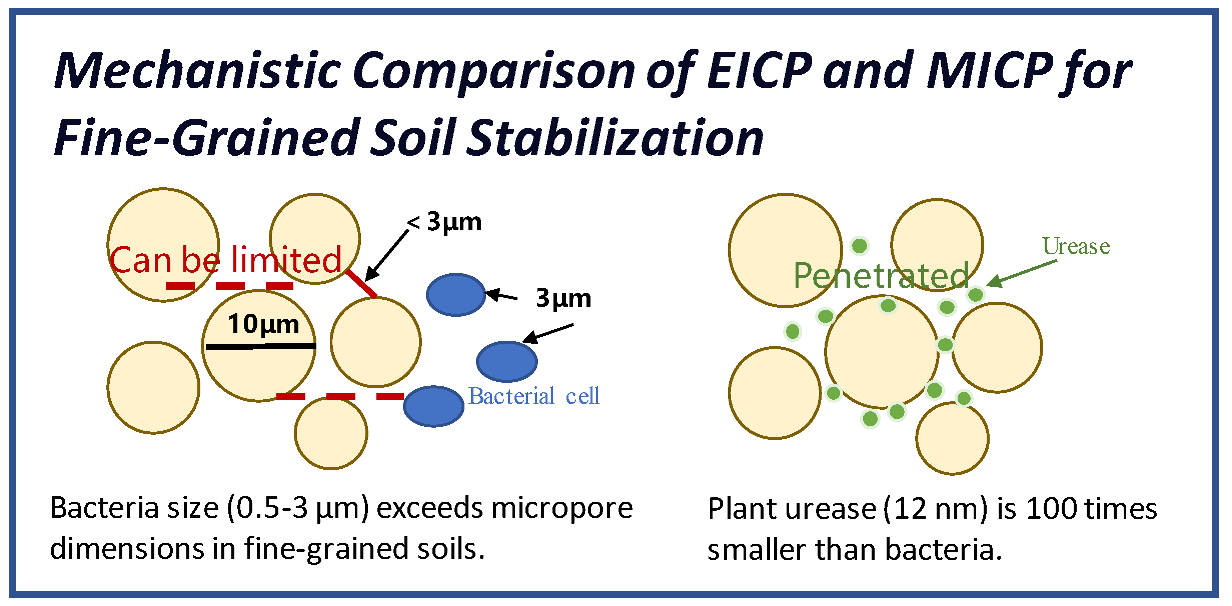
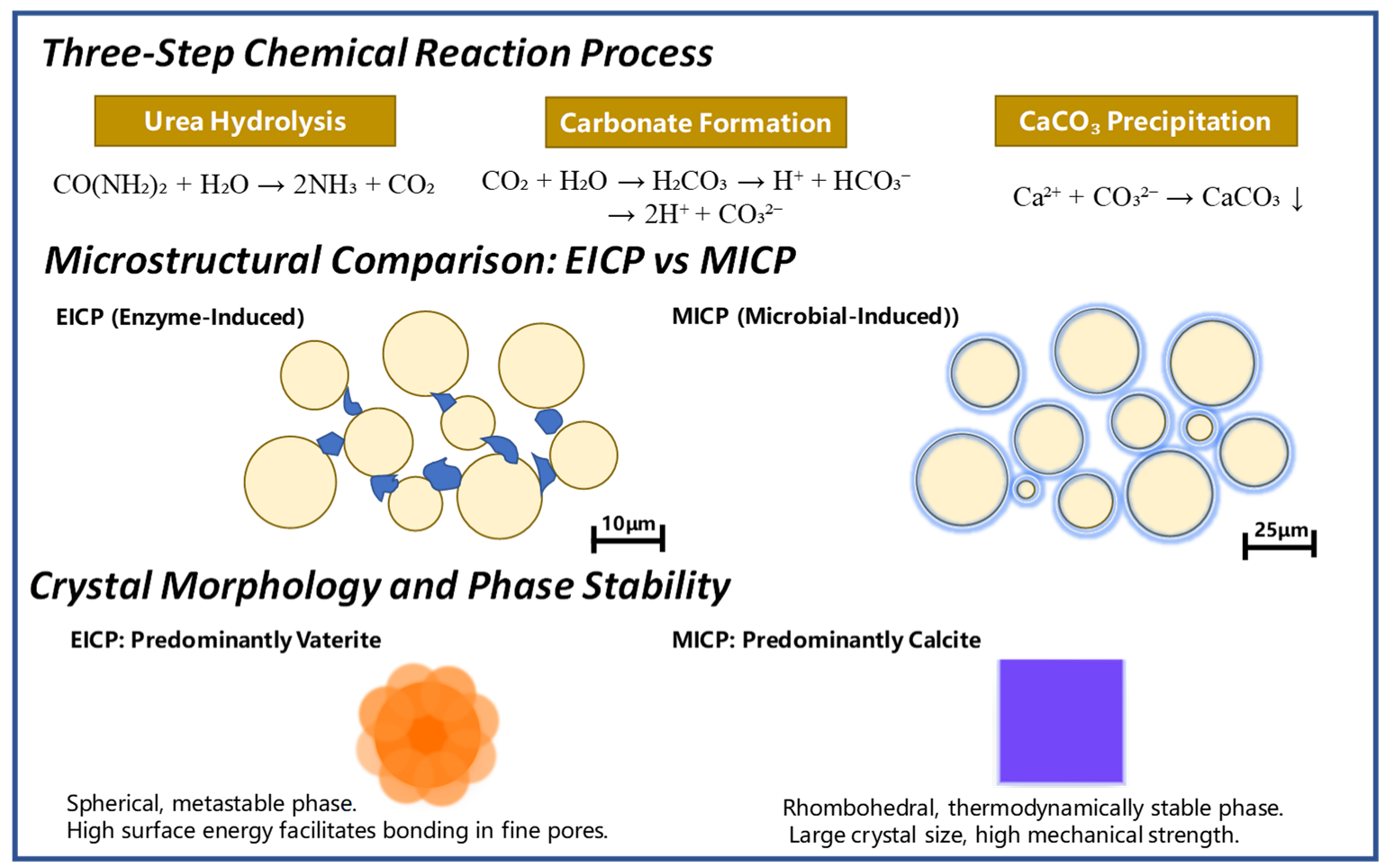
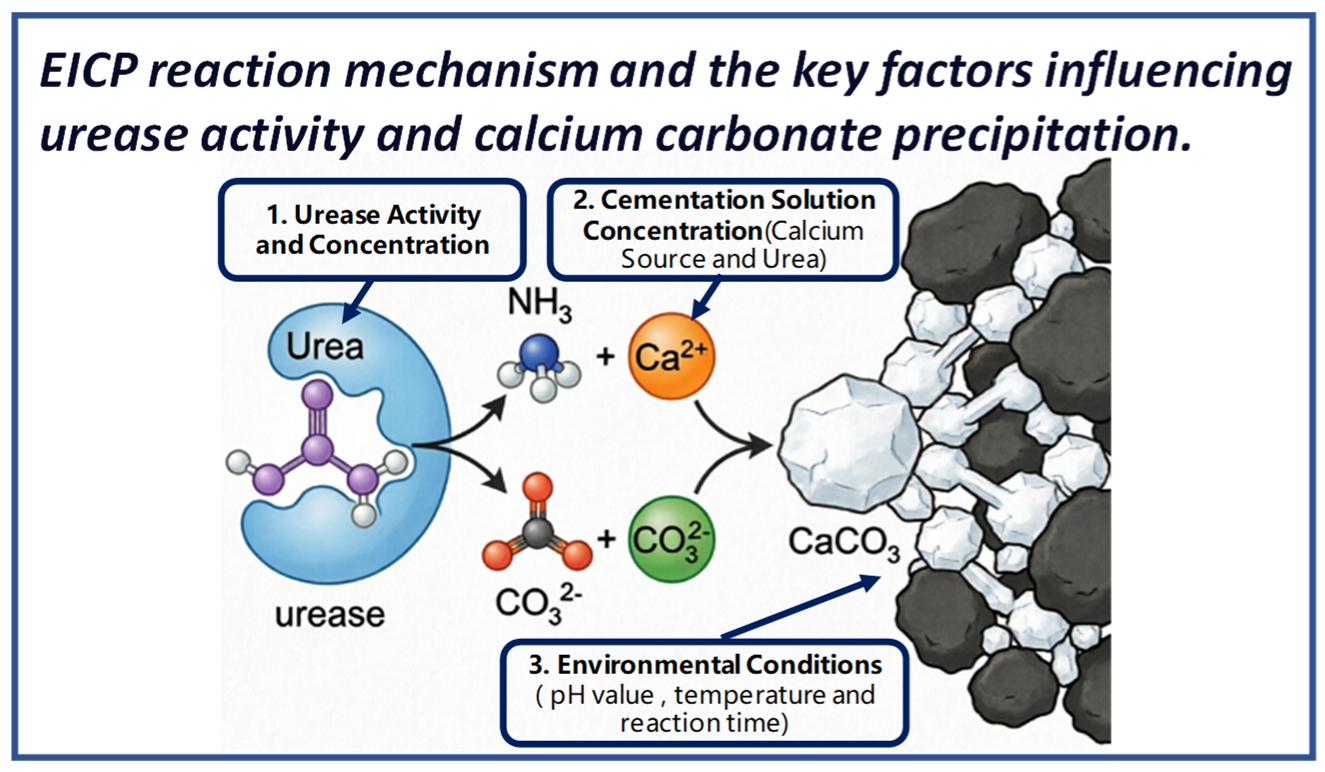
2. Reaction Mechanism and Solidification Mechanism of EICP
3. Source and Preparation of Urease
3.1. Types and Sources of Urease

| Urease Source | Typical Urease Activity (U/g Dry Weight) | Extraction Yield (mg/g Dry Weight) | Urease Extraction Potential |
|---|---|---|---|
| Soybean | 150–250 | 8–12 | A common source of urease due to its widespread use as a food material [16]. |
| Jack bean | 200–300 | 10–15 | An uncommon bean, and literature studies have shown it contains abundant urease [17] |
| Milk Vetch | 180–280 | 9–14 | Contains abundant proteins and is likely a good source of urease [18]. |
| Red Kidney Bean | 220–320 | 11–16 | Rich in proteins and likely contains urease with relatively high activity [19]. |
| Adzuki Bean | 160–240 | 7–11 | A traditionally common food material and may be an effective source of urease [20]. |
| Mung Bean | 140–220 | 6–10 | Widely cultivated in China, and its urease content is likely to be high [21]. |
| Black Soybean | 170–260 | 8–13 | With a distinctive black appearance and large color difference from yellow beans, it may possess unique urease types [22]. |
| Spotted Bean | 190–290 | 9–14 | With unique appearance, its urease is worth studying [23]. |
| Red Adzuki Bean | 160–240 | 7–11 | Similar to red beans, it has high protein content as a common food material and may contain urease with properties compatible with EICP [24]. |
| White Hyacinth Bean | 130–210 | 6–9 | With abundant proteins, it may contain urease required for EICP processing [25]. |
| Panda Bean | 180–270 | 8–12 | With unique appearance and high nutritional value, it may also contain urease [26]. |
| White Kidney Bean | 210–310 | 10–15 | Rich in proteins and may contain active urease [27]. |
3.2. Optimization of Preparation Process
4. Analysis of Key Influencing Factors
4.1. Reaction Solution Parameters
| Urease Source | Typical Urease Solution Concentration (g/L) | Urea Concentration Range (M) | Cementitious Solution Concentration Range (M) | Common Urea:Ca2+ Molar Ratio |
|---|---|---|---|---|
| Soybean | 0.45, 2.5, 7.5, 10 | 0.75–1.5 | 0.05–2.0 | 1:1, 1.5:1, 2:1 [46,47,48,49] |
| Jack bean | 0.45, 2.5 | 1.0–1.5 | 0.05–2.0 | 1.5:1, 2:1 [50,51] |
4.2. Soil Properties
4.3. Impact of Temperature on Kinetics and Precipitation
| Urease Source | Stress Factor | Quantitative Decay Metric | Observed Trend & Implication |
|---|---|---|---|
| Formate Dehydrogenase (FDH)/Plant Urease | Temperature (37 °C vs. 25 °C) | t1/2 reduced by 68% at 37 °C | Thermal Acceleration: Enzymatic hydrolysis rates double every 10 °C rise, but thermal denaturation accelerates, drastically shortening half-life [31]. |
| Canavalia ensiformis (Jack bean) | Temperature (70 °C exposure) | Ar = 45% after 60 min at 70 °C | Irreversible Denaturation: Sustained high temperatures degrade the enzyme’s tertiary structure, leading to permanent loss of catalytic function [44]. |
| Soybean-derived extract | pH (pH 5.0 vs. pH 7.0) | Ar dropped to <20% at pH 5.0 | pH Sensitivity: Deviating from the optimal pH (7.0–8.0) disrupts the active site’s ionization state, severely impeding substrate binding [47]. |
| Crude bacterial/cell-free extract | Storage Time (4 °C vs. 25 °C) | t1/2 of 14 days at 25 °C vs. >30 days at 4 °C | Storage Stability: Refrigeration (4 °C) is critical for preserving enzymatic potency; room temperature storage leads to rapid autolysis [54]. |
| Commercial/Purified urease | Combined pH & Temp (pH 8.0 & 20 °C) | Maintained >85% activity for 72 h | Synergistic Stability: Mild, near-optimal conditions significantly extend the functional window required for complete urea hydrolysis in soil pores [55]. |
4.4. Additives and Modification
4.5. Injection Process
| Method | Soil Type/ Gradation | Uniformity Coeff. (Cu) | Uniformity Metric (CoV) | Key Quantitative Observation on Injectability/Limitations |
|---|---|---|---|---|
| EICP & MICP | Shale/Dolomitic Rocks | / | Low CoV | High injectability into micro-porosity; MICP created stronger macro-bonds, EICP showed better pore penetration [50]. |
| EICP & MICP | Earthen Sites (Low Density) | Wide grading | Moderate CoV | Successful injection, but challenges in achieving uniform deep-layer precipitation due to conflicting density gradients [55]. |
| EICP | Sandy Soil | Well-graded | CoV decreased with optimization | One-phase-low-pH method significantly improved injectability and reduced clogging at the injection point [59]. |
| EICP & MICP | Standard Sand | Uniform (Cu = 2) | CoV | Excellent injectability and homogeneity in uniform coarse sands; distinct crystal morphologies observed [60]. |
| EICP | Red Mud | Fine-grained (Cu < 5) | CoV | Severe injectability limitations; rapid surface clogging occurred, restricting penetration depth and causing non-uniform treatment [61]. |
4.6. Performance and Limitations
| Soil Type/ Condition | Initial/Final Soil Classification | CaCO3 Precipitation (%) | Achieved UCS/ Improvement | Quantitative Conclusion on Soil Dependency |
|---|---|---|---|---|
| Silty Sand/Fine Sand | SP-SM/SM | 1–5% | UCS increased by 150–300% | EICP is highly effective in fine-grained sands, but efficiency drops sharply when the pore throat size is smaller than the enzyme molecule/clay particle size [9]. |
| Desert Sand (SICP) | SP | 3–10% | Erosion mass loss reduced by 70–95% | In uniform fine sands, plant-derived EICP (SICP) effectively binds particles, proving soil gradation critically dictates the mechanism of erosion control [49]. |
| Peat Soil (with Mg-Gypsum) | PT/OH | / | Significant strength gain observed | Direct EICP in peat is limited; however, adding synthetic gypsum alters plasticity and enables successful bio-cementation, showing dependency on soil chemistry [52]. |
| Fine-grained Soils (Silt/Clay) | ML/CL | 1–4% | / | Pure cohesive soils hinder enzyme transport. Mixing with coarse sand/aggregates is quantitatively proven to restore permeability and precipitation uniformity [66]. |
4.7. Laboratory to Field Implementation
| Method | Scale | Target Substrate/Soil | Precipitated CaCO3 (%) | Strength Gain (UCS/kPa) | Uniformity/Key Observation |
|---|---|---|---|---|---|
| MICP & EICP | Lab | Sand/Silty Sand | ~18% | 1200 kPa | Homogeneous distribution; high strength due to controlled flow [21]. |
| EICP & MICP | Lab | Sand | 15–22% | 1500–2500 kPa | Distinct crystal morphologies; EICP showed finer, more uniform bonds [24]. |
| EICP | Lab | Earthen Heritage Substrate | 12.5% | 1100 kPa | Effective reinforcement in low-density earthen structures. |
| EICP &MICP | Lab | Shale/Dolomitic Rocks | / | Increased tensile strength | MICP created stronger bonds; EICP showed better pore penetration [27]. |
| MICP | Field | Natural Slope/Hydrological Site | 9.8% | 450 kPa | Significant reduction in hydraulic conductivity; moderate strength gain [46]. |
| EICP & MICP | Field | Sandstone Built Heritage | 8.5% | 600 kPa | Successful in situ consolidation, though slightly lower CaCO3 than lab [51]. |
| EICP | Field | Earthen Heritage Site | 7.2% | 380 kPa | Non-uniform precipitation due to in situ moisture and temperature fluctuations [69]. |
| Lab | Homogeneous media | Higher (15–22%) | Higher (1000–2500 kPa) | High Uniformity [73] | |
| Field | Heterogeneous media | Lower (7–10%) | Lower (300–600 kPa) | Lower Uniformity (Influenced by in situ variability) [72] |
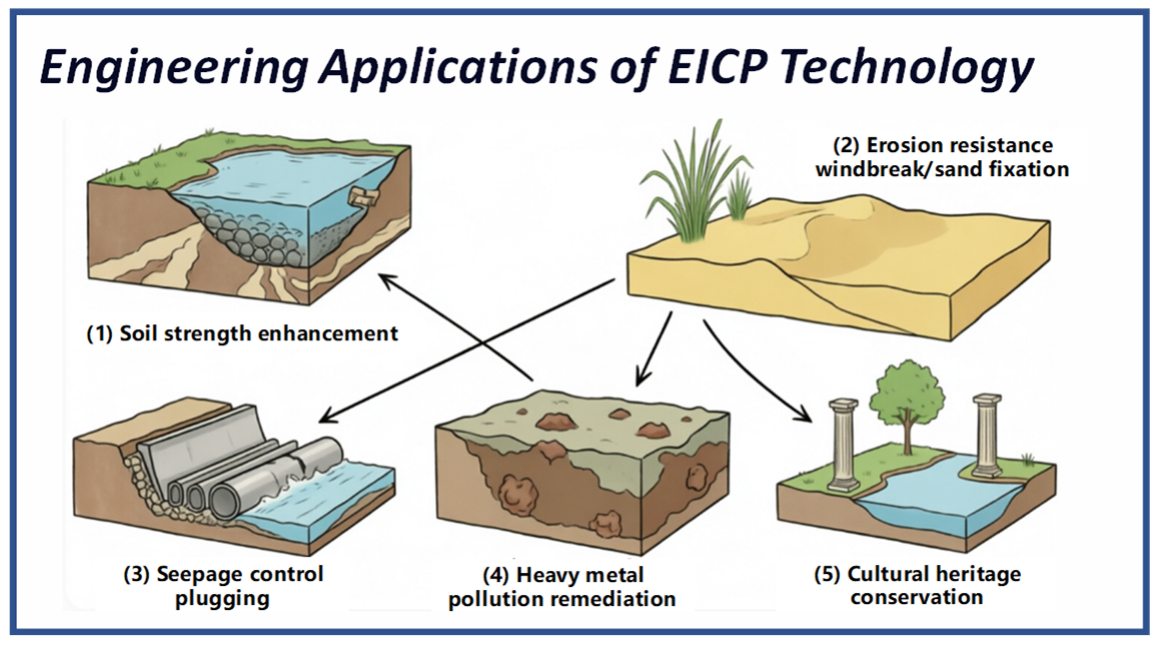
5. Engineering Applications and Improvement Effects
5.1. Soil Strength Enhancement
| Method | Soil Type/Clay Content | Cohesion (c)/UCS Increase | Internal Friction Angle (ϕ) Change | Stress–Strain Behavior & Qualitative Observation |
|---|---|---|---|---|
| EICP/MICP | Sand & Silt | C increased by 150–300% (UCS up to 2–5 MPa) | Slight decrease (3°–5°) due to particle lubrication | Transition to Ductile-Brittle: Stress–strain curves shifted from strain-hardening (loose) to distinct peak/strain-softening behavior [77]. |
| EICP/MICP | Ottawa Sand | Liquefaction resistance doubled at CSR 0.2 | Remained relatively constant (~35°) | Enhanced Dilatancy: Treated samples showed higher shear modulus and delayed contraction-to-dilation transition under simple shear [79]. |
| EICP/MICP | Standard/Fine Sand | C increased by 100–200 kPa | Minor variation (±2°) | Strain Localization: Treated sand exhibited a clear peak strength followed by gradual softening, contrasting with the monotonic hardening of untreated sand [82]. |
| MICP | Earthen Heritage Soil | UCS increased by 400–600% | Increased by 5°–8° | Quasi-Brittle Failure: Introduction of CaCO3 cementation caused a distinct linear-elastic rise to a sharp peak, followed by abrupt post-peak drop [85]. |
| EICP/MICP | Coarse Sand | C increases linearly | Φ slightly decreases | Softening: Exhibits strain-hardening behavior; failure is diffusing without a distinct peak [88,89]. |
| EICP/MICP | Treated Silt/Clay | C plateaus at high values | Φ may increase due to sand-like skeleton | Brittle Fracture: Clear peak stress followed by rapid loss of strength (strain-softening); prone to sudden shear band formation [90]. |
5.2. Durability
5.3. Dynamic Properties
5.4. Erosion Resistance and Windbreak/Sand Fixation
5.5. Anti-Seepage and Plugging
5.6. Heavy Metal Pollution Remediation
5.7. Hydraulic Properties
5.8. Other Applications
6. Challenges and Limitations Faced
6.1. Nucleation Site Deficiency Issue
6.2. Enzyme Stability and Cost Issues
6.3. By-Product Pollution Issue
6.4. Homogeneity Control Challenge
6.5. Insufficient Long-Term Durability Verification
6.6. Economic and Environmental Perspectives
6.7. Engineering Implementation and Constructability
7. Research Gaps and Future Prospects
7.1. Identification of Research Gaps
7.2. Future Research Directions and Opportunities
7.2.1. Nucleation Agent and Crystal Morphology Regulation Research
7.2.2. Grouting Process Innovation and Optimization
7.2.3. Fine-Grained Soil Application and Performance Prediction
7.2.4. Environmental Impact and Sustainable Development
7.2.5. Standardization and Engineering Application
8. Conclusions
Author Contributions
Funding
Institutional Review Board Statement
Informed Consent Statement
Data Availability Statement
Conflicts of Interest
References
- Yang, Y.; Liu, Z.; Yang, Q.; Guo, C.; Hu, Y.; Xiao, H.; Xia, D.; Wu, J.; Lu, Y.; Hu, X.; et al. Synergistic application of sandy ecological substrate through high-calcium fly ash and enzyme-induced carbonate precipitation integration. J. Environ. Chem. Eng. 2025, 13, 116783. [Google Scholar] [CrossRef]
- Zeng, G.; Wan, J.; Huang, D.; Hu, L.; Huang, C.; Cheng, M.; Xue, W.; Gong, X.; Wang, R.; Jiang, D. Precipitation, adsorption and rhizosphere effect: The mechanisms for Phosphate-induced Pb immobilization in soils—A review. J. Hazard. Mater. 2017, 339, 354–367. [Google Scholar] [CrossRef]
- Cui, M.-J.; Teng, A.; Chu, J.; Cao, B. A quantitative, high-throughput urease activity assay for comparison and rapid screening of ureolytic bacteria. Environ. Res. 2022, 208, 112738. [Google Scholar] [CrossRef] [PubMed]
- Gao, Y.; He, J.; Tang, X.; Chu, J. Calcium carbonate precipitation catalyzed by soybean urease as an improvement method for fine-grained soil. Soils Found. 2019, 59, 1631–1637. [Google Scholar] [CrossRef]
- Pang, S.; Yang, J.; Liu, G.; Zhang, H.; Ni, W.; Fan, H.; Meng, M. Shear strength and solidification mechanism of EICP-solidified waste sand to improve loess. J. Environ. Chem. Eng. 2026, 14, 122355. [Google Scholar] [CrossRef]
- Wang, Y.; Wang, Z.; Chen, Y.; Cao, T.; Yu, X.; Rui, P. Experimental study on bio-treatment effect of the dredged Yellow River silt based on soybean urease induced calcium carbonate precipitation. J. Build. Eng. 2023, 75, 106943. [Google Scholar] [CrossRef]
- Liu, B.; Zhu, C.; Tang, C.-S.; Xie, Y.-H.; Yin, L.-Y.; Cheng, Q.; Shi, B. Bio-remediation of desiccation cracking in clayey soils through microbially induced calcite precipitation (MICP). Eng. Geol. 2020, 264, 105389. [Google Scholar] [CrossRef]
- Gao, Y.; Ren, G.; Fan, H.; Li, X.; Pang, S.; Meng, M. Study on the modification of different kinds of dispersive soils using EICP: Comparative analysis with traditional modification materials. J. Environ. Chem. Eng. 2025, 13, 115826. [Google Scholar] [CrossRef]
- Martin, K.K.; Khodadadi Tirkolaei, H.; Kavazanjian, E. Mid-scale biocemented soil columns via enzyme-induced carbonate precipitation (EICP). Soils Found. 2021, 61, 1529–1542. [Google Scholar] [CrossRef]
- Hoang, T.; Alleman, J.; Cetin, B.; Ikuma, K.; Choi, S.-G. Sand and silty-sand soil stabilization using bacterial enzyme–induced calcite precipitation (BEICP). Can. Geotech. J. 2019, 56, 808–822. [Google Scholar] [CrossRef]
- Mi, T.; Peng, L.; Yu, K.; Zhao, Y. Enhancement strategies for recycled brick aggregate concrete using MICP and EICP treatments. J. Build. Eng. 2023, 79, 107909. [Google Scholar] [CrossRef]
- Weng, Y.; Zheng, J.; Lai, H.; Cui, M.; Ding, X. Biomineralization of soil with crude soybean urease using different calcium salts. J. Rock Mech. Geotech. Eng. 2024, 16, 1788–1798. [Google Scholar] [CrossRef]
- Cui, M.-J.; Chu, J.; Lai, H.-J. Optimization of one-phase-low-pH enzyme-induced carbonate precipitation method for soil improvement. Acta Geotech. 2024, 19, 1611–1625. [Google Scholar] [CrossRef]
- Arab, M.G.; Omar, M.; Almajed, A.; Elbaz, Y.; Ahmed, A.H. Hybrid technique to produce bio-bricks using enzyme-induced carbonate precipitation (EICP) and sodium alginate biopolymer. Constr. Build. Mater. 2021, 284, 122846. [Google Scholar] [CrossRef]
- Cui, M.-J.; Zheng, J.-J.; Zhang, R.-J.; Lai, H.-J.; Zhang, J. Influence of cementation level on the strength behaviour of bio-cemented sand. Acta Geotech. 2017, 12, 971–986. [Google Scholar] [CrossRef]
- Xue, Y.; Arulrajah, A.; Chu, J.; Horpibulsuk, S. Soybean urease-based EICP stabilization of washed recycled sands derived from demolition wastes cured at low temperatures. Constr. Build. Mater. 2024, 434, 136735. [Google Scholar] [CrossRef]
- Liu, L.; Gao, Y.; Geng, W.; Song, J.; Zhou, Y.; Li, C. Comparison of jack bean and soybean crude ureases on surface stabilization of desert sand via enzyme-induced carbonate precipitation. Geoderma 2023, 435, 116504. [Google Scholar] [CrossRef]
- Liew, C.Y.; Luo, H.-S.; Chen, J.-L.; Ni, C.-K. High Abundance of Unusual High Mannose N-Glycans Found in Beans. ACS Omega 2024, 9, 45822–45827. [Google Scholar] [CrossRef]
- Srenuja, D.; Hema, V.; Anand, M.T.; Mohan, R.J.; Vidyalakshmi, R. Kidney bean: Protein’s treasure trove and creates avenues for a healthy lifestyle. Legume Sci. 2023, 5, e193. [Google Scholar] [CrossRef]
- Liu, Z.; Miao, Q.; Zhang, Q.; Gan, J.; Cao, W.; Zhu, X.; Zhang, K.; Zhu, Q.; Dang, Q.; Deng, E. Pilot Study of Enzyme-Induced Calcium Carbonate Precipitation (EICP) Technique Based on Soybean and Potato Ureases. In Proceedings of the 2025 2nd International Conference on Civil Engineering Structures and Concrete Materials (CESCM 2025); Atlantis Press: Dordrecht, The Netherlands, 2025; pp. 217–231. [Google Scholar]
- Zhou, Q.; Chen, Y.; Peng, L.; Wu, J.; Hao, W.; Wang, M. Sprouting facilitates the antiglycative effect of black soybean (Glycine max (L.) Merr.) by promoting the accumulation of isoflavones. Curr. Res. Food Sci. 2024, 9, 100827. [Google Scholar] [CrossRef]
- Bian, H.; Liu, S.; Wang, P.; Hou, H.; Zhang, X.; Su, C.; Wan, H. Solidification of Pb-Contaminated Soil by Enzyme-Induced Carbonate Precipitation (EICP) Employing Different Enzymatic and Calcium Sources. J. Environ. Chem. Eng. 2026, 14, 120543. [Google Scholar] [CrossRef]
- Castro-Rubio, F.; Marina, M.L.; García, M.C. Perfusion reversed-phase high-performance liquid chromatography/mass spectrometry analysis of intact soybean proteins for the characterization of soybean cultivars. J. Chromatogr. A 2007, 1170, 34–43. [Google Scholar] [CrossRef]
- Yu, X. Laboratory and Field Testing in Support of Field Studies of Enzyme Induced Carbonate Precipitation (EICP) for Fugitive Dust Control. Master’s Thesis, Arizona State University, Tempe, AZ, USA, 2023. [Google Scholar]
- Ge, J.; Sun, C.; Chang, Y.; Li, S.; Zhang, Y.; Fang, Y. Understanding the differences in heat-induced gel properties of twelve legume proteins: A comparative study. Food Res. Int. 2023, 163, 112134. [Google Scholar] [CrossRef]
- Ashraf, J.; Liu, L.; Awais, M.; Xiao, T.; Wang, L.; Zhou, X.; Tong, L.-T.; Zhou, S. Effect of thermosonication pre-treatment on mung bean (Vigna radiata) and white kidney bean (Phaseolus vulgaris) proteins: Enzymatic hydrolysis, cholesterol lowering activity and structural characterization. Ultrason. Sonochem. 2020, 66, 105121. [Google Scholar] [CrossRef]
- Xu, K.; Huang, M.; Cui, M.; Jin, G.; Li, S. Micromechanical properties and bonding fracture of EICP-reinforced sand analyzed using microindentation test. Acta Geotech. 2025, 284, 122846. [Google Scholar] [CrossRef]
- Lee, H.W.; Rahmaninezhad, S.A.; Meng, L.; Srubar, W.V.; Sales, C.M.; Farnam, Y.; Hubler, M.H.; Najafi, A.R. Prediction of microbial-induced calcium carbonate precipitation for self-healing cementitious material. Cem. Concr. Compos. 2025, 158, 105945. [Google Scholar] [CrossRef]
- Meng, H.; Shu, S.; Gao, Y.; Yan, B.; He, J. Multiple-phase enzyme-induced carbonate precipitation (EICP) method for soil improvement. Eng. Geol. 2021, 294, 106374. [Google Scholar] [CrossRef]
- Cui, M.-J.; Lai, H.-J.; Hoang, T.; Chu, J. One-phase-low-pH enzyme induced carbonate precipitation (EICP) method for soil improvement. Acta Geotech. 2020, 16, 481–489. [Google Scholar] [CrossRef]
- Lai, H.; Ding, X.; Cui, M.; Zheng, J.; Chu, J.; Chen, Z.; Zhang, J. A new bacterial concentration method for large-scale applications of biomineralization. J. Rock Mech. Geotech. Eng. 2024, 16, 5109–5120. [Google Scholar] [CrossRef]
- Lai, H.-J.; Cui, M.-J.; Chu, J. Effect of pH on soil improvement using one-phase-low-pH MICP or EICP biocementation method. Acta Geotech. 2022, 18, 3259–3272. [Google Scholar] [CrossRef]
- Xiao, Y.; He, X.; Wu, W.; Stuedlein, A.W.; Evans, T.M.; Chu, J.; Liu, H.; van Paassen, L.A.; Wu, H. Kinetic biomineralization through microfluidic chip tests. Acta Geotech. 2021, 16, 3229–3237. [Google Scholar] [CrossRef]
- Guan, D.; Zhou, Y.; Shahin, M.A.; Khodadadi Tirkolaei, H.; Cheng, L. Assessment of urease enzyme extraction for superior and economic bio-cementation of granular materials using enzyme-induced carbonate precipitation. Acta Geotech. 2022, 18, 2263–2279. [Google Scholar] [CrossRef]
- Song, Z.; Wu, C.; Shen, D.; He, M.; Zhang, F. Microbially induced carbonate precipitation under high temperature and high pressure: Implications for geological CO2 storage. J. Rock Mech. Geotech. Eng. 2025, 17, 3872–3882. [Google Scholar] [CrossRef]
- Yue, J.; Zhao, L.; Zhang, B.; Kong, Q.; Wang, S.; Wang, H.; Garcia-Granda, S. Effect of Glutinous Rice Slurry on the Reinforcement of Silt in the Yellow River Basin by Microbially Induced Carbonate Precipitation (MICP): Mechanical Property and Microcosmic Structure. Adv. Mater. Sci. Eng. 2021, 2021, 5539854. [Google Scholar] [CrossRef]
- Zhang, S.; Wu, C.; Li, Z.; Song, Z.; Liu, Z.; Zhang, S. Experimental investigation on the failure behavior of EICP combined with sisal fiber-reinforced sandy soil subjected to plasma blasting. Acta Geotech. 2025, 21, 767–789. [Google Scholar] [CrossRef]
- Xiao, Y.; Fu, G.; Shi, J.; Huang, X.; Cui, H.; Liu, H. Bio-hydrogel and biomineralization in improving water retention ability of sandy soils. Acta Geotech. 2025, 20, 4589–4597. [Google Scholar] [CrossRef]
- Ahenkorah, I.; Rahman, M.M.; Karim, M.R.; Beecham, S. Enzyme induced calcium carbonate precipitation and its engineering application: A systematic review and meta-analysis. Constr. Build. Mater. 2021, 308, 125000. [Google Scholar] [CrossRef]
- Baffoe, E.; Ghahremaninezhad, A. The effect of biomolecules on enzyme-induced calcium carbonate precipitation in cementitious materials. Constr. Build. Mater. 2022, 345, 128323. [Google Scholar] [CrossRef]
- Almajed, A.; Abbas, H.; Arab, M.; Alsabhan, A.; Hamid, W.; Al-Salloum, Y. Enzyme-Induced Carbonate Precipitation (EICP)-Based methods for ecofriendly stabilization of different types of natural sands. J. Clean. Prod. 2020, 274, 122627. [Google Scholar] [CrossRef]
- Chen, Y.-Q.; Wang, S.-Q.; Tong, X.-Y.; Kang, X. Crystal transformation and self-assembly theory of microbially induced calcium carbonate precipitation. Appl. Microbiol. Biotechnol. 2022, 106, 3555–3569. [Google Scholar] [CrossRef]
- Yu, X.; Chu, J.; Yang, Y.; Qian, C. Reduction of ammonia production in the biocementation process for sand using a new biocement. J. Clean. Prod. 2021, 286, 124928. [Google Scholar] [CrossRef]
- Diao, Y.; Zhang, L.; Hu, Q.; Zhu, D.; Wang, C.; Jiang, Z.; Huang, J. Characterization of mechanical behavior and cementing mechanism of high-strength composites using biomimetic chemically induced calcium carbonate precipitation method. Constr. Build. Mater. 2024, 446, 138032. [Google Scholar] [CrossRef]
- Hang, L.; Yang, F.; Xu, J.; Zhao, Z.; Xiao, W.; He, J. Experimental Study on the Effective Production of Biocement for Soil Solidification and Wind Erosion Control. Sustainability 2023, 15, 5402. [Google Scholar] [CrossRef]
- Mahamaya, M.; Das, S.K.; Reddy, K.R.; Jain, S. Interaction of biopolymer with dispersive geomaterial and its characterization: An eco-friendly approach for erosion control. J. Clean. Prod. 2021, 312, 127778. [Google Scholar] [CrossRef]
- Sun, X.; Miao, L.; Yuan, J.; Wang, H.; Wu, L. Application of enzymatic calcification for dust control and rainfall erosion resistance improvement. Sci. Total Environ. 2021, 759, 143468. [Google Scholar] [CrossRef]
- Rodriguez-Navarro, C.; Ilić, T.; Ruiz-Agudo, E.; Elert, K. Carbonation mechanisms and kinetics of lime-based binders: An overview. Cem. Concr. Res. 2023, 173, 107301. [Google Scholar] [CrossRef]
- Dubey, A.A.; Dhami, N.K.; Ravi, K.; Mukherjee, A. Erosion mitigation with biocementation: A review on applications, challenges, & future perspectives. Rev. Environ. Sci. Bio/Technol. 2023, 22, 1059–1091. [Google Scholar]
- Ma, G.; Fang, Q.; Xiao, Y.; Chu, J.; Liu, H. Microscopic investigation on bonding fracture of biocemented sand from novel in situ brazil splitting tests. Acta Geotech. 2022, 17, 4935–4951. [Google Scholar] [CrossRef]
- Ahenkorah, I.; Rahman, M.M.; Karim, M.R.; Beecham, S.; Saint, C. A Review of Enzyme Induced Carbonate Precipitation (EICP): The Role of Enzyme Kinetics. Sustain. Chem. 2021, 2, 92–114. [Google Scholar] [CrossRef]
- Zheng, C.-T.; Pan, X.-H.; Li, X.-Z.; Tang, C.-S.; Shi, B. Practical bio-healing of rock weathering cracks using an enzyme-induced magnesia carbonization. J. Rock Mech. Geotech. Eng. 2025, 17, 3662–3675. [Google Scholar] [CrossRef]
- Bian, H.; Ma, Y.; Ji, P.; Zhang, G.; Liu, Z.; Chu, Y.; Zhang, J. Effect of enzyme-induced carbonate precipitation (EICP) combined with biochar on lead-contaminated soil solidification and plant growth. J. Environ. Chem. Eng. 2025, 13, 116977. [Google Scholar] [CrossRef]
- Liu, L.; Gao, Y.; Meng, H.; Cao, X.; Wang, Z.; Liu, B.; He, J. Bio-reinforcement efficiency of enzyme-induced carbonate precipitation modified by sword bean crude urease combined with multiple enhancers on bio-cemented sand. Acta Geotech. 2024, 20, 1193–1212. [Google Scholar] [CrossRef]
- Wu, L.; Miao, L.; Kawasaki, S.; Wang, H. Effects of Reaction Conditions on EICP-Treated Desert Aeolian Sand. KSCE J. Civ. Eng. 2022, 26, 2662–2674. [Google Scholar] [CrossRef]
- Yu, L.; Jing, T.; Zhang, J.; Xiao, H.; Zhou, L. Experimental study on synergistic reinforcement of riverbanks by enzyme-induced carbonate precipitation and plant roots. J. Environ. Chem. Eng. 2025, 13, 119532. [Google Scholar] [CrossRef]
- Kou, H.-L.; Liu, J.-H.; Zhang, P.; Wu, C.; Ni, P.; Wang, D. Ecofriendly improvement of coastal calcareous sandy slope using recycled shredded coconut coir (RSC) and bio-cement. Acta Geotech. 2022, 17, 5375–5389. [Google Scholar] [CrossRef]
- Shu, S.; Yan, B.; Ge, B.; Li, S.; Meng, H. Factors Affecting Soybean Crude Urease Extraction and Biocementation via Enzyme-Induced Carbonate Precipitation (EICP) for Soil Improvement. Energies 2022, 15, 5566. [Google Scholar] [CrossRef]
- Liu, Y.; Gao, Y.; He, J.; Zhou, Y.; Geng, W. An experimental investigation of wind erosion resistance of desert sand cemented by soybean-urease induced carbonate precipitation. Geoderma 2023, 429, 116231. [Google Scholar] [CrossRef]
- Crane, L.; Ray, H.; Hamdan, N.; Boyer, T.H. Enzyme-induced carbonate precipitation utilizing fresh urine and calcium-rich zeolites. J. Environ. Chem. Eng. 2022, 10, 107238. [Google Scholar] [CrossRef]
- Sun, X.; Miao, L.; Wang, H.; Yuan, J.; Fan, G. Enhanced rainfall erosion durability of enzymatically induced carbonate precipitation for dust control. Sci. Total Environ. 2021, 791, 148369. [Google Scholar] [CrossRef]
- Zhang, J.; Wang, X.; Shi, L.; Yin, Y. Enzyme-induced carbonate precipitation (EICP) combined with lignin to solidify silt in the Yellow River flood area. Constr. Build. Mater. 2022, 339, 127792. [Google Scholar] [CrossRef]
- Lai, H.-J.; Liu, H.; Cui, M.-J.; Zheng, J.-J.; Chen, Z.-B.; Zhang, Z.-C. Inorganic flocculant-based soybean urease extraction and its effect on biomineralization. J. Clean. Prod. 2024, 460, 142539. [Google Scholar] [CrossRef]
- Han, L.-J.; Li, J.-S.; Xue, Q.; Guo, M.-Z.; Wang, P.; Poon, C.S. Enzymatically induced phosphate precipitation (EIPP) for stabilization/solidification (S/S) treatment of heavy metal tailings. Constr. Build. Mater. 2022, 314, 125577. [Google Scholar] [CrossRef]
- Chen, Y.; Wang, Q.; Bian, Y.; Zhan, L.; Gao, Y.; Guo, H.; Wang, Y.; Gao, Y. Effects of enzyme-induced carbonate precipitation (EICP) with different urease sources on the zinc remediation. J. Hazard. Mater. 2024, 480, 136321. [Google Scholar] [CrossRef]
- Fan, W.; Xiao, Y.; Cao, B.; Wu, S.; Cui, H.; Chu, J.; Liu, H. Effects of biostimulation treatment methods on mechanical properties and microstructure characteristics of biocemented soil. Acta Geotech. 2025, 20, 2163–2184. [Google Scholar] [CrossRef]
- Ojha, A.; Bandyopadhyay, T.K.; Das, D.; Dey, P. Microbial Carbonate Mineralization: A Comprehensive Review of Mechanisms, Applications, and Recent Advancements. Mol. Biotechnol. 2025, 68, 1079–1105. [Google Scholar] [CrossRef]
- Wang, Y.; Sun, X.; Miao, L.; Wang, H.; Wu, L.; Shi, W.; Kawasaki, S. State-of-the-art review of soil erosion control by MICP and EICP techniques: Problems, applications, and prospects. Sci. Total Environ. 2024, 912, 169016. [Google Scholar] [CrossRef]
- Xie, D.; Zhang, R.; Wang, J. The influence of environmental factors and precipitation precursors on enzyme-induced carbonate precipitation (EICP) process and its application on modification of recycled concrete aggregates. J. Clean. Prod. 2023, 395, 136444. [Google Scholar] [CrossRef]
- Zhang, Q.; Ye, W.; Wang, Q.; Chen, Y. Mechanical behaviour of EICP-treated calcareous sands: Experimental study and constitutive modelling. Comput. Geotech. 2025, 184, 107308. [Google Scholar] [CrossRef]
- Weng, Y.; Lai, H.; Zheng, J.; Cui, M.; Chen, Y.; Xu, Z.; Jiang, W.; Zhang, J.; Song, Y. Effect of acid type on biomineralization of soil using crude soybean urease solution. J. Rock Mech. Geotech. Eng. 2024, 16, 5135–5146. [Google Scholar] [CrossRef]
- Shi, L.; Huo, L.; Fang, J.; Xu, X.; Zhang, J. Investigation on hydraulic conductivity reduction for silty sand by enzyme induced calcium carbonate precipitation considering urease activity and cementing solution concentration. Eng. Geol. 2025, 356, 108316. [Google Scholar] [CrossRef]
- Dubey, A.A.; Hooper-Lewis, J.; Ravi, K.; Dhami, N.K.; Mukherjee, A. Biopolymer-biocement composite treatment for stabilisation of soil against both current and wave erosion. Acta Geotech. 2022, 17, 5391–5410. [Google Scholar] [CrossRef]
- Nikseresht, F.; Landi, A.; Sayyad, G.; Ghezelbash, G.R.; Schulin, R. Sugarecane molasse and vinasse added as microbial growth substrates increase calcium carbonate content, surface stability and resistance against wind erosion of desert soils. J. Environ. Manag. 2020, 268, 110639. [Google Scholar] [CrossRef]
- Omoregie, A.I.; Muda, K.; Ong, D.E.L.; Ojuri, O.O.; Bakri, M.K.B.; Rahman, M.R.; Basri, H.F.; Ling, Y.E. Soil bio-cementation treatment strategies: State-of-the-art review. Geotech. Res. 2024, 11, 3–27. [Google Scholar] [CrossRef]
- Shivaprakash, S.H.; Burns, S.E. Microbial interactions during carbonate biomineralization via urea hydrolysis metabolic pathway. Acta Geotech. 2025, 20, 3929–3950. [Google Scholar] [CrossRef]
- Emminger, Y.H.; Ladner, L.; Ruiz-Agudo, C. Comparative study of the early stages of crystallization of calcium silicate hydrate (C-S-H) and calcium aluminate silicate hydrate (C-A-S-H). Cem. Concr. Res. 2025, 193, 107873. [Google Scholar] [CrossRef]
- Wei, R.-J.; Peng, J.; He, J.; Li, L.-L.; Jiang, Z.; Tang, J.-H. Effects of adding aluminum ion flocculant on MICP reinforcement of sand. Acta Geotech. 2023, 19, 3505–3517. [Google Scholar] [CrossRef]
- Shu, S.; Yan, B.; Meng, H.; Bian, X. Comparative study of EICP treatment methods on the mechanical properties of sandy soil. Soils Found. 2022, 62, 101246. [Google Scholar] [CrossRef]
- Dong, J.; Liu, X. Application of improved enzyme induced calcium carbonate precipitation (EICP) technology in surface protection of earthen sites. J. Cult. Herit. 2022, 54, 146–154. [Google Scholar] [CrossRef]
- Aghaalizadeh, S.; Kalantary, F.; Ghanati, F.; Kahani, M. Improving the Stability of Sandy Soils by Using Urease Enzyme in Soybean Plants. Transp. Infrastruct. Geotechnol. 2024, 11, 4275–4288. [Google Scholar] [CrossRef]
- Naeimi, M.; Chu, J.; Khosroshahi, M.; Kashi Zenouzi, L. Soil stabilization for dunes fixation using microbially induced calcium carbonate precipitation. Geoderma 2023, 429, 116183. [Google Scholar] [CrossRef]
- Yi, H.; Zheng, T.; Jia, Z.; Su, T.; Wang, C. Study on the influencing factors and mechanism of calcium carbonate precipitation induced by urease bacteria. J. Cryst. Growth 2021, 564, 126113. [Google Scholar] [CrossRef]
- Gowthaman, S.; Nakashima, K.; Kawasaki, S. Durability analysis of bio-cemented slope soil under the exposure of acid rain. J. Soils Sediments 2021, 21, 2831–2844. [Google Scholar] [CrossRef]
- Muhammed, A.S.; Kassim, K.A.; Ahmad, K.; Zango, M.U.; Chong, C.S.; Makinda, J. Influence of multiple treatment cycles on the strength and microstructure of biocemented sandy soil. Int. J. Environ. Sci. Technol. 2021, 18, 3427–3440. [Google Scholar] [CrossRef]
- Sun, X.; Miao, L.; Wang, H.; Yuan, J.; Fan, G.; Xia, J. Suppression of dust pollution by double-network material based on enzymatic calcification. Constr. Build. Mater. 2021, 312, 125432. [Google Scholar] [CrossRef]
- Neupane, D.; Yasuhara, H.; Kinoshita, N.; Unno, T. Applicability of Enzymatic Calcium Carbonate Precipitation as a Soil-Strengthening Technique. J. Geotech. Geoenviron. Eng. 2013, 139, 2201–2211. [Google Scholar] [CrossRef]
- Omoregie, A.I.; Ouahbi, T.; Kan, F.-K.; Sirat, Q.A.; Raheem, H.O.; Rajasekar, A. Advancing slope stability and hydrological solutions through biocementation: A bibliometric review. Hydrology 2025, 12, 14. [Google Scholar] [CrossRef]
- Li, Z.; Li, Z.; Sun, M.; Yang, C.; Bao, S.; Wang, F. Application of MICP and EICP in Cultural Heritage Restoration and Protection: A Review. Int. J. Archit. Herit. 2025, 1–17. [Google Scholar] [CrossRef]
- Gitanjali, A.; Jhuo, Y.-S.; Yeh, F.-H.; Ge, L. Bio-cementation of sand using enzyme-induced calcite precipitation: Mechanical behavior and microstructural analysis. Constr. Build. Mater. 2024, 417, 135360. [Google Scholar] [CrossRef]
- Wang, Z.; Qin, H.; Dong, X.; Zhang, W. Classification of additives and their influence mechanisms in improving the performance of biologically induced carbonate precipitation. Environ. Res. 2025, 275, 121376. [Google Scholar] [CrossRef]
- Li, J.; Zhu, F.; Wu, F.; Richards, J.; Li, T.; Cui, H.; Chen, Y.; Yu, J.; Guo, Q.; Viles, H. Consolidation of sandstone built heritage by EICP and MICP: Evaluation of laboratory and in situ application. Constr. Build. Mater. 2025, 489, 142315. [Google Scholar] [CrossRef]
- Xie, Y.-X.; Cheng, W.-C.; Xue, Z.-F.; Rahman, M.; Wang, L. Deterioration phenomenon of Pb-contaminated aqueous solution remediation and enhancement mechanism of nano-hydroxyapatite-assisted biomineralization. J. Hazard. Mater. 2024, 470, 134210. [Google Scholar] [CrossRef]
- Yin, J.; Zhang, L.; Zhang, K.; Zhang, C.; Yang, Y.; Shahin, M.A.; Cheng, L. Efficacy of milk powder additive in biocementation technique for soil stabilization. Biogeotechnics 2025, 3, 100111. [Google Scholar] [CrossRef]
- Li, Y.; Guo, Z.; Wang, L.; Zhu, Y.; Rui, S. Field implementation to resist coastal erosion of sandy slope by eco-friendly methods. Coast. Eng. 2024, 189, 104489. [Google Scholar] [CrossRef]
- Li, Y.; Guo, Z.; Wang, L.; Sun, X.; Zhu, Y. Numerical analysis of microbially induced calcite precipitation and enzyme induced calcite precipitation in calcareous sand: Multi-process and biochemical reactions. J. Rock Mech. Geotech. Eng. 2025, 17, 3225–3242. [Google Scholar] [CrossRef]
- Wang, W.; He, X.; Wu, S.; Chu, J. Presence of Mg-calcite and its influence on MICP and EICP processes. J. Rock Mech. Geotech. Eng. 2024, 17, 5373–5384. [Google Scholar] [CrossRef]
- Anjum, S.; Parks, K.; Clark, K.; Parker, A.; Heveran, C.M.; Gerlach, R. Strengthening biopolymer adhesives through ureolysis-induced calcium carbonate precipitation. Sci. Rep. 2025, 15, 3453. [Google Scholar] [CrossRef]
- Ojha, A.; Bandyopadhyay, T.K.; Das, D. Unveiling the role of microbial urease in ureolysis-induced calcium carbonate precipitation, Its mechanistic insights, and emerging applications. World J. Microbiol. Biotechnol. 2025, 41, 227. [Google Scholar] [CrossRef]
- Joshi, S.; Mavroulidou, M.; Gunn, M.J. Advances in microbial and enzymatic phosphate precipitation for sustainable biocementation in civil and geoenvironmental engineering applications. Sustain. Chem. Pharm. 2026, 49, 102290. [Google Scholar] [CrossRef]
- Lin, H.; O’dOnnell, S.T.; Suleiman, M.T.; Kavazanjian, E.; Brown, D.G. Effects of enzyme and microbially induced carbonate precipitation treatments on the response of axially loaded pervious concrete piles. J. Geotech. Geoenviron. Eng. 2021, 147, 04021057. [Google Scholar] [CrossRef]


| Method | Typical CaCO3 Yield (%) | UCS Increase | Relative Cost & Eco-Friendliness | Key Advantages & Limitations |
|---|---|---|---|---|
| MICP | 5–15% | Up to 50% increase in concrete; 1.5–4.0 MPa in sands | Moderate cost; Risk of ammonia byproduct pollution | Adv: Highly effective in coarse-grained soils [2]. Lim: Sensitive to soil pH and temperature extremes. |
| EICP | 2–10% | 150–300% increase in silty sands; Plateaus at ~4.0 MPa | Higher purity, but refined urease is expensive | Adv: No living cells required, avoids bio-clogging. Lim: Poorer nucleation control than MICP [3]. |
| SICP (Soybean urease) | 3–12% | Significant erosion reduction (70–95%) in desert sands | Lowest cost; Highly eco-friendly | Adv: Utilizes agricultural waste, ideal for large-scale field applications [5]. Lim: Lower max strength compared to purified enzymes [6]. |
| CPC (Calcium Phosphate) | / | Comparable stabilization to traditional lime/cement | lime/cement Low carbon footprint; Bypasses urea hydrolysis issues | Adv: Avoids greenhouse gas emissions associated with urea. Lim: Relatively new, long-term durability data lacking [7]. |
| Technology | Soil Type | CaCO3 Content (%) | UCS/Strength Improvement | Permeability Reduction | Key Finding |
|---|---|---|---|---|---|
| EICP/MICP | Sandy Soil | 2–8% | UCS up to 1.5–4.0 MPa | Significant reduction | EICP offers faster initial precipitation rates compared to MICP [11]. |
| EICP | Silty Sand | 1–5% | UCS increased by 150–300% | / | Crude urease extracts are cost-effective for large-scale soil stabilization [12]. |
| SICP (Soybean urease) | Desert Sand | 3–10% | Erosion mass loss reduced by 70–95% | / | Plant-derived urease effectively bonds fine particles, resisting wind erosion [17]. |
| MICP | Coarse Sand | 5–15% | UCS up to 5.0–10.0 MPa | Up to 90% reduction | MICP generally achieves higher max UCS in well-graded coarse sands due to superior bacterial clogging [19]. |
| Temperature Range | Target Enzyme/ Bacteria | Quantitative Observation/ Enzyme Activity | Precipitation/Mechanical Outcome | Key Conclusion on Temperature Dependency |
|---|---|---|---|---|
| 15–45 °C | Sporosarcina pasteurii Urease | Activity peaked near physiological temp (37 °C); dropped sharply beyond 45 °C | / | High temperatures cause structural instability in the urease active site, severely hindering catalytic efficiency [20]. |
| 4–60 °C | Formate Dehydrogenase (FDH) | Retained >80% activity after 1 h at 37 °C; rapidly denatured above 50 °C | Sustained calcite precipitation under optimal thermal conditions | Non-ureolytic EICP is highly temperature-sensitive; thermal stability of the specific enzyme dictates the viable operational window [23]. |
| 10–40 °C | Plant-derived Urease (EICP) | Inverse correlation between temp and urea hydrolysis rate constant | Higher temps accelerated initial CaCO3 precipitation but reduced total yield | Low temperatures inhibit the hydrolysis reaction kinetics, whereas moderately elevated temperatures expedite the process up to a denaturation threshold [26]. |
| 20–60 °C | General Carbonate System | / | Shift in crystal polymorph from calcite to Mg-calcite with increasing temperature | Temperature directly controls the incorporation of Mg2+ into the lattice, altering the crystal structure and growth habits of the precipitate [30]. |
| Method | Soil Type/Clay Content | Liquid Limit (LL)/PI | UCS/Strength Gain | Key Quantitative Observation on Limitations/Performance |
|---|---|---|---|---|
| EICP/MICP | Clean Sand | LL < 20/ PI ≈ 0 | 1500–2500 kPa | Baseline high performance; excellent permeability and uniformity [2]. |
| MICP | Sandy Clay/Silt | LL ≈ 25–35/ PI ≈ 10 | 400–800 kPa | Noticeable strength reduction due to capillary blockage and restricted flow [10]. |
| EICP | Earthen Site | Variable/Low PI | 300–600 kPa | Successful reinforcement, but required optimized low-pH injection to penetrate fine pores [18]. |
| MICP | Shale/Finer Fractions | / | Increased Tensile Strength | MICP bonds were strong, but required pressure injection due to low matrix permeability [32]. |
| EICP | Highly Plastic Clay | LL > 50/ PI > 25 | <200 kPa | Severe injectability issues; surface clogging dominated, rendering deep treatment ineffective [38]. |
| Optimized EICP | Plastic Fines | LL ≈ 30/ PI ≈ 15 | 600–1000 kPa | Pre-flushing with buffer solutions improved permeability and allowed deeper reagent penetration [40]. |
| Scale | Enzyme/ Bacteria | Curing Conditions | UCS Type | UCS Value (MPa) | Key Observation on Variability |
|---|---|---|---|---|---|
| Lab | S. pasteurii | 28 days, 20 °C | Peak | 4.5 ± 0.3 | High initial stiffness, strength decreased post-peak in brittle failure [6]. |
| Lab | Urease (plant) | 7 days, 25 °C | Average | 2.1 ± 0.8 | Large scatter due to heterogeneous gel distribution in sandy soil [13]. |
| Lab | S. pasteurii | 14 days, 30 °C | Maximum | 8.2 | Single value reported at maximum load before rapid failure [31]. |
| Field | S. pasteurii | 28 days, Ambient | Average | 1.5 | Values averaged over 10 core samples to represent field efficacy [35]. |
| Lab | Enzymatic | 3 days, 20 °C | Peak | 3.8 | Peak stress used to calculate Young’s modulus for elastic analysis [54]. |
| Lab | FDH | 7 days, 37 °C | Average | 3.5 | Focused on sustained load-bearing capacity rather than ultimate failure. |
| Field | S. pasteurii | 14 days, Ambient | Maximum | 2.8 | Reported highest value from test pit to demonstrate potential [55]. |
| Performance Metric | EICP | MICP | Key Advantage of EICP |
|---|---|---|---|
| UCS in Sand | 6.41 MPa [46] | 3.32 MPa [46] | 92.97% higher strength at equivalent conditions. |
| Strength Increase in Silt | 650% increase [57] | Limited/N/A [3] | Overcomes MICP’s limitation in fine-grained soils. |
| Calcium Conversion Efficiency | >98% [74] | ~75% (Traditional two-stage) [14] | Minimizes reagent waste and by-product formation. |
| Wind Erosion Resistance | ~20× higher than untreated soil [67] | ~5× higher than untreated soil [75] | Forms thicker, more durable surface crusts. |
| Permeability Reduction | From 10−6 to <10−9 cm/s (>99% reduction) [44] | From 10−6 to ~10−7 cm/s (~90% reduction) [76] | Achieves lower permeability without premature bio-clogging. |
| Heavy Metal Immobilization Rate | >99% (Pb, Zn, Cd) [52,53] | ~85–90% (Toxicity inhibits bacteria) [2] | Enzymes are more tolerant to heavy metal toxicity. |
| NH4CI By-product Generation | Stoichiometric (~0.4 g per 1 g CaCO3) [77] | Higher [36] | More predictable and controllable pollution potential. |
| Cost of Enzyme/Bacteria Source | $28.5/kg [9] | ~$50–100/kg [78] | Significantly lower operational cost for large-scale use. |
| Method | Quantitative Control Parameter | Resulting Polymorph Distribution (%) | Observed Trend & Implication |
|---|---|---|---|
| MICP/EICP | Mg/(Mg + Ca) Molar Ratio = 0.1 | 63% Vaterite, 37% Calcite | Ionic Impurity Effect: Mg2+ incorporation destabilizes the calcite lattice, kinetically trapping the system in a metastable vaterite/Mg-calcite phase [25]. |
| Synergistic MICP-EICP | Alternating 2-round injection strategy | 54% Calcite, 43% Vaterite, 3% Aragonite | Injection Dynamics: Modulating the supply of reactive ions alters nucleation kinetics, yielding a tailored mixture of polymorphs [79]. |
| EICP (Fractured Rock) | Ca-source: Ca(HCOO)2 vs. CaCl2 | Ca(HCOO)2: 86% Vaterite; CaCl2: 91% Calcite | Anion Coordination: Organic calcium sources promote kinetically favored vaterite, whereas inorganic sources favor thermodynamic calcite [29]. |
| EICP (Heavy Metal Soil) | Urease Activity: 15.8 vs. 9.4 U/mg | 15.8 U/mg: 89% Calcite; 9.4 U/mg: 76% Vaterite | Reaction Rate Control: Higher urease activity accelerates hydrolysis, overcoming the energy barrier for stable calcite formation [37]. |
| MICP | Temperature: 30 °C vs. 20 °C | 30 °C: Aragonite dominant; 20 °C: Vaterite/Calcite | Thermal Activation: Elevated temperatures provide the necessary activation energy for aragonite nucleation [45]. |
| EICP | Pb2+ concentration: 45 mg/L vs. 0 mg/L | With Pb2+: 45% Aragonite; Without: <10% Aragonite | Epitaxial Templating: Heavy metal ions act as catalysts/templates, specifically inducing aragonite overgrowth [53]. |
| Method | Durability Condition | Number of Cycles/ Exposure Tim | Strength Retention (%) | Mass Loss (%) | Key Quantitative Observation on Durability |
|---|---|---|---|---|---|
| EICP | Wet–Dry (WD) Cycles | 12 cycles | ~65% | 8.5% | Gradual strength reduction due to the dissolution and recrystallization of CaCO3 bonds at the interparticle contacts [65]. |
| EICP & MICP | WD Cycles | 10 cycles | 45–60% | 12.0% | EICP showed slightly better residual strength than MICP, attributed to the finer, more distributed initial crystal network [72]. |
| EICP (+Additives) | WD Cycles | 15 cycles | ~78% | 5.2% | The incorporation of organic/inorganic additives significantly enhanced bonding integrity, reducing strength loss by 20% [68]. |
| Various | Freeze-Thaw (FT) | 5 cycles | ~40% | 15.5% | Severe degradation; ice lens formation disrupted the bio-cemented matrix, leading to abrupt strength loss [74]. |
| MICP | FT Cycles | 8 cycles | 25% | 22.0% | Samples completely disintegrated after 8 cycles due to the expansion of frozen water within the treated pores [79]. |
| EICP & MICP | Wet–Dry Cycles | 10–15 cycles | Moderate Loss (45–65%) | 5–12% | Manageable degradation. Strength stabilizes after initial loss; highly dependent on the quality of the initial CaCO3 cementation [83]. |
| EICP & MICP | Freeze–Thaw Cycles | 5–8 cycles | Severe Loss (< 40%) | >15% | Critical vulnerability. The formation of ice lenses physically pries apart the cemented soil structure, leading to rapid disintegration [91]. |
| EICP & MICP | Sulfate Exposure | 30–60 days | High Loss (30–50%) | 10–15% | Chemical degradation. Sulfate ions attack the CaCO3, forming expansive products that fracture the soil matrix [75]. |
| Method | Soil Type | Confining Pressure (σ3)/Relative Density (Dr) | Cyclic Stress Ratio (CSR) | Key Quantitative Observation (Cycles to Liquefaction NL, Shear Modulus Gmax, Damping Ratio D) |
|---|---|---|---|---|
| EICP/MICP | Ottawa Sand | σ3 = 100 kPa Dr = 40–80% | 0.15–0.25 | Increased Liquefaction Resistance: EICP-treated samples (15% CaCO3) sustained ~150 cycles at CSR = 0.2 before liquefaction, compared to <10 cycles for untreated sand. Shear Modulus: Increased by 2–3 times [30]. |
| MICP | Nevada Sand | σ3 = 100 kPa Dr = 40% | 0.1–0.3 | Damping Ratio: Damping ratio (D) decreased significantly (from ~12% to 5%) after treatment as the soil became stiffer. NL increased by over 500% at CSR = 0.15 [35]. |
| MICP | Fujian Sand | σ3 = 50–150 kPa | 0.1–0.2 | Stiffness: Gmax increased by up to 400% post-treatment. The cyclic degradation rate of shear stiffness was drastically reduced under repeated loading [41]. |
| EICP | Fine Sand | σ3 = 100 kPa Dr = 60% | 0.15 | Energy Dissipation: Treated samples showed stable hysteresis loops after 1000 cycles, whereas untreated samples failed before 100 cycles [50]. |
| EICP/MICP | Coarse Sand | High Dr > 60% | Low CSR (<0.15) | High Resilience: Significant increase in Gmax (200–400%) and NL (>1000 cycles). Damping ratio drops by 30–50% [52]. |
| EICP/MICP | Loose Sand | Low Dr < 40% | High CSR (>0.2) | Moderate Improvement: Stiffness increases, but liquefaction resistance remains vulnerable under high cyclic strains [60]. |
| Method | Soil Type | CaCO3 Content (%) | Key Creep Parameter (Secondary Compression Index Cαe or Creep Strain Rate) | Key Stiffness Parameter (Shear Modulus Gmax or Degradation Constant k) |
|---|---|---|---|---|
| EICP/MICP | Sand | 5–15% | Cαe reduced by 40–60 compared to untreated soil | Gmax increased by 200–300% initially [32]. |
| MICP | Silt | 8–12% | Creep strain rate dropped from 10−3/h to 10−5/h | Stiffness degradation rate (k) reduced by 45% [39]. |
| EICP | Sand | 10–18% | Cαe stabilized at 0.005–0.01 after 100 h | Gmax retained >85 of its initial value after 1000 cycles [42]. |
| EICP/MICP | Coarse Sand | 10–20% | Cαe decreases by 50–70% | Gmax increases by 150–250% [50]. |
| EICP/MICP | Treated Sand | 5–15% | / | Stiffness degradation constant (k) ranges from 0.1 to 0.3 [55]. |
| Method | Initial k (m/s) | CaCO3 Content (%)/Cycles | Final k (m/s)/Reduction Magnitude | Key Quantitative Relationship & Observation |
|---|---|---|---|---|
| EICP | 10−3 | 3.2%/2 cycles | 10−7 (4 orders of magnitude drop) | Exponential Decay: High-concentration cementation fluid rapidly clogs surface pores, causing an abrupt initial drop in k [41]. |
| EICP & MICP | 2.0 × 10⁻⁴ | 1.5–4.5%/4 cycles | 4.0 × 10⁻⁵ (80% reduction) | Non-Linear Reduction: Permeability decreased proportionally to the square of the porosity reduction. Higher cycles led to heterogeneous pore clogging [23]. |
| EICP (+Additives) | 1.5 × 10⁻⁴ | 2.0–6.0%/1–4 cycles | 4.5 × 10⁻⁵ (60–70% reduction) | Cycle Dependency: A 4-cycle treatment reduced k by 67%, whereas a 1-cycle treatment only achieved a 17% reduction for the same CaCO3 content [33]. |
| Various | 10−2 to 10−4 cm/s | 0.5–3.0%/1–7 cycles | Up to 90% reduction at 7 cycles | Porosity-Specific Surface Area Trade-off: As MICP filled pores, total porosity decreased, but specific surface area increased, severely impeding fluid flow [29]. |
| MICP | 8.17 × 10⁻⁶ | 68.5%/21 cycles | 10−7 to 10−8 | Saturation Effect: The rate of permeability reduction damps down after 10 cycles as the larger interconnected pores are fully cemented [24]. |
| EICP & MICP | 10−3 to 10−5 | Low (1–5%) | Moderate Reduction (20–50%) | Early Stage: CaCO3 precipitates preferentially bridge larger pores, causing an initial rapid drop in k even at low CaCO3 contents [45]. |
| EICP & MICP | 10−5 to 10−7 | High (>10%) | Severe Reduction (>90%) | Clogging Limit: Excessive precipitation completely isolates pore networks, shifting the soil towards an impermeable barrier [52]. |
| Method | Urease Source/Activity | Calcium Source | Crystal Morphology (Avg. Diameter, μm) | Mineralogy (% Calcite/% Vaterite/% Aragonite) | Pore Geometry (Porosity/%) | Macro-Property |
|---|---|---|---|---|---|---|
| MICP | Sporosarcina pasteurii (10 U/mL) | CaCl2 | 11.4 ± 2.1 (calcite) | 89/8/3 | 28.7 ± 3.5 | UCS = 2.87 ± 0.3 MPa [45] |
| EICP | Soybean extract (4.65 mM/min) | CaCl2 | 3.2 ± 0.7 (vaterite) | 22/75/3 | 14.1 ± 2.3 | UCS = 4.32 ± 0.4 MPa [46] |
| Alternating MICP-EICP | MICP (1st round) + EICP (2nd round) | CaCl2 | 5.8 ± 1.2 (mixed) | 54/43/3 | 9.2 ± 1.7 | UCS = 9.05 ± 0.6 MPa [56] |
| EICP | Soybean extract (10 mM/min) | CaCl2 | 8.5 ± 1.8 (calcite) | 91/7/2 | 26.3 ± 2.9 | K_IC = 1.42 ± 0.1 MPa·m0.5 [54] |
| EICP | Soybean extract (10 mM/min) | C6H6O4Ca·H2O | 3.2 ± 0.7 (vaterite) | 12/86/2 | 14.1 ± 2.3 | K_IC = 1.87 ± 0.2 MPa·m0.5 [52] |
| EICP | Jack bean (15.8 U/mg) | CaCl2 | 2.1 ± 0.4 (vaterite) | 9/89/2 | 12.3 ± 1.8 | Cd2+ immobilization: 87.3% [67] |
| EICP | Soybean (9.4 U/mg) | CaCl2 | 4.7 ± 0.9 (vaterite) | 18/79/3 | 18.9 ± 2.1 | Cd2+ immobilization: 76.4% [68] |
| EICP | Soybean extract (4.65 mM/min) | Ca:Mg = 0.9:0.1 | 3.9 ± 0.8 (vaterite) | 37/63/0 | 16.2 ± 2.0 | UCS = 4.7 ± 0.3 MPa [69] |
| EICP | Soybean extract (4.65 mM/min) | Ca:Mg = 0.75:0.25 | 4.5 ± 0.9 (vaterite) | 22/76/2 | 17.8 ± 2.2 | UCS = 4.5 ± 0.3 MPa [70] |
| Enzyme/Urease Source | Optimal Dosage/Activity | Treatment Strategy | Quantitative Cost/Benefit Metric | Economic Implication |
|---|---|---|---|---|
| Canavalia ensiformis (Jack bean) extract | 10 U/mL | Low-cost growth media for cells | ~$15–$25 per m3 of treated soil | Media Optimization: Replacing pure reagents with industrial-grade waste/byproducts as nutrient media reduces overall treatment costs by 40–60% without sacrificing cementation efficiency [91]. |
| Commercial urease/Soybean extract | 5–15 mM urea/min (activity) | One-phase-low-pH (OPLP) method | 15–20% lower cost than traditional two-phase EICP | Process Optimization: The OPLP method reduces reagent consumption and the number of injection rounds, significantly lowering both material and operational (labor/machinery) costs [92]. |
| Plant-derived urease (Soybean) | 5 U/mL to 20 U/mL | Batch optimization for heavy metal soil | Cost reduction of >85% compared to purified commercial urease | Source Selection: Utilizing crude plant extracts instead of lab-purified/commercial enzymes offers a highly sustainable and economically viable pathway for large-field applications [93]. |
| Commercial/Standard EICP protocol | 0.5 M Urea, 0.5 M Ca2+ | Synergistic MICP-EICP alternating rounds | Optimal strength achieved in 2 treatment cycles | Dosage Control: Higher initial enzyme concentrations do not linearly correlate with better strength; optimizing dosage per cycle prevents enzyme inhibition and minimizes wasteful over-application [94]. |
| Urease Type/Source | Quantitative Performance Metric | Observed Trend & Engineering Implication |
|---|---|---|
| Commercial vs. C. ensiformis (Jack bean) | Initial hydrolysis rate: Commercial (0.65 mmol/min), Jack bean (0.58 mmol/min) | Comparable Kinetics: Despite being a crude extract, C. ensiformis is achieved ~89% of the hydrolysis rate of purified commercial urease, indicating high potential for cost-effective substitution [95]. |
| Commercial vs. Plant-derived extracts | Relative Cost Index: Commercial (1.0), Plant-derived (0.15) | Economic Feasibility: Utilizing low-cost plant extracts reduces the enzyme procurement cost by approximately 85%, addressing the primary barrier to large-scale field implementation [96]. |
| Commercial vs. Soybean extract | CaCO3 Conversion Efficiency: Commercial (92%), Soybean (88%) | Slightly Reduced Yield: Crude plant extracts contain natural inhibitors, leading to a marginal 4% drop in calcium carbonate conversion compared to ultra-pure commercial enzymes [97]. |
| Commercial vs. Plant-derived (with additives) | Unconfined Compressive Strength (UCS): Commercial (1.85 MPa), Plant-derived + Milk Powder (2.10 MPa) | Synergistic Enhancement: When combined with low-cost additives (e.g., milk powder), plant-derived urease systems can actually outperform standard commercial urease treatments in achieving higher UCS [98]. |
| Typical Application Scenario | Quantitative Performance Metric | Observed Trend & Engineering Implication |
|---|---|---|
| Slope erosion control, crack sealing | Penetration Resistance Increase: ~10× | Limited Depth, High Surface Strength: Highly effective for superficial clay slope protection and runoff control, but treatment depth is restricted to the upper 5–10 cm due to rapid pore clogging [95]. |
| Shallow foundations, brick fabrication | UCS Achieved: Up to 2500 kPa | Maximum Lab-Scale Strength Ensures perfect reagent homogeneity and maximizes chemical conversion efficiency (>95%), but is practically limited to excavated or shallow compacted fills [96]. |
| Deep soil improvement, column creation | Treatment Depth: Successfully tested up to 0.75 m (mid-scale) | Scalable for Deep Improvement: Utilizing systems like tube-à-manchette allows for targeted cylindrical column formation at depth, achieving target UCS of 500 kPa in situ [97]. |
| Uniform treatment of sandy soil | Chemical Conversion Efficiency: >90% | Optimized Distribution: Compared to single-phase permeation (which causes premature clogging), multi-phase injection significantly improves the spatial uniformity of CaCO3 and retains soil permeability [98]. |
| Monitoring Technique | Principle | Application in EICP | Advantages | Limitations |
|---|---|---|---|---|
| Electrical Resistivity Tomography (ERT) | Measures bulk electrical resistivity changes as pore fluid is replaced by insulating CaCO3. | Mapping spatial distribution of cementation; identifying untreated zones. | Non-invasive; provides 2D/3D visualization of treatment zones. | Resolution decreases with depth; affected by soil moisture and salinity [99]. |
| Ground-Penetrating Radar (GPR) | Detects changes in dielectric permittivity due to CaCO3 precipitation. | Detecting high-strength crusts and large-scale void filling. | Rapid coverage of large areas; high resolution near surface. | Limited penetration depth in conductive (clayey/wet) soils [100]. |
| Isotopic Tracers (e.g., Ca-45) | Uses labeled calcium to trace reaction pathways and retention. | Quantifying calcium conversion efficiency and retention within the soil matrix. | Provides quantitative data on reaction efficiency. | Requires specialized laboratory analysis; not for real-time field tracking [101]. |
| Tracer Tests (e.g., Fluorescein) | Injects inert dye before grouting to visualize flow paths. | visualize flow paths. Identifying preferential flow paths and heterogeneity before EICP application. | Simple, low-cost visual diagnostic tool. | Does not measure post-treatment strength; single-use diagnostic [96]. |
Disclaimer/Publisher’s Note: The statements, opinions and data contained in all publications are solely those of the individual author(s) and contributor(s) and not of MDPI and/or the editor(s). MDPI and/or the editor(s) disclaim responsibility for any injury to people or property resulting from any ideas, methods, instructions or products referred to in the content. |
© 2026 by the authors. Licensee MDPI, Basel, Switzerland. This article is an open access article distributed under the terms and conditions of the Creative Commons Attribution (CC BY) license.
Share and Cite
Li, Y.; Zhou, S.; Liu, F.; Dong, Z.; Fan, X.; Ge, Z.; Li, C.; Zhang, H. Enzyme-Induced Carbonate Precipitation (EICP) for Soil Stabilization: A Review of Mechanisms, Applications, and Future Challenges. Geotechnics 2026, 6, 53. https://doi.org/10.3390/geotechnics6020053
Li Y, Zhou S, Liu F, Dong Z, Fan X, Ge Z, Li C, Zhang H. Enzyme-Induced Carbonate Precipitation (EICP) for Soil Stabilization: A Review of Mechanisms, Applications, and Future Challenges. Geotechnics. 2026; 6(2):53. https://doi.org/10.3390/geotechnics6020053
Chicago/Turabian StyleLi, Yong, Shengya Zhou, Fankai Liu, Zhiyu Dong, Xiangtai Fan, Zhi Ge, Chong Li, and Hongzhi Zhang. 2026. "Enzyme-Induced Carbonate Precipitation (EICP) for Soil Stabilization: A Review of Mechanisms, Applications, and Future Challenges" Geotechnics 6, no. 2: 53. https://doi.org/10.3390/geotechnics6020053
APA StyleLi, Y., Zhou, S., Liu, F., Dong, Z., Fan, X., Ge, Z., Li, C., & Zhang, H. (2026). Enzyme-Induced Carbonate Precipitation (EICP) for Soil Stabilization: A Review of Mechanisms, Applications, and Future Challenges. Geotechnics, 6(2), 53. https://doi.org/10.3390/geotechnics6020053