
Dynamic Axial Pile Stiffness and Damping in Soil with Double Inhomogeneity

Abstract
1. Introduction
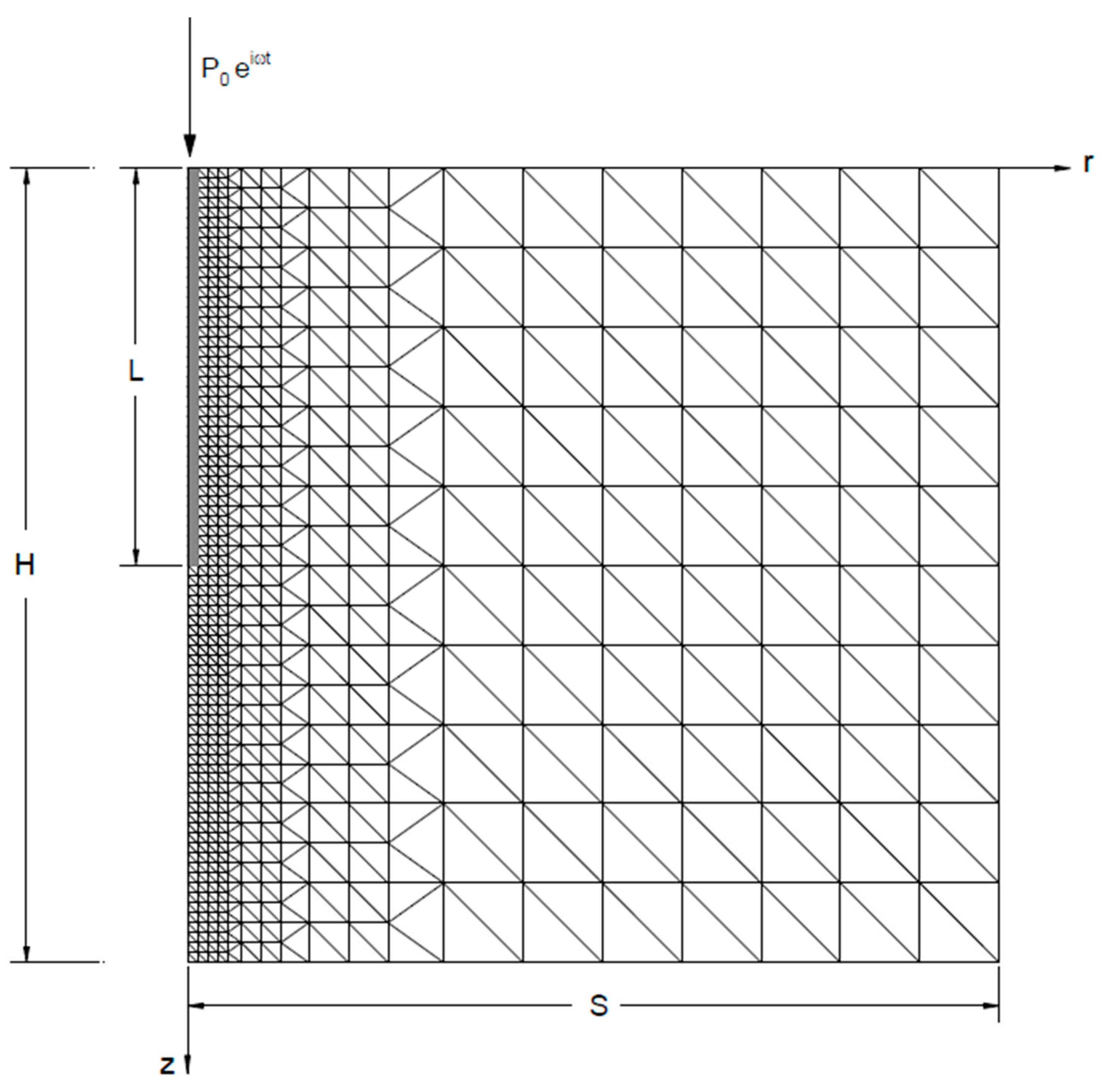
2. Problem Definition and Model Development
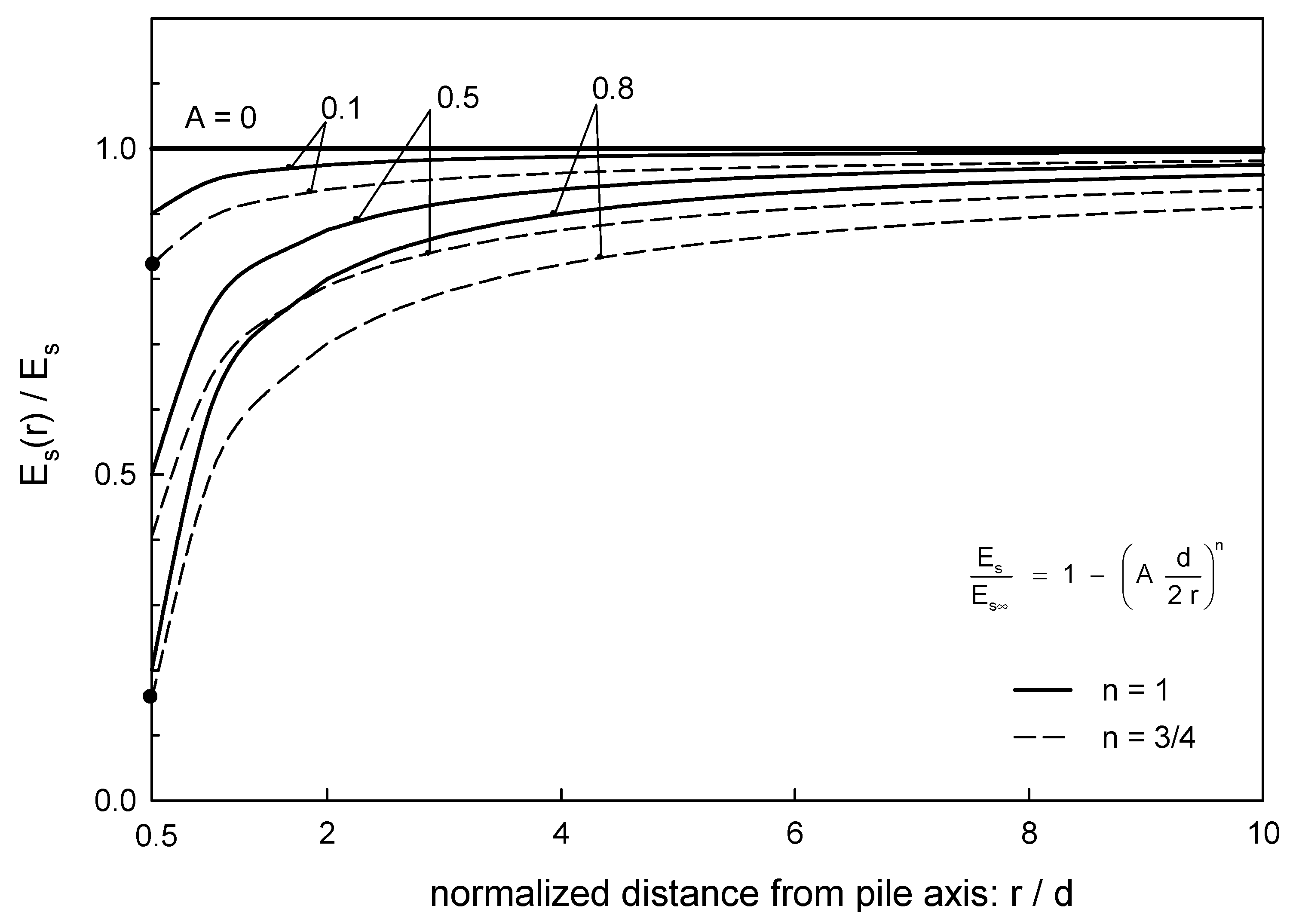
Modeling of Radial Soil Inhomogeneity
3. Soil and Pile Properties Considered
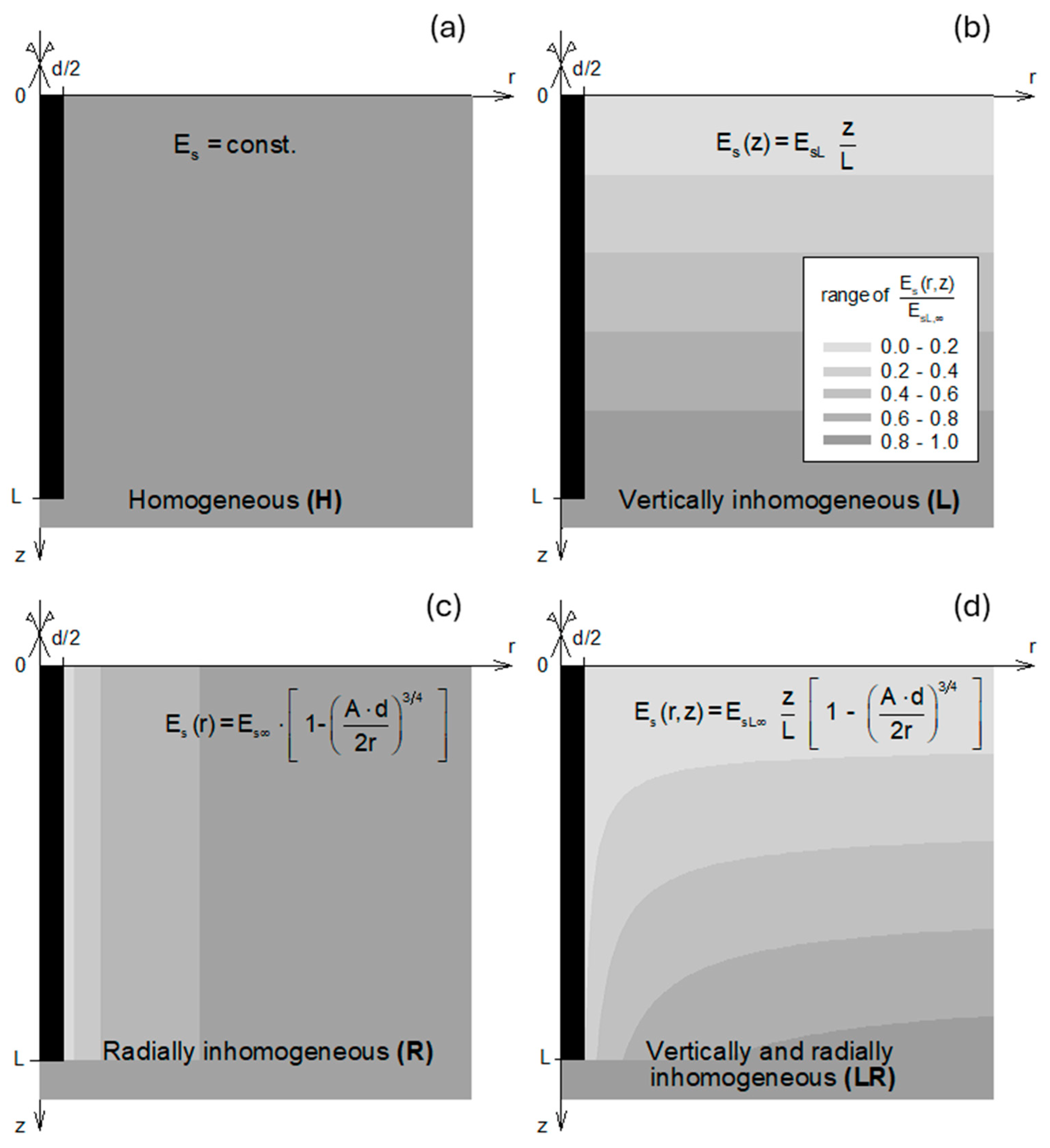
- A reference homogeneous profile of constant modulus of elasticity described by
- 2.
- A profile described by a modulus of elasticity increasing linearly with depth (to be referred hereafter to as “Linear” profile), starting from zero at the top and reaching EsL at pile tip (z = L), then remaining constant, i.e.,
- 3.
- A profile whose modulus of elasticity is constant with depth but varies with radial distance from the pile (to be termed hereafter “Radial” profile), starting from a near-pile value Es(d/2) and increasing monotonically until it asymptotes to a far-field value of Es according to Equation (1). As in the previous case, the soil is considered homogeneous below the pile tip. Accordingly,
- 4.
- A profile that is inhomogeneous in both the vertical and radial direction (to be referred hereafter to as “Linear-Radial” profile), whose modulus of elasticity varies linearly with depth above the pile tip (z < L) and with radial distance from the pile according to Equation (1). This is essentially a combination of the Linear and Radial profiles presented above and is characterized by a modulus EsL∞ at the depth of the pile tip and an infinite radial distance from the pile. In the same spirit as in the other profiles, Young’s modulus below the pile tip is considered constant, equal to EsL∞.
4. Model Validation and Parameter Analyses
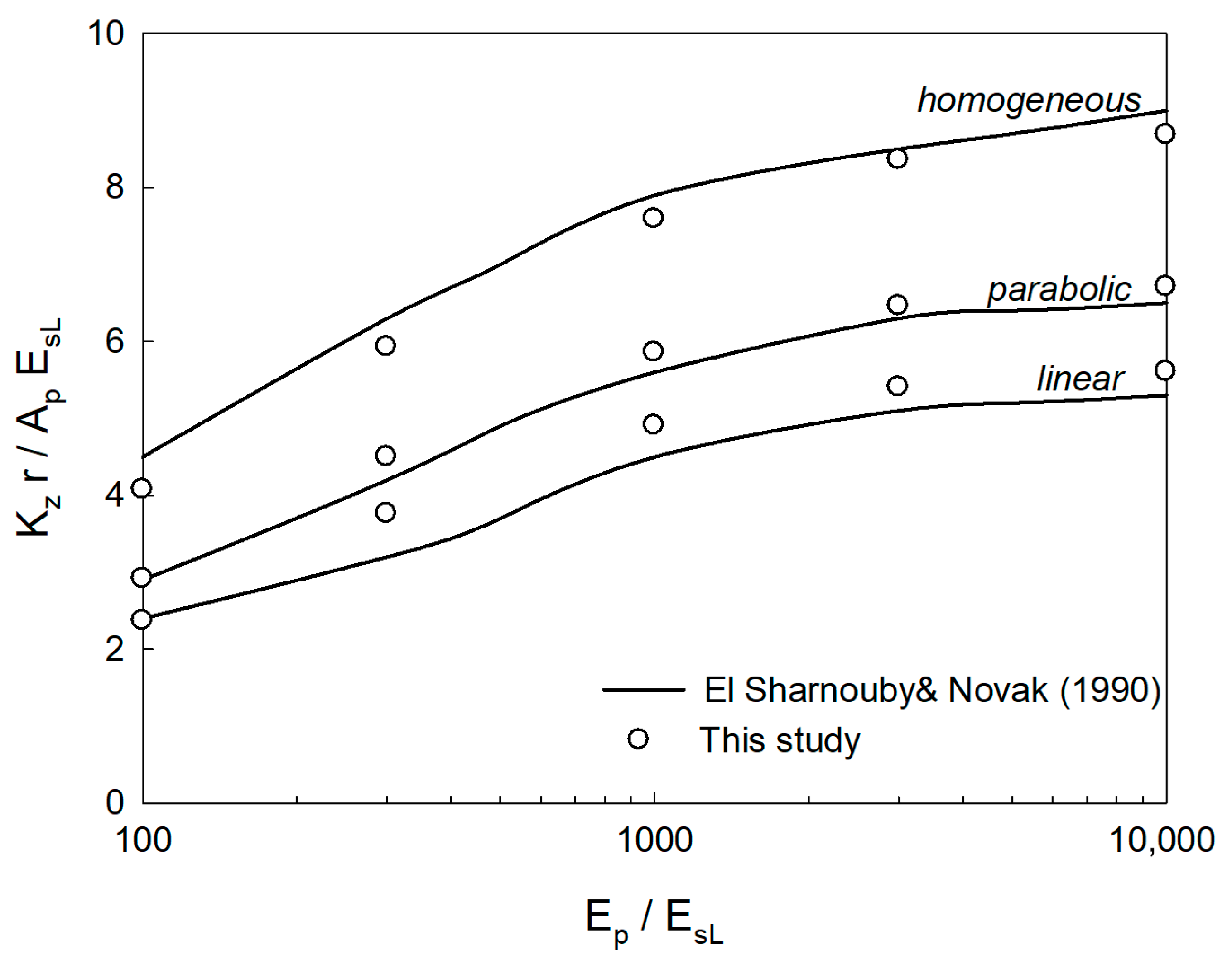
4.1. Static Loading Conditions
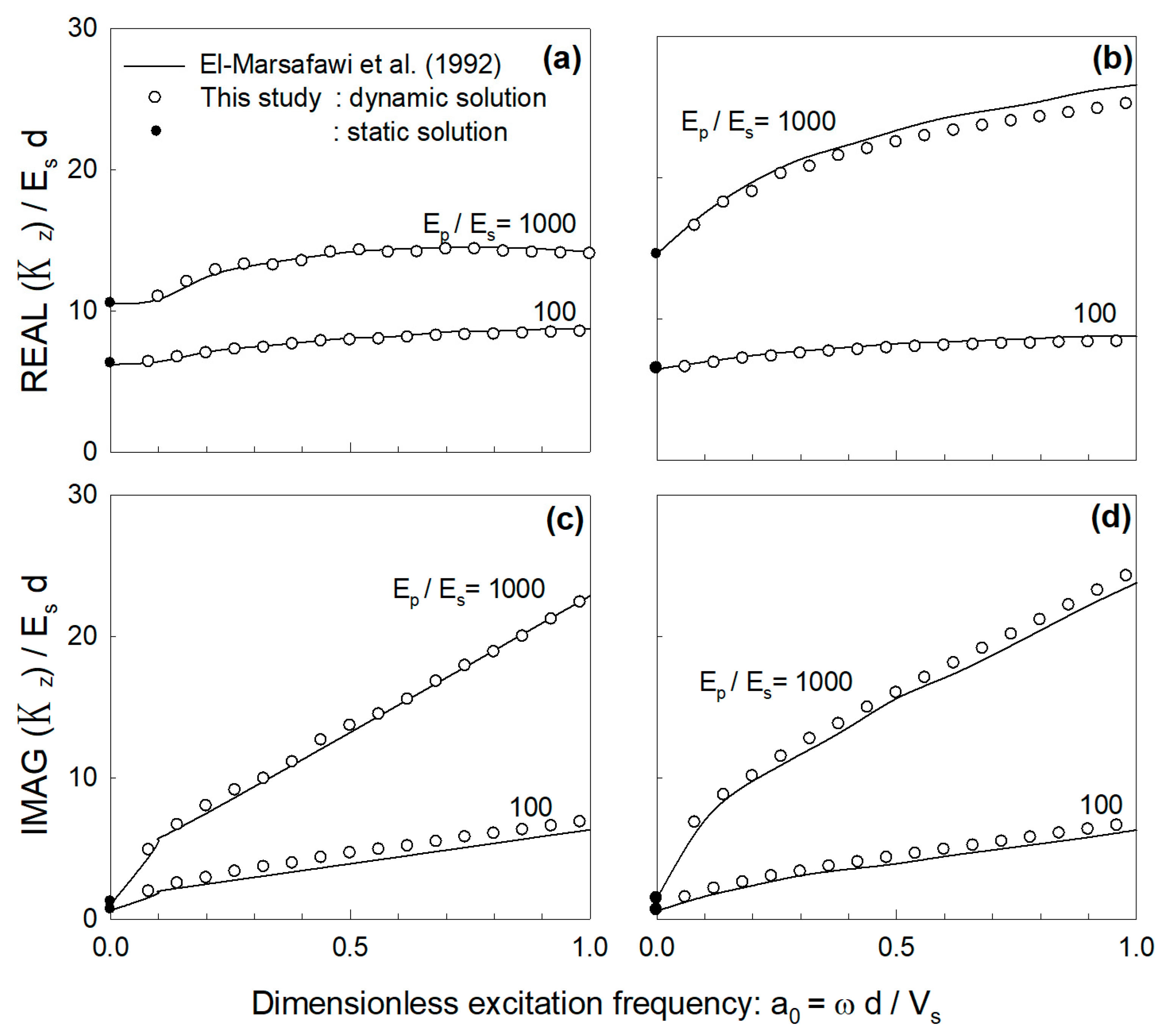
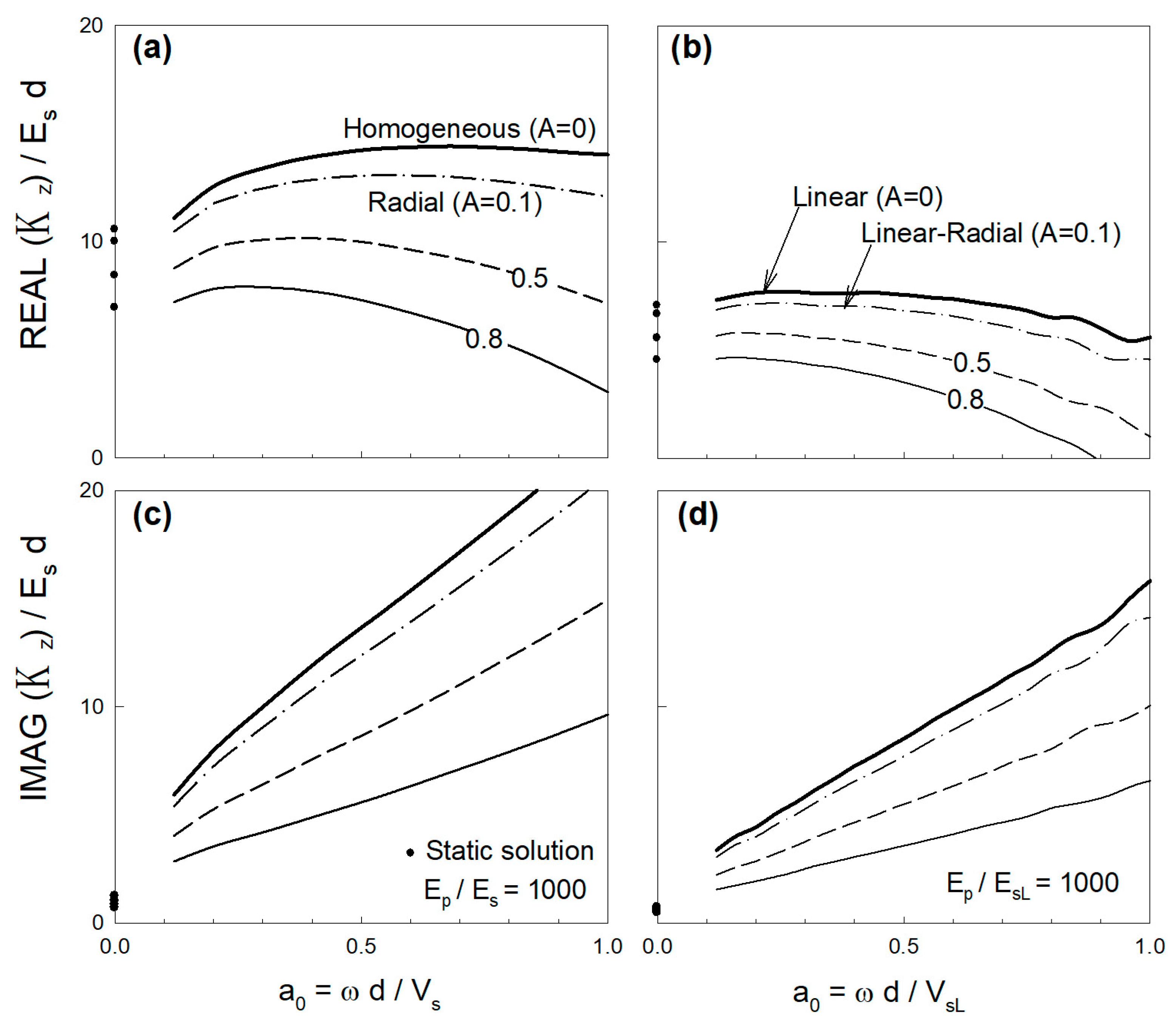
4.2. Dynamic Loading Conditions
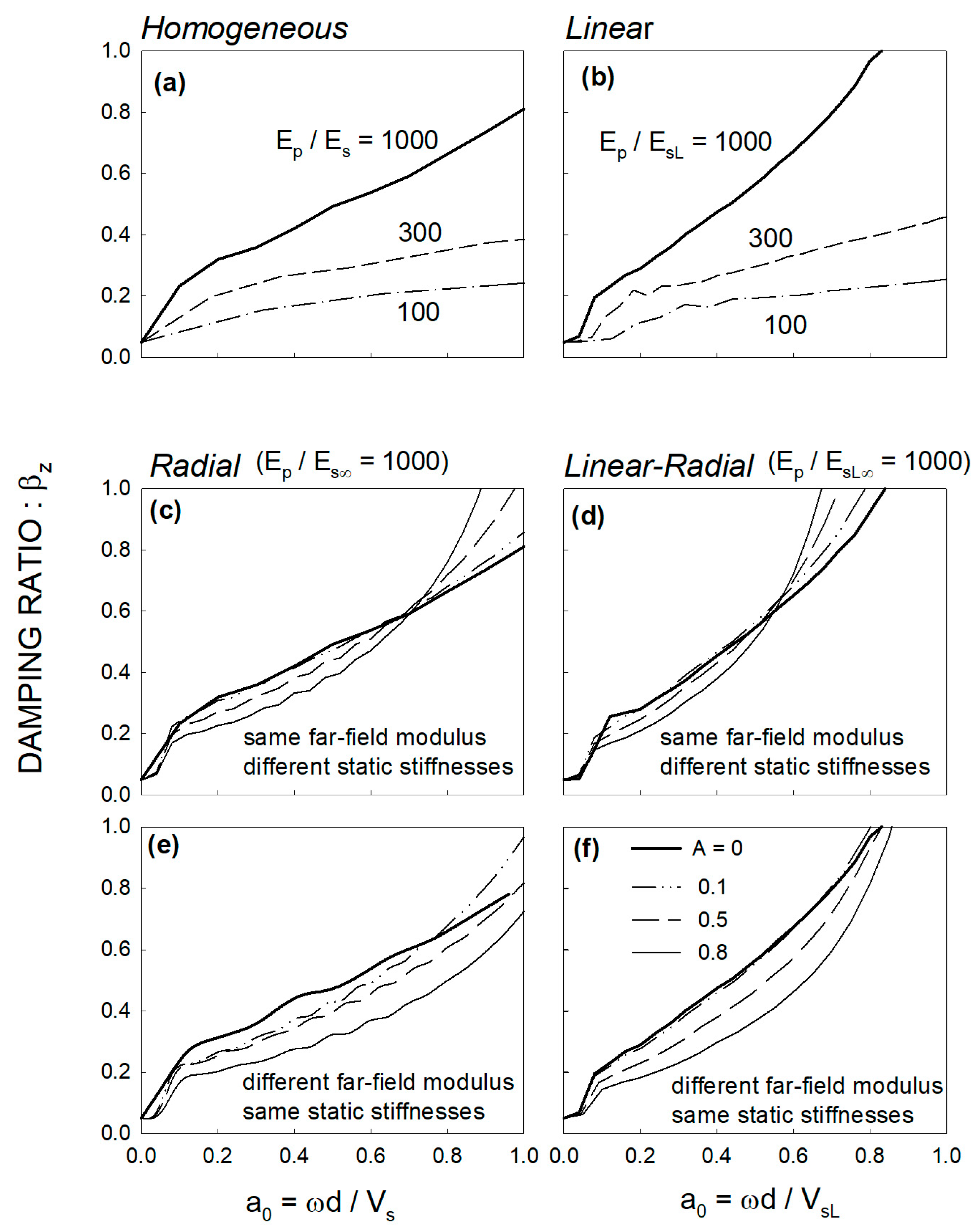
4.3. Effect of Soil Inhomogeneity on Pile Damping—Stiffness-Equivalent Soil Profiles
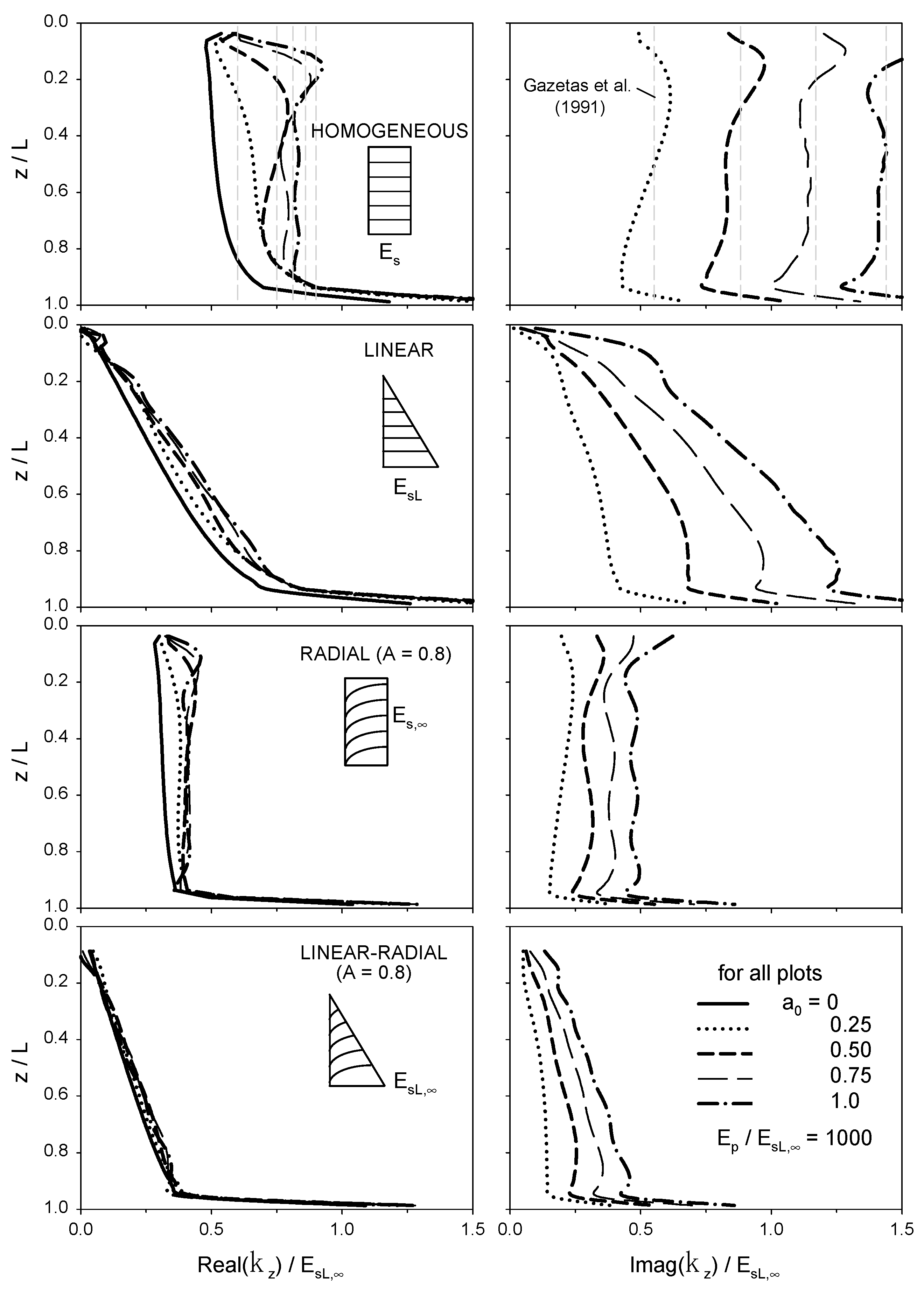
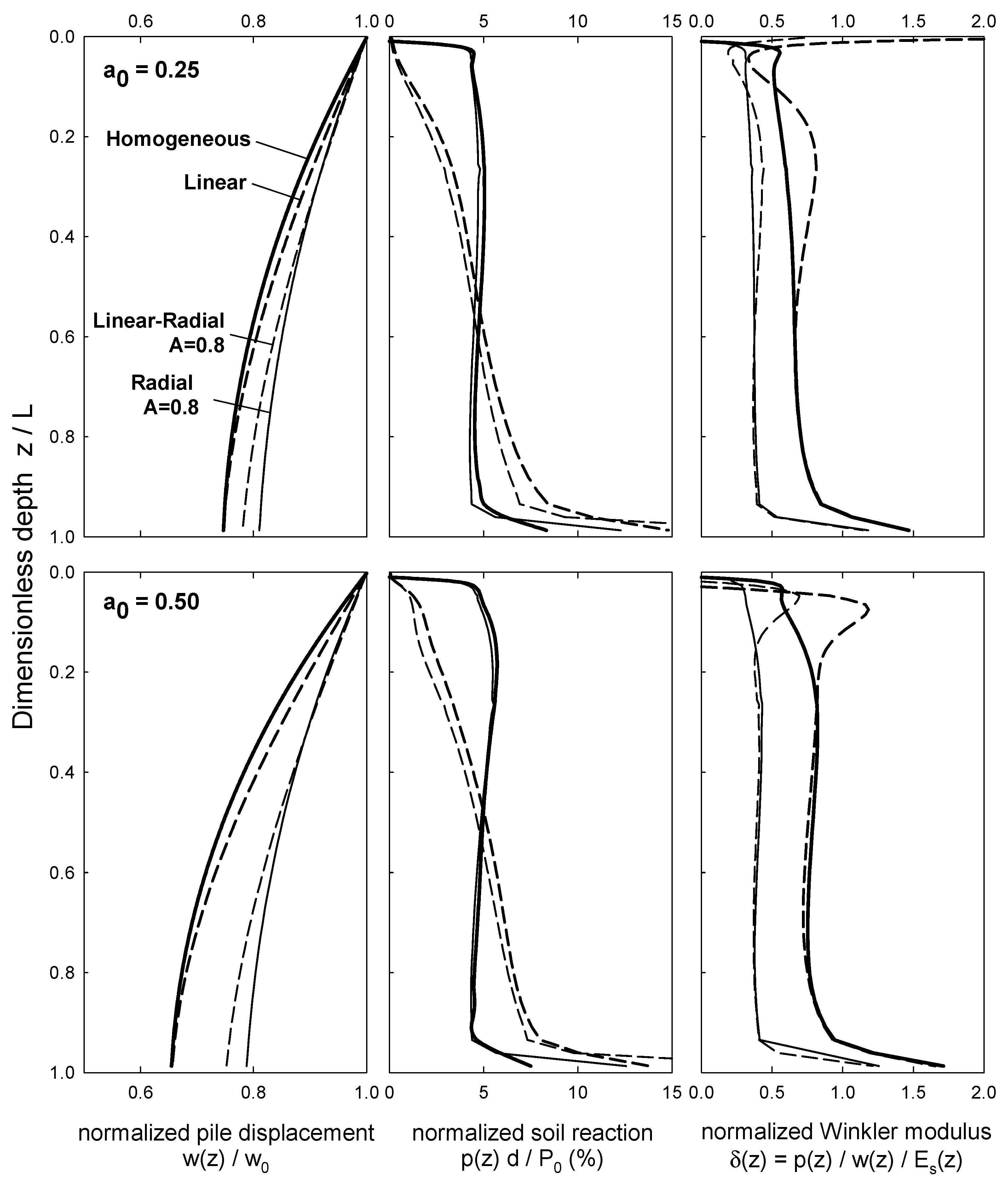
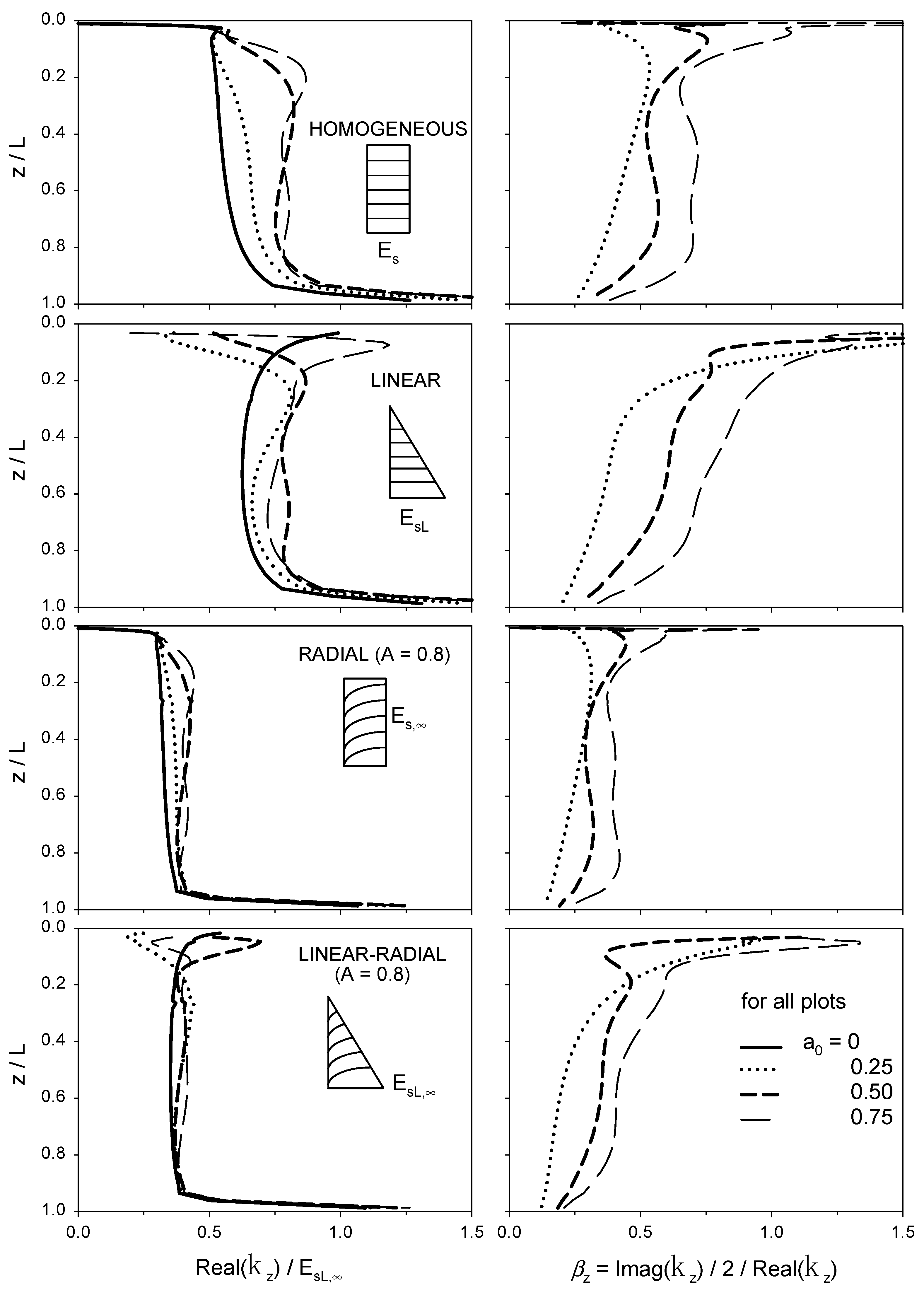
4.4. Dynamic Winkler Spring Stiffness
5. Comparisons with Experimental Results
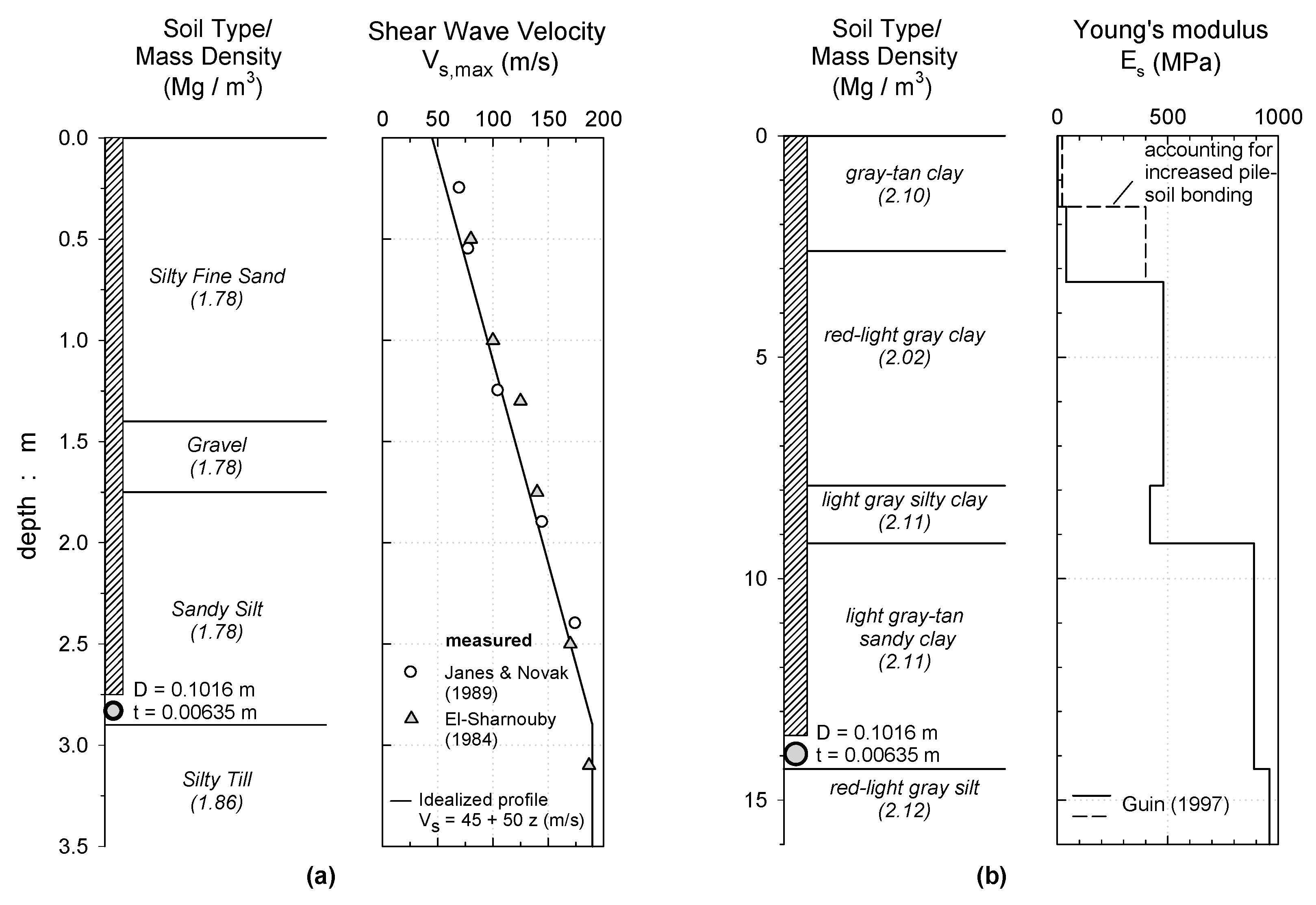
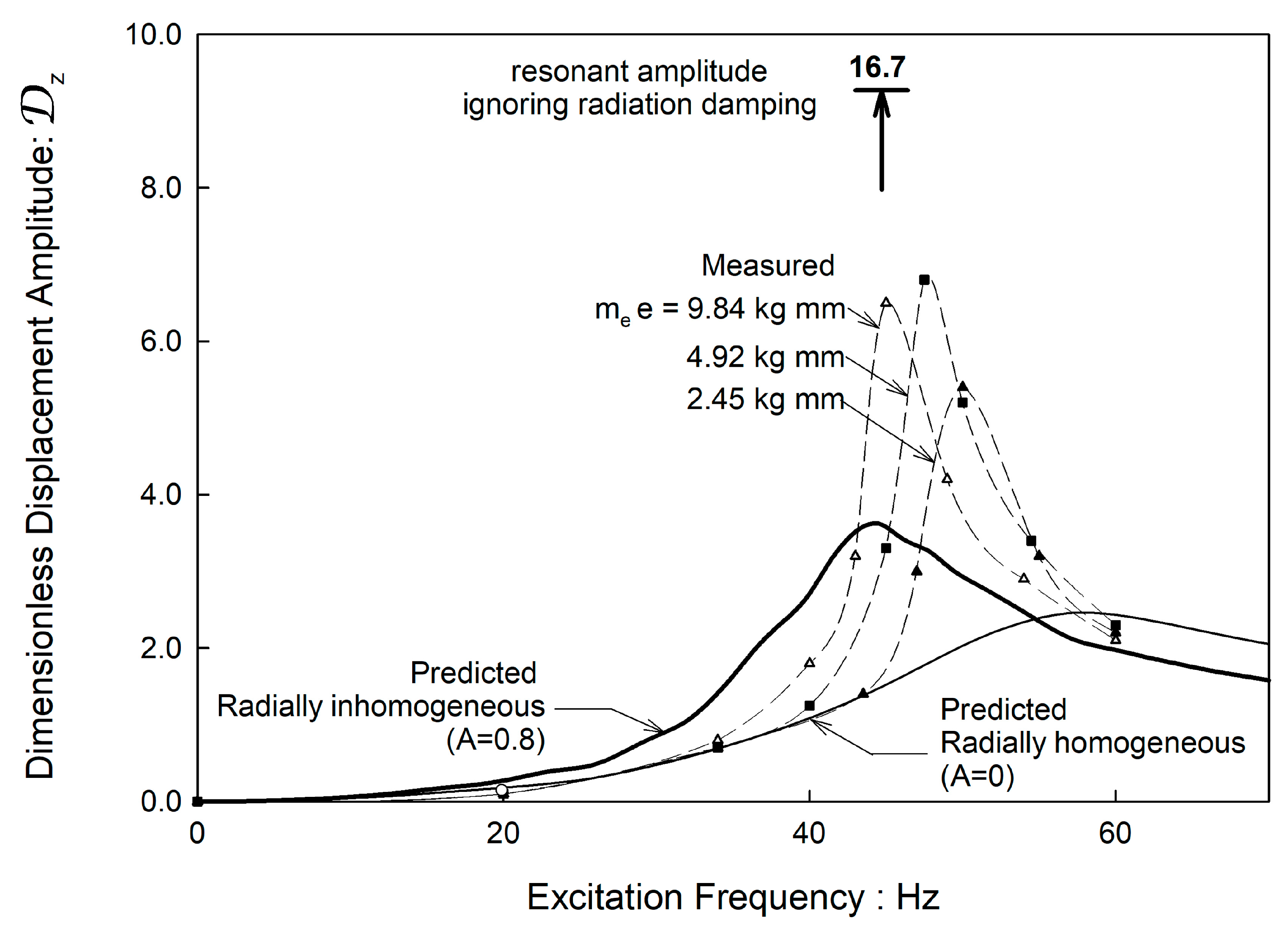
5.1. Dynamic Experiments by El-Marsafawi et al. [54]
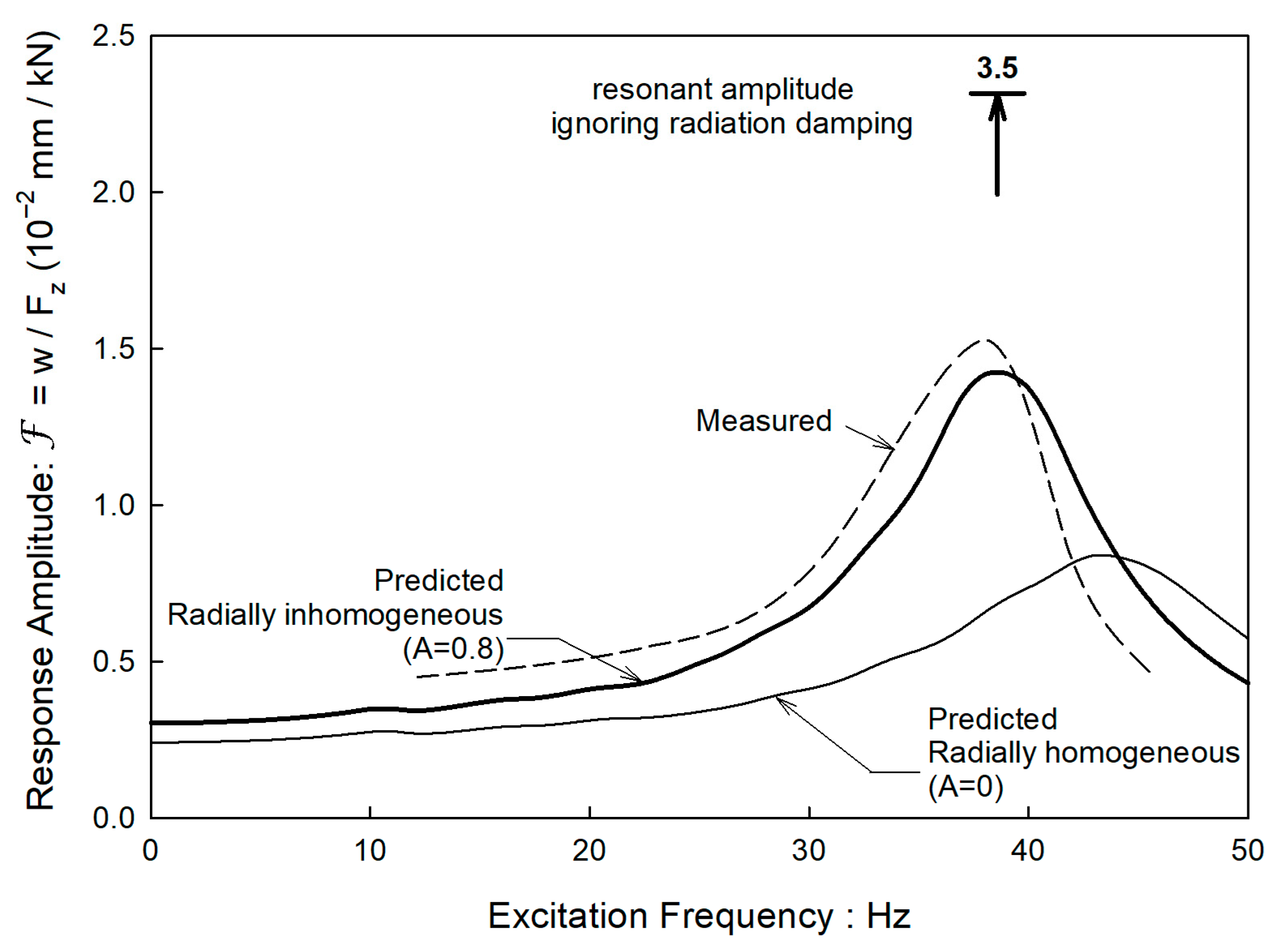
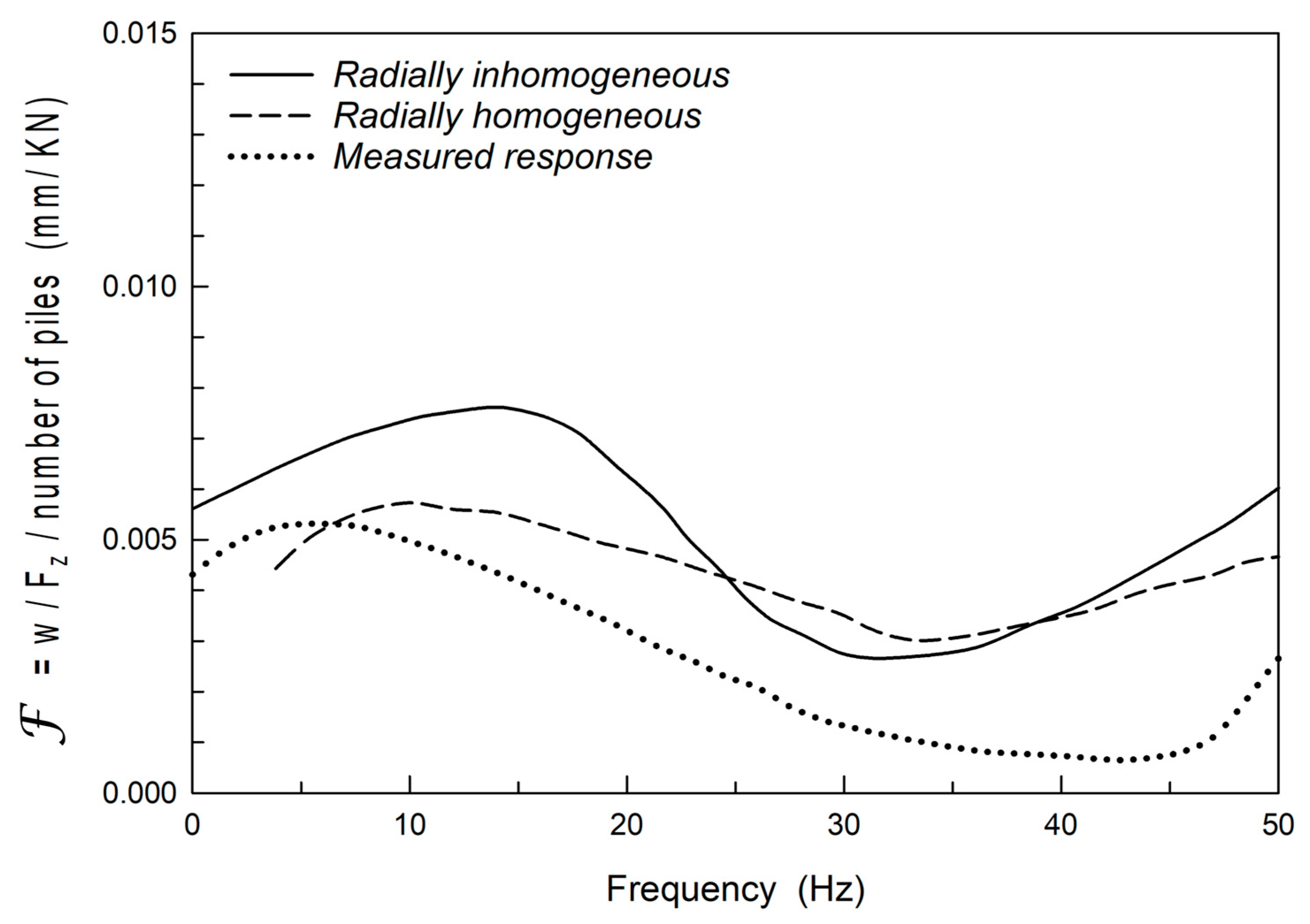
5.2. Dynamic Experiments by Blaney et al. [60]
6. Discussion
7. Conclusions
- (1)
- Ignoring radial soil inhomogeneity (reflecting installation and loading effects in the soil surrounding the pile) may lead to underestimation of static pile settlement by as much as 30%. Accordingly, use of far-field (“undisturbed”) soil moduli may result in reduced pile settlement estimates.
- (2)
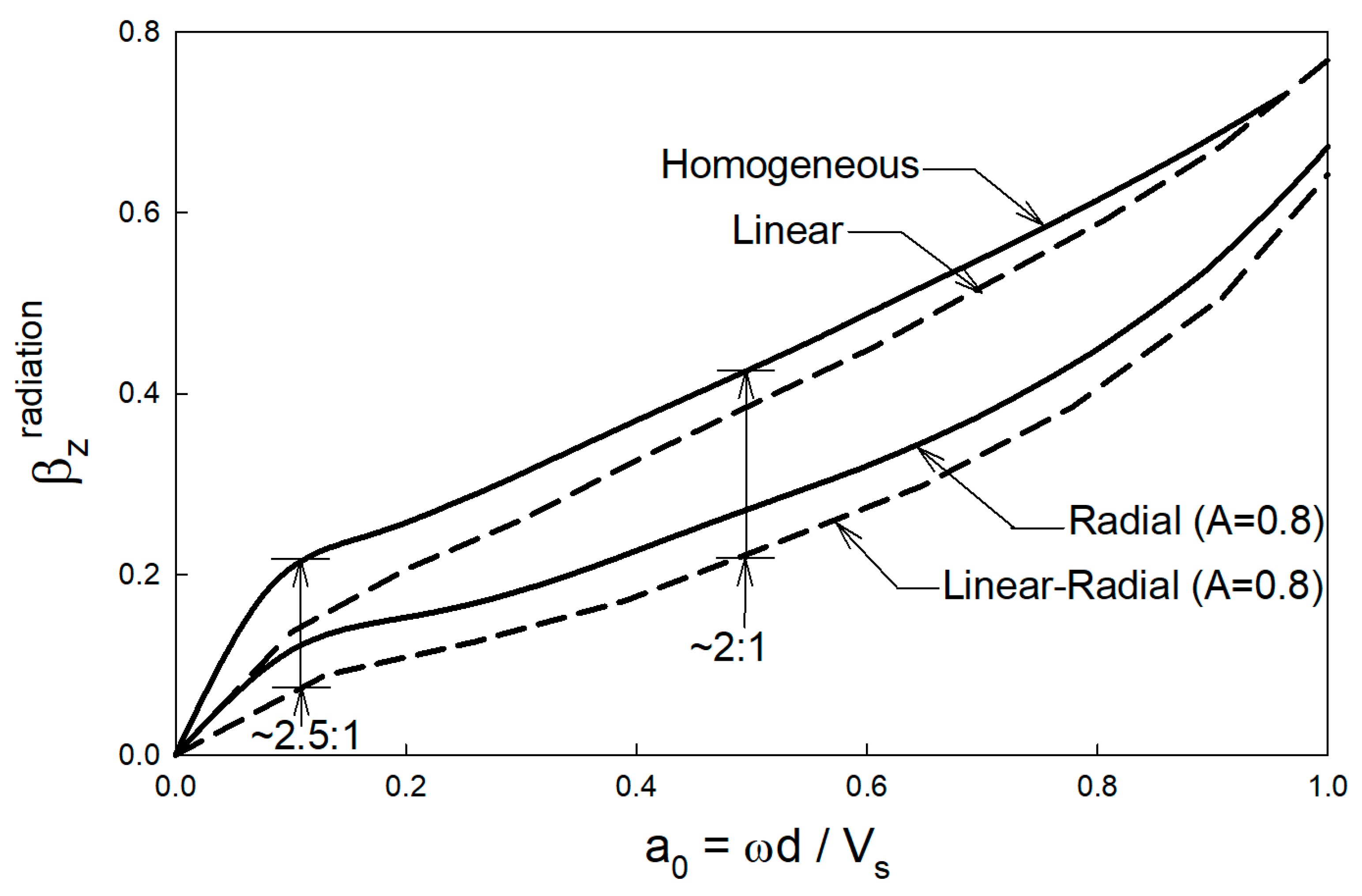
- Radiation damping drops significantly with increasing soil inhomogeneity. In a homogeneous half-space, it can be more than twice that in a soil with double inhomogeneity (Figure 8). Therefore, damping coefficients recommended in foundation engineering manuals based on assumptions of homogeneous half-space conditions should be employed with caution. As a rule of thumb, a reduction in radiation damping by a factor of 2 to 2.5 is recommended for relatively small pile-head loads (Equation (16)).
- (3)
- Modeling an inhomogeneous soil profile as an equivalent homogeneous medium with reduced modulus of elasticity, although routinely used for pile settlement analysis under static loads, may severely underestimate pile-head displacements under dynamic conditions and poorly predict the resonant frequency. This is because homogeneity in the soil tends to increase radiation damping and alter the dynamic stiffness of the pile–soil system.
- (4)
- The assumption of zero radiation damping tends to severely overestimate dynamic pile-head displacement compared to field measurements and thereby is likely too conservative for design.
- (5)
- Considering radial inhomogeneity in the soil to simulate installation and loading effects leads to improved simulations of experimentally measured pile response. A single generic value of the inhomogeneity parameter (A = 0.8) was found to provide reasonably accurate predictions in many cases. As a preliminary screening criterion for design purposes, the authors suggest that if the design load frequency is within 20% of the pile–soil resonant frequency, a reduction in radiation damping by a factor of 2 to 2.5 is used, and upper bound analyses (assumed shear wave velocities higher than average measurements) are considered in addition to lower-bound analyses (assumed shear wave velocities lower than average measurements). This criterion can be used in conjunction with available design-oriented formulae in literature such as those provided in Reference [67].
- (6)
- The presence of inhomogeneity leads to gradual diffraction of the waves emitted from the pile and impedes wave propagation towards infinity. In this token, the suppressed frequency dependence of the Winkler springs (especially dashpots) with increasing inhomogeneity is hardly surprising. Interestingly, these effects are not captured by generic p-y and t-z curves used in practice, as these are not calibrated for dynamic conditions and inhomogeneous soil (let alone presence of double inhomogeneity in the near-pile ground).
- (7)
- Regarding applications to transient problems such as earthquake motions, transient analysis is a complicated problem that lies beyond the scope of this study. Nevertheless, we believe that the reduction in radiation damping observed in harmonic steady-state response will naturally affect transient response. The amount of reduction, however, naturally depends on excitation frequency, number of excitation cycles, number and distribution of natural modes, etc. For instance, loads associated with earthquake shaking are usually of much lower frequency than the loads associated with machine vibrations, so the reduction in response is expected to be lower relative to machine-induced vibrations.
- (8)
- The expressions for stiffness provided in Equations (6)–(9) are calibrated for the range of parameters considered in this paper and probably are not that accurate for extreme conditions such as very soft soils or very slender piles. In the case of very soft soils, it is quite possible that end-bearing piles are used, which would behave differently from our examined configurations. However, to the extent of our knowledge, for L/D greater than 60, such piles are typically not very advisable, as they are prone to creeping.
- (9)
- Regarding inhomogeneity parameter A, we acknowledge there is no consolidated method for establishing a radially inhomogeneous profile around a pile, and the relevant experimental data are very scarce. Furthermore, it would be challenging to infer the A parameter from back-calculating results, because one can get the same results (pile-head settlement, for example) with different combinations of average Es values and A. However, it is a useful tool if you are trying to make sense of field data that disagree with each other (for example, measured high shear wave velocities but poor performance of a pile). In this context, our results should be interpreted as a proof-of-concept study.
- (10)
- As a final remark, it is noted that the general conclusions are not limited to axisymmetric conditions. In Reference [45], similar conclusions are reached for horizontal pile-head loads. Also, this study is primarily applicable to friction piles. For end-bearing piles, it is possible that the stiffness of the bearing layer is of greater importance for wave radiation and may overshadow radial inhomogeneity. Exploring this effect lies beyond the scope of our work. Finally, the bending of waves toward the pile due to near-field softening has been employed as an ad hoc mechanism for interpreting numerical results in other studies such as Reference [61].
Author Contributions
Funding
Institutional Review Board Statement
Informed Consent Statement
Data Availability Statement
Conflicts of Interest
References
- Mylonakis, G. Elastodynamic model for large-diameter end-bearing shafts. Soils Found. 2001, 41, 31–44. [Google Scholar] [CrossRef]
- Maiorano, R.M.S.; de Sanctis, L.; Aversa, S.; Mandolini, A. Kinematic response analysis of piled foundations under seismic excitations. Can. Geotech. J. 2009, 46, 571–584. [Google Scholar] [CrossRef]
- Dezi, F.; Carbonari, S.; Leoni, G. Kinematic bending moments in pile foundations. Soil Dyn. Earthq. Eng. 2009, 30, 119–132. [Google Scholar] [CrossRef]
- de Sanctis, L.; Maiorano, R.M.S.; Aversa, S. A method for assessing kinematic bending moments at the pile head. Earthq. Eng. Struct. Dyn. 2010, 39, 1133–1154. [Google Scholar] [CrossRef]
- Sica, S.; Mylonakis, G.; Simonelli, A.L. Transient kinematic pile bending in two-layer soil. Soil Dyn. Earthq. Eng. 2011, 31, 891–905. [Google Scholar] [CrossRef]
- Di Laora, R.; Mandolini, A.; Mylonakis, G. Insight on kinematic bending of flexible piles in layered soil. Soil Dyn. Earthq. Eng. 2012, 43, 309–322. [Google Scholar] [CrossRef]
- Di Laora, R.; Mylonakis, G.; Mandolini, A. Pile-head kinematic bending in layered soil. Earthq. Eng. Struct. Dyn. 2013, 42, 319–337. [Google Scholar] [CrossRef]
- Di Laora, R.; Rovithis, E. Kinematic bending of fixed-head piles in nonhomogeneous soil. J. Geotech. Eng. Div. 2015, 141, 04014126. [Google Scholar] [CrossRef]
- Chidichimo, A.; Cairo, R.; Dente, G.; Taylor, C.A.; Mylonakis, G. 1-g experimental investigation of bi-layer soil response and kinematic pile bending. Soil Dyn. Earthq. Eng. 2014, 67, 219–232. [Google Scholar] [CrossRef]
- Martinelli, M.; Burghignoli, A.; Callisto, L. Dynamic response of a pile embedded into a layered soil. Soil Dyn. Earthq. Eng. 2016, 87, 16–28. [Google Scholar] [CrossRef]
- Mucciacciaro, M.; Sica, S. Nonlinear soil and pile behaviour on kinematic bending response of flexible piles. Soil Dyn. Earthq. Eng. 2018, 107, 195–213. [Google Scholar] [CrossRef]
- Di Laora, R.; de Sanctis, L. Piles-induced filtering effect on the foundation input motion. Soil Dyn. Earthq. Eng. 2013, 46, 52–63. [Google Scholar] [CrossRef]
- Anoyatis, G.; Di Laora, R.; Mandolini, A.; Mylonakis, G. Kinematic response of single piles for different boundary conditions: Analytical solutions and normalization schemes. Soil Dyn. Earthq. Eng. 2013, 44, 183–195. [Google Scholar] [CrossRef]
- Di Laora, R.; Grossi, Y.; de Sanctis, L.; Viggiani, G.M.B. An analytical solution for the rotational component of the Foundation Input Motion induced by a pile group. Soil Dyn. Earthq. Eng. 2017, 97, 424–438. [Google Scholar] [CrossRef]
- Poulos, H.G. Analysis of the Settlement of Pile Groups. Géotechnique 1968, 18, 449–471. [Google Scholar] [CrossRef]
- Butterfield, R.; Banerjee, P.K. The elastic analysis of compressible piles and pile groups. Géotechnique 1971, 21, 43–60. [Google Scholar] [CrossRef]
- Anoyatis, G.; Mylonakis, G. Dynamic Winkler modulus for axially-loaded piles. Géotechnique 2012, 62, 521–536. [Google Scholar] [CrossRef]
- Anoyatis, G.; Di Laora, R.; Lemnitzer, A. Dynamic pile impedances for fixed-tip piles. Soil Dyn. Earthq. Eng. 2017, 97, 454–467. [Google Scholar] [CrossRef]
- Novak, M. Dynamic stiffnesses and damping of piles. Can. Geotech. J. 1974, 11, 574–598. [Google Scholar] [CrossRef]
- Blaney, G.W.; Kausel, E.; Roesset, J.M. Dynamic stiffness of piles. In Proceedings of the 2nd International Conference of Numerical Methods in Geomechanics; Virginia Polytechnic Institute and State University: Blacksburg, VA, USA, 1975; pp. 1010–1012. [Google Scholar]
- Kaynia, A.M.; Kausel, E. Dynamic Stiffness and Seismic Response of Pile Groups; Research Report R82-03; Massachusetts Institute of Technology: Cambridge, MA, USA, 1982. [Google Scholar]
- Nogami, T. Dynamic group effect in axial response of grouped piles. J. Geotech. Eng. 1983, 109, 228–243. [Google Scholar] [CrossRef]
- Rajapakse, R.K.N.D. Response of an axially-loaded elastic pile in a Gibson soil. Géotechnique 1990, 40, 237–249. [Google Scholar] [CrossRef]
- Wu, G.; Finn, W.D.L. Dynamic elastic analysis of pile foundations using the Finite Element method in the frequency domain. Can. Geotech. J. 1997, 31, 34–43. [Google Scholar] [CrossRef]
- Boulanger, R.W.; Curras, C.J.; Kutter, B.L.; Wilson, D.W.; Abghari, A. Seismic soil-pile-structure interaction experiments and analyses. J. Geotech. Geoenviron. Eng. 1999, 125, 750–759. [Google Scholar] [CrossRef]
- Guo, W.D. Vertically loaded single piles in Gibson soil. J. Geotech. Geoenviron. Eng. 2000, 126, 189–193. [Google Scholar] [CrossRef]
- Kim, S.; Stewart, J.P. Kinematic soil-structure interaction from strong motion recordings. J. Geotech. Geoenviron. Eng. 2003, 129, 323–335. [Google Scholar] [CrossRef]
- Poulos, H.G. Pile behaviour—Theory and application. Géotechnique 1989, 39, 365–415. [Google Scholar] [CrossRef]
- Novak, M. Piles under dynamic loads: State of the art. In Proceedings of the 2nd International Conferences on Recent Advances in Geotechnical Earthquake Engineering and Soil Dynamics, St. Louis, MI, USA, 11–15 March 1991; pp. 2433–2456. [Google Scholar]
- Pender, M. Aseismic pile foundation design analysis. Bull. N. Z. Natl. Soc. Earthq. Eng. 1993, 26, 49–160. [Google Scholar] [CrossRef]
- Gazetas, G.; Mylonakis, G. Seismic Soil-Structure Interaction: New Evidence and Emerging Issues; Emerging Issues Paper, Geotechnical Special Publication No 75; ASCE: Reston, VA, USA, 1998; pp. 1119–1174. [Google Scholar]
- Randolph, M.F. Science and empiricism in pile foundation design. Géotechnique 2003, 54, 847–874. [Google Scholar] [CrossRef]
- Crispin, J.J.; Mylonakis, G. Simplified models for axial static and dynamic analysis of pile foundations. In Analysis of Pile Foundations Subject to Static and Dynamic Loading; CRC Press: Boca Raton, FL, USA, 2021; pp. 131–184. [Google Scholar]
- Di Laora, R.; Rovithis, E. Design of piles under seismic loading. In Analysis of Pile Foundations Subject to Static and Dynamic Loading; CRC Press: Boca Raton, FL, USA, 2021; pp. 269–300. [Google Scholar]
- Poulos, H.G. Modified calculation of pile-group settlement interaction. J. Geotech. Eng. 1988, 114, 697–706. [Google Scholar] [CrossRef]
- Bateman, A.H.; Crispin, J.J. Theoretical t-z curves for radially inhomogeneous soil. DFI J. J. Deep Found. Inst. 2020, 14, 1–8. [Google Scholar]
- Novak, M.; Sheta, M. Approximate approach to contact effects of piles. In Dynamic Response of Pile Foundations: Analytical Aspects; ASCE: New York, NY, USA, 1980; pp. 53–79. [Google Scholar]
- Veletsos, A.S.; Dotson, K.W. Impedances of soil layer with disturbed boundary zone. J. Geotech. Eng. 1986, 112, 363–368. [Google Scholar] [CrossRef]
- Han, Y.C.; Sabin, G.C.W. Impedances for radially inhomogeneous viscoelastic soil media. J. Eng. Mech. Div. 1995, 121, 939–947. [Google Scholar] [CrossRef]
- Michaelides, O.; Gazetas, G.; Bouckovalas, G.; Chrysikou, E. Approximate non-linear dynamic axial response of piles. Géotechnique 1998, 48, 33–53. [Google Scholar] [CrossRef]
- El-Naggar, M.H. Vertical and torsional soil reactions for radially inhomogeneous soil layer. Struct. Eng. Mech. 2000, 10, 299–312. [Google Scholar] [CrossRef]
- Bateman, A.H.; Mylonakis, G. p-y curves for piles in radially inhomogeneous soil. In Proceedings of the 17th Danube European Conference on Geotechnical Engineering (17DCGE), Bucharest, Romania, 7–9 June 2023. [Google Scholar]
- Karatzia, X.; Papastylianou, P.; Mylonakis, G. Horizontal soil reaction of a cylindrical pile segment with a soft zone. J. Eng. Mech. 2014, 140, 04014077. [Google Scholar] [CrossRef]
- Fu, P.; Wu, J.; Jia, J.; Yi, E.; Wang, K.; Zhang, Z. Dynamic response of saturated layered soil around defective piles and its application in engineering testing. Soil Dyn. Earthq. Eng. 2025, 194, 109391. [Google Scholar] [CrossRef]
- Syngros, C. Seismic Response of Piles and Pile-Supported Bridge Piers Evaluated Through Case Histories. Ph.D. Dissertation, The City University of New York, New York, NY, USA, 2004. [Google Scholar]
- Mattes, N.S. The influence of radial displacement compatibility on pile settlement. Géotechnique 1969, 19, 157–159. [Google Scholar] [CrossRef]
- Marques, J.M.; Owen, D.R.J. Infinite elements in quasi-static materially nonlinear problems. Comput. Struct. 1984, 18, 739–751. [Google Scholar] [CrossRef]
- Kellezi, L. Local transmitting boundaries for transient elastic analysis. Soil Dyn. Earthq. Eng. 2000, 19, 533–547. [Google Scholar] [CrossRef]
- Price, T.E. Numerically exact integration of a family of axisymmetric finite elements. Commun. Numer. Methods Eng. 2003, 19, 253–261. [Google Scholar] [CrossRef]
- Syngros, C.; Mylonakis, G.; Price, T. Influence of soil heterogeneity on dynamic response of deep foundations. In Proceedings of the 5th GRACM, International Congress on Computational Mechanics (8 pages on CD-ROM), Limassol, Cyprus, 29 June–1 July 2005. [Google Scholar]
- Kim, Y.S. Dynamic Response of Structures on Pile Foundations. Ph.D. Dissertation, The University of Texas at Austin, Austin, TX, USA, 1987. [Google Scholar]
- Zheng, C.; Mylonakis, G.; Kouretzis, G. Inertial and kinematic response of laterally loaded piles: Sensitivity of elastodynamic continuum solutions to key assumptions. Soil Dyn. Earthq. Eng. 2024, 178, 108485. [Google Scholar] [CrossRef]
- El-Sharnouby, B.; Novak, M. Stiffness constants and interaction factors for vertical response of pile groups. Can. Geotech. J. 1990, 27, 813–822. [Google Scholar] [CrossRef]
- El-Marsafawi, H.; Kaynia, A.M.; Novak, M. Interaction Factors and the Superposition Method for Pile Group Dynamic Analysis; Geotechnical Research Center Report GEOT-1-92; The University of Western Ontario: London, ON, Canada, 1992. [Google Scholar]
- O’Neill, M.W.; Ghazzaly, O.I.; Ha, H.B. Analysis of three-dimensional pile groups with nonlinear soil response and pile-soil-pile interaction. In Proceedings of the 9th Annual Offshore Technology Conference, Houston, TX, USA, 2–5 May 1997; Paper No. OTC 2838. [Google Scholar]
- Bevington, P.R.; Robinson, D.K. Data Reduction and Error Analysis for the Physical Sciences; McGraw Hill: New York, NY, USA, 1992. [Google Scholar]
- Pak, R.Y.S.; Ji, F. Rational mechanics of pile-soil interaction. J. Eng. Mech. 1993, 119, 813–832. [Google Scholar] [CrossRef]
- Roesset, J.M. Stiffness and damping coefficients of foundations. In Proceedings ASCE, Geotechnical Engineering Division, National Convention; ASCE: Reston, VA, USA, 1980; pp. 1–30. [Google Scholar]
- Gazetas, G.; Fan, K.; Tazoh, T.; Shimizu, K.; Kavvadas, M.; Makris, N. Seismic response of soil-pile-foundation-structure systems: Some recent developments. In Piles Under Dynamic Loads; Special Publication No. 34; ASCE: Reston, VA, USA, 1992. [Google Scholar]
- Blaney, G.W.; Muster, G.L.; O’Neill, M.W. Vertical vibration test of a full-scale pile group. In Dynamic Response of Pile Foundations-Experiment, Analysis and Observation; Nogami, T., Ed.; Geotechnical Special Publication No. 11; ASCE: Reston, VA, USA, 1987. [Google Scholar]
- Gazetas, G. Foundation Vibrations. In Foundation Engineering Handbook; Springer: New York, NY, USA, 1991; pp. 553–593. [Google Scholar]
- Li, Z.; Jin, N.; Zhang, C.; Zhang, Z.; Wu, W. Vertical vibration of pipe piles in construction-induced inhomogeneous saturated soil. Ocean Eng. 2025, 341, 122750. [Google Scholar] [CrossRef]
- Guin, J. Advanced Soil-Pile-Structure Interaction and Nonlinear Behavior. Ph.D. Dissertation, State University of New York, Buffalo, NY, USA, 1997. [Google Scholar]
- El Sharnouby, B. Static and Dynamic Behavior of Pile Groups. Ph.D. Dissertation, The University of Western Ontario, London, ON, Canada, 1984. [Google Scholar]
- Janes, M.C.; Novak, M. Pile Group response to large lateral loads. In Proceedings of the 42nd Canadian Geotechnical Conference; Canadian Geotechnical Society: Surrey, BC, Canada, 1989; pp. 216–222. [Google Scholar]
- Mylonakis, G.; Gazetas, G. Vertical vibrations and additional distress of grouped piles in layered soil. Soils Found. 1998, 38, 1–14. [Google Scholar] [CrossRef]
- Stewart, J.P.; (Project Director) NEHRP Consultants Joint Venture. Soil-Structure Interaction for Building Structures; Report NIST GCR-12-917-21; National Institute of Standards and Technology: Gaithersburg, MD, USA, 2012.



| L/d | Ep/Es,∞ | A = 0 | A = 0.1 | A = 0.5 | A = 0.8 | |||
|---|---|---|---|---|---|---|---|---|
| Kz d/Es | Kz d/Es∞ | (%) | Kz d/Es∞ | (%) | Kz d/Es∞ | (%) | ||
| 20 | 100 | 6.26 | 5.99 | −4.3 | 5.24 | −16.3 | 4.50 | −28.1 |
| 300 | 8.69 | 8.29 | −4.6 | 7.13 | −18.0 | 5.99 | −31.1 | |
| 1000 | 10.54 | 9.99 | −5.2 | 8.42 | −20.1 | 6.93 | −34.3 | |
| 40 | 100 | 6.47 | 6.21 | −4.0 | 5.49 | −15.1 | 4.82 | −25.5 |
| 300 | 10.02 | 9.64 | −3.8 | 8.18 | −18.4 | 7.58 | −24.4 | |
| 1000 | 14.52 | 13.91 | −4.2 | 12.11 | −16.6 | 10.26 | −29.3 | |
| 60 | 100 | 6.48 | 6.22 | −4.0 | 5.50 | −15.1 | 4.83 | −25.5 |
| 300 | 10.26 | 9.90 | −3.5 | 8.87 | −13.5 | 7.85 | −23.5 | |
| 1000 | 16.07 | 15.49 | −3.6 | 13.77 | −14.3 | 11.97 | −25.5 | |
| L/d | Ep/EsL,∞ | A = 0 | A = 0.1 | A = 0.5 | A = 0.8 | |||
|---|---|---|---|---|---|---|---|---|
| Kz d/EsL | Kz d/EsL∞ | (%) | Kz d/EsL∞ | (%) | Kz d/EsL∞ | (%) | ||
| 20 | 100 | 3.81 | 3.66 | −3.9 | 3.24 | −15.0 | 2.81 | −26.2 |
| 300 | 5.60 | 5.34 | −4.6 | 4.57 | −18.4 | 3.84 | −31.4 | |
| 1000 | 6.86 | 6.48 | −5.5 | 5.41 | −21.1 | 4.44 | −35.3 | |
| 40 | 50 | 2.18 | 2.11 | −3.2 | 1.92 | −11.9 | 1.74 | −20.2 |
| 150 | 4.17 | 4.04 | −3.1 | 3.66 | −12.2 | 3.27 | −21.6 | |
| 500 | 7.37 | 7.08 | −3.9 | 6.22 | −15.6 | 5.35 | −27.4 | |
Disclaimer/Publisher’s Note: The statements, opinions and data contained in all publications are solely those of the individual author(s) and contributor(s) and not of MDPI and/or the editor(s). MDPI and/or the editor(s) disclaim responsibility for any injury to people or property resulting from any ideas, methods, instructions or products referred to in the content. |
© 2026 by the authors. Licensee MDPI, Basel, Switzerland. This article is an open access article distributed under the terms and conditions of the Creative Commons Attribution (CC BY) license.
Share and Cite
Syngros, K.; Mylonakis, G. Dynamic Axial Pile Stiffness and Damping in Soil with Double Inhomogeneity. Geotechnics 2026, 6, 28. https://doi.org/10.3390/geotechnics6010028
Syngros K, Mylonakis G. Dynamic Axial Pile Stiffness and Damping in Soil with Double Inhomogeneity. Geotechnics. 2026; 6(1):28. https://doi.org/10.3390/geotechnics6010028
Chicago/Turabian StyleSyngros, Konstantinos, and George Mylonakis. 2026. "Dynamic Axial Pile Stiffness and Damping in Soil with Double Inhomogeneity" Geotechnics 6, no. 1: 28. https://doi.org/10.3390/geotechnics6010028
APA StyleSyngros, K., & Mylonakis, G. (2026). Dynamic Axial Pile Stiffness and Damping in Soil with Double Inhomogeneity. Geotechnics, 6(1), 28. https://doi.org/10.3390/geotechnics6010028