1. Introduction
The stability, efficiency, and safety of retaining wall design are significantly affected by the lateral pressure acting on the wall. Traditional approaches, such as Coulomb’s [
1] and Rankine’s [
2] theories, are used for estimating active earth pressures based on assumptions of linear pressure distribution and fully formed failure surfaces. These methods do not provide the required accuracy when arching effects and geometric constraints strongly influence the walls.
Due to the rapid development of urban infrastructure and underground buildings, the accessible backfill soil is often limited, and the failure wedge cannot develop in backfill of many retaining walls completely. To improve stability in these constrained conditions, soil reinforcement is frequently used, leading to the construction of narrow Mechanically Stabilized Earth (MSE) walls. Experimental studies on unreinforced narrow backfills (e.g., [
3,
4]) have shown that the pressure distribution does not follow the usual triangular shape and is strongly influenced by arching. Janssen [
5] defined arching as a process where stresses are redistributed within the soil. Arching, described by Terzaghi [
6], happens due to the redistribution of stresses. Handy [
7] introduced the idea of principal stress trajectories to model the effect of arching, proposing a catenary shape for the minor principal stress path. Harrop-Williams [
8] supported this assumption, comparing it to a circular path.
In analytical approaches, techniques like the horizontal slice [
9], limit equilibrium [
10], and principal stress rotation [
11,
12] have been used to study lateral pressure distributions in reinforced and narrow backfills respectively. Chen et al. [
13] extended Spangler and Handy’s [
14] formulations for narrow backfills using bilinear slip surfaces.
Finite element simulations [
15,
16], discrete element methods [
17,
18], and limit analysis techniques have revealed critical insights into stress trajectories and slip surface inclinations. Similarly, studies on active pressure distribution for rough-faced retaining walls (e.g., [
19,
20,
21]) demonstrated the nonlinear pressure diagrams, with maximum pressure occurring above the wall base instead of the base.
The K-stiffness method developed by Allen and Bathurst [
22] is a semi-empirical, performance-based design approach in which reinforcement loads are estimated using a modified lateral earth pressure coefficient calibrated from full-scale instrumented GRS walls. This method implicitly incorporates the effects of soil–reinforcement interaction, facing stiffness, and global reinforcement stiffness, and has been shown to predict reinforcement loads reasonably well for conventional MSE walls with relatively wide backfills. However, it does not explicitly represent stress redistribution, arching mechanisms, or the influence of geometric confinement—factors that become dominant in narrow backfills.
The existing analytical formulations generally do not explicitly account for the combined effects of stress redistribution, principal stress rotation, and geometric confinement that govern the behavior of narrow reinforced backfills. In particular, the influence of arching and constrained failure mechanisms on both lateral earth pressure distribution and reinforcement forces is not fully captured within conventional approaches. These limitations highlight the need for an analytical method considering arching effects in narrow MSE walls.
This study presents an analytical method for predicting lateral earth pressures in narrow reinforced MSE walls. While previous research has discussed principal stress rotation and soil arching, these effects have not been fully incorporated into the design of narrow reinforced backfills. The proposed method incorporates arching, stress rotation, and a bilinear failure surface to capture nonlinear stress paths in confined geometries. It allows accurate prediction of non-triangular lateral pressure distributions and reinforcement tensile forces, with the maximum pressure occurring above the wall base. By explicitly considering backfill width, interface friction, and reinforcement–soil interaction, this approach provides a more realistic and transparent basis for the analysis and design of narrow MSE walls compared to conventional methods.
2. Assumptions Adopted in the Analysis
The proposed analytical model is based on assumptions that are commonly used in arching-based earth pressure analyses. The principal stress direction is assumed to vary linearly across the width of the backfill. This provides a simplified but practical representation of stress trajectories in confined soil masses.
A Rankine active stress state is assumed within the failure zone, implying that sufficient wall movement has occurred to mobilize active earth pressure conditions. This assumption is consistent with observations from yielding retaining walls and reinforced soil structures, where a clearly defined failure surface and stress redistribution develop after wall deformation. Therefore, the model focuses on stress conditions after active failure, arching, and reinforcement effects have been fully mobilized, and does not consider stress conditions before mobilization.
The proposed method is applicable to yielding walls and mechanically stabilized earth (MSE) structures, where lateral deformations are adequate to mobilize soil shear strength. For rigid or non-yielding walls, the stress state is expected to remain closer to at-rest conditions, and the assumptions adopted in this study may not be applicable.
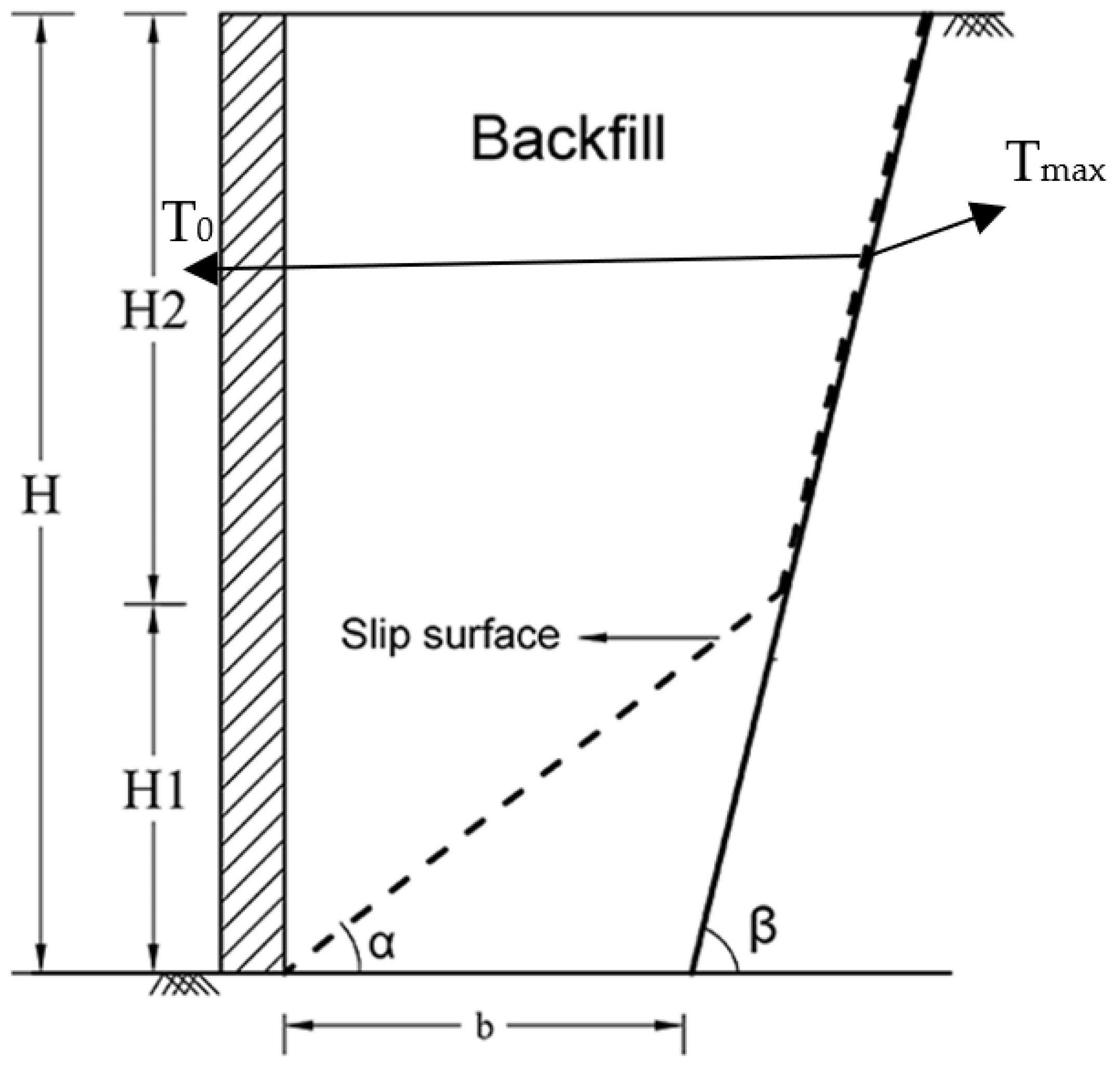
In reinforced soil structures, potential failure surfaces are generally associated with two critical locations: (i) the position of maximum reinforcement tensile force (T
max) and (ii) the facing connection location (T
0). In design practice, T
0 is often conservatively assumed to be equal to T
max [
23]. For narrow reinforced backfills, the failure surface deviates from the classical planar surface proposed by Coulomb. Accordingly, a bilinear failure surface, as suggested by Greco [
24] and Yang et al. [
25], is adopted in this study.
The assumed failure surface represents the locus of maximum tensile forces (T
max) in the lower part of the backfill. Above this point, the failure surface becomes tangential to the stable rear boundary and extends to the ground surface (
Figure 1).
3. Rotation of Principal Stresses Method
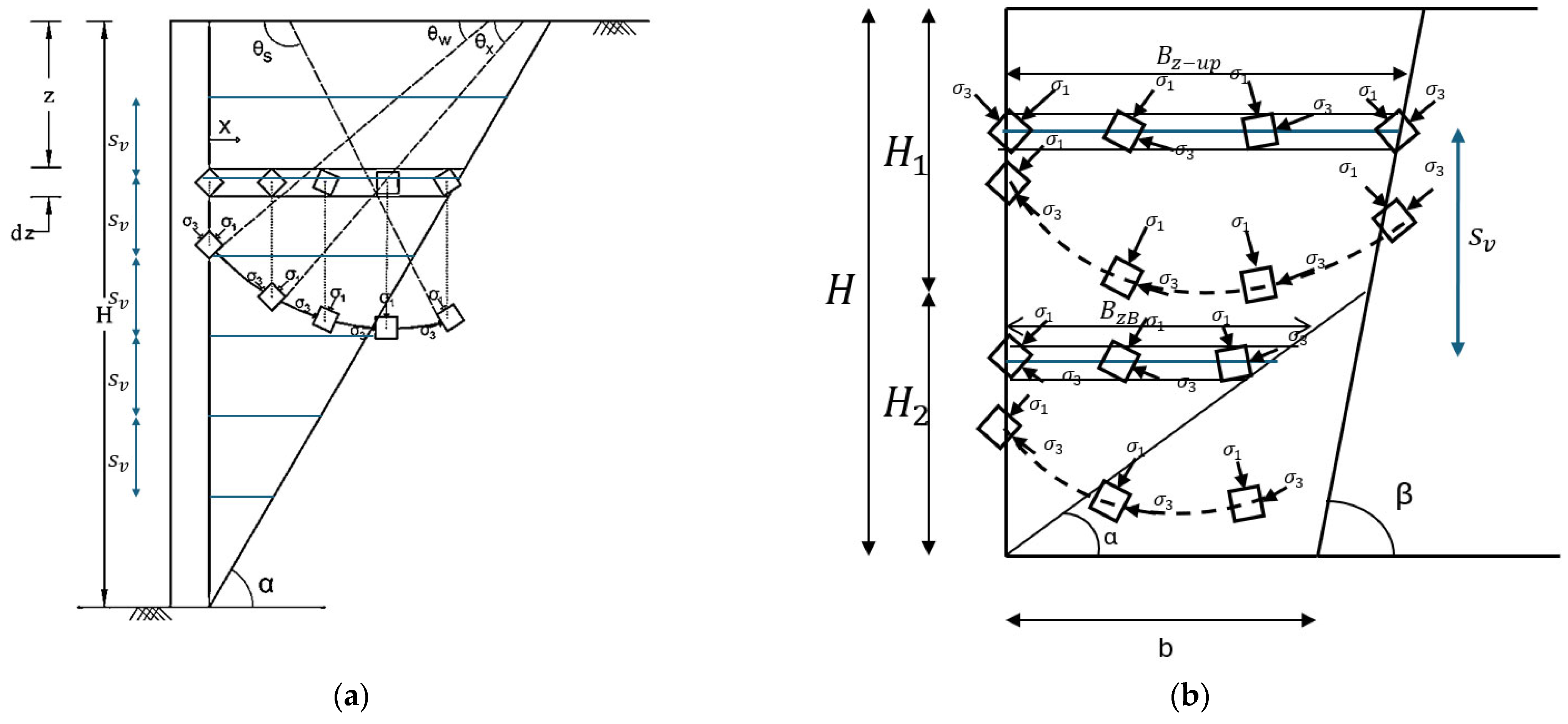
In reinforced soil structures, a portion of the soil weight behind the wall is supported by interface frictional forces, similar to unreinforced ones.
According to Janssen’s [
5] arching principle, this force alters the path of the principal stresses, resulting in a stress trajectory where the major principal stresses (
) and minor principal stresses (
) are tangent and normal, respectively. This phenomenon is illustrated in
Figure 2a for walls with semi-infinite backfill. However, in narrow backfills, where friction forces act on both sides of the backfill, the arching effect is greater, leading to a greater change in the principal stresses, as shown in
Figure 2b.
For the analysis of the principal stress trajectory behind a retaining wall, this study follows the approach proposed by Ghaffari Irdmoosa and Shahir [
11] and Ghobadi and Shahir [
12], where the direction of the major principal stress is assumed to change linearly in a horizontal element behind the retaining wall. The trajectory of the major principal stress at any given point can be expressed as
where
shows the angle of
measured from the horizontal. In addition,
,
and x represent the angles at the retaining wall, the angle at slip surface and the horizontal distance, respectively. The
represents the width of the flat horizontal element at a depth z, as defined by the equations
where
and
represent the widths at the top section and bottom section of the potential rupture block, respectively, with
being the total height of the wall. The angles α and β define the failure surface slope and backslope inclination, respectively, and
is the height of the top section of the rupture block.
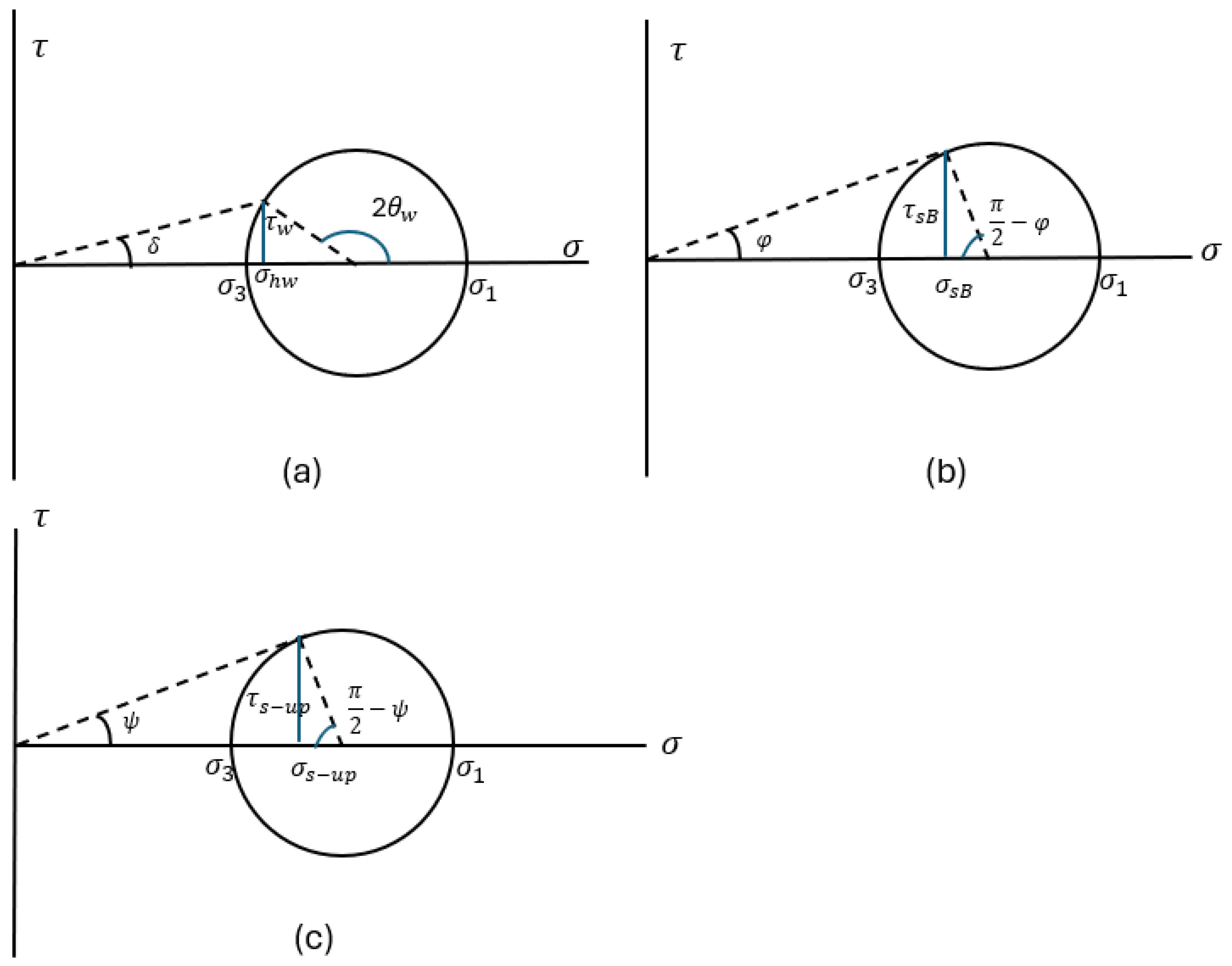
Figure 3a–c represent the stresses at wall face, top and bottom sections of the failure surface.
At the wall face, the shear stresses and normal stresses are represented by and respectively. shows the major principal stress angle at the wall face, and represents the friction angle between the wall and soil. At the slip surface, the normal and shear stresses are indicated as and . The angle of friction between the soil and the stable rear boundary is denoted as Ψ.
From the Mohr circle analysis in
Figure 3a, the following relationship can be established for the principal stress angle
:
Figure 3b,c show that π/4 −
/2 is the angle of principal stress and the failure surface for both the top and bottom section of the sliding wedge. Adding these to the respective inclination angles of the failure surface relative to the horizontal β for the upper part and α for the lower part, the principal stress angles are:
Here, α and β are the slopes of the slip surface, is the soil’s internal friction angle, and Ψ is the soil-backslope friction angle. B subscript shows the bottom part and “up” subscript shows the upper part. Using these relations alongside Equations (1) and (7), the principal stresses can be calculated at any point.
4. Equilibrium Equation
By analyzing the differential element next to the wall surface (
Figure 2), the lateral soil pressure is expressed by the principal stresses at the wall surface as follows:
divided by
,
As the sum of the two orthogonal stresses is constant (Equation (10)), the vertical stress can be obtained from Equation (11).
Equation (9) and (11) are valid for any distance from the wall. By substituting with from Equation (1), the corresponding expressions can be obtained.
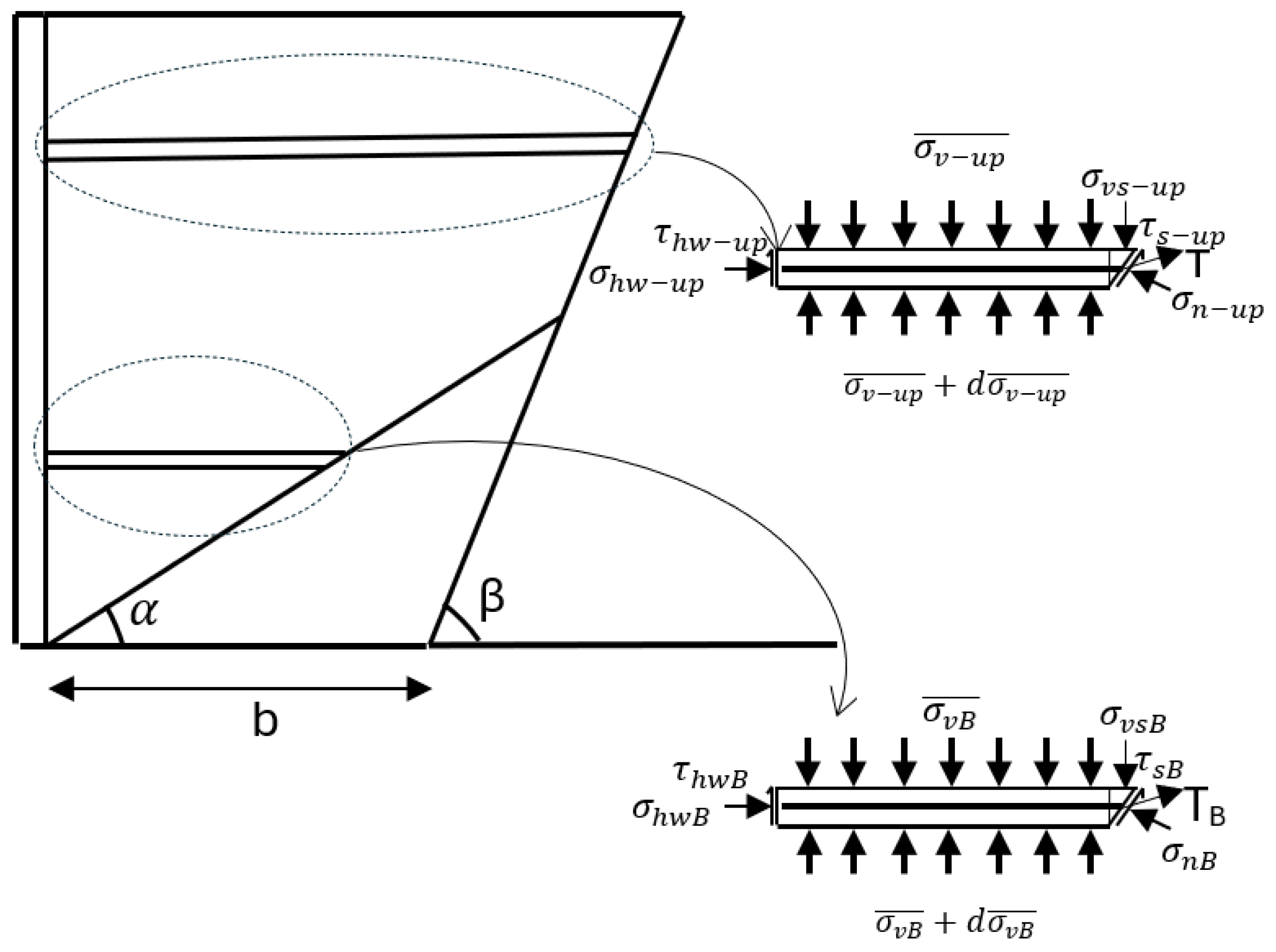
The vertical and horizontal equilibrium of the horizontal differential elements shown in
Figure 4, at the top part of the slip surface is as follows:
The “up” in all equations represents upper part of the slip surface.
: Lateral earth pressure acting on the wall.
: Reinforcement tension.
: Soil friction angles between the backfill soil and the wall surface.
: Friction angle between the rear stable backslope and the soil.
: Slope of the stable backslope.
: Unit weight of the soil.
: Geotextile spacing.
: Normal stress at the failure surface.
: Vertical stress at the failure surface.
The average vertical stress is
is the horizontal distance between the wall and the slip surface at depth z. By solving the integral, the equation related to average vertical stress is derived as follows:
The shear stress and the normal stress can be obtained from the below equation.
The geogrid tension (T) can be obtained from Equation (12), and by substituting
,
and
, T can be expressed in terms of principal stresses (
and
):
Based on the Mohr–Coulomb criterion, the major principal stress can be written in terms of the minor principal stress.
where
represents the ratio of the minor to major normal principal stresses, which is Rankine’s coefficient of active lateral earth pressure. The value of
can be expressed in terms of the soil’s internal friction angle, φ, as follows:
By substituting
,
,
,
and
with respect to the minor principal stress into the vertical equilibrium equation,
= 0, the following differential equation is obtained:
To simplify the above formula, Bup and Dup are defined as follows:
At z = 0, the average vertical stress is equal to the surcharge (
= q). Therefore, Equation (23) gives
at any distance from the surface in the top section (up) of the failure wedge:
Thus, the lateral pressure can be determined in respect to
in any distance from the surface as follows:
To find the simplified Equation (25), K
hw, K
vw and K
vs-up are defined as below:
All the equations are rewritten for the lower part of the slip surface.
: Normal stress on the failure surface.
: Shear stress on the failure surface.
: Average vertical stress.
α: Slip surface angle in the bottom section.
The normal and shear stresses in this area are defined as follows:
By substituting
and
into Equations (9) and (11),
and
can be rewritten in terms of the principal stresses. Consequently, Equation (36) results from substituting
,
,
,
and
based on the minor principal stress, into Equation (33).
To simplify the above formula
and
are as follows:
To solve Equation (36), the boundary condition at the interface of the top and bottom section is that the lateral earth pressure is equal (
=
at z = H
2). Accordingly,
can be obtained as follows for the lower part:
Thus, the lateral pressure can be determined in respect to
in any distance from the surface as follows:
5. Verification of Proposed Method, Field Data and Centrifuge Tests
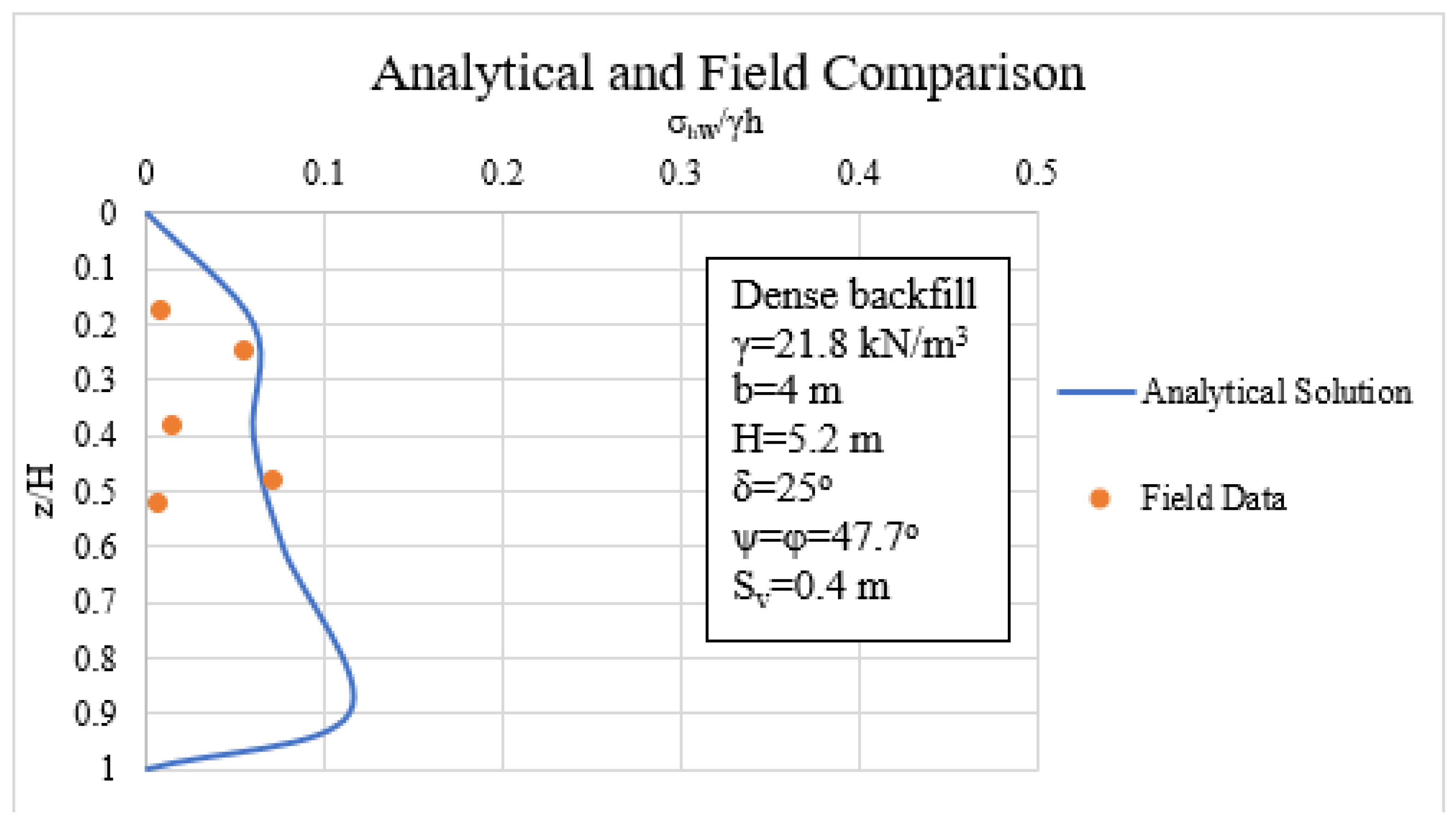
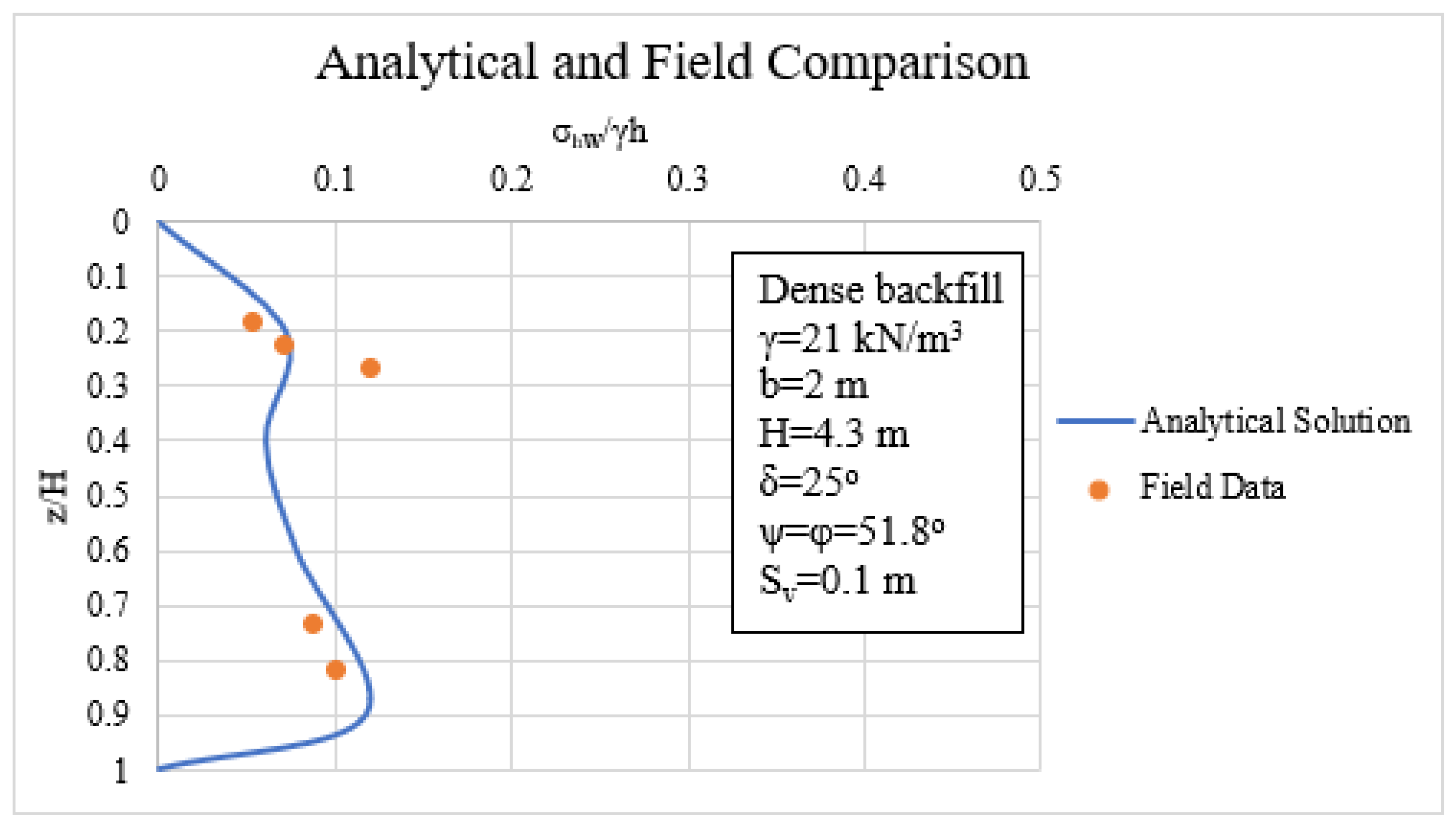
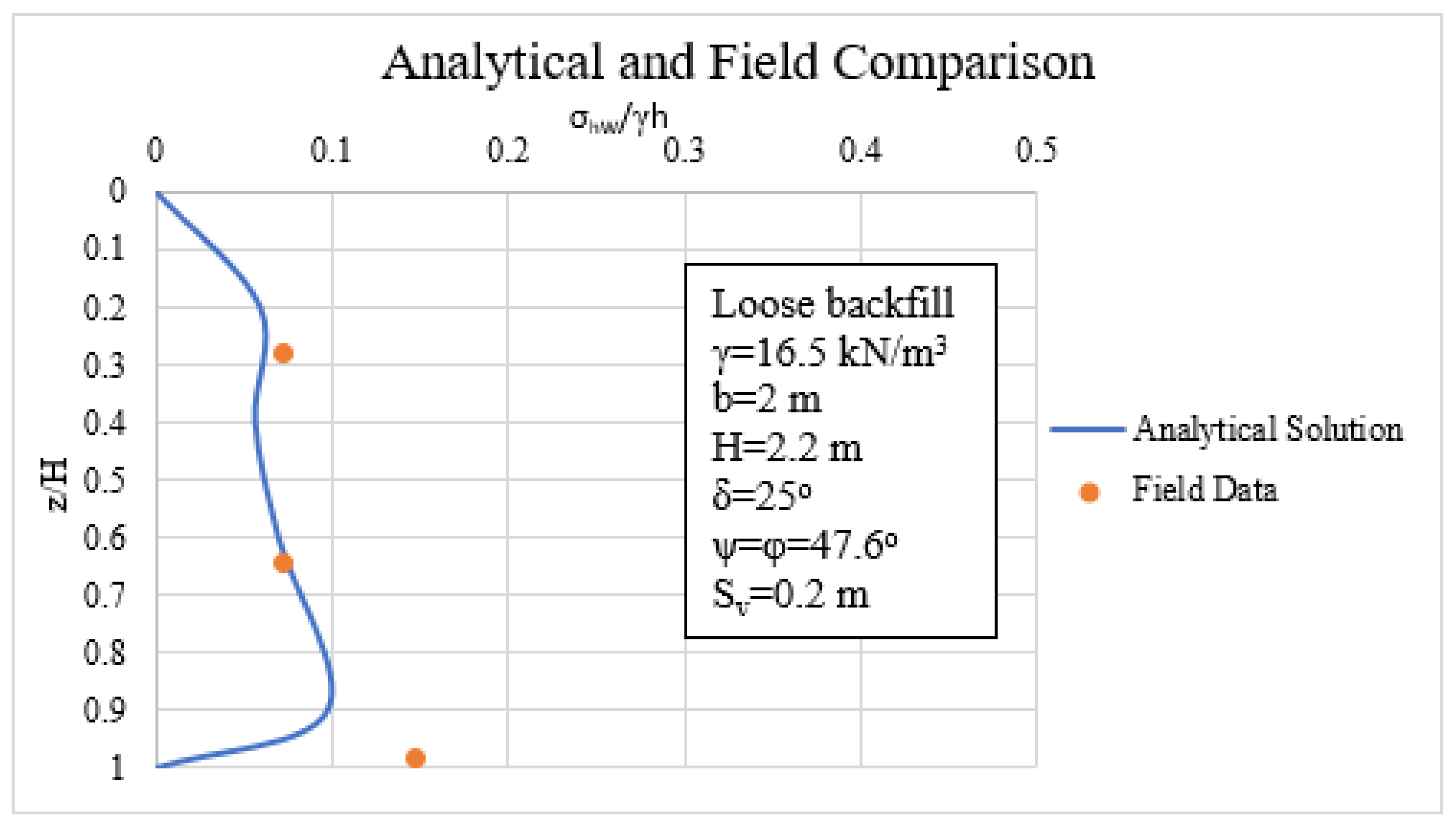
Since no narrow Mechanically Stabilized Earth (MSE) wall has been instrumented, the analytical solution (Equation (26)) and the related equations) is verified by comparing the results with field data from unlimited MSE walls, assuming that b is larger than 0.7 H in the proposed formula (
Figure 5,
Figure 6 and
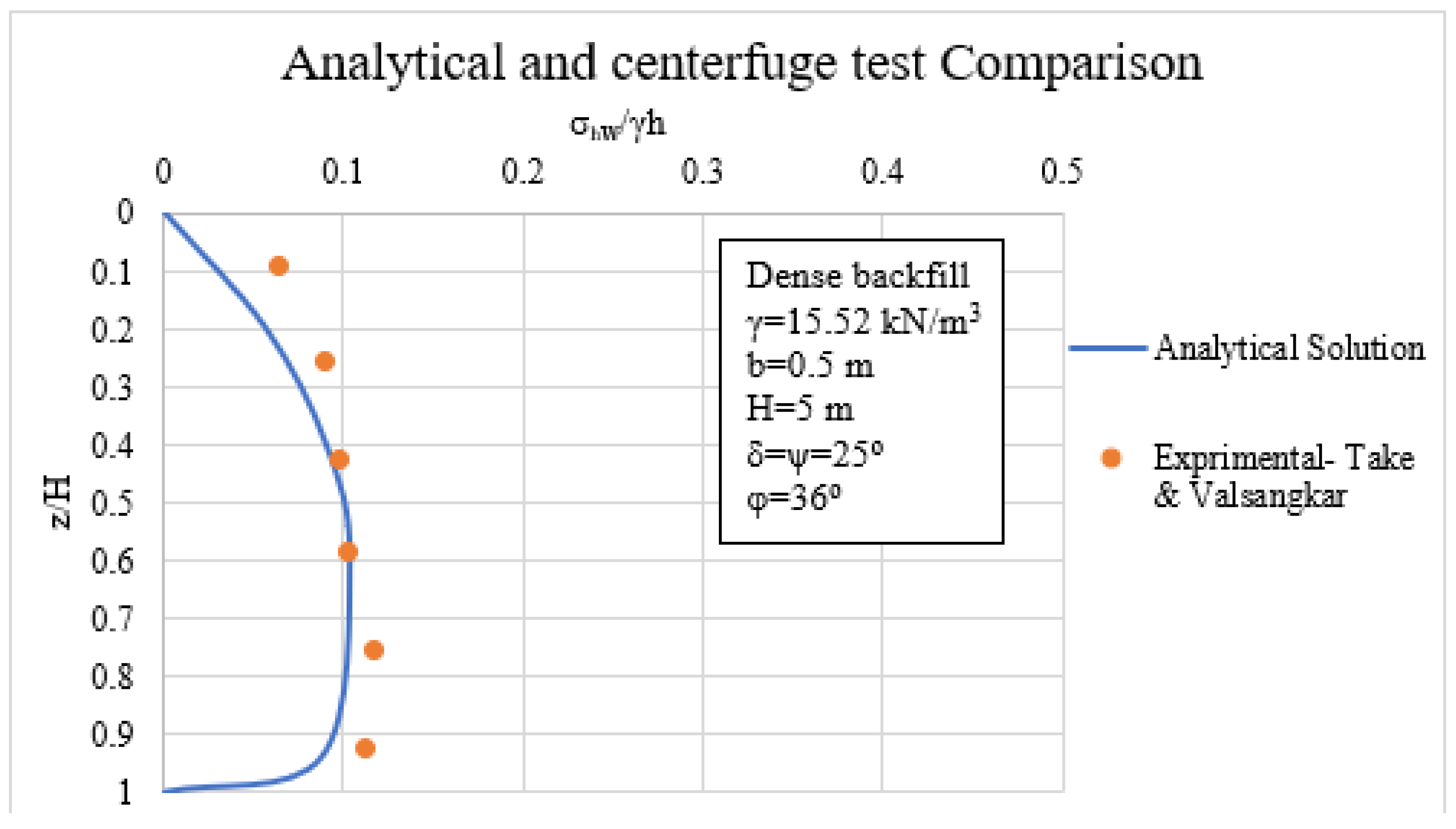
Figure 7). The results are also compared with unreinforced narrow walls by assuming T = 0 (
Figure 8,
Figure 9 and
Figure 10).
Three reinforced earth walls and three narrow walls are used for comparison in this section. In the instrumented MSE walls, measurements of lateral earth pressure were taken once construction was finished, but before any superstructures or surcharges were added.
- (i)
A reinforced earth wall with 5.2 m height located in Colorado, USA, provided by Abu-Hejleh et al. [
26,
27]. This reinforced earth wall was constructed using uniaxial geogrids placed at 0.4 m intervals, with well-graded silty sand as the backfill.
- (ii)
A bridge abutment with crushed stone as the backfill and 2.2 m height was built in Virginia, United States, [
28,
29]. The support used geotextiles with 0.2 m intervals as reinforcement.
- (iii)
A bridge with a 4.3 m abutment height was constructed in Denver, Colorado, USA. The support includes geotextiles located at 0.1 m intervals, with silty sand backfill.
- (iv)
Centrifuge model tests conducted by Take and Valsangkar [
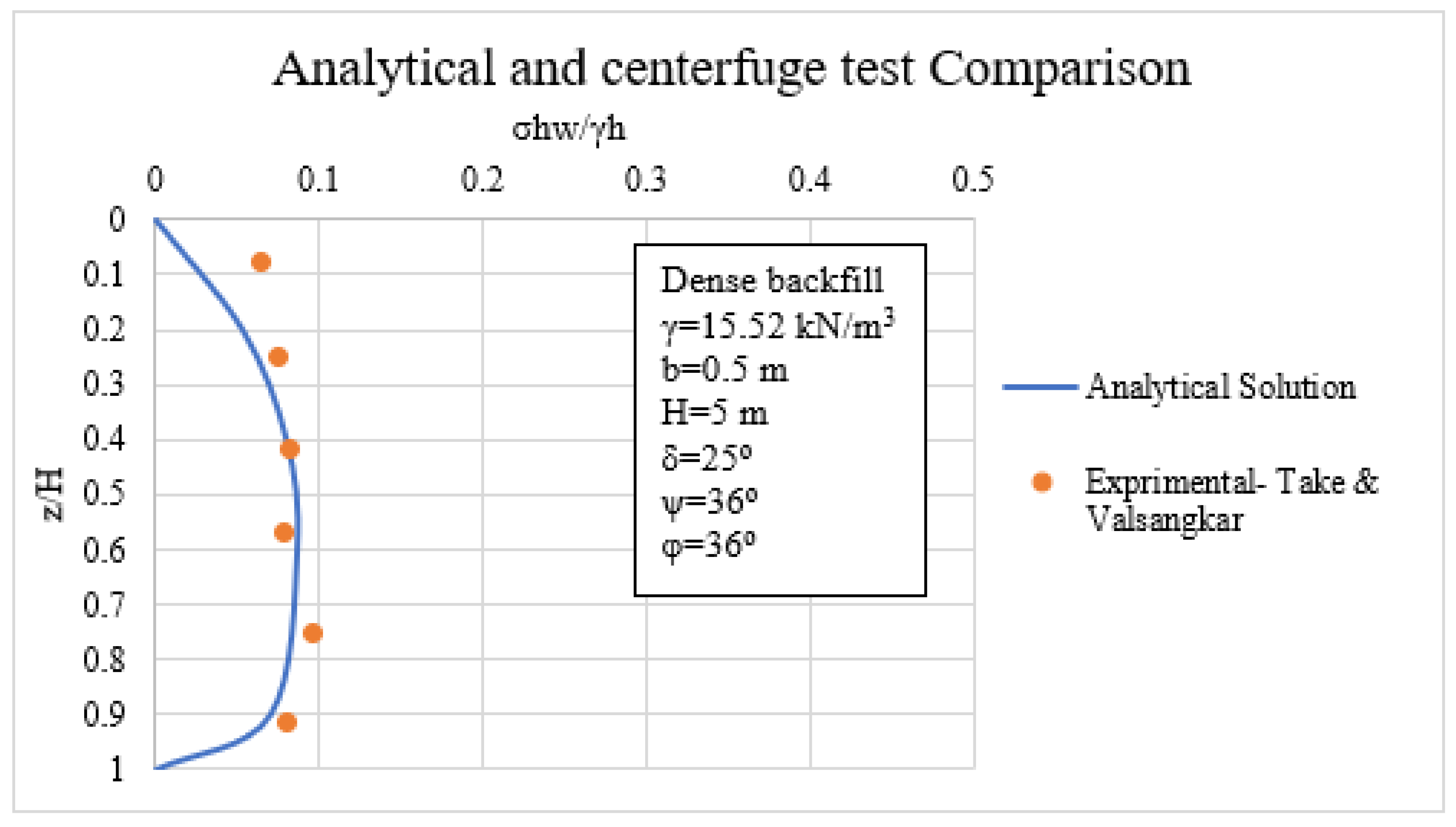
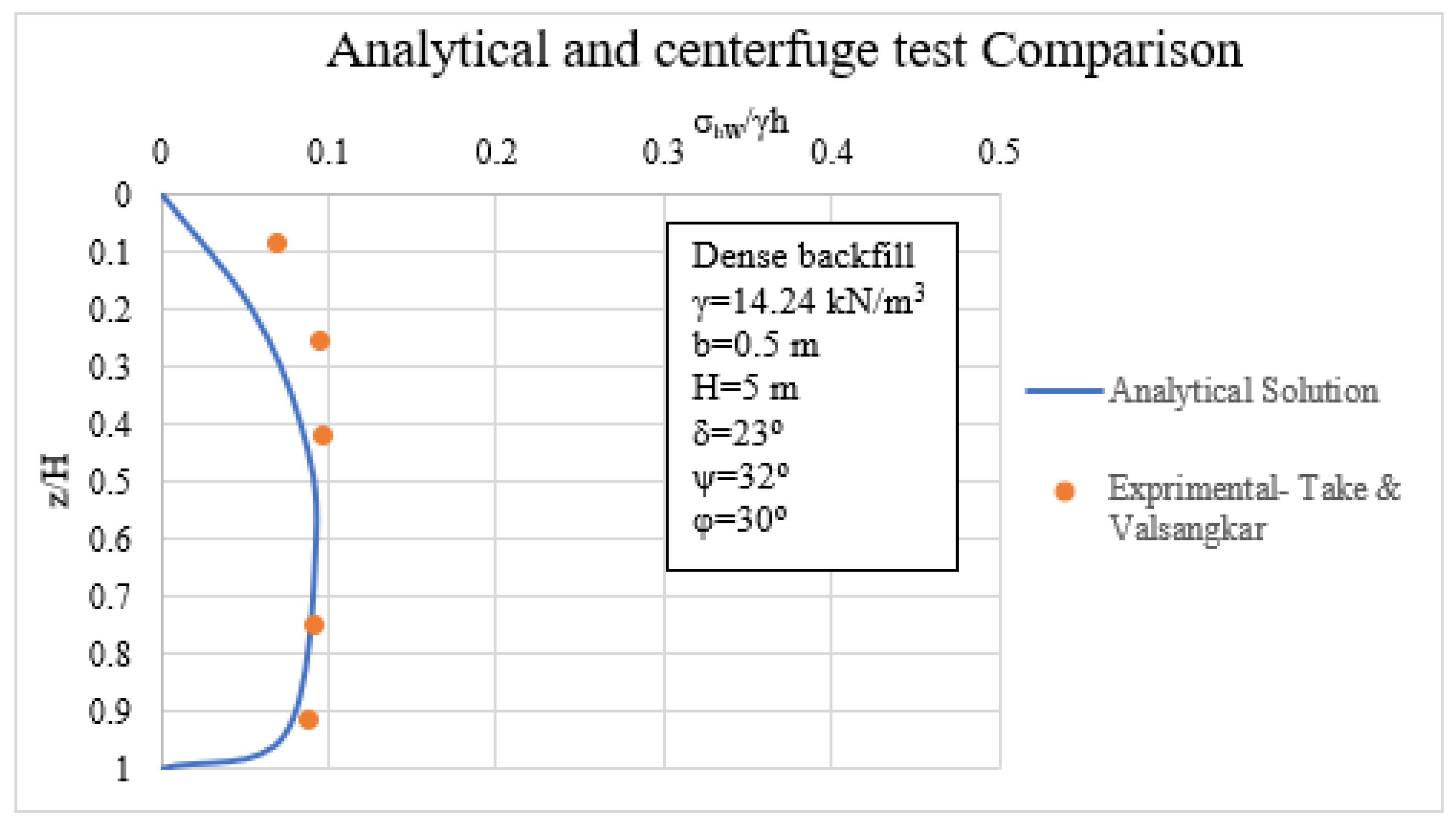
4] were also used for verification. These tests simulated a 5 m retaining wall with a 0.5 m backfill width, representing a narrow backfill condition with loose and dense sand. The soil parameters were φ = 30° and δ = 23° for the loose condition, and φ = 36° and δ = 25° for the dense condition. Two types of vertical boundary conditions behind the wall, with different interface roughness, were also examined.
Figure 5,
Figure 6 and
Figure 7 show a comparison between the measured and predicted lateral earth pressures for structures (i), (ii), and (iii), respectively.
Figure 8,
Figure 9 and
Figure 10 show the comparison between the results of the proposed analytical method and the centrifuge tests conducted by Take and Valsangkar [
4].
In structure 1,
Figure 5, the sensors measured the wall pressure from middle of the wall to the top. The prediction on the upper part of the wall is slightly greater than the real data, likely due to idealized assumptions regarding facing rigidity and wall–soil interface friction, but in the middle part shows a close alignment to the real data. Overall, the similar trend and magnitude confirm the method’s capability to accurately capture arching and the upward shift of the pressure maximum in narrow backfills.
Figure 6 compares analytical predictions and field data for the 2.2 m reinforced wall in Virginia, where sensors recorded pressures mainly at the top and bottom. The analytical method produces slightly higher pressures than measured values, reflecting differences in facing type and reinforcement characteristics between the real structure and the assumptions of the model.
In
Figure 7, the analytical solution predicts lower pressures at bottom of the wall, while closely matching the measured values in the mid-height region. This behavior reflects the arching-controlled pressure distribution commonly observed in narrow backfills. Despite these discrepancies, the central portion of the wall shows good agreement with field measurements. The strong match in the critical mid-height zone further validates the proposed method’s ability to capture the nonlinear, non-triangular lateral pressure distribution of reinforced narrow walls.
Figure 8,
Figure 9 and
Figure 10 compare the proposed analytical solution with the centrifuge tests of Take and Valsangkar [
4] for a 5 m high wall with a very narrow 0.5 m backfill. All three figures consistently show the characteristic nonlinear pressure profile dominated by arching: very low pressures near the top, increasing to a maximum around 0.75 H, and then decreasing again toward the base.
For both dense and loose sand cases, the analytical predictions follow the same trend as the experimental results. However, the analytical model typically underestimates the measured pressures by approximately 10% near the upper and lower portions of the wall. These differences are attributed to boundary and scale effects in the centrifuge model, as well as the sensitivity of the system to interface friction conditions.
In
Figure 8, the analytical and experimental curves match particularly well for dense sand with δ = ψ = 25°, accurately capturing both the magnitude and shape of the pressure distribution.
Figure 9 further demonstrates the model’s sensitivity to back slope or rear boundary friction: increasing ψ reduces lateral pressures, and both curves reflect this reduction while maintaining the same overall profile. Finally,
Figure 10 shows comparable agreement for loose sand (φ = 30°), where the overall pressures are lower but the nonlinear shape persists. The analytical model successfully predicts the mid-height maximum and general distribution, with only minor discrepancies near the top and bottom.
These three figures confirm that the proposed analytical method successfully reproduces the experimentally observed behavior of narrow backfills, accurately capturing arching, nonlinear pressure distribution, and the influence of soil friction parameters.
6. Results and Discussion
6.1. Effect of Interface Friction
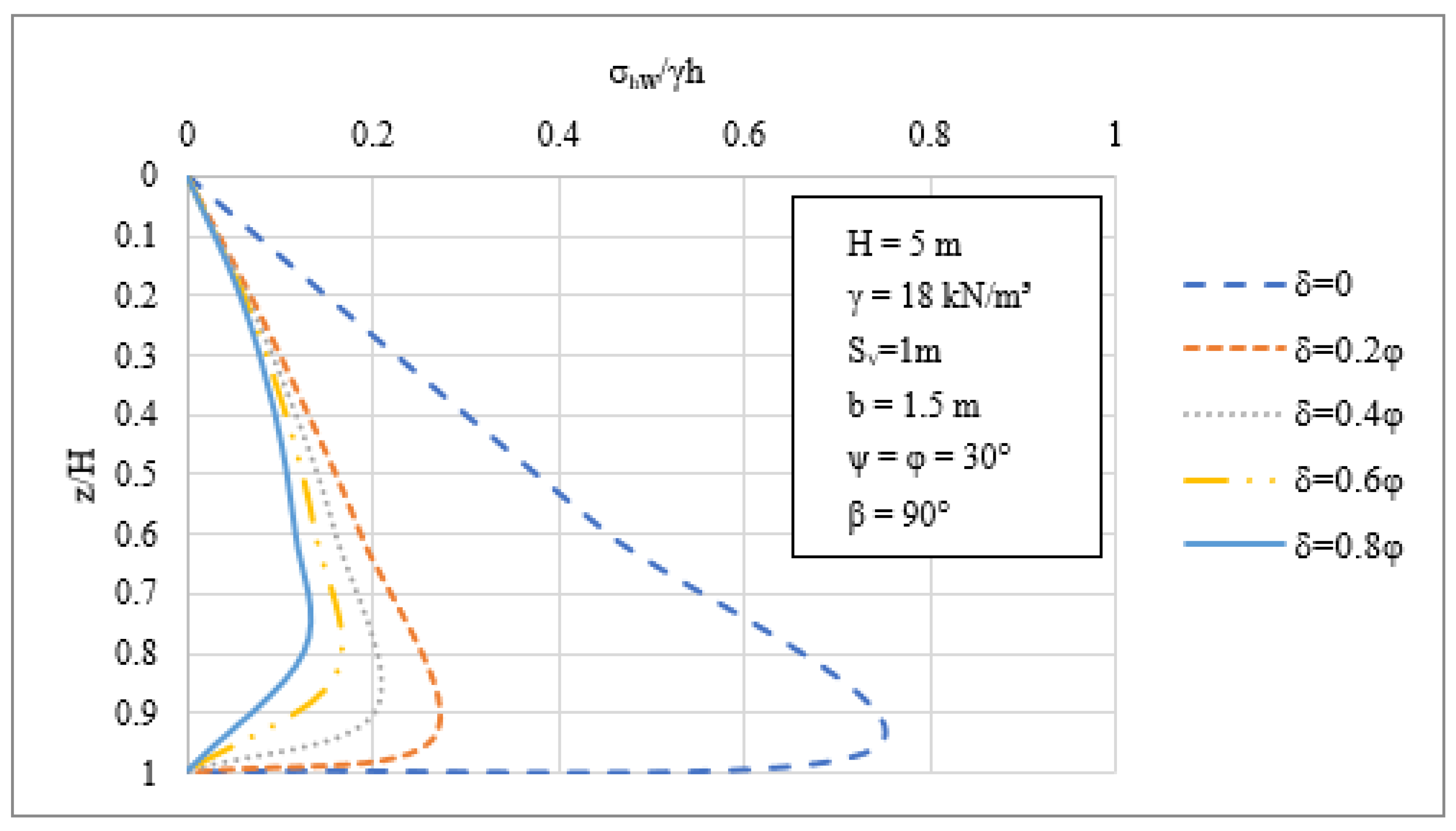
Figure 11 illustrates the effect of the soil–wall interface friction angle (δ), varied from 0 to 0.8φ, on the lateral earth pressure distribution. Increasing δ leads to a clear reduction in lateral earth pressure along the wall height. When δ = 0, the predicted pressure distribution is similar to the classical Mohr–Coulomb solution, with the maximum pressure occurring at the wall base. As δ increases, the pressure level decreases, particularly in the middle and upper portions of the wall. At mid-height (z/H ≈ 0.5), the normalized lateral pressure is reduced by approximately 30–40% for δ = 0.8φ compared with the smooth wall condition, while the reduction near the base is more limited (about 15–20%). In addition, the location of the maximum lateral pressure shifts upward to approximately z/H ≈ 0.6–0.7. This behavior reflects the increased development of arching within the backfill, which redistributes stresses away from the wall as interface friction increases.
6.2. The Effect of b/H (Width Ratio)
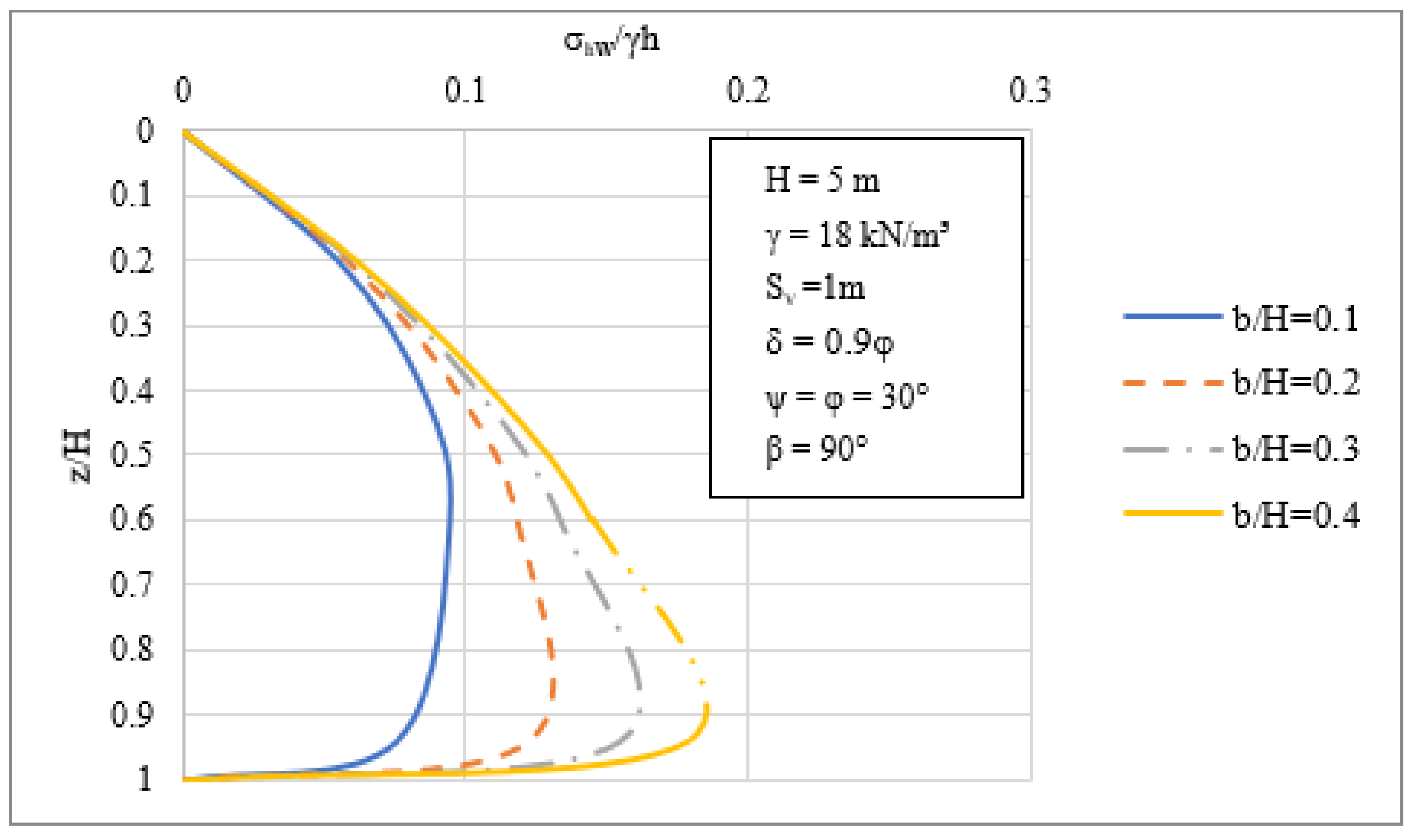
The influence of backfill width is illustrated in
Figure 12. A reduction in the width ratio from b/H = 0.4 to b/H = 0.1 leads to a decrease in lateral pressure, especially in the central part of the wall. At z/H ≈ 0.6, the pressure for the narrowest backfill is approximately half of that computed for the widest case. These results demonstrate that a decrease in b/H ratio causes the location of the maximum lateral earth pressure to move upward, implying a redistribution of stresses within the backfill due to enhanced arching effects.
6.3. Height Effect
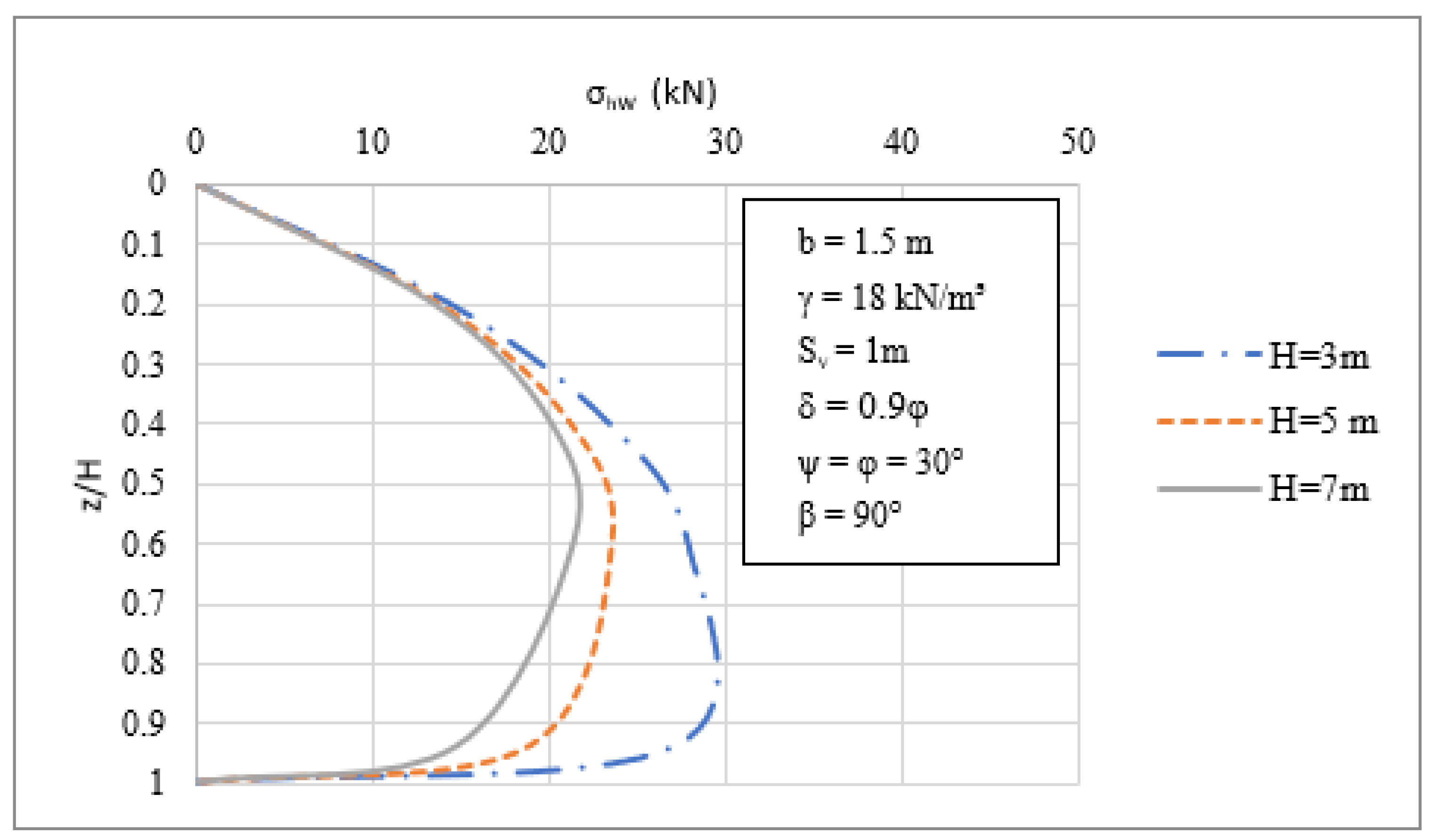
Figure 13 mainly highlights the effect of wall height on the non-normalized magnitude of lateral earth pressure. As expected, higher walls develop larger pressures, with the maximum pressure for the 7 m wall being more than twice that of the 3 m wall. However, the overall shape of the pressure distribution remains similar, and the peak consistently occurs at an intermediate depth rather than at the base. This indicates that the stress transfer mechanism governing the pressure distribution is largely independent of wall height.
6.4. Backslope Inclination (β)
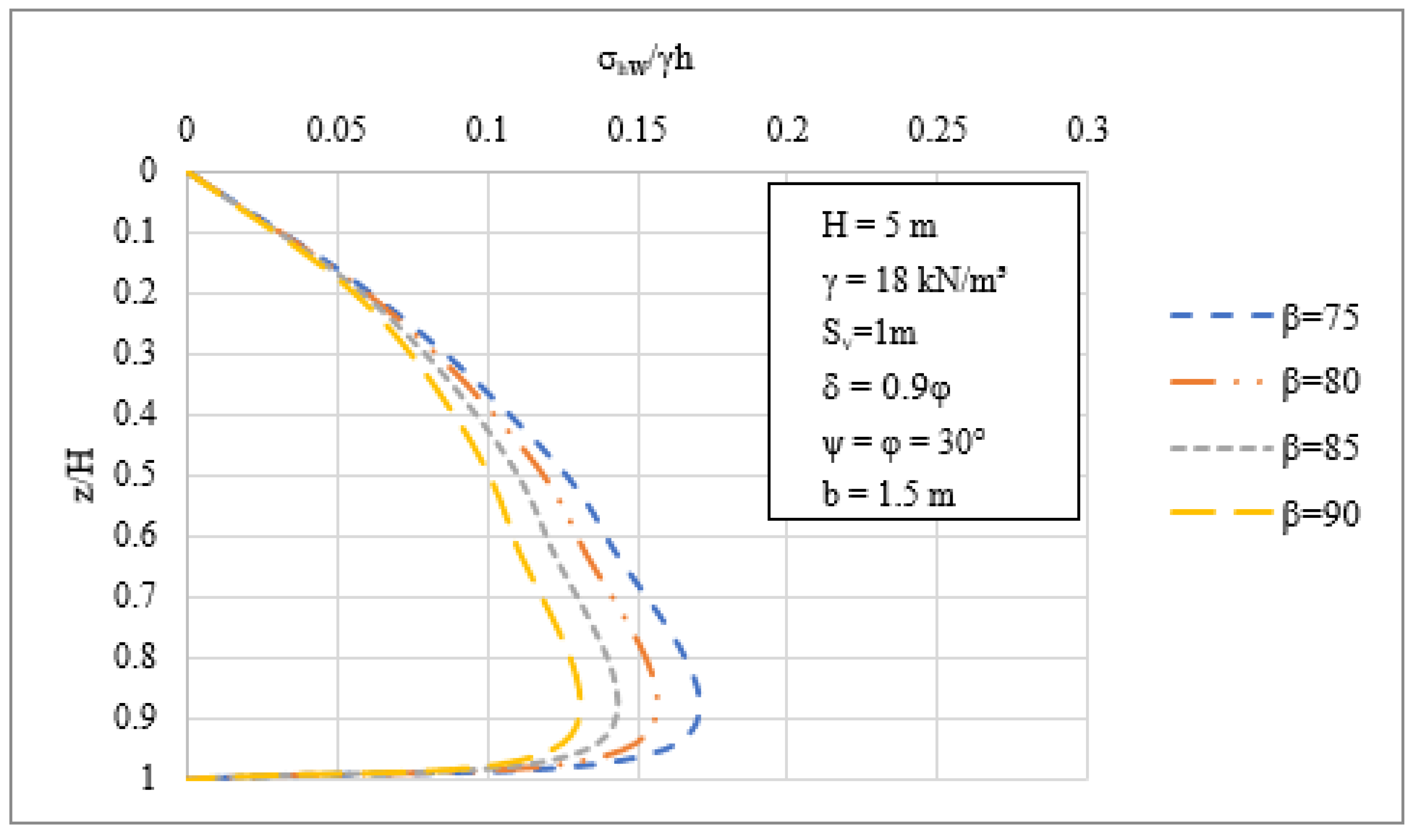
Figure 14 shows the inclination of backslope influence on the lateral earth pressure. As illustrated, increasing the backslope angle leads to a reduction in lateral earth pressure. The backfill volume decreases as the slope angle increases. This trend is obvious at β = 90°, where lower pressure occurs, and at β = 75°, where higher pressure occurs.
6.5. Effect of Interface Friction on Geotextile Tension
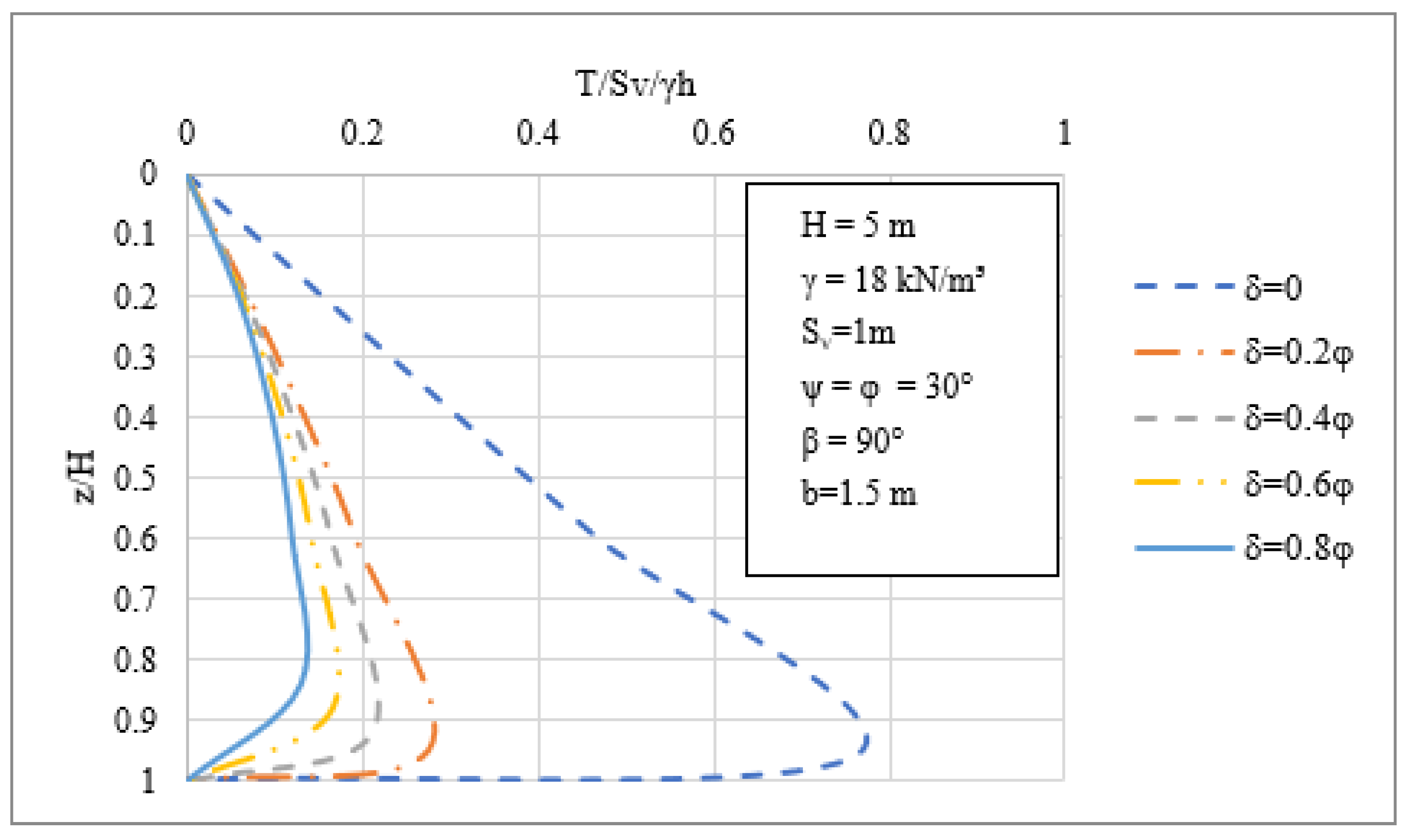
Figure 15 shows that the maximum geotextile tension is strongly affected by the interface friction angle. As δ increases to 0.8φ, the peak tension decreases, by roughly 40%, and its location shifts slightly upward. This indicates that improving the interface conditions decreases the forces acting on the wall facing as well as the reinforcement layers. The tensile force
denotes the maximum tensile force mobilized in the geotextile reinforcement.
6.6. Effect of Geotextile Spacing on Geotextile Tension
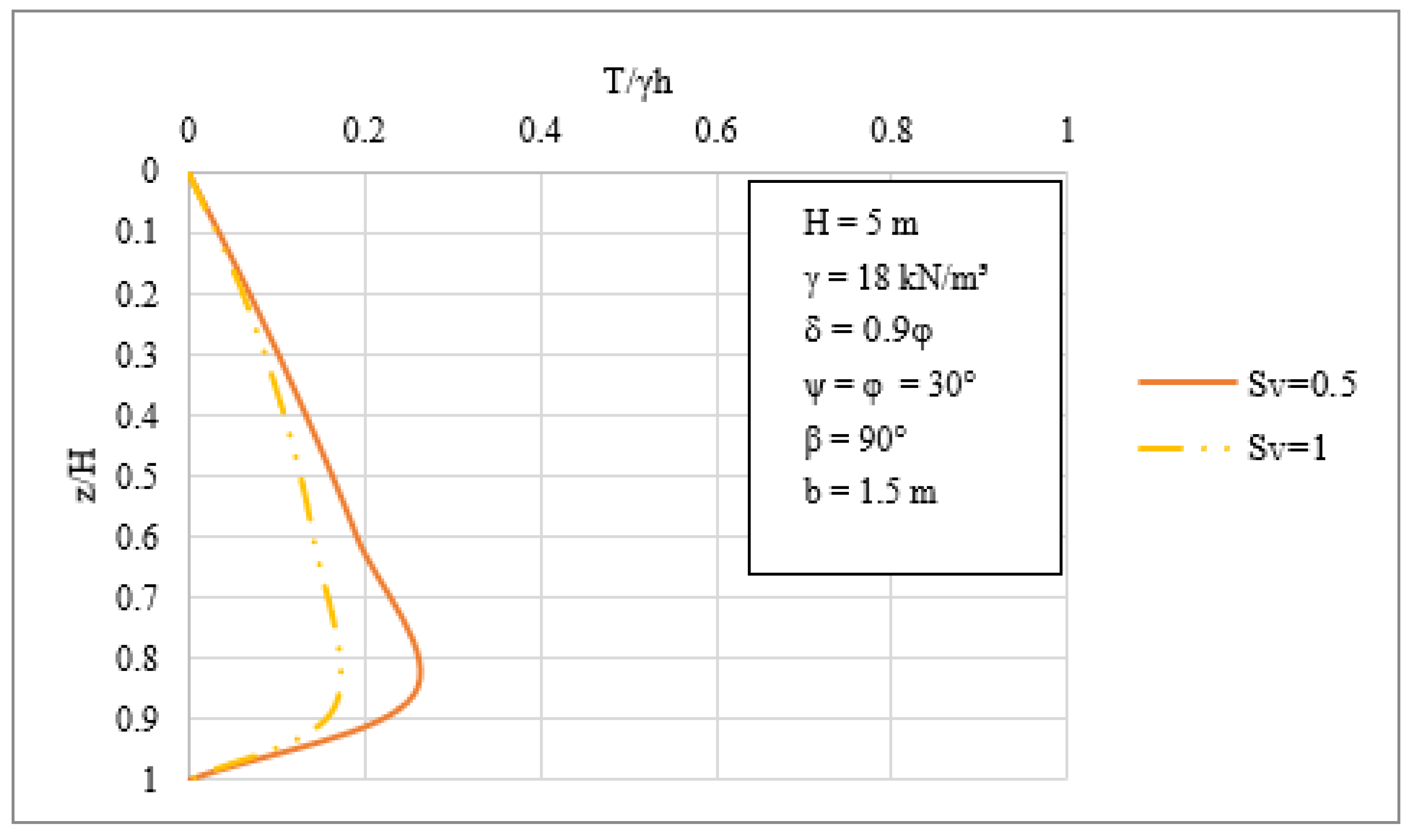
Figure 16 shows the influence of Geotextile spacing on the Geotextile maximum tension. Increasing the vertical spacing from S
v = 0.5 m to S
v = 1.0 m results in lower tensile forces in individual reinforcement layers. At the depth of maximum tension, the force corresponding to S
v = 1.0 m is approximately 20% lower than that for S
v = 0.5 m. Although fewer reinforcement layers are present, the overall stress redistribution pattern remains similar, suggesting that spacing primarily affects load sharing rather than the global pressure mechanism.
7. Conclusions
In this paper, the lateral earth pressure in narrow Mechanically Stabilized Earth (MSE) walls was evaluated through an analytical method that considered the arching effect. The proposed method, based on the principal stress rotation theory and a bilinear failure surface, provides a reliable tool for estimating lateral pressures and reinforcement forces in narrow reinforced backfills.
The analytical results confirm a close agreement with both field data and centrifuge test results. The comparisons positively show that the proposed method can accurately evaluate the nonlinear nature of lateral earth pressure distribution, with maximum pressures occurring at approximately mid-height of the wall rather than at the base. This result demonstrates the influence of arching, which distributes stress through the confined backfill.
In addition, based on the proposed method results, increasing the soil–wall interface friction significantly increases the arching effect, which leads to a shift of the maximum pressure point upward. Moreover, this behavior is dramatically influenced by the width ratio (b/H), wherein a reduction in the width ratio (b/H) increases the arching effect. According to the sensitivity analysis, the backslope inclination (β) affects the magnitude of lateral pressure. By closing to β = 90°, the pressure decreases because of the smaller backfill volume.
The results demonstrate that classical Rankine and Coulomb earth pressure theories are not applicable to narrow MSE walls, as they do not consider stress redistribution caused by geometric confinement and soil arching. For narrow backfills, lateral earth pressure is nonlinear, and the maximum pressure occurs away from the wall base. Therefore, design methods should explicitly consider backfill width, interface friction, and reinforcement–soil interaction, rather than relying on conventional triangular pressure assumptions. The proposed analytical approach offers a practical and computationally efficient framework for improving the accuracy and reliability of narrow MSE wall design.
Future research should focus on extending the proposed model to include cohesive and layered soils, construction sequencing effects, and time-dependent behavior. Additional validation using full-scale instrumented narrow MSE walls is recommended, along with extensions to seismic and surcharge loading conditions.