
Degradation and Decay of Rocks: Linking Wetting–Drying and Slake Durability Tests for Climate-Sensitive Maintenance


Abstract
1. Introduction
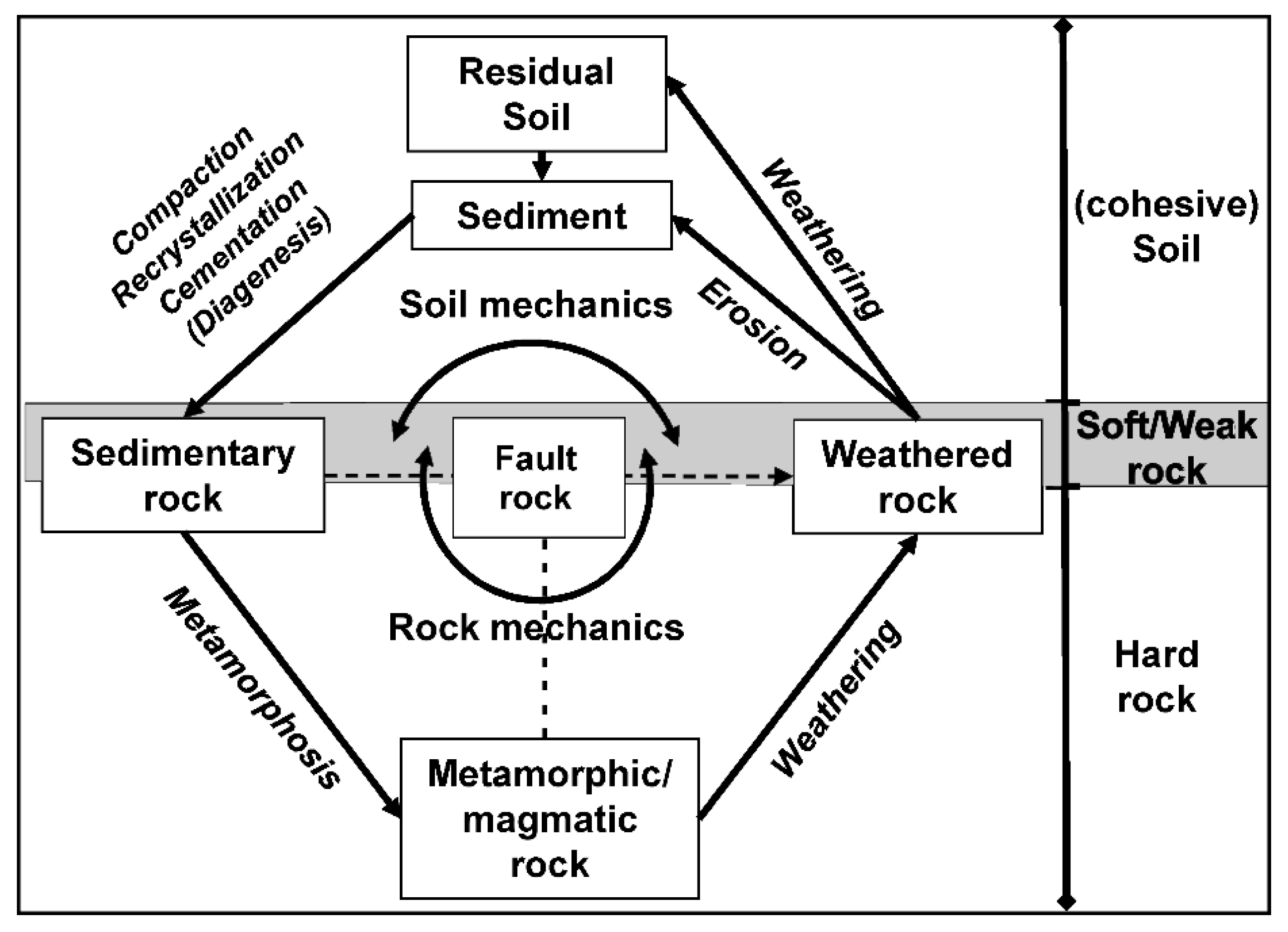
1.1. Thematic Background
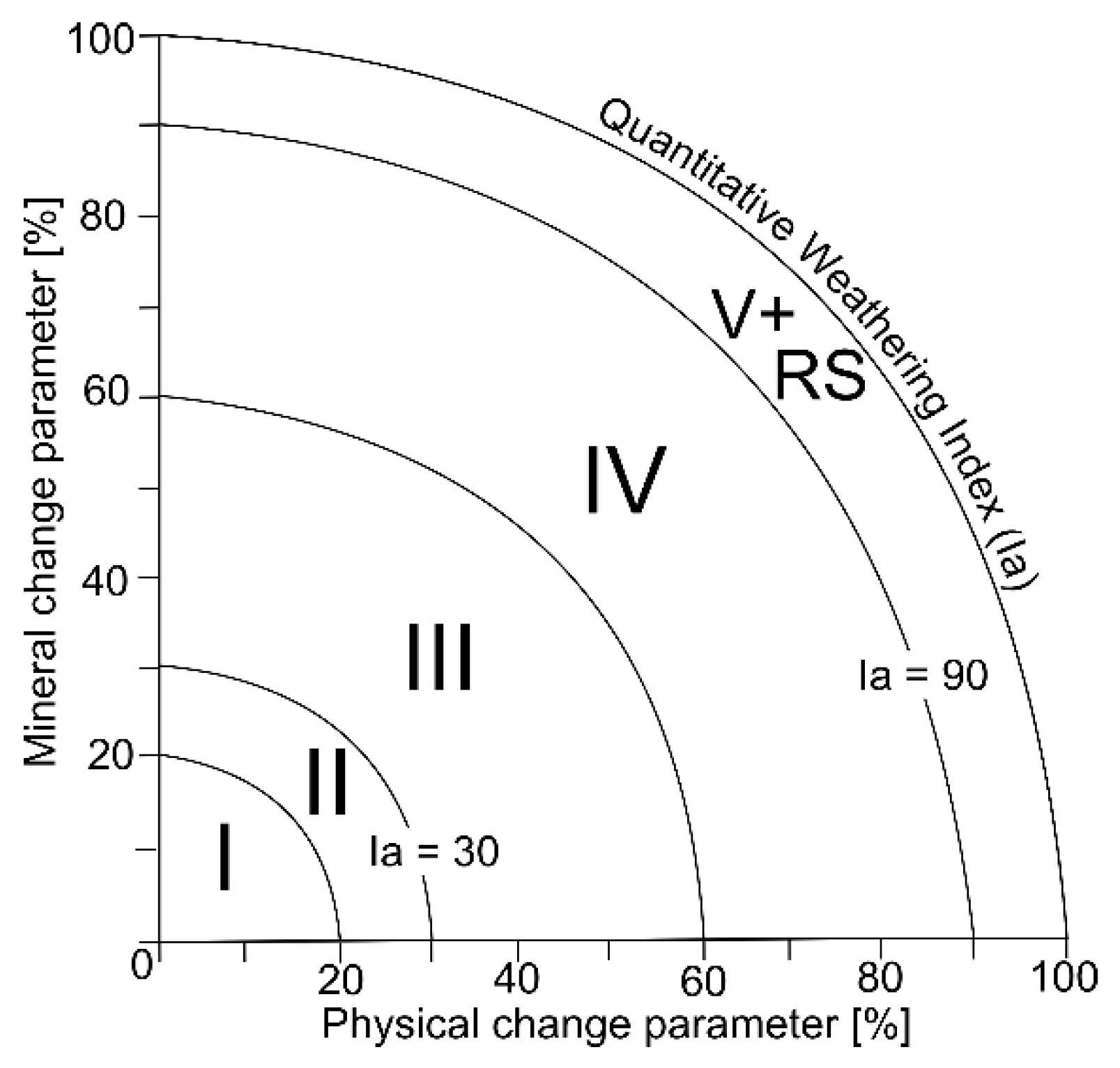
1.2. Current Practice of Rock Durability Testing
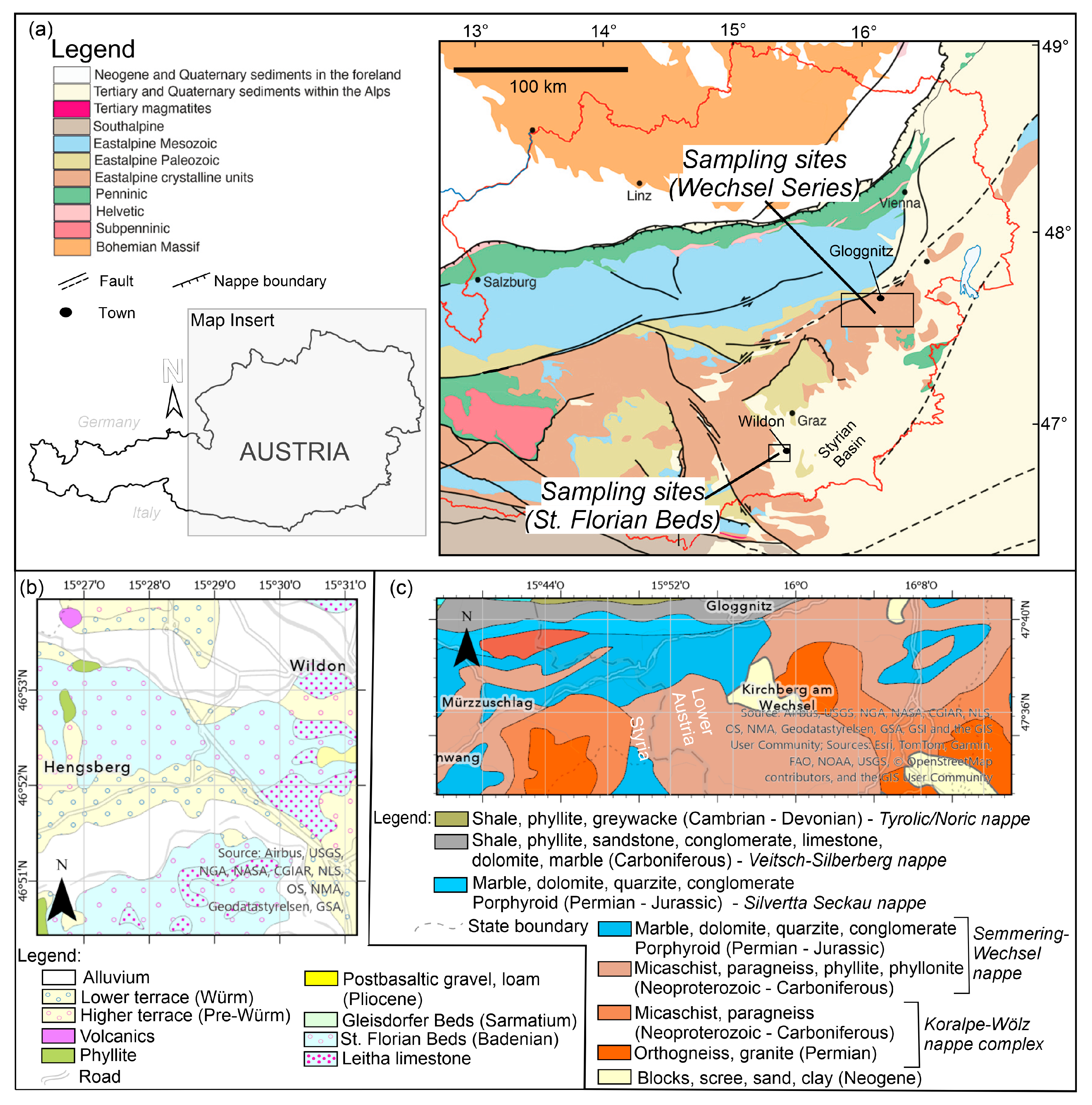
2. Materials and Methods

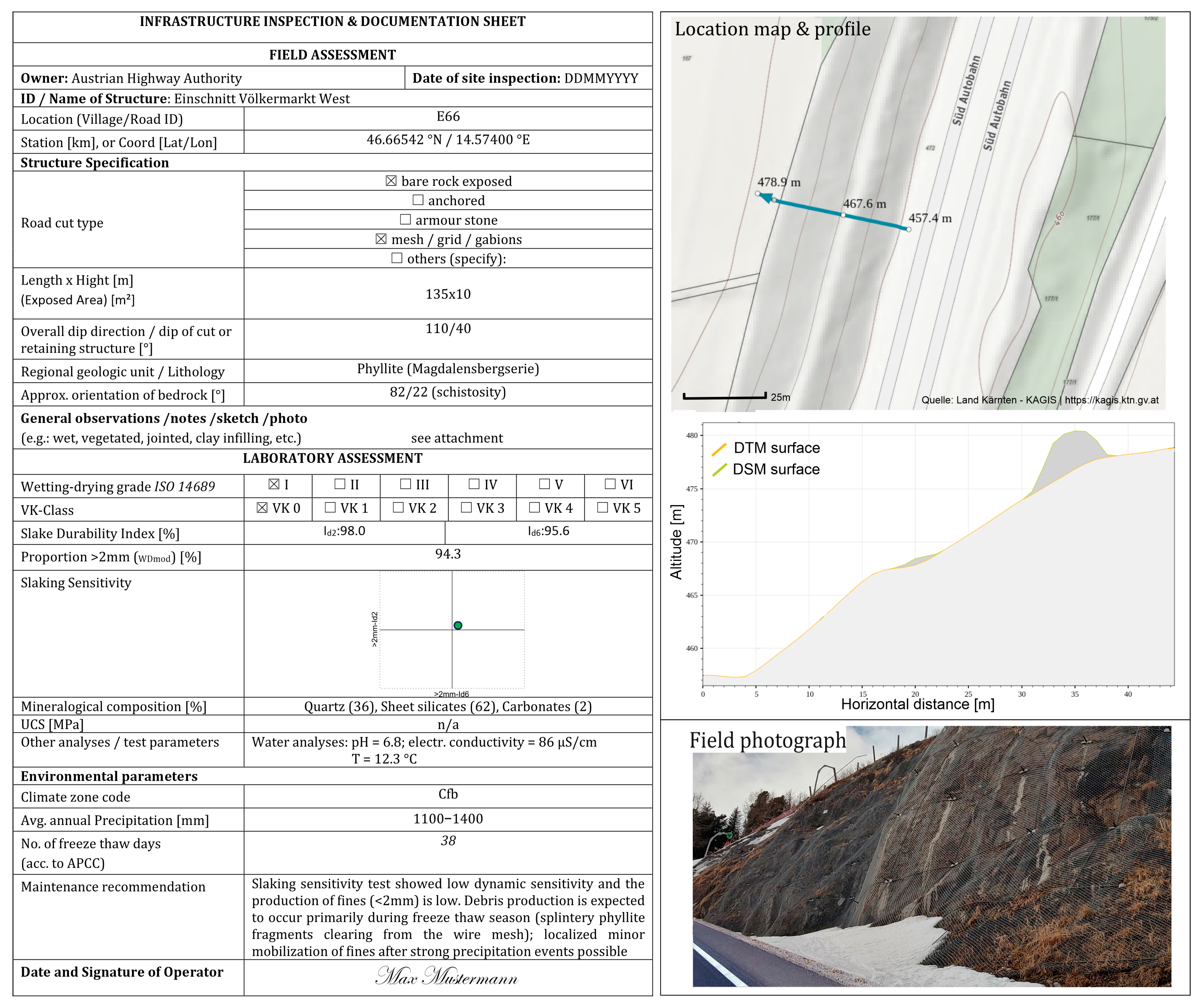
3. Results
4. Discussion
4.1. Mineralogical Controls of Slaking Processes
4.2. Environmental Impact on Slaking Processes
5. Conclusions
Author Contributions
Funding
Institutional Review Board Statement
Informed Consent Statement
Data Availability Statement
Acknowledgments
Conflicts of Interest
References
- Hashemnejad, A.; Aghda, S.M.; Talkhablou, M. Introducing a new classification of soft rocks based on the main geological and engineering aspects. Bull. Eng. Geol. Environ. 2021, 80, 4235–4254. [Google Scholar] [CrossRef]
- Selen, L.; Panthi, K.K.; Mørk, M.B.; Sørensen, B.E. Compositional features and swelling potential of two weak rock types Affecting Their Slake Durability. Geotechnics 2021, 1, 172–191. [Google Scholar] [CrossRef]
- Santi, P. Improving the jar slake, slake index and slake durability tests for shales. Environ. Eng. Geosci. 1998, 4, 385–396. [Google Scholar] [CrossRef]
- Dobereiner, L.; De Freitas, M.H. Geotechnical properties of weak sandstones. Géotechnique 1986, 36, 79–94. [Google Scholar] [CrossRef]
- Kanji, M.A. Critical issues in soft rocks. J. Rock Mech. Geotech. Eng. 2014, 6, 186–195. [Google Scholar] [CrossRef]
- Franklin, J.A.; Vogler, U.W.; Szlavin, J.; Edmond, J.M. Suggested methods for determining water content, porosity, density, absorption and related properties and swelling and slake-durability index properties. Int. Rock Mech. Min. Sci. Geomech. Abstr. 1979, 16, 141–156. [Google Scholar] [CrossRef]
- ISO 14689; Geotechnical Investigation and Testing—Identification, Description and Classification of Rock. Austrian Standards International: Vienna, Austria, 2017.
- Verhoef, P.N.W. Wear of Rock Cutting Tools—Implications for the Site Investigation of Rock Dredging Projects; Balkema: Rotterdam, The Netherlands, 1997; ISBN 90 5410 434 1. [Google Scholar]
- Kaspar, M.; Latal, C.; Blümel, M.; Pittino, G. Is soft rock also non-abrasive rock? An evaluation from lab testing campaigns. IOP Conf. Ser. Earth Environ. Sci. 2023, 1124, 012019. [Google Scholar] [CrossRef]
- Thuro, K. Drillability prediction: Geological influences in hard rock drill and blast tunnelling. Geol. Rundsch. 1997, 86, 426–438. [Google Scholar] [CrossRef]
- Kaspar, M.; Latal, C.; Pittino, G.; Blümel, M. Hardness, strength and abrasivity of rocks: Correlations and predictions. Geomech. Tunn. 2023, 16, 184–192. [Google Scholar] [CrossRef]
- Hollmann, F.S.; Thewes, M. Assessment method for clay clogging and disintegration of fines in mechanised tunnelling. Tunn. Undergr. Space Technol. 2013, 37, 96–106. [Google Scholar] [CrossRef]
- Amoun, S.; Sharifzadeh, M.; Shahriar, K.; Rostami, J.; Azali, S.T. Evaluation of tool wear in EPB tunneling of Tehran Metro, Line 7 Expansion. Tunn. Undergr. Space Technol. 2017, 61, 233–246. [Google Scholar] [CrossRef]
- Nickmann, M.; Spaun, G.; Thuro, K. Engineering geological classification of weak rocks. In Proceedings of the 10th Congress of the International Association for Engineering Geology and the Environment (IAEG), London, UK, 6–10 September 2006; Culshaw, M., Reeves, H.J., Jefferson, I., Spink, T.W., Eds.; Geological Society: Nottingham, UK, 2006. Paper No. 492. pp. 1–9. [Google Scholar]
- Kaspar, M.; Latal, C.; Frühwirt, T.; Blümel, M. Assessment of factors controlling the slaking behaviour of rocks from the Rhenodanubian Flysch Zone, Austria, using mineralogical-geomechanical laboratory tests. In New Challenges in Rock Mechanics and Rock Engineering—Proceedings of the ISRM Rock Mechanics Symposium, EUROCK 2024; Tomás, R., Cano, M., Riquelme, A., Pastor, J.L., Benavente, D., Ordóñez, S., Eds.; CRC Press: London, UK, 2024; pp. 892–897. [Google Scholar] [CrossRef]
- Knopp, J.; Moormann, C. Classification of the weathering-dependent disintegration behaviour of weak rocks. In Proceedings of the XVII ECSMGE-2019 “Geotechnical Engineering, Foundation of the Future”, Reykjavik, Iceland, 1–6 September 2019. [Google Scholar] [CrossRef]
- Riedmüller, G. Neoformations and transformations of clay minerals in tectonic shear zones. TMPM Tschermaks Petr. Mitt. 1978, 25, 219–242. [Google Scholar] [CrossRef]
- Baumgärtel, T.; Möller, P.; Bürger, M. Veränderlich feste Gesteine als Erdbaustoff—Neuerungen im straßenbautechnischen Regelwerk. In Vorträge zur Erd- und Grundbautagung 2023 (FGSV C 15); FGSV: Köln, Germany, 2023; Available online: https://verlag.fgsv-datenbanken.de/tagungsbaende?kat=Erd-+und+Grundbau&tagungsband=2392&_titel=Ver%C3%A4nderlich+feste+Gesteine+als+Erdbaustoff+%E2%80%93+Neuerungen+im+stra%C3%9Fenbautechnischen+Regelwerk (accessed on 20 July 2025). (In German)
- Song, Q.; Song, K. A Review of the evolution characteristics and argillization of clay interbeds in rockslides. Appl. Sci. 2023, 13, 11646. [Google Scholar] [CrossRef]
- FGSV. Merkblatt über Veränderlich Feste Gesteine als Erdbaustoff; Road and Transportation Research Association: Cologne, Germany, 2021; ISBN 978-3-86446-293-1. Available online: https://www.fgsv-verlag.de/m-vfg (accessed on 20 July 2025). (In German)
- Knopp, J.; Steger, H.; Moormann, C.; Blum, P. Influence of weathering on pore size distribution of soft rocks. Geotech. Geol. Eng. 2022, 40, 5333–5346. [Google Scholar] [CrossRef]
- Flandes, N.E.; Villalobos, F.A.; King, R. The effect of weathering on the variation of geotechnical properties of a granitic rock from Chile. Q. J. Eng. Geol. Hydrogeol. 2023, 56, 4. [Google Scholar] [CrossRef]
- Ceryan, S.; Tudes, S.; Ceryan, N. A new quantitative weathering classification for igneous rocks. Environ. Geol. 2008, 55, 1319–1336. [Google Scholar] [CrossRef]
- Liu, Z.; Liao, J.; Xia, C.; Zhou, C.; Zhang, L. Micro-meso-macroscale correlation mechanism of red-bed soft rocks failure within static water based on energy analysis. Acta Geotech. 2023, 18, 6457–6474. [Google Scholar] [CrossRef]
- He, M. Latest progress of soft rock mechanics and engineering in China. J. Rock Mech. Geotech. Eng. 2014, 6, 165–179. [Google Scholar] [CrossRef]
- Sousa, L.R.E.; Sousa, R.L.E.; Zhou, C.; Karam, K. Evaluation of geomechanical properties of soft rock masses by laboratory and In Situ testing. In Soft Rock Mechanics and Engineering; Kanji, M., He, M., Ribeiro e Sousa, L., Eds.; Springer: Cham, Switzerland, 2020; pp. 187–234. [Google Scholar] [CrossRef]
- Metzler, I.; Frühwirt, T.; Hölzl, H.; Marcher, T. Argillaceous soft rock in-situ test program in tunneling. Rock Mech. Rock Eng. 2025, 58, 11523–11539. [Google Scholar] [CrossRef]
- Arbanas, Ž.; Grošić, M.; Briški, G. Behaviour of engineered slopes in flysch rock mass. In SHIRMS 2008, Proceedings of the First Southern Hemisphere International Rock Mechanics Symposium, Perth, Australia, 16–19 September 2008; Potvin, Y., Carter, J., Dyskin, A., Jeffrey, R., Eds.; Australian Centre for Geomechanics: Perth, Australia, 2008; pp. 493–503. [Google Scholar] [CrossRef]
- Sun, X.; Jiang, M.; Miao, C.; Wang, J.; Zhang, J. Study on large deformation and failure mechanism of deep buried stratified slate tunnel and control strategy of high constant resistance anchor cable. Eng. Fail. Anal. 2023, 144, 106953. [Google Scholar] [CrossRef]
- Selen, L.; Panthi, K.K.; Vistnes, G. An analysis on the slaking and disintegration extent of weak rock mass of the water tunnels for hydropower project using modified slake durability test. Bull. Eng. Geol. Environ. 2020, 79, 1919–1937. [Google Scholar] [CrossRef]
- Taylor, R. Coal Measures mudrocks: Composition, classification and weathering processes. Q. J. Eng. Geol. Hydrogeol. 1988, 21, 85–99. [Google Scholar] [CrossRef]
- Kauther, R.; Günther, C. Veränderlich-feste Gesteine als geotechnisches Material am Beispiel des Tonsteins aus Minden (Minden Mudstone as an example of slaking rock material). BAW Mitteilungen 2017, 101, 49–60. Available online: https://hdl.handle.net/20.500.11970/104391 (accessed on 21 July 2025). (In German).
- Miščević, P.; Cvitanović, N.Š.; Vlastelica, G. Degradation processes in civil engineering slopes in soft rocks. In Soft Rock Mechanics and Engineering; Kanji, M., He, M., Ribeiro e Sousa, L., Eds.; Springer: Cham, Switzerland, 2020; pp. 335–371. [Google Scholar] [CrossRef]
- Okamoto, T. Testing methods of indurated soils and soft rocks suggestions and recommendations. In Technical Committee on Indurated Soils and Soft Rocks; International Society for Soil Mechanics and Foundation Engineering: London, UK, 1993. [Google Scholar]
- Hu, M.; Liu, Y.; Ren, J.; Zhang, Y.; Wu, R. Temperature-induced deterioration mechanisms in mudstone during dry–wet cycles. Geotech. Geol. Eng. 2017, 35, 2965–2976. [Google Scholar] [CrossRef]
- ISRM. International society for rock mechanics commission on standardization of laboratory and field tests: Suggested methods for the quantitative description of discontinuities in rock masses. Int. Rock Mech. Min. Sci. Geomech. Abstr. 1978, 15, 319–368. [Google Scholar] [CrossRef]
- Reinprecht, V.; Kaspar, M. Advances in remote sensing techniques in engineering geology for infrastructure inspection and site characterization. Geomech. Tunn. 2025, 18, 178–187. [Google Scholar] [CrossRef]
- Mishra, A.N.; Maraun, D.; Knevels, R.; Truhetz, H.; Brenning, A.; Proske, H. Climate change amplified the 2009 extreme landslide event in Austria. Clim. Change 2023, 176, 124. [Google Scholar] [CrossRef]
- Maraun, D.; Knevels, R.; Mishra, A.N.; Truhetz, H.; Bevacqua, E.; Proske, H.; Zappa, G.; Brenning, A.; Petschko, H.; Schaffer, A.; et al. A severe landslide event in the Alpine foreland under possible future climate and land-use changes. Commun. Earth Environ. 2022, 3, 87. [Google Scholar] [CrossRef]
- Nickmann, M. Abgrenzung und Klassifizierung Veränderlich Fester Gesteine Unter Ingenieurgeologischen Aspekten; Münchner Geowissenschaftliche Abhandlungen, Reihe B—Ingenieurgeologie Hydrogeologie Geothermie, Heft 12; Verlag Dr. Friedrich Pfeil: Munich, Germany, 2009; ISBN 978-3-89937-112-3. (In German) [Google Scholar]
- Nickmann, M.; Baumgärtel, T.; Plinninger, R. Determination of the slaking potential of rock using the combined method of wetting-drying and crystallization tests—Recommendation No. 27 by Commission 3.3. of the DGGT and Working Group 5.1.5 of the FGSV. Geotechnik 2025, 48, 126–139. [Google Scholar] [CrossRef]
- Nickmann, M.; Spaun, G.; Thuro, K. Untersuchungen zur Klassifizierung veränderlich fester Gesteine unter ingenieurgeologischen Aspekten. In Veröffentlichungen von der 15. Tagung Ingenieurgeologie; Moser, M., Ed.; Friedrich-Alexander-Universität: Erlangen, Germany, 2005; pp. 157–162. (In German) [Google Scholar]
- ASTM. Standard Test Method for Slake Durability of Shales and Similar Weak Rocks (D 4644-16); ASTM International: West Conshohocken, PA, USA, 2016. [Google Scholar]
- Herzel, P. Empfehlung Nr. 20 des Arbeitskreises 3.3 “Versuchstechnik Fels” der Deutschen Gesellschaft für Geotechnik e. V.: Zufallsbeständigkeit von Gestein—Siebtrommelversuch. Bautechnik 2002, 79, 101–105. [Google Scholar] [CrossRef]
- Gamble, J.C. Durability-Plasticity Classification of Shales and Other Argillaceous Rocks. Ph.D. Thesis, University of Illinois, Urbana-Champaign, Champaign, IL, USA, 1971. [Google Scholar]
- Cano, M.; Tomás, R. Proposal of a new parameter for the weathering characterization of carbonate Flysch-like rock masses: The Potential Degradation Index (PDI). Rock Mech. Rock Eng. 2016, 49, 2623–2640. [Google Scholar] [CrossRef]
- Jeremias, F.T.; Cripps, J. Laboratory testing and classification of mudrocks: A review. Geotechnics 2023, 3, 781–807. [Google Scholar] [CrossRef]
- Ersöz, T.; Topal, T. Classification and modification of slake durability test for different types of rocks. Bull. Eng. Geol. Environ. 2024, 83, 139. [Google Scholar] [CrossRef]
- EN 17542-1; Earthworks—Geotechnical Laboratory Tests—Part 1: Degradability Test Standard. Austrian Standards International: Vienna, Austria, 2022.
- Ulusay, R. The present and future of rock testing: Highlighting the ISRM Suggested Methods. In The ISRM Suggested Methods for Rock Characterization, Testing and Monitoring: 2007–2014; Ulusay, R., Ed.; Springer: Cham, Switzerland, 2015; pp. 1–22. [Google Scholar] [CrossRef]
- Hollmann, F.S. Bewertung von Boden und Fels auf Verklebungen und Feinkornfreisetzung beim Maschinellen Tunnelvortrieb. Doctoral Dissertation, Ruhr-University, Bochum, Germany, 2014. Available online: https://hss-opus.ub.ruhr-uni-bochum.de/opus4/frontdoor/index/index/year/2018/docId/4036 (accessed on 22 July 2025). (In German).
- Thewes, M.; Hollmann, F.S. Assessment of clay soils and clay-rich rock for clogging of TBMs. Tunn. Undergr. Space Technol. 2016, 57, 122–128. [Google Scholar] [CrossRef]
- Keaton, J.R.; Mishra, S.K. Modified slake durability test for erodible rock material. In Scour and Erosion, Proceedings of the Fifth International Conference on Scour and Erosion (ICSE-5), San Francisco, CA, USA, 7–10 November 2010; Geotechnical Special Publication No. 210; Burns, S.E., Bhatia, S.K., Avila, C.M.C., Hunt, B.E., Eds.; ASCE: Reston, VA, USA, 2010; pp. 743–748. [Google Scholar] [CrossRef]
- Ulusay, R.; Arikan, F.; Yoleri, M.F.; Çaǧlan, D. Engineering geological characterization of coal mine waste material and an evaluation in the context of back-analysis of spoil pile instabilities in a strip mine SW Turkey. Eng. Geol. Bull. Assoc. Eng. Geol. 1995, 40, 77–101. [Google Scholar] [CrossRef]
- Martinez-Bofill, J.; Corominas, J.; Soler, A. Behaviour of the weak rock cut slopes and their characterization using the results of the Slake Durability Test. In Engineering Geology for Infrastructure Planning in Europe; Hack, R., Azzam, R., Charlier, R., Eds.; Lecture Notes in Earth Sciences 104; Springer: Berlin/Heidelberg, Germany, 2004; pp. 405–413. [Google Scholar] [CrossRef]
- Wen, Y.; Niu, X.; Lu, Y.; Cheng, Y.; Lu, P.; Xia, J.; Lin, Y.; Tang, L.; Nie, Q.; Lin, K. Study on the Disintegration Resistance of Different Types of Schist on the Eastern Slope of the Tongman Open-Pit Mine. Processes 2025, 13, 915. [Google Scholar] [CrossRef]
- Gökçoğlu, C.; Ulusay, R.; Sönmez, H. Factors affecting the durability of selected weak and clay-bearing rocks from Turkey, with particular emphasis on the influence of the number of drying and wetting cycles. Eng. Geol. 2000, 57, 215–237. [Google Scholar] [CrossRef]
- Guo, P.; Gu, J.; Su, Y.; Wang, J.; Ding, Z. Effect of cyclic wetting–drying on tensile mechanical behavior and microstructure of clay-bearing sandstone. Int. J. Coal Sci. Technol. 2021, 8, 956–968. [Google Scholar] [CrossRef]
- Tritscher, M. Wasserempfindlichkeit Wechselnd Fester Gesteine des Steirischen Tertiärs. Master’s Thesis, Graz University of Technology, Graz, Austria, 2012. (In German). [Google Scholar] [CrossRef]
- Flügel, H.W.; Neubauer, F. Steiermark: Erläuterungen zur Geologischen Karte der Steiermark 1:200,000; Geological Survey of Austria: Vienna, Austria, 1984; 127p. [Google Scholar]
- Pfleiderer, S.; Reitner, H.; Leis, A. Availability, dynamics and chemistry of groundwater in the Bucklige Welt region of Lower Austria. Austrian J. Earth Sci. 2017, 110, 2. [Google Scholar] [CrossRef]
- Angeiras, A.G. Geology of Kirchberg am Wechsel and Molz Valley Areas (Semmering Window), Lower Austria. Jahrb. Geol. Bundesanst. 1967, 110, 217–243. [Google Scholar]
- Neubauer, F.; Liu, Y.; Chang, R.; Yuan, S.; Yu, S.; Genser, J.; Liu, B.; Guan, Q. The Wechsel Gneiss Complex of Eastern Alps: An Ediacaran to Cambrian continental arc and its Early Proterozoic hinterland. Swiss J. Geosci. 2020, 113, 21. [Google Scholar] [CrossRef]
- ISO 17892-4; Geotechnical Investigation and Testing—Laboratory Testing of Soil—Part 4: Determination of Particle Size Distribution. Austrian Standards International: Vienna, Austria, 2016.
- ON B 4810; Mechanical and Physical Properties of Aggregates—Frost Susceptibility of Mixtures for Unbound Bases for Road and Airfield Construction—Test Methods. Austrian Standards International: Vienna, Austria, 2024.
- Mutschler, T. Uniaxial compression tests on rock samples—Recommendation No. 1 (revised) of the Commission on Rock Testing of the German Geotechnical Society. Bautechnik 2004, 81, 825–834. [Google Scholar] [CrossRef]
- ON B 3124-9; Testing of Natural Stone; Mechanical Properties of Rock; Modulus of Elasticity, Stress-Strain Curve and Poisson’s Ratio Under Uniaxial Compressive Loading. Austrian Standard International: Vienna, Austria, 1986. Available online: https://www.austrian-standards.at/en/shop/onorm-b-3124-2024-10-01~p3812660 (accessed on 10 August 2024).
- Spötl, C.; Dublyansky, Y.; Koltai, G.; Honiat, C.; Plan, L.; Angerer, T. Stable isotope imprint of hypogene speleogenesis: Lessons from Austrian caves. Chem. Geol. 2021, 572, 120209. [Google Scholar] [CrossRef]
- GBA. Geodaten—Bundesland Steiermark (1:200,000); Tethys Research Data Repository; Geologische Bundesanstalt (GBA): Vienna, Austria, 2022. [Google Scholar] [CrossRef]
- GeoSphere Austria—Bundesanstalt für Geologie, Geophysik, Klimatologie und Meteorologie. Multithematische Geologische Karte von Österreich 1:1,000,000. GeoSphere Austria/CC BY 4.0. 2023. Available online: https://gis.geosphere.at/portal/home/item.html?id=1508ed1e2bf34137a4f62a6c1495eacd (accessed on 15 June 2025).
- Vivoda Prodan, M.; Mileusnić, M.; Arbanas, S.M.; Arbanas, Z. Influence of weathering processes on the shear strength of siltstones from a flysch rock mass along the northern Adriatic coast of Croatia. Bull. Eng. Geol. Environ. 2017, 76, 695–711. [Google Scholar] [CrossRef]
- Alonso, E.E.; Pineda, J.A.; Cardoso, R. Degradation of marls; two case studies from the Iberian Peninsula. Geol. Soc. Lond. Eng. Geol. Spec. Publ. 2010, 23, 47–75. [Google Scholar] [CrossRef]
- Lempp, C. Die Entfestigung Überkonsolidierter, Pelitischer Gesteine Süddeutschlands und ihr Einfluß auf die Tragfähigkeit des Straßenuntergrundes. Ph.D. Thesis, University Tübingen, Tübingen, Germany, 1979. (In German). [Google Scholar]
- Franklin, J.A.; Chandra, R. The slake-durability test. Int. J. Rock Mech. Min. Sci. 1972, 9, 325–341. [Google Scholar] [CrossRef]
- Zhang, D.; Chen, A.; Liu, G. Laboratory investigation of disintegration characteristics of purple mudstone under different hydrothermal conditions. J. Mt. Sci. 2012, 9, 127–136. [Google Scholar] [CrossRef]
- Liu, Q.; Huang, S.; Kang, Y.; Liu, X. A prediction model for uniaxial compressive strength of deteriorated rocks due to freeze–thaw. Cold Reg. Sci. Technol. 2015, 120, 96–107. [Google Scholar] [CrossRef]
- He, X.; Liu, C.; Zhang, X.; Wu, C.; Weng, Z. Disintegration Characteristics of Highly Weathered Granite under the Influence of Scouring. Water 2024, 16, 496. [Google Scholar] [CrossRef]
- Chimani, B.; Heinrich, G.; Hofstätter, M.; Kerschbaumer, M.; Kienberger, S.; Leuprecht, A.; Lexer, A.; Peßenteiner, S.; Poetsch, M.S.; Salzmann, M.; et al. Endbericht ÖKS15—Klimaszenarien für Österreich. Daten, Methoden und Klimaanalyse; ZAMG: Vienna, Austria, 2016; ISBN 978-3-903171-02-2. (In German). [Google Scholar] [CrossRef]
- APCC. Second Austrian Assessment Report on Climate Change (AAR2); Huppmann, D., Keiler, M., Riahi, K., Rieder, H., Eds.; Austrian Academy of Sciences Press: Vienna, Austria, 2025. [Google Scholar] [CrossRef]
- Rubel, F.; Brugger, K.; Haslinger, K.; Auer, I. The climate of the European Alps: Shift of very high resolution Köppen-Geiger climate zones 1800–2100. Meteorol. Z. 2017, 26, 115–125. [Google Scholar] [CrossRef]
- Cornforth, D.H. Landslides in Practice: Investigations, Analysis, and Remedial/Preventive Options in Soils, 1st ed.; Wiley: Hoboken, NJ, USA, 2005; 624p, ISBN 978-0-471-67816-8. [Google Scholar]
- FHWA. Geohazards, Extreme Weather Events, and Climate Change Resilience Manual; FHWA-HIF-23-008; U.S. Department of Transportation: Washington, DC, USA, 2023.
- Leone, J.D.; Holbrook, W.S.; Reibe, C.S.; Chorover, J.; Ferre, T.P.A.; Carr, B.J.; Callahan, R.P. Strong slope-aspect control of regolith thickness by bedrock foliation. Earth Surf. Proc. Land. 2020, 45, 2998–3010. [Google Scholar] [CrossRef]
- Dachroth, W.R. Handbuch der Baugeologie und Geotechnik, 3rd ed.; Springer: Berlin/Heidelberg, Germany, 2002; (In German). [Google Scholar] [CrossRef]
- Reinprecht, V.; Pettauer, M.; Rebhan, M.J.; Baldermann, A. Hydrochemical inspection of landslide drainage structures reveals high risk for scaling processes. Sci. Total Environ. 2025, 994, 180071. [Google Scholar] [CrossRef] [PubMed]
- Perri, F. Chemical weathering of crystalline rocks in contrasting climatic conditions using geochemical proxies: An overview. Palaeogeogr. Palaeoclimatol. Palaeoecol. 2020, 556, 109873. [Google Scholar] [CrossRef]





| Category of Durability | Class | Description |
|---|---|---|
| VK 0 | No slaking potential (durable rock) * | No change up to the third wetting–drying cycle; maybe small losses because of loosened aggregates during sample preparation (<2.5%) |
| VK 1 | Low slaking potential | No change up to the third wetting–drying cycle; maybe small losses because of loosened aggregates during sample preparation (<5%) |
| VK 2 | Slow slaking potential | No reaction during the first wetting, up to the third cycle, cracking and/or beginning of decay, up to 50% of the original mass |
| VK 3 | Medium slaking potential | During the first wetting, cracking or a loss of smaller aggregates (max. 10% of mass), but the sample remains preserved. Up to the third cycle, decay into aggregates > 2.5% of the original mass |
| VK 4 | Rapid and high slaking potential | During the first wetting, disintegration up to 75%, up to the third cycle, decay into aggregates < 2.5% of the original mass |
| VK 5 | Immediate and very high slaking potential | Spontaneous decay into aggregates < 25% during the first wetting, up to the third cycle into flakes < 0.1% |
| LG | Loose rock | n/a |
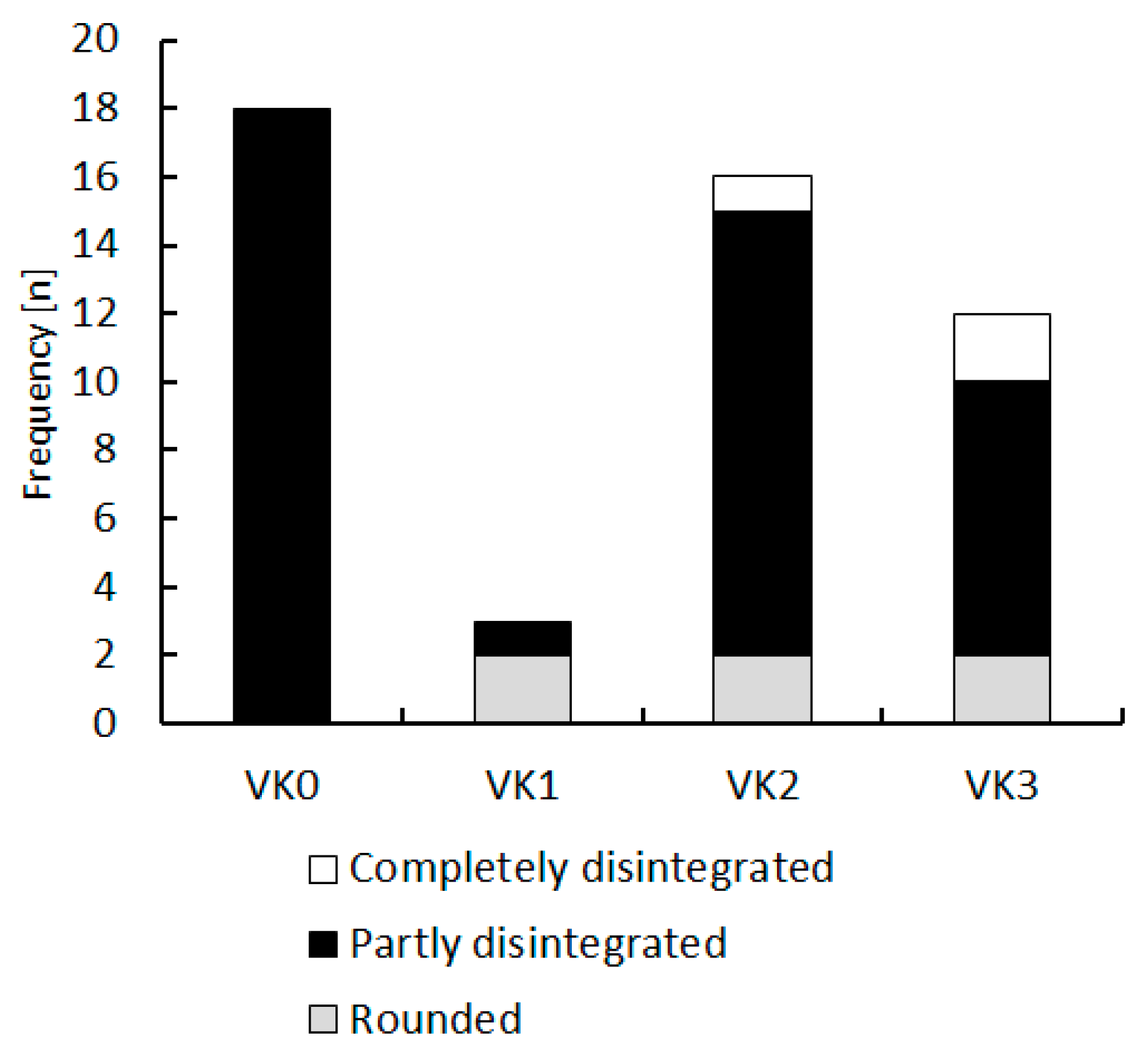
| ASTM D 4644-16 | Rec. No. 20 of DGGT | ||
|---|---|---|---|
| Type | Verbal Description | Classification | Assessment |
| I | Retained specimen remains virtually unchanged | 1 | Unchanged |
| II | Retained specimen consists of large and small fragments | 2 | Rounded |
| III | Retained specimen is exclusively small fragments | 3 | Partly disintegrated |
| 4 | Completely disintegrated | ||
Disclaimer/Publisher’s Note: The statements, opinions and data contained in all publications are solely those of the individual author(s) and contributor(s) and not of MDPI and/or the editor(s). MDPI and/or the editor(s) disclaim responsibility for any injury to people or property resulting from any ideas, methods, instructions or products referred to in the content. |
© 2025 by the authors. Licensee MDPI, Basel, Switzerland. This article is an open access article distributed under the terms and conditions of the Creative Commons Attribution (CC BY) license (https://creativecommons.org/licenses/by/4.0/).
Share and Cite
Kaspar, M.; Latal, C.; Pittino, G.; Reinprecht, V. Degradation and Decay of Rocks: Linking Wetting–Drying and Slake Durability Tests for Climate-Sensitive Maintenance. Geotechnics 2025, 5, 84. https://doi.org/10.3390/geotechnics5040084
Kaspar M, Latal C, Pittino G, Reinprecht V. Degradation and Decay of Rocks: Linking Wetting–Drying and Slake Durability Tests for Climate-Sensitive Maintenance. Geotechnics. 2025; 5(4):84. https://doi.org/10.3390/geotechnics5040084
Chicago/Turabian StyleKaspar, Markus, Christine Latal, Gerhard Pittino, and Volker Reinprecht. 2025. "Degradation and Decay of Rocks: Linking Wetting–Drying and Slake Durability Tests for Climate-Sensitive Maintenance" Geotechnics 5, no. 4: 84. https://doi.org/10.3390/geotechnics5040084
APA StyleKaspar, M., Latal, C., Pittino, G., & Reinprecht, V. (2025). Degradation and Decay of Rocks: Linking Wetting–Drying and Slake Durability Tests for Climate-Sensitive Maintenance. Geotechnics, 5(4), 84. https://doi.org/10.3390/geotechnics5040084