
Review

Pore Ice Content and Unfrozen Water Content Coexistence in Partially Frozen Soils: A State-of-the-Art Review of Mechanisms, Measurement Technology and Modeling Methods

Geotechnical Center, Department of Civil & Environmental Engineering, University of Alberta, Edmonton, AB T6G 1H9, Canada
*
Authors to whom correspondence should be addressed.
Geotechnics 2025, 5(4), 80; https://doi.org/10.3390/geotechnics5040080 (registering DOI)
Submission received: 1 August 2025 / Revised: 11 September 2025 / Accepted: 28 November 2025 / Published: 30 November 2025

Abstract

Partially frozen soil (PFS) is composed of coexisting unfrozen water and ice within its pores at subzero temperatures. This review paper examines how unfrozen water content (UWC) and pore ice content interact during phase changes under near-freezing conditions, governed by microscopic thermodynamic equilibrium. We present key theories describing why UWC persists (premelting, disjoining pressure) and the soil freezing characteristic curve (SFCC), along with measurement techniques, including the gravimetric approach to advanced nuclear magnetic resonance for characterization of water content. The influence of the water–ice phase composition on mechanical behavior is discussed, signifying pore pressure and effective stress. Various modelling approaches categorized into empirical SFCC, physio-empirical estimations, and emerging machine learning and molecular simulations are evaluated for capturing predictions in PFS behavior. The relevance of PFS to infrastructural foundations, tailing dams, permafrost slope stability, and climate change’s impacts on cold regions’ environmental geotechnics is also highlighted as a challenge in practical application. Hence, understanding pore pressure dynamics and effective stress in PFS is critical when assessing frost heave, thaw weakening, and the overall performance of geotechnical structures in cold regions. By combining micro-scale phase interaction mechanisms and macro-scale engineering observations, this review paper provides a theoretical understanding of the underlying concepts vital for future research and practical engineering in cold regions.

1. Introduction

Partially frozen soil (PFS) is a complex multiphase material consisting of soil particles, pore ice, unfrozen water and often air occurring at temperatures around or below 0 °C. Its behavior is highly sensitive to air temperature, pressure, and moisture conditions [1]. Remarkably, unfrozen water content (UWC) has been detected at temperatures as low as −71 °C in Siberian permafrost [2]. The coexistence of liquid and solid phases of water at subzero temperatures has been a subject of study for over a century, with early investigations such as [3], which were followed by extensive studies in the 1960s–1980s [4,5,6,7,8,9]. These studies laid the groundwork for modern theories describing phase equilibria in frozen ground.
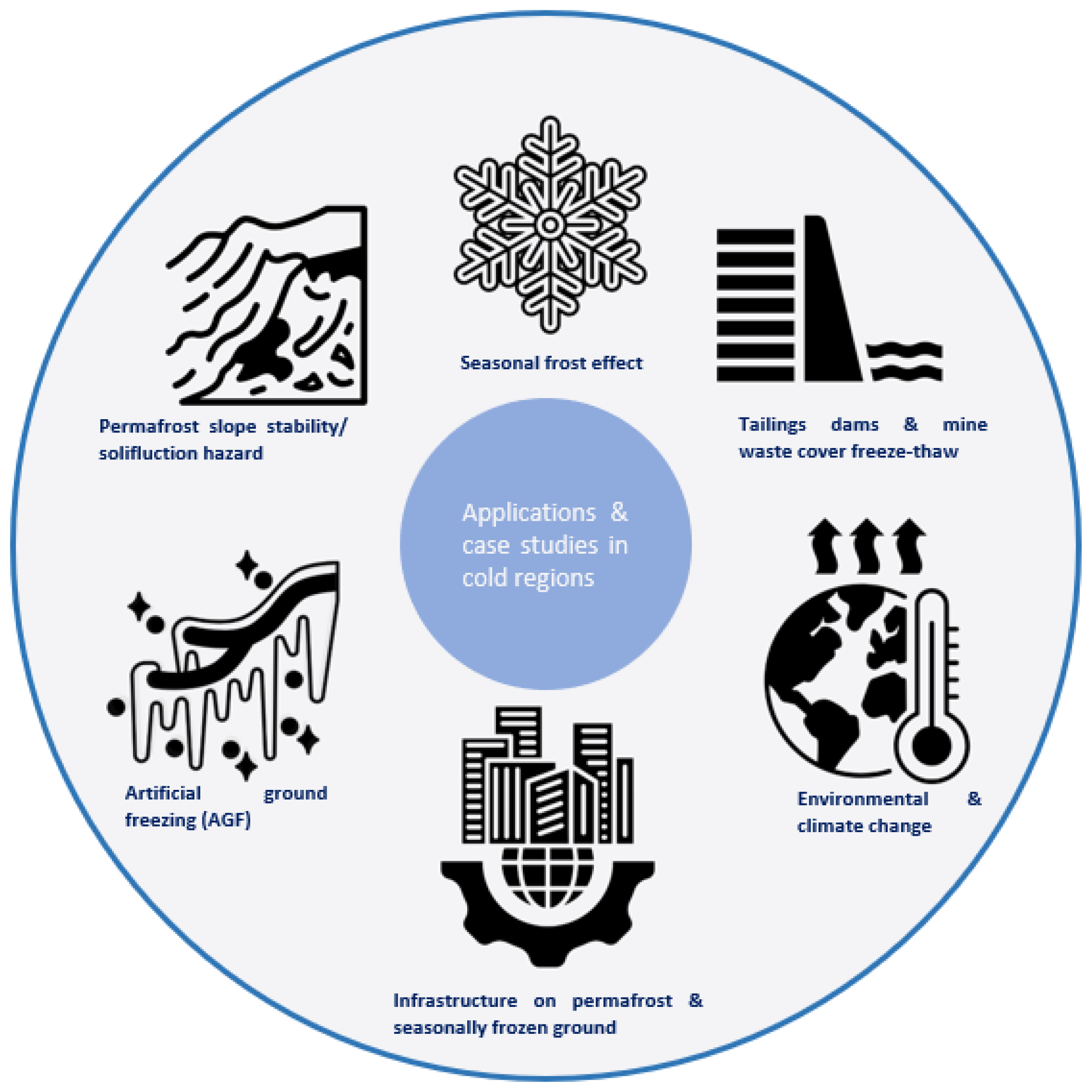
Understanding the evolution of UWC and PIC is vital for predicting strength, deformation, and hydraulic behavior in PFS across cold region applications such as in infrastructure, dams, and artificial ground freezing methods, as depicted in Figure 1. As climate change advances, integrating this knowledge into geotechnical design, hazard mapping, and environmental risk management will be essential. The geotechnical behaviors observed in cold regions can be explained by pore scale micromechanics, where UWC and PIC coexist, and control phase interactions. Previous review papers have generally considered only a single aspect of the problem at a time. Most existing works focus on UWC, including reviews of laboratory measurement techniques [10], evaluation of UWC prediction models [1], and scientometric analyses of UWC research trends [11], each treating UWC largely within its own domain. Other contributions concentrate on the constitutive and mechanical behavior of frozen soils [12,13], where the emphasis is on strength and damage modeling rather than on UWC measurement or pore-scale thermodynamics. To the best of the authors’ knowledge, no review exists for PIC or discusses how UWC measurement techniques relate to UWC–PIC coexistence and its implications for effective stress in PFS.
In contrast, the present review paper briefly presents the thermodynamics of freezing in PFS including premelting phenomena and the soil freezing characteristic curve (SFCC) as the basis of interpretation. It then reviews the progress of key measurement techniques for UWC (and indirectly PIC), evaluates mechanical behavior and effective stress, and surveys modeling approaches with their typical parameter and validity ranges.

2. Thermodynamics and Micro-Scale Pore Ice–Water Dynamics

Ice and liquid water coexist in PFS at subzero temperatures, governed by thermodynamic equilibrium at the ice–water interface. A key phenomenon is the zero-curtain effect, where temperature stabilizes for an extended period near 0 °C during phase transition due to latent heat exchange. Cryogenic suction develops as ice forms and consumes liquid water, lowering pore water pressure and drawing unfrozen water from warmer zones toward the freezing front [14,15].
The Clausius–Clapeyron equation (CCE) describes this thermodynamic equilibrium by relating temperature depression to pressure differences between ice and water, a key driver of ice lens formation [16,17]. Additionally, chemical and surface forces are also central to the equilibrium between UWC and PIC. The interfacial free energy at the ice–water–mineral boundary influences the formation of thin quasi-liquid water films to minimize total system energy, particularly in high-surface-energy soils [18]. These thin water films remain stable near freezing due to surface adsorption, and their formation is driven by gradients in temperature, pressure, and solute concentration [19,20].
The interaction between PIC and UWC controls the energy state of soil at temperatures lower than the freezing point. The pore ice ratio describes the relationship between the volume of ice within the pores and the volume of solid constituents (minerals) in a given soil sample. This ratio is closely associated with UWC during the freezing process. The term total water content (TWC) refers to the summation of UWC and PIC.
Ice segregation arises when the pore water pressure exceeds a critical threshold, initiating the formation of new ice lenses in the direction of heat removal. Interfacial free energy, which varies with temperature, is intrinsically linked to surface tension at the ice–water interface. The addition of solutes (e.g., salts) to the pore water reduces water activity and interfacial free energy, increasing the contact angle and suppressing ice nucleation [21]. Ref. [22] demonstrated solute-induced reductions in water activity and freezing temperature in structured clays.
Pore geometry significantly influences freezing. Smaller pores lower chemical potential and depress the freezing point, while larger pores reduce nucleation barriers. Ref. [23] measured pore size-dependent freezing point depression in compacted silt using differential scanning calorimetry. Ref. [24] observed nucleation delays in larger pores during controlled column freezing testing. In fine-grained soils, adsorbed water films remain unfrozen near particles due to strong surface forces, delaying crystallization.
The freezing sequence in soils typically progresses from bulk water to capillary water, then to bound water. Bulk water freezes first; capillary water persists longer due to pore curvature; and bound water, held by mineral surfaces, resists freezing even below –20 °C. Ref. [25] used micro CT imaging to visualize freezing front progression and confirm curvature-controlled ice formation. Capillary behavior is described by cryogenic suction and the Kelvin equation.
Bound water’s behavior depends on clay content, mineralogy, and surface area. It includes both film and hygroscopic water, with the latter remaining unfrozen at extremely low temperatures. Ref. [26] reported persistence of bound water in clay rich soils at very low temperatures, controlled by mineralogy and surface area.
Heterogeneous nucleation governs freezing in soils. Ice typically forms first in larger pores or on mineral surfaces. As freezing advances, liquid bridges transition to ice bridges, forming pendular regimes similar to unfrozen capillary menisci governed by capillary pressure and modeled via the Young–Laplace equation [27].
Three freezing stages are recognized in general and are as follows.
(i)
Stage I (0 to –5 °C): Ice nucleates in large pores and there is rapid UWC drop.
(ii)
Stage II (–5 to –15 °C): Ice fills medium/small pores and solute concentration rises.
(iii)
Stage III (<–15 °C): UWC stabilizes as thin adsorbed films.
Hysteresis in UWC is linked to advancing or receding contact angles, surface roughness, and mineralogy. Organic matter, being a wetting agent, lowers surface tension and enhances retention of UWC. Probabilistic models based on premelting theory and contact angle variability have been proposed to capture these effects [28].
Finally, the distribution of impurities and the arrangement of soil particles are described by two packing models: face-centered cubic and simple cubic. Both of these configurations facilitate estimating UWC in porous media by correlating pore volume concentration with impurity levels [29].

2.1. Premelting Theory and Disjoining Pressure

The persistence of unfrozen water in partially frozen soils is explained through two primary mechanisms: premelting dynamics and disjoining pressure. These concepts provide a multiscale framework for interpreting soil–water–ice interactions under subzero conditions.
Premelting dynamics occur in two forms [30]:
(i)
Curvature-induced premelting: Supercooled liquid water remains in micropores due to capillary effects and surface tension, analogous to cryogenic suction in unsaturated soils.
(ii)
Interfacial premelting: Thin water films form at ice–soil interfaces, driven by reductions in interfacial energy and thermal gradients, where the film on the colder side of the soil is thinner than that on the warmer side [31].
Disjoining pressure, originating from van der Waals and electrostatic interactions, is represented by the Hamaker constant and governs the stability and thickness of unfrozen water films. Its effects are amplified in fine-grained soils with high surface area and charge density [32]. A thinner film corresponds to higher disjoining pressure, promoting ice lens formation and soil particle repulsion [33].
Unfrozen films typically range from 2.5–15 nm at −1 °C, as confirmed by the ellipsometry technique [34]. These films can be modeled using a parallel-plate analogy in which Gibbs–Duhem formulations establish equilibrium between the solid and liquid phases. Recently, [35] implemented this framework in their numerical model for PFS. The water film is stratified into the following.
(i)
Adsorption layer, dominated by van der Waals and electrostatic forces.
(ii)
Diffuse layer, controlled primarily by electrostatic repulsion.
Hydrophilic surfaces of clay and ice retain water films through double-layer interactions. Disjoining pressure decreases with increasing film thickness, necessitating greater undercooling for freezing in wider pores [36]. At the micro-scale, film anisotropy and directional growth reflect interfacial tension and molecular orientation.
Overall, disjoining pressure enhances water migration along interfaces and facilitates frost heave by pushing particles toward warmer zones [37]. These effects are central to ice lens formation and mechanical softening in PFS.
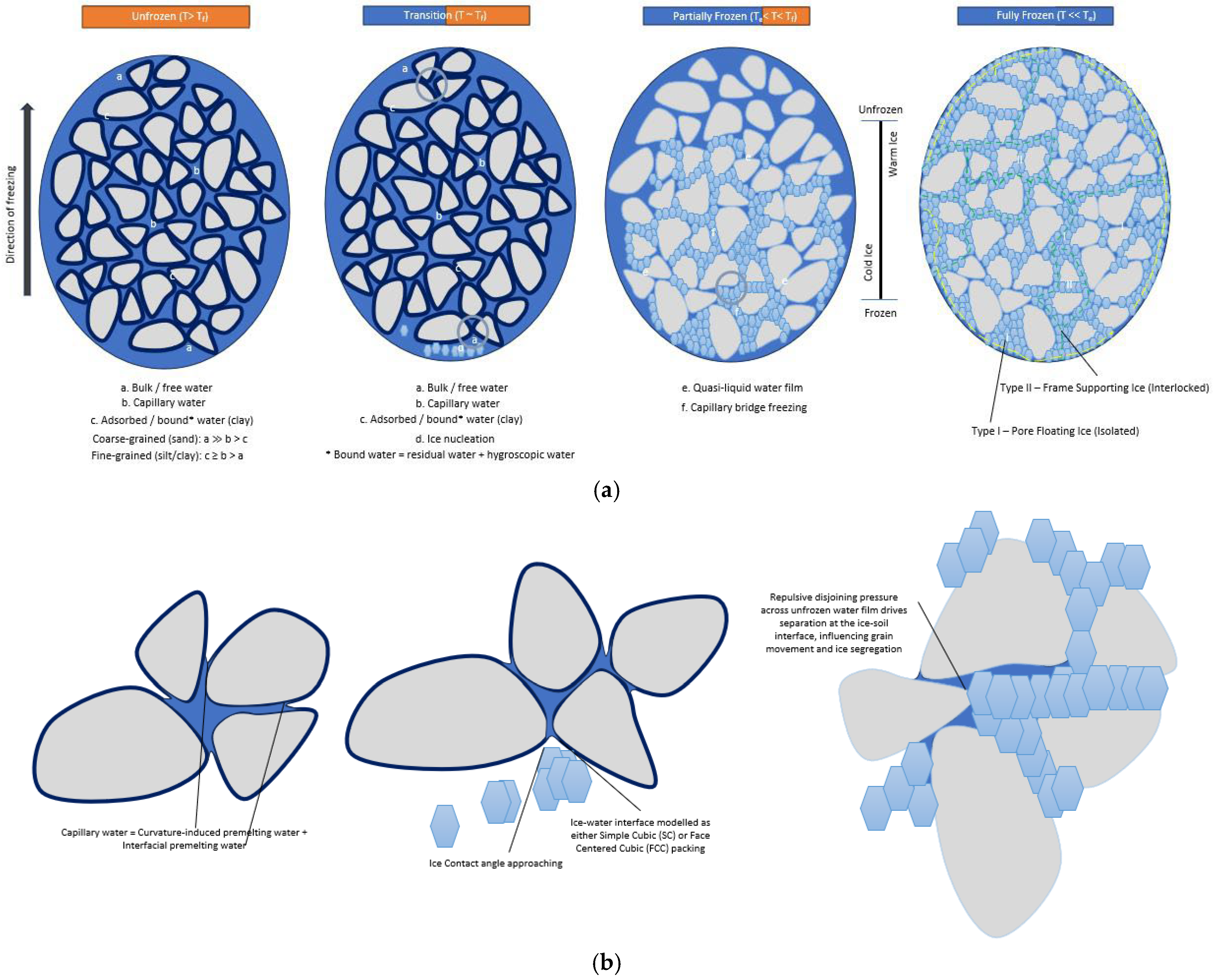
Figure 2 illustrates, in the direction of freezing (bottom to top), how ice crystals nucleate and grow while UWC decreases in the pore space. The top row summarizes four stages (T is soil temperature, Tf the start of freezing, and Te the end of freezing):
(i)
unfrozen (T > Tf) —bulk/free water coexists with capillary and adsorbed/bound films, and no ice has yet formed;
(ii)
transition (T ~ Tf) —capillary and adsorbed water persist while heterogeneous ice nucleation initiates in the largest pores at around freezing temperature, Tf;
(iii)
partially frozen (Te < T < Tf) —quasi-liquid water films remain and capillary bridges progressively freeze as temperature drops from start Tf to the end Te of the freezing range [29];
(iv)
fully frozen (T << Te)—two ice configurations emerge: Type I (pore-floating, isolated) and Type II (interlocked, frame-supporting) at the end of freezing Te, consistent with micro-CT observations of isolated vs. load-bearing ice networks in frozen granular materials [38].
The bottom row depicts pore-scale micromechanics corresponding to the insets:
(i)
decomposition of capillary water into curvature-induced components and interfacial premelting water films;
(ii)
advance of ice-water interfaces constrained by soil particles and approaching contact angle equilibration;
(iii)
repulsive disjoining pressure across quasi-liquid films that influences ice–soil segregation and interface dynamics. The ice-water interface is modeled using simple-cubic) or face-centered cubic packings to illustrate pore-scale geometry in the partially frozen stage.

2.2. Soil Freezing Characteristic Curve

The soil freezing characteristic curve (SFCC) describes the empirical relationship between temperature (or suction) and UWC during freezing and thawing. Analogous to the soil water characteristic curve (SWCC) in unsaturated soils, the SFCC provides a macroscopic representation of phase changes under equilibrium conditions (i.e., slow cooling or warming).
A typical SFCC is S-shaped. Near 0 °C, UWC remains high, approximating the initial water content. As the temperature drops slightly below 0 °C, capillary water rapidly freezes, reducing UWC. At lower temperatures, a plateau emerges where only adsorbed (bound) water persists.
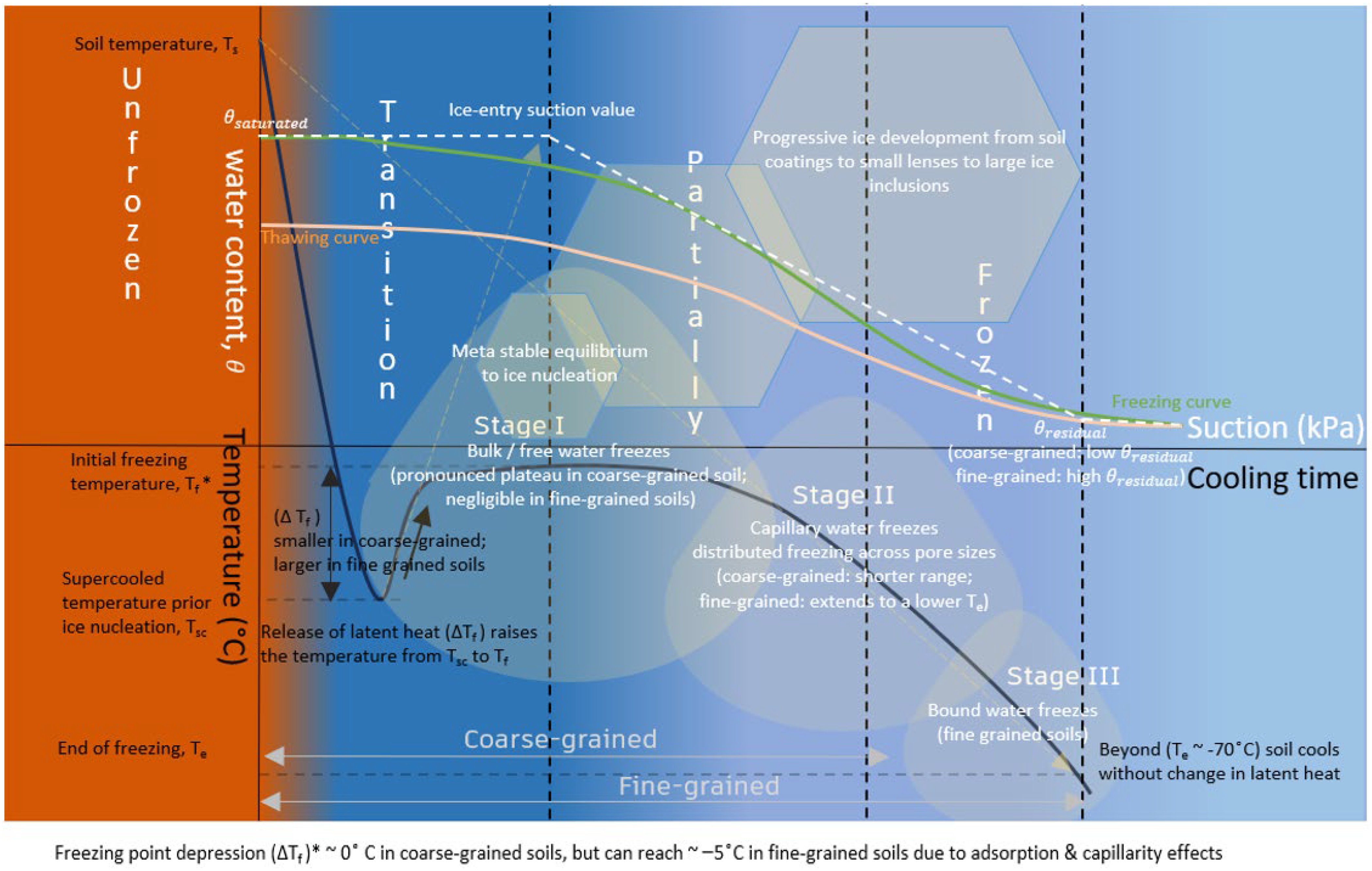
Figure 3 illustrates the thermally driven phase evolution of PFS. The top panel shows the SFCC (UWC vs. temperature or suction, combining matric and cryogenic components via the CCE) with hysteresis between freezing and thawing. Key thresholds are marked for saturation (θsaturated), the ice entry suction value, and residual unfrozen water content (θresidual).
The bottom panel sketches the concurrent microstructural progression (from nucleating pore-coating ice to lens/inclusion growth) aligned with the three freezing stages [39] (Tsc, supercooling temperature prior to first ice nucleation; Tf*, start of freezing temperature at which latent heat release begins; Te, end of freezing; and ΔTf = Tf* − Te, freezing point depression, which is small in coarse-grained soil (ΔTf =Tf* − 0) °C and large in fine-grained soils and is ~ −5 °C due to capillarity and adsorption. Dissolved solutes, when present, can further increase ΔTf), detailed as follows.
(i)
Stage I—metastable nucleation and bulk/free water plateau (Tsc < T< Tf*)—A short metastable interval may occur between the supercooled state and the onset of pore ice nucleation. Latent heat release raises the temperature toward Tf* and produces a brief plateau in UWC, pronounced in coarse-grained soils, negligible in fine-grained soils.
(ii)
Stage II—freezing of capillary water and increase in cryosuction (Tf* < T < Te)—With continued cooling below Tf*, capillary water freezes progressively across the pore size distribution. UWC decreases sharply while suction increases (cryosuction increases from a decrease in liquid pressure relative to ice pressure). Compared with coarse-grained soils (short range), Stage II in fine-grained soils spans a wider temperature interval and extends to a lower Te.
(iii)
Stage III—freezing of adsorbed/bound (T~Te)—Near the end of freezing, Te, the remaining adsorbed/bound water for fine-grained soil solidifies with little release of any additional latent heat effect. UWC asymptotically approaches the residual value of unfrozen water content, (θresidual). Beyond the end of freezing (T < Te), further cooling can occur without any phase change.
Empirical models often use exponential or power-law curve fits to match experimental UWC–T data [40]. Physically based models integrate pore size distribution (PSD) and specific surface area to predict phase change behavior along temperatures [41]. Some frameworks adapt SWCC models—such as van Genuchten or Fredlund–Xing—by substituting suction–temperature relationships via the CCE.
SFCC exhibits hysteresis between freezing and thawing due to metastable nucleation, pore-scale geometry, and thermodynamic factors. As described by the Gibbs–Thomson effect, larger pores freeze first during cooling, while smaller pores thaw first during warming, a phenomenon known as the ink-bottle effect [42]. As a result, the freezing curve lies above the thawing curve in UWC–T plots [43]. Although this complicates modeling, thermodynamic averaging, scanning curve approaches, and machine learning methods have been proposed to address it [44].
The thermodynamic interplay of phase changes, curvature, surface forces, and cryogenic suction governs how UWC and PIC are distributed in partially frozen soils. The SFCC provides a practical tool for predicting soil behavior in cold regions, combining micro-scale phase dynamics (e.g., cryogenic suction, interfacial curvature) with macroscale phenomena such as frost heave, strength loss, and hydraulic conductivity reductions.

3. Measurement Techniques for UWC

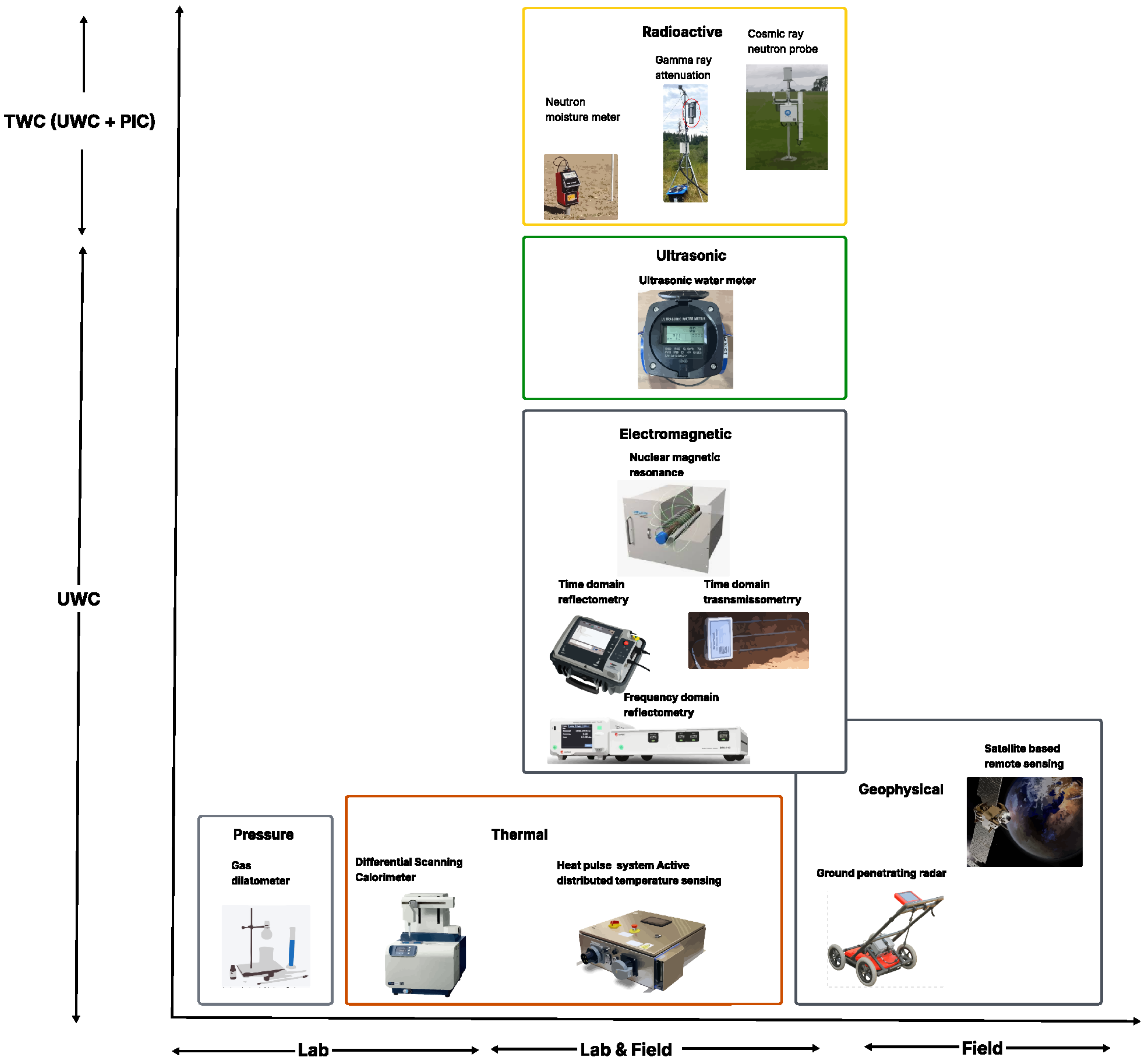
Accurately quantifying UWC in PFS is essential for establishing SFCCs and calibrating predictive models. However, this task is technically challenging due to the coexistence of ice and liquid water and the difficulty of distinguishing them in situ. A variety of laboratory and field techniques have been developed, each offering unique advantages and limitations and each sampling different spatial and temporal scales [10]. Figure 4 classifies commonly used instruments based on their application setting (lab/field) and their ability to measure UWC versus TWC, while Table 1 summarizes the principles and key attributes of selected methods used to determine UWC (and indirectly PIC). Description of some of these techniques is given here.

3.1. Laboratory Techniques

3.1.1. Gravimetric Methods

Early methods were primarily gravimetric; soils were cooled to a target temperature, then oven-dried to determine TWC, assuming any ice at that temperature was all the water above the measured unfrozen portion. While straightforward, this method is destructive, time-consuming, and poorly suited to monitoring dynamic freezing behavior.

3.1.2. Dilatometry (Volumetric and Pressure)

Dilatometry, pioneered by [3], relies on water’s ~9% volumetric expansion upon freezing. In volumetric dilatometry, a water-saturated soil sample sealed in a rigid container undergoes freezing, and volume changes are tracked. In pressure dilatometry, the pressure increase in a closed cell is measured [45]. Though capable of estimating both UWC and PIC, dilatometry is disturbing to the sample, requiring a paste-like soil consistency, and it is impractical for field deployment [46].

3.1.3. Differential Scanning Calorimetry

Differential scanning calorimetry (DSC) tracks heat flow as soil is cooled or heated. Distinct peaks correspond to latent heat release during phase transitions, allowing estimation of UWC and PIC melted [7,47]. By calibrating heat flow vs. temperature, SFCC can be derived [48], DSC can distinguish between bulk and bound water; however, it is limited to small laboratory samples and requires assumptions about specific heats.

3.1.4. Laboratory Heat Pulse

Laboratory heat pulse probes detect changes in thermal conductivity and volumetric heat capacity as liquid water transforms to ice. A controlled heat input is applied and the temperature response is monitored; as ice forms, enhanced thermal conductivity and altered heat capacity modify the response curve [49]. Inverse thermal modelling can then be used to infer the evolving phase composition. The method offers good temporal resolution but is sensitive to sensor placement, boundary conditions, and the magnitude of the applied heat pulse.

3.1.5. Bench-Top Nuclear Magnetic Resonance

Low-field bench-top nuclear magnetic resonance (NMR) is an electromagnetic technique that distinguishes water phases based on hydrogen proton relaxation times (T2). Long T2 components correspond to bulk or capillary water, while short T2 components reflect strongly bound water at mineral surfaces. As freezing proceeds, signals from bulk water diminish, leaving only short T2 peaks, allowing precise UWC quantification [50]. Bench-top NMR provides highly phase-specific measurements and can be used to derive SFCCs, but it requires strict thermal control, careful calibration, and specialized expensive equipment.

3.2. Lab and Field Techniques

3.2.1. Dielectric (Capacitance)

Modern dielectric sensors exploit water’s high permittivity (~80) relative to air (~1), ice (~3), and minerals (~5). Capacitance and frequency domain sensors inserted into the soil track permittivity changes due to freezing [22]. While economical and continuous, these sensors require site-specific calibration, as temperature, salinity, and density, significantly affect readings [51].

3.2.2. Time Domain Reflectometry and Transmissometry

Time domain reflectometry (TDR) sends high-frequency pulses (0.5–1.5 GHz) through waveguides to measure return signals and infer bulk permittivity. TDR signals typically decline with temperature due to ice formation, stabilizing near –1 °C as only bound water remains [52,53,54]. While accurate, TDR systems are expensive and require expert interpretation. Time domain transmissometry (TDT), a one-way signal version of TDR, performs better in saline soils (though TDR may overestimate UWC by capturing mobile water in thin films, it remains a gold standard for in situ monitoring [55,56].

3.2.3. Heat Pulse Probes

Heat pulse probes deployed in the field measure thermal response to imposed heating, supporting interpretation of freezing dynamics. Fiber-optic distributed temperature sensing (DTS) extends this to meter-scale or larger profiles, capturing freeze–thaw fronts along buried cables. Thermal data must be interpreted using supporting models to differentiate UWC from pore–ice content.

3.2.4. Neutron Moisture Meter

The neutron moisture meter (NMM) measures hydrogen content by counting thermalized neutrons scattered by soil water. Since hydrogen in ice also contributes, the NMM reflects TWC rather than UWC directly. By assuming negligible TWC change over time, differences in NMM readings can indicate phase transitions.

3.2.5. Gamma Ray Attenuation

Gamma ray attenuation is a radioactive technique capable of measuring density changes through attenuation of γ-photons. While commonly implemented in controlled laboratory columns, portable attenuation systems can also be used in enclosed test pits or controlled field lysimeters. Changes in attenuation during freezing reflect density evolution and when combined with independent constraints can support UWC estimation. However, radiation safety considerations limit broader field use.

3.2.6. Ultrasonic Sensors

Ultrasonic transducers may be installed in shallow boreholes or test beds to track velocity changes during freeze–thaw cycles. Their calibration is typically laboratory-based, but their deployment can extend into the field, making them hybrid lab–field tools.

3.3. Field Techniques

3.3.1. Cosmic Ray Neutron Probe

Cosmic ray neutron probes (CRNPs) estimate landscape-scale moisture across ~300 m footprints and ~0.5 m depth, useful for monitoring seasonal dynamics [57]. However, these techniques lack the spatial and phase resolution needed for SFCC characterization.

3.3.2. Borehole NMR

Borehole-deployed low-field NMR tools provide depth-resolved relaxation measurements in permafrost and seasonally frozen soil. Differences in proton relaxation times between liquid water and ice allow in situ estimation of UWC and ice content. Although phase-specific and direct, borehole NMR is expensive, logistically demanding, and provides lower resolution than laboratory NMR systems.

3.3.3. Ground Penetrating Radar

GPR transmits high-frequency electromagnetic waves into the subsurface and records reflections from contrasts in dielectric permittivity. Freeze–thaw interfaces and ice-rich layers produce strong reflectors, enabling mapping of active-layer thickness, ice lenses, and frozen boundaries. Although GPR cannot directly quantify UWC, it provides structural information that supports interpretation of UWC and pore-ice distributions.

3.3.4. Remote Sensing

Passive microwave radiometers and active radar systems detect surface dielectric variations associated with freeze–thaw processes at regional to continental scales [58]. These geophysical remote-sensing methods are valuable for large-scale monitoring but lack the vertical resolution and phase discrimination required to quantify UWC or pore-ice content at site scale.

3.4. Integrated Multiscale Approach

In practice, researchers often combine multiple methods for reliability and repeatability of results. For instance, TDR might monitor UWC in real time, while occasional NMR or calorimetry tests provide calibration. Advanced imaging (e.g., MRI or X-ray CT) can visualize ice distribution, lending qualitative support. Remote sensing (e.g., microwave satellite data) can infer surface soil freeze/thaw status at large scales by changes in dielectric properties, which is useful for climate-scale studies but not precise enough for local UWC values [58].
Overall, measuring UWC/PIC requires a multi-faceted approach. Each method addresses different scales from nanoscopic (NMR distinguishing bound water) to field-scale (neutron probes averaging moisture). Combining these techniques with proper calibration yields the most reliable characterization of UWC in partially frozen soils.
Table 1. Summary of methods for measuring UWC and PIC in partially frozen soils, including measurement principles and method-specific attributes.
MethodPrincipleAttributesReferences
Gravimetric (Oven-drying)Weighing soil before and after drying to compute total water; freeze/thaw separation can isolate unfrozen water.Simple and accurate but destructive and not suitable for in situ use.ASTM D2216; [40];
Dilatometry (Volumetric)Measuring pressure change in sealed saturated samples due to 9% volume expansion upon freezing of water to ice.Not widely commercialized; requires paste-like preparation and complex lab-based setup.[3,45,46]
Dielectric (Capacitance)Measuring bulk permittivity via capacitance sensors; water has high dielectric contrasts with ice/soil.Rapid, non-destructive, but needs calibration; affected by salinity, density, etc.[59,60]
Time Domain Reflectometry (TDR)Sending EM pulses along probes and measuring travel time (related to permittivity and thus water content).Real-time monitoring in both lab and field and requires calibration; otherwise, it may overestimate UWC if some ice is interpreted as liquid without proper models. Response time ~ 0.5 min.[54,61]
Nuclear Magnetic Resonance (NMR)Based on relaxation times (e.g., T2) for hydrogen protons. Detecting hydrogen protons; different relaxation times for liquid water vs. ice-bound water.Effective for distinguishing UWC vs. PIC; sensitive to temperature; highly accurate but expensive and often lab-based (sensitive to temperature control).[23,62,63]
Neutron Scattering (NMM/CRNP)Fast neutrons slowed by hydrogen in water; counting slowed neutrons to infer the moisture content.Effective for field profiling applications at 10–70 cm depth and large-scale monitoring (cosmic-ray probes cover ~300 m radius); cannot directly distinguish ice vs. liquid and involves radioactive sources.[57,64]
Calorimetry (DSC)Measuring heat flow during controlled freezing/thawing (latent heat) to back-calculate phase change fractions.Precise but slow determination of freezing/melting behavior in a lab with a response time ~ 35 min; requires known heat capacities, not an in-situ method.[47,65]

4. Mechanical Behavior and Effective Stress in PFS

The mechanical behavior of PFS is governed by its dual-phase nature, consisting of a mineral soil skeleton and pore-filling ice. At subzero temperatures, UWC persists as quasi-liquid films at grain contacts, acting as a pressurized fluid that influences strength and deformation behavior. Unlike saturated unfrozen soils, in PFS, both unfrozen water u w and pore ice u i contribute to stress transmission. A revised effective stress formulation is therefore required.

4.1. Revised Effective Stress for PFS

Classical effective stress, σ = σ u , cannot describe PFS because pore ice may become load-bearing. A generalized formulation expresses effective stress as follows:
σ = σ t o t a l χ u w 1 χ u i
where χ   ( 0 χ 1 ) denotes the relative contribution of unfrozen water to stress transfer. Near the freezing point, χ ≈ 1, as ice content increases and ice forms a structural framework, χ tends toward zero [66]. This generalized effective stress has been adopted in recent thermo-hydro-mechanical models of frozen soils [67]
Two mechanical constitutive modeling frameworks emerge from this formulation.
(i)
Category I: only the soil skeleton bears effective stress, with water and ice both acting as pore fluids.
(ii)
Category II: both the soil skeleton and ice matrix are co-load-bearing, incorporating cryogenic suction and interparticle bonding
These theoretical categories align with observed ice morphologies for effective stress in PFS.

4.2. Ice Morphology and Load Transfer Mechanisms

Microstructure plays a central role in mechanical behavior. Two pore scale freezing configurations are widely recognized:
(i)
Type I (pore floating ice) refers to isolated or disconnected ice that occupies pore spaces without forming a load-bearing structure, suitable for Category I formulations.
(ii)
Type II (frame supporting ice) develops as a connected network or ice lens that actively carries load and reinforces the soil, as modeled in Category II.

4.3. Cryogenic Suction and Pore Pressure Evolution

During freezing, ice formation in confined pores elevates pore water pressure. This phenomenon is explained by cryogenic suction, a thermodynamic potential that drives unfrozen water toward colder regions, promoting ice lens formation [15,16,17]. The CCE captures the pressure difference across phases:
u w ρ w u i ρ i = L l n T T o
where L is the latent heat of fusion, T is the reference temperature, and T o is the equilibrium freezing point at standard pressure [68]. Cryogenic suction modifies effective stress in Category II models through temperature-dependent terms such as S T = ρ w L T T o T o and S c r = ρ i L l n T T o [67].
Pore ice pressure dynamics govern two critical processes: ice segregation and ice lens development [69]. Ice lenses form when local pore pressure exceeds the overburden stress and tensile strength of the freezing soil [70,71]. Typical separation strengths range from 20 to 150 kPa [8,72]. After lens formation, pore pressure resets to the overburden value [73], and negative pore pressures develop near the base of the frozen fringe [74].

4.4. Rate- and Temperature-Dependent Mechanical Behavior

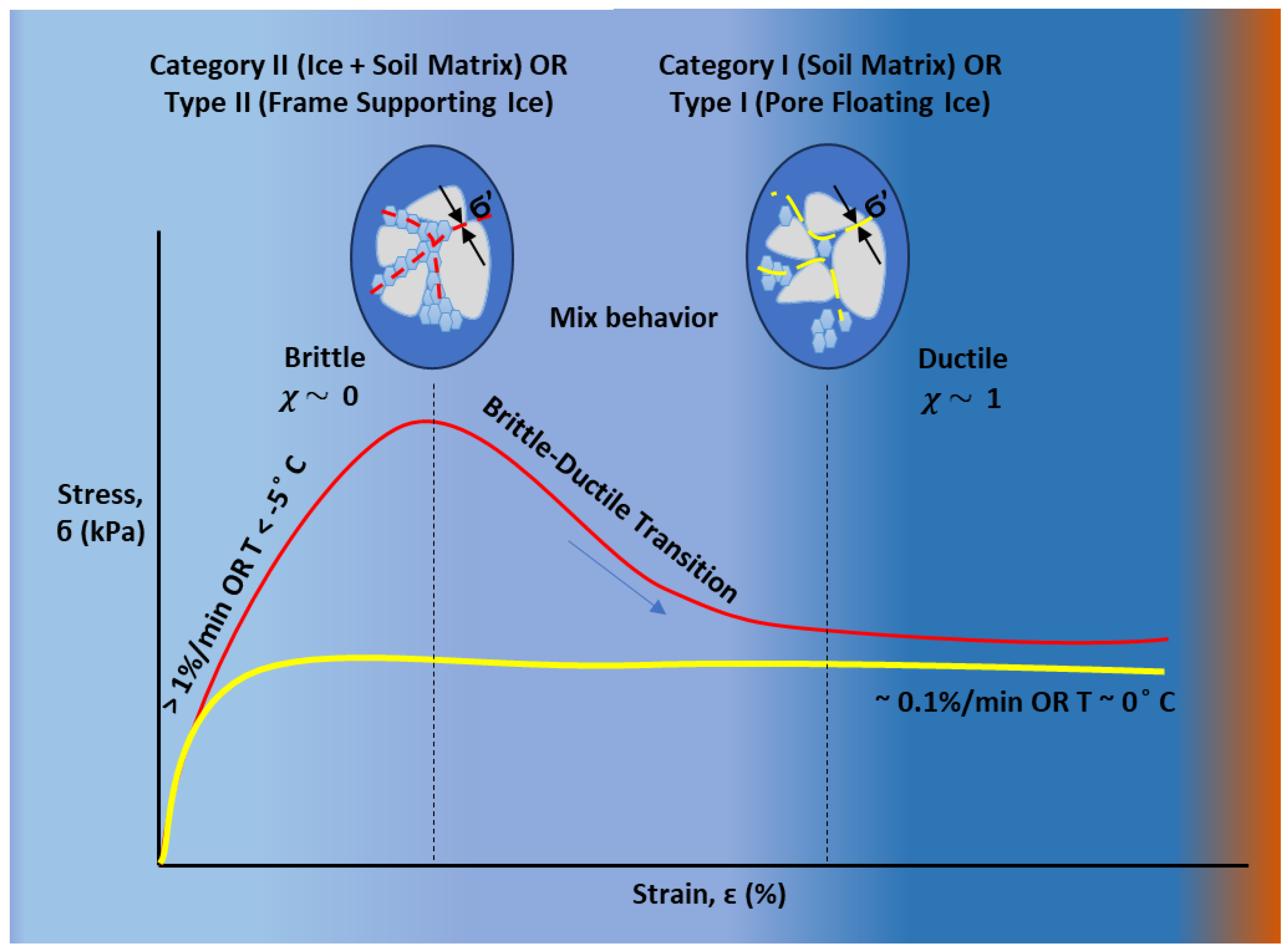
As PIC increases, both cohesion and internal friction are affected. PIC increases apparent cohesion [75], and shear strength correlates positively with strain rate and decreasing temperature [76]. At high confining pressures, the strength response becomes nonlinear. Ice crystals undergo compression and boundary slip during creep and shear loading, which promotes localized stress concentration. In triaxial testing, rate- and temperature-dependent behavior is commonly described by the brittle–ductile transition (BDT), wherein ice-rich soils transition from brittle failures at low temperatures (e.g., <–5 °C) and rapid loading to ductile, viscoelastic behavior in warmer conditions (–1 to 0 °C) or under a slow loading rate exhibiting creep and recrystallization [77]. This transition is particularly important in Type II (frame-supporting) ice morphologies, where ice forms interconnected structures that significantly contribute to load-bearing capacity [78]. Ref. [79] demonstrated that PFS strength arises from both the cohesion contributed by PIC and the internal friction angle of the unfrozen granular matrix. An additional structural hindrance emerges from the dilatant behavior of sand grains, especially within volumetric ice content Vs between 40% and 60%, which interlocks with PIC and enhances the shear resistances of PFS [80,81]. Figure 5 conceptually illustrates the various ice morphologies and the effect on strength under different experimental conditions.

4.5. Strength Behavior During Freezing and Thawing

Thawing reverses mechanical gains. Melting ice generates excess pore pressures faster than they dissipate, reducing effective stress [82]. Water remains bound as quasi-liquid films that enhance friction during shear [33]. Thermodynamic and viscoelastic models—such as probabilistic formulations, viscosity–temperature relationships, and Burgers’ models based on Arrhenius-type activation theory to estimate compliance—describe these transitions. Viscoelasticity results from proton reorientation and grain boundary sliding. Under wave stresses, the dipole alignment of water molecules relaxes over time, imparting time-dependent compliance to partially thawed PIC [5,83].
Ice relegation and recrystallization during thawing may exhibit self-healing behavior, sometimes producing double-strength peaks, where bond breaking and volume reduction occur [84]. Thermo-hydro-mechanical (THM) models integrate cryogenic suction, stress partitioning, and phase transitions into a continuum framework [66,85]. Critical state line (CSL) models adapted for temperature-dependent behavior help predict post-thaw strength and deformation [86].
Pore pressure and ice morphology are critical in governing the mechanical behavior of PFS. Both freezing and thawing processes involve transient changes in stress and strength due to water migration and phase changes. Effective stress modeling in such soils must therefore consider thermal history, drainage conditions, cryogenic suction, and ice structure.

4.6. Constitutive Modeling Approach

Modern constitutive models incorporate these factors to simulate strength evolution more accurately, and laboratory tests must be interpreted in light of temperature, strain rate, and phase composition [87,88]. Building on these ideas, [89] developed a thermo-elasto-viscoplastic constitutive framework within a critical state formulation to capture temperature-dependent creep and long-term deformation of frozen soils.

5. Modelling Approaches for UWC and PFS Behavior

Modeling the behavior of PFS requires accurate prediction of UWC as a function of temperature, along with its influence on mechanical, thermal, and hydraulic responses. Approaches include theoretical and empirical models, semi-empirical formulations, adaptations of soil water/freezing characteristic curves (SWCCs/SFCCs), machine learning (ML) methods, and molecular dynamics (MD) simulations. Table 2 provides a comparative overview of these modeling categories.

5.1. Thermodynamic and Pore-Scale Theoretical Models

Theoretical approaches are grounded in thermodynamics and pore-scale physics. Early models [90,91] applied the Gibbs–Thomson equation in conjunction with pore size distributions to estimate freezing behavior. Subsequent works incorporated premelting effects and disjoining pressure [30,92], while ref. [93] introduced electric double-layer effects to capture unfrozen water retention in fine-grained soils.
Segregation potential models, first introduced by [14], were expanded upon by [87] to incorporate frost heave. Ref. [43] addressed freeze–thaw hysteresis, while ref. [94] analyzed assumptions in Young–Laplace formulations, such as uniform contact angle. Ref. [1] emphasized the need for RMSE-based calibration to align model predictions with real soil behavior.

5.2. Empirical and Semi-Empirical SFCC/SWCC Formulations

Empirical SFCC formulations, such as those proposed by [40], relate UWC to clay content and specific surface area (SSA) [95,96]. Ref. [97] developed piecewise SFCCs for improved accuracy. NMR-based techniques, including pre-calibrated regression lines [98], relaxation time measurements [99], and Curie Law methods [6] have significantly advanced empirical estimation, though challenges remain in generalizing across salinity and pore chemistries [100].
Semi-empirical models bridge physics and observation. Cryogenic suction is related to matric suction using modified SWCCs [101,102]. Models by [103,104] are commonly adapted with the CCE for temperature scaling; however, they require soil-specific calibration.
SWCCs and SFCCs reinterpret freezing as a capillary retention process [105]. Using the analogy of suction to undercooling, S = ρ w L T T o T o , [45,106] extended van Genuchten, θ T = θ r + θ s θ r [ 1 + ( α . s ( T ) ) n ] m , and Fredlund-Xing, θ T = C T . ( l n ( e + ( φ a ) n ln e + 1 ) m , curves to SFCC. Refs. [93,107] refined these with PSD and electrostatic considerations. Refs. [94,104] studied the effects of hysteresis and contact angle variability, whereas ref. [108] introduced structural configurations (simple cubic, tetrahedral) into SFCCs, helping to model ice–soil interaction geometry.

5.3. Data-Driven and Machine Learning Methods

Machine learning (ML) methods capture complex nonlinear interactions between UWC and environmental variables. Artificial neural networks (ANNs) trained on lab datasets [109] and gradient boosting models like XGBoost and LightGBM [44] have shown success in freeze–thaw prediction. Monotonic neural networks (MNNs) address hysteresis by enforcing UWC(T) consistency [110,111]. Validation techniques such as k-fold cross-validation and Bayesian optimization are commonly adopted. However, ML models require large, high-quality datasets and must be constrained physically to ensure realistic outputs.

5.4. Molecular Dynamics Simulations

Molecular dynamics (MD) simulations employ advanced simulation software like LAMMPS (Large-scale Atomic/Molecular Massively Parallel Simulator), which allows for the modeling of complex multi-phase systems. LAMMPS provides robust abilities to simulate interactions at the atomic scale, employing periodic boundary conditions to model infinite systems and energy minimization algorithms to achieve stable initial configurations. TIP4P/Ice and CLAYFF force fields accurately represent the van der Waals, Coulombic, and electrostatic interactions that govern the behavior of water–ice–mineral systems [112,113]. Specifically, TIP4P/ice is optimized for replicating the characteristics of water and ice across different phases and temperatures. Through these simulations, UWC has been identified to exist in three zones [114,115]:
(i)
The mineral-dominated zone, where water molecules are tightly bound to mineral surfaces due to strong adsorption forces;
(ii)
The transition zone, where water molecules exhibit intermediate properties between tightly bound and freely mobile states;
(iii)
The ice-dominated zone, where water molecules form a quasi-liquid layer at the ice interface.
The structural behavior within these zones varies with temperature, as water molecules near mineral surfaces exhibit a more orderly arrangement at lower temperatures due to adsorption effects [116].
By applying LAMMPS, the dynamic features of these systems are investigated using methods like the particle–particle–particle–mesh (PPPM) approach to calculate long-range Coulombic interactions with high accuracy and the SHAKE algorithm to preserve water molecule shapes [117]. Simulations performed across a range of temperatures (230 K to 270 K) reveal critical temperature-dependent transformations. At lower temperatures, water molecules exhibit restricted mobility, reflected in low diffusion coefficients. As temperatures approach melting points, thermal fluctuations increase, leading to the breaking of hydrogen bonds (H-bonds) and the transformation of ice into quasi-liquid water layers.
The dynamics of hydrogen bonds are essential to comprehending the behavior of UWC. MD simulations reveal that H-bonds in water–ice systems respond sensitively to temperature changes. Higher temperatures cause ordered H-bonds in ice to be broken apart by thermal fluctuations, which results in disordered H-bonds in liquid water. This is particularly evident in the quasi-liquid layers at the ice interface, where mobility significantly increases. Additionally, simulations can also differentiate between water–water H-bonds (W-W), which dominate in bulk and quasi-liquid water, and clay–water H-bonds (C-W), which prevail in the mineral-dominated zone. Notably, C-W H-bonds remain stable at lower temperatures; however, they drastically diminish as temperatures approach melting points [114].
The freezing process observed in MD simulations aligns closely with experimental NMR observations and can be divided into three stages:
(i)
Quick freezing, where water in large pores solidifies rapidly, causing a sharp decline in UWC;
(ii)
The transitional stage, where capillary water gradually freezes, resulting in a slower decline in UWC;
(iii)
The stability stage, where there are minimal changes in UWC, with only bound water persisting at ultra-low temperatures.
The consistency between LAMMPS simulations and experimental data validates the reliability of these computational methods in analyzing partially frozen soils.
Furthermore, simulations using LAMMPS reveal the impact of mineral surface effects, particularly Coulomb electrostatic and van der Waals interactions, on UWC dynamics. The mobility and density distribution of water molecules are strongly impacted by these interactions. Near mineral surfaces, water densities exceed those of bulk water due to adsorption forces, while quasi-liquid layers exhibit densities approaching bulk water at higher temperatures. These dynamics are further demonstrated by the diffusion coefficients of water molecules, which show significant fluidity in quasi-liquid layers and limited mobility in bound water layers as temperatures rise.

5.5. Integrated Multiscale and Hybrid Modeling Framework
Despite their strengths, MD simulations face challenges, including computational costs and limitations in modeling large-scale systems. Future research should integrate MD with continuum-scale models, such as Finite Element Modeling (FEM), to enable multi-scale analyses. Additionally, expanding the temperature range of simulations and exploring the effects of saline soils can enhance the applicability of these methods. Aligning MD simulations conducted in LAMMPS with experimental studies on high-purity minerals will further refine models, bridging the gap between nanoscale simulations and macroscale observations.
Integrated approaches are increasingly common. Discrete element models (DEMs) have been linked with multiscale simulations [108], while 3D voxel-based microstructures generated using GANs (generative adversarial networks) offer realistic inputs for FEM simulations [118]. X-ray computed tomography (CT) images of partially frozen salty sand soils are used to train GANs, which replicate particle fabric, anisotropy, and elastic properties. GAN–FEM workflows optimize performance through hyperparameter through hyperparameter studies on latent dimensions and batch size, ensuring that the produced microstructures accurately reproduce the observed behaviors.
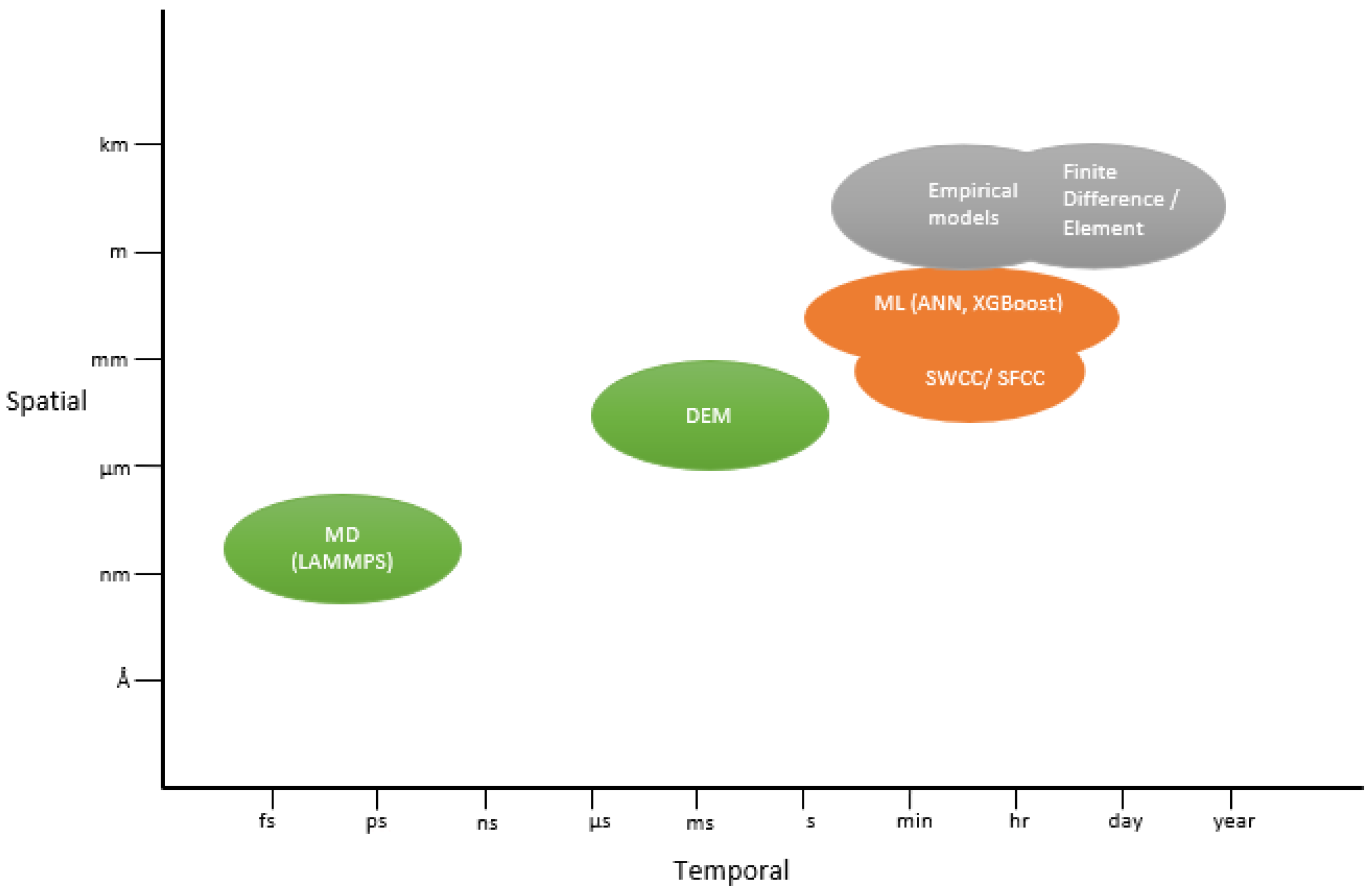
Robust engineering applications often combine models, i.e., empirical SFCCs for input, theoretical/ML models for UWC(T) and multiscale or FEM codes for coupled THM analysis. As datasets and computation improve, hybrid approaches incorporating physics-informed ML and validated MD will increasingly dominate frozen soil modeling. Figure 6 classifies the various UWC modelling approaches based on temporal and spatial scales.
Table 2. Categories of models for UWC and PFS behavior.
Model CategoryApproach (Phase–Temperature Relationship)LimitationExample Works (Reference Models)
Theoretical
(physics-based)
Thermodynamic and interfacial energy formulations based on Gibbs–Thomson effect, pore size, and disjoining pressure.Offer fundamental insight but involve simplificationsPremelting theory [30]; Disjoining pressure [120]; Cryogenic suction segregation [70]
Empirical/
Semi-empirical
Curve fitting experimental data with convenient equations, often using soil index properties to adjust curves.Easy to apply, however, not universally transferablePower-law SFCC [40]; SSA/clay-based UWC [95,96,97]
SWCC/
SFCC-based
Adapt unsaturated soil models (SWCC) to freezing conditions; use soil retention curve concepts with CCE to relate suction–temperature.Require soil-specific calibration and may not capture hysteresis or ice morphology effectsVan Genuchten/SFCC [45,106];
Electrostatic effects [45,93,94,104]
Machine Learning (ML)Train statistical or ML models on datasets of soil freezing behavior to predict UWC without explicit physical equations.Can be meaningless with non-physical outputsNeural network [109]; Gradient Boost [44]; Monotonic NN [110,111]
Molecular Dynamics and SimulationSimulate behavior at the pore or atomic scale level for phase changes and interfacial water properties.Highly detailed, however, computationally demandingMD with LAMMPS [114,115,116,121];
GAN-based 3D soil structure [118,122]

6. Discussion

The mechanical behavior of PFS is primarily controlled by the interplay between unfrozen water content (UWC) and pore ice content (PIC), which jointly govern strength, stiffness, and deformation behavior under subzero conditions [80]. This review compiled recent advances and conceptual models that describe how temperature, salinity, and soil type influence these interactions, which are critical for geotechnical, environmental, and climate-resilient infrastructure applications [39].
Thermodynamically, UWC and PIC coexist due to capillary effects, adsorption forces, and freezing-point depression, resulting in persistent liquid films that surround soil particles even below 0 °C [98,123,124,125,126] As temperature decreases further, UWC is progressively reduced, but rarely reaches zero in practical ranges, while PIC tends to increase, contributing to apparent cohesion and mechanical stabilization [95]. The transition from partially frozen to fully frozen states is not abrupt but occurs over a temperature interval, especially in fine-grained or saline soils where freezing is delayed and residual UWC remains high [42]. These dynamics directly impact effective stress, pore pressure, and ice lens formation, which in turn govern phenomena such as frost heave, thaw settlement, and creep [36,127].
Despite theoretical advances, including the development of SFCCs, disjoining pressure theory, and cryogenic suction models, many aspects of UWC–PIC interaction remain insufficiently understood. Key knowledge gaps include the quantification of structural versus pore-floating ice, the morphological evolution of ice inclusions during cyclic freeze–thaw processes, and the effect of heterogeneity in natural soils. Most models assume idealized pore geometries and surface chemistry, which oversimplify real-world soils where factors like organic matter, salinity gradients, and anisotropy can play significant roles.
Experimental characterization of UWC and PIC also presents challenges. While UWC can be measured through calorimetry, NMR, or dielectric methods, PIC is often inferred indirectly [9,45,128,129]. Advanced imaging techniques such as micro-CT and low-field NMR offer promise but are not yet standardized for geotechnical use. This limitation hinders accurate calibration of numerical models, especially those that aim to simulate coupled thermo-hydro-mechanical (THM) behavior under real environmental conditions.
Salinity further complicates UWC–PIC behavior by depressing the freezing point and extending the range over which liquid water can persist. In fine-grained soils, particularly clays, the larger specific surface area enhances water retention and adsorption, increasing cryogenic suction and frost susceptibility [1]. These effects are intensified under climate change, where accelerated thaw cycles can reduce PIC, mobilize pore water, and compromise the structural integrity of partially frozen soils. The resulting degradation poses a risk to infrastructure in Arctic and alpine regions and amplifies geomorphological hazards such as thaw slumps and solifluction.
Hence, understanding the UWC–PIC balance is essential not only for predictive modeling but also for practical applications such as, AGF, frost-protected foundation design, and tailing dam management. Future models should integrate pore pressure generation, SFCC-informed input functions, and constitutive laws reflecting phase transitions to better predict deformation and strength loss in PFS. These gaps also underscore the need for more robust modeling strategies and improved predictive tools for cold regions’ infrastructure. Integrating laboratory studies with long-term field monitoring will be essential to validate these models, refine safety margins, and adapt engineering design to the evolving challenges posed by thawing permafrost and seasonally frozen soils.

7. Conclusions

This review underscores the pivotal role of unfrozen water content (UWC) and pore ice content (PIC) in controlling the phase behavior, mechanical properties, and long-term stability of partially frozen soils (PFSs). Their — by temperature, salinity, soil structure, and pore pressure—affects strength, stiffness, and deformation, with direct implications for both natural processes and engineering practice.
The coexistence of water and ice at subzero temperatures arises from micro-scale thermodynamic mechanisms such as capillarity, adsorption, and cryogenic suction. UWC remains present even at very low temperatures, enabling microbial activity and water transport, while PIC imparts structural strength through bonding and interlocking. However, the morphological and mechanical distinctions between different ice forms in soil and their evolution during thawing remain poorly quantified in many practical contexts.
A key challenge moving forward is to bridge the gap between micro-scale processes and macroscale behavior. This will require improved experimental techniques, such as in situ NMR and high-resolution X-ray CT, to capture spatial distributions of UWC and PIC, along with coupled THM models that reflect real-world soil heterogeneity and dynamic boundary conditions. Incorporating field data from cold regions under varying climatic and salinity regimes is essential for calibrating and validating such models.
Applications ranging from foundation engineering and road design to tailing management and climate risk mitigation depend on accurate forecasts of how partially frozen soils will behave as they freeze, thaw, or transition between phases. Models must therefore integrate phase-dependent pore pressure evolution, stress redistribution, and ice lens dynamics. In particular, AGF techniques, thaw-sensitive embankment design, and permafrost infrastructure can all benefit from a refined understanding of UWC–PIC coupling.

Author Contributions

M.O.W.: Conceptualization, writing and editing—original and revision; L.D.: conceptualization, writing and editing—original and revision, supervision; D.S.: conceptualization, supervision; N.B.: conceptualization, supervision, funding acquisition. All authors have read and agreed to the published version of the manuscript.

Funding

This research received no external funding.

Institutional Review Board Statement

Not applicable.

Informed Consent Statement

Not applicable.

Data Availability Statement

The original contributions presented in this study are included in the article. Further inquiries can be directed to the corresponding author(s).

Conflicts of Interest

The authors declare no conflicts of interest.

References

  1. Bi, J.; Wang, G.; Wu, Z.; Wen, H.; Zhang, Y.; Lin, G.; Sun, T. Investigation on Unfrozen Water Content Models of Freezing Soils. Front. Earth Sci. 2023, 10, 1039330. [Google Scholar] [CrossRef]
  2. Chuvilin, E.M.; Bukhanov, B.A.; Mukhametdinova, A.Z.; Grechishcheva, E.S.; Sokolova, N.S.; Alekseev, A.G.; Istomin, V.A. Freezing Point and Unfrozen Water Contents of Permafrost Soils: Estimation by the Water Potential Method. Cold Reg. Sci. Technol. 2022, 196, 103488. [Google Scholar] [CrossRef]
  3. Bouyoucos, G.J. Measurement of the Inactive or Unfree Moisture in the Soil by Means of the Dilatometer Method. J. Agric. Res. 1917, 8, 195–217. [Google Scholar]
  4. Williams, P.J. Unfrozen Water Content of Frozen Soils and Soil Moisture Suction. Géotechnique 1964, 14, 231–246. [Google Scholar] [CrossRef]
  5. Vyalov, S.S. Methods of Determining Creep, Long-Term Strength and Compressibility Characteristics of Frozen Soils. Nrc Div Bldg Res Tech Transl/Can/. 1969. Available online: https://nrc-publications.canada.ca/eng/view/object/?id=14d51ca2-bade-40d0-a9e9-0bb7de42437b (accessed on 30 July 2025).
  6. Ishizaki, T.; Maruyama, M.; Furukawa, Y.; Dash, J.G. Premelting of Ice in Porous Silica Glass. J. Cryst. Growth 1996, 163, 455–460. [Google Scholar] [CrossRef]
  7. Anderson, D.M.; Tice, A.R. Low-Temperature Phases of Interfacial Water in Clay-Water Systems. Soil Sci. Soc. Am. J. 1971, 35, 47–54. [Google Scholar] [CrossRef]
  8. Tsytovich, N.A. The Mechanics of Frozen Ground; Scripta Book Company: Frankfurt, Germany, 1975. [Google Scholar]
  9. Smith, M.W.; Tice, A.R. Measurement of the Unfrozen Water Content of Soils: Comparison of NMR and TDR Methods; US Army Cold Regions Research and Engineering Laboratory: Hanover, NH, USA, 1988. [Google Scholar]
  10. Feng, S.; Chen, J.; Jones, S.B.; Flerchinger, G.; Dyck, M.; Filipovic, V.; Hu, Y.; Si, B.; Lv, J.; Wu, Q.; et al. Miscellaneous Methods for Determination of Unfrozen Water Content in Frozen Soils. J. Hydrol. 2024, 631, 130802. [Google Scholar] [CrossRef]
  11. Feng, S.; Zhang, H.; Lv, J.; Dyck, M.; Wu, Q.; He, H. A Scientometric Review of Research Status on Unfrozen Soil Water. Water 2021, 13, 708. [Google Scholar] [CrossRef]
  12. Li, K.-Q.; Yin, Z.-Y.; Qi, J.-L.; Liu, Y. State-of-the-Art Constitutive Modelling of Frozen Soils. Arch. Comput. Methods Eng. 2024, 31, 3801–3842. [Google Scholar] [CrossRef]
  13. Li, K.-Q.; Yin, Z.-Y.; Yang, Z.-H.; Liu, Y. State of the Art of Mechanical Behaviors of Frozen Soils through Experimental Investigation. Cold Reg. Sci. Technol. 2025, 236, 104497. [Google Scholar] [CrossRef]
  14. Miller, R.D. Frost Heaving in Non-Colloidal Soils. In Proceedings of the 3rd International Conference on Permafrost, Edmonton, AB, Canada, 10–13 July 1978. [Google Scholar]
  15. Black, P.B. Applications of the Clapeyron Equation to Water and Ice in Porous Media; US Army Corps of Engineers, Cold Regions Research and Engineering Laboratory: Hanover, NH, USA, 1995. [Google Scholar]
  16. Henry, K.S. A Review of the Thermodynamics of Frost Heave; US Army Corps of Engineers: Hanover, NH, USA, 2000. [Google Scholar]
  17. Arenson, L.U.; Springman, S.M. Triaxial Constant Stress and Constant Strain Rate Tests on Ice-Rich Permafrost Samples. Can. Geotech. J. 2005, 42, 412–430. [Google Scholar] [CrossRef]
  18. Henry, K.S.; Zhu, M.; Michalowski, R.L. Evaluation of Three Frost Heave Models. In Proceedings of the 7th International Conference on the Bearing Capacity of Roads, Railways and Airfields (BCRA’05), Trondheim, Norway, 25–27 June 2005. [Google Scholar]
  19. Hoekstra, P. Moisture Movement in Soils under Temperature Gradients with the Cold-side Temperature below Freezing. Water Resour. Res. 1966, 2, 241–250. [Google Scholar] [CrossRef]
  20. Chamberlain, E.; Groves, C.; Perham, R. The Mechanical Behaviour of Frozen Earth Materials under High Pressure Triaxial Test Conditions. Géotechnique 1972, 22, 469–483. [Google Scholar] [CrossRef]
  21. Dash, J.G.; Rempel, A.W.; Wettlaufer, J.S. The Physics of Premelted Ice and Its Geophysical Consequences. Rev. Mod. Phys. 2006, 78, 695–741. [Google Scholar] [CrossRef]
  22. Chen, Y.; Zhou, Z.; Wang, J.; Zhao, Y.; Dou, Z. Quantification and Division of Unfrozen Water Content during the Freezing Process and the Influence of Soil Properties by Low-Field Nuclear Magnetic Resonance. J. Hydrol. 2021, 602, 126719. [Google Scholar] [CrossRef]
  23. Tian, H.; Wei, C.; Lai, Y.; Chen, P. Quantification of Water Content during Freeze–Thaw Cycles: A Nuclear Magnetic Resonance Based Method. Vadose Zone J. 2018, 17, 1–12. [Google Scholar] [CrossRef]
  24. Wan, X.; Yang, Z. (Joey) Pore Water Freezing Characteristic in Saline Soils Based on Pore Size Distribution. Cold Reg. Sci. Technol. 2020, 173, 103030. [Google Scholar] [CrossRef]
  25. Qiu, E.; Wan, X.; Qu, M.; Zheng, L.; Zhong, C.; Gong, F.; Liu, L. Estimating Unfrozen Water Content in Frozen Soils Based on Soil Particle Distribution. J. Cold Reg. Eng. 2020, 34, 04020002. [Google Scholar] [CrossRef]
  26. He, Y.; Xu, Y.; Lv, Y.; Nie, L.; Kong, F.; Yang, S.; Wang, H.; Li, T. Characterization of Unfrozen Water in Highly Organic Turfy Soil during Freeze–Thaw by Nuclear Magnetic Resonance. Eng. Geol. 2023, 312, 106937. [Google Scholar] [CrossRef]
  27. Lian, G.; Thornton, C.; Adams, M.J. A Theoretical Study of the Liquid Bridge Forces between Two Rigid Spherical Bodies. J. Colloid Interface Sci. 1993, 161, 138–147. [Google Scholar] [CrossRef]
  28. Wan, X.; Zhu, J.; Pei, W.; Zhou, F.; Lu, J.; Yan, Z.; Wa, D. A Theoretical Model on Unfrozen Water Content in Soils and Verification. J. Hydrol. 2023, 622, 129675. [Google Scholar] [CrossRef]
  29. Wan, X.; Pei, W.; Lu, J.; Zhang, X.; Yan, Z.; Pirhadi, N. Prediction of the Unfrozen Water Content in Soils Based on Premelting Theory. J. Hydrol. 2022, 608, 127505. [Google Scholar] [CrossRef]
  30. Wettlaufer, J.S.; Worster, M.G. Premelting Dynamics. Annu. Rev. Fluid Mech. 2006, 38, 427–452. [Google Scholar] [CrossRef]
  31. Li, A.; Niu, F.; Zheng, H.; Akagawa, S.; Lin, Z.; Luo, J. Experimental Measurement and Numerical Simulation of Frost Heave in Saturated Coarse-Grained Soil. Cold Reg. Sci. Technol. 2017, 137, 68–74. [Google Scholar] [CrossRef]
  32. Ji, Y.; Zhou, G.; Zhou, Y.; Vandeginste, V. Frost Heave in Freezing Soils: A Quasi-Static Model for Ice Lens Growth. Cold Reg. Sci. Technol. 2019, 158, 10–17. [Google Scholar] [CrossRef]
  33. Gilpin, R.R. A Model of the “Liquid-like” Layer between Ice and a Substrate with Applications to Wire Regelation and Particle Migration. J. Colloid Interface Sci. 1979, 68, 235–251. [Google Scholar] [CrossRef]
  34. Furukawa, Y.; Ishikawa, I. Direct Evidence for Melting Transition at Interface between Ice Crystal and Glass Substrate. J. Cryst. Growth 1993, 128, 1137–1142. [Google Scholar] [CrossRef]
  35. Cheng, H.; Liu, X.; Chen, H.; Wang, X.; Guo, L.; Wang, X. Solid–Liquid Interface Disjoining Pressure of Frozen Clay and Its Effect on Water Transport. J. Cryst. Growth 2023, 614, 127218. [Google Scholar] [CrossRef]
  36. Style, R.W.; Peppin, S.S.L.; Cocks, A.C.F.; Wettlaufer, J.S. Ice-Lens Formation and Geometrical Supercooling in Soils and Other Colloidal Materials. Phys. Rev. E 2011, 84, 041402. [Google Scholar] [CrossRef]
  37. Revil, A.; Leroy, P.; Titov, K. Characterization of Transport Properties of Argillaceous Sediments: Application to the Callovo-Oxfordian Argillite. J. Geophys. Res. 2005, 110, 2004JB003442. [Google Scholar] [CrossRef]
  38. Priest, J.A.; Rees, E.V.L.; Clayton, C.R.I. Influence of Gas Hydrate Morphology on the Seismic Velocities of Sands. J. Geophys. Res. 2009, 114, 2009JB006284. [Google Scholar] [CrossRef]
  39. Andersland, O.B.; Ladanyi, B. Frozen Ground Engineering; Wiley: Hoboken, NJ, USA, 2004. [Google Scholar]
  40. Anderson, D.M.; Tice, A.R. Predicting Unfrozen Water Contents in Frozen Soils from Surface Area Measurements. Highw. Res. Rec. 1972, 393, 12–18. [Google Scholar]
  41. Azmatch, T.F.; Sego, D.C.; Arenson, L.U.; Biggar, K.W. Using Soil Freezing Characteristic Curve to Estimate the Hydraulic Conductivity Function of Partially Frozen Soils. Cold Reg. Sci. Technol. 2012, 83–84, 103–109. [Google Scholar] [CrossRef]
  42. Liu, X.; Cheng, H.; Chen, H.; Guo, L.; Fang, Y.; Wang, X. Theoretical Study on Freezing Separation Pressure of Clay Particles with Surface Charge Action. Crystals 2022, 12, 1304. [Google Scholar] [CrossRef]
  43. Chai, M.; Zhang, J.; Zhang, H.; Mu, Y.; Sun, G.; Yin, Z. A Method for Calculating Unfrozen Water Content of Silty Clay with Consideration of Freezing Point. Appl. Clay Sci. 2018, 161, 474–481. [Google Scholar] [CrossRef]
  44. Nartowska, E.; Sihag, P. Exploring Machine Learning Models to Predict the Unfrozen Water Content in Copper-Contaminated Clays. Cold Reg. Sci. Technol. 2024, 227, 104296. [Google Scholar] [CrossRef]
  45. Spaans, E.J.A.; Baker, J.M. The Soil Freezing Characteristic: Its Measurement and Similarity to the Soil Moisture Characteristic. Soil Sci. Soc. Am. J. 1996, 60, 13–19. [Google Scholar] [CrossRef]
  46. Pusch, R. Unfrozen Water as a Function of Clay Microstructure. Eng. Geol. 1979, 13, 157–162. [Google Scholar] [CrossRef]
  47. Horiguchi, K. Determination of Unfrozen Water Content by DSC. In Proceedings of the International Symposium on Ground Freezing, Sapporo, Japan, 5–7 August 1985; pp. 33–38. [Google Scholar]
  48. Zhang, B.; Han, C.; Yu, X. (Bill) A Non-Destructive Method to Measure the Thermal Properties of Frozen Soils during Phase Transition. J. Rock Mech. Geotech. Eng. 2015, 7, 155–162. [Google Scholar] [CrossRef]
  49. He, H.; Dyck, M.F.; Horton, R.; Ren, T.; Bristow, K.L.; Lv, J.; Si, B. Development and Application of the Heat Pulse Method for Soil Physical Measurements. Rev. Geophys. 2018, 56, 567–620. [Google Scholar] [CrossRef]
  50. Petrov, O.V.; Furó, I. NMR Cryoporometry: Principles, Applications and Potential. Prog. Nucl. Magn. Reson. Spectrosc. 2009, 54, 97–122. [Google Scholar] [CrossRef]
  51. He, H.; Dyck, M. Application of Multiphase Dielectric Mixing Models for Understanding the Effective Dielectric Permittivity of Frozen Soils. Vadose Zone J. 2013, 12, 1–22. [Google Scholar] [CrossRef]
  52. Bittelli, M.; Flury, M.; Roth, K. Use of Dielectric Spectroscopy to Estimate Ice Content in Frozen Porous Media. Water Resour. Res. 2004, 40, 2003WR002343. [Google Scholar] [CrossRef]
  53. Sun, Z.J.; Young, G.D. A Cost Effective Soil Moisture Instrument Based on Time-Domain Transmission Measurement. In Proceedings of the International Symposium and Workshop on Time Domain Reflectometry for Innovative Geotechnical Applications, Evanston, IL, USA, 5–7 September 2001; pp. 5–7. [Google Scholar]
  54. Blonquist, J.M., Jr.; Jones, S.B.; Robinson, D.A. A Time Domain Transmission Sensor with TDR Performance Characteristics. J. Hydrol. 2005, 314, 235–245. [Google Scholar] [CrossRef]
  55. He, H.; Dyck, M.; Wang, J.; Lv, J. Evaluation of TDR for Quantifying Heat-Pulse-Method-Induced Ice Melting in Frozen Soils. Soil Sci. Soc. Am. J. 2015, 79, 1275–1288. [Google Scholar] [CrossRef]
  56. He, H.; Aogu, K.; Li, M.; Xu, J.; Sheng, W.; Jones, S.B.; González-Teruel, J.D.; Robinson, D.A.; Horton, R.; Bristow, K.; et al. A Review of Time Domain Reflectometry (TDR) Applications in Porous Media. In Advances in Agronomy; Elsevier: Amsterdam, The Netherlands, 2021; Volume 168, pp. 83–155. ISBN 978-0-12-824589-7. [Google Scholar]
  57. Zreda, M.; Shuttleworth, W.J.; Zeng, X.; Zweck, C.; Desilets, D.; Franz, T.; Rosolem, R. COSMOS: The Cosmic-Ray Soil Moisture Observing System. Hydrol. Earth Syst. Sci. 2012, 16, 4079–4099. [Google Scholar] [CrossRef]
  58. Rowlandson, T.L.; Berg, A.A.; Roy, A.; Kim, E.; Pardo Lara, R.; Powers, J.; Lewis, K.; Houser, P.; McDonald, K.; Toose, P.; et al. Capturing Agricultural Soil Freeze/Thaw State through Remote Sensing and Ground Observations: A Soil Freeze/Thaw Validation Campaign. Remote Sens. Environ. 2018, 211, 59–70. [Google Scholar] [CrossRef]
  59. Topp, G.C.; Davis, J.L.; Annan, A.P. Electromagnetic Determination of Soil Water Content: Measurements in Coaxial Transmission Lines. Water Resour. Res. 1980, 16, 574–582. [Google Scholar] [CrossRef]
  60. Rao, B.H.; Singh, D.N. Moisture Content Determination by TDR and Capacitance Techniques: A Comparative Study. Int. J. Earth Sci. Eng 2011, 4, 132–137. [Google Scholar]
  61. Giese, K.; Tiemann, R. Determination of the Complex Permittivity from Thin-Sample Time Domain Reflectometry Improved Analysis of the Step Response Waveform. Adv. Mol. Relax. Process. 1975, 7, 45–59. [Google Scholar] [CrossRef]
  62. Coates, G.R.; Xiao, L.; Prammer, M.G. NMR Logging: Principles and Applications; Halliburton Energy Services: Houston, TX, USA, 1999. [Google Scholar]
  63. Kruse, A.M.; Darrow, M.M.; Akagawa, S. Improvements in Measuring Unfrozen Water in Frozen Soils Using the Pulsed Nuclear Magnetic Resonance Method. J. Cold Reg. Eng. 2018, 32, 04017016. [Google Scholar] [CrossRef]
  64. Franz, T.E.; Zreda, M.; Ferre, T.P.A.; Rosolem, R.; Zweck, C.; Stillman, S.; Zeng, X.; Shuttleworth, W.J. Measurement Depth of the Cosmic Ray Soil Moisture Probe Affected by Hydrogen from Various Sources. Water Resour. Res. 2012, 48, 2012WR011871. [Google Scholar] [CrossRef]
  65. Mironov, V.L.; Karavayskiy, A.Y.; Lukin, Y.I.; Pogoreltsev, E.I. Joint Studies of Water Phase Transitions in Na-Bentonite Clay by Calorimetric and Dielectric Methods. Cold Reg. Sci. Technol. 2018, 153, 172–180. [Google Scholar] [CrossRef]
  66. Li, N.; Chen, F.; Su, B.; Cheng, G. Theoretical Frame of the Saturated Freezing Soil. Cold Reg. Sci. Technol. 2002, 35, 73–80. [Google Scholar] [CrossRef]
  67. Qi, J.; Cui, W.; Wang, D. Applicability of the Principle of Effective Stress in Cold Regions Geotechnical Engineering. Cold Reg. Sci. Technol. 2024, 219, 104129. [Google Scholar] [CrossRef]
  68. Thomas, H.R.; Cleall, P.; Li, Y.-C.; Harris, C.; Kern-Luetschg, M. Modelling of Cryogenic Processes in Permafrost and Seasonally Frozen Soils. Géotechnique 2009, 59, 173–184. [Google Scholar] [CrossRef]
  69. Li, N.; Chen, F.; Xu, B.; Swoboda, G. Theoretical Modeling Framework for an Unsaturated Freezing Soil. Cold Reg. Sci. Technol. 2008, 54, 19–35. [Google Scholar] [CrossRef]
  70. O’Neill, K.; Miller, R.D. Exploration of a Rigid Ice Model of Frost Heave. Water Resour. Res. 1985, 21, 281–296. [Google Scholar] [CrossRef]
  71. Nixon, J.F. (Derick) Discrete Ice Lens Theory for Frost Heave in Soils. Can. Geotech. J. 1991, 28, 843–859. [Google Scholar] [CrossRef]
  72. Mackay, J.R. The Origin of Hummocks, Western Arctic Coast, Canada. Can. J. Earth Sci. 1980, 17, 996–1006. [Google Scholar] [CrossRef]
  73. Konrad, J.-M.; Morgenstern, N.R. A Mechanistic Theory of Ice Lens Formation in Fine-Grained Soils. Can. Geotech. J. 1980, 17, 473–486. [Google Scholar] [CrossRef]
  74. Ono, T. Lateral Deformation of Freezing Clay under Triaxial Stress Condition Using Laser-Measuring Device. Cold Reg. Sci. Technol. 2002, 35, 45–54. [Google Scholar] [CrossRef]
  75. Arenson, L.U.; Johansen, M.M.; Springman, S.M. Effects of Volumetric Ice Content and Strain Rate on Shear Strength under Triaxial Conditions for Frozen Soil Samples. Permafr. Periglac. 2004, 15, 261–271. [Google Scholar] [CrossRef]
  76. Xu, X.; Wang, Y.; Yin, Z.; Zhang, H. Effect of Temperature and Strain Rate on Mechanical Characteristics and Constitutive Model of Frozen Helin Loess. Cold Reg. Sci. Technol. 2017, 136, 44–51. [Google Scholar] [CrossRef]
  77. Yamamoto, Y.; Springman, S.M. Axial Compression Stress Path Tests on Artificial Frozen Soil Samples in a Triaxial Device at Temperatures Just below 0 °C. Can. Geotech. J. 2014, 51, 1178–1195. [Google Scholar] [CrossRef]
  78. Zou, Y.; Jiang, H.; Wang, E.; Liu, X.; Du, S. Variation and Prediction of Unfrozen Water Content in Different Soils at Extremely Low Temperature Conditions. J. Hydrol. 2023, 624, 129900. [Google Scholar] [CrossRef]
  79. Liang, Y.; Beier, N.A.; Sego, D.C. Strength of Partially Frozen Sand under Triaxial Compression. Can. Geotech. J. 2023, 60, 1277–1288. [Google Scholar] [CrossRef]
  80. Goughnour, R.R.; Andersland, O.B. Mechanical Properties of a Sand-Ice System. J. Soil Mech. Found. Div. 1968, 94, 923–950. [Google Scholar] [CrossRef]
  81. Ting, J.M.; Torrence Martin, R.; Ladd, C.C. Mechanisms of Strength for Frozen Sand. J. Geotech. Eng. 1983, 109, 1286–1302. [Google Scholar] [CrossRef]
  82. Zhan, L.; Matsushima, J. Rock-Physics Modeling of Ultrasonic P- and S-Wave Attenuation in Partially Frozen Brine and Unconsolidated Sand Systems and Comparison with Laboratory Measurements. Geophysics 2019, 84, MR153–MR171. [Google Scholar] [CrossRef]
  83. Qi, J.; Wang, S.; Yu, F. A Review on Creep of Frozen Soils. In Constitutive Modeling of Geomaterials; Yang, Q., Zhang, J.-M., Zheng, H., Yao, Y., Eds.; Springer Series in Geomechanics and Geoengineering; Springer: Berlin/Heidelberg, Germany, 2013; pp. 129–133. ISBN 978-3-642-32813-8. [Google Scholar]
  84. Shibata, T. Time-Dependence and Volumetric Change Characteristic of Frozen Sand under Triaxial Stress Condition. In Proceedings of the 4th International Symposium on Ground Freezing, Sapporo, Japan, 5–7 August 1985; Volume 1, pp. 173–179. [Google Scholar]
  85. Li, N.; Chen, B.; Chen, F.; Xu, X. The Coupled Heat-Moisture-Mechanic Model of the Frozen Soil. Cold Reg. Sci. Technol. 2000, 31, 199–205. [Google Scholar] [CrossRef]
  86. Ladanyi, B.; Morel, J.-F. Effect of Internal Confinement on Compression Strength of Frozen Sand. Can. Geotech. J. 1990, 27, 8–18. [Google Scholar] [CrossRef]
  87. Konrad, J.; Duquennoi, C. A Model for Water Transport and Ice Lensing in Freezing Soils. Water Resour. Res. 1993, 29, 3109–3124. [Google Scholar] [CrossRef]
  88. Cai, W.; Zhu, C. THM Model of Saturated Partially Frozen Soils: From Pore-Scale Ice Morphology to Macroscopic Behaviors. In Proceedings of the Geo-Congress 2024, Vancouver, BC, Canada, 25–28 February 2024; American Society of Civil Engineers: Vancouver, BC, Canada, 2024; pp. 769–779. [Google Scholar]
  89. Amini, D.; Maghoul, P.; Holländer, H.; Bilodeau, J.-P. A Critical State-Based Thermo-Elasto-Viscoplastic Constitutive Model for Thermal Creep Deformation of Frozen Soils. Acta Geotech. 2024, 19, 2955–2973. [Google Scholar] [CrossRef]
  90. Koopmans, R.W.R.; Miller, R.D. Soil Freezing and Soil Water Characteristic Curves. Soil Sci. Soc. Am. J. 1966, 30, 680–685. [Google Scholar] [CrossRef]
  91. Watanabe, K.; Mizoguchi, M. Amount of Unfrozen Water in Frozen Porous Media Saturated with Solution. Cold Reg. Sci. Technol. 2002, 34, 103–110. [Google Scholar] [CrossRef]
  92. Rempel, A.W.; Wettlaufer, J.S.; Worster, M.G. Premelting Dynamics in a Continuum Model of Frost Heave. J. Fluid Mech. 2004, 498, 227–244. [Google Scholar] [CrossRef]
  93. Jin, X.; Yang, W.; Gao, X.; Zhao, J.; Li, Z.; Jiang, J. Modeling the Unfrozen Water Content of Frozen Soil Based on the Absorption Effects of Clay Surfaces. Water Resour. Res. 2020, 56, e2020WR027482. [Google Scholar] [CrossRef]
  94. Zhou, B.; Brouchkov, A.V.; Hu, J. Numerical Study of Pore Water Pressure in Frozen Soils during Moisture Migration. Water 2024, 16, 776. [Google Scholar] [CrossRef]
  95. Kozlowski, T. A Semi-Empirical Model for Phase Composition of Water in Clay–Water Systems. Cold Reg. Sci. Technol. 2007, 49, 226–236. [Google Scholar] [CrossRef]
  96. Liu, Z.; Yu, X. Predicting the Phase Composition Curve in Frozen Soils Using Index Properties: A Physico-Empirical Approach. Cold Reg. Sci. Technol. 2014, 108, 10–17. [Google Scholar] [CrossRef]
  97. Kong, L.; Wang, Y.; Sun, W.; Qi, J. Influence of Plasticity on Unfrozen Water Content of Frozen Soils as Determined by Nuclear Magnetic Resonance. Cold Reg. Sci. Technol. 2020, 172, 102993. [Google Scholar] [CrossRef]
  98. Tice, A.R.; Oliphant, J.L.; Nakano, Y.; Jenkins, T.F. Relationship between the Ice and Unfrozen Water Phases in Frozen Soil as Determined by Pulsed Nuclear Magnetic Resonance and Physical Desorption Data. 1982. Available online: https://usace.contentdm.oclc.org/digital/collection/p266001coll1/id/7139 (accessed on 30 July 2025).
  99. Mitchell, J.; Webber, J.; Strange, J. Nuclear Magnetic Resonance Cryoporometry. Phys. Rep. 2008, 461, 1–36. [Google Scholar] [CrossRef]
  100. Wan, X.; Tan, D.; Lai, Y.; Li, S.; Lu, J.; Yan, Z. Experimental Study on Pore Water Phase Transition in Saline Soils. Cold Reg. Sci. Technol. 2022, 203, 103661. [Google Scholar] [CrossRef]
  101. Nishimura, S.; Gens, A.; Olivella, S.; Jardine, R.J. THM-Coupled Finite Element Analysis of Frozen Soil: Formulation and Application. Géotechnique 2009, 59, 159–171. [Google Scholar] [CrossRef]
  102. Zhang, Y.; Michalowski, R.L. Thermal-Hydro-Mechanical Analysis of Frost Heave and Thaw Settlement. J. Geotech. Geoenviron. Eng. 2015, 141, 04015027. [Google Scholar] [CrossRef]
  103. Fredlund, D.G.; Xing, A. Equations for the Soil-Water Characteristic Curve. Can. Geotech. J. 1994, 31, 521–532. [Google Scholar] [CrossRef]
  104. Zhou, Y.; Zhou, J.; Shi, X.; Zhou, G. Practical Models Describing Hysteresis Behavior of Unfrozen Water in Frozen Soil Based on Similarity Analysis. Cold Reg. Sci. Technol. 2019, 157, 215–223. [Google Scholar] [CrossRef]
  105. Sheshukov, A.Y.; Nieber, J.L. One-dimensional Freezing of Nonheaving Unsaturated Soils: Model Formulation and Similarity Solution. Water Resour. Res. 2011, 47, 2011WR010512. [Google Scholar] [CrossRef]
  106. Ren, J.; Vanapalli, S.K.; Han, Z. Soil Freezing Process and Different Expressions for the Soil-Freezing Characteristic Curve. Sci. Cold Arid. Reg. 2017, 9, 221–228. [Google Scholar]
  107. Watanabe, K.; Muto, Y.; Mizoguchi, M. Water and Solute Distributions near an Ice Lens in a Glass-Powder Medium Saturated with Sodium Chloride Solution under Unidirectional Freezing. Cryst. Growth Des. 2001, 1, 207–211. [Google Scholar] [CrossRef]
  108. Teng, J.; Zhong, Y.; Zhang, S.; Sheng, D. A Mathematic Model for the Soil Freezing Characteristic Curve: The Roles of Adsorption and Capillarity. Cold Reg. Sci. Technol. 2021, 181, 103178. [Google Scholar] [CrossRef]
  109. Chen, W.; Luo, Q.; Liu, J.; Wang, T.; Wang, L. Modeling of Frozen Soil-Structure Interface Shear Behavior by Supervised Deep Learning. Cold Reg. Sci. Technol. 2022, 200, 103589. [Google Scholar] [CrossRef]
  110. Li, J.; Ren, J.; Fan, X.; Zhou, P.; Pu, Y.; Zhang, F. Estimation of Unfrozen Water Content in Frozen Soils Based on Data Interpolation and Constrained Monotonic Neural Network. Cold Reg. Sci. Technol. 2024, 218, 104094. [Google Scholar] [CrossRef]
  111. Li, J.; Zhou, P.; Pu, Y.; Ren, J.; Zhang, F.; Wang, C. Comparative Analysis of Machine Learning Techniques for Accurate Prediction of Unfrozen Water Content in Frozen Soils. Cold Reg. Sci. Technol. 2024, 227, 104304. [Google Scholar] [CrossRef]
  112. Cygan, R.T.; Liang, J.-J.; Kalinichev, A.G. Molecular Models of Hydroxide, Oxyhydroxide, and Clay Phases and the Development of a General Force Field. J. Phys. Chem. B 2004, 108, 1255–1266. [Google Scholar] [CrossRef]
  113. Abascal, J.L.F.; Vega, C. A General Purpose Model for the Condensed Phases of Water: TIP4P/2005. J. Chem. Phys. 2005, 123, 234505. [Google Scholar] [CrossRef]
  114. Zhang, S.; Pei, H. Determining the Bound Water Content of Montmorillonite from Molecular Simulations. Eng. Geol. 2021, 294, 106353. [Google Scholar] [CrossRef]
  115. Wei, P.; Zheng, Y.-Y.; Zaoui, A.; Ma, W.; Ren, Z. Ice-Unfrozen Water on Montmorillonite Surface: A Molecular Dynamics Study. Geomech. Energy Environ. 2024, 39, 100569. [Google Scholar] [CrossRef]
  116. Wu, Y.; Wang, Y.; Hu, L. Molecular Insights into the Freezing Process of Water on the Basal Surface of Muscovite Mica. Appl. Clay Sci. 2024, 256, 107431. [Google Scholar] [CrossRef]
  117. Hickory, R.W.; Eastwood, J.W. Computer Simulation Using Particles; McGraw-Hill: New York, NY, USA, 1988. [Google Scholar]
  118. Argilaga, A.; Zhao, C.; Li, H.; Lei, L. Synthesising Microstructures of a Partially Frozen Salty Sand Using Voxel-Based 3D Generative Adversarial Networks. Comput. Geotech. 2024, 170, 106247. [Google Scholar] [CrossRef]
  119. Xu, W.-Q. Investigation of Soil-Soil and Soil-FRP Interfacial Mechanical Behavior Using Molecular Dynamics Simulations. Ph.D. Thesis, The Hong Kong Polytechnic University, Hong Kong, China, 2024. [Google Scholar]
  120. Rempel, A.W. Microscopic and Environmental Controls on the Spacing and Thickness of Segregated Ice Lenses. Quat. Res. 2011, 75, 316–324. [Google Scholar] [CrossRef]
  121. Ren, Z.; Zheng, Y.; Li, B.; Liu, J.; Wei, P.; Yao, Z. Characterization and Quantitative Analysis of Unfrozen Water at Ultra-Low Temperatures: Insights from NMR and MD Study. J. Hydrol. 2025, 647, 132354. [Google Scholar] [CrossRef]
  122. Shahin, G.; Desrues, J.; Pont, S.D.; Combe, G.; Argilaga, A. A Study of the Influence of REV Variability in Double-scale FEM ×DEM Analysis. Int. J. Numer. Methods Eng. 2016, 107, 882–900. [Google Scholar] [CrossRef]
  123. Goodman, M.A. Mechanical Properties of Simulated Deep Permafrost. J. Eng. Ind. 1975, 97, 417–425. [Google Scholar] [CrossRef]
  124. Cannell, G.H.; Gardner, W.H. Freezing-Point Depressions in Stabilized Soil Aggregates, Synthetic Soil, and Quartz Sand. Soil Sci. Soc. Am. J. 1959, 23, 418–422. [Google Scholar] [CrossRef]
  125. Dash, J.G.; Fu, H.; Wettlaufer, J.S. The Premelting of Ice and Its Environmental Consequences. Rep. Prog. Phys. 1995, 58, 115–167. [Google Scholar] [CrossRef]
  126. Hansen-Goos, H.; Wettlaufer, J.S. Theory of Ice Premelting in Porous Media. Phys. Rev. E 2010, 81, 031604. [Google Scholar] [CrossRef]
  127. Gilpin, R.R. A Model for the Prediction of Ice Lensing and Frost Heave in Soils. Water Resour. Res. 1980, 16, 918–930. [Google Scholar] [CrossRef]
  128. Stähli, M.; Stadler, D. Measurement of Water and Solute Dynamics in Freezing Soil Columns with Time Domain Reflectometry. J. Hydrol. 1997, 195, 352–369. [Google Scholar] [CrossRef]
  129. Tang, L.; Wang, K.; Jin, L.; Yang, G.; Jia, H.; Taoum, A. A Resistivity Model for Testing Unfrozen Water Content of Frozen Soil. Cold Reg. Sci. Technol. 2018, 153, 55–63. [Google Scholar] [CrossRef]
Figure 1. Overview of key applications and case studies involving frozen ground conditions in cold regions.
Geotechnics 05 00080 g001
Figure 2. (a) (Top row) Conceptual schematic progression of soil freezing states with decreasing temperature; (b) (Bottom row) Insets show representative pore-scale mechanisms associated with the transition and partially frozen stages (left to right).
Geotechnics 05 00080 g002
Figure 3. Conceptual diagram of the coupled thermal–hydraulic evolution of soil during freezing.
Geotechnics 05 00080 g003
Figure 4. Classification of common techniques for measuring unfrozen water content (UWC) and total water content (TWC) in partially frozen soils.
Geotechnics 05 00080 g004
Figure 5. Conceptual schematic illustrating the stress–strain behavior of partially frozen soils (PFSs) under varying temperatures and strain rates, showing transitions from brittle to ductile response.
Geotechnics 05 00080 g005
Figure 6. Multi-scale modelling approaches for UWC in PFS mapped along spatial and temporal dimensions, adopted from [119].
Geotechnics 05 00080 g006
Disclaimer/Publisher’s Note: The statements, opinions and data contained in all publications are solely those of the individual author(s) and contributor(s) and not of MDPI and/or the editor(s). MDPI and/or the editor(s) disclaim responsibility for any injury to people or property resulting from any ideas, methods, instructions or products referred to in the content.