1. Introduction
Fieldwork has traditionally been a fundamental element in undergraduate Physical Geography courses. Scott et al. [
1] define fieldwork as that formal process of study of the environment that takes place outside the classroom and that uses the environment as a learning resource. Fieldwork involves leaving the classroom and engaging in learning through first-hand experience of phenomena in outdoor settings, and the exploration in natural habitats introduces students to the variety and unpredictability of the real world and increases their interest in scientific inquiry [
2]. Whether approached as a conventional field visit or from a research-methodological perspective, fieldwork plays a fundamental role in geographical education, as it enables the validation of theoretical concepts, enhances students’ understanding of real-world contexts, and fosters the integration of theory with practical experience [
3].
Specifically, within the framework of geography studies, and in Physical Geography, fieldwork poses an indispensable basis to facilitate the student’s “in situ” understanding of concepts, phenomena and geographical processes [
4]. Geography as a discipline lends itself particularly well to learning experiences outside the classroom [
5], and learning concepts such as succession is potentially more successful with first-hand evidence and experience in the field [
6]. According to Ruiz [
7], the method par excellence for the teaching of landscape is direct observation. Ferreira [
8] pointed out that fieldwork, such as a trip to the countryside, had a major role in the learning of geographic skills, such as reading maps, identifying locations, drawing sketches of visible features, and highlighting key elements of the landscape. Mastery of such basic observational and recording skills constituted a core component of geographical training and could only be achieved through direct interaction with physical environments [
3].
From the point of view of the educators, fieldwork is vital to geography teaching, yet the problems and difficulties of organizing and running an effective field course are increasing at the present time [
9,
10,
11,
12]. The results of the study suggest that fieldwork has significant pedagogical value when employed as a teaching and learning strategy, as it relies on a structured action plan and a carefully organized sequence of activities designed to achieve specific educational objectives [
13].
In the field of Geography, according to Fernández [
7] and Montilla [
14], fieldwork is a valuable educational tool for verifying what is theoretically presented in class. Teachers can teach subjects more efficiently, and students can witness how theoretical knowledge is applied to practical knowledge [
5,
15].
According to Acosta et al. [
16], fieldwork breaks the monotony, making the educational process a life experience, where the procedural and attitudinal aspects gain value, beyond the merely theoretical. Through fieldwork, it is possible to translate scientific information into a common language, where what we think and feel can be confronted with what is written, which makes it possible to put into action the potentialities of the students [
16,
17]. In addition, field trips are one way of adding variety to instruction, thus optimizing teaching effectiveness while motivating student learning [
18,
19,
20]. Furthermore, Aguilera [
21] pointed that Krepel and Durrall [
22] defined field trip as a trip made by a class with an educational intention, where students can interact with the environment, experiment, and observe in order to associate their ideas with scientific concepts through experience.
Unfortunately, the field trip is one of the most complex and expensive activities in the educational system [
23]. Fieldtrips to sites around the world that present some of the issues covered in the course would be ideal, but are logistically challenging [
24]. In some remote areas, fieldwork is not plausible with a group of students, and Virtual Field Trips (VFTs) can be used as a substitute. For that reason, and despite VFTs not providing the physical perception that one has in the field, a well-designed VFT, involving maps, images and video clips in a variety of formats, could, however, help students imagine what a real field trip to the site would be like [
24]. Notwithstanding all the positive aspects of the fieldwork, over recent decades, Virtual Fieldwork techniques have increased their popularity in the studies of Physical Geography, and in many instances, replace traditional fieldwork. Several authors remarked on the advantages of virtual fieldwork as a complement to traditional fieldwork. Fletcher [
25] pointed out that the benefits available through Web-based and mobile technology are potentially useful for fieldwork and may provide significant learning opportunities. The use of technology-enabled Virtual Field Trips through photographs, videos, live expert seminars, web-based interactive experiments, and three-dimensional (3D) simulations has been promoted as a potential replacement for physical field trips, but more commonly as a means for improving the effectiveness of the physical fieldwork experience [
2].
According to Fletcher [
25], students can be trained on simulations so that they have already gained a degree of familiarization with a region or topic before exploring “real” environments (i.e., McMorrow [
26]). Moreover, Spicer and Stratford [
27] pointed out that the experiment with hypermedia was in one way perceived as being successful, but it was not seen as a “solution”, a replacement for field courses. They also stated that the students welcome the use of a VFT (Virtual Field Trip) as part of their undergraduate experience, but not in place of field courses. Finally, Garcia-Comendador et al. [
4] remarked that the development of VFT is valuable for students to familiarize themselves with the environment before visiting it, to revisit it as many times as they wish, or even to develop activities related to that geographic area in the “virtual space”.
Nevertheless, even when there are no logistical issues to carry out fieldwork, and as noted by Pedrinaci [
28] and Aguilera [
21], the frequency with which these trips to the countryside are conducted, traditionally in the curricular areas of Experimental and Social Sciences, is quite low. The students, as well as the educators, are becoming more technologically dependent, and there is a tendency to prioritize the VFW over the traditional fieldwork. Over recent decades, the VFW has become more and more common, and the positive aspects and benefits of traditional fieldwork are being lost.
Despite the extensive literature on both traditional fieldwork and Virtual Field Trips, i.e., [
29,
30,
31,
32], few studies have quantitatively assessed students’ perceptions after prolonged traditional fieldwork campaigns, particularly in Physical Geography courses. Moreover, previous research has often focused either on short field experiences or on virtual environments in isolation, leaving the pedagogical value of traditional fieldwork supported by technological tools before and after the field experience underexplored.
In this context, the present study aims to quantitatively assess the perceptions of undergraduate Physical Geography students regarding traditional fieldwork after several extended fieldwork campaigns. We hypothesize that traditional fieldwork continues to be highly valued by students and plays a key role in deepening conceptual understanding, even in increasingly technology-oriented educational contexts, and it helps them to clearly understand the concepts taught in class. We propose to test the perceptions and experience of students from various courses of Physical Geography after several days of traditional fieldwork campaigns, aided by technological elements in pre- and post-fieldwork stages.
3. Results
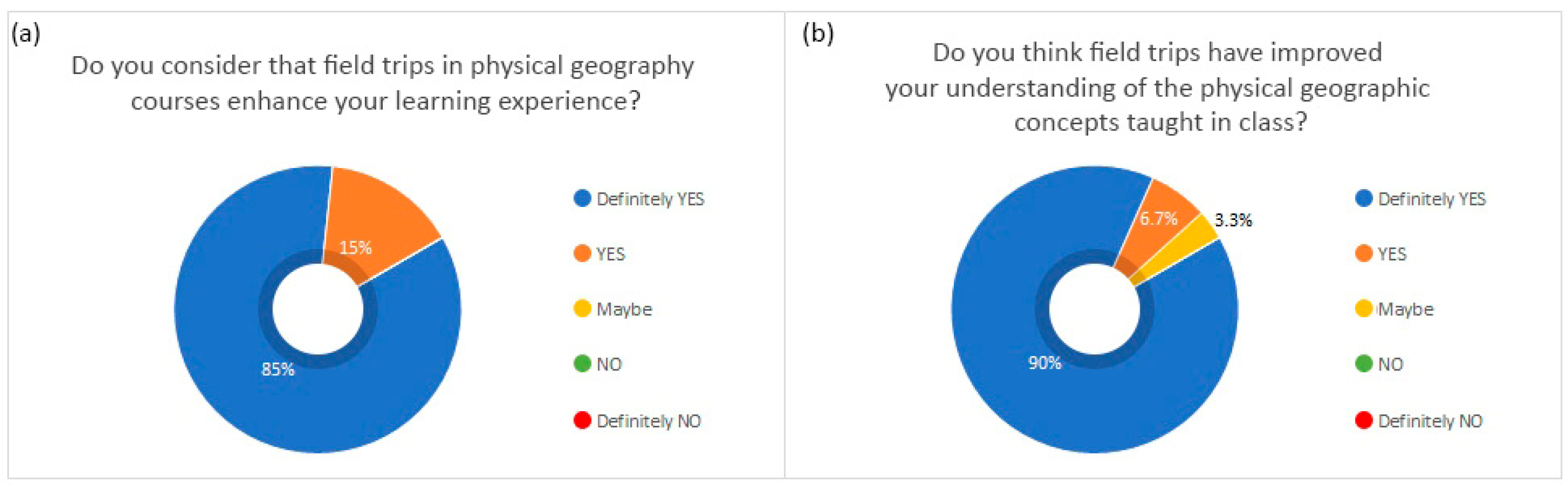
Overall, the results reveal a consistently positive perception of traditional fieldwork among the surveyed students across all evaluated dimensions, including learning enhancement, conceptual understanding, skill development, motivation, and environmental awareness. The combined percentage of positive responses (“Definitely YES” and “YES”) exceeded 90% in most cases, indicating a high level of agreement regarding the educational value of fieldwork in Physical Geography courses. The detailed results of the test are as follows. In the first question, the “questionees” answered that the field trips in Physical Geography courses enhance their learning experience. The 85% answered “definitely yes”, and 15% indicated “yes” (
Figure 3a). No other options were selected for this question. The second question (
Figure 3b), related with the improvement of the understanding of the concepts (
Table 1), 90% of the surveyed students consider “Definitely YES”, while the 6.67% answered “YES” and 3.33% “Maybe”.
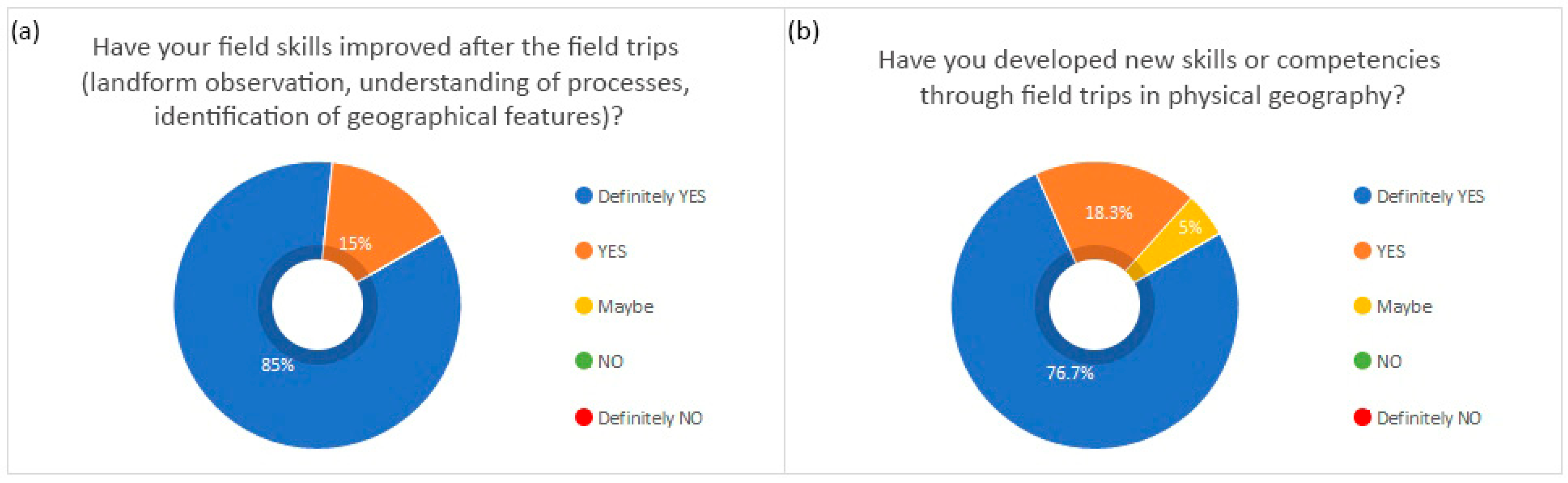
Next two questions are related with the field skills (
Figure 4). Question number 3 asked the students if they improved the field skills (
Figure 4a), the students answered positively to the question (85% “Definitely YES” and 15% “YES”). The fourth question (
Figure 4b) surveyed if the students developed new skills or competencies, 76.67% answered “Definitely YES”, 18.33% “YES” and 5% “Maybe”.
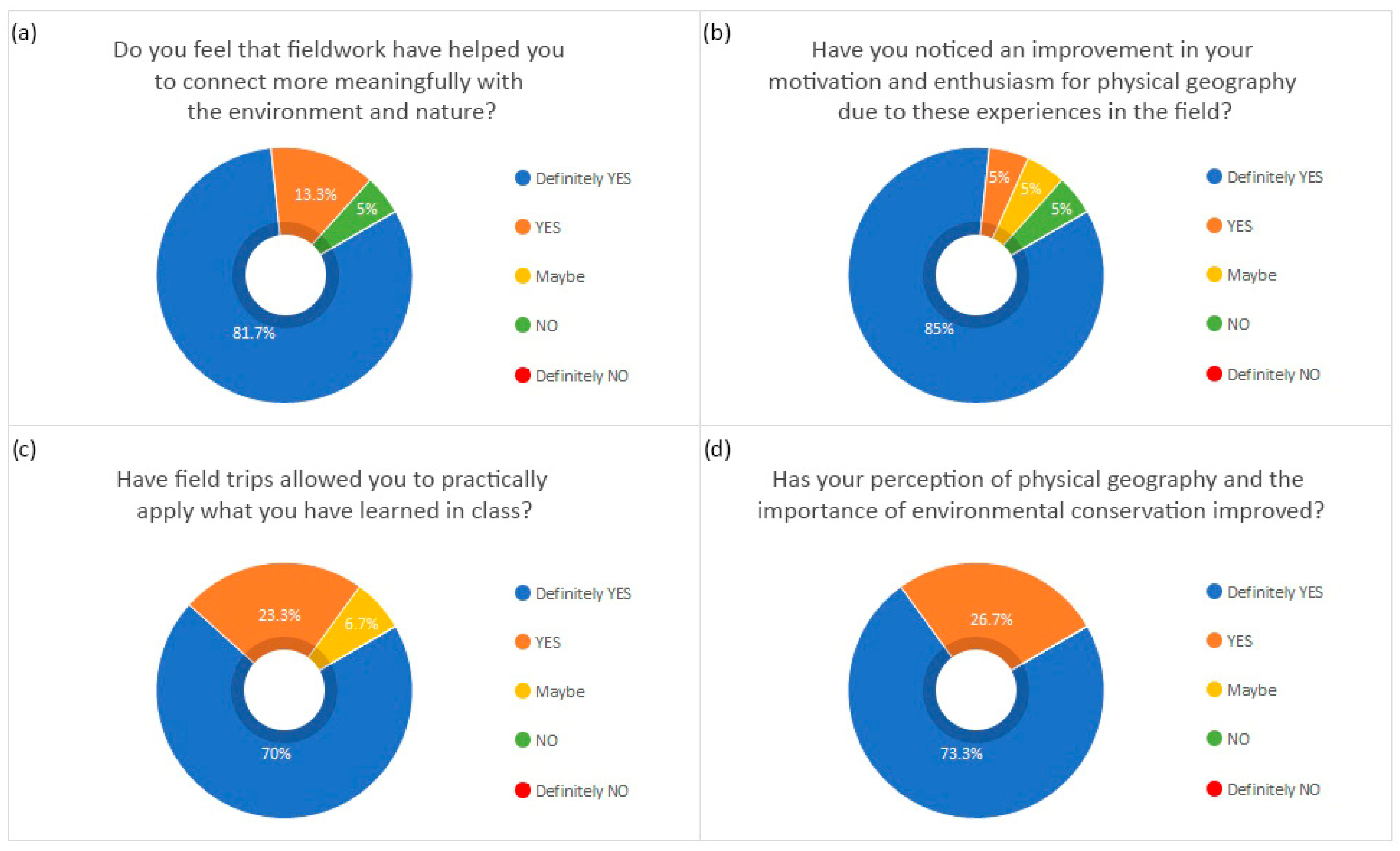
Question 5 (
Figure 5a) focused on the meaningful connection with the environment and nature (see
Table 1). The 81.67% of the surveyed students answered “Definitely YES”, the 13.33% “YES”, and the 5% (3 students) answered “No”. Question 6 is related to the improvement of the motivation and enthusiasm for Physical Geography due to the field work experience (
Figure 5b). The majority of the students answered “Definitely YES” (85%), while some students answered “YES”, “Maybe”, and “No” (5% in each case). In question 7 (
Figure 5c), the students answered 70% “Definitely YES”, 23.33% “YES”, and 6.67% “Maybe” that field trips allowed them to practically apply what they learned in class. Question 8 is related to the improvement of the perception of the Physical Geography and the importance of environmental conservation (
Figure 5d), the 73.33% of the “questionees” answered “Definitely YES”, while the 26.67% answered “YES”.
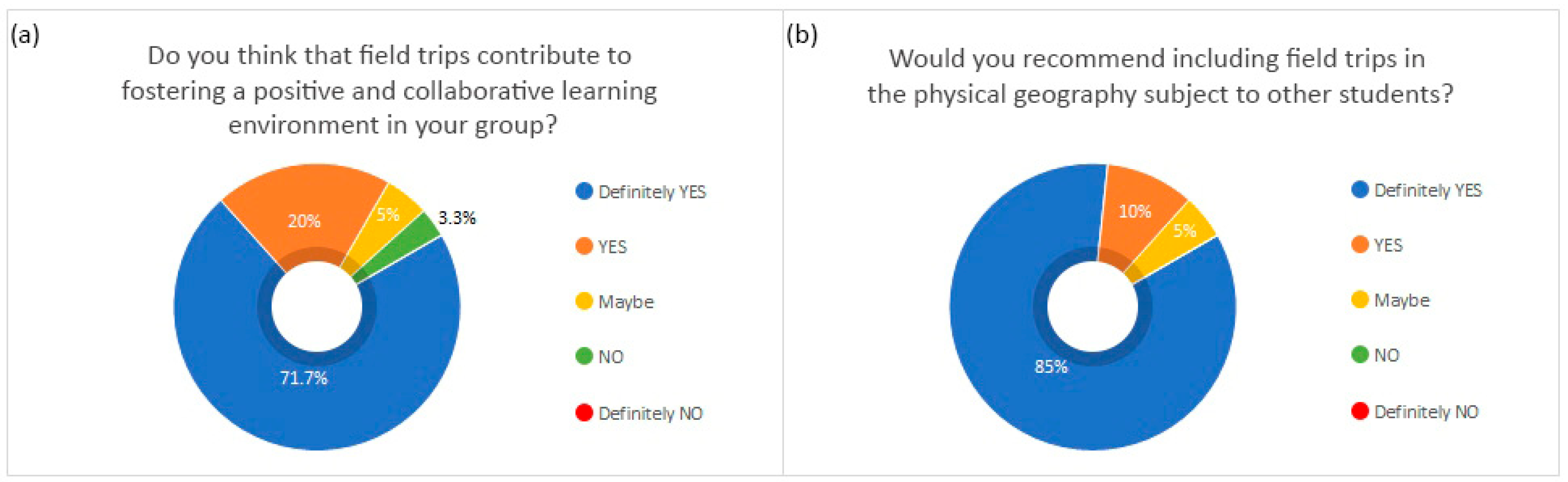
Question 9 asked the students if they think that field trips contribute to foster a positive and collaborative learning environment in their group, 71.67% answered “Definitely YES”, the 20% answered “YES”, 5% “Maybe”, and 3.33% (2 students) consider that the field trips do not contribute to foster a positive and collaborative learning environment in their group (
Figure 6a). Question 10 asked if they recommend including field trips in physical geography courses (
Figure 6b), and the responses are positive, with 85% choosing “Definitely YES” and 10% “YES”, and the other 5% answered “Maybe”.
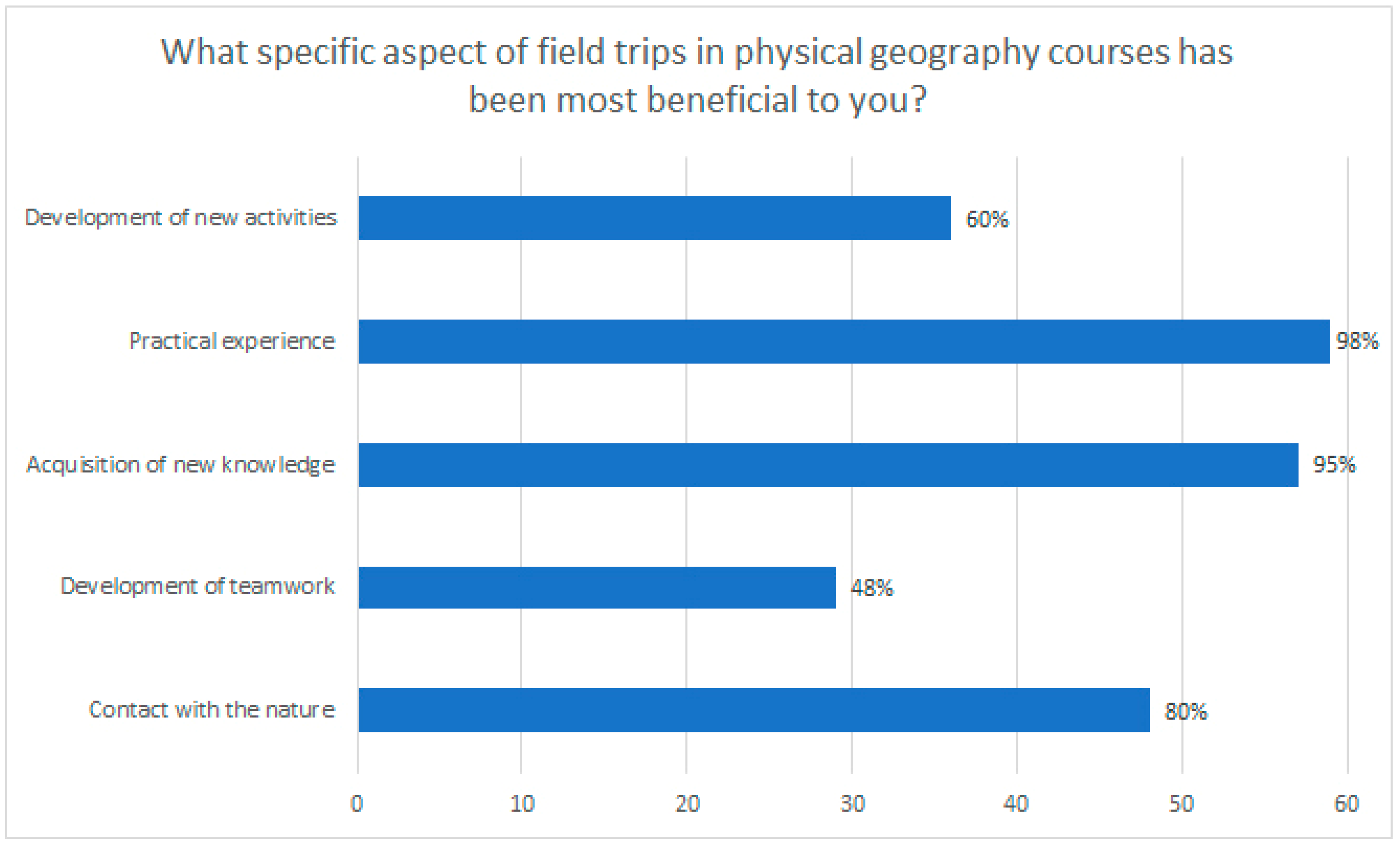
The last question asked about the beneficial aspects of field trips for the students. As a multiple-choice question, the students were free to select as many responses as they considered (
Figure 7).
A total of 80% of the students (48) consider that contact with nature is one of the most beneficial aspects of the field work. Moreover, 48% of the students (29) marked the development of teamwork as one of the benefits of field work. Regarding the knowledge and experience, 95% of the questionees (57) consider the acquisition of new knowledge one of the most beneficial aspects of the field trips in Physical Geography courses, while 98% (59) marked the practical experience as one of the great benefits. Finally, 60% of the students (36) chose the development of new activities as one of the benefits of the field trips in Physical Geography.
The high frequency of responses (
Figure 7) suggests that students highly value the practical experience they gain from field trips. This could mean that field trips provide opportunities to apply theoretical knowledge in real-world settings, making learning more engaging and effective. Moreover, students feel that they are learning new concepts and information during field trips that they might not have fully grasped in the classroom. Field trips likely provide context and clarity that enhance understanding. In addition, the significant number of responses for “contact with nature” implies that students appreciate the opportunity to connect with nature, which could foster a deeper appreciation for environmental conservation and the natural world. Furthermore, students are experiencing and learning new activities, which can contribute to their overall skill set and knowledge base. “Development of teamwork” had the lowest frequency, indicating that while teamwork is a part of the field trip experience, it might not be as impactful as other aspects. This could be an area for potential improvement, perhaps by designing activities that require more collaborative effort.
4. Discussion
The analysis of the survey responses clearly indicates that the majority of the queried students have a good perception of the fieldwork in the Physical Geography courses. As pointed by Godoy and Sanchez [
33], fieldwork is an essential tool for the teaching of geography in any of its ramifications or auxiliary sciences (geomorphology, climatology, cartography, among others) because from them we draw important experiences for the comprehension of phenomena occurring on the Earth’s surface in its relationship with space, its differentiation, changes, and causal interrelationships. This is confirmed in the present study by the results obtained in question #2, in which 90% of the students opined that the field trips improved their understanding of the concepts taught in the classroom. Furthermore, question #7 is related to the application of the learned concepts into the field (93.3% of the questionees answered affirmatively, while only 6.7% answered “Maybe”). This is in line with the thinking of Krakowka [
5], who mentioned that field trip encourages students to take what they have learned in the classroom and apply it outside to the real world, and hence promote their understanding of what they observe in the real world, and remarks that one of the most effective methods to get students to experience and, at best, understand geographic concepts is a field trip.
The results obtained related to the acquired skills (questions #3 and #4) indicate that the students have improved and gained skills through fieldwork. A total of 100% of them indicated that their field skills have been improved (85% answered “Definitely YES” and 15% “YES”). In relation to developing new skills, 95% responded positively (76.7% answered “Definitely YES” and 18.3% answered “YES”). These results agreed with Esteves et al. [
3] and Sanchez [
34] perception, who defined it as a key educational activity due to its contribution to the development of diverse skills, including observation, analysis, spatial orientation, localization, critical thinking, and research, all of which are essential components of geographical education.
According to Boyle et al. [
35], fieldwork is also considered to stimulate high levels of interest and motivation, as proved in the questions #6 and #9, where 90% of the students indicate that fieldwork improved their motivation for Physical Geography (question #6) and ~91.7% opined that field trips motivate a positive learning environment (question #9). After analyzing the results of the test, we agree with Kent et al. [
12] that fieldwork is widely regarded as an essential part of undergraduate education in geography, and lecturers generally agree that it represents one of the most effective and enjoyable forms of teaching and learning for both staff and students.
Regarding the connection with the environment and nature, the perception of Physical Geography and the improvement of the importance of environmental conservation, the results are in line with Sanchez [
34], who pointed out that fieldwork helps to raise awareness of environmental problems and their solutions, showing the influence of our actions over the natural environment. Also, Pérez de Sánchez and Rodríguez [
36] highlighted problem-solving in environmental recovery as one of the most representative aspects of the fieldwork. Our results reinforce these affirmations, obtaining positive responses in relation to the meaningful connection with nature (95%; question #5) and to the improvement of the perception of Physical Geography and the environment conservation (100%, 73.3% answered “Definitely YES”, and 26.7% answered “YES”; question #8).
Our results also indicate that field trips in Physical Geography enhanced the learning experience of the students (100% answered positively, question #1), acknowledging other researchers, who refer to field as a valuable learning experiences in geography [
5,
37,
38,
39,
40], which promote active learning through the physical and mental challenge of exploring landscapes [
5,
40]. These opinions are also reinforced by the results of question #9.
In both fieldworks, the statements by Krepel and Durrall [
22] have been fulfilled; in the field trips with an educational intention performed by the students, they interacted with the environment and associated their ideas with scientific concepts through the experience gained during these trips to the countryside. This is supported by the results of question #10, where 95% of the students recommended including field trips in Physical Geography courses.
Although the overall perception of fieldwork was highly positive, not all evaluated dimensions were valued equally by students. In particular, the development of teamwork was the least frequently selected benefit in the multiple-choice question, despite still receiving a substantial proportion of positive responses. This finding suggests a more nuanced interpretation of how fieldwork activities are experienced by students. One possible explanation is that the fieldwork campaigns were primarily designed to emphasize individual observation, interpretation and data collection skills, which are core competencies in Physical Geography. As a result, students may have perceived gains in practical experience and knowledge acquisition more clearly than improvements in collaborative skills, which tend to be less explicit and more difficult to self-assess. From a curriculum design perspective, these results imply that while traditional fieldwork is highly effective in promoting experiential and cognitive learning, additional instructional strategies may be required to strengthen its social and collaborative dimensions.
Despite the positive results obtained, several limitations of this study should be acknowledged. First, the sample size was relatively small and restricted to students from a single academic institution, which may limit the generalizability of the findings to other educational contexts or geographical settings. Future research including larger and more diverse student populations, would allow for broader comparisons. Second, the study relied on self-reported data to assess students’ perceptions and learning outcomes. While perception-based instruments are commonly used in educational research, they may be influenced by subjective factors such as motivation or recent experiences. The inclusion of objective performance measures or longitudinal assessments could strengthen future analyses. Moreover, the absence of a control group exposed exclusively to Virtual Field Trips or alternative teaching methodologies prevents direct comparison between instructional approaches. Although the present study was not designed as a comparative effectiveness analysis, future research incorporating control groups would provide valuable insights into the relative contributions of traditional and virtual fieldwork to student learning.
Finally, our hypothesis has been confirmed in this study; the tests showed that students of Physical Geography courses have a positive perception of traditional fieldwork, and it helped them to clearly understand the concepts taught in class. This statement can be confirmed through the responses to the questions analyzed in the preceding paragraphs, especially in questions #1, 2, 6, 7, and 8. Besides, the responses for the last question of the test (multiple-choice answers) indicate that the majority of the students consider contact with the environment, acquisition of new knowledge and practical experience the most beneficial aspects of the fieldwork in Physical Geography courses (80%, 95% and 98%, respectively).
5. Conclusions
The results of the tests suggest that the students have a positive perception of field work in Physical Geography. Not only is the perception positive, but also the motivation, the environmental awareness and the acquired skills in the field. The field trips improved the students’ motivation for Physical Geography, making the courses more engaging and stimulating. They also indicate that they are more aware of the environmental issues and their conservation. In relation to the acquired skills, the main part of the questionees state that they improved their field skills and developed new ones.
The primary objective of this study was to assess students’ perceptions of traditional fieldwork in Physical Geography courses after participation in extended fieldwork campaigns, rather than to test causal relationships or compare instructional modalities. Our findings reinforce the statements of other authors in relation to one of the topics addressed throughout this research, fieldwork in Physical Geography courses is a valuable and effective method to get students to experience and is a valuable tool for them to understand geographic concepts and get better knowledge of it, thanks to the direct contact with the territory. Finally, our results indicate that fieldwork in Physical Geography courses enhances the learning experience and improves the understanding of the concepts taught in class.
Based on these findings and considering the exploratory nature of the study, we recommend that educational institutions continue to integrate and emphasize fieldwork in Physical Geography courses. Incorporating more group activities and collaborative projects during field trips could further enhance teamwork skills among students. To maximize the benefits, it would be beneficial to design field trips that not only focus on skill acquisition but also foster environmental awareness and motivate students.