Article

Associations Between Limited Dorsiflexion Under Load and Compensatory Hip/Pelvic Gait Patterns in Healthy Adults


WWAMI Medical Education Program, University of Idaho, Moscow, ID 83843, USA
*
Author to whom correspondence should be addressed.
Biomechanics 2026, 6(1), 6; https://doi.org/10.3390/biomechanics6010006
Submission received: 20 November 2025 / Revised: 13 December 2025 / Accepted: 16 December 2025 / Published: 5 January 2026
(This article belongs to the Section Gait and Posture Biomechanics)

Abstract

Background/Objectives: Limited ankle dorsiflexion has been associated with compensatory movement patterns throughout the lower extremity kinematic chain. This study investigated relationships between weight-bearing dorsiflexion capacity and lower limb kinematics and plantar pressure patterns during gait. Methods: Twenty-seven healthy adults (age: 22.8 ± 3.4 years) performed a weight-bearing lunge test (WBLT) and walked at a standardized pace across a pressure-sensing walkway while wearing inertial measurement units. Statistical Parametric Mapping assessed correlations between WBLT dorsiflexion and kinematic variables throughout the stance phase. Partial correlations controlled for walking velocity and were used to examine relationships with discrete plantar pressure measurements. Results: Reduced dorsiflexion capacity during the WBLT showed bilateral moderate associations with less ankle dorsiflexion (LEFT: peak r = 0.53; RIGHT: peak r = 0.60) and knee flexion (LEFT: peak r = 0.56; RIGHT: peak r = 0.58) during terminal stance and push-off. Proximal compensations demonstrated limb-specific patterns. Hip abduction was strongly negatively correlated in the left leg only (peak r = −0.65), while pelvic tilt showed bilateral relationships with opposing temporal patterns (LEFT: peak r = −0.58 early stance; RIGHT: peak r = 0.62 terminal stance). Plantar pressure analysis revealed that reduced dorsiflexion was associated with decreased heel relative impulse bilaterally (r = 0.53–0.56) and altered temporal patterns of midfoot loading on the left leg (r = 0.56). Conclusions: Limited dorsiflexion under load is associated with compensatory movement patterns extending from the ankle to the pelvis bilaterally. The evaluation of loaded ankle mobility should be considered an essential component of lower extremity movement assessment.

1. Introduction

Regional interdependence is a clinical model of understanding how isolated movement impairments impact the function of joints throughout the kinematic chain [1]. For example, ankle dorsiflexion assists in moving the leg over the foot during functional tasks such as walking and squatting [2,3]. Healthy walking gait necessitates that the ankle flexes sufficiently when in contact with the ground (during the stance phase) to enable forward propulsion. However, when the ability to dorsiflex the ankle is limited, compensations at the knee, hip, and pelvis have been observed in sagittal, frontal, and transverse planes [2,4,5,6]. Specifically, when limited ankle dorsiflexion inhibits the body’s ability to lower the center of mass (COM), aberrant limb kinematics such as a valgus collapse of the knee, excessive foot pronation, or increased hip internal rotation during single-leg weight-bearing tasks may occur [7,8,9,10]. As these factors are thought to increase the risk of lower extremity injury, understanding the impact of limited weight-bearing dorsiflexion on walking gait mechanics could help develop targeted interventions for populations with a propensity for limited ankle dorsiflexion (i.e., individuals with chronic ankle instability (CAI) [11], diabetes mellitus [12], and the elderly [13].
Normal walking gait may only require 10–15° of ankle dorsiflexion during the stance phase [5,14]. Although this is considerably less dorsiflexion than reported values for maximal weight-bearing dorsiflexion [9], compensations from limited dorsiflexion have still been found to occur in tasks that use submaximal dorsiflexion [2,14,15]. Dorsiflexion restriction often originates from muscular tightness throughout the distal lower extremity, especially the gastrocnemius and soleus muscles that make up the Achilles tendon, which must stretch to achieve maximal degrees of dorsiflexion [4,5]. Therefore, a tighter musculotendinous ankle complex may be limiting joint mobility at different time points through the duration of the stance phase. Thus, correlations between maximum weight-bearing dorsiflexion and gait mechanics may be best assessed through statistical analyses of time series for the duration of the stance phase (i.e., Statistical Parametric Mapping [SPM]).
Prior findings related to gait kinematics in the stance phase indicate that restricted mobility at the ankle can result in decreased pelvic rotation [2] and contralateral pelvic tilt [16]. Reduced pelvic mobility can impair both step length and velocity [17], ultimately inhibiting overall gait efficiency by limiting forward progression of the body and necessitating compensatory movements in the pelvis and other proximal joints. However, findings for the impact of limited dorsiflexion on sagittal plane walking gait mechanics during the stance phase are mixed. For example, researchers have demonstrated both increased [4,5], decreased [2], and equal [16] peak knee flexion from participants with limited dorsiflexion. Findings for maximum hip flexion are also mixed, with reports of both increased [4,5] and decreased [2] values during the stance phase among individuals with limited dorsiflexion. Thus, further clarification on this relationship is needed.
A limitation of the aforementioned studies is that interpretations were based on stratifying individuals into limited or normal dorsiflexion based on a conventional cutoff. Cutoffs have indicated less than 10° of non-weight-bearing dorsiflexion as limited mobility. However, weight-bearing measurements of ankle dorsiflexion are typically much higher than non-weight-bearing measurements [18] and arguably a better measure of function during activities of daily living. For instance, comparisons of the two different measurements of ankle dorsiflexion found that weight-bearing dorsiflexion better predicted ankle dorsiflexion during gait and may provide a more sensitive measure for identifying excessive frontal plane motion [14,19]. While measuring weight-bearing dorsiflexion may be a more functional measure of dorsiflexion capacity, a potential constraint is the reliance on goniometers or inclinometers to take the measurement when predicting 3D motion capture data. Utilizing the same 3D motion capture system to measure both maximum weight-bearing dorsiflexion and gait kinematics may provide more precise and directly comparable data, potentially enhancing the accuracy of assessments regarding the relationship between dorsiflexion capacity and gait mechanics. Therefore, the purpose of the current study was to examine the relationships of maximum weight-bearing dorsiflexion as measured by motion capture analysis to kinematic, pedobarographic, and spatial-temporal measures of the stance phase of walking gait.

2. Materials and Methods

2.1. Participants

A priori power analysis was performed in RStudio V.3.6.2 (The R Foundation for Statistical Computing Platform, 2019) using the pwr package. Results of the power analysis (α = 0.05, power = 0.80) indicated that 27 participants would provide adequate power to detect correlations of r = 0.52 or greater. The expected correlation coefficient was taken from a prior study assessing the relationship between the weight-bearing lunge test (WBLT) and dorsiflexion during walking gait [14]. A convenience sample of 27 healthy individuals composed of 16 males and 11 females (age: 22.8 ± 3.4 yr; mass: 70.5 ± 12.5 kg; height: 172 ± 9.2 cm) participated in this cross-sectional correlation study. Participants were eligible for inclusion if they were between the ages of 18 and 55 years. To be eligible, participants also had to be able to ambulate and perform a WBLT without any pain. Participants were excluded if had a history of foot, lower extremity joint, or back surgeries. Participants were also excluded if they were taking any medications or had a medical condition that could impair their balance or proprioception. All participants signed an informed consent document that was approved by the University’s Internal Review Board for human subjects research.

2.2. Procedures

After measuring each participant’s height and body mass, participants were acquainted with the WBLT and ambulation. Walking gait and the WBLT were performed on a pressure distribution walkway (combined sensor area: 298 × 54.2 cm) with 22,528 capacitive sensors, 100 Hz sampling rate, and a measuring range of 1–120 N/cm2 (two Zebris FDM 1.5 platforms, Isny, Germany). Next, they were equipped with inertial measurement units (IMUs; Noraxon, Scottsdale, AZ, USA) which recorded kinematic data at 200 Hz. The kinematic data collected from the IMUs were time-synched to the pressure platforms using the MyoResearch 3 software (MR3; Noraxon, Scottsdale, AZ, USA) and Ultium Portable Lab (Noraxon, Scottsdale, AZ, USA). Following the manufacturers guidelines, IMU sensors were placed bilaterally on the dorsal aspect of the bare foot between the 1st and 2nd metatarsals, on the medial border of the shaft of the tibia and centered on the anterior thigh. The pelvis sensor was placed on the sacrum between the posterior superior iliac spines. A measuring tape was used to ensure symmetrical sensor placement by measuring the distance from the superior border of the patella to the senor on the thigh, from the medial malleolus to the sensor on the tibia, and from the dome of the talus to the sensor on the foot. Individual static calibrations were used to zero joint angles for the biomechanical model. Therefore, separate calibration trials were performed immediately prior to the WBLT and gait analysis to reduce the natural drift associated with IMU data [20]. To maintain consistency between calibrations, participants were cued to stand tall with their knees extended. Tape was also placed on the floor where their feet were at the initial calibration to maintain consistency. Data from the pressure-sensing platform was used to determine foot contact, toe off, heel lift during the WBLT, and pedobarographic data. All tasks were performed unshod.
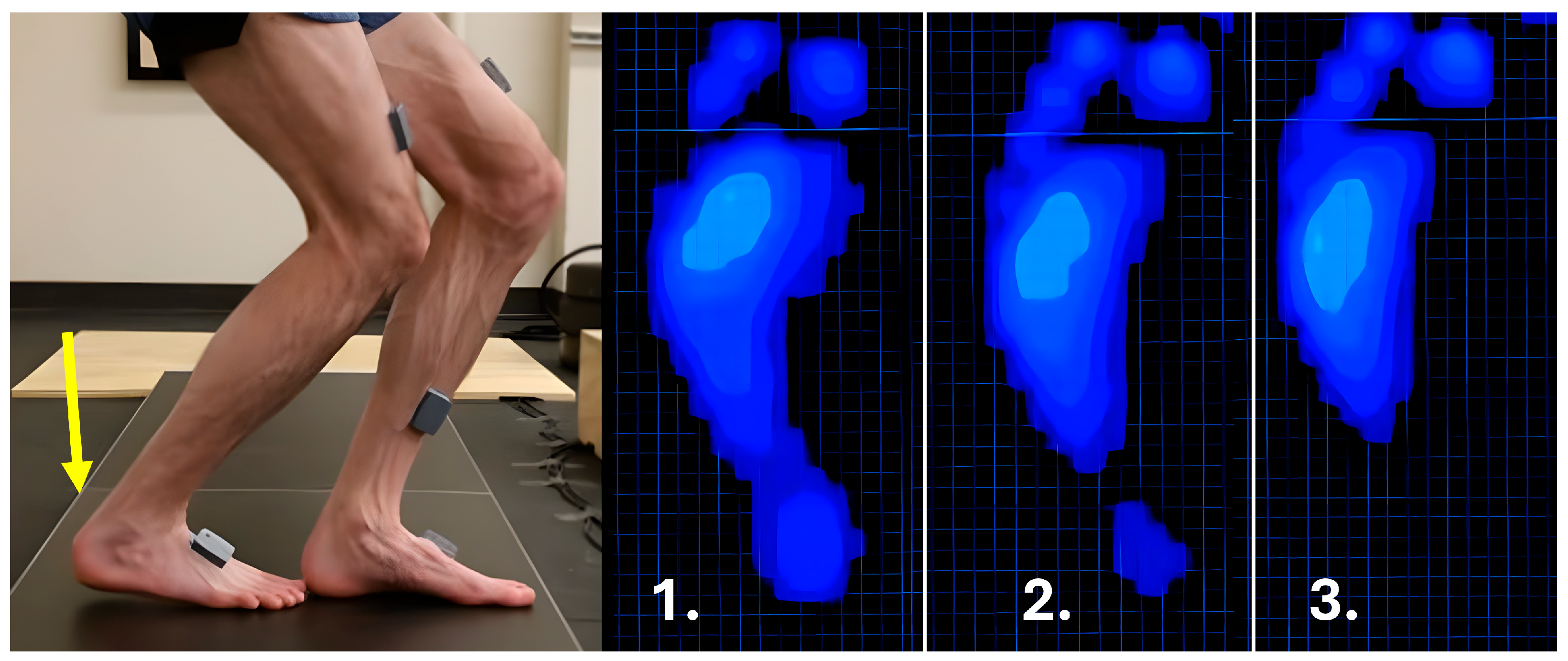
To determine maximal weight-bearing dorsiflexion, the WBLT was conducted bilaterally using the pressure distribution walkway. Each participant positioned their test foot posterior to the contralateral foot, aligning the great toe with the medial aspect of the front heel. Participants utilized a dowel for balance as they gradually shifted their weight forward over their lead foot while maintaining heel contact of the tested foot in contact with the ground for as long as possible. The moment of heel lift was identified through pressure distribution visualizations in the MR3 software interface (Figure 1). At this identified moment, peak ankle dorsiflexion was measured using the time synchronized IMUs. The mean value across three testing trials was calculated for subsequent analysis.
Following the WBLT, participants had their walking gait analyzed on the pressurized walkway. This was accomplished by having the participants walk at a standardized pace. To cue the pace, participants were asked to walk as though they were going to a meeting but not in a hurry. Due to the platform not being imbedded in the floor (Figure 1), the platform was extended with plywood so that gait could be initiated off the platform without having to step over the edge of the platform. Steady state walking speed on level ground has been found to occur at or by the third step [21,22]. Thus, participants started one step off of the platform which allowed ample room to reach their steady state walking pace. The stance phase of the left or right foot was therefore analyzed at the third or fourth step. Additionally, participants were instructed not to slow down until they were off the platform. This was performed ten times.

2.3. Data Analysis

All kinematic gait, WBLT values, and pedobarographic data were collected in the MR3 software. The software calculates joint angles based on the static calibration from the IMU-based body model. Angles in degrees are calculated in the software based on recommendations for IMUs from the International Society of Biomechanics and the software performs a Kalman filter that has been optimized for IMU data [23]. IMUs have demonstrated good to excellent validity for the measurement of dorsiflexion during walking gait (Root Mean Square Error [RMSE]: 1.2–2.0°) with moderate to good reliability (ICC: 0.6–0.95) [24]. For pelvis kinematics, a single IMU positioned on the sacrum has shown excellent validity (r2 > 0.88 for obliquity and rotation) and high reliability (absolute error < 1.2°, intra-subject SD < 1.1°) when compared to optical motion capture systems [25]. Kinematic data were then exported into MATLAB (Version 2021b, MathWorks, Natick, MA, USA). Kinematic variables of interest included the pelvis segment, hip, knee, and ankle joints in all three planes of motion. Once in MATLAB, the kinematic data were interpolated to 101 data points (0–100% of stance phase) from heel contact to toe off for each of the 10 recorded stance phases. The average of the 10 stance phases for each participant was then used for analysis. Peak force from the walkway was also analyzed as a waveform using these methods and normalized to body mass.
Pedobarographic data of the same stance phases were also processed using the MR3 software. The plantar surface was divided into three anatomical regions: heel, midfoot, and forefoot. Multiple pressure parameters were extracted from each region: peak pressure values, impulse relative percent, and temporal characteristics (onset, peak onset, and end timing expressed as percentage of stance phase). These data were exported to R studio for statistical analyses.

2.4. Statistical Analysis

Relationships between maximum dorsiflexion during the WBLT and both kinematic variables and peak plantar pressure were assessed with SPM throughout the stance phase. All analyses were conducted using the open source spm1D 0.4 software package. The SPM package uses general linear models for regression. These models were constructed with WBLT values as the independent variable and the kinematic waveform as the dependent variable. For each time point across the stance phase, the SPM analysis generated both t-statistics (indicating significance of the relationship) and correlation coefficients (r-values). Statistical significance at each time point was determined when the SPM t-curve reached or exceeded the critical threshold (α = 0.05). Bonferroni corrections for multiple comparisons were not performed as the SPM analysis uses random field theory to correct for multiple comparisons [26]. Corresponding r-values at the significant time periods were used to interpret the strength and direction of the relationship between dorsiflexion capacity and the dependent variables. Positive r-values indicate greater dorsiflexion during the WBLT was associated with a higher positive value for the variable measured during gait. Negative r-values indicate that lower dorsiflexion values were associated with higher measurement values during the gait assessments. Due to the potential for kinematics to vary between legs during walking gait of healthy individuals [27], correlation analyses between the WBLT and gait kinematics were performed for both legs. The periods of the stance phase were defined as: 0–16.7%—loading response; 16.7–50%—midstance; 50–83.3%—terminal stance; 66.7–100%—push-off; 83.3–100%—pre-swing [2]. Partial correlations were used to assess the relationships between maximum dorsiflexion during the WBLT and the discrete plantar pressure measurements while statistically controlling for the confounding influence of walking velocity, with a significance level of 0.05. Partial correlation coefficients (r) represent the strength of association between dorsiflexion capacity and plantar pressure variables after removing the variance attributable to gait velocity. Coefficients were interpreted according to guidelines for medical research: none (0), poor (0.0–0.2), fair (0.21–0.4), moderate (0.41–0.6), strong (0.61–0.8), and very strong (0.81–1.0) correlation [28].

3. Results

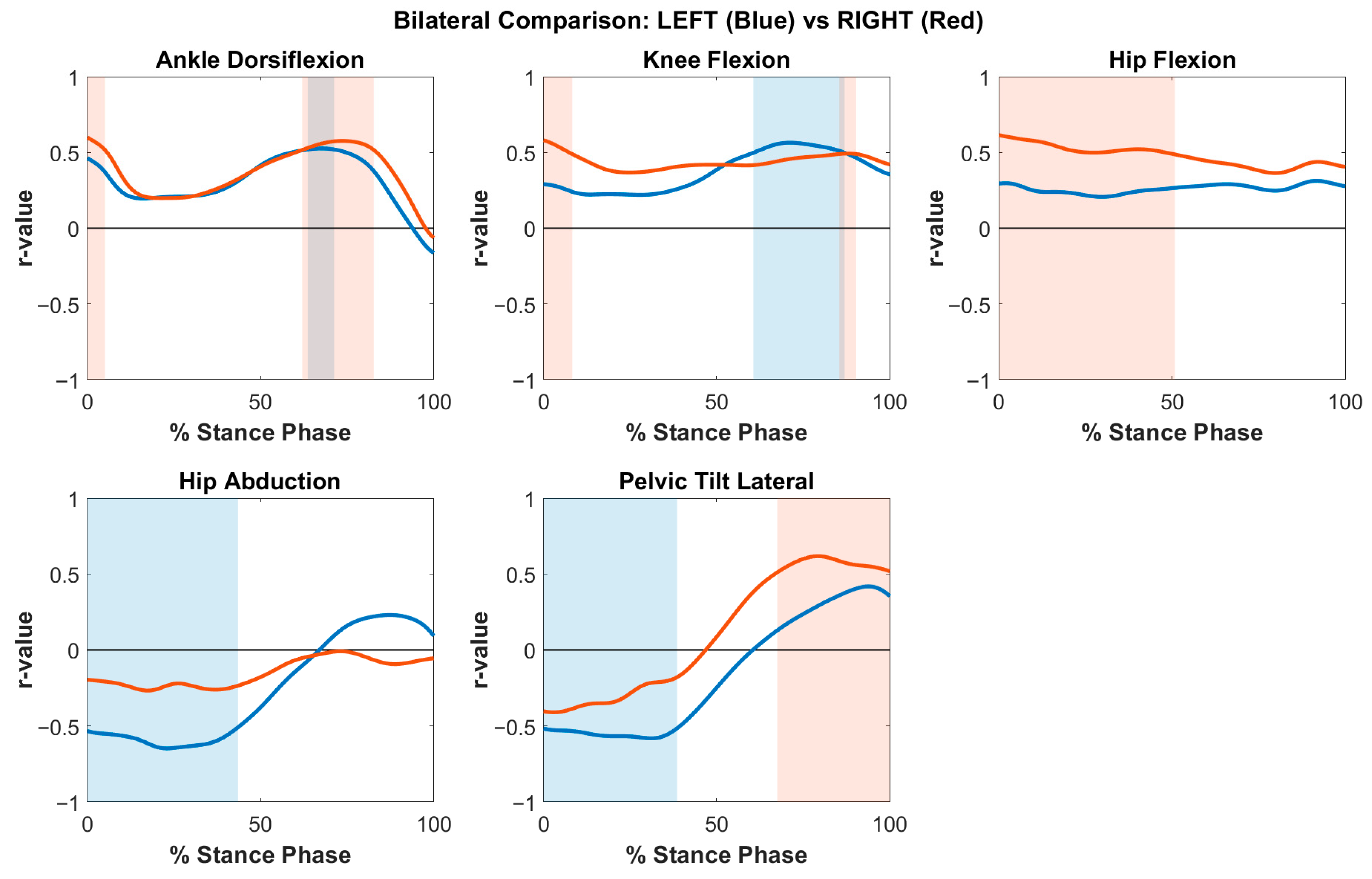
Figure 2 displays the r-values from the significant SPM regression analyses across the stance phase for both legs. Bilateral comparison revealed both limb-specific and symmetric relationships between dorsiflexion capacity and gait compensations.
Bilaterally consistent relationships were observed for distal joint compensations. Significant positive relationships were found between maximum ankle dorsiflexion during the WBLT and ankle dorsiflexion during gait in both legs (LEFT: peak r = 0.53, p = 0.037, 8% stance, 64–71%; RIGHT: peak r = 0.60, p = 0.044, 28% stance, 0–5% and 62–83%). Similarly, knee flexion showed bilateral positive correlations (LEFT: peak r = 0.56, p = 0.012, 27% stance, 61–87%; RIGHT: peak r = 0.58, p = 0.045, 15% stance, 0–8% and 85–90%), indicating that greater dorsiflexion capacity was associated with increased sagittal plane motion at the ankle and knee during terminal stance and push-off phases.
Limb-specific asymmetric relationships emerged at proximal joints. Hip abduction demonstrated a strong negative correlation in the left leg only (peak r = −0.65, p < 0.001, 44% stance, 0–43%), with no significant relationship in the right leg. Conversely, hip flexion showed a strong positive correlation in the right leg only (peak r = 0.61, p = 0.002, 52% stance, 0–51%), with no significant relationship in the left leg. These findings suggest that individuals with limited dorsiflexion capacity employ different compensatory strategies between limbs at proximal joints.
Pelvic tilt lateral showed bilateral significance with opposing temporal patterns. The left leg demonstrated a strong negative correlation during early stance (peak r = −0.58, p < 0.001, 40% stance, 0–39%), while the right leg showed a strong positive correlation during terminal stance (peak r = 0.62, p = 0.001, 33% stance, 68–100%). These relationships indicate that individuals with less dorsiflexion maintained a more neutral pelvis throughout stance, representing a compensatory stiffening strategy.
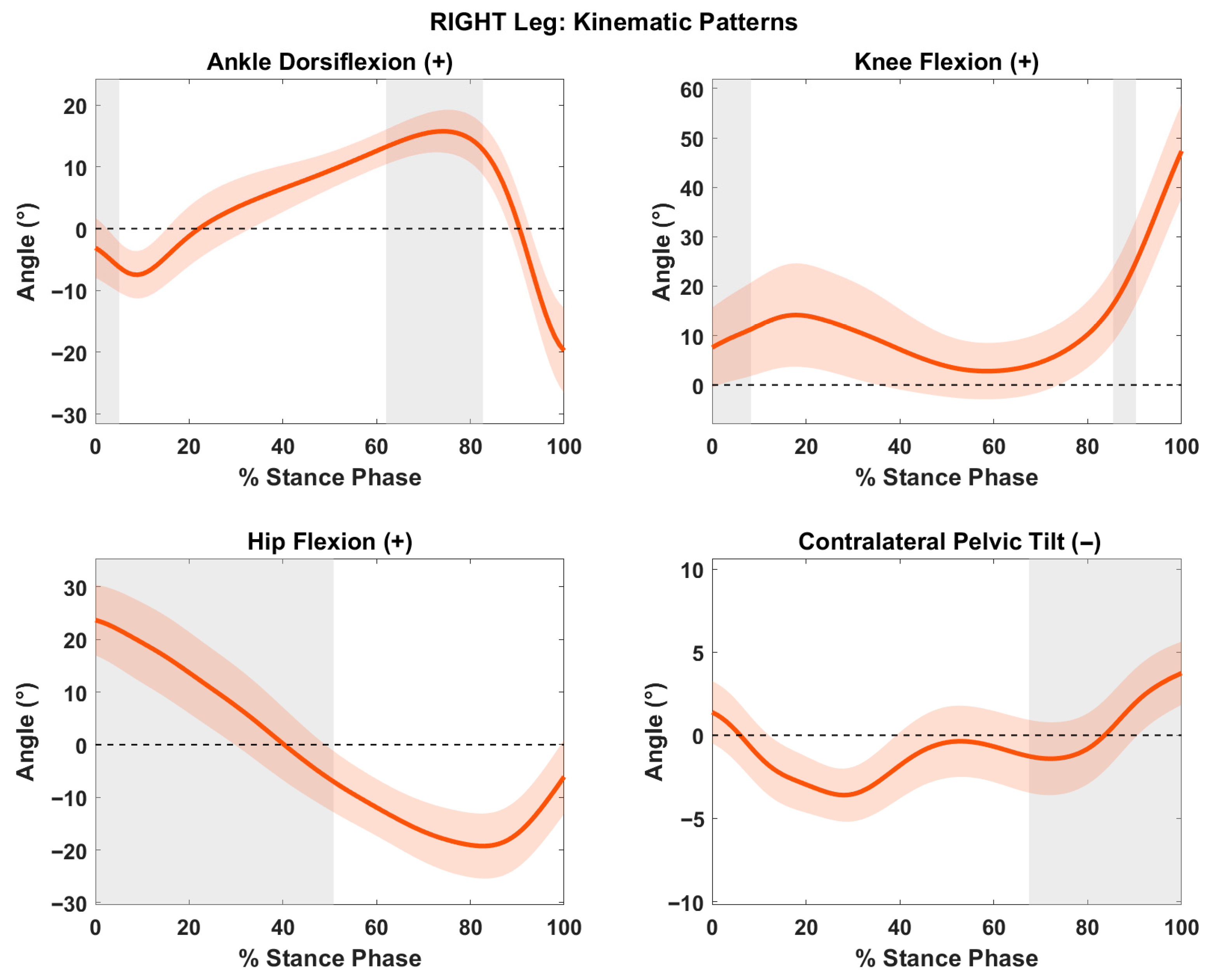
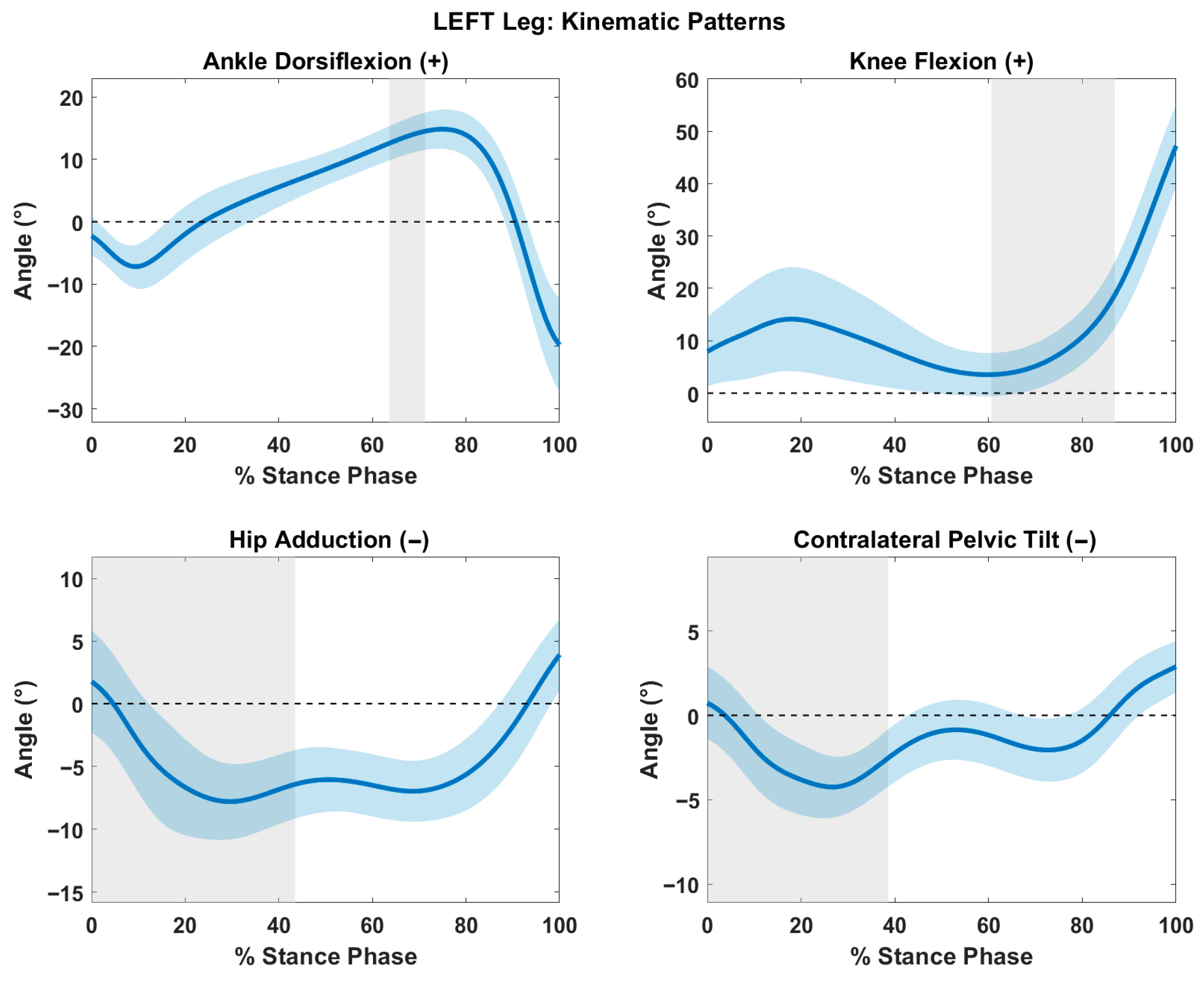
All SPM statistics are presented in Table 1, and visuals of the kinematic waveforms for significant findings for the left and right legs are presented in Figure 3 and Figure 4.
Table 2 provides a bilateral comparison of velocity-adjusted partial correlations for all plantar pressure variables. After controlling for walking velocity (4.02 ± 0.71 km/h), eight significant partial correlations emerged across both legs. The velocity correlation columns (r vel) demonstrate that several plantar pressure variables were substantially correlated with walking speed, justifying the partial correlation approach.
For the left leg, three significant partial correlations were observed: heel relative impulse (r = 0.56, p = 0.003), midfoot contact start timing (r = 0.39, p = 0.049), and midfoot peak force timing (r = 0.56, p = 0.003). These findings indicate that individuals with greater dorsiflexion capacity demonstrated proportionally greater heel loading and delayed midfoot pressure peaks during stance.
For the right leg, five significant partial correlations were identified: heel relative impulse (r = 0.53, p = 0.005), forefoot contact start timing (r = 0.42, p = 0.031), heel contact end timing (r = 0.51, p = 0.008), heel peak force timing (r = 0.55, p = 0.003), and single support line ratio (r = 0.42, p = 0.032). These relationships suggest that greater dorsiflexion was associated with prolonged heel contact, delayed forefoot loading initiation, and altered weight distribution patterns during single-limb support.

4. Discussion

Findings from the current study extend previous research by demonstrating the relationship between limited ankle dorsiflexion and bilateral gait patterns during the stance phase in healthy individuals. Reduced maximum dorsiflexion during the WBLT was associated with altered joint mechanics at the ankle, despite maximum WBLT values far exceeding the dorsiflexion requirements of normal gait. Further up the kinematic chain, dorsiflexion capacity was associated with compensatory movement patterns at the knee, hip, and pelvis. While compensatory movement patterns were symmetric at the ankle and knee, the hip and pelvis were found to have asymmetric compensations. Pedobarographic profiles were also found to be affected by ankle dorsiflexion capacity after controlling for walking velocity. These findings support the model of regional interdependence and the importance of evaluating mobility of the ankle joint in the presence of lower extremity abnormalities during gait.
Although multiple studies show consistent evidence that limited dorsiflexion capacity during clinical ROM tasks is related to limited dorsiflexion during the stance phase of [2,5,29], the strength of this relationship may only be moderate. Other studies performing correlational analyses have found dorsiflexion during the WBLT to have a significant (p < 0.001) r-value of 0.521 [14], which was similar to the current study’s bilateral peak r-values (LEFT: r = 0.53, p = 0.037; RIGHT: r = 0.60, p = 0.044) during the stance phase. The current study’s waveform analysis also found this relationship at peak dorsiflexion on the right leg, at foot contact on the right leg (Figure 3), and just prior to peak dorsiflexion on the left leg (Figure 4). Studies comparing individuals classified as having unloaded ankle dorsiflexion restrictions (i.e., less than 10° measured with a goniometer) have only found differences in ankle dorsiflexion between groups ranging from 0.5 to 2.3° during the stance phase [2,5]. Peak ankle dorsiflexion during the stance phase has also not been found to differ between groups classified as restricted or not while loaded [29]. The researchers [29] defined restriction under load with the WBLT and a 40° cutoff measured by an inclinometer. Interestingly, while loaded conditions did not find a difference between groups, the WBLT has been found to be more predictive of gait kinematics when compared to the passive dorsiflexion measurement [14]. The bilateral consistency of moderate relationships in the current study strengthens the evidence that weight-bearing dorsiflexion capacity influences stance phase mechanics, though clinically meaningful cutoff values for different measures of dorsiflexion should be established through future investigations.
There are also discrepancies between studies as it relates to compensatory movements at joints proximal to the ankle. Findings from the current investigation demonstrated that less dorsiflexion capacity was correlated bilaterally with less knee flexion during terminal stance and push-off, which is consistent with Aquino et al. [2], who reported similar findings when stratifying individuals into low or high passive dorsiflexion groups. This evidence supports the premise that most knee flexion during the pre-swing phase of gait results from energy generated by the ankle during terminal stance [30]. Nevertheless, healthy individuals with less dorsiflexion capacity have been found to exhibit more knee flexion during midstance [5]. The discrepancy between studies may again be related to how dorsiflexion capacity was measured. The current study assessed dorsiflexion capacity with the knee bent, which limits the contribution from the gastrocnemius, which crosses the knee joint. However, increased knee flexion during midstance was found with individuals having tight gastrocnemius assessed by ankle dorsiflexion in a non-weight-bearing position with the knee extended [5]. Although Aquino et al. [2] also assessed dorsiflexion with an extended knee, individuals with tight gastrocnemius may maintain the knee in a more flexed position during gait as a compensatory mechanism, whereas individuals in the current study may have had dorsiflexion restrictions more specifically targeted to the soleus muscle and ankle joint structures. This distinction aligns with findings of decreased knee flexion during the stance phase when ankle dorsiflexion was artificially restricted [6], suggesting that the source of the limitation (i.e., gastrocnemius or soleus/ankle joint) influences the resulting compensatory gait patterns.
Frontal and transverse plane knee kinematics were not significantly correlated to maximum dorsiflexion during the WBLT; however, bilateral analysis revealed limb-specific proximal compensatory patterns at the hip and pelvis. Hip abduction demonstrated a strong negative correlation in the left leg only (peak r = −0.65, p < 0.001, 0–43% stance), with no significant relationship in the right leg. Conversely, hip flexion showed a strong positive correlation in the right leg only (peak r = 0.61, p = 0.002, 0–51% stance), with no significant relationship in the left leg. Pelvic tilt lateral demonstrated bilateral relationships with opposing temporal patterns: the left leg showed a strong negative correlation during early stance (peak r = −0.58, p < 0.001, 0–39% stance), while the right leg showed a strong positive correlation during terminal stance (peak r = 0.62, p = 0.001, 68–100% stance). These asymmetric findings suggest that individuals with limited dorsiflexion capacity employ different compensatory strategies between limbs at proximal joints.
During healthy gait, the hip adducts and the pelvis drop contralaterally during the loading response. The observed relationships indicate that less dorsiflexion capacity was associated with a coordinated bilateral stiffening strategy that reduced normal motion excursions throughout the stance phase. On the left leg, less dorsiflexion was associated with reduced hip abduction (more neutral hip position) and reduced pelvic drop during early stance, creating a less compliant lower extremity during loading response. On the right leg, less dorsiflexion was associated with reduced hip flexion (more extended hip) during weight acceptance and less superior pelvic motion during terminal stance. Given that ankle dorsiflexion and knee flexion were also reduced during terminal stance bilaterally, these proximal compensations represent a temporally coordinated stiffening strategy across both limbs. By maintaining more neutral joint positions and reduced pelvic motion, individuals with limited dorsiflexion capacity may minimize the forward tibial progression demands that would otherwise require greater ankle mobility. Thus, clinicians should consider the evaluation of both ankles when there is unilateral hip dysfunction.
The current study succeeded in expanding upon prior evidence for the impact of dorsiflexion limitations on walking gait mechanics. Findings that individuals with limited dorsiflexion adapt movement strategies that reduce demand on tibial translation are supported by prior work finding significant and large effects for limited pelvic rotation during the pre-swing phase [2]. Rotational deficits at the pelvis were found to limit efficiency of forward progression (i.e., step length) [2], but the quantified impact of pelvis rotation on step length has been found to be less than 3% [31]. Nevertheless, strong correlations and large effect sizes for the relationship between dorsiflexion capacity and pelvic motion warrant further research to understand whether these alterations in segment and joint positions may lead to pathological conditions. Until more evidence becomes available, practitioners should consider the potential for ankle mobility issues when working with musculoskeletal conditions affecting the hip and pelvis.
The current study also provides novel evidence for the relationship between dorsiflexion capacity and foot mechanics as measured by a pressure-sensing walkway after controlling for walking velocity. Less dorsiflexion capacity during the WBLT was associated with reduced heel relative impulse bilaterally (LEFT: r = 0.56, p = 0.003; RIGHT: r = 0.53, p = 0.005). The partial correlation approach was necessary given that several plantar pressure variables demonstrated strong correlations with walking velocity (heel peak force: r = 0.55–0.62, p < 0.003; forefoot peak force: r = 0.83–0.84, p < 0.001), which would have substantially confounded the dorsiflexion-pressure relationships if not controlled. This data is consistent with and extends findings from cadaveric studies that indicated increasing levels of triceps surae contractures reduce pressure at the hindfoot [32]. Limited dorsiflexion capacity likely restricts normal tibial advancement over the foot during heel rocker, leading to compensatory early weight transfer characterized by earlier heel peak force timing (RIGHT: r = 0.55, p = 0.003), earlier heel contact end timing (RIGHT: r = 0.51, p = 0.008), and earlier left midfoot peak force timing (LEFT: r = 0.56, p = 0.003). This compensatory mechanism may lead to an earlier peak loading on the structures of the midfoot (i.e., the plantar fascia). Given that the current evidence for the relationship between plantar fasciitis and limited dorsiflexion is mixed [33,34], earlier timing of forces and reduced contact times could be considered as a biomechanical marker for future investigations of plantar fasciitis risk factors.
There are several limitations to consider when interpreting the findings from this study. The biomechanical model used in this investigation considered the foot as a single rigid segment, which may not capture the complex multi-segmental movements that occur within the foot during gait, particularly at the midtarsal and metatarsophalangeal joints that could influence the observed pressure distribution patterns. Additionally, dorsiflexion capacity was assessed exclusively with the knee in a flexed position during the WBLT, which primarily evaluates soleus and ankle joint mobility while minimizing gastrocnemius contribution, potentially limiting the generalizability of findings to studies that assess dorsiflexion with the knee extended and may explain some of the discrepancies observed between investigations. Although IMUs have been demonstrated as valid and reliable for sagittal plane ankle kinematics during walking gait, Hip rotation and movements performed in the transverse plane (i.e., hip abduction) showed higher RMSE and lower correlations (RMSE as high as 11.8 and r as low as 0.35) [24]. Thus, the potential for asymmetrical relationships between dorsiflexion and hip kinematics cannot be overlooked. Finally, while the correlational analysis provides valuable insights into the relationships between dorsiflexion capacity and gait mechanics across a broad range of dorsiflexion capacities, it does not establish clinically meaningful thresholds or cutoff values that practitioners could use to identify individuals at risk for compensatory movement patterns or related pathologies, limiting the immediate clinical applicability of these findings. Future research should begin to establish whether different cutoff levels for the WBLT can differentiate between individuals who do and do not present the gait compensations observed in this study.

5. Conclusions

The study objectives were met by expanding upon evidence from prior studies that used clinical measurements of loaded dorsiflexion. Evidence from the current study indicates that limited weight-bearing dorsiflexion capacity is associated with compensatory lower extremity kinematics and plantar pressure distribution throughout the stance phase of gait. Bilateral analysis revealed symmetric distal compensations and asymmetric proximal adaptations. Specifically, ankle dorsiflexion and knee flexion showed consistent bilateral relationships, indicating that less mobility during the WBLT leads to decreased tibial translation during gait. At proximal joints and the pelvis, limb-specific patterns were found that indicate individuals with less dorsiflexion walk in a manner that reduces demand on tibial translation. Individuals with less dorsiflexion also displayed earlier timings of peak force and less contact time at the heel. The integration of these findings within a regional interdependence framework reinforces the need to evaluate bilateral distal mobility as part of proximal joint dysfunction or overuse patterns. Future research should establish whether different cutoff levels for the WBLT can differentiate between individuals who do and do not present the gait compensations observed in this study.

Author Contributions

Conceptualization, N.J.P.M., K.M.K., D.G.K. and J.W.; Methodology, K.M.K., D.G.K., J.W. and N.J.P.M.; Software, N.J.P.M.; Validation, N.J.P.M.; Formal Analysis, N.J.P.M.; Investigation, K.M.K., D.G.K., J.W. and N.J.P.M.; Resources, N.J.P.M.; Data Curation, N.J.P.M.; Writing—Original Draft Preparation, K.M.K., D.G.K., J.W. and N.J.P.M.; Writing—Review and Editing, K.M.K. and N.J.P.M., Visualization, K.M.K. and N.J.P.M.; Supervision, N.J.P.M.; Project Administration: K.M.K., D.G.K., J.W. and N.J.P.M. All authors have read and agreed to the published version of the manuscript.

Funding

This research received no external funding.

Institutional Review Board Statement

The study was conducted in accordance with the Declaration of Helsinki and approved by the Institutional Review Board (or Ethics Committee) of the UNIVERSITY OF IDAHO (protocol code: 23-211, date of approval: 16 November 2024).

Informed Consent Statement

Informed consent was obtained from all subjects involved in the study. Written informed consent has been obtained from the patient(s) to publish this paper.

Data Availability Statement

The datasets generated and analyzed during the current study are available from the corresponding author on reasonable request.

Conflicts of Interest

The authors declare no conflicts of interest.

Abbreviations

The following abbreviations are used in this manuscript:
WBLTWeight-Bearing Lunge Test
ROMRange of Motion
SPMStatistical Parametric Mapping

References

  1. Lehr, M.E.; Pettineo, S.J.; Fink, M.L.; Meyr, A.J. Closed chain dorsiflexion and the regional interdependence implications on fundamental movement patterns in collegiate athletes. Foot 2021, 49, 101835. [Google Scholar] [CrossRef]
  2. Aquino, M.R.C.; Resende, R.A.; Kirkwood, R.N.; Souza, T.R.; Fonseca, S.T.; Ocarino, J.M. Spatial-temporal parameters, pelvic and lower limb movements during gait in individuals with reduced passive ankle dorsiflexion. Gait Posture 2022, 93, 32–38. [Google Scholar] [CrossRef]
  3. Gomes, J.; Neto, T.; Vaz, J.R.; Schoenfeld, B.J.; Freitas, S.R. Is there a relationship between back squat depth, ankle flexibility, and Achilles tendon stiffness? Sports Biomech. 2022, 21, 782–795. [Google Scholar] [CrossRef]
  4. Wu, S.K.; Lou, S.Z.; Lee, H.M.; Chen, H.Y.; You, J.Y. Gastrocnemius inflexibility on foot progression angle and ankle kinetics during walking. Clin. Biomech. 2014, 29, 556–563. [Google Scholar] [CrossRef]
  5. You, J.Y.; Lee, H.M.; Luo, H.J.; Leu, C.C.; Cheng, P.G.; Wu, S.K. Gastrocnemius tightness on joint angle and work of lower extremity during gait. Clin. Biomech. 2009, 24, 744–750. [Google Scholar] [CrossRef] [PubMed]
  6. Ota, S.; Fujita, R.; Ueda, M.; Aimoto, K.; Nakanishi, A.; Suzuki, Y. Sex Differences in the Correlation Between Restricted Ankle Dorsiflexion and Knee Joint Biomechanics During Gait-Focus on the Knee Adduction Moment. Biomed. J. Sci. Tech. Res. 2019, 23, 17578–17586. [Google Scholar] [CrossRef]
  7. Bell-Jenje, T.; Olivier, B.; Wood, W.; Rogers, S.; Green, A.; McKinon, W. The association between loss of ankle dorsiflexion range of movement, and hip adduction and internal rotation during a step down test. Man. Ther. 2016, 21, 256–261. [Google Scholar] [CrossRef] [PubMed]
  8. Grindstaff, T.L.; Dolan, N.; Morton, S.K. Ankle dorsiflexion range of motion influences Lateral Step Down Test scores in individuals with chronic ankle instability. Phys. Ther. Sport 2017, 23, 75–81. [Google Scholar] [CrossRef] [PubMed]
  9. Rabin, A.; Portnoy, S.; Kozol, Z. The association of ankle dorsiflexion range of motion with hip and knee kinematics during the lateral step-down test. J. Orthop. Sports Phys. Ther. 2016, 46, 1002–1009. [Google Scholar] [CrossRef]
  10. da Costa, G.V.; de Castro, M.P.; Sanchotene, C.G.; Ribeiro, D.C.; de Brito Fontana, H.; Ruschel, C. Relationship between passive ankle dorsiflexion range, dynamic ankle dorsiflexion range and lower limb and trunk kinematics during the single-leg squat. Gait Posture 2021, 86, 106–111. [Google Scholar] [CrossRef]
  11. Hoch, M.C.; Staton, G.S.; McKeon, J.M.M.; Mattacola, C.G.; McKeon, P.O. Dorsiflexion and dynamic postural control deficits are present in those with chronic ankle instability. J. Sci. Med. Sport 2012, 15, 574–579. [Google Scholar] [CrossRef]
  12. Maeshige, N.; Uemura, M.; Hirasawa, Y.; Yoshikawa, Y.; Moriguchi, M.; Kawabe, N.; Fujii, M.; Terashi, H.; Fujino, H. Immediate Effects of Weight-Bearing Calf Stretching on Ankle Dorsiflexion Range of Motion and Plantar Pressure During Gait in Patients with Diabetes Mellitus. Int. J. Low. Extrem. Wounds 2023, 22, 548–554. [Google Scholar] [CrossRef]
  13. Scott, G.; Menz, H.B.; Newcombe, L. Age-related differences in foot structure and function. Gait Posture 2007, 26, 68–75. [Google Scholar] [CrossRef]
  14. Kang, M.-H.; Oh, J.-S. Relationship Between Weightbearing Ankle Dorsiflexion Passive Range of Motion and Ankle Kinematics During Gait. J. Am. Podiatr. Med. Assoc. 2017, 107, 39–45. [Google Scholar] [CrossRef] [PubMed]
  15. Taylor, J.B.; Wright, E.S.; Waxman, J.P.; Schmitz, R.J.; Groves, J.D.; Shultz, S.J. Ankle Dorsiflexion Affects Hip and Knee Biomechanics During Landing. Sports Health 2022, 14, 328–335. [Google Scholar] [CrossRef]
  16. Rao, Y.; Yang, N.; Gao, T.; Zhang, S.; Shi, H.; Lu, Y.; Ren, S.; Huang, H. Effects of peak ankle dorsiflexion angle on lower extremity biomechanics and pelvic motion during walking and jogging. Front. Neurol. 2023, 14, 1269061. [Google Scholar] [CrossRef]
  17. Mun, K.R.; Guo, Z.; Yu, H. Restriction of pelvic lateral and rotational motions alters lower limb kinematics and muscle activation pattern during over-ground walking. Med. Biol. Eng. Comput. 2016, 54, 1621–1629. [Google Scholar] [CrossRef] [PubMed]
  18. Krause, D.A.; Cloud, B.A.; Forster, L.A.; Schrank, J.A.; Hollman, J.H. Measurement of Ankle Dorsiflexion: A Comparison of Active and Passive Techniques in Multiple Positions. J. Sport Rehabil. 2011, 20, 333–344. [Google Scholar] [CrossRef]
  19. Dill, K.E.; Begalle, R.L.; Frank, B.S.; Zinder, S.M.; Padua, D.A. Altered knee and ankle kinematics during squatting in those with limited weight-bearing-lunge ankle-dorsiflexion range of motion. J. Athl. Train. 2014, 49, 723–732. [Google Scholar] [CrossRef] [PubMed]
  20. Donaldson, B.; Bezodis, N.; Bayne, H. Within-subject repeatability and between-subject variability in posture during calibration of an inertial measurement unit system. In Proceedings of the 39th International Society of Biomechanics in Sport Conference, Canberra, Australia (Online), 19–23 July 2021; pp. 224–227. [Google Scholar]
  21. Strutzenberger, G.; Claußen, L.; Schwameder, H. Analysis of sloped gait: How many steps are needed to reach steady-state walking speed after gait initiation? Gait Posture 2021, 83, 167–173. [Google Scholar] [CrossRef]
  22. Macfarlane, P.A.; Looney, M.A. Walkway length determination for steady state walking in young and older adults. Res. Q. Exerc. Sport 2008, 79, 261–267. [Google Scholar] [CrossRef]
  23. Park, S.; Yoon, S. Validity evaluation of an inertial measurement unit (IMU) in gait analysis using statistical parametric mapping (SPM). Sensors 2021, 21, 3667. [Google Scholar] [CrossRef]
  24. Poitras, I.; Dupuis, F.; Bielmann, M.; Campeau-Lecours, A.; Mercier, C.; Bouyer, L.J.; Roy, J.-S. Validity and reliability of wearable sensors for joint angle estimation: A systematic review. Sensors 2019, 19, 1555. [Google Scholar] [CrossRef]
  25. Buganè, F.; Benedetti, M.G.; D’Angeli, V.; Leardini, A. Estimation of pelvis kinematics in level walking based on a single inertial sensor positioned close to the sacrum: Validation on healthy subjects with stereophotogrammetric system. Biomed. Eng. Online 2014, 13, 146. [Google Scholar] [CrossRef]
  26. Pataky, T.C. Generalized N-dimensional Biomechanical Field Analysis Using Statistical Parametric Mapping. J. Biomech. 2010, 43, 1976–1982. [Google Scholar] [CrossRef] [PubMed]
  27. Lathrop-Lambach, R.L.; Asay, J.L.; Jamison, S.T.; Pan, X.; Schmitt, L.C.; Blazek, K.; Siston, R.A.; Andriacchi, T.P.; Chaudhari, A.M.W. Evidence for joint moment asymmetry in healthy populations during gait. Gait Posture 2014, 40, 526–531. [Google Scholar] [CrossRef] [PubMed]
  28. Akoglu, H. User’s guide to correlation coefficients. Turk. J. Emerg. Med. 2018, 18, 91–93. [Google Scholar] [CrossRef] [PubMed]
  29. Kwon, Y.; Shin, G. Foot kinematics and leg muscle activation patterns are altered in those with limited ankle dorsiflexion range of motion during incline walking. Gait Posture 2022, 92, 315–320. [Google Scholar] [CrossRef]
  30. Zelik, K.E.; Adamczyk, P.G. A unified perspective on ankle push-off in human walking. J. Exp. Biol. 2016, 219, 3676–3683. [Google Scholar] [CrossRef]
  31. Liang, B.W.; Wu, W.H.; Meijer, O.G.; Lin, J.H.; Lv, G.R.; Lin, X.C.; Prins, M.R.; Hu, H.; van Dieën, J.H.; Bruijn, S.M. Pelvic step: The contribution of horizontal pelvis rotation to step length in young healthy adults walking on a treadmill. Gait Posture 2014, 39, 105–110. [Google Scholar] [CrossRef]
  32. Aronow, M.S.; Diaz-Doran, V.; Sullivan, R.J.; Adams, D.J. The Effect of Triceps Surae Contracture Force on Plantar Foot Pressure Distribution. Am. Orthop. Foot Ankle Soc. 2006, 27, 43–52. [Google Scholar] [CrossRef] [PubMed]
  33. Bolívar, Y.A.; Munuera, P.V.; Padillo, J.P. Relationship between tightness of the posterior muscles of the lower limb and plantar fasciitis. Foot Ankle Int. 2013, 34, 42–48. [Google Scholar] [CrossRef] [PubMed]
  34. Johannsen, F.E.; Rydahl, J.P.; Jacobsen, A.S.; Brahe, C.C.H.; Magnusson, P.S. Foot Posture and Ankle Dorsiflexion as Risk Factors for Developing Achilles Tendinopathy and Plantar Fasciitis: A Case-Control Study. Foot Ankle Int. 2024, 45, 1380–1389. [Google Scholar] [CrossRef] [PubMed]
Figure 1. Weight-bearing lunge test setup with an arrow pointing toward the ankle that was assessed (left panel). Sequential pressure platform images (right panels) demonstrate the measurement criterion: (1) heel maintains full ground contact, (2) initiation of heel lift, and (3) first frame with complete heel lift where maximum dorsiflexion was quantified with the inertial measurement units.
Biomechanics 06 00006 g001
Figure 2. Statistical Parametric Mapping regression analysis showing correlation curves (r-values) between dorsiflexion capacity and lower extremity kinematics. Blue lines and shaded areas represent the LEFT leg; red lines and shaded areas represent the RIGHT leg. Shaded regions indicate time intervals where correlations exceeded the critical threshold (p < 0.05).
Biomechanics 06 00006 g002
Figure 3. Descriptive time series for the left leg (group means and standard deviation clouds) from kinematic variables. The shaded areas indicate where the Statistical Parametric Mapping regression models found a significant relationship between ankle dorsiflexion and the kinematic variable.
Biomechanics 06 00006 g003
Figure 4. Descriptive time series for the right leg (group means and standard deviation clouds) from kinematic variables. The shaded areas indicate where the Statistical Parametric Mapping regression models found a significant relationship between ankle dorsiflexion and the kinematic variable.
Biomechanics 06 00006 g004
Table 1. Asterisks next to p-values indicate significant relationships (p < 0.05). Peak r = peak correlation coefficient in the significant region. % Sig = percentage of stance phase showing a significant relationship. Cluster Intervals = specific portions of the stance phase (0–100%) where significance occurred. - indicates no significant relationship. Background colors differentiate between left (blue) and right (orange) lower extremities.
Variablep-ValuePeak r% SigCluster
Intervals
p-ValuePeak r% SigCluster
Intervals
LEFTRIGHT
Ankle
Dorsiflexion
0.0370.53864–71%0.044 *0.60280–5%; 62–83%
Ankle
Inversion
-−0.220--0.430-
Ankle
Abduction
-−0.220--−0.440-
Knee Flexion0.012 *0.562761–87%0.045 *0.58230–8%; 85–90%
Knee
Abduction
-0.220--0.420-
Knee
Rotation
-0.270--0.200-
Hip Flexion-0.310-0.002 *0.61520–51%
Hip
Abduction
<0.001 *−0.65440–43%-−0.270-
Hip Rotation-−0.430--0.310-
Pelvic Tilt-0.180--0.320-
Pelvic Tilt Lateral<0.001 *−0.58400–39%0.001 *0.623368–100%
Pelvic
Rotation
-−0.330--−0.330-
Peak Force-−0.150--−0.420-
Peak
Pressure
-0.530--−0.540-
Table 2. Asterisks next to p-values indicate statistical significance (p < 0.05). r partial = partial correlation coefficient after controlling for walking velocity. r vel = correlation between variable and walking velocity. Bold variable names indicate significant partial correlations in at least one leg. n = 27 for all analyses. Background colors differentiate between left (blue) and right (orange) lower extremities.
VariableMean ± SDr Partialp-Valuer Velocityp-Valuer Partialp-Valuer Velocityp-Value
LEFTRIGHT
Heel Peak Force (N/kg)6.08 ± 0.760.370.0620.62<0.001 *0.340.0860.550.003 *
Midfoot Peak Force (N/kg)1.74 ± 0.82−0.310.126−0.400.037 *−0.230.250−0.410.033 *
Forefoot Peak Force (N/kg)9.25 ± 0.780.050.8160.84<0.001 *−0.130.5150.83<0.001 *
Heel Relative Impulse (%)30.30 ± 4.750.560.003 *0.100.6040.530.005 *0.030.867
Midfoot Relative Impulse (%)11.28 ± 5.61−0.320.111−0.450.018 *−0.280.166−0.390.043 *
Forefoot Relative Impulse (%)58.42 ± 4.81−0.230.2300.420.027 *−0.320.1090.350.074
Midfoot Contact Start (%)7.20 ± 1.570.390.0490.190.3550.230.2650.050.795
Forefoot Contact Start (%)7.02 ± 1.460.090.679−0.190.3530.420.031 *0.090.673
Heel Contact End (%)63.48 ± 4.940.330.095−0.470.013 *0.510.008 *−0.410.035 *
Midfoot Contact End (%)81.67 ± 4.18−0.040.865−0.480.012*0.240.245−0.220.261
Heel Peak Time (%)20.27 ± 3.030.350.082−0.400.039 *0.550.003 *−0.410.035 *
Midfoot Peak Time (%)46.05 ± 9.030.560.003 *−0.400.038 *0.340.087−0.240.235
Forefoot Peak Time (%)76.25 ± 1.480.020.9250.100.6300.100.6400.100.632
Disclaimer/Publisher’s Note: The statements, opinions and data contained in all publications are solely those of the individual author(s) and contributor(s) and not of MDPI and/or the editor(s). MDPI and/or the editor(s) disclaim responsibility for any injury to people or property resulting from any ideas, methods, instructions or products referred to in the content.