Communication

A Preliminary Mechanical Evaluation of a Newly Developed Polyaxial Locking Mechanism for a Distal Radius Plate

1
Department of Orthopedic Surgery, Niigata Cancer Center Hospital, 2-15-3 Kawagishicho, Chuo Ku, Niigata 951-8566, Japan
2
Department of Orthopedic Surgery, Niigata Hand Surgery Foundation, 997 Suwayama, Seiro-machi, Niigata 957-0117, Japan
3
Division of Orthopaedic Surgery, Niigata University Graduate School of Medical and Dental Sciences, 1-757 Asahimachi-dori, Chuo Ku, Niigata 951-8510, Japan
*
Author to whom correspondence should be addressed.
Biomechanics 2026, 6(1), 22; https://doi.org/10.3390/biomechanics6010022
Submission received: 10 December 2025 / Revised: 9 February 2026 / Accepted: 13 February 2026 / Published: 17 February 2026
(This article belongs to the Section Injury Biomechanics and Rehabilitation)

Abstract

Background/Objectives: Polyaxial locking systems for distal radius plates differ among manufacturers, and the mechanical strength of their locking mechanism is rarely disclosed. This study aimed to perform a preliminary mechanical evaluation of a newly developed polyaxial locking mechanism and to investigate its strength at different screw insertion angles. Methods: The polyaxial locking mechanism was evaluated via static load testing at three screw insertion angles until failure, and the maximum bending moment was measured. Loading was performed via cantilever bending to generate a bending moment in the polyaxial locking mechanism. The maximum bending moments of the insertion angles of 10° for the holes in the distal rows were investigated for significant differences. Results: Maximum bending moments significantly decreased as the screw insertion angle increased, with reductions of approximately 50% at 5° and 10° compared with 0°. At a 10° insertion angle, variation in ultimate strength was observed among screw hole in the distal row. The failure mechanism was loosening of the locking screws in all tests. Conclusions: The maximum bending moment of the polyaxial locking mechanism decreased with increasing locking screw insertion angle, highlighting the importance of insertion angle in polyaxial locking plate fixation.

1. Introduction

Distal radius fractures are among the most common skeletal injuries in adults, accounting for a significant proportion of all fractures and frequently occurring in both low-energy falls among the elderly and high-energy trauma in younger populations. These fractures, particularly unstable or intra articular patterns, can lead to long term disability if not properly managed, underscoring the importance of stable internal fixation to restore function and prevent complications such as malunion or diminished range of motion.
Volar locking plate fixation has emerged as a widely accepted surgical approach for unstable distal radius fractures [1,2,3,4]. Several biomechanical studies have reported that these devices are comparable to or better than conventional nonlocking plates [5,6,7]. A number of randomized controlled trials and systematic reviews suggest that volar locking plates yield favorable functional outcomes—often demonstrating lower disability scores and reduced pain compared with external fixation or casting in unstable fracture patterns at 3, 6, and 12 months post operation (e.g., improved DASH and VAS scores) while maintaining acceptable radiographic alignment and a relatively low complication rate [8]. Clinical series also report satisfactory maintenance of reduction and wrist stability with locking plate constructs, with many patients achieving excellent or good functional outcomes over mid term follow up [9].
However, despite these clinical benefits, traditional monoaxial volar locking plates have inherent limitations related to their fixed screw trajectory. Because the locking mechanism constrains the screw direction, achieving optimal subchondral screw placement—particularly in comminuted or osteoporotic bone—remains challenging, and suboptimal screw angulation has been implicated in fixation failure and implant complications in some cases. To address this limitation, polyaxial (variable angle) locking plates have been developed, allowing a range of screw trajectories that may be better tailored to individual fracture morphology. Clinical comparisons between fixed angle and variable angle plates suggest that variable angle designs may provide comparable or slightly better functional and radiographic outcomes, with similar overall rates of union and acceptable complication profiles [10]. We believe that the newly developed plate not only overcomes the limitations of fixed-angle plates but also retains the advantages of variable-angle plates. Manufacturers typically do not provide quantitative data on the mechanical strength of polyaxial locking mechanisms, and the existing biomechanical literature [11,12] on the mechanical performance of such mechanisms—especially under varying screw angles—is sparse compared with the extensive clinical data on clinical outcomes [13].
Given the increasing clinical adoption of polyaxial locking systems, there is a clear need for rigorous mechanical characterization of the locking interface under controlled conditions. Such data are important to inform implant design, surgical technique, and ultimately, clinical decision making. In particular, quantifying the effect of screw insertion angle on mechanical strength is critical, as deviations from the ideal trajectory are unavoidable in clinical practice and may influence construct stability. Therefore, the present study aimed to investigate the mechanical properties of the polyaxial locking mechanism of a newly developed implant for distal radius fractures, evaluating its strength at screw insertion angles of 0°, 5°, and 10°. We hypothesized that the locking strength at 5° and 10° would be inferior to that at 0°, reflecting the influence of screw angulation on the stability of the construct.

2. Materials and Methods

2.1. Ethical Statement

This study did not involve human participants or animal experiments and did not use any data or methods that are subject to ethical review.

2.2. Implants

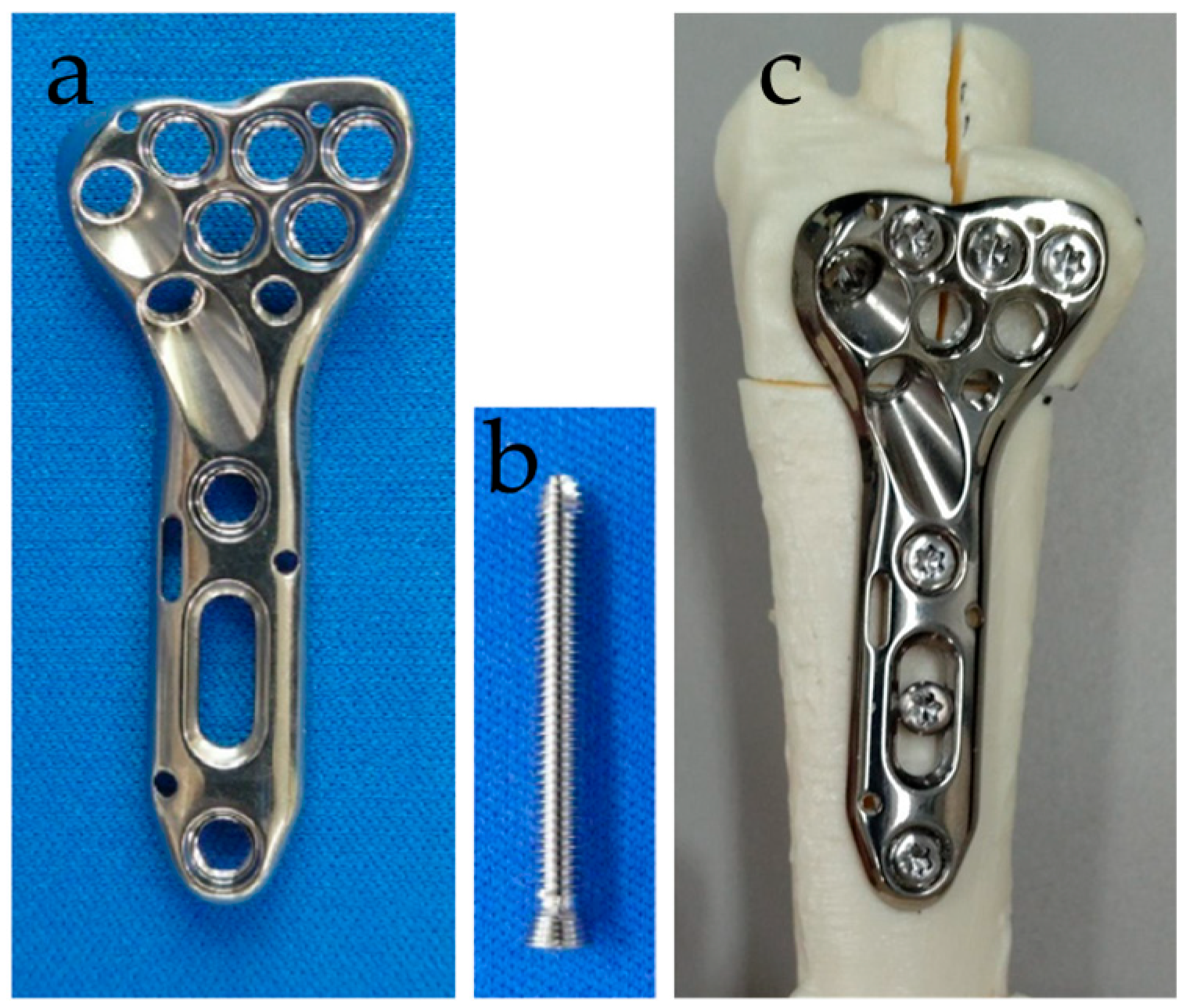
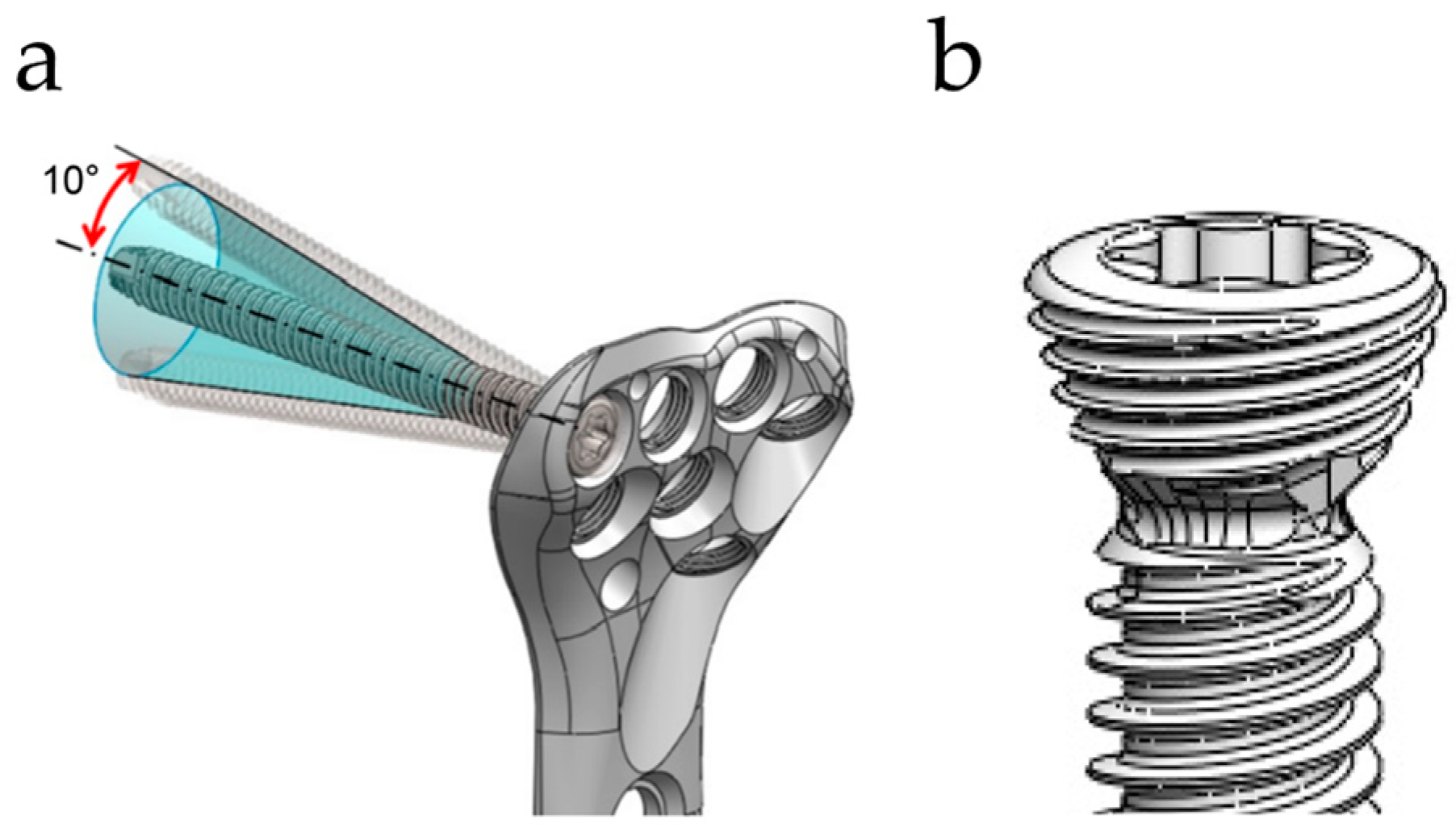
We used a newly developed PLP (Dual Loc Radii VF system [MEIRA Corp., Nagoya, Japan]) for the treatment of distal radius fractures, as shown in Figure 1. The locking screw holes had slotted hole processing to allow the selection of screw insertion angles. The thread lengths of the locking screw holes were standardized to 1 mm to ensure that they had the same strength. Polyaxial locking was achieved using internal and reverse internal threads in the holes on the plate, as illustrated in Figure 2. The locking screws of the implant had threaded tapered heads as illustrated in Figure 3. The internal thread of the screw hole and the external thread of the screw head engaged each other regardless of whether the screw was inserted along the screw hole axis or in a different direction. Locking was possible within the conical region, where the angle between the screw hole axis and screw insertion axis was 10°, as illustrated in Figure 3. The plates and screws were made of a titanium alloy (Ti-6Al-4V). The screw diameter was 2.7 mm, and the recommended tightening torque was 0.8–1.0 Nm.

2.3. Preparation of the Implants

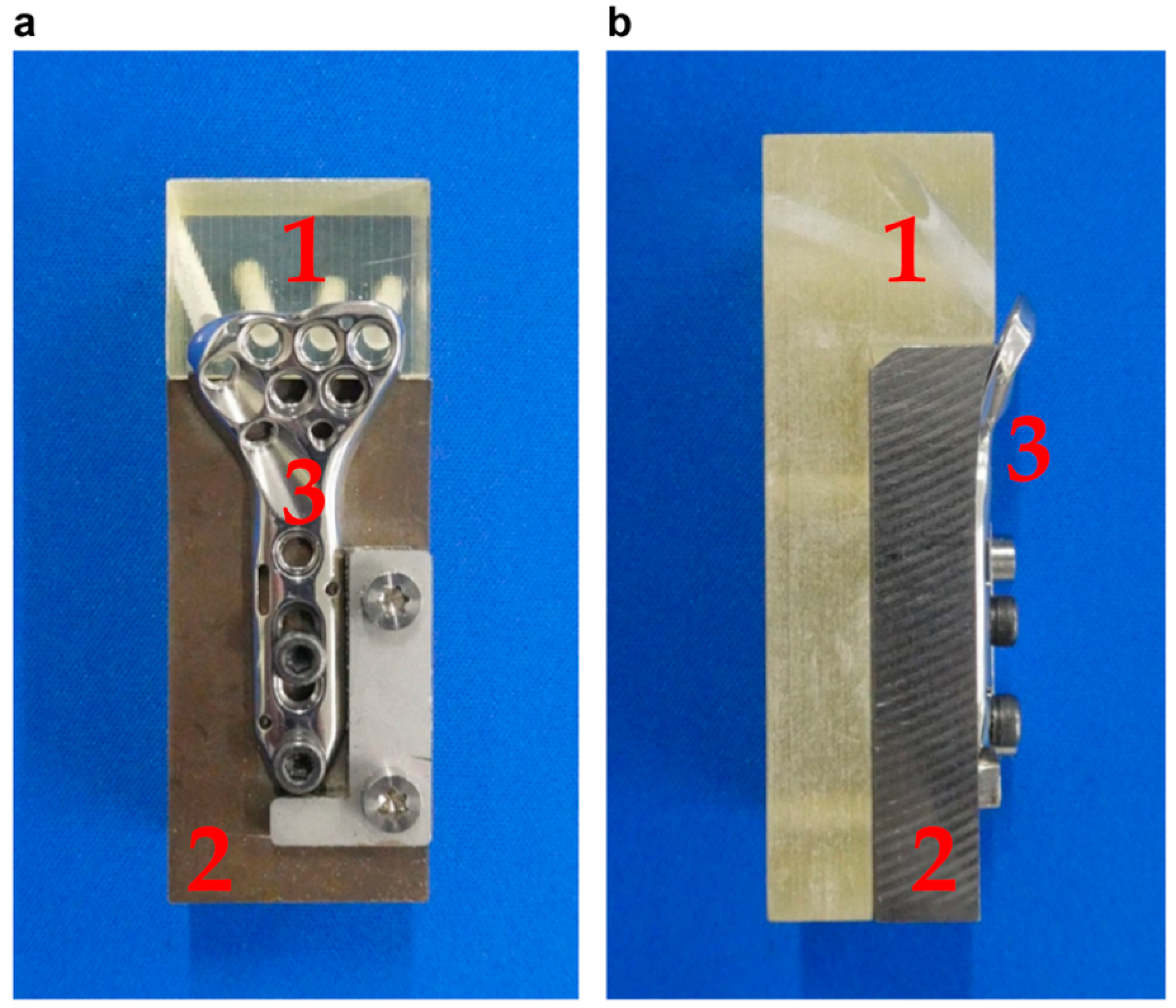
The plates were fixed to the jig at their proximal ends and mounted on a guiding block. The guiding block facilitated accurate insertion of the screws at the defined angles, as shown in Figure 4. The screws were inserted using a torque-limiting screwdriver (MEIRA Corp., Nagoya, Japan) with a release torque of 1.0 Nm.

2.4. Mechanical Testing

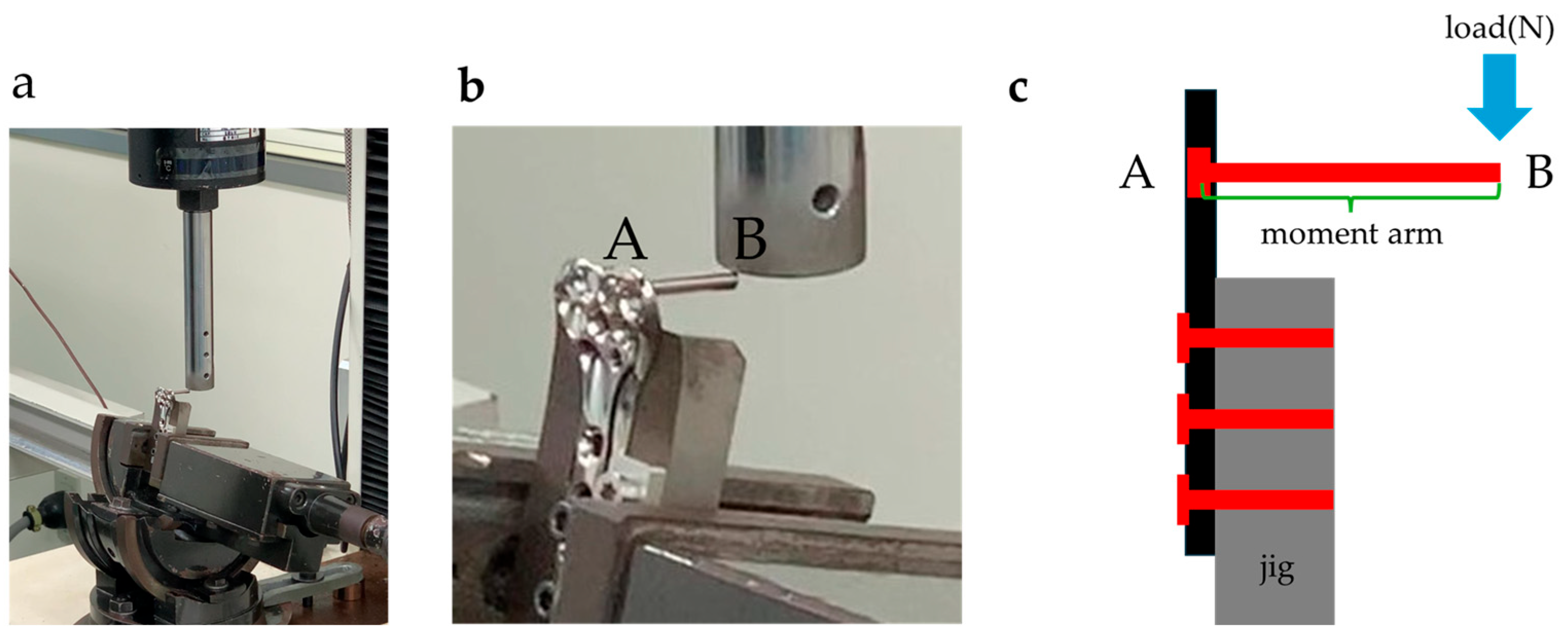
The polyaxial locking mechanism was tested under static loading and at three screw insertion angles (0°, 5°, and 10°) until failure using a material testing machine (Autograph AG-I, Shimadzu Corp., Kyoto, Japan) equipped with a 10 kN load cell. Loading was performed via cantilever bending to generate a bending moment in the polyaxial locking mechanism. The moment arm length was 20 mm. Three holes on the ulnar side and the most distal row were used for each implant. The screw insertion angle was the same for all the implants. Each angle was tested nine times (sample size: 3). A total of 3 independent plates were used for each group. For each plate, 3 screw holes were tested, resulting in a total of 9 measurements. Each measurement was recorded, but the plate—not the individual screw holes—was considered the experimental unit, and statistical analyses were based on plate-level averages. Failure was defined as a decrease in force due to screw breakage or loosening. The maximum bending moment was determined under displacement-controlled loading at 0.1 mm/s. All raw mechanical test data used in this study are openly available in a public repository [14].

2.5. Setup

The implants were fixed using a three-dimensional vise to ensure accurate alignment. They were rotated along the three orthogonal axes and positioned in the material testing machine such that the screws were horizontal to the ground. A load was applied to the tips of the screws, as shown in Figure 5.

2.6. Statistical Analysis

Data are presented as mean values ± standard deviation with 95% confidence intervals (CI) and coefficients of variation (CV). Statistical analysis was performed using EZR software (Saitama Medical Center, Jichi Medical University, Saitama, Japan) version 1.55 [15]. For each condition, plate-level average values were used for statistical analysis. The plate was defined as the experimental unit, and statistical analyses were performed with N = 3 plates. One-way analysis of variance and post hoc Tukey’s honestly significant difference tests were used to compare the three screw insertion angles (0°, 5°, and 10°) and the three different screw holes at a screw insertion angle of 10°. Statistical significance was set at p < 0.05.

3. Results

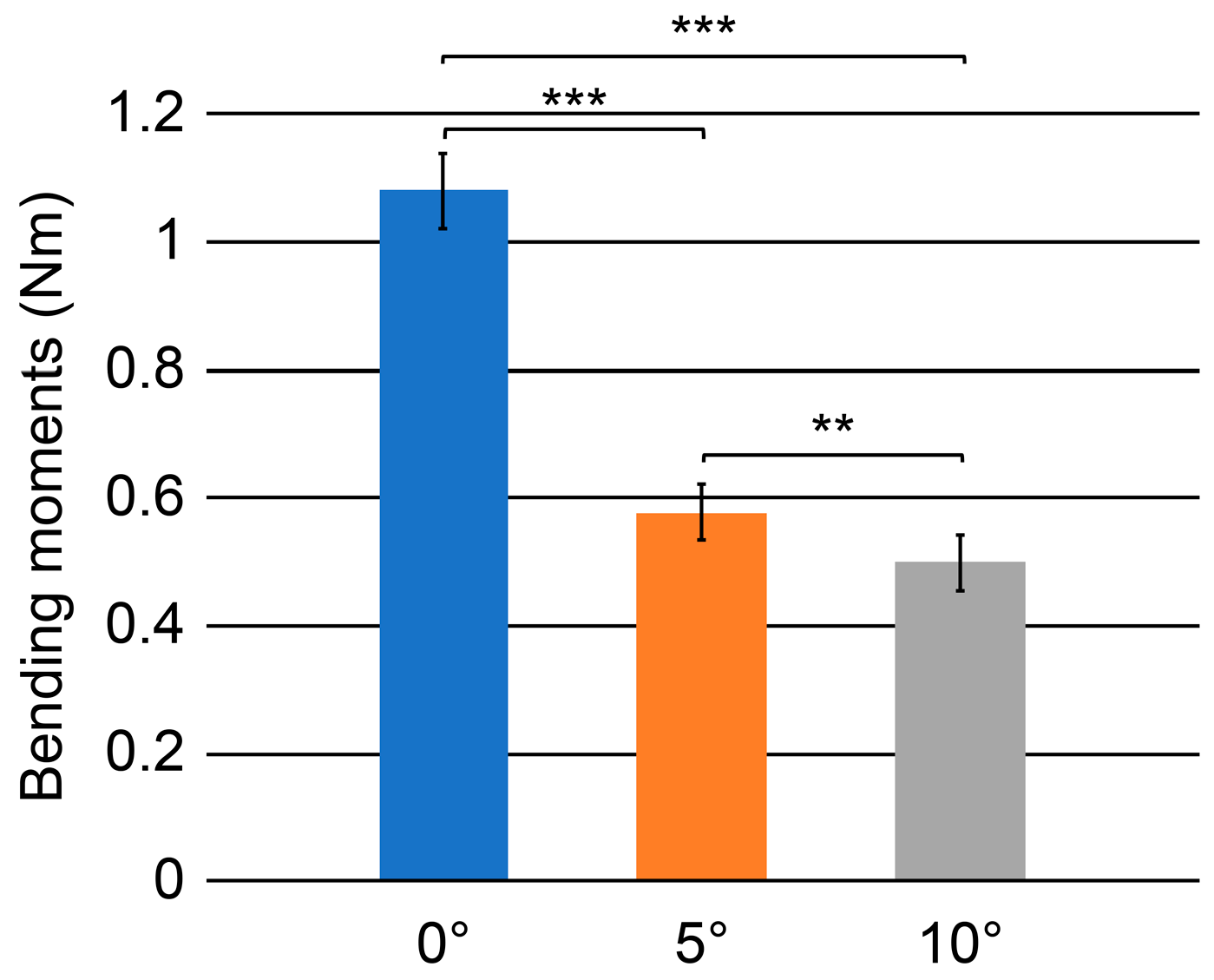
For each screw insertion angle, results were analyzed using plate-level average values derived from three independent plates. All statistical analyses were conducted with N = 3 plates as experimental units. The maximum bending moment at failure of the polyaxial locking mechanism decreased with increasing locking screw insertion angle, as shown in Figure 6. The plate-level average values for the insertion angles of 0°, 5°, and 10° were 1.079 ± 0.006 Nm (95% CI: 1.064–1.094 Nm; CV = 0.57%), 0.577 ± 0.009 Nm (95% CI: 0.554–0.601 Nm; CV = 1.64%), and 0.499 ± 0.027 Nm (95% CI: 0.456–0.542 Nm; CV = 5.40%), respectively. The strengths decreased by 47% and 54% at screw insertion angles of 0–5° and 0–10°, respectively. The main effect of the insertion angle was significant (p < 0.05). Post hoc Tukey’s tests revealed significant differences between all groups (0 vs. 5°, 0 vs. 10°, and 5 vs. 10°). The difference between the 0° and 10° groups showed an extremely large effect size (Cohen’s d = 29.6). Given the small sample size, Hedges’ g was also calculated, yielding a similarly large effect (g = 23.7).
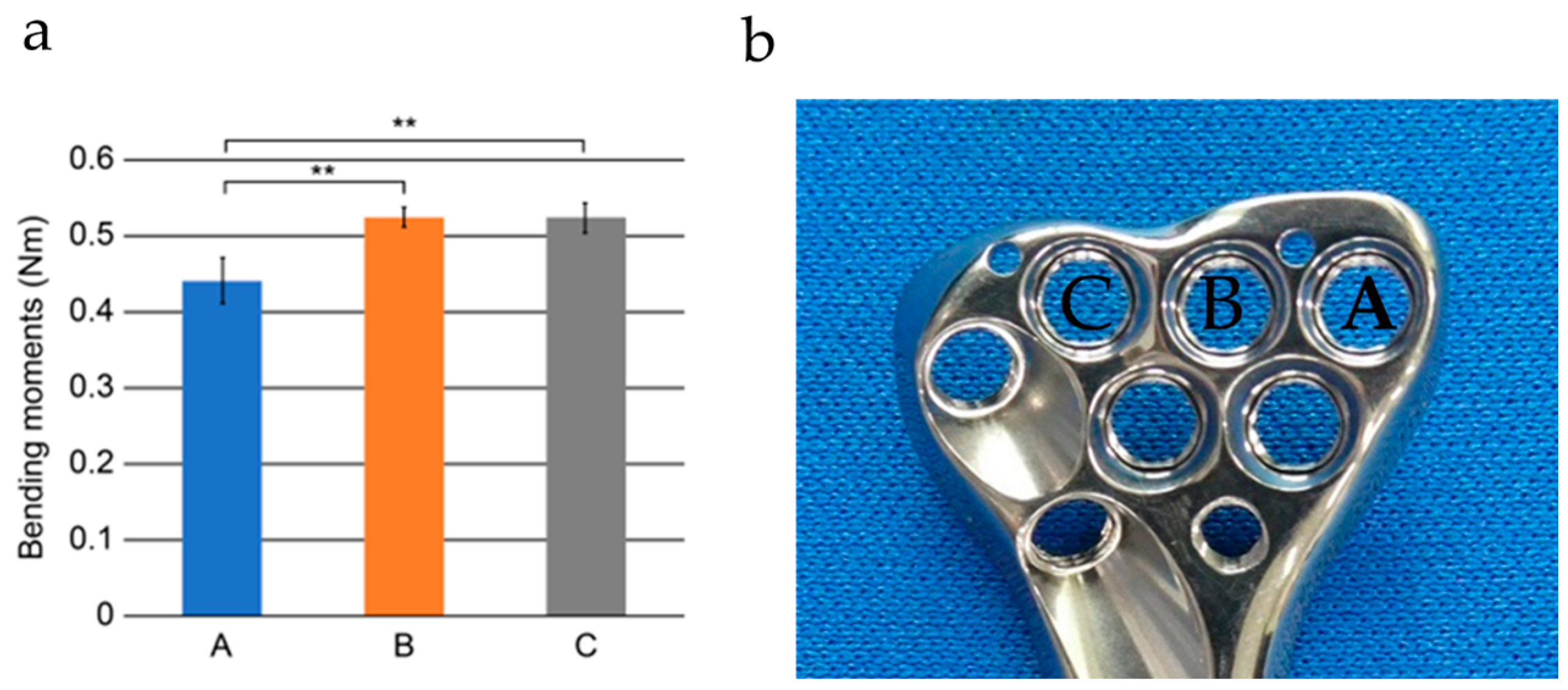
The maximum bending moments of the plate holes at a screw insertion angle of 10° are provided in Figure 7. The average maximum bending moments of the distal and most ulnar side holes of the plate were 0.44 Nm (range, 0.41–0.47 Nm). The mean maximum bending moments of the second and third ulnar holes were 0.52 Nm (range, 0.51–0.54 Nm) and 0.52 Nm (range, 0.50–0.54 Nm), respectively. The main effect of each hole was significant (p < 0.05). Post hoc Tukey’s tests confirmed significant differences between the hole at the most ulnar side hole and the second and third ulnar holes. The strength of the most ulnar side hole was lower than those of the other two.
The failure mechanism in all the tests was loosening of the locking screws.

4. Discussion

The maximum bending moment decreased with increasing locking screw insertion angle; it decreased by 47% and 54% for insertion angles of 0–5° and 0–10°, respectively. The comparison between the 0° and 10° groups demonstrated a marked reduction in maximum bending moment with increasing insertion angle, accompanied by an extremely large effect size (Cohen’s d = 29.6; Hedges’ g = 23.7). Although the calculated effect size was extremely large, this result should be interpreted with caution due to the small sample size and the very low variability within the 0° group, which may inflate standardized effect size measures. The ideal strength required to treat distal radius fractures is unknown. However, this study revealed that the strengths at 5° and 10° were lower than those reported in previous studies [11,12]. These studies primarily tested only one screw hole or changed the insertion angle of the screw for each screw hole [11,12]. Our study revealed that the strengths of the three screw holes in the most distal row were dependent on the screw hole used. The maximum bending moment of the most ulnar side screw hole was lower than those of the other two at a screw insertion angle of 10°. All failures resulted from loosening of the locking screws during the mechanical test.
From a surgical perspective, the present findings suggest that an increase in screw insertion angle is associated with a reduction in mechanical strength. Therefore, when using newly developed PLP, careful preoperative planning of plate positioning may be beneficial to minimize excessive screw angulation during fixation. This consideration may help preserve the mechanical stability of the plate–screw construct. Because stable locking was not consistently achieved at screw insertion angles exceeding 10° in preliminary testing, the present polyaxial locking plate is intended to be used within the manufacturer-recommended insertion range, and screw insertion beyond this angle should be avoided in clinical practice.
Although a marked reduction in maximum bending moment was observed at screw insertion angles of 5–10°, the clinical significance of this decrease should be interpreted with caution. At present, there is no established mechanical threshold derived from static testing that defines the minimum strength required to ensure adequate clinical stability of polyaxial locking screws, particularly in the absence of bone or fracture models. Therefore, the present findings do not allow definitive conclusions regarding clinical safety. Nevertheless, the observed reduction in mechanical strength with increasing insertion angle suggests a potential decrease in the mechanical margin of safety, which may become relevant under certain loading conditions. Further studies incorporating fracture models with simulated bone and cyclic loading protocols that reflect early postoperative rehabilitation are required to establish clinically meaningful safety criteria.
Hoffmeire et al. [11] reported decreases of 43% and 50% in the ultimate strengths at screw insertion angles of 0–10° and 0–20°, respectively, when using a Palmar 2.7 (Königsee Implantate und Instrumente zur Osteosynthese GmbH, Allendorf, Germany) plate. However, the fixation strength of some plates increases with the insertion angle [11,12]. This phenomenon is attributed to variations in locking mechanisms. Therefore, surgeons must understand the characteristics of the locking mechanisms of the plates. The polyaxial locking mechanisms available are primarily divided into point-loading thread-in, cut-in, locking cap, expansion bushing, and screw-head expansion types [16]. Schoch et al. [16] reported that the failure strength decreased with increasing screw insertion angle for the point-roading thread-in and cut-in designs. The ultimate strength of our new implant, which was made from a uniform titanium alloy, decreased with increasing locking screw insertion angle. Therefore, this locking mechanism can be classified as point-loading thread-in.
Hoffmeire et al. [11] evaluated the single polyaxial screw-plate interfaces of the Palmar 2.7 (point-roading thread-in), VariAXTM (Stryker Leibinger GmbH & Co. KG, Freiburg, Germany; cut-in), and ViperTM (Integra LifeSciences Corporation, Plainsboro, NJ, USA; screw-head expansion) implants at angulations of 0°, 10°, and 20°. The Palmar 2.7 implant interface had the highest ultimate strength at 0°. No failure of the polyaxial interface was observed due to screw breakage at a bending moment of 2.83 Nm. An interface with high ultimate strength is expected to break the screw without loosening it. Both the Palmar 2.7 and our newly developed PLP were classified as point-loading thread-in implants. However, all implants failed due to loosening of the locking screws in our study. The difference in the failure modes of the Palmar 2.7 and our newly developed PLP may be attributed to the larger contact area and friction between the screw and plate in the Palmar 2.7.
The thread lengths of the locking screw holes were standardized to 1 mm to ensure that they had the same strength. However, the maximum bending moments of most ulnar-side screw holes at a screw insertion angle of 10° were significantly lower than those of the other two. This could be due to the variation in the starting point of the internal thread from hole to hole, which significantly alters the contact area and friction between the locking screw and screw hole.

Limitations

This study has several limitations that should be considered when interpreting the results. First, mechanical testing was performed under simplified in vitro conditions without the use of bone stock. Consequently, the complex biomechanical environment of distal radius fractures—including bone quality, fracture configuration, and soft tissue constraints—was not fully reproduced.
Second, comparisons with plates from other manufacturers were not conducted, mainly because of difficulties in obtaining comparable products. Therefore, the present results describe the mechanical characteristics of the newly developed polyaxial locking mechanism rather than its relative performance against existing systems.
Third, the testing protocol was limited to monotonic static bending, and neither cyclic loading nor dynamic loads encountered during daily activities were considered. In addition, the minimum mechanical strength required for clinical stability in distal radius fracture fixation has not been established. Accordingly, the present findings should be regarded as reference data rather than direct evidence of clinical performance.
Furthermore, the lower mechanical strength observed at the most ulnar screw hole was hypothesized to be related to subtle differences in the starting point of the internal threads. However, this explanation remains speculative, as direct verification was beyond the scope of this study. Microstructural analyses using scanning electron microscopy and numerical simulations such as finite element modeling may help clarify the underlying failure mechanisms in future investigations.
Finally, this study was limited by a small sample size (N = 3 per group). Although this is consistent with prior exploratory mechanical studies, the statistical power to detect moderate differences was limited, and future studies with larger sample sizes, fracture models, and cyclic loading conditions are warranted to better bridge the gap between experimental findings and clinical application.


5. Conclusions

We developed a novel polyaxial locking technique involving clockwise and counterclockwise threads in the same screw hole. This biomechanical study revealed that the maximum bending moment decreases with increasing locking screw insertion angle. Therefore, our new polyaxial technique is classified as a point-loading thread-in. The strength of the most ulnar side hole at a screw insertion angle of 10° was lower than those of the other two holes. This may be attributable to slight differences in the starting point of the internal thread for each hole.

Author Contributions

K.Y.: Conceptualization, Methodology, Validation, Formal analysis, Investigation, Data Curation, Writing—Original Draft, Visualization, Funding acquisition. K.M.: Conceptualization, Methodology, Validation, Investigation, Writing—Review & Editing, Supervision, Project administration. Y.M.: Writing—Review & Editing, Supervision. T.Y.: Writing—Review & Editing, Supervision. H.H.: Writing—Review & Editing. H.K.: Writing—Review & Editing, Supervision. All authors have read and agreed to the published version of the manuscript.

Funding

This study was supported by Meira Corporation, Nagoya, Japan (300,000 JPY [approx. 2100 USD]).

Institutional Review Board Statement

Not applicable.

Informed Consent Statement

Not applicable.

Data Availability Statement

The data presented in this study are openly available in Zenodo at https://doi.org/10.5281/zenodo.17769482, [14].

Acknowledgments

All tested implants were provided by Meira Corporation. However, this involvement had no influence on study design, interpretation of data, or the writing of the manuscript. The authors declare that they do not have any personal relationship to this company. The authors thank Takaharu Ishii and Manabu Naoi of Meira Corporation for their research assistance.

Conflicts of Interest

The authors have no conflicts of interest other than those disclosed in the Funding section. The funders had no role in the design of the study; in the collection, analyses, or interpretation of data; in the writing of the manuscript; or in the decision to publish the results.

Abbreviations

The following abbreviations are used in this manuscript:
CIconfidence interval
CVcoefficient of variation
PLPpolyaxial locking plate

References

  1. Constantine, K.J.; Clawson, M.C.; Stern, P.J. Volar neutralization plate fixation of dorsally displaced distal radius fractures. Orthopedics 2002, 25, 125–128. [Google Scholar] [CrossRef] [PubMed]
  2. Downing, N.D.; Karantana, A. A revolution in the management of fractures of the distal radius. J. Bone Jt. Surg. Br. 2008, 90, 1271–1275. [Google Scholar] [CrossRef]
  3. Orbay, J. Volar plate fixation of distal radius fractures. Hand Clin. 2005, 21, 347–354. [Google Scholar] [CrossRef] [PubMed]
  4. Orbay, J.L.; Fernandez, D.L. Volar fixation for dorsally displaced fractures of the distal radius: A preliminary report. J. Hand Surg. Am. 2002, 27, 205–215. [Google Scholar] [CrossRef] [PubMed]
  5. Krukhaug, J.; Gjerdet, N.R.; Lundberg, O.J.; Lilleng, P.K.; Hove, L.M. Different osteosyntheses for Colles’ fracture: A mechanical study in 42 cadaver bones. Acta Orthop. 2009, 80, 239–244. [Google Scholar] [CrossRef] [PubMed]
  6. Liporace, F.A.; Kubiak, E.N.; Jeong, G.K.; Iesaka, K.; Egol, K.A.; Koval, K.J. A biomechanical comparison of two volar locked plates in a dorsally unstable distal radius fracture model. J. Trauma Acute Care Surg. 2006, 61, 668–672. [Google Scholar] [CrossRef] [PubMed]
  7. McCall, T.A.; Conrad, B.; Badman, B.; Wright, T. Volar versus dorsal fixed-angle fixation of dorsally unstable extra-articular distal radius fractures: A biomechanic study. J. Hand Surg. Am. 2007, 32, 806–812. [Google Scholar] [CrossRef] [PubMed]
  8. Gou, Q.; Xiong, X.; Cao, D.; He, Y.; Li, X. Volar locking plate versus external fixation for unstable distal radius fractures: A systematic review and meta-analysis based on randomized controlled trials. BMC Musculoskelet. Disord. 2021, 22, 433. [Google Scholar] [CrossRef] [PubMed]
  9. Verma, A.; Saroj, A.K.; Kumar, A.; Patel, U.; Prajwal, M.C. To assess the functional and radiological outcomes of intra-articular fractures of the distal end of the radius treated with open reduction and internal fixation using a volar locking plate. J. Bone Jt. Dis. 2023, 38, 18–23. [Google Scholar] [CrossRef]
  10. Abdel-Wahed, M.; Abdel-Zaher Khater, A.; El-Desouky, M.A. Volar locking plate fixation for distal radius fractures: Did variable-angle plates make a difference? Int. Orthop. 2022, 46, 2165–2176. [Google Scholar] [CrossRef]
  11. Hoffmeier, K.L.; Hofmann, G.O.; Mückley, T. The strength of polyaxial locking interfaces of distal radius plates. Clin. Biomech. 2009, 24, 637–641. [Google Scholar] [CrossRef]
  12. Mehling, I.; Scheifl, R.; Mehler, D.; Klitscher, D.; Hely, H.; Rommens, P.M. Are there any differences in various polyaxial locking systems? A mechanical study of different locking screws in multidirectional angular stable distal radius plates. Biomed. Tech. 2013, 58, 187–194. [Google Scholar] [CrossRef] [PubMed]
  13. Mohamed, M.F.; Emran, A.M.; Selim, O.A.; El Rosasy, M.A. Polyaxial locking plate in fractures of the distal radius. J. Adv. Med. Med. Res. 2020, 32, 79–88. [Google Scholar] [CrossRef]
  14. Yanabashi, K. Mechanical Strength Test Data of a Newly Developed Polyaxial Locking Mechanism for a Distal Radius Plate. (Version v1) [Dataset]; Zenodo: Geneva, Switzerland, 2025. [Google Scholar] [CrossRef]
  15. Kanda, Y. Investigation of the freely available easy-to-use software ‘EZR’ for medical statistics. Bone Marrow Transplant. 2013, 48, 452–458. [Google Scholar] [CrossRef]
  16. Schoch, B.; Hast, M.W.; Mehta, S.; Namdari, S. Not all polyaxial locking screw technologies are created equal: A systematic review of the literature. JBJS Rev. 2018, 6, e6. [Google Scholar] [CrossRef] [PubMed]
Figure 1. Dual Loc Radii VF system. (a) plate for distal radius (b) locking screw (c) Dual Loc Radii VF plate mounted on a synthetic radius model, provided as an alternative to a CAD image.
Biomechanics 06 00022 g001
Figure 2. Screw hole of the newly developed polyaxial locking mechanism. (a) Internal threads (red) in the screw hole. (b) Reverse internal threads (blue) in the screw hole. (c) Screw hole of the Dual Loc Radii VF system. The internal threads (shown in red) for the reverse internal threads (shown in blue) are indicated by the red lines combined with the blue lines.
Biomechanics 06 00022 g002
Figure 3. (a) Schematic illustration of the variable angle of the locking mechanism in the Dual Loc Radii VF system, showing the relationship between the plate and the locking screw. Locking is possible within the conical region where the angle between the screw hole axis and the screw insertion axis is 10°. (b) Schematic illustration of the screw head, highlighting the threaded surface responsible for the locking mechanism. The external thread on the screw head is tapered. The Dual Loc Radii VF system was designed using SOLIDWORKS 2022, AutoCAD 2020, and ZedView version 16.0.
Biomechanics 06 00022 g003
Figure 4. Guiding blocks for 10°. (a) Front view. (b) Lateral view. The guiding block (1), jig (2), and plate (3) are shown.
Biomechanics 06 00022 g004
Figure 5. Experimental setup for mechanical testing. (a) Photograph of the setup during testing. (b) Enlarged view of the area indicated in (a). (c) Corresponding schematic illustration of the enlarged region, showing the polyaxial locking mechanism (A, fixed end) and the tip of the screw (B, free end). The moment arm length (A–B) was 20 mm. The bending moment applied to the locking mechanism (Nm) was calculated as the load at the screw tip (N) multiplied by the moment arm (20 mm = 0.02 m).
Biomechanics 06 00022 g005
Figure 6. Average maximum bending moments at failure of the screws at each insertion angle. The bars indicate the average maximum bending moment in Nm for each screw insertion angle. The error bars represent the standard deviation. ** and *** indicate p < 0.01 and p < 0.001, respectively.
Biomechanics 06 00022 g006
Figure 7. Average bending moment at failure of each hole in the most distal row of the plate at a screw insertion angle of 10°. (a) Bar graph showing the maximum bending moments (Nm) for each screw hole. (b) Photograph of the most distal row of the plate indicating the screw hole positions. The bars in (a) represent the maximum bending moments (Nm) of the screw holes on the most ulnar side (A), second from the ulnar side (B), and third from the ulnar side (C). Error bars represent the standard deviation. ** indicates p < 0.01.
Biomechanics 06 00022 g007
Disclaimer/Publisher’s Note: The statements, opinions and data contained in all publications are solely those of the individual author(s) and contributor(s) and not of MDPI and/or the editor(s). MDPI and/or the editor(s) disclaim responsibility for any injury to people or property resulting from any ideas, methods, instructions or products referred to in the content.