Article

Dual-Channel TENG Probe for Pb2+ Detection in Drinking Water

1
Beijing Institute of Nanoenergy and Nanosystems, Chinese Academy of Sciences, Beijing 101400, China
2
School of Nanoscience and Engineering, University of Chinese Academy of Sciences, Beijing 100049, China
*
Authors to whom correspondence should be addressed.
These authors contributed equally to this work.
Nanoenergy Adv. 2026, 6(3), 22; https://doi.org/10.3390/nanoenergyadv6030022

Submission received: 8 June 2026 / Revised: 6 July 2026 / Accepted: 15 July 2026 / Published: 16 July 2026

Abstract

Lead-ion (Pb2+) contamination in drinking water poses a serious threat to public health, but conventional laboratory-based methods rely on bulky equipment and are unsuitable for on-site monitoring. Here, we develop a wireless monitoring system based on a dual-channel liquid–solid triboelectric nanogenerator probe (TENG probe) for detecting Pb2+ in drinking water. Based on the dynamic contact electrification at the liquid–solid interface, the sliding of a water droplet containing Pb2+ on the FEP surface is converted into an electrical signal for Pb2+ detection. A wireless acquisition circuit transmits the electrical signals via Wi-Fi to a computer, enabling remote and wireless detection. By integrating a one-dimensional convolutional neural network (1D CNN) deep learning model, the TENG probe achieved a detection accuracy of 99.62% and was capable of detecting Pb2+ in drinking water at the ppb level, exceeding the national standard. This work opens a way for safeguarding drinking-water quality.

1. Introduction

Ensuring the safety of drinking water is a core challenge in global public health [1]. With accelerated industrialization and urbanization, heavy metal contamination has become increasingly severe, posing a persistent threat to both ecosystems and human health [2]. Among various heavy metals, lead is of particular concern due to its high toxicity and environmental persistence [3]. Lead ions (Pb2+) can enter the human body through multiple pathways, including drinking-water sources and secondary contamination from supply pipes [4]. Even chronic exposure to extremely low concentrations can cause irreversible damage to the nervous and immune systems, as well as to liver and kidney function, and seriously affect the intellectual development and growth of children [5,6]. The World Health Organization has set a provisional guideline value of 10 μg/L for lead in drinking water [7]. Therefore, there is an urgent need to develop a simple, rapid, portable, and real-time detection technique for Pb2+ in drinking water.
Traditional detection methods for Pb2+ include spectrophotometry [8], electrochemical methods [9], and atomic absorption spectrometry [10]. Although these techniques offer low detection limits (for example, voltammetry [11] and atomic absorption spectrometry [12] achieve detection limits of 0.1 μg/L and 2 μg/L for Pb2+, respectively), most of them rely on bulky laboratory equipment, complex sample pretreatment, and external power supplies, making on-site and in situ rapid detection difficult. Optical methods [13], while feasible in conventional laboratories, have high requirements for environmental stability, involve complicated sample preparation, and are not easily adapted to portable applications. In recent years, the liquid–solid TENG, which operates based on the coupling of contact electrification and electrostatic induction at a liquid–solid interface, has emerged as a self-powered sensing technology with unique advantages in chemical sensing [14,15,16,17,18,19,20]. TENGs based on contact electrification at a liquid–solid interface can harvest mechanical energy from the contact process between a liquid and a solid surface and convert it directly into electrical signals without an external power supply. They also feature simple device structures, low cost, and in situ detection capability [21,22,23]. For example, the array liquid–solid TENG probe enables the identification of ten types of liquid foods without relying on an external power supply, and can further detect Pb2+ in white vinegar [24]. Also, there are more than 30 types of ions and organic molecules that can be successfully detected by triboelectric spectroscopy, including common toxic heavy metal ions, such as Cr6+, Ni2+, and Mn2+ [19]. In addition, a triboelectric sensor driven by water droplets containing an air cavity was developed to achieve rapid response through instantaneous electron transfer at the liquid–solid interface, eliminating the need for gas adsorption and desorption on the surface of solid-sensing materials [25]. By integrating deep learning algorithms, such triboelectric sensors can achieve an ammonia detection accuracy of 96.2%. These advances fully demonstrate that TENG probe offers a self-powered, low-cost, and in situ intelligent solution for Pb2+ sensing in real environmental water samples, such as drinking water [26].
In this work, we design and fabricate a dual-channel TENG probe for the identification of Pb2+ concentrations in drinking-water. The TENG probe exploits the differences in solid–liquid interfacial charge transfer behaviour between water samples containing various concentrations of Pb2+ and the triboelectric solid film, generating distinct triboelectric signals. Furthermore, by integrating the TENG probe with a one-dimensional convolutional neural network (1D CNN) deep learning algorithm for automatic feature extraction and classification, we achieve high-accuracy recognition of Pb2+ concentrations in drinking water, including multiple concentration levels around the World Health Organization guideline value of 10 μg/L. The recognition accuracy reaches 99.62%. Compared with conventional methods that require complex sample pretreatment and bulky instrumentation, the “self-powered sensing + deep learning” synergistic strategy developed here not only overcomes the technical bottleneck of in situ Pb2+ detection but also establishes a new paradigm for intelligent drinking water safety monitoring. This work holds promise for future integration into portable and Internet-of-Things (IoT) water-quality monitoring devices, facilitating the development of intelligent, distributed early-warning systems for drinking-water safety.

2. Materials and Methods

2.1. Materials

Fluorinated ethylene propylene (FEP) film (30 μm) was purchased from Daikin of Japan. We purchased 1 ppb, 10 ppb, 30 ppb, 50 ppb, 70 ppb and 100 ppb Pb2+ solutions from Codow (Guangzhou Howei Pharma Tech Co., Ltd., Guangzhou, China).

2.2. Fabrication of a Dual-Channel TENG Probe

The dual-channel TENG probe consists of PMMA as the supporting substrate, copper electrodes, and a FEP film. The fabrication process involves selecting a 100 mm × 150 mm × 3 mm acrylic sheet, attaching two 1 cm wide copper electrodes onto it—positioning the first electrode 4 cm from the top edge of the acrylic sheet with a 5 cm spacing between the two electrodes—and finally covering the copper electrodes with a 30 μm thick FEP film, thereby completing the dual-channel TENG probe.

2.3. Measurement of the Electrical Signal

All the tests were conducted under room temperature and a relative humidity of approximately 30%, and the size of the droplets used was 60 μL. The output voltages of the dual-channel TENG probe were measured by a custom wireless voltage acquisition circuit board, and the obtained dual-channel voltage signals were sent via Wi-Fi to a computer for display and storage.

3. Results

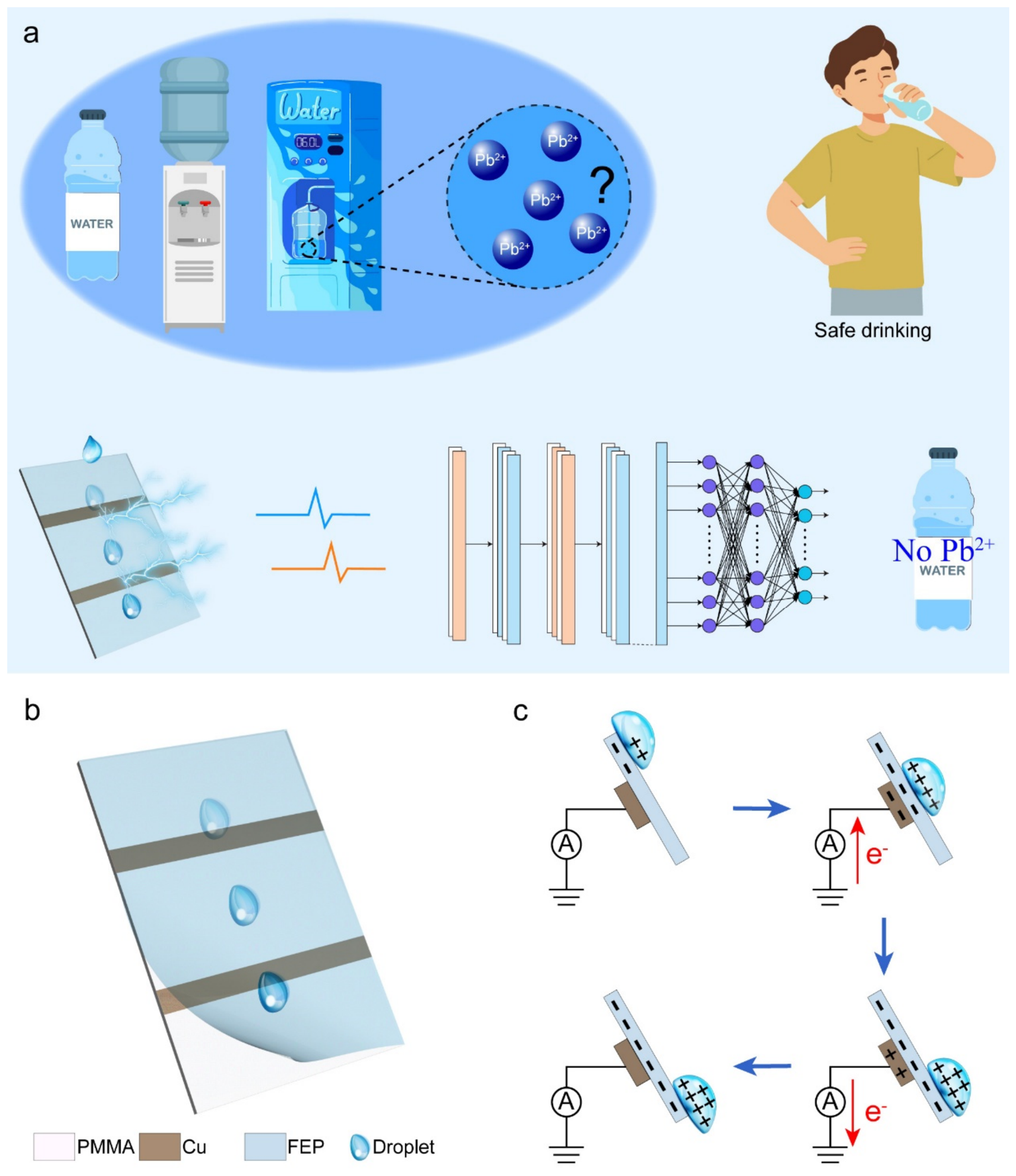
Figure 1a illustrates a detection system for Pb2+ in drinking water based on a dual-channel TENG probe. The TENG probe consists of two independent Cu electrodes and a wireless voltage signal acquisition circuit board. When a droplet of drinking water containing Pb2+ slides across the FEP film, the triboelectric output voltage signals from both channels (electrodes) are measured by the wireless acquisition circuit board and then fed into a deep learning network, which identifies the Pb2+ concentration in the droplet. If the Pb2+ concentration is below the World Health Organization guideline value of 10 ppb, the water is considered safe for consumption. The detailed structural composition of the dual-channel TENG probe is shown in Figure 1b. A polymethyl methacrylate (PMMA) substrate is used as the support, on which two Cu electrodes (each 1 cm wide) are attached. Above the Cu electrodes lies a 30 μm thick FEP film serving as the negative triboelectric layer. The mechanism of contact electrification between a moving droplet containing Pb2+ and the FEP film is depicted in Figure 1c. As the droplet containing Pb2+ slides on the FEP surface, electrons are first transferred to the FEP due to its strong electronegativity, leaving the FEP negatively charged and the droplet positively charged. During this process, H2O+ is generated (H2O − e → H2O+), and owing to its extremely short lifetime (less than 50 fs) [27], H2O+ rapidly reacts with a neighbouring H2O to form an OH radical and H3O+ (H2O+ + H2O → OH + H3O+). When the liquid droplet initially contacts the FEP film above the Cu electrode, an induced contact voltage (VC) is measured by an electrometer. Upon separation from the FEP surface, another induced separate voltage (VS) is likewise detected.
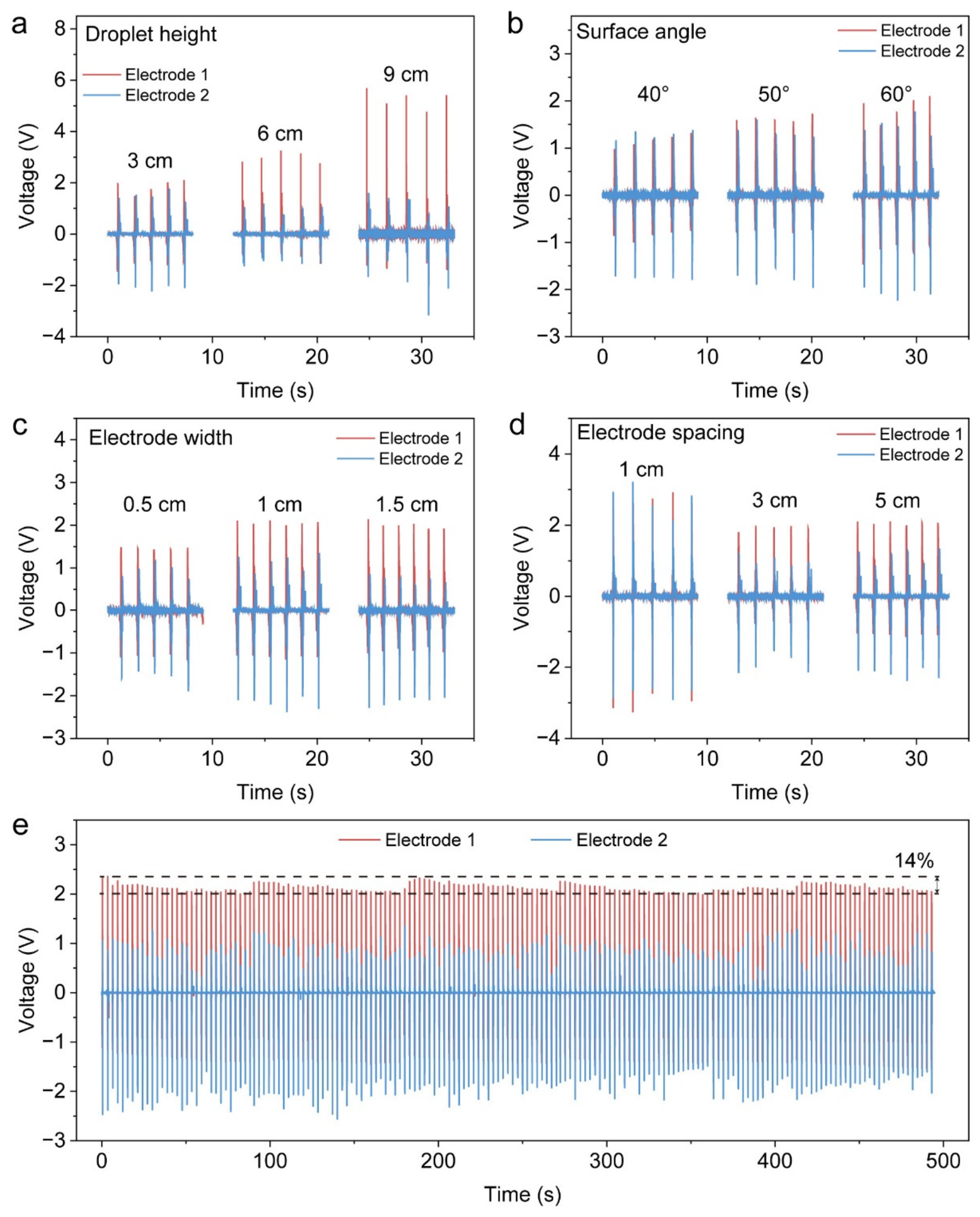
The stability of the output voltage of the dual-channel TENG probe is essential for accurate detection of Pb2+ in drinking water. Here, we systematically investigate the influence of various parameters on the output performance of the dual-channel TENG probe, including droplet release height, inclination angle of the probe, electrode width, and electrode spacing. We also evaluate the stability of the output performance. As shown in Figure 2a, as the droplet release height increases from 3 cm to 9 cm, the output voltage rises from 1.86 V to 5.27 V. This is because a greater release height imparts larger gravitational potential energy to the droplet, increasing its sliding velocity on the FEP surface of the dual-channel TENG probe and thereby enhancing the output voltage [28]. Increasing the inclination angle of the probe also raises the output voltage. Figure 2b shows that as the inclination angle increases from 40° to 60°, the output voltage increases from 1.15 V to 1.86 V. We further explore the effect of electrode geometry, including electrode width and spacing. Three dual-channel TENG probes are fabricated with electrode widths of 0.5 cm, 1 cm, and 1.5 cm and their optical images are shown in Figure S1a. The results (Figure 2c) indicate that as the electrode width increases from 0.5 cm to 1.5 cm, the output voltage first increases and then decreases, with the maximum output voltage of 2.1 V achieved at a width of 1 cm. Our previous work suggests that a small electrode spacing leads to crosstalk between electrodes. Therefore, we fabricate three dual-channel TENG probes with different electrode spacings (optical images in Figure S1b). The results (Figure 2d) show that the output voltage of the second electrode decreases with increasing electrode spacing, which is attributed to reduced signal interference (details in Figure S2). Finally, the output stability of the dual-channel TENG probe is also evaluated. As shown in Figure 2e, over more than 200 droplet tests, the voltage fluctuation of the first electrode is within 14%, demonstrating good output stability of the dual-channel TENG probe.
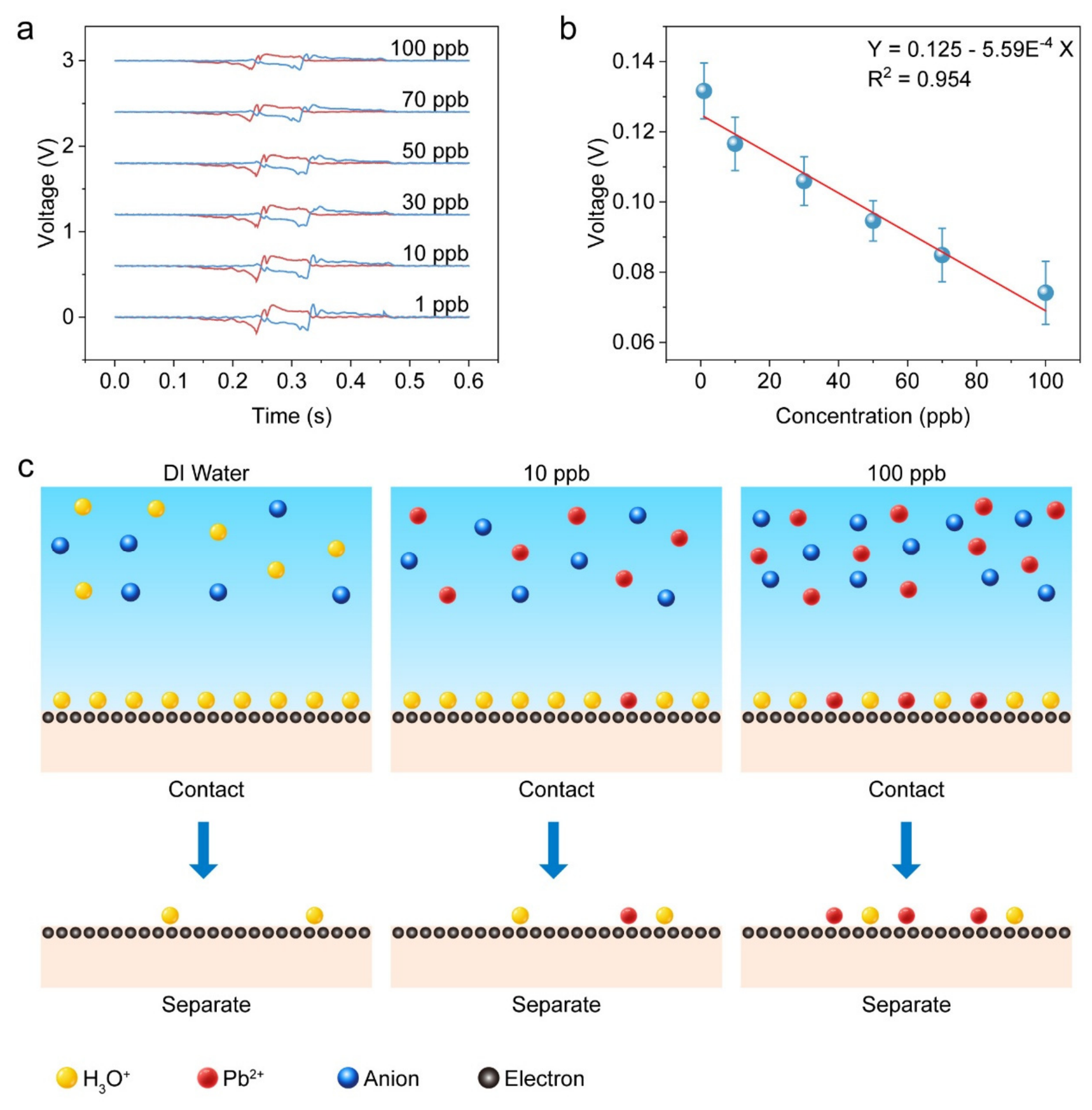
The World Health Organization has set a safe guideline value of ≤10 μg/L (≤10 ppb) for Pb2+ in drinking water. To evaluate the ability of the dual-channel TENG probe to detect Pb2+ in drinking water, we use six standard solutions of Pb2+ at concentrations of 1 ppb, 10 ppb, 30 ppb, 50 ppb, 70 ppb and 100 ppb. Figure 3a shows the output voltages of the dual-channel TENG probe for these different concentrations of Pb2+ solutions. As the Pb2+ concentration increases, the output voltage on both electrodes gradually decreases. For each concentration, we perform up to 200 independent measurements and calculate the mean and standard deviation of the peak voltage of the first electrode; the results are presented in Figure 3b. At a Pb2+ concentration of 1 ppb, the peak voltage of the first electrode is 0.132 V. As the concentration increases, the peak voltage decreases linearly, reaching 0.074 V at 100 ppb. We analysed the mechanism underlying this decrease in peak voltage with increasing Pb2+ concentration, as illustrated in Figure 3c. When a water droplet contacts the FEP surface, electrons are first transferred from water molecules to the FEP owing to its strong electron affinity, leaving the FEP negatively charged and the droplet positively charged (generating H3O+). Subsequently, cations in the droplet, including H3O+ and Pb2+, are electrostatically adsorbed onto the negatively charged FEP surface. In this way, the net charge generated reflects the difference between electron transfer and residual ion adsorption. Therefore, when the Pb2+ concentration in the solution increases from 1 ppb to 100 ppb, the higher concentration of high-valency Pb2+ is prone to highly adsorb on the negatively charged FEP surface and provide a stronger electron-shielding effect on the FEP surface. This mechanism should be considered a plausible and consistent interpretation of the experimental results. Consequently, the amplitude of the induced charge decreases, manifesting as a progressive reduction in the measured output voltage.
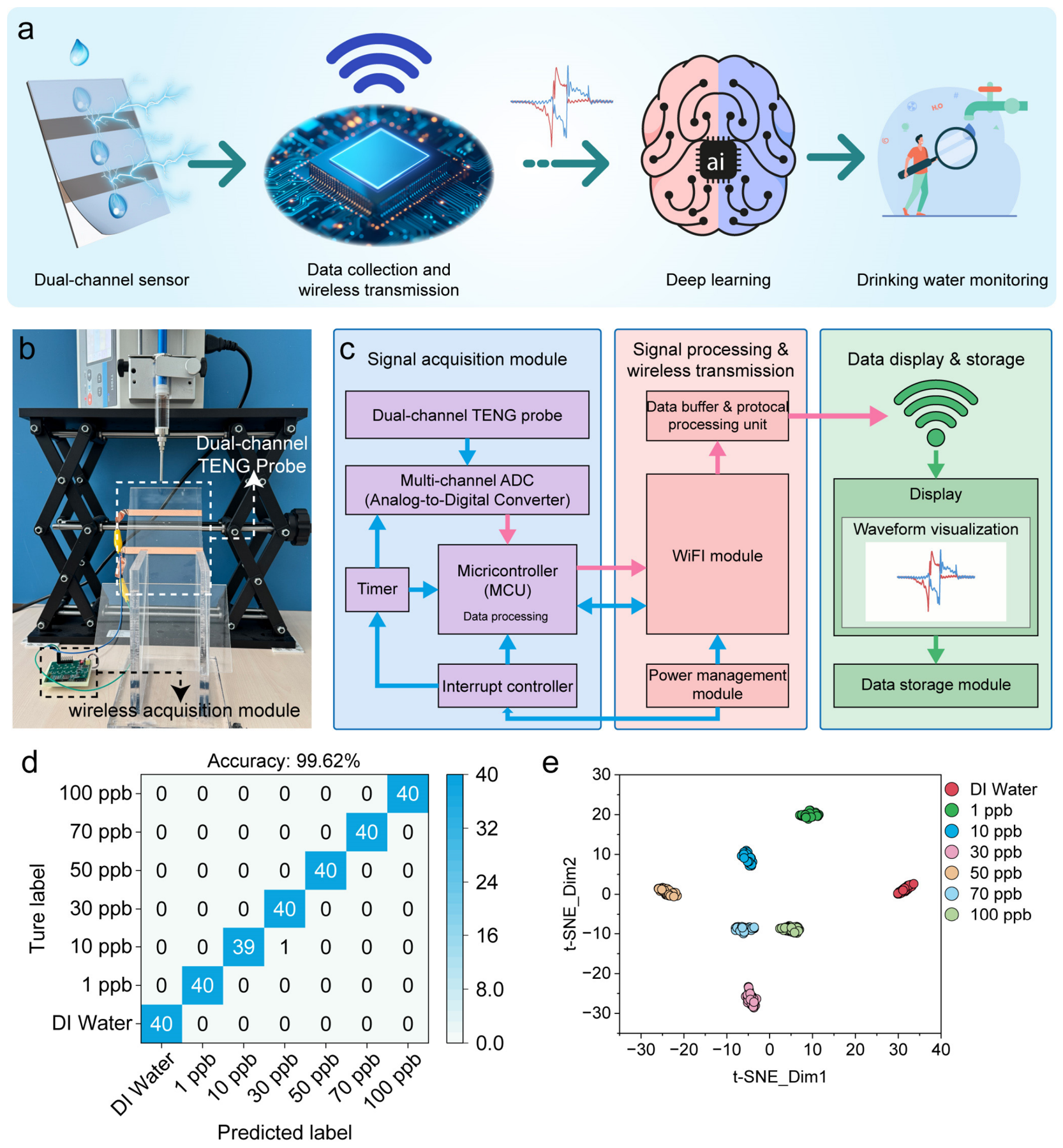
Globally, approximately 8 billion people consume about 120 billion litres of drinking water daily. According to the World Health Organization estimates, 240 million people are exposed to unsafe levels of toxic lead in their drinking water. Therefore, installing convenient Pb2+ detection sensors at water sources or in households, combined with wireless sensing and artificial intelligence for rapid water analysis, could better safeguard drink water safety. The entire workflow for Pb2+ concentration detection in drinking water is illustrated in Figure 4a. The dual-channel TENG probe is connected to a wireless acquisition module, and the collected dual-channel voltage signals are transmitted via a Wi-Fi module to a computer, where deep learning identifies the Pb2+ concentration in the drinking water. A photograph of the physical setup is shown in Figure 4b. The dual-channel TENG probe and the wireless acquisition module are integrated into a single platform for Pb2+ detection in drinking water. When a droplet of drinking water is released downwards, the electrical signals generated by the dual-channel TENG probe enter the analogue-to-digital converter (ADC) module of the wireless voltage signal acquisition unit. The ADC converts the dual-channel analogue signals into digital signals for processing by the central processing unit. Finally, the Wi-Fi module transmits the processed digital signals in real time to a smart display device (Figure 4c) while also saving the raw data.
A one-dimensional convolutional neural network (1D CNN) model is then used to further analyze the data signals transmitted to the smart display device, enhancing Pb2+ concentration recognition. The architecture of the model, shown in Figure S3, consists of four convolutional layers, an expand layer, two fully connected layers and an output layer. It can automatically learn and extract high-discrimination deep features directly from the raw, complex time-series triboelectric signals, ultimately enabling accurate determination of Pb2+ concentration. The overall process can be divided into data acquisition, data pre-processing, model training and solution recognition. For each Pb2+ concentration, 200 independent tests are performed. A total dataset of 1400 labelled samples is obtained for DI water and six different Pb2+ solutions. Of these, 80% (1120 samples) are used for model training and 20% (280 samples) for recognition. As the number of training epochs increases, the model exhibits very low training and test losses and very high training and test accuracies (Figure S4), indicating stable convergence during training. With the assistance of the 1D CNN, the dual-channel LS-TENG probe can accurately identify DI water and the six Pb2+ solutions, achieving a recognition accuracy of 99.62% (Figure 4d). Furthermore, we compare the performance of long short-term memory (LSTM) and gated recurrent unit (GRU) models (Figure S5). The results show that the LSTM model achieves an accuracy of 97.14% and the GRU model 97.50%; their confusion matrices are presented in Figure S6. We further use the 1D CNN model to extract high-dimensional features from the data and visualize them using the t-distributed stochastic neighbour embedding (t-SNE) algorithm to better understand and illustrate the clustering of different solutions. This approach aims to minimize the intra-class distances while maximizing the inter-class centre distances. As shown in Figure 4e, the seven solution samples form clear and orderly clusters, perfectly corresponding to the 99.62% recognition rate.

4. Conclusions

In summary, we have designed and fabricated a dual-channel TENG probe for the recognition of Pb2+ concentrations in drinking water. This TENG probe leverages the differences in solid–liquid interface contact electrification behaviour between water samples containing varying concentrations of lead ions and the triboelectric solid material, generating highly distinguishable triboelectric signals. These signals are collected by a wireless voltage signal acquisition module and transmitted remotely via a Wi-Fi module for display and data storage. By integrating a one-dimensional convolutional neural network (1D CNN) deep learning algorithm, the TENG probe automatically extracts and classifies signal features, achieving high-precision recognition of Pb2+ concentrations, including multiple concentration levels around the World Health Organization safety threshold of 10 μg/L with an ultrahigh accuracy of 99.62%. The synergistic “self-powered sensing + deep learning” strategy established in this work not only overcomes the technical bottleneck of in situ Pb2+ detection but also offers a new paradigm for intelligent drinking-water safety monitoring. This achievement holds promise for future integration into portable and IoT-based water-quality monitoring devices, advancing the development of intelligent, distributed early warning systems for drinking-water safety. Moreover, increasing the number of sensing electrodes may further improve the capability of the liquid–solid TENG sensor to differentiate diverse metal ions. Future work will also evaluate the robustness of the 1D CNN model under slight variations in droplet release height and probe inclination, thereby further improving the reliability of the liquid–solid TENG platform for portable applications.

Supplementary Materials

The following supporting information can be downloaded at: https://www.mdpi.com/article/10.3390/nanoenergyadv6030022/s1, Figure S1. The physical images of the dual-channel TENG probe with different electrode widths (a) and different electrode spacings (b). Figure S2. Signal interference under different electrode spacings. (a) When the electrode spacing is 1 cm, the second electrode generates an opposite-directional induced signal. (b) When the electrode spacing was 5 cm, the second electrode did not generate an opposite-directional induced signal. Figure S3. The structure diagram of the 1D CNN deep learning model. Figure S4. The training and test loss curves during the deep learning training process (a) and the training and test accuracy curves (b). Figure S5. Comparison of recognition accuracy rates of three algorithm models: 1D CNN, LSTM and GRU. Figure S6. The LSTM (a) and GRU (b) algorithm mode.

Author Contributions

G.G.: methodology, validation, formal analysis, writing—original draft. J.Z.: conceptualization, writing—review and editing, visualization. Q.L.: validation. H.G.: validation. G.G.: validation. Z.L.W.: project administration. All authors have read and agreed to the published version of the manuscript.

Funding

This research was funded by National Natural Science Foundation of China (Grant No. 22576017), and the National Key R&D Project from Minister of Science and Technology (2021YFA1201601).

Data Availability Statement

The data that support the findings of this study are available from the corresponding authors upon reasonable request.

Conflicts of Interest

The authors declare no conflicts of interest.

References

  1. Neverre, N.; Herman, J.D.; Schorpp, L.; Lanini, S.; Pulido-Velazquez, M.; Caballero, Y. Balancing drinking water security and conservation: A spatial multi objective optimization framework for regional groundwater management under global change. J. Hydrol. 2026, 668, 134950. [Google Scholar] [CrossRef]
  2. Liu, S.; Sun, Q.; Xu, N.; Wang, Y.; Li, Y.; Li, J.; Li, Z.; Rajput, V.D.; Minkina, T.; Kong, X.; et al. Recent advances in the treatment of heavy/precious metal pollution, resource recovery and reutilization: Progress and perspective. Coord. Chem. Rev. 2025, 523, 216268. [Google Scholar] [CrossRef]
  3. Chen, M.; Gazze, L.; DiTraglia, F.J.; Das, R.; Nriagu, J.; Erel, Y.; Boyle, E.A.; Taylor, C.M.; Weiss, D. Environmental lead risk in the 21st century. Commun. Earth Environ. 2025, 6, 776. [Google Scholar] [CrossRef] [PubMed]
  4. Triantafyllidou, S.; Burkhardt, J.; Tully, J.; Cahalan, K.; DeSantis, M.; Lytle, D.; Schock, M. Variability and sampling of lead (Pb) in drinking water: Assessing potential human exposure depends on the sampling protocol. Environ. Int. 2021, 146, 106259. [Google Scholar] [CrossRef] [PubMed]
  5. Bair, E.C. A narrative review of toxic heavy metal content of infant and toddler foods and evaluation of United States policy. Front. Nutr. 2022, 9, 919913. [Google Scholar] [CrossRef] [PubMed]
  6. Manna, K.; Debnath, B.; Singh, W. Sources and toxicological effects of lead on human health. Indian J. Med. Spec. 2019, 10, 66–71. [Google Scholar] [CrossRef]
  7. Guidelines for Drinking-Water Quality. Available online: https://www.who.int/publications/i/item/9789241549950 (accessed on 26 May 2026).
  8. Mohammed, G.I.; Nassar, S.; Farghaly, T.A. Spectrophotometric method for detecting lead (II) ions using a chemosensor of the thiosemicarbazone-linked phenyl sulphone moiety. Results Chem. 2025, 15, 102174. [Google Scholar] [CrossRef]
  9. Akbari, Z.; Abid, K.; Iannazzo, D.; Montazerozohori, M.; Neri, G. Novel gold nanoparticles Schiff base electrochemical sensor for the determination of lead (II) ions in biological samples. Bioelectrochemistry 2025, 163, 108886. [Google Scholar] [CrossRef] [PubMed]
  10. Nemček, L.; Hagarová, I. Quantification of ultra trace lead in water after preconcentration on nano titanium oxide using the slurry sampling ETAAS method. Toxics 2025, 13, 610. [Google Scholar] [CrossRef] [PubMed]
  11. Kiliç, H.D.; Kizil, H. Simultaneous analysis of Pb2+ and Cd2+ at graphene/bismuth nanocomposite film modified pencil graphite electrode using square wave anodic stripping voltammetry. Anal. Bioanal. Chem. 2019, 411, 8113–8121. [Google Scholar] [CrossRef] [PubMed]
  12. Van Beik, J.; Fontana, K.B.; Medeiros, D.C.C.S.; Sydney, A.C.N.; Chaves, E.S. Feasibility of calcium alginate beads to preconcentrate lead in river water samples prior to determination by flame atomic absorption spectrometry. Environ. Monit. Assess. 2021, 193, 666. [Google Scholar] [CrossRef] [PubMed]
  13. Su, R.; Li, Z.; Yang, C.; Li, Y.; Wang, J.; Sun, C. Fluorescent aptasensors for sensitive detection of lead ions based on structure switching DNA beacon probe and exonuclease I mediated signal amplification. Spectrochim. Acta A Mol. Biomol. Spectrosc. 2024, 320, 124643. [Google Scholar] [CrossRef] [PubMed]
  14. Kaswan, K.; Khan, A.; Chatterjee, S.; Ray, M.; Haji, H.S.; Joshi, R.; Pal, A.; Wang, T.S.; Chu, J.P.; Lin, Z.H. Glassy metallic nanotube arrays based solid liquid triboelectric nanosensor for wastewater contaminants sensing and its treatment by thermocatalysts. Adv. Funct. Mater. 2025, 36, e26347. [Google Scholar] [CrossRef]
  15. Liu, X.; Zhang, J.; Wang, X.; Lin, S.; Wang, Z.L. Charge accumulation kinetics at a liquid–solid interface depend on liquid chemistry. J. Mater. Chem. A 2023, 11, 18964–18971. [Google Scholar] [CrossRef]
  16. Zhang, J.; Gu, G.; Liu, Q.; Wang, Z.L. Triboelectric nanogenerator as a probe for investigating charge transfer at liquid–solid interfaces. Chem. Rev. 2026, 126, 5490–5517. [Google Scholar] [CrossRef]
  17. Zhang, J.; Lin, S.; Wang, Z.L. Electrostatic charges regulate chemiluminescence by electron transfer at the liquid–solid interface. J. Phys. Chem. B 2022, 126, 2754–2760. [Google Scholar] [CrossRef]
  18. Zhang, J.; Wang, X.; Wu, N.; Gu, G.; Wang, Z.L. Time resolved mapping of interface charge transfer for real time observation of microscopic chemical reactions. Angew. Chem. Int. Ed. 2026, 65, e1249028. [Google Scholar] [CrossRef]
  19. Zhang, J.; Wang, X.; Zhang, L.; Lin, S.; Ciampi, S.; Wang, Z.L. Triboelectric spectroscopy for in situ chemical analysis of liquids. J. Am. Chem. Soc. 2024, 146, 6125–6133. [Google Scholar] [CrossRef] [PubMed]
  20. Zhang, J.; Wu, C.; Mo, X.; Hu, B.; Wang, Z.L. Triboelectric nanogenerators as a probe for studying charge transfer at liquid–solid interface. MRS Bull. 2025, 50, 327–335. [Google Scholar] [CrossRef]
  21. Sun, J.; Kong, W.; Wang, X.; Lin, Z.; Zhang, L.; Nie, S. Tailoring Structural Uniformity of Cellulosic Triboelectric Aerogel Enabled by Pre-Nucleation-Controlled Synthesis. Adv. Funct. Mater. 2025, 36, e17042. [Google Scholar] [CrossRef]
  22. Tao, X.; Wang, T.; Tan, L.; Xu, F.; Chen, A.; Yang, Y.; Zhang, R.; Wang, X. High-Performance Constant Current Triboelectric Nanogenerator for Wind Energy Harvesting and Air Purification. SmartSys 2026, 1, e70012. [Google Scholar]
  23. Wang, X.; Kong, W.; Wu, H.; Zhao, J.; Lin, Z.; Sun, J. Cavitation-Tailored Cellulosic Triboelectric Aerogels via Dynamic Freeze-Casting for Stable Formaldehyde Monitoring. Nano Lett. 2025, 25, 15585–15593. [Google Scholar] [CrossRef] [PubMed]
  24. Gu, G.; Wang, X.; Zhang, J.; Wang, Z.L. Interface charge transfer mapping for in situ monitoring of contamination in liquid food. Small 2025, 21, e05761. [Google Scholar] [CrossRef] [PubMed]
  25. Liu, T.; Li, X.; He, H.; Yu, K.; Zhang, S.; Ye, Z.; Cui, X.; Luo, B.; Liu, Y.; Chi, M.; et al. Bioinspired triboelectric droplet sensor for ammonia monitoring. Nat. Commun. 2026, 17, 2153. [Google Scholar] [CrossRef] [PubMed]
  26. Sharma, M.K.; Lin, Y.-J.; Lin, C.K.; Nahak, B.K.; Huang, C.-J.; Chen, C.C.; Wang, Y.-L.; Lin, Z.-H. Self-powered AlGaN/GaN HEMT-based sensor integrated with rotational TENG for comprehensive water quality analysis. Nano Energy 2025, 135, 110637. [Google Scholar] [CrossRef]
  27. Gauduel, Y.; Pommeret, S.; Migus, A.; Antonetti, A. Some evidence of ultrafast H2O+ water molecule reaction in femtosecond photoionization of pure liquid water: Influence on geminate pair recombination dynamics. Chem. Phys. 1990, 149, 1–10. [Google Scholar] [CrossRef]
  28. Wang, X.; Zhang, J.; Liu, X.; Lin, S.; Wang, Z.L. Studying the droplet sliding velocity and charge transfer at a liquid–solid interface. J. Mater. Chem. A 2023, 11, 5696–5702. [Google Scholar] [CrossRef]
Figure 1. Dual-channel TENG probe for application in the detection of lead ions in water. (a) Dual-channel TENG probe for illustrating the application of water lead-ion detection. (b) The structural diagram of the dual-channel TENG probe. (c) The contact electrification process of the dual-channel TENG probe.
Nanoenergyadv 06 00022 g001
Figure 2. Effects of droplet impact conditions and electrode configurations on output performance and stability. (a) Influence of droplet impact height on output voltage. (b) Effect of droplet sliding angle on output voltage. (c) The influence of electrode width on output voltage. (d) Effect of electrode spacing on output voltage. (e) Output stability of the dual-channel TENG probe.
Nanoenergyadv 06 00022 g002
Figure 3. Mechanism of Pb2+ concentration detection. (a) The output voltage of the dual-channel TENG probe for different Pb2+ concentrations. (b) The output voltage of the dual-channel TENG probe decreases linearly as the Pb2+ concentration increases. (c) The mechanism corresponding to different Pb2+ concentrations detected by the dual-channel TENG probe.
Nanoenergyadv 06 00022 g003
Figure 4. Design and application demonstration of the Pb2+ detection platform for drinking water. (a) Technical framework of the Pb2+ detection platform for drinking water. (b) Physical diagram of the Pb2+ detection platform for drinking water. (c) Schematic diagram of wireless connection signal transmission between the dual-channel TENG probe and the intelligent display device. (d) Confusion matrix of Pb2+ concentration identification results. (e) Cluster diagram of Pb2+ concentration identification results.
Nanoenergyadv 06 00022 g004
Disclaimer/Publisher’s Note: The statements, opinions and data contained in all publications are solely those of the individual author(s) and contributor(s) and not of MDPI and/or the editor(s). MDPI and/or the editor(s) disclaim responsibility for any injury to people or property resulting from any ideas, methods, instructions or products referred to in the content.