


Abstract
In this study, an electrochemical system for methane conversion was developed, employing Ni- and Ce-doped LaCoO3 perovskite as the anode catalyst in an Na2CO3 electrolyte. Structural characterization revealed that the La1−yCeyCo1−xNixO3 (x = 0–0.5, y = 0–0.12) synthesized by the sol–gel method maintains the perovskite structure, but is rich in oxygen vacancies. Electrochemical studies revealed that the performance of methane activation is related to the presence of Ni(III) in the catalyst, and reactive oxygen species (•OH and HOO−) are provided through water oxidation reactions (WOR) in the Na2CO3 electrolyte. The electrocatalytic performance of the synthesized La0.92Ce0.08Co0.5Ni0.5O3 during methane conversion was verified in an electrolysis cell, and ethanol and acetic acid were identified as the methane conversion oxygenates. Under ambient conditions, the formation rate of ethanol reached 577.0 μmol gcat−1 h−1 at 0.90 V (vs. Ag/AgCl) in 0.5 mol L−1 Na2CO3. The catalyst was found to retain structural integrity and sustain catalytic activity over multiple reaction cycles.
1. Introduction
Methane (CH4), the main component of natural gas and shale gas, is regarded as a greenhouse gas with a global warming potential (GWP) more than 25 times that of CO2 [1,2,3]. Nowadays, it is a policy requirement to develop technical proposals for the capture and conversion of methane released from oilfields and petrochemical plant sites under ambient conditions [4]. However, methane possesses much greater chemical stability than methanol, and the thermodynamically favorable products of methane oxidation reactions are CO2 and H2O rather than the oxygenates. The mainstream process for converting methane to methanol is therefore achieved through a two-stage procedure: steam reforming of methane followed by Fischer–Tropsch synthesis [5,6,7].
Inspired by the methane monooxygenase found in methane-oxidizing bacteria, researchers have developed various mild-condition methane conversion systems in the field of enzymatic catalysis, photocatalysis, and electrocatalysis [8,9,10,11]. The electrocatalytic system has the potential for application in renewable electricity sources (such as solar energy), making it possible to collect and convert methane in remote environments like oil fields [12,13]. Studies have demonstrated that the design of electrocatalytic methane conversion systems necessitates two critical strategies: methane activation is realized through chemisorption of CH4 molecules at defined active sites on the catalyst, which facilitates C-H bond elongation [14]; then the activated CH4 molecules are attacked by reactive oxygen species (ROS) to transform to oxygenates, and the ROS, such as superoxide radicals (•O2−), hydrogen peroxide (H2O2), and hydroxyl radicals (•OH), are continuously generated through oxygen reduction reaction (ORR) on the cathode or water oxidation reaction (WOR) on the anode [15,16,17,18].
Recently, Sun and co-workers integrated dynamic infrared spectroscopy with theoretical calculations to demonstrate that the initial C–H bond cleavage occurs independently of applied potential, which means that methane activation is not the rate-determining step for electrocatalytic methane oxidation [19,20]. This shows that the efficiency of methane conversion might be controlled by the abundance and oxidative capability of ROS. In the past five years, the authors established different electrochemical reaction systems to generate different ROS: (1) by using ionic liquids as non-aqueous electrolytes, superoxide radicals (•O2−) are generated as the dominant ROS through the 1-electron pathway of ORR on the cathode; (2) by using an aqueous or water-containing ionic liquid electrolyte and selecting appropriate catalysts, H2O2 or HOO− are continuously generated via the 2-electron pathway of ORR on the cathode; and (3) hydroxyl radicals (•OH) produce through WOR on the anode in an aqueous electrolyte. Notably, both methane oxidation (including C–H bond activation) and ROS generation occur on the anode in the third system, which might improve the solubility of methane in a pressure-tight container [21,22,23]. However, higher oxidation state products such as aldehydes or carboxylic acids were the main oxygenates when •OH was the predominant ROS, whereas lower alcohols including methanol and ethanol were the dominant oxygenates when milder ROS (•O2−, HOO−) were used [18,24,25].
Several studies have reported that noble and transition metal oxides demonstrate the performance of methane activation [26,27,28]. It is generally recognized that oxygen vacancies existing at heterogeneous interfaces of metal oxides serve as effective adsorption sites for CH4. These are formed through the interaction between multivalent ions and high-valence oxide structures [29,30,31]. However, high-valence metals are prone to redox cycling and leaching under reaction conditions, leading to structural degradation and eventual catalyst deactivation [32,33,34]. The special lattices of perovskite-type oxides (ABO3) have better tolerance for reversible redox transitions of A or B metals, which might provide a viable strategy to solve the above problem [35,36,37,38]. On the other hand, precisely doping A and B metals with certain components would cause oxygen vacancies to form, thereby maintaining structural integrity but yielding highly stable catalysts for methane activation [39,40,41,42].
In this study, LaCoO3 doped with Ce and Ni elements was synthesized using the sol–gel method, which maintains the perovskite structure rich in oxygen vacancies. In electrochemical characterization, the Ni and Ce co-doped LaCoO3 perovskite demonstrated a catalytic performance for methane activation and ROS generation in carbonate electrolyte at an anodic potential, and ethanol and other oxygenates were identified as methane conversion products after continuous electrolysis under ambient conditions.
2. Materials and Methods
2.1. Materials and Reagents
Materials for perovskite synthesis: Na2CO3 (99.8%), Na2SO4 (99.0%), La(NO3)3·6H2O (99.0%) and Ni(NO3)3·6H2O (99.0%) were acquired from Shanghai Aladdin Biochemical Technology Co., Ltd. (Shanghai, China). Co(NO3)3·6H2O (99.99%), Ce(NO3)3·6H2O (99.99%), Triton X-100 (98%) and citric acid (99.5%) were acquired from Macklin (Shanghai, China). Ethylene glycol (C2H6O2, AR) and isopropyl alcohol (C3H8O, AR) were purchased from Fuyu Chemical Co., Ltd. (Tianjin, China). Carbon paper was purchased from Toray Industries, Inc. Fluorine-doped tin oxide (FTO) was obtained from Nippon Sheet Glass Co., Ltd. (Osaka, Japan).
2.2. Preparation of La1−yCeyCo1−xNixO3 Perovskite
LaCoO3 perovskites were synthesized via the sol–gel method. The procedure is described as follows: La(NO3)3·6H2O (1732.0 mg, 4.00 mmol) and Co(NO3)2·6H2O (1164.1 mg, 4.00 mmol) were dissolved in 40 mL deionized water, followed by the addition of citric acid (2101.4 mg, 10.00 mmol) and glycol (172 μL, 1.92 mmol). The mixture was stirred under an 80 °C water bath until a sol was obtained (the sol was also used for a film-coated FTO electrode as described below). After that, the sol was evaporated in a vacuum oven at 110 °C overnight to obtain a dry gel. Then, the ground dry gel powder was subjected to programmed calcination in a muffle furnace: room temperature to 200 °C at 1 °C min−1 and kept for 0.5 h, then raised to 700 °C at 5 °C min−1 and kept for 6 h. After cooling to room temperature, the product was thoroughly ground to obtain LaCoO3 powder.
The preparation procedure of Ni and/or Ce doped LaCoO3 perovskites was almost the same as that of LaCoO3, except for certain amounts of Co(NO3)2 and La(NO3)3 were substituted by Ni(NO3)2 and Ce(NO3)3. Taking La0.92Ce0.08Co0.5Ni0.5O3 as an example, La(NO3)3·6H2O (1593.5 mg, 3.68 mmol), Ce(NO3)3·6H2O (208.4 mg, 0.36 mmol), Co(NO3)2·6H2O (582.06 mg, 2.00 mmol), and Ni(NO3)2·6H2O (581.6 mg, 2.00 mmol) were dissolved in 40 mL deionized water, followed by the addition of citric acid (2101.4 mg, 10.00 mmol) and glycol (172 μL, 1.92 mmol) (Figure S1). The Ni- and/or Ce-doped LaCoO3 perovskites were designated as La1−yCeyCo1−xNixO3 (hereinafter as LCO-CeyNix), where x represents the molar ratio of Ni to Co, and y represents the molar ratio of Ce to La.
2.3. Structural Characterization
The morphological features and distribution of the particles were characterized by scanning electron microscopy (SEM, Zeiss SUPRA 55, Carl Zeiss, Oberkochen, Germany). The X-ray diffraction (XRD) patterns of the powders were collected using an X-ray diffractometer (XRD, Rigaku Ultima III, Rigaku Corporation, Tokyo, Japan) with Cu Kα radiation (λ = 1.5418 Å), scanned in the 2θ range of 10–90° at a scanning rate of 5° min−1. The X-ray photoelectron spectroscopy (XPS) measurements were conducted on an Al Kα X-ray source (Thermo Scientific ESCALAB Xi+ spectrometer, Thermo Fisher Scientific, Waltham, MA, USA) with a pass energy of 30 eV, where the binding energy scale was calibrated by referencing the C 1s peak at 284.8 eV.
2.4. Electrocatalytic Performance Measurements
The catalyst-loaded carbon paper (LCO-CeyNix@CP) electrode was fabricated as follows: 15.0 mg LCO-CeyNix was dispersed in a mixed solvent consisting of 3.5 mL isopropanol, 1.4 mL deionized water and 100 μL of 5 wt% Nafion solution, and the suspension was ultrasonicated to form the ink. Then, the ink was loaded onto a piece of carbon paper at 150 °C, and the loading was carefully controlled as 3.0 mg cm−2.
The catalyst-coated FTO (LCO-CexNiy@FTO) electrode was fabricated as follows (Figure S2). The sol of LCO-CexNiy was mixed with Triton X-100 at about 1% (v/v) to form a precursor solution for spin coating on the surface of an FTO slide; then, a dry gel film was formed after drying at 150 °C. After that, the slide was heated at 350 °C for 7 min. Then, we repeated the above procedures three times. The coated slide was then calcined at 550 °C for 6 h. The loading of the catalyst was calculated as the difference in weight before and after coating.
The cyclic voltammetry (CV) and linear sweep voltammetry (LSV) curves of these catalyst-loaded electrodes were characterized using an electrochemical workstation (CHI 660E, Shanghai Chenhua Instrument Co., Ltd., Shanghai, China) in a three-electrode system with a platinum plate (10 mm × 10 mm) as the cathode, and an Ag/AgCl electrode as the reference. An undivided cell containing 18 mL of 0.5 mol L−1 Na2CO3 electrolyte was used, after purging with high-purity methane or nitrogen gas for 30 min. All potentials mentioned in this work are referenced to the standard Ag/AgCl electrode.
The electrocatalytic performance of LCO-CexNiy for methane conversion under ambient pressure was evaluated in an undivided cell with methane gas bubbled at a flow rate of 10 mL min−1. As for performance evaluation under pressurized conditions, a self-designed gastight electrolysis bath was employed, where methane gas was preloaded at 0.15 MPa.
The oxygenates in the electrolyte after electrolysis were identified and quantitatively determined by using 1H-NMR (Bruker AVANCE III HD 400 MHz, Bruker Corporation, Billerica, MA, USA). In catalytic performance testing, the initial electrolyte (before reaction) was used as a blank sample to confirm that all detected oxygenates originated from the electrocatalytic oxidation of methane. A calibration curve established based on standard solutions showed excellent linearity, enabling quantitative analysis of the products (details in Supplementary Materials, Figure S3).
3. Results and Discussion
3.1. Structural Characterization of LCO-CexNiy
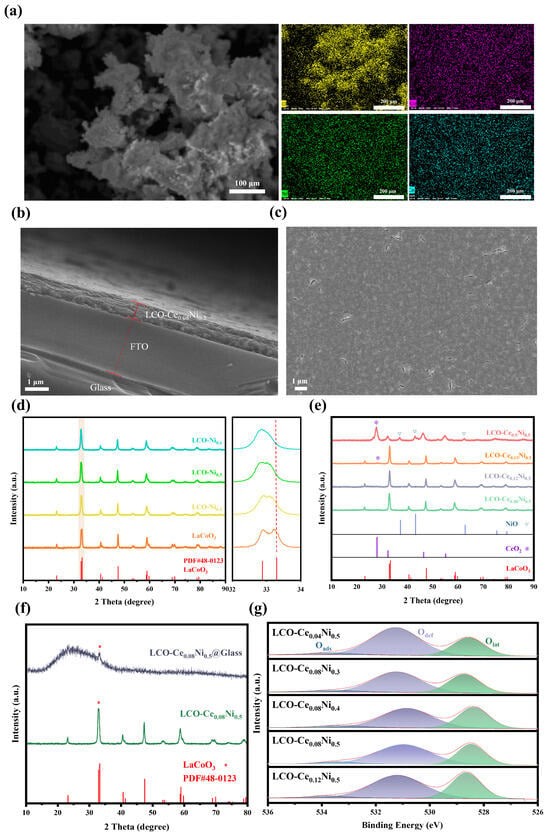
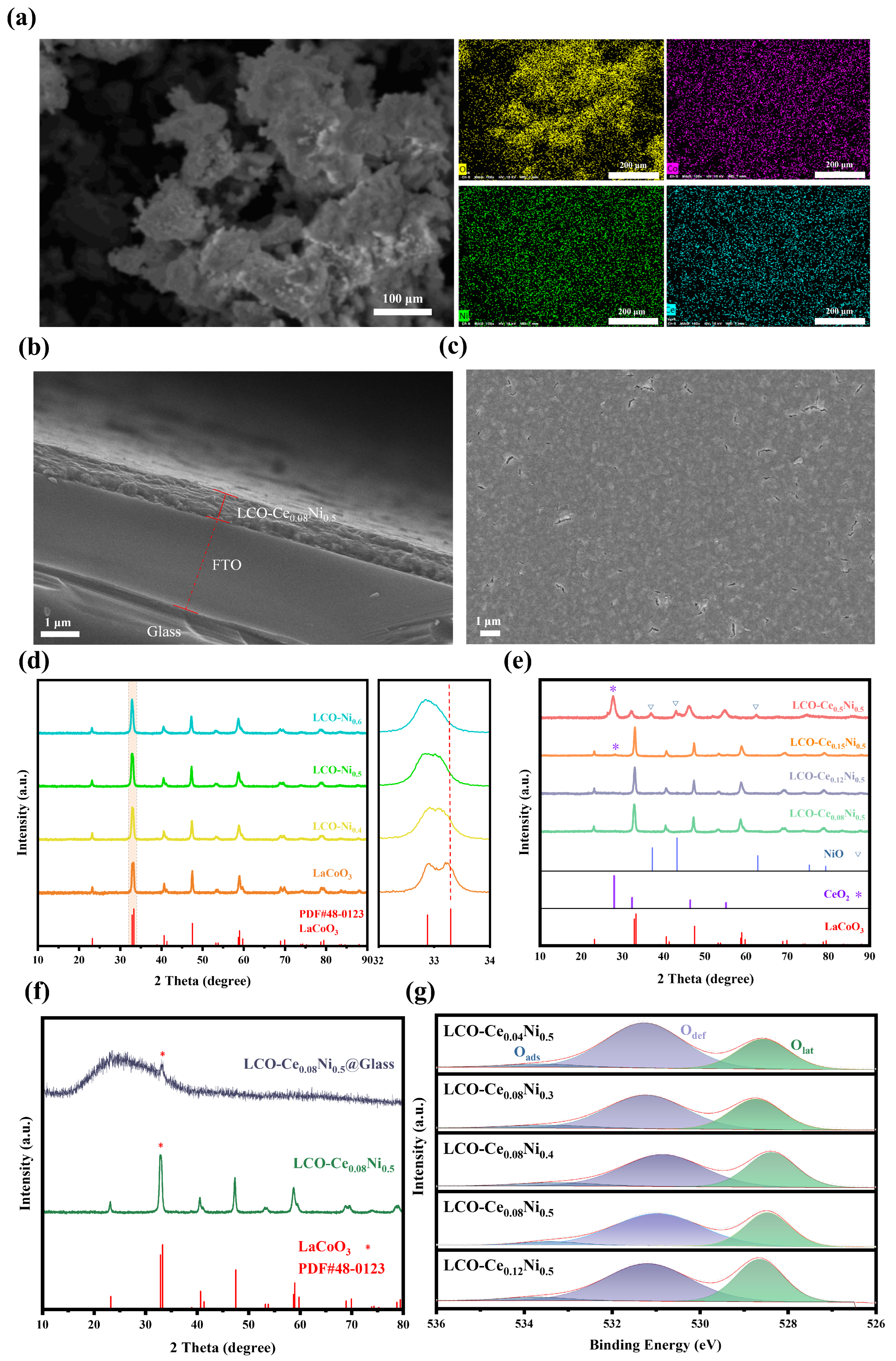
All the LCO-CexNiy powders prepared by the sol–gel method exhibit an agglomerated morphology (Figure S4), while the EDS mapping images demonstrate that the doped Ni and Ce elements are uniformly distributed (Figure 1a). Figure 1b,c show the top and cross-section views of LCO-CexNiy@FTO. It seems that a dense and smooth film was formed on the surface of FTO slide, and the layer of LCO-CexNiy was tightly adhered to the FTO film and the glass substrate.
Figure 1.
(a) EDS of LCO-Ce0.08Ni0.5 perovskite. SEM image of (b) cross-sectional and (c) surface morphology of the LCO-Ce0.08Ni0.5@FTO electrode. (d) XRD of Ni-doping LaCoO3. (e) XRD of Ni and Ce co-doped LaCoO3. (The * and ▽ correspond to the characteristic diffraction peaks of CeO2 and NiO, respectively). (f) XRD of LCO-Ce0.08Ni0.5@Glass. The * correspond to the characteristic diffraction peak of LaCoO3). (g) The O1s XPS of LCO-CeyNix (x = 0.3–0.5, y = 0.04–0.12).
The XRD patterns of LCO-Ni0.4, LCO-Ni0.5, LCO-Ni0.6 are shown in Figure 1d, and the position and relative intensity of peaks at 2θ = 23.22°, 33.24°, 40.62°, 47.48° and 58.96° are aligned with the PDF of LaCoO3 (JCPDS No.48-0123). That implies the perovskite structure could be maintained even when 60% of Co(NO3)2 was replaced by Ni(NO3)2 during the sol–gel preparation. Furthermore, it is found that the peak position of plane (104) shifted from 33.24° to 33.02° as the Ni doping increased from 40% to 60%, indicating a slight enlargement in lattice spacing occurred. As shown in Figure 1e, with 50% Ni doping (x = 0.5), the perovskite structure was still maintained when 12% of La(NO3)3 was substituted by Ce(NO3)3 (y < 0.12), but several extra diffraction peaks assigned to CeO2 and NiO phases were observed when the doping percentage reached 15% (y > 0.15). The synthesized LCO-CeyNix (x = 0.5, y = 0.12) with pure perovskite structure was used for further investigation. XRD patterns confirmed the formation of the target crystalline phase in the catalyst thin film (Figure 1f).
Figure 1g shows the O 1s XPS spectra of several powders of LCO-CeyNix (x = 0.5, y = 0.12), in which the deconvolved peaks at 528.4 eV, 531.3 eV, and 533.8 eV correspond to lattice oxygen, oxygen vacancies, and adsorbed oxygen species, respectively [43]. It is found that the relative proportions of oxygen vacancies increased with more Ni and Ce doping, and the oxygen vacancy content is about 62.1% in LCO-Ce0.08Ni0.5 (Table S1).
The La 3d5/2 XPS spectrum indicates that La ions in LCO-Ce0.08Ni0.5 have a single valence state of La3+ (Figure S5a). In the XPS spectra of Co 2p, two main peaks at 781.3 and 794.6 eV are ascribed to Co3+, whereas the Co2+ corresponds to the peaks at 796.5 and 779.4 eV (Figure S5b). Derived from the relative areas of the main peaks, Co3+/Co2+ is approximately 1.95. As shown in Figure S5c, the Ni XPS spectrum features two characteristic peaks: the Ni2+ 2p3/2 peak centered at 853.8 eV with a corresponding satellite at 861.7 eV, and the Ni3+ 2p peak at 855.1 eV accompanied by a satellite at 865.1 eV. The ratio of Ni3+/Ni2+ is approximately 1.26. Additionally, an interfering La 3d3/2 peak is observed at 852.4 eV [44]. The Ce 3d XPS spectrum confirms successful doping of Ce atoms into the perovskite structure in a mixed valence state of Ce3+ and Ce4+. The v and u peaks represent the Ce 3d5/2 and Ce 3d3/2 orbitals, respectively (Figure S5d) [45]. The oxygen vacancies are formed through the incorporation of Ni (II/III) and Ce (III/IV) into the LaCoO3 crystal lattice, which makes the ideal perovskite structure perturbated at both A- and B-sites. This structural perturbation triggers charge compensation through oxygen vacancy formation, leading to form a perovskite structure rich in oxygen vacancies.
3.2. Electrochemical Behaviors of LCO-CeyNix Perovskite
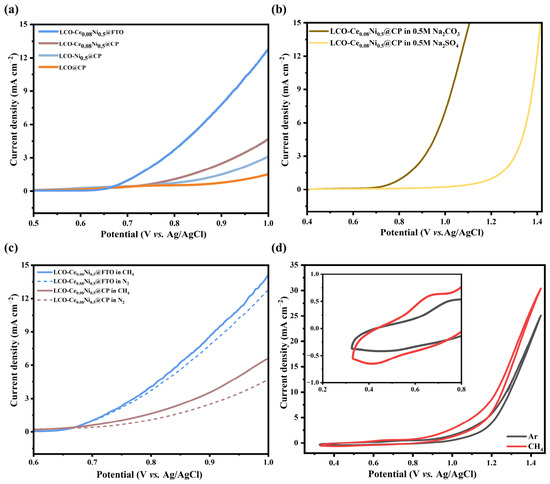
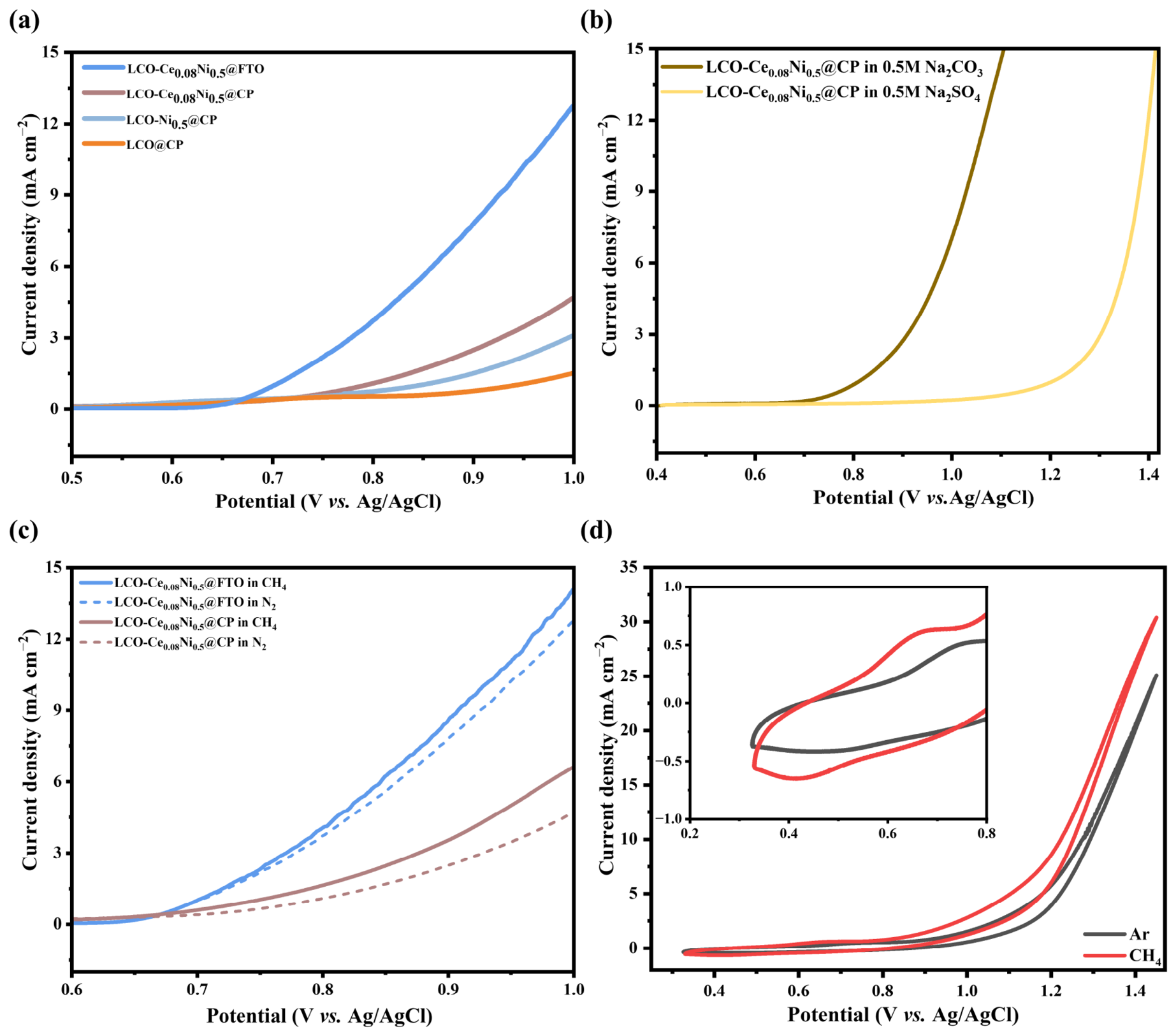
The LSV curves of LCO-Ce0.08Ni0.5@CP, LCO-Ni0.5@CP, LaCoO3@CP and LCO-Ce0.08Ni0.5@FTO electrodes in N2-saturated Na2CO3 electrolyte are shown in Figure 2a. Since it is measured in a N2 atmosphere, the anodic current could only originate from WOR on these electrodes. Notably, a certain slight current occurred before obvious oxygen evolution (below 0.90 V), which might be related to the generation of ROS. Judging from the current densities in the range of 0.65 V and 0.90 V, the order for the amount of generated ROS should be LCO-Ce0.08Ni0.5@FTO, LCO-Ce0.08Ni0.5@CP, LCO-Ni0.5@CP, and LaCoO3@CP. In further experiments, we confirmed the existence of H2O2 and •OH in N2-saturated 0.5 mol L−1 Na2CO3 electrolyte after potentiostatic electrolysis for 0.5 h by the Ce(IV) and bromopyrogallol red qualitative test (Figures S6 and S7). However, it is worth mentioning that no H2O2 was identified when a N2-saturated 0.5 mol L−1 Na2SO4 solution was used as the electrolyte, which is consistent with the information disclosed from LSV characteristics (Figure 2b). The function of carbonate in electrolyte in the formation of H2O2 through WOR has been well discussed [46,47,48].
Figure 2.
(a) LSV curves of LCO@CP, LCO-Ni0.5@CP, LCO-Ce0.08Ni0.5@CP and LCO-Ce0.08Ni0.5@FTO in N2-saturated carbonate electrolyte. (b) The comparison of LCO-Ce0.08Ni0.5@CP and LCO-Ce0.08Ni0.5@FTO in N2-saturated and CH4-saturated carbonate electrolyte. (c) LSV curves of LCO-Ce0.08Ni0.5@CP and LCO-Ce0.08Ni0.5@FTO in N2-saturated carbonate and N2-saturated sulfate electrolyte. (d) CV curves of LCO-Ce0.08Ni0.5@CP in N2-saturated 0.5 M Na2CO3.
Furthermore, the LSV curves of these electrodes in CH4 and N2 atmospheres are compared in Figure 2c. There is almost no change for LaCoO3@CP and Ce-doped LCO@CP (see more in Figure S8), but for LCO-Ce0.08Ni0.5-loaded electrodes, the anodic currents in the CH4 atmosphere are obviously higher than those in the N2 atmosphere. This incremental anodic current originated from the presence of CH4, indicating that CH4 molecules are involved in the electrode reaction occurring on the anode.
In the CV curves of the LCO-Ce0.08Ni0.5@CP electrode in Figure 2d, the pair of anodic and cathodic peaks at 0.65 V and 0.42 V are assigned to the reversible transformation between Ni(II) and Ni(III). In contrast, the CV curves of the LaCoO3@CP and the LCO-Ce0.08@CP exhibit no discernible redox peaks (Figure S9). It could be reasonably inferred that Ni(III) in LCO-CeyNix serves as the active site for chemisorption of CH4 molecules, with the recovery of desorbed Ni(II) to Ni(III) causing the anodic current to increase.
3.3. Evaluation of Electrocatalytic Performance for Methane Conversion
The electrocatalytic performance of LCO-CeyNix for methane conversion was evaluated in an undivided cell with aqueous carbonate solution as the electrolyte, and 1H-NMR spectroscopy was applied for qualitative and quantitative analysis of oxygenates in the electrolyte after electrolysis. The effect of the components in LCO-CeyNix, the anodic potential, and the concentration of carbonate solution on the electrocatalytic performance were investigated.
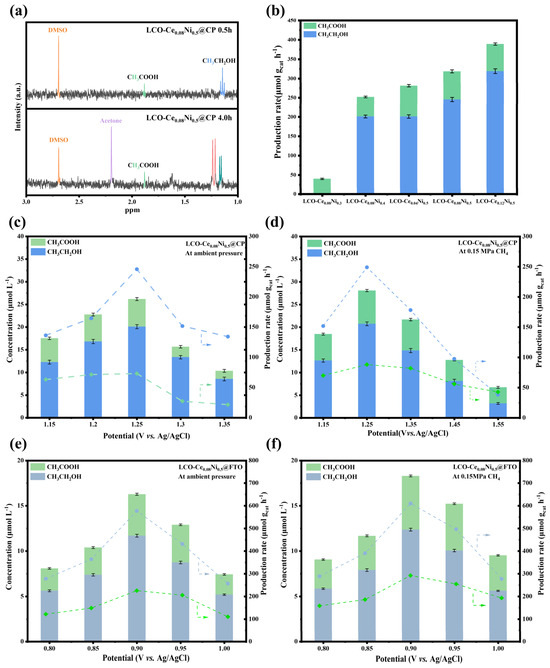
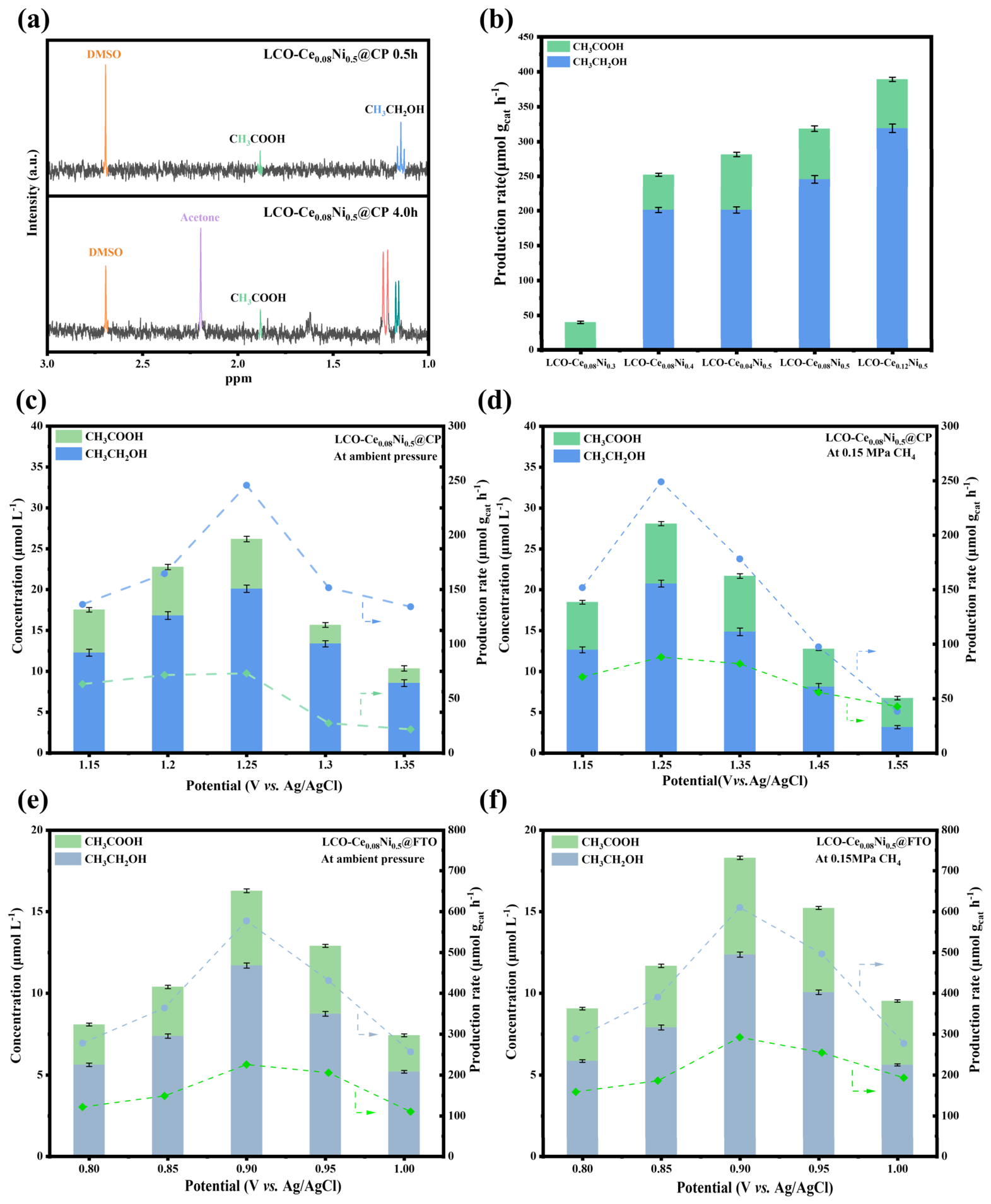
A typical 1H-NMR spectrum of the electrolyte after electrolysis is shown in Figure 3a, in which ethanol and acetic acid can be identified as methane conversion products. In most of the tests in this study, ethanol was identified as the main product. Furthermore, other oxygenates like acetic acid and acetone could be detected in the electrolyte when electrolysis was conducted for an extended period or at a higher positive potential. In the following discussion, the formation rates of ethanol and acetic acid calculated by the quantitative analysis results of 1H-NMR were used to evaluate the electrocatalytic performance of LCO-CeyNix.
Figure 3.
Electrocatalytic conversion of CH4 under different conditions. (a) 1H-NMR spectra of LCO-Ce0.08Ni0.5@CP electrode in 0.5 mol L−1 Na2CO3 at 1.25 V for 0.5 h and 4.0 h. (Each color corresponds to the hydrogen atoms (H) in different organic compounds). (b) The formation rate of methane conversion products for LCO-CeyNix@CP electrodes in 0.5 mol L−1 Na2CO3 at 1.25 V for 0.5 h. (c,d) Concentration and formation rate of products of LCO-Ce0.08Ni0.5@CP in 0.5 mol L−1 Na2CO3 at 1.25 V for 0.5 h under (c) ambient pressure and (d) 0.15 MPa CH4. (e,f) Corresponding data for LCO-Ce0.08Ni0.5@FTO electrode under (e) ambient pressure and (f) 0.15 MPa CH4. (The blue and green lines represent the formation rates of ethanol and acetic acid, respectively).
A comparison of electrolysis results by different LCO-CeyNix@CP electrodes operating under the same conditions is shown in Figure 3b. It is worth noting that no oxygenates were detected when the LaCoO3-loaded electrode was used (not shown in Figure 3b), and only acetic acid was detected using the LCO-Ce0.08Ni0.3@CP electrode, while quite a large amount of ethanol and acetic acid was detected when using other LCO-CeyNix@CP (x = 0.4, 0.5) electrodes. For instance, the formation rate of ethanol on the LCO-Ce0.08Ni0.5@CP is about 245.6 μmol gcat−1 h−1, and it is 319.1 μmol gcat−1 h−1 on the LCO-Ce0.12Ni0.5@CP electrode. Additionally, in most of the electrolysis experiments, the detected amount of acetic acid exhibited little variation. This observation indicates an apparent formation rate of 70 μmol gcat−1 h−1, suggesting that acetic acid is an intermediate product for further oxidation.
Under identical conditions, the effect of the anode potential on the performance of the LCO-Ce0.08Ni0.5@CP electrode was investigated, and the experimental results are presented in Figure 3c. It is shown that the formation rate of ethanol exhibited an inverted-V profile as the potential changed from 1.15 V to 1.35 V, and the maximum was obtained at 1.25 V. According to the CV curve, Ni(II) in the catalyst can be oxidized to Ni(III) at potentials more positive than 0.65 V, which serves as the active site for chemisorption of CH4, while abundant ROS could be generated near 0.9 V. This is the reason that the ethanol formation rate increases as the potential increases from 1.10 V to 1.25 V. The oxygen evolution reaction (OER) then becomes violent at potentials higher than 1.25 V, leading to the further oxidation of ethanol and acetic acid.
Electrolysis in a pressurized cell using LCO-Ce0.08Ni0.5@CP as the working electrode under the same conditions was performed to investigate the effect of methane solubility on the conversion rate. As shown in Figure 3d, the ethanol formation rate showed only a slight increase compared to that in atmospheric pressure. This phenomenon observed in this work is obviously different from our previous work [22], which indicates that methane solubility is not the rate-limiting factor in this electrocatalytic system.
It was found that the ethanol formation rate increased to 474.2 μmol gcat−1 h−1 when the Na2CO3 concentration of the electrolyte increased from 0.5 mol L−1 to 2.0 mol L−1 (Figure S10). Correspondingly, no products were detected when using 0.5 mol L−1 Na2SO4 solution as an electrolyte. It is reported that the carbonate ions in the electrolyte are involved in the generation of H2O2 through 2-electron pathway of WOR on anode. The oxidizing capacity of H2O2 is milder than •OH, which is beneficial to the formation of oxygenates in methane conversion. However, the low selectivity for H2O2 production results in low Faradaic efficiency for electrocatalytic methane oxidation to ethanol (Figure S11).
Figure 3e,f show the catalytic performance of LCO-Ce0.08Ni0.5@FTO electrodes, and the highest ethanol formation rates reached 577.0 μmol gcat−1 h−1 and 609.9 μmol gcat−1 h−1 at 0.9 V under ambient and pressurized conditions, respectively. LSV curves indicate that these electrodes demonstrate superior WOR activity compared to LCO-Ce0.08Ni0.5@CP, which promotes ROS formation at more negative potentials. However, the enhanced oxygen evolution at more positive potentials competes with the generation of methane oxidation products. This observation confirms the relationship between methane oxidation and WOR-derived ROS.
The optimized electrolysis conditions for methane conversion on LCO-Ce0.08Ni0.5@CP loaded electrode were determined as constant-potential electrolysis at 1.25 V in 2.0 M Na2CO3 solution, under which an ethanol formation rate of 474.2 μmol gcat−1 h−1 under atmospheric pressure and a rate of 482.6 μmol gcat−1 h−1 under pressurized conditions were achieved.
3.4. Stability of the Catalyst
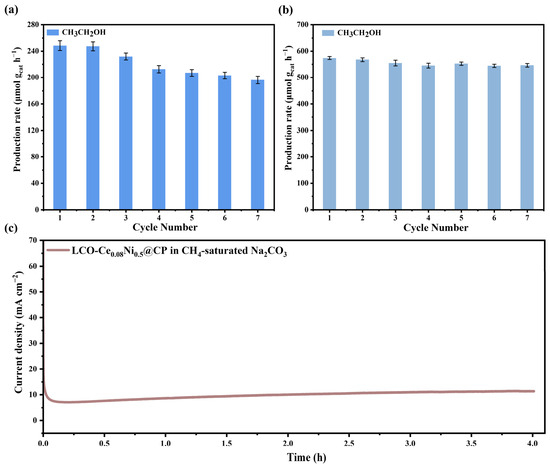
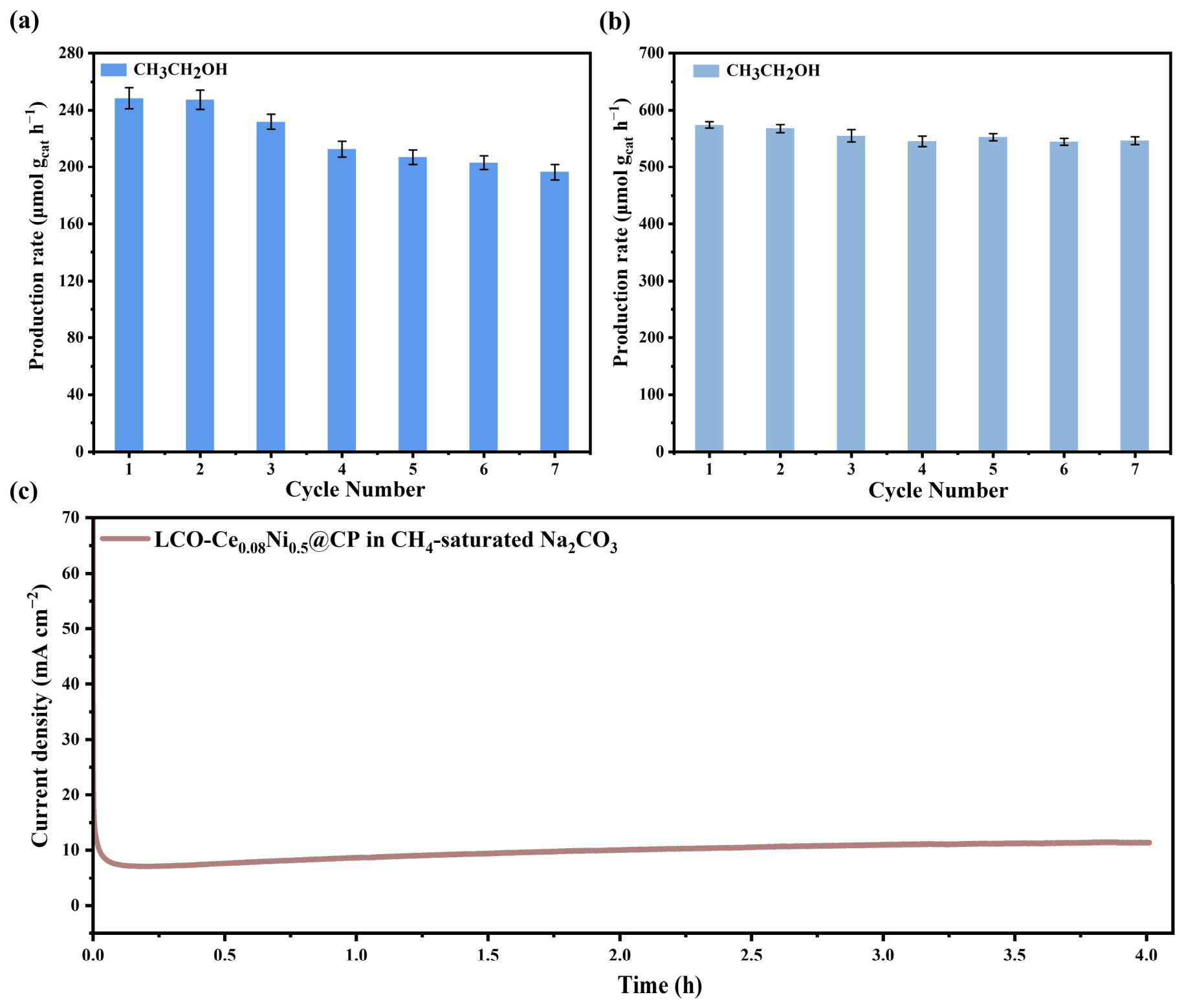
The stability of the catalyst was evaluated through consecutive electrolysis. The ethanol formation rate gradually stabilized with increasing cycle number during multiple 30 min electrolysis cycles of the identical electrode. As shown in Figure 4a, the ethanol formation rate gradually stabilized with increasing cycle number during multiple 30 min electrolysis cycles of the identical LCO-Ce0.08Ni0.5@CP electrode in 0.5 mol L−1 Na2CO3 solution at 1.25 V. Figure 4c shows an increase in current during prolonged electrolysis, followed by stabilization. XRD results indicated a limited extent of La-ion exsolution from the LaCoO3 matrix during the reaction, leading to surface reconstruction with a small amount of La2O2CO3 (JCPDS No. 23-0320, Figure S12) [49]. Considering the relatively low diffraction peak intensity and the stable catalytic performance in repeated tests, the crystal structure of the catalyst remains essentially stable. The performance degradation is due to OER-induced destabilization of the catalyst, leading to partial detachment and reduced methane conversion efficiency.
Figure 4.
The change in ethanol formation rate during repeated 30 min electrolysis cycles in 0.5 mol L−1 Na2CO3 for (a) LCO-Ce0.08Ni0.5@CP at 1.25 V and (b) LCO-Ce0.08Ni0.5@FTO at 0.9 V. (c) The LSV curve of LCO-Ce0.08Ni0.5@CP electrode at 1.25 V.
Figure 4b shows the ethanol formation rate of the LCO-Ce0.08Ni0.5@FTO electrode during repeated electrolysis cycles. This electrode exhibits better stability than the LCO-Ce0.08Ni0.5@CP electrode. The enhanced stability can be attributed to the direct deposition of perovskite films on the FTO surface, where tight interfacial attachment effectively prevents catalyst detachment. The film morphology remains stable through repeated electrolysis, further confirming the reliability of the loading strategy. These phenomena demonstrate that the Ni and Ce co-doped LaCoO3 catalyst integrates the structural stability of perovskites with the catalytic durability of the active phase.
3.5. Mechanisms for Electrochemical Methane Conversion
Studies have shown that the type of electrolyte significantly influences product distribution in catalytic methane oxidation by altering intermediate reaction pathways. In ionic liquid systems, activated methane rapidly reacts with reactive oxygen species (ROS), forming short-chain oxygenates such as CH3OH [21]. In contrast, aqueous-phase environments promote the coupling of surface-bound *O and *C intermediates at reaction interfaces, leading to the formation of C2 and C3 products. The point is that aqueous solutions can reduce the solvation free energy of oxygenates (e.g., = −0.22 eV at 298K), thereby preventing further oxidation and facilitating their accumulation [50,51]. Simultaneously, at the reaction interface, •CH3 first undergoes dehydrogenation to form •CH2, which then undergoes hydroxylation to form the key intermediate •CH2OH. The resulting •CH2OH then undergoes C–C coupling with •CH3 to yield ethanol (C2 product) [14]. By contrast, in mild catalytic conditions for methane conversion, where H2O2 serves as the dominant ROS, methanol is found to be the primary oxidation product preferentially generated [52,53]. However, these oxygenated intermediates can undergo further dehydrogenation and participate in radical reactions, subsequently driving C–C coupling and the formation of highly oxidized products (e.g., aldehydes and carboxylic acids) in the presence of highly reactive ROS such as •OH [54,55,56].
Based on existing theories and the experimental results, we propose a reaction mechanism for methane electrocatalytic oxidation in this system. First, Ni(II) sites on the catalyst are oxidized to Ni(III) at an anodic potential, generating active sites for chemisorption of methane molecules [4]. Subsequently, the adsorbed methane molecules at these sites undergo C–H bond stretching, leading to methane activation [19]. Meanwhile, the Ce/Ni co-doping strategy induces the formation of abundant oxygen vacancies within the catalyst, which enabled the anode to simultaneously catalyze the 1e-WOR for •OH generation and the CO32−-mediated 2e-WOR for H2O2 [46,57,58]. Since H2O2 is a relatively mild ROS, it partially inhibits the deep oxidation of intermediates, thereby promoting ethanol formation. In contrast, the more reactive ·OH promotes both further oxidation and C–C coupling of ethanol, yielding oxygenates such as acetic acid and acetone.
4. Conclusions
In this study, a Ni and Ce co-doped LaCoO3 with a perovskite structure was applied as an anodic catalyst to convert methane in a Na2CO3 electrolyte under ambient conditions, and ethanol was found to be the main conversion product. The doped Ni provides chemisorption sites for methane activation, and the introduction of oxygen vacancies caused by doping and the presence of CO32− in electrolyte promote the generation of •OH and H2O2 through WOR on the anode. As a result, the ethanol generation rate of 577.0 μmol gcat−1 h−1 was achieved on LCO-Ce0.08Ni0.5@FTO electrode at 0.9 V in 0.5 mol L−1 Na2CO3 under ambient conditions, and good performance stability was also tested.
Supplementary Materials
The following supporting information can be downloaded at: https://www.mdpi.com/article/10.3390/nanoenergyadv6030020/s1. Figure S1: Schematic diagram of sol–gel method for preparing co-doped perovskite; Figure S2: Schematic diagram of the preparation process for ABO3@FTO electrodes; Figure S3: The standard calibration curves of (a) CH3CH2OH and (b) CH3COOH; Figure S4: SEM images of perovskites synthesized by sol–gel method: (a,b) LaCoO3; (c,d) LCO-Ce0.08; (e,f) LCO-Ni0.5; (g,h) LCO-Ce0.08Ni0.5; Figure S5: XPS patterns of elements in LCO-Ce0.08Ni0.5. (a) La 3d; (b) Co 2p; (c) Ni 2p; (d) Ce 3d; Figure S6: The detection of •OH by pyrogallol red; Figure S7: The detection of H2O2 by Ce(SO4)2 in different electrolytes; Figure S8: The LSV curves of carbon paper electrodes loaded with different catalysts in N2 and CH4 saturated Na2CO3: (a) LaCoO3; (b) LCO-Ce0.04; (c) LCO-Ce0.08; (d) LCO-Ce0.12; Figure S9: The CV curves of LaCoO3@CP and LCO-Ce0.08@CP in N2 saturated Na2CO3; Figure S10: The ethanol formation rate in Na2CO3 solutions of different concentrations; Figure S11: Variation in ethanol formation rate and Faradaic efficiency with potential during electrolysis of LCO-Ce0.08Ni0.5@CP in CH4 saturated Na2CO3 solution; Figure S12: XRD patterns of LCO-Ce0.08Ni0.5 before and after the electrolytic reaction; Table S1: The integral result of O 1s in LCO-CeyNix.
Author Contributions
Conceptualization, Q.S.; methodology, Q.S.; investigation, Q.S. and H.Q.; writing—original draft preparation, Q.S.; writing—review and editing, Y.S., P.W., Y.T. and Y.C. All authors have read and agreed to the published version of the manuscript.
Funding
This research received no external funding.
Data Availability Statement
The original contributions presented in this study are included in the article and the Supplementary Materials. Further inquiries can be directed to the corresponding author.
Conflicts of Interest
The authors declare no conflicts of interest.
References
- Lauvaux, T.; Giron, C.; Mazzolini, M.; D’aSpremont, A.; Duren, R.; Cusworth, D.; Shindell, D.; Ciais, P. Global assessment of oil and gas methane ultra-emitters. Science 2022, 375, 557–561. [Google Scholar] [CrossRef] [Scilit] [PubMed]
- Yuliati, L.; Yoshida, H. Photocatalytic conversion of methane. Chem. Soc. Rev. 2008, 37, 1592–1602. [Google Scholar] [CrossRef] [Scilit] [PubMed]
- Schwach, P.; Pan, X.; Bao, X. Direct conversion of methane to value-added chemicals over heterogeneous catalysts: Challenges and prospects. Chem. Rev. 2017, 117, 8497–8520. [Google Scholar] [CrossRef] [Scilit] [PubMed]
- Jin, J.; Li, W.; Shen, Z.; Zhang, X.; Tang, S. Cost-effective copper, cobalt, and nickel catalysts for methane conversion: From greenhouse gas to green chemicals. Chem. Commun. 2025, 61, 15292–15312. [Google Scholar] [CrossRef] [Scilit]
- Kreuger, T.; Van Swaaij, W.P.M.; Bos, A.N.R.; Kersten, S.R.A. Methane decomposition kinetics on unfunctionalized alumina surfaces. Chem. Eng. J. 2022, 427, 130412. [Google Scholar] [CrossRef] [Scilit]
- Wang, B.; Lu, X.; Lundin, S.-T.B.; Kong, H.; Wang, J.; Su, B.; Wang, H. Thermodynamic analysis and optimization of solar methane dry reforming enhanced by chemical hydrogen separation. Energy Convers. Manag. 2022, 268, 116050. [Google Scholar] [CrossRef] [Scilit]
- Sushkevich, V.L.; Palagin, D.; Ranocchiari, M.; Van Bokhoven, J.A. Selective anaerobic oxidation of methane enables direct synthesis of methanol. Science 2017, 356, 523–527. [Google Scholar] [CrossRef] [Scilit] [PubMed]
- Li, X.; Wang, C.; Tang, J. Methane transformation by photocatalysis. Nat. Rev. Mater. 2022, 7, 617–632. [Google Scholar] [CrossRef] [Scilit]
- Henard, C.A. Insights into methanotroph carbon flux pave the way for methane biocatalysis. Trends Biotechnol. 2023, 41, 298–300. [Google Scholar] [CrossRef] [Scilit] [PubMed]
- Sun, C.; Zhao, K.; Yi, Z. Research progress in catalytic total oxidation of Methane. J. Inorg. Mater. 2023, 38, 1245–1256. [Google Scholar] [CrossRef] [Scilit]
- Yuan, S.; Li, Y.; Peng, J.; Questell-Santiago, Y.M.; Akkiraju, K.; Giordano, L.; Zheng, D.J.; Bagi, S.; Román-Leshkov, Y.; Shao-Horn, Y. Conversion of methane into liquid fuels—Bridging thermal catalysis with electrocatalysis. Adv. Energy Mater. 2020, 10, 2002154. [Google Scholar] [CrossRef] [Scilit]
- Huang, Y.; Zou, L.; Huang, Y.B.; Cao, R. Photocatalytic, electrocatalytic and photoelectrocatalytic conversion of methane to alcohol. Chin. J. Catal. 2025, 70, 207–229. [Google Scholar] [CrossRef] [Scilit]
- Lee, J.; Yang, J.; Moon, J.H. Solar cell-powered electrochemical methane-to-methanol conversion with CuO/CeO2 catalysts. ACS Energy Lett. 2021, 6, 893–899. [Google Scholar]
- Song, Y.; Zhao, Y.; Nan, G.; Chen, W.; Guo, Z.; Li, S.; Tang, Z.; Wei, W.; Sun, Y. Electrocatalytic oxidation of methane to ethanol via NiO/Ni interface. Appl. Catal. B Environ. 2020, 270, 118888. [Google Scholar] [CrossRef] [Scilit]
- Yan, L.; Jiang, L.; Qian, C.; Zhou, S. Electrocatalytic conversion of methane: Recent progress and future prospects. Energy Rev. 2024, 3, 100065. [Google Scholar] [CrossRef] [Scilit]
- Prajapati, A.; Collins, B.A.; Goodpaster, J.D.; Singh, M.R. Fundamental insight into electrochemical oxidation of methane towards methanol on transition metal oxides. Proc. Natl. Acad. Sci. USA 2021, 118, e2023233118. [Google Scholar] [CrossRef] [Scilit] [PubMed]
- Hayyan, M.; Hashim, M.A.; AlNashef, I.M. Superoxide ion: Generation and chemical implications. Chem. Rev. 2016, 116, 3029–3085. [Google Scholar] [CrossRef] [Scilit] [PubMed]
- Song, Y.; Yang, X.; Liu, H.; Liang, S.; Cai, Y.; Yang, W.; Zhu, K.; Yu, L.; Cui, X.; Deng, D. High-pressure electro-Fenton driving CH4 conversion by O2 at toom temperature. J. Am. Chem. Soc. 2024, 146, 5834–5842. [Google Scholar] [CrossRef] [Scilit] [PubMed]
- Du, J.F.; Ye, J.Y.; Yang, C.; Sheng, T.; Zhou, Z.Y.; Sun, S.G. Operando infrared spectroscopy insights into methane C-H bond activation and conversion on platinum. J. Am. Chem. Soc. 2025, 147, 46226–46233. [Google Scholar] [CrossRef] [Scilit] [PubMed]
- Oh, C.; Kim, J.; Hwang, Y.J.; Ma, M.; Park, J.H. Electrocatalytic methane oxidation on Co3O4- incorporated ZrO2 nanotube powder. Appl. Catal. B Environ. 2021, 283, 119653. [Google Scholar] [CrossRef] [Scilit]
- Qiu, H.; Li, A.; Wang, Z.; Shangguan, Q.; Sun, Y.; Tang, Y.; Wan, P.; Jiang, H.; Chen, Y. Electrocatalytic methane conversion via in-situ generated superoxide radicals in an aprotic ionic liquid. J. Colloid Interface Sci. 2025, 684, 449–456. [Google Scholar] [CrossRef] [Scilit] [PubMed]
- Li, A.; Qiu, H.; Wang, Z.; Sun, Y.; Tang, Y.; Wan, P.; Jiang, H.; Chen, Y. Electrocatalytic conversion of methane to ethanol via promoted •OH generation in aqueous electrolyte. ACS Sustain. Chem. Eng. 2024, 12, 9558–9567. [Google Scholar] [CrossRef] [Scilit]
- Su, Z.-Y.; Jiang, H.-M.; Han, Z.-W.; Zhang, L.-T.; Tang, Y.; Wan, P.-Y.; Khan, Z.U.H.; Chen, Y.-M. Direct conversion of methane to methanol on LaCo0.5Fe0.5O3 anode in aqueous ionic liquid. Int. J. Electrochem. Sci. 2022, 17, 221161. [Google Scholar] [CrossRef] [Scilit]
- Si, F.; Bai, J.; Li, Y.; Lan, R.; Cheng, S.; Hou, T.; Li, Y. Regulating reactive oxygen species via orbital rehybridization between intermediate and active site for selective methane photooxidation to methanol. Angew. Chem. Int. Ed. 2025, 64, e202505267. [Google Scholar] [CrossRef] [Scilit]
- Shen, K.; Kumari, S.; Huang, Y.-C.; Jang, J.; Sautet, P.; Morales-Guio, C.G. Electrochemical oxidation of methane to methanol on electrodeposited transition metal oxides. J. Am. Chem. Soc. 2023, 145, 6927–6943. [Google Scholar] [CrossRef] [Scilit] [PubMed]
- Jones, G.; Jakobsen, J.G.; Shim, S.S.; Kleis, J.; Andersson, M.; Rossmeisl, J.; Abild-Pedersen, F.; Bligaard, T.; Helveg, S.; Hinnemann, B.; et al. First principles calculations and experimental insight into methane steam reforming over transition metal catalysts. J. Catal. 2008, 259, 147–160. [Google Scholar] [CrossRef] [Scilit]
- Spencer, N.D. Partial oxidation of methane to formaldehyde by means of molecular oxygen. J. Catal. 1988, 109, 187–197. [Google Scholar] [CrossRef] [Scilit]
- Khan, M.M.; Somorjai, G.A. A kinetic study of partial oxidation of methane with nitrous oxide on a molybdena-silica catalyst. J. Catal. 1985, 91, 263–271. [Google Scholar] [CrossRef] [Scilit]
- Parfenov, M.V.; Starokon, E.V.; Pirutko, L.V.; Panov, G.I. Quasicatalytic and catalytic oxidation of methane to methanol by nitrous oxide over FeZSM-5 zeolite. J. Catal. 2014, 318, 14–21. [Google Scholar] [CrossRef] [Scilit]
- Woertink, J.S.; Smeets, P.J.; Groothaert, M.H.; Vance, M.A.; Sels, B.F.; Schoonheydt, R.A.; Solomon, E.I. A [Cu2O]2+ core in Cu-ZSM-5, the active site in the oxidation of methane to methanol. Proc. Natl. Acad. Sci. USA 2009, 106, 18908–18913. [Google Scholar] [CrossRef] [Scilit] [PubMed]
- Yang, J.; Hu, S.; Shi, L.; Hoang, S.; Yang, W.; Fang, Y.; Liang, Z.; Pan, C.; Zhu, Y.; Li, L.; et al. Oxygen vacancies and lewis acid sites synergistically promoted catalytic methane combustion over perovskite oxides. Environ. Sci. Technol. 2021, 55, 9243–9254. [Google Scholar] [CrossRef] [Scilit] [PubMed]
- Kareem, A.; Theyagarajan, K.; Thenmozhi, K.; Pitchaimuthu, S.; Senthilkumar, S. A comprehensive review on transition metal-based catalysts for water electrolysis: Fundamentals, recent progress, and future perspectives. Adv. Sustain. Syst. 2025, 9, e01270. [Google Scholar] [CrossRef] [Scilit]
- Vass, A.; Mul, G.; Katsoukis, G.; Altomare, M. Challenges in the selective electrochemical oxidation of methane: Too early to surrender. Curr. Opin. Electrochem. 2024, 47, 101558. [Google Scholar] [CrossRef] [Scilit]
- Zheng, X.; Yang, J.; Xu, X.; Dou, S.; Sun, W.; Wang, D.; Wang, G. Deciphering cationic and anionic overoxidation: Key insights into the intrinsic structural degradation of catalysts. Adv. Energy Mater. 2024, 14, 2401227. [Google Scholar] [CrossRef] [Scilit]
- Zhu, J.; Li, H.; Zhong, L.; Xiao, P.; Xu, X.; Yang, X.; Zhao, Z.; Li, J. Perovskite oxides: Preparation, characterizations, and applications in heterogeneous catalysis. ACS Catal. 2014, 4, 2917–2940. [Google Scholar] [CrossRef] [Scilit]
- Grabowska, E. Selected perovskite oxides: Characterization, preparation and photocatalytic properties—A review. Appl. Catal. B Environ. 2016, 186, 97–126. [Google Scholar] [CrossRef] [Scilit]
- Li, J.; Yao, Y.; An, L.; Wu, S.; Zhang, N.; Jin, J.; Wang, R.; Xi, P. Regulation of perovskite oxides composition for the efficient electrocatalytic reactions. Smart Mol. 2023, 1, e20220005. [Google Scholar] [CrossRef] [Scilit] [PubMed]
- Xu, X.; Wang, W.; Zhou, W.; Shao, Z. Recent advances in novel nanostructuring methods of perovskite electrocatalysts for energy-related applications. Small Methods 2018, 2, 1800071. [Google Scholar] [CrossRef] [Scilit]
- Bartel, C.J.; Sutton, C.; Goldsmith, B.R.; Ouyang, R.; Musgrave, C.B.; Ghiringhelli, L.M.; Scheffler, M. New tolerance factor to predict the stability of perovskite oxides and halides. Sci. Adv. 2019, 5, eaav0693. [Google Scholar] [CrossRef] [Scilit] [PubMed]
- Jiang, Q.; Xin, Y.; Xing, J.; Cao, Y.; Sun, F.; Xing, X.; Hong, H.; Xu, C.; Jin, H. Enhanced oxygen migration in tailored lanthanum-based perovskite for solar-driven dry reforming of methane. Fuel 2024, 363, 130852. [Google Scholar] [CrossRef] [Scilit]
- Suntivich, J.; Gasteiger, H.A.; Yabuuchi, N.; Nakanishi, H.; Goodenough, J.B.; Shao-Horn, Y. Design principles for oxygen-reduction activity on perovskite oxide catalysts for fuel cells and metal-air batteries. Nat. Chem. 2011, 3, 546–550. [Google Scholar] [CrossRef] [Scilit] [PubMed]
- Xu, X.; Su, C.; Zhou, W.; Zhu, Y.; Chen, Y.; Shao, Z. Co-doping strategy for developing perovskite oxides as highly efficient electrocatalysts for oxygen evolution reaction. Adv. Sci. 2016, 3, 1500187. [Google Scholar] [CrossRef] [Scilit]
- Wang, H.; Chen, X.; Huang, D.; Zhou, M.; Ding, D.; Luo, H. Cation deficiency tuning of LaCoO3 perovskite as bifunctional oxygen electrocatalyst. ChemCatChem 2020, 12, 2768–2775. [Google Scholar] [CrossRef] [Scilit]
- Yang, Y.; Yan, X.; Liu, J.; Liu, F.; Li, Y. Reaction mechanism and microkinetics of CO catalytic combustion over Ni-doped LaCoO3 perovskite. Proc. Combust. Inst. 2023, 39, 5621–5635. [Google Scholar] [CrossRef] [Scilit]
- Zhu, B.; Li, Q.-W.; Li, Y.-C.; Xia, Y.-Q.; Liu, J.-L.; Zhou, A.-M.; Zhang, X.-M. Improving oxidation removal of toluene in plasma coupling perovskite catalysts system by constructing Au sites on a La0.5Ce0.5CoO3-δ. Chem. Eng. J. 2023, 469, 143897. [Google Scholar] [CrossRef] [Scilit]
- Zhou, L.; Song, W.; Chen, Z.; Yin, G. Degradation of organic pollutants in wastewater by bicarbonate-activated hydrogen peroxide with a supported cobalt catalyst. Environ. Sci. Technol. 2013, 47, 3833–3839. [Google Scholar] [CrossRef] [Scilit] [PubMed]
- Gao, J.; Duan, X.; O’shea, K.; Dionysiou, D.D. Degradation and transformation of bisphenol A in UV/Sodium percarbonate: Dual role of carbonate radical anion. Water Res. 2020, 171, 115394. [Google Scholar] [CrossRef] [Scilit] [PubMed]
- Zhang, B.-T.; Kuang, L.; Teng, Y.; Fan, M.; Ma, Y. Application of percarbonate and peroxymonocarbonate in decontamination technologies. J. Environ. Sci. 2021, 105, 100–115. [Google Scholar] [CrossRef] [Scilit]
- Zhang, J.; Li, J.; Zhong, C.; Xi, P.; Chao, D.; Gao, D. Surface-electronic-structure reconstruction of perovskite via double-cation gradient etching for superior water oxidation. Nano Lett. 2021, 21, 8166–8174. [Google Scholar] [CrossRef] [Scilit] [PubMed]
- Latimer, A.A.; Kakekhani, A.; Kulkarni, A.R.; Nørskov, J.K. Direct methane to methanol: The selectivity–conversion limit and design strategies. ACS Catal. 2018, 8, 6894–6907. [Google Scholar] [CrossRef] [Scilit]
- Mostaghimi, A.H.B.; Al-Attas, T.A.; Kibria, M.G.; Siahrostami, S. A review on electrocatalytic oxidation of methane to oxygenates. J. Mater. Chem. A 2020, 8, 15575–15590. [Google Scholar] [CrossRef] [Scilit]
- Tang, X.; Wang, L.; Yang, B.; Fei, C.; Yao, T.; Liu, W.; Lou, Y.; Dai, Q.; Cai, Y.; Cao, X.-M.; et al. Direct oxidation of methane to oxygenates on supported single Cu atom catalyst. Appl. Catal. B Environ. 2021, 285, 119827. [Google Scholar] [CrossRef] [Scilit]
- Wang, W.; Zhou, W.; Tang, Y.; Cao, W.; Docherty, S.R.; Wu, F.; Cheng, K.; Zhang, Q.; Copéret, C.; Wang, Y. Selective oxidation of methane to methanol over Au/H-MOR. J. Am. Chem. Soc. 2023, 145, 12928–12934. [Google Scholar] [CrossRef] [Scilit] [PubMed]
- Ramos, A.S.; Santos, M.C.L.; Godoi, C.M.; Oliveira Neto, A.; De Souza, R.F.B. Obtaining C2 and C3 products from methane using Pd/C as anode in a solid fuel cell-type electrolyte reactor. ChemCatChem 2020, 12, 4517–4521. [Google Scholar] [CrossRef] [Scilit]
- Zhang, H.; Lewis, R.J.; Dugulan, A.I.; Li, Y.; Wang, S.; Wang, Z.; Zeng, J.; Dummer, N.F.; Xi, Y.; Li, Y.; et al. Direct oxidative carbonylation of methane to acetic acid via high-valent iron-oxo mediated water activation. Nat. Commun. 2026, 17, 3644. [Google Scholar] [CrossRef] [Scilit] [PubMed]
- Zhang, H.J.; Wang, X.-T.; Zhou, L.; Deng, J.; Liu, Z.-W.; Liu, Z.-Q. Electrocatalytic methane oxidation via integrated design of mechanism, microenvironment, and mass transfer. Chem. Sci. 2026, 17, 11789–11808. [Google Scholar] [CrossRef] [Scilit]
- Richardson, D.E.; Yao, H.; Frank, K.M.; Bennett, D.A. Equilibria, kinetics, and mechanism in the bicarbonate activation of hydrogen peroxide: oxidation of sulfides by peroxymonocarbonate. J. Am. Chem. Soc. 2000, 122, 1729–1739. [Google Scholar] [CrossRef] [Scilit]
- Jung, E.; Shin, H.; Lee, B.-H.; Efremov, V.; Lee, S.; Lee, H.S.; Kim, J.; Antink, W.H.; Park, S.; Lee, K.-S.; et al. Atomic-level tuning of Co–N–C catalyst for high-performance electrochemical H2O2 production. Nat. Mater. 2020, 19, 436–442. [Google Scholar] [CrossRef] [Scilit] [PubMed]
Disclaimer/Publisher’s Note: The statements, opinions and data contained in all publications are solely those of the individual author(s) and contributor(s) and not of MDPI and/or the editor(s). MDPI and/or the editor(s) disclaim responsibility for any injury to people or property resulting from any ideas, methods, instructions or products referred to in the content. |
© 2026 by the authors. Licensee MDPI, Basel, Switzerland. This article is an open access article distributed under the terms and conditions of the Creative Commons Attribution (CC BY) license.