Article

Patterns of Clinical Consultations in a Child and Adolescent Psychotherapeutic Clinic: Insights from a Large-Scale Analysis Covering over a Decade (2011–2023)


1
Faculty of Psychotherapy Science, Sigmund Freud University Vienna, 1020 Vienna, Austria
2
Department of Psychosomatic Medicine and Psychotherapy, University for Continuing Education Krems, 3500 Krems, Austria
*
Authors to whom correspondence should be addressed.
Adolescents 2026, 6(2), 33; https://doi.org/10.3390/adolescents6020033
Submission received: 19 December 2025 / Revised: 7 April 2026 / Accepted: 9 April 2026 / Published: 13 April 2026
(This article belongs to the Section Adolescent Health and Mental Health)

Abstract

We examined how sociodemographic, parental, and temporal factors are associated with parent-reported reasons for seeking consultation in a child and adolescent psychotherapeutic clinic. Data were derived from a large retrospective sample of more than 3000 cases collected between 2011 and 2023. Multivariable binary logistic regression analyses assessed the independent effects of age, gender, living arrangements, migration background, parental education, parental age at childbirth, parental separation or bereavement, and pandemic-related periods. School-aged children and adolescents were more likely than younger children to present with learning difficulties, depression, anxiety, mobbing and media addiction. Female patients showed lower odds of consultations related to learning difficulties, aggression, behavioral addiction, attention deficit/hyperactivity, but higher odds of depression, psychosomatic symptoms, anxiety, eating disorders and sleeping disorders. Parental separation increased the likelihood of consultations related to problematic social behavior within the family, delinquency and trauma and grief. Consultations for attention deficit/hyperactivity concerns were more frequent in the post-pandemic period compared to pre-pandemic. The findings highlight that sociodemographic, familial, and temporal factors are systematically associated with distinct patterns of parent-reported help-seeking patterns in child and adolescent psychotherapeutic care.

1. Introduction

The mental well-being of children and adolescents is a paramount concern in contemporary society, with a notable rise in psychological distress and psychiatric disorders observed in recent years [1]. As mental health issues among young populations grow, understanding the dynamics of help-seeking behavior, as reflected in clinical consultations, is crucial for developing tailored approaches to support the mental well-being of young individuals.
Previous studies have explored the association of age, gender, socioeconomic status, family structure, and cultural background with the occurrence and types of mental health issues [2,3,4]. Understanding these associations is foundational to comprehending mental health challenges in this demographic.
Research has shown that sociodemographic factors are associated with mental health outcomes in children and adolescents. For example, age and gender differences are associated with distinct patterns of psychopathology, with school-aged children and adolescents often encountering specific challenges compared to younger age groups [4,5]. Moreover, gender differences in mental health presentations have been well-documented, with females typically exhibiting higher rates of internalizing conditions such as depression and males displaying higher rates of externalizing conditions like aggression [6,7].
The influence of sociodemographic factors extends beyond individual characteristics to broader contextual elements. The role of cultural diversity in mental health outcomes has been recognized, with cultural background and migration status acting as significant determinants—migration itself often constitutes a risk factor for internalizing problems in children, while the process involves complex stressors, coping mechanisms and resilience [8,9]. Additionally, the impact of the COVID-19 pandemic on mental health is an evolving area of interest [10,11].
Despite these valuable insights into how sociodemographic, cultural and temporal factors are associated with the manifestation of psychopathology, there is a gap in understanding how these factors specifically relate to the patterns and concerns that lead families to seek professional help in children and adolescents [12]. Previous studies investigating potential predictors of help-seeking behavior among young populations, observed less positive attitudes toward seeking help to deal with mental health issues in male adolescents compared to female adolescents [13,14]. A substantial body of research confirms that adolescents face multiple obstacles when considering professional help for psychological distress. Gulliver et al. [15] systematically identified prominent themes across the literature, synthesizing evidence from interview and focus group studies and survey-based research. These include pervasive effects of social stigma and personal embarrassment, insufficient knowledge to identify mental health symptoms, and a strong inclination toward handling problems independently rather than seeking external support. Less is known about the factors that facilitate help-seeking. However, there is some evidence that positive past experiences, increased mental health literacy, social support, and encouragement from others can reduce the stigma of help-seeking and act as facilitators in this age group [16,17,18].
The complex interplay of factors influencing help-seeking behavior in young populations, including sociodemographic characteristics, family dynamics, and significant external events such as the COVID-19 pandemic, has not been assessed in previous studies. Help-seeking behavior is a critical aspect of mental health care, as it determines whether individuals receive timely and appropriate interventions [15,19]. Understanding these relationships is crucial for tailoring effective and targeted mental health support.
In this study, we seek to fill this gap by conducting a thorough examination of the dataset collected from a child and adolescent psychotherapeutic clinic, encompassing parent-reported reasons for seeking psychotherapeutic services. The overarching goal is to elucidate how sociodemographic variables, including age, gender, migration background, living conditions, and parental factors, including parental education and parental age at childbirth, parental separation, and death of a significant person, as well as the period (pre-pandemic, pandemic, post-pandemic) are associated with these presenting concerns.
While previous research has established various patterns of mental health issues among children and adolescents, our study is novel in its detailed investigation of parent-reported reasons for seeking psychotherapeutic services across a substantial period (2011–2023) and the specific impact of the COVID-19 pandemic. By focusing on parent-reported concerns at intake, we provide unique insights into the direct motivators for help-seeking behavior, which are crucial for tailoring effective interventions. Moreover, the integration of parental variables and temporal factors offers a comprehensive perspective on how family dynamics and significant events are associated with patterns of initial clinical presentations. This approach, which accounts for multiple testing in its analysis, not only reaffirms existing knowledge but also uncovers nuanced patterns that inform future mental health support strategies.
The unique methodological approach of this study lies in its simultaneous consideration of numerous variables to examine the complex relations with mental health seeking behavior in children and adolescents. This approach is crucial as it recognizes that sociodemographic and parental factors, such as parental education levels within families of migration background, frequently co-vary and exert multifaceted effects on mental health. By integrating multiple predictors into the analysis, the study aims to pinpoint how each variable independently relates to mental health presentations.
This study is guided by several key research questions:
Research question 1: To what extent do sociodemographic factors, including age, gender, living arrangements and migration background relate to the parent-reported reasons for clinical consultations?
Research question 2: What associations exist between parental characteristics—maternal and paternal age at childbirth, education levels, and parental separation—and the parent-reported concerns of their children at clinic intake?
Research question 3: How have parent-reported concerns at intake varied across different periods, specifically pre-pandemic, during the pandemic, and post-pandemic?

2. Materials and Methods

2.1. Design

This retrospective cross-sectional study utilized data collected from a child and adolescent psychotherapeutic clinic (Faulmanngasse, Vienna, Austria), spanning the period from 2011 to 2023. The university clinic for children and adolescents, affiliated with the Sigmund Freud Private University, offers comprehensive diagnostic and therapeutic services for diverse mental health issues in children and adolescents. The clinic serves as a primary care psychotherapeutic service for Vienna and the surrounding area, accepting self-referrals from parents or caregivers as well as referrals from pediatricians, schools, and other healthcare professionals. The multidisciplinary team includes experienced psychotherapists, clinical psychologists, and a child psychiatrist. The psychotherapeutic services aim to assist children, adolescents, and their parents in addressing psychological challenges across different life domains. Eligibility for treatment at the clinic requires the child or adolescent to be under 18 years of age and for the family to consent to the therapeutic process. While there are no formal exclusion criteria based on diagnosis, cases requiring more intensive or specialized care (e.g., acute suicidality, severe substance abuse disorders) are typically referred to appropriate specialized services, in line with the clinic’s role as a low-threshold, primary care facility. The therapy process typically begins with an initial session, conducted by a licensed psychotherapist, either jointly with the child or solely with the caregiver/s. Subsequently, a psychological assessment of the child is performed. Depending on the treatment plan, individual, group, or family therapies are conducted, usually on a weekly basis. If eligibility criteria are met, the costs for psychotherapy are covered by the Vienna Regional Health Insurance. In cases where coverage is not possible, the university offers affordable psychotherapy within the scope of academic training.

2.2. Data Collection

Data were collected through an initial contact form presented to the patients’ caregiver/s during their first visit to the clinic. Data were collected exclusively during their first visit. This form was not administered again during the subsequent therapy process. This form included a series of questions aimed at capturing various sociodemographic and clinical variables. The “reason for visit” section allowed parents to select one or more predefined categories from a list (e.g., depression, aggression, learning and performance difficulties) to indicate the primary concerns at the point of intake.
A detailed list of all exact questions and response options from this one-time initial contact form is provided in Supplementary Table S1. All data were initially collected in a paper-pencil format during these first patient visits. Subsequently, trained interns entered these data into an electronic database for subsequent extraction and analysis.

2.3. Participants

The participants in the study were the parents or legal guardians (caregivers) of children and adolescents seeking psychotherapeutic services at the university psychotherapeutic clinic. Data were derived from the initial contact forms completed by these caregivers during their child’s first in-person visit. Informed consents for the research use of the anonymized intake data were obtained from the caregivers. Participants in the study were included based solely on the criterion of having signed informed consent. This ensured that all individuals involved in the study had explicitly agreed to participate in research activities conducted at the psychotherapeutic clinic. Notably, individuals who underwent only a phone intake but did not attend in-person appointments (and thus for whom no contact form was completed) were not included in the dataset.

2.4. Sociodemographic Variables

Several sociodemographic variables were collected, including age, gender (male, female, diverse), migration background (no, yes), and living arrangements (with other children, without other children). The age was categorized into groups (<6 years: young child, 6–13 years: school-aged child, ≥14 years: adolescent).

2.5. Parental Variables

The following parental variables were collected: parental separation (no, yes), death of a significant person (no, yes), maternal and paternal age at childbirth, and education level of parents. Caregivers were asked to indicate the highest completed level of education for themselves and the other parent, with the response options: no formal education/secondary education, apprenticeship, high school, university.

2.6. Time

The time of the clinical visit was categorized into the following time frames: pre-pandemic (2011 to end of February 2020), pandemic (March 2020 to end of May 2023), post-pandemic (May 2023 onwards) following the declarations of the World Health Organization [20,21]. The WHO declaration was chosen as a clear, externally defined cutoff point for the pandemic’s status as a global health emergency. We acknowledge that local restrictions, school policies, and clinic operations in Austria varied by region and followed different timelines; these time bins serve as a general temporal framework rather than a precise mapping of all contextual changes.

2.7. Clinical Variables

Reasons for clinical visits were assessed via a list of parent-reported primary concerns. Caregivers were invited to select one or more predefined categories from this list to indicate the issues prompting the clinic visit. These categories (e.g., depression, anxiety, Attention Deficit Hyperactivity Disorder (ADHD)/Attention Deficit Syndrome (ADS)) represent the parents’ or caregivers perceptions and reported reasons for seeking help and are not equivalent to formal diagnoses. For the purpose of this analysis, only the predefined categories were used; responses to the available “Other” option were not evaluated.

2.8. Statistical Analyses

We conducted statistical analyses using SPSS version 26 [22].
Descriptive statistics were computed to describe the sociodemographic and clinical characteristics of the sample.
As this is a retrospective exploratory analysis of existing clinical data, no a priori sample size calculation was performed; the analysis includes all eligible cases from the specified timeframe. Statistical analysis was conducted using complete-case analysis.
Multivariable binary logistic regression [23] was conducted to explore the independent contribution of sociodemographic variables, parental variables, and time to various reasons for clinical visits. The outcome variable was the presence of each reason for seeking treatment (yes vs. no), with “no” as the reference category. The above described sociodemographic variables (age, gender, living arrangements, migration background), parental characteristics (maternal education, paternal education, maternal age at childbirth, paternal age at childbirth, parental separation, death of a significant person), and temporal factors (pre-pandemic, during the pandemic, post-pandemic) were the predictors.
Gender-diverse patients, totaling 5 individuals, were excluded from the statistical analyses due to the small sample size.
Adjusted odds ratios (aOR) and their 95% confidence intervals (CIs) were calculated to assess the statistical uncertainty. All tests were two-sided. Correlations between predictor variables were low (r < 0.70), indicating that multicollinearity was not a confounding factor in the analysis. To account for the increased risk of Type I errors due to the multiple comparisons across 22 outcomes and numerous predictors, we applied a False Discovery Rate (FDR) correction using the Benjamini–Hochberg procedure across all statistical tests. The primary interpretation of results focuses on associations that remained significant after this correction (q < 0.05). Associations significant at the nominal level (p < 0.05) but not surviving FDR correction are considered exploratory.

2.9. Ethical Considerations

Ethical approval for this study was obtained from the ethics committee of the Sigmund Freud University Vienna, Austria (protocol code: RD22K4TQC11J3S90698). The participants provided their written informed consent to participate in this study. All data were anonymized to ensure participant confidentiality. Written informed consent was obtained, permitting the research-oriented anonymized use of the collected data.

3. Results

We present associations that remained significant after False Discovery Rate (FDR) correction (q < 0.05). For all predictors, complete results including adjusted odds ratios and confidence intervals for every outcome are provided in Supplementary Tables S3–S24. Statistically significant results are additionally reported in the text.

3.1. Study Sample Characteristics

This retrospective analysis includes all eligible cases for which a completed initial contact form was available in the clinic’s records between 2011 and 2023. As the data were extracted from routine clinical documentation rather than a prospective survey with a defined sampling frame, traditional response rates (e.g., number approached vs. consented) are not applicable. All caregivers who attended an initial in-person consultation and completed the form are included. The sample characteristics are presented in Table 1. The extent of missing data for all key predictor variables using the regression is presented in Supplementary Table S2. In brief, the gender distribution shows a majority of males (58.6%) and females (41.2%), with a small percentage identifying as diverse (0.2%). Nearly half of the participants had a migration background (48.6%), and the sample spans different age groups, with 11.5% classified as young children, 58.5% as school-aged children, and 30.0% as adolescents.
Table 2 presents the distribution of parent-reported reasons for the initial clinic consultation. Participants sought assistance for various issues, with anxiety (38.8%) being the most prevalent reason, followed by learning and performance difficulties (34.0%) and social behavior outside the family (32.1%).

3.2. Sociodemographic Factors Associated with Reasons for Clinical Consultations

3.2.1. Age Group

Both school-aged children (aOR: 7.081 [4.430, 11.319]) and adolescents (aOR: 8.764 [5.332, 14.405]) presented higher odds of parents reporting concerns about learning and performance difficulties than young children. Lower odds for parent-reported concerns regarding social problems outside the family were observed in adolescents compared to young children (aOR: 0.466 [0.327, 0.666]). Both school-aged children (aOR: 3.569 [2.041, 6.243]) and adolescents (aOR: 14.268 [8.037, 25.329]) had higher odds of depression being reported as a concern than young children. Adolescents had significantly higher odds of substance addiction (aOR: 17.523 [2.334, 131.544]) and non-substance related behavioral addiction (aOR: 8.479 [2.536, 28.345]) being reported than young children. Both school-aged children (aOR: 2.744 [1.571, 4.793]) and adolescents (aOR: 4.366 [2.451, 7.777]) had higher odds of psychosomatic symptoms being reported than young children. School-aged children (aOR: 1.823 [1.313, 2.530]) and adolescents (aOR: 1.918 [1.336, 2.756]) had higher odds of anxiety being reported than young children. The likelihood of ADHD/ADS being reported as a concern was higher in school-aged children (aOR: 2.884 [1.781, 4.670]) compared to young children. Adolescents had higher odds of sleeping disorders being reported compared to young children (aOR: 2.512 [1.644, 3.838]). Both school-aged children (aOR: 19.404 [9.410, 40.011]) and adolescents (aOR: 23.121 [11.000, 48.599]) had higher odds of school difficulties being reported compared to young children. Mobbing emerged as being reported as a concern significantly more often for both school-aged children (aOR: 9.947 [4.330, 22.846]) and adolescents (aOR: 10.356 [4.413, 24.303]) compared to young children. The likelihood of reported media addiction was notably higher in both school-aged children (aOR: 5.318 [2.728, 10.367]) and adolescents (aOR: 8.824 [4.399, 17.700]) compared to young children. The odds of autism spectrum disorder being reported were lower in both school-aged children (aOR: 0.170 [0.100, 0.289]) and adolescents (aOR: 0.132 [0.063, 0.277]) compared to young children.

3.2.2. Gender

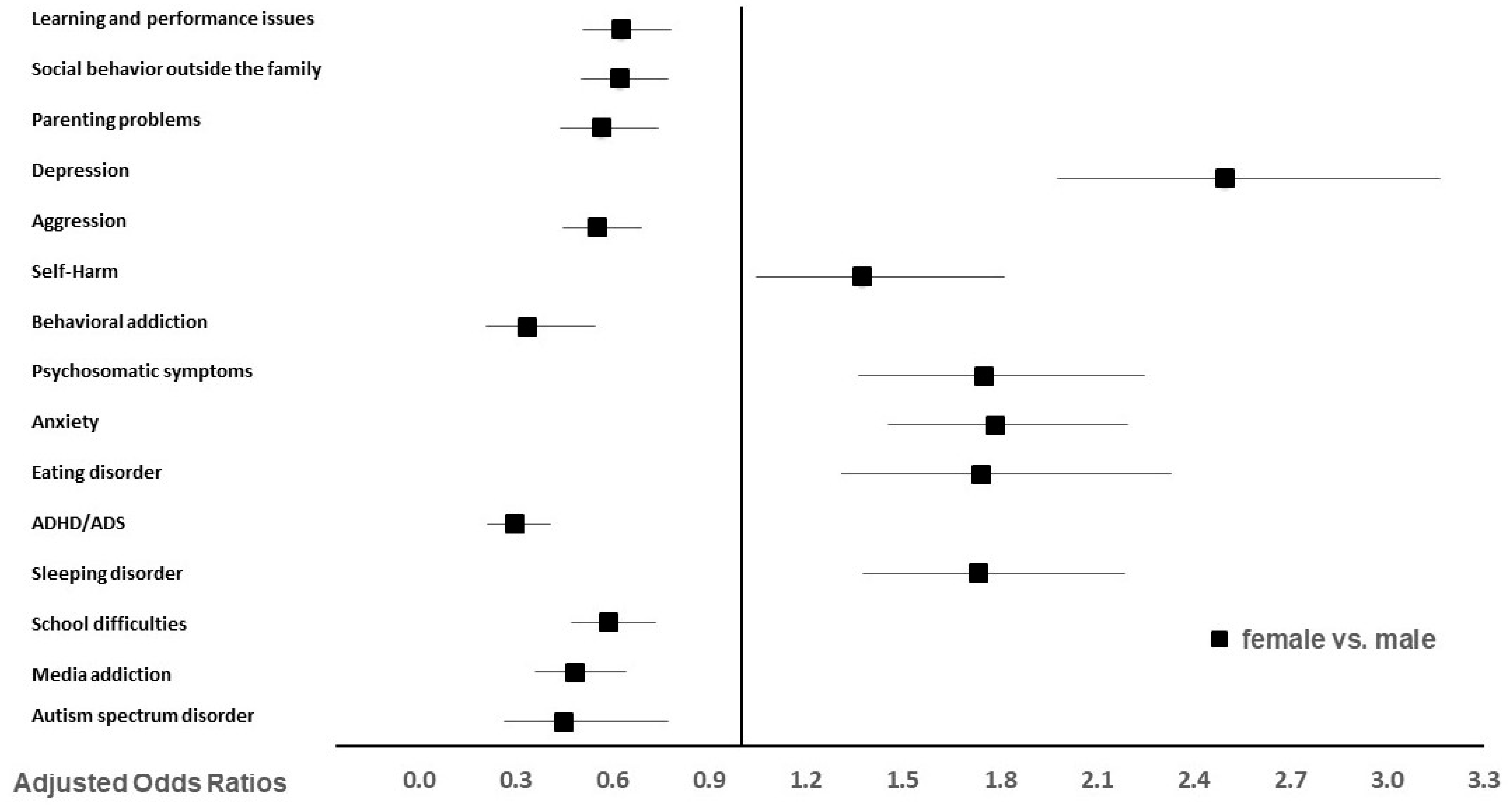
Examining gender-related variations in parent-reported concerns, our study identified distinctive patterns between female and male patients (Figure 1). Female patients had lower odds than males in the following parent-reported concerns: learning and performance difficulties, social behavior outside the family, parenting problems, aggression, non-substance related behavioral addiction, ADHD/ADS, school difficulties, media addiction, and autism spectrum disorder. Conversely, female patients had higher odds than males for the following parent-reported concerns: depression, psychosomatic symptoms, anxiety, eating disorders, and sleeping disorders.

3.2.3. Living with Other Children

No statistically significant associations surviving FDR correction were observed based on whether the patients were living with other children.

3.2.4. Migration Background

Children with a migration background exhibited lower odds of perceptual dysfunction being reported as a concern (aOR: 0.474 [0.318, 0.709]) compared to children without migration background.

3.3. Parental Characteristics Associated with Reasons for Clinical Consultations

3.3.1. Maternal Age at Childbirth

No significant associations surviving FDR correction were observed regarding maternal age at childbirth.

3.3.2. Paternal Age at Childbirth

No significant associations surviving FDR correction were observed regarding paternal age at childbirth.

3.3.3. Education Level Mother

The educational level of the mother exhibited no significant associations with parent-reported concerns after FDR correction.

3.3.4. Education Level Father

The paternal education level showed no significant association with parent-reported reasons for clinical visitations.

3.3.5. Parents’ Separation

Parents’ separation was associated with higher odds of the following concerns being reported: social behavior within the family (aOR: 1.451 [1.174, 1.794]), delinquency (aOR: 2.997 [1.497, 5.999]), and trauma/grief (aOR: 2.885 [2.277, 3.656]).

3.3.6. Death of a Significant Person

The death of a significant person was associated with higher odds of anxiety (aOR: 1.375 [1.090, 1.736]) and trauma/grief (aOR: 2.156 [1.678, 2.770]) being reported a concern.

3.4. Time Period Associated with Reasons for Clinical Consultations

The odds of ADHD/ADS reported as primary concern were significantly higher in the post-pandemic period (aOR: 2.601 [1.406, 4.812]) compared to the pre-pandemic phase.
An overview of all statistically robust associations is presented in Table 3.

4. Discussion

In this study, we analyzed an extensive dataset spanning over a decade (2011–2023) from a child and adolescent psychotherapeutic clinic, aiming to unravel the unique contribution of sociodemographic variables, parental factors, and time periods to patterns of parent-reported reasons for clinical consultations. Given the partially exploratory nature of the analyses and the multiple tests performed, the primary interpretation is focused on associations that withstood False Discovery Rate (FDR) correction (q < 0.05), while nominally significant findings (p < 0.05) are considered as preliminary, hypothesis-generating observations.
The findings are discussed in the following sections according to the initially formulated research questions.

4.1. Associations of Sociodemographic Factors with Reasons for Clinical Consultations

The robust associations (surviving FDR correction) indicating higher odds of parent-reported concerns regarding learning and performance difficulties, depression, anxiety, and mobbing in school-aged children and adolescents compared to their younger counterparts align with the existing literature highlighting the unique developmental challenges faced by these age groups [3,4,24]. School-aged children navigate the complexities of educational expectations and peer interactions, while adolescents grapple with hormonal changes and identity formation. The increased parent-reported likelihood of addiction in adolescents underscores the vulnerability of this age group to external influences and risk-taking behaviors [25]. Understanding these age-specific patterns is crucial for tailoring therapeutic approaches. School-aged children may benefit from interventions focused on academic support and social skills development, while adolescents may additionally require strategies to address risk behaviors and foster healthy coping mechanisms. Moreover, the findings emphasize the importance of early intervention, especially considering the potential long-term implications of mental health challenges during formative years.
The gender differences in parent-reported mental health presentations reveal distinct patterns that warrant attention. After FDR correction, parents of female patients reported lower odds for learning difficulties, ADHD/ADS, aggression, and autism spectrum disorder but higher odds for depression, anxiety, psychosomatic symptoms, sleeping and eating disorders compared to males. These findings resonate with existing research highlighting gender-specific vulnerabilities and coping mechanisms [6,26,27]. The lower odds of ADHD/ADS in females compared to males align with existing prevalence rates, where males are often diagnosed more frequently with attention-related disorders [28]. This gender difference may reflect variations in symptom manifestation or differential referral patterns, or gender biases in the parental perception and reporting. The strong association for reported aggression may similarly reflect both higher prevalence of externalizing behaviors in males and potential gender biases in the perception, interpretation, and reporting of aggressive behaviors by parents and caregivers in a clinical context. The higher likelihood of eating disorders in females suggests potential challenges related to body image and societal expectations [29], underscoring the importance of gender-sensitive therapeutic interventions. Understanding these gender-specific nuances is crucial for designing interventions that address the unique needs of both male and female patients.
Therapists should be sensitive to the socio-cultural factors influencing mental health challenges and tailor their approaches accordingly. Our analyses, adjusted for multiple testing, indicate that a migration background was robustly associated with lower odds of parents reporting perceptual dysfunction. Other observed lower odds of certain reasons for consultation of the outpatient clinic—such as aggression, issues related to social behavior, and compulsion—did not withstand FDR correction. This pattern, based on parent-reported data, must be interpreted with caution. It aligns with cultural theories that suggest that varying societal attitudes towards personality development and mental health may influence patterns of clinical consultations [30]. Critically, lower reported odds for certain concerns among families with a migration background may reflect barriers to access, differences in cultural expression or interpretation of symptoms, or under-reporting due to stigma, rather than a lower underlying prevalence of these issues. Migrant families often have less access to psychotherapeutic services due to language barriers, insufficient knowledge about the healthcare system, inadequate financial resources, stigmatization of mental illnesses, and cultural differences in understanding mental health [31,32,33]. Cultural influences on the expression and management of aggression and compulsion behaviors have been explored in the literature, suggesting that cultural norms and familial expectations may contribute to variations in the awareness of the prevalence of these behaviors [30,34]. Studies indicate that migrants less frequently seek professional help and tend to rely more on private networks or alternative healing methods [31,35]. Consequently, many individuals with a migrant background live with untreated mental disorder, which not only result in increased physical symptoms [36] but also burden the families of those affected and society as a whole [31,37]. This is of high relevance, as recent studies report higher rates of mental health issues among migrant youth [38,39]. Enhancing cultural competency among therapists and integrating culturally sensitive interventions into clinical practices are pivotal steps toward improving mental health care access and outcomes for young individuals with a migration background in urban settings like Vienna, where nearly half the population has migrant roots [40].

4.2. Associations Between Parental Characteristics and Reasons for Clinical Visits

The associations of parental factors with parent-reported mental health presentations among children and adolescents were more limited after rigorous correction. Critically, none of the associations involving maternal or paternal age at childbirth with any reason for consultation survived FDR correction. Therefore, we find no robust evidence to support a link between parental age and the likelihood of parents reporting the surveyed problems in this clinical sample. Previous research on the relationship between parental age and mental health disorders in children is controversial [41,42,43,44]. Our null findings suggest that in our clinical sample, after controlling for multiple testing and other covariates, parental age was not a robust correlate of the parent-reported concerns we measured.
Robust associations were observed for family structure and loss. Children with separated parents showed higher odds of parents reporting challenges, such as social behavior within the family, aggression, and trauma/grief compared to children with non-separated parents, which is consistent with the literature underscoring the impact of family dynamics on children’s psychological well-being. Separation can introduce instability and emotional stress, influencing children’s coping mechanisms and non-substance related behavioral patterns [45,46,47]. The significant impact of the death of a significant person on challenges such as anxiety and trauma/grief highlights the need for grief-informed therapeutic approaches. Acknowledging and addressing the emotional impact of loss is crucial for effective mental health interventions [48].
A paramount limitation for the interpretation of all parental characteristic associations is the absence of parental mental health history from our models, a likely central confounder. Although data were collected, they were missing for 56.8% of cases, precluding its inclusion. Therefore, the observed associations (e.g., with parental separation) are descriptive and may be substantially confounded by unmeasured parental psychopathology, which influences both the family environment and help-seeking behavior. Our results should not be interpreted as evidence for direct causal effects of the measured parental variables.

4.3. Variations in Mental Health Presentations Across Different Periods

The temporal analysis across pre-pandemic, pandemic, and post-pandemic periods yielded only one robust temporal association after FDR correction: the odds of consultations for ADHD/ADS being reported as concern were significantly higher in the post-pandemic period compared to the pre-pandemic phase (aOR: 2.601, 95% CI 1.406–4.812, q < 0.05). This substantial increase may reflect a heightened recognition or emergence of attention and concentration difficulties following the prolonged disruptions to routines, schooling, and social structures during the pandemic.
Other temporal patterns were observed at a nominal significance level (p < 0.05) but did not withstand FDR correction. These exploratory patterns—such as increased concerns regarding social behavior within the family during the pandemic and a trend toward higher trauma/grief-related consultations post-pandemic—align with clinical narratives and the literature highlighting the family strain and cumulative psychological impact of the crisis [26,27,49,50]. However, given the multiple tests performed, these specific uncorrected associations require replication in larger samples and are presented here as descriptive, hypothesis-generating findings. The small size of the post-pandemic cohort (n = 124) further limits the stability of estimates for this period.
These findings underscore that the impact of a major societal stressor like the pandemic may manifest most distinctly in specific domains of mental health, such as attention-related challenges. They highlight the importance of flexible, responsive mental health services that can anticipate and address evolving needs, particularly in supporting children and adolescents with attention deficits during periods of recovery and re-adjustment.

4.4. Limitations

Before discussing the implications, we acknowledge several limitations that should be considered when interpreting the findings. Firstly, the exclusion of gender-diverse patients due to a small sample size (n = 5) underscores the need for caution in generalizing the results to gender-diverse populations. The number of gender-diverse patients in our sample may appear lower due to the fact that younger children, whose gender information was provided by parents, might not have had the opportunity to express their gender identity independently.
Crucially, key variables such as migration background, parental separation, and bereavement were recorded using simple, non-standardized questions on the intake form. This coarse operationalization precludes nuanced interpretation and limits causal inference.
Additionally, an important limitation concerns the omission of family income from the analysis. While income data were collected, the varying fees associated with different income levels raised concerns about the accuracy of reported figures. To address this challenge, we opted to utilize parental education levels as a surrogate measure for socioeconomic status. However, it is crucial to recognize that this choice might not fully capture the nuanced dimensions of socioeconomic diversity. Future research endeavors could explore more comprehensive measures to better understand the intricate relationships between socioeconomic factors and mental health outcomes.
A further important factor missing in the parental characteristics is the parent’s own mental health history. Although we collected data on this issue, the high number of missing values (n = 1769, 56.8%) for this variable prevented us from including it in the analysis. This omission may limit our understanding of the potential influence of parental mental health on the children’s and adolescents’ outcomes.
Moreover, while the study draws on a rich dataset spanning over a decade from a prominent psychotherapeutic clinic in Vienna, the reliance on clinical data introduces the possibility of selection bias, as it may not capture the experiences of children and adolescents who do not seek or have access to such services. The sample’s geographical and cultural specificity to Vienna may limit the generalizability of the findings to more diverse populations.
Our outcome measures relied on parent-reported reasons for consultation, which may be subject to reporting biases. This introduces the potential for several forms of response bias: social desirability bias (the tendency to report concerns perceived as more socially acceptable), recall bias (inaccurate recollection of behaviors or symptoms), and interpretation bias (where parents’ own cultural backgrounds, mental health literacy, or stress levels influence how they perceive and categorize their child’s difficulties). For example, the low odds of aggression in females may partly reflect gender stereotypes in perceiving and labeling problematic behaviors, rather than the true prevalence of these behaviors.
Furthermore, the predefined categories themselves may have conceptual overlap (e.g., between “media addiction” and “non-substance related behavioral addiction”), and parental interpretation of these labels likely varies, adding another layer of measurement uncertainty to our analysis of parent-reported concerns.
Additionally, the ‘post-pandemic’ period in our analysis (from May 2023 onwards) encompasses only a few months of data. While we used the WHO declaration as a consistent cutoff point, this brief timeframe limits the stability and generalizability of estimates for this specific period, and results should be interpreted with caution.
Furthermore, we analyzed each parent-reported concern in separate regression models. While this allows for clear interpretation of associations per concern, it does not model the potential correlations between co-occurring concerns within individuals.
Also, our models did not include interaction terms (e.g., between gender and age, or between migration background and parental education), which limits our ability to detect more complex, combined effects of these predictors. Future studies with larger samples should consider testing such interactions.
Moreover, some reasons for consultation (e.g., delinquency, substance addiction) were rare events in our sample. This can lead to statistical imprecision, as reflected in wide confidence intervals, and increases the risk of model instability for these specific outcomes. Although we applied a stringent FDR correction to control for false positives across all tests, estimates for these rare outcomes should be interpreted with particular caution and are best viewed as preliminary, requiring replication in larger, targeted samples.
Our use of complete-case analysis for handling missing data must be considered a limitation. Variables such as parental education had notable amounts of missing data. If the probability of this data being missing is related to both the predictor itself (e.g., lower socioeconomic position) and the outcome, our estimates could be biased. The results for predictors with higher missingness should therefore be interpreted with this potential selection bias in mind.
Furthermore, the study’s cross-sectional design precludes establishing causal relationships between sociodemographic factors and mental health outcomes. Longitudinal research would be instrumental in elucidating the temporal dynamics of these associations.

5. Conclusions

Our study contributes to the growing body of literature on pediatric mental health by identifying robust associations between sociodemographic, parental, and temporal factors and parent-reported reasons for seeking psychotherapeutic care. Across more than 3000 clinical consultations spanning over a decade, we found that age, gender, parental separation, bereavement, and the post-pandemic period each showed distinct patterns of associations with specific presenting concerns.
These results have direct clinical implications. The pronounced gender differences—with female patients showing higher odds for internalizing concerns and lower odds for externalizing concerns—underscore the need for gender-sensitive diagnostic and therapeutic approaches. The strong associations of parental separation and bereavement with trauma/grief, anxiety, and family-related social behavior highlight the importance of assessing family history and providing trauma-informed care. The elevated odds of ADHD/ADS consultations in the post-pandemic period suggest that attention-related difficulties may be a specific sequela of pandemic-related disruptions, warranting targeted screening and support.
While these findings are constrained by the cross-sectional, parent-reported nature of the data and the absence of key confounders such as parental mental health history (as detailed in the Limitations section), their consistency with the prior literature and their robustness to FDR correction support their validity as hypothesis-generating evidence for clinical practice and future research. Future studies should employ longitudinal designs, standardized diagnostic assessments, and include parental psychopathology to further elucidate the mechanisms underlying these associations.

Supplementary Materials

The following supporting information can be downloaded at: https://www.mdpi.com/article/10.3390/adolescents6020033/s1, Tables S1–S24: Original items from the intake form. Prevalence of missing data for predictor variables. Results of the multivariable binary logistic regression analyses on the association of sociodemographic factors, parental variables and time on the odds for presenting at the clinic with the respective reasons.

Author Contributions

Conceptualization, E.H.; methodology, E.H., G.A. and E.R.; software, E.H.; validation, E.H., S.E. and E.R.; formal analysis, E.H.; investigation, S.E. and E.R.; resources, E.R.; data curation, S.E. and E.R.; writing—original draft preparation, E.H.; writing—review and editing, S.E., E.R., G.A. and J.F.; visualization, E.H.; supervision, E.R.; project administration, E.R. All authors have read and agreed to the published version of the manuscript.

Funding

This research received no external funding.

Institutional Review Board Statement

The study involving human participants was reviewed and approved by the Ethics Committee of the Sigmund Freud University Vienna, Austria (protocol code: RD22K4TQC11J3S90698; approval date: 27 February 2024). The participants provided their written informed consent to participate in this study.

Informed Consent Statement

Informed consent was obtained from all subjects involved in the study. Written informed consent has been obtained from the patients to publish this paper.

Data Availability Statement

The data that support the findings of this study are available on request from the corresponding author. The data are not publicly available due to ethical restrictions.

Acknowledgments

Open Access Funding by the University for Continuing Education Krems.

Conflicts of Interest

The authors declare no conflicts of interest.

Abbreviations

The following abbreviations are used in this manuscript:
ADHDAttention Deficit Hyperactivity Disorder
ADSAttention Deficit Syndrome
aORAdjusted Odds Ratios
CIsConfidence Intervals
FDRFalse Discovery Rate

References

  1. Melchior, M. The Long Shadow of the COVID-19 Pandemic on Children and Adolescents’ Mental Health. Eur. Child Adolesc. Psychiatry 2023, 32, 2385–2386. [Google Scholar] [CrossRef]
  2. Alegria, M.; Vallas, M.; Pumariega, A.J. Racial and Ethnic Disparities in Pediatric Mental Health. Child Adolesc. Psychiatr. Clin. N. Am. 2010, 19, 759–774. [Google Scholar] [CrossRef]
  3. Merikangas, K.R.; He, J.; Burstein, M.; Swanson, S.A.; Avenevoli, S.; Cui, L.; Benjet, C.; Georgiades, K.; Swendsen, J. Lifetime Prevalence of Mental Disorders in U.S. Adolescents: Results from the National Comorbidity Survey Replication–Adolescent Supplement (NCS-A). J. Am. Acad. Child Adolesc. Psychiatry 2010, 49, 980–989. [Google Scholar] [CrossRef] [PubMed]
  4. Costello, E.J.; Mustillo, S.; Erkanli, A.; Keeler, G.; Angold, A. Prevalence and Development of Psychiatric Disorders in Childhood and Adolescence. Arch. Gen. Psychiatry 2003, 60, 837. [Google Scholar] [CrossRef] [PubMed]
  5. Kessler, R.C.; Angermeyer, M.; Anthony, J.C.; de Graaf, R.; Demyttenaere, K.; Gasquet, I.; De Girolamo, G.; Gluzman, S.; Gureje, O.; Haro, J.M.; et al. Lifetime Prevalence and Age-of-Onset Distributions of Mental Disorders in the World Health Organization’s World Mental Health Survey Initiative. World Psychiatry 2007, 6, 168–176. [Google Scholar] [PubMed]
  6. Hankin, B.L.; Abramson, L.Y.; Moffitt, T.E.; Silva, P.A.; McGee, R.; Angell, K.E. Development of Depression from Preadolescence to Young Adulthood: Emerging Gender Differences in a 10-Year Longitudinal Study. J. Abnorm. Psychol. 1998, 107, 128–140. [Google Scholar] [CrossRef] [PubMed]
  7. Zahn-Waxler, C.; Shirtcliff, E.A.; Marceau, K. Disorders of Childhood and Adolescence: Gender and Psychopathology. Annu. Rev. Clin. Psychol. 2008, 4, 275–303. [Google Scholar] [CrossRef]
  8. Bhugra, D. Migration and Mental Health. Acta Psychiatr. Scand. 2004, 109, 243–258. [Google Scholar] [CrossRef]
  9. Belhadj Kouider, E.; Koglin, U.; Petermann, F. Emotional and Behavioral Problems in Migrant Children and Adolescents in Europe: A Systematic Review. Eur. Child Adolesc. Psychiatry 2014, 23, 373–391. [Google Scholar] [CrossRef]
  10. Loades, M.E.; Chatburn, E.; Higson-Sweeney, N.; Reynolds, S.; Shafran, R.; Brigden, A.; Linney, C.; McManus, M.N.; Borwick, C.; Crawley, E. Rapid Systematic Review: The Impact of Social Isolation and Loneliness on the Mental Health of Children and Adolescents in the Context of COVID-19. J. Am. Acad. Child Adolesc. Psychiatry 2020, 59, 1218–1239.e3. [Google Scholar] [CrossRef]
  11. Holmes, E.A.; O’Connor, R.C.; Perry, V.H.; Tracey, I.; Wessely, S.; Arseneault, L.; Ballard, C.; Christensen, H.; Cohen Silver, R.; Everall, I.; et al. Multidisciplinary Research Priorities for the COVID-19 Pandemic: A Call for Action for Mental Health Science. Lancet Psychiatry 2020, 7, 547–560. [Google Scholar] [CrossRef]
  12. Mansfield, R.; Patalay, P.; Humphrey, N. A Systematic Literature Review of Existing Conceptualisation and Measurement of Mental Health Literacy in Adolescent Research: Current Challenges and Inconsistencies. BMC Public Health 2020, 20, 607. [Google Scholar] [CrossRef]
  13. Jorm, A.F.; Kelly, C.M.; Wright, A.; Parslow, R.A.; Harris, M.G.; McGorry, P.D. Belief in Dealing with Depression Alone: Results from Community Surveys of Adolescents and Adults. J. Affect. Disord. 2006, 96, 59–65. [Google Scholar] [CrossRef] [PubMed]
  14. Kelly, C.M.; Jorm, A.F. Adolescents’ Intentions to Offer Assistance to Friends with Depression or Conduct Disorder: Associations with Psychopathology and Psychosocial Characteristics. Early Interv. Psychiatry 2007, 1, 150–156. [Google Scholar] [CrossRef]
  15. Gulliver, A.; Griffiths, K.M.; Christensen, H. Perceived Barriers and Facilitators to Mental Health Help-Seeking in Young People: A Systematic Review. BMC Psychiatry 2010, 10, 113. [Google Scholar] [CrossRef] [PubMed]
  16. Timlin-Scalera, R.M.; Ponterotto, J.G.; Blumberg, F.C.; Jackson, M.A. A Grounded Theory Study of Help-Seeking Behaviors among White Male High School Students. J. Couns. Psychol. 2003, 50, 339–350. [Google Scholar] [CrossRef]
  17. Lindsey, M.A.; Korr, W.S.; Broitman, M.; Bone, L.; Green, A.; Leaf, P.J. Help-Seeking Behaviors and Depression among African American Adolescent Boys. Soc. Work 2006, 51, 49–58. [Google Scholar] [CrossRef]
  18. Wilson, C.J.; Rickwood, D.; Deane, F.P. Depressive Symptoms and Help-Seeking Intentions in Young People. Clin. Psychol. 2007, 11, 98–107. [Google Scholar] [CrossRef]
  19. Rickwood, D.; Deane, F.P.; Wilson, C.J.; Ciarrochi, J. Young People’s Help-Seeking for Mental Health Problems. Aust. e-J. Adv. Ment. Health 2005, 4, 218–251. [Google Scholar] [CrossRef]
  20. WHO. WHO Director-General’s Opening Remarks at the Media Briefing on COVID-19—11 March 2020. Available online: https://www.who.int/news-room/speeches/item/who-director-general-s-opening-remarks-at-the-media-briefing-on-covid-19---11-march-2020 (accessed on 23 January 2024).
  21. WHO. Statement on the Fifteenth Meeting of the IHR (2005) Emergency Committee on the COVID-19 Pandemic. Available online: https://www.who.int/news/item/05-05-2023-statement-on-the-fifteenth-meeting-of-the-international-health-regulations-(2005)-emergency-committee-regarding-the-coronavirus-disease-(covid-19)-pandemic (accessed on 23 January 2024).
  22. IBM Corp. IBM SPSS Statistics for Windows, version 26.0.; IBM Corp: Armonk, NY, USA, 2019.
  23. Hosmer, D.W.; Lemeshow, S.; Sturdivant, R.X. Applied Logistic Regression, 1st ed.; Wiley Series in Probability and Statistics; Wiley: Hoboken, NJ, USA, 2013. [Google Scholar]
  24. Agency for Healthcare Research and Quality. 2023 National Healthcare Quality and Disparities Report; Executive Summary; No. 23 (24)-0091-EF; AHRQ Pub.: Rockville, MD, USA, 2023.
  25. Steinberg, L. A Social Neuroscience Perspective on Adolescent Risk-Taking. Dev. Rev. 2008, 28, 78–106. [Google Scholar] [CrossRef]
  26. Jesser, A.; Schaffler, Y.; Gächter, A.; Dale, R.; Humer, E.; Pieh, C. School Students’ Concerns and Support after One Year of COVID-19 in Austria: A Qualitative Study Using Content Analysis. Healthcare 2022, 10, 1334. [Google Scholar] [CrossRef] [PubMed]
  27. Humer, E.; Dale, R.; Plener, P.L.; Probst, T.; Pieh, C. Assessment of Mental Health of High School Students 1 Semester After COVID-19–Associated Remote Schooling Measures Were Lifted in Austria in 2021. JAMA Netw. Open 2021, 4, e2135571. [Google Scholar] [CrossRef] [PubMed]
  28. Gilbert, M.; Boecker, M.; Reiss, F.; Kaman, A.; Erhart, M.; Schlack, R.; Westenhöfer, J.; Döpfner, M.; Ravens-Sieberer, U. Gender and Age Differences in ADHD Symptoms and Co-Occurring Depression and Anxiety Symptoms Among Children and Adolescents in the BELLA Study. Child Psychiatry Hum. Dev. 2023, 56, 1162–1172. [Google Scholar] [CrossRef] [PubMed]
  29. Muehlenkamp, J.J.; Brausch, A.M. Body Image as a Mediator of Non-suicidal Self-injury in Adolescents. J. Adolesc. 2012, 35, 1–9. [Google Scholar] [CrossRef]
  30. Ronningstam, E.F.; Keng, S.-L.; Ridolfi, M.E.; Arbabi, M.; Grenyer, B.F.S. Cultural Aspects in Symptomatology, Assessment, and Treatment of Personality Disorders. Curr. Psychiatry Rep. 2018, 20, 22. [Google Scholar] [CrossRef] [PubMed]
  31. Wong, E.C.; Marshall, G.N.; Schell, T.L.; Elliott, M.N.; Hambarsoomians, K.; Chun, C.-A.; Berthold, S.M. Barriers to Mental Health Care Utilization for U.S. Cambodian Refugees. J. Consult. Clin. Psychol. 2006, 74, 1116–1120. [Google Scholar] [CrossRef]
  32. Calliess, I.; Akguel, G.; Jaeger, B.; Ziegenbein, M. Attitudes towards Psychotherapy of Young Second-Generation Turkish Immigrants Living in Germany. Psychiatr. Prax. 2007, 34, 343–348. [Google Scholar] [CrossRef]
  33. Amri, S.; Bemak, F. Mental Health Help-Seeking Behaviors of Muslim Immigrants in the United States: Overcoming Social Stigma and Cultural Mistrust. J. Muslim Ment. Health 2012, 7, 43–63. [Google Scholar] [CrossRef]
  34. Crijnen, A.A.M.; Achenbach, T.M.; Verhulst, F.C. Comparisons of Problems Reported by Parents of Children in 12 Cultures: Total Problems, Externalizing, and Internalizing. J. Am. Acad. Child Adolesc. Psychiatry 1997, 36, 1269–1277. [Google Scholar] [CrossRef]
  35. Markova, V.; Sandal, G.M.; Pallesen, S. Immigration, Acculturation, and Preferred Help-Seeking Sources for Depression. Comparison of Five Ethnic Groups. BMC Health Serv. Res. 2019, 20, 648. [Google Scholar] [CrossRef]
  36. Allen, J.; Balfour, R.; Bell, R.; Marmot, M. Social Determinants of Mental Health. Int. Rev. Psychiatry 2014, 26, 392–407. [Google Scholar] [CrossRef]
  37. Murray, K.E.; Davidson, G.R.; Schweitzer, R.D. Review of Refugee Mental Health Interventions Following Resettlement: Best Practices and Recommendations. Am. J. Orthopsychiatry 2010, 80, 576–585. [Google Scholar] [CrossRef]
  38. Dale, R.; Jesser, A.; Pieh, C.; O’Rourke, T.; Probst, T.; Humer, E. Mental Health Burden of High School Students, and Suggestions for Psychosocial Support, 1.5 Years into the COVID-19 Pandemic in Austria. Eur. Child Adolesc. Psychiatry 2022, 32, 1015–1024. [Google Scholar] [CrossRef]
  39. Pieh, C.; Dale, R.; Jesser, A.; Probst, T.; Plener, P.L.; Humer, E. The Impact of Migration Status on Adolescents’ Mental Health during COVID-19. Healthcare 2022, 10, 176. [Google Scholar] [CrossRef] [PubMed]
  40. Statistik Austria. Statistisches Jahrbuch. Migration & Integration. Zahlen, Daten, Indikatoren; Statistik Austria: Vienna, Austria, 2023; p. 128. [Google Scholar]
  41. Baker, B.H.; Joo, Y.Y.; Park, J.; Cha, J.; Baccarelli, A.A.; Posner, J. Maternal Age at Birth and Child Attention-deficit Hyperactivity Disorder: Causal Association or Familial Confounding? J. Child Psychol. Psychiatry 2023, 64, 299–310. [Google Scholar] [CrossRef]
  42. Gillberg, C.; Rasmussen, P.; Wahlström, J. Minor Neurodevelopmental Disorders in Children Born to Older Mothers. Dev. Med. Child Neurol. 1982, 24, 437–447. [Google Scholar] [CrossRef] [PubMed]
  43. D’Onofrio, B.M.; Rickert, M.E.; Frans, E.; Kuja-Halkola, R.; Almqvist, C.; Sjölander, A.; Larsson, H.; Lichtenstein, P. Paternal Age at Childbearing and Offspring Psychiatric and Academic Morbidity. JAMA Psychiatry 2014, 71, 432. [Google Scholar] [CrossRef]
  44. De Kluiver, H.; Buizer-Voskamp, J.E.; Dolan, C.V.; Boomsma, D.I. Paternal Age and Psychiatric Disorders: A Review. Am. J. Med. Genet. Part B Neuropsychiatr. Genet. 2017, 174, 202–213. [Google Scholar] [CrossRef] [PubMed]
  45. Amato, P.R. Research on Divorce: Continuing Trends and New Developments. J. Marriage Fam. 2010, 72, 650–666. [Google Scholar] [CrossRef]
  46. Apel, R.; Kaukinen, C. On the relationship between family structure and antisocial behavior: Parental cohabitation and blended households. Criminology 2008, 46, 35–70. [Google Scholar] [CrossRef]
  47. McMunn, A.M.; Nazroo, J.Y.; Marmot, M.G.; Boreham, R.; Goodman, R. Children’s Emotional and Behavioural Well-Being and the Family Environment: Findings from the Health Survey for England. Soc. Sci. Med. 2001, 53, 423–440. [Google Scholar] [CrossRef] [PubMed]
  48. Bowlby, E.J.M. Loss—Sadness and Depression: Attachment and Loss Volume 3; Random House: New York, NY, USA, 2008. [Google Scholar]
  49. Brooks, S.K.; Webster, R.K.; Smith, L.E.; Woodland, L.; Wessely, S.; Greenberg, N.; Rubin, G.J. The Psychological Impact of Quarantine and How to Reduce It: Rapid Review of the Evidence. Lancet 2020, 395, 912–920. [Google Scholar] [CrossRef] [PubMed]
  50. Prime, H.; Wade, M.; Browne, D.T. Risk and Resilience in Family Well-Being during the COVID-19 Pandemic. Am. Psychol. 2020, 75, 631–643. [Google Scholar] [CrossRef] [PubMed]
Figure 1. Adjusted odds ratios for patient-reported concerns at clinic intake, by patient gender (female vs. male). An adjusted odds ratio > 1 indicates higher odds for females; an aOR < 1 indicates lower odds for females. Error bars represent 95% confidence intervals. Abbreviations: ADHD, Attention Deficit Hyperactivity Disorder; ADS, Attention Deficit Syndrome.
Adolescents 06 00033 g001
Table 1. Study sample characteristics (N = 3115).
VariableN%
Gender
 Male182658.6
 Female128441.2
 Diverse50.2
Age
 Young child35911.5
 School-aged child182158.5
 Adolescent93230.0
Migration background
 No158951.4
 Yes150448.6
Maternal age at childbirth
 ≤25 years90830.0
 26–35 years162053.5
 ≥36 years50216.6
Paternal age at childbirth
 ≤25 years42915.4
 26–35 years139449.9
 ≥36 years96934.7
Education level mother
 No formal education/secondary school55223.8
 Apprenticeship58525.2
 High school52322.5
 University66028.5
Education level father
 No formal education/secondary education54624.2
 Apprenticeship69730.9
 High school46220.5
 University55324.5
Parents’ separation
 No124850.2
 Yes123749.8
Living with other children
 No58423.0
 Yes195977.0
Death of a significant person
 No178573.9
 Yes63226.1
Time
 Pre-pandemic207166.5
 Pandemic92029.5
 Post-pandemic1244.0
Note: Values do not always sum up to 3115 as not all data were provided by all patients. Percentages may not sum to 100% due to rounding.
Table 2. Patient-reported reasons to consult the clinic in the study sample (N = 3115).
VariableN%
Learning and performance difficulties106034.0
Social behavior within the family91929.5
Social behavior outside the family100132.1
Parenting problems54617.5
Depression81126.0
Aggression96230.9
Self-harm41613.4
Substance addiction973.1
Non-substance related behavioral addiction1585.07
Delinquency722.31
Psychosomatic symptoms56918.3
Anxiety120838.8
Compulsion37312.0
Eating disorder36811.8
ADHD/ADS 147115.1
Trauma/grief77624.9
Sleeping disorder70022.5
School difficulties94630.4
Mobbing49816.0
Perceptual dysfunction1825.84
Media addiction44114.2
Autism spectrum disorder1625.20
1 ADHD, Attention Deficit Hyperactivity Disorder; ADS, Attention Deficit Syndrome.
Table 3. Summary of robust associations (FDR-corrected, q < 0.05) between predictors and parent-reported concerns at clinic intake.
Predictor DomainPredictor
(Comparison)
Parent-Reported ConcernAdjusted Odds Ratio (aOR)95% CIq-Value (FDR)
Sociodemographic:
Age
School-aged child vs. Young childLearning & Performance
Difficulties
7.084.43–11.32<0.001
Adolescent vs.
Young child
Learning & Performance
Difficulties
8.765.33–14.41<0.001
School-aged child vs. Young childDepression3.572.04–6.24<0.001
Adolescent vs.
Young child
Depression14.278.04–25.33<0.001
Adolescent vs.
Young child
Substance Addiction17.522.33–131.540.040
Adolescent vs.
Young child
Non-Substance Behavioral Addiction8.482.54–28.350.005
School-aged child vs. Young childAnxiety1.821.31–2.530.002
Adolescent vs.
Young child
Anxiety1.921.34–2.760.002
School-aged child vs. Young childADHD/ADS2.881.78–4.67<0.001
School-aged child vs. Young childPsychosomatic Symptoms2.741.57–4.79<0.001
Adolescent vs.
Young child
Psychosomatic Symptoms4.372.45–7.78<0.001
Adolescent vs.
Young child
Sleeping Disorders2.511.64–3.84<0.001
School-aged child vs. Young childSchool Difficulties19.409.41–40.01<0.001
Adolescent vs.
Young child
School Difficulties23.1211.00–48.60<0.001
School-aged child vs. Young childMobbing9.954.33–22.85<0.001
Adolescent vs.
Young child
Mobbing10.364.41–24.30<0.001
School-aged child vs. Young childMedia Addiction5.322.73–10.37<0.001
Adolescent vs.
Young child
Media Addiction8.824.40–17.70<0.001
School-aged child vs. Young childAutism Spectrum Disorder0.170.10–0.29<0.001
Adolescent vs.
Young child
Autism Spectrum Disorder0.130.06–0.28<0.001
Adolescent vs.
Young child
Social Behavior Outside
Family
0.470.33–0.67<0.001
Sociodemographic:
Gender
Female vs. MaleLearning & Performance
Difficulties
0.630.51–0.78<0.001
Female vs. MaleDepression2.501.98–3.16<0.001
Female vs. MaleSocial Behavior Outside
Family
0.620.50–0.77<0.001
Female vs. MaleParenting Problems0.570.44–0.74<0.001
Female vs. MaleAggression0.550.45–0.69<0.001
Female vs. MaleNon-Substance Behavioral Addiction0.340.21–0.55<0.001
Female vs. MalePsychosomatic Symptoms1.751.36–2.25<0.001
Female vs. MaleAnxiety1.781.45–2.19<0.001
Female vs. MaleADHD/ADS0.290.21–0.41<0.001
Female vs. MaleEating Disorders1.741.30–2.330.003
Female vs. MaleSleeping Disorders1.741.38–2.19<0.001
Female vs. MaleSchool Difficulties0.590.47–0.73<0.001
Female vs. MaleMedia Addiction0.480.36–0.64<0.001
Female vs. MaleAutism Spectrum Disorder0.450.26–0.770.030
Sociodemographic:
Migration Background
Yes vs. NoPerceptual Dysfunction0.470.32–0.710.005
Parental/Familial
Factors
Parental Separation: Yes vs. NoSocial Behavior Within
Family
1.451.17–1.790.025
Parental Separation: Yes vs. NoDelinquency3.001.50–6.000.038
Parental Separation: Yes vs. NoTrauma/Grief2.892.28–3.66<0.001
Death of Significant Person: Yes vs. NoAnxiety1.381.09–1.740.037
Death of Significant Person: Yes vs. NoTrauma/Grief2.161.68–2.77<0.001
Temporal FactorsPost-Pandemic vs. Pre-PandemicADHD/ADS2.601.41–4.810.013
Note: Substance Addiction and Delinquency were rare outcomes. Models for rare outcomes are based on a small number of events. The resulting odds ratio estimates can be unstable and are presented with wide confidence intervals; they should be interpreted with caution. Abbreviations: ADHD, Attention Deficit Hyperactivity Disorder; ADS, Attention Deficit Syndrome; aOR, adjusted Odds Ratios; CI, Confidence Interval; FDR, False Discovery Rate.
Disclaimer/Publisher’s Note: The statements, opinions and data contained in all publications are solely those of the individual author(s) and contributor(s) and not of MDPI and/or the editor(s). MDPI and/or the editor(s) disclaim responsibility for any injury to people or property resulting from any ideas, methods, instructions or products referred to in the content.