
Value Profiles as Moderators of the Relationship Between National Identification and Attitudes Towards Minorities: An Example from Croatian Youth


Abstract
1. Introduction
1.1. Present Study
1.2. Research Questions and Hypotheses
2. Materials and Methods
2.1. Participants and Procedure
2.2. Measures
2.3. Analytical Approach
3. Results
3.1. Descriptives and Correlations
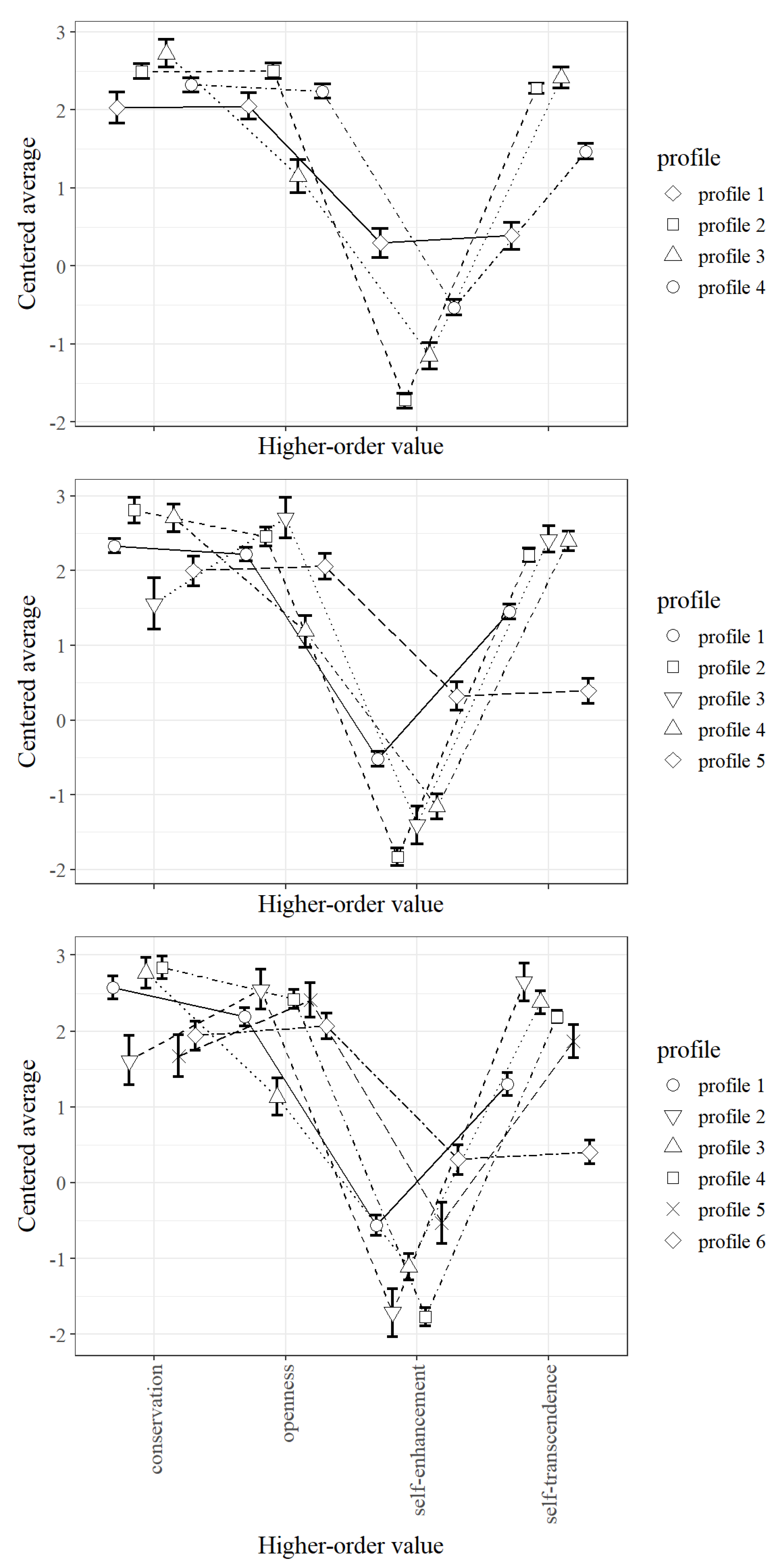
3.2. RQ1: Do Distinct Value Profiles Emerge?
3.2.1. Model Selection and Retained Solution
3.2.2. Description of the Five Profiles
3.3. RQ2: Do Value Profiles Differ in National Identification, Attitudes Towards Minorities, and Multicultural Experience (Exposure and Interaction)?
3.4. RQ3: Do Value Profiles Moderate the Association Between National Identification and Attitudes Towards Minorities?
4. Discussion
4.1. Value Profiles in Croatian Youth
4.2. Between-Profile Differences in Minority Attitudes and National Identification
4.3. Value Profiles as Moderators of the National Identification–Minority Attitudes Association
4.4. Limitations
4.5. Conclusions
Supplementary Materials
Author Contributions
Funding
Institutional Review Board Statement
Informed Consent Statement
Data Availability Statement
Conflicts of Interest
References
- Tajfel, H.; Turner, J.C. An Integrative Theory of Intergroup Conflict. In The Social Psychology of Intergroup Relations; Austin, W.G., Worchel, S., Eds.; Brooks/Cole: Monterey, CA, USA, 1979; pp. 33–48. [Google Scholar]
- Tajfel, H.; Turner, J.C. The Social Identity Theory of Intergroup Behaviour. In Psychology of Intergroup Relations; Worchel, S., Austin, W., Eds.; Nelson Hall: Chicago, IL, USA, 1986; pp. 7–24. [Google Scholar]
- Hornsey, M.J. Social Identity Theory and Self-Categorization Theory: A Historical Review. Soc. Pers. Psychol. Compass 2008, 2, 204–222. [Google Scholar] [CrossRef] [Scilit]
- Trepte, S. Social Identity Theory. In Psychology of Entertainment; Bryant, J., Vorderer, P., Eds.; Routledge: London, UK, 2013; pp. 255–271. [Google Scholar]
- Greco, L.M.; Porck, J.P.; Walter, S.L.; Scrimpshire, A.J.; Zabinski, A.M. A Meta-Analytic Review of Identification at Work: Relative Contribution of Team, Organizational, and Professional Identification. J. Appl. Psychol. 2022, 107, 795–830. [Google Scholar] [CrossRef] [Scilit]
- Steffens, N.K.; Haslam, S.A.; Schuh, S.C.; Jetten, J.; van Dick, R. A Meta-Analytic Review of Social Identification and Health in Organizational Contexts. Pers. Soc. Psychol. Rev. 2017, 21, 303–335. [Google Scholar]
- Steffens, N.K.; LaRue, C.J.; Haslam, C.; Walter, Z.C.; Cruwys, T.; Munt, K.A.; Tarrant, M. Social Identification-Building Interventions to Improve Health: A Systematic Review and Meta-Analysis. Health Psychol. Rev. 2021, 15, 85–112. [Google Scholar]
- Chapman, C.M.; Spence, J.L.; Hornsey, M.J.; Dixon, L. Social Identification and Charitable Giving: A Systematic Review and Meta-Analysis. Nonprofit Volunt. Sect. Q. 2025, 54, 1308–1341. [Google Scholar] [CrossRef] [Scilit]
- Balliet, D.; Wu, J.; De Dreu, C.K. Ingroup Favoritism in Cooperation: A Meta-Analysis. Psychol. Bull. 2014, 140, 1556. [Google Scholar] [CrossRef] [Scilit] [PubMed]
- Wichardt, P.C. Identity and why we cooperate with those we do. J. Econ. Psychol. 2008, 29, 127–139. [Google Scholar] [CrossRef] [Scilit]
- Schmidt, K.; Drake, R.G. Minimal Group Procedures and Outcomes. Collabra Psychol. 2023, 9, 90187. [Google Scholar] [CrossRef] [Scilit]
- Yang, X.; Yang, F.; Guo, C.; Dunham, Y. Which Group Matters More: The Relative Strength of Minimal vs. Gender and Race Group Memberships in Children’s Intergroup Thinking. Acta Psychol. 2022, 229, 103685. [Google Scholar] [CrossRef] [Scilit]
- Bonin, K.; Lane, J.E. Identity Fusion, Devoted Actor Theory, and Extremism. In Routledge Handbook of Evolutionary Approaches to Religion; Routledge: London, UK, 2022; pp. 46–64. [Google Scholar]
- Swann, W.B.; Buhrmester, M.D. Identity Fusion. Curr. Dir. Psychol. Sci. 2015, 24, 52–57. [Google Scholar] [CrossRef] [Scilit]
- Varmann, A.H.; Kruse, L.; Bierwiaczonek, K.; Gomez, A.; Vazquez, A.; Kunst, J.R. How Identity Fusion Predicts Extreme Pro-Group Orientations: A Meta-Analysis. Eur. Rev. Soc. Psychol. 2024, 35, 162–197. [Google Scholar]
- Yogeeswaran, K.; Verkuyten, M. The Political Psychology of National Identity. In The Cambridge Handbook of Political Psychology; Osborne, D., Sibley, C.G., Eds.; Cambridge University Press: Cambridge, UK, 2022; pp. 311–328. [Google Scholar]
- Kunovich, R.M. The Sources and Consequences of National Identification. Am. Sociol. Rev. 2009, 74, 573–593. [Google Scholar] [CrossRef] [Scilit]
- Pehrson, S.; Vignoles, V.L.; Brown, R. National Identification and Anti-Immigrant Prejudice: Individual and Contextual Effects of National Definitions. Soc. Psychol. Q. 2009, 72, 24–38. [Google Scholar] [CrossRef] [Scilit]
- Theiss-Morse, E. Who Counts as an American? The Boundaries of National Identity; Cambridge University Press: Cambridge, UK, 2009. [Google Scholar]
- Bitschnau, M.; Mußotter, M. (National) Pride and (Conceptual) Prejudice: Critical Remarks on the Distinction between Patriotism and Nationalism. J. Polit. Ideol. 2024, 29, 64–78. [Google Scholar] [CrossRef] [Scilit]
- Staub, E. Blind versus Constructive Patriotism: Moving from Embeddedness in the Group to Critical Loyalty and Action. In Patriotism in the Lives of Individuals and Nations; Bar-Tal, D., Staub, E., Eds.; Nelson-Hall: Chicago, IL, USA, 1997; pp. 213–228. [Google Scholar]
- Brewer, M.B. The Psychology of Prejudice: Ingroup Love and Outgroup Hate? J. Soc. Issues 1999, 55, 429–444. [Google Scholar] [CrossRef] [Scilit]
- Bar-Tal, D. Patriotism as Fundamental Beliefs of Group Members. Politics Individ. 1993, 3, 45–62. [Google Scholar]
- Feshbach, S. Nationalism, Patriotism, and Aggression: A Clarification of Functional Differences. In Aggressive Behavior: Current Perspectives; Springer: Boston, MA, USA, 1994; pp. 275–291. [Google Scholar]
- Golec de Zavala, A.; Lantos, D. Collective narcissism and its social consequences: The bad and the ugly. Curr. Dir. Psychol. Sci. 2020, 29, 273–278. [Google Scholar] [CrossRef] [Scilit]
- Nincic, M.; Ramos, J.M. The Sources of Patriotism: Survey and Experimental Evidence. Foreign Policy Anal. 2012, 8, 373–388. [Google Scholar] [CrossRef] [Scilit]
- Schwartz, S.H. Universals in the Content and Structure of Values: Theory and Empirical Tests in 20 Countries. In Advances in Experimental Social Psychology; Zanna, M., Ed.; Academic Press: New York, NY, USA, 1992; Volume 25, pp. 1–65. [Google Scholar]
- Schwartz, S.H. Les valeurs de base de la personne: Théorie, mesures et applications [Basic human values: Theory, measurement, and applications]. Rev. Française Sociol. 2006, 42, 249–288. [Google Scholar]
- Schwartz, S.H. An Overview of the Schwartz Theory of Basic Values. Online Read. Psychol. Cult. 2012, 2, 1–20. [Google Scholar]
- Schwartz, S.H.; Caprara, G.V.; Vecchione, M. Basic Personal Values, Core Political Values, and Voting: A Longitudinal Analysis. Polit. Psychol. 2010, 31, 421–452. [Google Scholar]
- Schwartz, S.H.; Caprara, G.V.; Vecchione, M.; Bain, P.; Bianchi, G.; Caprara, M.G.; Zaleski, Z. Basic Personal Values Underlie and Give Coherence to Political Values: A Cross National Study in 15 Countries. Polit. Behav. 2014, 36, 899–930. [Google Scholar]
- Livi, S.; Leone, L.; Falgares, G.; Lombardo, F. Values, Ideological Attitudes and Patriotism. Pers. Individ. Dif. 2014, 64, 141–146. [Google Scholar] [CrossRef] [Scilit]
- Yazıcı, F. The Values Predicting Patriotism Attitudes in Turkey. Curr. Psychol. 2022, 41, 135–145. [Google Scholar] [CrossRef] [Scilit]
- Miles, E.; Crisp, R.J. A Meta-Analytic Test of the Imagined Contact Hypothesis. Group Process. Intergroup Relat. 2014, 17, 3–26. [Google Scholar] [CrossRef] [Scilit]
- Pettigrew, T.F.; Tropp, L.R. A Meta-Analytic Test of Intergroup Contact Theory. J. Pers. Soc. Psychol. 2006, 90, 751–783. [Google Scholar] [CrossRef] [Scilit] [PubMed]
- Zhou, S.; Page-Gould, E.; Aron, A.; Moyer, A.; Hewstone, M. The Extended Contact Hypothesis: A Meta-Analysis on 20 Years of Research. Pers. Soc. Psychol. Rev. 2019, 23, 132–160. [Google Scholar] [CrossRef] [Scilit]
- Sagiv, L.; Schwartz, S.H. Value Priorities and Readiness for Out-Group Social Contact. J. Pers. Soc. Psychol. 1995, 69, 437–448. [Google Scholar] [CrossRef]
- Sagiv, L.; Schwartz, S.H. Personal Values across Cultures. Annu. Rev. Psychol. 2022, 73, 517–546. [Google Scholar] [CrossRef] [Scilit]
- Croatian Bureau of Statistics. Objavljeni Konačni Rezultati Popisa 2021. Available online: https://dzs.gov.hr/vijesti/objavljeni-konacni-rezultati-popisa-2021/1270 (accessed on 1 December 2025).
- McCauley, C.; Moskalenko, S. Mechanisms of Political Radicalization: Pathways toward Terrorism. Terror. Polit. Violence 2008, 20, 415–433. [Google Scholar] [CrossRef] [Scilit]
- Atran, S.; Sheikh, H. Dangerous Terrorists as Devoted Actors. In Evolutionary Perspectives on Social Psychology; Springer International Publishing: Cham, Switzerland, 2015; pp. 401–416. [Google Scholar]
- Ginges, J.; Atran, S. Sacred Values and Cultural Conflict. In Advances in Culture and Psychology; Gelfand, M.J., Chiu, C.-Y., Hong, Y.-Y., Eds.; Oxford University Press: Oxford, UK, 2014; pp. 273–301. [Google Scholar]
- Primorac, D.; Anđelinović, Š.; Definis-Gojanović, M.; Škaro, V.; Projić, P.; Čoklo, M.; Marjanović, D. Identification of Skeletal Remains in Croatia and Bosnia and Herzegovina, Including the Homeland War–a 30-Year Review. Croat. Med. J. 2024, 65, 239–248. [Google Scholar] [CrossRef] [Scilit]
- Blanuša, N. Croatia between the “Return” to Europe and the “Remaining” in the Balkans. In Croatia and the European Union; Maldini, P., Pauković, D., Eds.; Routledge: London, UK, 2016; pp. 69–92. [Google Scholar]
- Butković, H.; Šelo Šabić, S. The Challenges of Euroscepticism in Croatia: Ten Years after EU Accession. Online J. Modelling New Eur. 2023, 42, 81–108. [Google Scholar] [CrossRef] [Scilit]
- Franc, R.; Soler-i-Marti, R.; Pavlović, T.; Popov, A.; Fooks, G. Cultural Heritage & Identities of Europe’s Future (CHIEF) Survey of Young People’s Cultural Literacy; Common Data File with Relevant Documentation (Horizon 2020, Grant Reference 770464, WP3, D3.3); Aston University: Birmingham, UK, 2021. [Google Scholar]
- Türken, S.; Rudmin, F.W. On Psychological Effects of Globalization: Development of a Scale of Global Identity. Psychol. Soc. 2013, 5, 63–89. [Google Scholar]
- Sandy, C.J.; Gosling, S.D.; Schwartz, S.H.; Koelkebeck, T. The Development and Validation of Brief and Ultrabrief Measures of Values. J. Pers. Assess. 2017, 99, 545–555. [Google Scholar] [CrossRef] [Scilit]
- IEA Civic Education Study (Cived). ICCS 2016 Technical Report; IEA (International Association for the Evaluation of Educational Achievement): Amsterdam, The Netherlands, 2016; pp. 202–203. [Google Scholar]
- R Core Team. R: A Language and Environment for Statistical Computing; R Foundation for Statistical Computing: Vienna, Austria, 2025. [Google Scholar]
- Van Lissa, C.J. tidySEM: Tidy Structural Equation Modeling. Available online: https://cran.r-project.org/web/packages/tidySEM/index.html (accessed on 15 October 2025). [CrossRef] [Scilit]
- Van Lissa, C.J.; Garnier-Villarreal, M.; Anadria, D. Recommended Practices in Latent Class Analysis Using the Open-Source R-Package tidySEM. Struct. Equ. Model. 2024, 31, 526–534. [Google Scholar] [CrossRef] [Scilit]
- Kowarik, A.; Templ, M. Imputation with the R Package VIM. J. Stat. Softw. 2016, 74, 1–16. [Google Scholar]
- Bolck, A.; Croon, M.; Hagenaars, J. Estimating Latent Structure Models with Categorical Variables: One-Step versus Three-Step Estimators. Polit. Anal. 2004, 12, 3–27. [Google Scholar]
- Lo, Y.; Mendell, N.R.; Rubin, D.B. Testing the number of components in a normal mixture. Biometrika 2001, 88, 767–778. [Google Scholar] [CrossRef] [Scilit]
- Aho, K.; Derryberry, D.; Peterson, T. Model Selection for Ecologists: The Worldviews of AIC and BIC. Ecology 2014, 95, 631–636. [Google Scholar] [CrossRef] [Scilit]
- Nylund, K.L.; Asparouhov, T.; Muthén, B.O. Deciding on the Number of Classes in Latent Class Analysis and Growth Mixture Modeling: A Monte Carlo Simulation Study. Struct. Equ. Model. 2007, 14, 535–569. [Google Scholar] [CrossRef] [Scilit]
- Pavlović, T.; Rajter, M. Razlike u odnosu osobnih vrijednosti i mračne trijade kod muškaraca i žena. Društvena Istraživanja 2020, 29, 349–371. [Google Scholar] [CrossRef] [Scilit]
- Alfirević, N.; Potočan, V.; Nedelko, Z. Roles of Personal Values and Information Technology Usage in Forming the University Students’ View of Environmental Sustainability: A Preliminary Regional Study of Economics and Business Students. Sustainability 2024, 16, 9830. [Google Scholar] [CrossRef] [Scilit]
- Dević, I.; Franc, R.; Mateša Dević, R. Stabilnost i promjene osobnih i (post) materijalističkih vrijednosti hrvatskih građana. Društvena Istraživanja 2020, 29, 263–285. [Google Scholar] [CrossRef] [Scilit]
- Bullock, J.; Lane, J.E.; Mikloušić, I.; Shults, F.L. Modeling Nationalism, Religiosity, and Threat Perception: During the COVID-19 Pandemic. PLoS ONE 2023, 18, e0281002. [Google Scholar] [CrossRef] [Scilit]
- Akrami, N.; Ekehammar, B.; Bergh, R. Generalized Prejudice: Common and Specific Components. Psychol. Sci. 2011, 22, 57–59. [Google Scholar] [CrossRef] [Scilit] [PubMed]
- Schwartz, S.J.; Dunkel, C.S.; Waterman, A.S. Terrorism: An Identity Theory Perspective. Stud. Confl. Terror. 2009, 32, 537–559. [Google Scholar] [CrossRef] [Scilit]
- Bevanda, D. Proturadikalizacija–mogu li koncepti generalne prevencije dovesti do suzbijanja terorizma? Most. Časopis Društvene Humanističke Znan. 2024, 28, 159–180. [Google Scholar]


| M | SD | (1) | (2) | (3) | (4) | (5) | (6) | (7) | ||
|---|---|---|---|---|---|---|---|---|---|---|
| (1) | self-enhancement | 3.27 | 1.12 | 1 | ||||||
| (2) | self-transcendence | 5.02 | 0.97 | −0.61 *† | 1 | |||||
| (3) | openness to change | 4.59 | 0.96 | −0.20 *† | −0.11 *† | 1 | ||||
| (4) | conservation | 4.22 | 0.97 | −0.30 *† | 0.02 | −0.20 *† | 1 | |||
| (5) | national identification | 0 | 0.90 | −0.04 | −0.05 | 0.04 | 0.26 *† | 1 | ||
| (6) | general attitude towards minorities | 0 | 0.93 | −0.12 *† | 0.31 *† | 0.15 *† | −0.05 | −0.12 *† | 1 | |
| (7) | attitudes towards specific minorities | 0 | 0.95 | −0.12 *† | 0.30 *† | 0.07 * | −0.03 | −0.16 *† | 0.79 *† | 1 |
| Profiles | LL | Parameters | AIC | BIC | saBIC | Entropy | % in the Smallest Profile | LMR | |
|---|---|---|---|---|---|---|---|---|---|
| p | p(ω2) | ||||||||
| 1 | −4713.0 | 8 | 9442.0 | 9481.2 | 9455.8 | 1 | 100% | - | - |
| 2 | −4508.6 | 13 | 9043.3 | 9107.0 | 9065.7 | 0.69 | 39% | <0.001 | <0.001 |
| 3 | −4484.2 | 18 | 9004.5 | 9092.7 | 9035.5 | 0.63 | 11% | <0.001 | 0.089 |
| 4 | −4400.8 | 23 | 8847.5 | 8960.3 | 8887.2 | 0.70 | 8% | <0.001 | <0.001 |
| 5 | −4374.7 | 28 | 8805.4 | 8942.7 | 8853.8 | 0.67 | 8% | <0.001 | 0.084 |
| 6 | −4358.0 | 33 | 8782.0 | 8943.8 | 8839.0 | 0.65 | 6% | 0.012 | 0.603 |
| 7 | −4331.2 | 38 | 8738.3 | 8924.6 | 8803.9 | 0.69 | 3% | <0.001 | 0.699 |
| 8 | −4312.1 | 43 | 8710.3 | 8921.1 | 8784.5 | 0.70 | 3% | 0.035 | 0.894 |
| 9 | −4295.1 | 48 | 8686.2 | 8921.4 | 8769.0 | 0.70 | 4% | 0.013 | 0.956 |
| 10 | −4283.6 | 53 | 8673.1 | 8932.9 | 8764.6 | 0.70 | 4% | 0.020 | 0.980 |
| Profile | Name | M | p | 1 | 2 | 3 | 4 | 5 | |
|---|---|---|---|---|---|---|---|---|---|
| general attitude towards minorities | 1 | (C–O)–T–E | −0.09 | * | - | ||||
| 2 | C–O–T–E | 0.16 | ** | *** | - | ||||
| 3 | (O–T)–C–E (openness-over-conservation) | 0.48 | *** | *** | *** | - | |||
| 4 | (C–T)–O–E (conservation-over-openness) | 0.00 | *** | - | |||||
| 5 | (C–O)–(T–E) | −0.71 | *** | *** | *** | *** | *** | - | |
| attitudes towards specific minorities | 1 | (C–O)–T–E | −0.12 | * | - | ||||
| 2 | C–O–T–E | 0.16 | ** | *** | - | ||||
| 3 | (O–T)–C–E (openness-over-conservation) | 0.40 | *** | *** | ** | - | |||
| 4 | (C–T)–O–E (conservation-over-openness) | 0.12 | * | ** | - | ||||
| 5 | (C–O)–(T–E) | −0.70 | *** | *** | *** | *** | *** | - | |
| national identification | 1 | (C–O)–T–E | 0.03 | - | |||||
| 2 | C–O–T–E | 0.22 | *** | ** | - | ||||
| 3 | (O–T)–C–E (openness-over-conservation) | −0.64 | *** | *** | *** | - | |||
| 4 | (C–T)–O–E (conservation-over-openness) | −0.04 | *** | *** | - | ||||
| 5 | (C–O)–(T–E) | −0.04 | ** | *** | - |
| Profile | Name | b | p | 1 | 2 | 3 | 4 | 5 | |
|---|---|---|---|---|---|---|---|---|---|
| General attitude towards minorities | 1 | (C–O)–T–E | −0.03 | - | |||||
| 2 | C–O–T–E | −0.12 | - | ||||||
| 3 | (O–T)–C–E (openness-over-conservation) | 0.13 | * | - | |||||
| 4 | (C–T)–O–E (conservation-over-openness) | −0.27 | ** | * | *** | - | |||
| 5 | (C–O)–(T–E) | −0.34 | * | * | ** | - | |||
| Attitudes towards specific minorities | 1 | (C–O)–T–E | −0.17 | ** | - | ||||
| 2 | C–O–T–E | −0.15 | * | - | |||||
| 3 | (O–T)–C–E (openness-over-conservation) | 0.07 | * | * | - | ||||
| 4 | (C–T)–O–E (conservation-over-openness) | −0.32 | *** | ** | - | ||||
| 5 | (C–O)–(T–E) | −0.20 | - |
| Profile Name | General Attitudes Towards Minorities | Attitudes Towards Specific Minorities | |
|---|---|---|---|
| Comparison of averages | (C–O)–T–E (similar conservation and openness) | about the overall average | about the overall average |
| C–O–T–E (hierarchy—conservation first) | about the overall average | about the overall average | |
| (O–T)–C–E (openness-over-conservation) | above the overall average | above the overall average | |
| (C–T)–O–E (conservation-over-openness) | about the overall average | about the overall average | |
| (C–O)–(T–E) (conservation-and-openness-over-self-transcendece-and-enhancement) | below the overall average | below the overall average | |
| Relationship (b) with national identification | (C–O)–T–E (similar conservation and openness) | negative, insignificant | negative, significant |
| C–O–T–E (hierarchy—conservation first) | negative, (marginally) insignificant | negative, significant | |
| (O–T)–C–E (openness-over-conservation) | positive, (marginally) insignificant | positive, insignificant | |
| (C–T)–O–E (conservation-over-openness) | negative, significant | negative, significant | |
| (C–O)–(T–E) (conservation-and-openness-over-self-transcendece-and-enhancement) | negative, significant | negative, (marginally) insignificant |
Disclaimer/Publisher’s Note: The statements, opinions and data contained in all publications are solely those of the individual author(s) and contributor(s) and not of MDPI and/or the editor(s). MDPI and/or the editor(s) disclaim responsibility for any injury to people or property resulting from any ideas, methods, instructions or products referred to in the content. |
© 2026 by the authors. Licensee MDPI, Basel, Switzerland. This article is an open access article distributed under the terms and conditions of the Creative Commons Attribution (CC BY) license.
Share and Cite
Pavlović, T.; Maglić, M.; Antić, M.; Mikloušić, I. Value Profiles as Moderators of the Relationship Between National Identification and Attitudes Towards Minorities: An Example from Croatian Youth. Adolescents 2026, 6, 29. https://doi.org/10.3390/adolescents6020029
Pavlović T, Maglić M, Antić M, Mikloušić I. Value Profiles as Moderators of the Relationship Between National Identification and Attitudes Towards Minorities: An Example from Croatian Youth. Adolescents. 2026; 6(2):29. https://doi.org/10.3390/adolescents6020029
Chicago/Turabian StylePavlović, Tomislav, Marina Maglić, Marija Antić, and Igor Mikloušić. 2026. "Value Profiles as Moderators of the Relationship Between National Identification and Attitudes Towards Minorities: An Example from Croatian Youth" Adolescents 6, no. 2: 29. https://doi.org/10.3390/adolescents6020029
APA StylePavlović, T., Maglić, M., Antić, M., & Mikloušić, I. (2026). Value Profiles as Moderators of the Relationship Between National Identification and Attitudes Towards Minorities: An Example from Croatian Youth. Adolescents, 6(2), 29. https://doi.org/10.3390/adolescents6020029