1. Introduction
Social media use has increased exponentially [
1]. In Mexico, digital penetration is high. By 2024, there were 100 million internet users according to the National Institute of Statistics and Geography (INEGI), representing 83.1% of people aged 6 years and older [
2]. In addition, according to DataReportal [
3], there are currently 110 million internet users, of which 99 million are social media users. This means that platforms such as Instagram reach tens of millions of users. Social media platforms include blogs, virtual gaming worlds, and social media sites for creating, collaborating, and sharing content online, and they can have a considerable influence on individuals’ sociability, habits, and mental health [
4,
5]. What is worse, they employ key metrics such as “likes,” followers, and comments to keep users engaged [
6]. As Petekkaya et al. [
7] point out, one social media-related activity offered by innovative photo and video sharing apps is the taking of selfies, which have become a means of self-expression in the last decade.
Selfies are characterised by three interrelated components: (1) they involve visual reproduction and (2) a portrait of the human face, and (3) they are created for the purpose of sharing. A selfie is a photo of oneself, usually taken with a smartphone or webcam via a selfie stick or by hand, which is then shared on social media [
8,
9,
10,
11,
12]. One of the most common social medial activities in the modern era is the taking and sharing of selfies; they satisfy the need for communication and self-exploration, attracting favourable comments and attention from peers and strangers alike. Similarly, the receipt of feedback (e.g., comments and likes) is associated with one spending more time using and checking one’s social media accounts. Social median can thus have a dual psychological influence, being capable of generating both positive and negative effects on mental health [
4,
13,
14]. Fs et al. [
15] warn that social media use can affect young people’s mental health, generating problems such as self-discrepancy, loneliness, and the development of narcissistic characteristics such as vanity and grandiose exhibitionism, which are understood to be adaptive evolutionary self-promotion mechanisms.
Adolescence and emerging adulthood are periods in which people tend to be more sensitive to their status among their peers. Therefore, selfies can serve as a low-cost tool in the search for belonging and status, as receiving many “likes” and positive comments is considered by young people to signify popularity [
16].
Narcissism is characterised by a need for admiration, grandiosity, and a lack of empathy. Relatedly, narcissists experience fear in the face of revealing their imperfections and flaws; they also tend to be simplistic, exploitative, superficial, and stubborn [
17]. Narcissists tend to focus on their own feelings at the expense of those of others and to believe in their own superiority [
18,
19]. They do not prioritise warmth, interpersonal intimacy, or long-term positive relationships, although they often initiate them to appear successful and popular and to accrue status in the short term [
18]. There are various subcategories of narcissism, such as grandiose narcissism, which is associated with egocentricity, manipulation, interpersonal dominance, insensitivity, and a lack of modesty, and vulnerable narcissism, which is related to reactive anger, hostility, psychological distress, distrust, negative affectivity (e.g., shame, anxiety), egocentricity, and low self-esteem [
20]. Similarly, egocentricity, vanity, and theatrical social behaviour are associated with grandiose exhibitionism. A willingness to manipulate others for personal gain, coupled with the belief that one deserves privileges and respect, are associated with narcissistic exploitation, selfishness, dominance, and entitlement. The particularities of authority and leadership are associated with social skills, a belief in superior leadership, a sense of dominance, and an exaggerated view of oneself [
21,
22]. There are a number of studies that link narcissistic characteristics with the use of social media, such as that by Jiang et al. [
19], who revealed the relationship between high levels of narcissistic characteristics and high levels of problematic social media use in adolescents.
Previous research has determined that self-pity and narcissism in women mediate between self-esteem and women’s self-perceived body image by way of social media, and that adolescents tend to use social media excessively, sometimes displaying signs of addiction [
9,
23]. Other studies have found that both young men and women report using Instagram daily, but women report spending more time on Instagram and making more appearance-related comparisons. It should be noted that posting selfies on Instagram is not directly related to body-shame but rather to appearance comparisons [
21,
24]. Fidan et al. [
25] point out that most adolescents share meaningless or funny videos and filtered photos—especially selfies—to attract the attention of their peers. Individuals with narcissistic characteristics may use smartphones to present themselves on social networks (Instagram, Facebook, etc.) in such a way as to induce a positive mood change and satisfy their need for gratification [
26]. Richa et al. [
27] thus suggest that the effects of extraversion, as well as a person’s exhibitionist traits, are significant.
Consequently, selfies and narcissism are related; individuals who take selfies usually see themselves from an external observer’s perspective; i.e., they are more concerned with their physical appearance. People deliberately choose and edit their selfies before consciously posting them. While a selfie is an extension of the self, i.e., a personal mode of expression, it is one that is filtered through social networks, with their emphasis on glamour and asserting the best possible version of oneself [
28,
29]. Posting selfies is related to predictors of psychological needs for competence and relatedness in individuals with a high degree of exhibitionism; i.e., when one presents oneself in an exaggeratedly positive way, one tends to fall deeper in love with oneself [
28,
30]. Selfies thus have a self-reinforcing effect, along with a reciprocal process that can contribute to increased levels of narcissism [
31]. Taylor [
32], as well as emphasising the relationship between social media use and narcissism, also highlighted the even stronger relationship between social media use and envy.
Given that the phenomenon of taking selfies is growing, and that there are ongoing discussions in the media and academia concerning the value and wider implications of social media, it is recommended that further research into the causes of selfie addiction be conducted. It is also important to address social media addiction among adolescents more generally [
9,
33,
34], as well as to study the effects of social media on psychological processes in order to identify potential means of mitigating them [
23]. At the same time, there is a lack of studies on the particular impact of body image ideals on problematic social media use and the factors that mediate this relationship [
14]. Beos et al. [
35] suggest that while general social media use should be investigated, it is important to delve deeper into the relationship between social media use and one’s assessment of one’s physical appearance.
The present study contributes to this discussion in three ways: First, it provides cross-validated structural evidence via exploratory factor analysis (EFA) and confirmatory factor analysis (CFA) for the NPI-40 and PSAS adapted to the Mexican student context. Second, the structural equation model is parsimonious, clarifying the differential relationships between the narcissistic characteristics of exhibitionism, authority, and exploitation and selfie addiction. Third, the findings have implications for the promotion of psychological well-being and digital literacy in late adolescents and emerging adults. It is worth emphasising from the outset that, given the response format and limited number of items, these results should be interpreted as preliminary.
Using structural equation modelling (SEM), the aim of this study was to analyse the relationships between the various dimensions of selfie addiction and narcissism in a sample of 264 students from the Universidad Autónoma de Zacatecas (UAZ, Autonomous University of Zacatecas). We sought to identify the narcissistic characteristics that may be associated with addiction to selfies.
2. Materials and Methods
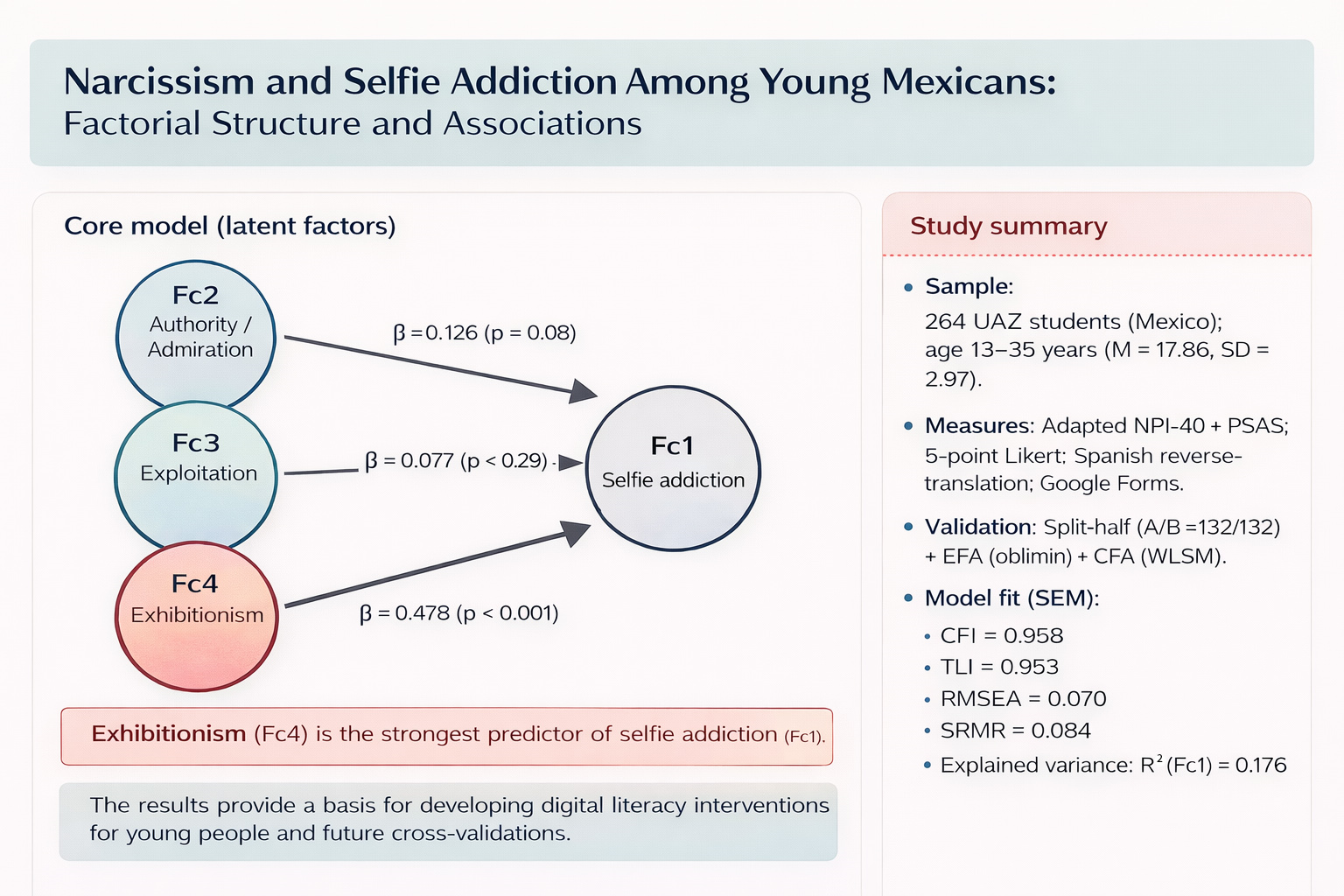
The relationships between different aspects of narcissism and selfie addiction were analysed using structural equation modelling (SEM) with a sample of 264 students from the UAZ, Mexico. The sample consisted mainly of late adolescents and emerging adults, aged between 13 and 35 years (M = 17.86; SD = 2.97). The Narcissistic Personality Inventory (Adapted NPI-40) and the Psychometric Selfie Addiction Scale (PSAS) [
36,
37] were used to analyse and identify the factorial structure. Data collection was carried out between September and November 2024 among UAZ students using convenience sampling. The invitation to participate was distributed through institutional communication channels such as WhatsApp groups associated with different subjects by teachers and programme managers. Since the link to the survey was shared through group channels and participation was voluntary, it was not possible to determine the total number of people who saw the invitation, so the response rate could not be calculated. The WhatsApp message contained a brief explanation of the research, eligibility criteria, and ethical considerations. Regarding the inclusion criteria, students had to be currently enrolled at UAZ and to have provided informed consent. In the case of minors, written consent from a legal guardian was also required. Incomplete questionnaires were removed from the analysis. Based on the above, exploratory factor analysis (EFA) and confirmatory factor analysis (CFA) were used as part of the structural validation process; the information was obtained through questionnaires provided via Google Forms, as in previous studies [
38,
39]. It is important to note that an ethics statement for research involving human subjects was added to the Google Forms questionnaire. It was also explained that the research project was approved by the Higher Education Teaching Unit Council, which is the institutional body responsible for ethical oversight, in addition to reviewing research protocols. Furthermore, it was also mentioned that the research project is registered with the UAZ Research and Postgraduate Coordination Office under number UAZ-2024-39072, as has been the case in previous studies [
40,
41,
42]. To ensure the confidentiality of the respondents, no information that could compromise their identity was requested, and they were also given the right not to answer the questions and to stop answering the questionnaire at any time without any consequences. The statistical programme JASP 0.19.2 was used to perform the SEM analysis. The PSAS and Adapted NPI-40 were customised using a 5-point Likert scale (1 = Strongly disagree; 2 = Disagree; 3 = Neither disagree nor agree; 4 = Agree; 5 = Strongly agree), following previous protocols [
38,
39,
43].
No a priori sample size calculation was performed as data collection was limited by student availability between September and November 2024. However, the sample (n = 264) was considered adequate for the planned analyses. Although SEM sample size requirements depend on the model, simulation research and implemented guidelines suggest that samples in the range of 200 are usually appropriate for SEM of moderate complexity, including WLSM with ordinal indicators, as mentioned in previous studies [
44]. Our model is parsimonious, with four latent variables; furthermore, it was additionally validated using split-half EFA/CFA. Thus, as a first step, reliability was assessed using Cronbach’s alpha (α = 0.896) and McDonald’s Omega coefficient (ω = 0.895), as in previous studies [
45,
46,
47,
48,
49]. Subsequently, to verify the suitability of the data for performing the EFA, they were checked using the Kaiser–Mayer–Olkin (KMO) test, which yielded a value of 0.832, and Bartlett’s sphericity test, with a
p ≤ 0.001, replicating reported methods [
38,
50]. In addition to the above, the EFA was performed with an oblimin oblique rotation as this allows for better interpretation of the correlations between factors. Then, normality was assessed. Since the items are ordinal Likert 1 to 5, the EFA was estimated using the robust weighted least squares means adjusted method (WLSM). Due to deviations from normality in the Likert-type items, a least squares extraction method was used in the EFA, as in previous research [
51,
52]. We also decided to eliminate 26 items from the NPI-40 and 1 from the PSAS that had a factor loading value of less than 0.3, as recommended in previous studies [
50,
53,
54,
55,
56]. Subsequently, a confirmatory factor analysis (CFA) was carried out within the structural equation modelling (SEM) methodology.
Measures
Narcissistic characteristics were measured using the Narcissistic Personality Inventory (NPI-40), originally proposed by Raskin and Terry (1988) [
37]. Selfie addiction behaviours were assessed using the Psychometric Selfie Addiction Scale (PSAS) by Arumugam and Nagalingam (2015) [
36]. The statements were formulated as affirmations (see
Appendix A Table A1 and
Table A2 for the wording of the items). The purpose of this was to capture the narcissistic facets of authority, self-sufficiency, superiority, exhibitionism, exploitation, vanity, and entitlement, as well as the tendencies of these dimensions, in addition to their possible association with loss of control over taking selfies and difficulty in reducing selfie-taking behaviour.
For this study, both the NPI-40 and the PSAS were adapted with 5-point Likert-type responses, where 1 = Strongly disagree, 2 = Disagree, 3 = Neither agree nor disagree, 4 = Agree, and 5 = Strongly agree. This followed previous protocols that used Likert scales for ordinal modelling in EFA, CFA, and SEM. The items were translated into Spanish using a reverse translation and consensus procedure and were reviewed to verify their equivalence. Data were collected using Google Forms.
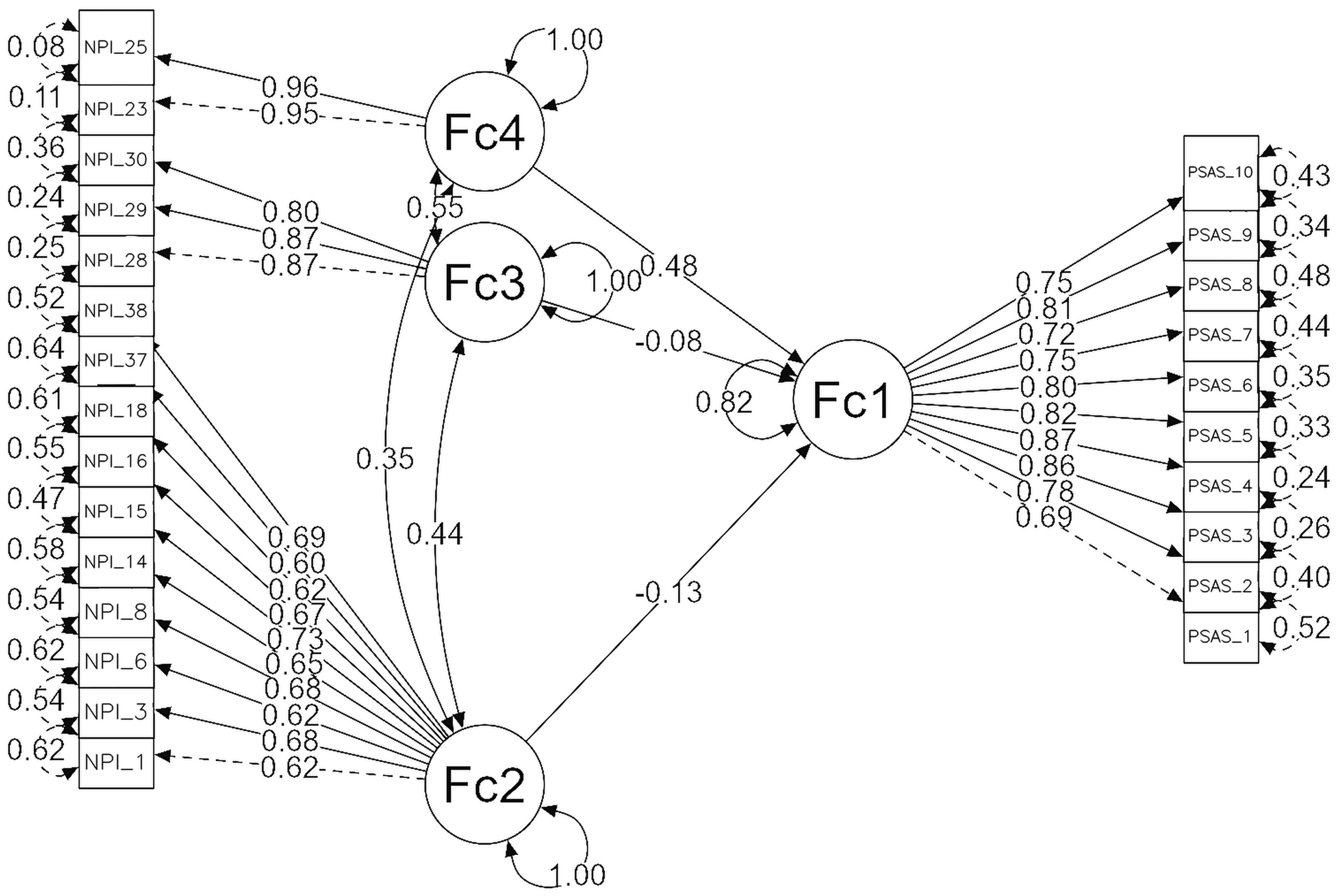
The highest levels of the constructs were indicated by high scores. The analyses were carried out using latent variables. Therefore, the quality of the measurements was evaluated through reliability indices and factor loadings. During the EFA, items with factor loadings < 0.30 were discarded. The final measurement model retained 9 items from the PSAS and 15 from the NPI-40 (Adapted NPI-40), which loaded the narcissistic characteristics modelled in the SEM (
Table 1). Additionally, internal consistency was estimated using Cronbach’s alpha and McDonald’s Omega, as well as Spearman–Brown split-half.
Once the data had been collected, the cross-validation strategy was continued, and the sample (n = 264) was randomly divided into two equal subsamples (A: n = 132; B: n = 132), as was performed in other studies [
57,
58]. An EFA was then performed on subsample “A,” with a KMO of 0.804 and Bartlett’s sphericity test indicating a
p-value of 0.001. In addition, an oblique rotation was performed using the least squares factorisation method, in which three factors were identified (
Table 1). The first factor is unidimensional, with nine PSAS items, while factors two and three were derived from Adapted NPI-40 statements, with seven items each. Subsequently, CFA was performed on subsample “B” to verify the factors obtained in subsample “A” (
Table 2).
In this regard, Factor 1 is defined solely by PSAS statements 1 to 9, with loadings between 0.830 and 0.544. Similarly, Factor 2 is made up of items Adapted NPI_28, Adapted NPI_30, Adapted NPI_29, Adapted NPI_23, and Adapted NPI_25, with loadings ranging from 0.841 to 0.545. In addition to the above, Adapted NPI_15, Adapted NPI_14, Adapted NPI_18, Adapted NPI_3, Adapted NPI_6, Adapted NPI_37, Adapted NPI_38, and Adapted NPI_1 comprise Factor 3, with loadings ranging from 0.737 to 0.343 (
Table 1).
With subsample “B,” the CFA was estimated using the weighted least squares means adjusted approach (WLSM), which showed an χ
2 (gl) = 322.296 (249) (
p = 0.001) contrast, which is expected in SEMs with moderate sample sizes and ordinal variables. Based on the above, an overall fit is observed, with CFI = 0.967, TLI = 0.964, GFI = 0.922, SRMR = 0.100, and RMSEA = 0.047 (
Table 2).
Finally, to reinforce the split-half analysis and complement McDonald’s omega and Cronbach’s alpha coefficients, Spearman–Brown’s coefficient was estimated for both subsamples A and B, as was the case in previous studies [
59,
60]. Therefore, the values of 0.903 in subsample “A” and 0.922 in subsample “B” indicate a solid internal consistency of the split-half, suggesting that the two halves have an adequate level of homogeneity (
Table 3).
4. Discussion
This study employed the structural equation model to analyse the association between different aspects of narcissism and selfie addiction in 264 students at the UAZ, Mexico. As a result, our EFA technique revealed that Factor 1 (Fc1) only has PSAS items, with large factor loadings (0.828 to 0.552). Fc1 explains 18.7% of the total variance and represents a clear and consistent dimension of the impulse to take and post selfies. This finding is in line with previous research, which has shown a significant relationship between various indicators of psychological distress in adolescents and problematic use of social media. For example, it has been observed that a positive body image can reduce psychological distress; however, it has also been found that with a more positive assessment of one’s own body comes a corresponding increase in selfies taken and posted, indicating a search for validation and the reaffirmation of identity via the feedback received through social media [
72]. Similarly, it has been noted that the frequent posting of selfies can cause narcissistic personality disorders, which correlate with selfies in terms of their role in the creation of a dual personality and the deliberate construction of a social image [
28]. Our results are in line with this evidence, given that selfie-related behaviour responds to a complex interplay of compensation mechanisms, emotional vulnerability, and self-affirmation needs. In the same vein, Boursier et al. [
73] point out that both women and men with narcissistic traits (whether grandiose or vulnerable) tend to share photographs of their bodies through selfies, hoping to improve their self-esteem. Complementarily, selfies are not only a means of self-expression but are also a means of developing and maintaining an externally validated image, which may be related to socialisation processes that fuel social comparison and body surveillance.
The dynamics of emotional compensation through selfies take on different nuances depending on the facets of narcissism in question. While Factor 1 of the PSAS is unidimensional, narcissism is multidimensional, being divided into three distinct factors. The need for admiration, superiority, and authority of the Adapted NPI-40 comprised Fc2, with 13.9% of the total variance explained. The statements on exploitation are grouped into Fc3, with 10.3% of the total variance explained. Finally, with only two items, we have exhibitionism (Fc4), accounting for 7.3% of the total variance explained. Therefore, our findings support the idea that narcissism is a complex and multifaceted construct. This aligns with the work of Omori and Allen [
74], who suggest that narcissists with self-conception of interdependence seek to post large numbers of selfies on social media to gain attention and admiration. Thus, the taking and posting of selfies is a viable means by which narcissists can satisfy their needs for authority, superiority, admiration, exhibitionism, and exploitation. In support of this perspective, previous research, such as that by Nash et al. [
75], proposes that narcissists with high levels of leadership and authority prioritise validation through “likes” on selfies posted on social media over having balanced relationships. Similarly, our results are also consistent with those of Ansari and Azhar [
76], who explain that the behaviour of taking and posting selfies significantly predicts self-esteem, as well as narcissism and exhibitionism. Consequently, narcissists use selfies as a means of obtaining reliable social validation without the need to resort to real-world social relationships, which require reciprocity and sacrifice.
Selfies as a source of validation are a resource by which narcissists obtain controlled and immediate validation, without the need for empathy, emotional sacrifice, or reciprocity. Regarding the above, the structural equation model showed a good fit, with values of CFI = 0.958, TLI = 0.953, and RMSEA = 0.070. Therefore, our results provide empirical evidence of the relationship between narcissism and selfie addiction. Thus, our research reinforces the results of previous studies regarding the need for external validation and digital exhibitionism, such as that of Casale and Banchi [
77], who comment that Facebook is an attractive space for grandiose and vulnerable narcissists, who are also more likely to use Facebook problematically. Our work also supports the findings of Richa et al. [
27], who emphasise the role of extraversion and social exhibitionism in the taking and posting of selfies. Similarly, the results of our study contribute to the hypothesis that exhibitionism is a moderator of the relationship between the taking and posting selfies and psychological needs [
30]. In addition to the above, our findings strengthen the theory that narcissists take and post selfies for the purpose of reinforcing their tendencies towards exploitation, authority, admiration, superiority, and exhibitionism.
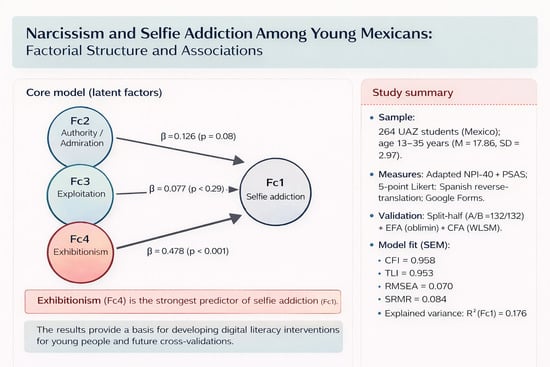
Based on these findings, the SEM of our research on exhibitionism (Fc4) revealed the closest association with selfie addiction (Fc1), given that exhibitionism coincides with motives such as increased visibility and self-presentation. In contrast, authority, superiority, and need for admiration (Fc2) seem to reflect a need for status that can be satisfied without selfies. On the other hand, exploitation (Fc3) may depend on interpersonal contexts rather than posting selfies. Similarly, R
2 = 0.176, which is the explained variance, suggesting that narcissistic characteristics are significant but partial predictors; therefore, there are likely to be other predictors, such as self-esteem, impulsivity, social media problems, or social reinforcement from peers, that may explain the additional variance. In addition to the above, it is worth mentioning that another implication is the possible association between interpreting one’s own perspective within a narcissistic reality, as well as prioritising one’s own thoughts and needs, and the risk of a body image psychopathologies such as dysmorphia. In line with the above, the authors of [
78] conclude that social media use appears to be negatively related to body image in both girls and boys. Therefore, selfie addiction may be clinically relevant to the extent that intersects with emotional distress related to physical appearance.
While the results of our research provide theoretical and empirical evidence for selfies playing a compensatory role in satisfying narcissistic needs, it is important to emphasise that both the PSAS and the Adapted NPI-40 were modified to fit a 1–5 Likert scale, and the number of items was reduced. The scores obtained should therefore be interpreted as preliminary evidence of the consistency and internal structure of these adapted versions, not as equivalents of their originals. Although convergent evidence, reliability tests, and cross-validation were incorporated, these should not replace a complete validity programme, and the results should be understood within this scope. Furthermore, although Fc4 presented large loadings between 0.983 and 0.799, it contains only two items, so its factorial stability may be questionable. This result must therefore be taken as exploratory. In future research, the sample should be expanded, and as this study was a cross-sectional study, longitudinal studies are recommended.
Our sample consisted only of students from the Autonomous University of Zacatecas, which limits the generalisation of the findings to other cultural contexts, educational levels, or populations. In addition, the results are interpreted mainly within the framework of late adolescent development and emerging adulthood. Similarly, although a psychometric scale was used to indicate selfie addiction, this construct is still under development; thus, a consensus is yet to form in the scientific literature. It is recommended that research on the relationship between selfie addiction and narcissism continue, and we recommend using predictor variables such as the time and frequency of social media use, the importance of “likes” and negative comments on posts, jealousy, and one’s self-perception of one’s image on social media. We further recommend that scales such as the Body Shape Questionnaire (BSQ), the Appearance Anxiety Inventory (AAI), and the Body Dysmorphic Disorder Questionnaire (BDDQ) be used in future studies.
5. Conclusions
We have described the relationship between narcissistic traits and selfie addiction in 264 UAZ students using a structural equation model. We can therefore conclude that selfie addiction is a well-defined construct, since the EFA confirmed a variance of 18.7% in a single dimension with PSAS statements. This may imply an addictive impulse to take and post selfies. Our results further suggest that narcissism is multifaceted and related to different motives for posting selfies. Thus, the EFA included, first, the Adapted NPI-40 items of authority, superiority, and the need for admiration; second, those of narcissistic exploitation statements; and third, those of exhibitionism (a less stable dimension). We can conclude that narcissism is a construct with complex facets that are variously associated with the urge to post selfies. Taken together, these results suggest that selfies satisfy the urge to obtain quick and controlled validation, thus avoiding the emotional sacrifice and reciprocity demanded by narcissists in face-to-face interactions. For this reason, our findings reinforce theories about the need for self-affirmation and digital exhibitionism in people with narcissistic traits.
Our results indicate that people with narcissistic traits demonstrate addictive behaviour with respect to taking and posting selfies. Since the SEM showed an excellent fit of CFI = 0.958, TLI = 0.953, RMSEA = 0.070, this may be due to a number of different facets of narcissism. Consequently, we understand our present findings as having implications for wider research; our results indicate that variables such as time spent on social media and comments received, as well as psycho-emotional variables such as emotional regulation, self-esteem, and anxiety, should be incorporated. We contend that this approach will better describe how selfie addiction and narcissism influence people’s psychological well-being. For this reason, future research should include longitudinal studies, more in-depth studies on the subject of exhibitionism, and the expansion of samples to different cultural contexts.



 ,
,