
Article

Relationship of Internet Addiction and Gambling Craving with Personality and Psychological Well-Being


by
Joan García-Perales
1,
Isabel Martínez
2,* and
Elena Delgado
2
1
Department of Methodology of the Behavioral Sciences, University of Valencia, Av. Blasco Ibáñez, 21, 46010 Valencia, Spain
2
Department of Psychology, University of Castilla-La Mancha, Avda. Los Alfares 44, 16071 Cuenca, Spain
*
Author to whom correspondence should be addressed.
Adolescents 2026, 6(1), 20; https://doi.org/10.3390/adolescents6010020
Submission received: 25 September 2025 / Revised: 29 January 2026 / Accepted: 10 February 2026 / Published: 13 February 2026

Abstract

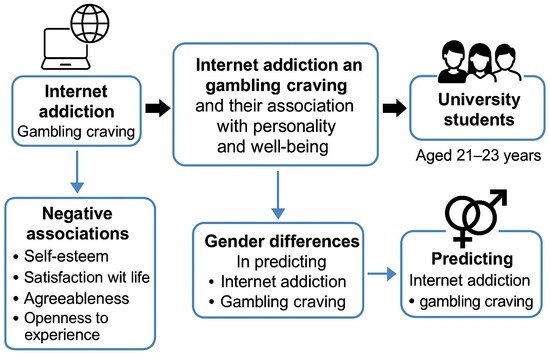
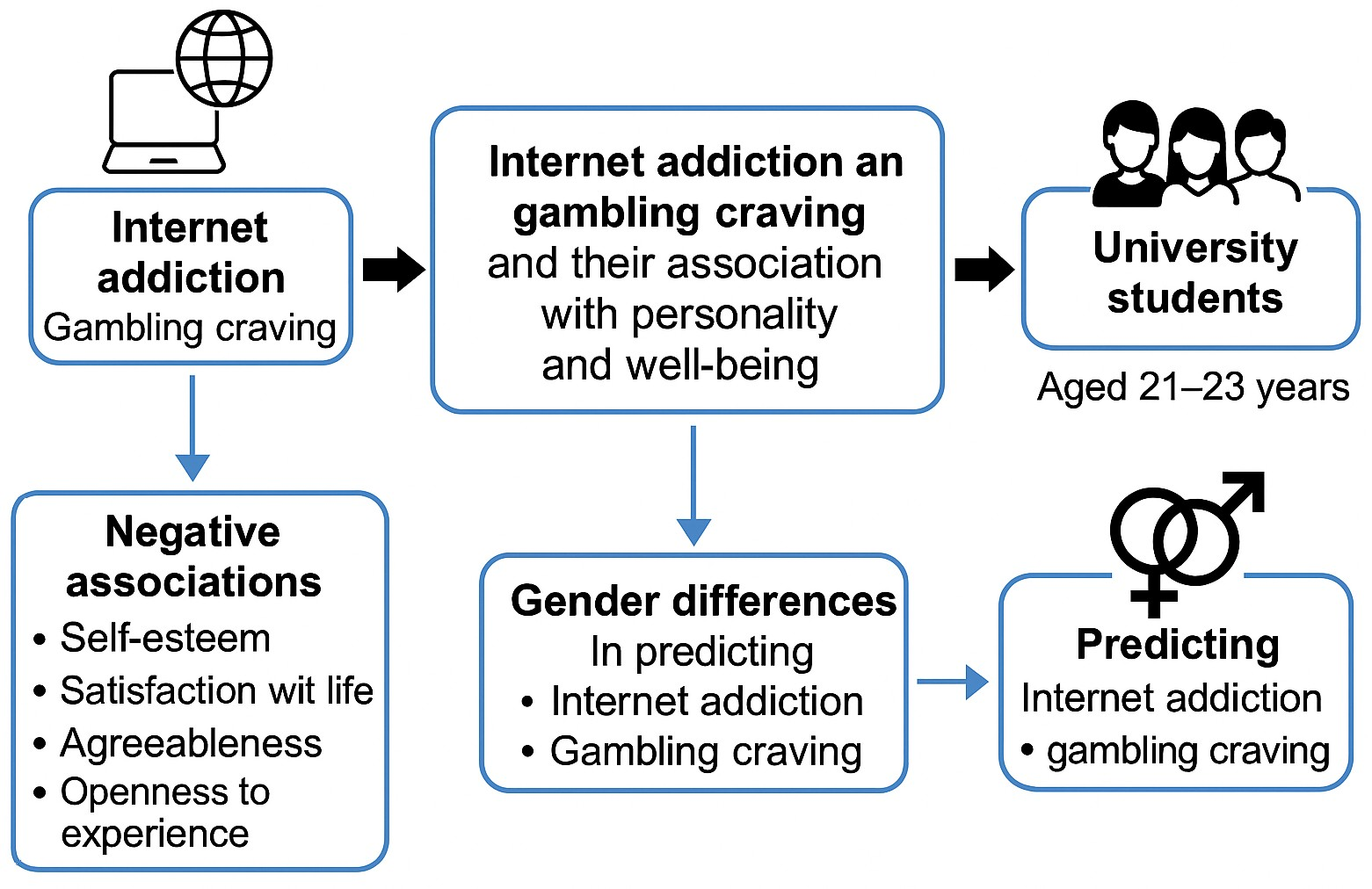
The availability of the Internet in current society has brought about the development of Internet addiction and participation in online gambling. This study aimed to examine the associations between Internet addiction and gambling craving with personality traits and psychological well-being (self-esteem and life satisfaction), controlling for gender differences. The sample consisted of 517 Spanish university students (28.6% males), aged 21–23 years (mean age = 21.53 years; SD = 3.76). Participants were administered the Internet Addiction Test (IAT), Gambling Craving Scale, Self-Esteem Scale, Mini-IPIP Scale, and Satisfaction with Life Scale (SWLS). The results show that Internet addiction is negatively related to self-esteem, satisfaction with life, and personality traits of agreeableness, conscientiousness, emotional stability, and openness to experience. In line with these findings, the results concerning gambling craving are particularly noteworthy, revealing significant negative associations with self-esteem, life satisfaction, and the personality traits of agreeableness and openness to experience. This pattern suggests that heightened craving may be linked to broader deficits in psychological well-being and adaptive personality functioning. Finally, the results indicate differences by gender when predicting Internet addiction and gambling craving through personality and psychological well-being.

Graphical Abstract

1. Introduction

The Internet has become an essential part of people’s lives, helping them to carry out various academic, free-time, or social activities via social media, becoming an almost indispensable part of everyday life. Due to its ease of access, Internet usage has increased across all age groups worldwide. According to data reported by Statista Research Department [1], approximately 73.2% of the global population were Internet users as of December 2025, reflecting exponential growth in recent years. Despite the benefits that the Internet provides, it is not exempt from problems, the greatest of which is the addiction that it generates.
Internet addiction is defined as the excessive use of the Internet, which produces cognitive, psychological, or physical harm; experiencing withdrawal symptoms such as depression, anxiety, and nervousness upon losing access, producing a decline in areas of functioning such as school, family, and social life [2]. It commonly manifests through behaviors such as compulsive social media checking, prolonged engagement in online gaming without adequate rest, or heightened anxiety and irritability when attempting to reduce use. Empirical research has consistently linked Internet addiction to adverse mental health outcomes, including increased anxiety and depressive symptoms and reduced self-esteem, particularly among younger populations [3]. Although, unlike other addictions [3,4,5], Internet addiction has not been adopted in the diagnostic section of the 5th Edition of the Diagnostic and Statistical Manual of Mental Disorders [6] nor the International Classification of Diseases 11th Revision [7], considerable proof exists regarding the negative effects on physical and mental health, as well as on social development [5,8]. Gender differences have been frequently reported in patterns of Internet addiction [9,10,11,12].
Technological advances and massive Internet usage have also made access to online gambling easier, offering a wide variety of gambling activities that can be carried out via Internet-enabled devices (mobile phones, computers, etc.). These, in turn, can be carried out anytime and anywhere. The possibility to place large bets continuously, easily, and instantaneously is cause for concern as it encourages online gambling addiction. Furthermore, one advantage for the player is that one can remain anonymous while gambling, which is a benefit for the gambler given that they can avoid the negative judgments associated with gambling behavior [13]. As a result of parallels between gambling problems and substance use, the Fifth Edition of the Diagnostic and Statistical Manual of Mental Disorders (DSM-5) [6] include a new category of Non-Substance Behavioral Addiction within the substance addictions category, in which only gambling disorder is officially included. The DSM-5 classified Internet Gaming Disorder (IGD) as a condition for further study, noting that excessive gaming shares core features with addictive disorders, such as impaired control, prioritization over other activities, and persistence despite negative consequences [14]. Consistently, the ICD-11 [7] recognizes Gaming Disorder (GD) as a behavioral addiction defined by the same characteristics.
In summary, given the pathological similarities of gambling experience and Internet gambling, and the added harm of Internet addiction, the use of Internet gambling warrants specific consideration. Although a large body of empirical research has been conducted on identifying risk and resiliency factors that influence gambling behavior (demographic, environmental, personality, or biological factors), only a handful of studies have examined other variables that may be associated with online gambling [15]. In this sense, it is important to keep the role of craving in mind, that is, the urge to gamble, which functions as excitement as well as alleviating negative emotions [16].
Studies indicate that differences in motivation exist by gender, whereby males tend to experience more addictive behavior when they play games related to power and controlling or exploring sexual fantasies online [9,10,12]. In contrast, females are more likely to communicate with both close and anonymous friends online to share their feelings and emotions [17,18,19].
Additionally, research indicates that the association between Internet addiction and related psychological factors (e.g., low self-esteem, attention deficits) is stronger in males, with gender identified as a risk factor for Internet addiction [9,10,11,18], insofar as males show a higher likelihood of exhibiting problematic or excessive patterns of Internet use compared to their female counterparts [12,20]. Gender constitutes a risk factor because it influences both patterns of Internet use and the motivations underlying such use [17,18,19]. Men and women tend to engage in different online activities, some of which possess a higher addictive potential, such as online gaming or social networking sites. Furthermore, gender-related differences in emotion regulation, reward sensitivity, and the need for social connection may increase susceptibility to excessive Internet use. These differences suggest differences in gender vulnerability to Internet addiction [18,19,20].
Moreover, excessive Internet usage has prompted research to analyze the influence of different factors on Internet addiction. In this way, Internet addiction has been related to different variables, such as personality, academic performance, depression, the consumption of drugs, alcohol, and tobacco, along with other factors of psychological well-being, such as self-esteem [13,21,22]. In this study, Internet addiction and gambling craving are related to personality and psychological well-being, measured through self-esteem and satisfaction with life, considering possible gender differences. The research focuses on personality and psychological well-being, because these relatively stable individual characteristics help both to understand individual vulnerability to addictive behaviors and have consistently demonstrated strong associations with such behaviors [3,4]. Furthermore, gender is considered in the analysis since scientific literature has generally overlooked gender differences in the relationship between Internet addiction and personal variables such as personality traits or self-esteem. Likewise, the psychological variables that may explain gambling craving have been scarcely examined, and the potential moderating role of gender has rarely been considered.
Personality has been defined as psychological traits that contribute to an individual’s enduring and distinctive patterns of feeling, thinking, and behaving [23]. One of the models most used to describe personality is “The Big Five Model” [24,25]. Through this model, personality is explained with five big dimensions: (1) extraversion, which includes the ability to assert oneself, the ability to stand out and influence others, energy, and enthusiasm; (2) agreeableness, which includes the ability to cooperate and listen to others and politeness, i.e., affability or trustworthiness; (3) conscientiousness, which includes perseverance, persistence, and conscientiousness (meticulousness and orderliness); (4) emotional stability (or the inverse trait, neuroticism), which includes control of one’s behavior and control of emotions; and (5) openness, which includes openness to experience (different values or ways of life) and openness to culture (interest in staying informed and acquiring new knowledge) [26,27]. Some differences in personality traits by gender have been detected. Women tend to score higher in agreeableness, extraversion, and neuroticism. In the case of openness and conscientiousness, gender differences were small or undetectable [28].
The relationship between the big five personality factors and Internet addiction has been analyzed in some recent studies [29,30] Most studies agree that emotional stability (or neuroticism) is one of the personality traits that predict Internet addiction. In general, the greater the emotional stability, the lower the Internet addiction [29]. Similarly, the traits of extraversion, openness, agreeableness, and conscientiousness tend to relate negatively to Internet addiction in most studies [29,31].
Moreover, self-esteem is an individual’s set of thoughts and feelings about him/herself and the degree of self-approval or refusal [32]. Self-esteem, as the person’s perception of him/herself, is formed through experiences with the environment and is influenced especially by environmental reinforcements and significant others [33]. As the core of the individual, self-esteem has been considered key in understanding behavioral, cognitive, emotional, and social functioning [33,34]. Evidence has shown that males score higher on standard measures of global self-esteem than females because of learned gender roles and stereotypes [35]. Self-esteem has been related to a large variety of positive psychological and behavioral outcomes, such as psychological adjustment, positive emotion, or Internet addiction, with a negative relationship between Internet addiction and self-esteem tending to appear [22,34,36].
Finally, an area of increasing interest among researchers is concerned with how and why people experience their lives in positive ways (i.e., life satisfaction). Life satisfaction is defined as an individual’s overall appraisal of the quality of her or his life, including the immediate effects of life events and mood states [37,38]. Life satisfaction has been related to health status, occupation, effective interpersonal relationships, and school dropout [39,40]. Research has also shown that global life satisfaction remains invariant across genders [41,42,43].
The objective of this study was to relate Internet addiction and gambling craving with personality and psychological well-being, measured through self-esteem and satisfaction with life, in a sample of Spanish university students, considering possible gender differences. Although studies analyzing online gambling are limited in comparison to those that analyze Internet addiction, given previous research, we expect that Internet addiction and online gambling relate negatively to self-esteem, life satisfaction, and the big five personality factors (agreeableness, conscientiousness, openness, extraversion, and emotional stability), in both, male and female university students.

2. Materials and Methods

2.1. Participants and Procedure

To ensure a statistical power of 95% (1 − β = 0.95), an a priori calculation was conducted using G*Power 3.1.9.7 [44] to determine the minimum required sample size. The analysis set the Type I error rate at the conventional threshold (α = 0.05) and considered a medium effect size (f = 0.21) [45] in the F-test between Internet addiction and personality factors. The findings indicated that at least 510 participants would be needed for the study. The sample consisted of 517 university students from a large metropolitan area in Spain with over one million inhabitants, 148 men (28.6%) and 369 women (71.4%), from 21 to 23 years old (M = 21.53 years, SD = 3.76).
From a comprehensive list of the university courses in the region, twelve classes were randomly selected using a simple random sampling procedure. A professor from each selected class was contacted to facilitate the online administration of the survey, which was distributed through a secure digital platform. Participation was entirely voluntary, and no incentives or financial compensation were offered. Inclusion criteria required participants to be enrolled as undergraduate students at the time of data collection and to provide informed consent prior to participation. Since the questionnaire was administered online and was designed so that all questions were mandatory, there was no missing data. In accordance with the principles of the Declaration of Helsinki and the protocol approved by the Ethics Committee of 1004SEU on 21 March 2025, participants were fully informed about the study procedures, the anonymous and confidential nature of the data, and the importance of providing honest and sincere responses.

2.2. Instruments

2.2.1. Internet Addiction Test

Internet addiction was captured with the Internet Addiction Test (IAT) developed by Young [2] who likened excessive Internet use most closely to pathological gambling, a disorder of impulse control in DSM-4, and adapted the DSM-4 criteria. Respondents answered the 20-item questionnaire on which are asked to rate items on a five-point Likert scale, from 1 (“never”) to 5 (“always”), covering the degree to which their Internet use affects their daily routine, social life, productivity, sleeping pattern, and feelings (e.g., “How often do you neglect the things you need to do around the house to spend more time online?”). This scale has high face validity, and it has been subjected to systematic psychometric testing in several countries, such as Spain, the USA, and Colombia [46]. In this study, the reliability of the Internet Addiction Test showed a Cronbach’s alpha of 0.91.

2.2.2. Gambling Craving Scale

Online gambling was captured with the Gambling Craving Scale (GC) developed by Young and Wohl [16]. This scale is a short version of a longer scale based on literacy and on criteria to diagnose pathological gambling according to the APA in the Fourth Edition of the Diagnostic and Statistical Manual of Mental Disorders [6]. Respondents answered the 9 questions on a 7-point scale anchored at 1 (strongly disagree) to 7 (strongly agree), measuring the intention to gamble that was anticipated to be fun and enjoyable, the strong and urgent desire to gamble, or the relief from expected negative gambling experiences (e.g., “If I were gambling now, I would be able to think more clearly”). In this study, the reliability of the Gambling Craving Scale showed a Cronbach’s alpha of 0.74.

2.2.3. Self-Esteem Scale

Self-esteem was captured with the Self-Esteem Scale (SE) developed by Rosenberg [32,33] that was adapted to Spanish by [47]. Respondents answered the 10-item questionnaire on which they are asked to rate items on a five-point Likert scale from 1 to 4 (strongly disagree, disagree, agree, strongly agree) (e.g., “I feel that I’m a person of worth”). This scale has been validated in numerous countries [48], and its original reliability was 0.77. For this study, the reliability of the Self-Esteem Scale showed a Cronbach’s alpha of 0.86.

2.2.4. Mini-IPIP Scale

Personality traits were captured with Mini-IPIP Scale [49], which is the abbreviated version of the IPIP (International Personality Item Pool) Big Five factorial markers [24]. Respondents answered the 20 items (four per dimension): Extraversion (E) (e.g., “Talk to a lot of different people at parties”), agreeableness (A) (e.g., “Feel others’ emotions”), conscientiousness (C) (e.g., “Talk to a lot of different people at parties”), emotional stability (S) (originally formulated in the inverse sense as neuroticism) (e.g., “ Get upset easily”), and openness (O) (In some research this dimension is also called Intellect or Imagination) (e.g., “Am interested in abstract ideas”). We applied the Spanish version of the Mini-IPIP Scales used by Martínez-Molina and Arias [50]. In this study, the reliability of the Mini-IPIP showed a Cronbach’s alpha of 0.91, and for every factor, the reliability was 0.72 (E), 0.78 (A), (0.75) C, (0.79) S and O (0.81).

2.2.5. Satisfaction with Life Scale

Satisfaction with Life Scale was captured with the Satisfaction with Life Scale (SWL) developed by Diener [38], which was adapted to Spanish by Vázquez, Duque, and Hervás [40]. It is a one-dimensional instrument consisting of five items that evaluate the general satisfaction that the individual has with his life. The Likert-type scale of five points ranged from 1 (very disagree) to 5 (strongly agree); higher scores reflect greater satisfaction (e.g., “I am satisfied with my life”). In this study, the reliability of the Satisfaction with Life Scale showed a Cronbach’s alpha of 0.86.

2.3. Plan of Analysis

Firstly, a descriptive and correlational analysis of the study variables was performed (Internet Addiction, Gambling Craving, Self-Esteem, Satisfaction with Life, Extraversion, Agreeableness, Conscientiousness, Emotional Stability, Openness to Experience). The correlations between the study variables were calculated using Pearson’s correlation coefficient, and the difference by gender for each variable was calculated using Student’s t-test. Subsequently, we performed multiple regression analyses to predict the factors of Internet addiction and gambling craving for women and men based on the personality factors of the big five and the scales of satisfaction with life and self-esteem. Statistical analyses were performed using the software package SPSS 28.0 [51].

3. Results

3.1. Descriptive Statistics and Analysis of Differences

Internet addiction presents a positive and significant correlation with GC (r = 0.197, p < 0.001); however, it shows a significant and inverse relationship with SE (r = −0.258, p < 0.001), SWL (r = −0.172, p < 0.001), BFA (r = −0.268, p < 0.001), BFC (r = −0.224, p < 0.001), BFS (r = −0.130, p < 0.01), and BFO (r = −0.223, p < 0.001). On the other hand, gambling craving presents inverse and significant correlations with SE (r = −0.129, p < 0.01), SWL (r = −0.119, p < 0.01), BFA (r = −0.235, p < 0.001), and BFO (r = −0.099, p < 0.05).
The results (Table 1) showed that IA (internet addiction) was higher in men (M = 2.12, SD = 0.68) than in women (M = 1.93, SD = 0.64), (t(515) = 3.03, p < 0.01), and GC (gambling craving) was also higher in men (M = 1.44, SD = 0.82) than in women (M = 1.30, SD = 0.46) (t(515) = 2.41, p < 0.01). Satisfaction with life presents statistically significant differences (t(515) = −2.41, p < 0.01), showing that men (M = 2.76, SD = 0.63) present lower scores than women (M = 2.90, SD = 0.57). Self-esteem did not present statistically significant differences between men and women. On the other hand, the personality factors of the Mini-IPIP showed statistically significant differences by gender; in BFE (extraversion), women (M = 3.11, SD = 0.82) scored higher than men (M = 2.94, SD = 0.88) (t(515) = −2.09, p < 0.05), in BFA (agreeableness), women obtained higher scores (M = 4.15, SD = 0.64) than men (M = 3.74, SD = 0.68) (t(515) = −6.49, p < 0.001), in BFC (conscientiousness), the scores of women (M = 3.24, SD = 0.82) were statistically higher than those of men (M = 3.07, SD = 0.84) (t(515) = 2.19, p < 0.05), in BFS (emotional stability), men (M = 3.05, SD = 0.82) scored higher than women (M = 2.71, SD = 0.72) (t(515) = 4.66, p < 0.001), and, finally, the results did not show statistically significant differences in BFO (openness to experience) between genders.

3.2. Predictive Factors of Internet Addiction

To estimate the association between the personal variables of young people with Internet addiction, a multiple linear regression was performed separately for men (Table 2) and women (Table 3). Before multiple regression analysis, multicollinearity should be assessed using the variance inflation factor (VIF) and tolerance. Tolerance measures how much beta coefficients are affected by the presence of other predictor variables in a model. The cut-off for tolerance that is generally accepted falls at 0.25; smaller values of tolerance denote higher levels of multicollinearity [52]. VIF (variance inflation factor) measures the extent to which the regression coefficients are affected by other independent variables in the model. Higher values of VIF are associated with multicollinearity. The generally accepted cutoff for VIF is 2.5, with higher values indicating levels of multicollinearity that could negatively affect the regression model.
The explanatory model of Internet addiction based on personal factors does not show multicollinearity between the variables (tolerance > 0.25, VIF < 2.5). The predictive model for men was statistically significant (F (7, 140) = 6.113, p < 0.001, R2adjust = 0.196), explaining 19.6% of the variance. The significant factors of the predictive model in men were extraversion (BFE) (Beta = −0.243, (t(140) = −3.08, p = 0.003), conscientiousness (BFC) (Beta = −0.14, (t(140) = −2.31, p = 0.022), and openness to experience (BFO) (Beta = −0.159, (t(140) = −2.14, p = 0.034) (see Table 2). The predictive model for women was also statistically significant (F (7, 361) = 9.693, p < 0.001, R2adjust = 0.153), explaining 15.3% of the variance. The significant factors of the predictive model in women were self-esteem (SE) (Beta = −0.221, (t(361) = −2.947, p = 0.003), agreeableness (BFA) (Beta = −0.131, (t(361) = −2.570, p = 0.011), conscientiousness (BFC) (Beta = −0.133, (t(364) = −3.422, p = 0.001), and openness to experience (BFO) (Beta = −0.148, (t(361) = −2.14, p < 0.001) (see Table 3).

3.3. Predictive Factors of Gambling Craving

The predictive model for gambling craving in men was not statistically significant (F (7, 140) = 1.467, p > 0.05). However, the predictive model for women (Table 4) was statistically significant (F (7, 361) = 5.384, p < 0.001, R2adjust = 0.077), explaining 7.76% of the variance. The explanatory model of gambling craving in women based on personal factors did not show multicollinearity between the variables (tolerance > 0.25, VIF < 2.5). The significant factor of the predictive model in women was agreeableness (BFA) (Beta = −0.175, (t(361) = −4.595, p < 0.001). None of the other variables of the model were not statistically significant.

4. Discussion

The relationship between Internet addiction and gambling craving with personality and psychological well-being, measured through self-esteem and satisfaction with life, is confirmed in Spanish university students. Additionally, the results show that Internet addiction relates positively with online gambling, in line with previous studies that indicate that Internet addiction is closely linked to pathological online gambling, given that the availability of the Internet today provides novel and ample opportunities to gamble online [53]. Pathological online gambling must be understood as the result of an interaction between neurological and social factors. Neurobiological research indicates that gambling disorder shares core mechanisms with substance-related addictions, particularly involving dysregulation of dopaminergic reward pathways [54]. Social and contextual factors are also salient in online gambling. Continuous access to gambling platforms through digital devices eliminates traditional temporal and spatial constraints, thereby facilitating higher gambling frequency and increasing the risk of problematic use. Online gambling is often associated with greater severity of gambling-related problems, particularly among younger users [55]. Moreover, participation in online gambling communities may contribute to the normalization of excessive gambling behaviors and the reinforcement of cognitive distortions, acting as a maintaining factor of the disorder [56].
Furthermore, the results of the study show that Internet addiction relates negatively to self-esteem and satisfaction with life. These results are consistent with previous studies, which have shown that self-esteem and satisfaction with life relate negatively to Internet addiction [34,57]. Regarding the relationship of personality traits of agreeableness, conscientiousness, emotional stability, and openness to experience with Internet addiction, the results also confirm previous research [29,31]. This reinforces the idea that youth who have difficulty relating with peers in a real, face-to-face environment are at greater risk for addiction to the Internet [58]. It has also been argued that individuals with low levels of agreeableness are likely to demonstrate aggressive and hostile behaviors, preferring the Internet to establish new, interpersonal relationships to satisfy the need for relationships and to display these behaviors [58]. Likewise, youth who score low on conscientiousness have been described as low self-disciplined individuals who cannot control their Internet usage [59]. In the same way, youth with low emotional stability would also not possess regulation strategies that allow them to control Internet addiction [31,46]. Lastly, youth who score high on openness have a lower tendency to develop an addiction to the Internet, which could have to do with real-world experiences being more vivid and realistic than virtual ones [29].
Moreover, gambling craving is negatively related to self-esteem, satisfaction with life, agreeableness, and openness to experience. Although this relationship has not been extensively researched in the literature, the results are consistent with previous studies that identified a relationship between personal vulnerability (e.g., inferiority in peer groups, self-esteem) and gambling craving, such that gambling acts would represent a form of emotional evasion while substituting other deficiencies [60].
Additionally, the differences between female and male university students were considered in predicting Internet addiction and gambling craving through personality and psychological well-being. The results indicate that in males, the traits of personality, extraversion, conscientiousness, and openness to experience predict Internet addiction. This pattern suggests that stimulation seeking and lower self-regulation associated with extraversion, openness, and low conscientiousness increase vulnerability to excessive Internet use in males. However, self-esteem and the personality traits of agreeableness, conscientiousness, and openness better predict Internet addiction in females. This result could suggest that low self-esteem may lead to greater reliance on online contexts for emotional regulation or social validation [61]. Furthermore, the role of agreeableness and conscientiousness suggests that interpersonal sensitivity and self-regulatory processes are particularly salient for females. Regarding gambling craving, none of the variables analyzed predicted its presence in males, while in females, agreeableness was the predictive variable.
Finally, although not central to this research, the study shows some gender differences in personality and psychological well-being variables consistent with previous research [57,62]. Females scored higher than male students in the personality traits of extraversion, agreeableness, and conscientiousness, whereas males scored higher than female students in emotional stability. These gender-related differences have been widely documented in the literature and are often interpreted as reflecting a combination of biological influences and gendered socialization processes that shape emotional expression, interpersonal behavior, and self-regulation [62].
In contrast, no gender differences were found in self-esteem between female and male university students; however, females scored higher than males in satisfaction with life. This finding aligns with prior research indicating that gender differences in self-esteem are typically small or context-dependent, particularly in adult samples [36]. Likewise, women in the present study reported higher levels of life satisfaction than men. Although this result may appear counterintuitive given women’s higher levels of neuroticism reported in many studies, previous research has shown that life satisfaction is influenced by multiple factors beyond personality traits, including social relationships, emotional expressiveness, and perceived social support, domains in which women often report higher engagement [63].
The present findings highlight the need to strengthen prevention and public health strategies targeting problematic Internet use and gambling-related behaviors, particularly during youth and adulthood. The distinct patterns observed between men and women underscore the importance of adopting gender-sensitive approaches in both prevention and intervention efforts. Prevention programs should consider gender-specific psychological, social, and motivational factors that differentially contribute to Internet addiction and gambling craving. Public health actions would benefit from integrating educational initiatives within academic and community settings that promote digital literacy, emotional regulation, and adaptive coping strategies [64,65]. Additionally, early screening tools should be implemented to identify at-risk individuals, considering gender-related vulnerabilities. Interventions designed for men may need to focus on impulsivity and risk-taking tendencies, whereas those targeting women may benefit from addressing emotional well-being and social influences. Overall, incorporating a gender-sensitive framework into public health policies may enhance the effectiveness of prevention strategies and contribute to reducing the burden of problematic online behaviors.

Limitations

Several limitations of the present study should be acknowledged, as they provide important directions for future research.
First, the sample consisted exclusively of university students, which limits the generalizability of the findings to other age groups and populations. University samples tend to be relatively homogeneous in terms of age, educational level, and socioeconomic background, which may restrict the variability of key psychological constructs and underestimate or overestimate the observed relationships.
Second, the cross-sectional design of the study precludes any conclusions regarding causal or temporal relationships among the variables examined. Although significant associations were identified, longitudinal or prospective designs are needed to determine the directionality of these relationships and to examine how Internet addiction and gambling craving may develop and interact over time.
Third, all variables were assessed using self-report measures, which may be subject to common method variance, social desirability bias, and recall inaccuracies. Future studies would benefit from incorporating multi-method assessment approaches, such as behavioral indicators, informant reports, or objective usage data, to strengthen the validity of the findings.
Despite these limitations, the results underscore the importance of conceptualizing Internet addiction and gambling craving as distinct behavioral phenomena and highlight meaningful gender differences in the variables predicting each behavior. These findings contribute to a more nuanced understanding of problematic online behaviors and may inform the development of gender-sensitive prevention and intervention strategies.

Author Contributions

J.G.-P.: Conceptualization, Data curation, Formal analysis, Investigation, Methodology, Software, Validation, Visualization, Writing—original draft, Writing—review and editing. I.M.: Conceptualization, Investigation, Methodology, Project administration, Software, Supervision, Validation, Visualization, Writing—original draft, Writing—review and editing. E.D.: Investigation, Visualization, Software, Writing—original draft, Writing—review and editing. All authors have read and agreed to the published version of the manuscript.

Funding

This work was realized in the framework of the project 2025-GRIN-38473, 85% co-financed by the European Regional Development Fund, within the framework of the FEDER Program of Castilla-La Mancha for the period 2021–2027, action 01A/008. Resolution of 4 November 2025, of the University of Castilla-La Mancha, approving the call for Expressions of Interest for the year 2025.

Institutional Review Board Statement

The study was conducted following the Declaration of Helsinki and approved by the Ethics Committee of Selart European University in Spain (protocol code 7/2024 and 15 October 2024).

Informed Consent Statement

Informed consent was obtained from all subjects involved in the study.

Data Availability Statement

Dataset available on request from the authors.

Conflicts of Interest

The authors declare no conflicts of interest.

References

  1. Statista Research Department. Number of Internet and Social Media Users Worldwide. Statista. 2025. Available online: https://www.statista.com/ (accessed on 20 December 2025).
  2. Young, K.S. Internet addiction: A new clinical phenomenon and its consequences. Am. Behav. Sci. 2004, 48, 402–415. [Google Scholar] [CrossRef]
  3. Soriano-Molina, E.; Limiñana-Gras, R.M.; Patró-Hernández, R.M.; Rubio-Aparicio, M. The Association Between Internet Addiction and Mental Health: A Meta-Analytic Review. Behav. Sci. 2025, 15, 116. [Google Scholar] [CrossRef]
  4. Chemnad, K.; Aziz, M.; Al- Harahsheh, S.; Abdelmoneium, A.; Baghdady, A.; Hassan, D.A.; Ali, R. Assessing the Relationship Between the Type of Internet Use and Internet Addiction in Early and Middle Adolescents: Cross-Sectional Study from Qatar. JMIR Hum. Factors 2025, 12, e62955. [Google Scholar] [CrossRef]
  5. Alaswad, N.; Hassan, S.; Abdullah, S.E.A. The relationship between emotional intelligence, internet addiction, and psychological well-being among university nursing students. BMC Nurs. 2025, 24, 1341. [Google Scholar] [CrossRef]
  6. American Psychiatric Association. Diagnostic and Statistical Manual of Mental Disorders (DSM-5), 5th ed.; American Psychiatric Publishing: Washington, DC, USA, 2013. [Google Scholar]
  7. World Health Organization. International Classification of Diseases for Mortality and Morbidity Statistics; 11th Revision; WHO: Geneva, Switzerland, 2019; Available online: https://icd.who.int/ (accessed on 10 September 2025).
  8. Serna, C.; García-Perales, J.; Martínez, I. Protective and risk parenting styles for Internet and online gambling addiction. Hum. Behav. Emerg. Technol. 2023, 2023, 6674541. [Google Scholar] [CrossRef]
  9. Liang, L.; Zhou, D.; Yuan, C.; Shao, A.; Bian, Y. Gender differences in the relationship between Internet addiction and depression: A cross-lagged study in Chinese adolescents. Comput. Hum. Behav. 2016, 63, 463–470. [Google Scholar] [CrossRef]
  10. Mari, E.; Biondi, S.; Varchetta, M.; Cricenti, C.; Fraschetti, A.; Pizzo, A.; Barchielli, B.; Roma, P.; Marti-Vilar, M.; González-Sala, F.; et al. Gender differences in internet addiction: A study on variables related to its possible development. Comput. Hum. Behav. Rep. 2023, 9, 100247. [Google Scholar] [CrossRef]
  11. Ponizovsky, P.; Skurat, E.; Trusova, A.; Shmukler, A.; Grechany, S.; Ilyuk, R.A.K. Internet addiction: Gender-associated differences in psychological characteristics. Eur. Psychiatry 2022, 65, S817. [Google Scholar] [CrossRef]
  12. Varchetta, M.; Tagliaferri, G.; Mari, E.; Quaglieri, A.; Cricenti, C.; Giannini, A.M.; Martí-Vilar, M. Exploring Gender Differences in Internet Addiction and Psychological Factors: A Study in a Spanish Sample. Brain Sci. 2024, 14, 1037. [Google Scholar] [CrossRef]
  13. Frisone, F.; Settineri, S.; Sicari, P.F.; Merlo, E.M. Gambling in adolescence: A narrative review of the last 20 years. J. Addict. Dis. 2020, 38, 438–457. [Google Scholar] [CrossRef]
  14. Petry, N.M.; Rehbein, F.; Ko, C.H.; O’Brien, C.P. Internet Gaming Disorder in the DSM-5. Curr. Psychiatry Rep. 2015, 17, 72. [Google Scholar] [CrossRef]
  15. Philander, K.S.; MacKay, T.L. Online gambling participation and problem gambling severity: Is there a causal relationship? Int. Gambl. Stud. 2014, 14, 214–227. [Google Scholar] [CrossRef]
  16. Young, M.M.; Wohl, M.J. The Gambling Craving Scale: Psychometric validation and behavioral outcomes. Psychol. Addict. Behav. 2009, 23, 512–522. [Google Scholar] [CrossRef]
  17. Young, K.S. Caught in the Net: How to Recognize the Signs of Internet Addiction—And a Winning Strategy for Recovery; John Wiley & Sons: Hoboken, NJ, USA, 1998. [Google Scholar]
  18. Anthony, R.; Young, H.; Hewitt, G.; Sloan, L.; Moore, G.; Murphy, S.; Cook, S. Young people’s online communication and its association with mental well-being: Results from the 2019 student health and well-being survey. Child Adolesc. Ment. Health 2023, 28, 4–11. [Google Scholar] [CrossRef]
  19. Lyyra, N.; Junttila, N.; Gustafsson, J.; Lahti, H.; Paakkari, L. Adolescents’ online communication and well-being: Findings from the 2018 health behavior in school-aged children (HBSC) study. Front. Psychiatry 2022, 13, 976404. [Google Scholar] [CrossRef]
  20. Benvenuti, M.; Panesi, S.; Giovagnoli, S.E.A. Teens online: How perceived social support influences the use of the Internet during adolescence. Eur. J. Psychol. Educ. 2024, 39, 629–650. [Google Scholar] [CrossRef]
  21. Dong, G.; Wang, J.; Yang, X.; Zhou, H. Risk personality traits of Internet addiction: A longitudinal study of Internet—Addicted Chinese university students. Asia-Pac. Psychiatry 2013, 5, 316–321. [Google Scholar] [CrossRef]
  22. Fioravanti, G.; Dèttore, D.; Casale, S. Internet addiction: Testing the association between self-esteem, the perception of Internet attributes, and preference for online social interactions. Cyberpsychol. Behav. Soc. Netw. 2012, 15, 318–323. [Google Scholar] [CrossRef]
  23. Cervone, D.; Pervin, L.A. Personality: Theory and Research; John Wiley & Sons: Hoboken, NJ, USA, 2022. [Google Scholar]
  24. Goldberg, L.R. The development of markers for the Big-Five factor structure. Psychol. Assess. 1992, 4, 26. [Google Scholar] [CrossRef]
  25. Goldberg, L.R. The structure of phenotypic personality traits. Am. Psychol. 1993, 48, 26–34. [Google Scholar] [CrossRef]
  26. McCrae, R.R.; Costa, P.T. Personality trait structure as a human universal. Am. Psychol. 1997, 52, 509–516. [Google Scholar] [CrossRef]
  27. Saiz, J.; Álvaro, J.L.; Martínez, I. Relación entre rasgos de personalidad y valores personales en pacientes dependientes de la cocaína. Adicciones 2011, 23, 125–132. [Google Scholar] [CrossRef]
  28. Weisberg, Y.J.; DeYoung, C.G.; Hirsh, J.B. Gender differences in personality across the ten aspects of the Big Five. Front. Psychol. 2011, 2, 178. [Google Scholar] [CrossRef]
  29. Kayiş, A.R.; Satici, S.A.; Yilmaz, M.F.; Şimşek, D.; Ceyhan, E.; Bakioğlu, F. Big five-personality trait and Internet addiction: A meta-analytic review. Comput. Hum. Behav. 2016, 63, 35–40. [Google Scholar] [CrossRef]
  30. Hidalgo-Fuentes, S.; Fernández-Castilla, B. Problematic internet use and the big five personality model: An updated three-level meta-analysis. Behav. Inf. Technol. 2024, 43, 3537–3560. [Google Scholar] [CrossRef]
  31. Servidio, R. Exploring the effects of demographic factors, Internet usage and personality traits on Internet addiction in a sample of Italian university students. Comput. Hum. Behav. 2014, 35, 85–92. [Google Scholar] [CrossRef]
  32. Rosenberg, M. Society and the Adolescent Self-Image; Princeton University Press: Princeton, NJ, USA, 1965. [Google Scholar]
  33. Rosenberg, M.; Schooler, C.; Schoenbach, C.; Rosenberg, F. Global Self-Esteem and Specific Self-Esteem: Different Concepts, Different Outcomes. Am. Sociol. Rev. 1995, 60, 141–156. [Google Scholar] [CrossRef]
  34. Shavelson, R.J.; Hubner, J.J.; Stanton, G.C. Self-concept: Validation of construct interpretations. Rev. Educ. Res. 1976, 46, 407–441. [Google Scholar] [CrossRef]
  35. Bahrainian, S.A.; Alizadeh, K.H.; Raeisoon, M.R.; Gorji, O.H.; Khazaee, A. Relationship of Internet addiction with self-esteem and depression in university students. J. Prev. Med. Hyg. 2014, 55, 86. [Google Scholar]
  36. Bleidorn, W.; Arslan, R.C.; Denissen, J.J.; Rentfrow, P.J.; Gebauer, J.E.; Potter, J.; Gosling, S.D. Age and gender differences in self-esteem—A cross-cultural window. J. Personal. Soc. Psychol. 2016, 111, 396–410. [Google Scholar] [CrossRef]
  37. Kling, K.C.; Hyde, J.S.; Showers, C.J.; Buswell, B.N. Gender differences in self-esteem: A meta-analysis. Psychol. Bull. 1999, 125, 470–500. [Google Scholar] [CrossRef]
  38. Diener, E.; Suh, E.M.; Lucas, R.E.; Smith, H.L. Subjective well-being: Three decades of progress. Psychol. Bull. 1999, 125, 276. [Google Scholar] [CrossRef]
  39. Diener, E.D.; Emmons, R.A.; Larsen, R.J.; Griffin, S. Satisfaction with life scale. J. Personal. Assess. 1985, 49, 71–75. [Google Scholar] [CrossRef]
  40. Lin, M.; Tseng, H.; Lee, Y. Internet use time and subjective well-being during the COVID-19 outbreak: Serial mediation of problematic internet use and self-esteem. BMC Psychol. 2023, 11, 438. [Google Scholar] [CrossRef]
  41. Vázquez, C.; Duque, A.; Hervas, G. Satisfaction with life scale in a representative sample of Spanish adults: Validation and normative data. Span. J. Psychol. 2013, 16, E82. [Google Scholar] [CrossRef]
  42. Swami, V.; Stieger, S.; Voracek, M.; Aavik, T.; Abdollahpour Ranjbar, H.; Adebayo, S.O.; Afhami, R.; Ahmed, O.; Aime, A.; Akel, M.; et al. Life satisfaction around the world: Measurement invariance of the Satisfaction with Life Scale (SWLS) across 65 nations, 40 languages, gender identities, and age groups. PLoS ONE 2025, 20, e0313107. [Google Scholar] [CrossRef]
  43. Joshanloo, M.; Jovanović, V. The relationship between gender and life satisfaction: Analysis across demographic groups and global regions. Arch. Women’s Ment. Health 2020, 23, 331–338. [Google Scholar] [CrossRef]
  44. Batz-Barbarich, C.; Tay, L.; Kuykendall, L.; Cheung, H.K. A Meta-Analysis of Gender Differences in Subjective Well-Being: Estimating Effect Sizes and Associations with Gender Inequality. Psychol. Sci. 2018, 29, 1491–1503. [Google Scholar] [CrossRef]
  45. Faul, F.; Erdfelder, E.; Buchner, A.; Lang, A.G. Statistical power analyses using G* Power 3.1: Tests for correlation and regression analyses. Behav. Res. Methods 2009, 41, 1149–1160. [Google Scholar] [CrossRef]
  46. Cohen, J. Statistical Power Analysis for the Behavioral Sciences; Routledge: New York, NY, USA, 2013. [Google Scholar] [CrossRef]
  47. Panova, T.; Carbonell, X.; Chamarro, A.; Ximena Puerta-Cortes, D. Internet Addiction Test research through a cross-cultural perspective: Spain, USA and Colombia. Adicciones 2021, 33, 307. [Google Scholar] [CrossRef]
  48. Atienza, F.; Moreno, Y.; Balaguer, I. Escala de autoestima de Rosenberg. Apunt Psicol. 2000, 22, 247–255. [Google Scholar]
  49. Schmitt, D.P.; Allik, J. Simultaneous administration of the Rosenberg Self-Esteem Scale in 53 nations: Exploring the universal and culture-specific features of global self-esteem. J. Personal. Soc. Psychol. 2005, 89, 623–642. [Google Scholar] [CrossRef]
  50. Donnellan, M.B.; Oswald, F.L.; Baird, B.M.; Lucas, R.E. The mini-IPIP scales: Tiny-yet-effective measures of the Big Five factors of personality. Psychol. Assess. 2006, 18, 192. [Google Scholar] [CrossRef]
  51. Martínez-Molina, A.; Arias, V.B. Balanced and positively worded personality short-forms: Mini-IPIP validity and cross-cultural invariance. PeerJ 2018, 6, e5542. [Google Scholar] [CrossRef]
  52. IBM Corp. IBM SPSS Statistics, V. 28.0; IBM Corp.: Armonk, NY, USA, 2021. Available online: https://www.ibm.com/products/spss-statistics (accessed on 10 September 2025).
  53. Shrestha, N. Detecting multicollinearity in regression analysis. Am. J. Appl. Math. Stat. 2020, 8, 39–42. [Google Scholar] [CrossRef]
  54. Comparcini, D.; Simonetti, V.; Galli, F.; Buccoliero, D.; Palombelli, E.; Sepede, G.; Cicolini, G. Gioco d’azzardo patologico e dipendenza da Internet tra gli studenti infermieri: Uno studio pilota. Prof. Inferm. 2018, 71. [Google Scholar]
  55. Potenza, M.N.; Leeman, R.F.; Grilo, C.M. Pathological gambling: A systematic review of biochemical, neuroimaging, and neuropsychological findings. Neurosci. Biobehav. Rev. 2012, 36, 147–168. [Google Scholar] [CrossRef]
  56. Gainsbury, S.M.; Blaszczynski, A.; Russell, A.; Hing, N.; Pollock, C. Risk and protective factors in online gambling: A systematic review. J. Behav. Addict. 2023, 12, 567–584. [Google Scholar] [CrossRef]
  57. Hing, N.; Russell, A.M.T.; Li, E.; Vitartas, P. The role of online gambling communities in the normalization of gambling behaviors. Comput. Hum. Behav. 2024, 149, 107956. [Google Scholar] [CrossRef]
  58. Arayici, M.E.; Gultekin Arayici, S.; Erkin Geyiktepe, O.; Simsek, H. Assessment of the Relationship Between Internet Addiction, Psychological Well-Being, and Sleep Quality: A Cross-Sectional Study Involving Adult Population. Behav. Sci. 2025, 15, 344. [Google Scholar] [CrossRef]
  59. Landers, R.N.; Lounsbury, J.W. An investigation of Big Five and narrow personality traits in relation to Internet usage. Comput. Hum. Behav. 2006, 22, 283–293. [Google Scholar] [CrossRef]
  60. Costa, P.T., Jr.; McCrae, R.R. Four ways five factors are basic. Personal. Individ. Differ. 1992, 13, 653–665. [Google Scholar] [CrossRef]
  61. Blaszczynski, A.; Nower, L. A pathways model of problem and pathological gambling. Addiction 2002, 97, 487–499. [Google Scholar] [CrossRef] [PubMed]
  62. Cuadri, C.; Garcia-Perales, J.; Martínez, I.; Veiga, F. Relationship Between Parenting Styles and Personality in Older Spanish Adolescents. Behav. Sci. 2025, 15, 339. [Google Scholar] [CrossRef] [PubMed]
  63. Westerberg, T.; Håkansson, A.; Berglund, K. The role of craving in gambling behavior: Examining its relevance and links to psychological distress, personality, and demographics. BMC Psychol. 2025, 14, 74. [Google Scholar] [CrossRef]
  64. Diener, E.; Oishi, S.; Tay, L. Advances in subjective well-being research. Nat. Hum. Behav. 2018, 2, 253–260. [Google Scholar] [CrossRef]
  65. Peñafiel Mora, V.; Granda, M.; Parra, O. Technology-based interventions to address internet addictive behaviors: Systematic review. Discov. Ment. Health 2025, 5, 167. [Google Scholar] [CrossRef]

Table 1. Correlations and differences in means by gender.
1 2 3 4 5 6 7 8 9
1. IA---
2. GC0.197 ***
3. SE−0.258 ***−0.129 **
4. SWL−0.172 ***−0.119 **0.617 ***
5. BFE−0.058−0.0240.263 ***0.241 ***
6. BFA−0.268 ***−0.235 ***0.135 ***0.181 ***0.196 ***
7. BFC−0.224 ***−0.0560.122 **0.131 **−0.0500.137 **
8. BFS−0.130 **−0.0650.443 **0.391 ***0.097 *−0.058−0.024
9. BFO−0.223 ***−0.099 *0.127 ***0.0670.103 *0.202 ***−0.0260.052
Mm2.121.443.012.762.943.743.073.053.72
SDm0.680.820.620.630.880.680.840.820.71
Mw1.931.303.022.903.114.153.242.713.62
SDw0.640.460.550.570.820.640.820.720.76
t3.03 **2.41 **−0.19−2.41 **−2.09 *−6.49 ***−2.19 *4.66 ***1.32
IA = Internet Addiction, GC = Gambling Craving, SE = Self-Esteem, SWL = Satisfaction with Life, BFE = Extraversion, BFA = Agreeableness, BFC = Conscientiousness, BFS = Emotional Stability, BFO = Openness to Experience. M = mean, SD = standard deviation, m = men, w = women, t = Student test; * p < 0.05; ** p < 0.01, *** p < 0.001.
Table 2. Multiple linear regression to identify predictor of Internet addiction in men.
RR SquareAdjust R2 SEEFp
0.4840.2340.1960.607F (7, 140) = 6.113<0.001
BStand. CoeftsigCI 95%ToleranceVIF
Constant4.817 11.120.000 0.548
SE−0.216−0.199−1.950.0533.960.5850.5271.899
SWL0.0860.0790.780.436−0.440.8670.5301.886
BFE−0.014−0.019−0.230.815−0.130.8900.8611.161
BFA−0.243−0.245−3.080.003−0.140.9340.8671.154
BFC−0.14−0.174−2.310.022−0.400.7260.9621.039
BFS−0.102−0.122−1.450.148−0.260.9370.7711.297
BFO−0.159−0.167−2.140.034−0.240.5480.8911.123
R = multiple correlations, R Square = coefficient of determination, SEE = standard error of estimate, Constant = y-intercept, F = F value, B = slope of the line, Stand. Coef = Correlation, t = t-test, sig = Significance, CI = Confidence Interval (lower and upper bound), Collinearity statistics: Tolerance, variance inflation factor (VIF). SE = Self-Esteem, SWL = Satisfaction with Life, BFE = Extraversion, BFA = Agreeableness, BFC = Conscientiousness, BFS = Emotional Stability, BFO = Openness to Experience.
Table 3. Multiple linear regression to identify predictors of Internet addiction for women.
RR SquareAdjust R2 SEEFp
0.3980.1580.1530.588F (7, 361) = 9.693<0.001
BStand. CoeftSigCI 95%ToleranceVIF
Constant4.014 13.599<0.0013.434.59
SE−0.221−0.192−2.9470.003−0.36−0.070.5481.823
SWL0.0250.0230.3630.717−0.110.160.5851.710
BFE0.0630.0811.5530.121−0.010.140.8671.153
BFA−0.131−0.132−2.5700.011−0.23−0.030.8901.124
BFC−0.133−0.171−3.4220.001−0.21−0.050.9341.071
BFS−0.065−0.073−1.2960.196−0.160.030.7261.377
BFO−0.148−0.177−3.557<0.001−0.22−0.060.9371.067
R = multiple correlations, R Square = coefficient of determination, SEE = standard error of estimate, F = F Value Constant = y-intercept, B = slope of the line, Stand. Coef = Correlation, t = t-test, sig = Significance, CI = Confidence Interval (lower and upper bound), Collinearity statistics: Tolerance, variance inflation factor (VIF). SE = Self-Esteem, SWL = Satisfaction with Life, BFE = Extraversion, BFA = Agreeableness, BFC = Conscientiousness, BFS = Emotional Stability, BFO = Openness to Experience.
Table 4. Multiple linear regression to identify predictor of gambling craving for women.
RR SquareAdjust R2SEEFp
0.3070.0950.0770.44018F (7, 361) = 5.384<0.001
BStand. CoeftSigCI 95%ToleranceVIF
Constant2.310 10.461<0.0011.872.74
SE−0.099−0.119−1.7590.079−0.200.010.5481.823
SWL−0.055−0.069−1.0540.293−0.150.040.5851.710
BFE0.0350.0621.1600.247−0.020.090.8671.153
BFA−0.175−0.244−4.595<0.001−0.25−0.100.8901.124
BFC0.0240.0420.8140.416−0.030.080.9341.071
BFS−0.002−0.003−0.0510.959−0.070.070.7261.377
BFO−0.001−0.002−0.0380.969−0.060.060.9371.067
R = multiple correlation, R Square = coefficient of determination, SEE = standard error of estimate, F = F value, Constant = y-intercept, B = slope of the line, Stand. Coef = Correlation, t = t-test, sig = Significance, CI = Confidence Interval (lower and upper bound), Collinearity statistics: Tolerance, variance inflation factor (VIF). SE = Self-Esteem, SWL = Satisfaction with Life, BFE = Extraversion, BFA = Agreeableness, BFC = Conscientiousness, BFS = Emotional Stability, BFO = Openness to Experience.
Disclaimer/Publisher’s Note: The statements, opinions and data contained in all publications are solely those of the individual author(s) and contributor(s) and not of MDPI and/or the editor(s). MDPI and/or the editor(s) disclaim responsibility for any injury to people or property resulting from any ideas, methods, instructions or products referred to in the content.