
A Participatory Rural Action Approach for Developing Strategies to Mitigate Substance Use Among Secondary School Students in Limpopo Province, South Africa

 ,
,
Abstract
1. Introduction
1.1. Definition of Terms
1.2. Theoretical Framework
1.3. Purpose and Objectives
1.3.1. Phase One Objectives
- To explore the experiences of parents of secondary school students using substances at rural secondary schools in Limpopo province, South Africa.
- To explore and describe the experiences of secondary school students using substances at rural secondary schools in Limpopo Province, South Africa.
- To identify social, cultural, and environmental factors contributing to the use of substances by the secondary school students at rural secondary schools in Limpopo Province, South Africa.
1.3.2. Phase Two Objective
- To collaboratively develop community-based strategies for mitigating substance use amongst the secondary school students at rural secondary schools in Limpopo province, South Africa, using PRAA.
1.3.3. Phase Three Objective
- To validate the co-developed strategies for mitigating substance, use among rural secondary school students in Limpopo Province, South Africa through stakeholder participation.
1.4. Research Questions
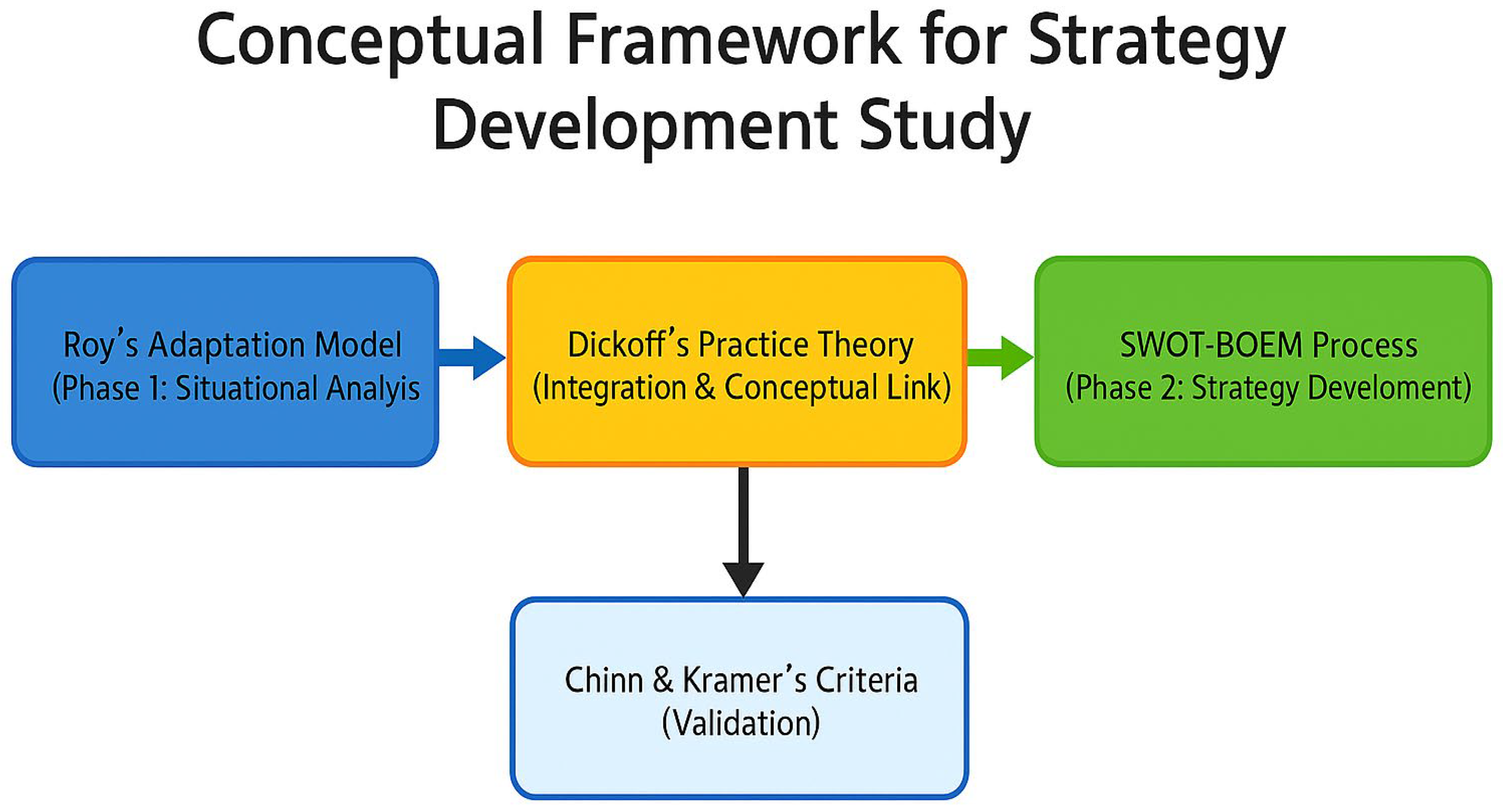
1.4.1. Phase 1: Situational Analysis (Guided by Roy’s Adaptation Model)
- What are the patterns, types, and contributing factors to substance use among secondary school students in Limpopo province, South Africa?
- How do secondary school students and parents perceive and experience the effects of substance use on school performance and behavior?
- How do affected secondary school students and parents adapt to the social and environmental stressors related to substance use?
1.4.2. Phase 2: Co-Development of Strategies (Guided by Dickoff’s Practice-Oriented Theory and PRAA Principles)
- What community-driven strategies can be collaboratively developed to prevent and manage substance use among secondary school students?
- How can the PRAA process foster stakeholder collaboration in addressing substance use?
1.4.3. Phase 3: Validation of Strategies (Guided by Chinn and Kramer’s Evaluation Criteria)
- How do experts and stakeholders evaluate the developed strategies in terms of clarity, simplicity, generality, accessibility, and importance?
- What recommendations can be made to enhance the sustainability and effectiveness of the proposed strategies within the school and community context?
1.5. Protocol Presentation
- Introduction: Provides the rationale, local context, and specific objectives of the study.
- Experimental Design: Details the qualitative, participatory rural action research and phases approach, outlining the specific activities for the situational analysis, strategy co-development, and validation.
- Study Setting and Population: Describes the study site in Limpopo Province and the procedures for participant recruitment.
- Materials and Equipment: Explains the range of materials and equipment that will be utilized to support data collection and ensure the integrity of the research process. It also addresses the measures taken to protect the rights, dignity, and safety of participants, including informed consent, assent, and confidentiality.
- Detailed Procedure: Explains the procedures for data collection, quality assurance, and the planned analytical methods (e.g., thematic analysis).
- Ethical consideration: It addresses the measures taken to protect the rights, dignity, and safety of participants, including informed consent, assent, and confidentiality.
- Anticipated Implications and Conclusion: Discusses the expected contributions of the research to local practice and potential policy development.
2. Experimental Design
2.1. Study Phases and Process
2.1.1. Phase One: Situational Analysis
2.1.2. Phase Two: Co-Development of Strategies
2.1.3. Phase Three: Strategy Validation
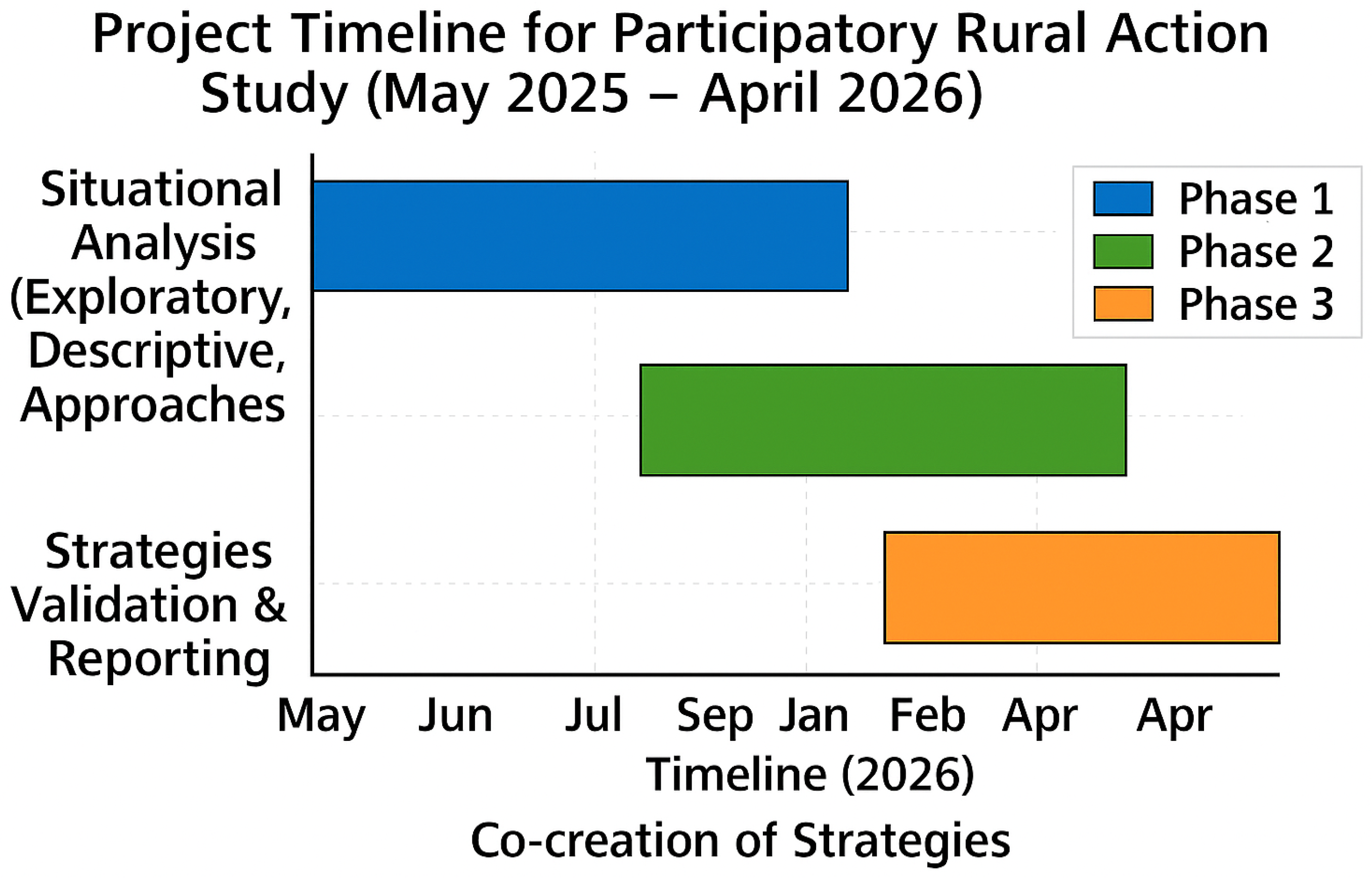
2.1.4. Project Timeline
- Phase 1 (May–September 2025): Situational Analysis (Exploratory, Descriptive, Contextual Approaches).
- Phase 2 (October–December 2025): Co-creation of Strategies.
- Phase 3 (January–April 2026): Validation and Reporting of Strategies.
2.2. Study Setting and Population
- Secondary school students, aged 13–18 years, who have been identified by teachers or school management as engaging in substance use.
- Parents or guardians of these students, who are directly involved in their upbringing, may provide valuable insights into the social and familial factors influencing substance use.
2.3. Sampling Method and Eligible Criteria
- Secondary school students aged 13–18 years, currently enrolled in rural secondary schools within Limpopo Province, South Africa.
- Students identified by school staff as engaging in substance use (e.g., alcohol, tobacco, cannabis).
- Parents or guardians of secondary school students engaging in substance use.
- Both male and female participants will be included.
3. Materials and Equipment
- Semi-structured interview guides tailored for both secondary school students and their parents. These guides will facilitate open-ended discussions, allowing participants to share their experiences and perspectives on substance use in a flexible and conversational manner.
- Audio recorders will be used to accurately capture interviews and focus group discussions, ensuring that all verbal data is preserved for thorough analysis and helping maintain the authenticity of participants’ narratives.
- Secure digital storage devices will be employed to store audio recordings and transcriptions. These devices will be password-protected to maintain confidentiality and data security.
- Consent and assent forms will be provided for all participants. These documents will outline the purpose of the study, procedures, potential risks and benefits, and participants’ rights, including the option to participate and withdraw at any time voluntarily.
4. Detailed Procedure
- Individual interviews with parents to explore their experiences and perceptions regarding substance use among their children.
- Focus group discussions with secondary school students to understand their lived experiences, contributing factors, and coping mechanisms related to substance use.
- Reading all transcripts carefully.
- Identifying key topics and themes.
- Clustering similar topics.
- Coding the data.
- Organizing codes into categories.
- Refining themes.
- Interpreting findings.
- Validating results through peer review and member checking.
5. Measures to Ensure Trustworthiness
- Credibility will be enhanced through prolonged engagement with participants, triangulation of data sources (e.g., interviews and focus groups), and member checking, where participants will be invited to verify the accuracy of the transcribed data and interpretations.
- Transferability will be supported by providing a rich, detailed description of the study context, including the setting, participant characteristics, and data collection procedures, which will enable readers to determine the applicability of the findings to similar contexts.
- Dependability will be ensured through the use of Audit trails, which document all research decisions, processes, and changes throughout the study, allowing for replication and assessment of the consistency of the findings.
- Confirmability will be achieved by maintaining reflective journals and involving an independent coder to analyze the data, which will help minimize researcher bias and ensure that the findings are grounded in participants’ perspectives rather than the researchers’ assumptions.
6. Ethical Consideration
7. Expected Results
8. Limitations
9. Anticipated Implications and Conclusions
Author Contributions
Funding
Institutional Review Board Statement
Information Consent Statement
Data Availability Statement
Conflicts of Interest
Abbreviations
| BOEM | Building, Overcoming, Exploring, and Minimizing |
| PAR | Participatory Action Research |
| PRAA | Participatory Rural Action Approach |
| RAM | Roy’s Adaptation Model |
| SADAG | South African Anxiety and Depression Group |
| SGB | School Governing Body |
| SWOT | Strengths, Weaknesses, Opportunities, and Threats |
| WHO | World Health Organization |
References
- Onigbogi, O.; Ojo, O.; Babalola, O. Prevalence of substance abuse among secondary school students in Lagos State of Nigeria. Eur. Sci. J. ESJ 2023, 19, 67. [Google Scholar] [CrossRef]
- United Nations Office on Drugs and Crime. World Drug Report 2021; United Nations: New York, NY, USA, 2021; Available online: https://www.unodc.org/unodc/data-and-analysis/wdr2021.html (accessed on 2 October 2025).
- Whylken, L.; Modise, A.; Percy, S. Social issues on the academic performance of Secondary School Learners in the Limpopo Province. Int. E-J. Educ. Stud. 2022, 6, 174–183. [Google Scholar] [CrossRef]
- Brennan, M.M.; Corrigan, C.; Mongan, D.; Doyle, A.; Galvin, B.; Nixon, E.; Zgaga, L.; Smyth, B.; Ivers, J.H.; McCarthy, N. Predictors and outcomes of adolescent alcohol and drug use: A scoping review. Eur. J. Public Health 2024, 34 (Suppl. 3), ckae144.594. [Google Scholar] [CrossRef]
- Tai, H.; Swart, M.; Marsden, D.; Perry, C. The Future of Substance Abuse Now: Relationships among adolescent use of vaping devices, marijuana, and synthetic cannabinoids. Subst. Use Amp Misuse 2021, 56, 192–204. [Google Scholar] [CrossRef] [PubMed]
- Castro-Alves, J.; Bastos, F.; Cobo, B.; De Boni, R.B. Physical violence against women in Brazil: Findings from the 3rd Brazilian household survey on substance use. Glob. Public Health 2023, 18, 2244032. [Google Scholar] [CrossRef]
- Boström, L.; Bostedt, G. Student conceptions of motivation to study in upper Secondary School in Sweden revealed through phenomenography. J. Pedagog. Res. 2022, 6, 214–230. [Google Scholar] [CrossRef]
- Mwakazanga, D.K.; Mulenga, D.; Siziya, S. Prevalence of cigarette and marijuana smoking and its associated factors amongst secondary school going adolescents in Ndola Urdan, Zambia. Asian Pac. J. Health Sci. 2016, 3, 241–248. [Google Scholar] [CrossRef]
- Kugbey, N. Prevalence and correlates of substance use among school-going adolescents (11–18years) in eight Sub-Saharan Africa countries. Subst. Abus. Treat. Prev. Policy 2023, 18, 44. [Google Scholar] [CrossRef] [PubMed]
- Mmethi, T.G.; Modjadji, P.; Mathibe, M.; Thovhogi, N.; Sekgala, M.D.; Madiba, T.K.; Ayo-Yusuf, O. Substance Use among School-Going Adolescents and Young Adults in Rural Mpumalanga Province, South Africa. Behav. Sci. 2024, 14, 543. [Google Scholar] [CrossRef]
- Nyashanu, T.; Visser, M. Treatment barriers among young adults living with a substance use disorder in Tshwane, South Africa. Subst. Abus. Treat. Prev. Policy 2022, 17, 75. [Google Scholar] [CrossRef]
- Reddy, S.P.; James, S.; Sewpaul, R.; Koopman, F.; Funani, N.I.; Sifunda, S.; Josie, J.; Masuka, P.; Kambaran, N.S.; Omardien, R.G. Umthente Uhlaba Usamila–The 3rd South African National Youth Risk Behaviour Survey 2011; South African Medical Research Council Human Sciences Research Council: Pretoria, South Africa; Cape Town, South Africa, 2013; Available online: https://africacheck.org/sites/default/files/3rd-Annual-Youth-Risk-Survey-2011.pdf (accessed on 2 October 2025).
- Mmereki, B.; Pengpid, S.; Peltzer, K. Risk factors for alcohol use among adolescents. Front. Public Health 2022, 10, 969053. [Google Scholar] [CrossRef] [PubMed]
- Mokwena, K.E.; Setshego, N.J. Substance abuse among high school learners in a rural education district in the Free State province, South Africa. S. Afr. Fam. Pract. 2021, 63, a5224. [Google Scholar] [CrossRef] [PubMed]
- Osuafor, G.N. Alcohol and drug use as factors for high-school learners’ absenteeism in the Western Cape. S. Afr. J. Psychiatry 2021, 27, a1679. [Google Scholar] [CrossRef]
- Gonçalves, S.; Majhanovich, S. Introduction: Art in diverse social settings. In Art in Diverse Social Settings; Emerald Publishing: Leeds, UK, 2021; pp. 1–21. [Google Scholar] [CrossRef]
- Grant, R.M. Contemporary Strategy Analysis: Text and Cases Edition, 9th ed.; Wiley: Hoboken, NJ, USA, 2016. [Google Scholar]
- Wheelen, T.L.; Hunger, J.D. Strategic Management and Business Policy: Globalization, Innovation, and Sustainability, 15th ed.; Pearson Education: London, UK, 2017. [Google Scholar]
- United Nations Educational, Scientific and Cultural Organization (UNESCO). International Standard Classification of Education (ISCED 2011); UNESCO Institute for Statistics: Montreal, QC, Canada, 2012; Available online: https://uis.unesco.org/en/topic/international-standard-classification-education-isced (accessed on 2 October 2025).
- Keyl, S. Development, Education, and Participatory Action Research to Empower Marginalized Groups; Taylor & Francis: London, UK, 2022. [Google Scholar] [CrossRef]
- World Health Organization. Lexicon of Alcohol and Drug Terms (Updated Edition); WHO: Geneva, Switzerland, 2019; Available online: https://www.who.int/publications/i/item/lexicon-of-alcohol-and-drug-terms (accessed on 2 October 2025).
- McKnight, R.; Price, J.; Geddes, J. Problems due to use of alcohol and other psychoactive substances. In Psychiatry; Thornicroft, G., Tansella, M., Eds.; Oxford University Press: Oxford, UK, 2019; pp. 501–515. [Google Scholar] [CrossRef]
- Polit, D.F.; Beck, C.T. Nursing Research: Generating and Assessing Evidence for Nursing Practice, 11th ed.; Wolters Kluwer: Singapore, 2017. [Google Scholar]
- Roy, C. Research based on the Roy adaptation model: Last 25 years. Nurs. Sci. Q. 2011, 24, 312–320. [Google Scholar] [CrossRef]
- Alligood, M.R. Nursing Theorists and Their Work, 9th ed.; Elsevier: Amsterdam, The Netherlands, 2017. [Google Scholar]
- Phillips, K.D.; Harris, R.F. Adaptation Model. In Nursing Theorists and Their Work, 9th ed.; Alligood, M.R., Ed.; Elsevier: Amsterdam, The Netherlands, 2020; pp. 249–272. [Google Scholar]
- Dickoff, J.; James, P.; Wiedenbach, E. Theory in a practice discipline. I Pract. Oriented Discip. Nurs. Res. 1968, 17, 415–435. [Google Scholar]
- Samuels, A. The future of Jungian analysis: Strengths, weaknesses, opportunities, threats (“SWOT”). J. Anal. Psychol. 2017, 62, 636–649. [Google Scholar] [CrossRef]
- Trisnowati, H.; Ismail, D.; Padmawati, R.S.; Utarini, A. Developing a framework for youth empowerment to prevent smoking behaviour in a rural setting: Study protocol for participatory action research. Health Educ. 2020, 121, 30–47. [Google Scholar] [CrossRef]
- Chinn, P.L.; Kramer, M.K. Knowledge Development in Nursing: Theory and Process; Elsevier: St-Louis, MO, USA, 2018. [Google Scholar]
- Walker, L.O.; Avant, K.C. Strategies for Theory Construction in Nursing, 6th ed.; Pearson: London, UK, 2019. [Google Scholar]
- Statistics South Africa. Provincial Profile: Limpopo; Stats SA: Pretoria, South Africa, 2024. Available online: https://www.statssa.gov.za (accessed on 2 October 2025).
- Moumakwe, M. Socio-Economic Dynamics of Limpopo Province: An Overview; University of Limpopo Press: Polokwane, South Africa, 2024. [Google Scholar]
- Babashahi, M.; Mohebbi, S.; Zolfaghari, M. Sampling Methods in Qualitative Research: A Practical Guide for Researchers. J. Nurs. Midwifery Res. 2022, 27, 245–252. [Google Scholar]
- Creswell, J.W.; Creswell, J.D. Research design: Qualitative, Quantitative, and Mixed Methods Approach, 5th ed.; Sage: Newcastle upon Tyne, UK, 2018. [Google Scholar]
- Etikan, I.; Musa, S.A.; Alkassim, R.S. Comparison of convenience sampling and purposive sampling. Am. J. Theor. Appl. Stat. 2016, 5, 1–4. [Google Scholar] [CrossRef]
- Palinkas, L.A.; Horwitz, S.M.; Green, C.A.; Wisdom, J.P.; Duan, N.; Hoagwood, K. Purposeful sampling for qualitative data collection and analysis in mixed method implementation research. Adm. Policy Ment. Health Ment. Health Serv. Res. 2015, 42, 533–544. [Google Scholar] [CrossRef]
- Robinson, O.C. Sampling in interview-based qualitative research: A theoretical and practical guide. Qual. Res. Psychol. 2014, 11, 25–41. [Google Scholar] [CrossRef]
- Stratton, S.J. Population research: Convenience sampling strategies. Prehosp. Disaster Med. 2021, 36, 373–374. [Google Scholar] [CrossRef] [PubMed]
- Saunders, B.; Sim, J.; Kingstone, T.; Baker, S.; Waterfield, J.; Bartlam, B.; Burroughs, H.; Jinks, C. Saturation in qualitative research: Exploring its conceptualization and operationalization. Qual. Quant. 2018, 52, 1893–1907. [Google Scholar] [CrossRef] [PubMed]



| Terms | Definition |
|---|---|
| Community | A group of individuals with diverse backgrounds connected by social relationships, shared values, and collective actions within a specific geographic area [16]. In this study, the term refers to parents of affected students, school management, students involved in substance use, the School Governing Body (SGB), and local leaders in selected villages of Vhembe District in Limpopo Province. |
| Strategy Development | A systematic process of formulating, implementing, and evaluating coordinated actions designed to achieve specific goals within the community [17,18]. In this study, strategy development will involve planning and coordinating actions among stakeholders to address specific challenges, such as reducing substance use among secondary school students. |
| Students | Students are individuals enrolled in formal educational institutions who are actively engaged in structured learning processes to acquire the knowledge, skills, attitudes, and values necessary for their personal and social development [19]. In this study, the students specifically refer to adolescents aged 13–18 years attending rural secondary schools in Limpopo Province. |
| Participatory Rural Action Approach (PRAA) Research | A community-driven research methodology that empowers local populations to identify issues, develop solutions, and monitor progress [20]. In this study, PRAA will emphasize inclusive participation and local ownership in addressing substance use among school students. |
| Substance Use | Substance use refers to the consumption or administration of psychoactive substances, including alcohol, tobacco, cannabis, opioids, stimulants, and inhalants, which alter mental states, mood, perception, and behavior [21,22]. In this study, substance use denotes explicitly the use of any psychoactive substances by secondary school students in rural schools of Limpopo Province, South Africa. |
Disclaimer/Publisher’s Note: The statements, opinions and data contained in all publications are solely those of the individual author(s) and contributor(s) and not of MDPI and/or the editor(s). MDPI and/or the editor(s) disclaim responsibility for any injury to people or property resulting from any ideas, methods, instructions or products referred to in the content. |
© 2025 by the authors. Licensee MDPI, Basel, Switzerland. This article is an open access article distributed under the terms and conditions of the Creative Commons Attribution (CC BY) license (https://creativecommons.org/licenses/by/4.0/).
Share and Cite
Mabasa, T.E.; Rangwaneni, M.E.; Maluleke, M.; Raliphaswa, N.S. A Participatory Rural Action Approach for Developing Strategies to Mitigate Substance Use Among Secondary School Students in Limpopo Province, South Africa. Adolescents 2025, 5, 76. https://doi.org/10.3390/adolescents5040076
Mabasa TE, Rangwaneni ME, Maluleke M, Raliphaswa NS. A Participatory Rural Action Approach for Developing Strategies to Mitigate Substance Use Among Secondary School Students in Limpopo Province, South Africa. Adolescents. 2025; 5(4):76. https://doi.org/10.3390/adolescents5040076
Chicago/Turabian StyleMabasa, Tshikani Elsie, Mphedziseni Esther Rangwaneni, Mary Maluleke, and Ndidzulafhi Selina Raliphaswa. 2025. "A Participatory Rural Action Approach for Developing Strategies to Mitigate Substance Use Among Secondary School Students in Limpopo Province, South Africa" Adolescents 5, no. 4: 76. https://doi.org/10.3390/adolescents5040076
APA StyleMabasa, T. E., Rangwaneni, M. E., Maluleke, M., & Raliphaswa, N. S. (2025). A Participatory Rural Action Approach for Developing Strategies to Mitigate Substance Use Among Secondary School Students in Limpopo Province, South Africa. Adolescents, 5(4), 76. https://doi.org/10.3390/adolescents5040076